Yesterday, the greenback weakened against a basket of world currencies. The dollar index (#DX) closed in the red zone (-0.25%). At the moment, currency majors are stable. Financial market participants assess the risks of the further spread of coronavirus and its impact on the global economy. The US Federal Reserve continues to provide stimulus measures. On Monday, the regulator introduced a new range of programs for large companies, households and small businesses. It should be recalled that earlier, the Central Bank urgently reduced the range of key interest rates to 0.00-0.25%.
British Prime Minister Boris Johnson imposed a strict quarantine in the country to fight the coronavirus epidemic. The official said that the government would offer support to the economy and impose restrictions, including public gatherings of more than two people for at least three weeks. Today we recommend paying attention to important economic releases from Germany, the Eurozone, the UK and the US. These statistics may affect the dynamics of the main currency pairs in the short term.
The “black gold” prices have started recovering after a significant collapse. At the moment, futures for the WTI crude oil are testing the $24.80 mark per barrel.
Market indicators
Major US stock indices continue to show negative dynamics: #SPY (-2.56%), #DIA (-3.01%), #QQQ (-0.14%).
The 10-year US government bonds yield rose slightly. At the moment, the indicator is at the level of 0.80-0.81%.
The news feed on 2020.03.24:
– Indicators of economic activity in Germany and the Eurozone at 10:30 and 11:00 (GMT+2:00), respectively;
– Statistics on economic activity in the UK at 11:30 (GMT+2:00);
– Data on economic activity in the US at 15:45 (GMT+2:00);
Investors are now actively seeking ‘new world’ sectors and companies as the world readjusts to life with coronavirus and looks ahead to an economic recovery.
The assessment from Nigel Green, the chief executive and founder of deVere Group, one of the world’s largest independent financial advisory organizations with operations in 100 countries, comes as global stock markets rallied on Tuesday.
Mr Green notes: “Every economic downturn creates a new normal. The one being triggered by the coronavirus pandemic will be the same.
“The Covid-19 impact has hit firms across the world – there’s been immense international disruption – with many sectors experiencing major issues of supply, demand, or both.
“However there remain some sections of the economy which are benefitting from the coronavirus fallout.”
He continues: “Sensibly, investors are now actively seeking these ‘new world’ sectors and companies in order to grow and protect their wealth.
“This is evidenced by the tech-heavy Nasdaq Composite index which has done well, where other global indices have faltered.
“New industries will come into their own and, as ever, there will be winners and losers. This will mean job losses in some sectors and huge – possibly unprecedented – job and investment opportunities in others.”
Last week, in a media release, Nigel Green noted that a Covid-19 recession is likely “to fundamentally shift how we live, do business and invest.” He added that it could also be expected to “speed up the Fourth Revolution, which is fuelled by new technologies, such as Artificial Intelligence and mobile supercomputing.”
Mr Green goes on to say: “Big tech is just one likely winner. The likes of Apple, Facebook, Amazon, and Google’s parent company Alphabet have immense cash reserves to continue, maybe even bolster, research and development and to sustain their business operations.
“This sector is also likely to face higher demand as social distancing, isolation and quarantine affect much of its existing and potential consumer base.
“Plus, recently heightened regulatory restrictions and political opposition to their expansion and growth of influence is likely to be scaled back considerably.”
He adds: “For similar and other reasons, other sectors besides the Silicon Valley giants, are likely to continue to offer positives for investors.
“These include pharmaceutical and healthcare firms, delivery brands, supermarkets and manufacturers of electronic goods, such as fridges and freezers.”
Nigel Green concludes: “Of course, there will be a recovery from the global economic impact of coronavirus.
“But the world has already changed as a result of it – and will do so more – and savvy investors are aware of this new normal and are already readjusting their portfolios accordingly.
“Times of immense tumult can be times of great ingenuity, promise and opportunity.”
About:
deVere Group is one of the world’s largest independent advisors of specialist global financial solutions to international, local mass affluent, and high-net-worth clients. It has a network of more than 70 offices across the world, over 80,000 clients and $12bn under advisement.
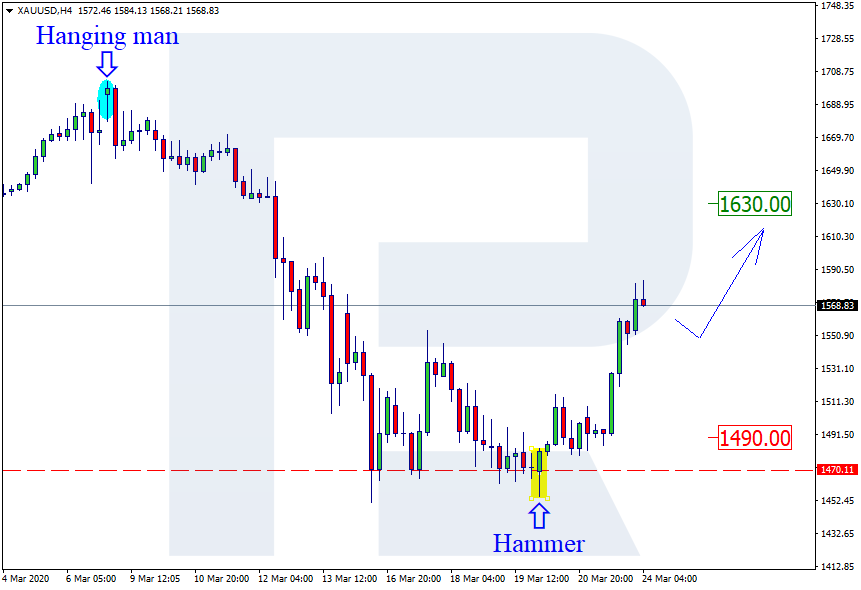
As we can see in the H4 chart, Gold is growing from the support level. After forming several reversal patterns, such as Hammer, the pair is reversing. The upside target may be at 1630.00. However, one shouldn’t ignore another scenario, according to which the instrument may continue falling without testing 1630.00. In this case, the downside target may be at 1490.00.
NZDUSD, “New Zealand vs. US Dollar”
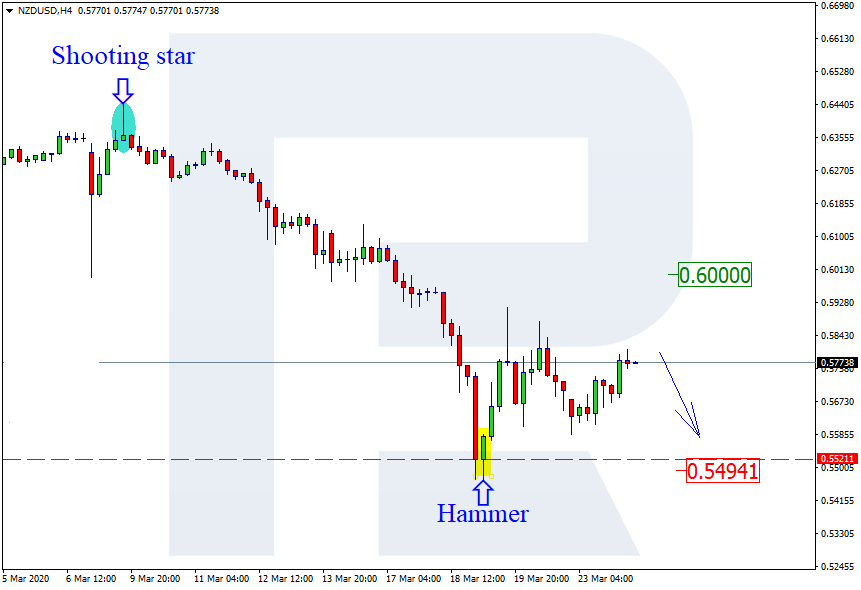
As we can see in the H4 chart, after breaking the descending channel and forming a Hammer reversal pattern not far from the support level, NZDUSD is reversing. The upside target may be at 0.6000. After testing this level, the price may rebound and resume trading downwards. At the same time, one shouldn’t exclude an opposite scenario, according to which the instrument may fall towards 0.5494 without testing 0.6000.
GBPUSD, “Great Britain Pound vs US Dollar”
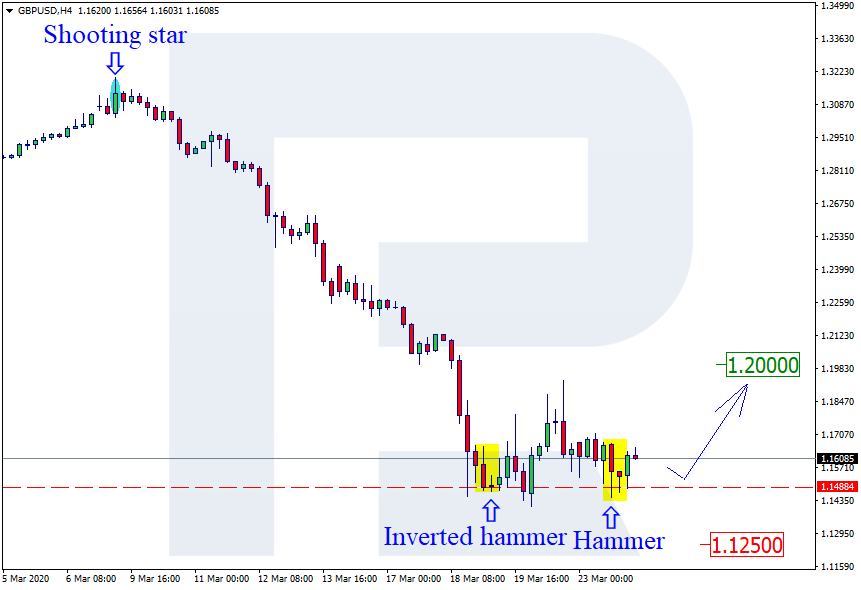
As we can see in the H4 chart, the pair continues trading sideways. By now, GBPUSD has formed another Hammer reversal pattern close to the support level. Possibly, the pair may reverse and get back to 1.1200. Later, the market may continue the descending tendency. However, there is another scenario, which implies that the instrument may fall towards 1.1250 without reversing.
Attention! Forecasts presented in this section only reflect the author’s private opinion and should not be considered as guidance for trading. RoboForex LP bears no responsibility for trading results based on trading recommendations described in these analytical reviews.
The world economy has received huge hits as the coronavirus spread around the world. It originally started spreading in the Wuhan region in China several months ago, and soon it was able to affect almost every country around the globe.
Every field has received damage from the virus, but the world economy suffers the most. Some say that the situation might get even worse than it was in 2008, but what will happen still is unknown. The situation is getting worse every day, as the number of people infected is changing every minute.
For now, there are more than 350,000 confirmed cases of coronavirus in the world, most of them being in China, Italy, Iran, the US, and Europe in general. As the situation in China is getting better, Europe becomes a new epicenter of the virus. The World Health Organization already declared coronavirus as a pandemic.
The threat that this can have on the world’s economy can be unmatchable. Many businesses closed down, people are left without jobs, even places like McDonald’s are getting closed in many countries. Only pharmacies and grocery stores are remaining to be open. All the bars, restaurants, night clubs have been closed in many countries. In some places, people are not even allowed to leave their homes.
As the situation gets worse, there are fewer hopes for the economy to survive without huge damage. Since the 2008 crisis, stocks have never been this low, and the number is dropping down even further. Even fields like crypto, that many thought would not get affected, are suffering in this climate a lot.
There are many businesses announcing that they will have to go out of the business for some time because they do not have anything left to do. Some companies even went as far as declaring bankruptcy.
Fields being affected by the coronavirus
Many fields were affected by the novel coronavirus. Some of the biggest hits were received by the companies that work in the tourism sector. But, it was like a chain. Because of the virus, the Airlines got a huge hit as most of the flights got canceled to prevent the virus from spreading further. Because people were not able to travel anymore, small tourism businesses stayed without any visitors, which resulted in a very bad situation.
In addition, even fields like crypto received a huge hit. It’s not easy to say why, as many people thought that it could survive the virus. In reality, its price dropped dramatically.
Many events got canceled because of the virus, including music festivals, theater releases, gambling competitions, conferences, and many other gatherings. Just like in 2008, the gambling industry received quite a damage this year as well. As many tournaments are getting canceled around the world, the field is losing a lot of clients. Cities like Las Vegas are facing huge challenges since gambling and tourism is what makes their economy strong.
All of the casinos in Las Vegas are closed as of now, and nobody knows when they will be open again. However, in this situation, online gambling is managing to stand strong. As most of the people do not have the ability to leave their homes, the demand for online gambling has been skyrocketing.
The gambling industry, among many others, is facing a huge challenge. The future is simply unknown, and nobody can really tell what the world will look like. But as a result of people being self-quarantined, online casino gambling platforms are becoming more popular.
Many people are trying to spend their time playing online casino games, and the field is becoming more and more successful. As many different tournaments got canceled, some of the leaders of the companies had the initiative to hold the competitions online, with the help of online gambling platforms.
What happened in 2008?
Named as the worst economic disaster since the 1929’s Great Depression, the 2008 financial crisis occurred despite federal reserve and treasury department efforts to prevent it. The crisis led to housing prices dropping a lot, and even two years after the crisis ended, the unemployment still stayed above 9 percent.
There were many causes of the 2008 crisis but it is largely believed that it was mainly caused by deregulation in the financial industry. First, the prices of houses went down, and many thought that it would go up by itself, but it did not. Then, everything else followed. The world got into a very bad situation. Many think that the same thing will happen now, 12 years later, as the coronavirus attacks the economy as strong as no other virus was able to.
The world has survived many pandemics, but none of them were this easily transmitted as coronavirus. The spread of the virus is helped by globalization and easier traveling. Also, the fact that the virus affects people differently, is another problem. There were even some people who did not have any kind of symptoms whatsoever, this helped the virus to spread further.
Can 2008 happen again?
Many professionals have been saying for years that 2008 can re-happen again. While many did not believe, coronavirus worked as a catalyst in this situation and 2020 has a chance of being another 2008. There are many fields that are affected by the virus and stopping it seems to be impossible. The thing is that it seems like the world did not even try to prepare for the next crisis.
It seems like the world economy froze and there is nothing that can be done until the virus is gone. While the world hopes for the spread of the virus to end soon, the virus is getting nowhere close to being done. It is becoming stronger every day, more and more preventive measures are taken, which damages the economy even harder.
However, the thing that could work is that the priority should be the management of the pandemic. The longer the pandemic goes, the harder it will be for the global economy to get back on track.
Coronavirus
The first case of the ‘unknown virus’, now known as the COVID-19, was first reported from the Wuhan region of China in late December 2019. Since then, the virus slowly started to spread around the world, and now there have been cases of it in almost every country.
Although China managed to fight well against the virus, COVID-19 managed to spread further in Europea and in the US. The number of people infected by the virus is rising, and so does the death toll. Currently, there are more than 350,000 people infected by the virus, and more than 15,000 killed.
By TheTechnicalTraders – In this second part of our research into the potential collateral damage, the Covid-19 global virus event may cause in the housing and commercial real estate markets, we want to start by sharing some information that severe cracks are already starting to appear in the entire system.
Hedge funds and banking institutions may already be feeling the pressure to attempt to contain the losses that are piling up (source: https://www-bloomberg-com).
An extended decline in the global markets will continue to place pressure on institutional financial markets, banks, hedge funds, and other traditional lending and investment firms. Investors will start to pull investment capital away from risk (out of the markets and funds) and may expose some of these larger institutions’ excessive leverage and risk exposure in the process.
This is almost exactly what happened with Bernie Madoff when his firm, Bernard L. Madoff Investment Securities, collapsed in December 2008. As long as there was no pressure on his firm from clients pulling out capital or asking too many questions, he was allowed to continue running his Ponzi scheme. Once investors started pulling capital out of the firm and questioning the transactions/reports, it became evident that it was all a house of cards and would come crashing down quickly.
If larger investment firms and hedge funds are attempting to “buy the dip” at this point in time, we believe they are making a grave mistake. We believe the downside risks associated with the Covid-19 virus event are just starting to unfold and the collateral damage that may come from this massive global shutdown that is currently taking place will be unprecedented. We don’t believe there has been anything like this happening in any recent history – even WWII pales in comparison to this event.
News is starting to hit the wires about large investment firms and Real Estate investment companies sounding the alarm The one news item out this weekend that caught our attention was this one from https://www-bloomberg-com. The fear is evident in the short content of this news article.
“Loan repayment demands are likely to escalate on a systemic level, triggering a domino effect of borrower defaults that will swiftly and severely impact the broad range of stakeholders in the entire real estate market, including property and homeowners, landlords, developers, hotel operators, and their respective tenants and employees,” he wrote.
Just take look at the foreclosures in the major cities starting to spike in the maps below. This was before the virus closed down most businesses, and everyone losing their jobs. Give the fact that 70% or more of the world lives pay-check to pay-check, foreclosures and real estate values are likely to plummet lower to an extreme similar to how overpriced they are now.
I have talked about his in some presentations, and in videos in the past how real estate is grossly overvalued and when the music stops, prices will tumble. Huge opportunities for those who can preserve their capital until the recession matures enough will be able to buy real estate, businesses, and equipment for pennies on the dollar, but this will take another 1-2 years from now I imagine, but it will be great for those with money on hand when things get ugly.
Be sure to opt-in to our free market trend signals before closing this page, so you don’t miss our next special report!
Current Los Angeles Foreclosure Map (Source: Zillow.com)
Current San Francisco Foreclosure Map (Source: Zillow.com)
Current New York Foreclosure Map (Source: Zillow.com)
Many of you may remember my Crunching Numbers article from just a week ago where I attempted to model what I believe would be the likely outcome of US GDP over the next 5+ years? Well, it now appears others are following up with their own predictions for US GDP. Based on some of the expectations within this Bloomberg article, my predictions pale in comparison to these comments. Source: https://www.bloomberg.com
Now, let’s try to be realistic about how this entire process is likely to take place. We know the economy will find a base (at some point) and attempt to recover from this virus event. The question is what does that base look like and where is the bottom?
We won’t really know where the bottom is in the global markets until most of the unknowns have been processed, most of the collateral damage has been identified and processed, and consumers realize the bottom is in sight. At that point, there is a real chance that the global markets will begin a recovery process that may eventually push to new all-time highs.
What we’re concerned about right now is the Q1 and Q2 economic activity and how that relates to consumer markets, credit markets, existing business enterprises and the potential collateral damage to hard assets like homes, commercial real estate and other foundations of wealth. We believe the first few dominos of this event will be the collapse of jobs, earnings, and consumer spending. The longer the global stays in a mostly shutdown economic environment, the greater the risks these critical numbers will implode – possibly taking with it the rest of the economy.
We believe the suspension of Foreclosures for a potential 12 month period may not reduce the total number of foreclosures across the US, we believe it may compound the problem. The suspension effort is designed to help people stay in their homes if their incomes become threatened or lost. But the reality is that a Foreclosure suspension will simply start to build larger and larger numbers of properties in foreclosure (waiting for the suspension to be lifted) while home prices potentially collapse.
We’ll dig into more data in Part III of this article and attempt to illustrate the data we believe will point to a clearer picture of how all of this may unfold in the near future.
As a technical analysis and trader since 1997, I have been through a few bull/bear market cycles. I believe I have a good pulse on the market and timing key turning points for short-term swing traders.
Visit my ETF Wealth Building Newsletter and if you like what I offer, and ride my coattails as I navigate these financial markets and build wealth while others lose nearly everything they own during the next financial crisis.
The EUR/USD currency pair is still in sideways movement. There is no defined trend. At the moment, local support and resistance levels are at 1.07200 and 1.08600, respectively. The spread of the COVID-19 virus continues to put pressure on the financial markets. The US Federal Reserve introduced a new range of stimulus programs for large companies, households and small businesses. The current technical pattern signals a possible correction of the EUR after a significant fall. We recommend opening positions from key levels.
The Economic News Feed for 24.03.2020:
– A number of indicators on business activity in Germany and the EU – 10:30, 11:00 (GMT+3:00);
– Reports on business activity in the US (EU) – 15:45 (GMT+3:00);
– New Home Sales (US) – 16:00 (GMT+3:00);
Indicators do not give accurate signals: the price has crossed 100 MA.
MACD histogram has moved to the positive zone, which indicates the recovery of EUR/USD quotes.
The Stochastic Oscillator is located in the neutral zone, the %K line has crossed the %D line. There are no signals at the moment.
Trading recommendations
Support levels: 1.07200, 1.06350
Resistance levels: 1.08600, 1.09550, 1.10600.
If the price fixes above 1.08600, the correction of the EUR/USD currency pair is expected toward 1.09400-1.10000.
Alternatively, the quotes will descend toward 1.06500-1.06000.
The GBP/USD currency pair
Technical indicators of the currency pair:
Prev Open: 1.16698
Open: 1.15087
% chg. over the last day: -0.62
Day’s range: 1.14857 – 1.16900
52 wk range: 1.1466 – 1.3516
The technical pattern on the GBP/USD currency pair is ambiguous. The pound is being traded in a flat. There is no defined trend. The key support and resistance levels are 1.14500 and 1.17200, respectively. British Prime Minister Boris Johnson introduced a strict quarantine in the country to stop the spread of the COVID-19 virus. Technical correction of the trading instrument is not ruled out in the nearest future. Open positions from key levels.
At 11:30 (GMT+2:00) the UK will publish a number of important indicators on business activity.
Indicators do not give an accurate signal: 50 MA crossed 100 MA.
MACD histogram is near the 0 mark.
The Stochastic Oscillator is located in the neutral zone, the %K line crossed the %D line. No signals at the moment.
Trading recommendations
Support levels: 1.14500
Resistance levels: 1.17200, 1.19000, 1.21350
If the price fixes above 1.17200, expect a correction toward 1.19000-1.20000.
Alternatively, the quotes could descend toward 1.14000-1.13500.
The USD/CAD currency pair
Technical indicators of the currency pair:
Prev Open: 1.43566
Open: 1.45076
% chg. over the last day: +0.70
Day’s range: 1.43812 – 1.45076
52 wk range: 1.2949 – 1.4668
The CAD is in a flat. The technical picture is ambiguous. At the moment the following key support and resistance levels can be distinguished: 1.43600 and 1.45450, respectively. The correction of USD/CAD quotes after the prolonged rally is not excluded in the nearest future. We recommend you to pay attention to the dynamics of oil prices. Open positions from key levels.
The Economic News Feed for 24.03.2020 is calm.
Indicators do not give accurate signals: the price has crossed 50 MA and 100 MA.
The MACD histogram began to decline, which indicates a bearish sentiment.
The Stochastic Oscillator is in a neutral zone, the %K line has crossed the %D line. There are no signals at the moment.
Trading recommendations
Support levels: 1.43600, 1.41500, 1.40000
Resistance levels: 1.45450, 1.46600
If the price fixes below 1.43600, expect a correction of USD/CAD currency to 1.42500-1.41500.
Alternatively, the quotes could grow toward 1.46500-1.47000.
The USD/JPY currency pair
Technical indicators of the currency pair:
Prev Open: 110.755
Open: 111.222
% chg. over the last day: +0.76
Day’s range: 110.086 – 111.239
52 wk range: 101.19 – 112.41
USD/JPY currency pair continues to trade in a flat. There is no defined trend. Investors are waiting for additional drivers. At the moment local support and resistance levels are at 110.200 and 111.450, respectively. Technical correction of the trading instrument is not ruled out in the nearest future. We recommend you to pay attention to the dynamics of US government securities yield. Open positions from key levels.
The Economic News Feed for 24.03.2020 is calm.
Indicators do not give accurate signals: the price has crossed 50 MA and 100 MA.
MACD histogram is near the 0 mark.
The Stochastic Oscillator is located in the neutral zone, the %K line is above the %D line, which indicates a bullish mood.
Trading recommendations
Support levels: 110.200, 109.300, 108.500.
Resistance levels: 111.450, 112.000
If the price fixes below 110.200, expect the quotes to correct toward 109.300-108.500.
Alternatively, the quotes could grow toward 112.000.
– Despite China’s success in containment, the novel coronavirus is exploding in the US and Europe. The contraction will shake economies, politics and governments worldwide.
As the accumulated confirmed cases of the novel coronavirus (Covid-19) continue to soar, there is no immediate deceleration in sight. The official figures are just the tip of the iceberg. In the US and Europe, mobilization is 1-2 months late.
In China, the impact of the coronavirus is easing, but imported cases have only begun. Outside China, epidemiologists currently anticipate a peak around June. If that’s the case, economic damage in China would be largely limited to the first quarter, but international economic damage would endure into the second quarter, and in the most affected countries well beyond.
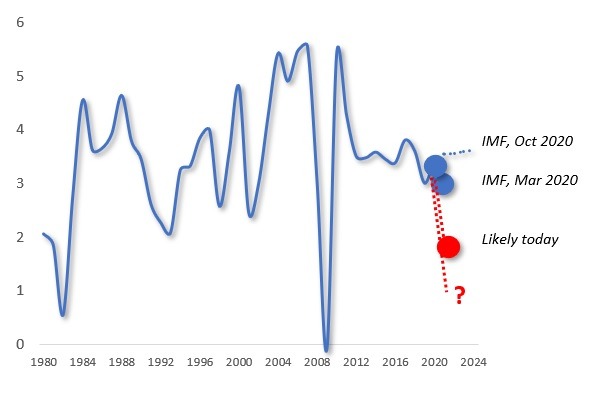
In early March, the International Monetary Fund (IMF) projected global growth to fall 0.1 percentage points from the expected 3.3%. The estimate was too optimistic. In view of current data, a global contraction could cause economic growth prospects to plunge closer to 2% and below. The explosive growth of virus cases in the US and Europe will compound those rates in the rest of the world – which, in turn, could further undermine the year-end outlook (Figure).
FigureGlobal growth projections, 2020
Source: IMF/WEO data, Difference Group
Depending on the outcome of the virus battle in Europe and particularly the U.S., one plausible but dark scenario is that the battle against the coronavirus may last through the ongoing year and possibly through 2021.
China toward rebound
Thanks to China’s draconian measures, reported cases peaked and plateaued between January 23 and 27, and have largely declined since then.
Before the crisis, Chinese economy was benefiting from a mild recovery. In early March, IMF projected China’s growth to fall to 5.6% in 2020. Now estimates in the West anticipate baseline growth of less than 5%, with significant downside risk of less than 3%. In January, factory activity did contract at the fastest pace on record, as did the services activity. Yet, both plunges were only to be expected.
Economic shocks translate to contractions. The real question involves the strength of the post-shock rebound between mid-March and April, given the low starting-point.
As the populous country is moving from containment to the mitigation stage, the challenge will be to contain new imported cases in the borders, while quickly extinguishing potential new virus clusters at home. That will be the key challenge in Asian countries that are likely to prove relatively successful in containment.
In economic terms, China and the rest of Asia must prepare for the negative feedback effect from the world economy. In North America and Europe, the plunges of the 1st quarter are only a prelude to the carnage in the 2nd quarter.
Contraction in US…
Despite elevated warnings since mid-January, uncertainty began to grip the rest of the world only at the end of February. Instead of mobilizing against the virus, complacency in advanced economies led to a series of missteps, including faulty and belated local testing, failures in evacuations and quarantines, lax enforcement of self-quarantines. Hence the consequent multi-trillion-dollar market corrections.
Worse, thanks to a misguided and ill-timed price war, oil prices have plunged a whopping 60% since January 1, down to $20 per barrel. As the virus impact has not yet been fully factored into the prices, crude oil could fall even further.
Recently, the IMF projected US growth to suffer a slowdown from 2.0% to 1.6%. But the estimate is too optimistic. If the second quarter carnage proves limited, U.S. growth could still stay close to 0.2%-5%. But the risks are on the downside and, after a series of policy mistakes, the margin of error is slim.
After the White House’s delays in the outbreak management, the Fed cut interest rates close to zero, starting $700 billion quantitative easing, while pushing for liquidity. That is likely to be coupled with a $1.3 trillion fiscal stimulus. In the short-term, these moves are understandable. In the long-term, they will compound new risks. Under Trump, U.S. sovereign debt has soared faster than in decades – and now it will accelerate even more.
Despite their indebted economies, central banks in Europe, the UK and Japan will follow US footprints into more monetary and fiscal accommodation. In 2008-9, that worked. But if infection rates continue to soar, even these measures will not pacify virus fears, anxious markets and uncertain economies.
… Eurozone
Before the virus, the Eurozone quarterly growth was 0.1%; the weakest in seven years. Now things will get a lot worse. German GDP will stall further, France and Italy will remain in contraction. In the UK, annualized growth is likely to fall fast from 1% to contraction territory.
Soaring infection rates have already reversed Spain’s growth pickup. With sovereign debt at 134% of its economy, Italy is struggling against infections and deaths that are climbing faster than in any other major economy.
If the virus cases continue to soar in the Eurozone, regional growth prospects are likely reverse fully into contraction territory. In the most affected countries, the failure of timely containment is likely to foster a recession through the first half of the year.
If the virus cases continue to climb in the second quarter, the contraction will prove steeper. A potential protracted appreciation of the euro – a déjà vu of the sovereign debt crisis in the early 2010s – could penalize growth even into 2021.
If the virus is not managed appropriately, the consequent hit will cast a shadow over the hoped-for rebound in the second half of 2020 and beyond.
… And Japan
Prior to the coronavirus, Japanese growth contracted 0.7% in the fourth quarter of 2019, thanks to last fall’s consumption tax. With or without the Olympics, the outcome will further weaken the world’s most rapidly aging major economy that’s been in secular stagnation since the mid-90s.
In 2019, South Korea’s economy grew 2%, the slowest in a decade. With some 9,000 confirmed cases, expansion is reversing, and growth is plunging. Additionally, Australia and the regional financial hubs Singapore and Hong Kong are on their way to or in contraction. Since these countries are significant investors in Southeast Asia, their challenges will reverberate across emerging Asia.
Amid the struggle to restore their pre-virus output level, emerging economies will face an economic tsunami from the West. That will cause huge pressures on weaker healthcare systems and cast a dark economic shadow over countries depending on capital inflows and commodity reliance (Indonesia, Mexico and South Africa) or excessive debt (Turkey).
————-
What is urgently needed is multipolar cooperation among major economies and across political differences. Otherwise, worse nightmare scenarios will loom ahead.
About the Author:
Dr. Dan Steinbock is an internationally recognized strategist of the multipolar world and the founder of Difference Group. He has served at the India, China and America Institute (USA), Shanghai Institutes for International Studies (China) and the EU Center (Singapore). For more, see https://www.differencegroup.net
This is a short version of Dr Steinbock’s COVID-19 briefing on March 16, released as “The Global Coronavirus Contraction” by the World Financial Review (March/April) on March 23, 2020
By TheTechnicalTraders– The current global Covid-19 virus event has upended everyone’s forward expectations related to the US and global economy. Recently, President Trump has announced a 12-month reprieve for homeowners who find themselves without income, or a job, because of the US National Emergency related to the Covid-19 pandemic (source: https://www.npr.org). All of the recent repositionings of the global markets and forward expectations got us thinking about “what happens after 8 to 12+ months? How will the US and global markets attempt a recovery process – if at all?”. Today, we are going to try to start digging into the data that we believe is relevant to the future in terms of hard asset prices (home and other property) and more liquid asset prices (global financial markets).
First, we want to preface this article by stating that humans are somewhat predictable in terms of how they will react in emergency or panic situations like this current Covid-19 pandemic. Initially, they will react to protect what is vital to them (family, assets, safety). This same thing happened in the 2008-09 credit market crisis market collapse. Then, after a bit more time, people change their thinking and start to adapt to the situation as it unfolds. We believe that 30 to 60 days from now, as more information becomes available and consumers globally are more capable of addressing the true longer-term risks of this virus event, a social process will begin to take place where valuations and expectations will adjust to the new perceived outcome (whatever that may be).
The global stock market has collapsed nearly -35% based on our Custom Indexes. The SPY has collapsed -32.25% since February 23, 2020. During the 2008-09 Credit Crisis, the SPY collapsed -57.50% before finding a bottom near $67.10. We believe this initial price decline in the global markets is just the first downside price collapse of what may become many. Ultimately, we believe the 2015/2016 lows will become the ultimate support for this downside move in the US markets.
Be sure to opt-in to our free market trend signals before closing this page, so you don’t miss our next special report!
SPY Weekly Chart
Custom Real Estate Index Weekly Chart
Custom European Index Weekly Chart
The data that is currently being reported and posted is data from January and February 2020. Current expectations for March data look grim (at best). Jobless claims, hours worked, and other economic data for the US and global markets may shock investors and the general public for many months to come. In 2008-09, these types of large economic contraction numbers were not uncommon. We want to prepare all of our friends and followers that we believe the next 6 to 12+ months could somewhat mirror what we saw in 2008-09 – be prepared.
If our assumptions are correct, the reprieve in Foreclosures and Mortgage repayments for US consumers may not do much to resolve the ultimate problem. The problem will quickly revolve around the issue of how quickly the US economy can resume somewhat normal functions after the virus event subsides. We believe the reprieve offered to US consumers will assist in making the data a bit more tolerable for a short period of time, but ultimately any extended disruption in the US and global economy will result in extended risks in hard assets like homes, commercial property, and future valuation expectations.
This multi-part research article will dig deeper into the data and expected data to help you prepare for what may be likely in the markets (hard and soft). Now is the time to prepare for what could become one of the biggest disruptions in the global markets and global society we’ve ever seen.
As a technical analysis and trader since 1997, I have been through a few bull/bear market cycles. I believe I have a good pulse on the market and timing key turning points for short-term swing traders.
Visit my ETF Wealth Building Newsletter and if you like what I offer, and ride my coattails as I navigate these financial markets and build wealth while others lose nearly everything they own during the next financial crisis.
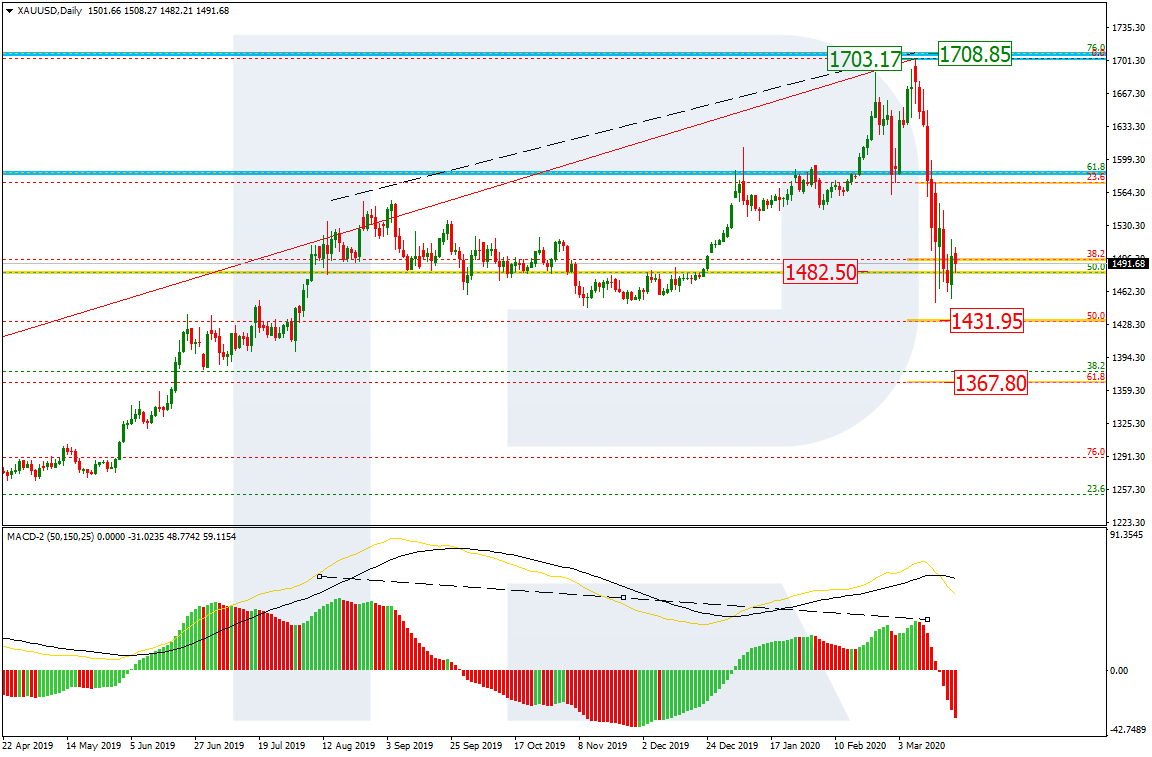
As we can see in the daily chart, the divergence made the pair form a new wave to the downside; the wave broke 38.2% fibo but later stopped not fare from 50.0% fibo at 1431.95. After finishing the correction, XAUUSD may resume trading downwards to reach 50.0% and 61.8% fibo at 1431.95 and 1367.80 respectively. The resistance is the high at 1703.17.
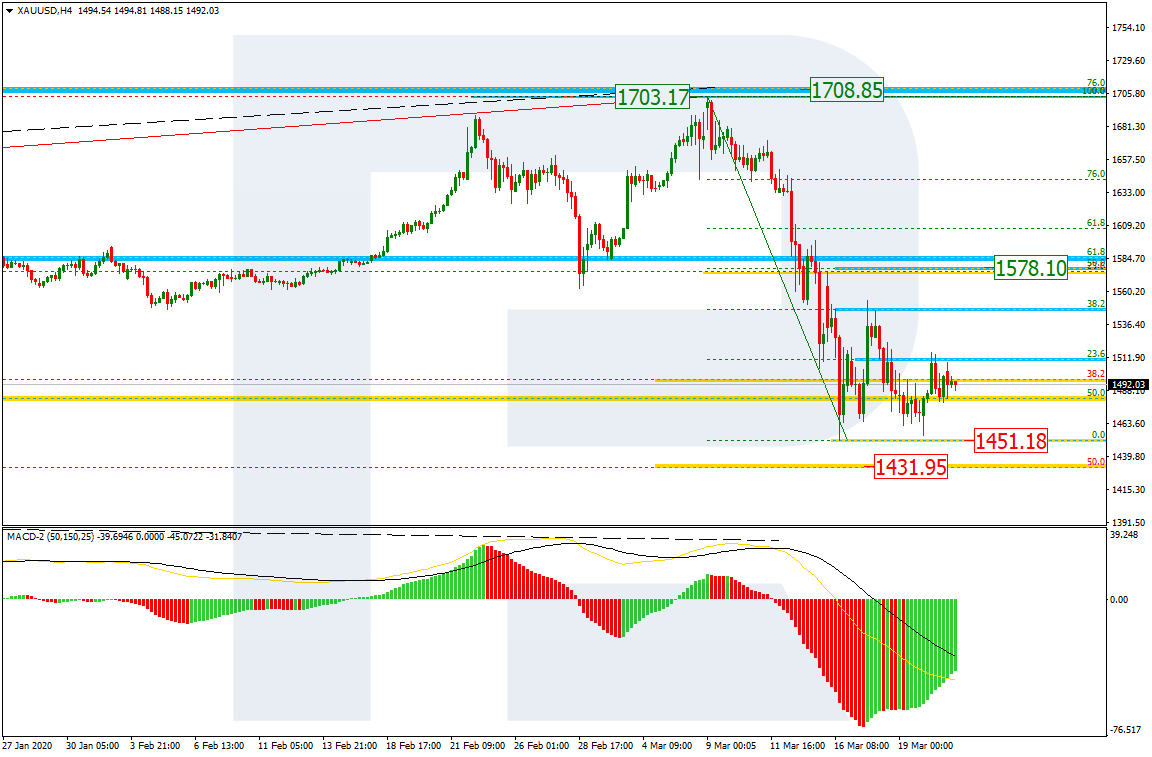
In the H4 chart, the first rising impulse has corrected the previous descending wave by 38.2%. Later, the pair may continue growing towards 50.0% fibo at 1578.10. After completing the pullback and breaking the low at 1451.18, the price may continue its mid-term descending tendency.
USDCHF, “US Dollar vs Swiss Franc”
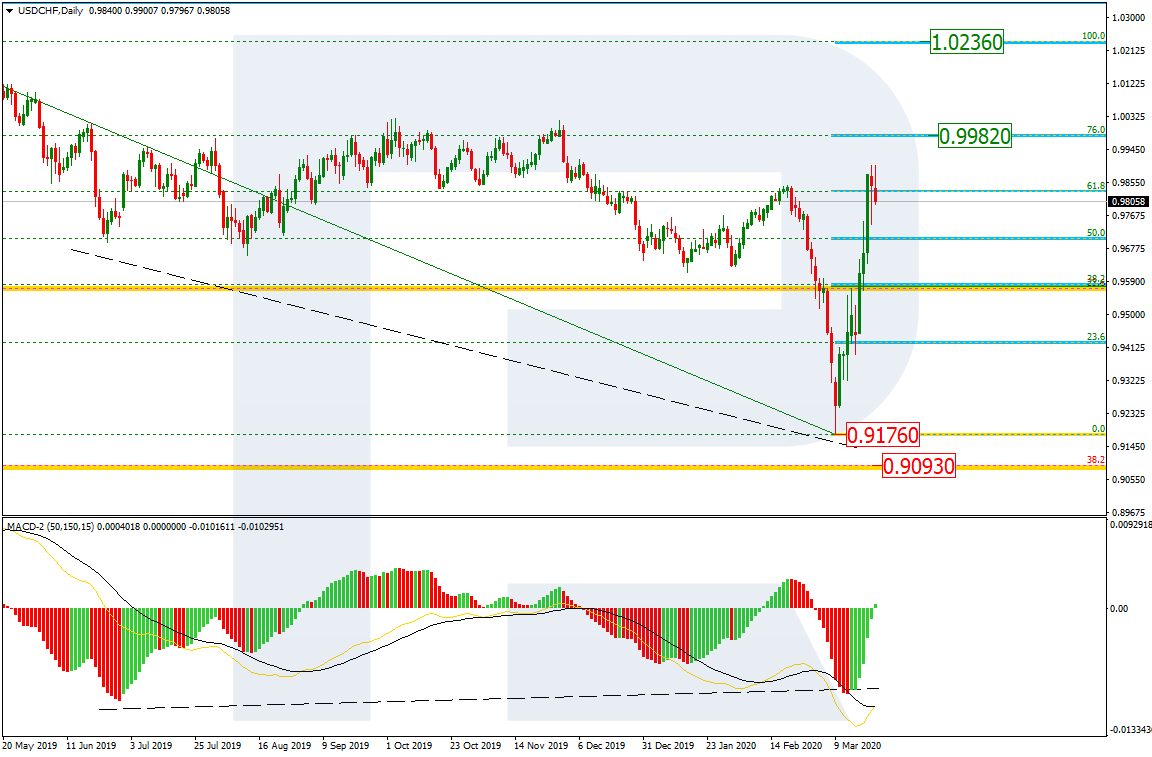
In the daily chart, the rising impulse has completely corrected the previous descending wave, which means that the pair may continue growing towards 76.0% fibo at 0.9982 and the fractal high at 1.0236. In the mid-term, USDCHF is expected to trade between 0.9176 and 1.0236.
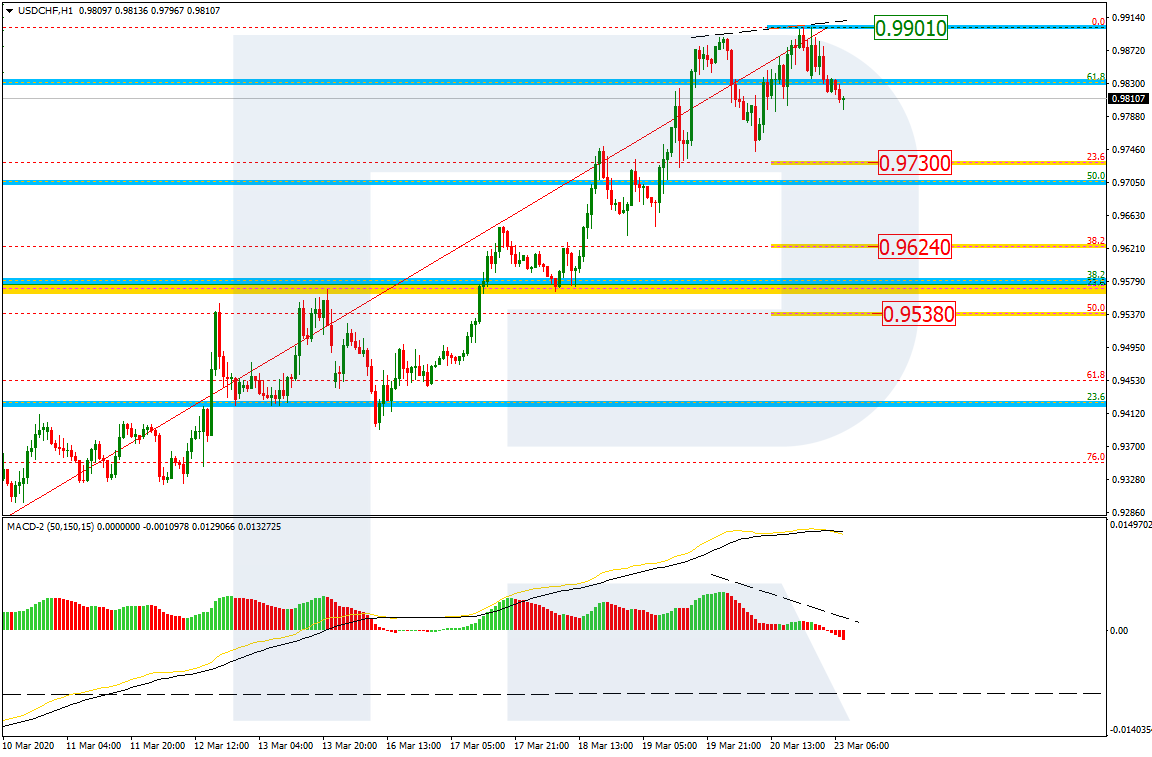
In the H1 chart, we can see a local divergence and a new pullback. The descending wave may be heading towards 23.6%, 38.2%, and 50.0% fibo at 0.9730, 0.9624, and 0.9538 respectively. The resistance is at 0.9901.
Attention! Forecasts presented in this section only reflect the author’s private opinion and should not be considered as guidance for trading. RoboForex LP bears no responsibility for trading results based on trading recommendations described in these analytical reviews.
By George Prior – Global financial markets will use China’s recovery as a sentiment tracker, affirms the CEO of one of the world’s largest independent financial advisory and services organizations.
The comments from Nigel Green come as European and Asian-Pacific markets and U.S. futures fell after a stream of stark headlines over the weekend.
His observations also follow Chen Yulu, a vice governor at the People’s Bank of China, giving a press conference on Sunday at which he noted that two ways the country is contributing to global financial recovery is by maintaining domestic financial markets’ stability and by being involved in international talks on macroeconomic policy collaboration.
Mr Green says: “Since the World Health Organisation upped its rhetoric on Covid-19 due to the rapid spread, financial markets – including stocks, oil, government bonds and gold – have experienced wild bouts of volatility and major sell-offs.
“Investors are now not only monitoring the habitual markers like the price of gold and oil and international fiscal and monetary policies, but they’re also tracking the global health policies and Coronavirus-death tolls.”
He continues: “The epicentre of Coronavirus has shifted from China to Europe. Europe has now registered more Coronavirus cases and fatalities than China.
“Almost immediately, the Chinese authorities launched intense lockdown measures to try and halt the outbreak. It appears to have been successful, with cases having fallen considerably.
“However, the adverse impact on the world’s second-largest economy – which drives in a large part – the global economy – has been significant.”
Mr Green goes on to say: “As such investors around the world will now be looking at how China gets back on its feet economically. Did the extreme lockdown work? Were the public health facilities adequate? Will there be another outbreak as activity resumes? How will the authorities now kickstart the economy? How will these decisions and the success of them impact the rest of the world?
“I’m confident that global financial markets will stage a relief rally when there is a definitive signal that the infection rate is dropping and that cases have peaked. Investors will come off the sidelines and prices will jump.”
The deVere CEO concludes: “Therefore, the next stage in China’s public health and economic recovery is critical.
“What takes place in the People’s Republic will be used by investors as a sentiment guide and a gauge for the rest of the world, particularly the U.S. and Europe where Covid-19 transmissions are yet to peak.”
About:
deVere Group is one of the world’s largest independent advisors of specialist global financial solutions to international, local mass affluent, and high-net-worth clients. It has a network of more than 70 offices across the world, over 80,000 clients and $12bn under advisement.