Author Archive for InvestMacro – Page 66

Currency Majors Have Become Stable

by JustForex

The greenback has recovered part of the losses relative to its main competitors. Yesterday, the dollar index (#DX) closed in the green zone (+0.76%). Currency majors are currently consolidating. Financial market participants continue to assess the impact of the COVID-19 pandemic on the global economy. According to the World Bank, the coronavirus pandemic will significantly slow down the growth of developing economies in East Asia and the Pacific.

The loonie remains under pressure after a significant collapse in oil prices during yesterday’s trading session. Demand for the “safe haven” currencies is still high. Investors expect a report on the US labor market for March, which will be published on Friday. Last week’s jobless claims data show how severely the coronavirus pandemic is affecting the US economy.

At the moment, the “black gold” prices are recovering after a sharp decline. Futures for the WTI crude oil are testing the $21.20 mark per barrel.

Market indicators

Major US stock indices continue to recover after a prolonged fall: #SPY (+3.25%), #DIA (+3.12%), #QQQ (+3.64%).

The 10-year US government bonds yield has moved away from multi-year lows. At the moment, the indicator is at the level of 0.70-0.71%.

The news feed on 2020.03.31:
  • – Report on the labor market in Germany at 10:55 (GMT+3:00);
  • – Eurozone’s consumer price index at 12:00 (GMT+3:00);
  • – Canada’s GDP data at 15:30 (GMT+3:00);
  • – CB consumer confidence index in the US at 17:00 (GMT+3:00).

by JustForex

EURUSD: expecting a drop to 1.0945

By Alpari.com

On Monday the 30th of March, trading on the euro closed down. The US dollar rose against the majors following a week of decline as investors prepare for a long period of uncertainty. This rise looks like a technical correction.

Trading on the US stock market closed up. The S&P 500 posted its highest weekly rise in percentage terms in 10 years. Stock indices were boosted by the announcement of a $2.2tn stimulus package for the US economy.

Day’s news (GMT+3):

  • 10:55 Germany: unemployment rate (Mar).
  • 11:30 UK: GDP (Q4).
  • 12:00 Eurozone: CPI (Mar).
  • 15:30 Canada: GDP (Jan).
  • 16:00 US: S&P/Case-Shiller home price indices (Jan).
  • 16:45 US: Chicago PMI (Mar).
  • 17:00 US: consumer confidence (Mar).

Pic. 1Current situation:

Expectations of a drop on the EURUSD were met, except that the bears broke through the trend line in this morning’s Asian session. Fears over the spread of the coronavirus continue to reign supreme over the currency market.

We reckon that the downwards correction is set to continue. It would be nice to see a test of 1.0945/50 first. If the rate stays above 1.0953 today, then we can expect to revisit the 1.1148 high. Also bear in mind that the nonfarm payrolls report comes out in the US on Friday. Markets are already bracing themselves for a bad showing. Because of this, trading is likely to remain flat until Friday. Today, we’re forecasting a drop to the D3 line at 1.0945, followed by a bounce to 1.1035.

By Alpari.com

From Global Virus Acceleration to Global Debt Explosion

By Dan Steinbock

– The novel coronavirus is exploding in the US and Europe, due to complacency and inadequate preparedness. The escalation will translate to debt explosion, which will further complicate and prolong the fight against the virus globally.

As the COVID-19 challenge moved from imported cases to local transmissions, I warned in the briefing of March 9 that the rise of local transmissions was a game-changer in the coronavirus escalation. Here’s what I projected then:

“Even though many observers expected virus challenges to ease toward April, the acceleration of new cases outside China is only beginning and likely grossly under-reported. The number of confirmed cases worldwide is set to climb in the future – even faster as tests are broadened in major affected countries.”

So, what has actually happened in the past three weeks?

Explosion of new virus cases in the US and Europe

On January 9, the few known cases were in Wuhan. On February 9, the number of cases exceeded 40,000, most of them were in China. During the subsequent critical month, when China contained the virus, major countries outside China – especially North America and Europe – failed to mobilize against the virus.

The net effect? On March 9, there were almost 315,000 cases, but most of them outside China. And if these cases continue to soar by 40,000-60,000 daily – nearly 4-6 times faster than 1-2 weeks ago, then by April 9 they could exceed 1.3 million. If the acceleration still intensifies, that figure will be even higher. If it decelerates, it will be lower (Figure).

Figure “Current acceleration” scenario (through April 9, 2020)

Source: Difference Group; data from WHO

In the worst phase of the Chinese outbreak, the comparable acceleration was barely 4,000; that is, less than 7% (!) of the current acceleration.

Over time, this acceleration may translate to huge collateral damage not just in North America and Europe, but particularly in emerging and developing economies of the Middle East, Latin America, Asia and Africa – through plunges in world finance, trade, investment, and migration.

Explosion of new sovereign debt

The early economic defense has been by the major central banks to cut down the rates, inject liquidity and re-start major asset purchases.  But as the post-2008 decade has shown, monetary responses cannot resolve fiscal challenges.

The early damage has focused on a set of key sectors, such as healthcare, transportation, retail, tourism, among others. As a result, ultra-low rates, liquidity injections and asset purchases will be coupled with targeted fiscal stimuli in affected economies. Yet, current measures to restrict the infection and economic damage will contribute to further debt erosion in major advanced and emerging economies.

Recently, the White House signed the $2 trillion coronavirus bill, the largest ever US stimulus. In the Trump era, US sovereign debt has increased record fast and now exceeds $23.5 trillion (107% of GDP). Thanks to the bill, it will soar faster than ever before. Yet, unemployment rates and business defaults could prove devastating.

In view of the US Federal Reserve, there is no reason for concern because it can support the economy. As the only central bank in the world, the Fed can print more dollars to reduce the severity and limit the duration of the coronavirus economic crisis. That will ease the US crisis in the short-term, while worsening the severity and extending the duration of the coronavirus contraction in the rest of the world.

In other words, we are back in the post-2008 territory, but now, after a decade of ultra-low rates, rounds of quantitative easing and liquidity injections, the situation is potentially much worse.

Before the virus, Washington’s debt burden was expected to increase to 110% of GDP, which the stimulus bill (9% of GDP) will dramatically increase – to a level where that ratio was in Italy during its sovereign debt crisis in the early 2010s.

In Italy, the level of sovereign debt is today significantly higher (135%) and in Japan outright alarming (240%). In Europe, the Maastricht Treaty deems that member states should not have excessive government debt (60%+ of GDP). Today, no major European economy fulfills that criteria.

Nevertheless, to overcome their short-term challenges, the major European countries will take more debt, which will further erode their debt to GDP ratios.

Multipolar cooperation to deter nightmare scenarios

In advanced economies, the coronavirus contraction has potential to wipe out much of the past decade’s recovery, which the US tariff wars have already undermined for two years.  Meanwhile, developing countries, which have weaker healthcare systems, already suffer from financial and debt vulnerabilities and may not be able to withstand still another external shock.

Moreover, supply-side measures alone cannot resolve pandemic challenges. If containment measures fail, or subsequent mitigation proves inadequate, or new virus clusters emerge after containment and mitigation, markets will remain volatile and economies will suffer further damage, particularly with multiple waves of secondary infections after the current restrictive measures.

Worse, current virus scenarios are based on the assumption that the virus won’t return and won’t mutate. Yet, increasing numbers of cases could raise the probability of both scenarios.

What is needed to avoid further nightmare scenarios is multipolar cooperation among major economies and across political differences. President Xi Jinping’s call on Trump to cooperate against the virus is a good start – but far more is needed in the US and Europe to defuse the virus acceleration.

About the Author:

Dr. Dan Steinbock is an internationally recognized strategist of the multipolar world and the founder of Difference Group. He has served at the India, China and America Institute (USA), Shanghai Institutes for International Studies (China) and the EU Center (Singapore). For more, see https://www.differencegroup.net

Based on Dr Steinbock’s briefing of March 29, 2020.


Fibonacci Retracements Analysis 30.03.2020 (GOLD, USDCHF)

Article By RoboForex.com

XAUUSD, “Gold vs US Dollar”

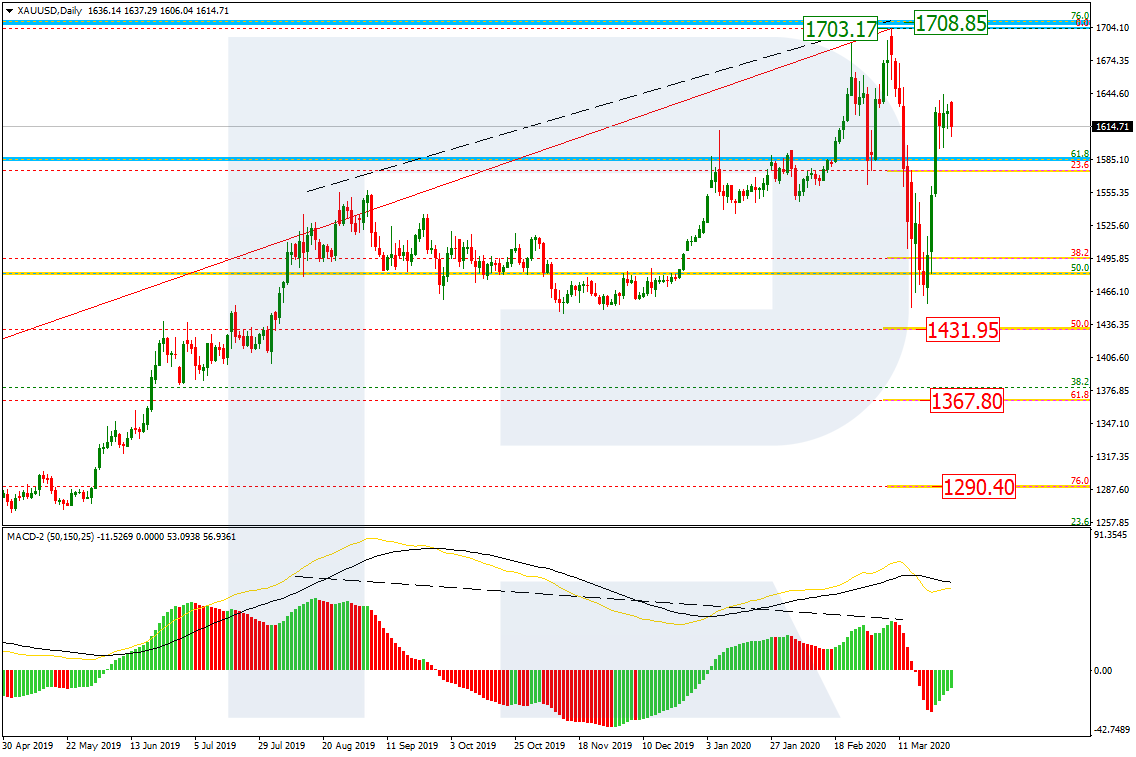
As we can see in the daily chart, after falling and reaching 38.2% fibo, the pair has returned to its highs. There is a strong possibility that the price may break the high at 1703.13 and reach 76.0% fibo at 1708.85 but the main scenario implies a new wave to the downside with the targets at 50.0% (1431.95), 61.8% (1367.80), and 76.0% (1290.40).

GOLD_D1
Risk Warning: the result of previous trading operations do not guarantee the same results in the future

In the H1 chart, there is a local divergence, which may indicate a new descending wave soon. In this case, the downside targets may be 23.6%, 38.2%, and 50.0% fibo at 1598.53, 1571.25, and 1549.10 respectively. However, the key downside target is the low at 1451.18. The resistance is the high at 1643.07.

GOLD_H1
Risk Warning: the result of previous trading operations do not guarantee the same results in the future

USDCHF, “US Dollar vs Swiss Franc”

In the daily chart, the rising impulse has corrected the previous descending wave by 61.8%. The descending wave may be considered a short-term pullback before a new wave to the upside, which may head towards 76.0% fibo at 0.9982 and the fractal high at 1.0236. The key pressure on the market is coming from 1.0344.

USDCHF_D1
Risk Warning: the result of previous trading operations do not guarantee the same results in the future

In the H1 chart, the convergence made the pair stop falling at 50.0%, Possibly, the pair may form one more descending impulse to reach 61.8% fibo at 0.9453. However, the main scenario implies a new rising wave towards the high at 0.9901.

USDCHF_H1

Article By RoboForex.com

Attention!
Forecasts presented in this section only reflect the author’s private opinion and should not be considered as guidance for trading. RoboForex LP bears no responsibility for trading results based on trading recommendations described in these analytical reviews.

Forex Technical Analysis & Forecast 30.03.2020

Article By RoboForex.com

EURUSD, “Euro vs US Dollar”

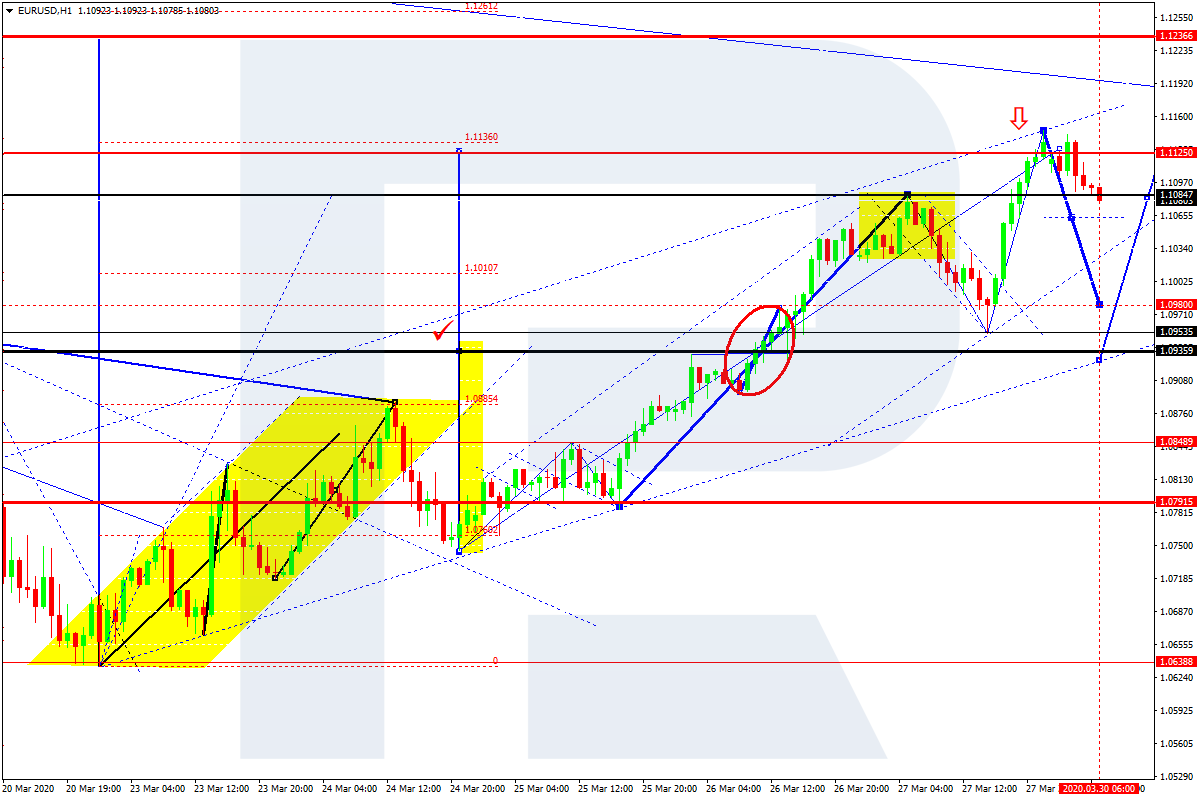
After finishing the ascending structure at 1.1146 and almost completing the third ascending wave, EURUSD is trading downwards. Possibly, the pair may start a new correction towards 1.0980, at least. Later, the market may form one more ascending structure with the target at 1.1236.

EURUSD
Risk Warning: the result of previous trading operations do not guarantee the same results in the future

GBPUSD, “Great Britain Pound vs US Dollar”

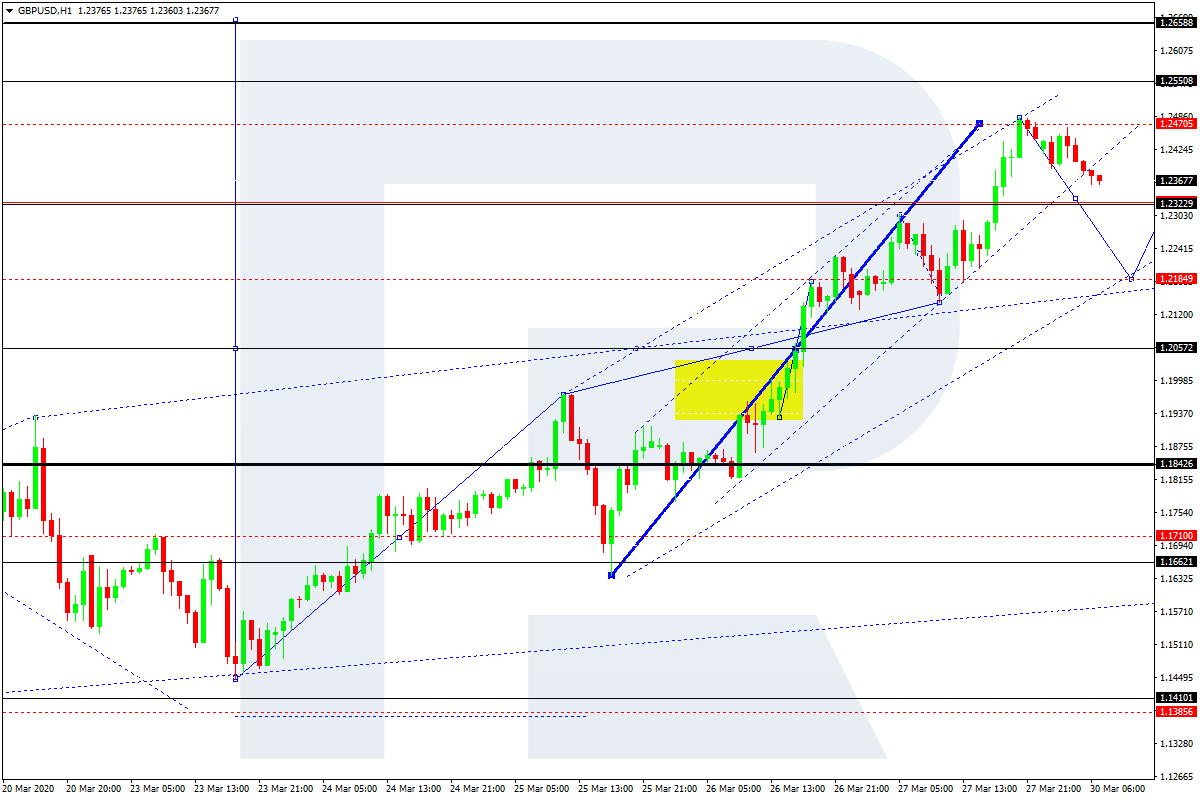
After completing the ascending structure at 1.2470, GBPUSD is moving downwards. Today, the pair may correct towards 1.2185 and then form one more ascending structure with the target at 1.2650.

GBPUSD
Risk Warning: the result of previous trading operations do not guarantee the same results in the future

USDCHF, “US Dollar vs Swiss Franc”

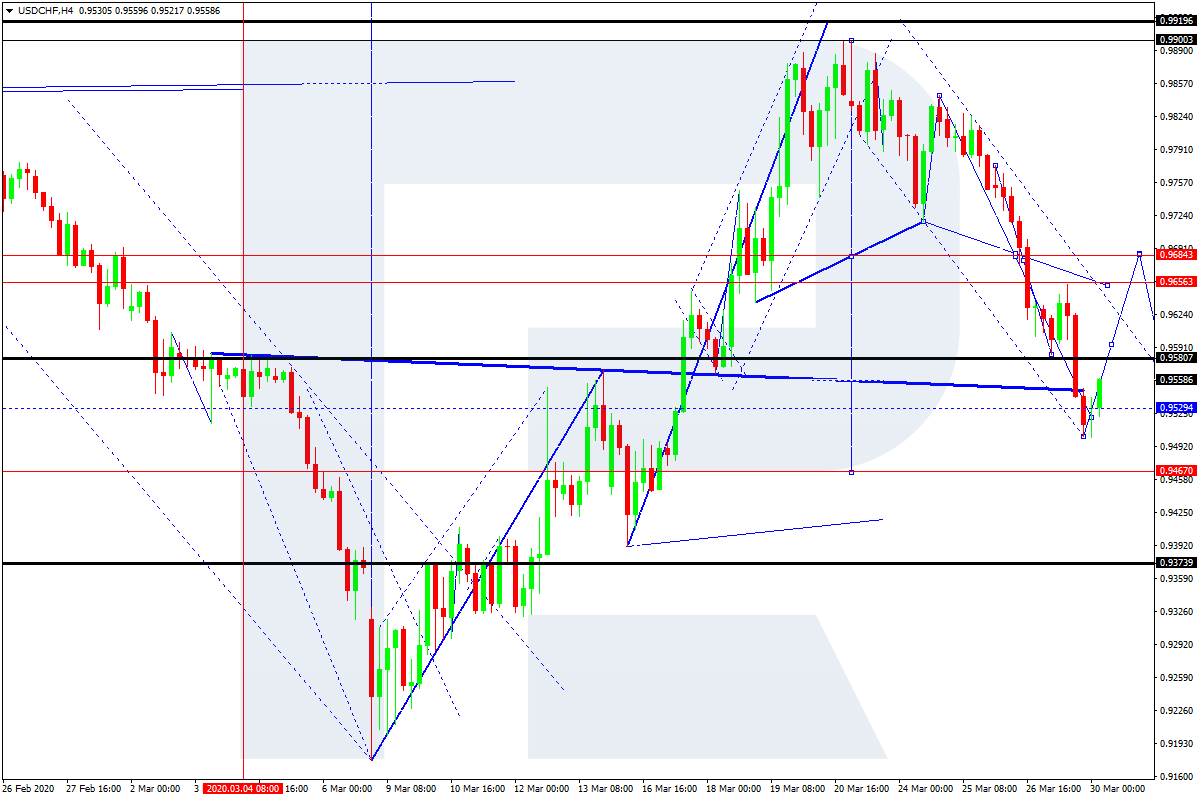
USDCHF has finished the descending wave at 0.9500; right now, it is growing to reach 0.9656, at least. Later, the market may resume trading downwards with the target at 0.9470.

USDCHF
Risk Warning: the result of previous trading operations do not guarantee the same results in the future

USDJPY, “US Dollar vs Japanese Yen”

USDJPY is still falling towards 106.80. Possibly, today the pair may reach this level and then start another correction towards 109.04. After that, the instrument may resume trading inside the downtrend with the target at 106.77.

USDJPY
Risk Warning: the result of previous trading operations do not guarantee the same results in the future

AUDUSD, “Australian Dollar vs US Dollar”

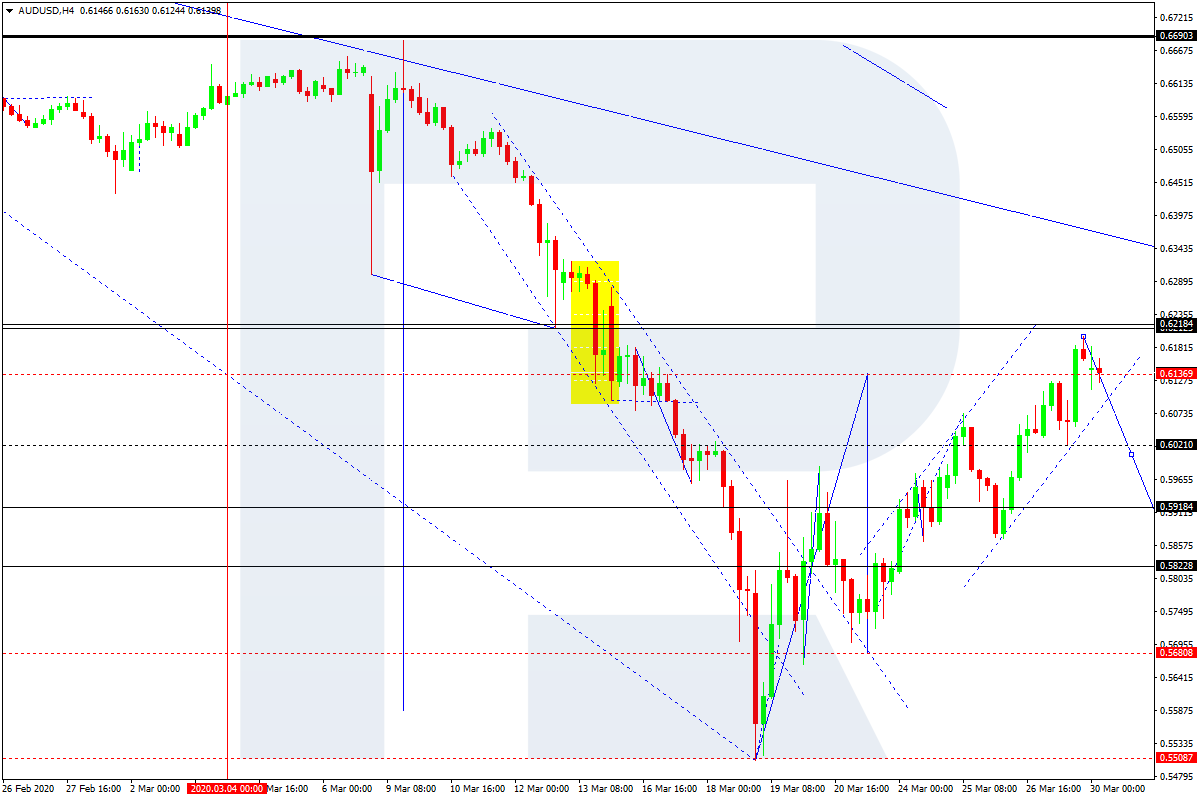
AUDUSD has reached its upside target at 0.6138; right now, it is forming a narrow consolidation range at the top of this wave. Possibly, the pair may grow towards 0.6220 and then resume trading downwards to reach 0.5822.

AUDUSD
Risk Warning: the result of previous trading operations do not guarantee the same results in the future

USDRUB, “US Dollar vs Russian Ruble”

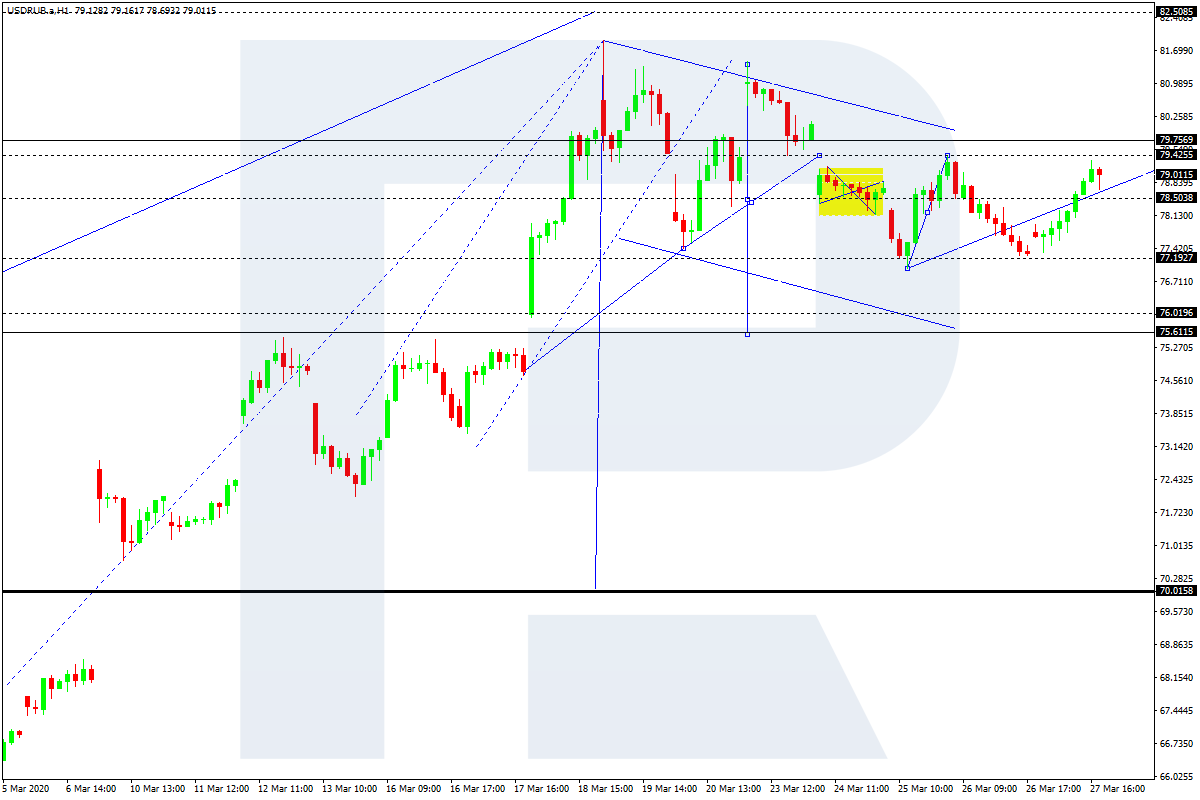
USDRUB is still consolidating around 78.00; right now, it is growing towards 79.75. Possibly, the pair may reach this level and then resume trading downwards to break 77.10. Later, the market may continue falling with the target at 75.20.

USDRUB
Risk Warning: the result of previous trading operations do not guarantee the same results in the future

USDCAD, “US Dollar vs Canadian Dollar”

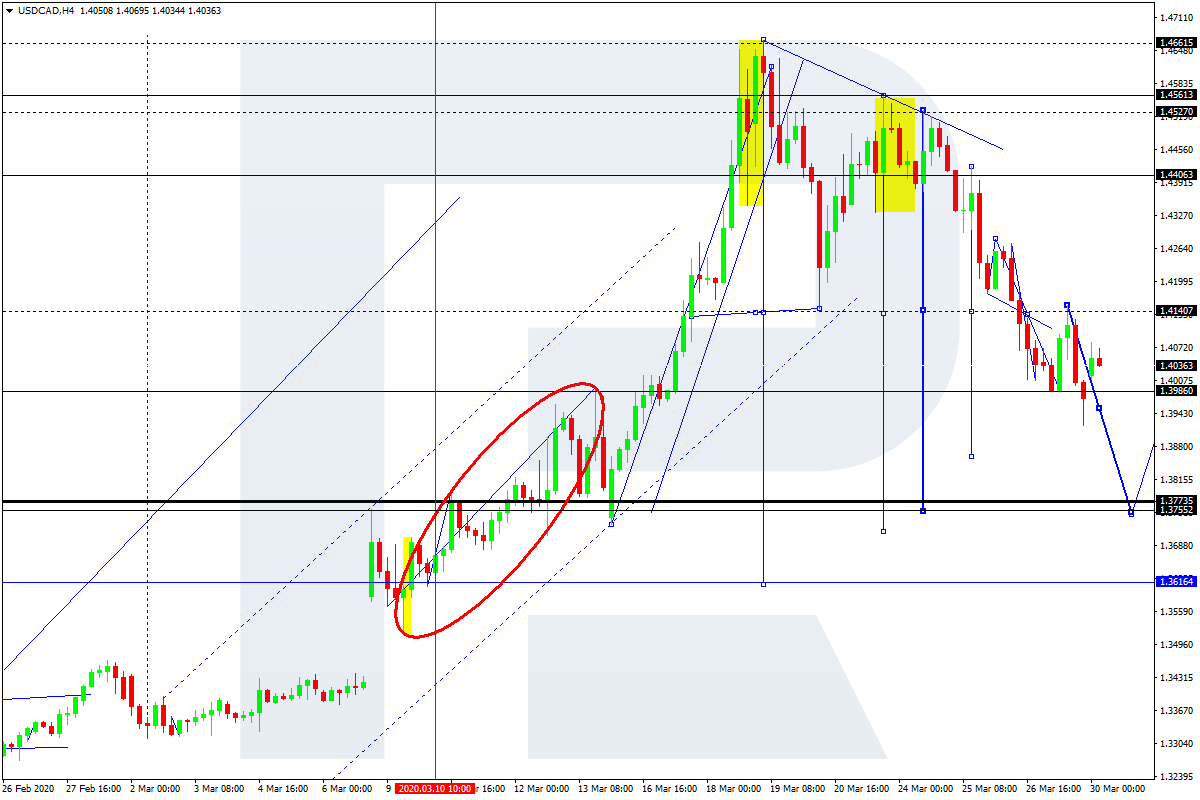
USDCAD continues falling. Today, the pair may correct to reach 1.4140. Later, the market may form a new descending structure with the target at 1.3755.

USDCAD
Risk Warning: the result of previous trading operations do not guarantee the same results in the future

XAUUSD, “Gold vs US Dollar”

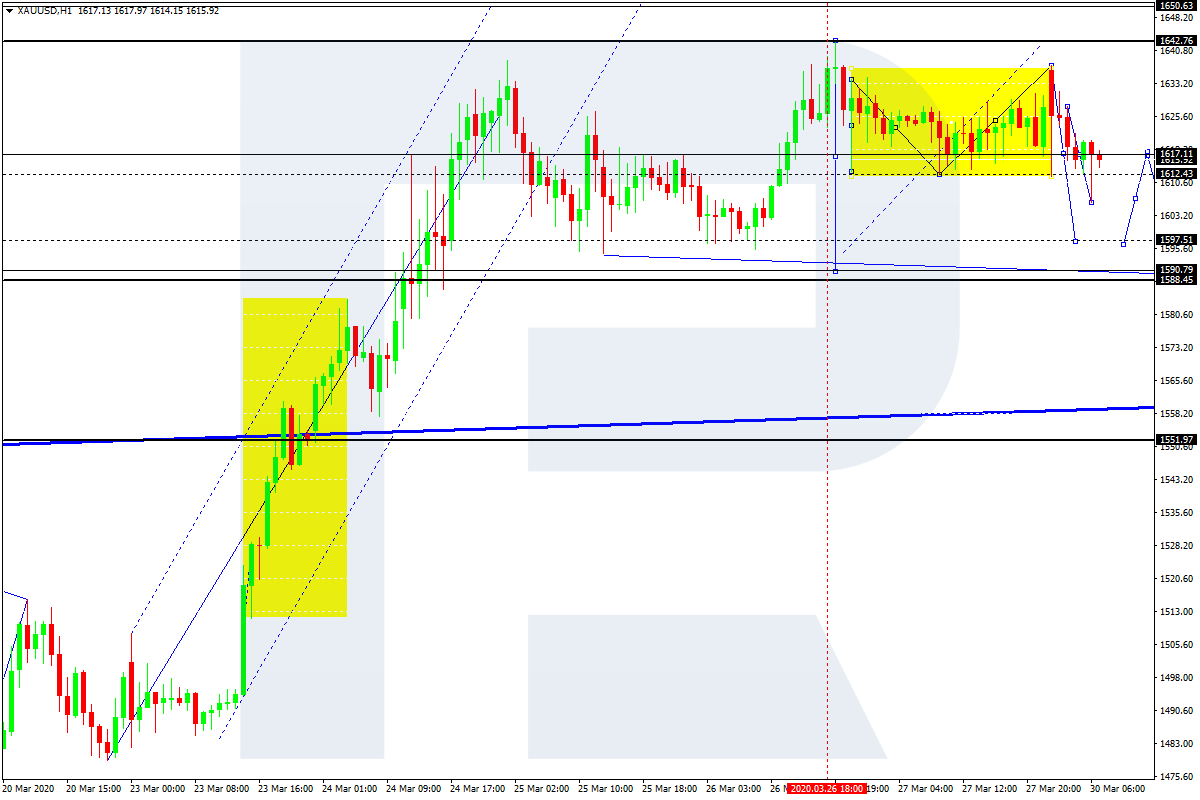
Gold is falling towards 1597.50. Possibly, the pair may reach this level and then start another growth towards 1612.50. After that, the instrument may form a new descending structure with the first target at 1590.50.

GOLD
Risk Warning: the result of previous trading operations do not guarantee the same results in the future

BRENT

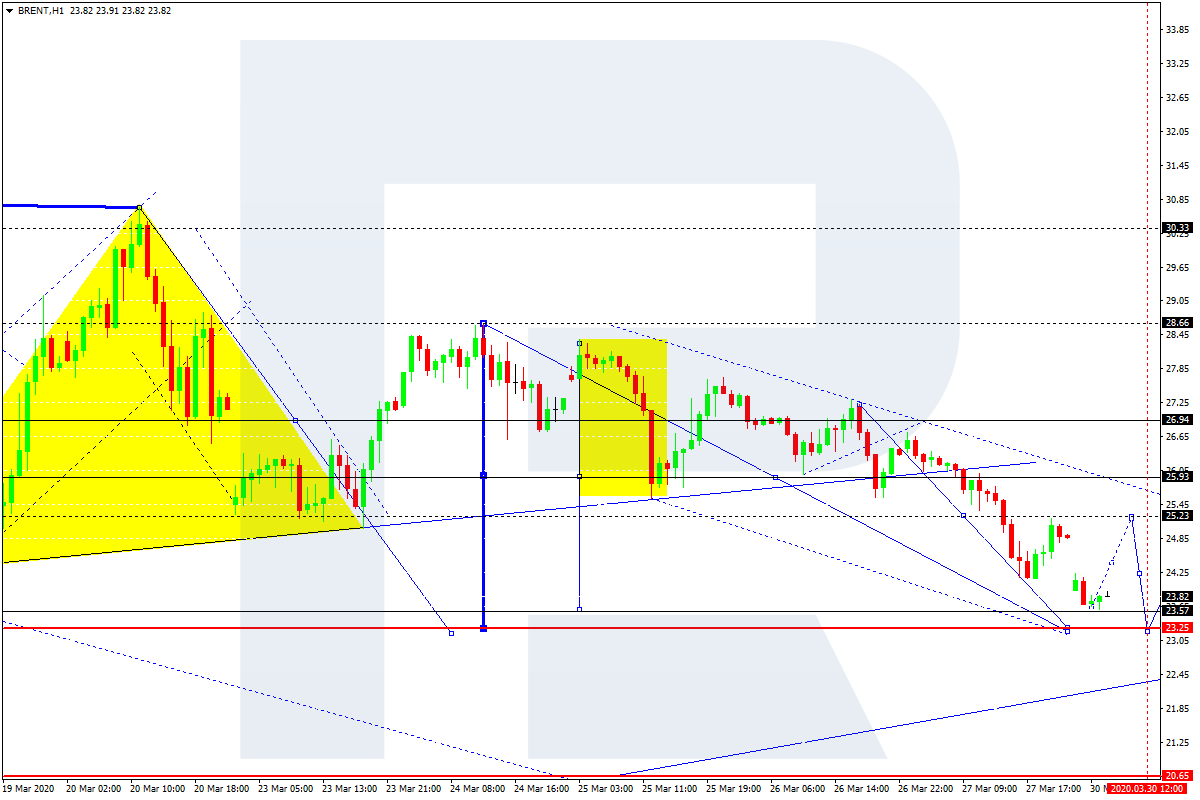
Brent is falling. Possibly, today the pair may reach 23.55 and then form one more ascending structure towards 25.25. Later, the market may fall to reach 23.23 and then resume trading upwards with the target at 25.95.

BRENT
Risk Warning: the result of previous trading operations do not guarantee the same results in the future

BTCUSD, “Bitcoin vs US Dollar”

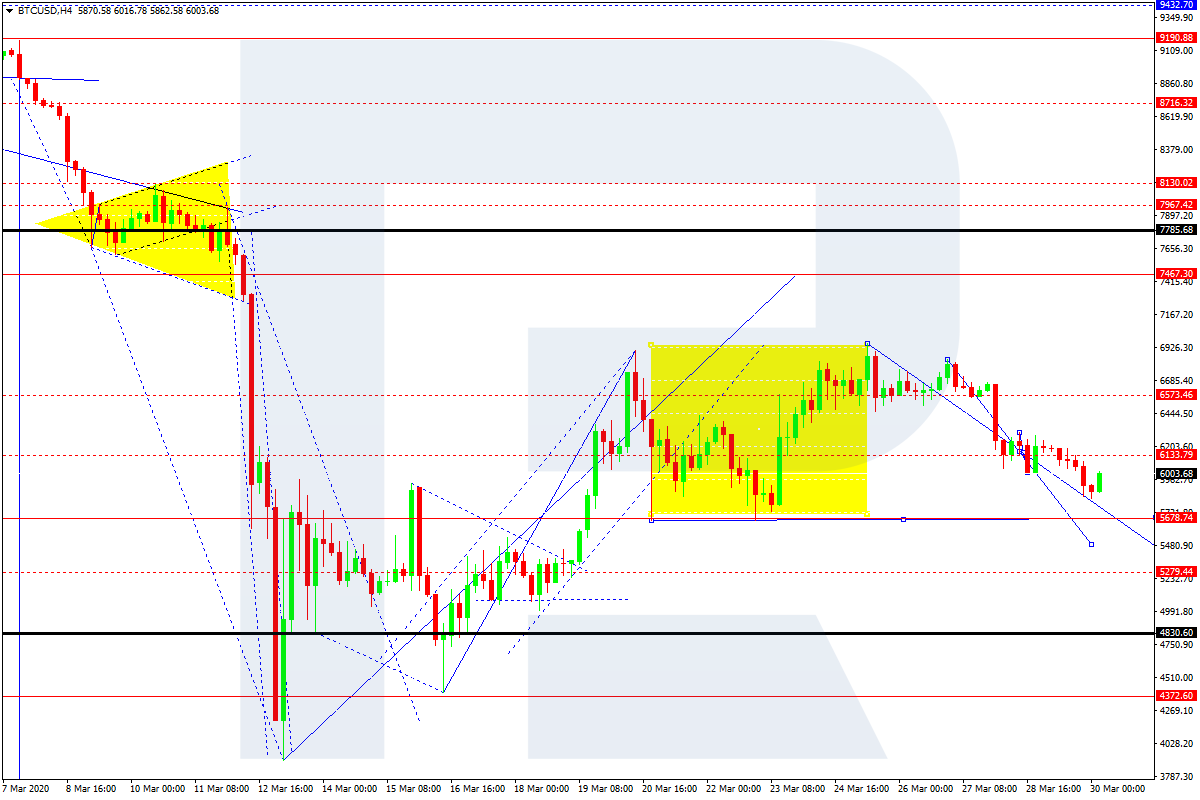
BTCUSD has broken 6150.00 to the downside. The main scenario implies that the instrument may correct towards 5300.00 and then start a new growth with the target at 7500.00.

BITCOIN

Article By RoboForex.com

Attention!
Forecasts presented in this section only reflect the author’s private opinion and should not be considered as guidance for trading. RoboForex LP bears no responsibility for trading results based on trading recommendations described in these analytical reviews.

The Analytical Overview of the Main Currency Pairs on 2020.03.30

by JustForex

The EUR/USD currency pair

Technical indicators of the currency pair:
  • Prev Open: 1.10279
  • Open: 1.11161
  • % chg. over the last day: +1.02
  • Day’s range: 1.10608 – 1.11441
  • 52 wk range: 1.0777 – 1.1494

The coronavirus pandemic continues to negatively impact the global economy. The U.S. president on Sunday extended the recommendation for self-isolation until the end of April. Earlier, Donald Trump signed a bill, granting financial support to the US economy in the amount of $2 trillion. Currently, the EUR/USD currency pair is consolidating in the range of 1.10400-1.11450. The trading instrument has the potential for further growth. We recommend opening positions from key levels.

At 17:00 (GMT+3:00) the US will publish an index of unfinished sales in the real estate market.

EUR/USD

Indicators signal the power of buyers: the price has fixed above 50 MA and 100 MA.

The MACD histogram is in the positive zone, indicating bullish sentiment.

The Stochastic Oscillator is in the neutral zone, the %K line began to cross the %D line. There are no signals at the moment.

Trading recommendations
  • Support levels: 1.10400, 1.09600, 1.08850
  • Resistance levels: 1.11450, 1.12000

If the price consolidates above 1.11450, expect further growth to 1.12000.

Alternatively, the quotes could reduce toward 1.09700-1.09400.

The GBP/USD currency pair

Technical indicators of the currency pair:
  • Prev Open: 1.21546
  • Open: 1.24262
  • % chg. over the last day: +2.09
  • Day’s range: 1.23176 – 1.24666
  • 52 wk range: 1.1466 – 1.3516

On the GBP/USD currency pair, bullish sentiment still prevails. The pound reached key extremes. At the moment, GBP/USD quotes are testing the mirror support level of 1.23000. 1.24800 is the nearest resistance. Demand for USD remains at a fairly low level. We do not exclude further growth of the GBP/USD currency pair. Open positions from key levels.

The Economic News Feed for 30.03.2020 is calm.

GBP/USD

Indicators signal the power of buyers: the price has fixed above 50 MA and 100 MA.

The MACD histogram is in the positive zone, indicating a bullish sentiment.

The Stochastic Oscillator is in the neutral zone, the %K line crossed the %D line. There are no signals at the moment.

Trading recommendations
  • Support levels: 1.23000, 1.21450, 1.20150
  • Resistance levels: 1.24800, 1.25500

If the price consolidates above 1.24800, expect further growth toward 1.25500-1.26000.

Alternatively, the quotes could descend toward 1.22000-1.21000.

The USD/CAD currency pair

Technical indicators of the currency pair:
  • Prev Open: 1.40446
  • Open: 1.40170
  • % chg. over the last day: +0.50
  • Day’s range: 1.40076 – 1.40973
  • 52 wk range: 1.2949 – 1.4668

The USD / CAD currency pair has stabilized. Looney is currently trading in a flat without a defined trend. The key support and resistance levels are: 1.39900 and 1.41450, respectively. Participants in financial markets expect additional drivers. We recommend you to pay attention to the dynamics of oil prices and open positions from key levels.

The Economic News Feed for 30.03.2020 is calm.

USD/CAD

The indicators do not give accurate signals: the price crossed 50 MA.

The MACD histogram is near the 0 mark.

The Stochastic Oscillator is in the neutral zone, the %K line is above the %D line, which gives a signal to buy USD/CAD.

Trading recommendations
  • Support levels: 1.39900, 1.39250, 1.38700
  • Resistance levels: 1.41450, 1.42750, 1.43750

If the price consolidates below 1.39900, expect further descend toward 1.39000-1.38000.

Alternatively, the quotes could grow toward 1.42400-1.43000.

The USD/JPY currency pair

Technical indicators of the currency pair:
  • Prev Open: 109.458
  • Open: 107.644
  • % chg. over the last day: -1.54
  • Day’s range: 107.191 – 108.244
  • 52 wk range: 101.19 – 112.41

USD/JPY quotes show a steady downtrend. The trading instrument has again set new local lows. At the moment, the USD/JPY currency pair is consolidating in the range 107.200-108.250. Demand for safe haven currencies has grown significantly. The yen can grow further against the greenback. We recommend you to pay attention to the dynamics of yield on US government bonds. Open positions from key levels.

The Economic News Feed for 30.03.2020 is calm.

USD/JPY

Indicators signal the power of sellers: the price has fixed below 50 MA and 100 MA.

MACD is in the negative zone, indicating a bearish sentiment.

The Stochastic Oscillator is in the overbought zone, the% K line crossed the% D line. There are no signals at the moment.

Trading recommendations
  • Support levels: 107.200, 106.000.
  • Resistance levels: 108.250, 109.000, 110.000

If the price consolidates below 107.200, expect a drop toward 106.500-106.000.

Alternative ly, the quotes could grow toward 109.000-109.500.

by JustForex

DAX bulls fail to recapture 10,000 points – end of the bear market rally?

By Admiral Markets

Forex Calender

Source: Economic Events March 30, 2020 – Admiral Markets’ Forex Calendar

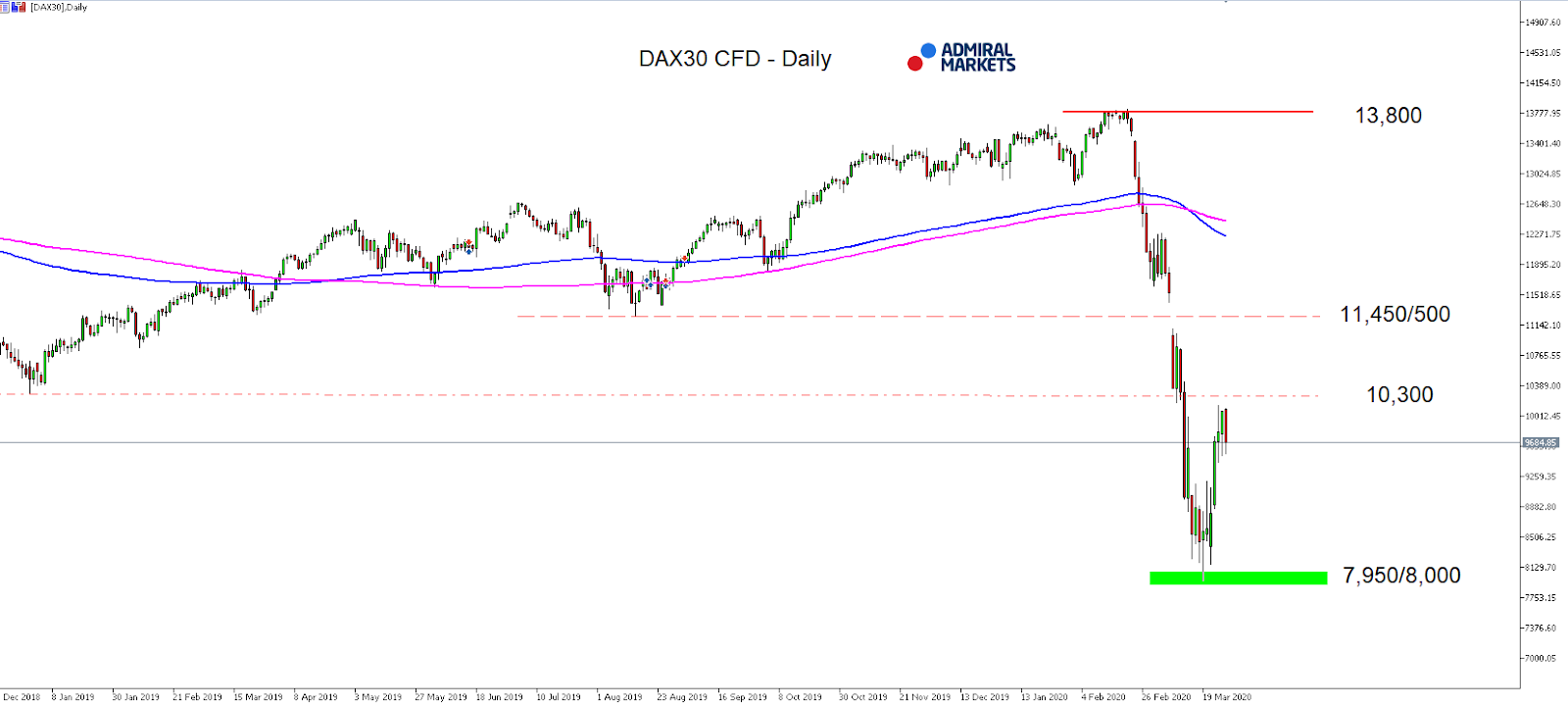
After the DAX30 CFD failed to recapture 10,000 points over the last week, and had a relatively weak weekly close, it appears that both its biggest daily gain in points (+959.42), and the third biggest last Tuesday with 10.98%, has been nothing more than a bear market rally.

Bear market rallies everywhere have been just as sharp as what we saw over the last week. In US Equity markets, the Dow Jones extended its surge to 21% in three days by Thursday, bringing it back into bull market territory, but is only relevant from a “technical” standpoint.

Overall, we stay bearish with a potential trigger of a next leg down being potentially coming from the developments around the Coronavirus, particularly in the US, and if signs of an extended shutdown of the US economy intensify.

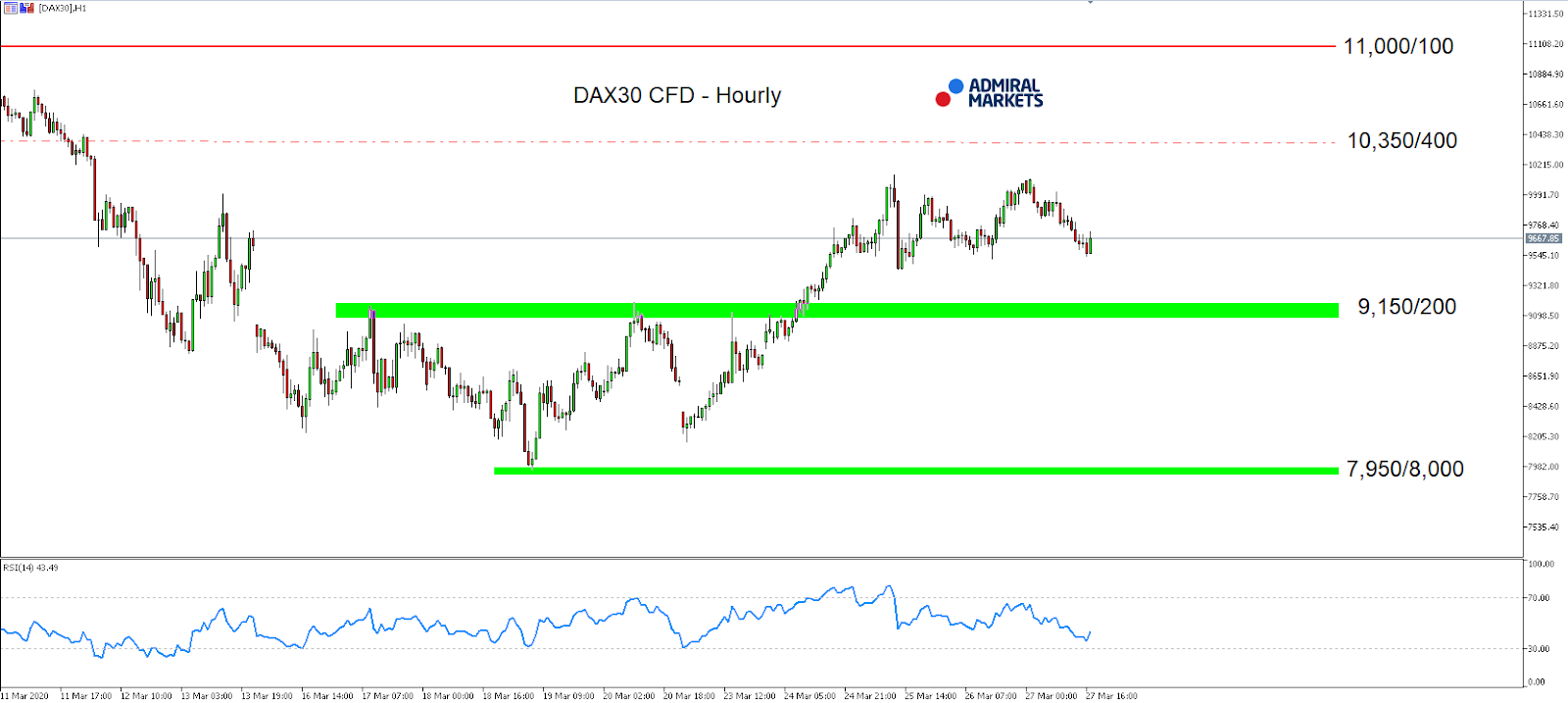
Technically, the main focus in the DAX30 CFD lies in the region around 9,150/200 points, where a sustainable break lower could trigger a next wave of selling down to 8,000 points and even lower in the days to come.

Above 9,150/200 points, another push up to and above 10,000 points stays on the table with a break above the pre-weekly highs around 10,150 points levelling the path to a deeper corrective move (still a bear market rally in the higher Daily time-frames) and bringing the mark around 11,000 points back into play.

Hourly chart

Source: Admiral Markets MT5 with MT5-SE Add-on DAX30 CFD Hourly chart (between March 11, 2020, to March 27, 2020). Accessed: March 27, 2020, at 10:00pm GMT

Daily chart

Source: Admiral Markets MT5 with MT5-SE Add-on DAX30 CFD Daily chart (between December 7, 2018, to March 27, 2020). Accessed: March 27, 2020, at 10:00pm GMT – Please note: Past performance is not a reliable indicator of future results, or future performance.

In 2015, the value of the DAX30 CFD increased by 9.56%, in 2016, it increased by 6.87%, in 2017, it increased by 12.51%, in 2018, it fell by 18.26%, in 2019, it increased by 26.44% meaning that after five years, it was up by 34.2%.

Discover the world’s #1 multi-asset platform

Admiral Markets offers professional traders the ability to trade with a custom, upgraded version of MetaTrader 5, allowing you to experience trading at a significantly higher, more rewarding level. Experience benefits such as the addition of the Market Heat Map, so you can compare various currency pairs to see which ones might be lucrative investments, access real-time trading data, and so much more. Click the banner below to start your FREE download of MT5 Supreme Edition!

Download MetaTrader 5 and begin trading today!

Disclaimer: The given data provides additional information regarding all analysis, estimates, prognosis, forecasts or other similar assessments or information (hereinafter “Analysis”) published on the website of Admiral Markets. Before making any investment decisions please pay close attention to the following:

  1. This is a marketing communication. The analysis is published for informative purposes only and are in no way to be construed as investment advice or recommendation. It has not been prepared in accordance with legal requirements designed to promote the independence of investment research, and that it is not subject to any prohibition on dealing ahead of the dissemination of investment research.
  2. Any investment decision is made by each client alone whereas Admiral Markets shall not be responsible for any loss or damage arising from any such decision, whether or not based on the Analysis.
  3. Each of the Analysis is prepared by an independent analyst (Jens Klatt, Professional Trader and Analyst, hereinafter “Author”) based on the Author’s personal estimations.
  4. To ensure that the interests of the clients would be protected and objectivity of the Analysis would not be damaged Admiral Markets has established relevant internal procedures for prevention and management of conflicts of interest.
  5. Whilst every reasonable effort is taken to ensure that all sources of the Analysis are reliable and that all information is presented, as much as possible, in an understandable, timely, precise and complete manner, Admiral Markets does not guarantee the accuracy or completeness of any information contained within the Analysis. The presented figures refer that refer to any past performance is not a reliable indicator of future results.
  6. The contents of the Analysis should not be construed as an express or implied promise, guarantee or implication by Admiral Markets that the client shall profit from the strategies therein or that losses in connection therewith may or shall be limited.
  7. Any kind of previous or modeled performance of financial instruments indicated within the Publication should not be construed as an express or implied promise, guarantee or implication by Admiral Markets for any future performance. The value of the financial instrument may both increase and decrease and the preservation of the asset value is not guaranteed.
  8. The projections included in the Analysis may be subject to additional fees, taxes or other charges, depending on the subject of the Publication. The price list applicable to the services provided by Admiral Markets is publicly available from the website of Admiral Markets.
  9. Leveraged products (including contracts for difference) are speculative in nature and may result in losses or profit. Before you start trading, you should make sure that you understand all the risks.

By Admiral Markets

Bears are Attacking Brent Again

By Dmitriy Gurkovskiy, Chief Analyst at RoboForex

Crude Oil prices are falling on Monday. The most serious bearish attack took place early in the morning during the Asian trading session when WTI broke 20 USD for the first time since 2002. A barrel of Brent is now trading at 23.52 USD.

Four correctional waves couldn’t help Brent fix above 30 USD. Obviously, market players are not sure about the future outlook: starting from April 1st, oil-producing countries, members of the OPEC+, will not be bound by any agreement to limit the daily output, which means that by the middle of April cheap oil from Saudi Arabia may flood the market and make crude oil prices plummet much lower.

In addition to that, even if the capacity utilization rate of the Chinese industry reaches 98%, no one can be sure that the demand for energy commodities will be more or less stable. This is a fundamental factor that drags oil prices down.

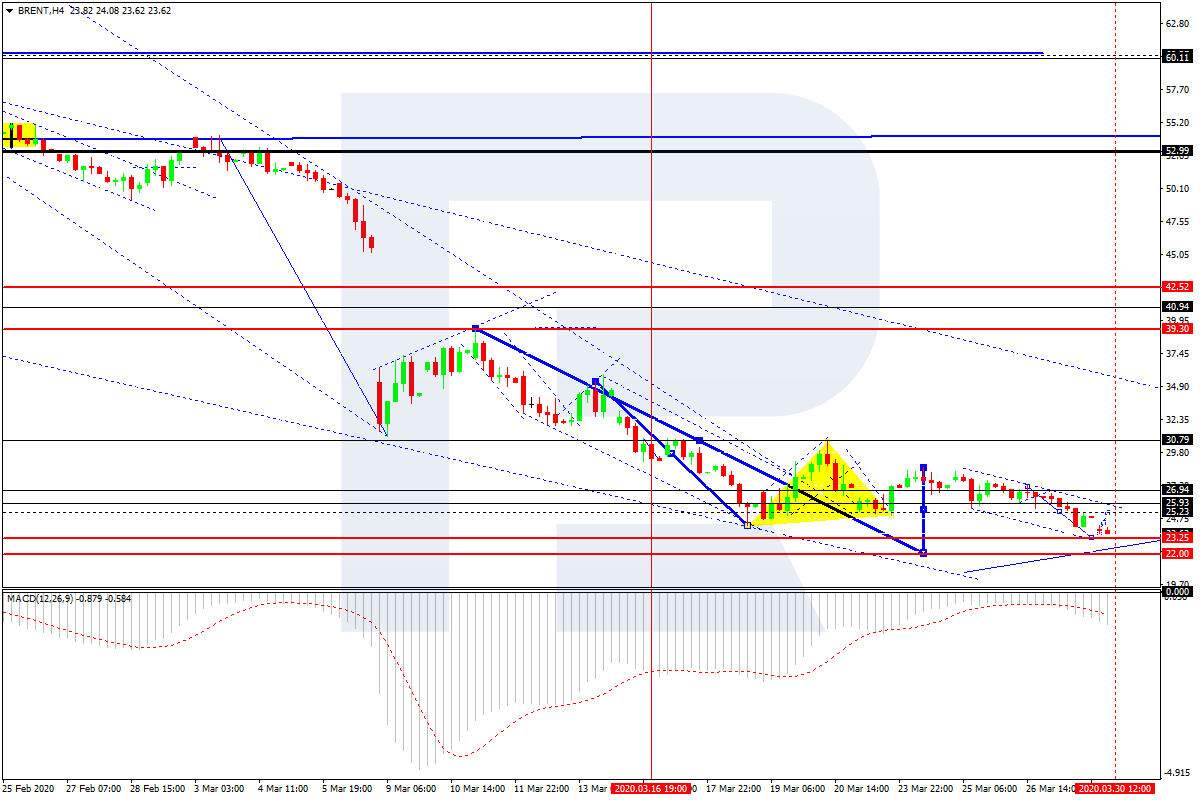
In the H4 chart, after breaking 25.25 to the downside, Brent may continue falling to reach 22.00. Later, the market may start another growth to test 25.25 from below and then form a new descending structure towards 21.50. Later, the market may resume trading upwards with the first target at 30.00. From the technical point of view, this scenario is confirmed by MACD Oscillator: its signal line is moving below 0 inside the histogram area, thus indicating further decline on the price chart.

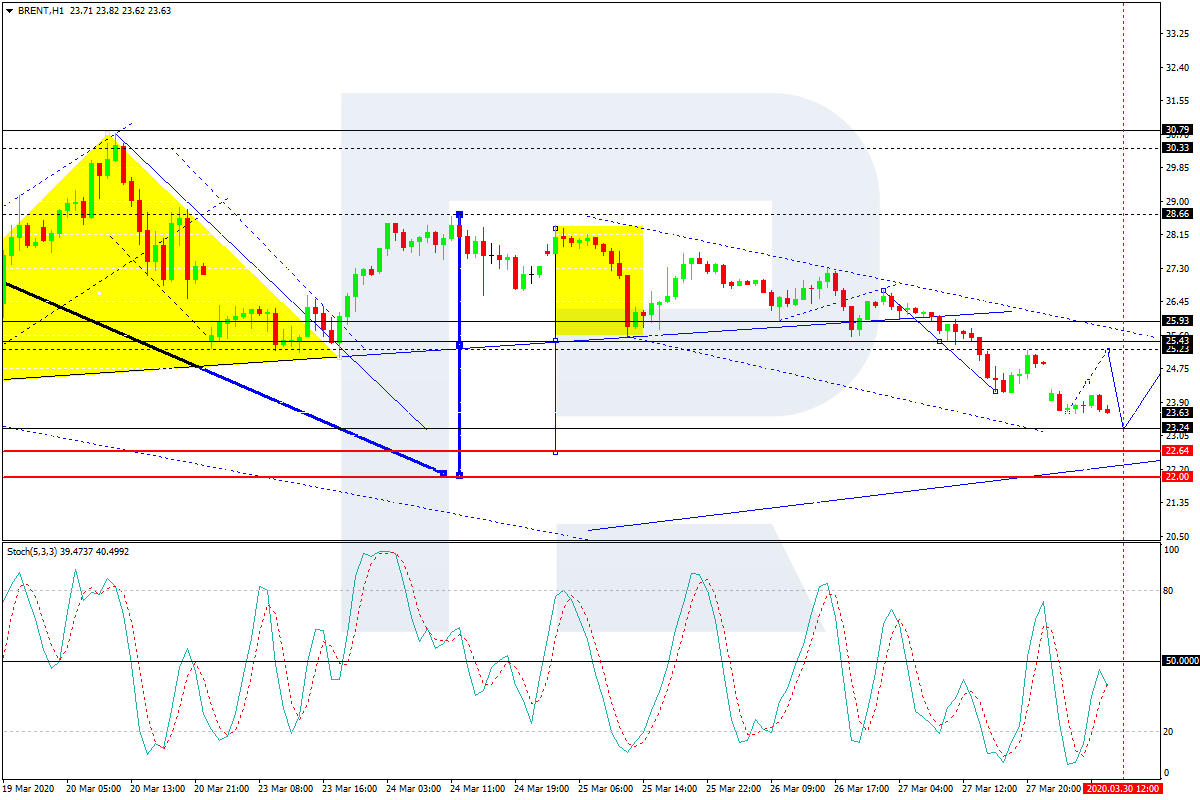
As we can see in the H1 chart, Brent has broken 24.00 downwards; right now, it is still falling with the short-term downside target at 23.23. After reaching this level, the pair may correct towards 25.25, at least, and then resume trading inside the downtrend to reach the target from the H1 chart at 22.00. From the technical point of view, this scenario is confirmed by Stochastic Oscillator: its signal line is moving below 50. Later, the line may fall to break 20 and then resume moving upwards, thus indicating a correction on the price chart.

Disclaimer

Any predictions contained herein are based on the authors’ particular opinion. This analysis shall not be treated as trading advice. RoboForex shall not be held liable for the results of the trades arising from relying upon trading recommendations and reviews contained herein.

Three Charts Every Trader and Investor Must See

By TheTechnicalTradersUnderstanding the stock market and its potential through the use of technical analysis and historical price events has been proven repeatedly to outperform all forms of fundamental trading styles. The following is a story that walks you through my experience, the shift in my mindset and how I came to the conclusion that the three charts I share in this article are critical to your understanding of to make money in today’s market!

When I first learned to trade, I got all caught up with researching companies and finding the ones with the best earnings and future growth. I did that for several years after studying and following many “professional traders” who said it was the best way to trade and invest long term. We lost our shirts during the 2000 bear market by continuing to trade on fundamentals as stocks fell in value week after week. Even the companies that showed quarterly earnings growth fell in value – none of it seemed to make any sense to me, and it was very frustrating.

Losing money when buying the best companies made no logical sense, making me step back from the markets and ask myself, ‘what am I doing wrong here‘. People today are asking themselves the same question given today’s dizzying markets:

· Telsa shares fell from $971 a share down to $347, whopping 63% drop, in only a few weeks and then rebounded again too xx

· Netflix is down 30%, even though people are stuck at home desperately trying to find things to watch)

· Amazon has fallen 26% in the past couple of weeks despite soaring demand for their delivery services

· GDXJ, the gold miners sector that is typically a safe haven during times of volatility, crashed 57% even though gold is usually a safe haven during times of volatility.

So, what was I doing wrong? I started calling and visiting traders who were making money during the bear market to see what they were doing, and 100% of them were doing the same thing – Trading with Technical Analysis. I wasn’t doing anything wrong, per se. I was simply using the wrong tools and analysis for success!

What is Technical Analysis? In short, it’s the study of price, time, and volatility of any asset using price charts and indicators. Traders use technical analysis to find cycles and patterns in the market and trade on the analysis of preferred indicators as opposed to the fundamentals of a company and/or the economy in general.

When you start studying technical traders, you will notice every trader has a particular time frame, a preferred set of indicators, and trading frequency that fits their unique personality and lifestyle. Their brains can see the charts in ways you and I may not see them to predict future price direction over the next few hours, days, weeks, or months ahead. I quickly learned there are infinite ways to trade using technical analysis.

I was very surprised by how much these pro traders allowed me. While standing over their shoulders, I was looking at their charts to try to divine their high-level strategies and learn how they think, analyze, and trade. It was amazing how different each of them traded the market. Some traded currencies; others traded stocks, indexes, options, futures, etc. Most were day traders, swing traders, or a mix of the two. But none of them gave me their secret sauce. That is why I turned 100% of my focus to technical analysis. I was excited at the prospect of being able to profit from both rising and falling prices and no concern for anything other than price action reduced my research time dramatically. It was and is the biggest AH-HA moment of my life and a turning point for my career as a trader.

The year was 2001, when I made the shift to technical analysis. I unsubscribed from everything fundamental based. I canceled my CNBC, stopped listing to news, and stopped reading other people’s reports altogether. My goal was to create my own technical trading strategy that best suited my personality and lifestyle. I would have to discover the securities I was most comfortable trading, the frequency I would trade, and the type and amount of risk I was prepared to take.

I traded options, covered-calls, currencies, stocks, ETFs, and futures. From day trading to position trading (holding several months), I tried it all, hoping something would click for me to pursue at a much deeper level. Day trading, momentum, and swing trading were my sweet spots. Having three of them was a bonus as I know some traders only ever master one in their lifetime if they are lucky. I grew a liking for trading the major indexes like the DJIA, S&P 500, and Nasdaq… great liquidity with big money always at play.

Along my journey, I realized that if I could predict the overall market trend direction for the day or week, then I could day-trade small-cap stocks in the same direction as the index, knowing 80+% of the stocks follow the general stock market trend. I could generate much larger gains in a very short period of time. As time went on, I became comfortable predicting, trading, and profiting from the indexes, and my new trading strategy began to emerge.

I was fortunate enough to start learning about the markets and trading in college with a $2,000 E-Trade account, and then retiring (kinda) in 2009 at the age of 28. I built my dream home on the water, bought cars and boats, and spent time traveling with my growing family. I love trading and sharing my analysis with others – it is better than I had ever imagined and why I continue to help thousands of traders around the world every day with these video courses Trading System Mastery, and Trading As Your Business so you learn and make money from your home forever.

I contribute 100% of my trading success and lifestyle to the fact that I embraced technical analysis, where my strategy involves nothing more than price movement, position-sizing, and trade risk management techniques. All these allow me to easily reduce exposure, drawdowns, and losses with proper position sizing and protective strategies. If you want quick and simple, read about my journey and core trading tools in my book Technical Trading Mastery – 7 Steps to Win with LogicMy strategy is represented by human psychology and historical trading, as expressed in the three charts below.

Chart 1 – Human Psychology Is What Drives Price Action

This chart is my favorite as it explains trader and investor psychology at various market stages. It also includes a simplified market cycle in the upper right corner, letting you know where the maximum financial risk is for investors and the highest opportunity for a trade.

Chart 2 – 2000 Stock Market Top & Bear Market That Followed

The chart may look a little overwhelming, but look at each part and compare it to the market psychology chart above. What happened in 2000 is what I feel is happening this year with the stock market sell-off.

In 2000, all market participants learned of at the same time was that there were no earnings coming from their darling .com stocks. Knowing they were not going to make money for a long time, everyone started selling these terrible stocks, and the market collapsed 40% very quickly.

What is similar between 2000 and 2020? Simple really. COVID-19 virus has halted a huge portion of business activity, travel, purchases, sporting events, etc. Everyone knows earnings are going to be poor, and many companies are going to go bankrupt. It is blatantly clear to everyone this is bad and will be for at least 6-12 months in corporate earnings; therefore, everyone is in a rush to sell their stock shares and are in a panic to unload them before everyone does.

Chart 3 – The 2020 Stock Market Top Looks To Be Unfolding

As you can see, this chart below of this year’s market crash is VERY similar to that of 2000 thus far, it’s based on a similar mindset, which is the fear of losing money, which causes everyone to sell their positions.

I am hopeful that we get a 25-30% rally from these lows before the market starts to fall and continue the new bear market, which I believe we are entering. Only the price will confirm the direction and major trend to follow, and since we follow price action and do not pick tops or bottoms, all we have to do is watch, learn, and trade when price favors new low-risk, high reward trade setups.

It does not matter which way the market crashes from here, we will either profit from the next leg down, or will miss/avoid it depending on if we get a tradable setup. Either cause is a win, just one makes money, while the worst-case scenario just preserves capital in a cash position, you can’t complain either way if you ask me.

Before you continue, be sure to opt-in to our free market trend signals 
before closing this page, so you don’t miss our next special report!

Concluding Thoughts:

In short, is if you lost money during the recent market crash, then you likely have not mastered a technical trading strategy and do not have proper trade management rules in place. All traders must manage risk and trades to be sure you lock in profits and limit losses when prices start pullback or collapse. Without either of these, you will not be able to achieve long term success/gains, and that’s a fact.

While we can all make money during a bull market when stocks are rising, if you cannot retain or grow your account during market downturns, then you may as well be a passive buy and hold investors. You are better at riding the emotional investor rollercoaster without wasting your time and effort as a trader if you are not going to spend the time and money to learn to follow someone to become a successful trader. Without proven trading strategies or someone to follow, you are more likely to underperform a long-term passive investor.

I get dozens of emails from people every week trying to trade this wild stock market and use leveraged ETFs, which doing so during these unprecedented market conditions is absolute craziness if you ask me.

These people think that because there are big moves in the market, they should be trading. That big money should be made trading them, which drives me crazy because it could not be further from the truth unless you are a scalp or day trader. To me, in this market condition, it’s about preserving capital, not risking it, in my opinion.

A subscriber to my market video analysis and ETF trading newsletter said it perfectly:

“Always intrigues me how many amateur surfers get to the north shore beaches in Hawaii, take one look at monster waves and conclude it’s way too dangerous. Yet the amateur trader looks at treacherous markets like these and wants to dive right in!!” Richard P.

I have to toot my own horn here a little because subscribers and I had our trading accounts close at a new high watermark for our accounts. We not only exited the equities market as it started to roll over we profited from the sell-off in a very controlled way.

I hope you found this informative, and if you would like to get a pre-market video every day before the opening bell, along with my trade alerts, visit my ETF swing trading visit my website at TheTechnicalTraders.com.

Chris Vermeulen
Founder of Technical Traders Ltd.


Stocks: Why “Buying the Dip” is Fraught with Danger

Take a look at “a dip buyer’s nightmare”

By Elliott Wave International

Investors know that the main U.S. stock indexes have tumbled very quickly.

On a historical basis, some may not realize just how quickly.

A March 23 Marketwatch headline referred to a “mind-bending stat”:

The S&P 500 has dropped 30% from peak to trough faster than any other time in history. The next three fastest were all nasty pullbacks during the Great Depression era. Yes, just 22 days for this stock market to get cut by a third.

This historically swift downturn has prompted a “buy the dip” mentality.

On March 23, a prominent founder of a financial firm told CNBC:

“I’m nibbling right now, for what it is worth.”

Other professional investors have also mentioned that they were doing a little nibbling of their own.

The sentiment expressed was that the market may have a little more downside to go, but that’s about it.

These professionals might turn out to be correct in their judgments of the market. Then again, just because stocks have fallen far and fast – doesn’t mean they can’t fall way farther.

As a historical lesson, let’s take you back 19 years, when our April 2001 Elliott Wave Financial Forecast showed this chart and said:

“If there were ever a testament to the importance of market timing, the NASDAQ over the last year is it. Anyone who bought into the euphoria at the all-time high or the bull trap highs of early September and late January, would have taken successive hits of 40%, 47% and 38%. You can bet that many people followed the “buy” advice in the media on every bounce, losing even more than the “hold-only” loss of 65% from top to bottom.”

Bear in mind, the NASDAQ continued to fall into October 2002, handing even deeper losses to investors who continued to buy on the way down.

Returning to 2020, only time will tell when the bear market has bottomed, if it hasn’t already done so.

Yet, one thing’s for sure even now: The Elliott wave model is offering its own clues about what’s next for the main stock indexes.

See for yourself – 100% free.

You see, Elliott Wave International has just made available our entire “Stocks” section of our monthly Elliott Wave Financial Forecast to Club EWI members. Joining Club EWI is also free.

Elliott Wave International has been guiding investors through bull and bear markets since 1979. From that long experience, EWI’s analysts know that at certain market junctures, they can help the most by giving everyone their latest analysis free.

Now is one of those market junctures.

Read the Financial Forecast excerpt now, free.

This will help you understand how the markets got to this juncture — and, more importantly what’s likely next.

Also, please feel free to share this special excerpt with friends and family.

Again, simply follow this link:

Read the Financial Forecast excerpt now, free.

This article was syndicated by Elliott Wave International and was originally published under the headline Stocks: Why “Buying the Dip” is Fraught with Danger. EWI is the world’s largest market forecasting firm. Its staff of full-time analysts led by Chartered Market Technician Robert Prechter provides 24-hour-a-day market analysis to institutional and private investors around the world.