Author Archive for InvestMacro – Page 603

3 Ways the Elliott Wave Principle Enhances Your Trading

Learn practical ways in which Elliott wave analysis sets you apart from the herd

By Elliott Wave International

In this interview, the head of Elliott Wave International’s Educational Resources, Wayne Gorman, tells you about 3 practical benefits of trading with the Elliott Wave Principle: setting realistic price targets, finding ideal entry points — and squeezing the most out of the trend.

Wayne has more than 30 years of experience as a risk manager and trader — so chances are, you will learn something new:


The Free Elliott Wave Tutorial

Learn how you can apply the Wave Principle to improve your trading and investing in this free 10-lesson tutorial. You’ll learn:

  • What the basic Elliott wave progression looks like
  • Difference between impulsive and corrective waves
  • How to estimate the length of waves
  • How Fibonacci numbers fit into wave analysis
  • Practical application tips for the method

Get Details and Instant Access

This article was syndicated by Elliott Wave International and was originally published under the headline 3 Ways the Elliott Wave Principle Enhances Your Trading. EWI is the world’s largest market forecasting firm. Its staff of full-time analysts led by Chartered Market Technician Robert Prechter provides 24-hour-a-day market analysis to institutional and private investors around the world.

The Story of the U.S. Regime Change Plan in the Philippines

By Dan Steinbock

As long-needed economic reforms are taking off in the Philippines, regime change plans have been prepared in the US State Department against a democratically-elected president who enjoys very high popular support.

During the Philippine presidential campaigns in spring 2016, U.S. Ambassador Philip Goldberg sided visibly with anti-Duterte forces, which led to several high-profile confrontations. After the controversial Ambassador left the Philippines, he wrote a “blueprint to undermine Duterte within 18 months.” Last month, the plan was leaked to The Manila Times, the oldest English-language daily in the Philippines.

It is not the first time Goldberg is associated with regime change efforts. In 2008 President Evo Morales and the Bolivian government gave him three days to leave the country after declaring him persona non grata – following Goldberg’s efforts to fund the opposition leaders, separatists and think-tanks with millions of dollars.

Yet, President Obama rewarded Goldberg by appointing him assistant secretary of state for Intelligence and Research; one of the 16 elements of the US Intelligence Community (IC). Thereafter he was sent to the Philippines, which he left in less than three years after efforts to intervene with the elections.

From Obama’s pivot to Goldberg’s regime change plan

After former President Benigno Aquino III’s designated successor – former interior minister Manuel Roxas, an ex-investment banker and Liberal Party leader who supports neoliberal policies and the U.S. pivot – failed to deliver a victory in the election, Goldberg began to devise his regime change plan. The latter seeks to foster public discontent with Duterte by isolating the Philippines through military assistance and economic “blackmail” relative to other ASEAN member countries.

Goldberg’s “divide and rule” plan seeks to split Philippine congressmen and senators, ASEAN states, and international multilateral organizations. He also advocates strengtheningthe pro-U.S. opposition through aids and grants. The plan calls on Washington to deploy economic, political and military forces against Duterte, “to bring him to his knees and eventually remove him from office.”

According to Daniel Russel, State Department’s assistance secretary for East Asian affairs, the allegations of a blueprint are false. However, Russel’s credibility is overshadowed by the fact that he remains a key figure in the U.S. pivot towards Asia. U.S.-based sources have also tried to discredit the blueprint as coming from China’s Philippine Ambassador Zhao Jianhua, which the executive editor of The Manila Times Dr. Dante Ang calls a “fantasy.”

As Washington sees it, the close ties between the two countries are rooted in the U.S. colonial regime in the Philippines between 1898 and 1946, broad military cooperation, a bilateral security alliance, and common strategic and economic interests. After these ties were cemented with the Enhanced Defense Cooperation Agreement (EDCA), Washington and Manila in March 2016 chose half a dozen sites in the Philippines to host the rotation of the U.S. Department of Defense (DOD) military units. It was the first time that US military returned to the country since 1992 – after the end of the Marcos era (1965-86), when close bilateral cooperation left many Filipinos infuriated.

However, the alliance was predicated on smooth post-Obama continuity (but Clinton lost the U.S. election), the confirmation of the Trans-Pacific Partnership (which Trump pledged to bury), and the victory of Aquino’s preferred successor Manuel “Mar” Roxas in the Philippines 2016 election (Roxas came second). After elections, questions about a “Mexico-style” narco state and its cooperation with military leaders during Roxas’ watch as interior minister led Duterte to order the investigation of five former and incumbent police generals led by retired general Marcelo Garbo Jr., a vocal supporter of Roxas, for involvement in illegal drugs.

Following his election triumph, Duterte has initiated a series of economic reforms, which are likely to accelerate growth to 7-7.5%, while recalibrating Manila’s relations away from Washington and toward Beijing and Moscow. In turn, the long-delayed Code of Conduct (COC) in the South China Sea may be completed by mid-year.
Today, the State Department may see the Goldberg’s regime change plan as a way to undermine the outcome of democratic elections – in the name of democracy.

Exploiting political opposition, human rights and NGOs

Goldberg’s regime change plan builds on that stance by exploiting political opposition, human rights, non-governmental organizations, and international media. He advises “restraint in expressing public support for former President Fidel Ramos and Vice President Leni Robredo, and other opposition leaders so as not to alarm the Duterte administration of an impending destabilization or a coup.” Ramos’s ties with the U.S. go back to his training at West Point in 1960. In the 1980s, he was in President Marcos’s inner circle of national police and military. Following the fall of Marcos, he served as President Corazon Aquino’s military chief and subsequently as president. After serving Duterte as early emissary to China, he has criticized the administration’s efforts to weaken U.S. military ties.

In turn, Robredo is a lawyer and social activist, who the Duterte administration sees more loyal to Aquino’s Liberal coalition. Her relationship with the Cabinet fell apart on December 4, 2016, when she was informed by Cabinet Secretary “to desist from attending all Cabinet meetings.” Robredo won vice-presidency with a narrow margin against former senator Ferdinand Marcos. In his electoral protest, Marcos, former President Marcos’s son, alleged that the Liberal Party rigged the elections in favor of Robredo. The case is lingering in courts.

In the public debate, the point person has been Senator Leila de Lima, Aquino’s former Secretary of Justice, who chaired a senate inquiry into the extrajudicial killings of drug suspects. She has been glorified by the BBC as “the woman who dares to defy Philippine president Duterte,” which is also the reason that she was invited to and awarded in the U.S. last month as one of the “leading 100 global thinkers” by the influential Democratic Foreign Policy.

In the Philippines, many see de Lima’s awards as perversions of justice, however. Through the Aquino era, she had a 7-year affair with her lucratively-rewarded driver Ronnie Dayan who served as her money collector for drug protection and campaign financing. During her watch, prison gangs still exerted control over the New Bilibid Prisons, while being coddled by incumbent political leaders, as evidenced by a Discovery Channel documentary. Last September, de Lima was removed from the Senate committee. Oddly enough, her international accolades ensued after the disclosure of the true nature of her activities as international media has ignored the pile of evidence of her abuse of public office and public funds.

The Goldberg plan also relies on NGOs, particularly a handful wealthy U.S. Filipinos linked with the Aquino circles, including billionaire philanthropist Loida Nicolas-Lewis and her sister, former chairwoman of the Commission on Filipinos Overseas. Both are Vice President Robredo’s supporters who have urged the members of the Global Filipino Diaspora Council (GFDC) “to ask Duterte to resign.”

A more influential source of funds is billionaire George Soros, who Duterte says has bankrolled local NGOs against him as he has been portrayed as a “mass murderer” in the West. International coverage has relied on these NGOs and think-tanks. Yet, in the Aquino III era, complacency with drug lords and narco politicians went hand in hand with the rise of some 3.7 million addicts, while international media was quiet about both. However, when Duterte started war against drugs, which has cost 6,000 lives, international ‘concern’ escalated rapidly.

“America First” via regime change?

Another signal came in mid-December, when the U.S.-based Millennium Challenge Corp. (MCC) did not renew its $430 million aid grant to the Philippines. While Manila’s criticism about “aid conditions” was reported as “tirades against America,” the MCC is hardly independent. It is chaired by State Secretary John Kerry and Treasury Secretary Jacob Lew and tens to precondition aid on neoliberal policies.

The MCC debacle is overshadowed by the economic implications of U.S.-Philippine military ties. Until 2010, the country’s military expenditures decreased two decades from 1.6% to 0.8% of GDP. During the Aquino era, which coincides with the U.S. pivot to Asia, the expenditures soared to almost 1.4%, according to SIPRI research – which in dollar terms is over five times the proposed aid package in just one year.

If a Ramos-Robredo scenario were to fail, Golberg plan advises exploiting possible rifts “among Duterte supporters,” or assisting “Robredo-led opposition groups”” coupled with the Catholic Church, business sector and NGOs. Yet, Duterte’s support remains very high across all classes nationally, while the ratings of opposition figures have been declining. According to the latest Pulse Asia survey, Duterte approval and trust ratings in the Philippines is 83%. Only 5% of the nation disapproves his actions. As a result, any US-led regime change effort in the Philippines would face firm domestic, regional and international opposition.

Stability in the Philippines is also supported by Beijing. Amid the news about the “ouster plot,” foreign ministry spokeswoman Hua Chunying said China was confident on Duterte’s leadership and would continue to support his policies. In turn, both Trump and Duterte have portrayed each other as good friends.

After January, Trump must reassess Goldberg’s regime-change plan scenarios in light of his own pledges, which are no longer subject to Obama’s pivot, shun US Interventionism abroad but hope to redefine “America First” policies in Asia.

About the Author:

Dan Steinbock is the founder of the Difference Group and has served as the research director at the India, China, and America Institute (USA) and a visiting fellow at the Shanghai Institutes for International Studies (China) and the EU Center (Singapore). For more information, see http://www.differencegroup.net/

The original version was published by China-US Focus on January 13, 2017
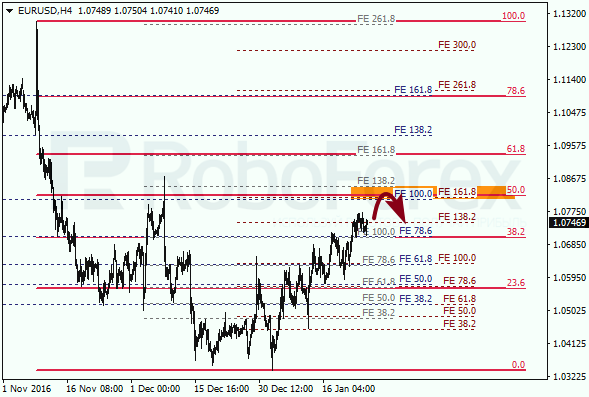


Fibonacci Retracements Analysis 25.01.2017 (EUR/USD, EUR/GBP)

Article By RoboForex.com

EUR USD, “Euro vs US Dollar”

The EUR/USD pair is still being corrected. The closest target is the retracement of 50%, which is confirmed by local fibo-levels. If later the price rebounds from this area, bears may try to reverse the market to the downside.

As we can see at the H1 chart, the pair rebounded from the group of local fibo-levels, which means that it may continue moving upwards. The closest target is the area at 1.0835 – 1.0810.


EUR GBP, “Euro vs Great Britain Pound”

The EUR/GBP pair is still being corrected to the downside. The closest target is the retracement of 61.8% at 0.8515. if later the market rebounds from this level, it may resume moving upwards.

As we can see at the H1 chart, the price moved very close to the group of fibo-levels at 0.8520 – 0.8500. Possibly, the market may rebound from this area and start a new bullish correction, at least.


RoboForex Analytical Department

Article By RoboForex.com

Attention!
Forecasts presented in this section only reflect the author’s private opinion and should not be considered as guidance for trading. RoboForex LP bears no responsibility for trading results based on trading recommendations described in these analytical reviews.

Forex Technical Analysis & Forecast 25.01.2017 (EUR/USD, GBP/USD, USD/CHF, USD/JPY, AUD/USD, USD/RUB, GOLD, BRENT)

Article By RoboForex.com

EUR USD, “Euro vs US Dollar”

Being under pressure, the EUR/USD pair is moving downwards; in fact, the market has broken its consolidation range to the downside. Possibly, the price may reach 1.0680 and then grow towards 1.0794.


GBP USD, “Great Britain Pound vs US Dollar”

The GBP/USD pair is consolidating. Possibly, today the price may rebound from the upside border of this range and start falling 1.2400. After that, the instrument may form another ascending structure to reach 1.2550.


USD CHF, “US Dollar vs Swiss Franc”

Being under pressure, the USD/CHF pair is growing. Possibly, the price may reach 1.0036. Later, in our opinion, the market may fall with the target at 0.9943.


USD JPY, “US Dollar vs Japanese Yen”

Being under pressure, the USD/JPY pair is growing as well. Possibly, the price may be corrected with the target at 114.50. After that, the instrument may continue falling to reach 112.20.


AUD USD, “Australian Dollar vs US Dollar”

Being under pressure, the AUD/USD pair is moving downwards. Possibly, the price may reach 0.7400. Later, in our opinion, the market may grow with the target at 0.7500.


USD RUB, “US Dollar vs Russian Ruble”

The USD/RUB pair is still consolidating; in fact, the market is forming the expanding triangle pattern. Possibly, today the price may reach 58.60 and then move upwards with the target at 60.40.


XAU USD, “Gold vs US Dollar”

Being under pressure, Gold is moving downwards. Possibly, the price may reach 1192. After that, the instrument may continue moving upwards with the target at 1207.


BRENT

Brent is consolidating in the center of the range. Possibly, the price may grow towards 56.30 and then move downwards to reach 53.80. Later, in our opinion, the market may return to 55.00 and then continue falling with the target at 53.00.


RoboForex Analytical Department

Article By RoboForex.com

Attention!
Forecasts presented in this section only reflect the author’s private opinion and should not be considered as guidance for trading. RoboForex LP bears no responsibility for trading results based on trading recommendations described in these analytical reviews.

Trumping World Trade

By Dan Steinbock

After the inauguration, President Trump has begun to reset the White House trade policies. But the consequences of “America First” stance in world trade are wrought with threats.

Recently, President Xi Jinping gave a strong speech about the need for more inclusive globalization at Davos. World trade is a case in point.

In 2015, world export volumes reached a plateau. World trade is no longer growing. Any major protectionist initiative has potential to make a bad situation a lot worse.

Trump’s trade appointments and tariff plans

In the early 2010s, the Obama administration touted the Trans-Pacific Partnership (TPP), which excluded China. On his inauguration day, Trump announced US withdrawal from the TPP and promised to renegotiate NAFTA; if Mexico and Canada would refuse a negotiation, he would have US withdraw also from NAFTA.

Trump has promised to renegotiate or reject other US international commitments. And he has threatened to use 35-45% import tariffs, while his team has floated 10% tariffs. The goal is to force some countries, particularly Mexico and China, to change their trade practices, which he has vowed to challenge with “cease and desist” letters and greater pressure for intellectual property rights (IPRs).

Trump’s appointments suggest potential for serious trade friction. He selected Peter Navarro, the author of sensationalist China-bashing books (The Coming China Wars, 2005; Death by China, 2011; and What China’s Militarism Means for the World, 2015), to head the new National Trade Council (NTC), which will oversee industrial policy in the White House.

Navarro’s anti-China buddy Dan DiMicco, former CEO of largest US steel company Nucor and vocal free trade critic, became Trump’s trade advisor and former Reagan administration trade hawk Robert Lighthizer, his US Trade Representative.

The three will work with Secretary of Commerce, billionaire Wilbur Ross, who made a fortune by offshoring American jobs and as bankruptcy expert. He calls China “the world’s most protectionist country.”

Targeting US deficit

Targeting the US deficit Trump has also named Japan as one of the deficit contributors, which Japan’s Finance Minister Taro Aso has considered inappropriate. In terms of trade imbalances, “China is No 1,” Aso says.

In protectionist initiatives, the blame is in the eye of the beholder because one country’s deficit is another’s surplus. Trump’s trade warriors will begin by singling out nations that have large trade surplus with the US. That makes big trading economies obvious targets. In 2015, the list was topped by China ($367 billion), Japan ($69) and Mexico ($61 billion), and Germany ($60 billion)

However, they are likely to ignore the size of these surpluses on a per capita basis. If we take into account the population size, Germany ($720) is the deficit leader followed by Japan ($543), Mexico ($488), but China ($262) is far behind.

Now, if the Trump administration really is serious about targeting deficit leaders, it should probably consider a trade war with Ireland. After all, US has a deficit of $30 billion with Ireland, which translates to $6,380 in per capita terms – that’s 9 times the German and 24 times the Chinese figure, respectively.

In reality, trade deficits are likely to serve as pretexts for protectionism – even if such policies penalize the rest of the world.

Regional trade deficits, nationalist tariffs

Trump’s goals may well be dictated by realpolitik. Deficit criticism serves largely as an effort to undermine European unity (hence his anti-Merkel tirade), the rise of China and Mexico, and Japanese reforms. In such a win-lose world, “America First” is not possible through cooperation or even competition, but only by winning and harming perceived adversaries.

And yet, historically, US trade deficits did not start with China, or any other single country. Rather, they are regional and have prevailed for more than 41 years with Asia – first with Japan, then with newly-industrialized Asian tigers and recently with China and emerging Asia.

A single-minded focus on trade deficits ignores the fact that global economic cooperation is not just about trade in goods, but about trade in services and high-technology. It also includes investment, which Trump would like to attract from the very same countries that he risks alienating with his trade policy.

And it includes migration flows, which Trump would like to restrict dramatically, which would hurt US long-term growth, reduce remittances to poorer nations and boost anti-US resentment particularly in the Middle East.

Smoot-Hawley Tariff Act Déjà vu

Trump’s stated protectionism does have a historical precedent. In 1930, the US Congress passed the notorious Smoot-Hawley Tariff Act, which sharply raised the cost of foreign imports.

While the Tariff Act seemed to work initially, it soon caused other nations to retaliate. As rounds of tit-for-tat retaliation contributed to the Great Depression, the way was soon paved for another world war.
Trumping world trade is a bad idea, but its timing is even worse.

About the Author:

Dr Dan Steinbock is the founder of the Difference Group and has served as the research director at the India, China, and America Institute (USA) and a visiting fellow at the Shanghai Institutes for International Studies (China) and the EU Center (Singapore). For more, see http://www.differencegroup.net/

The original, slightly shorter commentary was released by China Daily on January 23, 2017


Canadian Dollar to Weaken as the US Dollar Strengthens

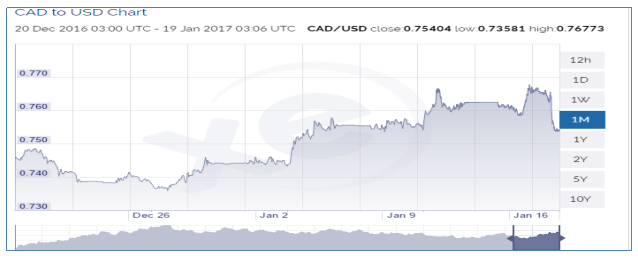
The Canadian Dollar started the year at a high note amid signs that the Canadian economy might be poised for growth in 2017. Rallying upwards by about 3% since the beginning of the year, this marks the best annual start since the currency was floated in 1970. The last time the Canadian dollar experienced such gains within the first two weeks of the year was in 2003 when it rose 2.4%. However, according to the analysis of global daily financial news at the Stern Options YouTube channel, the US dollar is expected to strengthen if the Fed raises its interest rates; and hence pull back the gains made by the its Canadian counterpart later on in the year.

On Tuesday 17th January 2017, the Canadian dollar surged up by a whole 1% to an almost three months high of 76.66 US cents. This came in the wake of comments by the President elect Donald Trump that the US dollar was too strong and that its strength was “killing us” – while referring to the US economy. His sentiments put pressure on the US stocks which dropped from their record highs, while the US dollar index experienced a 0.78% drop the same day.

Following Trumps election in November 2016, the greenback has been upbeat jumping to a 13-year high; hence triggering the statement from the President elect that the currency had strengthened so much such that it had resulted to unfair competition for American companies against their Chinese counterparts in the global markets. In his statement, Trump blamed Beijing for holding down the value of the yuan in order to benefit Chinese exporters.
Positive outlook for Canadian dollar with a pullback from the US dollar

According to forecasts compiled by Bloomberg, analysts expect the Canadian dollar to retreat to 73.52 US cents by the end of 2017. The current upward trajectory by the loonie is therefore in the opposite direction from the expected trend.

Initially, the Canadian Imperial Bank of Commerce had predicted that the Canadian dollar would slip to 72.99 US cents, but after analyzing the short-term trend within the first few weeks of 2017 and factoring in the expected economic growth, the bank is reconsidering its predictions.

“We’re in the trade still, but if C$1.30 (76.92 cents) goes we may close it out,” said Bipan Rai, a Toronto-based senior foreign-exchange and macro strategist at the bank. Attributing the recent gains in the Canadian dollar to the optimism on global manufacturing; Rai however said that those improvements were not strong enough to change his mind yet. He believes that there are other macro-economic factors that have not yet been priced in currently including the concern on the expected Trump economic policy changes that could impact the North American Free Trade Agreement (NAFTA) negatively.

Not all Trump policies will hurt the Canadian dollar though. Trump has signaled that he may approve the Keystone XL oil pipeline from Alberta’s oil sands to the US Gulf Coast. In addition, he is has promised to authorize new high spending, deregulate the markets and cut taxes; changes whose combined effect could boost Canadian exports of raw materials and equipment to the US. This could in the end support the Canadian dollar from falling drastically against its US counterpart in the long run.

Positive economic growth in Canada is also boosting the loonie.

According to data released on 6th January 2017, Canada posted its first trade surplus in more than two years in November 2016. In addition, 53,700 jobs were created in December of 2016 against the prediction by analysts that the employment numbers would experience a slight decline.

The likelihood of the Bank of Canada raising its interest rate in 2017 has been predicted to be positive by only 30% of analysts. This therefore means that the monetary policy in Canada is going to be rather stable and predictable. On the other hand, the US is expected to raise its interest rates sometime in 2017, hence strengthening the greenback which in turn will weaken the Canadian dollar.

The Trump effect is another pull back on the Canadian dollar, according to Mark McCormick, North American head of foreign-exchange strategy at Toronto-Dominion Bank. McCormick explained that, “The market has been pricing in mostly the good stuff from Trump and largely ignoring the negatives.” He continued to add that, “Trump’s policies will be more inflationary than growth-supportive and Canada continues to lag the U.S. on the closure of the output gap, leading to a wider rate gap and stronger U.S. dollar.”

Viewed collectively the above factors determining the direction the Canadian dollar will take in 2017 seem to imply that all economic fundamentals are supporting a strong Canadian dollar. However, the strength of the US dollar and the economic policy approach by Trump’s administration will weigh in heavily in finally determining the final range within which the loonie will be trading in 2017.

By Taylor Wilman


USA: Barack Obama, Donald Trump, and the Global Financial Markets

How will the end of Barack Obama’s presidency and Donald Trump’s appointment affect the global financial markets?

The 44th president of the United States of America, Barack Obama, has given his farewell address. His 8-year tenure as President is over and by the time this article is published, the 45th president-elect, Donald Trump, would more than likely have been inaugurated on 20 January 2017.

By and large, Trump’s public utterances have been explosive, changeable, rude, bombastic, and offensive, leaving the global community wondering what America is getting herself into. In my limited understanding (I am not a political expert, nor am I a historian), the election of Donald Trump is in line with the current global sentiment. There seems to be worldwide growth in nationalism and socialism. Look at Brexit, and popular nationalist sentiment in France, Germany, and the Netherlands, amongst other countries.

Obama spoke extensively on the need for America to continue along the path of democracy and not to allow nationalism to destroy everything that the USA has fought hard for.

“Democracy does not require uniformity… democracy does require a basic sense of solidarity — the idea that for all our outward differences, we are all in this together; that we rise or fall as one. There have been moments throughout our history that threatened to rupture that solidarity…. And how we meet these challenges to our democracy will determine our ability to educate our kids, and create good jobs, and protect our homeland. In other words, it will determine our future… Our democracy won’t work without a sense that everyone has economic opportunity.”

He has also urged Americans not to lose faith in the future. According to Jeff Mason of the Mail & Guardian newspaper, “President Barack Obama urged Americans on Tuesday to stand up for US values and reject discrimination as the United States transitions to the presidency of Republican Donald Trump.”

Many feel that Trump has moderated his explosive comments and that he is indeed the right man for the job. Others remain staunchly against what he stands for. The fact of the matter is that the next four years are cast in stone. No one can change the fact that the American people elected Donald Trump as the 45th USA president. What impact will this have on the American economy and, by extension, the global financial markets?

Donald Trump’s policies and the global financial markets

According to the Stern Options blog, “Trump will remain a wildcard on the global scene.. [however]… All signs point to a strong dollar through the rest of the year.”

Trump seems to be building a partnership with Russia’s Vladimir Putin instead of the traditional European Union countries, and he is intent on starting a trade war with China. He has spoken out vociferously against China, the importation of Chinese goods into the USA, and he has proposed a 45% tariff increase on all Chinese goods. In a nutshell, he blames China for stealing American jobs and capital.

Unfortunately, the addition of a 45% surcharge to all Chinese goods imported into the USA will cause economic hardships for the blue-collar workers that make up Trump’s support base. Prices of clothing and basic necessities will rise, knocking more people below the breadline. Trump’s theory is that it will protect USA jobs and promote USA business. In reality, this surcharge will have a negative impact on the USA and, by extension, the global economy. In the past, Chinese and American trade has generated major benefits for the American citizen. The manufacturing of goods in China has kept the prices lower than they would be if the same goods were manufactured in the USA. It is true that the number of jobs has decreased in the USA since the manufacturing industry has been subcontracted out to Chinese companies; however, adding a 45% tariff onto the price of all Chinese imports will do more harm than good. It won’t add any jobs to the USA economy. It will only increase the cost of goods.

At the moment, the global financial markets seem to be pricing in Trump’s ascendance to the USA presidency. The US dollar remains strong based on the promise of increased jobs in the construction sector. Trump has promised to renew ageing infrastructure.

Final words

Because the Trump factor is a wildcard on the global geopolitical stage, no one can really safely predict how long the strength of the US dollar will last. Currently, as said before, analysts are predicting a strong dollar throughout 2017, but, when all is said and done, anything can happen. The only thing we can do is wait, watch and see!

By Taylor Wilman


Ichimoku Cloud Analysis 24.01.2017 (GBP/USD, GOLD)

Article By RoboForex.com

GBP USD, “Great Britain Pound vs US Dollar”

GBP USD, Time Frame H4. Indicator signals: Tenkan-Sen and Kijun-Sen are still influenced by “Golden Cross” (1); all lines except Senkou Span B are directed upwards. Ichimoku Cloud is going up (2) and expanding, Chinkou Lagging Span is above the chart, and the price is on Tenkan-Sen. Short-term forecast: we can expect support from D Senkou Span B, and growth of the price.

GBP USD, Time Frame H1. Indicator signals: Tenkan-Sen and Kijun-Sen ran into one another above Kumo Cloud, they may intersect and form “Dead Cross” (1). Ichimoku Cloud is heading up (2), Chinkou Lagging Span is very close to the chart, and the price is on Tenkan-Sen and Kijun-Sen. Short-term forecast: we can expect support from Senkou Span A, and a further growth of the price.


XAU USD, “Gold vs US Dollar”

XAU USD, Time Frame H4. Indicator signals: Tenkan-Sen and Kijun-Sen intersected above Kumo Cloud and formed “Golden Cross” (1); the lines are still influenced by D “Golden Cross” (3). Ichimoku Cloud is moving upwards (2), Chinkou Lagging Span is on the chart, and the price is on Tenkan-Sen, inside the daily cloud. Short‑term forecast: we can expect support from Kijun-Sen, and the growth of the price towards the daily cloud’s upside border.


RoboForex Analytical Department

Article By RoboForex.com

Attention!
Forecasts presented in this section only reflect the author’s private opinion and should not be considered as guidance for trading. RoboForex LP bears no responsibility for trading results based on trading recommendations described in these analytical reviews.

Trump’s “Great Game”: Playing Russia against China?

By Dan Steinbock

Trump has pledged to reset the White House policies on “America First” basis. In Asia, it may mean an effort to balance with Russia against China – the reverse of US China approach in the 1970s.

After inauguration, Donald Trump will move from Trump Plaza in mid-Manhattan to White House in Washington, where he will enjoy extraordinary execution power. Today, Republicans will control the White House, the Senate and the House of Representatives.

Consequently, whatever the administration will decide to do is likely to be bigger and bolder, move ahead faster and have greater consequences.

In Asia, that may translate to a double pivot.

Pivoting away from China

Through his campaign, Trump voiced strong opposition against Obama-led Trans-Pacific Partnership (TPP), while labeling the North American Free Trade Agreement (NAFTA) a “disaster.” He has also suggested that he would renegotiate or reject other US international commitments.

In particular, he has threatened to use 35-45% import tariffs (although currently Trump’s team has been floating a 10% tariff) to force some countries, particularly Mexico and China, to change what he calls their “unfair trade practices.” Indeed, he is likely to press talks on trade practices, while forcing Beijing to enforce intellectual property rights.

High-level trade appointments suggest that he is likely to walk the talk. He chose Peter Navarro – the author of The Coming China Wars (2005) and Death by China (2011), and What China’s Militarism Means for the World (2015) – to head the newly-created National Trade Council (NTC), which will oversee industrial policy in the White House.

Navarro’s fellow China critic Dan DiMicco, former CEO of Nucor, America’s largest steel company, became Trump’s trade advisor. In turn, the new US Trade Representative will be former Reagan administration official Robert Lighthizer, a staunch critic of China’s trade practices.

Trump’s trade warriors will work closely with Secretary of Commerce Wilbur Ross, another billionaire investor. Trump’s trade warriors will begin by targeting those countries – China, Germany, Japan and Mexico – that currently enjoy the heftiest trade surplus with the US. In turn, the demise of NAFTA would hurt not just Mexico, but Canada.
Meanwhile, US-led free trade plans have been shelved, which has left China an opportunity to redefine trade in Asia Pacific. That effort, however, may have to cope with Trump’s double pivot.

Pivoting toward Russia

If President Obama’s major foreign policy goal was a pivot to Asia, President Trump is likely to pivot toward President Putin and Russia. Indeed, Trump’s efforts to improve relations with Russia led to a last-minute counter-attack by the US intelligence community, based in part on facts but largely on circumstantial and unsubstantiated evidence. To Trump, the intelligence dossiers, including one about him, represent the kind of neoconservative fiction that served as a pretext for the Iraq War.

Unlike Obama, Trump is open to lifting sanctions on Russia and is likely to meet Putin soon after he takes office.
In contrast to Russia, Trump has used China as a scapegoat for US trade deficit, offshoring and manufacturing decline. He has also shown willingness to challenge the basis of US-China ties since 1979, as evidenced by the recent “one China” policy debacle. Ultimately, these efforts go back to neoconservative visions in the 1990s to use imperial ‘divide and rule’ efforts in China’s special administrative regions (Hong Kong and Macao), Taiwan, and certain autonomous regions ((Xinjiang, Tibet), in order to foster dissension within the mainland.

Regionally, these efforts are likely to mean greater assertiveness, most likely in the name of “freedom of navigation” (FON) operations. In his confirmation hearing, secretary of state, Rex Tillerson, former CEO of ExxonMobil, said that he would take a strong stance on China’s claims over the South China Sea adding that US should “send China a clear signal that, first, the island-building stops, and second, your access to those islands also is not going to be allowed.”

In details, Tillerson is said to have misspoken, however. Any forceful effort of the US to circle one or all the islands would result in an open conflict with China, which is not in the US interest. Nonetheless, the new administration is opting for a somewhat new regional stance.

Playing Russia against China

Indeed, there may be a curious logic underlying Trump’s efforts to foster a pivot toward Russia but away from China. Usually, the two geopolitical moves have been analyzed separately. In fact, they are linked.

In the past few weeks, Trump has had several meetings with Henry Kissinger, who remains close to both Moscow and Beijing.

In the early 1970s, President Richard Nixon and his security adviser Kissinger sought to undermine Soviet Union’s might by making a historical opening to Beijing. What is less known is that Kissinger then observed that “in 20 years your successor, if he’s as wise as you, will wind up leaning towards the Russians against the Chinese.” He argued that the US needed “to play this balance of power game unemotionally. Right now, the US needed the Chinese to insulate the Soviets. “But in the future, it would be the other way around,” he added.

The Trump administration may presume that, from the US standpoint, such a balancing game would weaken or contain China, while, to Russia, it would ensure closer cooperation with Europe.

Yet, the assumption may prove flawed on three counts. Today, Putin’s economic, political and military ties with China are strategically too critical to endanger. Moreover, after the betrayal of its promise to avoid NATO enlargement in Russia’s regional neighborhood, US has also implemented several ill-conceived rounds of sanctions against Russia. In the process, Washington has lost all credibility among

Russians. Finally, as China has been transformed in the past four decades, Kissinger himself has maintained close ties with both Russia and China.

Nevertheless, Trump’s recent geopolitical moves – non-interventionist rhetoric but neoconservative advisers, the effort to challenge “One China” principles, the stated shift toward greater assertiveness in East and Southeast China and his double pivot vis-à-vis China and Russia – indicate that his longer-term goal may be to include Putin’s Russia in a “Common European Home” from the Atlantic to the Urals that Gorbachev promoted in 1987.
The problem is that the Cold War ended almost three decades ago, however.

About the Author:

Dr Dan Steinbock is the founder of the Difference Group and has served as the research director at the India, China, and America Institute (USA) and a visiting fellow at the Shanghai Institutes for International Studies (China) and the EU Center (Singapore). For more, see http://www.differencegroup.net/

The original version was released by The World Financial Review on Jan 17, 2017


EUR/GBP: May must get parliament approval to trigger Brexit

By GrowthAces.com

Macroeconomic overview

Jeffrey Lacker, the hawkish president of the Federal Reserve Bank of Richmond, said he is worried inflation could surge unless the U.S. central bank raises interest rates faster than his fellow policymakers anticipate.  Most of the Fed’s policymakers see the central bank raising rates three times this year.

The market ignored hawkish comments from Lacker. The dollar wallowed near seven-week lows in Asian trade on Tuesday, pressured by concerns about the impact of U.S President Donald Trump’s protectionist trade stance.

The benchmark 10-year yield posted its biggest one-day drop in more than two weeks as concerns about the fallout of Trump’s tough stance on trade spurred safe-haven demand for bonds.

Trump’s nominee for Treasury Secretary Steven Mnuchin said that an excessively strong dollar was negative in the short term, which put additional pressure on the dollar.

Technical analysis

The situation has not changed a lot from yesterday. We see a small retreat in the morning of the European trade, but this does not change an overall bullish structure.

EURUSD Daily Forex Signals Chart

Yield spread between German and U.S. 10-year bonds

Yield spread between German and U.S. 10-year bonds

Trading strategy

(Sign up now: $1 trial week or -25% for other subscriptions)


EUR/GBP: May must get parliament approval to trigger Brexit

Macroeconomic overview

Britain’s pound surged to its highest in five weeks against the USD on Monday as investors priced in a defeat for the government in its appeal against a ruling that forces it to consult parliament before formally triggering EU exit talks in March.

Today the UK Supreme Court ruled on Tuesday that Prime Minister Theresa May must get parliament’s approval before she begins Britain’s formal exit from the European Union. We see a ‘buy the rumor, sell the fact’ reaction today as GBP weakens after the court decision.

Recent macroeconomic data from the UK has been broadly mixed, with upbeat wage growth figures offset by weaker hiring and investment numbers. Official national retail sales released on Friday saw the biggest fall since April 2012, dropping 1.9% mom in December.

Technical analysis

The EUR/GBP is close to the rising December-January trendline and a close below this trendline may signal a deeper downward move. EUR/GBP bulls need a break above 0.8663/80 resistance area to feel more comfortable with their positions.

EURGBP Daily Forex Signals Chart

Yield spread between German and British 10-year bonds

Yield spread between German and British 10-year bonds

Trading strategy

(Sign up now: $1 trial week or -25% for other subscriptions)


AUD/USD: Technical analysis suggests a corrective move in the coming days

Macroeconomic overview

The Australian dollar touched two-and-a-half month highs on Tuesday as the greenback wallowed on concerns about the impact of U.S. President Donald Trump’s protectionist trade stance. Trump formally withdrew the United States from the Trans-Pacific Partnership trade deal on Monday, distancing America from its Asian allies even as China’s influence in the region rises.

CPI numbers tonight in Australia are set to confirm the general theme seen in the fourth quarter 2016 in most countries, i.e. an acceleration of inflation, mostly driven by higher oil prices and therefore boosting primarily the headline indices.

The Aussie dollar has run very fast so far this month, which may trigger some profit taking from time to time, especially if macroeconomic data disappoint.

Technical analysis

The AUD/USD struggles to hold gains on rallies toward 0.7600. A doji candlestick on Friday and long upper wick on today’s candle suggest a corrective move may be coming.

AUDUSD Daily Forex Signals Chart

Yield spread between Australian and U.S. 10-year bonds

Yield spread between Australian and U.S. 10-year bonds

Trading strategy

(Sign up now: $1 trial week or -25% for other subscriptions)


TRADING STRATEGIES SUMMARY:

FOREX – MAJOR PAIRS:

(Sign up now: $1 trial week or -25% for other subscriptions)

FOREX – MAJOR CROSSES:

(Sign up now: $1 trial week or -25% for other subscriptions)

PRECIOUS METALS:

(Sign up now: $1 trial week or -25% for other subscriptions)

About the Author:

By GrowthAces.com – Daily Forex Trading Strategies