Author Archive for InvestMacro – Page 58

The Analytical Overview of the Main Currency Pairs on 2020.04.16

by JustForex

The EUR/USD currency pair

Technical indicators of the currency pair:
  • Prev Open: 1.09786
  • Open: 1.09079
  • % chg. over the last day: -0.66
  • Day’s range: 1.08646 – 1.09112
  • 52 wk range: 1.0777 – 1.1494

Yesterday, the United States published a series of pessimistic economic releases. At the same time, the greenback has strengthened relative to its main competitors. The fall in EUR/USD quotes exceeded 100 points. Demand for risky assets was significantly weakened amid the COVID-19 pandemic. At the moment, the EUR/USD currency pair is consolidating in the range of 1.0860-1.0910. A trading instrument has the potential for further decline. We expect the publication of important statistics. Positions should be opened from key levels.

The Economic News Feed for 16.04.2020

  • – German IFO business climate index at 11:00 (GMT+3:00);
  • – Data on the US real estate market at 15:30 (GMT+3:00);
  • – Philadelphia Fed manufacturing index at 15:30 (GMT+3:00).
EUR/USD

Indicators do not give accurate signals: the price has crossed 100 MA.

The MACD histogram is in the negative zone and below the signal line, which gives a strong signal to sell EUR/USD.

Stochastic Oscillator is in the neutral zone, the %K line has started to cross the %D line. There are no signals at the moment.

Trading recommendations
  • Support levels: 1.0860, 1.0830, 1.0775
  • Resistance levels: 1.0910, 1.0950, 1.0990

If the price fixes below 1.0860, a further fall in the EUR/USD currency pair is expected. The movement is tending to 1.0830-1.0800.

An alternative could be the growth of EUR/USD quotes to 1.0940-1.0960.

The GBP/USD currency pair

Technical indicators of the currency pair:
  • Prev Open: 1.26187
  • Open: 1.25095
  • % chg. over the last day: -0.86
  • Day’s range: 1.24606 – 1.25268
  • 52 wk range: 1.1466 – 1.3516

GBP/USD quotes have been declining. The British pound has updated local lows. The trading instrument is currently consolidating. The key range is 1.2440-1.2525. We expect the publication of important economic reports from the US. Investors continue to assess the risks of the further COVID-19 spread and its impact on the global economy. We recommend opening positions from key support and resistance levels.

The news feed on the UK economy is calm.

GBP/USD

Indicators do not give accurate signals: the price has fixed between 50 MA and 100 MA.

The MACD histogram is in the negative zone, indicating the bearish sentiment.

Stochastic Oscillator is in the neutral zone, the %K line is above the %D line, which gives a signal to buy GBP/USD.

Trading recommendations
  • Support levels: 1.2440, 1.2360, 1.2290
  • Resistance levels: 1.2525, 1.2575, 1.2645

If the price fixes above 1.2525, further growth of GBP/USD quotes is expected. The movement is tending to 1.2575-1.2630.

An alternative could be a decrease in the GBP/USD currency pair to 1.2400-1.2350.

The USD/CAD currency pair

Technical indicators of the currency pair:
  • Prev Open: 1.38861
  • Open: 1.41074
  • % chg. over the last day: +1.67
  • Day’s range: 1.40884 – 1.41372
  • 52 wk range: 1.2949 – 1.4668

There are aggressive purchases on the USD/CAD currency pair. During yesterday’s and today’s trading, the growth of quotes exceeded 250 points. The trading instrument has set new local highs. The loonie is under pressure due to the negative dynamics of “black gold” prices. The Bank of Canada, as expected, kept the key marks of monetary policy at the same level. At the moment, the USD/CAD currency pair is consolidating in the range of 1.4070-1.4140. Quotes have the potential for further growth. We recommend opening positions from key levels.

Today, the news feed on Canada’s economy is calm enough.

USD/CAD

Indicators signal the power of buyers: the price has fixed above 100 MA.

The MACD histogram is in the positive zone, which indicates the development of bullish sentiment.

Stochastic Oscillator is in the neutral zone, the %K line has crossed the %D line. There are no signals at the moment.

Trading recommendations
  • Support levels: 1.4070, 1.4000, 1.3925
  • Resistance levels: 1.4140, 1.4200, 1.4260

If the price fixes above the resistance level of 1.4140, further growth of USD/CAD quotes is expected. The movement is tending to the round level of 1.4200.

An alternative could be a decrease in the USD/CAD currency pair to 1.4030-1.4000.

The USD/JPY currency pair

Technical indicators of the currency pair:
  • Prev Open: 107.211
  • Open: 107.378
  • % chg. over the last day: +0.25
  • Day’s range: 107.307 – 108.081
  • 52 wk range: 101.19 – 112.41

The USD/JPY currency pair has been growing after a prolonged fall. The trading instrument has updated local highs. At the moment, USD/JPY quotes are consolidating in the range of 107.70-108.10. Investors expect additional drivers. Demand for the “safe haven” currency is still high. We recommend paying attention to the news feed from the US. Positions should be opened from key levels.

The publication of important economic releases from Japan is not planned.

USD/JPY

Indicators do not give accurate signals: the price has fixed between 50 MA and 100 MA.

The MACD histogram is in the positive zone, indicating the bullish sentiment.

Stochastic Oscillator is in the neutral zone, the %K line is below the %D line, which gives a signal to sell USD/JPY.

Trading recommendations
  • Support levels: 107.70, 107.25, 106.90
  • Resistance levels: 108.10, 108.50

If the price fixes below 107.70, it is necessary to look for entry points to the market to open short positions. The movement is tending to 107.40-107.30.

An alternative could be the growth of the USD/JPY currency pair to 108.40-108.60.

by JustForex

If Investors Crunched Data Like This Their Expectations Would Change Dramatically

By TheTechnicalTraders 

– New economic data being released as earnings start to hit may alter how investors perceive the recent price recovery in the US and global markets.  Many institutional analysts began suggesting “the bottom is in” and recently began to issue stronger forward guidance.  The new data suggests we are seeing an economic contraction that, in some cases, maybe 2x or 3x the contraction that took place in the 2008-09 Credit Crisis.

The US stock markets reacted to this news and earnings data by collapsing over -2% in early trading.  Gold and Silver are both lower as we write this article which would indicate weakness across the broader market.  We continue to believe a deeper price low will set up in the near future with the US and global stock prices attempting to retest recent price lows – possibly falling below these levels.  We believe the collateral damage to consumer engagement, manufacturing, transportation, retail/leisure, real estate and other sectors of the economy is just now starting to become evident.  What the economy may look like near Mid-May is anyone’s guess.

Manufacturing Output Index

One of the most interesting data items published recently in the US Manufacturing Output Index which reported at -6.3%.  This is the largest downside (negative) print going back over 20 years.  It is nearly 2x larger than the deepest levels from the 2008-09 Credit Crisis and nearly 6x the levels of the 2001 9/11 terrorist attacks.  This time it really is different.

Before we continue, be sure to opt-in to our free market trend signals 
before closing this page, so you don’t miss our next special report!

New York Empire State Manufacturing Index

The New York Empire State Manufacturing Index was no different – posting a level at -78.20%.  This massive negative number is nearly 2x the deepest levels printed during the 2008-09 Credit Crisis and clearly illustrates how the COVID-19 virus event has disrupted manufacturing output across the globe.  Depressed manufacturing translates into decreased shipping, decreased supply, decreased demand, and decreased overall economic engagement (employment, support services, taxes, and others).  A number similar to the lows of 2008-09 would be sufficiently terrible.  A number that is 2x below the lowest levels in 2008-09 is absolutely destructive to forward expectations.

NAHB Real Estate Index

Real estate is starting to feel the pinch too.  The NAHB Real Estate Index came in at 30.  The only times in history where this level has been reached were September 1990, October 2006, and June 2007.  These areas in history clearly point to an early recession indicator in the markets.  We found it interesting that September 2001 (9/11) didn’t experience any major downside print in the NAHB index.  The lowest level reached after 9/11 was 46 (November 2001).  The current 30 level is shocking.  If history is any indication of what to expect in the future, this real estate index may attempt to set up an extended bottom near or below 15 to 20 over the next 12+ months.

Redbook Index

Lastly, the Redbook Index – which printed a level of -8.3.  This index of over 9000 retail locations is one of the broadest market indicators of consumer/retail-based activity in the US.  Obviously, with the shutdown taking place within the US and across the globe, we were not expecting any type of fantastic number. Yet our concern is that consumer engagement continues to slowly emerge from the shutdown over the next 12+ months and the collapse in retail may become prolonged

Historically, this is the deepest level printed on the Redbook Index since 2008-09.  We believe the continued shutdown and disruption to traditional manufacturing, supply and retail will continue to present very negative outcomes for global economic measures.  Thus, we believe the risks to the US and global stock market are still very real for skilled traders.

Concluding Thoughts:

The US Fed and global central banks are doing everything possible to support a shocked global economy – yet they can’t print enough money to replace the global activity of consumers, manufacturers, and traditional economic functions. They can just attempt to “patch things up” while they wait for consumers and manufacturers to begin operating near-normal levels.

It is very important for skilled traders to understand the bigger economic risks that are at play and to understand the process of price moves within the current market cycle.  I was recently interviewed about my market opinions and stated very clearly how investors could fall into a “suckers rally” trap.  Listen to my talk here.

Be prepared for more downside risks and a potential for a much deeper price bottom over the next 6+ months.  Those individuals/firms suggesting “the bottom is in” are certainly jumping the shark, in our opinion, right now.  It’s a pretty big event to come out right now and tell investors “buy these dips because we believe the US Fed has everything under control”.  Be cautious and use your own skills to wait for a proper bottom setup.

I have to toot my own horn here a little because subscribers and I had our trading accounts close at a new high watermark for our accounts. We not only exited the equities market as it started to roll over, but we profited from the sell-off in a very controlled way, and yesterday we locked in more profits with our SPY ETF trade on this bounce.

As a technical analyst and trader since 1997, I have been through a few bull/bear market cycles in stocks and commodities. I believe I have a good pulse on the market and timing key turning points for investing and short-term swing traders. 2020 is going to be an incredible year for skilled traders.  Don’t miss all the incredible moves and trade setups.

I hope you found this informative, and if you would like to get a pre-market video every day before the opening bell, along with my trade alerts. These simple to follow ETF swing trades have our trading accounts sitting at new high water marks yet again this week, not many traders can say that this year. Visit my Active ETF Trading Newsletter.

We all have trading accounts, and while our trading accounts are important, what is even more important are our long-term investment and retirement accounts. Why? Because they are, in most cases, our largest store of wealth other than our homes, and if they are not protected during a time like this, you could lose 25-50% or more of your entire net worth. The good news is we can preserve and even grow our long term capital when things get ugly like they are now and ill show you how and one of the best trades is one your financial advisor will never let you do because they do not make money from the trade/position.

If you have any type of retirement account and are looking for signals when to own equities, bonds, or cash, be sure to become a member of my Long-Term Investing Signals which we issued a new signal for subscribers.

Ride my coattails as I navigate these financial markets and build wealth while others lose nearly everything they own during the next financial crisis.

Chris Vermeulen
Chief Market Strategies

TheTechnicalTraders.com


In Every Bear Market, One Asset Always Surges in Value — This One

“The relative value of cash will necessarily zoom higher when stocks plunge.”

By Elliott Wave International

A negative sentiment toward cash had been in place for quite some time.

Let’s go back a little more than a year when our Feb. 2019 Elliott Wave Theorist showed this chart and said:

The average cash holding in mutual funds just fell to an all-time low. All long term sentiment indicators look like [this], except for the ones that look even worse.

These headlines published later in 2019:

  • Why you shouldn’t go to cash now — in one chart (Aug. 6, CNBC)
  • 3 reasons to stay in a volatile market and not cash out (Aug. 8, Yahoo Finance)

These dismissive views toward cash are what to expect after a historically long uptrend in stocks. Many investors expected equity prices to keep climbing, so why hold cash?

Indeed, as recently as January, one highly prominent professional investor reverted back to the old saying, “Cash is trash.”

However, in the same month, our Elliott Wave Financial Forecast said:

Cash is the only answer to survival in the coming environment.

The just-published April Elliott Wave Financial Forecast followed up with this chart and said:

Equities are the opposite of cash; risk-assets that require the surrender of cash. The relative value of cash will necessarily zoom higher when stocks plunge. The chart inverts the Dow’s recent plunge to show the liftoff for a new bull market in cash. … As [the book] Conquer the Crash stated: “When the stock market reaches bottom, you can buy incredibly cheap shares that almost no one else can afford because they lost it all when their stocks collapsed.”

Speaking of a stock market bottom, are we almost there?

Well, as recently as March 28 (Marketwatch), a major financial website sported this sub-headline:

Coronavirus crash is a buying opportunity for focused, long-term investors

As the April Elliott Wave Financial Forecast relatedly noted:

The evidence of an entrenched and even surging public infatuation with shares is not simply anecdotal. A Bankrate survey of about 2500 U.S. consumers from March 20 through March 24 found that just 11% have taken investments out of the marker in first quarter of 2020, while 13% “added more investments over the last three months.” Another 66% of respondents said “they intentionally left their holdings as is.” Ten percent said “they were unaware of the current economic volatility.” So, buyers or holders of equities accounted for almost 90% of investors through the worst first quarter in the 124-year history of the Dow Jones Industrial Average. Remarkably, 47% said they cut spending over “concerns of the economy.” Just 15% said they did so because of “concerns over the stock market.”

However, Elliott wave analysis of the stock market’s price pattern suggests that many investors will soon wish they had embraced cash instead of stocks.

Now is the time to learn all you can about the Elliott wave model so you can apply this knowledge to the current stock market picture and gain insights into what to expect next.

A great educational resource is the online version of the book, Elliott Wave Principle: Key to Market Behavior by Frost & Prechter, which you can access free when you join Club EWI. Membership in Club EWI is also 100% free.

Get started.

This article was syndicated by Elliott Wave International and was originally published under the headline In Every Bear Market, One Asset Always Surges in Value — This One. EWI is the world’s largest market forecasting firm. Its staff of full-time analysts led by Chartered Market Technician Robert Prechter provides 24-hour-a-day market analysis to institutional and private investors around the world.


Forex Technical Analysis & Forecast 15.04.2020

Article By RoboForex.com

EURUSD, “Euro vs US Dollar”

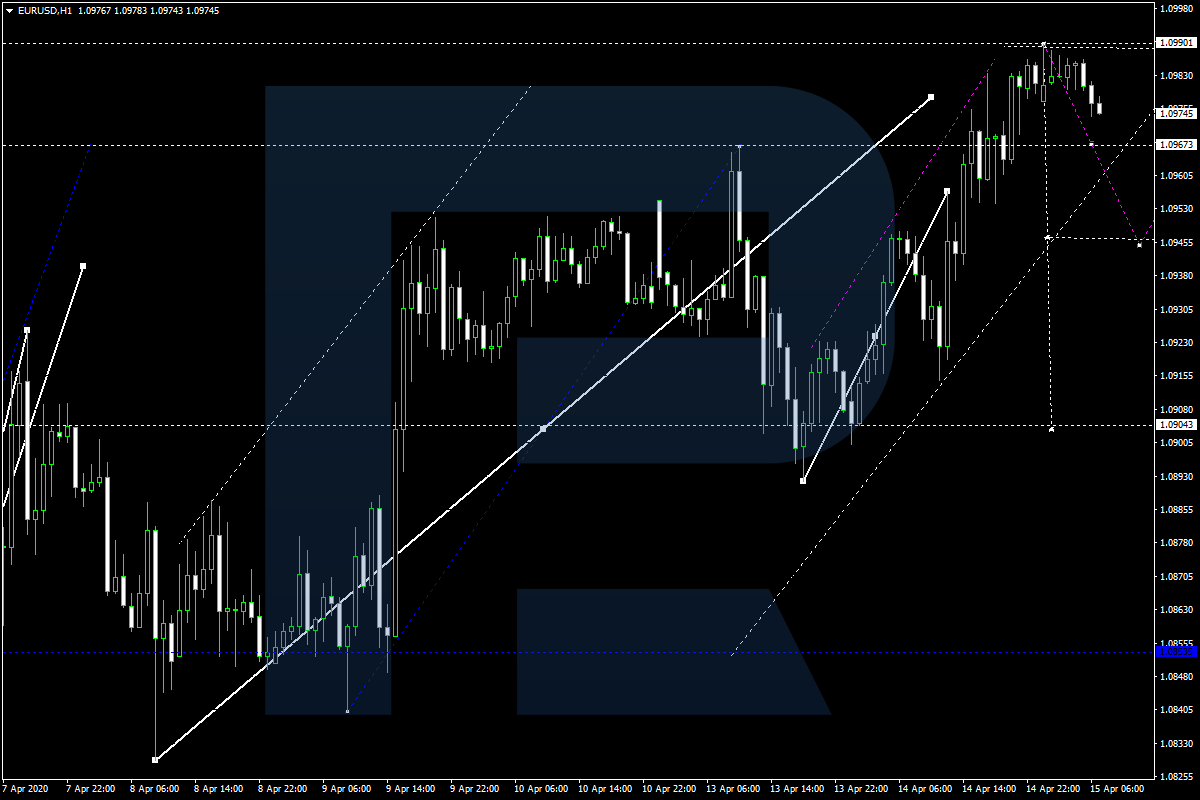
After finishing another ascending structure at 1.0090, EURUSD has almost completed one more ascending wave. Possibly, today the pair may form the first descending towards 1.0940 and then resume growing to reach 1.0966, thus forming a new consolidation range between these two levels. Later, the market may break the range to the downside and then start another decline with the first target at 1.0900.

EURUSD
Risk Warning: the result of previous trading operations do not guarantee the same results in the future

GBPUSD, “Great Britain Pound vs US Dollar”

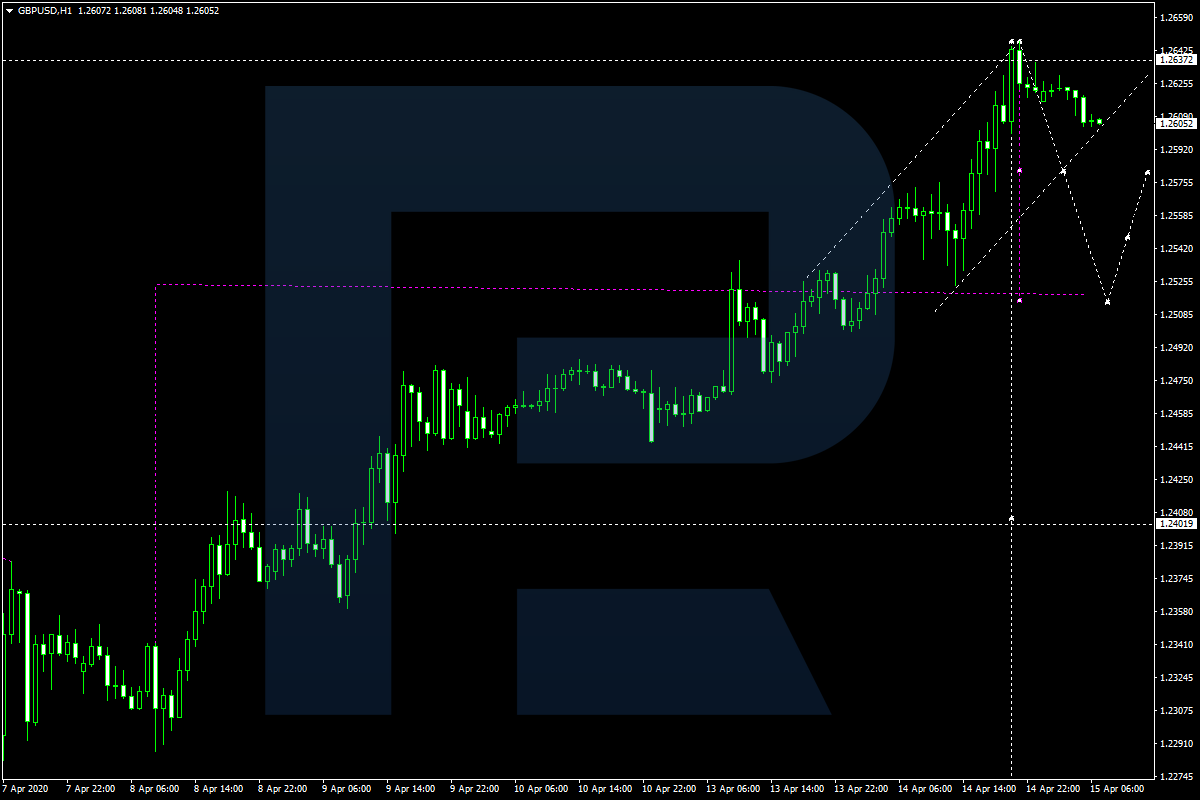
After completing the ascending structure at 1.2635, GBPUSD is moving downwards to reach 1.2520. After that, the instrument may resume growing towards 1.2580, thus forming a new consolidation range between these two levels. If later the price breaks this range to the downside, the market may resume trading downwards with the first target at 1.2400.

GBPUSD
Risk Warning: the result of previous trading operations do not guarantee the same results in the future

USDRUB, “US Dollar vs Russian Ruble”

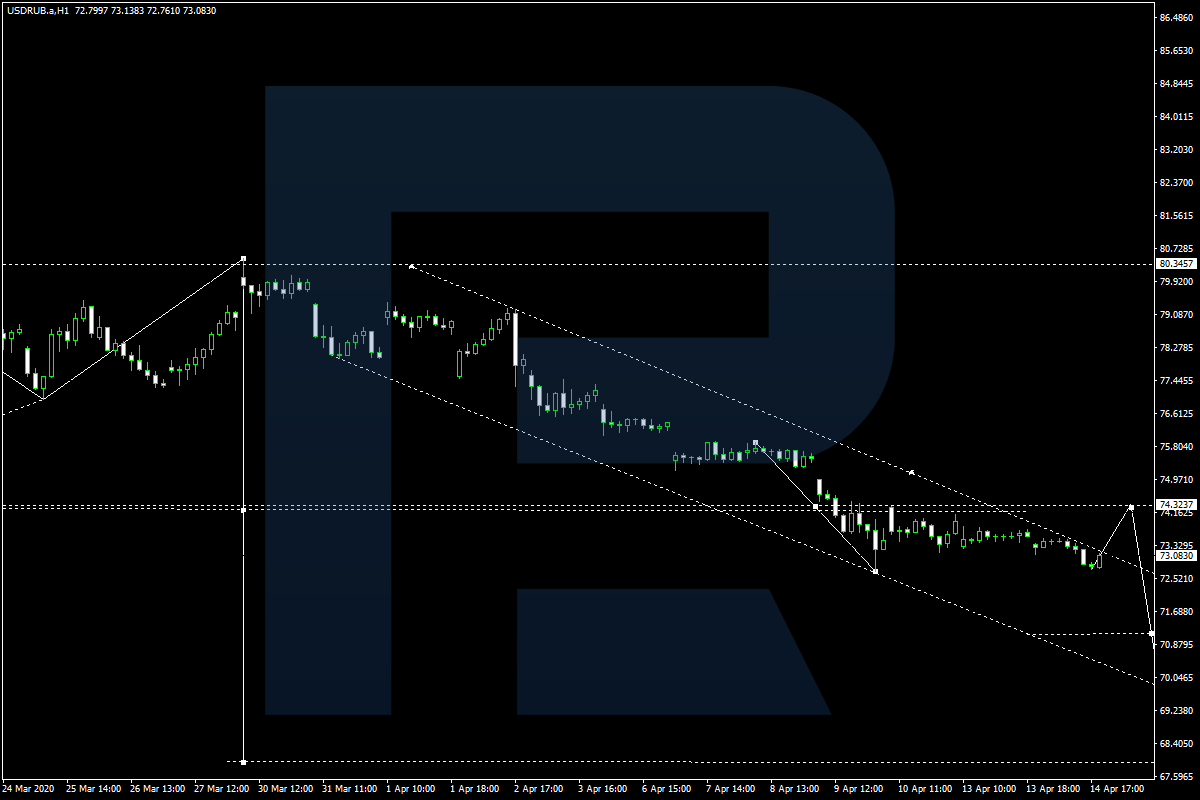
After forming the consolidation range below 74.34, USDRUB is moving not far from its downside border. According to the main scenario, the price is expected to break 72.60 and then continue falling towards 71.20. Later, the market may start another consolidation range and then resume trading downwards with the target at 68.50.

USDRUB
Risk Warning: the result of previous trading operations do not guarantee the same results in the future

USDJPY, “US Dollar vs Japanese Yen”

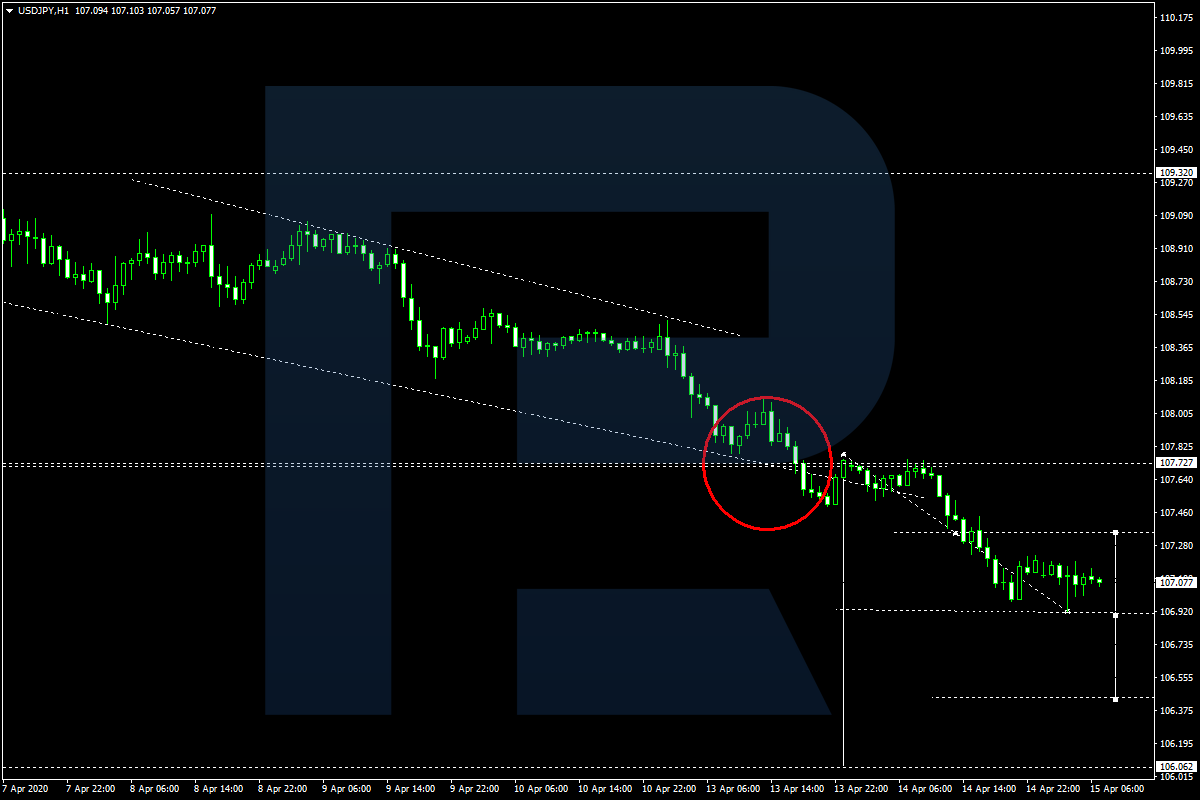
After breaking 107.33 to the downside, USDJPY has finished the first part of another descending wave at 106.92. Today, the pair may correct to return to 107.33 and test it from below. Later, the market may start another decline with the target at 106.10.

USDJPY
Risk Warning: the result of previous trading operations do not guarantee the same results in the future

USDCHF, “US Dollar vs Swiss Franc”

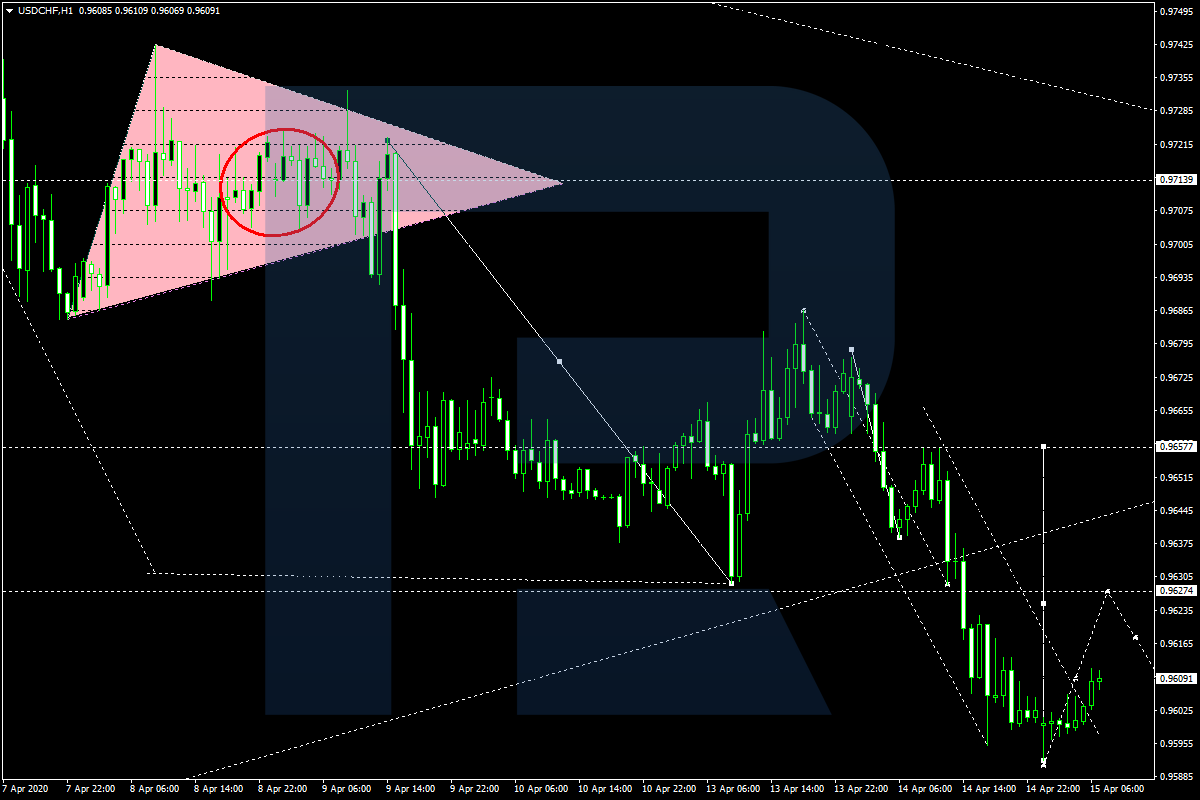
After completing another descending wave towards 0.9595, USDCHF is moving upwards. Possibly, the pair may reach 0.9630 and then start another decline towards 0.9600, thus forming a new consolidation range between these levels. Later, the market may break the range to the upside and resume growing with the first target at 0.9660.

USDCHF
Risk Warning: the result of previous trading operations do not guarantee the same results in the future

AUDUSD, “Australian Dollar vs US Dollar”

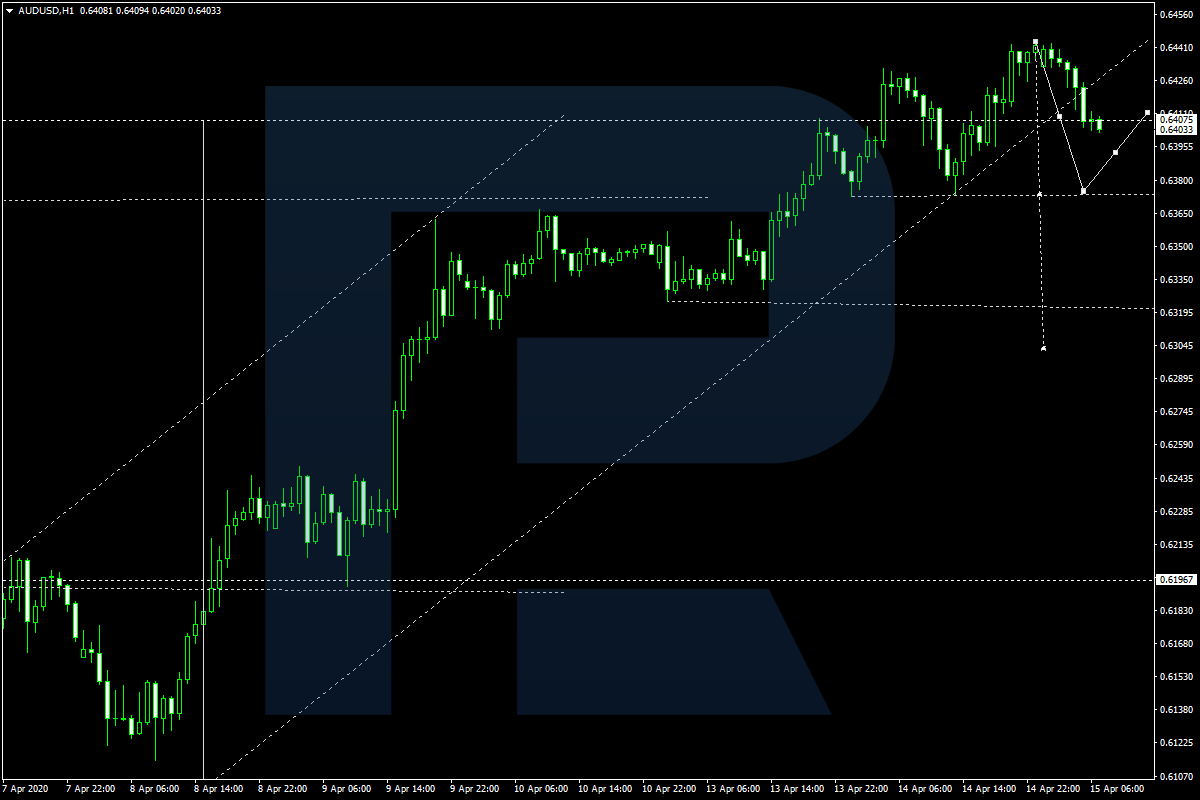
After extending the ascending wave up to 0.6440, AUDUSD is moving downwards to reach 0.6380. After that, the instrument may start another growth towards 0.6408, thus forming a new consolidation range between these levels. Later, the market may break the range to the downside and then resume trading downwards with the first target at 0.6200.

AUDUSD
Risk Warning: the result of previous trading operations do not guarantee the same results in the future

BRENT

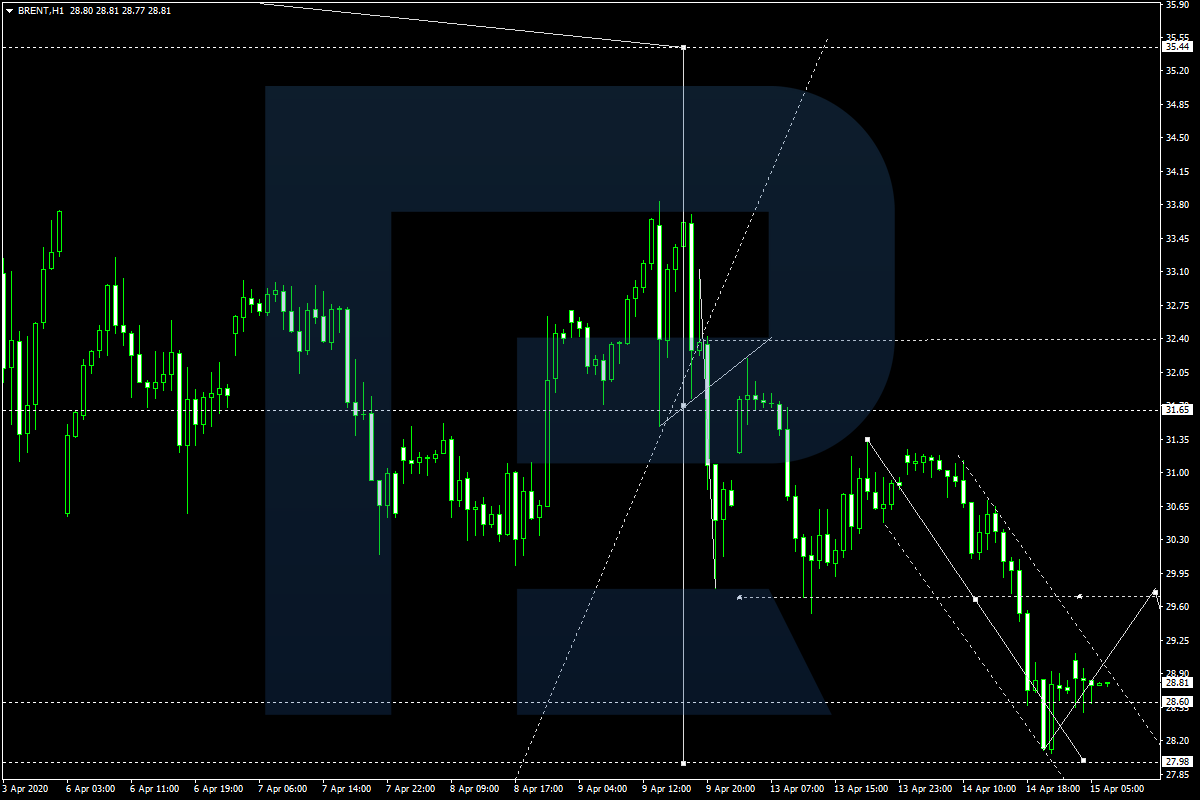
After finishing another descending structure at 29.08, Brent is consolidating below this level. Possibly, the pair may form one more ascending structure towards 29.60 and then resume falling to reach 27.90. Later, the market may start another growth with the target at 31.60.

BRENT
Risk Warning: the result of previous trading operations do not guarantee the same results in the future

XAUUSD, “Gold vs US Dollar”

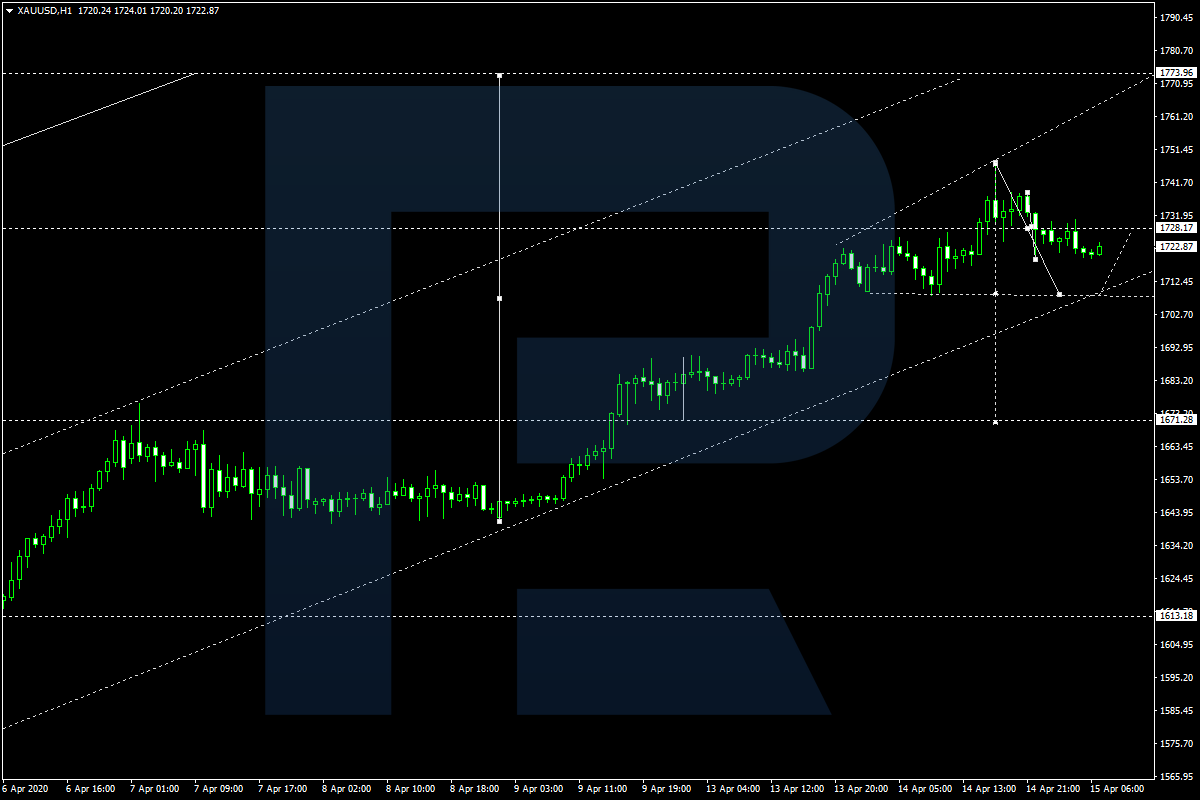
Gold is falling towards 1708.00. Possibly, the pair may reach it and then start another growth towards 1728.00, thus forming a new consolidation range between these two levels. If later the price breaks this range to the downside, the market may correct to reach 1672.00; if to the upside – resume trading inside the uptrend to complete the ascending wave at 1770.0. After that, the instrument may start a new decline with the first target at 1615.00.

GOLD
Risk Warning: the result of previous trading operations do not guarantee the same results in the future

BTCUSD, “Bitcoin vs US Dollar”

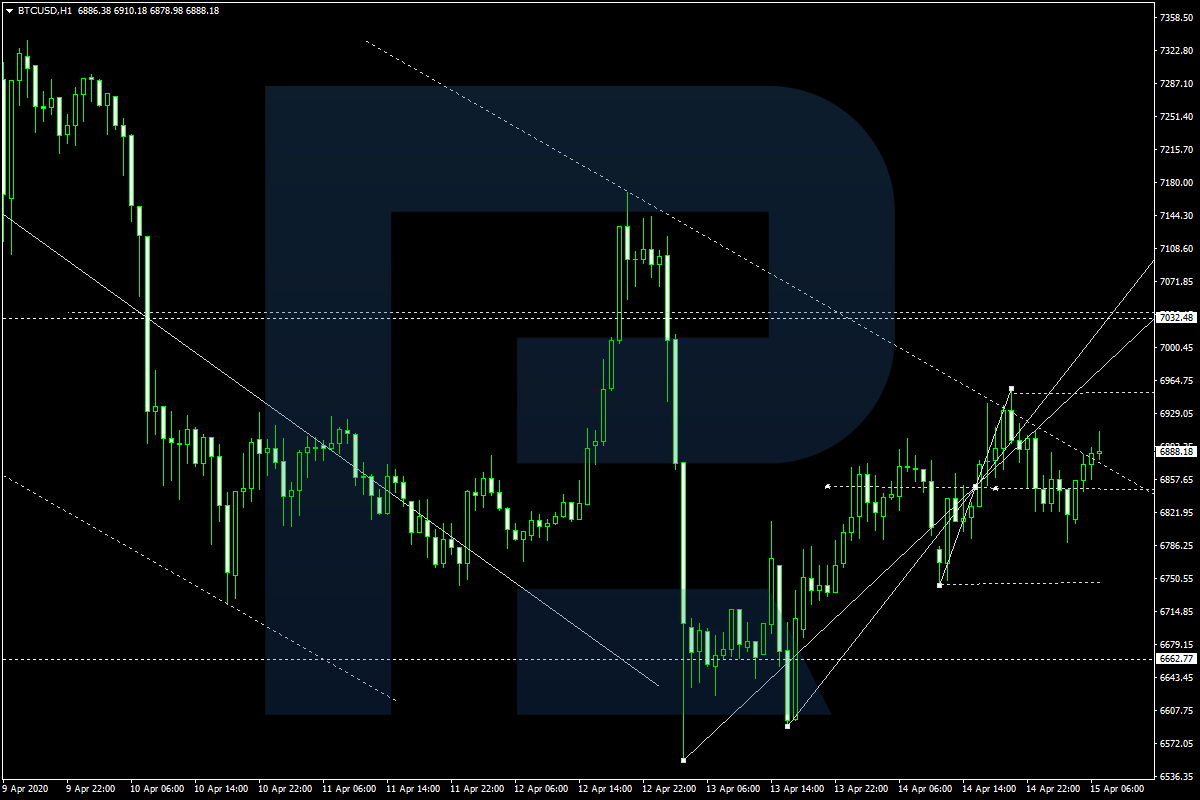
BTCUSD is consolidating in the center of the range around 6830.00. Possibly, today the pair may break the range to the upside to reach 7100.00 and then resume falling towards 6850.00. After that, the instrument may form one more ascending structure with the target at 7200.00.

BITCOIN
Risk Warning: the result of previous trading operations do not guarantee the same results in the future

S&P 500

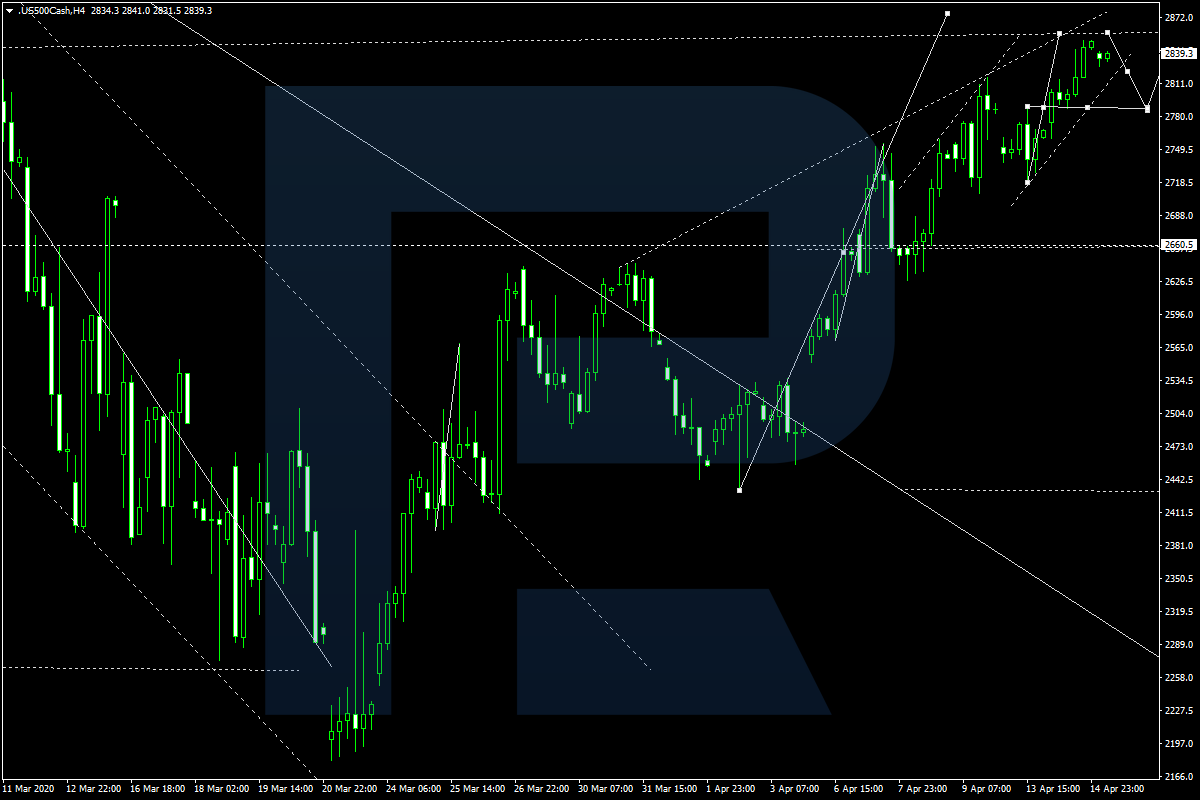
S&P 500 is moving upwards to reach 2871.5. Today, the instrument may reach 2856.5 and then form a new descending structure towards 2793.5. Later, the market may start another growth to return to 2871.5 and then resume trading downwards with the first target at 2660.5.

SP500

Article By RoboForex.com

Attention!
Forecasts presented in this section only reflect the author’s private opinion and should not be considered as guidance for trading. RoboForex LP bears no responsibility for trading results based on trading recommendations described in these analytical reviews.

Fibonacci Retracements Analysis 15.04.2020 (GBPUSD, EURJPY)

Article By RoboForex.com

GBPUSD, “Great Britain Pound vs US Dollar”

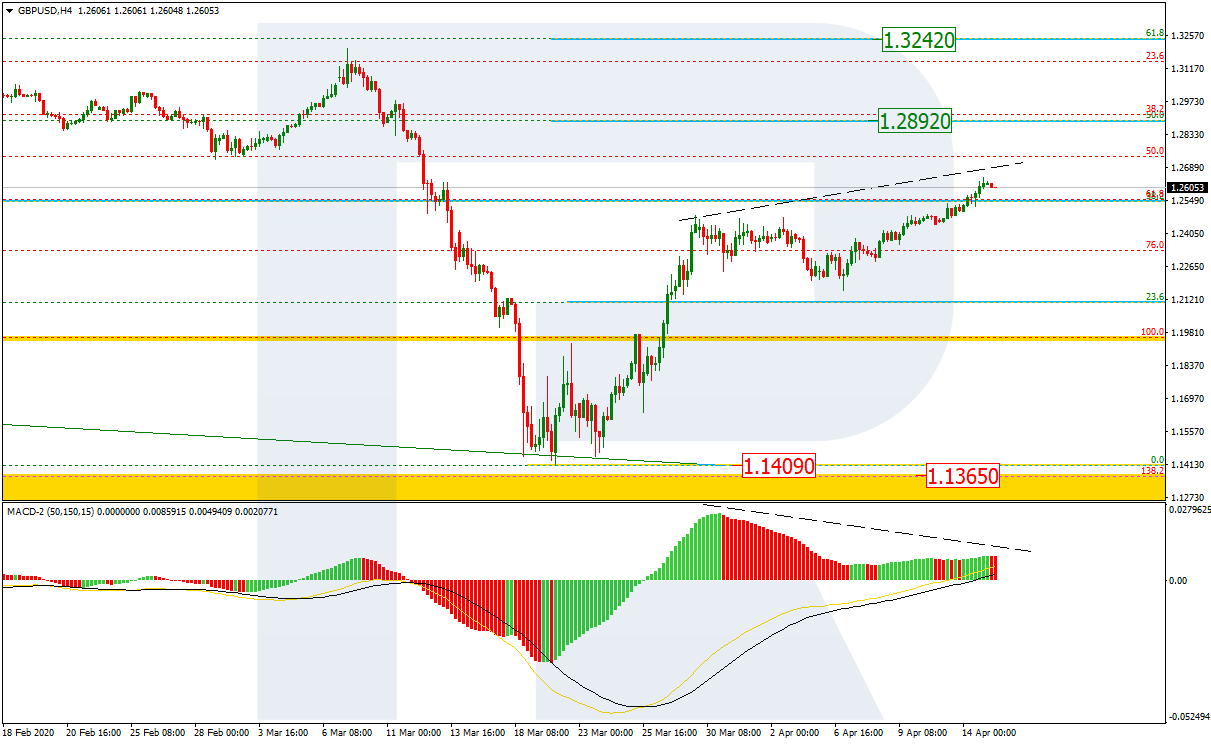
As we can see in the H4 chart, after completing a short-term correction and breaking the local high, GBPUSD has reached 38.2% fibo. The next upside targets may be 50.0% and 61.8% fibo at 1.2892 and 1.3242 respectively, but the current growth is so slow that it may suggest a possible pullback. Another signal to confirm the pullback is a divergence on MACD. If the price breaks the low at 1.1409, the instrument may continue falling towards the post-correctional extension area between 138.2% and 161.8% fibo at 1.1365 and 1.0996 respectively.

GBPUSD_H4
Risk Warning: the result of previous trading operations do not guarantee the same results in the future

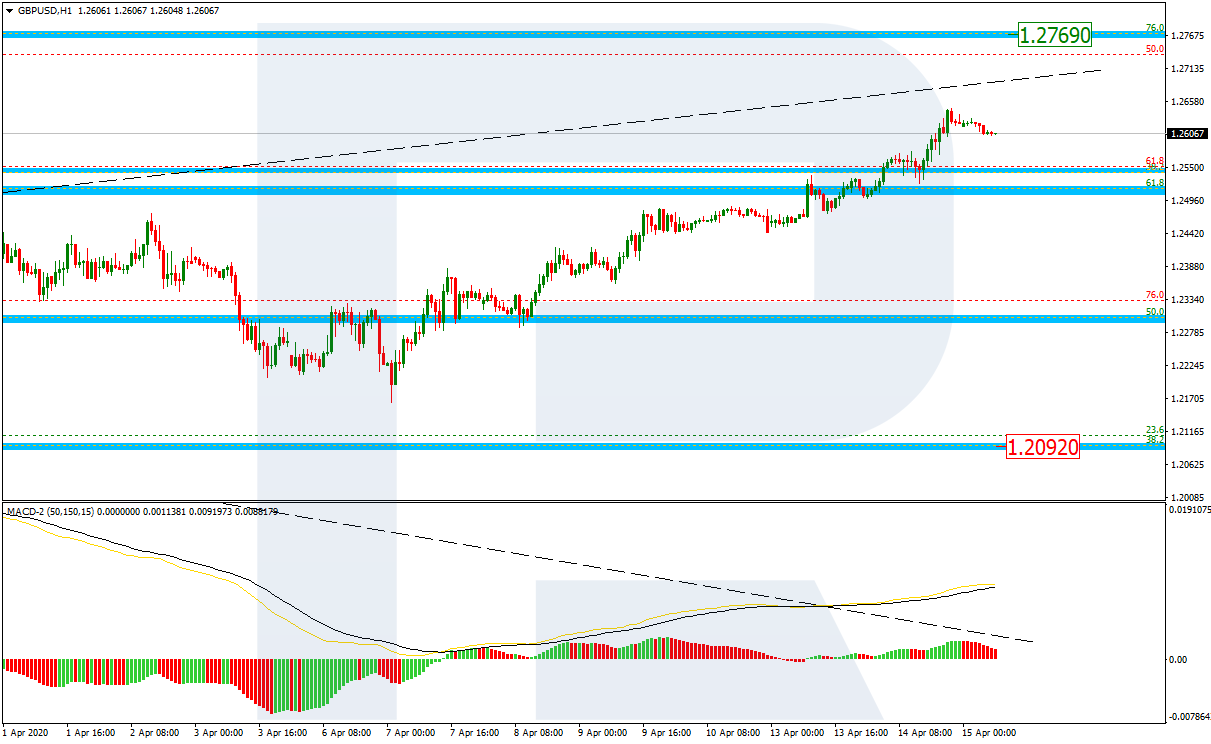
The H1 chart shows a more detailed structure of the rising tendency. The pair is approaching 76.0% fibo at 1.2769. At the same time, there is a divergence on MACD, which may indicate a possible reversal towards 38.2% fibo (1.2092).

GBPUSD_H1
Risk Warning: the result of previous trading operations do not guarantee the same results in the future

EURJPY, “Euro vs. Japanese Yen”

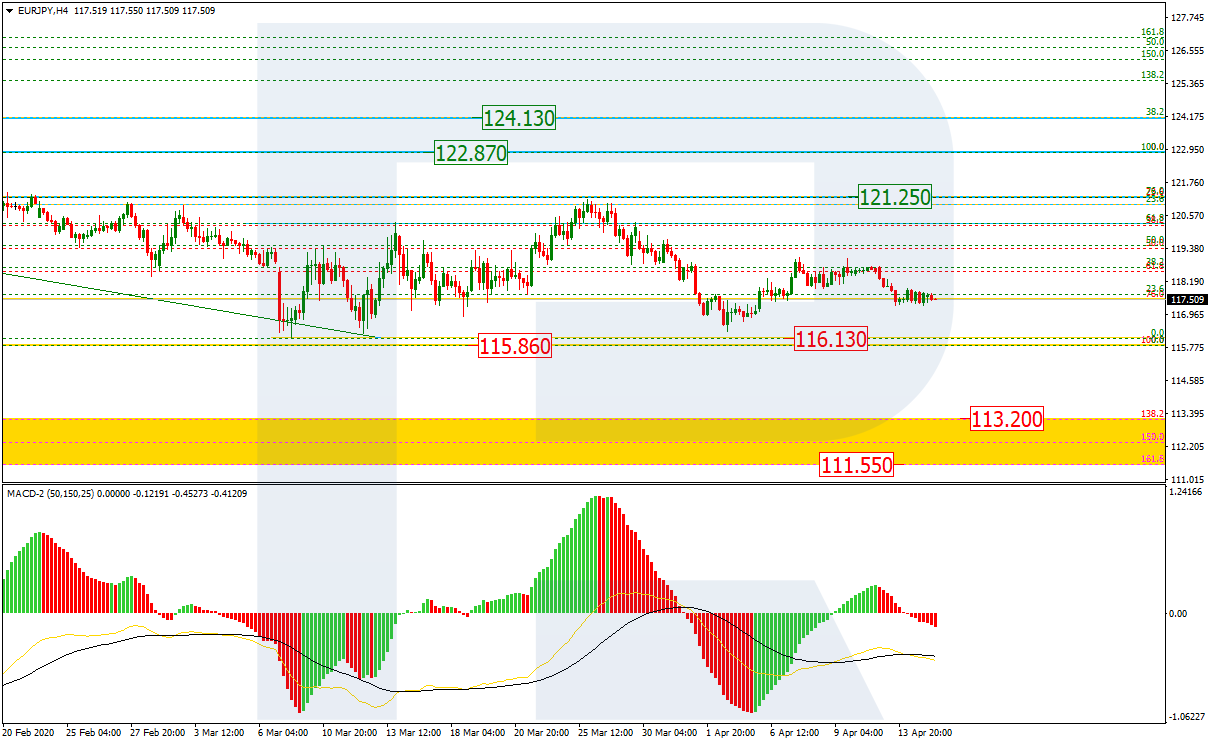
As we can see in the H4 chart, nothing has really changed over the previous week. The pair has failed to reach 76.0% fibo at 121.25; right now, it is failing to break the local low at 116.13 and then the key one at 115.85. If it happens, the instrument may continue trading towards the post-correctional extension area between 138.2% and 161.8% fibo at 113.20 and 111.55 respectively.

EURJPY_H4
Risk Warning: the result of previous trading operations do not guarantee the same results in the future

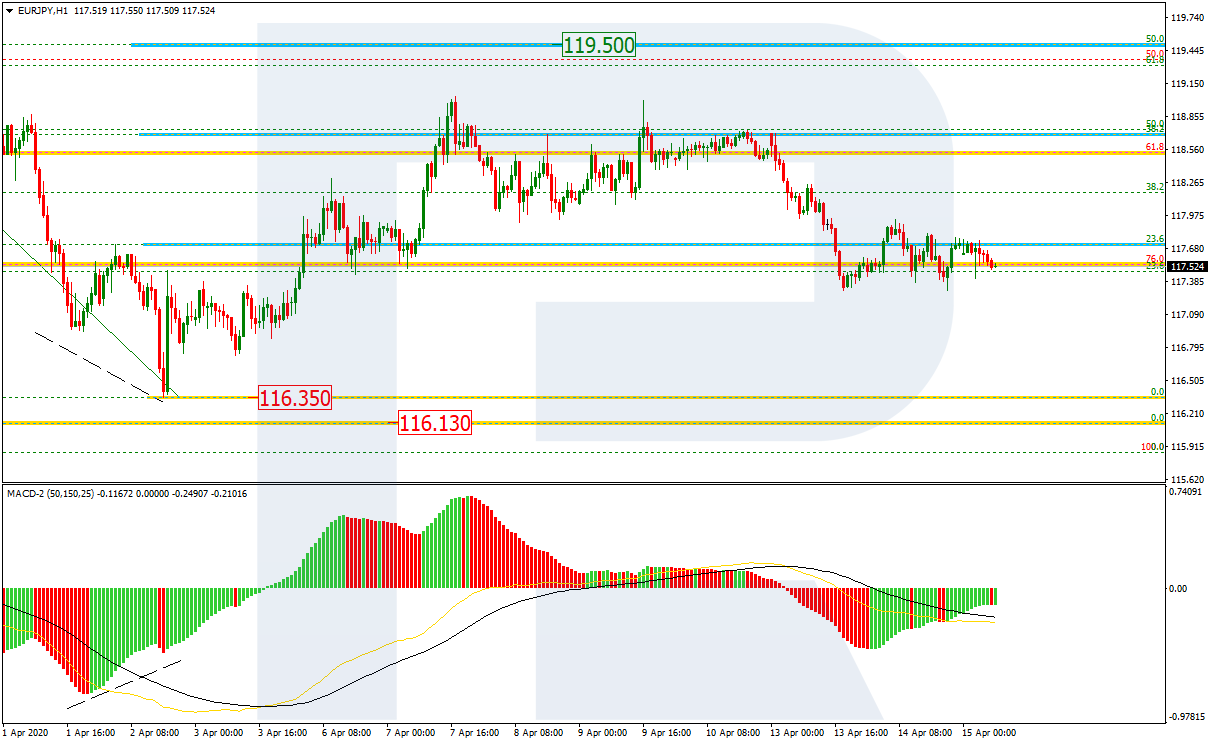
In the H1 chart, the correctional uptrend has reached 38.2% fibo and judging by the structure of the first descending wave the uptrend is very unlikely to reach 50.0% fibo at 119.50 anytime soon. The downside target and the support are the low at 116.35.

EURJPY_H1

Article By RoboForex.com

Attention!
Forecasts presented in this section only reflect the author’s private opinion and should not be considered as guidance for trading. RoboForex LP bears no responsibility for trading results based on trading recommendations described in these analytical reviews.

Could This Be a “Suckers” Rally?

By TheTechnicalTraders 

– Everyone I know who is not involved in the stock market or has little knowledge about it is calling me and asking what stocks, indexes, and commodities to buy because everything is so cheap and dividends are juicy again.

Just look at the market sentiment chart, and price cycles that the stock market goes through, and listen to my talk below while reviewing these to images. It’s not rocket science, but the lack of education on the financial markets coupled with the force of greed to make money and miss out on the next big bull market has everyone getting suckered into this dead-cat bounce, also known as a bear trap, bear market rally.

LISTEN TO MY TALK – CLICK HERE

If you want to see something else really exciting/nerve-wracking/ and real check out this post on the Stock Market Top.

A subscriber to my market video analysis and ETF trading newsletter said it perfectly:

“Always intrigues me how many amateur surfers get to the north shore beaches in Hawaii, take one look at monster waves and conclude it’s way too dangerous. Yet the amateur trader looks at treacherous markets like these and wants to dive right in!!” Richard P.

I have to toot my own horn here a little because subscribers and I had our trading accounts close at a new high watermark for our accounts. We not only exited the equities market as it started to roll over we profited from the sell-off in a very controlled way.

As a technical analyst and trader since 1997, I have been through a few bull/bear market cycles in stocks and commodities. I believe I have a good pulse on the market and timing key turning points for investing and short-term swing traders. 2020 is going to be an incredible year for skilled traders.  Don’t miss all the incredible moves and trade setups.

I hope you found this informative, and if you would like to get a pre-market video every day before the opening bell, along with my trade alerts. These simple to follow ETF swing trades have our trading accounts sitting at new high water marks yet again this week, not many traders can say that this year. Visit my Active ETF Trading Newsletter.

We all have trading accounts, and while our trading accounts are important, what is even more important are our long-term investment and retirement accounts. Why? Because they are, in most cases, our largest store of wealth other than our homes, and if they are not protected during a time like this, you could lose 25-50% or more of your entire net worth. The good news is we can preserve and even grow our long term capital when things get ugly like they are now and ill show you how and one of the best trades is one your financial advisor will never let you do because they do not make money from the trade/position.

If you have any type of retirement account and are looking for signals when to own equities, bonds, or cash, be sure to become a member of my Long-Term Investing Signals which we issued a new signal for subscribers.

Ride my coattails as I navigate these financial markets and build wealth while others lose nearly everything they own during the next financial crisis.

Chris Vermeulen
Chief Market Strategies
TheTechnicalTraders.com


Coronavirus And The Coming Financial Revolution

By OilPrice.com

– The coronavirus pandemic is one of the biggest and unprecedented seismic shifts in the global economy that we’ve ever seen in modern history, and it’s just getting started.

Already, economies around the world are shutting down. The federal reserve has pumped trillions into the United States economy in just a matter of days. Global supply chains have collapsed as entire Chinese industries went dark. And this is just the first stage. We’re heading into a year’s long recession that will have far-reaching consequences, some of which we can predict with near certainty, and some of which will be entirely unpredictable.

Of course, the global economic system has seen major shakeups before. The timespan known as modern history, in official terms, begins with the onset of the industrial revolution. The globalized market economy that we live in today is all thanks to the revolution that started in Great Britain in the late 18th century, which mechanized manufacturing and made mass production possible. Likewise, in only slightly lesser terms, our current political economy wouldn’t be what it is now without World Wars I and II, the Green Revolution, and the invention of the internet.

So no, market shocks and economic recalibration are nothing new. But with each passing year, the world’s economy becomes increasingly intertwined and interdependent. Globalization grows stronger and more widespread all the time, meaning that every economic shakeup anywhere on earth will only have more and more far-reaching consequences as we move forward. The evidence is overwhelming.

For those of us that have grown up against the backdrop of the 2008 recession, Arab Spring, Occupy Wall Street, to name just a few economic shakeups, crises, and movements, not to mention the looming omnipresent dread of the existential hyperobject that is climate change, it seems that, in many ways, the neoliberal economic trajectory that we are on has reached its limits and dropped us off at the doorway to Armageddon.

Hyperbole? Maybe. But spend five minutes on the internet and you’ll see that it’s a common sentiment.

In October of last year, protests, riots, and uprisings were fomenting and blooming like so many fireworks across the globe. “In Lebanon they are against a tax on WhatsApp and endemic corruption. In Chile, a hike in the metro fare and rampant inequality. In Hong Kong, an extradition bill and creeping authoritarianism. In Algeria, a fifth term for an aging president and decades of military rule,” the Guardian wrote at the time. “The protests raging today and in the past months on the streets of cities around the world have varying triggers. But the fuel is familiar: stagnating middle classes, stifled democracy and the bone-deep conviction that things can be different – even if the alternative is not always clear.” And now? Well, a global pandemic certainly isn’t improving the mood. And there’s likely more to come in the not so distant future.

Scientific American reports that we can expect a lot more pandemics in our future, as urbanization, suburban sprawl, deforestation, and overpopulation have worn down the spatial barriers between humans and wild animals.

“We invade tropical forests and other wild landscapes, which harbor so many species of animals and plants—and within those creatures, so many unknown viruses,” David Quammen, author of Spillover: Animal Infections and the Next Pandemic, wrote in the New York Times back in January.

“I am not at all surprised about the coronavirus outbreak,” disease ecologist Thomas Gillespie, associate professor in Emory University’s Department of Environmental Sciences, told Scientific American. “The majority of pathogens are still to be discovered. We are at the very tip of the iceberg.”

We made the coronavirus pandemic,” reads a New York Times headline from January. “It may have started with a bat in a cave, but human activity set it loose.” When logging, mining, drilling, shopping malls, and apartment buildings have set us up for not just one apocalypse but an accelerating series of worsening apocalypses, it’s time for a change. And a new generation of investors, innovators, scientists, and scholars, are ready for it.

The coronavirus crisis has paved the way for one of the biggest shifts in capital reallocation that the world has ever seen. This new generation of investors is working with an urgency never felt before, because they believe that they’re the last line of defense to save the world.

Hyperbole? Probably not.

Look no further than the starry-eyed, revolutionary ideas of Elon Musk and the geniuses of Silicon Valley, and then consider that these are the old guys. Going forward, green energy, decarbonization, social justice, appropriate governance, sustainability, resilience, climate-smart investment, and equal rights won’t just be buzzwords, they will actually be on the corporate agenda. Continuing to pour money into Big Oil and Big Pharma will no longer be marketable.

Investors are already using their money as a voice for change. The ESG or Environment, Sustainability, and Governance investment niche already has over $30 trillion in assets under management. It’s now more than a trend. It’s the future.

And a small Canadian company with big ambitions knows this all too well. Facedrive is looking to take on some of the biggest names in transportation with a simple, but important philosophy: “take something as simple as hailing a ride and turn it into a collective force for change.” The company is actively taking control of its place in this movement and helping shape a better world. More importantly, it’s marketable. A key feature that has been missing from the adoption of greener alternatives.

Facedrive is a local company bringing its values to the main stage. Its message has traction. It’s already partnering with major international names and capturing investor attention in a way that other companies dream they could.

This is not about politics. It’s about logic and a healthy dose of realism. And that’s exactly what makes Facedrive so genuine and accessible. Sure, business, as usual has made a lot of money for a lot of people and has driven incredible innovation and some of the best quality of life in human history. Yes, an oil-powered industrial complex has paved the way for modern medicine that have saved untold millions if not billions of lives, food systems that have staved off widespread famine, and we now live with the comforts of electricity, heat and air-conditioning, air travel, and thousands of other nearly objective improvements to our daily lives. (In the first world, that is.) But now we must reckon with the unintended externalities of all of this economic growth. Our soil is degraded, our oceans are polluted and acidifying, we’re losing biodiversity at breakneck speed, and the earth is getting warmer. Investors, if they are smart, will start investing in the future, not in the cash cows of the past.

Few can attempt to deny that this is the direction that the global political economy is heading. Consumers are savvier, the stakes are higher, and business simply can’t go on as usual. It’s just a matter of time before a fossil-fuel based economy peters out, whether we reach peak oil by exploiting the global reserves or whether demand simply fades away as renewable energies become more efficient and more cost-effective. Solar and wind power are already cheaper than coal in most of the world, and they’re getting cheaper all the time.

Much of the developed world, with Canada, in particular, leading the charge, are already taking major strides towards decarbonizing their energy industries. Even cleaning up transportation with efforts like Toronto’s electric bus initiative, or even local companies like Facedrive making waves with greener solutions to some of our biggest challenges. And let’s not discount the researchers around the world racing to improve green energies and find a solution to unlock the solution to the green energy holy grail that is nuclear fusion. These efforts are all finally starting to be taken seriously, getting the attention, and maybe more importantly, the investments they need to push their visions further by the day.

Heck, even Saudi Aramco had to admit that peak oil is due by midcentury in documents shared as part of their initial public offering last year. Yes, to be sure, their IPO was the biggest in history, and fossil fuels continue to make big money for their investors–but for how much longer? And what of all those in the middle and lower classes that are not only not reaping any significant economic benefits from the current investment agenda, but are often actively suffering from it, either directly by market squeezes and a widening wealth gap, or indirectly by environmental and health externalities that the global poor routinely bear the burden of.

Last year’s protesters in Chile, Hong Kong, Algeria, Iraq, Iran, and Lebanon may not have known exactly what kind of change they wanted, but there are people that do. And a good number of those people are the new class of investors who give a damn.

Clean energy and climate-friendly technologies have long been bottlenecked at the research and development level because there simply wasn’t enough investment money. But that’s changing, and it’s changing rapidly. Some of the deepest pockets in the world are diving into renewable energies in a way that would have sounded like a fairy tale even five to ten years ago. The big four of Silicon Valley and the tech industry as a whole have been pouring money into the renewables sector.

Take Google (GOOGL), for example. Despite being one of the largest companies on the planet, in many ways it has lived up to its original “Don’t Be Evil” slogan. Not only is Google powering its data centers with renewable energy, it is also on the cutting edge of innovation in the industry, investing in new technology and green solutions to build a more sustainable tomorrow. It’s bid to reduce its carbon footprint has been well received by both younger and older investors. And as the need to slow down climate change becomes increasingly dire, it’s easy to see why.

Social media giant Facebook (FB) is doing its part, as well. Not only have they made dramatic progress towards their goal to run on 100% renewable energy by the end of 2020, they’re working to build more water-efficient data centers. In fact, their data centers use 80 percent less water than typical data centers.

Not to be outdone, Apple (AAPL) has made significant moves towards renewables, as well. All of Apple’s operations run on 100% renewable energy. “We proved that 100 percent renewable is 100 percent doable. All our facilities worldwide—including Apple offices, retail stores, and data centers—are now powered entirely by clean energy. But this is just the beginning of how we’re reducing greenhouse gas emissions that contribute to climate change. We’re continuing to go further than most companies in measuring our carbon footprint, including manufacturing and product use. And we’re making great progress in those areas too,” CEO Tim Cook explained.

Amazon (AMZN), for its part, is not carbon neutral quiet yet, but it is making massive moves to clean up its act. It pledges to be fully carbon neutral by 2040, and it is buying up 100,000 electric delivery vehicles to get there. Not only that, but it has also built a 253 MW wind farm in Scurry County, Texas, generating over one million megawatt-hours of electricity annually.

Even Big Oil supermajors have been dipping their toes into the sector to diversify their portfolios and hedge their bets in the rapidly changing cultural and economic zeitgeist. Total (TOT) maintains a ‘big picture’ outlook across all of its endeavors. It is not only aware of the needs that are not being met by a significant portion of the world’s growing population, it is also hyper-aware of the looming climate crisis if changes are not made. In its push to create a better world for all, it has committed to contributing to each of the United Nations’ Sustainable Development Goals. From workplace safety and diversity to societal progression and reducing its carbon footprint, Total is checking all of the boxes that the next generation of investors hold close to their hearts.

**IMPORTANT! BY READING OUR CONTENT YOU EXPLICITLY AGREE TO THE FOLLOWING. PLEASE READ CAREFULLY**

Forward-Looking Statements

This publication contains forward-looking information which is subject to a variety of risks and uncertainties and other factors that could cause actual events or results to differ from those projected in the forward-looking statements. Forward looking statements in this publication include that the demand for ride sharing services will grow; that the demand for environmentally conscientious ride sharing services companies in particular will grow; that Facedrive can achieve its environmental goals without sacrificing profit; that Facedrive plans to move to over 15 cities over the next 24 months; that Facedrive will be able to fund its capital requirements in the near term and long term; and that Facedrive will be able to carry out its business plan. These forward-looking statements are subject to a variety of risks and uncertainties and other factors that could cause actual events or results to differ materially from those projected in the forward-looking information. Risks that could change or prevent these statements from coming to fruition include changing governmental laws and policies; the company’s ability to obtain and retain necessary licensing in each geographical area in which it operates; the success of the company’s expansion activities; the ability of the company to attract a sufficient number of drivers to meet the demands of customer riders; the ability of the company to attract drivers who have electric vehicles and hybrid cars; the ability of the company to keep operating costs and customer charges competitive with other ride-hailing companies; and the company’s ability to continue agreements on affordable terms with existing or new tree planting enterprises in order to retain profits. The forward-looking information contained herein is given as of the date hereof and we assume no responsibility to update or revise such information to reflect new events or circumstances, except as required by law.

DISCLAIMERS

ADVERTISEMENT. This communication is not a recommendation to buy or sell securities. An affiliated company of Oilprice.com, Advanced Media Solutions Ltd, and their owners, managers, employees, and assigns (collectively “the Company”) has signed an agreement to be paid in shares to provide services to expand ridership and attract drivers in certain jurisdictions outside Canada and the United States. In addition, the owner of Oilprice.com has acquired additional shares of FaceDrive (TSX:FD.V) for personal investment. This compensation and share acquisition resulting in the beneficial owner of the Company having a major share position in FD.V is a major conflict with our ability to be unbiased, more specifically:

This communication is for entertainment purposes only. Never invest purely based on our communication. Therefore, this communication should be viewed as a commercial advertisement only. We have not investigated the background of the featured company. Frequently companies profiled in our alerts experience a large increase in volume and share price during the course of investor awareness marketing, which often end as soon as the investor awareness marketing ceases. The information in our communications and on our website has not been independently verified and is not guaranteed to be correct.

SHARE OWNERSHIP. The owner of Oilprice.com owns shares of this featured company and therefore has a substantial incentive to see the featured company’s stock perform well. The owner of Oilprice.com will not notify the market when it decides to buy more or sell shares of this issuer in the market. The owner of Oilprice.com will be buying and selling shares of this issuer for its own profit. This is why we stress that you conduct extensive due diligence as well as seek the advice of your financial advisor or a registered broker-dealer before investing in any securities.

NOT AN INVESTMENT ADVISOR. The Company is not registered or licensed by any governing body in any jurisdiction to give investing advice or provide investment recommendation. ALWAYS DO YOUR OWN RESEARCH and consult with a licensed investment professional before making an investment. This communication should not be used as a basis for making any investment.

RISK OF INVESTING. Investing is inherently risky. Don’t trade with money you can’t afford to lose. This is neither a solicitation nor an offer to Buy/Sell securities. No representation is being made that any stock acquisition will or is likely to achieve profits.

Link to original article: https://oilprice.com/Energy/Energy-General/Coronavirus-And-The-Coming-Financial-Revolution.html

By. Michael Kern


Investors Have Taken a Wait-and-See Attitude Before the Bank of Canada Meeting

by JustForex

The US dollar has continued to decline against a basket of major currencies. The US dollar index (#DX) closed in the negative zone (-0.45) yesterday. US President Donald Trump announced the possibility of an early lifting of some restrictions aiming to slow the coronavirus spread. So, the President wants to reopen production on May 1st. However, Trump’s chief infectious disease expert says that this plan is “a bit overly optimistic.”

Meanwhile, investors expect the Bank of Canada meeting, which will be held today at 17:00 (GMT+3:00). It is expected that the regulator will keep the key marks of monetary policy at the same level. It should be recalled that last month the regulator lowered interest rates from 1.75% to a record low of 0.25%. We recommend paying attention to the comments by representatives of the Central Bank. Financial market participants will also assess important economic releases from the US.

The “black gold” prices have fallen again. Currently, futures for the WTI crude oil are testing the $19.70 mark per barrel. At 17:30 (GMT+3:00), EIA crude oil inventories will be published.

Market indicators

Yesterday, there was the bullish sentiment in the US stock market: #SPY (+2.95%), #DIA (+2.44%), #QQQ (+2.35%).

The 10-year US government bonds yield rose slightly. At the moment, the indicator is at the level of 0.69-0.70%.

The news feed on 2020.04.15:
  • – Data on retail sales in the US at 15:30 (GMT+3:00);
  • – US industrial production at 16:15 (GMT+3:00);
  • – Bank of Canada interest rate decision at 17:00 (GMT+3:00);
  • – Fed’s “Beige Book” at 21:00 (GMT+3:00).

by JustForex

The Analytical Overview of the Main Currency Pairs on 2020.04.15

by JustForex

The EUR/USD currency pair

Technical indicators of the currency pair:
  • Prev Open: 1.09084
  • Open: 1.09786
  • % chg. over the last day: +0.60
  • Day’s range: 1.09570 – 1.09908
  • 52 wk range: 1.0777 – 1.1494

The bullish sentiment still prevails on the EUR/USD currency pair. Quotes have updated local highs again. Greenback demand remains at a fairly low level. Today, financial market participants will assess a number of important economic releases from the US, which may affect the further alignment of forces on currency majors. Currently, EUR/USD quotes are consolidating. The key range is 1.0950-1.0990. We do not rule out further growth of the single currency. Positions should be opened from key levels.

The Economic News Feed for 15.04.2020

  • – Report on retail sales in the US at 15:30 (GMT+3:00);
  • – Industrial production in the US at 16:15 (GMT+3:00);
  • – Fed’s “Beige Book” at 21:00 (GMT+3:00).
EUR/USD

Indicators signal the power of buyers: the price has fixed above 50 MA and 100 MA.

The MACD histogram is in the positive zone, but below the signal line, which gives a weak signal to buy EUR/USD.

Stochastic Oscillator is in the oversold zone, the %K line is below the %D line, which indicates the bearish sentiment.

Trading recommendations
  • Support levels: 1.0950, 1.0915, 1.0885
  • Resistance levels: 1.0990, 1.1030, 1.1050

If the price fixes above 1.0990, further growth of the EUR/USD currency pair is expected. The movement is tending to 1.1020-1.1040.

An alternative could be a drop in EUR/USD quotes to 1.0920-1.0900.

The GBP/USD currency pair

Technical indicators of the currency pair:
  • Prev Open: 1.24975
  • Open: 1.26187
  • % chg. over the last day: +0.90
  • Day’s range: 1.25500 – 1.26308
  • 52 wk range: 1.1466 – 1.3516

The GBP/USD currency pair has become stable after a prolonged rally. Investors have started to fix positions on the British pound partially. At the moment, the local support and resistance levels are 1.2535 and 1.2600, respectively. We expect the publication of important statistics from the US. We also recommend following the latest information regarding the COVID-19 spread. Positions should be opened from key levels.

The news feed on the UK economy is calm.

GBP/USD

Indicators do not give accurate signals: the price has crossed 50 MA.

The MACD histogram has started to decline, which signals a possible correction of the GBP/USD currency pair.

Stochastic Oscillator is in the oversold zone, the %K line is below the %D line, which gives a weak signal to sell GBP/USD.

Trading recommendations
  • Support levels: 1.2535, 1.2480, 1.2440
  • Resistance levels: 1.2600, 1.2645

If the price fixes above 1.2600, further growth of GBP/USD quotes is expected. The movement is tending to 1.2650-1.2680.

An alternative could be a decrease in the GBP/USD currency pair to 1.2490-1.2460.

The USD/CAD currency pair

Technical indicators of the currency pair:
  • Prev Open: 1.38912
  • Open: 1.38861
  • % chg. over the last day: -0.15
  • Day’s range: 1.38764 – 1.39775
  • 52 wk range: 1.2949 – 1.4668

USD/CAD quotes have been growing. The trading instrument has updated local highs. The loonie is under pressure due to a sharp decline in the “black gold” prices. At the moment, the key support and resistance levels are 1.3925 and 1.4000, respectively. Investors have taken a wait-and-see attitude before the Bank of Canada meeting. It is expected that the regulator will keep the key marks of monetary policy at the same level. It should be recalled that last month the regulator lowered interest rates from 1.75% to a record low of 0.25%. We recommend opening positions from key levels.

At 17:00 (GMT+3:00), the Bank of Canada will announce its key interest rate decision.

USD/CAD

Indicators do not give accurate signals: the price has fixed between 50 MA and 100 MA.

The MACD histogram has started to rise, indicating the development of bullish sentiment.

Stochastic Oscillator is in the overbought zone, the %K line is above the %D line, which gives a weak signal to buy USD/CAD.

Trading recommendations
  • Support levels: 1.3925, 1.3855, 1.3800
  • Resistance levels: 1.4000, 1.4070, 1.4140

If the price fixes above the round level of 1.4000, further growth of USD/CAD quotes is expected. The movement is tending to 1.4040-1.4070.

An alternative could be a decrease in the USD/CAD currency pair to 1.3870-1.3840.

The USD/JPY currency pair

Technical indicators of the currency pair:
  • Prev Open: 107.745
  • Open: 107.211
  • % chg. over the last day: -0.45
  • Day’s range: 106.927 – 107.211
  • 52 wk range: 101.19 – 112.41

The USD/JPY currency pair continues to show a steady downtrend. The trading instrument has updated local lows again. Demand for the “safe haven” currencies is still high amid the spread of the coronavirus pandemic. Nevertheless, in the near future, we do not exclude the technical correction of the USD/JPY currency pair. At the moment, USD/JPY quotes are consolidating in the range of 106.90-107.25. Economic reports from the US are in the spotlight. Positions should be opened from key levels.

The news feed on Japan’s economy is calm.

USD/JPY

Indicators signal the power of sellers: the price has fixed below 50 MA and 100 MA.

The MACD histogram is in the negative zone, indicating the bearish sentiment.

Stochastic Oscillator is in the neutral zone, the %K line has crossed the %D line. There are no signals at the moment.

Trading recommendations
  • Support levels: 106.90, 106.50
  • Resistance levels: 107.25, 107.50, 107.75

If the price fixes below 106.90, a further drop in the USD/JPY quotes is expected. The movement is tending to 106.60-106.30.

An alternative could be the growth of the USD/JPY currency pair to 107.50-107.80.

by JustForex

US Retail Sales to print at an all-time low – Gold with new bullish momentum?

By Admiral Markets

Economic Event

Source: Economic Events April 15, 2020 – Admiral Markets’ Forex Calendar

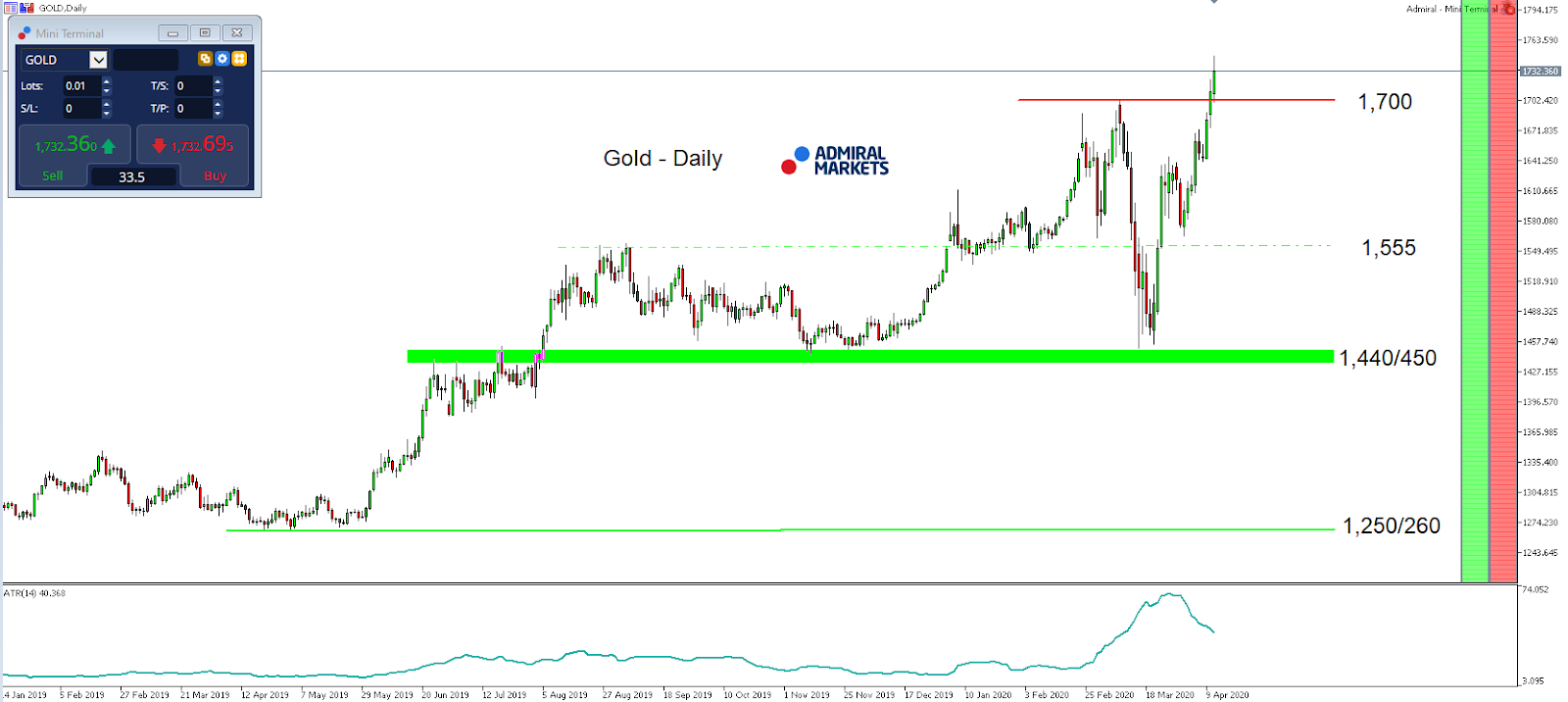
The picture in Gold hasn’t changed over the last week, and while we still consider the situation to be tense, the push above 1,700 USD on Monday is a clearly bullish sign.

Technically, the mode stays bullish as long as we trade above 1,440/450 USD.

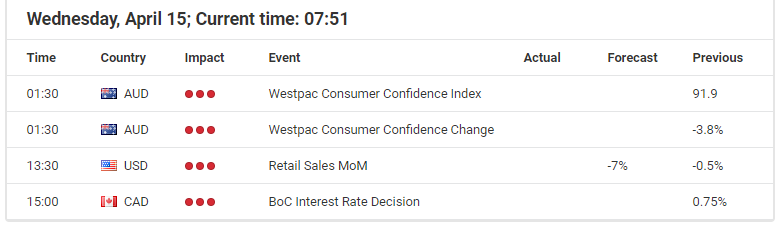
A potential driver for a push above 1,700 USD could come on Wednesday, from the Retail Sales data at 1230pm GMT.

After US Retail Sales posted their biggest fall in over a year last February, as consumers cut back on spending in a range of products, data for March is expected to come in even worse with the “Corona shutdown”.

In fact, the expected print of -7% would indicate the weakest number since the data set was first published back in 1992, and far below the current all-time low at -3.9% in 2008 during the Great Financial Crisis.

If we get to see a double-digit print (meaning everything greater -10%), Gold could see a push to new yearly highs, since Retail Sales can be considered the backbone of the US economy. Such a weak print, in addition to the explosion in initial jobless claims, could legitimately be seen as a very dark outlook for the US economy, thus favouring long engagements in the precious metal.

Still, short-term a next wave of de-leveraging hitting global financial markets shouldn’t be ruled out, mainly driven by the given global USD shortage, also resulting in a new wave of aggressive selling in Gold due to liquidity reasons.

But again: technically, the key-support can still be found around 1,440/450, above that level a deeper push above 1,700 USD is definitely an option.

Nevertheless, another “liquidation wave” could bring a short-term drop below 1,440/450 USD into play which would technically darken the picture, activating 1,250/260 USD as a first target:

 Gold Daily chart

Source: Admiral Markets MT5 with MT5-SE Add-on Gold Daily chart (between January 14, 2019, to April 14, 2020). Accessed: April 14, 2020, at 10:00pm GMT – Please note: Past performance is not a reliable indicator of future results, or future performance.

In 2015, the value of Gold fell by 10.4%, in 2016, it increased by 8.1%, in 2017, it increased by 13.1%, in 2018, it fell by 1.6%, in 2019, it increased by 18.9%, meaning that after five years, it was up by 28%.

Discover the world’s #1 multi-asset platform

Admiral Markets offers professional traders the ability to trade with a custom, upgraded version of MetaTrader 5, allowing you to experience trading at a significantly higher, more rewarding level. Experience benefits such as the addition of the Market Heat Map, so you can compare various currency pairs to see which ones might be lucrative investments, access real-time trading data, and so much more. Click the banner below to start your FREE download of MT5 Supreme Edition!

Download MetaTrader 5 and begin trading today!

Disclaimer: The given data provides additional information regarding all analysis, estimates, prognosis, forecasts or other similar assessments or information (hereinafter “Analysis”) published on the website of Admiral Markets. Before making any investment decisions please pay close attention to the following:

  1. This is a marketing communication. The analysis is published for informative purposes only and are in no way to be construed as investment advice or recommendation. It has not been prepared in accordance with legal requirements designed to promote the independence of investment research, and that it is not subject to any prohibition on dealing ahead of the dissemination of investment research.
  2. Any investment decision is made by each client alone whereas Admiral Markets shall not be responsible for any loss or damage arising from any such decision, whether or not based on the Analysis.
  3. Each of the Analysis is prepared by an independent analyst (Jens Klatt, Professional Trader and Analyst, hereinafter “Author”) based on the Author’s personal estimations.
  4. To ensure that the interests of the clients would be protected and objectivity of the Analysis would not be damaged Admiral Markets has established relevant internal procedures for prevention and management of conflicts of interest.
  5. Whilst every reasonable effort is taken to ensure that all sources of the Analysis are reliable and that all information is presented, as much as possible, in an understandable, timely, precise and complete manner, Admiral Markets does not guarantee the accuracy or completeness of any information contained within the Analysis. The presented figures refer that refer to any past performance is not a reliable indicator of future results.
  6. The contents of the Analysis should not be construed as an express or implied promise, guarantee or implication by Admiral Markets that the client shall profit from the strategies therein or that losses in connection therewith may or shall be limited.
  7. Any kind of previous or modeled performance of financial instruments indicated within the Publication should not be construed as an express or implied promise, guarantee or implication by Admiral Markets for any future performance. The value of the financial instrument may both increase and decrease and the preservation of the asset value is not guaranteed.
  8. The projections included in the Analysis may be subject to additional fees, taxes or other charges, depending on the subject of the Publication. The price list applicable to the services provided by Admiral Markets is publicly available from the website of Admiral Markets.
  9. Leveraged products (including contracts for difference) are speculative in nature and may result in losses or profit. Before you start trading, you should make sure that you understand all the risks.

By Admiral Markets