Author Archive for InvestMacro – Page 59

The Trump COVID-19 deflection game

By Dan Steinbock

– President Trump blames the WHO for his administration’s COVID-19 debacle. In reality, the White House knew about the virus threat already on Jan 3 but chose not to mobilize until late March.

In a recent interview with Fox News, President Trump said that the projections and pronouncements of the World Health Organization (WHO) about the coronavirus pandemic have been routinely wrong.

“Literally, they called every shot wrong,” the president added. “They didn’t want to say where [coronavirus] came from.” Threatening the WHO with the withdrawal of US funding, Trump charged WHO director-general Dr Tedros for siding with “Communist China.”

On April 14, Trump instructed his administration to halt funding to the WHO, as it conducts a “coronavirus review.” It is not clear how he intends to withhold WHO funding, much of which is appropriated by Congress. But it is clear that the review will be conducted by the same administration that delayed the virus response, in the first place. That will virtually ensure a prejudiced outcome.

Why did Trump target the WHO, its projections and its chief? And why did he do it now?

Ignoring realities

From early January, President Trump has dismissed the risk of the novel coronavirus, repeatedly. Two days after the first virus case was identified in the U.S., Trump said at the World Economic Forum in Davos that “we have [the novel coronavirus] totally under control. It’s one person coming in from China, and we have it under control,” (Jan 22).

After 10 days of national emergency in China and the WHO’s international emergency alert, Trump repeated that “we have it very well under control” (Jan 30). Even weeks later, he repeated his statement (Feb 23).

Soon thereafter, he declared in the White House that “[coronavirus is] going to disappear. One day — it’s like a miracle — it will disappear” (Feb 27).

Then, Trump took the blame-game to another level accusing Democrats for politicizing coronavirus, which he proclaimed “their new hoax” (Feb 28).

A day later, he announced again that his administration had the virus fully under control thanking his healthcare advisers (Feb 29) whose virus advice he had rejected – as we today know – since the first week of January.

In March, when the virus was about to have an almost free ride in New York City and the rest of America, Trump suggested that the WHO’s estimate of the global death rate was “false.” He described the virus as “very mild” and suggested that the infected could get better by “going to work” (Mar 4) – a suggestion that virus specialists considered idiotic.

Barely a week later, Trump declared the common flu worse than COVID-19 (Mar 9).

And yet, only a week later, Trump wanted Americans to believe he was taking the virus seriously. ““This is a pandemic,” he told reporters. “I felt it was a pandemic long before it was called a pandemic … I’ve always viewed it as very serious” (Mar 17).

What changed the tone?

Two and half months of delays

The simple answer is a New York Times expose one day before (Mar 16) and the impending presidential election.

As the Times reported, “from the beginning, the Trump administration’s attempts to forestall an outbreak of a virus now spreading rapidly across the globe was marked by a raging internal debate about how far to go in telling Americans the truth.”

What we know with certainty today is that, on January 3, China’s CDC completed the virus gene sequencing, initiated emergency monitoring and notified the WHO and relevant countries and regions about the virus.

As Hong Kong and Singapore began to prepare for the virus that same day, US CDC director Dr. Robert R. Redfield called Alex M. Azar II, Trump’s secretary of health and human services, to tell him China had discovered a new coronavirus. Azar told his chief of staff to inform the National Security Council (NSC) about the matter.

There was reason for hurry. When Trump arrived in the White House three years before, his administration had eliminated NSC’s global health unit that had monitored such virus risks. Now, the administration’s top health executive team began daily meetings in the basement of the West Wing.

Yet, there was no proactive mobilization in the White House. Rather, a long debate began within the Trump administration over “what to tell to the American public.” Meanwhile, cabinet members projected its mishandling on China, which was blamed for not being transparent, faking the case counts and associated deaths.

This odd state of affairs lasted two and a half months.

Deflecting responsibility

Faced with the Times expose, one of the greatest failures in U.S. pandemic preparedness and the impending fall election, President Trump declared that – actually – he had always viewed the COVID-19 as “very serious.”

After botching its virus response, the administration still would not disclose the full realities. Instead, Trump blamed the disastrous delay on China, the WHO, its chief and others who had been urging greater mobilization after mid- January.

After China’s CDC had alerted the WHO and its key members about the virus threat, WHO director-general Dr Tedros spoke about the potential risks in a series of international releases. On Jan 20, President Xi declared a national emergency in China. A day later, the WHO began daily situation reports about the virus spread.

On January 30, the WHO declared the virus outbreak a “public health emergency of international concern” (PHEIC). In the subsequent weeks, the WHO, its chief and his executives did whatever they could to alert the international community about the threats. And on March 11, the WHO proclaimed the virus a global pandemic.

The net effect? Almost 2 million COVID-19 cases and over 100,000 deaths which will be followed by the worst global economic contraction since the Great Depression. And an impending carnage that may prove far worse in vulnerable emerging and developing economies.

These nightmares were neither necessary nor inevitable. Most of them could have been avoided. That’s why President Trump ordered the “coronavirus review” – to rewrite the history of how his White House failed America

About the Author:

Dr. Dan Steinbock is an internationally recognized strategist of the multipolar world and the founder of Difference Group. He has served at the India, China and America Institute (USA), Shanghai Institutes for International Studies (China) and the EU Center (Singapore). For more, see https://www.differencegroup.net  
 

Stocks are ‘on fire’ – but a second coronavirus wave isn’t priced in

By George Prior

U.S. stock markets might be ‘on fire’ as earnings season begins – but Wall Street has not priced in a second wave of coronavirus, warns the CEO of one of the world’s largest independent financial advisory organizations.

The warning from deVere Group’s chief executive Nigel Green comes as the S&P 500 gained over 2 per cent in early trading, following gains in European and the Asia-Pacific markets.

Mr Green notes: “This week, with earnings season underway, we are going to see just the beginning of how corporate America and Europe have been hit by the coronavirus pandemic. The results are likely to be dismal and forecasts for the rest of the year can be expected to be revised down.

“However, investors are overlooking this. Instead, they are clinging on to relatively positive economic news from China, hints that some major lockdowns in Europe and elsewhere are being eased, and that confirmed cases are falling –meaning economic activity can be revived.”

He continues: “It’s truly astonishing that as global economic growth forecasts are looking bleak and most countries are battling potentially one of the worst downturns in a generation, the markets are on fire and trading as though these are normal times.

“They are not normal times. We are in unchartered waters. This isn’t the time to be complacent as I doubt the bear market is over. We shouldn’t call the bottom yet.

“It would appear that the financial markets are oblivious to the obvious and serious financial threat of a potential second wave of the coronavirus.  Alarmingly, this does not seem to have been priced in.”

Mr Green goes on to add: “The markets’ bullish sentiment during this mass disruption and dislocation would be baffling enough, but there are also other headwinds on the horizon.”

These, he notes, include the U.S. Presidential election, the threat of a no-deal Brexit, and the longer-term inflation risks.

The deVere CEO observes: “We can expect markets to remain volatile in the short-term.

“Many savvy investors will be riding the wave of volatility to build up their portfolios through lower entry points and seeking value and decent returns in order to grow their wealth. Why? Because history teaches us that over the longer-term the performance of stock markets is fairly predictable: they go up.”

Nigel Green concludes: “The markets are growing more positive about the Covid-19 crisis.

“But to sidestep taking a potentially massive hit, investors must avoid complacency and emotional decisions through solid financial strategies.”

About:

deVere Group is one of the world’s largest independent advisors of specialist global financial solutions to international, local mass affluent, and high-net-worth clients.  It has a network of more than 70 offices across the world, over 80,000 clients and $12bn under advisement.

Ichimoku Cloud Analysis 14.04.2020 (AUDUSD, USDJPY, USDCHF)

Article By RoboForex.com

AUDUSD, “Australian Dollar vs US Dollar”

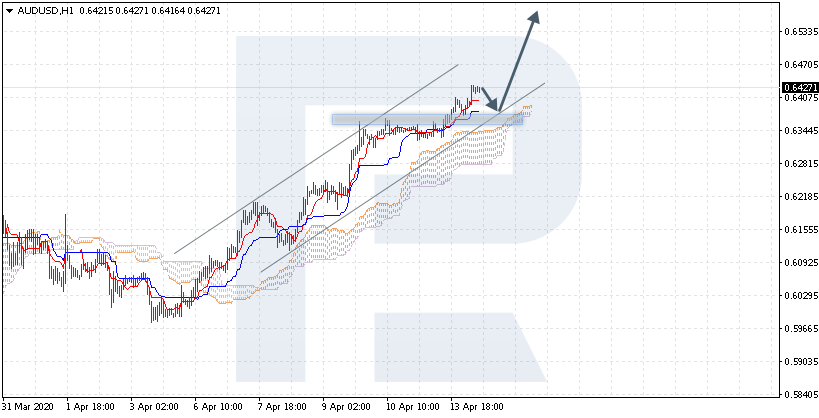
AUDUSD is trading at 0.6427; the instrument is moving above Ichimoku Cloud, thus indicating a bullish tendency. The markets could indicate that the price may test Tenkan-Sen and Kijun-Sen at 0.6395 and then resume moving upwards to reach 0.6535. Another signal to confirm further ascending movement is the price’s rebounding from the rising channel’s downside border. However, the scenario that implies further growth may be canceled if the price breaks the cloud’s downside border and fixes below 0.6225. In this case, the pair may continue falling towards 0.6175.

AUDUSD
Risk Warning: the result of previous trading operations do not guarantee the same results in the future

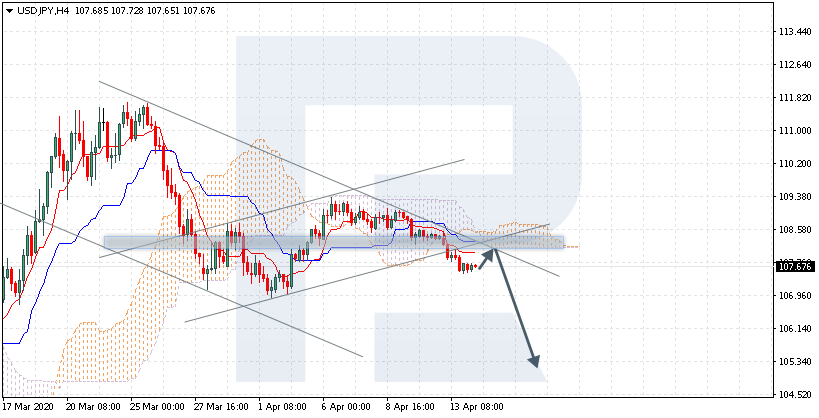
USDJPY, “US Dollar vs Japanese Yen”

USDJPY is trading at 107.67; the instrument is moving below Ichimoku Cloud, thus indicating a descending tendency. The markets could indicate that the price may test the cloud’s downside border at 107.95 and then resume moving downwards to reach 105.25. Another signal to confirm further descending movement is the price’s rebounding from the descending channel’s upside border. However, the scenario that implies further decline may be canceled if the price breaks the cloud’s upside border and fixes above 109.35. In this case, the pair may continue growing towards 110.05.

USDJPY
Risk Warning: the result of previous trading operations do not guarantee the same results in the future

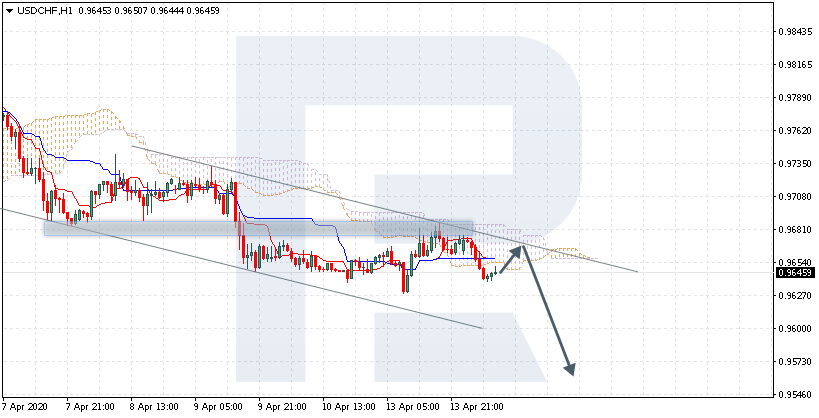
USDCHF, “US Dollar vs Swiss Franc”

USDCHF is trading at 0.9645; the instrument is moving below Ichimoku Cloud, thus indicating a descending tendency. The markets could indicate that the price may test the cloud’s upside border at 0.9660 and then resume moving downwards to reach 0.9565. Another signal to confirm further descending movement is the price’s rebounding from the descending channel’s upside border. However, the scenario that implies further decline may be canceled if the price breaks the cloud’s upside border and fixes above 0.9695. In this case, the pair may continue growing towards 0.9775.

USDCHF

Article By RoboForex.com

Japanese Candlesticks Analysis 14.04.2020 (GOLD, NZDUSD, GBPUSD)

Article By RoboForex.com

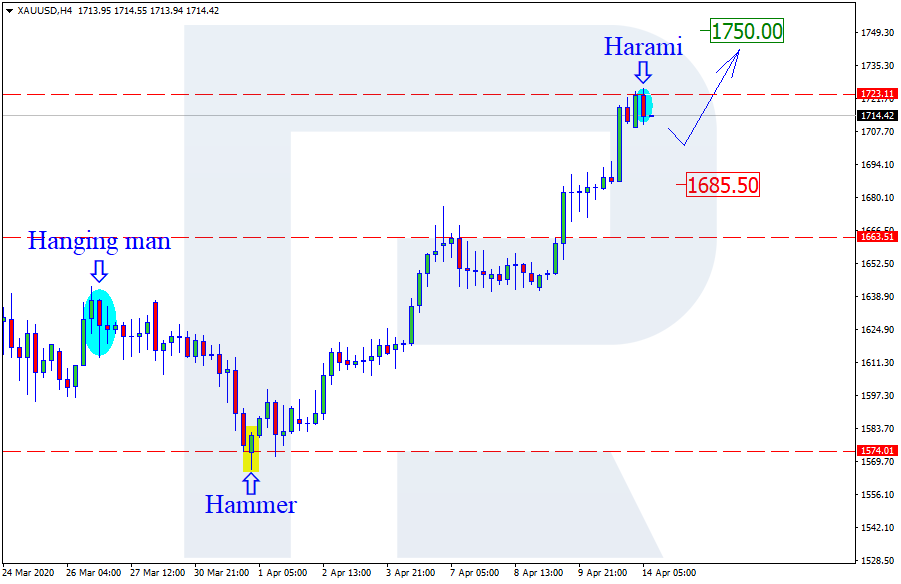
XAUUSD, “Gold vs US Dollar”

As we can see in the H4 chart, after testing another resistance level and forming several reversal patterns, such as Harami, Gold is trying to reverse. The current situation implies that the pair may form a correction and then resume the rising tendency. In this case, the upside target may be at 1750.00. At the same time, there is another scenario, according to which the instrument may correct towards 1685.00.

GOLD
Risk Warning: the result of previous trading operations do not guarantee the same results in the future

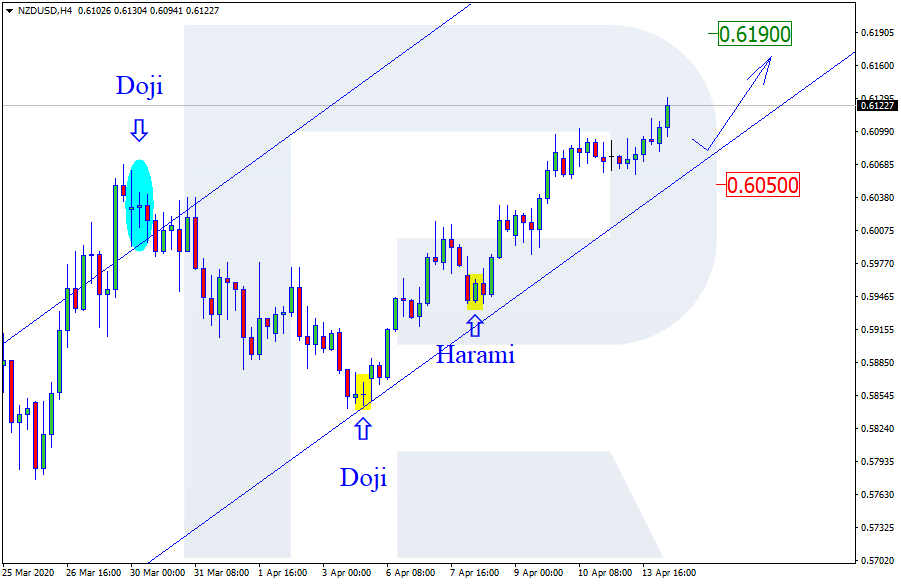
NZDUSD, “New Zealand vs. US Dollar”

As we can see in the H4 chart, the rising channel continues. After finishing a Harami reversal pattern, NZDUSD is reversing. Possibly, the pair complete the correction and resume trading upwards. The upside target may be at 0.6190. Still, one shouldn’t exclude another scenario, which says that the instrument may continue the pullback towards 0.6050.

NZDUSD
Risk Warning: the result of previous trading operations do not guarantee the same results in the future

GBPUSD, “Great Britain Pound vs US Dollar”

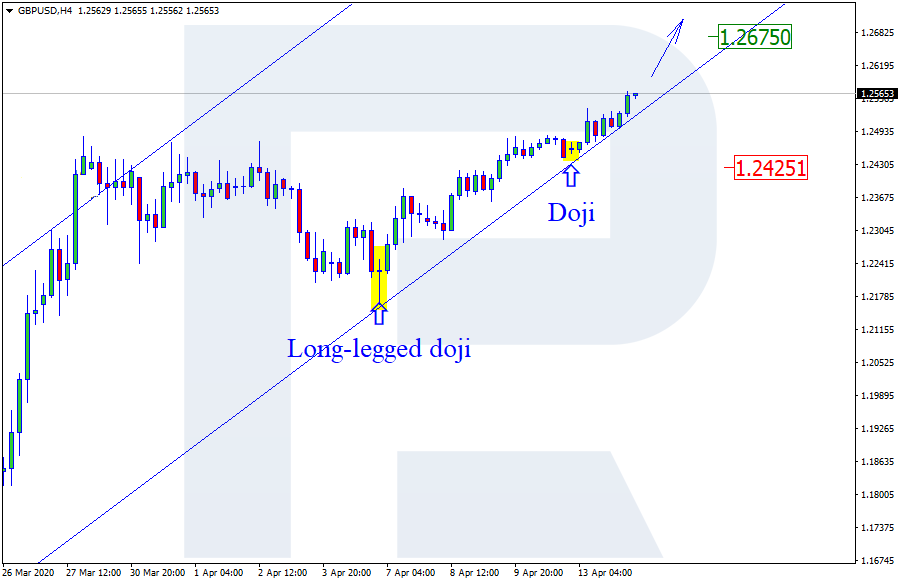
As we can see in the H4 chart, the pair continues growing within the rising channel. By now, GBPUSD has formed several reversal patterns, such as Doji, close to the support level. At the moment, the pair is reversing and may later resume growing with the target at 1.2675. However, there is another scenario, which implies that the instrument may fall and test 1.2425.

GBPUSD

Article By RoboForex.com

The Analytical Overview of the Main Currency Pairs on 2020.04.14

by JustForex

The EUR/USD currency pair

Technical indicators of the currency pair:
  • Prev Open: 1.09390
  • Open: 1.09084
  • % chg. over the last day: -0.16
  • Day’s range: 1.09016 – 1.09487
  • 52 wk range: 1.0777 – 1.1494

The EUR/USD currency pair has become stable. At the moment, the technical pattern is ambiguous. Financial markets participants expect additional drivers. The local support and resistance levels are 1.0915 and 1.0965, respectively. We do not exclude further growth of the single currency. Positions should be opened from key support and resistance levels.

Chinese exports and imports slowed down the decline in March after falling earlier this year. At the same time, most experts agree that a confident recovery in trade is not expected in the near future.

The Economic News Feed for 14.04.2020

  • Today, the publication of important economic releases is not planned.
EUR/USD

Indicators do not give accurate signals: the price has crossed 50 MA.

The MACD histogram is near the 0 mark.

Stochastic Oscillator is in the neutral zone, the %K line is below the %D line, which indicates the bearish sentiment.

Trading recommendations
  • Support levels: 1.0915, 1.0885, 1.0835
  • Resistance levels: 1.0965, 1.1010, 1.1035

If the price fixes above 1.0965, further growth of the EUR/USD currency pair is expected. The movement is tending to 1.1000-1.1020.

An alternative could be a drop in the EUR/USD quotes to 1.0885-1.0860.

The GBP/USD currency pair

Technical indicators of the currency pair:
  • Prev Open: 1.24583
  • Open: 1.24975
  • % chg. over the last day: +0.42
  • Day’s range: 1.24971 – 1.25739
  • 52 wk range: 1.1466 – 1.3516

GBP/USD quotes show a steady uptrend. The trading instrument has updated local highs again. The British pound found resistance at 1.2570. The round level of 1.2500 is already a “mirror” support. We do not exclude further growth of the GBP/USD currency pair. We recommend following the latest information regarding the COVID-19 spread. Positions should be opened from key levels.

The news feed on the UK economy is calm.

GBP/USD

Indicators signal the power of buyers: the price has fixed above 50 MA and 100 MA.

The MACD histogram is in the positive zone, indicating the bullish sentiment.

Stochastic Oscillator has started to exit the overbought zone, the %K line is below the %D line, which indicates a possible correction of the GBP/USD currency pair.

Trading recommendations
  • Support levels: 1.2500, 1.2440, 1.2400
  • Resistance levels: 1.2570, 1.2650

If the price fixes above 1.2570, further growth of GBP/USD quotes is expected. The movement is tending to 1.2620-1.2650.

An alternative could be a decrease in the GBP/USD currency pair to 1.2470-1.2440.

The USD/CAD currency pair

Technical indicators of the currency pair:
  • Prev Open: 1.39236
  • Open: 1.38912
  • % chg. over the last day: -0.47
  • Day’s range: 1.38627 – 1.39060
  • 52 wk range: 1.2949 – 1.4668

The USD/CAD currency pair has been declining. The trading instrument has updated local lows. The loonie is currently consolidating near the support level of 1.3855. The 1.3925 mark is already a “mirror” resistance. The Canadian dollar has the potential for further growth against the greenback. We recommend paying attention to the dynamics of oil quotes. Positions should be opened from key levels.

The news feed on Canada’s economy is calm.

USD/CAD

Indicators signal the power of sellers: the price has fixed below 50 MA and 100 MA.

The MACD histogram is in the negative zone, indicating the bearish sentiment.

Stochastic Oscillator is in the neutral zone, the %K line is above the %D line, which gives a signal to buy USD/CAD.

Trading recommendations
  • Support levels: 1.3855, 1.3800
  • Resistance levels: 1.3925, 1.4000, 1.4070

If the price fixes below 1.3855, a further drop in the USD/CAD quotes is expected. The movement is tending to the round level of 1.3800.

An alternative could be the growth of the USD/CAD currency pair to 1.3960-1.4000.

The USD/JPY currency pair

Technical indicators of the currency pair:
  • Prev Open: 108.388
  • Open: 107.745
  • % chg. over the last day: -0.52
  • Day’s range: 107.536 – 107.756
  • 52 wk range: 101.19 – 112.41

The USD/JPY currency pair continues to show a negative trend. The trading instrument has updated local lows again. At the moment, USD/JPY quotes are consolidating in the range of 107.50-107.85. Demand for the “safe haven” currencies is still high. The yen has the potential for further growth against the greenback. We recommend paying attention to the dynamics of US government bonds yield. Positions should be opened from key levels.

The news feed on Japan’s economy is calm.

USD/JPY

Indicators signal the power of sellers: the price has fixed below 50 MA and 100 MA.

The MACD histogram is in the negative zone, indicating the bearish sentiment.

Stochastic Oscillator is in the neutral zone, the %K line is below the %D line, which also gives a signal to sell USD/JPY.

Trading recommendations
  • Support levels: 107.50, 107.15, 106.90
  • Resistance levels: 107.85, 108.20, 108.60

If the price fixes below 107.50, a further drop in the USD/JPY quotes is expected. The movement is tending to the round level of 107.00.

An alternative could be the growth of the USD/JPY currency pair to 108.10-108.30.

by JustForex

Optimistic Data from China Brought Investors Hope

by JustForex

Yesterday, the US dollar did not change a lot against a basket of major currencies. Trading activity was reduced due to the Easter holidays. Today, the US currency has been declining, and more risky currencies have risen, as fairly optimistic economic data were published in China. Signs of a slowdown in the spread of coronavirus in China gave hope that the peak of the pandemic could be behind. Thus, Chinese exports and imports decreased by 6.6% and 0.9%, respectively, while experts forecasted a decrease by 14% and 9.5%.

The Fed and the US Congress, in turn, “have precluded the prospect of a complete economic collapse.” The number of deaths from COVID-19 in the United States per day also fell sharply, and the country began to plan a resumption of economic activity. To date, there are 1,925,811 people infected with coronavirus, of which 582,594 are in the United States.

The “black gold” prices have fallen again. Currently, futures for the WTI crude oil are testing the $22.05 mark per barrel. At 23:30 (GMT+3:00), API weekly crude oil stock will be published.

Market indicators

Yesterday, there was a variety of trends in the US stock market: #SPY (-0.91%), #DIA (-1.34%), #QQQ (+1.08%).

The 10-year US government bonds yield rose slightly. At the moment, the indicator is at the level of 0.75-0.76%.

The news feed on 2020.04.14:
  • – Export and import price indices in the US at 15:30 (GMT+3:00).

by JustForex

OTHER major headwinds – not just coronavirus – could hit your finances

By George Prior

To protect and grow wealth, investors need to carefully monitor other major factors – not just coronavirus, warns the CEO of one of the world’s largest independent financial advisory organisations.

The warning from deVere Group’s Nigel Green follows last week’s sharp rally in global markets – the MSCI experienced its biggest rise in more than a decade – but as first-quarter earnings results season gets underway this week.

Mr Green says: “We will get an insight this week into how heavy a hammer-blow coronavirus has delivered to corporate America and corporate Europe in the first three months of the year.

“Almost inevitably, the results will trigger widespread downward revisions.

“However, this sits against a growing optimistic investor sentiment as many countries move to ease lockdown restrictions and as many of the hardest-hit areas around the world see a flattening of their infection curves.

“Investors are now increasingly looking beyond the immediate poor data towards the likely recovery towards the end of 2020.”

He continues: “Yet Covid-19 is set to have a hold over investment decisions for a long time to come because it has, in many respects, fundamentally changed how we do business.

“For instance, in 2018, it was reported that more than half (56% – source: OWL Labs) the companies in the world allowed remote working.  Of course, this figure is now going to be significantly higher as working remotely becomes increasingly the ‘new normal’ in many sectors across the globe.

“New industries will emerge, some existing sectors will rebound and strongly, whereas others will decline.”

Due to its far-reaching impact, investors around the world are not only monitoring the usual markers like the price of gold and oil and international fiscal and monetary policies, but they’re also tracking the global health policies and coronavirus-death tolls, insists Mr Green.

“This is as it should be. But there is also a concern that the all-encompassing coronavirus news could prevent investors from tracking other key factors that could significantly impact their returns.”

The deVere CEO observes that besides Covid-19, investors need to consider a raft of other potential headwinds.

“These include the uncertainty generated by this year’s U.S. presidential election,” he says.

“Uncertainty – something financial markets loathe – typically increases in election periods.

“The 2020 U.S. presidential election is seen by many as particularly important as not only will whoever wins be the CEO of the world’s largest economy, they will be in that role as the world economically readjusts following the global fallout of coronavirus.”

He goes on to say: “The risk of a no-deal Brexit for the UK, EU and global economies also remains a key headwind.  The UK government has so far not withdrawn from its threat to walk out on critical and complex talks in June if no progress is being made, despite the mass financial disruption caused by the pandemic.

“Another concern should be the longer-term inflation threat.

“Already bloated central bank balance sheets are about to become larger still. As with the asset purchase initiatives rolled out in the last financial crash, they come with the risk that too much cash is being produced.

“When coronavirus passes, and cash is no longer stashed in the same way, will households and firms use very cheap loans and their cash piles to turbo-charge an economic recovery into inflation?”

Nigel Green concludes: “Clearly, coronavirus remains the number one investment headwind.

“However, to safeguard and grow their wealth, it is essential that investors don’t take their eye off other issues that are likely to impact their returns.”

About:

deVere Group is one of the world’s largest independent advisors of specialist global financial solutions to international, local mass affluent, and high-net-worth clients.  It has a network of more than 70 offices across the world, over 80,000 clients and $12bn under advisement.

AI Fibonacci Modeling Predicts Silver at $26

By TheTechnicalTraders 

– Our Adaptive Fibonacci Price Modeling system incorporates an intelligent “Inference Engine” into internal decision-making and future analysis.  This type of “Adaptive Learning” is one of the core elements of Artificial Intelligence – the ability to read inputs, adapting to price structures and setups and infer expected outcomes/results based on a complex decision-making process.  Today, we are alerting you that our Adaptive Fibonacci Price Modeling system is suggesting $26 is the next target level for Silver (which is currently trading near $15.65).

Learning how to interpret the data presented by our Adaptive Fibonacci Price Modeling system is simple – it does the internal analysis automatically and presents future target levels and trigger levels on the charts as lines and blocks.  Trigger levels are set up as both GREEN and RED lines for current Bullish and Bearish Trends.  Each of these trends also has target BLOCKS drawn out into the future representing where the Adaptive Fibonacci system believes the next price target will be located.  These target levels are determined by the Adaptive Learning Inference Engine and represent the best outcome of the true Fibonacci price structure we can deliver.

Weekly Silver Chart

This Weekly Silver chart highlights the incredible +66% upside opportunity setting up based on our research.  Silver continues to underperform compared to Gold and it continues to be overlooked as a safe-haven metal.  Back in September 2019, we authored this article suggesting Silver would become the “Super-Hero” of precious metals.  That research is still very valid today.

This Weekly Silver chart highlights our Adaptive Fibonacci Price Modeling system’s results and clearly shows you the upside price target near $26.  We believe the US and Global stock markets may continue to weaken as earnings and forward guidance continue to rattle investors’ expectations.  This uncertainty will translate into a continued upside price rally in Metals.  Gold will obviously lead the way higher, yet we believe the sleeper metal is Silver.  Once silver clears recent highs near $19.75, be prepared for an incredible parabolic upside move.

Daily Gold Chart

The other aspect of this move is that Gold will continue to move higher as well.  The next upside target for gold is $1840, followed by a brief pause in price, then a continued rally to levels near $2000.  If you think the metals rally it sputtering out right now, we urge you to reconsider your thinking.

Before we continue, be sure to opt-in to our free market trend signals 
before closing this page, so you don’t miss our next special report!

Weekly Gold Chart

Precious metals will likely continue to rally higher and higher, eventually entering a parabolic upside price rally, as global concerns reach a peak.  After the US and Global stock markets set up a real price bottom, metals will continue to rally for 8 to 12+ months after that bottom has setup.  Metals are about to become one of the fastest-growing assets on the planet and may not stop until well into 2021 or 2022.

Concluding Thoughts:

Do yourself a favor and take a minute to review some of our most recent market research and really prepare for the rally in metals.  That last Weekly Gold chart highlights what we believe will be the initial upside price rally (in YELLOW) and shows how Gold will target $2000, then briefly pause, then attempt another upside move to levels above $2300.  Our real upside price target for the long-term Fibonacci peak in Gold is near $3750 – that should tell you something really important.

As a technical analyst and trader since 1997, I have been through a few bull/bear market cycles in stocks and commodities. I believe I have a good pulse on the market and timing key turning points for investing and short-term swing traders. 2020 is going to be an incredible year for skilled traders.  Don’t miss all the incredible moves and trade setups.

I hope you found this informative, and if you would like to get a pre-market video every day before the opening bell, along with my trade alerts. These simple to follow ETF swing trades have our trading accounts sitting at new high water marks yet again this week, not many traders can say that this year. Visit my Active ETF Trading Newsletter.

We all have trading accounts, and while our trading accounts are important, what is even more important are our long-term investment and retirement accounts. Why? Because they are, in most cases, our largest store of wealth other than our homes, and if they are not protected during a time like this, you could lose 25-50% or more of your entire net worth. The good news is we can preserve and even grow our long term capital when things get ugly like they are now and ill show you how and one of the best trades is one your financial advisor will never let you do because they do not make money from the trade/position.

If you have any type of retirement account and are looking for signals when to own equities, bonds, or cash, be sure to become a member of my Long-Term Investing Signals which we issued a new signal for subscribers.

Ride my coattails as I navigate these financial markets and build wealth while others lose nearly everything they own during the next financial crisis.

Chris Vermeulen
Chief Market Strategies

TheTechnicalTraders.com

AI Trading System Using Fibonacci Theory Forecasts Future Gold, Silver & Stock prices – Part IV

By TheTechnicalTraders 

– As we’ve attempted to illustrate the intuitive nature of the Adaptive Fibonacci Price Modeling system we as one of the tools to help us understand the markets and price setups, we now want to more clearly illustrate other components of the current global economic environment.  We want to illustrate just how deep the current price move resonates against historical price norms.

In Part I of this article, we highlighted the Fibonacci system running on the ES (S&P 500) charts.  The point of this example was to show that a new price low had already been established and a recent new price high (the all-time high peak) was now acting as a critical price peak.  This suggests we are in the process of establishing a much deeper price low (bottom) that may come over the next few weeks as price attempts to “revalue” current economic expectations.

In Part II of this article, we highlighted the Fibonacci Price Theory concepts and attempted to teach you how to identify major and minor Fibonacci price pivot points.  This was done to help you understand what we are attempting to share with you and to help you learn to use these techniques in the future.  The conclusion of that, Part II, shared our expectations that a new, deeper low, would likely set up in the ES and NQ markets as price attempts to establish a future bottom setup.

In Part III of this article, we shared with you the NQ (Nasdaq) Fibonacci price analysis which was similar to the ES charts.  We are attempting to share with you the reality that price will setup intermediate high and low price pivots over time.  But we are really trying to explain how the major price pivots have now set up as a massive warning that a deeper low may be targeted as long as price fails to recover to levels near the all-time highs.  As “obvious” as that may seem to you now, many traders are already entering the markets expecting a recovery similar to May 2018 or January 2019 to begin.  We urge you to reconsider the scope of this disruption of the global economy.

Before we continue, be sure to opt-in to our free market trend signals 
before closing this page, so you don’t miss our next special report!

Weekly chart of our Custom Smart Cash Index

The first chart we want to share with you is a Weekly chart of our Custom Smart Cash Index.  This chart clearly illustrates just how destructive the recent collapse in the global economy has been.  Previous downside price rotations (Feb 2018 & October~December 2018) prompted downside price moves that stayed within the upward sloping price channel established from the 2015~2016 price range setup.

We believe this new downside price cycle will establish a new support channel for future price growth that may include a transition away from traditional economic measures.  Essentially, a “new normal” related to debt and economic expectations.

We believe this COVID-19 virus event may be unwinding a large portion of capital appreciation that originated back in 2000~2002 – after the DOT COM and 9/11 Terrorist attacks in NY.  Since that time, the US Fed and global central banks have engaged in a series of QE experiments designed to spark economic activity.  We believe the core element of the current COVID-19 economic contagion is not related to the central bank’s inability to print more money to throw at the problems in the markets.  The problem exists that a healthy market must remove risky debt/credit issues and unhealthy deficits in order to sustain real forward growth opportunities.  See this ZeroHedge article for a clear example of what we are attempting to explain: www.zerohedge.com

Looking at some of the charts from the ZeroHedge article, it becomes clear that real economic growth (in relation to proper debt expansion and economic function) likely completed a transitional cycle end near 1999~2002.  This came after the US Fed reached peak interest rate levels in the early 1980s and began a deficit spending binge that continues till today.  As credit/debt became the new norm, we can see how the expansion of credit created a broader expansion of capital valuation levels (global stock market prices) and provided for an expansion of derivatives and global shadow banking operations.  Debt begot more debt/credit – which begot more debt/credit.  And the cycle continues until it breaks.

We believe the unwinding process of the global credit market is really just beginning.  The COVID-19 virus event was just the catalyst for this event.  The virus event prompted a collapse in the global economy because of the global economic shutdown that took place to prevent the spread of the virus.  This shutdown strained the global economic/credit market and continues to do so today, by exposing many at-risk companies and business enterprises that were operating on the “fringe” – that space where lack of consumer engagement creates a void in income while debt levels continue to plague future operations.  We believe this process of UN-leveraging debt will continue until the markets decide a suitable amount of risk has been removed from the markets.  This is when global economic expansion and growth will begin to take hold.

Weekly Custom Volatility Index – Deleveraging Is The New Normal

This Weekly Custom Volatility Index highlights the potential for a “new normal” range as the recent deep low levels on this chart suggests a “deleveraging” process is currently taking place.  Even as the US Fed and global central banks pour trillions into the markets, this Custom Volatility Index continues to suggest deleveraging is still ongoing throughout the global markets.  Our research team believes the US Fed and global central banks are simply sucking up the immediate risk “froth” in the global markets while the “real meat” of the issue still persists.

Precious Metals Analysis Points To Higher Prices Long Term

This analysis leads us to Precious Metals – yes, we know, everyone is talking about Gold and Silver right now.  Yet, the real reason we are talking about Gold and Silver is because we believe the current economic environment will present an incredible (once in a lifetime) opportunity for skilled traders.  Once you truly understand the process that is taking place throughout the globe and how debt/credit expansion over the past 45+ years has propelled the capital markets to massive highs while the metals market has been ignored.

Recently, Gold has rallied to a 6+ year high and Silver is still trading near multi-year lows.  The reality is that the global stock market is about to experience a credit/debt revaluation event that is unlike anything we’ve seen since 1929 and/or WWII.  Precious metals are about to enter a phase that has never been experienced in recent history.  What happens to safe-havens throughout the process of a global market credit/debt crisis event?  What happens to metals as the global economy attempts to wash-away excessive debt, derivatives and shadow banking risks that have built up over the past 40+ years?

Concluding Thoughts:

If we are correct and our Fibonacci price modeling systems are correct, a deeper price low in the global markets is about to set up that will attempt to force a “wash-out” event in the global credit/debt markets.  This process will likely send precious metals skyrocketing higher.  The unknowns of this process are the same unknowns that happened after 1929 & WWII – what will the new financial functions and societal structure be composed of?  Until that side of the future becomes more clear, expect a number of unknown factors to continue to drive excessive volatility and risk in the global markets.

As a technical analyst and trader since 1997, I have been through a few bull/bear market cycles in stocks and commodities. I believe I have a good pulse on the market and timing key turning points for investing and short-term swing traders. 2020 is going to be an incredible year for skilled traders.  Don’t miss all the incredible moves and trade setups.

I hope you found this informative, and if you would like to get a pre-market video every day before the opening bell, along with my trade alerts. These simple to follow ETF swing trades have our trading accounts sitting at new high water marks yet again this week, not many traders can say that this year. Visit my Active ETF Trading Newsletter.

We all have trading accounts, and while our trading accounts are important, what is even more important are our long-term investment and retirement accounts. Why? Because they are, in most cases, our largest store of wealth other than our homes, and if they are not protected during a time like this, you could lose 25-50% or more of your entire net worth. The good news is we can preserve and even grow our long term capital when things get ugly like they are now and ill show you how and one of the best trades is one your financial advisor will never let you do because they do not make money from the trade/position.

If you have any type of retirement account and are looking for signals when to own equities, bonds, or cash, be sure to become a member of my Long-Term Investing Signals which we issued a new signal for subscribers.

Ride my coattails as I navigate these financial markets and build wealth while others lose nearly everything they own during the next financial crisis.

Chris Vermeulen
Chief Market Strategies

TheTechnicalTraders.com


Ichimoku Cloud Analysis 13.04.2020 (BTCUSD, USDRUB, XAUUSD)

Article By RoboForex.com

BTCUSD, “Bitcoin vs US Dollar”

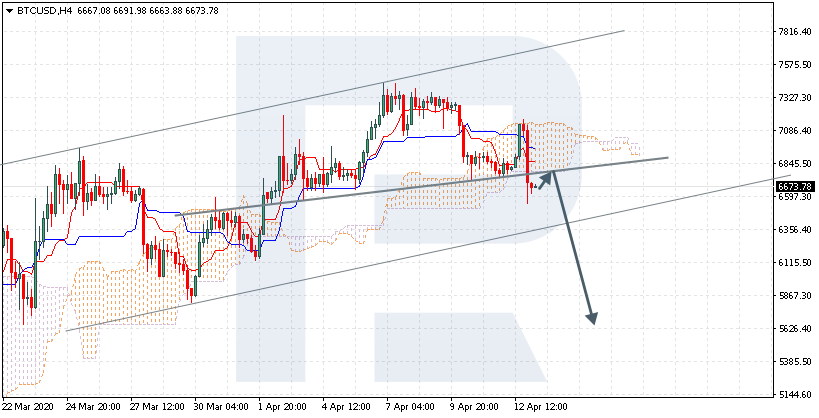
BTCUSD is trading at 6673.00; the instrument is moving below Ichimoku Cloud, thus indicating a bearish tendency. The markets could indicate that the price may test the cloud’s downside border at 6725.00 and then resume moving downwards to reach 5625.00. Another signal to confirm further descending movement is the price’s rebounding from the neckline of a Head & Shoulder pattern. However, the scenario that implies further decline may be canceled if the price breaks the cloud’s upside border and fixes above 7105.00. In this case, the pair may continue growing towards 7605.00 without completing the reversal pattern. After breaking the rising channel’s downside border and fixing below 6255.00, the price may resume moving downwards.

BTCUSD
Risk Warning: the result of previous trading operations do not guarantee the same results in the future

USDRUB, “US Dollar vs Russian Ruble”

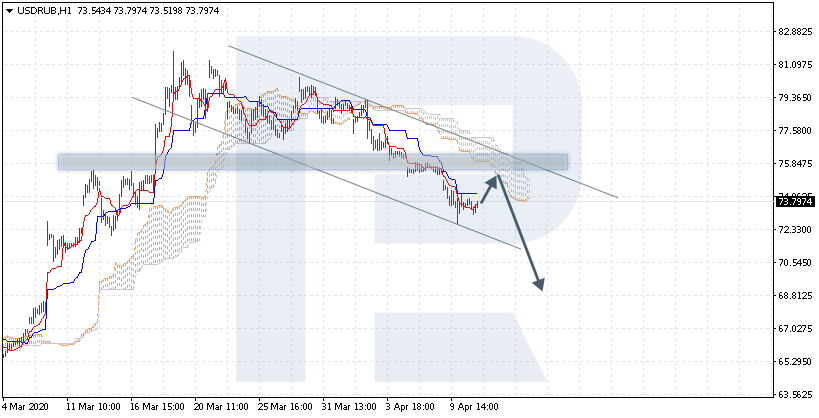
USDRUB is trading at 73.79; the instrument is moving below Ichimoku Cloud, thus indicating a descending tendency. The markets could indicate that the price may test the cloud’s downside border at 74.35 and then resume moving downwards to reach 68.75. Another signal to confirm further descending movement is the price’s rebounding from the descending channel’s upside border. However, the scenario that implies further decline may be canceled if the price breaks the cloud’s upside border and fixes above 77.55. In this case, the pair may continue growing towards 78.25.

USDRUB
Risk Warning: the result of previous trading operations do not guarantee the same results in the future

XAUUSD, “Gold vs US Dollar”

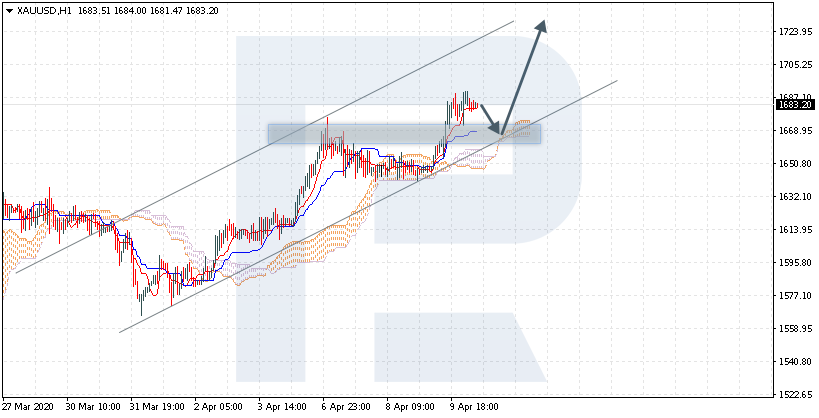
XAUUSD is trading at 1683.00; the instrument is moving above Ichimoku Cloud, thus indicating an ascending tendency. The markets could indicate that the price may test the cloud’s upside border at 1670.00 and then resume moving upwards to reach 1735.00. Another signal to confirm further ascending movement is the price’s rebounding from the rising channel’s downside border. However, the scenario that implies further growth may be canceled if the price breaks the cloud’s downside border and fixes below 1645.00. In this case, the pair may continue falling towards 1595.00.

GOLD

Article By RoboForex.com

Attention!
Forecasts presented in this section only reflect the author’s private opinion and should not be considered as guidance for trading. RoboForex LP bears no responsibility for trading results based on trading recommendations described in these analytical reviews.