Author Archive for InvestMacro – Page 549

Admiral Markets UK Ltd. Announces Changes in the Top Management

Admiral Markets UK Ltd. has recently announced the appointment of Mr. Simon Roberts as the company’s new General Manager. Additionally, Mr. Stephen Ayme has been added to the management board team and will be leading the compliance department.

Mr. Simon Roberts has extensive experience in operations, compliance and corporate governance across the Financial Services industry. As a previously Financial Conduct Authority approved Director, he is a versatile and results-driven senior manager with in-depth knowledge of regulation and legal matters. On top of that, in his previous roles, he has shown extensive commercial awareness, which has assisted in driving sales and increasing revenue through resource optimisation. “I’m excited to join Admiral Markets and honoured to be leading such a talented group of people”, says Mr. Roberts. “I’m confident that my background and subsequent expertise will add value to the company”, he continues.

Moreover, Admiral Markets UK Ltd.’s compliance team will now be led by Mr. Stephen Ayme – the company’s new Compliance Officer, who is an experienced financial regulation expert, with an impressive background in banking and asset management. “I joined Admiral Markets at an exciting time and I am looking forward to leading a compliance team that will rise to the regulatory challenges and provide excellent support to the business”, said Mr. Ayme.

Admiral Markets UK Ltd. is delighted to have such high-calibre additions to the team.

Press contact: [email protected].

Risk disclosure: Forex and CFD’s carry a high level of risk and losses may exceed your initial deposit. Admiral Markets UK Ltd. recommends you seek advice from an independent financial advisor to ensure that you understand the risks involved with Forex, CFD’s, Margin and Leveraged trading.


Forex Technical Analysis & Forecast 08.06.2017 (EUR/USD, GBP/USD, USD/CHF, USD/JPY, AUD/USD, USD/RUB, GOLD, BRENT)

Article By RoboForex.com

EUR USD, “Euro vs US Dollar”

The EUR/USD pair has formed another consolidation range: one three-wave ascending structure and one three-wave descending structure. Right now, it is moving in the very center of the range, and may both fall to reach 1.1200 and grow towards 1.2888. Possibly, the pair may reach 1.1305. We should note one more time that the third ascending wave has been completed. The main scenario implies that the market may form a reversal pattern and start a new descending correction with the target at 1.0900, at least.


GBP USD, “Great Britain Pound vs US Dollar”

The GBP/USD pair has completed another ascending structure and right now is being corrected to return to 1.2898. Later, the market may grow towards 1.3050. All ascending structures may be considered as an alternative scenario only. The main scenario remains the same and implies that the instrument may be corrected to the downside to reach 1.2700, at least.


USD CHF, “US Dollar vs Swiss Franc”

The USD/CHF pair is still consolidating near its lows. We think, today the price may grow to reach 0.9686. Later, in our opinion, the market may fall towards 0.9646. if the pair breaks this consolidation range upwards, it may reach 0.9900. The first target is at 0.9760.


USD JPY, “US Dollar vs Japanese Yen”

The USD/JPY pair is forming the third descending wave. Possibly, the price may reach 108.87. After that, the instrument may be corrected towards 110.47 and then form the fifth wave with the target at 106.60.


AUD USD, “Australian Dollar vs US Dollar”

The AUD/USD pair has started another descending impulse. Possibly, today the price may reach 0.7513 and then grow towards 0.7540. Later, in our opinion, the market may break the low and then continue moving downwards with the target at 0.7200.


USD RUB, “US Dollar vs Russian Ruble”

The USD/RUB pair has broken its consolidation range upwards. We think, today the price may test 56.69 from above and then grow to reach 57.20. After that, the instrument may fall towards 55.50.


XAU USD, “Gold vs US Dollar”

Gold is falling. Possibly, today the price may reach 1280. Later, in our opinion, the market may grow towards 1288 and then fall with the target at 1267.


BRENT

Brent has broken its consolidation range to the downside. Possibly, today the price may test 49.22 from below. After that, the instrument may fall to reach 47.78 and then move upwards towards the target at 51.30.


RoboForex Analytical Department

Article By RoboForex.com

Attention!
Forecasts presented in this section only reflect the author’s private opinion and should not be considered as guidance for trading. RoboForex LP bears no responsibility for trading results based on trading recommendations described in these analytical reviews.

EURUSD: price has stopped at the lb line

By Gabriel Ojimadu, Alpari

Previous:

On Wednesday the 7th of June, markets were frantic, with participants clashing everywhere. The cause of these collisions were the Reuters and Bloomberg news outlets. Bloomberg reported that the ECB has decided after their meeting to downgrade their forecast for consumer price growth in the Eurozone during 2017-2019. Then it hit the airwaves that the Eurozone’s GDP had been revised. Reuters published the results of opinion polls from IFOP and Ipsos, which suggest that the newly-elected president of France, Emmanuel Macron, is set to win the parliamentary elections. The election will be held over two rounds on the 11th and 18th of June. Volatility subsided after European markets closed. The Euro/dollar pair has stabilised around the lb line at 1.1260.

Market expectations:

Trader attention today is focused on the British parliamentary elections, the ECB meeting and Mario Draghi’s press conference, as well as former FBI director James Comey’s testimony to the Senate. Considering yesterday’s fluctuations on the Euro, I think it pointless to make a forecast for every planned event today. I think it better to stay out of the market today and watch from the sidelines.

Day’s news (GMT+3):

  • All day in the UK: parliamentary elections;
  • 09:00 Germany: industrial production (Apr);
  • 10:15 Switzerland: CPI (May);
  • 12:00 Eurozone: GDP revised (Q1);
  • 14:45 Eurozone: ECB interest rate decision;
  • 15:15 Canada: housing starts (May);
  • 15:30 Canada: new housing price index (Apr);
  • 15:30 Eurozone: ECB monetary policy statement and press conference;
  • 15:30 USA: initial jobless claims (2 Jun);
  • 17:30 Canada: financial system review;
  • 18:15 Canada: BoC governor Poloz’s speech.

EURUSD rate on the hourly. Source: TradingView

Intraday forecast: low: n/a, high: n/a, close: n/a.

Let’s take a look at the technical analysis. The rumours from Bloomberg about the ECB have pushed the Euro to 67 degrees. Buyers opened long positions from here, shifting the price back to 1.1282 and leaving the daily candlestick with a long lower shadow.

The price range is between the 67th degrees. The price is consolidating on the lb line. I believe that it will stay here until Draghi’s press conference. The market has defined its own boundaries at 1.1204 and 1.1285. Beyond these there are some protective stop levels. By the end of the day traders should have determined who will be hunting for stops and where the price is set to move over the next month.

Wave Analysis 08.06.2017 (EUR/USD, GBP/USD, USD/JPY, AUD/USD)

Article By RoboForex.com

EUR USD, “Euro vs US Dollar”

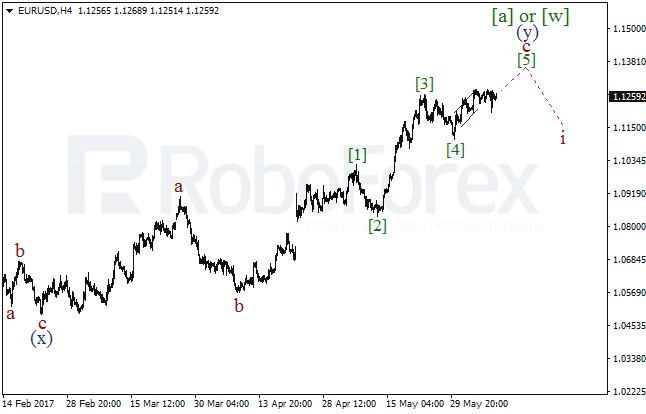
It looks like the EUR/USD pair is still forming the wave [a] or [w]. On a shorter timeframe, the price may yet continue forming the wave [5] of c. Consequently, on Thursday the market may break the local high.

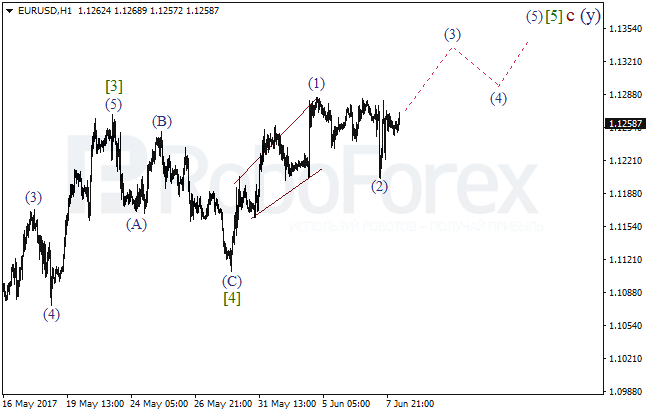
As we can see at the H1 chart, the pair completed the wedge(1), the correctional wave (2), and, probably, the bullish impulse in the wave (3) of [5]. As a result, on Thursday the market may continue moving upwards.


GBP USD, “Great Britain Pound vs US Dollar”

Probably, the GBP/USD pair is still forming the wave [iv]. Earlier, the price completed the bullish extension in the wave [iii]. In the future, the market may break the local low, but later it is expected to form another bullish impulse in the wave [v] of C.

It’s highly likely that the diagonal triangle in the wave c of (b) is still being formed. Consequently, in the nearest future the market may continue growing. Later, after finishing the wave (b), the market may start falling in the wave (c) of [iv].


USD JPY, “US Dollar vs Japanese Yen”

Possibly, after finishing the ascending impulse in the wave (i), the USD/JPY pair completed the wave (ii). As a result, later the market may resume growing in the wave (iii).

More detailed structure is shown on the H1 chart. It’s highly likely that the price completed the descending impulse in the wave [C] of y and then the bullish impulse in the wave (1) of [1]. After finishing the local correction, the market may continue growing and break the local high.


AUD USD, “Australian Dollar vs US Dollar”

The AUD/USD pair may yet continue forming the wave (y) in the double zigzag[ii]. Consequently, on Thursday the market may continue moving upwards. To confirm a new decline, the price has to form the bearish impulse in the wave [iii].

At the H1 chart, after finishing the zigzag(x), the price started growing in the wave c of (y). It’s highly likely that after finishing this wave, the market may resume moving downwards in the wave [iii].


RoboForex Analytical Department

Article By RoboForex.com

Attention!
Forecasts presented in this section only reflect the author’s private opinion and should not be considered as guidance for trading. RoboForex LP bears no responsibility for trading results based on trading recommendations described in these analytical reviews.

EUR/USD: How to turn hawkish in a dovish way?

By GrowthAces.com

Macroeconomic overview: The ECB is widely expected to keep policy unchanged today, but important changes to ECB communication should be expected.

The new set of macroeconomic projections will help provide the analytical framework for this more constructive assessment. We expect the GDP forecasts to remain broadly unchanged compared to March, but for the third consecutive quarter, slight upward revisions look more likely than small downward adjustments, mainly due to encouraging developments in global trade. However, if upward revisions do materialize, they would only probably affect the first one-to-two quarters of the forecast horizon.

The inflation outlook is unlikely to materially depart from that envisaged in March either. If anything, risks are for a small downward revision to the near-term trajectory for headline inflation due to lower oil price assumptions. Changes at the policy-relevant horizon are unlikely because there the impact of exogenous variables tends to peter out and price dynamics are largely driven by domestic factors. ECB forecasts for core inflation in 2018-2019 are already quite aggressive and it is unlikely that any moderate upward revision to the growth projections would lead to an even stronger path for underlying price pressure.

Increased confidence in the recovery amid still slow progress on the inflation mandate will have implications for the ECB forward guidance. In particular, the Governing Council is likely to assess four important features of its guidance.

1. The easing bias on policy rates (“We [the Governing Council] continue to expect them to remain at present or lower levels for an extended period of time”); 2. The exit sequence, i.e. the time of QE-end vs. first rate increase; 3. The expected time lag between the end of QE and the first rate hike (“well past the horizon of our net asset purchases”); 4. The easing bias on asset purchases (we stand ready to increase our asset purchase program in terms of size and/or duration).

We think that the main changes will regard #1, with the ECB likely to drop the reference to the possibility of lower policy rates. The exit sequence is not written in stone, but will almost certainly be confirmed. And unless the side effects of negative rates significantly increase, the sequence will not change also in the future. #3 and #4 are trickier to call, but we tend to think that there will be no major changes. First, if the ECB were to hint at a shorter time lag between the end of QE and the first rate increase, for example by changing the “well past the horizon” language into “past the horizon”, this would start giving an impulse to short-term rates, which the ECB seems unwilling to do at this stage. Second, if the ECB drops the easing bias on asset purchases, the market may easily start speculating that QE may be reduced already before the end of the year. Instead, the ECB has often hinted they are on autopilot at EUR 60 billion per month until December 2017.

We do not expect the ECB to explicitly start talking down the EUR, but we know that ECB President Mario Draghi is a jawboning master and he certainly will not say anything that could strengthen the EUR. That is why we think there is a risk of a corrective move in the EUR/USD after today’s ECB meeting.

Technical analysis: Strong resistance in the 1.1280s may prove tough to break ahead of the key 1.1300 level. Pullbacks remain shallow so far and the bias is with the bulls. The situation may change after today’s ECB meeting.

EURUSD Daily Forex Signals Chart

Short-term signal: We think that a corrective move is likely in the coming days if the ECB statement is less hawkish than expected. We got short at 1.1235 for the target at 1.1070. But we think the EUR/USD pullback would be only temporary and our long-term outlook remains bullish.

Long-term outlook: Bullish


USD/CAD jumped on lower oil prices

Macroeconomic overview: The Canadian dollar weakened on Wednesday against its U.S. counterpart as oil prices tumbled.

Prices of oil, one of Canada’s major exports, fell sharply on Wednesday after the U.S. government reported an unexpected rise in crude and gasoline inventories, which added to concerns that efforts to cut output by the world’s biggest oil producers have not made enough impact.

Crude stocks in the United States grew 3.3 million barrels to 513 million barrels, according to the U.S. Energy Information Administration. That confounded forecasters who had predicted a drop of 3.5 million barrels, especially a day after data from the American Petroleum Institute indicated an even bigger fall.

Gasoline inventories also unexpectedly rose, imports increased, and exports dropped, the EIA data showed.

Some in the market remained concerned about the move by OPEC members Saudi Arabia and the United Arab Emirates to cut diplomatic and transport ties with Qatar, an OPEC member that had agreed to cut about 30k barrels a day as part of the Organization of the Petroleum Exporting Countries agreement to reduce output.

The Bank of Canada’s review of developments in the financial system is scheduled for today, followed by a news conference with Governor Stephen Poloz. Investors will weigh Poloz’s assessment of the housing and mortgage markets in light of recent troubles at non-bank lender Home Capital.

Technical analysis: The USD/CAD fluctuating between 61.8% fibo and 50% fibo of April-May rise, but is still away from 1.3575, which is a very strong resistance level. We think that improving risk sentiment should support the USD/CAD bears.

USDCAD Daily Forex Signals Chart

Short-term signal: Our sell order at 1.3510 was filled yesterday. The target is 1.3310.

Long-term outlook: We think that long-term outlook is slightly bearish now.


TRADING STRATEGIES SUMMARY:

FOREX – MAJOR PAIRS:

Please enable images to upload to view this email properly
About the Author:

By GrowthAces.com – Daily Forex Trading Strategies


Forex Technical Analysis & Forecast 07.06.2017 (EUR/USD, GBP/USD, USD/CHF, USD/JPY, AUD/USD, USD/RUB, GOLD, BRENT)

Article By RoboForex.com

EUR USD, “Euro vs US Dollar”

The EUR/USD pair is consolidating above 1.1200. We think, today the price may grow towards 1.1288 and then fall to reach 1.1212. Possibly, the pair may reach 1.1305 (an alternative scenario). The main scenario implies that the market may continue its descending correction with the target at 1.0900.


GBP USD, “Great Britain Pound vs US Dollar”

The GBP/USD pair is trading to break the Pennant pattern to the upside; it has already reached 1.2882. Later, the market may grow towards 1.2966 and then fall with the target at 1.2888. After that, the instrument may form the fifth structure to reach 1.3051.


USD CHF, “US Dollar vs Swiss Franc”

The USD/CHF pair is still consolidating near its lows; it has already reached 0.9620. Later, in our opinion, the market may grow towards 0.9700. and then form a reversal pattern to start a new correction with the target at 0.9900.


USD JPY, “US Dollar vs Japanese Yen”

The USD/JPY pair has expanded its consolidation range to the downside. Possibly, the price may grow towards 110.47. The main scenario implies that the market may reach the local target at 108.87. After that, the instrument may be corrected inside the fourth wave towards 110.47 and then form the fifth one with the target at 106.60.


AUD USD, “Australian Dollar vs US Dollar”

The AUD/USD pair has completed the fifth ascending structure. Possibly, the price may reach 0.7545 and then form a n reversal pattern. Later, in our opinion, the market may move downwards and form the fifth wave with the target at 0.7200.


USD RUB, “US Dollar vs Russian Ruble”

The USD/RUB pair is still consolidating without any particular direction. Possibly, the price may choose an alternative scenario and reach 57.00. The main scenario implies that the market may fall towards 55.50.


XAU USD, “Gold vs US Dollar”

Gold has finished the second ascending structure, which is as long as the first one. Possibly, today the price may consolidate near the highs. After that, the instrument may reverse to the downside and form the fourth wave towards 1267. Later, in our opinion, the market may form the fifth one with the target at 1300.


BRENT

Brent is trading upwards with the target at 50.50. Later, in our opinion, the market may fall to reach 49.80 and then move upwards towards the first target at 53.33.


RoboForex Analytical Department

Article By RoboForex.com

Attention!
Forecasts presented in this section only reflect the author’s private opinion and should not be considered as guidance for trading. RoboForex LP bears no responsibility for trading results based on trading recommendations described in these analytical reviews.

Fibonacci Retracements Analysis 07.06.2017 (EUR/USD, EUR/GBP)

Article By RoboForex.com

EUR USD, “Euro vs US Dollar”

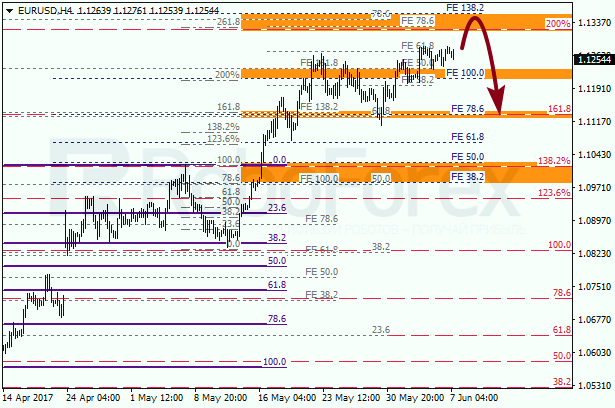
The EUR/USD pair is still consolidating above 1.1230, which means that it may continue growing towards the next target area at 1.1350 – 1.1320. If later the price rebounds from this area, the market may start a new bearish correction.

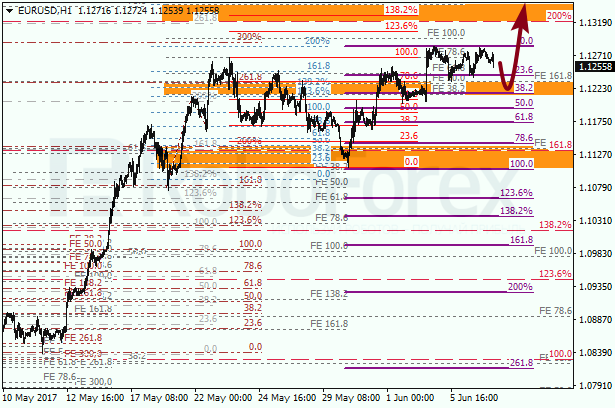
At the H1 chart, the pair may test the local correctional retracement of 38.2%. If the price rebounds from this level, the market may resume growing towards its upside targets. It’s highly likely that the pair may reach a new local high soon.


EUR GBP, “Euro vs Great Britain Pound”

The EUR/GBP pair rebounded from the group of fibo-levels reached earlier, which means that it may start a new ascending movement. However, if the price rebounds from the upside target area at 0.8770 – 0.8790, the market may start a new bearish correction.

Yesterday, the pair rebounded from the local correctional retracement of 38.2%. As a result, in the nearest future the market may break the local high and test the group of upside fibo-levels.


RoboForex Analytical Department

Article By RoboForex.com

Attention!
Forecasts presented in this section only reflect the author’s private opinion and should not be considered as guidance for trading. RoboForex LP bears no responsibility for trading results based on trading recommendations described in these analytical reviews.

EURUSD: increased risk of breaking 1.1285

By Gabriel Ojimadu, Alpari

Previous:

Trading on the Euro closed up on Thursday. The price ricocheted after the publication of a new survey from YouGov. The survey shows that the gap between Labour and the Conservative has decreased and it is projected that the Conservatives may only win 304 seats in Parliament.

Another boost for the Euro was provided by a general weakening of the dollar, which came after Bloomberg reported that China plans to increase its purchases of US bonds. US bonds incurred some losses on this news, which in turn were passed on to the dollar. In the end, the apparent breakout of the trend line turned out to be a false one. The Euro rate closed at around 1.1285.

Market expectations:

Tensions on the markets are growing by the day. Traders are bracing themselves for a series of important events due to take place on Thursday. These include the British parliamentary elections, the ECB meeting followed by a press conference with Mario Draghi, and former FBI director James Comey is set to testify to the US Senate about Russian interference in the US election.

There are no important statistical releases planned for today and the news block is fairly empty. The movements of currency pairs will be determined by opinion polls on the British election as well as rumours about what James Comey will say to the Senate. If we look at the technical side of the EUR/USD pair, everything points to a breakout of the 1.1285 resistance.

Day’s news (GMT+3):

  • 10:00 Switzerland: foreign currency reserves (Apr);
  • 10:30 UK: Halifax house prices (May);
  • 15:30 Canada: building permits (Apr);
  • 17:30 USA: EIA crude oil stock change (2 Jun);
  • 22:00 USA: consumer credit change (Apr).

EURUSD rate on the hourly. Source: TradingView

Intraday forecast: low: n/a, high: n/a, close: n/a.

The YouGov polls and rumours from China prevented a breakout of the trend line. This line now runs through 1.1285 level. The price rebounded from this and the lb. Now, buyers are once again aiming for 1.1285.

Yesterday, in the second half of the day, I imagined two scenarios. The first one was a downwards correction on the EUR/USD pair after a breakout of the trend line. The second was for the breakout of the trend line to be reversed. My forecast on the chart shows growth on our pair until the end of today’s session. However, should the hourly candlestick close below 1.1240, I think this projection will become useless. If no one manages to stop the bulls after the European session opens, it’s highly probable that we’ll see 1.1308 level being tested.

Don’t forget about all the events planned for Thursday. Technical analysis doesn’t work when there’s so much important news and so many rumours.

Regime Change in the Trump White House?

By Dan Steinbock

No U.S. postwar president has managed to reset relations with Russia. Now the Trump administration must cope with a special counsel’s investigation. In the past, US efforts at regime change targeted foreign countries; today, the White House. How will it impact Trump’s stalled policy agenda?

As I argued in spring 2016 (TWFR, April 25, 2016), US election is a global risk and it would continue to be fought after the Trump election win. But recently, these political struggles moved to an entirely new phase.

First, the Department of Justice (DOJ) dismissed James Comey, Director of the Federal Bureau of Investigation (FBI), reportedly only days after his request for increased resources to investigate Russia’s alleged interference in the election. Barely a week later, DOJ appointed Robert Mueller, former director of the FBI (2001-13) as special counsel overseeing the investigation into alleged Russian interference in the 2016 election.

There is little doubt about the political outcome of the Mueller investigation. Just as he loyally served under President George W. Bush, along with Defense Secretary Donald Rumsfeld and Vice President Dick Cheney’s neoconservatives, he is unlikely to treat any Russian initiative – whether planned, unintended, alleged, or misrepresented – with silk gloves. So from the White House’s perspective, the end result is known. Consequently, it is the process that has potential to undermine the effective presidency.

In order to assess the probable impact of the investigation on Trump’s stalled policy agenda, it is important to understand what is actually new in his trade, political and military stances.

Obama-Bernanke origins of Trump’s anti-EU rhetoric

During a bruising series of meetings in the NATO summit in Belgium and at the G-7 gathering in Italy, President Trump was quoted as calling Germany “very, very bad” on trade, which the White House denied, however. That was followed by German Chancellor Angela Merkel’s speech, which was perceived as historical in Europe, and in which she said that “the times in which we can fully count on others are somewhat over.”

While Merkel’s Atlanticist supporters saw the speech as signaling the end of the postwar Western consensus, it was also geared to Merkel’s domestic constituencies to pave way for victory in the German federal election in September 2017. Also, Trump’s accusations of excessive German trade deficits and Western Europe’s free-ride at NATO are hardly new. He has made them repeatedly in the past two years. And truth to be told, so did President Obama.

Trump is neither the first nor unique in his criticism of Europe. Following the end of the Cold War, every US president, in one way or another, has engaged in similar criticism. The notion that Europeans are “free riders,” enjoying the benefits of an international order safeguarded by the U.S. without contributing much to it, is an old one in Washington. Soon after he received his Nobel Peace Prize, Obama began to complain about those NATO members who do not pay their “fair share” in global affairs. In particular, he launched an “anti-free rider campaign” in which, among other things, he pushed his European allies to lead the NATO intervention in Libya in 2011—“to prevent the Europeans and the Arab states from holding our coats while we did all the fighting.”

What about deficit criticism? That’s not unique to Trump either. Following the global financial crisis, both Obama and former Fed chief Ben Bernanke often argued that “Germany’s trade surplus is a problem.” Unlike China, which has been working to reduce its dependence on exports since the early 2010s, Germany has not. As a result, Obama and Bernanke often pleased Chancellor Merkel to launch Keynesian investment initiatives and promote German consumption so that European recovery could happen faster, but without success. To Obama and Bernanke, that was frustrating; to Trump, hypocrisy.

What’s new in the current Atlanticist friction, however, is Trump’s willingness to push both NATO payments and trade distortions in parallel, as well as Chancellor Merkel’s shrewd timing in using anti-Trump sentiments to foster pan-European unity. Until recently, her center-right Christian-Democrats (CDU) were struggling against Social-Democrats (SDP) and the radical right (Alternative for Germany AfD). But when Trump began his efforts to divide Europe before election season, Merkel started her attempt to rally Germans behind CDU and united Europe, taking advantage of anti-Trump sentiments in the Old Continent. Thereafter CDU’s polls began to rise again.

While Trump’s policy agenda is not entirely new, it is tougher, broader and less politically correct than its precursors in decades. However, Mueller’s investigation will cast a dark shadow over the White House’s policy agenda.

Deferred trade friction

During the 2016 campaign, Trump threatened to use high import tariffs against nations that have a significant trade surplus with the US. In 2016, the deficit list was topped by China ($347 billion), Japan ($69 billion), Germany ($65 billion), Mexico ($63 billion), and Canada ($11 billion). On a per capita basis, Germany is the leading “deficit offender.”

In his campaign, President Trump promised to renegotiate America’s key free trade agreements, including the North American Free Trade Agreement (NAFTA). Right after his inauguration, he used executive order to pull out of the Trans-Pacific Partnership (TPP), which was seen as President Obama’s legacy deal. In turn, NAFTA renegotiations are set to start soon. However, according to the positive spin of US Trade Representative Robert Lighthize the Trump administration will seek to “expand” NAFTA trade rather than to “overturn” it.

As the talks are to begin after mid-August, they will be followed closely by other bilateral trade talks (South Korea, Japan, Taiwan), including allegations on “currency manipulation.” Since these negotiations are likely to endure through the fall, major trade friction may not be likely until 2018.

The Trump administration’s tone about China has also softened following an internal struggle between Trump’s trade hawks (head of the National Trade Council Peter Navarro, and trade advisor and former CEO of steel giant Nuctor, Dan DiMicco), and their more moderate opponents (Treasury Secretary Steve Mnuchin, and chief of National Economic Council Gary Cohn). After the two-day summit at Mar-a-Lago, President Trump and President Xi Jinping announced a 100-day plan to improve strained trade ties and boost cooperation between two nations.

However, unless the plan can offer major breakthroughs after the summer, trade haws may return later and deficit rhetoric may escalate toward the year-end.

Since sanctions fall under executive actions, Trump tends to have more strategic maneuverability in these areas. Then again, both Republican neoconservatives and Democratic liberal internationalists support sanctions against North Korea, Russia and, with some qualifications, Iran.

Headwinds against tax reforms

Until recently, progressive taxation has played a critical role in all advanced economies. In America, that model has been under a siege since the Reagan years. Today, US personal income tax rate is one of the lowest among the G20 economies, whereas US corporate tax rates are high internationally. As a result, US companies have parked more than $1 trillion worth of cash abroad.

Nevertheless, Mueller’s investigation is likely to overshadow Trump efforts at tax overhaul, which depends on legislative support for success.

The Trump administration hopes to simplify the number of individual income tax brackets. It would like to reduce the tax rate on capital gains, non-corporate business taxes and those in the highest bracket, repeal the alternative minimum tax and the Affordable Care Act (the “Obamacare”) surtax, and the estate tax. Critics expect the total costs of the plan to soar to $5 trillion over a decade. While Republicans are ready to move ahead with a repeal bill, it has been diluted but still divides Republicans in the Senate and House of Representatives. Senate Majority Leader Mitch McConnell suspects that the new bill will not pass through the Senate.

The Trump corporate tax plan is seen as even more controversial. In 2016, these rates were around 30-35% in major advanced economies (France, Japan, Germany), except for the UK (19%). The US rate (39%) is the highest among all G20 economies. Trump’s plan would almost halve rates to just 15 percent, which would put America ahead even of low-tax city paradises, Singapore (17%) and Hong Kong (16.5%). With reduced rates and one-time and one-time repatriation tax rate stashed, the White House hopes that US companies’ overseas profits and corporate operations would return home. In reality, such expectations are inflated.

There has been no major outflux of foreign firms from large emerging economies, which offer growth that is 3-4 times faster than in the US or Europe. Since the 1970s, US trade deficits have been a regional issue mainly with Asia. As costs are rising in China, emerging Asia will take the mantle but US trade deficits will prevail. And even when relocation offers some benefits, US and other multinationals may prove reluctant to move their core operations because an increasing number of these companies rely on emerging-economy middle classes and new innovation hubs for their profitability.

While the Trump administration will try to push its stalled policy agenda, it must now do so with the White House in shackles. Intriguingly, despite their global might, all US postwar presidents have failed to reset relations with Russia.

Four presidents, four Russia resets, four failures

After the dissolution of the Soviet Union in 1991, relations between Russia and the US remained generally warm between the Bush and Clinton administrations, and President Boris Yeltsin until the US-inspired “shock therapy” caused Russia an economic nightmare that proved far worse than the Great Depression in the U.S. That is when three former Soviet satellites – Poland, Hungary and the Czech Republic – were invited to join the NATO. By mid-90s, Poland, Hungary, the Czech Republic, and the Baltic states were also ushered into NATO – against the angry but ultimately futile protests by presidents Yeltsin and Mikhail Gorbachev.

In 2001, President George W. Bush wanted to reset US Russia relations. But after the White House was swept by 9/11 and neoconservatives’ increasingly unilateral foreign policy, it began incursions into Afghanistan, withdrew from the Anti-Ballistic Missile Treaty, and invaded Iraq. As NATO began looking even further eastward to Ukraine and Georgia, Russian protests turned angrier and more aggressive. Most Russians saw the Rose Revolution in Georgia 2003, and US effort to build an anti-ballistic missile defense installation in Poland with a radar station in the Czech Republic, as intrusions into its sphere of interest, along with US efforts to gain access to Central Asian oil and natural gas.

Like Clinton and Bush initially, President Obama wanted to reset US-Russia relations and by March 2010 both countries agreed to reduce their nuclear arsenals. Yet, the reset was not supported by Obama’s Secretary of State Hillary Clinton, Secretary of Defense Robert Gates and US ambassador to Russia John Beyrle. Subsequently, rising tensions in Crimea were seized to bury the effort.

In the campaign trail, Trump lauded President Putin as a strong leader, arguing in favor of friendlier relations. Meanwhile, FBI began investigating alleged connections between Donald Trump’s former campaign manager Paul Manafort, foreign policy adviser Carter Page and pro-Russian interests. In January 2017, Trump and President Putin began phone conferences as the White House still mulled lifting economic sanctions to reset relations with Russia. But in February, Trump’s security adviser Michael Flynn was forced to resign. As the Empire stroke back, Secretary of State Rex Tillerson said only two months later that US-Russia relations were at a new low point. And by May, Mueller was appointed to head the investigation into alleged Russian interference in the 2016 US elections.

The Wolfowitz doctrine had prevailed – against four US presidents.

Who’s Afraid of the Big Bad Wolf-owitz Doctrine

Historically Washington has been involved in dozens of overt and covert actions aimed at regime change in other countries. The postwar list of covert involvement alone features some two dozen overseas attempts at regime change in overseas. Ironically, the list begins and ends with Syria (Figure).

Now a regime effort is targeting the White House, say the Trump supporters. That effort relies on the Wolfowitz Doctrine, a highly controversial policy blueprint developed amid the end of the Cold War by Undersecretary of Defense for Policy Paul Wolfowitz, the prophet of the Bush neoconservatives, and his deputy Scooter Libby, later an adviser to Vice President Cheney until his indictment for leaking the covert identity of a major CIA officer.

The Doctrine announced the U.S’s status as the world’s only remaining superpower and proclaimed its main objective to be retaining that status. Its first objective thus was “to prevent the re-emergence of a new rival, either on the territory of the former Soviet Union or elsewhere that poses a threat on the order of that posed formerly by the Soviet Union.”

In December 1989, Soviet President Gorbachev and US President George H. W. Bush declared the Cold War over at the Malta Summit. In February 1990, then-Secretary of State James Baker suggested that, in exchange for cooperation on Germany, U.S. could make “iron-clad guarantees” that NATO would not expand “one inch eastward.” Gorbachev acceded to Germany’s Western alignment on the condition that the U.S. would limit NATO’s expansion. But behind the façade, Baker’s own top officials and Wolfowitz at the Pentagon began to push Eastern Europe in the U.S. orbit inspiring “a call for 21st century American imperialism that no other nation can or should accept,” as Senator Edward M. Kennedy once put it.

It was the same Wolfowitz Doctrine that inspired the neoconservatives to initiate multiple wars in the Middle East following September 11, 2001; and that undermined the efforts of four post-Cold War presidents to reset relations with Russia. In each case, the “military-industrial complex” – about which President Eisenhower, a five-star general, had warned already in 1961 –– played a critical but low-profile role behind the scenes. President Clinton did not oppose the military interests, as long as they supported U.S. economic interests; Bush’s inner circle comprised Pentagon’s ultimate insiders; Obama talked against the military and security complex but became its cheerleader. In contrast, Trump fought efforts to kill the reset of Russia relations – until Mueller’s appointment.

The Mueller investigation does not indicate that the role of the U.S. as the major global risk has now faded away. These investigations can lead anywhere, as President Clinton discovered after his affair with Monica Lewinsky. In the process, they can create great collateral damage, both at home and abroad.

The role of the U.S. as a global risk is only about to begin.

This commentary was released by The World Financial Review on June 2, 2017. The online version will be followed by a print version (July-August 2017).

About the Author        

Dr. Dan Steinbock is an internationally recognized expert of the nascent multipolar world. In early 2016, he predicted that the United States had become a global risk; that the Clinton campaign, the perceived winner, suffered from gross corruption, including collusion with leading US media, and that there was a significant potential for a Trump upset in the 2016 election. In late summer, he forecast that the struggle for the US presidency would intensify after the election.Dr Steinbock is the founder of DifferenceGroup. He has served as Research Director of International Business at India China and America Institute (USA) and Visiting Fellow at Shanghai Institutes for International Studies (China) and the EU Center (Singapore). For more, please see www.differencegroup.net 

Figure Covert United States involvement in postwar regime change

1949 Syrian coup d’état

1949–1953 Albania

1951–56 Tibet

1953 Iranian coup d’état

1954 Guatemalan coup d’état

1956–57 Syria crisis

1957–58 Indonesian coup d’état

1960 Cuba, Bay of Pigs Invasion

1961 Dominican Republic

1963 South Vietnamese coup

1964 Bolivian coup d’état

1964 Brazilian coup d’état

1966 Ghana coup d’état

1971 Bolivian coup d’état

1970–73 Chile

1980 Turkish coup d’état

1979–89 Afghanistan, Operation Cyclone

1981–87 Nicaragua, Contras

1996 Iraq coup attempt

2001 Afghanistan

2011 Libyan civil war

2011–today   Syria


Source: Creative Commons


How will the financial markets react to the UK election result? Four different scenarios

By George Prior

The British pound will come under intense pressure, UK-focused stocks will weaken, gilt prices will rise and capital markets will experience significant volatility after the UK’s general election.

These are the warnings from a leading global analyst at one of the world’s largest financial services organizations.

Tom Elliott, deVere Group’s International Investment Strategist, sets out his predictions and the likely consequences for the UK election, taking place Thursday (June 8).

His four scenarios come as the gap between the Conservatives and Labour, the two major parties, has continued to narrow in recent days.  The latest poll from YouGov has the Conservative lead at just four points over Labour, while ICM has it standing at 11 points.

Mr Elliott comments: “I believe that there’s a 55 per cent chance that the Conservatives will have a majority of ‎below 60.  Should this happen, sterling would wobble, and would fall sharply if that majority is below 40 and Theresa May is again beholden to the hard Brexit lobby of Tory MPs. FTSE 100 would rally as sterling falls, UK-focused stocks weaken and gilt prices would rise (and yields fall) in anticipation of a weaker economy.  Anything below 25 and Mrs May’s job would be on the line, with a leadership contest beckoning. Sterling would then fall further as the risk of a hard Brexit PM, such as David Davis, is priced in.  Capital markets would become very volatile.”

He continues: “A Conservative majority of over 60 – from the current 17 -I believe has a 25 per cent chance of occurring.  ‎Such a majority would vindicate her decision to call an election, and give her a large enough majority to effectively ignore the estimated 30 or so conservative MPs who want as hard a Brexit as possible. Sterling would rally as the prospect of Mrs May doing a soft Brexit deal rises, short term gilts would fall in price (and yields rise) as the prospect for the economy improves. On the stock market, FTSE 100 foreign currency earning stocks would weaken as sterling rallies, but UK-focused stocks would rally as prospects for the economy improve. This would lead to outperformance by mid and small cap indices, compared to FTSE 100.

Mr Elliott goes on to say: “I estimate that there’s a 15 per cent chance of no parliamentary majority. A Labour/Liberal Democrat pact could emerge to govern. The Lib Dems would likely ensure a soft Brexit – a Norway-like arrangement, but without free movement of people, in return for large annual payments to Brussels. But sterling, UK-focused stocks and gilt prices would all fall on the prospect of the Labour leader, Jeremy Corbyn, becoming Prime Minister.

“I put a Labour majority at a 5 per cent chance. Not so different from the previous scenario as regards to impact on capital markets, though Britain’s relationship to the EU would be more distant, with fewer obligations and benefits.”

deVere Group’s International Investment Strategist concludes: “There are a few certainties in this election, but one thing we almost know for sure is that turbulence in financial markets is likely to intensify in the short-term as Britain readjusts.”

deVere Group is one of the world’s largest independent advisors of specialist global financial solutions to international, local mass affluent, and high-net-worth clients.  It has a network of more than 70 offices across the world, over 80,000 clients and $12bn under advisement.