Author Archive for InvestMacro – Page 471

EURUSD: uncertainty in Germany continues to weigh down on the euro

By Gabriel Ojimadu, Alpari

Previous:

On Monday the 20th of November, trading on the euro/dollar pair closed down. The euro was under pressure from the off due to the fact that German chancellor Angela Markel has failed to reach an agreement with other parties to form a coalition government.

After a drop to 1.1722 (-73 pips), the euro hit a new intraday high of 1.1809. There were no fundamental factors behind this jump, so the price had returned to 1.1728 by the session’s close.

The dollar was given a boost by a rise in US bond yields. Mario Draghi then added to pressure on the euro. He didn’t mention monetary policy in his speech, but he did talk about low inflation.

Day’s news (GMT+3):

  • 10:00 Switzerland: trade balance (Oct).
  • 12:05 Australia: RBA Governor Philip Lowe’s speech.
  • 12:30 UK: public sector net borrowing (Oct).
  • 13:00 UK: inflation report hearings.
  • 14:00 UK: CBI industrial trends survey – orders (Nov).
  • 16:30 Canada: wholesale sales (Sep).
  • 16:30 USA: Chicago Fed national activity index (Oct).
  • 18:00 USA: existing home sales (Oct).
  • 18:00 Eurozone: ECB’s Cœuré Speech.

Fig 1. EURUSD rate on the hourly. Source: TradingView

Yesterday’s rebound was unexpected. The price made it to the 67th degree in a couple of hours. The euro’s dropped gathered pace as the price corrected downwards from 1.1809 and broke the LB balance line down. Still, from the intraday high, the price fell by the same 67 degrees. In the end, this turned out to be a false breakout of the A-A channel.

Market participants continue to watch the situation in Germany closely. German president Frank-Walter Steinmeier has called on the parties to try and reach a compromise. So long as there is uncertainty in Germany, I fear that on Tuesday, the euro is going to drop to the 112th degree at 1.1674. I’m expecting the drop to begin from 1.1755 (22 degrees). The quicker the price reaches 1.17, the higher the probability of my forecast working out. This will all fail if the hour closes above the LB balance line, although the price could repeat yesterday’s movements.

Trader activity will begin to subside towards the end of the week. The US will celebrate Thanksgiving on Thursday and markets will close early on Friday. Janet Yellen is set to speak on Wednesday night shortly after the publication of the minutes of the FOMC’s latest meeting.

Trump’s Asia Strategy, Goals and Realities

By Dan Steinbock    

Trump’s critics claim he lacks a comprehensive approach to Asia. In reality, his current approach is aligned with moderate “America First” goals. But what did Trump really achieve in Asia?

If President Obama’s pivot was based on multilateral trade agreements, which were mainly geopolitical and predicated on exclusionary politics against China, Trump’s interest is in bilateral trade deals, which are fueled by US exports, foreign investments in US jobs and foreign purchases of American military weaponry.

That’s what Trump was after in the grueling 12-day Asia tour.

Deals with Japan

Outside of North America, Japan is America’s third-largest export market and second-largest source of imports. Japanese firms are the second-largest source of foreign direct investment (FDI) in the US, and Japanese investors are the largest foreign holders of US treasuries. After Trump withdrew from the Trans-Pacific Partnership (TPP), the White House’s focus has been on a redefined bilateral trade deal with Japan that would also include significant arms deals.

Abe pursues controversial strategic initiatives, including re-militarization, the US-style security legislation, and re-nuclearization. However, the share of Japanese trade covered by free trade deals or economic partnership agreements remains less than a third now (and would only rise to 34% even with the EU deal), which is half of that of South Korea (68%). Also, Japan lacks deals with its largest trade partners, China and the US, as well as India.

With his quest for a bilateral trade deal with Japan, Trump wants more US exports and arms sales to Tokyo, and Japan’s military buys from Pentagon. Abe seeks a trade deal to assist support structural reforms at home and US security assurances against China.

Tensions with South Korea

Since the 1950s, the Mutual Defense Treaty has allowed the US to dominate South Korea’s defense. However, after the Park impeachment, South Korea opted for a strategic U-turn in economy and strategic relations. Elected in May 2017, President Moon Jae-in supports the US anti-missile system (THAAD) and sanctions against North Korea, but only as long as it may bring Pyongyang to the negotiating table.

South Korea is the US’s seventh-largest trading partner and the US is South Korea’s second-largest trading partner. The two economies are joined by the Korea-US Free Trade Agreement (KORUS FTA). While Trump has stated its intent to review and renegotiate the deal, it has not specified what it would like to amend.

During his visit, Trump offered strategic security assurances in return for deals that would generate more jobs in the US and reduce the bilateral trade deficit. South Korea is likely to purchase advanced strategic assets, including nuclear-powered submarines and reconnaissance assets.

Strategic patience with China

In East Asia, Trump’s priorities are secondary to his China agenda. In 2016, US-China trade amounted to $579 billion, while Trump’s focus is on the $368 billion trade deficit. Yet, merchandise trade is only one aspect of the bilateral economic relationship. China is America’s fourth largest services trading partner, third-largest services export market, and US has a major services trade surplus with China.

The combined annual US-China investment passed $60 billion in 2016, and China remains the second-largest foreign holder of US Treasury securities ($1.2 billion as of August 2017), which help keep US interest rates low.

In Beijing, Trump’s more moderate approach toward China paid off, as evidenced by the historic $254 billion deals. Some of these buys, including Boeing’s $37 billion aircraft order, were negotiated previously, while other pacts extend over long periods, including a 20-year shale gas and chemical project in West Virginia. Nevertheless, the volume of bilateral deals will ease tension between Washington and Beijing for some time to come.

Tributary deals with the ASEAN

Trump seeks to renegotiate many of the existing trade deals. So several Association of Southeast Asian Nations (ASEAN) countries that were not included in the current tour sought to preempt pressures.

During a recent visit, Premier Najib Raza announced that Malaysia’s national pension and provident funds would invest several billion dollars in equity and infrastructure projects in the US. Prime Minister Prayut Chanocha promised Thailand would buy Blackhawk and Lakota helicopters, a Cobra gunship, Harpoon missiles and F-16 fighter jet upgrades, plus 20 new Boeing jetliners for Thai Airways.

Singapore’s Prime Minister Lee Hsien Loong showcased Singapore Airlines’ deal with Boeing for buying 39 B787 and B777-9 aircraft.

That is the regional way to offer dollar-tribute to the US hegemon.

“Strategic partnership” with Vietnam

While Obama’s goal was to push a “strategic partnership” with Vietnam, Trump’s objectives are more economic. Following the post-1986 Vietnamese economic reforms and US extension of normal trade relations (NTR) status in 2001, bilateral trade soared from $220 million in 1994 to $45 billion in 2015, which has turned Vietnam into the 13th-largest source for US imports (but only 37th-largest destination for US exports).

According to Trump, the US got a $12 billion order from Boeing, but critics claim that the deal with Vietnam’s VietJet airline was a result of Obama visit in 2016.  Nevertheless, Trump sees Vietnam as a deficit risk and the latter sees the US as captive of agricultural interests.

Obama and his Pentagon dreamed of permanent US military installations in Vietnam. Trump might concede –if the price is right.

Strategic continuity with the Philippines

During the Aquino III years (2010-16), increasing cooperation with the US resulted in the Enhanced Defense Cooperation Agreement (EDCA), the return of US forces, rearmament supported by the Pentagon and the escalation of maritime conflicts with China. However, close US ties also coincided with deep strategic dependency on US, economic polarization within the country and the spread of drugs, corruption and alleged “narco ties” with the pre-2016 regime.

With Duterte, the US-Philippines relationship has been subject to a recalibration and, in the end of the Obama era, alleged US efforts at destabilization. Duterte’s sovereign foreign policy maintains US security guarantees but benefits from economic ties with China. Now the Philippines is linked to China’s One Road One Belt (OBOR) initiative, which supports the government’s infrastructure program to triple the Philippine per capita incomes in the next 25 years.

Concurrently, US-Philippines tensions have been eased as Duterte has developed more constructive personal ties with the Trump White House.

Free trade prospects

Trump also attended the Asia Pacific Economic Cooperation (APEC) Summit in Danang, Vietnam, followed by the 50th Anniversary of ASEAN. While trade ministers from 11 countries announced they would push ahead with a TPP without the US, the latter is a shaky TPP lite that will serve as a face-saving measure to Japan and as a hedge option to other nations.

The best APEC may hope for is long-term US-Chinese cooperation for the Free Trade Area of Asia-Pacific (FTAAP), which focuses on trade and investment and has room for both the US and China.

In effect, the ASEAN nations’ integration plan AEC 2025, which would be undermined by a “America First” policies, stands to benefit from China’s OBOR plans, and the Asian Infrastructure Investment initiative (AIIP).

New risks, new opportunities

Except for China, Trump’s Asian tour was largely a hard sell of military assets across the region. While the conventional wisdom is that Obama achieved America’s pivot to Asia, the reality is that the pivot was mainly military and sought strategic gains.

This is why: During the Obama military pivot to Asia, Asia/Oceania received most of global imports (43%), according to SIPRI. US continues to dominate imports to its key security allies in Australia, Japan, and South Korea. But while the Obama pivot contributed to maritime conflicts in the region thus fueling demand for weapons, Pentagon did not cash the profits. Instead, today Russia accounts for most arms deliveries to Asia and Oceania (37%), followed by the US (27%) and China (10%).

What about the economic realities? Trump said that the Asian tour generated “at least $300 billion worth of deals,” which will more than “triple in a fairly short period of time.” Yet, the bottom line is $253 billion from deals with China and perhaps a total of $300 billion – if ASEAN deals that were negotiated prior to the tour are included. That may be far more than any post-Cold War US administration – including Clinton, Bush and Obama – ever achieved in Asia.

If US-Chinese economic ties prevail, China’s rebalancing and the rise of emerging Asia could contribute to far greater economic gains with the US and in the region.

About the Author:

Dr Dan Steinbock is the founder of Difference Group and has served as research director at the India, China and America Institute (USA) and visiting fellow at the Shanghai Institutes for International Studies (China) and the EU Center (Singapore). For more, see https://www.differencegroup.net/ 

The original commentary was released by The Manila Times on November 20, 2017


Fibonacci Retracements Analysis 20.11.2017 (GOLD, USD/CHF)

Article By RoboForex.com

XAU USD, “Gold vs US Dollar”

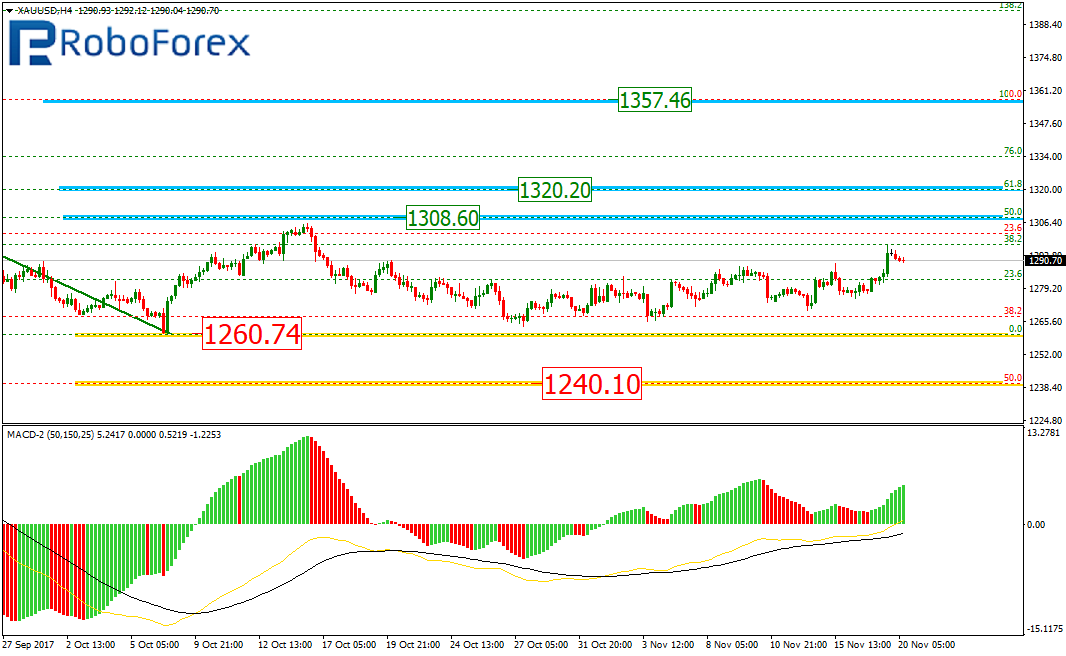
At the H4 chart, after breaking the local highs, the XAU/USD pair continues forming a mid-term correction. The correction has already reached the retracement of 38.2%. The next possible targets may be the retracements of 50.0% and 61.8% at 1308.60 and 1320.20 respectively.

GOLD1

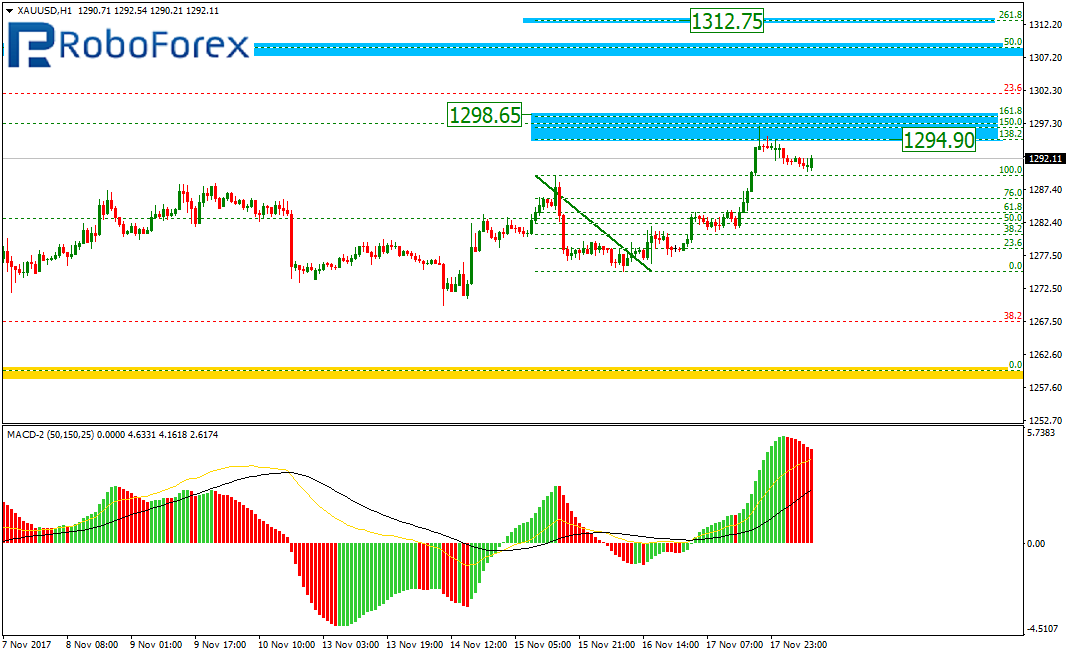
As we can see at the H1 chart, after being corrected to the downside, the pair started forming a new ascending impulse and has already reached the post-correctional extension area between the retracements of 138.2% and 161.8% at 1294.90 and 1298.65 respectively. One of the main closest targets is the retracement of 261.8% at 1312.75.

GOLD2


USD CHF, “US Dollar vs Swiss Franc”

At the H4 chart, the local correction continues. By now, the USD/CHF pair has already been corrected by 23.6%. The next targets of this correction are the retracements of 38.2% and 50.0% at 0.9803 and 0.9728 respectively. After finishing the correction, the instrument may resume growing towards 1.0123.

USDCHF1

At the H1 chart, the current situation is the same.

USDCHF2


RoboForex Analytical Department

Article By RoboForex.com

Attention!
Forecasts presented in this section only reflect the author’s private opinion and should not be considered as guidance for trading. RoboForex LP bears no responsibility for trading results based on trading recommendations described in these analytical reviews.

Forex Technical Analysis & Forecast 20.11.2017 (EUR/USD, GBP/USD, USD/CHF, USD/JPY, AUD/USD, USD/RUB, GOLD, BRENT)

Article By RoboForex.com

EUR USD, “Euro vs US Dollar”

The EUR/USD pair is forming the second descending impulse with the target at 1.1668. Later, in our opinion, the market may grow towards 1.1746 and then resume falling to reach 1.1630.

EURUSD


GBP USD, “Great Britain Pound vs US Dollar”

The GBP/USD pair is forming the third ascending structure with the target at 1.3280. After that, the instrument may resume falling towards 1.3172 and then form another structure to the upside with the target at 1.3310 to complete the correction. Later, in our opinion, the market may continue falling.

GBPUSD


USD CHF, “US Dollar vs Swiss Franc”

The USD/CHF pair is still being corrected. We think, today the price may grow to reach 0.9963 and start another decline to return to 0.9900. After that, the instrument may resume growing inside the uptrend with the target at 1.0081.

USDCHF


USD JPY, “US Dollar vs Japanese Yen”

The USD/JPY pair has reached its target and expanded the range to the downside. Possibly, today the price may grow to reach 112.51 and then resume trading to the downside with the target at 111.71.

USDJPY


AUD USD, “Australian Dollar vs US Dollar”

The AUD/USD pair is extending the wave downwards. We think, today the price may reach 0.7523 and then grow towards 0.7570. Later, in our opinion, the market may continue falling with the target at 0.7490.

AUDUSD


USD RUB, “US Dollar vs Russian Ruble”

The USD/RUB pair has broken 59.50 downwards. Possibly, today the price may grow to reach 59.50 and then resume falling with the first target at 58.68.

USDRUB


XAU USD, “Gold vs US Dollar”

Gold has completed the third ascending impulse. We think, today the price may fall to reach 1277, thus forming another consolidation range. If later the instrument breaks this range to the upside, the market may continue the correction towards 1311; if to the downside – fall inside the downtrend with the target at 1250.

GOLD


BRENT

Brent is moving upwards; it has broken 62.26 upwards. The target is at 63.30. After that, the instrument may fall to return to 62.26 and then resume moving to the upside towards 66.00.

BRENT


RoboForex Analytical Department

Article By RoboForex.com

Attention!
Forecasts presented in this section only reflect the author’s private opinion and should not be considered as guidance for trading. RoboForex LP bears no responsibility for trading results based on trading recommendations described in these analytical reviews.

EURUSD: Merkel has failed to form a coalition government

By Gabriel Ojimadu, Alpari

On Friday the 17th of November, trading on the euro/dollar pair closed slightly up. Despite continued pressure on the euro due to difficulties in Germany in forming a coalition government, the single currency was bolstered by a surge in demand following a retreat by traders towards safe haven assets amid new developments concerning North Korea. The euro was also helped by a decline in US bond yields, which brought the dollar down with it.

North Korea has announced that it will refuse to have any kind of dialogue with the United States for as long as they maintain their hostile stance and for as long as they continue to carry out military training exercises with South Korea.

Day’s news (GMT+3):

  • 10:00 Germany: PPI (Oct).
  • 14:00 Germany: German Buba monthly report.
  • 15:15 Eurozone: ECB’s Lautenschläger Speech.
  • 17:00 Eurozone: ECB president Draghi’s speech.
  • 21:00 USA: leading index (Oct).

Fig 1. EURUSD rate on the hourly. Source: TradingView

Sellers didn’t make it to the 45th degree on Friday. A support level came into play at the 1.1775 mark which they were unable to break due to increased demand for safe havens. The price closed at 1.1795.

On Monday the 20th of November, trading on the euro opened with a sharp decline. The euro dropped to 1.1722 (-73 pips) after news that talks on creating a coalition government in Germany had broken down. Germany’s Free Democratic Party (FDP) walked out of negotiations after failing to reach a compromise with Angela Merkel’s Christian Democratic Union, its sister party the Christian Social Union, and the Green Party.

At the time of writing, the euro is trading at 1.1735. The price bounced off the lower boundary of the A-A channel and has been trading in a sideways trend for the last few hours. There won’t be many news releases relevant to the euro today, so the deadlock over forming a coalition government will be the main focus throughout the day.

My forecast expects a breakout of the TR trend line, the 90th degree, and the A-A channel, followed by a price drop to 1.1686.

Independence Lost: Catalan’s Plight for Succession

By Adinah Brown

There is no question that the Catalonians put up a good fight. It was the epic and upward struggle for independence that all came tumbling down on October 27th. The Catalan parliament voted for succession, with much of the opposition party having walked out, 70 votes were cast in favor to constitute Catalonia as a republic, 10 opposed and 2 abstained.

After the vote was tallied the Catalan President, Mr Carles Puigdemont declared “Today, the parliament took a long-awaited and struggled-for step”. But in truth, the step was nothing if just symbolic as the response from Madrid was fast, fierce and forthcoming. The overwhelming majority of the Spanish senate approved the government’s request to exercise constitutional power to intervene in Catalonia, using whatever method necessary to quash the rebellion.

First step was the dismissal of the Catalan government and parliament and its election declared void by Spain’s Constitutional Tribunal. Then, the Senate approved the application of Article 155, a legislative position which enables Spain to apply wide powers that compel a national region to obey its constitution. No holds barred, Article 155 was passed with the overwhelming support of Spain’s opposition party, even despite it being an exceptional decision that throughout Spain’s history has never been applied before.

On the basis that the Catalan administration has “continued a process of anti-democratic decisions, against the law and Spanish and European values”, Spain announced the shutting down of the Catalan government’s offices abroad. It intends to replace commanders of the Catalan police force along with usurping the government’s finances and IT departments, stopping just short of taking over the public broadcasters.

What’s worse is that it appears all this could have been avoided. Up and until then it had been hoped that a compromise could be sought. Just the day before on October 26th, representatives from both Madrid and Barcelona worked out the details to an agreement whereby President Puigdemont would call for a fresh election and in return the government would suspend its plans for direct rule. Yet this agreement was to fall flat, due to the inherent mistrust between the two administrations and fears by Puigdemont that he would lose the confidence and be perceived as a traitor by his own independence movement.

Which brings us to where we are now; a dissolved Catalan parliament and a swift call to new regional elections which is due to take place on December 21st. The political instability has seen 1,500 companies, including all international corporations, move their domiciles to outside the region and a big drop in tourism, a punch that will hurt its capital, Barcelona.

With Spain’s constitutional court declaring the succession illegal, the impact on the Euro, has been particularly underwhelming. If forex traders have been concerned about the impact of this political turmoil, they have not been showing it. In the days leading up to the triggering of Article 155, the Euro appeared entirely unperturbed as it continued on its merry ascent against the US dollar. While on October the 27th there was an almost 1.5% drop in the EUR:USD, it has since resumed a steady recovery. Spain’s benchmark, the IBEX 35 index did take an acute hit on October 4th with a 3% drop, however come October 30th and the index had fully recovered itself, reaching a high that hadn’t been seen for months prior.

ING currency strategist Chris Turner explained the markets’ non-responsiveness “while the situation continues attracting headlines… the actual impact on the (euro) has been limited” as the common currency becomes “more immune” to Eurozone risks. Jane Foley at Rabobank confirmed this analysis, “Coming just a week after Germany’s national elections, which made the far-right AfD the third largest party in the Bundestag, investors are reassessing the divisions that exist within the eurozone,” to the effect of minimizing the destabilizing impact of any one regional incident.

About the Author:

Adinah Brown is a professional writer who has worked in a wide range of industry settings, including corporate industry, government and non-government organizations. Within many of these positions, Adinah has provided skilled marketing and advertising services and is currently the Content Manager at Leverate.


Facebook Traders: Tech Giant + Technical Analysis = Thumbs Up

See how two technical indicators, RSI and ZLR, helped anticipate the resumption of FB’s uptrend — back in May

By Elliott Wave International

Some days, the fundamental backdrop of the markets you follow is as peaceful and quiet as a Zen garden. The news cycle is calm and the mainstream predictions about price are clear.

Other days, though, that backdrop is as chaotic as the Jersey turnpike during rush hour; jackhammers of breaking news pound in your ears while the “horns” of prognostication honk in opposite directions.

Wednesday, November 1 was a turnpike kind of day for the likes of Facebook, as market followers braved a media maelstrom over the tech giant’s testimony on Capitol Hill, one of three social networks accused of providing a broad, public forum for Russia to influence the 2016 U.S. presidential election via strategically divisive Facebook ads and posts.

In the wake of the House & Senate Intelligence Committee hearing, Facebook analysts were all over the map on how the investigation and criticism will affect the tech giant’s stock moving forward. Here, these news items from November 1 and 2 capture the conflicting outlooks:

Facebook is invincible: “Facebook Shatters Earnings… show[ing] just how insulated its business remains from political risks.” (Fortune)

Facebook is vulnerable: “Facebook shares fell as much as 2% after it said on a conference call that 2018 expenses would rise 45% to 60%… for more security.” (CNBC)

Facebook is invincible: “If you haven’t bought Facebook Inc, What are you Waiting for?” (Investorplace.com)

Facebook is vulnerable: “Facebook Inc (FB) Warns Drop in Profits As it Ramps Up Security” (Value Walk)

Not to get too meta here, but if Facebook traders had their own Facebook page, this news-driven uncertainty would illicit a big, fat Facebook thumbs down.

So, what’s the alternative? When you have a company as hugely popular as Facebook, stopping the news cycle from churning out gossip, hearsay, rumbles and rumors is impossible.

That’s true. You can’t stop the news. But you can stop yourself from being distracted by it.

See, for our Trader’s Classroom instructor Jeffrey Kennedy, the one way to objectively gauge price trends is with technical analysis. It’s an airtight, noise-controlled assessment of market action that shuts out fundamentals and focuses strictly on the “mathematics” of price patterns.

Take Facebook. Six months ago, in his May 30 Trader’s Classroom, Jeffrey praised the “versatility” of technical analysis; namely, how it works on every liquid market, virtually every timeframe, and for every type of trader from day scalper to long-term campaigner. In his video lesson, Jeffrey tracked the progress of three main indicators — the Relative Strength Index (RSI) “phase change,” Elliott wave analysis, and the MACD Zero Line Reversal (ZLR) — all of which pointed to the resumption of Facebook’s uptrend.

From there, Facebook shares broke out of their months-long sideways trend and took to the upside. Then, in his August 22 Trader’s Classroom, Jeffrey returned to the ZLR on Facebook’s price chart and showed how this simple indicator confirmed the tech stock’s rally was well on its way to setting new highs above 175.

The following chart of Facebook shows exactly when and where Jeffrey’s Trader’s Classroom episodes aired within the market’s powerful rally.

Image 1

We eagerly invite you to listen to an exclusive compilation of the May 30 and August 22 Trader’s Classroom webisodes to hear Jeffrey walk traders through his “buy-side oriented” analysis of Facebook in real-time:

Free Trader’s Workshop: “Battle-Tested Tools to Boost Your Trading Confidence”

Get 7 free lessons that will give you the tools you need to confidently identify trading opportunities in the charts you follow every day. Register now and get your first 6 lessons instantly.

Then, on Monday, Nov. 20, join Jeffrey Kennedy for a live webinar where he will show you how to apply these techniques to live charts of some of today’s most popular stocks, like Facebook, Amazon and Netflix.

Register Now!

This article was syndicated by Elliott Wave International and was originally published under the headline Facebook Traders: Tech Giant + Technical Analysis = Thumbs Up. EWI is the world’s largest market forecasting firm. Its staff of full-time analysts led by Chartered Market Technician Robert Prechter provides 24-hour-a-day market analysis to institutional and private investors around the world.

COT Report: USD bets continue improvement. Crude bets jump to record high

By CountingPips.com – Get our weekly COT Reports by Email

Here is a short summary and this week’s links (below) to the latest Commitment of Traders changes that was released on Monday due to the Veteran’s Day holiday.

Speculators continued to raise US Dollar bets for 7th week

WTI Crude Oil Speculators boosted bullish net positions to new record high

10-Year Note Speculators bullish bets rebounded for 2nd week

Gold Speculators slightly lowered bullish bets

S&P500 Speculators trimmed their bearish net positions

Silver Speculators slightly raised their bets, up for 2nd week

Copper Speculators lowered their bullish net positions for a 3rd week


Forex Speculators raised their US Dollar bets for 7th week

US Dollar net speculator positions leveled at $-0.643 billion as of Tuesday

The latest data for the weekly Commitment of Traders (COT) report, released by the Commodity Futures Trading Commission (CFTC) on Friday, showed that large traders and currency speculators further raised their bets for the US dollar this week. See full article


WTI Crude Oil Speculators pushed bullish net positions to new record high

The non-commercial contracts of WTI crude futures totaled a net position of 596,466 contracts, according to data from this week. This was a lift of 51,260 contracts from the previous weekly total. See full article


Gold Speculators slightly lowered their bullish net positions this week

The large speculator contracts of gold futures totaled a net position of 195,084 contracts. This was a weekly decline of -706 contracts from the previous week. See full article


10-Year Note Speculators boosted their bullish net positions for 2nd week

The large speculator contracts of 10-year treasury note futures totaled a net position of 74,836 contracts. This was a weekly increase of 24,773 contracts from the previous week. See full article


S&P500 Speculators reduced their bearish net positions this week

The large speculator contracts of S&P 500 futures totaled a net position of -158 contracts. This was a rise of 1,567 contracts from the reported data of the previous week. See full article


Silver Speculators slightly raised their net positions, up for 2nd week

The non-commercial contracts of silver futures totaled a net position of 69,173 contracts, according to data from this week. This was a weekly gain of 271 contracts from the previous totals. See full article


Copper Speculators lowered bullish net positions for 3rd week

The large speculator contracts of copper futures totaled a net position of 39,714 contracts. This was a weekly shortfall of -2,861 contracts from the data of the previous week. See full article


Article by CountingPips.com

The Commitment of Traders report data is published in raw form every Friday by the Commodity Futures Trading Commission (CFTC) and shows the futures positions of market participants as of the previous Tuesday (data is reported 3 days behind).

To learn more about this data please visit the CFTC website at http://www.cftc.gov/MarketReports/CommitmentsofTraders/index.htm


Forex Speculators raised their US Dollar bets for 7th week

By CountingPips.comGet our weekly COT Reports by Email

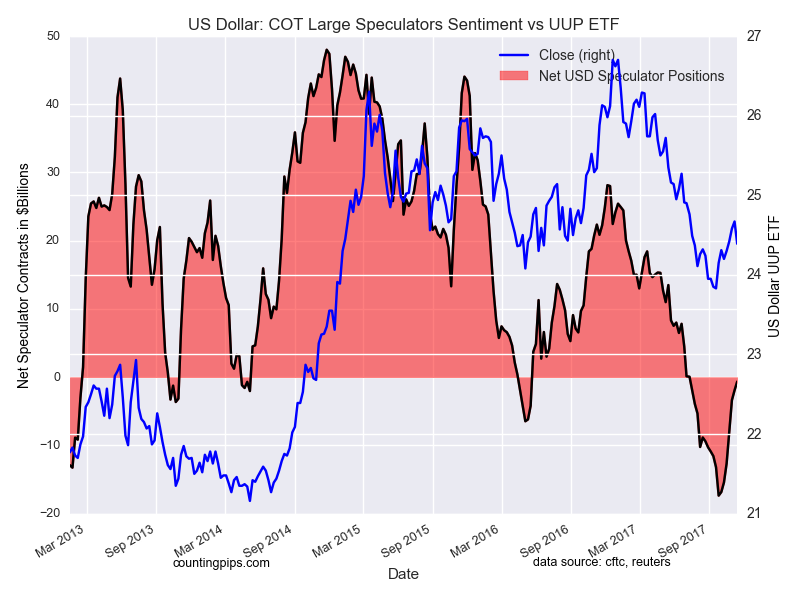
US Dollar net speculator positions stand at $-0.643 billion this week

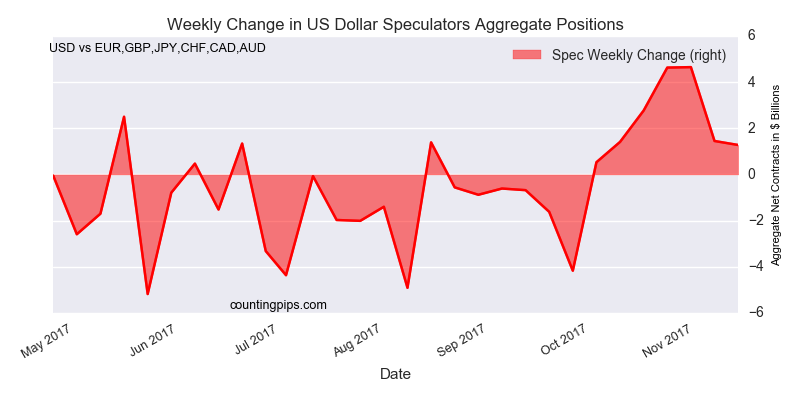
The latest data for the weekly Commitment of Traders (COT) report, released by the Commodity Futures Trading Commission (CFTC) on Friday, showed that large traders and currency speculators further raised their bets for the US dollar this week.

Non-commercial large futures traders, including hedge funds and large speculators, had an overall US dollar net position totaling $-0.643 billion as of Tuesday November 14th, according to the latest data from the CFTC and dollar amount calculations by Reuters. This was a weekly rise of $1.277 billion from the $-1.92 billion total position that was registered the previous week, according to the Reuters calculation (totals of the US dollar contracts against the combined contracts of the euro, British pound, Japanese yen, Australian dollar, Canadian dollar and the Swiss franc).

The aggregate speculative US dollar position has improved (become less bearish) for seven consecutive weeks and is now at the lowest bearish level since July.

Weekly Speculator Contract Changes:

The major currencies that improved against the US dollar this week were the British pound sterling (4,665 weekly change in contracts) and the Mexican peso (5,558 contracts).

The currencies whose speculative bets declined this week versus the dollar were the euro (-869 weekly change in contracts), Japanese yen (-8,151 contracts), Swiss franc (-2,873 contracts), Canadian dollar (-3,554 contracts), Australian dollar (-1,405 contracts) and the New Zealand dollar (-704 contracts).


Table of Weekly Commercial Traders and Speculators Levels & Changes:

CurrencyNet CommercialsComms Weekly ChgNet SpeculatorsSpecs Weekly Chg
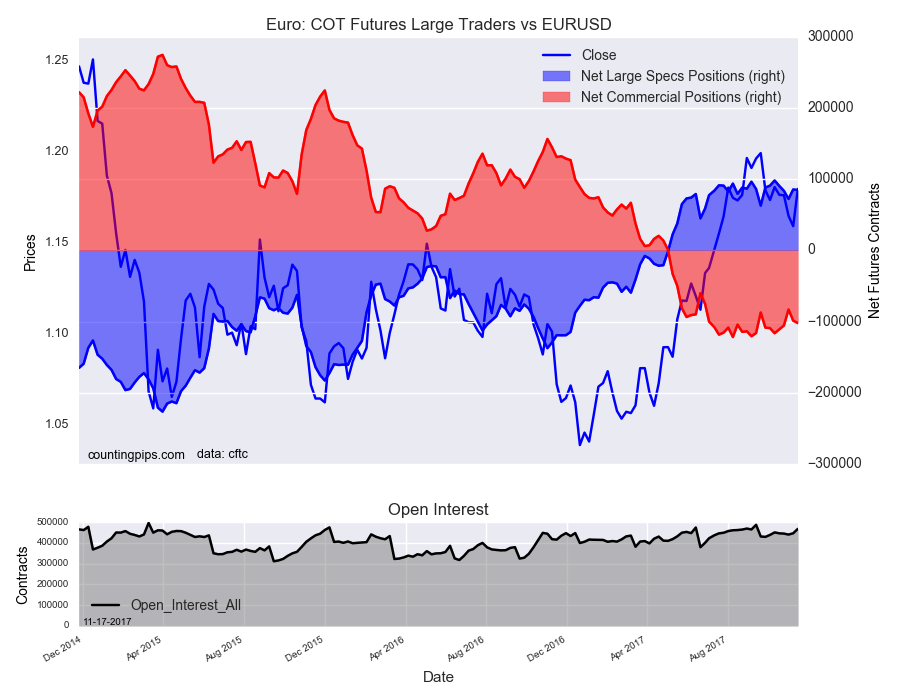
EuroFx-102,185-3,35784,586-869
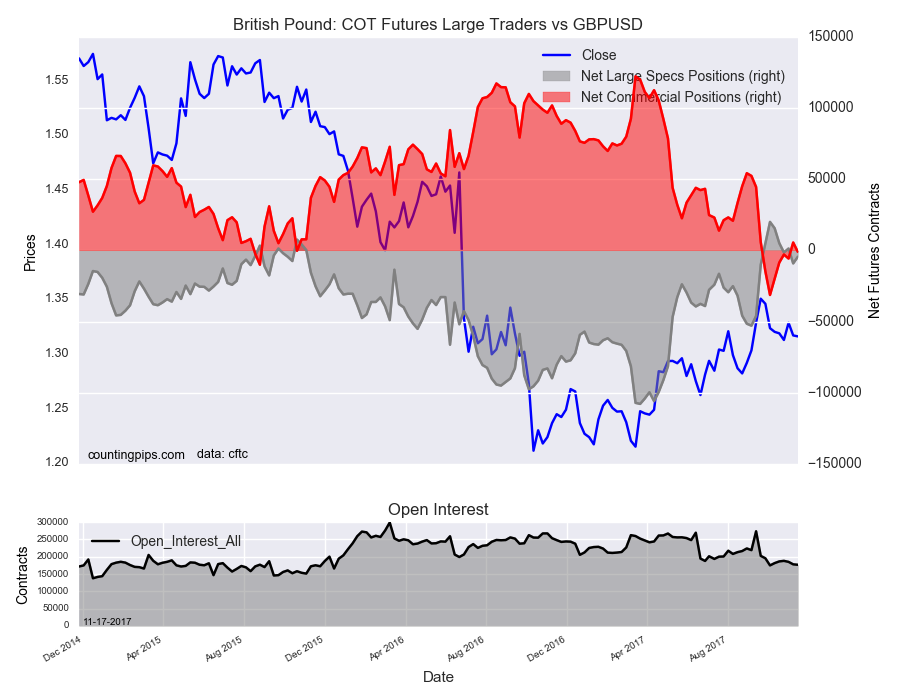
GBP-1,084-6,577-4,5334,665
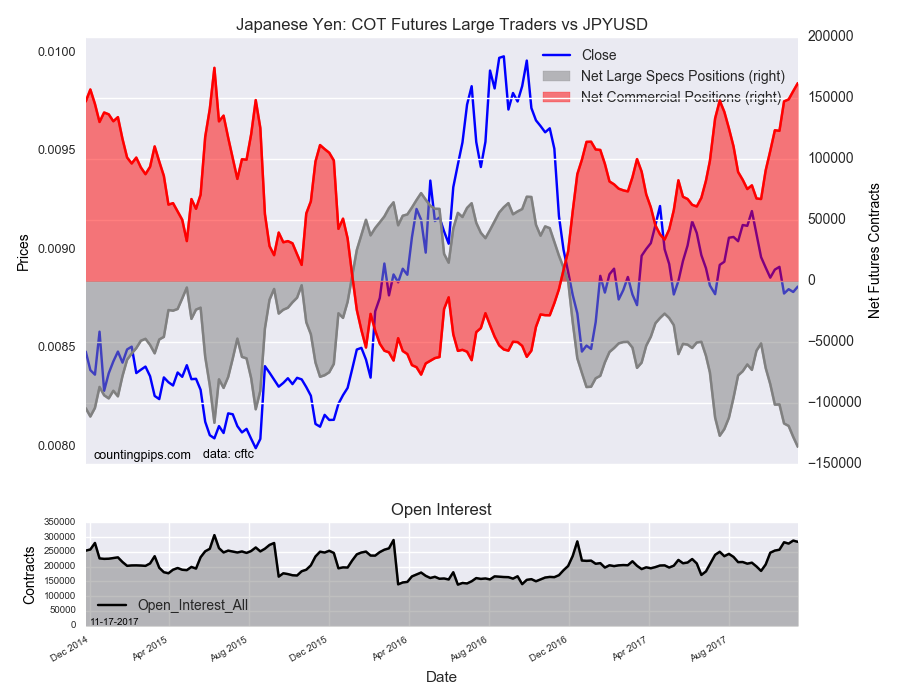
JPY161,9476,539-135,999-8,151
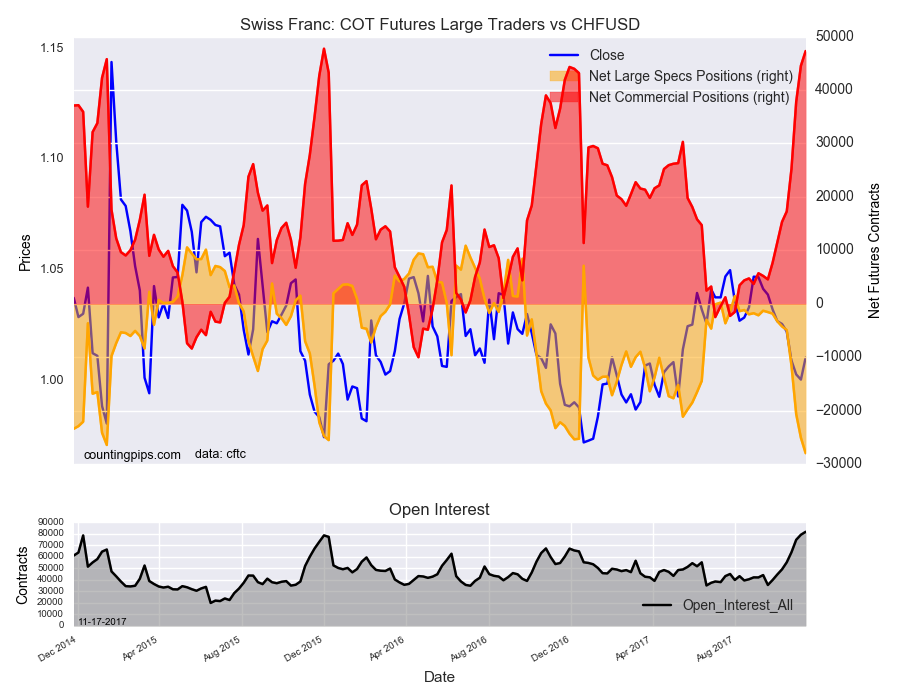
CHF47,3112,739-27,983-2,873
CAD-57,9653,97647,335-3,554
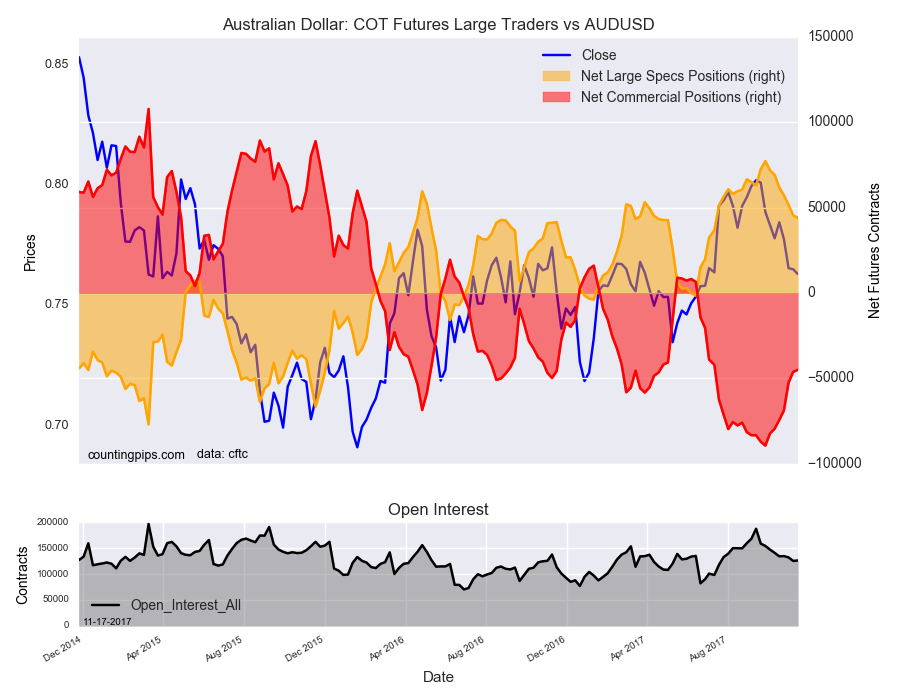
AUD-44,9031,23144,032-1,405
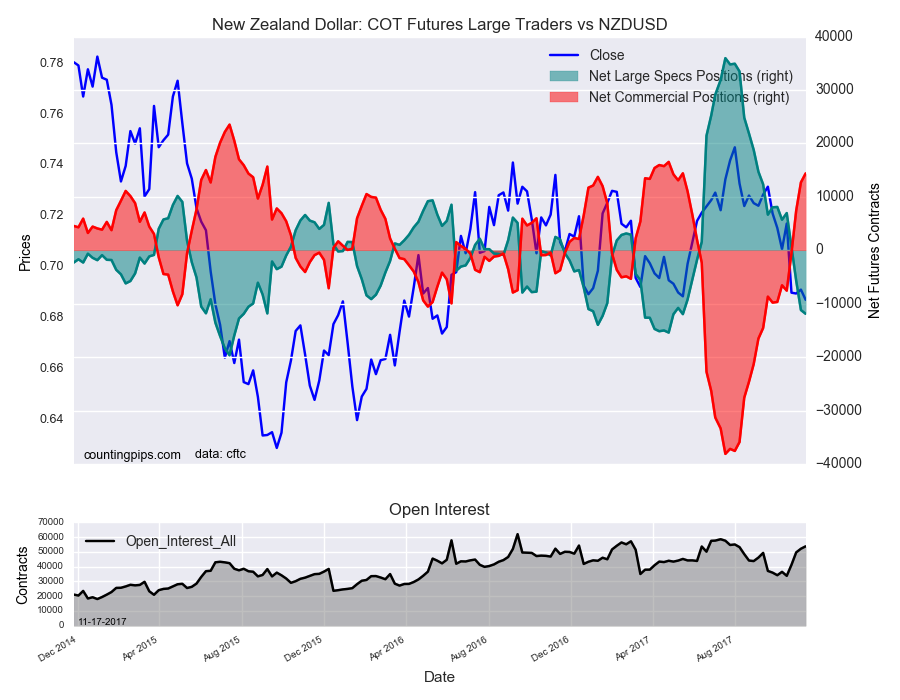
NZD14,4031,680-11,891-704
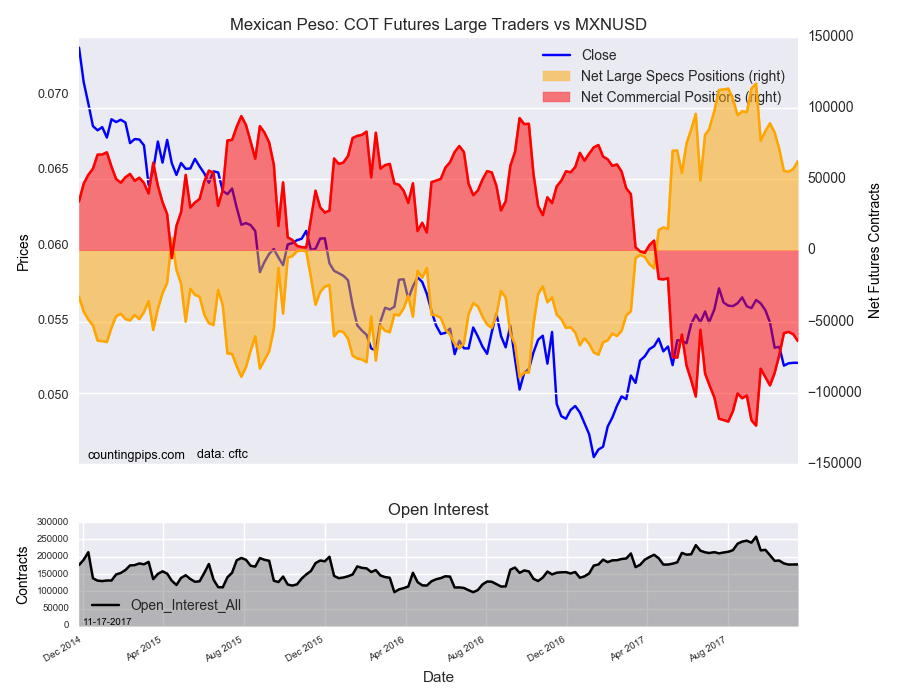
MXN-63,671-4,76462,5335,558


This latest COT data is through Tuesday and shows a quick view of how large speculators or non-commercials (for-profit traders) as well as the commercial traders (hedgers & traders for business purposes) were positioned in the futures markets. All currency positions are in direct relation to the US dollar where, for example, a bet for the euro is a bet that the euro will rise versus the dollar while a bet against the euro will be a bet that the dollar will gain versus the euro.


Weekly Charts: Large Trader Weekly Positions vs Price

EuroFX:


British Pound Sterling:


Japanese Yen:


Swiss Franc:


Canadian Dollar:


Australian Dollar:


New Zealand Dollar:


Mexican Peso:


*COT Report: The weekly commitment of traders report summarizes the total trader positions for open contracts in the futures trading markets. The CFTC categorizes trader positions according to commercial hedgers (traders who use futures contracts for hedging as part of the business), non-commercials (large traders who speculate to realize trading profits) and nonreportable traders (usually small traders/speculators). Find CFTC criteria here: (http://www.cftc.gov/MarketReports/CommitmentsofTraders/ExplanatoryNotes/index.htm).

The Commitment of Traders report is published every Friday by the Commodity Futures Trading Commission (CFTC) and shows futures positions data that was reported as of the previous Tuesday (3 days behind).

Each currency contract is a quote for that currency directly against the U.S. dollar, a net short amount of contracts means that more speculators are betting that currency to fall against the dollar and a net long position expect that currency to rise versus the dollar.

(The charts overlay the forex closing price of each Tuesday when COT trader positions are reported for each corresponding spot currency pair.) See more information and explanation on the weekly COT report from the CFTC website.

Article by CountingPips.com


WTI Crude Oil Speculators pushed bullish net positions to new record high

By CountingPips.comReceive our weekly COT Reports by Email

WTI Crude Oil Non-Commercial Speculator Positions:

Large energy speculators sharply lifted their net positions in the WTI Crude Oil futures markets this week to a record high bullish level, according to the latest Commitment of Traders (COT) data released by the Commodity Futures Trading Commission (CFTC) on Friday.

The non-commercial futures contracts of WTI Crude Oil futures, traded by large speculators and hedge funds, totaled a net position of 596,466 contracts in the data reported through Tuesday November 14th. This was a weekly increase of 51,260 contracts from the previous week which had a total of 545,206 net contracts.

Speculative positions have now risen for five straight weeks (by a total of +179,405 contracts) and on to a new record high that surpasses the previous high of +556,607 contracts that was registered on February 21st of this year.

WTI Crude Oil Commercial Positions:

The commercial traders position, hedgers or traders engaged in buying and selling for business purposes, totaled a net position of -614,084 contracts on the week. This was a weekly shortfall of -62,677 contracts from the total net of -551,407 contracts reported the previous week.

USO:

Over the same weekly reporting time-frame, from Tuesday to Tuesday, the USO Crude Oil ETF, which tracks the price of WTI crude oil, closed at approximately $11.13 which was a decrease of $-0.36 from the previous close of $11.49, according to unofficial market data.

*COT Report: The COT data, released weekly to the public each Friday, is updated through the most recent Tuesday (data is 3 days old) and shows a quick view of how large speculators or non-commercials (for-profit traders) as well as the commercial traders (hedgers & traders for business purposes) were positioned in the futures markets. The CFTC categorizes trader positions according to commercial hedgers (traders who use futures contracts for hedging as part of the business), non-commercials (large traders who speculate to realize trading profits) and nonreportable traders (usually small traders/speculators). Find CFTC criteria here: (http://www.cftc.gov/MarketReports/CommitmentsofTraders/ExplanatoryNotes/index.htm).

Article By CountingPips.comReceive our weekly COT Reports by Email