Author Archive for InvestMacro – Page 472

10-Year Note Speculators boosted their bullish net positions for 2nd week

By CountingPips.comReceive our weekly COT Reports by Email

10-Year Note Non-Commercial Speculator Positions:

Large treasury speculators further raised their bullish net positions in the 10-Year Note futures markets this week, according to the latest Commitment of Traders (COT) data released by the Commodity Futures Trading Commission (CFTC) on Friday.

The non-commercial futures contracts of 10-Year Note futures, traded by large speculators and hedge funds, totaled a net position of 74,836 contracts in the data reported through Tuesday November 14th. This was a weekly increase of 24,773 contracts from the previous week which had a total of 50,063 net contracts.

Speculative positions rose for a second week following a gigantic weekly decline of -150,873 contracts on October 31st that brought positions to essentially a neutral level (+2,724 net contracts).

10-Year Note Commercial Positions:

The commercial traders position, hedgers or traders engaged in buying and selling for business purposes, totaled a net position of 133,459 contracts on the week. This was a weekly shortfall of -62,254 contracts from the total net of 195,713 contracts reported the previous week.

IEF ETF:

Over the same weekly reporting time-frame, from Tuesday to Tuesday, the 7-10 Year Treasury Bond ETF (IEF) closed at approximately $105.93 which was a decrease of $-0.62 from the previous close of $106.55, according to unofficial market data.

*COT Report: The COT data, released weekly to the public each Friday, is updated through the most recent Tuesday (data is 3 days old) and shows a quick view of how large speculators or non-commercials (for-profit traders) as well as the commercial traders (hedgers & traders for business purposes) were positioned in the futures markets. The CFTC categorizes trader positions according to commercial hedgers (traders who use futures contracts for hedging as part of the business), non-commercials (large traders who speculate to realize trading profits) and nonreportable traders (usually small traders/speculators). Find CFTC criteria here: (http://www.cftc.gov/MarketReports/CommitmentsofTraders/ExplanatoryNotes/index.htm).

Article By CountingPips.comReceive our weekly COT Reports by Email

Gold Speculators slightly lowered their bullish net positions this week

By CountingPips.comReceive our weekly COT Reports by Email

Gold Non-Commercial Speculator Positions:

Large precious metals speculators slightly reduced their net positions in the Gold futures markets this week, according to the latest Commitment of Traders (COT) data released by the Commodity Futures Trading Commission (CFTC) on Friday.

The non-commercial futures contracts of Gold futures, traded by large speculators and hedge funds, totaled a net position of 195,084 contracts in the data reported through Tuesday November 14th. This was a weekly reduction of -706 contracts from the previous week which had a total of 195,790 net contracts.

Speculative positions had risen for two straight weeks and for three out of the previous four weeks before this week’s small decline.

Gold Commercial Positions:

The commercial traders position, hedgers or traders engaged in buying and selling for business purposes, totaled a net position of -215,791 contracts on the week. This was a weekly decline of -504 contracts from the total net of -215,287 contracts reported the previous week.

GLD ETF:

Over the same weekly reporting time-frame, from Tuesday to Tuesday, the GLD ETF, which tracks the price of gold, closed at approximately $121.56 which was an advance of $0.35 from the previous close of $121.21, according to unofficial market data.

*COT Report: The COT data, released weekly to the public each Friday, is updated through the most recent Tuesday (data is 3 days old) and shows a quick view of how large speculators or non-commercials (for-profit traders) as well as the commercial traders (hedgers & traders for business purposes) were positioned in the futures markets. The CFTC categorizes trader positions according to commercial hedgers (traders who use futures contracts for hedging as part of the business), non-commercials (large traders who speculate to realize trading profits) and nonreportable traders (usually small traders/speculators). Find CFTC criteria here: (http://www.cftc.gov/MarketReports/CommitmentsofTraders/ExplanatoryNotes/index.htm).

Article By CountingPips.comReceive our weekly COT Reports by Email

S&P500 Speculators reduced their bearish net positions this week

By CountingPips.comReceive our weekly COT Reports by Email

S&P500 Non-Commercial Speculator Positions:

Large stock market speculators cut back on their bearish net positions in the S&P500 futures markets this week, according to the latest Commitment of Traders (COT) data released by the Commodity Futures Trading Commission (CFTC) on Friday.

The non-commercial futures contracts of S&P500 futures, traded by large speculators and hedge funds, totaled a net position of -158 contracts in the data reported through Tuesday November 14th. This was a weekly advance of 1,567 contracts from the previous week which had a total of -1,725 net contracts.

Speculative positions had increased their bearishness the previous two weeks before this week’s pull back. The overall speculative net position has now been in a short position for three straight weeks.

S&P500 Commercial Positions:

The commercial traders position, hedgers or traders engaged in buying and selling for business purposes, totaled a net position of 5,321 contracts on the week. This was a weekly decline of -310 contracts from the total net of 5,631 contracts reported the previous week.

SPY ETF:

Over the same weekly reporting time-frame, from Tuesday to Tuesday, the SPY ETF, which tracks the price of S&P500 Index, closed at approximately $257.73 which was a loss of $-0.94 from the previous close of $258.67, according to unofficial market data.

*COT Report: The COT data, released weekly to the public each Friday, is updated through the most recent Tuesday (data is 3 days old) and shows a quick view of how large speculators or non-commercials (for-profit traders) as well as the commercial traders (hedgers & traders for business purposes) were positioned in the futures markets. The CFTC categorizes trader positions according to commercial hedgers (traders who use futures contracts for hedging as part of the business), non-commercials (large traders who speculate to realize trading profits) and nonreportable traders (usually small traders/speculators). Find CFTC criteria here: (http://www.cftc.gov/MarketReports/CommitmentsofTraders/ExplanatoryNotes/index.htm).

Article By CountingPips.comReceive our weekly COT Reports by Email

Silver Speculators slightly raised their net positions, up for 2nd week

By CountingPips.comReceive our weekly COT Reports by Email

Silver Non-Commercial Speculator Positions:

Large speculators slightly increased their net positions in the Silver futures markets this week, according to the latest Commitment of Traders (COT) data released by the Commodity Futures Trading Commission (CFTC) on Friday.

The non-commercial futures contracts of Silver futures, traded by large speculators and hedge funds, totaled a net position of 69,173 contracts in the data reported through Tuesday November 14th. This was a weekly lift of 271 contracts from the previous week which had a total of 68,902 net contracts.

Speculative positions rose for the second straight week and have now advanced to the highest net position level of the past nine weeks.

Silver Commercial Positions:

The commercial traders position, hedgers or traders engaged in buying and selling for business purposes, totaled a net position of -80,448 contracts on the week. This was a weekly boost of 1,193 contracts from the total net of -81,641 contracts reported the previous week.

SLV ETF:

Over the same weekly reporting time-frame, from Tuesday to Tuesday, the SLV ishares ETF, which tracks the price of silver, closed at approximately $16.08 which was a boost of $0.07 from the previous close of $16.01, according to unofficial market data.

*COT Report: The COT data, released weekly to the public each Friday, is updated through the most recent Tuesday (data is 3 days old) and shows a quick view of how large speculators or non-commercials (for-profit traders) as well as the commercial traders (hedgers & traders for business purposes) were positioned in the futures markets. The CFTC categorizes trader positions according to commercial hedgers (traders who use futures contracts for hedging as part of the business), non-commercials (large traders who speculate to realize trading profits) and nonreportable traders (usually small traders/speculators). Find CFTC criteria here: (http://www.cftc.gov/MarketReports/CommitmentsofTraders/ExplanatoryNotes/index.htm).

Article By CountingPips.comReceive our weekly COT Reports by Email

Copper Speculators lowered bullish net positions for 3rd week

By CountingPips.comReceive our weekly COT Reports by Email

Copper Non-Commercial Speculator Positions:

Large metals speculators lowered their net positions in the Copper futures markets this week, according to the latest Commitment of Traders (COT) data released by the Commodity Futures Trading Commission (CFTC) on Friday.

The non-commercial futures contracts of Copper futures, traded by large speculators and hedge funds, totaled a net position of 39,714 contracts in the data reported through Tuesday November 14th. This was a weekly decrease of -2,861 contracts from the previous week which had a total of 42,575 net contracts.

Speculative positions have now fallen for three straight weeks and by a total of -13,538 contracts over that time as the overall net level is at the lowest standing of the past six weeks.

Copper Commercial Positions:

The commercial traders position, hedgers or traders engaged in buying and selling for business purposes, totaled a net position of -45,644 contracts on the week. This was a weekly boost of 3,995 contracts from the total net of -49,639 contracts reported the previous week.

JJC ETF:

Over the same weekly reporting time-frame, from Tuesday to Tuesday, the JJC iPath Bloomber Copper ETN, which tracks the price of copper, closed at approximately $34.83 which was a fall of $-0.44 from the previous close of $35.27, according to unofficial market data.

*COT Report: The COT data, released weekly to the public each Friday, is updated through the most recent Tuesday (data is 3 days old) and shows a quick view of how large speculators or non-commercials (for-profit traders) as well as the commercial traders (hedgers & traders for business purposes) were positioned in the futures markets. The CFTC categorizes trader positions according to commercial hedgers (traders who use futures contracts for hedging as part of the business), non-commercials (large traders who speculate to realize trading profits) and nonreportable traders (usually small traders/speculators). Find CFTC criteria here: (http://www.cftc.gov/MarketReports/CommitmentsofTraders/ExplanatoryNotes/index.htm).

Article By CountingPips.comReceive our weekly COT Reports by Email

EUR/USD: Stay long for 1.1960

By GrowthAces.com

Macroeconomic overview:

  • Congressional Republicans took important steps on Thursday toward U.S. tax-code overhaul, with the House of Representatives approving a broad package of tax cuts, and a Senate panel advancing its own version of the legislation sought by senior lawmakers and President Donald Trump.
  • The House vote shifted the tax debate to the Senate, where a tax-writing panel finished debating and approved a bill late Thursday evening. That measure has already encountered resistance from some within the Republicans ranks. Full Senate action is expected after next week’s Thanksgiving holiday.
  • Four Republican senators – enough to derail the legislation – have been talking privately about opposing the bill because it would balloon the federal deficit, according to a Time magazine report.
  • Trump, who is still seeking his first major legislative win since taking office in January, went to the U.S. Capitol just before the House vote to urge Republicans to pass the tax bill, which Democrats call a giveaway to the wealthy and businesses.
  • Congress has not thoroughly overhauled the sprawling U.S. tax code since Republican Ronald Reagan was president. The House measure is not as comprehensive as Reagan’s 1986 package, but it is more ambitious than anything since then.
  • The path forward for the tax plan in the Senate, where Republicans have a narrow majority, is fraught with obstacles about concerns over the deficit, healthcare and the distribution of tax benefits. Republicans can lose no more than two Senate votes if Democrats remain united in opposition.
  • Senate Republican tax-writers earlier this week made the risky decision of tying their plan to a repeal of the requirement for people to get healthcare insurance under former President Barack Obama’s Affordable Care Act. That exposed the tax initiative to the same political forces that wrecked Republicans’ anti-Obamacare push earlier in July.
  • The House bill, estimated to increase the federal deficit by nearly USD 1.5 trillion over 10 years, would consolidate individual and family tax brackets to four from seven and reduce the corporate tax rate to 20% from 35%.
  • It also would scale back or end some popular tax deductions, including one for state and local income taxes, while preserving a capped deduction for property tax payments.
  • Democrats have pointed to analyses showing millions of Americans could end up with a tax hike because of eliminated deductions. Repealing or shrinking some deductions is a way to offset the revenue lost from tax cuts.
  • Senate Democratic leader Chuck Schumer warned Republicans that by increasing the deficit, the tax bill would imperil other important priorities such as military spending.
  • Thirteen House Republicans opposed the bill, all but one from New York, New Jersey or California – states with high taxes where residents would feel the pinch from eliminating the deduction for state and local income taxes.
  • Investors have cheered the prospect of a tax overhaul. U.S. stocks rose and the dollar edged higher against a basket of major currencies on Thursday after the House vote. The USD reaction was short-lived. The EUR/USD climbed back above 1.1800 again during Asian trading hours.
  • San Francisco Federal Reserve President John Williams reiterated his view that the U.S. economy is growing strongly enough for the Fed to continue raising rates gradually over the next couple of years to around 2.5%.

Technical analysis and trading signals:

  • Positive cross on the 7/14 exponential moving averages is a bullish sign. We suggest the buy dips strategy. The nearest target is the October 1.1880 peak.
  • We stay long for 1.1960.

EURUSD Daily Forex Signals Chart


USD/CAD: Eyes on inflation data and NAFTA renegotiations

Macroeconomic overview:

  • Canadian manufacturing sales unexpectedly rose in September, boosted by sales of petroleum and coal products, data from Statistics Canada showed on Thursday. The 0.5% increase in total sales topped market forecasts for a 0.3% decline, while volumes rose 0.7%. August was downwardly revised to a gain of 1.4% from a previously reported 1.6% increase.
  • The petroleum and coal industry led the way with a 10.3% increase in sales, amid higher prices and volumes. The gain was tempered by a 0.7% decline in the transportation sector as sales of motor vehicles and parts fell. Excluding vehicles, total manufacturing sales were up 1.4%.
  • Overall new orders declined by 1.7% after a strong gain in August and as there was less demand in the aerospace and vehicles industries.
  • Separate domestic data showed that foreign investors bought a net CAD 16.81 billion in Canadian securities in September.
  • The firm data and a reduced gap between the yields on Canadian and U.S. government debt boosted the Canadian dollar.
  • Prices of oil, one of Canada’s major exports, rose on Friday but remained en route for their first week of losses in six, as concerns grew over Russia’s support for an extension of the crude output cuts that have bolstered prices in recent months. An agreement by the Organization of the Petroleum Exporting Countries and other producers such as Russia to limit oil production has propped up prices in recent months, with the deal expected to be extended at the group’s next meeting on November 30. Saudi Arabia has signalled a willingness to extend the curbs, which are due to expire in March 2018, with energy minister Khalid al-Falih saying on Thursday that targets to reduce global oil surplus would not be reached in time.
  • CAD traders have also been focusing this week on the resumption of North American Free Trade Agreement (NAFTA) renegotiations. NAFTA working groups began meeting on Wednesday in Mexico. Talks will begin on Friday and continue through November 21.
  • Canada’s inflation report for October will be released today.

Technical analysis and trading signals:

  • Technical situation has not changed a lot since yesterday. The fact that the pair did not manage to break above the November 15 high at 1.2789 is encouraging for USD/CAD bears.
  • We stay short for 1.2550.

USDCAD Daily Forex Signals Chart


TRADING STRATEGIES SUMMARY:

FOREX – MAJOR PAIRS:

Please enable images to upload to view this email properly

FOREX – MAJOR CROSSES:

Please enable images to upload to view this email properly

PRECIOUS METALS:

Please enable images to upload to view this email properly

How to read these tables?

1. Support/Resistance – three closest important support/resistance levels
2. Position/Trading Idea:
BUY/SELL – It means we are looking to open LONG/SHORT position at the Entry Price. If the order is filled we will set the suggested Target and Stop-loss level.
LONG/SHORT – It means we have already taken this position at the Entry Price and expect the rate to go up/down to the Target level.
3. Stop-Loss/Profit Locked In – Sometimes we move the stop-loss level above (in case of LONG) or below (in case of SHORT) the Entry price. This means that we have locked in profit on this position.
4. Risk Factor – green “*” means high level of confidence (low level of uncertainty), grey “**” means medium level of confidence, red “***” means low level of confidence (high level of uncertainty)
5. Position Size (forex)– position size suggested for a USD 10,000 trading account in mini lots. You can calculate your position size as follows: (your account size in USD / USD 10,000) * (our position size). You should always round the result down. For example, if the result was 2.671, your position size should be 2 mini lots. This would be a great tool for your risk management!
Position size (precious metals) – position size suggested for a USD 10,000 trading account in units. You can calculate your position size as follows: (your account size in USD / USD 10,000) * (our position size).
6. Profit/Loss on recently closed position (forex) – is the amount of pips we have earned/lost on recently closed position. The amount in USD is calculated on the assumption of suggested position size for USD 10,000 trading account.
Profit/Loss on recently closed position (precious metals) – is profit/loss we have earned/lost per unit on recently closed position. The amount in USD is calculated on the assumption of suggested position size for USD 10,000 trading account.


VIP Traders Club members should expect to receive forex and precious metals trading signals updates at least twice a day. We will send you:

  1. Buy and sell forex, precious metals signals (entry level, target, stop-loss)
  2. Suggested position size that you can easily adjust to your trading account size – this would help you in risk management and you will survive longer drawdown periods
  3. Early heads-up about the potential trading opportunities or rationale to taken positions ( fundamental analysis, technical analysis )
  4. Forecasts of most important macroeconomic indicators prepared by our economists and econometricians.

JOIN VIP TRADERS CLUB – TRIAL MONTH FOR $1 NOW

About the Author:

By GrowthAces.com – Daily Forex Trading Strategies


Fibonacci Retracements Analysis 17.11.2017 (BITCOIN, ETHEREUM)

Article By RoboForex.com

BTC USD, “Bitcoin vs US Dollar”

As we can see at the H4 chart, after being corrected to the downside very quickly, the BTC/USD pair has broken its previous highs and reached new ones. The next upside targets may be inside the post-correctional extension area between the retracements of 138.2% and 161.8% at 8774.76 and 9313.05 respectively.

BTCUSD1

At the H1 chart, the pair is being corrected to the downside with the target at 38.2%, 50.0%, and 61.8% at 7076.06, 6776.85, and 6490.11 respectively

BTCUSD2


ETH USD, “Ethereum vs. US Dollar”

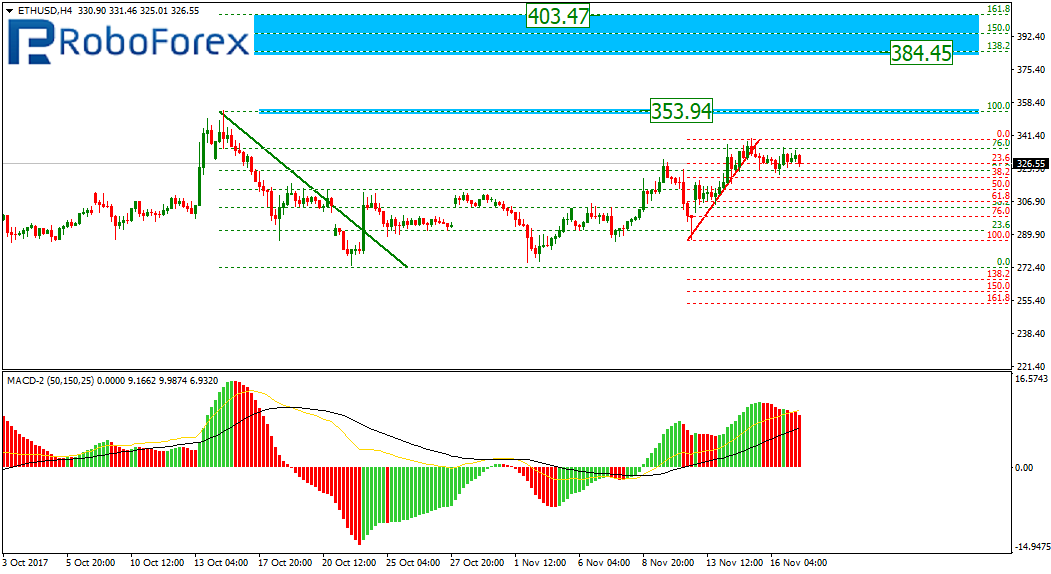
At the H4 chart, the uptrend continues, although the mid-term tendency is still a sideways range in the form of the Triangle. After breaking the high at 353.94, the ETH/USD pair may move towards the post-correctional extension area between the retracements of 138.2% and 161.8% at 384.45 and 403.47 respectively.

ETHUSD1

As we can see at the H1 chart, the pair is being corrected to the downside. The target are the retracements of 38.2%, 50.0%, and 61.8% 391.36, 313.10, and 306.83 respectively.

ETHUSD2


RoboForex Analytical Department

Article By RoboForex.com

Attention!
Forecasts presented in this section only reflect the author’s private opinion and should not be considered as guidance for trading. RoboForex LP bears no responsibility for trading results based on trading recommendations described in these analytical reviews.

The New US-Chinese Globalization Opportunity

By Dan Steinbock

While US postwar policies in Asia are shifting, a new Sino-US historical opportunity has emerged. US and Chinese visions of globalization could still prove complementary.

President Trump’s grueling 12-day Asia tour took place amid a worrisome historical moment. Since the mid-2010s, global economic integration – as measured by trade, investment and migration – has come to a standstill. Trade has been falling. Investment continues to stagnate. And slower migration has given rise to elevated global displacement and refugee crises – the worst since 1945.

After Japan, South Korea, China and Vietnam, Trump attended the Asia Pacific Economic Cooperation (APEC) Summit in Da Nang, Vietnam, followed by the 50th Anniversary of ASEAN in Manila.

It was the two leaders’ speeches in the Vietnam that seemed to leave room for an emerging opportunity – a new kind of globalization.

Competing views – only part of the story

In a defiant address, President Trump told the APEC meeting that the US would no longer tolerate “chronic trade abuses.” In turn, President Xi announced that globalization was irreversible.

In his speech, Trump complained about trade imbalances, arguing that America had lowered market barriers and ended tariffs, whereas other countries had not responded in kind. “Such practices hurt many people in our country,” he lamented.

Trump believed that those Bretton Woods multilateral organizations that America had created in the postwar era have become dysfunctional. So he railed against the World Trade Organization (WTO), which sets global trade laws, claiming that it “cannot function properly” if all members do not respect the rules.

Speaking right after his US counterpart, Chinese President Xi Jinping gave a strong address about the benefits world trade. Unlike Trump, Xi defended multilateral trade deals, which can help poorer nations to benefit: “”We should support the multilateral trading regime and practice open regionalism to allow developing members to benefit more from international trade and investment.”

Yet, neither leader has illusions about pure free trade ideals in which markets would be self-disciplinary and which thus would only generate winners.

“Globalization is an “irreversible historical trend,” Xi noted. Yet, he argued that the philosophy behind free trade must be repurposed to be “more open, more balanced, more equitable and more beneficial to all”.

The great opportunity

Unsurprisingly, most Western media headlined the APEC Summit with the startling contrast: “Trump and Xi offer competing visions for trade.” What got lost in the translation was the intriguing fact – and historical opportunity – that the Trump and Xi visions need not be seen as exclusive.

In fact, both the US and Chinese visions support globalization, but with caveats. Both criticize the old multilateral international banks, though for different reasons. Both believe in rebalancing that is not accompanied by excessive trade deficits and foreign investment that should benefit both investors and destinations.

As aging advanced economies suffer from secular stagnation, they can no longer fuel world trade, investment and migration as vigorously as before. That’s reflected by Trump’s pessimistic narrative of a globalization victim.

Yet, the global economy is also amid a secular transition that is characterized by increasing South-to-South trade, investment and migration, which are now fueled by emerging and developing nations. And that’s reflected by Xi’s more optimistic narrative of a globalization champion. The big picture includes both narratives.

In the 21st century, the international environment that fuels global economic integration is shifting dramatically. While globalization was initiated by advanced economies in the 20th century, it will be completed by emerging economies in the 21st century. At the same time, the drivers of globalization are moving from the transatlantic axis to Asia.

It is thus not the competitive US-China visions that will lead to a destructive conflict in Asia Pacific. Rather, it is the inherent commonalities in the Sino-US approaches that have potential to sustain economic cooperation in the region – and globally.

About the Author:

Dr Dan Steinbock is the founder of Difference Group and has served as research director at the India, China and America Institute (USA) and visiting fellow at the Shanghai Institutes for International Studies (China) and the EU Center (Singapore). For more, see https://www.differencegroup.net/ 

The original, slightly abbreviated commentary was released by Shanghai Daily on November 17, 2017


Forex Technical Analysis & Forecast 17.11.2017 (EUR/USD, GBP/USD, USD/CHF, USD/JPY, AUD/USD, USD/RUB, GOLD, BRENT)

Article By RoboForex.com

EUR USD, “Euro vs US Dollar”

The EUR/USD pair has completed the first descending impulse and right now is being corrected. Possibly, the price may reach 1.1822. Later, in our opinion, the market may resume falling towards 1.1667.

EURUSD


GBP USD, “Great Britain Pound vs US Dollar”

The GBP/USD pair is moving upwards. Possibly, the price may continue the correction to reach 1.3280 and resume falling towards 1.3171. After that, the instrument may form another structure to the upside with the target at 1.3300.

GBPUSD


USD CHF, “US Dollar vs Swiss Franc”

The USD/CHF pair is trading to rebound from 0.9903. Later, in our opinion, the market may grow to reach 0.9963 and start another correction to return to 0.9903. After that, the instrument may resume growing inside the uptrend with the target at 1.0050.

USDCHF


USD JPY, “US Dollar vs Japanese Yen”

The USD/JPY pair is moving downwards. We think, today the price may reach 112.25 and then resume trading to the upside with the target at 113.55.

USDJPY


AUD USD, “Australian Dollar vs US Dollar”

The AUD/USD pair is consolidating near the lows. If later the instrument breaks this range to the downside the market may reach 0.7520 and then continue falling towards 0.7400; if to the upside – start another correction with the target at 0.7666.

AUDUSD


USD RUB, “US Dollar vs Russian Ruble”

The USD/RUB pair is forming the first correctional wave towards 59.50. Later, in our opinion, the market may grow to reach 59.90 and then resume falling with the target at 59.00.

USDRUB


XAU USD, “Gold vs US Dollar”

Gold is moving upwards to reach 1286. After that, the instrument may fall towards 1269, break it, and then continue falling with the target at 1250.

GOLD


BRENT

Brent is moving downwards; it has broken the consolidation channel to the downside. Possibly, the price may fall to reach 60.80 and then resume moving to the upside with the target at 61.80.

BRENT


RoboForex Analytical Department

Article By RoboForex.com

Attention!
Forecasts presented in this section only reflect the author’s private opinion and should not be considered as guidance for trading. RoboForex LP bears no responsibility for trading results based on trading recommendations described in these analytical reviews.

EURUSD: price pulls back 61.8% before bouncing off the A-A channel

By Gabriel Ojimadu, Alpari

Previous:

On Thursday the 16th of November, trading on the euro/dollar pair closed down. The rate twice approached the zone of 1.1757 – 1.1759, but failed to break through. News from the US didn’t do sellers any good either. The US House of Representatives yesterday passed a tax reform bill proposed by the Trump administration. Markets were slow to react to the news given that the Senate has put forward an alternative proposal, which involves deferring tax cuts for another year. As such, it’s unclear as of yet what the final legislation will look like.

From the 1.1770 mark, the euro should have continued its decline until 1.1710, but the political news held it up. More on this later.

Day’s news (GMT+3):

  • 11:30 Eurozone: ECB president Draghi’s speech.
  • 12:00 Eurozone: current account (Sep), construction output (Sep).
  • 16:00 Germany: German Buba president Weidmann’s speech.
  • 16:30 Canada: CPI (Oct).
  • 16:30 USA: building permits (Oct), housing starts (Oct).
  • 20:00 USA: Baker Hughes US oil rig count.

Fig 1. EURUSD rate on the hourly. Source: TradingView

The euro closed down against the dollar on Thursday, although sellers didn’t make it to their target of 1.1751. If the euro weren’t rallying today, I’d have predicted that it would decline to form a pin bar model reaching down to 1.1710. The euro, however, has jumped to 1.1822, leaving us without a pin bar.

The dollar declined across the board after an article published in the Wall Street Journal. Special Counsel Robert Mueller has issued a subpoena to more than a dozen officials from Donald Trump’s presidential campaign, requesting documents related to Russia.

Safe haven assets (yen, gold, franc) were given a boost after an article published by Reuters, which reported that satellite images suggest that North Korea is working on its first submarine with ballistic missiles.

Suffice to say that politics is having an influence on trading. It’s unclear how Europe will react when their session gets underway. In theory, the euro should continue to grow to 1.1866, although cycles and patterns seem to suggest a decline. Here, I think it’s a personal decision as to whether you should sell or buy euros.

Personally, I’m leaning towards selling. Aside from the cycles, the upwards correction came to 61.8% of the drop from 1.1860 to 1.1757. The price has rebounded from the upper boundary of the A-A channel. I created the channel by connecting subsequent lows.

I want to stress again that the market is starting to be influenced by political factors. Technical analysis is of secondary importance now. Anything that doesn’t work out on the technical side as expected may come to fruition later. If the price breaks up out of the A-A channel, we can forget about a decline.