Author Archive for InvestMacro – Page 470

Are Britons Economically Ready for Driverless Cars?

BBC recently reported the agreement between Uber and Volvo. The former company struck a deal to buy up to 24,000 driverless cars from Volvo. The purchase is set to commence in 2019 and will continue over the course of three years.

Last year in America, Uber even began testing prototypes made by the Volvo Company. This shows to some extent the seriousness of their agreement as well as the direction that Uber is planning to take. What about the financial terms? According to BBC, that is yet to be disclosed although finance companies like Wilkins Finance estimate the deal to be worth a lot.

The UK also to purchase self-driving cars

It seems Britain also plans to move with technology. A few days back, British Chancellor Philip Hammond told the BBC that in about four years to come, UK residents could be witnessing driverless cars on the roads. According to the Chancellor, Britons should be using complete driverless vehicles by 2021. He believes that that would be one way of preparing the country to take charge and lead the next industrial revolution.

The Chancellor’s announcement came after UK’s largest car manufacturer, Jaguar Land Rover, began testing self-driving cars on the State’s public roads. The trials took place at Coventry city center for several weeks. All the trials rely on sensors that allow the cars to detect signals, traffic as well as pedestrians. However, during every trial, one person was always on board to attend to any emergencies.

What does this mean for the UK budget?

It is okay for the country to want to be at par with or even ahead of the latest technology. But really, is the public ready for that kind of development? First of all, several critics have warned that the technology required for driverless cars to succeed is so far from being ready. For one, Jeremy Clarkson, a former Top Gear host, wrote that he was recently almost killed in a self-driving car.

Writing in the Sunday Times Magazine, the now Grand Tour presenter explained that the particular car he was in made two grave mistakes, which convinced him that the technology was still far off from seamless.

Another concern is the budget. With the government now incorporating new and expensive technology, the public is definitely anticipating for some major changes in the next budget presentation. Previous budgets had promises of salary increments free from income tax, but the Chancellors recent announcement could cancel it all.

Some predictions are that the young public could escape the burden which is most likely to be placed on shoulders of the much grown up public. This prediction stems from the promise by the government to change the threshold at which students loans are repaid. Precisely, students will only be paying back when they earn at least £25,000 per annum. The government is also planning on canceling an increase in the tuition fees, which would have otherwise taken a toll on their accounts.

The effect on other industries

According to CNBC, self-driving cars are set to disrupt more than just the auto industry. Not to ignore the possibility that they have what it takes to create tremendous value for consumers. They will make life much easier by providing significant user convenience and saving drivers time. They will improve passenger safety and make it possible for people to do other things while travelling…these are just among the numerous amazing benefits they can offer consumers.

However, many industries are feared to be at risk of suffering great disruptive shifts from this development. One such industry is the insurance industry. Whereas many accidents occur due to human error, autonomous vehicles are expected to reduce the number of accidents significantly. This is a great thing, but it will, in turn, change the insurance revenue model. In other words, the demand for insurance will not be as high.

Likewise, legal professionals will not be frequently needed to solve cases. This is because some civil trials will be eliminated by driverless vehicles; especially vehicle collision cases. This then means that many professionals who specialize in personal injury and such like cases will have to search for alternative jobs.

Bottom Line

To sum it all up, driverless vehicles are definitely a genius invention. They come with many advantages that will help make life easier for the UK population. The question is, how many people will be able to afford these cars? Once they are purchased by the government, tax rates are more likely to shoot. And the sad part is that the public will be paying taxes to support a product they can barely have themselves.

By Taylor Wilman


Some Traders Hit. Some Traders Miss. Here’s How to be Part of the 1st Group

Also, watch Jeffrey Kennedy identify two high-confidence trade set-ups in Johnson & Johnson (NYSE: JNJ)

By Elliott Wave International

‘It’s the most wonderful time of the year,’ goes the famous holiday song. Except on Black Friday morning, that is, when a deadly stampede of shoppers at the big-name box store runs Granny down in the dry goods aisle.

But, if you think about it, a Black Friday stampede is not that different from a trading ‘stampede’ when thousands of trades all rush into the same hot stock.

When the trading “doors” open and a throng of people are all angling for the same opportunity as you, the clock is ticking. Under pressure, many traders race headlong into that market, palms sweating, heart racing, with no secure trading plan in place.

Have you ever been part of that crowd? That’s OK. All traders have.

Our very own master analyst Jeffrey Kennedy describes this tendency in his newest educational resource ’12 Real Life Techniques That Will Make You a Better Trader Now.’ It’s a collection of 5 video tutorials, and in the third one Jeffrey nails the ‘stampede’ impulse on the head:

“The reason is because people are running on a ‘lack’ mentality. Everybody’s knocking each other down, fighting to get to the front of the pack because again, they’re thinking there’s a limited supply of whatever items, say flat-screen TV’s.

Well, ever since they made flat-screen TV’s, I don’t think there has ever, in reality, been a single day that I couldn’t go out and buy whatever flat-screen TV I’ve wanted. I could buy five a week if I wanted to because the supply is out there.

Likewise, there’s plenty of opportunity in the markets. Literally, there is more opportunity than you actually have money in your trading account. By understanding that, you begin to discard the ‘lack’ mentality, and embrace an abundant one.”

That’s 1 lesson of 12: “Wait for the market to commit to you before you commit to the market” because no matter what, there is always another opportunity waiting just around the corner.

It helps, of course, to know exactly what you’re waiting for. In the second video of this five-video series, Jeffrey catalogs the “four critical elements of a high-confidence trade set-up,” using the price chart of Johnson & Johnson stock (NYSE: JNJ)

JNJ Opportunity #1: December 29, 2016 Trader’s Classroom lesson. There, Jeffrey identified recent selling as a corrective fourth wave and called for the resumption of the larger uptrend in a fifth wave rally “above $124.38.”

JNJ Opportunity #2: May 2, 2017 Trader’s Classroom video lesson, where Jeffrey showed subscribers how, if they missed the big JNJ rally from December, there was another “opportunity to the buy side” — one that would take prices to $132, or even $137.

The chart below shows how Jeffrey’s objective criteria kept his subscribers one step ahead of two major opportunities in this popular stock:

Want to watch Jeffrey’s actual video forecast where he analyses JNJ in real-time?

Press play and enjoy!

Some traders hit. Others, miss. Learn to be part of the first group today with Jeffrey’s five-video educational resource, “12 Real Life Techniques That Will Make You a Better Trader Now.”

Let our own Master Instructor Jeffrey Kennedy share with you 5 videos with 12 battle-tested trading tips. These free lessons will make you understand the steps you should always take to capitalize on new market opportunities.

Get Access Now!

This article was syndicated by Elliott Wave International and was originally published under the headline Some Traders Hit. Some Traders Miss. Here’s How to be Part of the 1st Group. EWI is the world’s largest market forecasting firm. Its staff of full-time analysts led by Chartered Market Technician Robert Prechter provides 24-hour-a-day market analysis to institutional and private investors around the world.

Forex Technical Analysis & Forecast 22.11.2017 (EUR/USD, GBP/USD, USD/CHF, USD/JPY, AUD/USD, USD/RUB, GOLD, BRENT)

Article By RoboForex.com

EUR USD, “Euro vs US Dollar”

The EUR/USD pair is consolidating around 1.1739 without any particular direction. According to the main scenario, the price may break this range to the downside and continue falling inside the downtrend to reach the first target at 1.1630.

EURUSD


GBP USD, “Great Britain Pound vs US Dollar”

The GBP/USD pair is still forming the third ascending structure. We think, today the price may reach 1.3282. After that, the instrument may fall towards 1.3111 and then resume moving to the upside with the target at 1.3310.

GBPUSD


USD CHF, “US Dollar vs Swiss Franc”

The USD/CHF pair has formed another consolidation channel around 0.9905. According to the main scenario, the price may break this channel upwards to reach 0.9991. An alternative scenario implies that the market may fall towards 0.9838 and then resume moving to the upside with the target at 1.0100.

USDCHF


USD JPY, “US Dollar vs Japanese Yen”

The USD/JPY pair is moving downwards. Possibly, today the price may reach 111.82 and complete this descending wave. After that, the instrument may resume growing with the target at 113.57.

USDJPY


AUD USD, “Australian Dollar vs US Dollar”

The AUD/USD pair has finished the ascending impulse and right now is being corrected. We think, today the price may continue the correction. The first target is at 0.7666. Later, in our opinion, the market may fall to reach 0.7600.

AUDUSD


USD RUB, “US Dollar vs Russian Ruble”

The USD/RUB pair is forming another descending structure with the target at 58.58. Possibly, today the price may complete this structure and then resume moving to the upside to reach 59.50.

USDRUB


XAU USD, “Gold vs US Dollar”

Gold continues falling towards 1271. Later, in our opinion, the market may grow to reach 1284 and then start another descending wave with the target at 1250.

GOLD


BRENT

Brent is moving upwards. Possibly, the price may break 63.20. The local target is at 64.85. After that, the instrument may fall to return to 63.20 and then resume moving to the upside with the first target at 65.30.

BRENT


RoboForex Analytical Department

Article By RoboForex.com

Attention!
Forecasts presented in this section only reflect the author’s private opinion and should not be considered as guidance for trading. RoboForex LP bears no responsibility for trading results based on trading recommendations described in these analytical reviews.

EUR/USD: FOMC minutes without strong impact?

By GrowthAces.com

Macroeconomic overview:

  • Federal Reserve Chair Janet Yellen stuck by her prediction that U.S. inflation will soon rebound but offered on Tuesday an unusually strong caveat: she is “very uncertain” about this and is open to the possibility that prices could remain low for years to come.
  • Yellen said the Fed is nonetheless reasonably close to its goals and should continue to gradually raise interest rates to keep both inflation and unemployment from drifting too low.
  • Inflation should rebound over the next year or two, she said, adding: “I will say I am very uncertain about this. My colleagues and I are not certain that it is transitory, and we are monitoring inflation very closely.”
  • A key lesson of her four-year tenure atop the Fed was to keep an open mind and not assume “you have a monopoly on truth,” Yellen said. “It may be that there is something more endemic going on or long-lasting here that we need to pay attention to.”
  • The Fed’s top policymakers have repeated their belief that inflation would rebound even while their preferred price measure has slipped to 1.3%, below a 2% target. Unemployment has fallen to 4.1% while overall economic growth is running strong at 3%, prompting high expectations for a rate hike next month despite the price weakness.
  • Yellen noted that while undershooting the inflation target for too long “can be quite dangerous,” the Fed must also avoid driving unemployment “way below” sustainable levels. “We do not want a boom-bust policy,” she said.
  • U.S. President Donald Trump earlier this month nominated Jerome Powell, a Fed governor, to become Fed chair in February – a decision that broke with tradition of chairs serving at least two terms. On Monday Yellen said she would resign her seat on the Fed’s Board of Governors once Powell is confirmed and sworn in.
  • The euro edged higher for a second consecutive day on Wednesday, recouping more than half of its losses sustained after the German coalition collapse as investors bought the single currency on expectations of strong economic growth.
  • In the Eurozone, the data calendar is very light, offering no meaningful direction for yields. In the US, investor attention will be focused on the FOMC minutes today. Concerns of some FOMC members over the inflation path should not jeopardize the December rate hike, which is currently almost fully priced in. Given what is priced-in by the rates market, our baseline case is that the release of the FOMC minutes will not impact meaningfully the FX market.

Technical analysis and trading signals:

  • The EUR/USD is rising and has broken back inside the daily cloud. The 55-dma is the next port of call for EUR/USD bulls. The next target would be daily cloud top at 1.1877.
  • Tuesday’s price action formed a doji on the candles and now we are looking for confirmation with a higher high and close today.
  • Buying on dips seems to be a good trading idea. We stay long for 1.1960.

EURUSD Daily Forex Signals Chart


USD/CAD: Loonie recovers on higher oil prices

Macroeconomic overview:

  • The Canadian dollar is strengthening against the USD, with the currency recovering from an earlier three-week low as oil prices climbed and investors weighed prospects for the North American Free Trade Agreement.
  • Prices of oil, one of Canada’s major exports, rose as traders looked ahead to a meeting next week at which major crude exporters are expected to extend production cuts.
  • However, persistently high oil production in the United States will be the predominant bearish factor limiting gains in oil prices.
  • There are also some doubts about the willingness of some participants including Russia to keep restricting production. Russian news agency TASS reported that the country’s oil producers had met with the energy ministry to discuss a six-month extension, as opposed to the nine months originally floated by President Vladimir Putin.
  • The loonie gained ground on Tuesday despite weaker-than-expected domestic data. Canadian wholesale trade fell by 1.2% in September from August. The market had forecast a 0.3% increase.

Technical analysis and trading signals:

  • The USD/CAD is testing key support levels of 7- and 14-day exponential moving averages. A close below that levels would be a first step to stronger downward move. Another support level is 23.6% fibo of September-October rise at 1.2714. The USD/CAD failed to permanently break below that level two weeks ago.
  • We stay short for 1.2550.

USDCAD Daily Forex Signals Chart


TRADING STRATEGIES SUMMARY:

FOREX – MAJOR PAIRS:

Please enable images to upload to view this email properly

FOREX – MAJOR CROSSES:

Please enable images to upload to view this email properly

PRECIOUS METALS:

Please enable images to upload to view this email properly

How to read these tables?

1. Support/Resistance – three closest important support/resistance levels
2. Position/Trading Idea:
BUY/SELL – It means we are looking to open LONG/SHORT position at the Entry Price. If the order is filled we will set the suggested Target and Stop-loss level.
LONG/SHORT – It means we have already taken this position at the Entry Price and expect the rate to go up/down to the Target level.
3. Stop-Loss/Profit Locked In – Sometimes we move the stop-loss level above (in case of LONG) or below (in case of SHORT) the Entry price. This means that we have locked in profit on this position.
4. Risk Factor – green “*” means high level of confidence (low level of uncertainty), grey “**” means medium level of confidence, red “***” means low level of confidence (high level of uncertainty)
5. Position Size (forex)– position size suggested for a USD 10,000 trading account in mini lots. You can calculate your position size as follows: (your account size in USD / USD 10,000) * (our position size). You should always round the result down. For example, if the result was 2.671, your position size should be 2 mini lots. This would be a great tool for your risk management!
Position size (precious metals) – position size suggested for a USD 10,000 trading account in units. You can calculate your position size as follows: (your account size in USD / USD 10,000) * (our position size).
6. Profit/Loss on recently closed position (forex) – is the amount of pips we have earned/lost on recently closed position. The amount in USD is calculated on the assumption of suggested position size for USD 10,000 trading account.
Profit/Loss on recently closed position (precious metals) – is profit/loss we have earned/lost per unit on recently closed position. The amount in USD is calculated on the assumption of suggested position size for USD 10,000 trading account.


VIP Traders Club members should expect to receive forex and precious metals trading signals updates at least twice a day. We will send you:

  1. Buy and sell forex, precious metals signals (entry level, target, stop-loss)
  2. Suggested position size that you can easily adjust to your trading account size – this would help you in risk management and you will survive longer drawdown periods
  3. Early heads-up about the potential trading opportunities or rationale to taken positions ( fundamental analysis, technical analysis )
  4. Forecasts of most important macroeconomic indicators prepared by our economists and econometricians.

JOIN VIP TRADERS CLUB – BLACK FRIDAY OFFER – 50% OFF FOR ALL SUBSCRIPTION PLANS!

About the Author:

By GrowthAces.com – Daily Forex Trading Strategies


EURUSD: rebound from the LB balance line likely

By Gabriel Ojimadu, Alpari

Previous:

On Wednesday the 21st of November, trading on the euro/dollar pair closed slightly up (+6 pips). In Europe, the euro dropped against the dollar to 1.1713. By the end of the day, the price had recovered to 1.1752. A decline in US bond yields weakened the dollar across the board, giving euro bulls a boost. The price has stabilised around the 1.1740 mark just below the balance line.

Day’s news (GMT+3):

  • 15:30 UK: Autumn forecast statement.
  • 16:30 USA: initial jobless claims (17 Nov), durable goods orders (Oct).
  • 18:00 Eurozone: consumer confidence (Nov).
  • 18:00 USA: Michigan consumer sentiment index (Nov).
  • 18:30 USA: EIA crude oil stocks change (17 Nov).
  • 21:00 USA: Baker Hughes US oil rig count.
  • 22:00 USA: FOMC minutes.

Fig 1. EURUSD rate on the hourly. Source: TradingView

Sellers twice tried to break down the 90th degree on Tuesday, going against the market with the support of the crosses, but their efforts came to nothing. The dollar’s universal decline pushed the euro back up. The price is currently consolidating beneath the LB balance line at 1.1740. Traders are buying the euro against the Aussie dollar and selling against the other majors.

Although yesterday’s intraday pricing model was slightly more in favour of buyers, my forecast hasn’t changed. The MA lines are looking downwards. I’m expecting to see a rebound from the LB and a decline for the euro against the dollar to 1.1674. I think this decline will still play out even if quotes rise again to the upper boundary of the A-A channel (1.1767) before dropping. Political uncertainty in Germany should restrict buyers as long as there aren’t any positive developments on this front.

Today’s key event is the FOMC minutes. The US will celebrate Thanksgiving on Thursday. A lot of Americans will take Wednesday and Friday off as well, so trader activity is expected to decline as the week progresses. This means that volumes will be lower, which could lead to short-term surges in volatility.

Ichimoku Cloud Analysis 22.11.2017 (AUD/USD, NZD/USD, USD/CAD)

Article By RoboForex.com

AUD USD, “Australian Dollar vs US Dollar”

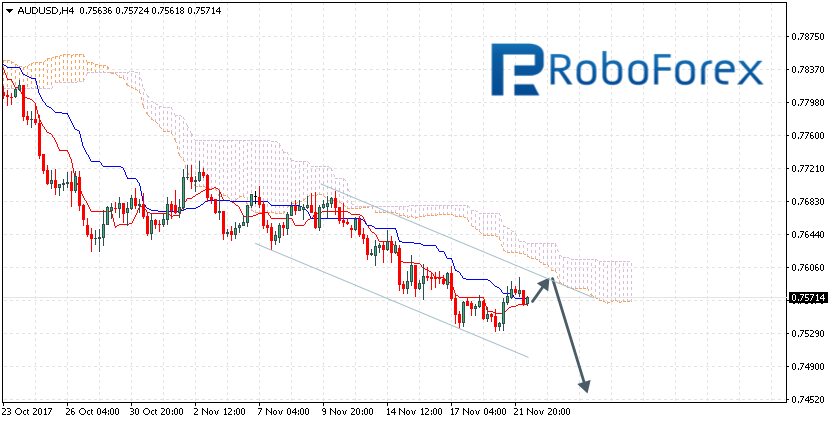
The AUD/USD pair is trading at 0.7571; the instrument is still moving below Ichimoku Cloud, which means that it may continue falling. We should expect the price to test the downside border of the cloud at 0.7585 and then continue moving downwards to reach 0.7460. However, the scenario that Implies further decline may be cancelled if the price breaks the upside border of the cloud and fixes above 0.7630. In this case, the pair may continue growing towards 0.7730.

AUDUSD


NZD USD, “New Zealand Dollar vs US Dollar”

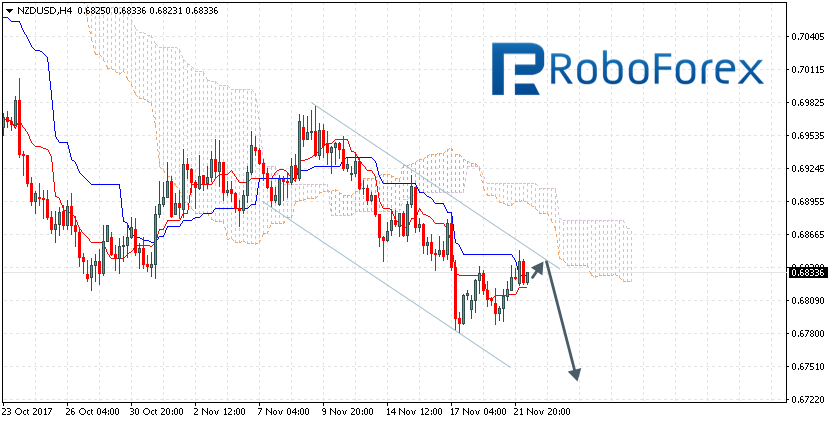
The NZD/USD pair is trading at 0.6833; the instrument is still moving below Ichimoku Cloud, which means that it may continue falling. We should expect the price to test Tenkan-Sen and Kijun-Sen at 0.6835 and then continue moving downwards to reach 0.6750. However, the scenario that implies further decline may be cancelled if the price breaks the upside border of the cloud and fixes above 0.6870. In this case, the pair may continue growing towards 0.7010.

NZDUSD


USD CAD, “US Dollar vs Canadian Dollar”

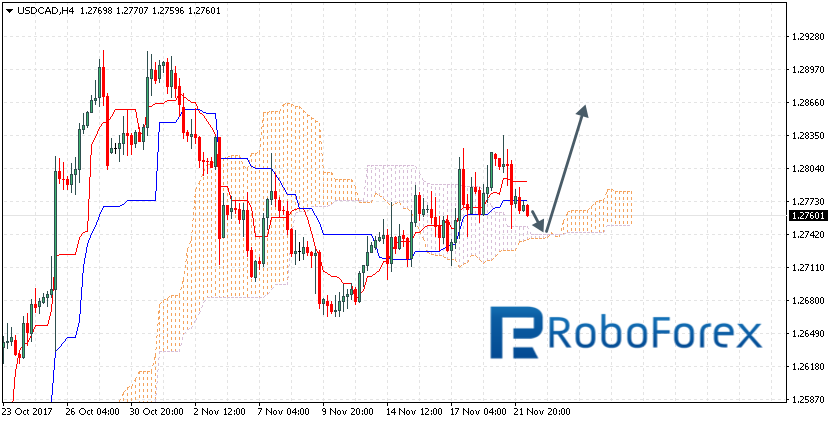
The USD/CAD pair is trading at 1.2760; the instrument is still moving above Ichimoku Cloud, which means that it may continue growing. We should expect the price to test the upside border of the cloud at 1.2750 and then continue moving upwards to reach 1.2865. However, the scenario that implies further growth may be cancelled if the price breaks the downside border of the cloud and fixes below 1.2710. In this case, the pair may continue falling towards 1.2620.

USDCAD


RoboForex Analytical Department

Article By RoboForex.com

Attention!
Forecasts presented in this section only reflect the author’s private opinion and should not be considered as guidance for trading. RoboForex LP bears no responsibility for trading results based on trading recommendations described in these analytical reviews.

Rumors make Oil go up

Author: Dmitriy Gurkovskiy, Chief Analyst at RoboForex

The oil market has another reason to recover. At the beginning of last week, they were selling oil because there were rumors that Russia had no interest to extend the OPEC+ agreement, but at the end of it the price movement direction changed to the opposite. Saudi Arabia announced that Russia would support the OPEC+ agreement extension after March 2018.

The closer November 30th is, when the OPEC is going to have a meeting in Vienna, the more doubts investors have about future announcements and actions. Saudis say that the decision on the agreement will be announced during the meeting in Austria. “Oil bulls” like this possibility, but mostly because of hopelessness and lack of options: everybody knows that the organization has no plan “B”.

The latest statistics from Baker Hughes published last Friday shows that by November 17th the Rig Count has increased by 8 and now equals 915 units. All 8 are gas rigs; the number of oil rigs hasn’t changed. It turns out that the shale oil sector is still in stagnation phase. It’s very unlikely that shale oil producers are afraid of the current commodity prices, because they look quite balanced and help to keep the production profitable. Financing may be a problem, because shale deposits can’t be suspended. If a deposit is stopped, all operations will have to start anew.

A factor that may slow down “bulls” this week will be the updated API weekly crude oil stock report. The previous readings showed increase in stocks, which is reasonable as far as both seasonal factor and oil demand/supply balance are concerned.

From the technical point of view, the short-term trend for Brent is bearish, but the dominating one is still bullish. The short-term decline may move towards 60.30, because this area is a support level for both short- and long-term tendencies. If the price rebounds from this level, it may start a new rising impulse with the targets near the current high at 64.75 and the upside border of the long-term rising channel at 66.50.

Attention!

Forecasts presented in this section only reflect the author’s private opinion and should not be considered as guidance for trading. RoboForex bears no responsibility for trading results based on trading recommendations described in these analytical reviews.


EUR/USD: Use dips as fresh buying opportunities

By GrowthAces.com

Macroeconomic overview:

  • German President Frank-Walter Steinmeier will meet the party heads of the Greens and the FDP today in an attempt to revive the Jamaica coalition negotiations and to avoid new elections. Tomorrow, Steinmeier will also meet SPD party chairman Martin Schulz. In our view, the chances of a successful resumption of the coalition negotiations or the formation of a new grand coalition are low. Yesterday, Angela Merkel announced that she would run again as the CDU/CSU’s candidate for chancellor in the event that there are new elections. Merkel basically ruled out the formation of a minority government. The latest available opinion polls, which were conducted yesterday, signal a political landscape largely unchanged since the general election in September(DeutschlandTrend): CDU/CSU (32%); SPD (22%); AfD (11%); FDP (10%); Left (10%); Greens (11%).
  • Fixed income markets have been unimpressed by political developments in Germany, which probably reflects fact that good economic fundamentals will remain the most important driver as well as, to some extent, expectations that an agreement will be eventually found, avoiding the need for early elections at least in the near term.
  • Political developments in Germany also remain center stage for FX markets; like on other asset classes, investor reaction has been surprisingly subdued so far: EUR/USD managed to recover above 1.750 after an early modest dip to 1.1723 and EUR/JPY rebounded back to around 132. With the German recovery already well underway (GDP rose 0.8% qoq in the third quarter 2017, bringing annual growth to 2.8% yoy), investors seem to consider the collapse of government talks in Berlin as unlikely to harm the economic outlook. Nevertheless, we think that markets are underestimating the risk of new general elections in Germany, which may be called for early next February. EUR/USD 3M implied volatility remains quite low, confirming that markets are shrugging off these negative developments. A minority government – for which the FDP offered support – would also be very troublesome for Angela Merkel, in our view, and may, in the end, just delay the electoral test.
  • That said, we do not think that unexpected political uncertainty in Germany would derail the EUR/USD convergence to its fair value of 1.2400 that we expect in 2018, given strong Eurozone fundamentals. However, markets are long enough on the common currency at the moment, as IMM weekly data on non-commercial commitments indicate, and this may increase the risk of correction from time to time. On balance, we think that EUR/USD will probably remain more nervous and volatile than anticipated over the next few weeks.

Technical analysis and trading signals:

  • The positive cross on the 7/14-ema last week was an important bullish sign. We stick to our bullish view and think that buying on dips could be a profitable strategy.
  • We stay long at 1.1714 for 1.1960.

EURUSD Daily Forex Signals Chart


AUD/USD slips to 5-month low on RBA minutes

Macroeconomic overview:

  • Minutes of the Reserve Bank of Australia’s November 7 policy meeting showed it harboured “considerable uncertainty” about how quickly wages growth and inflation might pick up.
  • Minutes showed policymakers pondered subdued consumer prices and pay rewards across the economy against the backdrop of sky-high household debt.
  • The meeting came as the RBA cut its forecasts for core inflation, which is now seen lurking under its long-term 2-3% target band for another two years.
  • Figures out since the meeting showed wages grew at an annual pace of just 2% in the third quarter, again disappointing hopes for an acceleration. “In particular…pressure on margins from strong competition and a faster-than-expected pick-up in productivity growth could delay the pass-through of tighter labour market conditions to inflationary pressure,” the minutes showed.
  • The RBA had been hopeful of inflation firing up as employment proved surprisingly strong, but data out last month showed another quarter of lukewarm consumer prices. Tepid inflation was a major reason the central bank cut interest rates to an all-time trough of 1.50% in August 2016.
  • The low growth in salaries is eating into spending power and slugging the retail sector where sales suffered a rare contraction in the third quarter.
  • In a speech last week, RBA Deputy Governor Guy Debelle said policymakers were well aware that the country’s heavily indebted household would struggle if interest rates were to rise sharply, but there was no shock on the horizon to force such an increase.
  • Indeed, the futures market has responded by pushing out the likely timing of a rate hike to early 2019. A couple of months ago, a move had been priced in for July 2018. The central bank’s economic outlook was guardedly optimistic, noting that strong jobs growth across the country was supporting household incomes. In addition, government spending on public infrastructure had boosted private business investment and is likely to support economic growth for some time. Tuesday’s minutes showed the RBA expects Australia’s economy to grow around 3% over the next few years as the drag from a mining downturn diminishes and exports gather momentum.  A further appreciation in the local dollar could jeopardise those forecasts, members noted.
  • The Australian dollar slipped to a fresh 5-month low on Tuesday as minutes from a meeting of the country’s central bank voiced concerns on sluggish wages and cemented views that interest rates will stay at record lows for months. The AUD/USD has been on a downtrend since early September when it climbed atop 0.8100. It has since lost 6.5% amid diminishing expectations of an interest rate hike and rising U.S. bond yields.

Technical analysis and trading signals:

  • Bear sentiment persists as pair broke below Friday’s low. RSIs are biased down and not diverging. Further losses are likely. The test of 50% fibo of 2016-17 ascent at 0.7473 is a probable scenario.
  • We stay sideways.

AUDUSD Daily Forex Signals Chart


VIP Traders Club members should expect to receive forex and precious metals trading signals updates at least twice a day. We will send you:

  1. Buy and sell forex, precious metals signals (entry level, target, stop-loss)
  2. Suggested position size that you can easily adjust to your trading account size – this would help you in risk management and you will survive longer drawdown periods
  3. Early heads-up about the potential trading opportunities or rationale to taken positions ( fundamental analysis, technical analysis )
  4. Forecasts of most important macroeconomic indicators prepared by our economists and econometricians.

JOIN VIP TRADERS CLUB – BLACK FRIDAY OFFER – 50% OFF FOR ALL SUBSCRIPTION PLANS!

About the Author:

By GrowthAces.com – Daily Forex Trading Strategies


Ichimoku Cloud Analysis 21.11.2017 (AUD/USD, NZD/USD, USD/CAD)

Article By RoboForex.com

AUD USD, “Australian Dollar vs US Dollar”

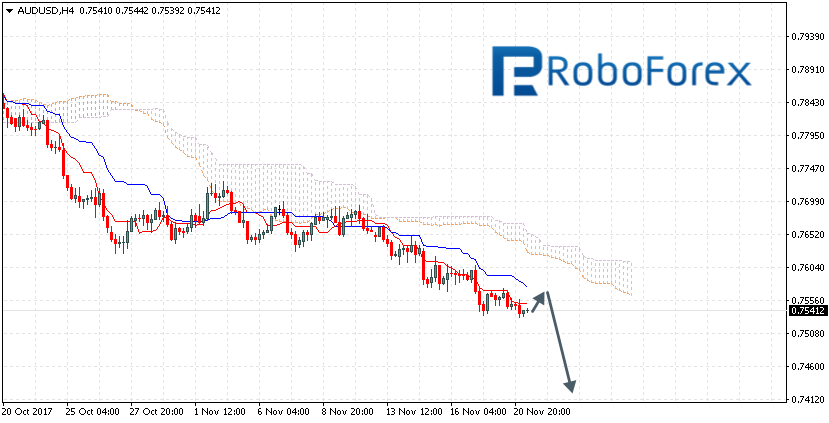
The AUD/USD pair is trading at 0.7541; the instrument is still moving below Ichimoku Cloud, which means that it may continue falling. We should expect the price to test Tenkan-Sen and Kijun-Sen at 0.7550 and then continue moving downwards to reach 0.7420. However, the scenario that Implies further decline may be cancelled if the price breaks the upside border of the cloud and fixes above 0.7620. In this case, the pair may continue growing towards 0.7740.

AUDUSD


NZD USD, “New Zealand Dollar vs US Dollar”

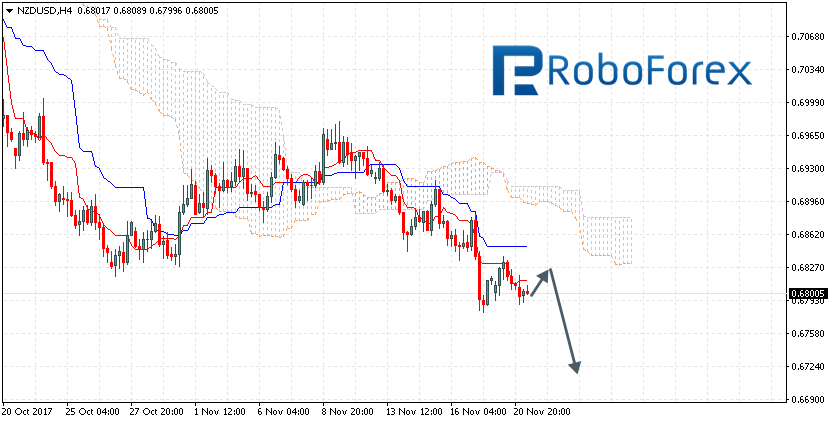
The NZD/USD pair is trading at 0.6800; the instrument is still moving below Ichimoku Cloud, which means that it may continue falling. We should expect the price to test Tenkan-Sen and Kijun-Sen at 0.6825 and then continue moving downwards to reach 0.6720. However, the scenario that implies further decline may be cancelled if the price breaks the upside border of the cloud and fixes above 0.6870. In this case, the pair may continue growing towards 0.7010.

NZDUSD


USD CAD, “US Dollar vs Canadian Dollar”

The USD/CAD pair is trading at 1.2806; the instrument is still moving above Ichimoku Cloud, which means that it may continue growing. We should expect the price to test Tenkan-Sen and Kijun-Sen at 1.2785 and then continue moving upwards to reach 1.2910. However, the scenario that implies further growth may be cancelled if the price breaks the downside border of the cloud and fixes below 1.2700. In this case, the pair may continue falling towards 1.2620.

USDCAD


RoboForex Analytical Department

Article By RoboForex.com

Attention!
Forecasts presented in this section only reflect the author’s private opinion and should not be considered as guidance for trading. RoboForex LP bears no responsibility for trading results based on trading recommendations described in these analytical reviews.

Murrey Math Lines 21.11.2017 (AUD/USD, NZD/USD)

Article By RoboForex.com

AUD USD, “Australian Dollar vs US Dollar”

At the H4 chart, the AUD/USD pair is consolidating between the 3/8 and 5/8 levels. The price is expected to test the 3/8 level (0.7507), rebound from it, and then resume growing to reach the upside border of the range at the 5/8 one (0.7629).

AUDUSD1

As we can see at the H1 chart, the pair is trading below the support at the 0/8 level, inside the “oversold zone”, which means that it may move upwards. In this case, the instrument may resume growing after breaking the -1/8 level (0.7537) or rebounding from the -2/8 one (0.7507).

AUDUSD2

At the M15 chart, the pair may break the upside line of the VoltyChannel indicator and, as a result, continue moving upwards to reach 0.7629.

AUDUSD3


NZD USD, “New Zealand Dollar vs US Dollar”

At the H4 chart, the NZD/USD pair is trading below the 0/8 level (0.6835), inside the “oversold zone”. If the price breaks this level, it may resume growing towards the 3/8 one (0.7019).

NZDUSD1

As we can see at the H1 chart, the pair is also moving inside the “oversold zone”. If the price breaks the -1/8 level (0.6805), it may resume growing.

NZDUSD2

At the M15 chart, the pair may break the upside line of the VoltyChannel indicator and, as a result, continue moving upwards to reach 0.7019.

NZDUSD3


RoboForex Analytical Department

Article By RoboForex.com

Attention!
Forecasts presented in this section only reflect the author’s private opinion and should not be considered as guidance for trading. RoboForex LP bears no responsibility for trading results based on trading recommendations described in these analytical reviews.