Author Archive for InvestMacro – Page 467

Euro Owes Its Strength to the News

Author: Dmitriy Gurkovskiy, Chief Analyst at RoboForex

At the end of November, the Euro is feeling very well. A remote possibility of creating a governing coalition in Germany and a strong report published by the European Central Bank supported the main currency pair while the United States of America was celebrating the Thanksgiving Day. The EUR/USD has potential to reach 1.20 and grow higher, unless the news and the German politics throw investors “a curve ball”.

Once again, investors have turned to Germany’s issue relating to a governing coalition. It’s been two months since the parliamentary elections and the Christian Democratic Union of Germany, the party led by Angela Merkel, hasn’t been able to strike a deal with any other political line, which didn’t get enough seats in Bundestag. Some said that the governing party’s political agenda was disappointing; other didn’t want to govern in a wrong way. As a result, right now Merkel’s CDU is “face to face” with the Social Democratic Party of Germany.

In the past, the SDP said that it had its own political views. Right now, these views are used as conditions that may help to form a coalition with the CDU, but only in case they are met. The conditions include changes of the country’s insurance system and other social issues. Merkel is confused: on one hand, the cabinet of ministers really needs this coalition, otherwise the parliament will have to be reelected. However, on the other hand, Merkel has already rejected other parties’ conditions, so why switch sides this time?

The report published by the European Central Bank showed that the regulator was no longer focused on the inflation as a major factor for making decision relating to its monetary policy. Investors immediately took these words as another speculations about closing the QE program earlier than it had been expected before. Such conclusions have little in common with the strategy the ECB spoke so many times about, but it’s okay for the EUR/USD pair to hit this kind of turbulence.

Hedge funds and the interbank market seem to intend buying the main currency pair. However, a very busy week is ahead, so the instrument will surely “swing” both upwards and downwards.

As we can see at the EUR/USD pair chart, the price has started another uptrend. The current price movement is expected to test the upside border of the current rising channel close to 1.2000 – 1.2020. After testing this area, the trend may transform into a correction towards the support line at 1.1875, which may result in a rebound and a new test of the area between 1.20000 and 1.2020. if the instrument breaks this area, it may continue growing to reach 1.2270.

Attention!

Forecasts presented in this section only reflect the author’s private opinion and should not be considered as guidance for trading. RoboForex bears no responsibility for trading results based on trading recommendations described in these analytical reviews.


EUR/USD: Profit taken at 1.1960, buy again at 1.1830

By GrowthAces.com

Macroeconomic overview:

  • The USD strengthened slightly in the yesterday’s afternoon, with the near-term focus on a possible Senate vote on a U.S. tax plan later in the week. Worries about potential delays in the implementation of U.S. tax cuts and the possibility of reform measures being weakened have weighed on the greenback in recent weeks.
  • A U.S. Senate Republican tax bill strongly backed by President Donald Trump faced potential opposition on Monday from two Republican lawmakers who could prevent the sweeping legislation from reaching the Senate floor. Senators Ron Johnson and Bob Corker, both members of the Senate Budget Committee, said they could vote against the tax package at a Tuesday hearing that Republican leaders hoped would send the legislation to a full Senate vote as early as Thursday. Each senator is seeking different changes to the legislation. Their opposition could create the first major hurdle for the Republican tax overhaul in the Senate, where political infighting killed the party’s effort to overturn the Obamacare healthcare law earlier this year
  • Jerome Powell, the nominee to chair the Federal Reserve, defended the Fed’s use of broad crisis-fighting powers in remarks prepared for his Tuesday Senate confirmation hearing, positioning himself as an extension of the central bank policies of current Chair Janet Yellen and her predecessor Ben Bernanke. Powell, who is currently a member of the Fed’s Board of Governors, endorsed the core ideas that have defined U.S. central banking since the financial crisis of 2007 to 2009 – a willingness to move aggressively against a downturn, and an insistence on flexibility and independence from political influence in setting policy. On current monetary policy, he said, “We expect interest rates to rise somewhat further and the size of our balance sheet to gradually shrink.”

Technical analysis and trading signals:

  • The EUR/USD is looking a little overstretched on the charts. We took profit at 1.1960 on Monday and our strategy now is to use corrective action as opportunities to rejoin bull trend.
  • We placed bid at 1.1830.

EURUSD Daily Forex Signals Chart


USD/CAD: Focus on OPEC meeting

Macroeconomic overview:

  • The CAD turned weaker against the USD on Monday, as U.S. oil prices pulled back from a two-year high amid uncertainty about Russia’s resolve to extend output cuts at a meeting of producing countries this week.
  • Members of the Organization of the Petroleum Exporting Countries and other key producers, including Russia, will meet on November 30 to discuss whether to continue with the cuts after they agreed last January to withhold 1.8 million bpd of output.
  • United Arab Emirates energy minister Suhail bin Mohammed al-Mazroui said on Tuesday that while the meeting would not be easy, he was personally optimistic producers would reach an agreement that served the market.
  • Saudi energy minister Khalid al-Falih said the oil market should wait for the outcome of this week’s OPEC meeting when asked on Tuesday in Dubai about how long producers might extend their cuts.
  • Russia’s economy was negatively affected in October by the ongoing curbs, which saw Moscow agree to cut output by 300k bpd, Economy Minister Maxim Oreshkin said on November 23.
  • We expect the following: 1. the current deal to be extended to the end of 2018, 2. the production cut to be increased to about 2 million bpd from 1.8 million bpd, 3. Nigeria to be added to the deal (but not Libya, where the political situation is still too unstable for a credible commitment) and 4. the export cap for Saudi Arabia (at around 6.6-6.8 million bpd) might be formalized after having been introduced last summer.
  • The loonie’s next major catalyst could come at the end of this week, with both a domestic jobs report for November and GDP data for the quarter that ended in September due on Friday.

Technical analysis and trading signals:

  • The USD/CAD remains in consolidation mode. The pair did not manage to break below the November 23 low at 1.2672 yesterday and today’s is back above short-term moving averages. The nearest resistance level is November 21 high at 1.2836.
  • We think that using upticks as selling opportunities could be a good trading idea. We stay short at 1.2815 for 1.2500.

USDCAD Daily Forex Signals Chart


VIP Traders Club members should expect to receive forex and precious metals trading signals updates at least twice a day. We will send you:

  1. Buy and sell forex, precious metals signals (entry level, target, stop-loss)
  2. Suggested position size that you can easily adjust to your trading account size – this would help you in risk management and you will survive longer drawdown periods
  3. Early heads-up about the potential trading opportunities or rationale to taken positions ( fundamental analysis, technical analysis )
  4. Forecasts of most important macroeconomic indicators prepared by our economists and econometricians.

JOIN VIP TRADERS CLUB – TRIAL MONTH FOR $1 NOW

About the Author:

By GrowthAces.com – Daily Forex Trading Strategies


Japanese Candlesticks Analysis 28.11.2017 (USD/CAD, AUD/USD)

Article By RoboForex.com

USD CAD, “US Dollar vs Canadian Dollar”

As we can see at the H4 chart, the USD/CAD pair skyrocketed and formed several Hanging Man patterns. These patterns are unlikely to result is a reverse, but may force a slight correction before the price resumes growing towards 1.2818.

USDCAD


AUD USD, “Australian Dollar vs US Dollar”

At the H4 chart, the AUD/USD pair reversed and resumed moving upwards. By now, the price has formed a slight correction with several Hammer and Inverted Hammer patterns. These patterns indicate that the instrument may continue growing towards the resistance level at 0.7686.

AUDUSD


RoboForex Analytical Department

Article By RoboForex.com

Attention!
Forecasts presented in this section only reflect the author’s private opinion and should not be considered as guidance for trading. RoboForex LP bears no responsibility for trading results based on trading recommendations described in these analytical reviews.

Factors Influencing Bitcoin Price

By Mary Ann Callahan

Playing on the crypto market has proven to be a roller coaster ride. With hard forks, bad publicity and talks about a bubble from critics, it is no wonder the price of cryptos including Bitcoin goes up and down. The cryptocurrency world is unpredictable, which gives all the more reason for jumping onto the bandwagon. Trading and investing in cryptocurrencies can be extremely profitable if you know the ins and outs of the industry.

We explore the factors that influence the Bitcoin price so that you can be ahead of the game at all times.

Moves from Institutional Investors

Every day there are more financial institutions and investment companies offering clients the option of investing in Bitcoin. This has a big influence on the price of this cryptocurrency as investors get more familiar with this form of investment. Where do things stand today?

Recently, the BTC price has skyrocketed and now equals $8,200. One of the first people to predict that mark was Goldman Sachs who is actively considering the introduction of Bitcoin trading. Another financial giant, JP Morgan, is also showing a strong interest in the first-ever cryptocurrency and is well on the way to offering Bitcoin futures to their clients. As for the European market, it has joined the party by designing innovative products based on cryptocurrencies and blockchain technology.

There are even more financial influencers in line to jump onto the Bitcoin bandwagon, which is bound to be reflected in the value of cryptocurrency. Even the Bank of America agrees and says this increase in the number of investors can affect the price of currencies considerably.

Interest from the Asian market

Having the largest population in the world, Asia has a substantial influence on the price of Bitcoin due to the masses that show interest in the product. In the past, the moves from China and South Korea really upset the markets by making nerve-shattering announcements like the ones about banning Initial Coin Offerings (ICOs) and Bitcoin itself in China.

Regardless, this has not stopped the Asian market from continuing to invest in cryptocurrencies like Bitcoin. It is interesting to note that since news about South Korea regulating Bitcoin broke, the demand for cryptos has grown even more in these countries. Japan is also a driving force behind the price of Bitcoin in this regard.

Growing demand

Supply and demand definitely have an effect on the price of Bitcoin. Cryptos are still a new concept to majority of the world, and the demand for Bitcoin will increase as more people become familiar with it.

To a large extent, the mining community plays a significant role in establishing the demand for Bitcoin. As more Bitcoin is mined, its value may decrease. Sticking to mining with the cheaper price of solar power or renewable energy in comparison to energy from a supplier may give the mining sector a significant boost.

Something really interesting is that the demand for Bitcoin or other crypto coins also increases when they appear stolen by hackers from a wallet. In recent news, 110 Bitcoin was stolen from a YouTuber, and the price suddenly increased.

Have you heard the latest news?

It is a fact that about 1% of the world know what cryptocurrencies and Bitcoin are. This is something that early investors can use to their advantage. Investing early in cryptos, particularly in Bitcoin, will give these investors the competitive edge as they would be years ahead with building their portfolios. This leaves a lot of room for new investors to learn about the benefits of cryptos and how one can take advantage of the investment opportunity.

News is one of the biggest contributors to whether Bitcoin’s price will increase or decrease. Since the idea behind cryptos and their potential are still widely regarded as unconventional, the industry tends to get a lot of bad publicity. This can easily scare off amateur investors as they fear for the security of their investment.

On the other hand, good news of a new record price or a big retailer accepting Bitcoin as a method of payment can make the price of Bitcoin go through the roof. Clients will hear the news and start asking the revolutionary question – What is Bitcoin? And the rest is history.

It is clear that as more people invest, the price will increase. One must remember that there is no such thing as bad publicity. The more Bitcoin is being reported on by the leading news outlets, the more popular it will become, and this will affect the price in the long run.

Altcoin – the new kid on the block (chain)

The general rule of thumb is that when the price of Bitcoin increases, the price of alternative coins or altcoins will drop, and vice versa. There are hundreds of altcoins available, and it has become very easy for almost anyone to create an altcoin.

Altcoins hold their value in their blockchain technology that aims at improving features of Bitcoin. The biggest challenge altcoins face is being pumped and dumped. This is when investors force the price to go up and down and then to buy and sell at strategic points to make more money. This can cause serious damage to an altcoin, so the majority of financial investors recommend buying the altcoins that will be most profitable over the long term.

Possibility of free fork money

Nothing makes the price of Bitcoin soar like the prospect of receiving free money during a hard fork. 2017 can testify to this as two hard forks took place, which caused the price of Bitcoin to fly through the roof as investors were dumping altcoins to have more Bitcoin.

The holders of Bitcoin at a specific time around the fork were rewarded free fork money, namely Bitcoin Cash and Bitcoin Gold. Hard forks can be extremely profitable if you play your cards right.

Despite the fact that the crypto industry has yet to be stable, the number of Bitcoin enthusiasts keeps rising, because investing in Bitcoin has never been easier than it is now. Every year the cryptocurrency arena is entered by new Bitcoin exchanges and brokers. The leading brands like CEX.IO are now trusted by millions to buy and sell Bitcoin on a daily basis, because they offer customers the best and most secure online service. Buying Bitcoin is simple – all you need is just do a bank transfer or pay with your credit card to become a part of the cryptocurrency elite.


About the Author: Mary Ann Callahan

As an expert on Bitcoin-related topics, I’ve found myself as a Journalist at Cex.io – cryptocurrency exchange. I’m working on articles related to blockchain security, bitcoin purchase guides or bitcoin regulations in different countries.


EURUSD: reversal candlestick on the daily timeframe

By Gabriel Ojimadu, Alpari

Previous:

On Monday the 27th of November, trading on the euro/dollar pair closed down. Monday’s movements went against Friday’s, except that the euro made a couple of highs before dropping. After a housing market report from the US, buyers started to cash in on their long positions. The report showed an increase in new home sales where markets had expected a decline. The euro reacted to this with a drop to the balance line at 1.1891.

Robert Kaplan, the president of the Dallas Fed, provided additional support to the dollar when he announced that he is in favour of raising interest rates by another 25 base points at the Fed’s December meeting.

Day’s news (GMT+3):

  • 10:00 UK: bank stress test results.
  • 10:30 UK: BoE Governor Mark Carney’s speech.
  • 10:45 France: consumer confidence (Nov).
  • 12:00 Eurozone: private loans (Oct), M3 money supply (Oct).
  • 15:00 Germany: Gfk consumer confidence survey (Dec).
  • 16:30 Canada: industrial product price (Oct).
  • 16:30 USA: goods trade balance (Oct).
  • 17:00 USA: S&P/Case-Shiller home prices index (Sep).
  • 17:15 USA: Fed’s William Dudley speech.
  • 17:45 USA: Fed’s Jerome Powell speech.
  • 18:00 USA: Richmond Fed manufacturing index (Nov).
  • 18:15 USA: FOMC member Harker’s speech.
  • 18:30 Canada: financial system review.
  • 19:30 Canada: BoC Governor Poloz’s speech.
  • 23:00 New Zealand: RBNZ financial stability report.
  • 23:45 USA: Treasury Sec Steve Mnuchin’s speech.

Fig 1. EURUSD rate on the hourly. Source: TradingView

The dollar has recovered about 50% of the ground lost against the euro during the Thanksgiving period. Given that US exchanges were working on a limited schedule, many Americans held off on entering the market until Monday. Because of this, trading volumes remained low.

After the publication of US data, the euro dropped from the 202nd degree to the balance line. This means that the market is now in equilibrium on the hourly timeframe and the price could go in any direction.

Since the MA lines are all looking upwards, buyers will try to nurture this impulse and start a rally that will allow them to recover their positions. This would all be fine, except that in Asia, the euro/pound cross is in the red and a reversal candlestick has formed on the daily timeframe.

What does all this mean? In theory we should see the rate rise to 1.1918, or certainly no higher than 1.1935. This would mark the end to the correction of the downwards movement from 1.961 to 1.1891. After this, we could see a triple top form with a target of 1.1879 or 1.1852 depending on where the upwards correction ends.

1.1860 – 1.1880 is a strong support zone. So, if sellers manage to shift this on the first attempt, there will be an increased risk of retreating below the TR2 trend line below 1.1837.

Source: EURUSD: reversal candlestick on the daily timeframe


COT Report: USD Specs raise bearish bets. 10YR, Gold bets rise as WTI, Silver fall

By CountingPips.com

Here is a short summary and this week’s links (below) to the latest Commitment of Traders changes that was released on Monday due to the Thanksgiving’s Day holiday.

Speculators increased US Dollar bearish bets for 1st time in 8 weeks

WTI Crude Oil Speculators cut back positions from record high

10-Year Note Speculators pushed bullish net positions higher for 3rd straight week

Gold Speculators bullish net positions advanced for 3rd out of 4 weeks

Large S&P500 Speculators pushed bets into deeper bearish level

Silver Speculators pulled back on bullish bets, still over +60,000 contracts

Copper Spec positions had slight uptick following 3 down weeks


Currency Futures Speculators added to US Dollar bearish positions this week

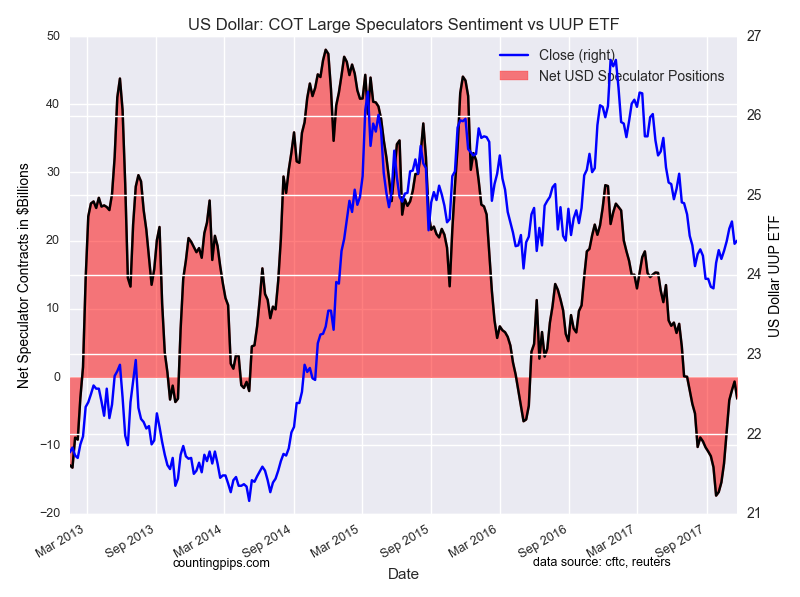
US Dollar net speculator positions leveled at $-3.15 billion as of Tuesday

The latest data for the weekly Commitment of Traders (COT) report, released by the Commodity Futures Trading Commission (CFTC) on Monday due to the Thanksgiving’s Day holiday, showed that large traders and currency speculators raised their bearish bets for the US dollar last week. See full article


WTI Crude Oil Speculators cut back on their bullish positions last week

The non-commercial contracts of WTI crude futures totaled a net position of 577,078 contracts, according to data from this week. This was a slide of -19,388 contracts from the previous weekly total. See full article


Gold Speculators bullish net positions advanced higher last week

The large speculator contracts of gold futures totaled a net position of 201,827 contracts. This was a weekly advance of 6,743 contracts from the previous week. See full article


10-Year Note Speculators raised bullish net positions for 3rd week

The large speculator contracts of 10-year treasury note futures totaled a net position of 111,080 contracts. This was a weekly increase of 36,244 contracts from the previous week. See full article


Large S&P500 Speculators decreased bets into deeper bearish level

The large speculator contracts of S&P 500 futures totaled a net position of -2,330 contracts. This was a decrease of -2,172 contracts from the reported data of the previous week. See full article


Silver Speculators pulled back on bullish net positions last week

The non-commercial contracts of silver futures totaled a net position of 67,641 contracts, according to data from this week. This was a weekly fall of -1,532 contracts from the previous totals. See full article


Copper Speculator positions show slight rebound after 3 down weeks

The large speculator contracts of copper futures totaled a net position of 40,613 contracts. This was a weekly boost of 899 contracts from the data of the previous week. See full article


Article by CountingPips.com

The Commitment of Traders report data is published in raw form every Friday by the Commodity Futures Trading Commission (CFTC) and shows the futures positions of market participants as of the previous Tuesday (data is reported 3 days behind).

To learn more about this data please visit the CFTC website at http://www.cftc.gov/MarketReports/CommitmentsofTraders/index.htm


Currency Futures Speculators added to US Dollar bearish positions this week

By CountingPips.comGet our weekly COT Reports by Email

US Dollar net speculator positions leveled at $-3.15 billion this week

The latest data for the weekly Commitment of Traders (COT) report, released by the Commodity Futures Trading Commission (CFTC) on Monday due to the Thanksgiving’s Day holiday, showed that large traders and currency speculators raised their bearish bets for the US dollar last week.

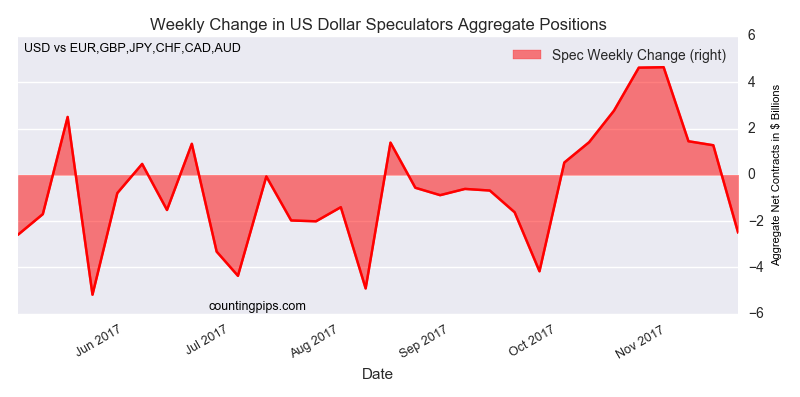
Non-commercial large futures traders, including hedge funds and large speculators, had an overall US dollar net position totaling $-3.15 billion as of Tuesday November 21st, according to the latest data from the CFTC and dollar amount calculations by Reuters. This was a weekly decline of $-2.50 billion from the $-0.643 billion total position that was registered the previous week, according to the Reuters calculation (totals of the US dollar contracts against the combined contracts of the euro, British pound, Japanese yen, Australian dollar, Canadian dollar and the Swiss franc).

The aggregate US dollar position had seen improvements for seven straight weeks before last week’s decline. The USD position has been in an overall bearish aggregate standing now for nineteen consecutive weeks.


Weekly Speculator Contract Changes:

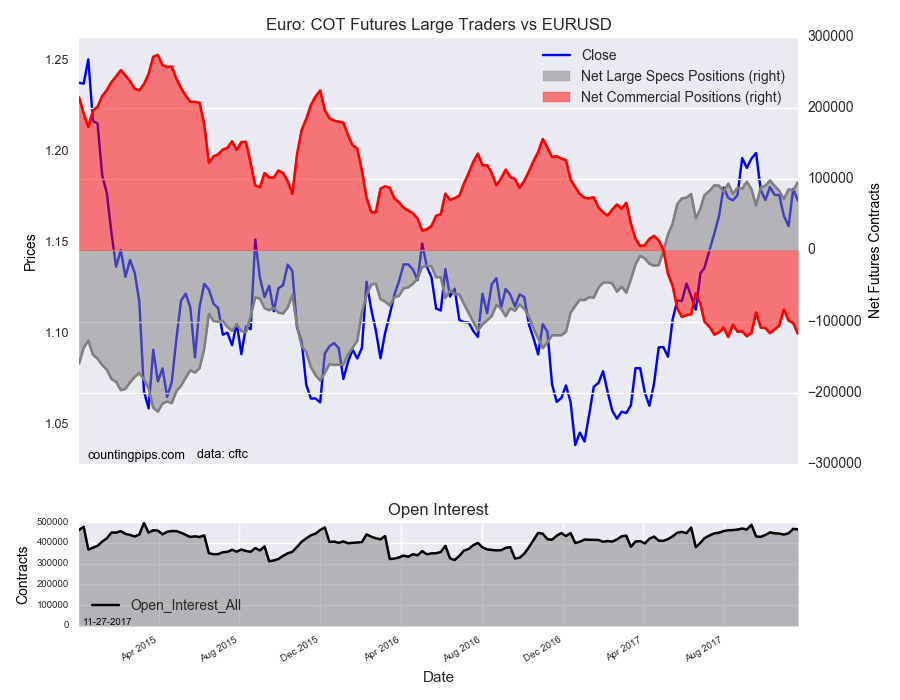
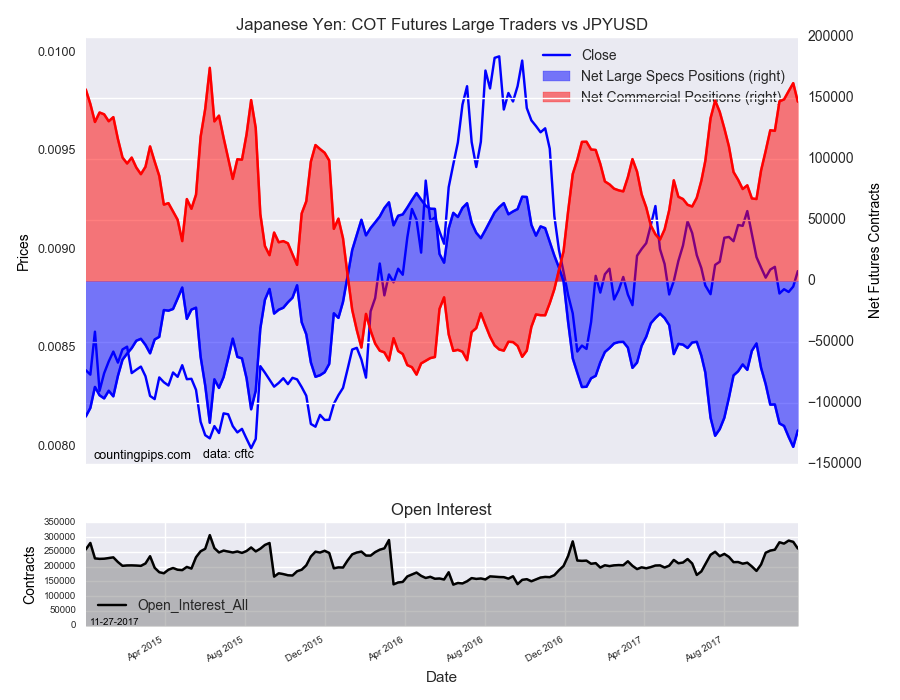
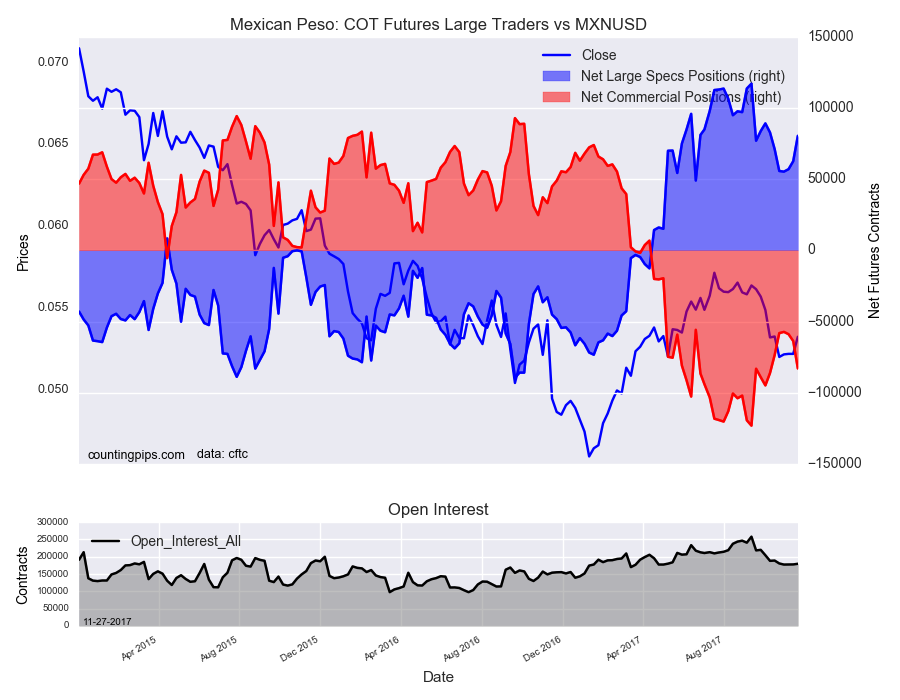
The major currencies that improved against the US dollar this week were the euro (10,851 weekly change in contracts), British pound sterling (4,233 contracts), Japanese yen (13,397 contracts) and the Mexican peso (17,853 contracts).

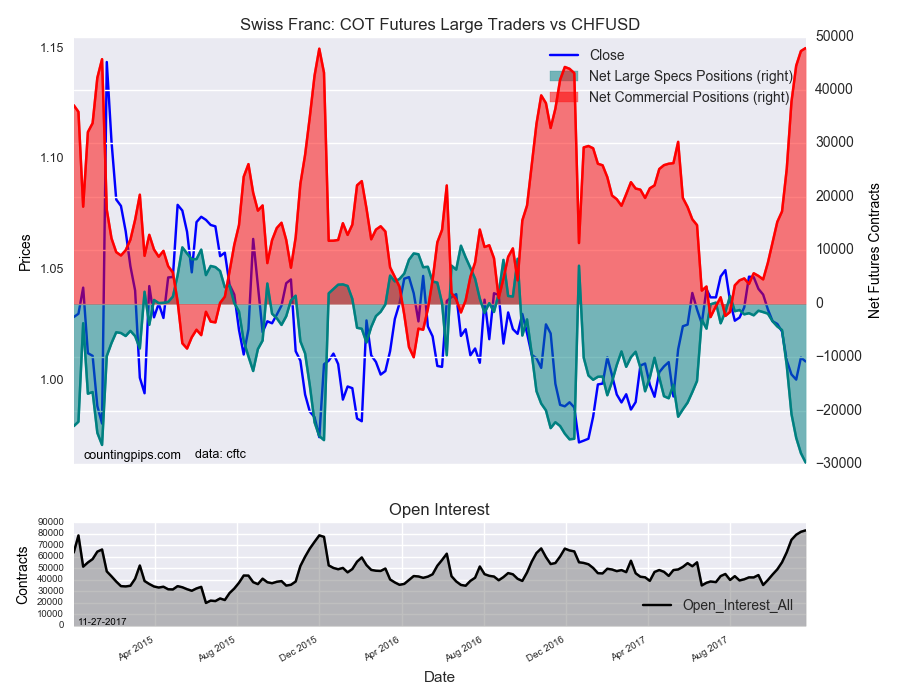
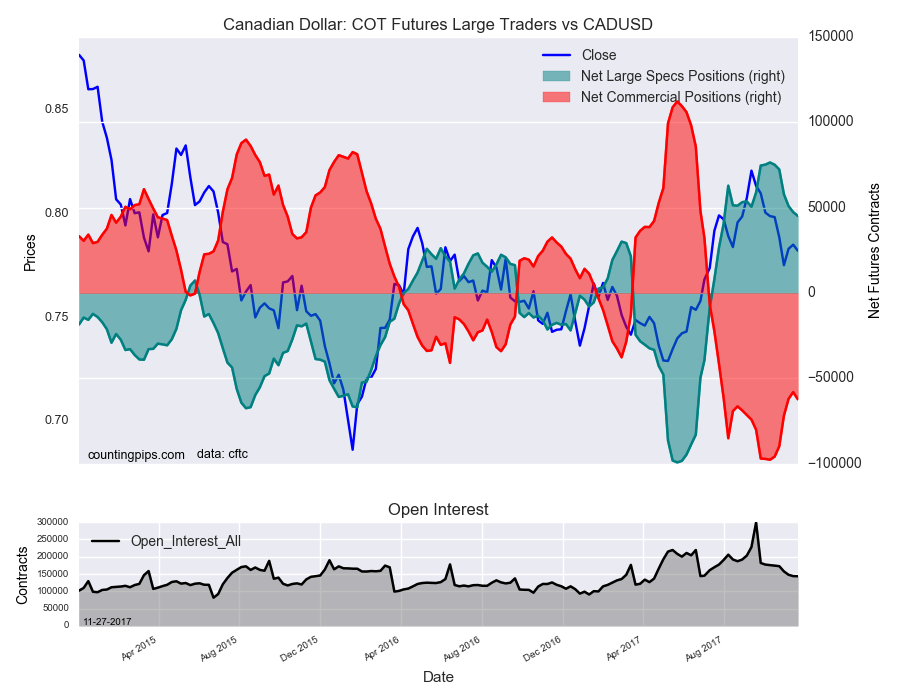
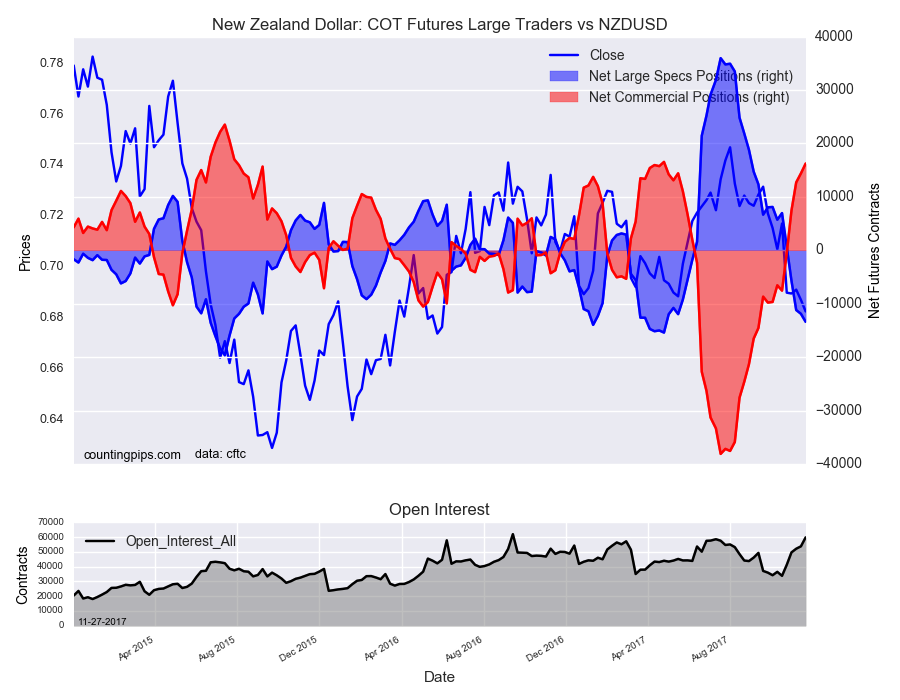
The currencies whose speculative bets declined this week versus the dollar were the Swiss franc (-1,757 weekly change in contracts), Canadian dollar (-2,210 contracts), Australian dollar (-4,215 contracts) and the New Zealand dollar (-1,503 contracts).


Table of Weekly Commercial Traders and Speculators Levels & Changes:

CurrencyNet CommercialsComms Weekly ChgNet SpeculatorsSpecs Weekly Chg
EuroFx-117,075-14,89095,43710,851
GBP-7,143-6,059-3004,233
JPY146,781-15,166-122,60213,397
CHF47,867556-29,740-1,757
CAD-62,186-4,22145,125-2,210
AUD-36,8148,08939,817-4,215
NZD16,2501,847-13,394-1,503
MXN-82,986-19,31580,38617,853


This latest COT data is through Tuesday and shows a quick view of how large speculators or non-commercials (for-profit traders) as well as the commercial traders (hedgers & traders for business purposes) were positioned in the futures markets. All currency positions are in direct relation to the US dollar where, for example, a bet for the euro is a bet that the euro will rise versus the dollar while a bet against the euro will be a bet that the dollar will gain versus the euro.


Weekly Charts: Large Trader Weekly Positions vs Price

EuroFX:


British Pound Sterling:


Japanese Yen:


Swiss Franc:


Canadian Dollar:


Australian Dollar:


New Zealand Dollar:


Mexican Peso:

*COT Report: The weekly commitment of traders report summarizes the total trader positions for open contracts in the futures trading markets. The CFTC categorizes trader positions according to commercial hedgers (traders who use futures contracts for hedging as part of the business), non-commercials (large traders who speculate to realize trading profits) and nonreportable traders (usually small traders/speculators). Find CFTC criteria here: (http://www.cftc.gov/MarketReports/CommitmentsofTraders/ExplanatoryNotes/index.htm).

The Commitment of Traders report is published every Friday by the Commodity Futures Trading Commission (CFTC) and shows futures positions data that was reported as of the previous Tuesday (3 days behind).

Each currency contract is a quote for that currency directly against the U.S. dollar, a net short amount of contracts means that more speculators are betting that currency to fall against the dollar and a net long position expect that currency to rise versus the dollar.

(The charts overlay the forex closing price of each Tuesday when COT trader positions are reported for each corresponding spot currency pair.) See more information and explanation on the weekly COT report from the CFTC website.

Article by CountingPips.com


WTI Crude Oil Speculators cut back on their bullish positions last week

By CountingPips.comReceive our weekly COT Reports by Email

WTI Crude Oil Non-Commercial Speculator Positions:

Large energy speculators lowered their bullish net positions in the WTI Crude Oil futures markets last week after pushing bets to a new record high the week prior, according to the latest Commitment of Traders (COT) data released by the Commodity Futures Trading Commission (CFTC) on Monday due to the Thanksgiving’s Day holiday.

The non-commercial futures contracts of WTI Crude Oil futures, traded by large speculators and hedge funds, totaled a net position of 577,078 contracts in the data reported through Tuesday November 21st. This was a weekly fall of -19,388 contracts from the previous week which had a total of 596,466 net contracts.

Speculative bets had risen for five straight weeks and reached a new record high on November 14th before last week’s decline.

WTI Crude Oil Commercial Positions:

The commercial traders position, hedgers or traders engaged in buying and selling for business purposes, totaled a net position of -583,798 contracts on the week. This was a weekly gain of 30,286 contracts from the total net of -614,084 contracts reported the previous week.

USO:

Over the same weekly reporting time-frame, from Tuesday to Tuesday, the USO Crude Oil ETF, which tracks the price of WTI crude oil, closed at approximately $11.40 which was a rise of $0.27 from the previous close of $11.13, according to unofficial market data.

*COT Report: The COT data, released weekly to the public each Friday, is updated through the most recent Tuesday (data is 3 days old) and shows a quick view of how large speculators or non-commercials (for-profit traders) as well as the commercial traders (hedgers & traders for business purposes) were positioned in the futures markets. The CFTC categorizes trader positions according to commercial hedgers (traders who use futures contracts for hedging as part of the business), non-commercials (large traders who speculate to realize trading profits) and nonreportable traders (usually small traders/speculators). Find CFTC criteria here: (http://www.cftc.gov/MarketReports/CommitmentsofTraders/ExplanatoryNotes/index.htm).

Article By CountingPips.comReceive our weekly COT Reports by Email

10-Year Note Speculators raised bullish net positions for 3rd week

By CountingPips.comReceive our weekly COT Reports by Email

10-Year Note Non-Commercial Speculator Positions:

Large speculators raised their net positions in the 10-Year Note futures markets last week, according to the latest Commitment of Traders (COT) data released by the Commodity Futures Trading Commission (CFTC) on Monday due to the Thanksgiving’s Day holiday.

The non-commercial futures contracts of 10-Year Note futures, traded by large speculators and hedge funds, totaled a net position of 111,080 contracts in the data reported through Tuesday November 21st. This was a weekly increase of 36,244 contracts from the previous week which had a total of 74,836 net contracts.

Speculative positions have increased strongly the past three weeks and the overall bullish level is above the +100,000 contract level for the first time since October 24th.

10-Year Note Commercial Positions:

The commercial traders position, hedgers or traders engaged in buying and selling for business purposes, totaled a net position of 117,453 contracts on the week. This was a weekly loss of -16,006 contracts from the total net of 133,459 contracts reported the previous week.

IEF ETF:

Over the same weekly reporting time-frame, from Tuesday to Tuesday, the 7-10 Year Treasury Bond ETF (IEF) closed at approximately $106.03 which was an uptick of $0.10 from the previous close of $105.93, according to unofficial market data.

*COT Report: The COT data, released weekly to the public each Friday, is updated through the most recent Tuesday (data is 3 days old) and shows a quick view of how large speculators or non-commercials (for-profit traders) as well as the commercial traders (hedgers & traders for business purposes) were positioned in the futures markets. The CFTC categorizes trader positions according to commercial hedgers (traders who use futures contracts for hedging as part of the business), non-commercials (large traders who speculate to realize trading profits) and nonreportable traders (usually small traders/speculators). Find CFTC criteria here: (http://www.cftc.gov/MarketReports/CommitmentsofTraders/ExplanatoryNotes/index.htm).

Article By CountingPips.comReceive our weekly COT Reports by Email

Gold Speculators bullish net positions advanced higher last week

By CountingPips.comReceive our weekly COT Reports by Email

Gold Non-Commercial Speculator Positions:

Large precious metals speculators continued to lift their bullish net positions in the Gold futures markets last week, according to the latest Commitment of Traders (COT) data released by the Commodity Futures Trading Commission (CFTC) on Monday due to the Thanksgiving’s Day holiday.

The non-commercial futures contracts of Gold futures, traded by large speculators and hedge funds, totaled a net position of 201,827 contracts in the data reported through Tuesday November 21st. This was a weekly gain of 6,743 contracts from the previous week which had a total of 195,084 net contracts.

Speculative positions have now risen for three out of the last four weeks and the overall bullish level is back above the +200,000 contract threshold for the first time since October 17th.

Gold Commercial Positions:

The commercial traders position, hedgers or traders engaged in buying and selling for business purposes, totaled a net position of -225,056 contracts on the week. This was a weekly drop of -9,265 contracts from the total net of -215,791 contracts reported the previous week.

GLD ETF:

Over the same weekly reporting time-frame, from Tuesday to Tuesday, the GLD ETF, which tracks the price of gold, closed at approximately $121.51 which was a loss of $-0.05 from the previous close of $121.56, according to unofficial market data.

*COT Report: The COT data, released weekly to the public each Friday, is updated through the most recent Tuesday (data is 3 days old) and shows a quick view of how large speculators or non-commercials (for-profit traders) as well as the commercial traders (hedgers & traders for business purposes) were positioned in the futures markets. The CFTC categorizes trader positions according to commercial hedgers (traders who use futures contracts for hedging as part of the business), non-commercials (large traders who speculate to realize trading profits) and nonreportable traders (usually small traders/speculators). Find CFTC criteria here: (http://www.cftc.gov/MarketReports/CommitmentsofTraders/ExplanatoryNotes/index.htm).

Article By CountingPips.comReceive our weekly COT Reports by Email