Author Archive for InvestMacro – Page 455

Gold Speculators raised their bullish net positions this week

By CountingPips.comReceive our weekly COT Reports by Email

Gold Non-Commercial Speculator Positions:

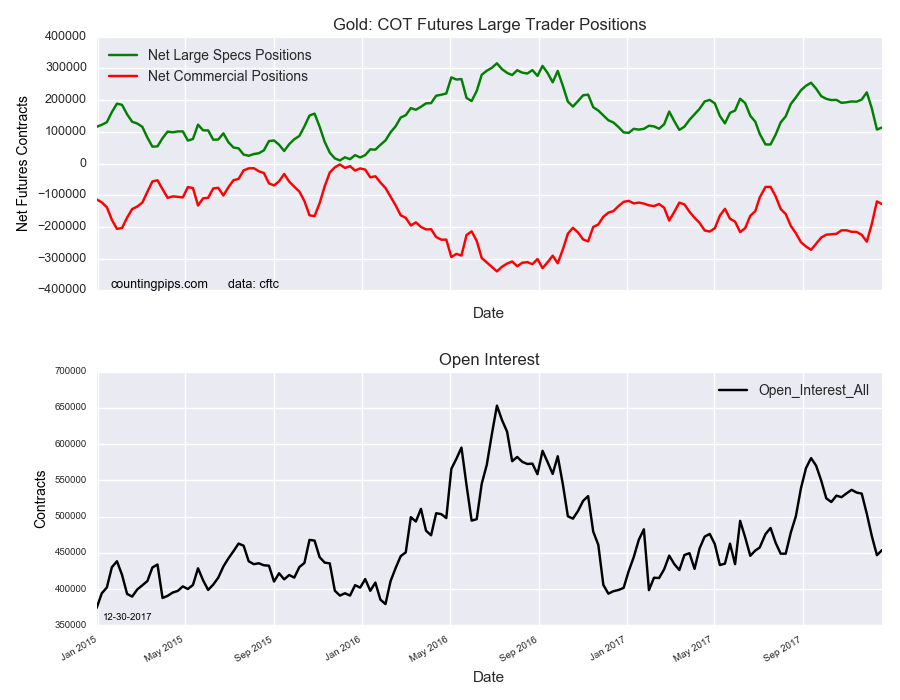
Large metals speculators lifted their bullish net positions in the Gold futures markets this week, according to the latest Commitment of Traders (COT) data released by the Commodity Futures Trading Commission (CFTC) on Friday.

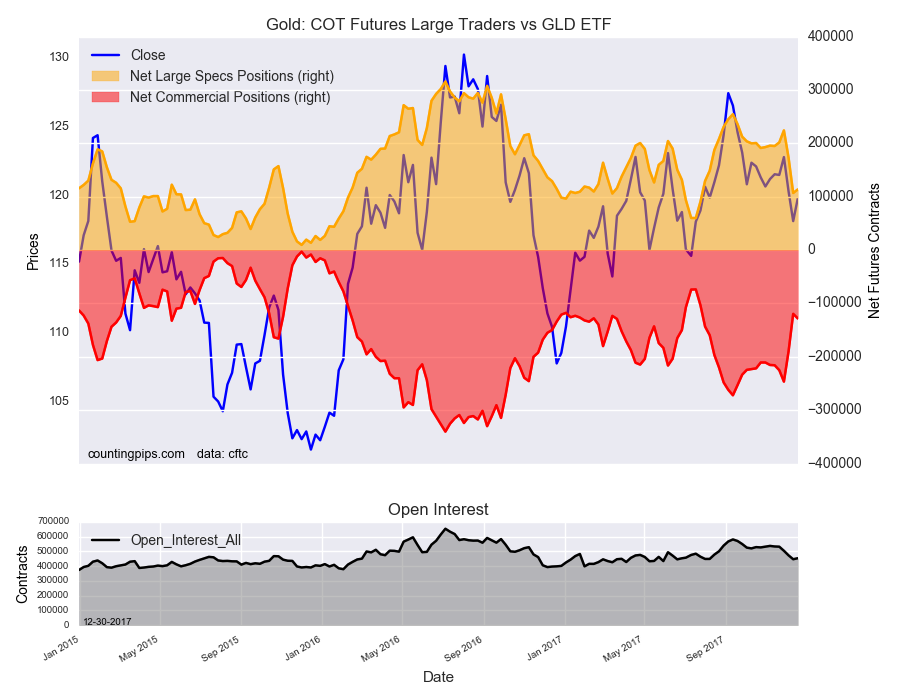
The non-commercial futures contracts of Gold futures, traded by large speculators and hedge funds, totaled a net position of 113,795 contracts in the data reported through Tuesday December 26th. This was a weekly increase of 6,727 contracts from the previous week which had a total of 107,068 net contracts.

The gold speculative position had taken two huge declines over the previous two weeks (weekly drops of -51,088 and -66,261 contracts, respectively) before this week’s slight turnaround. The speculative gold position has remained above the +100,000 contract level for twenty-one straight weeks.

Gold Commercial Positions:

The commercial traders position, hedgers or traders engaged in buying and selling for business purposes, totaled a net position of -128,217 contracts on the week. This was a weekly shortfall of -8,754 contracts from the total net of -119,463 contracts reported the previous week.

GLD ETF:

Over the same weekly reporting time-frame, from Tuesday to Tuesday, the GLD ETF, which tracks the price of gold, closed at approximately $119.82 which was an uptick of $1.67 from the previous close of $118.15, according to unofficial market data.

*COT Report: The COT data, released weekly to the public each Friday, is updated through the most recent Tuesday (data is 3 days old) and shows a quick view of how large speculators or non-commercials (for-profit traders) as well as the commercial traders (hedgers & traders for business purposes) were positioned in the futures markets. The CFTC categorizes trader positions according to commercial hedgers (traders who use futures contracts for hedging as part of the business), non-commercials (large traders who speculate to realize trading profits) and nonreportable traders (usually small traders/speculators). Find CFTC criteria here: (http://www.cftc.gov/MarketReports/CommitmentsofTraders/ExplanatoryNotes/index.htm).

Article By CountingPips.comReceive our weekly COT Reports by Email

10-Year Note Speculators decrease positions into new bearish level

By CountingPips.comReceive our weekly COT Reports by Email

10-Year Note Non-Commercial Speculator Positions:

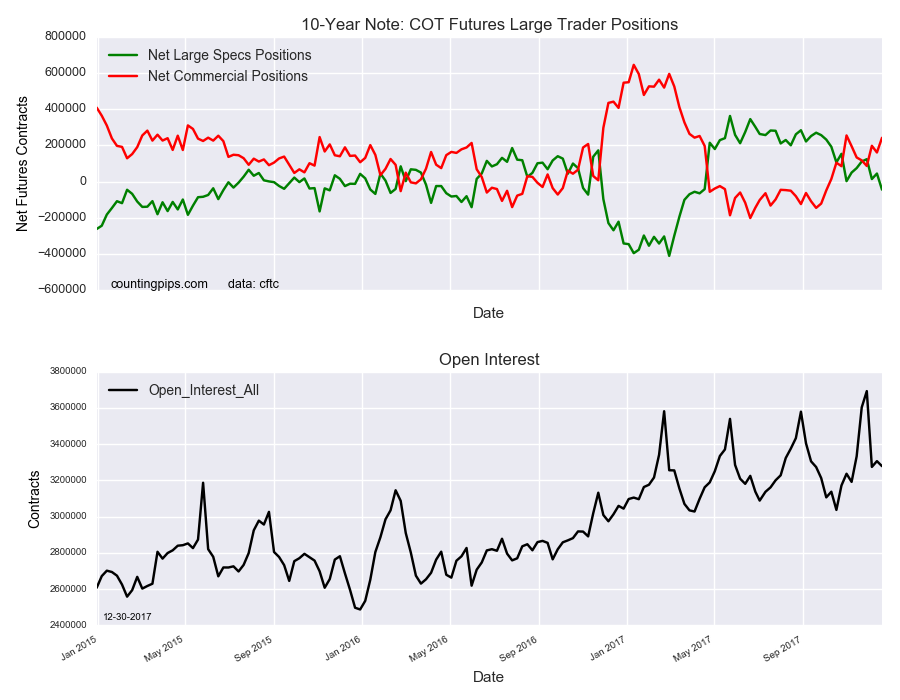
Large speculators sharply lowered their net positions in the 10-Year Note futures markets this week, according to the latest Commitment of Traders (COT) data released by the Commodity Futures Trading Commission (CFTC) on Friday.

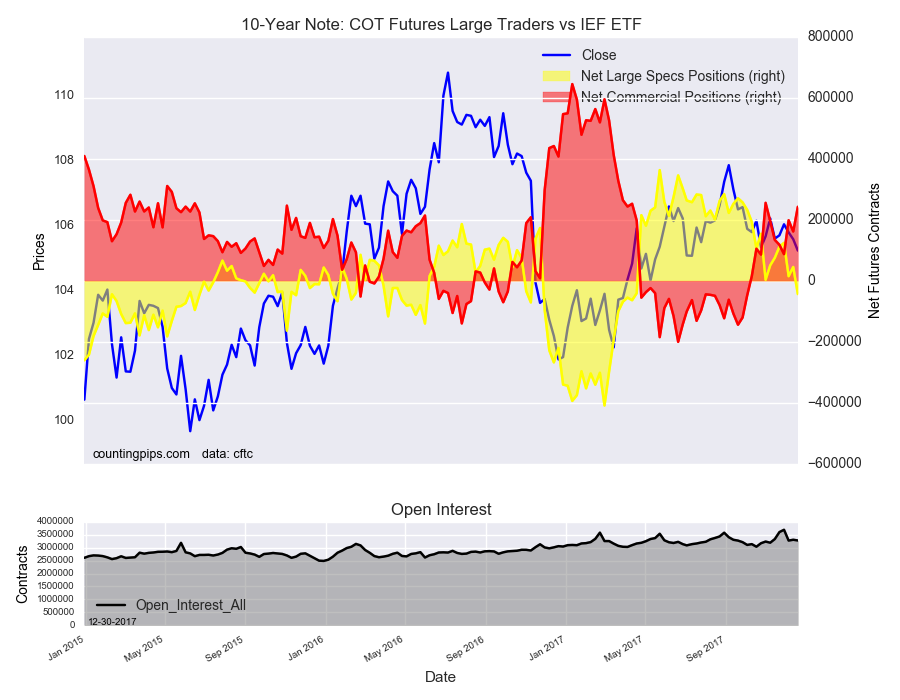
The non-commercial futures contracts of 10-Year Note futures, traded by large speculators and hedge funds, totaled a net position of -44,230 contracts in the data reported through Tuesday December 26th. This was a weekly lowering of -88,971 contracts from the previous week which had a total of 44,741 net contracts.

Speculative positions are now in a bearish overall standing for the first time since April 18th when net positions totaled -41,300 contracts.

10-Year Note Commercial Positions:

The commercial traders position, hedgers or traders engaged in buying and selling for business purposes, totaled a net position of 242,045 contracts on the week. This was a weekly uptick of 81,114 contracts from the total net of 160,931 contracts reported the previous week.

IEF ETF:

Over the same weekly reporting time-frame, from Tuesday to Tuesday, the 7-10 Year Treasury Bond ETF (IEF) closed at approximately $105.24 which was a decline of $-0.35 from the previous close of $105.59, according to unofficial market data.

*COT Report: The COT data, released weekly to the public each Friday, is updated through the most recent Tuesday (data is 3 days old) and shows a quick view of how large speculators or non-commercials (for-profit traders) as well as the commercial traders (hedgers & traders for business purposes) were positioned in the futures markets. The CFTC categorizes trader positions according to commercial hedgers (traders who use futures contracts for hedging as part of the business), non-commercials (large traders who speculate to realize trading profits) and nonreportable traders (usually small traders/speculators). Find CFTC criteria here: (http://www.cftc.gov/MarketReports/CommitmentsofTraders/ExplanatoryNotes/index.htm).

Article By CountingPips.comReceive our weekly COT Reports by Email


S&P500 Speculators lowered their net positions this week

By CountingPips.comReceive our weekly COT Reports by Email

S&P500 Non-Commercial Speculator Positions:

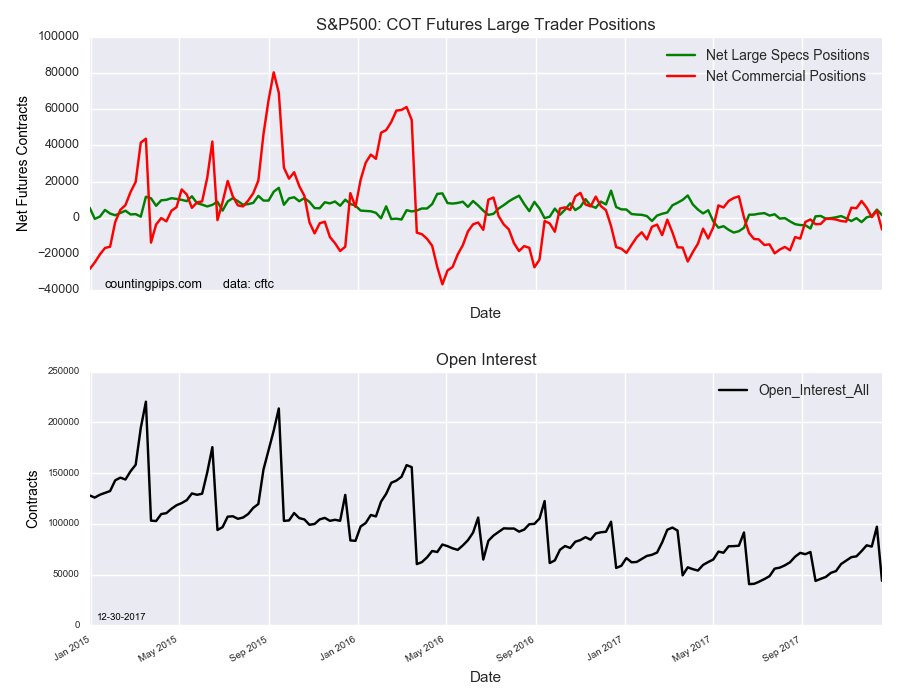
Large stock market speculators decreased their net positions in the S&P500 futures markets this week, according to the latest Commitment of Traders (COT) data released by the Commodity Futures Trading Commission (CFTC) on Friday.

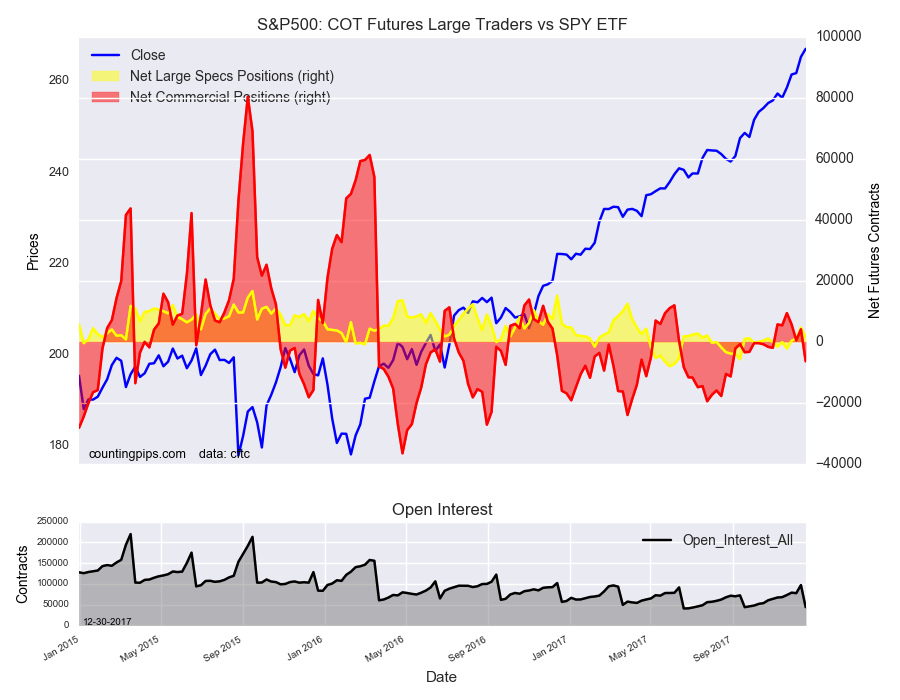
The non-commercial futures contracts of S&P500 futures, traded by large speculators and hedge funds, totaled a net position of 1,532 contracts in the data reported through Tuesday December 26th. This was a weekly reduction of -3,052 contracts from the previous week which had a total of 4,584 net contracts.

Speculative positions had risen for three straight weeks before this week’s decline. The overall position has remained in a slightly neutral level (hovering around the zero level) for more than ten weeks.

S&P500 Commercial Positions:

The commercial traders position, hedgers or traders engaged in buying and selling for business purposes, totaled a net position of -6,461 contracts on the week. This was a weekly shortfall of -10,509 contracts from the total net of 4,048 contracts reported the previous week.

SPY ETF:

Over the same weekly reporting time-frame, from Tuesday to Tuesday, the SPY ETF, which tracks the price of S&P500 Index, closed at approximately $267.17 which was a gain of $1.75 from the previous close of $265.42, according to unofficial market data.

*COT Report: The COT data, released weekly to the public each Friday, is updated through the most recent Tuesday (data is 3 days old) and shows a quick view of how large speculators or non-commercials (for-profit traders) as well as the commercial traders (hedgers & traders for business purposes) were positioned in the futures markets. The CFTC categorizes trader positions according to commercial hedgers (traders who use futures contracts for hedging as part of the business), non-commercials (large traders who speculate to realize trading profits) and nonreportable traders (usually small traders/speculators). Find CFTC criteria here: (http://www.cftc.gov/MarketReports/CommitmentsofTraders/ExplanatoryNotes/index.htm).

Article By CountingPips.comReceive our weekly COT Reports by Email

Silver Speculators reduced their net positions for a 5th week

By CountingPips.comReceive our weekly COT Reports by Email

Silver Non-Commercial Speculator Positions:

Large metals speculators decreased their net positions in the Silver futures markets again this week, according to the latest Commitment of Traders (COT) data released by the Commodity Futures Trading Commission (CFTC) on Friday.

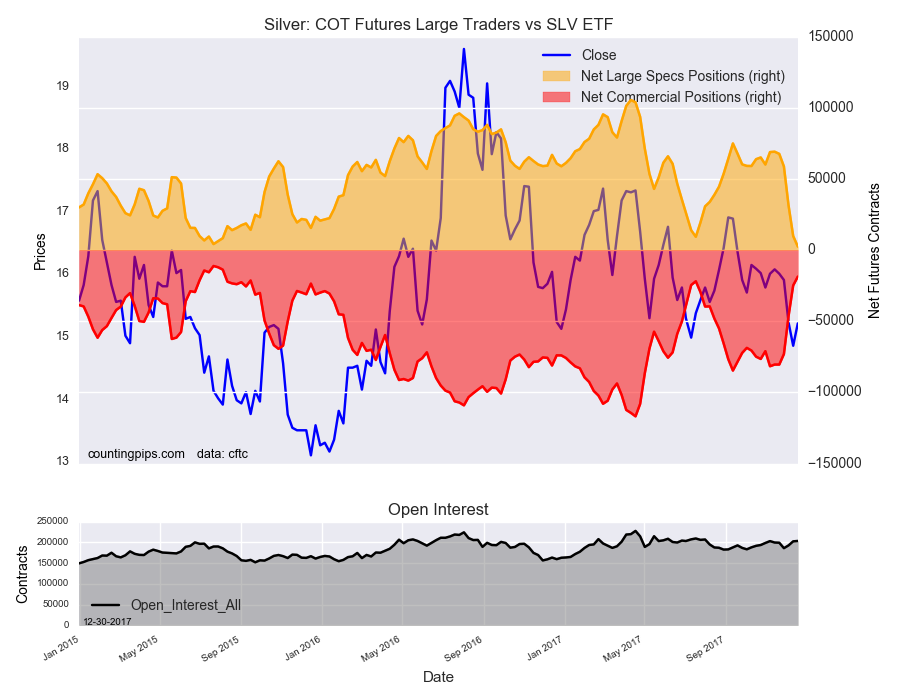
The non-commercial futures contracts of Silver futures, traded by large speculators and hedge funds, totaled a net position of 2,469 contracts in the data reported through Tuesday December 26th. This was a weekly decline of -7,445 contracts from the previous week which had a total of 9,914 net contracts.

Speculative positions have now fallen for five straight weeks and the overall standing is at the lowest level since June 3rd of 2014 when net positions equaled 766 contracts.

Silver Commercial Positions:

The commercial traders position, hedgers or traders engaged in buying and selling for business purposes, totaled a net position of -18,621 contracts on the week. This was a weekly advance of 6,208 contracts from the total net of -24,829 contracts reported the previous week.

SLV ETF:

Over the same weekly reporting time-frame, from Tuesday to Tuesday, the SLV ishares ETF, which tracks the price of silver, closed at approximately $15.22 which was an advance of $0.36 from the previous close of $14.86, according to unofficial market data.

*COT Report: The COT data, released weekly to the public each Friday, is updated through the most recent Tuesday (data is 3 days old) and shows a quick view of how large speculators or non-commercials (for-profit traders) as well as the commercial traders (hedgers & traders for business purposes) were positioned in the futures markets. The CFTC categorizes trader positions according to commercial hedgers (traders who use futures contracts for hedging as part of the business), non-commercials (large traders who speculate to realize trading profits) and nonreportable traders (usually small traders/speculators). Find CFTC criteria here: (http://www.cftc.gov/MarketReports/CommitmentsofTraders/ExplanatoryNotes/index.htm).

Article By CountingPips.comReceive our weekly COT Reports by Email

Copper Speculators sharply boosted their bullish net positions this week

By CountingPips.comReceive our weekly COT Reports by Email

Copper Non-Commercial Speculator Positions:

Large metals speculators advanced their bullish net positions in the Copper futures markets this week, according to the latest Commitment of Traders (COT) data released by the Commodity Futures Trading Commission (CFTC) on Friday.

The non-commercial futures contracts of Copper futures, traded by large speculators and hedge funds, totaled a net position of 42,698 contracts in the data reported through Tuesday December 26th. This was a weekly gain of 14,944 contracts from the previous week which had a total of 27,754 net contracts.

Speculative positions rose for a second straight week and are at the highest standing since Ocotber 31st when net positions totaled 47,593 contracts.

Copper Commercial Positions:

The commercial traders position, hedgers or traders engaged in buying and selling for business purposes, totaled a net position of -43,066 contracts on the week. This was a weekly loss of -11,937 contracts from the total net of -31,129 contracts reported the previous week.

JJC ETF:

Over the same weekly reporting time-frame, from Tuesday to Tuesday, the JJC iPath Bloomber Copper ETN, which tracks the price of copper, closed at approximately $35.76 which was a rise of $1.57 from the previous close of $34.19, according to unofficial market data.

*COT Report: The COT data, released weekly to the public each Friday, is updated through the most recent Tuesday (data is 3 days old) and shows a quick view of how large speculators or non-commercials (for-profit traders) as well as the commercial traders (hedgers & traders for business purposes) were positioned in the futures markets. The CFTC categorizes trader positions according to commercial hedgers (traders who use futures contracts for hedging as part of the business), non-commercials (large traders who speculate to realize trading profits) and nonreportable traders (usually small traders/speculators). Find CFTC criteria here: (http://www.cftc.gov/MarketReports/CommitmentsofTraders/ExplanatoryNotes/index.htm).

Article By CountingPips.comReceive our weekly COT Reports by Email

Murrey Math Lines 28.12.2017 (USD/CHF, GOLD)

Article By RoboForex.com

USD CHF, “US Dollar vs Swiss Franc”

As we can see at the H4 chart, the USD/CHF pair has broken the 3/8 level and right now is expected to continue falling towards the 1/8 one.

USDCHF1

At the H1 chart, the price is trading to the downside towards the support at the 0/8 level. If the price rebounds from this level, the instrument may grow to reach the 3/8 one without falling towards 0.9796.

USDCHF2

As we can see at the M15 chart, the pair has broken the downside line of the VoltyChannel indicator and, as a result, may continue moving downwards.

USDCHF3


XAU USD, “Gold vs US Dollar”

At the H4 chart, the XAU/USD pair is growing quite fast and right now it is breaking the 5/8 level. Later, the instrument is expected to continue growing towards the first target at the 7/8 one.

GOLD1

The lines at the H4 and H1 charts are completely the same and confirm the scenario described above.

GOLD2

As we can see at the M15 chart, the pair has broken the upside line of the VoltyChannel indicator and, as a result, may continue moving upwards to reach 1304.69.

GOLD3


RoboForex Analytical Department

Article By RoboForex.com

Attention!
Forecasts presented in this section only reflect the author’s private opinion and should not be considered as guidance for trading. RoboForex LP bears no responsibility for trading results based on trading recommendations described in these analytical reviews.

Forex Technical Analysis & Forecast 28.12.2017 (EUR/USD, GBP/USD, USD/CHF, USD/JPY, AUD/USD, USD/RUB, GOLD, BRENT)

Article By RoboForex.com

EUR USD, “Euro vs US Dollar”

The EUR/USD pair is moving upwards; after reaching the target of this wave, it has formed another consolidation range and broken it upwards to reach 1.1934. We think, today the price may start another decline towards 1.1823 and then grow with the target at 1.1882. Later, in our opinion, the market may fall to reach 1.1717.

EURUSD


GBP USD, “Great Britain Pound vs US Dollar”

The GBP/USD pair is moving upwards; it is trying to break the upside border of the consolidation range. Possibly, the price may extend this wave towards 1.3460. After that, the instrument may continue falling to reach the downside border.

GBPUSD


USD CHF, “US Dollar vs Swiss Franc”

The USD/CHF pair is moving downwards and breaking the downside border of the range. The target is at 0.9787. Later, in our opinion, the market may start another growth to reach the first target at 0.9880.

USDCHF


USD JPY, “US Dollar vs Japanese Yen”

The USD/JPY pair is moving downwards; it has tested the neckline and almost completed the correction. Possibly, today the price may form another ascending structure with the target at 113.28.

USDJPY


AUD USD, “Australian Dollar vs US Dollar”

The AUD/USD pair is moving upwards. Possibly, the price may reach 0.7828. After that, the instrument may resume trading downwards with the target at 0.7665.

AUDUSD


USD RUB, “US Dollar vs Russian Ruble”

The USD/RUB pair is consolidating above 57.35. If later the instrument breaks this range to the downside, the market may reach 56.55; if to the upside – start another correction towards 58.34.

USDRUB


XAU USD, “Gold vs US Dollar”

Gold has finished the ascending wave and right now is consolidating. If later the instrument breaks this range to the downside, the market may start another descending wave with the target at 1263.

GOLD


BRENT

Brent has formed another consolidation channel. If later the instrument breaks this channel to the downside, the market may be corrected towards 64.60; if to the upside – continue growing to reach 67.87.

BRENT


RoboForex Analytical Department

Article By RoboForex.com

Attention!
Forecasts presented in this section only reflect the author’s private opinion and should not be considered as guidance for trading. RoboForex LP bears no responsibility for trading results based on trading recommendations described in these analytical reviews.

RoboForex (CY) Ltd is announcing its rebranding to RoboMarkets

RoboForex (CY) Ltd, a European broker, is announcing its rebranding to RoboMarkets and will continue its professional activities under a new name. RoboMarkets has taken strategic steps to establish a global brokerage and expand a product line with the collaboration of cutting-edge technology and proprietary solutions. RoboMarkets will continue to strengthen European Market presence and provide clients access to the financial markets while continuously improving trading conditions.

RoboForex (CY) Ltd started as a forex broker operating under CySEC license No. 191/13. Throughout the years, the company established itself within the financial industry and continuously refines its services to serve the needs of trader’s worldwide while delivering innovations within the industry. As the company evolves, it has always followed a client-centric approach, placing client’s needs in the forefront of all operations in parallel with providing a wide range of opportunities for trading the world’s markets.

RoboMarkets defines itself as multi-asset broker and provides access to more than 8,700 trading instruments in seven types of assets classes. The company’s core objectives are to assist traders’ needs and deliver access to global markets in Europe.

Konstantin Rashap, RoboMarkets Chief Business Officer for Europe:

All this time, we’ve been systematically expanding the list of available services and improving the quality of existing solutions. Nowadays, we’re offering our clients access to the majority of the financial markets by utilizing the industry’s essential trading platforms like MetaTrader 4/5 and proprietary solutions such as R Trader, R WebTrader, and R MobileTrader. We provide competitive trading conditions alongside 24/7 online support in 11 languages. RoboMarkets’ short-term plans are to expand trading opportunities for the popular platforms MetaTrader, constant development of the proprietary solutions and enhance CopyFX and RAMM investments platforms. Continuous improvement of our Affiliate program, and expansion of financial instruments as within the scope of the company’s targets. We acknowledge the importance of a local presence hence we are taking calculated steps to strengthen and grow in European countries. In 2018, RoboMarkets will be opening new representative offices in Central and Western Europe.

About RoboMarkets

RoboMarkets is a trademark of RoboForex (CY) Ltd, a European broker with the CySEC license No. 191/13. RoboMarkets offers brokerage services in various countries all over the world and provides financial markets traders access to a variety of trading platforms. More detailed information about RoboMarkets can be found on the official website at www.robomarkets.com.


Chinese Economy in 2018 and Beyond

By Dan Steinbock

In the coming years, China shall aim at high-quality development, while seeking to forestall financial and international risks.

The recent Central Economic Work Conference marked a historical point in China’s economic development. After Mao’s struggle for the mainland’s sovereignty, and Deng’s economic reforms and opening-up, President Xi’s team seeks complete much of the transition to post-industrial society by the early 2020s.

What does it all mean for Chinese economy in 2018?

New economic guidelines at home

A “moderately prosperous society” will become the reality as China’s growth is likely to remain at 6.8-6.3 percent until the end of the decade. “High-speed” growth, which was typical to intensive industrialization, is now morphing into “high-quality” growth. Due to China’s huge size, the repercussions will reverberate around the world.

China’s rebalancing from exports and investment to consumption and innovation is likely to be completed around 2030. Meanwhile, per capita incomes are expected to double by 2020. Xi’s Chinese dream is predicated on greater economic focus on quality and equality of development.

Investments in social equity mean less uneven coverage of pension and health care insurance nationwide, better public services, rejuvenation of rural areas, scaling of farming operations, increased spending on high school education and vocational training, affordable housing and extended rural land leases – and an aggressive push to eradicate poverty in China.

A key aspect of the shift is Beijing’s expansive goal to restore blue skies over the mainland by cutting pollutants dramatically by 2020, coupled with efforts to attract investors to put substantial funds into environmental rehabilitation.

The new stress on environmental protection means new technologies in green manufacturing and clean energy; cleaning up air, water and soil pollution; developing green finance; emissions-reduction per targets; and tighter environmental rules.

Forestalling financial risks

While the Fed’s Ben Bernanke initiated US central bank’s exit from quantitative easing, Janet Yellen has tightened monetary policies, which Jerome Powell is likely to sustain starting in February 2018. As the European Central Bank is likely to gradually follow in the footprints, monetary tightening will spread.

Chinese policymakers seek to maintain a proactive fiscal and a neutral monetary policy stance, ruling out major stimulus packages and monetary easing. Yet, the People’s Bank of China (PBOC) can rely on Chinese growth to continue 3-4 times faster than in most other major economies.

In the coming year, policymakers seek to keep the yuan’s exchange rate basically stable. For years, the currency’s internationalization was pushed hard in the world stage. After market volatility in 2015, the progress has been slower but more solid. In turn, the gold-backed petro-yuan is likely to bring substantial institutional changes.

While the Chinese stock market experienced a slight correction recently, the status quo is now more stable than in 2015. The PBOC will take an active stance in managing financial-market risks through macro-prudential measures, rather than with policy rate tools. In 2018, it is likely to maintain a broadly neutral stance. Currently, the benchmark lending rate remains 4.35%.

With moderate tightening, inflation pressure has been subdued to less than 2% and growth is steady, probably around 6.8% by the year-end.

Recently, the International Monetary Fund (IMF) noted that China’s credit is high by international levels. The mainland’s total social debt is almost 270% as percentage of the GDP. Yet, despite continued absolute rise, credit-taking is decelerating and the government’s effort to deleverage corporates has started to bite.

Today, China’s leverage is significantly higher than that of emerging economies (189% of GDP). But unlike them, China is transitioning to a post-industrial society. Moreover, advanced economies’ leverage (268% of GDP) exceeds that of China, which is implementing structural reforms that major advanced countries continue to delay.

International risks

In addition to economic and financial threats, the coming months will introduce new unilateral “America First” pressures. Following US-Chinese friction on intellectual property, the US Commerce Department has launched a trade investigation into Chinese exports of sheet aluminum to the US.

The Trump administration will pursue a more aggressive trade agenda in 2018, while its corporate tax reform, which is likely to penalize the Republicans in mid-term elections, has significant trade implications as well. Most recently, the Trump administration’s new security strategy named China as a competitive rival.

In contrast, China is fostering inclusive multilateralism in its economic, security and trade policies, while the One Belt One Road initiative is proceeding faster than expected. The huge infrastructure is estimated at $4 trillion to $8 trillion over time, which is about 30-60 times the cost of the Marshall Plan at the turn of the 1950s.

Relying on its multilateral and new “major-country diplomacy,” China’s international statecraft complements its domestic economic policies. But it must navigate in the “new normal” – a high-risk international environment in which, ironically, America is now the greatest risk in the global economy.

About the Author:

Dr Dan Steinbock is the founder of Difference Group and has served as research director at the India, China and America Institute (USA) and visiting fellow at the Shanghai Institutes for International Studies (China) and the EU Center (Singapore). For more, see https://www.differencegroup.net/ 

The original commentary was published by China Daily on December 25, 2017


Toward “Nuclear Winter”?

By Dan Steinbock

All efforts to resolve the elevated nuclear tensions in the Korean Peninsula should be subject to extreme caution, due to the potential of massive collateral damage of death, destruction, radiation and environmental collapse.

Reportedly, Washington is drawing up plans for a “bloody nose” military attack on North Korea to stop its nuclear weapons program. According to high-level sources, the White House has “dramatically” stepped up preparation for a military solution in recent months amid fears diplomacy is not working.

A few years ago, North Korea was thought to be a decade away from developing a missile that could hit America with nuclear weapons. After Pyongyang’s successful test of intercontinental ballistic missile capabilities in July, the figure has dropped to about a year and a half.

The premise of the proposed conventional military attack is that it will not provoke an escalation of conflict that could have catastrophic consequences for the Korean Peninsula, Japan, East Asia or beyond.

But what if it did?

The “nuclear winter” effect

During our conversation in mid-2000s, Harvard’s Graham Allison, perhaps the leading analyst of the threats of nuclear proliferation and nuclear terrorism, sought to imagine the consequences of a 10-kiloton weapon exploding in New York City, Washington, D.C., Los Angeles, or any other major American city.

As he put it, “From the epicenter of the blast to a distance of approximately one-third mile, every structure will be destroyed and no one would be left alive. A second circle of destruction extending three-quarters of a mile from ground zero would leave buildings looking like the Federal Office Building in Oklahoma City. A third circle reaching out 1 mile would be ravaged by fires and radiation.”

There is also a fourth circle, the widest and deadliest of all – the long-term environmental impact of a nuclear conflict.

Ever since the first experiences of nuclear devastation in Hiroshima and Nagasaki, it has become increasingly obvious that the post-nuclear attack effects pose overwhelming challenges not just locally, but regionally, even internationally.

In the 1980s, independent research teams began to explore not just the immediate possible impact of nuclear strikes but their aftermath scenarios. While military attention focused on the global nuclear exchange, these scientists concentrated on the subsequent massive fires and smoke emissions in the lower atmosphere causing severe short-term environmental after-effects – the so-called “nuclear winter.”

After the mid-80s, the early models of such scenarios led Presidents Ronald Reagan and Mikhail Gorbachev to devise treaties to reduce the numbers of nuclear weapons from their 1986 peak. In retrospect, those predictions of “nuclear winter” effects were under-estimates.

Building on these pioneering studies by Paul Crutzen and John Birks, recent research indicates that in the aftermath of such nuclear attacks worldwide climatic cooling from stratospheric smoke could cause massive agricultural collapse that would threaten most of humanity with starvation.

At the same time, hawkish observers have sought to discredit the idea of nuclear winter effects because it undermines their political and military objectives. That error has fostered misleading policy conclusions, including the proposition that the US could successfully destroy Russia in a surprise first-strike nuclear attack.

In view of the nuclear winter impact, such an action would be suicidal. Yet, the fact that the Trump administration has rejected all evidence of climate change could foster very different official scenarios in which ultimate risks are downplayed and elusive opportunities magnified.

Thinking the unthinkable

With these imagined futures, the devil is in the details; that is, the extent of the devastation depends on the underlying assumptions. A military strike against North Korean nuclear sites is one thing. An escalation that would involve China and perhaps even Russia in the Korean Peninsula is another.

If the hostilities would be limited to a conventional war, a 2010 RAND study suggests that costs would amount to 60%-70% of South Korea’s annual GDP ($1.4 trillion in 2016). If North Korea detonated a 10-kilotone nuclear weapon in Seoul (mimicking Allison’s terror scenario), the financial costs would be more than 10% of South Korea’s GDP over the ensuing 10 years.

According to current estimates, an escalation of a military conflict on the peninsula could affect upwards of 25 million people on either side of the border, including at least 100,000 U.S. citizens (up to 300,000 or more). If Pyongyang uses only its conventional weapons (which is unlikely given its arsenal of weapons of mass destruction and the perception of an “existential” struggle for survival), estimates range from around 30,000 and 300,000 dead in the first days of fighting.

If North Korea would escalate to attacking Japan with ballistic missiles, it could target the greater Tokyo with a population of about 38 million. And that would only be the beginning.

If non-conventional weapons would be seized regionally, the net effect would be comparable to scenarios envisioning a nuclear conflict between India and Pakistan, in which weapons dropped on cities and industrial areas would unleash firestorms that would put massive amounts of smoke into the upper atmosphere.

That’s where these particles would remain for years, blocking the sun and making the earth’s surface cold, dark and dry.

In such a nightmare scenario, the lingering nuclear winter effects would be felt months after the nuclear bombs detonated across megacities, from Seoul to Tokyo and Shanghai, and beyond. In rural Middle America, farmers are familiar with snow and cold during the winter; but amid nuclear winter Iowans would face Arctic tundra as temperatures could plunge well below zero at night and might not recover above -10 degrees Celsius even during the day.

Agricultural collapse and fears of famines would accelerate on international scale.

Regional escalation, global Ice Age

If, in an extreme scenario, the confrontation in North Korea would escalate and result in an attack by the US on China and Russia with 2,200 weapons, that would affect agriculture worldwide, potentially lead to mass starvation, while generating Ice Age conditions.

Here’s the bottom line: Even a regional nuclear confrontation could have massive global cooling consequences with the associated collateral damage around the world.

Although nuclear munitions and other weapons of mass destruction were first developed in the US and the old Soviet Union, nuclear proliferation has created a high-risk status quo in which six of the nine countries known to have nuclear weapons are in Asia. As India, Pakistan, and North Korea pursue expensive weapons programs, their economic development is penalized but risks are global .

It is the collateral damage that should caution all efforts to resolve the Korean crisis or any possible nuclear confrontation. True, diplomatic negotiations take time and are predicated on difficult trade-offs. Yet, the alternatives seem far, far more costly.

Nuclear winter is a preventable hell.

About the Author:

Dr. Dan Steinbock is an internationally recognized expert of the nascent multipolar world. He is the founder of Difference Group. He has served as Research Director of International Business at India China and America Institute (USA) and Visiting Fellow at Shanghai Institutes for International Studies (China) and the EU Center (Singapore). For more, see www.differencegroup.net 

The commentary is based on the research project, “Nuclear scenarios, climate impacts” by the Difference Group.