Author Archive for InvestMacro – Page 453

Fibonacci Retracements Analysis 09.01.2018 (EUR/USD, USD/JPY)

Article By RoboForex.com

EUR USD, “Euro vs US Dollar”

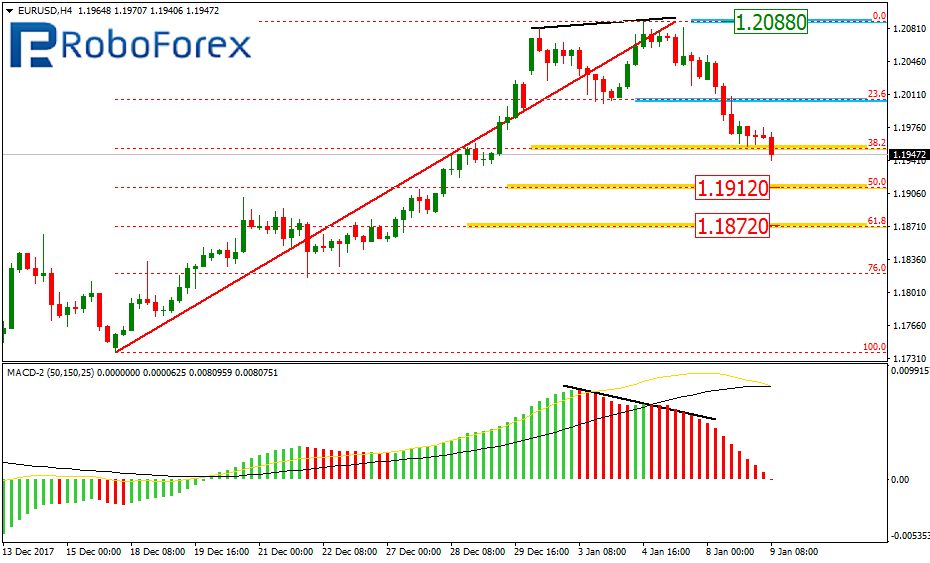
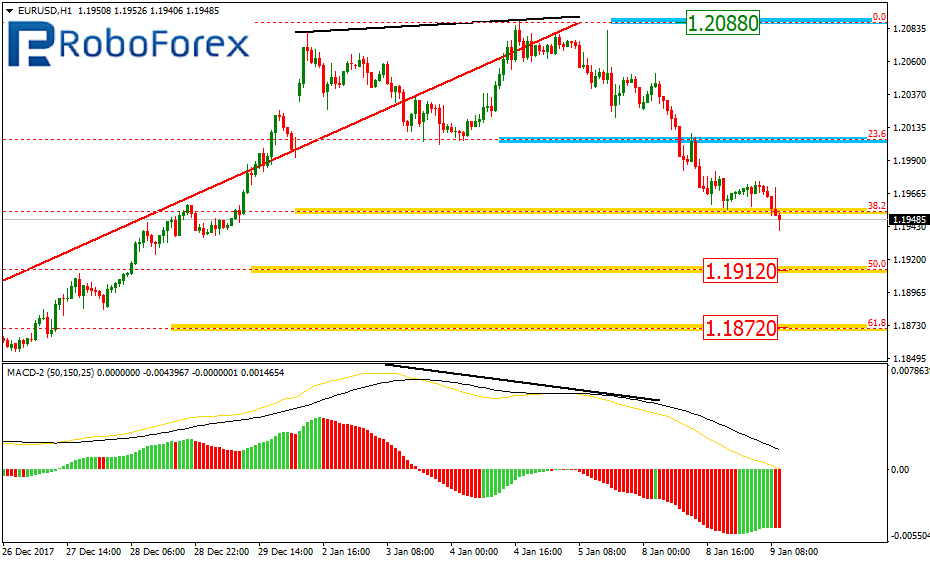
As we can see at the H4 chart, the EUR/USD pair is being corrected to the downside after the divergence and has already reached the retracement of 38.2%. The next targets of this local downtrend may be the retracements of 50.0% and 61.8% at 1.1912 and 1.1872 respectively. The resistance level is at 1.2088.

EURUSD1

At the H1 chart, the situation is similar and confirms the scenario described above.

EURUSD2


USD JPY, “US Dollar vs. Japanese Yen”

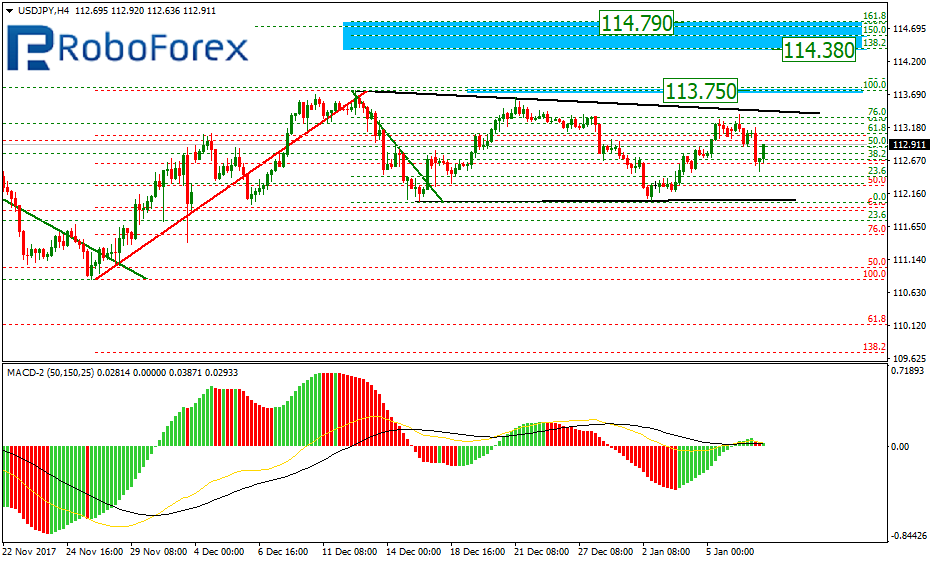
As we can see at the H4 chart, the USD/JPY pair is trading sideways inside the Triangle pattern. If the price breaks the pattern’s upside border, it may start a new ascending impulse. After breaking the current high at 113.75, the instrument may continue growing towards the post-correctional extension area between the retracements of 138.2% and 161.8% at 114.38 and 114.79.

USDJPY1

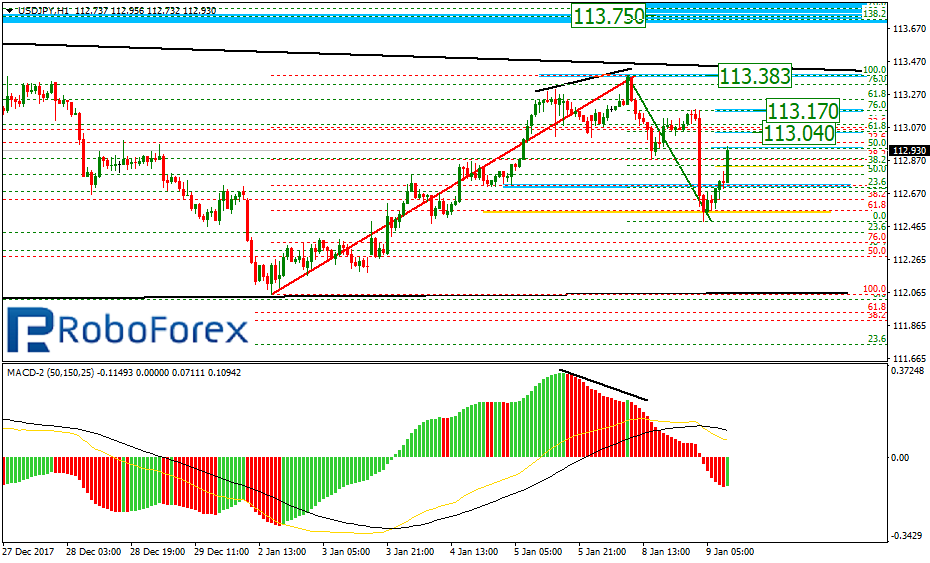
At the H1 chart, the price is about to finish the correction to the downside. The upside targets will be the retracements of 61.8% and 76.0% at 113.04 and 113.17 respectively. After reaching them, the instrument may continue growing to reach the local high at 113.38.

USDJPY2


RoboForex Analytical Department

Article By RoboForex.com

Attention!
Forecasts presented in this section only reflect the author’s private opinion and should not be considered as guidance for trading. RoboForex LP bears no responsibility for trading results based on trading recommendations described in these analytical reviews.

Ichimoku Cloud Analysis 09.01.2018 (AUD/USD, NZD/USD, USD/CAD)

Article By RoboForex.com

AUD USD, “Australian Dollar vs US Dollar”

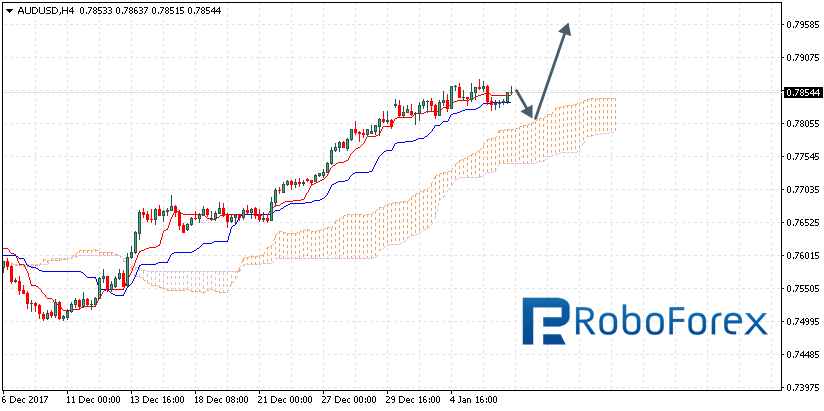
The AUD/USD pair is trading at 0.7854; the instrument is still moving above Ichimoku Cloud, which means that it may continue growing. We should expect the price to test Tenkan-Sen and Kijun-Sen at 0.7810 and then continue moving upwards to reach 0.7960. However, the scenario that Implies further growth may be cancelled if the price breaks the downside border of the cloud and fixes below 0.7745. In this case, the pair may continue falling towards 0.7680.

AUDUSD


NZD USD, “New Zealand Dollar vs US Dollar”

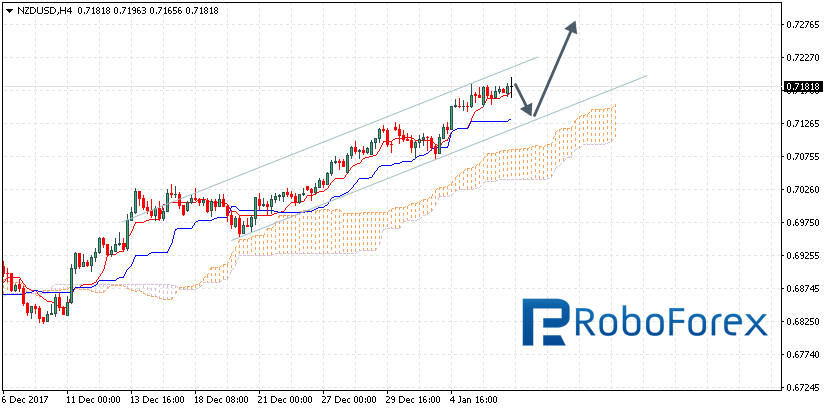
The NZD/USD pair is trading at 0.7181; the instrument is still moving above Ichimoku Cloud, which means that it may continue growing. We should expect the price to test Tenkan-Sen and Kijun-Sen at 0.7135 and then continue moving upwards to reach 0.7275. Another signal to confirm further ascending movement is the price’s rebounding from the downside border of the rising channel. However, the scenario that implies further growth may be cancelled if the price breaks the downside border of the cloud and fixes below 0.7060. In this case, the pair may continue falling towards 0.6975.

NZDUSD


USD CAD, “US Dollar vs Canadian Dollar”

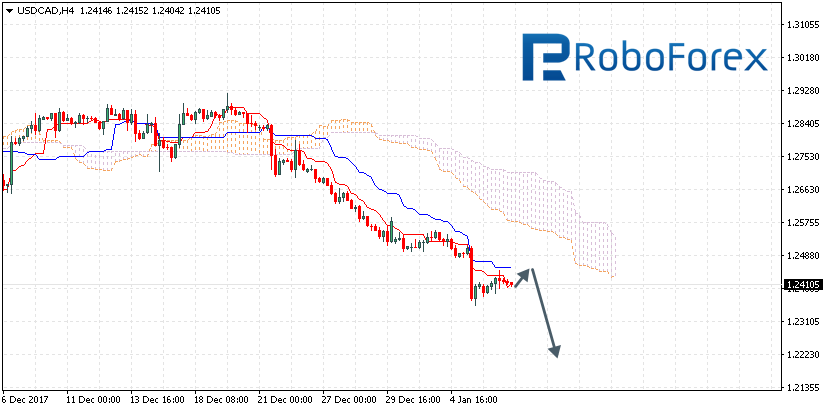
The USD/CAD pair is trading at 1.2410; the instrument is still moving below Ichimoku Cloud, which means that it may continue falling. We should expect the price to test Tenkan-Sen and Kijun-Sen at 1.2420 and then continue moving downwards to reach 1.2230. However, the scenario that implies further decline may be cancelled if the price breaks the upside border of the cloud and fixes above 1.2570. In this case, the pair may continue growing towards 1.2650.

USDCAD


RoboForex Analytical Department

Article By RoboForex.com

Attention!
Forecasts presented in this section only reflect the author’s private opinion and should not be considered as guidance for trading. RoboForex LP bears no responsibility for trading results based on trading recommendations described in these analytical reviews.

EURUSD: euro gets a foothold beneath 1.20

By Gabriel Ojimadu, Alpari

Previous:

On Monday the 8th of January, trading on the euro/dollar pair closed down. The euro dropped to the 1.1956 mark. Sellers came out to play as the European session opened and managed to bring the price back down below 1.20 by closing time.

The US dollar rose across the board. In addition to the technical correction, the dollar was bolstered by the comments of 2 FOMC members; Raphael Bostic and John Williams.

Williams, the president of the San Francisco Federal Reserve Bank, said over the weekend that the Fed should raise interest rates three times this year. Bostic revealed that the central bank is envisioning 2 – 3 rate hikes in 2018 depending on inflation.

Day’s news (GMT+3):

  • 09:45 Switzerland: unemployment rate (Dec).
  • 10:00 Germany: industrial production (Nov), trade balance (Nov).
  • 10:45 France: trade balance (Nov).
  • 11:15 Switzerland: real retail sales (Nov).
  • 13:00 Eurozone: unemployment rate (Nov).
  • 16:15 Canada: housing starts (Dec).
  • 18:00 USA: JOLTS job openings (Nov).

Fig 1. EURUSD hourly chart. Source: TradingView

Sellers refrained from accumulating positions during the consolidation phase around 1.2035. They went on the attack at the beginning of the European session. On Friday, they broke through the TR1 trend line and then through the TR2 on Monday.

The euro’s decline slowed down around the 112th degree. As the euro fell below 1.2000, this created a double top formation on the 4H timeframe. For this, the closest targets are 1.1945 and 1.1911.

My forecast will limit itself to 1.1945 given that the dollar is currently trading down against the majors in Asia. Should the dollar rise again, and all the major euro crosses decline, we can place 1.1925 levels at the 135thdegree firmly in our sights.

How a Simple Line Can Improve Your Trading Success

Elliott Wave International’s Jeffrey Kennedy explains many ways to use this basic chart tool

By Elliott Wave International

The following trading lesson has been adapted from Jeffrey Kennedy’s eBook, “Trading the Line — 5 Ways You Can Use Trendlines to Improve Your Trading Decisions.”

“How to draw a trendline” is one of the first things traders and investors learn when they study technical analysis. Typically, they quickly move on to more advanced topics and too often discard this simplest of all technical tools.

Yet you’d be amazed at the value a simple line can offer when you analyze a market. As Jeffrey Kennedy, editor of Elliott Wave International’s Trader’s Classroom service, puts it:

“A trendline represents the psychology of the market, specifically, the psychology between the bulls and the bears. If the trendline slopes upward, the bulls are in control. If the trendline slopes downward, the bears are in control. Moreover, the actual angle or slope of a trendline can determine whether or not the market is extremely optimistic or extremely pessimistic.”

In other words, a trendline can help you identify the market’s trend. And, “the trend is your friend,” remember? Consider this example in the price chart of Google.

That one trendline — drawn between the lows in 2004 and the lows in 2005 — provided price support for several corrective retracements over the next two years. Each time prices would touch that line, they would rebound higher and higher.

That’s pretty basic. But there are many more ways to draw trendlines. For example, when a market is in a correction you can draw a trendline — and then draw a parallel line to create a channel. You’ll find that it often “contains” the corrective price action. When price breaks out of this channel, there’s a good chance the correction is over and the main trend has resumed. Here’s an example of a trend channel in a chart of Soybeans. Notice how the upper trendline provided support for the subsequent rally.

Bottom line is, if you’ve been considering adding technical analysis to your arsenal, know that it doesn’t have to be complicated. As Jeffrey Kennedy likes to tell his students, “A kid with a ruler can make a million bucks in the stock market if he/she knows how to draw a trendline.”


5 Ways You Can Use Trendlines to Improve Your Trading Decisions

Learn five ways to draw trendlines that will help you to identify support and resistance, the end of a move, and changes in trend — critical information for your trading success.

Learn how to get free, instant access to this resource.

This article was syndicated by Elliott Wave International and was originally published under the headline How a Simple Line Can Improve Your Trading Success. EWI is the world’s largest market forecasting firm. Its staff of full-time analysts led by Chartered Market Technician Robert Prechter provides 24-hour-a-day market analysis to institutional and private investors around the world.

Preparing for the Cryptocurrency Swan Event

By www.TheTechnicalTraders.com 

Many people have speculated that Cryptocurrencies can go to $10k or higher.  Recently, the Chinese government has stepped up policy to regulate and eliminate Crypto ICOs as a means of increased speculation and gray-market capital.  Additionally, Jamie Dimon, of JP Morgan, stated that Bitcoin is a fraud and that it would “blow up” (http://www.msn.com/en-my/news/other/bitcoin-is-a-fraud-that-will-blow-up-says-jp-morgan-boss/ar-AArR1lF).  What is the truth and what should investors expect in the future?  Well, here is my opinion on this topic.

Bitcoin is based on the BlockChain technology architecture.  I believe this architecture will continue to be explored under the basis of an open, distributed ledger method of developing opportunities.  This technology improvement will likely drive advancement in other sectors of the global market as security and accountability continue to increase.  Yet, the growing pains of this technology will likely continue to drive some wild moves over the next few years.

It has been reported that Cryptocurrencies fell $23 Billion in value since the peak.  This would put the total valuation of the Crypto market at about $117 Billion near the same peak.  Consider for a moment that the Bernie Madoff scandal was near $65 Billion total.  Could a Cryptocurrency based “Swan Event” create chaos in the global markets?

In comparison to more traditional investment instruments, the risk exposure of Cryptocurrencies seems somewhat limited.  Yet consider this…  Many global firms jumped onto the Blockchain bandwagon within the last 12~24 months.  This is not just individual investors any longer, this is most of the global financial market.

DATE TIMELINE OF FIRST INVESTMENT INTO CRYPTOCURRENCIES


So, now our “SwanEvent” has a bit of depth in terms of risk exposure and breadth in terms of global market reach.  What would an extended decline in Cryptocurrency valuations do to these firms and to the confidence in the Cryptocurrency market?

Could a collapse “Swan Event” drive prices back to below $1000 (USD) or further?  What would the outcome of such an event be like for the global markets?  Would this type of move reflect into the global market as an advance or decline overall?  And what would this mean to the bottom line of these financial firms that have invested capital, resources and client’s capital into these markets?

It is our believe that the global markets are, without a Cryptocurrency event, setting up for a potentially massive corrective move.  The chart, below, clearly shows what we believe to be a Head-n-Shoulders pattern forming that will likely prompt a breakdown move near October 2017 or shortly thereafter.

We believe this global market correction will prompt selling in weaker instruments and drive a massive “rip your face off” rally in the metals.  We believe this move has already started with the formation of the Head-n-Shoulders pattern in the US markets as well as the recent upside move in the metals.  The Cryptocurrency “Swan Event” may be the catalyst event that is needed to put pressure on other market instruments (US and Global equities, RealEstate, Consumer confidence/spending and Metals).

US CUSTOM INDEX (HEAD-N-SHOULDER FORMATION)

METALS : START OF RIP YOUR FACE OFF RALLY


REAL ESTATE CORRECTION

Are you prepared for this move?  Do you want to know what to expect and do you need help understanding these market dynamics?  The markets are setting up for what could be one of the most explosive cycle event moves in nearly a decade and you need to be prepared.  We offer our research to our clients at TheMarketTrendForecast.com for far less than you would imagine.  For less than $3 per day, you can have access to our advanced research and analytics, market trend forecasts and more.  We keep you informed with our timely updates and research to help you understand how these markets are moving, where to find opportunities and how to protect your investments.

Our research team has over 30 years experience in the markets and have been trained by some of the best technicians that ever lived.  Isn’t it time you invested in a team of dedicated market analysts that can help you protect your assets and find opportunities for an unbelievable subscription rate?

When you join, we’ll send your our Guide to understanding trading PDF booklet to help you understand our advanced analysis techniques and adaptive learning strategies.  These are all part of our commitment to providing you the best analysis, research and understanding of the market’s dynamics as well as making sure you understand what we are delivering to you each week.

Don’t miss this next big move (“Swan Event”).  Timing is everything.

Visit www.TheTechnicalTraders.com to see what we are offering you.


The Rise of the Blockchain Era

By Adinah Brown

Everyone knows that the blockchain is the technology that underlies Bitcoin. It is a distributed ledger that permanently records transactions, as well as verifying the transactions.

For peer to peer networks used to transfer currencies, the blockchain has been hailed as the next big thing. But, what is it about the technology that it has created so much interest?

The fundamental advantage of the blockchain is its capacity to solve what is known as “Double Spending”. Double spending is the issue with digital cash that allows the potential for a single token to be spent more than once. As an example, let’s think of digital currencies as simply a digital file that confers a $5 value. As a digital file, you can easily duplicate the file, giving you two identical files each worth $5. It’s the equivalent of printing your own money.

The blockchain acts as an internal ledger whereby each part of the blockchain is used to verify the file and transaction. In effect, each of the files are linked and part of the chain. This allows them only to be used once and prevents any duplication or falsification, as such an act would be blocked by those transactions of the chain.

Where is the blockchain technology likely to take us?

For the last few years, electronic transactions have become increasingly common. Whether it is online banking or fund transfers, visa paywave, or the like, traditional banking have mostly been undertaken electronically. However, the system relied heavily on existing methods of transfer, which has the capacity to be easily hacked or corrupted. Blockchain technology, with its internal verification and chain linking to other blocks effectively removes the possibility of electronic fraud.

It is able to achieve this without utilising an intermediary, since it independently executes and verifies the counterparties. This improves not only the safety but also the cost of an intermediary, and speeds up the execution of the transaction. Not only does this make painfully slow bank transfers obsolete, it ensures that these transfers are more secure and accurate. And it does so automatically.

The blockchain was originally designed to decentralise transactions. In fact, decentralization and anonymity increase the security of the service. In addition, the architecture of the digital wallets involves interconnection. This allows for a streamlined peer to peer interaction, allowing the different users to improve the speed of transaction and interconnectedness.

With the increase speed and linking, it is not just the world of finance that recognises the  benefits of the blockchain. Already there is development and use of the blockchain to undertake smart contracts (like Ethereum), proof of ownership, voting and basically any other activity that benefits from fast, secure self reconciliation.

Whilst the blockchain technology was designed specifically for cryptocurrencies and is a clear disruptor for existing currency transfer methods, other uses of the blockchain are being exploited. Whilst most work on the premise of decentralization, there is also a big advantage for  “private blockchains”, which work as a sort of internal compliance function.

So whilst the noise about the blockchain grows with the price of bitcoin, its impact will be felt exponentially in the coming years as its capabilities are adapted for more and more scenarios.

The rise of the blockchain era has begun and it is only just getting started.

About the Author:

Adinah Brown is a professional writer who has worked in a wide range of industry settings, including corporate industry, government and non-government organizations. Within many of these positions, Adinah has provided skilled marketing and advertising services and is currently the Content Manager at Leverate.


A Timely Lesson for Today’s Stock Market Investors

“The names may change, but the psychology remains the same.”

By Elliott Wave International

Have you ever compared chart patterns from history with financial markets today? Elliott Wave International can show you the unique value of doing exactly that.

Why?

Because patterns on market charts repeat themselves. It happens across the globe, regardless of time period. When a still-unfolding pattern in the present looks a lot like a chart from the past, the price action to come may well remain on that earlier path.

Which means you can anticipate what’s next. [Ed. note: this video link shows you an example]

As the book The Mania Chronicles (2009) by Peter Kendall and Robert Prechter says:

The names may change, but the psychology remains the same.

The Mania Chronicles is an account of the financial bubble between 1995 and 2008, and it illustrates the point with this September 2000 chart and commentary:

Since January [2000], the Elliott Wave Financial Forecast has been tracking the NASDAQ’s uncanny resemblance to the Japanese Nikkei-225 in 1989 and 1990. Now that it has fallen and bounced, it has acquired a look that is also very similar to the post-peak performance of the 1929 DJIA, the 1987 DJIA and the 1997 Hong Kong Hang Seng index.

In all cases, the manic final run to all-time highs was followed by an initial leg down that led to a three-wave countertrend rebound, the classic Elliott wave signature of a correction. Look closely, and you will notice that these rebounds usually start with a big up day (sometimes on a gap) that fools the bulls into thinking that a major bottom has been recorded. The rallies last mere days, though, and then prices turn down in a crash. The NASDAQ gapped higher off its May low at 3043 and then traced a three-wave move to the September 1 high of 4260. The decline since then has violated the trendline support that contained the entire countertrend rally.

…The clock is ticking for the start of the “cascading phase” of the pattern. Prices may rally briefly, but a severe decline is likely.

As we now know, the NASDAQ did cascade downward into 2002, with the entire 2000-2002 bear market consuming 78% of the index’s value.

Lately, Elliott Wave International has also been reviewing other chart formations with similarities to the present.

In July 2017, the Elliott Wave Financial Forecast showed this chart and said:

The chart shows [a] succession of tops. The bottom four panels show peaks in real estate, commodities and bonds since 2006, and an impending high in stocks. The topping sequence is similar to that which occurred during the last peak of Supercycle degree, wave (III) in 1929. The current top is a Grand Supercycle degree peak ….


Since we showed that chart in July 2017, yet another chart pattern surfaced in the stock market — and it’s eerily similar to 1929. EWI’s Robert Folsom reveals that pattern, in his Chart of the Day video titled “Believe Your Own Eyes: Ghost of a Stock Market Past in the Present.” Follow this link to watch the video.


Investors will need ‘risk assets’ to beat inflation in 2018

By George Prior

Investors now have little alternative but to support risk assets if they want to beat inflation, affirms one of the world’s largest independent financial advisory organizations.

The assertion from Tom Elliott, International Investment Strategist at deVere Group, comes as global stock markets enter 2018 with positive momentum, including the Dow Jones which has surpassed 25,000 for the first time in history.

Mr Elliott explains: “Market confidence is supported by a reasonably strong cyclical upswing in world GDP growth. This is being translated into corporate earnings growth, by a belief that central banks will not significantly tighten monetary policy unless justified by growth and inflation data, and by the U.S. corporate tax cuts announced in December which will boost Wall Street corporate earnings.

“In the face of continuing low interest rates and bond yields, investors now have little alternative but to support risk assets such as equities and non-core government bonds, if they want a yield that will beat inflation.”  

An acronym is currently being popularized that describes how many investors see markets unfolding in 2018: MOTS, standing for ‘more of the same’. That is to say, solid returns for stock markets with continuing low volatility, and positive returns from investment grade corporate bonds.

“The risks to the MOTS scenario include central bank policy error, Trump turning America away from its traditional support for free trade, a credit crunch in the Chinese financial system and from geopolitics such as North Korea and the Middle East. However, as supporters of MOTS would argue, none of these risks are particularly new and they failed to de-rail markets in 2017,” confirms the strategist.

He continues: “We favour a long-term multi-asset approach to investing, whereby investors choose a suitable combination of global equities and bonds – depending on their risk profile and investment horizon – and leave the portfolio unchanged. Regular re-balancing ensures winners are sold and losers are bought – which financial history, and common sense, supports but which is so hard for us to do in practice.”

Mr Elliott goes on to say: “Looking forward to 2018, Japanese and emerging market stock markets appear to some commentators to offer most value, the U.S. less so. The Japanese economy, which grew at an annualised rate of 1.4% in the third quarter 2017 (despite a shrinking population), continues to benefit from a weak yen and the upturn in global demand for its exports. Fiscal reform, in particular lower corporate tax rates for companies that increase wages by 3% or more, comes into effect in April. It is hoped that this will lead to improvements in household demand growth, which has been weak in recent years. Emerging market equities continue to look undervalued relative to their developed market peers on most valuation measures, despite their outperformance in 2017.

“Wall Street is the most overvalued of the major stock markets, with the attractiveness of equities against bonds diminishing as Treasury yields creep up. However, the increase in yields is likely to be modest and U.S. corporate earnings growth will remain strong, limiting any pull-back in share prices. The weak dollar boosts export earnings, while strong consumer confidence supports domestic-focused sectors. Tax cuts will be a net benefit to U.S. corporate earnings, but the impact of changes to the tax code on individual sectors is as yet unpredictable. Fourth quarter earnings statements and outlook comments, from mid-January, will hopefully offer clues.”

Mr Elliott is not so confident about fixed income.  He concludes: “Once again we begin the year with commentators generally nervous of bonds, fearing that an inflation problem is around the corner. Some fear that central banks will tighten monetary policy faster than is priced into the market in an accelerated effort to ‘normalize’ policy.

“It seems prudent to heed such warnings, even while acknowledging that the fear of imminent inflation has been voiced by monetarist hawks – and proved wrong- ever since central bank’s policies of quantitative easing and ultra-low interest rates began nearly 10 years ago. This suggests favouring short duration core government bonds, since the cash can be re-invested in a few years in higher bond yields.”


deVere Group is one of the world’s largest independent advisors of specialist global financial solutions to international, local mass affluent, and high-net-worth clients.  It has a network of more than 70 offices across the world, over 80,000 clients and $12bn under advisement.


Fibonacci Retracements Analysis 05.01.2018 (BITCOIN, ETHEREUM)

Article By RoboForex.com

BTC USD, “Bitcoin vs US Dollar”

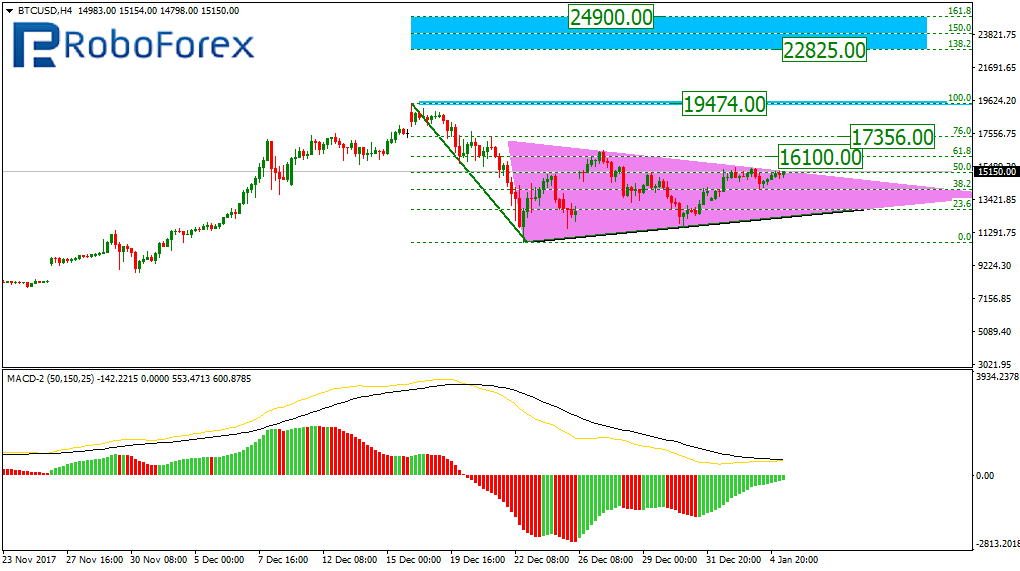
As we can see at the H4 chart, the BTC/USD pair is testing the upside border of the triangle consolidation range. After the price breaks the resistance level, the closest targets of this movement may be the retracements of 61.8% and 76.0% at 16100.00 and 17356.00 respectively. If the pair breaks the high at 19474.00, the instrument may grow towards the post-correctional extension area between the retracements of 138.2% and 161.8% at 22825.00 and 24900.00 respectively.

BTCUSD1

At the H1 chart, the pair is forming the ascending impulse towards 16100.00 and 17351.00.

BTCUSD2


ETH USD, “Ethereum vs. US Dollar”

As we can see at the daily chart, the ETH/USD pair has broken the high and started moving towards the post-correctional extension area between the retracements of 138.2% and 161.8% at 1003.00 and 1088.00 respectively. Also, one should pay attention to the divergence, which may indicate a possible reverse after the price reaches its upside targets.

ETCUSD1

At the H1 chart, the situation is similar and confirms the scenario described above.

ETCUSD2


RoboForex Analytical Department

Article By RoboForex.com

Attention!
Forecasts presented in this section only reflect the author’s private opinion and should not be considered as guidance for trading. RoboForex LP bears no responsibility for trading results based on trading recommendations described in these analytical reviews.

Forex Technical Analysis & Forecast 05.01.2018 (EUR/USD, GBP/USD, USD/CHF, USD/JPY, AUD/USD, USD/RUB, GOLD, BRENT)

Article By RoboForex.com

EUR USD, “Euro vs US Dollar”

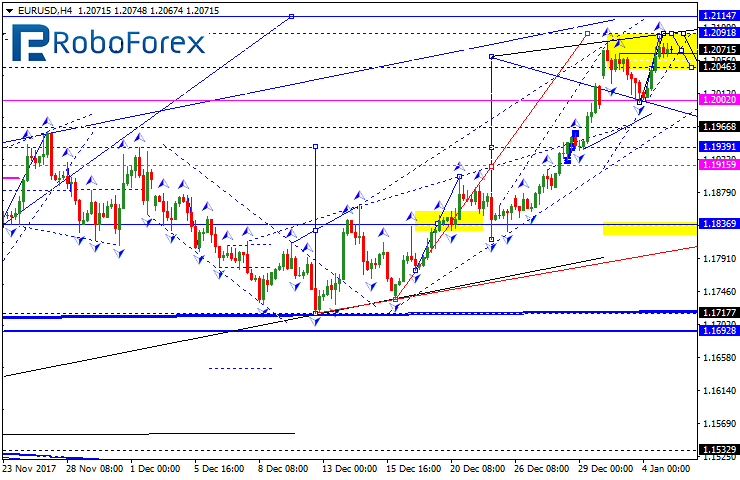
The EUR/USD pair is trading upwards. Possibly, today the price may reach 1.2091 and then start another correction towards 1.2046 (at least). Later, in our opinion, the market may form one more ascending structure towards 1.2114 and then continue falling inside the downtrend with the first target at 1.1840.

EURUSD


GBP USD, “Great Britain Pound vs US Dollar”

The GBP/USD pair has almost completed the correction. We think, today the price may form another descending structure towards 1.3831, thus forming a new consolidation range. If later the instrument breaks this range to the downside, the market may continue falling towards 1.3422; if to the upside – grow to reach 1.3617.

GBPUSD


USD CHF, “US Dollar vs Swiss Franc”

The USD/CHF pair is being corrected towards 0.9718. After that, the instrument may start another growth to reach 0.9800, break it, and then continue its movement towards the local target at 0.9880.

USDCHF


USD JPY, “US Dollar vs Japanese Yen”

The USD/JPY pair has reached the target of the first ascending structure. Possibly, today the price may be corrected towards 112.47. Later, in our opinion, the market may grow to reach the upside border of the Triangle pattern at 113.33.

USDJPY


AUD USD, “Australian Dollar vs US Dollar”

The AUD/USD pair has finished the ascending structure. We think, today the price may fall towards 0.7800 and then grow to reach 0.7834, thus forming another consolidation range at the top of the wave. In the future, the instrument may break this range to the downside and fall to reach 0.7665.

AUDUSD


USD RUB, “US Dollar vs Russian Ruble”

The USD/RUB pair is trading downwards. The target is at 56.80. After that, the instrument may start another correction towards 57.35 and then fall to reach 56.55.

USDRUB


XAU USD, “Gold vs US Dollar”

Gold is still consolidating. Possibly, the price may reach 1329 and then fall to break 1305. Later, in our opinion, the market may start another descending wave with the target at 1264.

GOLD


BRENT

Brent has completed another consolidation range near 68.30. If later the instrument breaks this range to the downside, the market may start another correction to reach 67.00; if to the upside – continue growing towards 69.30. The local target of the wave is at 70.72.

BRENT


RoboForex Analytical Department

Article By RoboForex.com

Attention!
Forecasts presented in this section only reflect the author’s private opinion and should not be considered as guidance for trading. RoboForex LP bears no responsibility for trading results based on trading recommendations described in these analytical reviews.