Author Archive for InvestMacro – Page 445

Bitcoin’s $10,000 “Line in the Sand”

The cryptocurrency’s trends continue to be fueled by investor psychology

By Elliott Wave International

On January 23, Bitcoin fell below $10,000. That’s the second time in recent days that prices dipped below this psychologically important threshold. The headlines picked up on the drama:

“Bitcoin tumbles below $10,000 and is now down 25% on the year…” (CNBC, Jan 23)

That same article also observed:

No specific driver was immediately apparent behind Tuesday’s decline…”


The driver was investor psychology. That’s something Elliott waves analysis is adept at helping you track and forecast, so let’s see what the waves had to say about Bitcoin’s latest slide.

The day before the drop, our Cryptocurrency Pro Service posted this chart and a bearish forecast (partial Elliott wave labels shown):

Bottom Line: Multiple [Elliott] wave counts warn XBT is headed lower.

BitcoinPic 1

(Last Price 10710): The decline below 11,040 signals that the recent correction is likely complete. There are two ways to count it. Wave iv might have ended… or we can count [a still-unfolding wave iv triangle]… Both [wave counts] warn the risk is to the downside…

Early the next day, Bitcoin fell to $9,910. Here’s what the price action has looked like since (partial Elliott wave labels shown):

BitcoinPic 2

Keep in mind that sideways market moves are almost always corrective. Meaning that, most likely, Bitcoin’s “wave iv” our January 22 analysis mentioned above is still developing — as an Elliott wave pattern called a “contracting triangle.”

If you know Elliott, you know exactly what this wave labeling implies.


[FREE REPORT] Bitcoin: The Greatest Bubble of All Time

As you read the news that Bitcoin dropped “below $10,000 with $36 billion of value wiped off in a day…” (CNBC, Jan. 17), you’re probably asking,

“What’s next for Bitcoin and other cryptos?”

Our new, free report gives you some much-needed answers.

Learn how to get free, instant access to this resource.

This article was syndicated by Elliott Wave International and was originally published under the headline Bitcoin’s $10,000 “Line in the Sand”. EWI is the world’s largest market forecasting firm. Its staff of full-time analysts led by Chartered Market Technician Robert Prechter provides 24-hour-a-day market analysis to institutional and private investors around the world.

How to Surpass the Middle-Income Trap

By Dan Steinbock

China will surpass the middle-income trap by continuing to implement structural reforms and focusing on economic development. The lesson to other emerging economies is to distinguish good growth policies from self-serving agendas in the advanced West.

According to the World Bank, high-income economies ($12,236 or more) include the US, Western Europe and Japan, while upper middle-income economies ($3,956 -$12,235) feature Turkey, Russia, Brazil and China, among others.

In the past, many countries have attained moderate living standards, yet failed to graduate to the next level. China entered the ranks of the “upper-middle-income” countries in the early 2010s. But can the country avoid the middle-income trap?

Overcoming the middle-income trap

China has great potential to overcome the middle-income trap. First of all, its world-historical growth record speaks for itself.

Second, the rebalancing of the economy from exports and investment to consumption and innovation is proceeding according to the expected trajectory.

Third, new growth targets indicate that policymakers are well attuned to the need to move from simple growth to higher-quality development.  Also, the deleveraging has slowed credit growth and will significantly lower local government debt in the late 2010s, which will ensure higher-quality growth.

Finally, the huge size of China’s population disguises regional progress. In relatively wealthier megacities, including Shanghai, Shenzhen and Beijing, the middle-income trap may already have been surpassed.

What makes Chinese progress so impressive is that, unlike other major economies, China is executing structural reforms, which has proven so difficult in other countries.

America is so polarized that some policymakers prefer a government shutdown to a credible, bipartisan medium-term debt-cutting plan. In the Eurozone, the sovereign debt crisis has caused huge dislocations and a cyclical recovery alone is not enough to resolve the structural crisis. In Japan, half a decade of massive monetary injections has not achieved adequate inflation.

Economic development is the priority

In the 19th National Congress of the Chinese Communist Party (CPC), President Xi Jinping stressed that “development is the foundation and key to addressing all problems.” China’s medium-term policies must cope with these challenges in the “new normal” of the international environment, even as the country’s “uneven and inadequate development” is at odds with “people’s ever-growing demand for better life.”

Achieving these objectives requires less uneven coverage of pension and health care insurance nationwide; basic public services; rejuvenation of rural areas through land and fiscal reforms; appropriate scaling of farming operations; increased spending on high school education and vocational training; more affordable housing; and extended rural land leases.

In China, economic reforms are central to the rebalancing, which could lift another 70 million people from poverty by 2020, just as it is turning the mainland into the leading actor in global efforts to combat climate change through innovation.

Not all Western lessons work in emerging world

To avoid the middle-income trap, the ability to distinguish between appropriate policies and misguided prescriptions is pressing for several reasons. First, there are the historical lessons.

It took advanced economies decades, even centuries, to advance from low income to high income economies. Yet, today many of them demand that emerging economies should do the same in a matter of years. In Latin America, such policies cost “lost decades” not so long ago.

Second, there is the matter of size. Advanced economies like to tout the success of British or American industrialization as a blueprint to emerging countries. Yet, when Britain and the US began industrialization, the former had barely 30 million people and the latter around 40 million (about the same as in Shanghai and Guangzhou alone). Laissez-faire doctrines fare particularly poorly in emerging economies, which are larger by magnitudes.

At the regional level, some areas of China’s wealthier coastal megacities have already graduated into the high-income category, but national economy is still amid the transition. So the real question is not to compare China with industrializing Britain or the US, but to ask, “How long has it taken for Europe to industrialize, from the first industrial centers in the UK to rural Romania?”  In the latter, more than 25 percent of people are still employed in agriculture.

If, after two centuries, industrialization is still not completed in peripheral Europe (in which population remains only half of that in the mainland), why is China expected to complete it in three decades?

Third, there is the issue of wealth. Advanced economies were pretty prosperous even before they industrialized, thanks – not to democracies and free markets but – to imperial regimes that grew wealthy on the back of infant-industry protection and protectionism, brutal colonialism, or both. In the mid-19th century Britain and late 19th century America, per capita incomes were at the level that Russia first reached in the 1950s,  Brazil around 1960, China in the early 1990s and India just a decade ago.

The trick to avoid the middle-income trap is to avoid those development doctrines that reflect self-interested doctrines in the advanced world. The real task is to concentrate on economic development that supports progressive increases in living standards of ordinary people in emerging economies.

About the Author:

Dr Dan Steinbock is Guest Fellow of Shanghai Institutes for International Studies (SIIS).This commentary is based on his SIIS project on “China in the era of economic uncertainty and geopolitical risk.” For more about SIIS, see http://www.siis.org.cn/EnIndex and Dr Steinbock, see http://www.differencegroup.net/ 


A shorter version of this commentary was released by China Daily on January 29, 2018

Forex Technical Analysis & Forecast 31.01.2018 (EUR/USD, GBP/USD, USD/CHF, USD/JPY, AUD/USD, USD/RUB, GOLD, BRENT)

Article By RoboForex.com

EUR USD, “Euro vs US Dollar”

The EUR/USD pair is trading upwards; this structure may be considered as a correction that may reach 1.2464. Later, in our opinion, the market may start another decline towards 1.2323.

EURUSDRisk Warning: the results of previous trading operations do not guarantee the same results in the future.

GBP/USD GBP USD, “Great Britain Pound vs US Dollar”

The GBP/USD pair is growing; this growth may be considered as a correction with the target at 1.4220. After that, the instrument may form another structure to the downside to reach 1.3950.

GBPUSDRisk Warning: the results of previous trading operations do not guarantee the same results in the future.

USD CHF, “US Dollar vs Swiss Franc”

The USD/CHF pair is moving downwards. Possibly, the price may reach 0.9270 and then grow towards the first target at 0.9465.

USDCHFRisk Warning: the results of previous trading operations do not guarantee the same results in the future.

USD JPY, “US Dollar vs Japanese Yen”

The USD/JPY pair is falling; after breaking 108.65, it may continue moving downwards to reach 108.14. We think, today the price may reach this level and then start a new growth with the first target at 110.50.

USDJPYRisk Warning: the results of previous trading operations do not guarantee the same results in the future.

AUD USD, “Australian Dollar vs US Dollar”

The AUD/USD pair is consolidating at the top. According to the main scenario, the price may fall to break 0.8004 and then continue trading to the downside to reach the target at 0.7980.

AUDUSDRisk Warning: the results of previous trading operations do not guarantee the same results in the future.

USD RUB, “US Dollar vs Russian Ruble”

The USD/RUB pair is still moving upwards; the predicted target is at 56.56. After that, the instrument may fall to reach 56.05 and then resume growing with the target at 56.90.

USDRUBRisk Warning: the results of previous trading operations do not guarantee the same results in the future.


XAU USD, “Gold vs US Dollar”

Gold is moving upwards. Possibly, today the price may start another correction to reach 1383.00. Later, in our opinion, the market may resume falling towards 1315.00.

GOLDRisk Warning: the results of previous trading operations do not guarantee the same results in the future.

BRENT

Brent has broken 69.08 and formed a downside continuation pattern there. Possibly, the price may continue falling to reach the short-term target at 67.44.

BRENTRisk Warning: the results of previous trading operations do not guarantee the same results in the future.


RoboForex Analytical Department

Article By RoboForex.com

Attention!
Forecasts presented in this section only reflect the author’s private opinion and should not be considered as guidance for trading. RoboForex LP bears no responsibility for trading results based on trading recommendations described in these analytical reviews.

Murrey Math Lines 31.01.2018 (USD/JPY, USD/CAD)

Article By RoboForex.com

USD JPY, “US Dollar vs. Japanese Yen”

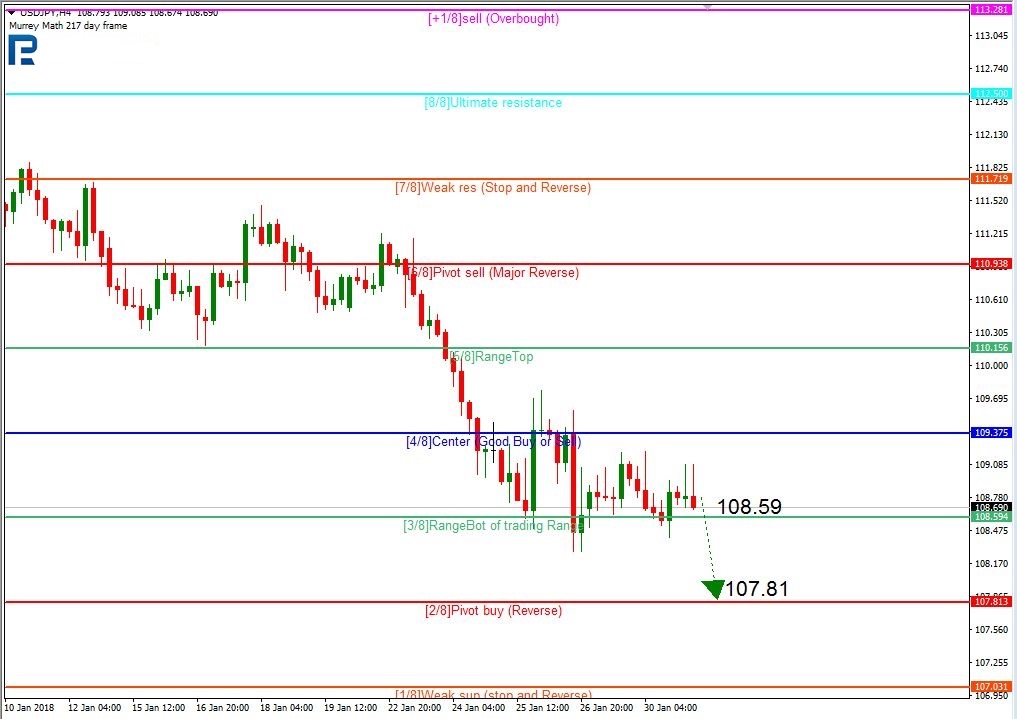
At the H4 chart, the USD/JPY pair is consolidating between the 3/8 and 5/8 levels. If the price breaks the 3/8 level, the instrument may continue falling to reach the 2/8 one.

USDJPY1
Risk Warning: the results of previous trading operations do not guarantee the same results in the future.

As we can see at the H1 chart, the price has rebounded from the 3/8 level. In the future, the instrument is expected to continue falling towards the main target, which is the support at the 0/8 level.

USDJPY2
Risk Warning: the results of previous trading operations do not guarantee the same results in the future.

At the M15 chart, the pair may break the downside line of the VoltyChannel indicator and, as a result, continue moving downwards to reach the main target at 107.81.

USDJPY3
Risk Warning: the results of previous trading operations do not guarantee the same results in the future.

USD CAD, “US Dollar vs Canadian Dollar”

As we can see at the H4 chart, the USD/CAD pair has broken the 5/8 level and right now is consolidating between it and the 3/8 one. In the future, the price is expected to fall towards the support at the 4/8 level.

USDCAD1
Risk Warning: the results of previous trading operations do not guarantee the same results in the future.

At the H1 chart, the pair may break the 3/8 level and then continue falling towards the support at the 0/8 one.

USDCAD2
Risk Warning: the results of previous trading operations do not guarantee the same results in the future.

As we can see at the M15 chart, the pair has broken the downside line of the VoltyChannel indicator and, as a result, may continue moving downwards.

USDCAD3
Risk Warning: the results of previous trading operations do not guarantee the same results in the future.

RoboForex Analytical Department

Article By RoboForex.com

Attention!
Forecasts presented in this section only reflect the author’s private opinion and should not be considered as guidance for trading. RoboForex LP bears no responsibility for trading results based on trading recommendations described in these analytical reviews.

EURUSD: dollar declining along with US10Y

By Gabriel Ojimadu, Alpari

Previous:

On Wednesday the 31st of January, trading on the euro/dollar pair closed slightly up, leaving both a long wick and a long tail on the candlestick. The euro initially dropped to 1.2337 at the beginning of the European session. Prices then recovered from there to 1.2453 (+116 pips) on the back of declining US bond yields.

After consumer confidence data for the US was published as well as US Finance Minister Mnuchin’s comments, US 10Y bond yields hit a three-year high. Mnuchin said that a strong dollar was in the US’s long-term interest. The dollar rose along behind US bond yields in response.

US 10Y bond yields grew from 2.683% to 2.735%. The euro corrected from 1.2453 to 1.2384 (-69 pips).

The US consumer confidence index came out at 125.4 (forecast: 123.1, previous reading revised from 122.1 to 123.1).

Day’s news (GMT+3):

  • 10:00 Switzerland: UBS consumption indicator (Dec).
  • 10:00 Germany: retail sales (Dec).
  • 10:45 France: CPI (Jan).
  • 11:55 Germany: unemployment change (Jan), unemployment rate (Jan).
  • 12:00 Switzerland: ZEW survey – expectations (Jan).
  • 13:00 Eurozone: CPI (Jan), unemployment rate (Dec).
  • 16:15 USA: ADP employment change (Jan).
  • 16:30 Canada: GDP (Nov), industrial product price (Dec).
  • 17:45 USA: Chicago PMI (Jan).
  • 18:00 USA: pending home sales (Dec).
  • 18:30 USA: EIA crude oil stocks change (26 Jan).
  • 22:00 USA: Fed interest rate decision and monetary policy statement.

Fig 1. EURUSD hourly chart. Source: TradingView

For the most part, my predictions for yesterday came true. The correction from 1.2494 completed the double top formation. As I was writing the review, buyers pushed the price up to the 45th degree at 1.2440. On the current hour, the resistance runs through 1.2450; the upper line of the downwards channel. This is made up from three values: L 1.2364, L 1.2337, and H 1.2464.

Today, all eyes will be on the Federal Reserve’s meeting and their interest rate decision. According to the latest futures on interest rates, the likelihood of a rate hike today is 5.2%. There won’t be a press conference following the meeting.

There could be no reaction at all to the Fed’s decision. I do think it possible, however, that buyers will push the price up a bit ahead of Friday’s NFP report. Moreover, all the main euro crosses are trading up.

The dollar is currently declining due to a drop in US 10Y bond yields. My forecast has our pair rising to 1.2450, before dropping to 1.2406 by the end of the day.

Why Is The Shale Industry Still Not Profitable?

By OilPrice.com

Echoing the criticism of too much hype surrounding U.S. shale from the Saudi oil minister last week, a new report finds that shale drilling is still largely not profitable. Not only that, but costs are on the rise and drillers are pursuing “irrational production.”

Riyadh-based Al Rajhi Capital dug into the financials of a long list of U.S. shale companies, and found that “despite rising prices most firms under our study are still in losses with no signs of improvement.” The average return on asset for U.S. shale companies “is still a measly 0.8 percent,” the financial services company wrote in its report.

Moreover, the widely-publicized efficiency gains could be overstated, at least according to Al Rajhi Capital. The firm said that in the third quarter of 2017, the “average operating cost per barrel has broadly remained the same without any efficiency gains.” Not only that, but the cost of producing a barrel of oil, after factoring in the cost of spending and higher debt levels, has actually been rising quite a bit.

Shale companies often tout their rock-bottom breakeven prices, and they often use a narrowly defined metric that only includes the cost of drilling and production, leaving out all other costs. But because there are a lot of other expenses, only focusing on operating costs can be a bit misleading.

The Al Rajhi Capital report concludes that operating costs have indeed edged down over the past several years. However, a broader measure of the “cash required per barrel,” which includes other costs such as depreciation, interest expense, tax expense, and spending on drilling and exploration, reveals a more damning picture. Al Rajhi finds that this “cash required per barrel” metric has been rising for several consecutive quarters, hitting an average $64 per barrel in the third quarter of 2017. That was a period of time in which WTI traded much lower, which essentially means that the average shale player was not profitable.

Not everyone is posting poor figures. Diamondback Energy and Continental Resources had breakeven prices at about $52 and $37 per barrel in the third quarter, respectively, according to the Al Rajhi report. Parsley Energy, on the other hand, saw its “cash required per barrel” price rise to nearly $100 per barrel in the third quarter.

A long list of shale companies have promised a more cautious approach this year, with an emphasis on profits. It remains to be seen if that will happen, especially given the recent run up in prices.

But Al Rajhi questions whether spending cuts will even result in a better financial position. “Even when capex declines, we are unlikely to see any sustained drop in cash flow required per barrel … due to the nature of shale production and rising interest expenses,” the Al Rajhi report concluded. In other words, cutting spending only leads to lower production, and the resulting decline in revenues will offset the benefit of lower spending. All the while, interest payments need to be made, which could be on the rise if debt levels are climbing.

One factor that has worked against some shale drillers is that the advantage of hedging future production has all but disappeared. In FY15 and FY16, the companies surveyed realized revenue gains on the order of $15 and $9 per barrel, respectively, by locking in future production at higher prices than what ended up prevailing in the market. But, that advantage has vanished. In the third quarter of 2017, the same companies only earned an extra $1 per barrel on average by hedging.

Part of the reason for that is rising oil prices, as well as a flattening of the futures curve. Indeed, recently WTI and Brent have showed a strong trend toward backwardation — in which longer-dated prices trade lower than near-term. That makes it much less attractive to lock in future production.

Al Rajhi Capital notes that more recently, shale companies ended up locking in hedges at prices that could end up being quite a bit lower than the market price, which could limit their upside exposure should prices continue to rise.

In short, the report needs to be offered as a retort against aggressive forecasts for shale production growth. Drilling is clearly on the rise and U.S. oil production is expected to increase for the foreseeable future. But the lack of profitability remains a significant problem for the shale industry.

Link to original article: https://oilprice.com/Energy/Energy-General/Why-Is-The-Shale-Industry-Still-Not-Profitable.html

By Nick Cunningham of Oilprice.com


GPB to Continue Rising after a Pause

The British pound is experiencing correction in late January; however, this correction is just pulling back a little from the new highs the pound made last week. After peaking at 1.4344, GBP/USD started going down slowly because of the fundamentals.

The optimism last week was caused by the USD and some UK reports. The first reason is clear: the greenback weakened upon the US government shutdown and ECB statement after the January meeting. As for the second one, this should be analyzed a bit more carefully.

Mid last week, employment data was released int he UK, which quite supported the pound. The unemployment came at 4.3%, which is a multiple-year low. Neither Brexit nor the EU politicians’ pessimistic comments stating that London will have to ‘pay a dear price’ for leaving the EU in terms of economy and employment sector had any influence on the GBP price. The employment sector grew from 74.5% to 75.3%, which is a great result.

The average wages have also grown, adding 2,5%, just as expected. Thus, the employment sector in the UK is doing great, so, combined with weak dollar, this was a solid support for the pound, which used this support to rally against the greenback.

This week, no such important fundamental releases are expected. Still, the traders will be monitoring mortgage permits and, perhaps, GfK consumer confidence. Overall, however, the now sustainable British pound will be looking at the USD.

Technically, the GBP/USD trend is still ascending, with the market testing the upper long-term channel line. Once the price breaks out the resistance and manages to remain higher, the price may start heading towards the important round number of 1.5000.

The market is forming a new ascending channel at the momnt, with a local support at 1.3920. Breakout at 1.4260 will help the price enter the upper projection channel, with the new target at 1.4675.

Author: Dmitriy Gurkovskiy, Chief Analyst at RoboForex


Disclaimer

Any forecasts contained herein are based on the authors’ particular opinion. This analysis may not be treated as trading advice. RoboForex bears no responsibility for trading results based on trading recommendations and reviews contained herein.


RoboMarkets Has Become The Official Sponsor of Andrei Kulebin

29.01.2018 – Limassol, Cyprus – RoboMarkets, a European financial broker, has become the official sponsor of Muay Thai fighter and kickboxing world champion Andrei Kulebin.

In early 2018, RoboMarkets signed a sponsorship agreement with one of the world’s leading professional combat athletes Andrei Kulebin. Under terms of the agreement, the athlete shall take part in the broker’s marketing events as well as participate in RoboMarkets brand promotion worldwide.

Anton Ivanov, RoboMarkets marketing manager, is commenting: “We’re very pleased to sign the sponsorship agreement with Andrei. He is an excellent fighter, a professional, a many-time Europe champion, and the most important thing is that he’s a wonderful person. Andrei totally shares our values both inside and outside the ring. He’s got ambitious plans for the future and a lot more wins are waiting ahead. RoboMarkets, in its turn, will support him on his way to reach new frontiers in sports. We’ll be very happy to share his new success.”

Andrei Kulebin is a 25-time Thai boxing world champion, 4-time Europe champion, and the World Combat Games winner. In addition to that, Kulebin became the first Belarusian Thai boxing fighter to be awarded the Honored Master of Sports. At the moment, Andrei is the reigning world champion according to the World Muay Thai Council (WMC) and the World Kickboxing Network (WKN).

About RoboMarkets

RoboMarkets is a European broker with the CySEC license No. 191/13. RoboMarkets offers brokerage services by providing traders, who work on financial market, with access to its own trading platforms. More detailed information about RoboMarkets can be found on the official website at www.robomarkets.com.


Fibonacci Retracements Analysis 30.01.2018 (EUR/USD, USD/JPY)

Article By RoboForex.com

EUR USD, “Euro vs US Dollar”

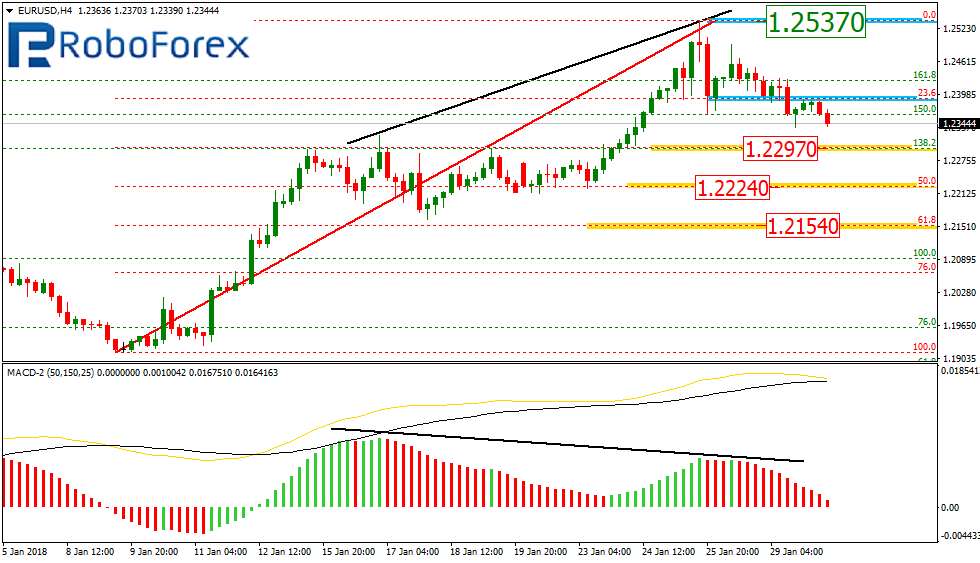
As we can see at the H4 chart, the divergence made the EUR/USD pair reverse and start a new downtrend, which has already reached the retracement of 23.6%. The next downside targets are the retracements of 38.2%, 50.0%, and 61.8% at 1.2297, 1.2224, and 1.2154 respectively. The main resistance level is at 1.2537.

EURUSD1

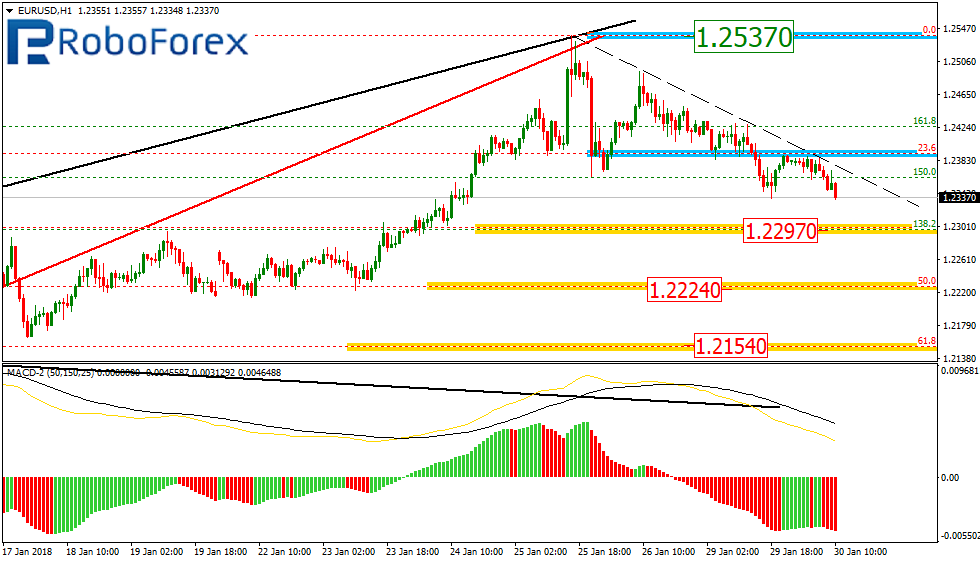
At the H1 chart, the pair is being corrected downwards.

EURUSD2


USD JPY, “US Dollar vs. Japanese Yen”

At the H4 chart, the downtrend continues. After finishing a short-term correction, the pair is moving towards the post-correctional extension area between the retracements of 138.2% and 161.8% at 108.03 and 107.72 respectively. The main target is the low at 107.32. However, we can see the convergence being formed, which may indicate a possible reverse after the instrument reaches its targets.

USDJPY1

At the H1 chart, the situation is similar and confirms the scenario described above.

USDJPY2


RoboForex Analytical Department

Article By RoboForex.com

Attention!
Forecasts presented in this section only reflect the author’s private opinion and should not be considered as guidance for trading. RoboForex LP bears no responsibility for trading results based on trading recommendations described in these analytical reviews.

Ichimoku Cloud Analysis 30.01.2018 (AUD/USD, NZD/USD, USD/CAD)

Article By RoboForex.com

AUD USD, “Australian Dollar vs US Dollar”

The AUD/USD pair is trading at 0.8066; the instrument is still moving above Ichimoku Cloud, which means that it may continue growing. We should expect the price to test Tenkan-Sen and Kijun-Sen at 0.8030 and then continue moving upwards to reach 0.8225. Another signal to confirm further ascending movement is the price’s rebounding from the support level. However, the scenario that Implies further growth may be cancelled if the price breaks the downside border of the cloud and fixes below 0.7965. In this case, the pair may continue falling towards 0.7860.

AUDUSD


NZD USD, “New Zealand Dollar vs US Dollar”

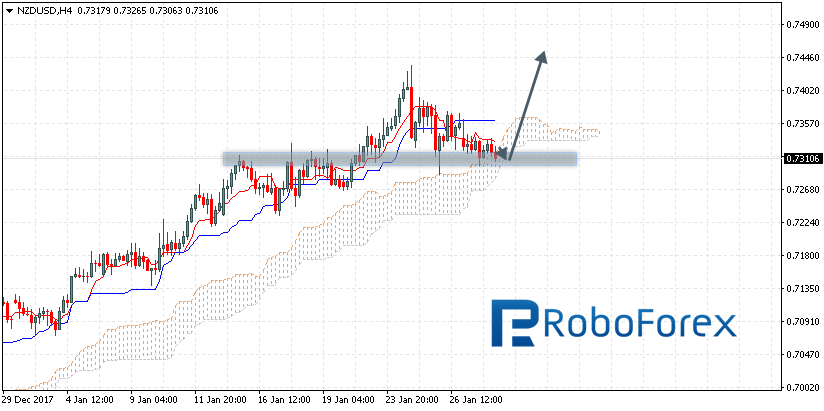
The NZD/USD pair is trading at 0.7310; the instrument is still moving inside Ichimoku Cloud, which means that it is moving sideways. We should expect the price to test the downside border of the cloud at 0.7305 and then continue moving upwards to reach 0.7445. Another signal to confirm further ascending movement is the price’s rebounding from the support level. However, the scenario that implies further growth may be cancelled if the price breaks the downside border of the cloud and fixes below 0.7260. In this case, the pair may continue falling towards 0.7155. After breaking 0.7360, the pair may resume growing.

NZDUSD


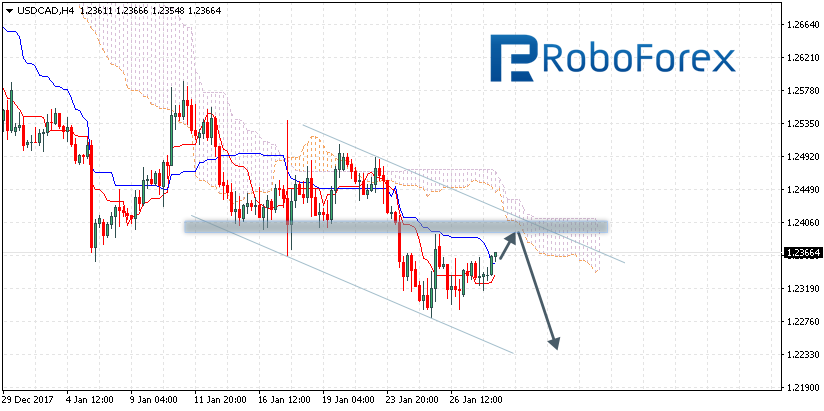
USD CAD, “US Dollar vs Canadian Dollar”

The USD/CAD pair is trading at 1.2366; the instrument is still moving below Ichimoku Cloud, which means that it may continue falling. We should expect the price to test the downside border of the cloud at 1.2385 and then continue moving downwards to reach 1.2245. Another signal to confirm further descending movement is the price’s rebounding from the resistance level. However, the scenario that implies further decline may be cancelled if the price breaks the upside border of the Triangle pattern and fixes above 1.2455. In this case, the pair may continue growing towards 1.2650.

USDCAD


RoboForex Analytical Department

Article By RoboForex.com

Attention!
Forecasts presented in this section only reflect the author’s private opinion and should not be considered as guidance for trading. RoboForex LP bears no responsibility for trading results based on trading recommendations described in these analytical reviews.