Author Archive for InvestMacro – Page 446

EURUSD: technical factors weighing on buyers on the daily timeframe

By Gabriel Ojimadu, Alpari

Previous:

On Monday the 29th of January, trading on the euro closed down. The main driver for this decline was the rise of the US dollar as well as bond yields.

The US dollar index, which measures the dollar against a basket of major currencies, rose to 89.61, while US 10Y bond yields jumped to 2.7282%.

The euro spent the European session trading above 1.2385 before dropping to 1.2337 in the US session. This is where some technical factors from the daily timeframe came into play (two candlesticks with long wicks). By the day’s close, the euro had recovered to 1.2390.

Day’s news (GMT+3):

  • 09:30 France:  GDP (Q4).
  • 10:00 Switzerland: trade balance (Dec).
  • 11:00 Switzerland: KOF leading indicator (Jan).
  • 12:30 UK: net lending to individuals (Dec), M4 money supply (Dec), mortgage approvals (Dec).
  • 13:00 Eurozone: GDP (Q4), economic sentiment indicator (Jan), consumer confidence (Jan), industrial confidence (Jan), business climate (Jan).
  • 16:00 Germany: harmonised index of consumer prices (Jan).
  • 17:00 USA: S&P/Case-Shiller home prices indices (Nov).

Fig 1. EURUSD hourly chart. Source: TradingView

In Asia, the euro is trading slightly down. The greenback is showing mixed dynamics against the majors. The euro crosses are showing a similar picture.

I reckon that the dollar’s rise could slow down today. Trader attention will be focused on European data; the preliminary CPI data from Germany as well as GDP data from both France and he Eurozone. Today also marks the beginning of the FOMC’s two-day meeting. Markets are expecting interest rates to be maintained at 1.25% – 1.50%.

In my forecast, I expect to see the euro drop to 1.2352 followed by a jump to 1.2400 as part of an upwards correction. Sellers shouldn’t let buyers get any further than the LB line, which currently runs through 1.2408, or else buyers will turn the trend in their favour and restore the euro to 1.2450. After the dollar’s collapse last week, its potential for growth hasn’t been completely exhausted. It’s in a position to correct itself until the 1stof February.

The Lessons Learnt from Davos

By Adinah Brown

For the first time in 20 years Trump was the first US President to attend the World Economic Forum at Davos this last Thursday. Rubbing shoulders with the likes of Britain’s Theresa May and Israel’s Benjamin Netanyahu. Trump attended a full day of meetings before delivering a highly polished keynote address. Carefully following the event, these are our take away lessons of what appears to matter most to the world’s global elite.

Business has learnt how to cozy up to Trump

Despite his loud and conspicuous efforts to slam big foreign business on his campaign trail to presidency, Trump used this opportunity to encourage global companies to invest in the United States and take advantage of corporate tax cuts that he has since instituted during his term. During the forum, Trump hosted an exclusive dinner for top European business executives on Thursday night, where he supposedly reassured them that he was a partner in their business interests. Striking right at the heart of what matters most to any chief executive, Trump addressed the cash incentives of establishing partnerships in the US. Thus, it appeared that memories were short as the response from executives was overwhelmingly positive, fawning praise both on the served grilled beef tenderloin as they did on Trump’s tax cuts and policies of deregulation.

The Nastiness of Social Media

Social Media and its major protagonists of Facebook and Twitter was punched around from pillar to post. It was chastised from almost every single angle; be it failing to control extremist messages, the corruption it is causing to the lifestyles of society’s youth, putting them on an unhealthy routine of selfies and streamed updates. George Soros had the most stinging attack, blaming social media for exploiting the social fabric of our society and undermining the very viability of democracy. This was echoed around the room as Theresa May accused media moguls for assisting terrorist activity and child abusers.

Sexual Harassment: Game Over

News of Britain’s notorious President’s Club charity dinner, appeared to make its way up the slopes to the Davos summit where the sordid details spread like wild fire of executives who were invited to enjoy both the meal and the “hostesses” in attendance. Yet as the news spread, business leaders appeared to be more concerned about checking the guest list to confirm that none amongst their staff where in attendance, and then visibly blanching when it came to any details.

That’s not to say there wasn’t any authentic concern behind the gossip vine. Canada’s Justin Trudeau called for a “critical discussion” to address women’s rights and business chiefs were still listening as Nobel Peace Prize winner, Malala Yousafzai advocated for women to be supported in raising up their voices to end harassment.

Adjusting Education to the Era of AI

No less of a concern for world leaders is the fear that unemployment rates will sky rocket as AI heralds in the fourth Industrial Revolution. While business leaders sweat the thought that the workforce just won’t have the skills needed in the fast approaching technological age. The solution was loud and clear from John Goodwin, Chief of the Lego Foundation, education has to change. He reported that too many countries are still using educational practices that are dated back to our grandparents, the potential outcome of this could be disastrous with data already showing that two-thirds of children are preparing to enter occupations that are unlikely to exist anymore.

Has Davos become another European relic?

With its long and prestigious history of welcoming the world’s upper-crust to its lofty chateaus every winter, there was the growing sensation that perhaps Davos has finally outgrown itself. The theme of this year’s WEF summit was “Creating a Shared Future in a Fractured World”,  but the story on the ground only pointed towards one “fracture”, represented by the echo chamber of the global elite.

Trump’s arrival was hardly inconspicuous, overshadowing all other events even before he touched down. But the atmosphere was set even before this point. What else could you expect when creating a gathering of world leaders on a glamorous, if not exclusive, ski resort? The schedule, which included a series of keynote speeches, executive meetings and private sessions were all held amongst the world’s decision makers and shape shifters. One senior UK delegate half-jokingly admitted he had a serially bad case of FOMO- Fear of Missing Out. But the reality is, those who were kept out, were you and I, and the voices of billions.

As Davos, received one of its most pathetic downfalls of snow in decades, the thought begins to settle; is Davos just not what it used to be? Or, has Davos become another expensive European relic?

About the Author:

Adinah Brown is a professional writer who has worked in a wide range of industry settings, including corporate industry, government and non-government organizations. Within many of these positions, Adinah has provided skilled marketing and advertising services and is currently the Content Manager at Leverate.


Short-term trading idea FX GBPCHF – looking down: awaiting confirmation of a double top

By Gabriel Ojimadu, Alpari

Trading opportunities on the currency pair: last week, this cross declined by 293 pips to reach 1.3199. This resulted in a double top formation, which will be confirmed should the pair drop below 1.3132. My forecast has the price breaking out of the B-B channel downwards, followed by a further drop to 1.2856 (50.0% of the growth from 1.2220 to 1.3492).

Current situation

In my review on the EURCHF pair, I looked back at the SNB’s decision at the beginning of 2015 to abandon the cap on the EURCHF rate and lower the deposit rate to -0.75%. The pair dropped sharply by 19.6% in response to this, while the GBPCHF pair dropped by 18.8% to hit 1.2611. Since the SNB’s cap related only to the euro, the pound recovered its losses in the space of 10 months. However, after the Brexit vote, the pair dropped to hit a new low of 1.1784.

Fig 1. EURGBP monthly chart. Source: TradingView

On the monthly timeframe, the GBPCHF pair has seen a 45% correction of the downwards movement from 1.5572 to 1.1784. The price is trading within the A-A channel. December’s candlestick closed down. This month, buyers tried to break through 1.35, but were blown off course by the retreat to safe haven assets and the dollar’s decline. In the end they only managed to get as far as 1.3209. This can happen; the franc is that kind of asset. The month isn’t over yet, but the wicks on the daily timeframe over the last 2 months have created a double top formation that is worth our attention.

Fig 2. GBPCHF weekly chart. Source: TradingView

Buyers have thrice attempted to break out of the A-A channel to no avail. Trading on the pound against the franc closed down last week. The rate dropped from 1.3492 to 1.3199 (-293 pips). This has created a double top formation. This formation will receive confirmation once the rate drops below 1.3132. My forecast has the pair exiting the B-B channel with a subsequent drop to 1.2856 (50.0% of the growth from 1.2220 to 1.3492).

Short-term trading idea FX EURCHF – looking down: correction to the 38.2% Fibonacci level at 1.1372

By Gabriel Ojimadu, Alpari

Trading opportunities on the currency pair: since the euro’s collapse in 2015, it’s been trading within the boundaries of the 3-year B-B channel. Considering that the upwards impulse is running out of steam, my forecast is projecting an exit from the C-C channel and a decline to 1.1372. I’m expecting a downwards correction amounting to 38.2% of the upwards movement from 1.0625 to 1.1833.

Current situation

I haven’t done an idea on a cross with the franc since January 2015, when the Swiss franc jumped sharply against all other currencies. On the 15th of January, 2017, the Swiss National Bank (SNB) took everyone by surprise when they declined to protect the exchange rate against the euro at 1.20 and lowered the deposit rate to -0.75%.

A lower limit was set for this cross pair in September 2011 in order to protect against deflation and to strengthen the position of Swiss exporters. For several years, the regulator intervened when necessary to keep the exchange rate above 1.20. There was no limit on the number of times the bank could intervene, which was good news for speculators, who would earn from buying euros as the rate approached 1.20.

After the SNB’s abandonment of the euro cap, the EURCHF rate dropped by 19.6% to 0.9651. 3 years later, the rate has nearly returned to 1.20, marking a 22.6% increase to 1.1833.

Fig 1. EURCHF monthly chart. Source: TradingView

I’ve included the monthly chart on this instrument so that you can see the franc’s upwards trajectory since the beginning of 2015.

The pair is trading within the 3-year upwards B-B channel, which is embedded within the 6-year A-A channel. There’s a resistance zone between levels 1.1877 and 1.2050. The annotations from the monthly chart are also present on the weekly chart below.

Fig 2. EURCHF weekly chart. Source: TradingView

Since the end of February 2017, the EURCHF pair has been in an uptrend. We can see from the chart that since August last year, this trend had slowed down. Last week, buyers encountered a resistance level at 1.2833. The exchange rate declined by 1.61% to reach 1.1601 over the course of the week.

Traders opened long positions of the franc, ignoring comments by the SNB’s chairman, Thomas Jordan, who announced that the central bank would intervene in the market if necessary. The franc, along with the yen and gold, became safe haven assets in the wake of the dollar’s collapse last week. This decline was initially triggered by the US government shutdown and intensified by US Finance Minister Mnuchin’s comments that a weak dollar was good for the US.

Taking into account the fact that the upwards trend has slowed down; I expect to the pair exit the C-C channel and drop to 1.1372. Sellers are in control for the time being. I don’t see the trend being broken, though, at least no further than the 38.2% correction of the upwards movement from 1.0625 to 1.1833. If the correction amounts to 61.8% after exiting the C-C channel, our target will drop.

Forex Technical Analysis & Forecast 29.01.2018 (EUR/USD, GBP/USD, USD/CHF, USD/JPY, AUD/USD, USD/RUB, GOLD, BRENT)

Article By RoboForex.com

EUR USD, “Euro vs US Dollar”

The EUR/USD pair is forming another descending structure; it has broken 1.2400 and may reach 1.2360. Later, in our opinion, the market may grow to test 1.2400 from below and then start another decline to reach 1.2330. An alternative scenario suggests that the price may break 1.2490 upwards and then continue growing to reach 1.2600.

EURUSD


GBP/USD GBP USD, “Great Britain Pound vs US Dollar”

The GBP/USD pair is forming the second descending impulse. We think, today the price may break 1.4067 downwards and then consolidate around it. If later the instrument breaks this range to the downside, the market may reach fall to reach the local target at 1.3846.

GBPUSD


USD CHF, “US Dollar vs Swiss Franc”

The USD/CHF pair is consolidating near the lows. Possibly, the price may form another descending structure towards 0.9282 and then grow to reach 0.9355. The market is expected to extend this descending structure towards 0.9267 and complete the downtrend. After that, the instrument may start forming a new ascending weave with the target at 0.9640.

USDCHF


USD JPY, “US Dollar vs Japanese Yen”

The USD/JPY pair is moving downwards; it has broken 108.94 and may continue falling towards 108.14. Possibly, today the price may reach this level and then start a new growth with the first target at 110.50.

USDJPY


AUD USD, “Australian Dollar vs US Dollar”

The AUD/USD pair has updated its high and right now is forming another descending impulse with the target at 0.8040. Later, in our opinion, the market may grow towards 0.8080, thus forming another consolidation range at the top of the ascending wave. According to the main scenario, the instrument may fall to reach the first target at 0.7966.

AUDUSD


USD RUB, “US Dollar vs Russian Ruble”

The USD/RUB pair has broken the descending channel. Possibly, today the price may form a new ascending impulse towards 56.56 and then start another correction to reach 56.04. After that, the instrument may resume moving upwards with the target at 57.22.

USDRUB


XAU USD, “Gold vs US Dollar”

Gold is forming the third descending impulse with the target at 1339.00. After reaching this level, the instrument may grow towards 1353.00, thus forming a new consolidation range between them. If later the price breaks this range to the downside, the market may fall to reach 1315.00; if to the upside – start another growth towards 1380.00.

GOLD


BRENT

Brent is trading to rebound from 70.55 downwards. Possibly, the price may fall towards 69.70, break it, and then continue the correction to reach 68.50.

BRENT


RoboForex Analytical Department

Article By RoboForex.com

Attention!
Forecasts presented in this section only reflect the author’s private opinion and should not be considered as guidance for trading. RoboForex LP bears no responsibility for trading results based on trading recommendations described in these analytical reviews.

Japanese Candlesticks Analysis 29.01.2018 (GOLD, NZD/USD)

Article By RoboForex.com

XAU USD, “Gold vs US Dollar”

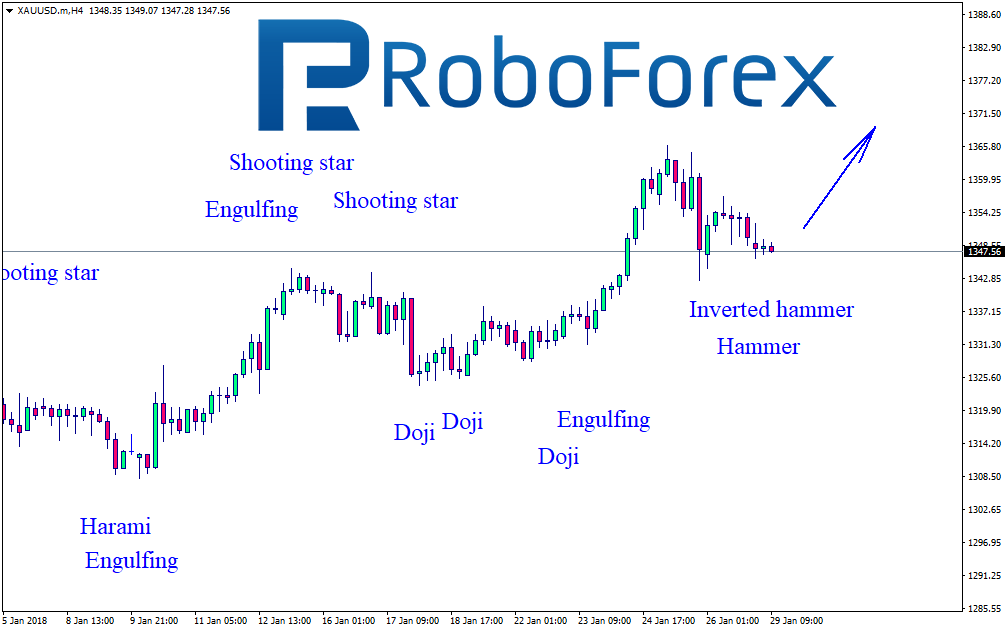
As we can see at the H4 chart, the XAU/USD pair has completed another correction by forming Hammer and Inverted Hammer reversal patterns. In this light, we may assume that the instrument may resume growing and update the closest highs.

GOLD


NZD USD, “New Zealand vs. US Dollar”

As we can see at the H4 chart, the current correction is lasting way too long. By now, the NZD/USD pair has formed Hammer and Inverted Hammer patterns at the support level. Judging by the current uptrend, we may assume that the ascending tendency may continue.

NZDUSD


RoboForex Analytical Department

Article By RoboForex.com

Attention!
Forecasts presented in this section only reflect the author’s private opinion and should not be considered as guidance for trading. RoboForex LP bears no responsibility for trading results based on trading recommendations described in these analytical reviews.

EURUSD: consolidation within Thursday’s range (25th Jan)

By Gabriel Ojimadu, Alpari

Previous:

On Friday the 26th of January, trading on the euro closed up. The euro rose against the dollar during the Asian session before erasing all it gains in the US. The dollar rose across the board, ignoring the weak US GDP data for the 4th quarter.

GDP figures came out lower than the estimates and the reading for the previous quarter was revised downwards, which is a negative for the dollar.

These negatives were cancelled out by the index for durable goods orders, which came out much better than expected, as well as the rise in US 10Y bond yields. The pair dropped from a high of 1.2494 to 1.2406 (-88 pips).

US data:

  • GDP index – +2.6% YoY (forecast: 3.0%, previous reading revised from 3.2% to 2.6%).
  • Durable goods orders (Dec) – 2.9% (forecast: 0.8%, previous reading revised from 1.3% to 1.7%).

Day’s news (GMT+3):

  • 10:00 UK: Nationwide housing price index (Jan).
  • 13:00 Eurozone: ECB’s Praet speech.
  • 13:45 Eurozone: ECB’s Lautenschläger Speech.
  • 16:30 USA: core personal consumption expenditure – price index (Dec), personal income (Dec).
  • 19:00 Eurozone: ECB’s Cœuré Speech.

Fig 1. EURUSD hourly chart. Source: TradingView

My predictions for Friday came off in full. At the time of writing this review, the euro is trading at 1.2411. Buyers were met with resistance around the 1.24 region, through which the upper line of the recently broken B-B channel runs.

The daily candlestick has a bullish body and a long wick. This is the second candlestick with a long shadow that we’ve seen in recent times. These suggest a strong resistance around 1.25, so we’ll most likely see a correction on the euro ahead of Friday’s payrolls.

Trader attention this week will turn towards the upcoming FOMC meeting and Friday’s payrolls report for January.

Metals and US Dollar set to Rollover

By www.TheTechnicalTraders.com 

We’ve been warning our members that this move was going to happen and it looks like it is just starting to initiate.  The US Dollar and Metals markets are about to rotate in dramatic form over the next few weeks – possibly months.  Right now, what we can tell you is that our cycle analysis and adaptive learning models are showing we are in for a very dramatic move in these markets.

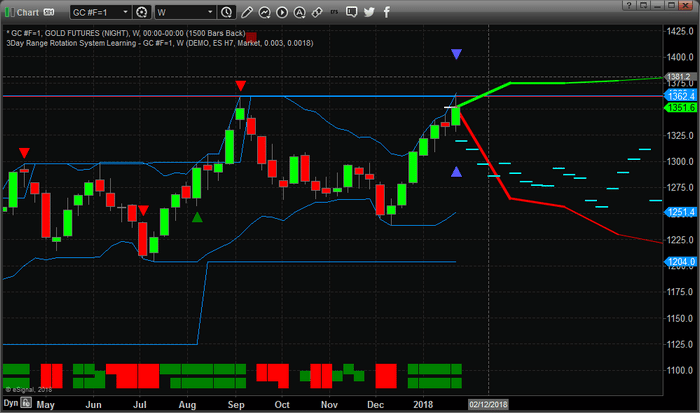
This first chart is a GOLD Weekly chart showing our adaptive learning price modeling system and the predicted price activity going forward.  One can easily see this weekly double top formation is predicting prices to drop by nearly 5~8% over the next few weeks before basing near the $1250 to $1275 levels.  This should be a very clear warning to metals investors that Gold and Silver are setting up for a lower price rotation before the next big move higher.


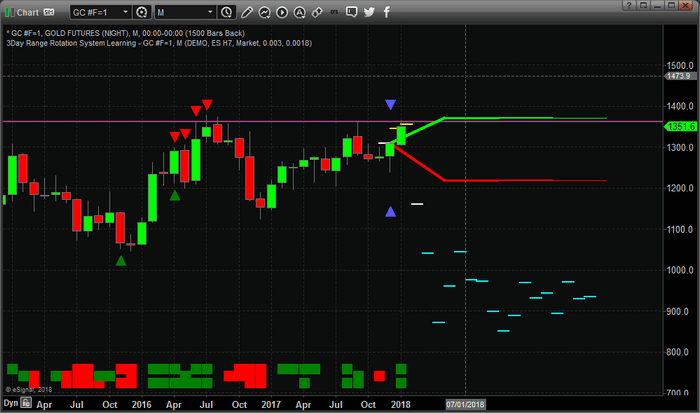
This next chart is a GOLD Monthly chart and one can easily see the adaptive learning modeling system is predicting massively lower prices over the next few months.  We would caution our reader that these dramatically lower prices (toward and below $1000) would be an incredible downward move in the metals.  It would also indicate that the US and global economies continue to “melt-up” extensively over the next few months. We believe the downside rotation is accurate, yet we don’t believe prices will fall below $1000 within 2~3 months in Gold.  Although, one can never accurately predict the future with any degree of certainty.


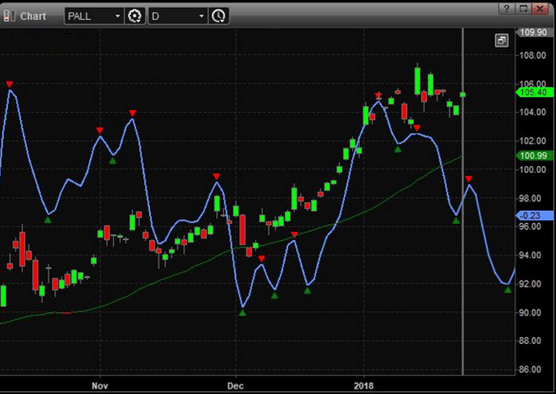
This next chart of a Daily Palladium chart showing our cycle analysis.  Once can clearly see the relationship between the cycle levels and price activity.  Currently, the cycles are showing use that price is weakening and that a lower price cycle is setting up to drive prices back to near of below $100.  All of the metals markets are setting up like this currently and Silver is the only metal that shows the potential for a muted downside price swing.


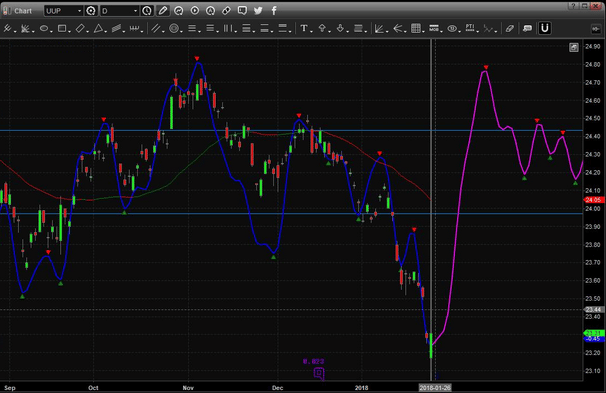
This last chart of a Daily US Dollar cycle analysis chart showing what we believe will be a primary driver of the rotation in the metals markets – the predicted US Dollar price advance.  Take a look at this chart and see the aggressive cycle levels that are expected to happen in the immediate future?  This type of advancement is usually associated with a fairly dramatic upward price move.  We expect this move to mature over the next 2~3 weeks culminating in a general market top formation for the US majors near March 15~19, 2018 – as our earlier research has shown.


You don’t want to miss this move, folks.  Visit www.TheTechnicalTraders.com to learn how we can assist you in finding great trades and profiting from these future moves.  Please take a few minutes to read some of our research reports from the beginning of 2018 to see how well we’ve been calling these market moves weeks in advance.  If you are a GoldBug or you want to find new opportunities in the markets, visit www.TheTechnicalTraders.com to learn how we help you achieve success.

Our articles, Technical Trading Mastery book, and 3 Hour Trading Video Course are designed for both traders and investors to explore the tools and techniques that discretionary and algorithmic traders need to profit in today’s competitive markets. Created with the serious trader and investor in mind – whether beginner or professional – our approach will put you on the path to win. Understanding market structure, trend identification, cycle analysis, volatility, volume, when and when to trade, position management, and how to put it all together so that you have a winning edge.

By www.TheTechnicalTraders.com 

The best time to start your trading career

Modern time is now advancing at a great speed. If you look at the 80s and you look at now, you will find a lot of difference between these two times. There were Forex markets that were open for trading by the people. Only the biggest banks and the wealthy people had that privilege and now look at where the Forex market has come. The market is now online and anybody can trade the market with a small money and with an internet connection form their home. People no longer need to go outside for placing their trades and Forex market is also replacing stock markets in many counties. There were a lot of stock traders in tougher countries at one time but now people are interested in Forex trading. They know if they can trade this market right, they have a chance to make a lot of money. Many people do not understand and they only try to make their profit by working on offices. Time is now changing and people are now considering to build a career in Forex. Even the retired peoples are also investing their money in Forex. People want to know when the best time of life of building a career in Forex is and we believe this article will help you in finding your answer.

If you want to lead your life based on a trading profession, you need to start trading as early as possible. Age should be a factor for you to consider trading as your alternative source of income. You need to read a lot about the dynamic nature of this market so that you get a clear overview how risky this industry is. Taking a big risk for the senior citizen it little bit complicated since they have lots of responsibility on their shoulder. For this very reason, many expert traders often say that youth time is the best time to start learning the art of trading. You are extremely energetic at that your time and you can easily overcome lots challenges.

You need to understand the complex structure of the Forex market to become successful in the financial industry. If you don’t learn the technical part with a high level of precision, you will not be able to find quality trade setup in your online trading platform. Knowledge is power in the investment world. You have to focus on your education so that you can easily decipher the price movement. The more you will learn the better you will become at trading. Always consider this market as a probability factor and try to trade with high-risk reward ratio.

Youth is the best time for building career

It is undoubtedly that youth is the best time to do anything. If you ask anybody who is old what they miss in their lives, they will answer that they miss their youth time of their lives. It is the best colorful time of anybody’s lives and also the most productive time. You may not do something when you get old but when you are young, you can take anything and try to make it done. This is the courage that only young people have and it is also the time when you can do many works at once. Many people do their office in the daytime and trade Forex in their spare time. If you are you g and thinking to build your career in Forex, try from now. You will have a plenty of time and you will also not feel tired in your trading. Even after your office work, you will still find the courage within you that will tell you to trade. You can start trading the market part-time to develop your knowledge of the market. As you grow older and over time you can trade the market full time when you have started making profit consistently.

By Taylor Wilman


Dovish Bank of Japan Fails to Weigh on Yen

Despite dovish commentary from the Bank of Japan, the USD/JPY continues to form a bear flag pattern in the wake of their monetary policy decision on Tuesday. The bank kept rates unchanged and committed to monetary easing including their quantitative easing program. The program will last until the Central Bank’s inflation target of 2% is reached.  Despite dovish statements, the yen continued to rise against the dollar and could move lower on a break of support.

The Bank of Japan’s Interest Rate Decision

The Bank of Japan kept interest rates unchanged. In their post meeting comments, the BoJ’s Kuroda sounded dovish at the Bank’s press conference. He said that the central bank will remain strongly committed to monetary easing, including QQE, until the 2% inflation target has been reached (which doesn’t seem to be the case). He said that the BoJ remains committed to yield curve control and downplaying the January-9 announcement of a trimming in long-dated JGB purchases. He also said that day-to-day operations are not an indication of future monetary policy.

Governor Haruhiko Kuroda delivered a message to investors speculating that the Bank of Japan might be nearing the start of policy normalization. The BOJ’s board voted 8-1 to keep its interest rates and asset purchases at current levels. In a small sign of progress, it said that inflation expectations remained unchanged. The central bank forecasts the economy to grow 1.4% in the fiscal year starting in April with inflation of 1.4% over the same period.

Looking Forward

The Japanese December trade report which is scheduled for Wednesday should reveal a widening of the surplus. December national CPI which is scheduled for Friday should show the overall index rising to a 1.0% year over year pace from its previous pace of 0.6% with core reading at 1.0% year-over-year, from 0.9%. Tokyo January CPI is expected to be unchanged at 1.0% year-over-year overall and steady at 0.8% year-over-year on a core basis. December services PPI will likely be unchanged at 0.8% year-over-year.

U.S. production sentiment could remain positive which may buoy the dollar.

Production sentiment could be poised for continued strength in January despite headline declines in the early month measures. The boosts that sentiment has received from post-hurricane rebuilding and tax cuts, could persist through the early months of 2018.

Producer sentiment has mostly remained firm in January despite headline declines in the Empire State and Philly Fed. The Empire State headline slipped to 17.7 from 19.6 with the ISM-adjusted falling to 54.6 from 56.4. The Philly Fed fell to 22.2 from 27.9 in December, and the ISM-adjusted eased to 57.3 from 57.8 in December. Despite these minor slips ISM-adjusted average of all measures is positioned to hold at the 58 cycle-high for a fourth consecutive month.

The forex trading on the USD/JPY remains negative as the dollar has failed to gain traction.  Prices are forming a topping pattern with resistance seen near the 10-day moving average at 110.90.  Support is seen near the January lows at 110.13, and a break of this level would lead to a test of the September lows at 107.29.

By Taylor Wilman