Author Archive for InvestMacro – Page 441

America’s New Steel and Aluminum Protectionism

By Dan Steinbock

Now that the White House seeks to turn China’s steel and aluminum overcapacity into a national security matter, America’s new protectionism risks international trade discord.

Following a trade investigation of imports, U.S. Department of Commerce recently recommended imposing heavy tariffs or quotas on foreign producers of steel and aluminum in the interest of national security. Armed with steel and aluminum reports, Commerce Secretary Wilbur Ross stated that steel is vital to U.S. national security and current import flows are adversely impacting the steel industry.

Ross urged President Trump to take immediate action by adjusting the level of imports through quotas or tariffs. Trump is likely to invoke the Section 232 of the 1962 Trade Act, which allows the president to impose tariffs without congressional approval. He must respond to the reports by April 11 and 19 for steel and aluminum, respectively.

China, the main target of the proposals (though a minor steel importer in the U.S.), contends the U.S. already has excessive protections on domestic iron and steel products and it reserves the right to retaliate.

The proposed policy instruments suggest that the Trump administration is willing to subsidize American steel and aluminum, even at the expense of far bigger and more consequential U.S. industries – and the world trade.

From Trade Expansion to Trade Contraction

While the proposed measures extend from broad adjustments that involve many countries to targeted adjustments that focus on a few countries, the rationale of the suggested figures is fuzzy and ultimately undermined by geopolitical considerations.

In steel industries, the Commerce Department recommends that the U.S. could introduce a global tariff of at least 24 percent on steel imports from all countries. Another option would be a tariff of 53 percent on all steel imports from 12 countries (none are advanced economies, except for South Korea), with a quota on steel imports from all other countries equal to 100 percent of their 2017 exports to the U.S. In the third option, a quota could be enacted on steel products from equal to 63 percent of each country’s 2017 exports to the U.S.

In aluminum, the Commerce Department recommends a 7.7 percent tariff on imports from all exporter countries. The second option is a 23.5 percent tariff on aluminum products from China, Hong Kong, Russia, Venezuela and Vietnam, with a cap for all countries at 2017 import levels. A third option would be an aluminum import quota on all countries of 86.7 percent of their 2017 imports.

Nevertheless, President Trump is given substantial geopolitical leeway. He could have specific countries exempted from the proposed quota, based on U.S. economic interests or national security. Moreover he could also take into account the countries’ willingness to cooperate with the U.S. to address global excess capacity (read: turn against China) and other challenges that face U.S. aluminum and steel industries.

The leeway permits Trump to seize unilateral geopolitical objectives to undermine any semblance of multilateral economic cooperation and to deploy the imperial “divide and rule” principle to play targeted countries against each other.

Ironically, President Kennedy used the Trade Expansion Act of1962 to negotiate tariff reductions of up to 80 percent, which paved the way for the Kennedy Round of General Agreement on Tariffs and Trade (“GATT”) negotiations that ended in 1967 and eventually led to the World Trade Organization (WTO) in 1995. In contrast, President Trump is exploiting the seldom-used Section 232 of the Act to increase trade barriers, in order to undermine or reverse 50 years of trade progress in just a few years.

In effect, Trump is trying to use the Trade Expansion Act for trade contraction.

Broadening the scope of new protectionism

In his campaign, Trump targeted those economies with which America has the largest aggregate trade deficit. In order to legitimize a trade offense, which has a highly questionable legal basis, he is starting by focusing on steel, but is expanding to aluminum. The ultimate objective is to target America’s deficit partners, however. The proposed measures are just means to that final goal.

In 2017, U.S. imports increased 34 percent to $22 billion. The U.S. is the world’s largest steel importer. The top 10 source countries for steel imports represent 78 percent of the total steel import volume. Canada accounts for the largest share (16%) followed by Brazil, South Korea, Mexico and Russia (Figure a). Although China has a key role in the proposed tariffs and quotas, it is not even among the top-steel importers in the U.S. If the White House would target its tariffs and quotas proportionately, it should hit hardest its North American Free Trade (NAFTA) allies and trade partners in Asia, which together account for a half of all steel imports.

FIGURE U.S. Trade Deficits, Steel and Aluminum Imports

a. US Steel Imports: Major Source Countries (%, Jan-Sep 2017)

Sources: International Trade Center; World Steel Association; International Trade Administration   

In 2017, U.S. aluminum imports increased some 31 percent to $13.9 billion, while U.S. production of primary aluminum decreased for the fourth consecutive year to the lowest level since 1951. Like in steel, Canada is the leading source of aluminum imports into the U.S., accounting for more than two-fifths of total imports by both value and weight in 2016. Imports from China amounted to only half of that, a slight decline from 2015 levels, while the Commerce Department argues imports from China were significantly up (Figure b).

b. US Aluminum Imports: Major Source Countries (%, Jan-Oct 2017)

What are the economic realities of the U.S. trade deficits? In 2017, America incurred a $863 billion trade deficit (up 8.1% from 2016). The highest deficit was with China ($396 billion), followed by Mexico ($74 billion) and Japan ($72 billion). These are the countries that Trump is really after (Figure c). In order to achieve that objective, the White House seems to be willing to risk its economic and strategic cooperation with China, undermine ties with its NAFTA partners, alienate its European North American Treaty Organization (NATO) allies and undercut alliances with the rest of its trade and security partners in Asia.

c. US Trade Deficits: Major Source Countries (%, 2017)

The record to date is distressing. Recently, the Trump administration announced tariffs on imported solar cells and modules, which protects a small number of U.S.-based solar manufacturers (including one Chinese-owned firm), while destroying some 23,000 American solar workers’ jobs. China has already retaliated. Moreover, South Korea is considering filing a complaint with the World Trade Organization if the U.S. levies heavy duties on steel.

In turn, Trump is likely to resort to Section 301 of the Trade Act of 1974 to unilaterally seek remedies for unfair Chinese trade practices, which will risk Chinese retaliation and a tit-for-tat trade war, just as the Tariff Act of 1930 did with dark consequences. Such moves risk undermining not just international trade but the very institutions -trade-dispute resolution mechanisms – that support it.

Time to apply the right lessons

Amid the world trade collapse in 2008, Jagdish Bhagwati published his Termites in the Trading System, which demonstrated how preferential agreements undermine free trade. Since the end of the Cold War, both Republican and Democratic leaders have moved toward such pacts. Until 2016, those moves were gradual and occurred with one pact at a time, however. In the Trump era, the shift is disruptive and multilateral. Today, the international trading system is not threatened by little termites nibbling away walls, but a huge stealth termite – new protectionism – munching away the very foundations of world trade.

Steel and aluminum overcapacity crises are multilateral and have global repercussions, not bilateral as the U.S. measures imply. China’s rise has not come at the expense of the U.S. After the Cold War, the U.S. economy accounted for a fourth of global GDP. Today, the corresponding figure is about the same. Moreover, research indicates that U.S. job losses are the net effect of technology and automation, not just of offshoring to China, India and emerging economies.

Second, since China continues to support world trade and investment, its role is vital in global growth prospects. And as s industrialization will intensify in India and other emerging economies, so will their need for steel, aluminum and other commodities. Rapid economic development that supports global growth prospects should not be penalized.

Third, through the Silk Road initiatives (OBOR), Chinese overcapacity can serve industrialization in emerging economies that participate in these initiatives, which also offer opportunities to advanced economies.

Finally, any sustained success in overcoming the global steel and aluminum friction must be based on multilateral cooperation with all major producers that will seek to reduce overcapacity in the largest producers but will also ensure emerging economies’ opportunities for rapid economic development in the future.

About the Author:

Dr. Dan Steinbock is an internationally recognized strategist of the multipolar world and the founder of Difference Group. He has served as research director at the India, China and America Institute (USA) and visiting fellow at the Shanghai Institutes for International Studies (China) and the EU Center (Singapore). For more, see https://www.differencegroup.net/

The commentary was released by China-US Focus on February 27, 2018


Forex Technical Analysis & Forecast 01.03.2018 (EURUSD, GBPUSD, USDCHF, USDJPY, AUDUSD, USDRUB, GOLD, BRENT)

Article By RoboForex.com

EURUSD, “Euro vs US Dollar”

EURUSD has reached 1.2200. Possibly, today the price may start another consolidation range. After breaking the range downwards, the instrument may continue falling inside the downtrend with the short-term predicted target at 1.1860.

EURUSDRisk Warning: the results of previous trading operations do not guarantee the same results in the future.

GBPUSD, “Great Britain Pound vs US Dollar”

GBPUSD has reached 1.3760. Today, the price may form another consolidation channel. Later, the market may break it downwards and then continue trading to the downside with the short-term predicted target at 1.3375.

GBPUSDRisk Warning: the results of previous trading operations do not guarantee the same results in the future.

USDCHF, “US Dollar vs Swiss Franc”

USDCHF is trading to break 0.9440 upwards. Possibly, today the price may continue growing towards short‑term predicted target at 0.9550.

USDCHFRisk Warning: the results of previous trading operations do not guarantee the same results in the future.

USDJPY, “US Dollar vs Japanese Yen”

USDJPY is still consolidating. If later the instrument breaks this range to the upside, the market may start another correction to reach 110.40. if to the downside – continue falling inside the downtrend with the target at 103.30.

USDJPYRisk Warning: the results of previous trading operations do not guarantee the same results in the future.

AUDUSD, “Australian Dollar vs US Dollar”

AUDUSD is still forming the third descending wave with the short-term predicted target at 0.7663.

AUDUSDRisk Warning: the results of previous trading operations do not guarantee the same results in the future.

USDRUB, “US Dollar vs Russian Ruble”

USDRUB has returned to 56.17. Today, the price may continue falling to reach 55.50. According to an alternative scenario, the instrument may form another ascending structure towards 56.84.

USDRUBRisk Warning: the results of previous trading operations do not guarantee the same results in the future.

XAUUSD, “Gold vs US Dollar”

Gold is falling inside the downtrend with the target at 1307.00. After that, the instrument may form another consolidation range, break it downwards, and then continue trading to the downside with the target at 1250.00.

GOLDRisk Warning: the results of previous trading operations do not guarantee the same results in the future.

BRENT

Brent has finished the descending correctional structure. Possibly, the price may start another growth towards 66.60. The instrument is expected to start a new wave with the target at 70.60.

BRENTRisk Warning: the results of previous trading operations do not guarantee the same results in the future.


RoboForex Analytical Department

Article By RoboForex.com

Attention!
Forecasts presented in this section only reflect the author’s private opinion and should not be considered as guidance for trading. RoboForex LP bears no responsibility for trading results based on trading recommendations described in these analytical reviews.

Murrey Math Lines 01.03.2018 (USDCHF, GOLD)

Article By RoboForex.com

USDCHF, “US Dollar vs Swiss Franc”

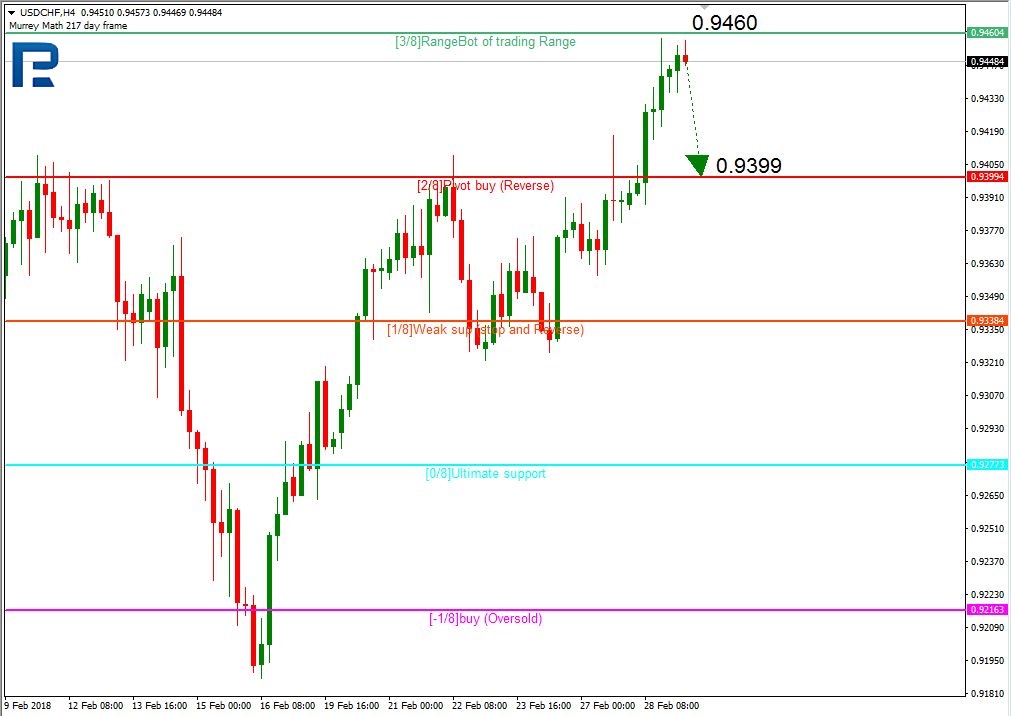
In the H4 chart, USDCHF is expected to rebound from the 3/8 level and then resume falling towards the 2/8 one.

USDCHF1
Risk Warning: the results of previous trading operations do not guarantee the same results in the future.

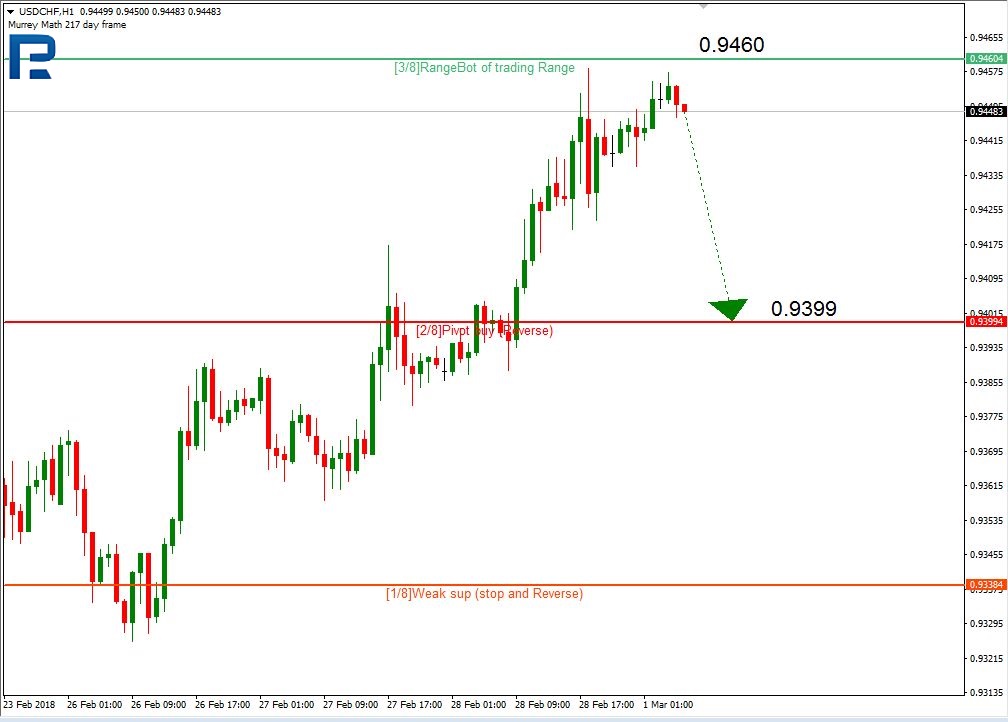
The lines in the H4 and H1 charts are completely the same and confirm the scenario described above.

USDCHF2Risk Warning: the results of previous trading operations do not guarantee the same results in the future.

XAUUSD, “Gold vs US Dollar”

In the H4 chart, XAUUSD is expected to test the support at the 0/8 level, rebound from it, and then resume growing towards the 2/8 one.

GOLD1
Risk Warning: the results of previous trading operations do not guarantee the same results in the future.

The lines in the H4 and H1 charts are completely the same and confirm the scenario described above.

GOLD2
Risk Warning: the results of previous trading operations do not guarantee the same results in the future.

As we can see in the M15 chart, the pair may break the upside line of the VoltyChannel indicator and, as a result, continue moving upwards to reach 1328.13.

GOLD3Risk Warning: the results of previous trading operations do not guarantee the same results in the future.


RoboForex Analytical Department

Article By RoboForex.com

Attention!
Forecasts presented in this section only reflect the author’s private opinion and should not be considered as guidance for trading. RoboForex LP bears no responsibility for trading results based on trading recommendations described in these analytical reviews.

EURUSD: single currency still under pressure

By Gabriel Ojimadu, Alpari

On Wednesday the 28th of February, trading on the euro closed down. Including during today’s Asian session, the single currency has dropped to 1.2184. As the dollar was rising across board, the euro’s drop could have been more intense. It was saved by the euro/pound cross, which posted a 1% gain to reach 0.8869.

The pound came under pressure after a draft proposal on Britain’s withdrawal from the EU was published. The document has revealed deep rifts between the two sides and shows how far they are from reaching a final agreement. This could lead to even tougher terms of exit.

Aside from the dollar’s gains on all fronts, the euro also came under pressure from reduced Eurozone inflation as well as the upcoming parliamentary elections in Italy, which will be held on Sunday.

US data:

  • Pending home sales (Jan): -4.7% (forecast: +0.4%, previous reading revised from 0.5% to 0.0%).
  • Chicago PMI (Feb): 61.9 (forecast: 64.2, previous: 56.7).
  • GDP (Q4): +2.5% (forecast: +2.5%, prelim reading: +2.6%).

Day’s news (GMT+3):

  • 09:45 Switzerland: GDP (Q4).
  • 11:15 Switzerland: retail sales (Jan).
  • 11:50 France: Markit manufacturing PMI (Feb).
  • 11:55 Germany: Markit manufacturing PMI (Feb).
  • 12:00 Eurozone: Markit manufacturing PMI (Feb).
  • 12:30 UK: Markit manufacturing PMI (Feb), net lending to individuals (Jan), mortgage approvals (Jan), consumer credit (Jan).
  • 13:00 Eurozone: unemployment rate (Jan).
  • 16:30 Canada: current account (Q4), Markit manufacturing PMI (Feb).
  • 16:30 USA: personal consumption expenditure – price index (Jan), personal income (Jan), personal spending (Jan), initial jobless claims (23 Feb).
  • 17:45 USA: Markit manufacturing PMI (Feb).
  • 18:00 ISM manufacturing PMI (Feb), construction spending (Jan), Fed’s Powell speech.
  • 19:00 USA: Fed’s Dudley speech.

Fig 1. EURUSD hourly chart. Source: TradingView

I correctly predicted that the euro would retreat to the 135th degree yesterday. It missed my target of 1.2181 by 3 pips. Today, I think the rate will drop significantly lower than this.

At the moment, the euro crosses are providing support to buyers in Asia. The EURGBP pair is on the verge of a drop. The downwards correction has brought it to 0.8823. I think it highly unlikely that buyers will manage to hold onto 0.8870. Also, considering that the dollar is trading up against the majors in Asia, a drop on the cross would push the EURUSD pair down to the 157th degree at 1.2154.

Today will be full of news, so price fluctuations could vary from my forecast. Jerome Powell’s speech is scheduled for 18:00 (GMT+3).

Admiral Markets Warns Against Rogue Website

By Admiral Markets

Admiral Markets has recently announced that a rogue website, with a similar domain name, has begun operating at the following address: “admiral-crypto.com”. The website appears to have content in both French and English languages and claims to offer cryptocurrency trading services. It also claims to be an entity of Admiral Markets UK Ltd. and states that it is subject to UK regulatory supervision.

This website is, in no way, associated with Admiral Markets UK Ltd., nor does Admiral Markets UK Ltd. have any responsibility for business conducted through it. This is a scam and should be avoided at all costs.

“Spam emails used to be the trendy bad habit. Now, even web pages are getting scammed”, says Jens Chrzanowski, Member of the Admiral Markets AS Group Management Board. “If you ever see a web page that you think is suspicious, please double check that it’s authentic!” he continued.

As you know, Admiral Markets UK Ltd. is fully regulated by the Financial Conduct Authority (FCA Register No. 595450) and follows all requirements and laws regulating the industry. Any other unauthorised persons, companies or websites using the Admiral Markets brand for fraudulent activities, not only break the applicable laws, but also do not comply with the basic rules of investor protection, information disclosure, claims handling and other regulatory obligations.

Admiral Markets strongly recommends to remain vigilant against such fraudulent websites and contact their customer support team for further questions.

Risk disclosure: Forex and CFD’s carry a high level of risk and losses may exceed your initial deposit. Admiral Markets UK Ltd. recommends you seek advice from an independent financial advisor to ensure that you understand the risks involved with Forex, CFD’s, Margin and Leveraged trading.


Fibonacci Retracements Analysis 27.02.2018 (EURUSD, USDJPY)

Article By RoboForex.com

EURUSD, “Euro vs US Dollar”

As we can see in the H4 chart, the divergence made EURUSD start a new correction, which has almost reached the retracement of 38.2%. This descending correction may yet continue towards the retracements of 38.2%, 50.0%, and 61.8% at 1.2232, 1.2134, and 1.2036 respectively. After completing the correction, the price may start a new ascending impulse to break the high at 1.2555. In this case, later the instrument may continue growing towards the post-correctional extension area between the retracements of 138.2% and 161.8% at 1.2666 and 1.2736 respectively.

EURUSD1
Risk Warning: the results of previous trading operations do not guarantee the same results in the future.

In the H1 chart, after the convergence, the pair started a new local correction; it has already reached the retracement of 38.2% at 1.2371. The next target of the correction may be the retracements of 50.0%, 61.8%, and 76.0% at 1.2406, 1.2441, and 1.2483 respectively, and then the high at 1.2555.

EURUSD2Risk Warning: the results of previous trading operations do not guarantee the same results in the future.

USDJPY, “US Dollar vs. Japanese Yen”

As we can see in the H4 chart, USDJPY is being corrected upwards and has almost reached the retracement of 50.0%. The next upside targets mat be the retracements of 61.8% and 76.0% at 108.58 and 109.30 respectively. The main support level is the low at 105.54.

USDJPY1
Risk Warning: the results of previous trading operations do not guarantee the same results in the future.

In the H1 chart, the convergence made the pair start a new ascending impulse, which has already reached the retracement of 50.0%. The next targets of this impulse may be the retracements of 61.8% and 76.0% at 107.31 and 107.53 respectively. After breaking the high at 107.90, the instrument may continue growing towards the post-correctional extension area between the retracements of 138.2% and 161.8% at 108.49 and 108.85 respectively.

USDJPY2Risk Warning: the results of previous trading operations do not guarantee the same results in the future.


RoboForex Analytical Department

Article By RoboForex.com

Attention!
Forecasts presented in this section only reflect the author’s private opinion and should not be considered as guidance for trading. RoboForex LP bears no responsibility for trading results based on trading recommendations described in these analytical reviews.

Japanese Candlesticks Analysis 27.02.2018 (GOLD, NZDUSD)

Article By RoboForex.com

XAUUSD, “Gold vs US Dollar”

As we can see in the H4 chart, XAUUSD is trading upwards. By now, it has formed Hammer, Doji, and Inverted Hammer reversal patterns close to the support level. These patterns indicate that the instrument may rebound from the level and then resume moving to the upside and reach new highs.

GOLDRisk Warning: the results of previous trading operations do not guarantee the same results in the future.

NZDUSD, “New Zealand vs. US Dollar”

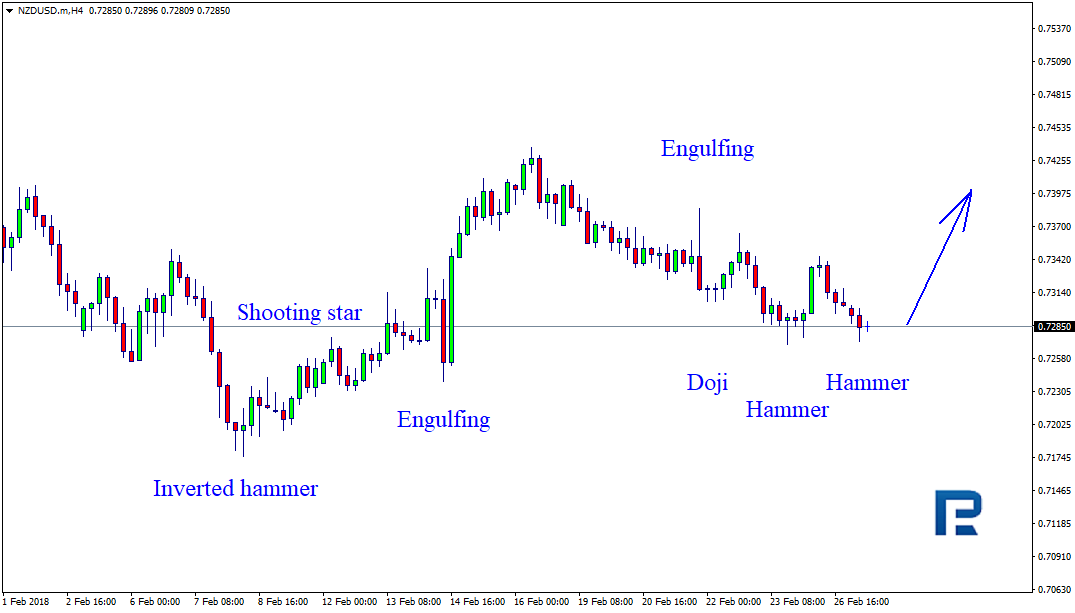
As we can see in the H4 chart, NZDUSD has stopped at the support level and formed Doji, Hammer, and Inverted Hammer patterns there. These patterns may indicate that the instrument may start a new growth to update its closest highs.

NZDUSDRisk Warning: the results of previous trading operations do not guarantee the same results in the future.


RoboForex Analytical Department

Article By RoboForex.com

Attention!
Forecasts presented in this section only reflect the author’s private opinion and should not be considered as guidance for trading. RoboForex LP bears no responsibility for trading results based on trading recommendations described in these analytical reviews.

Gold Setting Up For a Massive Upside Rally

By www.TheTechnicalTraders.com

Over the past few months, our research team has nailed many of the recent moves in the Metals market thanks to our advanced price modeling systems and detailed research.  Recently, we’ve been watching a setup play out in Gold that has excited us.  The potential for a massive upside rally that should originate as early as March 19 (only a few weeks away).  The reason this is so exciting is that a breakout move in the gold market would indicate a global rush into a protective market because of fears originating from other market sectors.

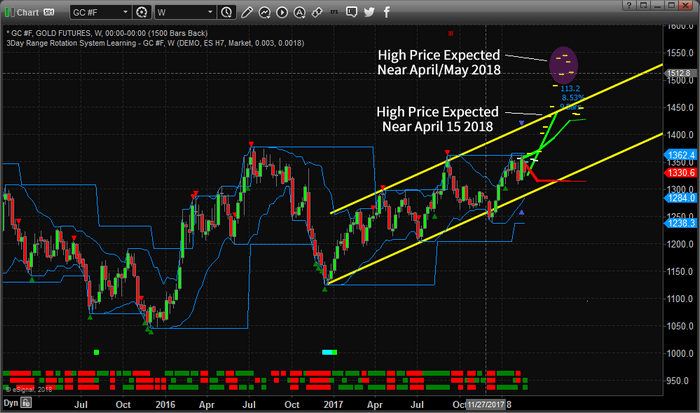
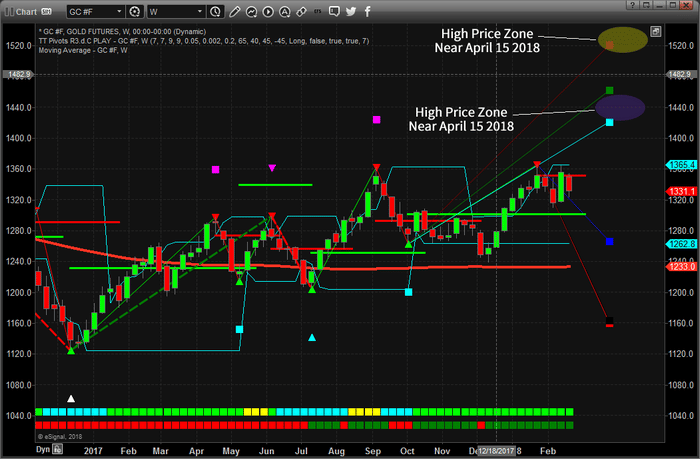
This first chart is a Weekly Gold chart highlighting our Adaptive Dynamic Learning (ADL) price modeling system.  This price modeling system is capable of identifying and mapping historical price and technical patterns as well as ranking and evaluating future price moves – showing only the highest probable outcomes.  This analysis is designed to teach us exactly what price should be doing based on a current price pattern.  Please notice the two highlighted areas, a high price level near April 15 (near $1450) and a high price level near the end of April or early May (near $1550).  Both of these moves represent massive upside legs in Gold.  The first being nearly 8.5% and the second being nearly 18% advancements.


This second chart illustrates our Adaptive Fibonacci price modeling system on a Gold Weekly chart.  This price modeling system tracks price rotation and uses a unique form of AI to apply Fibonacci price rotation price models showing us where price rotation is happening and what to expect in future moves.  Please note the similarities in the projected future price levels in addition to the moderately tight price flag that is setting up on the right side of this chart.  With higher lows and a multiple top formations near $1365, this new analysis plays perfectly with our most recent analysis.


Over the past few weeks, we alerted our members to a breakdown in price which we traded DUST inverse gold miners ETF, followed by a recent price basing/bottoming zone and breakout. We have been warning our members that the US major markets would experience weakness over from February 20 till about March 2 where a new price rally/breakout would begin. We’ve recently called a basing level in the NQ near $6500 that should happen within the next few days where support should be found before a price rally/breakout happens to create a peak near March 15. Everything we have been warning our clients about has played out almost perfectly.

Now, our price modeling systems are warning of a metals market breakout/rally originating near March 26th.  Why is this so important to us and why do we believe this could be an ominous signal?  The answer is simple, for the metals markets to experience this type of breakout move, some global concern must be driving a fear component and driving global investment into the metals market in a protectionist move.  So, we are expecting some market event to play out near the middle of March 2018 that generates a bit of fear, resulting is a massive increase in the price of Gold and Silver.  This move appears to peak near May 21~28, 2018 before weakening a bit.

We can’t stress enough that you should not worry about the overall market implications of a crisis event at this time. Our analysis of the US majors shows that the remainder of this year should continue to be relatively positive in price activity with overall higher than average price volatility after the recent surge in volatility. In other words, this crisis event appears to be an external event – not a US event.

If you want to know how you can profit from these types of move and how our research team can assist you, visit www.TheTechnicalTraders.com to learn more.


Stock Market Cycles and Price Forecasts

By The Technical Traders

GET THESE VIDEOS EVERY DAY BEFORE THE MARKET OPENS, SUBSCRIBE NOW!


Ichimoku Cloud Analysis 26.02.2018 (AUDUSD, NZDUSD, USDCAD)

Article By RoboForex.com

AUDUSD, “Australian Dollar vs US Dollar”

AUDUSD is trading at 0.7875; the instrument is moving inside Ichimoku Cloud, which means that it is moving sideways. The markets could indicate that the price may test the upside border of the cloud at 0.7885 and then continue moving downwards to reach 0.7720. Another signal to confirm further descending movement is the price’s rebounding from the channel’s upside border. However, the scenario that Implies further decline may be cancelled if the price breaks the upside border of the cloud and fixes above 0.7930. In this case, the pair may continue growing towards 0.8020.

AUDUSDRisk Warning: the results of previous trading operations do not guarantee the same results in the future.

NZDUSD, “New Zealand Dollar vs US Dollar”

NZDUSD is trading at 0.7330; the instrument is moving inside Ichimoku Cloud, which means that it is moving sideways. The markets could indicate that the price may test the downside border of the cloud at 0.7315 and then continue moving upwards to reach 0.7440. Another signals to confirm further ascending movement are Head and Shoulders reversal pattern and the price’s rebounding from the channel’s border. However, the scenario that implies further growth may be cancelled if the price breaks the downside border of the cloud and fixes below 0.7280. In this case, the pair may continue falling towards 0.7185.

NZDUSDRisk Warning: the results of previous trading operations do not guarantee the same results in the future.

USDCAD, “US Dollar vs Canadian Dollar”

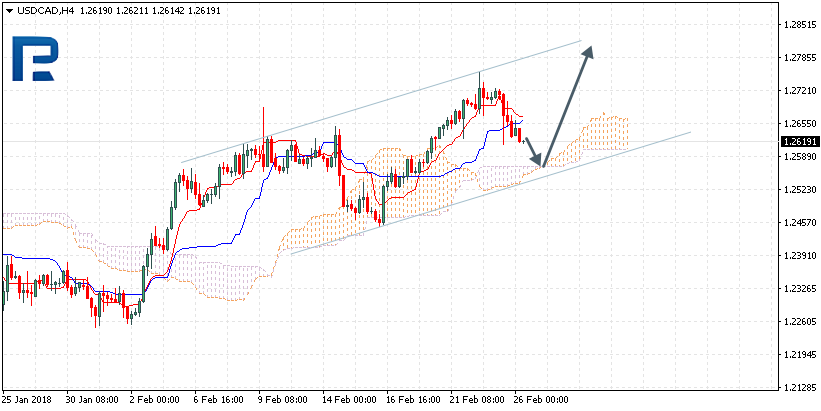
USDCAD is trading at 1.2619; the instrument is moving above Ichimoku Cloud, which means that it may continue growing. The markets could indicate that the price may test the upside border of the cloud at 1.2575 and then continue moving upwards to reach 1.2785. Another signal to confirm further ascending movement is the price’s rebounding from the downside border of the rising channel. However, the scenario that implies further growth may be cancelled if the price breaks the downside border of the cloud and fixes below 1.2530. In this case, the pair may continue falling towards 1.2390.

USDCADRisk Warning: the results of previous trading operations do not guarantee the same results in the future.


RoboForex Analytical Department

Article By RoboForex.com

Attention!
Forecasts presented in this section only reflect the author’s private opinion and should not be considered as guidance for trading. RoboForex LP bears no responsibility for trading results based on trading recommendations described in these analytical reviews.