Author Archive for InvestMacro – Page 440

Ichimoku Cloud Analysis 07.03.2018 (AUDUSD, NZDUSD, USDCAD)

Article By RoboForex.com

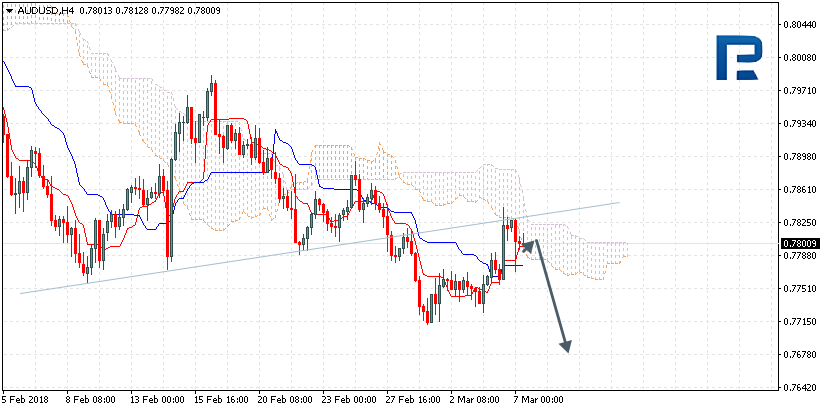
AUDUSD, “Australian Dollar vs US Dollar”

AUDUSD is trading at 0.7800; the instrument is moving below Ichimoku Cloud, which means that it may continue falling. The markets could indicate that the price may test the downside border of the cloud at 0.7810 and then continue moving downwards to reach 0.7675. Another signal to confirm further descending movement is the price’s rebounding from the resistance level. However, the scenario that Implies further decline may be cancelled if the price breaks the upside border of the cloud and fixes above 0.7830. In this case, the pair may continue growing towards 0.7960.

AUDUSDRisk Warning: the results of previous trading operations do not guarantee the same results in the future.

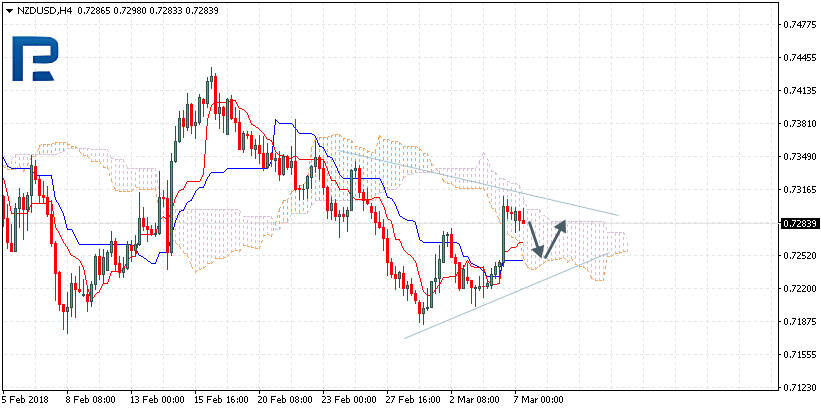
NZDUSD, “New Zealand Dollar vs US Dollar”

NZDUSD is trading at 0.7283; the instrument is moving inside Ichimoku Cloud, which means that it is moving sideways. The markets could indicate that the price may test the downside border of the cloud at 0.7250 and then continue moving upwards to reach 0.7285. However, the scenario that implies further growth may be cancelled if the price breaks the downside border of the cloud and fixes below 0.7225. In this case, the pair may continue falling towards 0.7155. After breaking the upside border of the cloud and fixing above 0.7305, the price may resume growing.

NZDUSDRisk Warning: the results of previous trading operations do not guarantee the same results in the future.

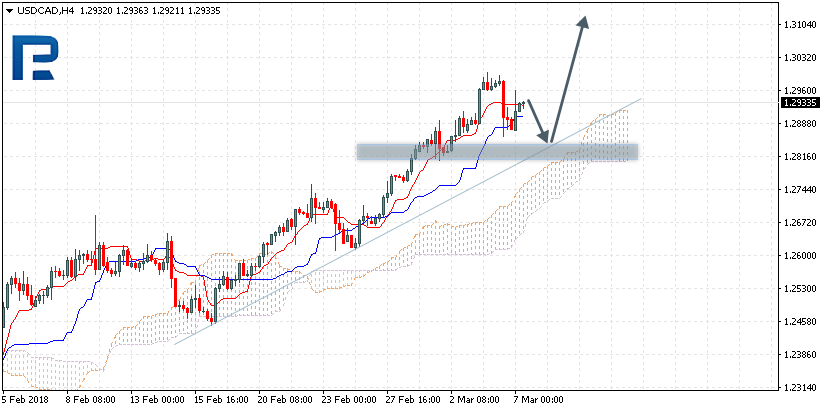
USDCAD, “US Dollar vs Canadian Dollar”

USDCAD is trading at 1.2933; the instrument is moving above Ichimoku Cloud, which means that it may continue growing. The markets could indicate that the price may test Tenkan-Sen and Kijun-Sen at 1.2840 and then continue moving upwards to reach 1.3105. Another signal to confirm further ascending movement is the price’s rebounding from the support level. However, the scenario that implies further growth may be cancelled if the price breaks the downside border of the cloud and fixes below 1.2740. In this case, the pair may continue falling towards 1.2570.

USDCADRisk Warning: the results of previous trading operations do not guarantee the same results in the future.


RoboForex Analytical Department

Article By RoboForex.com

Attention!
Forecasts presented in this section only reflect the author’s private opinion and should not be considered as guidance for trading. RoboForex LP bears no responsibility for trading results based on trading recommendations described in these analytical reviews.

Forex Technical Analysis & Forecast 07.03.2018 (EURUSD, GBPUSD, USDCHF, USDJPY, AUDUSD, USDRUB, GOLD, BRENT)

Article By RoboForex.com

EURUSD, “Euro vs US Dollar”

EURUSD is moving upwards; it has almost completed the correctional wave. Possibly, today the price may form another consolidation range with a reversal pattern. After breaking 1.2380, the instrument may resume moving downwards with the first target at 1.2330.

EURUSDRisk Warning: the results of previous trading operations do not guarantee the same results in the future.

GBPUSD, “Great Britain Pound vs US Dollar”

GBPUSD has completed the ascending wave and may start consolidating. After breaking the range to the downside, the instrument may fall towards 1.3817. Later, the market may grow to reach 1.3887 and the resume moving downwards with the target at 1.3700.

GBPUSDRisk Warning: the results of previous trading operations do not guarantee the same results in the future.

USDCHF, “US Dollar vs Swiss Franc”

USDCHF is still consolidating. Today, the price may fall towards 0.9330 and then grow to reach 0.9420. If later the instrument breaks this range to the upside, the market may form the third ascending wave with the target at 0.9620.

USDCHFRisk Warning: the results of previous trading operations do not guarantee the same results in the future.

USDJPY, “US Dollar vs Japanese Yen”

USDJPY is moving downwards. Possibly, the price may reach 104.80 and then start another growth towards 106.30. Later, the market may continue falling inside the downtrend with the target at 104.50.

USDJPYRisk Warning: the results of previous trading operations do not guarantee the same results in the future.

AUDUSD, “Australian Dollar vs US Dollar”

AUDUSD is forming another descending impulse. Today, the price may fall towards 0.7757 and then grow to reach 0.7800. After that, the instrument may continue trading to the downside with the target at 0.7715.

AUDUSDRisk Warning: the results of previous trading operations do not guarantee the same results in the future.

USDRUB, “US Dollar vs Russian Ruble”

USDRUB is falling towards 56.12. After that, the instrument may grow to reach 56.71 and then resume falling towards 55.50.  Later, the market may break it to the downside and then continue trading to the downside with the target at 54.80.

USDRUBRisk Warning: the results of previous trading operations do not guarantee the same results in the future.

XAUUSD, “Gold vs US Dollar”

Gold is forming the descending impulse. Possibly, today the price may reach 1327.00. After that, the instrument may grow towards 1333.00 and then start another decline with the target at 1290.00.

GOLDRisk Warning: the results of previous trading operations do not guarantee the same results in the future.

BRENT

Brent has returned to 65.30. Today, the price may continue growing to reach the first target at 67.07. Later, the market may start another correction towards 65.30.

BRENTRisk Warning: the results of previous trading operations do not guarantee the same results in the future.


RoboForex Analytical Department

Article By RoboForex.com

Attention!
Forecasts presented in this section only reflect the author’s private opinion and should not be considered as guidance for trading. RoboForex LP bears no responsibility for trading results based on trading recommendations described in these analytical reviews.

EURUSD: euro could retreat to 1.2385 ahead of the ECB meeting

By Gabriel Ojimadu, Alpari

Previous:

On Tuesday the 6th of March, trading on the euro closed up. News from North Korea instilled buyers with some fighting spirit. This news eased geopolitical tensions and created an appetite for risk. The euro rose against the dollar by 92 pips, moving from 1.2328 to 1.2420.

North Korea has agreed to hold talks with the US regarding its nuclear program. US factory orders yesterday missed expectations, posting its biggest decline in 6 months. Meanwhile the US’s decision to impose import tariffs on aluminium and steel has continued to pile pressure on the greenback.

Economic data:

USA: factory orders (Jan): -1.4% (forecast: -1.1%, previous: 1.8%).

Day’s news (GMT+3):

  • 10:45 France: trade balance (Jan).
  • 11:00 Switzerland: foreign currency reserves (Jan).
  • 11:30 UK: Halifax house prices (Feb).
  • 13:00 Eurozone: GDP (Q4).
  • 16:15 USA: ADP employment change (Feb).
  • 16:30 USA: trade balance (Jan), nonfarm productivity (Q4), unit labour costs (Q4).
  • 16:30 Canada: imports (Jan), exports (Jan), labour productivity (Q4).
  • 18:00 Canada: BoC interest rate decision and rate statement.
  • 18:30 USA: EIA crude oil stocks change (2 Mar).
  • 22:00 USA: Fed’s Beige Book.

Fig 1. EURUSD hourly chart. Source: TradingView

On Tuesday, I was expecting the euro to drop to 1.2307. However, it only made it as far as 1.2338. The euro crosses prevented the bears from advancing any further. Buyers broke the 1.2360 resistance on the back of the news from North Korea, after which the rise gathered pace to reach 1.2414. My expectations were proven wrong.

In today’s Asian session, the pair has moved up to 1.2429. Three subsequent higher highs along with declining values on the AO indicator is usually a bearish signal. However, most of the euro crosses and safe haven assets are trading up. Because of this, buyers could hit a new high before the downwards correction begins. When the correction kicks in, I’m expecting the euro to retreat to 1.2385.

Let’s not forget about tomorrow’s ECB meeting and Mario Draghi’s subsequent press conference. The ADP employment report will come out during the US session, which is always published 2 days before the NFP report. Ahead of such important market events, it’s difficult to make any solid predictions as trader emotion comes into the equation and news items intensify these emotions.

How Chinese Growth Is Changing

By Dan Steinbock

What many international observers continue to miss is that the deceleration of growth in China goes hand in hand with rapidly-rising living standards.

In his annual work report, Chinese Premier Li Keqiang said on Monday that China aims to expand its economy by around 6.5 percent this year.

While some of the leading international media reported the new growth target factually, others portrayed it as a “slowdown” that could even undermine global growth prospects.

Much of the international media is missing the real story of Chinese growth.

Mistaking long-term trends with short-term fluctuations

Speaking at People’s Congress (NPC) on Monday, Premier Li Keqiang did say that China’s new growth target is 6.5 percent. At surface, that’s the same as the official target in 2017. Last year, the goal was kept unchanged, even though the economy grew 6.9 percent and exceeded the government’s official target.

In a deeper view, the growth target is not the same as in 2017 because the landscape of Chinese growth is changing.

In the past, credit growth was almost twice as high as the growth rate. But now China is pressing ahead with a campaign to reduce risks in the financial system.

Premier Keqiang’s report left no doubt about the fact that the government’s attention is now firmly fixed on credit risks and higher-quality growth. That’s why China has also cut its budget deficit target for the first time since 2012.

Authorities will be more watchful of fiscal spending, even as they avoid excessive tightening – which many Western observers advocate in China, even though that would risk a sharper slowdown.

Like too many times before, much of international media mistakes secular, longer-term trends with cyclical, short-term fluctuations. Consequently, they misunderstand the deceleration of Chinese growth as a slowdown, stagnation, or even a hard landing. In reality, deceleration simply reflects the eclipse of the intensive phase of industrialization, which heralds a transition to post-industrial society.

The deceleration of growth in China is not some mystical omen of bad things to follow. Rather, it is mainly a sign that Chinese rebalancing is on track.

Decelerating growth, rising incomes

When Industrial Revolution peaked in Britain in the early 19th century, the country experienced a “growth miracle.” In the late 19th century, US growth, too, accelerated. As these countries completed their industrialization and began to move toward post-industrial services, growth acceleration gave way to deceleration.

Barely a decade ago, China still enjoyed double-digit growth. However, today China’s growth is slowing relative to its past performance. Historically, that is the norm with all industrializing economies, not the exception.

What makes China different is its massive scale and the purposeful effort to shift from economic growth to rising living standards. Consequently, as China’s growth rate decelerates, living standards continue to rise – very rapidly, even historically.

Along with innovation, thriving consumption is the goal of Chinese rebalancing. Such consumption requires growing living standards, not unsustainable growth. This narrative can be illustrated with the first term of President Xi Jinping and Premier Li Keqiang and their projected next half a decade, assuming the current trend line and peaceful conditions will continue to prevail in the world economy.

Between 2012 and 2022, Chinese growth rate could decelerate from 7.9 percent to 5.8 percent. Despite this deceleration, living standards will almost double. In 2012, Chinese GDP per capita was about $11,000. By 2022, it is likely to increase to $20,000 (Figure). During this decade, the compound annual growth rate of per capita incomes could thus be around 6.7 percent in China.


Figure China’s Growth Deceleration and Rising Per Capita Incomes,

2012-E2022


Growth rate: GDP, constant prices, percent change

Per capita income:  GDP per capita, constant prices (purchasing power parity; 2011 international dollars)

Source: IMF/WEO Database

Now, let’s compare these results with those of the United States. Between 2012 and 2022, US growth rate could decelerate from 2.2 percent to 1.7 percent, while GDP per capita will increase from $50,500 to $57,700 – assuming the country can continue its current leverage-ridden growth.

During the time period, the compound annual growth rate of U.S. per capita incomes could thus be around 1.5 percent. Relative to other major advanced economies, that’s pretty good but not relative to China, the largest emerging economy. After all, it is only a fourth of what is projected in China.

Oddly enough, when the growth rate of the US economy is slower than anticipated, that’s usually attributed to a “bad quarter.” It is seldom seen as a predictor of U.S. slowdown, collapse or hard landing. In other words, international media seems to have different norms and expectations regarding to China, even though economic realities are pretty clear.

Such discrepancies can have distressing implications. While international media systematically highlights mainly downside risks in China and other large emerging economies, it is consistently downplaying the magnitude of leverage-ridden growth and thus downside risks in the U.S. and other major advanced economies.

About The Author:

Dr Dan Steinbock is the founder of Difference Group and has served as research director at the India, China and America Institute (USA) and visiting fellow at the Shanghai Institutes for International Studies (China) and the EU Center (Singapore). For more, see https://www.differencegroup.net/ 


The original commentary was released by China Daily on March 7, 2018
What Factors Influence the Price of Gold

By Amram Margalit – Leverate

By the 8th of February, the S&P 500 had dropped $300, wiping trillions of value off US shares. This drop, on the back of global concerns of the impact of Trump’s protectionist fiscal policies, was most unusually reflected in the price of gold. The subsequent rebound in US shares was a much welcome reprieve for investors, who had significant fears of a long sustained drop in US equities. The S&P 500 price peaked at $2,779 on the 26th, before dropping again to $2,677 at the beginning of March.

The initial rebound in the S&P was reflected in the gold price, which peaked on the 15th at $1,363, before dropping down to about $1,311 by the end of the month.

In early February, the similarity of price patterns between gold and the S&P represented an unusual situation. Gold, which often serves as a hedge in times of geo-political turmoil, generally strengthens when stock markets begin to drop. Since it is priced in USD, the link between gold to US equities and the dollar is particularly strong.

With low confidence in the stock market, gold, which has been in the process of a long term uptrend based on moving averages, should have pushed through the resistance line. However, it has actually not moved substantially, maintaining its levels around the $1,300 for an extended period of time.

Perhaps a better understanding of the gold activity in February is more accurately reflected in the precious metals sector, rather than in reflection of the S&P. Generally, precious metals have been in correction. In early march, silver was in a consolidation, with the daily sentiment index for silver showing at 40% bull, whilst being stuck within the support resistance lines. Gold, however, has been trending around $1300 without significant breakout despite the long term bullish moving averages. The commodity is not overbought, whilst gold shares were in overbought territory. This indicates an interesting element, seemingly with the value of gold in dispute between the shares and the commodity.

The expected increase in gold from a macroeconomic perspective relates to a potential increase in inflation. This is something that was not immediately expected in February, with current global competitive pressures hampering this increase. In this light, the current sideways trend – using long term indicators and the lack of breakout as a result of Trump’s policies and subsequent confusion – would point to a longer term fundamental reason that the gold price has remained the same. The increase in gold shares purchasing in this case would be reflective of a market that recognizes the potential for gold, whilst understanding that the value of gold is not yet ready to breakout.

The activity of gold during February seems to be more in line with longer term precious metal activities. Because of this, the apparent mirroring of the S&P and gold was both out of character for short term, but in character for a long term analysis.

Time will tell if the summer of gold is upon us, and how much the glitter predicted by the increase in gold shares will be a forbearer of things to come.

About the Author:

Amram Margalit is a professional writer who has worked in a wide range of settings, including technology companies, nonprofits, and the entertainment industry. Within these positions, Amram has provided quality content and advertising services and is currently the Content Manager at Leverate.

The Good, the Bad, and the Ugly: Upcoming Bitcoin Hard Forks for 2018

Blockchain-based cryptocurrencies like Bitcoin have a number of unique characteristics. Blockchains are, by definition, resistant to tampering thanks to their distributed, decentralized nature. Despite this, changes can and are made to blockchain ledgers all the time. In fact, the Bitcoin blockchain undergoes changes all the time.

The process behind these changes referred to as undergoing a “hard fork”, and their consequences can sometimes be game-changing. Here’s what you need to know about how hard forks have changed the Bitcoin blockchain in the past and how new hard forks this year will change it even further.

How Hard Forks Work

There’s more to learn about cryptocurrency besides knowing how to trade crypto assets. Understanding how blockchain tech works, at least on a theoretical level, is important if you want to understand hard forks. When you get right down to brass tacks, blockchain ledgers consist of complex bits of code that control the rules for a particular cryptocurrency. Changing that code means that there are, technically, two versions of the blockchain in existence: the old one that contains the original code, or a new one that diverges like a fork in the road – hence the name “hard fork.”

In many cases, the community that uses a cryptocurrency abandons the old blockchain and begins using the new, forked version of that same blockchain instead. However, if the community is split, then this means the original blockchain continues to be used alongside the new blockchain. In this instance, a hard fork creates a brand new cryptocurrency — and in the case of Bitcoin hard forks, these new currencies have been positioned as direct competitors to BTC.

Previous Bitcoin Hard Forks

Bitcoin’s gone through a few hard forks of its own. These hard forks were undertaken in order to provide users new capabilities that the original Bitcoin blockchain lacked, but none of these hard forked blockchains have reached the popularity of the original quite yet despite these improvements.

The first Bitcoin hard forks began in 2017 with Bitcoin Cash (BCH), which split from the core ledger in August. Bitcoin Cash was quite similar to its predecessor in many ways, but it differed in that it was designed to support a higher number of transactions per second, which made it more scalable and less prone to bottlenecking than Bitcoin. At the time of this writing, BCH is routinely ranked within the top five cryptocurrencies for market capitalization, with Bitcoin (BTC) firmly in the top spot.

Another notable Bitcoin hard fork that created a rival cryptocurrency in 2017 was Bitcoin Gold (BTG), which occurred in October of that year. Originally conceived as a version of the Bitcoin blockchain that was more advantageous to miners, controversies related to user security have plagued BTG and limited its success, keeping it currently out of the top 20 cryptocurrencies by market capitalization. Its valuation is also much lower than BTC or even BCH, much likely due to these controversies as well.

Forks on the Horizon

2017 might have seen the first few Bitcoin hard forks come down the pike, but there’s many more on the way in 2018. Some have already arrived, while others are expected to hit as the year goes on. Here’s a list of some of the most interesting.

Super Bitcoin

Squeaking in under the wire by launching in December of 2017, Super Bitcoin (SBTC) features the ability to handle more transactions per second, much like Bitcoin Cash. However, SBTC also expands the Bitcoin blockchain’s original capabilities even further by instituting smart contracts, much in the same way the Ethereum blockchain does.

Lightning Bitcoin

Another last-minute December 2017 hard fork, Lightning Bitcoin (LBTC) helped usher in the 2018 New Year by providing “lightning” fast payments. The dev team claims that LBTC will be able to handle between 1000 and 10,000 transactions per second. Additionally, smart contract support will be added sometime in 2018 as well.

Bitcoin God

Forking in January of 2018, Bitcoin God (GOD) has an ambitious name and boasts an ambitious suite of capabilities. GOD is coded to support smart contracts, higher transaction speeds, mining using an alternative proof-of-stake system, and support for third-party overlays like the Lightning Network (which has no connection to Lightning Bitcoin).

Bitcoin Uranium

Slated to have gone live in January as well, this hard fork with yet another precious metal in its name seems to have been back burnered for now. Bitcoin Uranium (BUM) was originally conceived to be a cryptocurrency that would focus on decentralization, making it easier to mine by hobbyists instead of massive mining rigs. However, considering that the last communication from BUM’s dev team was a tweet in February 2018 of a single-worded vulgarity, it’s a safe bet this hard fork has been cancelled.

Bitcoin Cash Plus

Bitcoin Cash Plus went live in the middle of February 2017. This hard fork altered the core Bitcoin blockchain in ways that resemble Bitcoin Cash, hence the addition of “Plus” to its name. The core conceit behind BCP, however, are not to use it for speculative gain but as a peer-to-peer payment system instead.

Bitcoin Silver

Bitcoin Silver is a good example of “just because it’s got Bitcoin in the name doesn’t mean it’s good.” This supposed hard fork, after some research, turned out to be a pre-mined coin that the Bitcoin Silver team is offering in an ICO — and is accepting Ether in return. This differs from traditional Bitcoin hard forks, where anyone holding BTC gets an equal amount of the new forked currency automatically.

Further in the Future

Thanks to the success of hard forks like Bitcoin Cash, these half-a-dozen new Bitcoin hard forks are unlikely to be the last of their kind. New and enterprising dev teams are going to continue to design alternatives to the core Bitcoin blockchain ledger for the rest of 2018 and, likely, for many more years to come.

Will any of these hard forks ever achieve as much success as the original? Time will tell, but we don’t recommending holding your breath.

About the Author:

Catherine Tims is the owner of at  Ivy League Content. After receiving her Master’s degree in English Language and Linguistics at the University of Arizona, she taught writing to graduate students at the University of Illinois/Champaign-Urbana. She has her own writing business, and freelances full time for business clients who need highly-researched articles. You can follow her on twitter @ivyleaguewriter


Fibonacci Retracements Analysis 02.03.2018 (BITCOIN, ETHEREUM)

Article By RoboForex.com

BTCUSD, “Bitcoin vs US Dollar”

In the H4 chart, after being corrected to the downside by 38.2%, BTCUSD is trying to form a new ascending impulse. If it succeeds, the price may break the current high at 11750.00 and then trade towards the post-correctional extension area between the retracements of 138.2% and 161.8% at 12740.00 and 13325.00 respectively. However, one shouldn’t exclude a possibility that the current correction may yet continue. The next downside targets may be the retracements of 50.0%, 61.8%, and 76.0% at 8875.00, 8190.00, and 7365.00 respectively.

BTCUSD1
Risk Warning: the results of previous trading operations do not guarantee the same results in the future.
As we can see in the H1 chart, after breaking the local high, the pair is trading towards the post-correctional extension area between the retracements of 138.2% and 161.8% at 11385.00 and 11585.00 respectively.

BTCUSD2Risk Warning: the results of previous trading operations do not guarantee the same results in the future.

ETHUSD, “Ethereum vs. US Dollar”

In the H4 chart, ETHUSD is still being corrected downwards and has almost reached the retracement of 50.0%. The next downside targets may be the retracements of 61.8% (725.00), 76.0% (669.10), and the low at 570.40. However, if the price breaks the high at 977.00, the instrument may continue growing towards the post-correctional extension area between the retracements of 138.2% and 161.8% at 1050.00 and 1095.00 respectively.

ETHUSD1
Risk Warning: the results of previous trading operations do not guarantee the same results in the future.

As we can see in the H1 chart, the pair is starting a new descending correction. The targets are the retracements of 50.0%, 61.8%, and 76.0% at 841.00, 828.00, and 812.20 respectively.

ETHUSD2
Risk Warning: the results of previous trading operations do not guarantee the same results in the future.

RoboForex Analytical Department

Article By RoboForex.com

Attention!
Forecasts presented in this section only reflect the author’s private opinion and should not be considered as guidance for trading. RoboForex LP bears no responsibility for trading results based on trading recommendations described in these analytical reviews.

Forex Technical Analysis & Forecast 02.03.2018 (EURUSD, GBPUSD, USDCHF, USDJPY, AUDUSD, USDRUB, GOLD, BRENT)

Article By RoboForex.com

EURUSD, “Euro vs US Dollar”

EURUSD has completed the ascending structure. Possibly, today the price may fall towards 1.2195 and then start another consolidation range. If later the instrument breaks this range to the upside, the market may continue the correction to reach 1.2355; if to the downside – resume falling inside the downtrend with the target at 1.2054.

EURUSDRisk Warning: the results of previous trading operations do not guarantee the same results in the future.

GBPUSD, “Great Britain Pound vs US Dollar”

GBPUSD is still consolidating. If later the instrument breaks this range to the upside, the market may continue the correction towards 1.3924; if to the downside – fall inside the downtrend with the target at 1.3460.

GBPUSDRisk Warning: the results of previous trading operations do not guarantee the same results in the future.

USDCHF, “US Dollar vs Swiss Franc”

USDCHF has finished the descending impulse. Today, the price may grow towards 0.9437 and form another consolidation range. If later the instrument breaks this range to the upside, the market may start another growth to reach 0.9620; if to the downside – continue the correction with the target at 0.9337.

USDCHFRisk Warning: the results of previous trading operations do not guarantee the same results in the future.

USDJPY, “US Dollar vs Japanese Yen”

USDJPY has broken the consolidation channel downwards. Possibly, today the price may fall to reach 105.55 and then grow towards 107.15, thus forming another consolidation range. If later the instrument breaks this range to the upside, the market may start another growth to reach 108.40. if to the downside – continue falling inside the downtrend with the target at 103.30.

USDJPYRisk Warning: the results of previous trading operations do not guarantee the same results in the future.

AUDUSD, “Australian Dollar vs US Dollar”

AUDUSD is forming the ascending impulse. Possibly, the price may be corrected towards 0.7777 and then fall to reach 0.7690.

AUDUSDRisk Warning: the results of previous trading operations do not guarantee the same results in the future.

USDRUB, “US Dollar vs Russian Ruble”

USDRUB is trading to reach 56.40. After that, the instrument may form another ascending structure towards 57.22 and then and then continue trading to the downside with the target at 54.80.

USDRUBRisk Warning: the results of previous trading operations do not guarantee the same results in the future.

XAUUSD, “Gold vs US Dollar”

Gold is moving upwards. Possibly, the price may reach 1323.00. Later, the market may fall to break 1307.00. The next target is at 1288.00.

GOLDRisk Warning: the results of previous trading operations do not guarantee the same results in the future.

BRENT

Brent is consolidating near the lows of the descending wave. According to the main scenario, the instrument may grow to break the range upwards. The upside target is at 67.70.

BRENTRisk Warning: the results of previous trading operations do not guarantee the same results in the future.


RoboForex Analytical Department

Article By RoboForex.com

Attention!
Forecasts presented in this section only reflect the author’s private opinion and should not be considered as guidance for trading. RoboForex LP bears no responsibility for trading results based on trading recommendations described in these analytical reviews.

EURUSD: announcement of US import tariffs boosts the euro

By Gabriel Ojimadu, Alpari

Previous:

On Thursday the 1st of March, trading on the euro/dollar closed up. The pair dropped to the 157th degree at 1.2155 on the back of a rising dollar. From there, the euro rebounded to reach 1.2273, marking a rise of 118 pips.

The US dollar and US stock markets have taken a big hit from this announcement as it’s seen by many to be threatening a trade war with the EU and China. President Trump has announced a 25% import duty on steel and 10% on aluminium.

A spokesperson for China’s Ministry of Foreign Affairs said that China would take its own protective measure should such duties be imposed, while the EU has also promised a firm response.

The US stock market’s decline of around 1.3% – 1.6% led to a mass closing of riskier positions on the Forex market. The safe haven assets (gold, Swiss franc, yen) all closed the day up. The euro, as a funding currency, also ended the day up against the dollar.

As a result of all this, Jerome Powell’s speech was given secondary importance. New York Fed President William Dudley said that he wouldn’t rule out the possibility of 4 interest rate hikes this year.

Economic data:

  • USA – initial jobless claims (23 Feb): 210,000 (forecast: 226,000, previous: 220,000).
  • USA – ISM manufacturing PMI (Feb): 60.8 (forecast: 58.7, previous: 59.1).
  • USA – Markit manufacturing PMI (Feb): 55.3 (forecast: 55.9, previous: 55.9).
  • Canada – Markit manufacturing PMI (Feb): 55.6 (forecast: 55.8, previous: 55.9).
  • USA – personal income (Jan): 0.4% (forecast: 0.3%, previous: 0.4%), personal spending: 0.2% (forecast: 0.2%, previous: 0.4%).

Day’s news (GMT+3):

  • 10:00 Germany: retail sales (Jan).
  • 12:30 UK: PMI construction (Feb).
  • 13:00 Eurozone: PPI (Jan).
  • 16:30 Canada: GDP (Q4), GDP (Dec).
  • 18:00 USA: Michigan consumer sentiment index (Feb).
  • 21:00 USA: Baker Hughes US oil rig count.

Fig 1. EURUSD hourly chart. Source: TradingView

I correctly predicted a testing of the 157th degree with a subsequent rebound. The price missed its target by a single pip. The imposition of tariffs on steel and aluminium by Trump pushed the euro up to 1.2288. At the time of writing, the euro is trading at 1.2278. The price is currently hovering around the 112th degree. Having weighed all the pros and cons, I’ve concluded that the euro’s rise will continue to 1.2306. This scenario will go out the window, however, if the hourly candlestick closes below 1.2260.

If European stock indices start trading up and the retreat to safe haven assets stops, the price will most likely return to the LB balance line. This would be the best scenario; a return to the LB at 1.2223.

Should You “Fret” Over the New Fed Chair’s Possible Actions?

Learn what really governs the trend of interest rates

By Elliott Wave International

Is new Fed Chair Jerome Powell a hawk — meaning, will he aggressively raise rates to curb inflation?

That’s what investors are asking as Powell makes his first appearance before Congress in his new role. The belief that Powell will be hawkish has already rattled markets, according to some observers (Reuters, Feb. 23):

Markets fret over Federal Reserve’s approach under new chair Powell

Investors are starting to doubt whether they can count on the protective embrace of an accommodative U.S. central bank when markets go haywire.

Of course, “accommodative” means leaving interest rates low, or raising them slowly and a little at a time. This is “accommodative” to the stock market because low rates are supposed to motivate investors to seek higher returns in the stock market. On the other hand, higher rates would provide competition for stocks.

Here’s something to keep in mind, before we go on: EWI’s studies show no consistent relationship between the trend in rates and the stock market. Even so, this belief remains widespread.

Getting back to whether Powell will be aggressive with raising rates, our research posits that wondering about the new Fed chair’s possible future actions is based on a false premise.

You see, the evidence shows that the Fed does not act; it reacts. It reacts to the bond market. In other words, the bond market leads the way on rates, not the Fed.

Robert Prechter’s 2017 book, The Socionomic Theory of Finance, provides a historical example when it showed this chart and said:

FedFollows

No one monitoring the Fed’s decisions can predict when T-bill rates will change, but anyone monitoring the T-bill rate can predict with fair accuracy when the Fed will change its funds rate. The Elliott Wave Financial Forecast demonstrated this ability in September 2007 by predicting that the Fed was about to lower its federal funds rate dramatically.

The aftermath is shown in this chart:

FedStill

As you can see, the Fed’s benchmark rate followed the T-bills rate lower.

This pattern maintained even during the dramatic period of double-digit rates in the late 1970s and early 1980s…. T-bill rates peaked four times in 1980-1982. Each of those peaks occurred a month or more before subsequent and reactive peaks in the federal funds rate. The Fed’s rate also lags at bottoms, [such as] the lows of 1980, 1981 and 1982-3.

So, regarding interest rates, it’s best to monitor the bond market, not the Fed.

Financial markets are governed by investory psychology, which expresses itself in repetitive price patterns at all degrees of trend. We call them Elliott wave patterns.

Following these patterns in the bond markets — something us here at EWI do regularly and share our findings with subscribers — can help you anticipate what’s next for interest rates.

Is Your Portfolio Built on False Assumptions?
Download this Free 33-Page Report to Find Out.

Did you know that the vast majority of portfolios are built on false assumptions? These false assumptions — or Market Myths — have been passed down across generations. They are so baked into investor psyche that no one ever thinks to challenge them… but we do. Do earnings really drive stock prices? Can the FDIC actually protect you? Is portfolio diversification a smart move? Download Market Myths Exposed now and find out whether your portfolio is built on flawed foundations. We guarantee you’ll be shocked to find the truth.

Sign up now and get FREE access to The Market Myths Exposed eBook.

This article was syndicated by Elliott Wave International and was originally published under the headline Should You “Fret” Over the New Fed Chair’s Possible Actions?. EWI is the world’s largest market forecasting firm. Its staff of full-time analysts led by Chartered Market Technician Robert Prechter provides 24-hour-a-day market analysis to institutional and private investors around the world.