Author Archive for InvestMacro – Page 437

Ichimoku Cloud Analysis 29.03.2018 (AUDUSD, NZDUSD, USDCAD)

Article By RoboForex.com

AUDUSD, “Australian Dollar vs US Dollar”

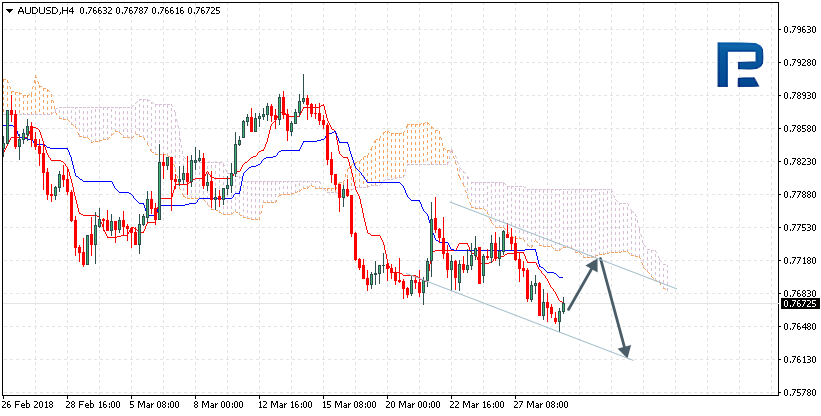
AUDUSD is trading at 0.7672; the instrument is moving below Ichimoku Cloud, which means that it may continue falling. The markets could indicate that the price may test the downside border of the cloud at 0.7715 and then continue moving downwards to reach 0.7610. Another signal to confirm further descending movement is the price’s rebounding from the channel’s upside border. However, the scenario that Implies further decline may be cancelled if the price breaks the upside border of the cloud and fixes above 0.7780. In this case, the pair may continue growing towards 0.7860.

AUDUSD
Risk Warning: the result of previous trading operations do not guarantee the same results in the future


NZDUSD, “New Zealand Dollar vs US Dollar”

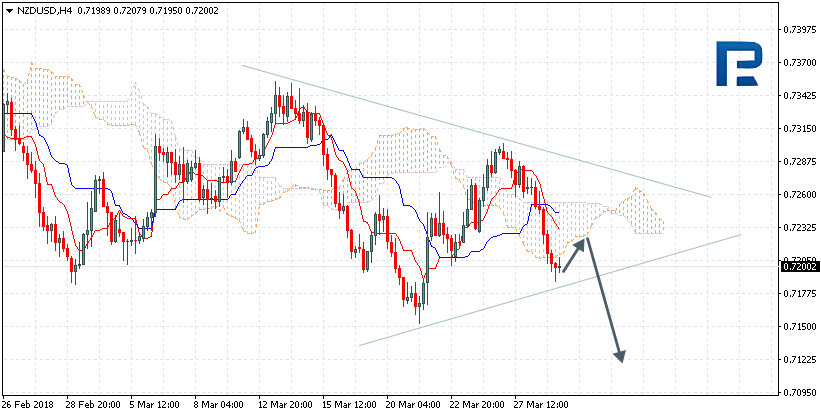
NZDUSD is trading at 0.7200; the instrument is moving below Ichimoku Cloud, which means that it may continue growing. The markets could indicate that the price may test the downside border of the cloud at 0.7225 and then continue moving downwards to reach 0.7125. However, the scenario that implies further growth may be cancelled if the price breaks the upside border of the cloud and fixes above 0.7265. In this case, the pair may continue growing towards 0.7350. After breaking the downside border of the Triangle pattern and fixing below 0.7170, the price may continue moving downwards.

NZDUSD
Risk Warning: the result of previous trading operations do not guarantee the same results in the future


USDCAD, “US Dollar vs Canadian Dollar”

USDCAD is trading at 1.2912; the instrument is moving below Ichimoku Cloud, which means that it may continue falling. The markets could indicate that the price may test the downside border of the cloud at 1.2920 and then continue moving downwards to reach 1.2725. However, the scenario that implies further decline may be cancelled if the price breaks the upside border of the cloud and fixes above 1.2990. In this case, the pair may continue growing towards 1.3090.

USDCAD
Risk Warning: the result of previous trading operations do not guarantee the same results in the future


RoboForex Analytical Department

Article By RoboForex.com

Attention!
Forecasts presented in this section only reflect the author’s private opinion and should not be considered as guidance for trading. RoboForex LP bears no responsibility for trading results based on trading recommendations described in these analytical reviews.

Murrey Math Lines 29.03.2018 (USDCHF, GOLD)

Article By RoboForex.com

USDCHF, “US Dollar vs Swiss Franc”

In the H4 chart, USDCHF is consolidating between the 3/8 and 5/8 levels. The price is expected to test the 5/8 level, rebound from I, and then resume falling to reach the support at the 4/8 one.

USDCHF1
Risk Warning: the result of previous trading operations do not guarantee the same results in the future

As we can see in the H1 chart, the pair is trading inside the “overbought zone” above the 8/8 level. If the price breaks the +1/8level, the instrument may resume moving downwards to reach the support at the 7/8 one.

USDCHF2
Risk Warning: the result of previous trading operations do not guarantee the same results in the future


XAUUSD, “Gold vs US Dollar”

In the H4 chart, XAUUSD may rebound from the 2/8 level and resume falling towards the support at the 0/8 one.

GOLD1
Risk Warning: the result of previous trading operations do not guarantee the same results in the future

The lines in the H4 and H1 charts are completely the same and confirm the scenario described above. However, the pair may yet test the resistance at the 3/8 level, rebound from it, and then resume moving downwards to reach the support at the 0/8one.

GOLD2
Risk Warning: the result of previous trading operations do not guarantee the same results in the future


RoboForex Analytical Department

Article By RoboForex.com

Attention!
Forecasts presented in this section only reflect the author’s private opinion and should not be considered as guidance for trading. RoboForex LP bears no responsibility for trading results based on trading recommendations described in these analytical reviews.

EURUSD: renewed sales expected after an upwards correction

By Gabriel Ojimadu, Alpari

Previous:

On Wednesday the 28th of March, trading on the EURUSD pair closed down. The euro dropped from 1.2422 to 1.2300 (-122 pips). It looks like some stop levels were triggered as we went below 1.2370 and a new wave of euro sales commenced.

The dollar has made significant gains against most other currencies on the back of positive US economic data as well as President Trump confirming that a meeting took place between the leaders of North Korea and China. According to China, Kim Jong Un is willing to hold a summit with the US over the denuclearisation of the Korean Peninsula.

The 3rd reading of US GDP for the 4th quarter of 2017 posted an annual growth rate of 2.9% against a forecast of 2.5%. Pending home sales on the US real estate market also exceeded expectations.

The decline on the EURUSD pair is also down to technical factors, specifically the triggering of large sell orders as a result of the breakout of yesterday’s low (1.2372).

Day’s news (GMT+3):

  • 10:00 Switzerland: KOF leading indicator (Mar).
  • 10:55 Germany: unemployment change (Mar), unemployment rate (Mar).
  • 11:30 UK: GDP (Q4), current account (Q4), net lending to individuals (Apr), consumer credit (Feb), mortgage approvals (Feb).
  • 15:00 Germany: harmonised index of consumer prices (Mar).
  • 15:30 Canada: GDP (Jan), industrial product price (Feb).
  • 15:30 USA: personal spending (Feb), personal income (Feb), core personal consumption expenditure – price index (Feb).
  • 16:45 USA: Chicago PMI (Mar).
  • 17:00 USA: Michigan consumer sentiment index (Mar).

Fig 1. EURUSD hourly chart. Source: TradingView

By the end of the US session, sellers had been beaten back to the 135th degree at 1.2309. My predictions for yesterday came off in full. My targets were even reached ahead of schedule.

At the time of writing this review, the euro is trading at 1.2334. In Asia, the price is recovering as part of a correction to 1.2335. In today’s forecast, I’m expecting the euro to drop to 1.2289. I should warn you that the area between the 112th and 135th degrees is a reversal zone, so the upwards correction could make it as far as the 45th degree at 1.2357. As for the drop, it hasn’t ended yet. There’s no bullish divergence between the AO and the price.

Source: EURUSD: renewed sales expected after an upwards correction


Oil Prices Vs. Production: See the “Elephant” Almost Everyone Ignores

If production drives prices, how does oil rise 14x when production trends sideways for 10 years?

By Elliott Wave International

There’s a widespread assumption that supply and demand drive oil prices. Almost all economists base their oil forecasts entirely on this premise, and so do many speculators.

If the oil industry ramps up production and increases supply, economists expect a drop in oil prices. If production decreases, or some other factors hint at supply constraints, they anticipate a rise in oil’s price.

A case in point is this March 23 CNBC headline:

Trump security pick John Bolton likely to turn up heat on Iran and boost oil prices

As you may know, Bolton is considered to be “hawkish” toward Iran, so the thinking goes that a ramping up of U.S. sanctions against the nation could hamper Iranian oil production or Iran’s ability to sell oil on the open market.

It may very well turn out that oil prices do move higher, but, according to our research, production is not everything.

Consider this graph and commentary from EWI founder Robert Prechter’s 2017 book, The Socionomic Theory of Finance:

OilHerd14x

Supply-demand theorists glance at this graph and declare that the trend toward more U.S. oil production caused oil’s price to fall. But the claim does not bear scrutiny. How does one get a 14-times rise in the price of oil out of the perfectly sideways production trend from 1998 to 2008? It seems a bit extreme. Oil prices then crashed before the volume of production emerged from its historical range, an event that doesn’t fit the mechanics paradigm. Finally, it is outright impossible to account for the fact that oil prices tripled as production surged from December 2008 to May 2011 and held up for three years thereafter as production continued to expand. This history of behavior mercilessly mocks the ubiquitous assumption that changes in the supply of oil determine changes in its price. Yet no one seems to notice.

Rather than a change in supply dictating a change in price, the chart shows one thing unequivocally: that a change in price ultimately encouraged the discovery of a new source of supply. The huge, 14-times rise in the price of oil from 1998 to 2008 prompted U.S. oil producers to step up exploration, which ultimately led to new production.

So, if you’re an oil trader, basing your trading decisions on the traditional supply-demand model may do great damage to your portfolio. Supply and demand factors do play a role in price formation, but they are far from being the only factors.

The trend in collective psychology of speculators, reflected by Elliott wave price patterns on oil’s price chart, govern oil prices to a much higher degree.

Indeed, the fact is that the Elliott wave model helped EWI call “every major turn in crude oil since 1993.” It’s a verifiable claim.

Now is the time to learn more about this essential forecasting tool, so you can stay ahead of the oil market trend — as well as those in other major financial markets.

Even the Surprise Disruption in Oil Supply by Hurricane Katrina Failed to Make Crude Prices Soar!

Plus, how does an oil market observer explain “why the price of oil zoomed 1,300% in ten years, crashed over 78% in five months, tripled in 2 1/2 years and then plunged 75%”

EWI’s research reveals that a major shift in supply and / or demand did not either precede or happen at the same time as any of these big changes in oil prices.

So, what does govern the trend of oil prices?

In this compelling video from EWI founder Robert Prechter, you’ll learn how a team of oil market analysts anticipated every major price move since 1993 — including crude’s 75% crash in 2014-2015.

Watch Now: The Forecasting Tool That Called Every Major Turn in Crude Oil Since 1993.

This article was syndicated by Elliott Wave International and was originally published under the headline Oil Prices Vs. Production: See the “Elephant” Almost Everyone Ignores. EWI is the world’s largest market forecasting firm. Its staff of full-time analysts led by Chartered Market Technician Robert Prechter provides 24-hour-a-day market analysis to institutional and private investors around the world.

Yen No Longer at Its 18-Month High

Author: Dmitriy Gurkovskiy, Chief Analyst at RoboForex

While the greenback was experiencing a selloff, the Japanese yen kept getting stronger. Both the Fed commenting decisively on making 3, not 4, rate hikes this year, and then Mr Trump’s ‘trading wars’ sent the US dollar lower and supported the Japanese currency. In this light, the yen claimed again its safe haven status.

However, over the last two trading sessions, in spite of the dollar still getting worse against other majors, the yen is falling, too. On the one hand, a technical factor has much weight on it, as the last upside impulse led the yen to its high since Nov 9, 2016, and now the time has come for a correction. On the other, news coming from Japan and those related to it makes the investors think geopolitical situation is not that bad.

Thus, there have been some talks around the new round of negotiations between the US and the Land of the Rising Sun regarding the trade conditions. After President Trump imposed customs duties on Chinese goods last week, it was clear the next country to have the same issues with the US was going to be Japan. The reasons for Trump making these decisions is understandable: he is taking every attempt to protect the internal US market, making it so that the businesses may not depend on the competition and start working in a more active and efficient way. The Asian countries are of course not fond of such a policy.

Now, however, the US is not likely to impose severe limits on Japanese goods before talking this over with the government. This will allow Japan to take both some relevant moves and time to elaborate adequate response.

As for the internal Japanese news, the scandal around Prime Minister Shinzo Abe’s wife and land plots is still here to stay. Still, there’s some info that tamps down tensions: as Mr Sagawa, the former head of the Japanese tax service, says, Prime Minister Abe has nothing to do with those land plot documents and did not give any related tasks to his officials. This is actually a warranty of the fact that the Prime Minister really had nothing to do with that notable case. Still, Abe’s rating fell drastically over the last few weeks, which does have influence on the Cabinet performance.

Over the last few days, the descending USD/JPY trend formed a new important low, but the momentum is fading out, which may signal a pullback. Technically, on H4, the price is inside a midterm downside channel. Short term, the yen is also trading in a descending range. Still, after the major channel support has been tested, the price is heading higher and forming a new upside impulse to reach the upper short term descending channel boundary at 106.15. If this level gets broken out, the price may head forward to the major channel resistance at around 106.75. Reaching this level may actually become a stress test for the dominating downtrend. If the price manages to break out the resistance, it may go even further to the upper projection channel to reach its resistance at 108.50. This may also issue a long term trend reversal signal. Conversely, if the price fails to break out the resistance and pulls back, it may come back to the current support at 104.70.

Disclaimer

Any forecasts contained herein are based on the authors’ particular opinion. This analysis may not be treated as trading advice. RoboForex bears no responsibility for trading results based on trading recommendations and reviews contained herein.

Forex Technical Analysis & Forecast 28.03.2018 (EURUSD, GBPUSD, USDCHF, USDJPY, AUDUSD, USDRUB, GOLD, BRENT)

Article By RoboForex.com

EURUSD, “Euro vs US Dollar”

EURUSD has finished the descending impulse along with the correction. Today, the price may form another descending impulse towards 1.2318. Later, the market may start another correction with the target at 1.2372.

EURUSD
Risk Warning: the result of previous trading operations do not guarantee the same results in the future


GBPUSD, “Great Britain Pound vs US Dollar”

GBPUSD has completed the descending impulse and right now is being corrected. Possibly, the price may reach 1.4195. After that, the instrument may fall towards 1.4000 and then start another growth with the target at 1.4075.

GBPUSD
Risk Warning: the result of previous trading operations do not guarantee the same results in the future


USDCHF, “US Dollar vs Swiss Franc”

USDCHF is consolidating in the center of the range. Possibly, today the price may grow towards 0.9514 and then fall to reach 0.9472. If later the instrument breaks this range to the upside, the market may grow to reach 0.9570; if to the downside – continue the correction with the target at 0.9393 and then resume moving inside the uptrend towards 0.9700.

USDCHF
Risk Warning: the result of previous trading operations do not guarantee the same results in the future


USDJPY, “US Dollar vs Japanese Yen”

USDJPY is consolidating at the top of the ascending impulse. If later the instrument breaks this range to the downside, the market may start another correction to reach 105.03; if to the upside – resume growing with the short-term target at 106.67.

USDJPY
Risk Warning: the result of previous trading operations do not guarantee the same results in the future


AUDUSD, “Australian Dollar vs US Dollar”

AUDUSD is consolidating; it has reached a new low and right now is trading towards the center of the range. Possibly, today the price may reach 0.7714 and then resume falling with the target at 0.7639. Later, the market may grow to reach 0.7714 at least and then continue falling inside the downtrend with the short-term target at 0.7563.

AUDUSD
Risk Warning: the result of previous trading operations do not guarantee the same results in the future


USDRUB, “US Dollar vs Russian Ruble”

USDRUB is still being corrected and forming the Flag pattern. Possibly, the price may reach 57.51. After that, the instrument may move downwards to break 56.56 and then continue falling inside the downtrend towards with the short-term target at 55.50.

USDRUB
Risk Warning: the result of previous trading operations do not guarantee the same results in the future


XAUUSD, “Gold vs US Dollar”

Gold has finished the descending impulse along with the correction. Possibly, today the price may form another descending impulse towards 1331.00 and then start another correction to reach 1339.00.

GOLD
Risk Warning: the result of previous trading operations do not guarantee the same results in the future


BRENT

Brent is moving downwards. Today, the price may be corrected towards 68.50 and then grow to reach 71.31. All these structures are parts of the third wave with the target at 72.00. Later, the market may start another correction towards 67.85.

BRENT
Risk Warning: the result of previous trading operations do not guarantee the same results in the future


RoboForex Analytical Department

Article By RoboForex.com

Attention!
Forecasts presented in this section only reflect the author’s private opinion and should not be considered as guidance for trading. RoboForex LP bears no responsibility for trading results based on trading recommendations described in these analytical reviews.

Fibonacci Retracements Analysis 28.03.2018 (GBPUSD, EURJPY)

Article By RoboForex.com

GBPUSD, “Great Britain Pound vs US Dollar”

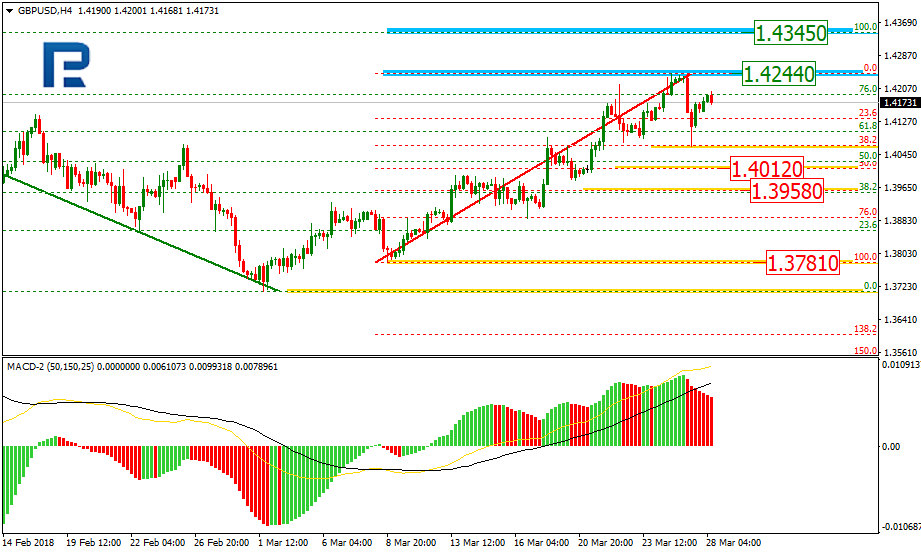
As we can see in the H4 chart, GBPUSD is forming a new ascending impulse inside the long-term uptrend. However, right now the price is forming a short-term descending correction, which has already reached the retracement of 38.2%. The next downside targets may be the retracements of 50.0% and 61.8% at 1.4012 and 1.3958 respectively. After breaking the local high at 1.4244, the instrument may continue growing towards the main resistance level at 1.4345. The closest support level is at 1.3781.

GBPUSD1
Risk Warning: the result of previous trading operations do not guarantee the same results in the future

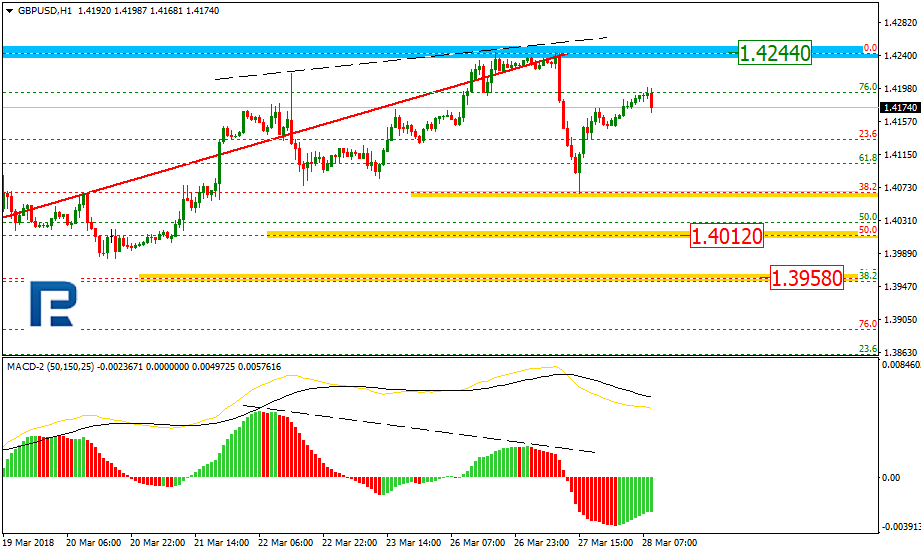
The H1 chart shows more detailed structure of the current movement. The closest downside target is the retracement of 50.0% at 1.4012.

GBPUSD2
Risk Warning: the result of previous trading operations do not guarantee the same results in the future


EURJPY, “Euro vs. Japanese Yen”

As we can see in the H4 chart, EURJPY is being corrected to the upside and has already reached the retracement of 23.6%. The next targets of the correction are the retracements of 38.2%, 50.0%, and 61.8% at 132.22, 133.22, and 134.22 respectively. The main support level is the local low at 128.94.

EURJPY1
Risk Warning: the result of previous trading operations do not guarantee the same results in the future

In the H1 chart, the pair is forming a short-term correction after completing a quick ascending impulse.

EURJPY2
Risk Warning: the result of previous trading operations do not guarantee the same results in the future


RoboForex Analytical Department

Article By RoboForex.com

Attention!
Forecasts presented in this section only reflect the author’s private opinion and should not be considered as guidance for trading. RoboForex LP bears no responsibility for trading results based on trading recommendations described in these analytical reviews.

EURUSD: expecting the downwards correction to intensify to reach 1.2350

By Gabriel Ojimadu, Alpari

Previous:

On Tuesday the 27th of March, trading on the EURUSD pair closed down. The euro retreated to 1.2373 against a broadly resurgent dollar. This growth for the dollar was largely down to technical factors as well as an easing in tensions over the trade dispute between the US and China.

Bloomberg reported on Monday that US Finance Minister Steve Mnuchin has been discussing the trade deficit with Chinese Finance Minister Liu Kun and said he is hopeful that a deal can be reached.

The US has asked China to reduce tariffs on American cars, to give US companies greater access to China’s financial sector, and for China to buy more US semiconductors.

Day’s news (GMT+3):

  • 11:00 Switzerland: ZEW survey – expectations (Mar).
  • 13:00 UK: CBI distributive trends survey – realized (Mar).
  • 15:30 USA: GDP (Q4), goods trade balance (Feb).
  • 17:00 USA: pending home sales (Feb).
  • 17:30 USA: EIA crude oil stocks change (23 Mar).

Fig 1. EURUSD hourly chart. Source: TradingView

The pair exited the symmetrical triangle upwards to hit the 1.2476 mark. Missing the 90th degree by 4 pips, the pair then rebounded downwards to reach 1.2432. On the back of a mass closing of long positions, sellers stood on the balance line at 1.2396 up until the US session. The drop eventually stopped at 1.2373.

The correction has been going on for 15 hours and now we’re again seeing short positions on the single currency. At the time of writing, the euro is trading at 1.2394. Sellers are testing the trend line.

The hourly cycles suggest a declining euro up until 14:00 EET on the 30th of March. For now, I’m predicting a drop to 1.2353, taking Thursday’s Asian session into account.

The euro crosses paint a mixed picture as does the US dollar. The dollar is rising against a lot of the majors, except for the pound and Aussie.

I’m ignoring the US GDP figures since this is a third reading and won’t have much of an influence on markets. This week marks the end of the first quarter of 2018.

Source: EURUSD: expecting the downwards correction to intensify to reach 1.2350

The Irresistible Rise of Mobile in Business

Mobile applications are no longer a luxury that only some companies can afford to have. They have become a fundamentally important element in this new market development. Such is the impact of mobile development that we now have countless courses, certifications, and entire careers focused on it, not to mention the cascade of jobs that come along.

Some numbers are even hard to believe. By 2019, there will be approximately 2.66 billion smartphone users worldwide, roughly 1 out of 3 people. That is absolutely impressive; cellphones have stopped being just a means to communicate bilaterally with other people, they are now our gateways to global information. Mobile apps, games, gadgets, multimedia content, social media, live news feed, you name it. We want it all, and we want it on-the-go.

This behavioural change is driving everybody in the market to quickly adapt to our needs and demands. No matter which division of the market you function in, your products and/or services absolutely must be available to your customers not only locally, or by the Internet, but most importantly, on mobile devices.

The Reality of the Mobile Surge

Ready for some more jaw-dropping stats? By 2017, the number of downloaded apps will have reached 268 billion and will have generated over $77 billion in revenues. Between 2011 and 2016 the mobile advertising revenue is expected to grow by a stunning 400%. And with the rise of Near Field Communication or NFC, by 2015, 1 out of 3 consumers brands will offer integrated payment methods in their mobile apps, they will work as some kind of electronic wallet.

Thinking about becoming a mobile developer yourself? Definitely not a bad idea, by 2014, mobile app developers were earning an average of between $100K – $144K annually in the United States and this average is only expected to keep on growing.

Now, while the gap between smartphone vendors is relatively small – a slight lead by Samsung over Apple at 21.4% and 18.7% respectively – there is one absolute leader when talking about OS. Android boasts an astonishing 82.8% market share over the rest of its competitors; both stats as reported by the last quarter of 2015.

Why Should my Company Go Mobile?

When talking about the exact reasons why your company should go mobile, there are some minor considerations to take. If your company is aiming to offer this mobile app as some type of product, then, of course, you should charge for it. Maybe even offer a free demo app, with limited features.

If, however, you’re a company which offers its customers some kind of service, then most definitely your mobile app must come free of charge to all of them. Its quality and special features are going to be huge factors when your clients have to choose whether or not to continue using your services.

This is extremely important because they make that choice almost every day, as they are bombarded with several other offers from your competitors. In this way, a great mobile app will contribute to creating a feeling of uniqueness, so your customers won’t have the need to replace you.

Who Can Benefit from this Mobile Revolution?

The truth is, everyone. And as stated above, especially companies which offer some kind of service to their customers, and finance companies are a great case study. Banks, brokers, and online trading platforms are all investing in mobile development quite heavily.

Companies like UK based CMC Markets are presenting their investors state-of-the-art mobile apps for both Android and iOS, where they can seamlessly integrate and analyze all of the relevant market information to help them make smart and factual-based trading decisions.

This is remarkable because it gives all investors a secure and intelligent platform to perform trading operations without necessarily having to be in front of a computer, and with a market as volatile as the one we’re living in right now, it could potentially translate into huge profits, all on-the-go.

By Taylor Wilman

The Economic Moral Hazards of the International Criminal Court – and the Philippines Withdrawal

By Dan Steinbock  

As the Philippines is withdrawing from the International Criminal Court, ICC is blaming the Duterte government. In reality, the withdrawal is still another example of the erosion of the ICC’s credibility, its failure at judicial independence and gross bias against the emerging world.

In February, the ICC said it was investigating allegations that the Philippines president had committed “crimes against humanity” by facilitating extrajudicial killings and other rights abuses in the war against drugs. These charges, which have often relied on flawed data, have been pushed by two Duterte critics. Known for his coup efforts, controversial senator Antonio Trillanes has spent much time in Washington and Europe to gain support, while the obscure Jude Sabio has gained notoriety as a hit man lawyer. What’s not known is who funds the two and why leading Western media companies have bought their stories with hardly any source scrutiny.

In Manila’s view, the ICC can only investigate criminal cases if domestic courts are unable or unwilling to do so, and neither applies to the Philippines. Moreover, Philippine polls indicate that more than 70 percent of Filipinos stand behind Duterte and are more satisfied with his government than any previous one.

Yet in March, the controversial UN’s High Commissioner for Human Rights (HCHR), Prince Zeid Ra’ad al-Hussein, joined the ICC debacle saying that Duterte needed a psychiatric evaluation. During Zeid’s tenure, the HCHR has repeatedly been accused of efforts at domestic policy intervention, which impinges on state sovereignty. As Zeid played a central role in the founding of the ICC from the mid-90s to 2010, his statement triggered valid concerns in Manila about the institution’s neutrality.

The withdrawal of the Southeast Asia’s most rapidly-growing economy from the ICC would not be either the first or the last of its kind. The credibility of the ICC is under erosion. The case of the Philippines is just the latest nail in the coffin.

Targeting the poorest and the weakest

For a decade or two, the ICC has suffered from an odd inclination to go after the poorest countries in Africa, which has suffered the worst and longest from colonial massacres and plunder – and still does. The prosecution of President Uhuru Kenyatta led to the Kenyan parliament’s call for withdrawal from the ICC and the call on more than 30 African member states to withdraw their support.

The frustration led to a special African Union (AU) summit in 2013 in which Uhuru accused the ICC of being “a toy of declining imperial powers.”

ICC Prosecutor Luis Moreno Ocampo charged Uhuru as an indirect co-perpetrator in the violence that followed the 2007-08 Kenyan crisis. Uhuru is a popular, highly-regarded politician and the son of the famed anti-colonial leader Jomo Kenyatta. After a three-year juridical chaos, the ICC charges were dropped in March 2015 for lack of evidence. If the case undermined the ICC’s credibility, wasting resources and causing gratuitous political turmoil, why was Uhuru targeted?

Certainly, his political opposition hoped to benefit from his demise. It was led by Raila Odinga and his Orange Democratic Movement, which was reportedly named after the Ukrainian “Orange Revolution” as billionaire George Soros’s Open Society funded the pro-Odingakey NGOs, and Kenyan think-tanks to stop President Uhuru from the 2013 general election due to the ICC trials. As the ICC process began to penalize Kenya’s political leadership, economic growth almost halved to 4.6 percent in 2012 stabilizing thereafter but at a significantly lower level than in 2010.

In the past few years, many African leaders have reproached the ICC of “mishandling complex African issues,” and several countries, including South Africa, intend to withdraw from the ICC. In addition to President Uhuru, almost 40 individuals have been indicted by the ICC, including Ugandan rebel leader Joseph Kony, Sudanese president Omar al-Bashir, Libyan leader Muammar Gaddafi, Ivorian president Laurent Gbagbo, and Congolese vice-president Jean-Pierre Bemba.

Many cases suggest a pattern of sequence and orchestration: promising development, political destabilization in the name of “democratization,” financial speculation, new leaders, weaker development.

ICC’s compromised former prosecutor

Since fall 2017, even Ocampo’s ICC role has elicited questions. While his legal expertise is highly-regarded, his ties to Soros-supported organizations stem from the early 1990s, when Soros began to infuse funds into a real estate conglomerate (IRSA), a prominent backer of Ocampo’s NGO in Argentina. In the mid-‘90s, Ocampo began to work for Transparency International, a corruption watchdog that has been criticized for bias against developing countries, overseeing work on Latin America. A decade later, he participated in a roundtable by Soros’s Open Society called “Restoring American Leadership – the International Criminal Court.”

When the UN Security Council assigned Ocampo the task of investigating war crimes in Libya, which was soon hit by airstrikes of France, Britain, the US and other countries, Ocampo reportedly shared confidential information about ongoing investigations with a party to the conflict; the French foreign minister’s cabinet chief.

Ocampo indicted Gaddafi and his son Saif al-Islam for war crimes in 2011 before leaving his job at the ICC for a lucrative career in private practice. According to a French investigative website Mediapart, and a Spiegel team, he then agreed to a contract worth $3 million over three years, plus $5,000 a day, to “protect” and advice an influential Libyan oil billionaire Hassan Tatanaki who had close links with the Colonel Muammar Gaddafi and was deeply involved with the Libyan civil war; Ocampo used insider information to protect his client from possible prosecution by the ICC.

More recently, Tatanaki has been linked to a Libyan militia accused of extrajudicial killings and other rights violations. Reportedly, the contract was terminated after three months, with the ex-prosecutor earning $750,000. Yet, he used ICC employees to continue to carry out PR work for Tatanaki and was paid to do so, which was still another potential breach of the ICC’s code of conduct.

As the champion for transparency, Ocampo made millions of dollars in such deals routing monies to his offshore companies in several tax havens, as evidenced by the Panama Papers. Ironically, he used what he had learned about corruption to benefit from illicit capital flows. As he later said, he wanted to “make some more millions” because the ICC salary (€200,000) was inadequate for his needs.

Unsurprisingly, perhaps, the ICC secured its first verdict only in 2012, when Ocampo’s nine-year tenure at the ICC was about to end. Last fall, the ICC said that its current prosecutor Fatou Bensouda had asked Ocampo to “refrain from any public pronouncement or activity that may — by virtue of his prior role as ICC prosecutor — interfere with the activities of the office or bring it into disrepute.”

Who controls the ICC

Usually, economic power translates to political control. The ICC is not an exception. Yet, the ICC’s funding is not transparent. It is financed “primarily” by its member states. The contributions of each state are determined by the method used by the UN, which roughly corresponds with a country’s income. In 2017, the ICC’s budget was €145 million. About two-thirds came from only 10 countries, more than half from Europe’s former colonial powers and the rest from Japan, South Korea, and Canada.

In the world economy, the EU accounts for about a fifth of the total; its funding of the ICC is thus three times its share of the global economy. Yet, according to the ICC, “additional funding is provided by voluntary government contributions, international organizations, individuals, corporations, and other entities.”

The lack of transparency and accountability creates potential for gross moral hazard. For instance, multinationals that have funded war lords in Africa to extract oil, gas, minerals and conflict diamonds might be particularly interested in targeting African politicians in the ICC.

Critics believe that as the ICC ignores the governments and focuses on their leaders, it may support flawed investigations that ignore the role of the governments while tacitly supporting regime change through new leaders. In some cases, prosecution of leaders in the ICC has made them less likely to peacefully step down. Also, success in investigations requires state cooperation, which the ICC mandate shuns and that can result in inconsistent and discriminatory selection of cases.

Unsurprisingly, the half a dozen countries that voted against the ICC Statute in 1998 included both the US and China. While President Clinton signed the Statute, he knew that it would never be ratified on Capitol Hill.

More recently, the US and Russia have said they no longer intend to become ICC members and thus have no legal obligations arising from their signature of the Statute. China’s view is that the ICC goes against the sovereignty of nation states.

Advanced economies’ court?

It was the Rome Statute of the International Criminal Court that led to the creation of the ICC in 1998. Nevertheless, its ability to investigate and prosecute is severely restricted by its mandate and, due to its creation in 2002 it can only prosecute crimes after that date. That conveniently suspends the worst genocides, crimes against humanity, war crimes and crimes of aggression – the four core international crime categories that the ICC claims to focus on.

Today, there are more than 120 state parties to the Rome Statute. Over 30 countries have signed but not ratified the statute, and there are more than 50 non-signatory countries. Let’s look more closely at the countries that are parties to the Rome Statute and those that aren’t.

The overwhelming majority of the world populations have not joined the Rome Statute. The most populous middle-income economies remain outside the ICC. Only the smaller populations of high-income economies see the ICC as useful. Among the poorest economies, half have joined the ICC and another half hasn’t.  Many have been forced to adjust to major powers’ status quo (Figure 1a).

The economic story is even clearer. It has been very much in the interest of the high-income economies to join the ICC. Conversely, it has been very much in the interest of the less prosperous middle-income economies to stay away from the ICC, along with low-income countries (Figure 1b).

Figure 1 Parties and Non-Parties of the ICC:

High-, Middle- and Low-Income Economies, 2017

  1. By Population (millions)


  1. By Gross Domestic Product (GDP, $ millions)

Sources: ICC, IMF.

In Asia, neither China nor India is a signatory. In Southeast Asia, both relatively wealthier countries (Singapore, Brunei, Malaysia) and emerging economies (Indonesia, Thailand, Vietnam, Myanmar, Lao) have not signed the Statute.

Cambodia did ratify the Statute in 2002, which may be currently contributing to elevated tensions in the country. The Philippines signed the Statute in 2000 but did not ratify it. That’s what most US partners did at the time emulating Washington’s stance. Yet, President Aquino did sign the Statute in February 2011, right before he aligned Manila’s foreign policy with President Obama’s security pivot to Asia geopolitically – but in contrast with almost all BRIC and ASEAN economies.

The simple reality is that, in the past two decades, the ICC’s credibility has deflated and its judicial independence has been compromised. Distressingly, it has shown gross bias against emerging and developing economies. A membership in such an international court is no litmus test for the advocacy for human rights in which the Philippines has a long history.

About the Author:

Dr Dan Steinbock is the founder of Difference Group and has served as research director at the India, China and America Institute (USA) and visiting fellow at the Shanghai Institutes for International Studies (China) and the EU Center (Singapore). For more, see https://www.differencegroup.net/  


The original commentary was published by The Manila Times on March 20, 2018.