Author Archive for InvestMacro – Page 428

Fibonacci Retracements Analysis 04.05.2018 (BITCOIN, ETHEREUM)

Article By RoboForex.com

BTCUSD, “Bitcoin vs US Dollar”

As we can see in the H4 chart, BTCUSD has finished its short-term correction and started a new ascending impulse. Right now, the price is testing the previous high. After breaking it, the instrument may continue trading towards the post-correctional extension area between the retracements of 138.2% and 161.8% at 10172.00 and 10430.00 respectively. The support level is at 8986.30.

BTCUSD1
Risk Warning: the result of previous trading operations do not guarantee the same results in the future

The H1 chart shows more detailed structure of the current movement. The price is trying to break the high.

BTCUSD2
Risk Warning: the result of previous trading operations do not guarantee the same results in the future


ETHUSD, “Ethereum vs. US Dollar”

As we can see in the H4 chart, after breaking the high, ETHUSD continued moving inside the uptrend and has already reached the post-correctional extension area between the retracements of 138.2% and 161.8%. The next upside target may be the retracement 261.8% at 902.50. The support level is at 711.76.

ETHUSD1
Risk Warning: the result of previous trading operations do not guarantee the same results in the future

In the H1 chart, the pair is being corrected inside the post-correctional extension area.

ETHUSD2
Risk Warning: the result of previous trading operations do not guarantee the same results in the future


RoboForex Analytical Department

Article By RoboForex.com

Attention!
Forecasts presented in this section only reflect the author’s private opinion and should not be considered as guidance for trading. RoboForex LP bears no responsibility for trading results based on trading recommendations described in these analytical reviews.

Forex Technical Analysis & Forecast 04.05.2018 (EURUSD, GBPUSD, USDCHF, USDJPY, AUDUSD, USDRUB, GOLD, BRENT)

Article By RoboForex.com

EURUSD, “Euro vs US Dollar”

EURUSD is still consolidating. If later the instrument breaks this range to the upside, the market may start another correction to reach 1.2040; if to the downside – resume trading to the downside towards the short-term target at 1.1900.

EURUSD
Risk Warning: the result of previous trading operations do not guarantee the same results in the future


GBPUSD, “Great Britain Pound vs US Dollar”

GBPUSD is consolidating. If later the instrument breaks this range to the upside, the market may start another correction to reach 1.3700; if to the downside – resume trading towards 1.3505.

GBPUSD
Risk Warning: the result of previous trading operations do not guarantee the same results in the future


USDCHF, “US Dollar vs Swiss Franc”

USDCHF continues consolidating. If the instrument breaks this range to the downside, the market may start another correction to reach 0.9924; if to the upside – continue growing towards 1.0050.

USDCHF
Risk Warning: the result of previous trading operations do not guarantee the same results in the future


USDJPY, “US Dollar vs Japanese Yen”

USDJPY is consolidating as well. If the instrument breaks this range to the downside, the market may start another decline to reach 107.40; if to the upside – continue growing towards 109.75.

USDJPY
Risk Warning: the result of previous trading operations do not guarantee the same results in the future


AUDUSD, “Australian Dollar vs US Dollar”

AUDUSD is trying to break its consolidation range. Possibly, today the price may be corrected towards 0.7583 and then fall to reach 0.7542. After that, the instrument may start another ascending structure with the target at 0.7600.

AUDUSD
Risk Warning: the result of previous trading operations do not guarantee the same results in the future


USDRUB, “US Dollar vs Russian Ruble”

USDRUB is moving downwards. Today, the price may break the consolidation range to the downside. If later the instrument breaks this range to the upside, the market may continue growing to reach 65.00; if to the downside – resume trading falling towards 62.20.

USDRUB
Risk Warning: the result of previous trading operations do not guarantee the same results in the future


XAUUSD, “Gold vs US Dollar”

Gold is being corrected towards 1320.00. Later, the market may fall to reach 1311.00 and then resume growing with the target at 1323.00. After that, the instrument may continue trading to the downside to reach 1292.00.

GOLD
Risk Warning: the result of previous trading operations do not guarantee the same results in the future


BRENT

Brent has returned to 74.40. Possibly, today the price may fall towards 73.30 and then grow to reach 74.50. If later the instrument breaks this range to the downside, the market may start another correction to reach 71.60; if to the upside – resume growing towards 76.33.

BRENT
Risk Warning: the result of previous trading operations do not guarantee the same results in the future


RoboForex Analytical Department

Article By RoboForex.com

Attention!
Forecasts presented in this section only reflect the author’s private opinion and should not be considered as guidance for trading. RoboForex LP bears no responsibility for trading results based on trading recommendations described in these analytical reviews.

Traders look to payrolls report

By Orbex Blog

Daily Forex Market Preview, 04/05/2018

The U.S. dollar was seen holding ground on Thursday albeit trading mixed. Economic data on the day included the UK’s services PMI. Data showed that services sector activity increased modestly from March’s 51.7 to 52.8.

In the Eurozone, the flash inflation estimates showed that headline inflation rebounded to 1.2% but this was below forecasts of a 1.3% increase. Core inflation rate eased further to 0.7%.

The ISM’s non-manufacturing PMI data showed that the index eased to 56.8 missing forecasts and down from March’s reading of 58.8

Looking ahead, the economic data for the day will see the nonfarm payrolls report standing out. Median forecast point to the U.S. unemployment rate potentially easing to 4.0% in the month of April. The number of jobs added during the month is expected to rebound from March’s 103k to 189k. Wage growth which also remains a key component is expected to show a 0.2% increase on a month over month basis. A better than expected report could potentially renew hawkish bets on the U.S. dollar.

Elsewhere, the Canadian Ivey PMI data is due to be released today. A number of Fed speeches are also lined up including Dudley, Williams and Quarles.


EURUSD intra-day analysis
EURUSD 04.05.18

EURUSD (1.1987): The EURUSD was seen closing weaker on the day as price action fell to a fresh 4-month low at 1.1954. The decline to this support level coincided with the support level that was established in late November 2017. Price action has remained slightly volatile after slipping to this level. In the near term, we expect to see the EURUSD consolidate around this level of support before possibly posting a rebound. The resistance level at 1.2090 – 1.2070 remains as a key level to the upside and therefore, the EURUSD could remain range bound within these levels.


GBPUSD intra-day analysis
GBPUSD 04.05.18

GBPUSD (1.3576): The British pound continued its decline although price action remains supported above the price level of 1.3530. The weaker services PMI data cast doubts on whether the BoE would be able to hike rates next week. This led to the GBPUSD posting declines. From a technical outlook, we expect to see the currency pair consolidating near the current levels of support. A rebound off this price level could signal a potential move to the upside. The breached trend line remains a key dynamic resistance level if there is a correction.


XAUUSD intra-day analysis XAUUSD 04.05.18

XAUUSD (1312.88): Gold prices managed to breakout above the price level of 1311 – 1307. A close above this support level now suggests a potential upside move in prices. The resistance level of 1325.50 remains a key level for price action to test. In the near term, we expect gold prices to remain range bound within the current levels. The support at 1311 – 1307 is likely to hold the declines in the near term. However, if this support level gives way, we could expect gold prices to drop toward the 1300 level of round number support.


US-China trade talks in focus, Dollar waits for NFP

Article by ForexTime

Asian stock markets fell while the Japanese Yen held steady, as investors closely monitored tense trade talks between the United States and China, in Beijing.

The chances of a breakthrough trade deal from the two-day meeting are seen as highly unlikely. However, the talks could be a positive step for the two nations to avoid a potential trade war. Although it is difficult to predict the outcome of the trade meetings, continual talks and negotiations between the Trump administration officials and Chinese officials may ease tensions. Any signs of a possible breakdown in negotiations between the US and China have the ability to weigh on risk sentiment, consequently punishing global stocks.

Will NFP push the Dollar higher?

It has certainly been another incredibly positive trading week for the Dollar, which has rallied to its highest level this year, moving above 92.80.

Friday’s main risk event will be the monthly US jobs report for April which should offer fresh insight into the health of the labour market. With inflation expectations rising and strong economic data boosting sentiment, today’s NFP report will be in sharp focus. Markets expect the US economy to have added 195k jobs in April, up from 103k in March, while unemployment is predicted to drop to 4.0% from 4.1%.

While the headline NFP figures and unemployment rate are both of great importance, much attention will be directed towards wage growth. Any signs of accelerating wage growth will suggest that inflationary pressures are building, ultimately reinforcing expectations of a rate hike in June.

Taking a look at the technical picture, the Dollar Index is firmly bullish on the daily charts. Although prices retreated from near 2018 highs on Thursday, this has less to do with a change of sentiment towards the Dollar, and more to do with investors profit taking. The Dollar Index trades firmly above the 200 Daily Simple Moving Average, while the MACD has crossed to the upside. Bulls remain supported above the 92.00 level with 93.00 acting as a key level of interest. Alternatively, sustained weakness below 92.50 could invite a decline back towards 92.00.

Commodity spotlight – Gold

Gold prices were flat during early trading on Friday as investors positioned themselves ahead of the anticipated US jobs data release.

Price action suggests that Gold bulls and bears have been engaged in a tug of war since the start of the trading year, with support at $1300 and resistance at $1360. While geopolitical tensions and overall uncertainty supported bulls, bears have received constant inspiration from US rate hike expectations. With prices sinking close to the $1300 support level this week amid an aggressively appreciating Dollar, could the tug of war be coming to an end?

Gold bears may be offered an opportunity to attack and conquer the $1300 level today, if the NFP data results exceed market expectations.

Taking a look at the technical picture, the yellow metal is under pressure on the daily charts. Previous support around $1324 could transform into a dynamic resistance that encourages a decline towards $1300 and $1260, respectively.

Disclaimer: The content in this article comprises personal opinions and should not be construed as containing personal and/or other investment advice and/or an offer of and/or solicitation for any transactions in financial instruments and/or a guarantee and/or prediction of future performance. ForexTime (FXTM), its affiliates, agents, directors, officers or employees do not guarantee the accuracy, validity, timeliness or completeness, of any information or data made available and assume no liability as to any loss arising from any investment based on the same.


Forex-Time-LogoArticle by ForexTime

ForexTime Ltd (FXTM) is an award winning international online forex broker regulated by CySEC 185/12 www.forextime.com

Leverate is celebrating its 10-year anniversary

Premium brokerage technology provider Leverate is celebrating 10 years of existence this month, and it is time to look back at this company’s achievements over the years.

It’s hard to believe just how much Leverate has evolved in one decade alone – from a single dedicated product to an all-out solutions and services provider.

Leverate was founded in 2008, when four friends from IDF decided to turn their programming skills into profit by creating an automated trading algorithm. The company’s first product as a pure technology provider was a fast and accurate price feed, designed to help brokers present the quickest results to their traders. Soon after, the company released its first self-made trading platform, Sirix, complete with its own server and a whole host of tools covering everything a broker needs – from risk management to CRM, from social trading to regulation compliance.

Throughout the years, Leverate expanded to a global business, opening financial services and sales offices from Cyprus to Hong Kong, and branched-out to crypto and marketing automation, growing from 4 to 150 employees in the process.

Yasha Polyakov, CEO of Leverate said: “In its 10 years of existence, Leverate has become a leading player in forex and general brokerage technology. In the same spirit, we will continue to excel in different fields in the upcoming years, from marketing automation to cryptocurrency and blockchain.”


US equities in spotlight before Non-farm

Article by ForexTime

It could be a case of the straw that breaks the camel’s back with the upcoming non-farm payroll data due out tomorrow. So far there have been some very strong economic figures out from the US economy, but there are also worries that Trumps trade wars could push the US economy into a recession, a voice that has been echoed recently by a letter signed by 1000 economists warning him of such at thing. However, the market will be watching employment figures as usual and with a keen sense of interest to see if Trump has made a dent in them recently as we start to head into the summer period. So far the market is expecting 192K tomorrow, which is a lot more robust than the previous 103K reading we saw last month, and a drop in the unemployment rate to a record 4%, something that seems tantalising close for the US economy.

Today however we saw the market react sharply though to bad news as US durable goods (core) m/m missed expectations to come in at 0.1% (0.5% exp), and the worry is that with non-farm payroll we could see another sharp turn in the market again. Something that would play out across the US dollar and of course US equity markets.

The biggest impact today was on the S&P 500 which faltered sharply in today’s trading before clawing back some ground as the bulls rushed back into the market. At present the US equity markets are very vulnerable to economic data and we’ve seen some big swings as of late. We’ve also seen the S&P 500 looking to sit between the 200 day moving average and the 100 and this looks like it may continue unless we saw a solid breakout of these levels. A very weak non-farm figure  tomorrow could push the S&P 500 much lower as markets are quite jittery at present compared to a year ago. If we see a positive figure I would look to see a push back up to the 100 day moving average at present, as it looks to act as dynamic resistance in this market.

Across the Pacific and the bears took a break today from the AUDUSD as it was upbeat for a change. This was on the back of weaker US dollar, but also the fact that the AUDUSD encountered strong support at 0.7472 as it bottomed out. There is a chance we could see further bearish pressure tonight with the Monetary policy report, so traders will be looking for a retest here and potentially a move to lower support at 0.7371. In the event it’s hawkish I would expect a breakout above 0.7546 and potentially move to the topside of 0.7638 as the bulls will be keen to have a crack at this one. All in all though, the Australian economy continues to struggle so it may be a hard ask for the Reserve Bank of Australia to be more optimistic at present – especially based of their recently neutral statements.

Disclaimer: The content in this article comprises personal opinions and should not be construed as containing personal and/or other investment advice and/or an offer of and/or solicitation for any transactions in financial instruments and/or a guarantee and/or prediction of future performance. ForexTime (FXTM), its affiliates, agents, directors, officers or employees do not guarantee the accuracy, validity, timeliness or completeness, of any information or data made available and assume no liability as to any loss arising from any investment based on the same.


Forex-Time-LogoArticle by ForexTime

ForexTime Ltd (FXTM) is an award winning international online forex broker regulated by CySEC 185/12 www.forextime.com

Chile holds rate, sees steady rate till inflation nears 3%

By CentralBankNews.info
      Chile’s central bank left its monetary policy rate at 2.50 percent and said its board “foresees that it will keep the monetary stimulus at its current level until macroeconomic conditions tend to consolidate the convergence of inflation towards 3%.”
      The Central Bank of Chile, which has maintained its rate since May 2017, added it expects inflation to remain low during the better part of this year and then rise toward the 3.0 percent target as the capacity gap gradually closes.
      But the persistence of low inflation, especially low core inflation, means the central bank will continue to monitor “with special care” the risk that inflation will not reach the inflation target.
      Chile’s headline inflation rate declined for the fourth consecutive month to 1.8 percent in March from 2.0 percent in February, with the central bank saying inflation was still driven by the appreciation of the peso, the current capacity gaps and indexation to lower inflation rates.
      Inflation expectations showed no significant change from the March monetary policy report, the central bank said, with analysts’ expectations for inflation one year ahead between 2.5 and 2.7 percent and between 2.8 and 3.0 percent two years ahead.
       Chile’s peso has appreciated since January 2016 though it eased in the last half of April in line with the trends seen in international markets.
      Today the peso was trading at 618.5 to the U.S. dollar, down 0.5 percent this year but up 8.2 percent than at the start of 2017.
       The latest data on economic activity and demand are in line with the baseline scenario in the March report, with growth in the first quarter significantly affected by the rise in mining. Activity in other sectors maintained the better performance seen in earlier months, with the central bank pointing to a greater contribution of several investment-related sectors.
      But private salaried employment has yet to recover and wages have decelerated, which the bank said could “take a toll on wage mass growth and possibly on consumption.”
       The economic expectations survey from April showed no major changes in expected growth for this year and 2019, with growth in each year seen somewhat above 3.5 percent.
       In March the central bank raised its forecast for growth this year to 3.0-4.0 percent from 2.5-3.5 percent.
       Last year Chile’s economy grew 1.5 percent, up from 1.3 percent in 2016.

       The Central Bank of Chile issued the following statement:

“At its monetary policy meeting, the Board of the Central Bank of Chile decided to hold the monetary policy interest rate at 2.5%, so the intensity of the monetary impulse is unchanged. The decision was adopted by the unanimous vote of all the Board members.

The international scenario and related risks are in line with the contents of the last Monetary Policy Report, including the downward bias on domestic activity. Growth prospects in the developed economies have stabilized around higher figures than the previous year’s, although several of them have seen a moderation of their earlier optimism. US inflation has accelerated in the margin, while markets continue to anticipate the gradual withdrawal of the monetary stimulus, and the Federal Reserve has maintained the orientation of its monetary policy path. Prospects for the materialization of monetary policy in Europe and Japan have moderated. In this context, the dollar has appreciated, reversing the trend of previous months.

Regarding emerging economies, China’s first-quarter GDP remained as dynamic as the quarter before, and the numbers continue to sustain the rebalancing of activity and the moderation of growth going forward. In Latin America, activity has shown mixed results. Inflation data has moderated in several countries, and the market outlook suggests that it will remain low for some time, while in other economies the pressure from the appreciated dollar has become stronger.

For most countries, global financial conditions remain favorable from a historic perspective. In recent weeks there have been some turbulences due to announced protectionist measures and geopolitical tensions; however, currently the main volatility indicators are very near those of the previous Meeting and the risk premiums remain bounded. In this context, most stock market indexes rose and so did long-term dollar interest rates, with different economies showing different magnitudes. Regarding commodities, the 10% increase in the Brent/WTI oil average prices stands out. Copper, with ups and downs, has hovered around its price of the previous Meeting. In the local financial market, long-term interest rates have not changed materially from the last Meeting, the same as risk premiums, which remain low from a historic standpoint. Stock market indexes rose in line with better business results. The peso depreciated with respect to the dollar in the last two weeks, following the trends of international markets.

With respect to the credit market, the Bank Credit Survey for the first quarter of 2018 reported a somewhat stronger demand in several segments, and marginal improvements in the supply of consumer loans and commercial credit to big companies. Interest rates remain low and credit growth is still bounded.

The latest data on activity and demand are consistent with the baseline scenario of the March Report. First-quarter growth in activity was significantly influenced by the increase in mining, favored by the low basis for comparison. Activity in the other sectors maintained the better performance of previous months, where worth highlighting was the greater contribution of several investment-related sectors. Investment in construction and other works continues to recover, while exports continue to grow in the main areas, consumer and business confidence are still in optimistic levels and financial conditions are comfortable. However, private salaried employment has yet to recover and nominal wages have decelerated in annual terms, which could take a toll on wage mass growth and possibly on consumption. The Economic Expectations Survey (EES) of April showed no major changes in expected growth for this year and next, both somewhat above 3.5%.

Annual CPI inflation declined to 1.8% in March, while core inflation—the CPIEFE—was again 1.6%, with minor differences with the last Report’s estimates. Its evolution, as has been the trend of the last few quarters, continues to be driven by the appreciation of the peso, the current state of capacity gaps and indexation to lower inflation rates. Y-o-y change in CPIEFE for goods persists in slightly negative ground, and for services it remains near 3%. Inflation expectations showed no significant changes. Accordingly, expectations one year ahead as measured by analysts’ surveys stand between 2.5% and 2.7% and two years ahead, between 2.8% and 3.0%.

The Board’s decision considered that inflation will remain low during the better part of 2018, to then advance more robustly toward the target during next year, consistently with a gradual closure of capacity gaps. The Board foresees that it will keep the monetary stimulus at its current level until macroeconomic conditions tend to consolidate the convergence of inflation towards 3%. The persistence of inflation at low levels, especially its core component, means that the risks of not achieving the target within the policy horizon remain, a situation that will continue to be monitored with special care. Thus, the Board reaffirms its commitment to conduct monetary policy with flexibility, so that projected inflation stands at 3% over the two-year policy horizon.

The minutes of this Monetary Policy Meeting will be published at 8:30 hours of Friday, 18 May 2018. The next Monetary Policy Meeting will be held on 13 June 2018 and the statement thereof will be published at 18:00 hours the same day.”

      www.CentralBankNews.info

US Dollar Cycle Rotation to Boost Oil & Other Commodities

By TheTechnicalTraders

Our recent analysis of the US Dollar has presented a very unique and interesting setup for traders – an opportunity for a general commodity rally with Oil leading the way.

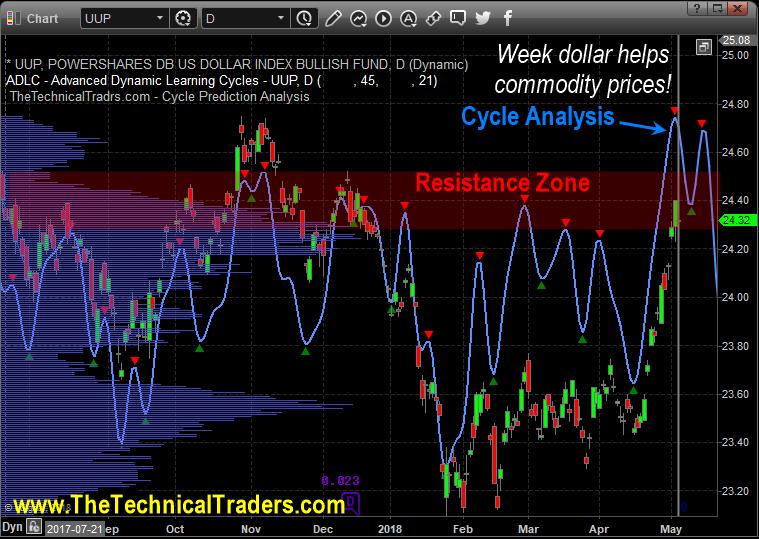
Taking a look at this Daily chart of the UUP (US Dollar Index Bullish Fund) with our Advanced Dynamic Learning Cycles price modeling system applied to it, we can see that the cycle analysis is predicting a rotational top in the US Dollar over the next 2~5+ trading days before a new bearish price trend pushes this US Dollar fund back to below the $24 level.  We have highlighted the Resistance Zone in red and we believe this rotating top will play out fairly quickly as an excellent opportunity for traders.

This general weakness setting up in the US Dollar should translate to strength in a number of commodities; Gold, Silver, Platinum, Oil and many others will likely see a 4~12% price increase if the US dollar contracts throughout this downward cycle rotation.

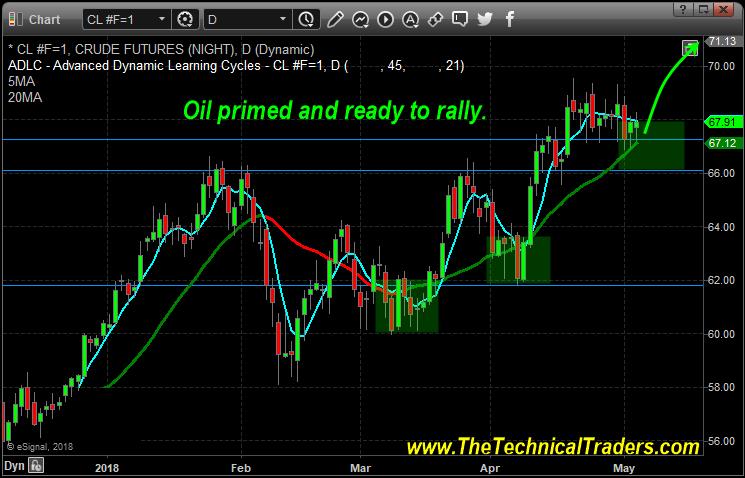
Oil is particularly interesting to us because we believe the rotational top in the US Dollar will result in support solidifying in Oil near or above $66 and launch Oil into a new upside rally to well above $70.  It makes sense to us that weakness in the US Dollar with the corresponding upside pressure exerted on commodities will present an easy upside move in Oil for traders who see this move coming and are willing to take the trade.

Any Oil price move below $67 is well within our GREEN highlighted support zone and should be considered a BUY ZONE for this trade.  Remember, as this rotational top in the US Dollar plays out, there could be some volatility in both the US Dollar and Oil, so spread out your trades over a couple days to reduce risk.

The upside potential for this trade is, in our opinion, 4~7% or more.  Our modeling systems expect a 5.25% upside swing from this move currently and we believe the upside may be a little bit more than this expectation.  We believe this is a solid trade setup and weakness in the US Dollar will be key to this trade playing out as we expect.  Remember, all of this is expected to happen within the next 10 to 20 trading days, so you have time to position your trades and take advantage of this move.

You can receive our daily pre-market analysis with index, oil, and precious metals trade signals by joining our Wealth Building Newsletter.

Chris Vermeulen


Turkey rate increase unlikely to benefit Lira, Rand higher after FOMC statement

Article by ForexTime

The South African Rand is showing some indications of recovery against the US Dollar in the aftermath of the latest FOMC statement. The Rand is up by 0.5% at time of writing with the Greenback also slipping lower against the Euro, British Pound, Yen and Aussie Dollar. External factors like demand for the Dollar is dictating the majority of swings in the global currency markets, explaining why the Dollar unexpectedly making a turnaround over the previous fortnight has resulted in the Rand moving back to levels not seen since December 2017. If the Dollar did encounter another reversal and suffer from investors taking profit, it would be seen as encouraging for the Rand.

The Dollar is showing signs of momentary weakness after the latest FOMC statement indicated to investors that the Federal Reserve will not raise US interest rates at a faster pace than has already been priced into the market. One of the main takeaways from the statement is that the Federal Reserve acknowledged that inflation is close to its target, but it appears this will not dictate the central bank accelerating its path of gradually raising US interest rates.

Where the US Dollar could head from here is a tough question to answer, especially when you consider how stunned most investors were by the unexpected turnaround in Dollar momentum over the past couple of weeks.

What could inspire further Dollar strength is if other developed central banks, like the Bank of England (BoE) and European Central Bank (ECB) remain hesitant towards tightening monetary policy. We have seen the British Pound suffer a nosedive following BoE Governor Mark Carney once again backtracking from his previous upbeat tone on higher UK interest rates, and this has provided a reminder that interest rate differentials between the Federal Reserve and other developed central banks can still drive traders towards the US Dollar.

One risk that investors do need to take into account over the near-term is that the United States is set to begin trade talks with China. There is a concern that a breakthrough in the trade tensions will be unlikely and any suggestions that there will be a breakdown in talks between the two largest economies in the world presents a risk that the financial markets will react. The trade talks carry the potential to negatively impact global stocks as a result of reduced risk appetite, and could also result in reduced purchasing momentum for emerging market currencies.

Gold manages to defend $1300

The ability of Gold to defend the psychological support level of $1300 will encourage investors to consider adding Gold to their portfolio around its current levels. If the trade talks between the United States and China do hit a wall, as many anticipate, during the early phases it would provide encouragement for investors to search for Gold as a safe haven asset. The Japanese Yen would also likely benefit if the trade talks between the U.S. and China did lead to a period of renewed uncertainty in the market.

Turkish Lira remains at risk to further historic weakness

Optimism that the Turkish central bank raising interest rates by 0.75% would prevent the Lira from another fall is at risk of falling on its head, as a result of concerns that the interest rate increase is too late to prevent the economy from overheating.

Standard & Poor’s announced yesterday that Turkey’s credit rating had moved into junk territory. Fears over a widening account deficit, inflation more than double the central bank target and an ongoing reoccurrence of political risk is going to continue discouraging traders from purchasing the Turkish Lira at its historic low levels.

Singapore Dollar climbs higher, Ringgit and Rupiah edge lower

The Malaysian Ringgit is coming under marginal selling pressure as the financial markets edge into the closing part of the week, with the USDMYR trading 0.13% higher at time of writing. The Indonesian Rupiah is showing a similar level of weakness to the Ringgit against the Dollar, which suggests that increased confidence that the Federal Reserve will raise US interest rates in June is behind the currency moves. The Singapore Dollar on the other hand is showing signs of increased momentum against the US Dollar with the USDSGD currently 0.32% lower for the day. Singapore is not seen as being as sensitive to higher US interest rates in comparison to its regional peers, which does provide some light behind why the Singapore Dollar is trading somewhat higher against the USD after the FOMC statement.

Disclaimer: The content in this article comprises personal opinions and should not be construed as containing personal and/or other investment advice and/or an offer of and/or solicitation for any transactions in financial instruments and/or a guarantee and/or prediction of future performance. ForexTime (FXTM), its affiliates, agents, directors, officers or employees do not guarantee the accuracy, validity, timeliness or completeness, of any information or data made available and assume no liability as to any loss arising from any investment based on the same.


Forex-Time-LogoArticle by ForexTime

ForexTime Ltd (FXTM) is an award winning international online forex broker regulated by CySEC 185/12 www.forextime.com

Will Rising Bond Yields Send Stock Prices Tumbling?

Conventional Wall Street wisdom says “rising rates are bad for stocks.” Let’s put that belief to a test.

By Elliott Wave International

One of the big financial news stories on April 24 was that the 10-year Treasury yield hit 3% for the first time since 2014.

The other big financial news story was that the DJIA closed 424 points lower on that day.

As you probably know, the conventional wisdom on Wall Street is that investors will sell stocks in favor of bonds when yields reach an attractive level. So, it’s not surprising that many pundits blamed the DJIA’s triple-digit decline on rising bond yields.

Here’s a sample April 24 headline along with higher bond yield warnings from the past few months:

  • Here’s the threat to the stock market from rising bond yields (Marketwatch, April 24)
  • Rising bond yields could win next round in battle with stock market (CNBC, Feb. 7)
  • How Spiking Bond Yields Could Topple a Stock Market Rally (Bloomberg, Feb. 4)

But, is the conventional wisdom that says higher bond yields will send stocks lower correct?

Well, our research reveals that there is no consistent correlation between interest rates or bond yields and the stock market.

Take a look at these charts from Robert Prechter’s 2017 book, The Socionomic Theory of Finance:

STF_2-2-5_portrait

The book notes:

Figure 2 shows a history of the four biggest stock market declines of the past hundred years. The graphs display routs of 54% to 89%. In all four cases, interest rates fell, and in two of those cases they went all the way to zero. … [Conversely, Figure 3 shows when stocks climbed as interest rates climbed].

[Yet,] there have been plenty of times when the stock prices rose and interest rates fell. It happened, for example, in the period from 1984 to 1987, when stock indexes more than doubled while interest rates fell by half, [as Figure 4 shows].

[Looking at Figure 5,]. there have also been times when stocks fell and interest rates rose, as in 1973-1974 when stock indexes dropped nearly in half as interest rates doubled.

So, you can see why it’s folly to forecast the stock market based solely on the direction of rates. What’s more, this lack of “cause and effect” doesn’t just apply to interest rates.

In fact, our research shows that there is not a single factor outside of the stock market itself that determines the trend of aggregate stock prices.

Elliott Wave Principle, the Wall Street classic book by Frost & Prechter, says:

Sometimes the market appears to reflect outside conditions and events, but at other times it is entirely detached from what most people assume are causal conditions. The reason is that the market has a law of its own.

We call that law the Elliott Wave Principle.

If you are prepared to take the next step in educating yourself about the basics of the Wave Principle — access the FREE Online Tutorial from Elliott Wave International.

The Elliott Wave Basic Tutorial is a 10-lesson comprehensive online course with the same content you’d receive in a formal training class — but you can learn at your own pace and review the material as many times as you like!

Get 10 FREE Lessons on The Elliott Wave Principle that Will Change the Way You Invest Forever.

This article was syndicated by Elliott Wave International and was originally published under the headline Will Rising Bond Yields Send Stock Prices Tumbling?. EWI is the world’s largest market forecasting firm. Its staff of full-time analysts led by Chartered Market Technician Robert Prechter provides 24-hour-a-day market analysis to institutional and private investors around the world.