Author Archive for InvestMacro – Page 427

From Trumped Equities to Gold

By Dan Steinbock

Despite misguided economic policies and rising geopolitical tensions, the long market expansion has prevailed. But times may be changing.

With the Trump fiscal policies and rearmament, America is taking more debt than in decades, even though its sovereign debt now exceeds $21.2 trillion, or 106 percent of the GDP. As fiscal stimulus kicks in (read: Trump’s tax cuts), the deficit will widen.

The US is now the only major advanced economy that’s expected to see a rise in the debt-to-GDP ratio over the next 5 years (almost 10%!). The huge leverage relies on the continued willingness of other countries to finance America’s imbalances, even as US debt held by other countries already hovers around $6.4 trillion.

Meanwhile, the Sino-US bilateral friction continues, along with talks on the North American Free Trade Agreement (NAFTA) with Canada and Mexico, and on tariffs with the EU. In Europe, political winds are rising, despite cyclical recovery. In Germany, Chancellor Merkel’s rule is more constrained politically. Italy is heading to elections in which the old center has been played out. In France, May riots indicate Macron’s liabilities. And volatility is escalating in the post-Brexit UK.

Multiple international geopolitical flashpoints – from the new Cold War against Russia, the unilateral effort to “renew” Iran sanctions, the escalation of violence from Gaza to Syria, the nuclear talks in the Korean Peninsula, and so on – will ensure that geopolitical risks will prevail, along with brickering about the Mueller investigation and mid-term elections in the fall.

And yet, US dollar has strengthened, while Dow Jones remains over 24,200. Is the market mispricing the risks, once again?

Uneasy markets – and gold

Since the Cold War, there have been several conjecture points as investor optimism and booming markets have given way to pessimist sentiments and bear markets, as evidenced by two decades of Dow Jones and gold prices.

In the Clinton and Bush years markets boomed as investor optimism was fueled by the technology bubble, speculation in real estate and finance until 2008. That’s when markets plunged and gold soared until it reached record highs of almost $1,900 in September 2011.

As central bankers in major advanced economies resorted to ultra-low interest rates and rounds of quantitative easing, a new market boom took off with President Trump’s arrival in late 2016 (Figure).

But does this mean that markets have a lot of potential to climb, while gold will remain subdued in the coming years?


Figure  Market Booms and Busts via Dow Jones and Gold, 1991-2018


Subdued gold in the short-term

Such views seem to be supported by the World Gold Council’s first quarter data, which suggests that gold demand had a soft start, mainly because of a fall in investment demand for gold bars and gold-backed ETFs. Yet, jewellery demand was steady as growth in China and the US covered for weaker Indian demand. Moreover, central banks bought 117 ton of gold (42% increase year-on-year) and technology demand extended its upward trend.

Gold is again beginning to attract investors, especially those that build on secular trends rather than short-term fluctuations. Some believe that gold prices have broken their downtrend line, but others think that these fluctuations reflect longer-term secular trends.

In long term, secular stagnation is broadening across the major advanced economies, which cannot be disguised by monetary injections, huge leverage and overpriced markets. While the Fed is tightening, central banks in Europe and Japan continue quantitative easing and record-low interest rates. Historically, periods of low rates – or negative rates – tend to correlate with gold returns that are significantly higher than their long-term average.

With increasing global jitters, investors are seeking out traditional havens from geopolitical risks. Yet, Treasuries are no longer the obvious choice as central banks have turned the bond market into a bubble territory.

… While secular trends support gold

Several emerging economies, which today fuel most of global growth prospects, are intrigued by the idea of re-coupling gold with a multilateral currency basket to avoid excessive exposure to US denominated energy and commodity markets. As the China-supported One Belt One Road (OBOR) initiatives advance, new arrangements are bypassing US dollar.

While advanced economies, such as the US (8,134 tons) and Germany (3,374 tons), still own most global gold reserves, they are either keeping their current levels of gold or reducing reserves. In contrast, while the large emerging economies, including Russia (1,858 tons) and China (1,843 tons), own less gold, they are increasing their gold reserves far, far faster.

In the past decade, the US has increased its gold holdings by only some 0.5 ton, while Germany has cut its reserves by almost 50 tons. In contrast, China has tripled its reserves, while Russia has nearly quintupled its gold, despite rounds of sanctions.

As some 90 percent of the physical demand for gold comes from outside the US, gold is on the right side of the future.

About the Author:

Dan Steinbock is the founder of Difference Group and has served as research director of international business at the India, China and America Institute (US) and a visiting fellow at the Shanghai Institute for International Studies (China) and the EU Centre (Singapore). For more, see http://www.differencegroup.net/ 

The original commentary was released by DifferenceGroup on May 5, 2018
 

Emerging markets face punishment from stronger Dollar

Article by ForexTime

The unprecedented turnaround of fortunes for the US Dollar is continuing to leave a lasting impression on the FX markets, following the Dollar Index’s rise to above 92.80 on Monday, a new milestone for 2018. The emerging market currencies are now playing catch up with some of the excessive losses seen in developed currencies like the Euro, British Pound and Japanese Yen over the past couple of weeks, with the Dollar broadly stronger against the emerging markets at the start of the week. Asian currencies have also fallen victim to the latest round of USD buying momentum. The Japanese Yen, Singapore Dollar, New Taiwan Dollar, Korean Won, Philippine Peso, Indonesian Rupiah, Chinese Yuan, Malaysian Ringgit and Thai Baht are all suffering as a result of the USD’s strength at time of writing.

While there will be concerns that the extended run of Dollar-buying momentum risks spelling pain for the emerging markets in ways not seen since the Federal Reserve began raising US interest rates back in 2015, emerging market investors should not panic. It must not be forgotten that we are encountering an unexpected global theme where the Dollar has become unexpectedly stronger than the overwhelming majority of its counterparts. The British Pound has nosedived 5.5% since April 17th, while the Euro has lost 3.7% during the same period.

Rather than investors becoming concerned about the future prospects of the emerging markets, the real question to ask is –  what exactly has encouraged such a turnaround in investor demand for the Dollar? Many will be inclined to look towards the 10-year US treasury yields, that are above 3% for the first time since 2014, as being the main catalyst behind the Dollar drive. Although I am personally leaning towards the view that increased interest rate differentials between the United States and its developed peers are what is causing the move in the US Dollar. Both the Bank of England (BoE) & European Central Bank (ECB) have seemingly backtracked from their own interest rate ambitions over the past couple of weeks. This has reminded investors that the Federal Reserve remains significantly beyond its developed peers when it comes to normalizing monetary policy.

Euro hits new 2018 low

The EURUSD has resumed its recent downward spiral by falling below 1.19 for the first time since late 2017. A new round of weak economic data has exposed further fears that the Euro area is at risk of entering another downturn. I personally feel that this view is a little unfair, considering that the Eurozone outperformed all expectations throughout the previous year. The latest EU data will however provide the ECB with more reason to remain hesitant on raising  interest rates, meaning that  increasing interest rate differentials between the United States and Europe risk exposing the EURUSD further to the downside.

China and Nafta talks still in spotlight

The first round of negotiations between the United States and China concluded at the end of last week with no breakthrough, as expected. While ongoing talks behind the scenes have eased tensions around a potential trade war between two of the largest economies in the world, investors will remain on high alert for trade threats, as long as the discussions fail to bring any tangible results.

Oil benefits from Iran risk

Persistent fears that President Trump will pull out of the Iran nuclear deal later this week have played a pivotal role behind the price of US Oil rising above $70 for the first time since November 2014. With Trump having referred to the Iran agreement in the past as “the worst deal ever”, it is not difficult to understand why investors are pricing in heavy risk premiums into the price of oil before Trump’s announcement on the Iran nuclear deal this evening. It does need to be remembered that there will be wider implications than the price of oil, if Trump does abandon the 2015 nuclear deal.

Iranian President Hassan Rouhani has already warned that the US would “regret” its decision to exit the nuclear deal, and concerns over how Iran might react to the United States pulling out do not appear to have been factored into other asset classes.  One of the most difficult questions to answer is what impact the United States pulling out of the deal might mean for politics in the Middle East.

There is a likelihood of market uncertainty in the lead up to Trump’s “decision” on the Iran nuclear deal today, and I think the Japanese Yen and Gold will be sought from investors if there is a period of risk aversion in the markets.

Ringgit weakens ahead of General Election

Ahead of an extremely busy week for the Malaysian economic calendar, the  Ringgit is showing signs of weakness against the USD.

The intense buying momentum in the USD has probably been the main contributor to the Ringgit fluctuations, but the general election later this week will still be seen as a potential event risk. If there is unexpected uncertainty with the election in Malaysia, it can’t be ruled out that the Ringgit could find itself at risk of further selling pressure.

Rupiah weakens as Indonesia GDP disappoints

The Indonesian Rupiah tumbled to its lowest levels since December 2015 at 14,000, after GDP growth in Indonesia showed signs of weakness in the first quarter of 2018. The headline GDP miss has been attributed to weak consumption, and the news failed to help the Rupiah pull away from its recent rut that has seen the currency take the position of the second-worst Asian performer over the past three months.

The slower pace of economic growth is going to make it difficult for Bank Indonesia to raise interest rates, despite calls for the central bank to take action in an effort to prevent the local currency from further weakness.

Disclaimer: The content in this article comprises personal opinions and should not be construed as containing personal and/or other investment advice and/or an offer of and/or solicitation for any transactions in financial instruments and/or a guarantee and/or prediction of future performance. ForexTime (FXTM), its affiliates, agents, directors, officers or employees do not guarantee the accuracy, validity, timeliness or completeness, of any information or data made available and assume no liability as to any loss arising from any investment based on the same.


Forex-Time-LogoArticle by ForexTime

ForexTime Ltd (FXTM) is an award winning international online forex broker regulated by CySEC 185/12 www.forextime.com

USD traders aim for week ahead

Article by ForexTime

The USDJPY has been going through some interesting changes as of late, as the USD has surged back into vogue with bullish traders. This in part has been lead by stronger than expected US economic data – bar the recent NFP reading – which in turn has helped boost the prospects for the US economy and the outlook for inflation. As a result traders are clearly being much less risk averse and looking to move out of safe haven currencies, and this can be clearly seen in the USDJPY which has been climbing the charts strongly over the past two weeks. Originally many had worried about the Abe scandal regarding property, but that seems to have fallen to the way side and not having as large as impact as people had speculated. As a result the Yen continues to be quite strong, but the USD much more stronger.

One of the major points about the USDJPY has been the technical’s which it plays off strongly, and there has been a strong trend line which the USDJPY has been respecting thus far. The last two daily candles have seen a strong bounce under bearish pressure, so it’s clear that bulls are keen to keep the USDJPY on track. Right now we’ve also seen a rejection off resistance at 109.347, showing that right now the USDJPY is between a rock and a hard place and traders will be looking for direction based off the next major move. If we do see a push through 109.347 then I would expect to see bulls looking to target 111.083. If the bears however take control then I would expect to see a target of 107.718 in the long run, with further potential to go below this if the USD losses appeal to traders in the market. Nevertheless, the USDJPY continues to show great trending movements, but markets are waiting for the next move to take action.

The other shocker so far has been the AUDUSD which I touched on a bit last week. Dollar bulls have dominated this pair as it continues to look very bearish. This is on the back of weaker than expected Australian data, as Job Advertisements were down -0.2% on last month. However, business confidence saw a lift to 10 (8 prev) for this month, showing that businesses do think the economic situation is starting to get better.

Looking at the AUDUSD it’s clear to see that the bears have taken control. The AUDUSD was able to surge back and managed to even breakthrough resistance at 0.7546 before the bears swooped back in to reassert control. With the market continuing to remain bearish I am looking at a price target of 0.7472 and potentially further down at 0.7371 – if the market continues to run in this climate.

Disclaimer: The content in this article comprises personal opinions and should not be construed as containing personal and/or other investment advice and/or an offer of and/or solicitation for any transactions in financial instruments and/or a guarantee and/or prediction of future performance. ForexTime (FXTM), its affiliates, agents, directors, officers or employees do not guarantee the accuracy, validity, timeliness or completeness, of any information or data made available and assume no liability as to any loss arising from any investment based on the same.


Forex-Time-LogoArticle by ForexTime

ForexTime Ltd (FXTM) is an award winning international online forex broker regulated by CySEC 185/12 www.forextime.com

Romania raises rate 25 bps as inflation still accelerating

By CentralBankNews.info
      Romania’s central bank raised its monetary policy rate by another 25 basis points to 2.50 percent, its third rate hike this year, saying its latest inflation report re-confirms “a slight pick-up and a leveling off of the annual inflation rate over several months at values above the variation band of the target, followed by its return to the vicinity of the upper bound of the bank at the end of this year.”
      The National Bank of Romania (NBR) has now raised its benchmark rate by 75 basis points this year following increases in January and February, and today it also raised the deposit and lending rates by 25 points to 1.50 percent and 3.50 percent, respectively.
      Today’s rate hike was expected by analysts after inflation in March rose for the 8th month in a row to 5.0 percent, well in excess of the bank’s inflation target range of 3.5 to 1.5 percent.
      In April the NBR surprised analysts by maintaining its rates as it wanted to gauge the impact of the first two rate hikes.
      The rise in March inflation was in line with the central bank’s forecast, with the increase mainly due to supply-side factors such as higher fuel prices, but also due to CORE2 inflation – the NBR’s gauge of core inflation – which remained on an upward trend to 3.0 percent in March from 2.9 percent in February.
      The central bank said the May quarterly inflation report, which will be presented on May 9, showed a path of inflation that was “almost similar” to its February projections when the central bank raised its 2018 inflation forecast to 3.5 percent from 3.2 percent.
       The uncertainties and risks surround its inflation outlook stem mainly from administers prices, labour market conditions and future oil prices, the bank said, adding economic growth and inflation in the euro area and thus the monetary policy stance of the European Central Bank (ECB) and other banks in the region were also relevant.
       The latest economic data show a “slightly more pronounced deceleration” than previously estimated for the fourth quarter of 2017, with growth revised down to 6.7 percent from 6.9 percent.
      But NBR said growth was still robust, with 2017 growth revised down to 6.9 percent from 7.0 percent as household consumption was revised lower.
      Last week the European Commission maintained its forecast for Romania’s economy to expand by 4.5 percent this year while the 2019 forecast was lowered to 3.9 percent from 4.0 percent.
      The European Union executive also forecast 4.2 percent inflation this year as demand pressures rise and 3.4 percent in 2019
      Against the rising U.S. dollar, Romania’s leu has weakened since mid-April though it firmed slightly in response to the rate hike. The leu was trading at 3.9 to the dollar, practically unchanged on the year.
      Against the euro, the leu also firmed after the rate hike and was trading at 4.66, unchanged since the start of 2018.

      The National Bank of Romania issued the following statement:

In its meeting of 7 May 2018, the Board of the National Bank of Romania decided the following:
  • to increase the monetary policy rate to 2.50 percent per annum from 2.25 percent per annum as of 8 May 2018;
  • to raise the deposit facility rate to 1.50 percent per annum from 1.25 percent per annum and the lending facility rate to 3.50 percent per annum from 3.25 percent per annum as of 8 May 2018;
  • to maintain the existing levels of minimum reserve requirement ratios on both leu- and foreign currency-denominated liabilities of credit institutions.
In March 2018, the annual inflation rate continued to increase to reach 4.95 percent, in line with the forecast, from 4.72 percent in the previous month. The faster pace owed mostly to the action of supply-side factors, especially the hike in fuel prices, but also to the adjusted CORE2 inflation, the annual rate of which stayed on an upward trend to 3.0 percent in March from 2.9 percent in February. The advance in the adjusted CORE2 index shows pressures from excess aggregate demand in the economy, the rise in production costs (labour force, utilities), some influences exerted by the dynamics of the leu exchange rate, as well as the further upward adjustment of short-term inflation expectations.
The average annual CPI inflation rate followed a similar path, rising to 2.5 percent in March from 2.1 percent in February; calculated based on the Harmonised Index of Consumer Prices, the annual average stood at 1.9 percent, up from 1.6 percent in February.
The revised data on economic growth indicate a slightly more pronounced deceleration than previously published for 2017 Q4, its annual dynamics remaining, however, robust, at 6.7 percent (versus 6.9 percent initially). In 2017 as a whole, the growth rate of real GDP was revised to 6.9 percent (from 7 percent). On the demand side, the slight downward adjustment for 2017 Q4 reflected in both household consumption, the main driver of economic growth, and gross fixed capital formation. The negative contribution of net exports to the advance in real GDP remained unchanged.
The latest statistical data show the deterioration of the balance on trade in goods and services and, consequently, the widening of the current account deficit in the first two months of 2018 compared to the same year-earlier period. The same interval reports fast-paced annual dynamics of industrial output, although slightly moderating, a swifter increase in new orders across manufacturing, as well as a still high annual growth rate of trade and services.
Monetary conditions continued to be less accommodative in April, amid the rise in relevant money market rates and the relative stability of the leu exchange rate. The NBR strengthened control over liquidity across the banking system by conducting at mid-April time deposit-taking operations, with full allotment, at a rate equal to the policy rate.
In March, the annual growth rate of credit to the private sector remained at 6.1 percent. The leu-denominated component further widened its share in total credit to 63.6 percent, against a low of 35.6 percent in May 2012. Annual dynamics of loans to households stepped up to 9.4 percent, driven largely by consumer credit.
In today’s meeting, the NBR Board examined and approved the May 2018 Inflation Report, which incorporates the most recent data and information available. The new scenario of the projection reconfirms the prospects for a slight pick-up and a levelling-off of the annual inflation rate over several months at values above the variation band of the target, followed by its return to the vicinity of the upper bound of the band at the end of this year. Compared to the previous Inflation Report, the path of the annual inflation rate is expected to stick to coordinates almost similar to those in the preceding projection.
The uncertainties and risks surrounding the inflation outlook stem mainly from administered prices, labour market conditions and the future movements in the international oil price. Also relevant are the economic growth pace and developments in inflation in the euro area and hence the monetary policy stance of the ECB and of central banks in the region.
Based on the currently available data, the Board of the National Bank of Romania decided to increase the monetary policy rate to 2.50 percent per annum from 2.25 percent per annum; moreover, the NBR Board decided to raise the deposit facility rate to 1.50 percent per annum and the lending (Lombard) facility rate to 3.50 percent per annum. In addition, the NBR Board decided to maintain the existing levels of minimum reserve requirement ratios on both leu- and foreign currency-denominated liabilities of credit institutions.
The NBR Board decisions aim to ensure and preserve price stability over the medium term in a manner conducive to achieving sustainable economic growth and amid safeguarding financial stability. The NBR Board underlines that the balanced macroeconomic policy mix and the implementation of structural reforms designed to foster the growth potential over the long term are of the essence in preserving a stable macroeconomic framework and strengthening the capacity of the Romanian economy to withstand potential adverse developments.
The new quarterly Inflation Report will be presented to the public in a press conference on 9 May 2018. The account (minutes) of discussions underlying the adoption of the monetary policy decision during today’s meeting will be posted on the NBR website on 14 May 2018, at 3:00 p.m.
The next monetary policy meeting of the NBR Board is scheduled for 4 July 2018.”

May 12th Iran deadline carries risks beyond price of Oil

Article by ForexTime

Persistent fears that President Trump will pull out of the Iran nuclear deal later this week have played a pivotal role behind the price of US Oil rising above $70 for the first time since November 2014 during early morning trading. Recent price action suggests that investors have not yet concluded pricing in further risk premium as we edge closer to the May 12th deadline Trump has set himself to decide whether the US will remain in the 2015 Iran nuclear deal, and any comments Trump makes in the lead up to the event have the potential to encourage fireworks in the oil markets.

With Trump having referred to the Iran agreement in the past as “the worst deal ever” it is not difficult to understand why investors seem to be expecting the worst on May 12th. The only problem with pricing in the current worst-case scenario is that investors are going to be at risk of being on the complete wrong side of the trade, if any headlines come out in the meantime that Trump could delay his decision on whether to pull out of the Iran deal.

It does also need to be remembered that despite much of the risk premium heading into May 12th being focused on how the price of oil might react, there is going to be a threat of wider implications than oil supplies, if Trump does abandon the 2015 nuclear deal. Iranian President Hassan Rouhani has already warned that the US would regret its decision to exit the nuclear deal, and concerns over how Iran might react to the United States pulling out do not appear to have been factored into other asset classes.

One of the most difficult questions to answer is what impact the United States pulling out of the deal might mean for politics in the Middle East. There have been underlying concerns for some time that Iran is having a growing influence on the region. We are not just talking about a return to strained relations between the US and Iran if Trump pulls out of the deal, but we also need to look at the risk of what impact this could have on regional markets within the Middle East.

Uncertainty could also play a role in investor sentiment for wider risk appetite, meaning a period of uncertainty could expose emerging market assets and currencies to downside risks in an environment where investors are already maintaining a cautious stance ahead of geopolitical tensions elsewhere. We are in a trading period where emerging market currencies are already in the midst of sudden weakness, due to the unexpected turnaround in the fortunes of the US Dollar and there is a risk of buying momentum for emerging market currencies taking additional punishment if tensions around Iran surge.

There is a threat that the uncertainty will play a role in how global stocks perform over the coming days, while it should also not be understated that higher-yielding currencies like the South African Rand, Russian Ruble and Turkish Lira, to name just a few, are highly reliant on investors being attracted towards taking on risk.

I am concerned heading that all of the market focus heading into May 12th seems to have been dictated on how the price of oil might react, without looking at the connotations that the United States pulling out might have on other asset classes.

Disclaimer: The content in this article comprises personal opinions and should not be construed as containing personal and/or other investment advice and/or an offer of and/or solicitation for any transactions in financial instruments and/or a guarantee and/or prediction of future performance. ForexTime (FXTM), its affiliates, agents, directors, officers or employees do not guarantee the accuracy, validity, timeliness or completeness, of any information or data made available and assume no liability as to any loss arising from any investment based on the same.


Forex-Time-LogoArticle by ForexTime

ForexTime Ltd (FXTM) is an award winning international online forex broker regulated by CySEC 185/12 www.forextime.com

Dollar strengthens as US economy slows less than expected

By IFCMarkets

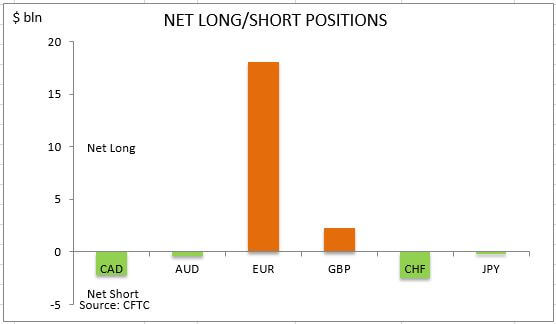
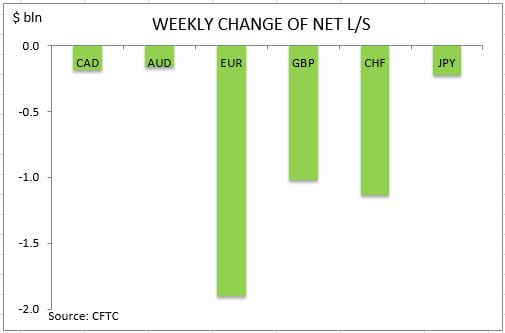
US dollar net short bets fell further to $15.14 billion from $19.77 billion against the major currencies during the previous week , according to the report of the Commodity Futures Trading Commission (CFTC) covering data up to May 1 released on Friday May 4. The dollar strengthening continued as US GDP slowed in the first quarter less than expected: Q1 GDP grew 2.3% after 2.9% expansion in the last three months of 2017.


CFTC Sentiment vs Exchange Rate

May 01 2018BiasEx RateTrendPosition $ mlnWeekly Change
CADbearishnegative-2144-183
AUDbearishpositive-425-166
EURbullishnegative18070-1898
GBPbullishnegative2243-1021
CHFbearishnegative-2441-1135
JPYbearishpositive-160-227
Total15144


commitment of traders net long short
commitment of traders weekly change
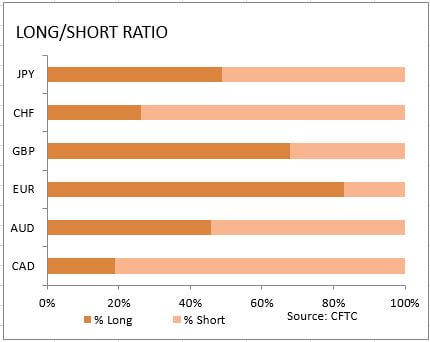
market sentiment ratio long short positions

Market Analysis provided by IFCMarkets

Note:
This overview has an informative and tutorial character and is published for free. All the data, included in the overview, are received from public sources, recognized as more or less reliable. Moreover, there is no guarantee that the indicated information is full and precise. Overviews are not updated. The whole information in each overview, including opinion, indicators, charts and anything else, is provided only for familiarization purposes and is not financial advice or а recommendation. The whole text and its any part, as well as the charts cannot be considered as an offer to make a deal with any asset. IFC Markets and its employees under any circumstances are not liable for any action taken by someone else during or after reading the overview.

What to watch in the week ahead?

Article by ForexTime

U.S. equities rallied sharply at the end of last week as did the dollar, despite the NFP disappointment.

The headline number for the rise in jobs came short of analysts’ expectations, “164K vs. 193K forecast”, but the previous month’s figure was revised up by 32K. Average hourly earnings also came in below expectations, growing by 2.6% YoY. The bright spot was the unemployment rate which dropped to an 18-year low at 3.9%.

Overall the labor market remains solid, and with rising inflation the Federal Reserve will persevere with monetary policy normalization. However, there isn’t enough indication yet of the economy overheating, suggesting that two more rate hikes for 2018 will remain the base case scenario.

With the U.S. earning season coming closer to an end, politics are likely to dominate again. Here’s what to watch for the week ahead.

Decision on China; Nafta talks

The first round of negotiations between China and the U.S. ended on Friday with no breakthrough. Although China said some progress was made in trade talks, there weren’t any tangible results. The U.S. demanded China cut the trade deficit by at least $200 billion by the end of 2020, which to many economists seems a mission impossible. The ongoing negotiations might have bought some time and eased tensions in the short-run, but investors will remain alert for another round of trade threats. Markets will closely scrutinize any statement from President Trump on this front.

The negotiation skills of team Trump will be tested again next week, as Nafta talks resume. According to U.S. Trade Representative, Robert Lighthizer, failure to complete trade negotiations with Canada and Mexico in the next two weeks could put the agreement in jeopardy. The Canadian dollar and Mexican peso would be hit hard if a deal doesn’t come through.

Iran Nuclear deal

With oil trading at its highest levels in more than three years, investors are in “wait-and-see” mode on whether to push prices to new highs or start taking some profit. Over the past few weeks, Trump has been criticizing the Iranian nuclear deal and is set to withdraw from it on 12 May, unless his European allies agree to fix the deal. Although oil prices have benefited from tighter supplies, a lot of risk premium has been priced in due to Trump’s threat. However, it’s challenging to know the magnitude of re-imposing sanctions on oil exports from Iran. That’s why analysts’ expectations varied widely on this front. Whether exports will be hit by 100 thousand or 1 million depends on the nature of the new sanctions. How will Europe react? Will sanctions hit banks and businesses dealing with Iran? How will Iran respond? What about the impact on Middle East politics? Until we get answers to these questions, it’s difficult to estimate the impact on Iranian oil exports. However, prices may remain elevated and even reach $80 in the short run.

Bank of England

A couple of weeks ago, it looked certain that the Bank of England would be hiking rates by 25 basis points, during its May policy meeting. This was before a round of disappointing UK economic data and BoE Governor Carney seemingly backtracking once again from his previous tone that the markets should prepare for an interest rate rise. It is now expected that the BoE will look to raise interest rates gradually and is conscious that there are other meetings over the course of 2018 to raise UK interest rates. As a result, the pound plunged by more than 800 pips from its 17 April peak. While a rate hike is off the table for now, forward guidance may lend the GBP some support, especially if new voices were added to Michael Saunders and Ian McCafferty, who voted for a rate hike in the last meeting.

Disclaimer: The content in this article comprises personal opinions and should not be construed as containing personal and/or other investment advice and/or an offer of and/or solicitation for any transactions in financial instruments and/or a guarantee and/or prediction of future performance. ForexTime (FXTM), its affiliates, agents, directors, officers or employees do not guarantee the accuracy, validity, timeliness or completeness, of any information or data made available and assume no liability as to any loss arising from any investment based on the same.


Forex-Time-LogoArticle by ForexTime

ForexTime Ltd (FXTM) is an award winning international online forex broker regulated by CySEC 185/12 www.forextime.com

Payrolls mixed but unemployment rate falls to 3.9%

By Orbex Blog

Daily Forex Market Preview, 07/05/2018

The monthly payrolls report for April showed that the U.S. unemployment rate fell to a seventeen and a half year low to 3.9%. This was stronger than the estimates which forecasted a decline in the unemployment rate to 4.0% from 4.1% in March.

The U.S. economy was seen adding 164k jobs during the month which was below estimates of 190k. However, the payrolls report for March was seen to be revised higher to 135k. Wage growth remained muted, rising at a sluggish pace of 0.1%. The U.S. dollar was seen rising on the back of the broadly mixed but robust jobs report.

Looking ahead, the economic calendar for the day is relatively quiet. The day starts off with the German factory orders report. Economists’ polled expect factory orders to rise 0.5% on the month. This marks a modest increase from 0.3% seen in the month before. A rebound in the factory orders could potentially ease concerns of a possible slowdown in the economic momentum in the Eurozone.

Later in the day, the Swiss monthly inflation report is due. Estimates point to a 0.3% increase in consumer prices following an increase of 0.4% the month before. Other economic indicators for the day include the retail PMI from the Eurozone and the Sentix investor confidence report.

The U.S. trading session will see the FOMC members Bostic and Barkin speaking later in the day.


EURUSD intra-day analysis

EURUSD 07.05.18

EURUSD (1.198657): The EURUSD remained at the monthly lows, albeit with price action testing a fresh 5-month low on an intraday basis. The euro managed to pull back from the lows briefly to settle above the support level of 1.1934. This potentially indicates a rebound in price action in the near term. The lows formed on Friday also coincided with the Stochastics posting a higher low. The bullish divergence could be validated on a close above 1.1988 where minor resistance is seen. A breakout above this level could signal a move toward 1.2090 – 1.2070 level of resistance initially.


GBPUSD intra-day analysis

GBPUSD 07.05.18

GBPUSD (1.3552): The British pound was seen trading subdued with price action seen testing the support level at 1.3530 on Friday. In the near term, we expect the GBPUSD to continue to consolidate around this level heading into Thursday’s Bank of England meeting. There is scope for the GBPUSD to correct to the upside as the 4-hour Stochastics oscillator points to a bullish divergence. The initial target is likely to be the resistance level which could act as dynamic resistance to the upside. To the downside, a break down below 1.3530 could signal a decline to 1.3500 round number support.


XAUUSD intra-day analysis

XAUUSD 07.05.18

XAUUSD (1317.41): Gold prices were seen consolidating around the 1311 – 1307 level of support with price action closing on Friday above this level. In the near term, gold prices could potentially push higher with the resistance level at 1325 to be the likely target. A breakout above this level could signal a further continuation to the correction. For the moment, the downside looks limited with any dips likely to be supported near the current price levels.


This week in monetary policy: Romania, Argentina, New Zealand, Malaysia, Philippines, Serbia, UK, Peru & Sri Lanka

By CentralBankNews.info

     This week – May 6 through May 12 – central banks from 9 countries or jurisdictions are scheduled to decide on monetary policy: Romania, Argentina, New Zealand, Malaysia, Philippines, Serbia, United Kingdom, Peru and Sri Lanka.
     Following table includes the name of the country, the date of the next policy decision, the current policy rate, the result of the last policy decision, the change in the policy rate year to date, the rate one year ago, and the country’s MSCI classification.
     The table is updated when the latest decisions are announced and can always accessed by clicking on This Week.
WEEK 19
MAY 6 – MAY 12, 2018:
COUNTRY                   DATE                     RATE                LATEST                    YTD              1 YR AGO      MSCI
ROMANIA7-May2.25%0501.75%         FM
ARGENTINA8-May40.00%6751,12526.25%         FM
NEW ZEALAND10-May1.75%001.75%         DM
MALAYSIA10-May3.25%0253.00%         EM
PHILIPPINES10-May3.00%003.00%         EM
SERBIA10-May3.00%-25-504.00%         FM
UNITED KINGDOM10-May0.50%000.25%         DM
PERU10-May2.75%0-504.00%         EM
SRI LANKA 1)11-May7.25%007.25%         FM
SRI LANKA 2)11-May8.50%-25-258.75%         FM
1. Deposit rate
2: Lending rate

When Will Electric Cars Take Over The Roads?

By OilPrice.com

The age of the electric vehicle (EV) will be here sooner than you think.

Out of 1 billion cars in the world, only 2 million are electric. But that will soon change, as costs diminish, and more governments encourage the adoption of EVs to cut carbon emissions and fight urban pollution.

According to Bloomberg, by 2040, 54 percent of all new car sales will be for EVs. Millions of new EVs will take a big bite out of oil demand and displace 8 million barrels of transport fuel (gasoline and diesel) every day.

But the biggest factor in the EV surge is what’s under the hood…lithium ion batteries.

Bloomberg estimates that in the late 2020s, cheap battery technology will allow EV production to skyrocket.

The key is lithium, “white petroleum,” which is quickly becoming the world’s most sought-after mineral.

Jonathan More of lithium miner Power Metals Corp. calls it the largest commodity boom “in a generation.” The world is going to need “mountains of lithium, from all over the world, to satisfy the global hunger for batteries.”

A lot of those lithium batteries will be needed for EVs: in fact, major oil companies like Total SA have estimated that 20 million EVs will be on the road by 2030, and they’ll need enough batteries to power 200 million cell phones. That’s 1.2 million tons, six times current production levels.

With future demand like that, it’s no wonder that miners like Power Metals are so bullish. With a 15,000m drilling program about to get underway on 3000 hectares, Power Metals is at the center of the Canadian lithium belt that could contain as much as 7.5 million tons of lithium.

Forget oil and gas; the future of energy belongs to lithium.

Carpocalypse Now

When EVs first started to roll off assembly lines, plenty of skeptics scoffed. EV sales were tiny and concentrated on the luxury car market.

But now that’s all changing.

In March 2018, more than 40,000 EVs were sold in Europe, a 41 percent increase from last year. Total sales for the year were up 37 percent from 2017. European auto-makers like Volvo want to concentrate on EVs, and plan on electric cars and trucks covering 50 percent of all sales by 2025.

Porsche will be 50 percent EV by 2023. General Motors and Toyota want to sell 1 million EVs per year by 2025.

The real juggernaut in the global EV market is China, where half of all EVs are currently in use. China will remain the chief EV market for the next 5-7 years, and demand is growing more quickly than expected.

Global EV sales are estimated to increase from 1.2 million in 2017 to 1.6 million in 2018 and 2 million in 2019. By 2025, some states have decreed that EVs must make up 15 percent of all new car sales.

The Boston Consulting Group released a report estimating that hybrids and EVS would cut the market share of internal combustion cars by 50 percent by 2030.

Whether you’re an EV skeptic or a Tesla super-fan, it’s impossible to deny that EVs are going to transform the international auto market…and trigger a massive increase in demand for lithium, the key ingredient in all EV batteries.

The White Gold

You can’t have EVs without lithium ion batteries. That’s why Tesla CEO Elon Musk built a “gigafactory” in the Nevada desert, where thousands of batteries are churned out every year.

The worldwide battery market was $5.1 billion in 2017, but it’s to expand rapidly and could reach $58.8 billion by 2024.

Batteries have gotten a lot cheaper to make, but it all hinges on securing an adequate supply of lithium.

New lithium deposits are being uncovered all the time. One asset, Paterson Lake in Ontario, contains thousands of tons of lithium spodumene locked away in “pegmatite,” hard-rock formations that are entirely different from the salt-brine lithium found in South America.

Power Metals Corp., which owns the Paterson Lake property, has launched an aggressive 15,000m drilling program. According to head geologist Dr. Julie Selway, the property contains a “staggering amount of pegmatite dykes” and a “huge potential of finding more lithium mineralization.”

Along with firms like Nemaska Lithium and Quantum Minerals Corp., Power Metals (PMC) is at the forefront of Canada’s lithium boom.

Together with new production in South America, Australia and Europe, Canada will help feed the world’s lithium demand and facilitate the surge in EVs by the 2020s.

When EV demand began picking up in 2015, it triggered a bull market for lithium. Prices shot up as battery manufacturers started buying up all the lithium they could find.


Lithium prices remained strong in early 2018, and capital is flooding into lithium projects all over the world.

A lot of the money is coming from China, the world’s leading battery manufacturer. Capital is seeking out lithium properties in South America, as Chinese companies hope to secure lithium supplies to feed EV battery growth.

A Chinese investment group recently acquired Lithium X for $265 million, taking over that company’s Argentinian property at the center of South America’s “lithium triangle.”

Chile and Argentina are the world’s no. 2 and no. 3 lithium producers, and production in Argentina is expected to triple by 2019 to more than 15,000 metric tons per year.

So aggressive has the Chinese push into South American lithium been, the Chileans have started to push back, warning one Chinese firm away from attempting to buy one major lithium producer, worth $5 billion.

Money is flooding into the lithium sector. And lithium miners like Power Metals will need every penny to fuel surging battery demand.

Fueling the Fire

According to one August 2017 analysis, the global lithium ion battery market could reach $93 billion by 2025, growing at a rate of 17 percent each year.

To feed that colossal demand, the world is going to need lithium. A lot of it.

Miners in Canada and South America will bear the burden. Power Metals could potentially turn Canada into a major lithium producer, and it’s not alone: other companies like Nemaska Lithium have also made big discoveries, riding them to billion-dollar valuations.

Battery manufacturers feeding the EV market will rely upon new sources of lithium production. The surge of investment into lithium mining could turn into a flood.

Pretium Resources (NYSE:PVG): This impressive Canadian company is engaged in the acquisition, exploration and development of precious metal resource properties in the Americas.. Additionally, construction and engineering activities at its top location continue to advance, and commercial production is targeted for this year.

The company’s modest market cap and stock price make it an appealing buy for investors. Pretium has an impressive portfolio and if you can catch the stock while the price is right, there could be huge opportunity for upside.

Newmont Mining Corp (NYSE:NEM) Founded over 100 years ago, Newmont Mining Corporation is one of the leading mining companies in the world. The company holds assets in Peru, Australia, Ghana, Indonesia, Mexico, and around the United States. Primarily focusing on gold and copper, Newmont has steadily carved out a name for itself among those in the industry.

Newmont has had an excellent start to 2018, and it is set to keep up the pace as burnt bitcoin buyers move back to gold and silver.

Agnico Eagle Mines Ltd (NYSE:AEM) Canadian based miner, Agnico Eagle Mines is an especially noteworthy company for investors. Why? Between 1991-2010, the company paid out dividends every year. With operations in Quebec, Mexico, and Finland, the company also is taking place in exploration activities in Europe, Latin America, and the United States. This is certainly a company with tremendous potential that grows better by the day.

Investors have certainly taken note. In the past month, Agnico has seen its share prices climb steadily, and 2018 looks to be shaping up to be a promising year.

Turquoise Hill Resources (NYSE:TRQ) is a mid-cap Canadian mineral exploration and development company headquartered in Vancouver, British Columbia. Its focus is on the Pacific Rim where it is in the process of developing several large mines.

The company mines a diversified set of metals/minerals including Coal, Gold, Copper, Molybdenum, Silver, Rhenium, Uranium, Lead and Zinc. One of the fortes of Turquoise hill is its good relationship with mining giant Rio Tinto.

Going forward, Turquoise’s success at the giant Oyu Tolgoi project in Mongolia will be crucial to boost its lagging share price.

Cameco Corporation (NYSE:CCJ) Cameco is one of the largest global producers and sellers of uranium and nuclear fuel. Its operating uranium properties include the McArthur River/Key Lake, Cigar Lake, and Rabbit Lake properties located in Saskatchewan, Canada; the Inkai property situated in Kazakhstan; the Smith Ranch-Highland property located in Wyoming, the United States; and the Crow Butte property situated in Nebraska.

While many analysts see low uranium prices as a problem for miners, an OPEC like move from world uranium leader Kazakhstan to bump prices could benefit Cameco and its peers.

A strong push towards nuclear power from China, India and the Middle East could create further upside for this promising miner.

By James Burgess

NOT AN INVESTMENT ADVISOR. Oilprice.com is not registered or licensed by any governing body in any jurisdiction to give investing advice or provide investment recommendation. ALWAYS DO YOUR OWN RESEARCH and consult with a licensed investment professional before making an investment. This communication should not be used as a basis for making any investment.

RISK OF INVESTING. Investing is inherently risky. While a potential for rewards exists, by investing, you are putting yourself at risk. You must be aware of the risks and be willing to accept them in order to invest in any type of security. Don’t trade with money you can’t afford to lose. This is neither a solicitation nor an offer to Buy/Sell securities.

RISK OF BIAS. We often own shares in the companies we feature. For those reasons, please be aware that we are extremely bias in regards to the companies we write about and feature in our newsletter and on our website.

Link to original article: https://oilprice.com/Alternative-Energy/Renewable-Energy/When-Will-Electric-Cars-Take-Over-The-Roads.html