Author Archive for InvestMacro – Page 419

Turkish Lira crisis continues to deepen with currency in freefall

Article by ForexTime

Matters just continue to go from bad to worse for the Turkish Lira.

The currency is in complete freefall and the outlook is still that there is an increased risk of further losses ahead. This is despite the Lira being crippled by meeting new historic lows on a near-daily basis as of late, a consequence of investors having an extreme lack of confidence in Turkish assets.

There is no disputing that the comments Turkish President Recep Tayyip Erdogan made last week regarding him having more influence in economic matters and monetary policy has been the catalyst behind the depression the Lira currently finds itself in. The issue is that it has scared investors away to such an extent, that it is difficult to imagine what buyers there are out there for the Turkish Lira. Erdogan effectively eliminated buyers from the market, and despite the currency on headline looking extremely oversold, the threat of central bank independence being under scrutiny is so high that it is preventing traders from wanting to even take a risk on buying the Lira at its current depressed levels.

The latest headline from yesterday is that Japanese investors turned their backs on Turkish assets, which is seen as the reason for the Lira plunging in excess of another 3% on Tuesday. The exodus is likely to continue, and it does appear to be only a matter of time before the Turkish Lira jumps towards 5 against the Dollar. With the acceleration in selling momentum for the Turkish Lira over the past week, it can’t be ruled out that the Lira could weaken to 5 against the Dollar before the end of the month.

We are still a month away from the upcoming June 24th elections in Turkey, but I do think that traders will be encouraged to price in as much negative news into Turkey as they can before the event. If Erdogan wins, as he is likely to do so, and does indicate that he will imminently instruct interest rates in Turkey to move lower as it is also suggested, there is a threat that there won’t be a ceiling to Turkish Lira weakness.

Although the events in markets like Turkey and Argentina might be looked at as idiosyncratic matters, we should also not underestimate the impact these could have on the general emerging market sentiment. I do not think it is a coincidence that the moves seen in the Turkish Lira on Tuesday have been mirrored by the majority of emerging market currencies, that are trading lower against the USD in the early hours of Wednesday trading.

Disclaimer: The content in this article comprises personal opinions and should not be construed as containing personal and/or other investment advice and/or an offer of and/or solicitation for any transactions in financial instruments and/or a guarantee and/or prediction of future performance. ForexTime (FXTM), its affiliates, agents, directors, officers or employees do not guarantee the accuracy, validity, timeliness or completeness, of any information or data made available and assume no liability as to any loss arising from any investment based on the same.


Forex-Time-LogoArticle by ForexTime

ForexTime Ltd (FXTM) is an award winning international online forex broker regulated by CySEC 185/12 www.forextime.com

UPDATE-This week in monetary policy: Ghana, Hungary, Nigeria, Argentina, Paraguay, South Korea, South Africa, Ukraine, Pakistan & Colombia

By CentralBankNews.info

    (Following item is updated with Pakistan’s central bank, the State Bank of Pakistan (SBP), which will announce its monetary policy for the next two months on Friday, May 25.)
     This week – May 20 through May 26 – central banks from 10 countries or jurisdictions are scheduled to decide on monetary policy: Ghana, Hungary, Nigeria, Argentina, Paraguay, South Korea, South Africa, Ukraine, Pakistan and Colombia.
    Following table includes the name of the country, the date of the next policy decision, the current policy rate, the result of the last policy decision, the change in the policy rate year to date, the rate one year ago, and the country’s MSCI classification.
    The table is updated when the latest decisions are announced and can always accessed by clicking on This Week.
WEEK 21
MAY 20 – MAY 26, 2018:
COUNTRY                   DATE                     RATE                LATEST                    YTD              1 YR AGO      MSCI
GHANA21-May17.00%-100-30022.50%         FM
HUNGARY22-May0.90%000.90%         EM
NIGERIA22-May14.00%0014.00%         FM
ARGENTINA22-May40.00%0112526.25%         FM
PARAGUAY22-May5.25%005.50%
SOUTH KOREA24-May1.50%001.25%         EM
SOUTH AFRICA24-May6.50%-25-257.00%         EM
UKRAINE24-May17.00%025012.50%         FM
PAKISTAN25-May6.00%0255.75%         EM
COLOMBIA25-May4.25%-25-506.25%         EM

EUR and NZD come under pressure

Article by ForexTime

The Euro has been having a bad couple of weeks recently as political uncertainty continues to weigh heavily on the Euro, and a resurgent USD has caused some weakness as well. The main focus over the last few weeks has been the recent Italian elections with the five star party coming to power, and the likelihood that a very progressive yet economically challenging government is likely to be calling the shots. This could mean that Italy, one of the major players in the euro-zone, is likely to but-heads with other Euro leaders in the same way Greece did not too long ago. Greece eventually lost that fight and enacted heavy reforms in order to please the euro-zone, but Italy’s new movement is looking to try and shake up the so called establishment as they feel voters have given them a mandate. The reality is that it will take some time for anything to really come into fruition and for any demands to be made to the euro-zone leaders, but one thing is certain, there will be some demands, and the markets will be paying close attention to see how things work. Historically speaking Italy has been politically volatile over the past 70 years, so potentially the market could be overreacting to things a little here.

Looking at the EURUSD which is the main focus for most traders shorting on Italian news, it’s clear to see that the EURUSD has been struggling for almost a month now. We saw some resurgence today with a push up to resistance at 1.1824 before an announcement on the Italian economic minister and the market was quick to sell. With the bulls soundly defeated today, we could see further pushes to support at 1.1719, which is a key support level, any movement below this and closing would signal a potential push to 1.1582 in the short to medium term. Evidently if the new government is quick to point the finger at the euro-zone and make demands then we could see further falls below this support level and bearish pressure on the Euro much like the Greek saga of old.

The other struggling pair today has been the NZDUSD which has failed to gain any further ground as it attempted to break through resistance at 0.6966 before falling just short of the 20 day moving average as the bears were quick to come back into the market. Tomorrow will be a big day for the NZ economy as trade balance is due out, however in the interim the market is still bearish on the pair  and this failure could see the bears finally look to push down to support 0.6819 on the charts. In the off chance that the bears are unable to take back full control I would look to resistance levels at 0.7054 and 0.7171 in the long run, as the bulls look to drive back up the charts.

Disclaimer: The content in this article comprises personal opinions and should not be construed as containing personal and/or other investment advice and/or an offer of and/or solicitation for any transactions in financial instruments and/or a guarantee and/or prediction of future performance. ForexTime (FXTM), its affiliates, agents, directors, officers or employees do not guarantee the accuracy, validity, timeliness or completeness, of any information or data made available and assume no liability as to any loss arising from any investment based on the same.


Forex-Time-LogoArticle by ForexTime

ForexTime Ltd (FXTM) is an award winning international online forex broker regulated by CySEC 185/12 www.forextime.com

How TIME’s Bremmer Got Duterte Wrong

By Dan Steinbock

Today, global dominant media is often exploited as a tool of coercive diplomacy. The recent Time commentary on the Philippines president is a case in point. The real story is behind the story.

In early May, Time magazine released the feature story, “The Strongmen Era,” by Ian Bremmer, the venerable president of Eurasia Group. The cover featured the photos of Russian President Putin, Hungarian Prime Minister Urban, Turkey’s President Erdogan, and Philippines President Duterte. It was a promotional piece for Bremmer’s new book on globalization. As Duterte reject the term “strongman,” Bremmer penned a new attack.

Bremmer’s arguments are neither original nor deep. What makes them different is that the Eurasia Group is very close – too close, say critics – to U.S. economic, political and intelligence power, including the famed military-industrial complex, along with his role as Time’s editor-at-large and global affairs columnist.

Flawed data, compromised sources

In his sequel on Duterte, Bremmer relied largely on just a single report by Human Rights Watch (HRW), which he considers “highly credible.” Yet, the HRW has lost much of its reputation. Billionaire speculator George Soros has had leverage over HRW since the ‘80s. In 2010 Soros cemented the ties with a 10-year $100 million HRW donation. Since then, HRW’s record has been tarnished by allegations of partisanship and bias, which climaxed in the 2014 open letter by Nobel Peace Laureates criticizing HRW for intimate ties with the US government.

Moreover, the head of HRW’s Asia Division Phelim Kine continues to inflate data in reporting on the Philippines anti-drugs campaign; and Bremmer uses this flawed data without slightest source criticism. Relying on HRW, Bremmer blames Duterte for “sending anyone to jail for criticizing him,” yet the examples he comes up with are Senator Leila de Lima and Supreme Court Chief Justice Maria Lourdes Sereno.

In reality, de Lima is imprisoned for receiving substantial payola money from drug lords, abusing public office and paying off confidants, while serving as Justice Secretary in the former Aquino administration. In turn, Sereno, another Aquino appointee, got her office, thanks to partisan politics, but not to credentials, and she was ousted after grossly abusing her office.

Finally, Bremmer relies on “international rights organizations” and UN officials that Duterte has tried to “harass and intimidate.” In reality, the Duterte government invited UN Special Rapporteur Agnes Callamard – who has been supported by Soros in the US and the UN – to a public debate, yet Callamard sneaked into Manila for a lecture at the request of Chico Gascon, a veteran Liberal Party leader, who promotes the misguided views that Bremmer takes for divine truths.

Links with the Philippine failed liberals, and Malloch-Brown (Soros)

The common denominator in all these cases is the ongoing meltdown of the Liberal Party (LP), which Washington has relied on in the Philippines since the late 1980s, despite the party’s internal decay. Human rights is the pretext in a geopolitical effort to corner the Duterte government, restore the LP and its special ties with the US.

Bremmer’s Time debacle is the latest in a long series, which began in May 2016, when he warned in the New York Times that “The Philippines Has to Know It Needs the US.” The Philippines needs Chinese infrastructure investment, but “if you deal with China without us… That will be bad for you and your country.”

And yet, as Duterte has recalibrated Philippines ties with the US in security and with China in the infrastructure, the country is positioned to grow at 6-7% annually for years. These realities are fully ignored in Bremmer’s pieces for Time, along with Duterte’s democratic and huge popular support – and by other global media that failed to report on the darker side of the Aquino era, its massive graft, proliferation of drugs, and high-profile corruption debacles.

In contrast to Nobel critics of human rights’ political exploitation, Bremmer’s case rests on HRW and Soros, who he deems the “advocate of liberal Western democracy.” Yet, the two may share more prosaic common interests. In 1998, the Financial Times reported that Soros’s commentary on the need for Russia to devalue its currency precipitated the country’s massive default on debt, which was created by Prime Minister Sergey Kiryenko’s cabinet. That’s also the year when Bremmer founded his consultancy which has advised Kiryenko, according to his own bio.

Moreover, the Eurasia Group is linked with Soros through Lord Malloch-Brown, the controversial chairman behind the election technology Smartmatic – which has caused political debacles around the world, including the Philippines – who has served as vice-chairman of Soros Fund Management and the Open Society Institute. Since 2016, Lord Malloch-Brown – who has been a longstanding advisor of the Aquinos and the Liberal Party – also became Senior Advisor of the Eurasia Group.

None of these associations were disclosed in the Time commentary.

Links with the White House and US intelligence community

Specializing in the former Soviet Union, Bremmer got his PhD in Stanford in 1994. The young policy wizard proved influential in think-tanks that work with, for and by the US government, multinationals and Wall Street. He founded Eurasia Group in the late ‘90s when the US pioneer of geopolitics Zbigniew Brzezinski used to warn that American hegemony can only survive if the US can dominate Eurasia and deter future rivals – such as Russia and China.

As the National Security Agency (NSA) intensified efforts to shape US foreign policy in the early 2000s, along with the State Department and Pentagon, its leaders listened Bremmer about oil, natural gas, terrorism and Iraqi reconstruction. The Group’s CEO is Robert Johnston, an energy specialist, who used to serve in UBS and Enron. Its head of research David Gordon has served in the highest posts of the CIA and the State Department. Evan Medeiros was recruited in fall 2015 to head the Group’s Asia branch. As Obama’s top advisor on the Asia Pacific, he was responsible for coordinating US policy toward Asia, including “modernizing” key alliances, such as the US-Philippines 10-year defense agreement.

There is nothing wrong about hiring the “best and the brightest.” But a revolving door between the government and the private sector comes with huge moral hazards. If the two are not kept in arm’s length, collusion becomes viable and political risk consultancies operating in the private sector risk morphing into arms of the government. That’s precisely the kind of “statism” – centralized state control – that Bremmer purports to oppose.

About the Author:

Dr. Dan Steinbock is an internationally recognized strategist of the multipolar world and the founder of Difference Group. He has served as research director at the India, China and America Institute (USA) and visiting fellow at the Shanghai Institutes for International Studies (China) and the EU Center (Singapore). For more, see https://www.differencegroup.net/

The original version was released by The Manila Times on May 21, 2018.


Japanese Candlesticks Analysis 22.05.2018 (GOLD, NZDUSD)

Article By RoboForex.com

XAUUSD, “Gold vs US Dollar”

As we can see in the H4 chart, after reaching the support level, forming several Hammer, Inverted Hammer, and Engulfing reversal patterns, and updating its low, XAUUSD has been corrected again. Judging by the previous movements, it may be assumed that after finishing the correction the price may continue moving downwards despite the above-mentioned reversal patterns.

GOLD
Risk Warning: the result of previous trading operations do not guarantee the same results in the future


NZDUSD, “New Zealand vs. US Dollar”

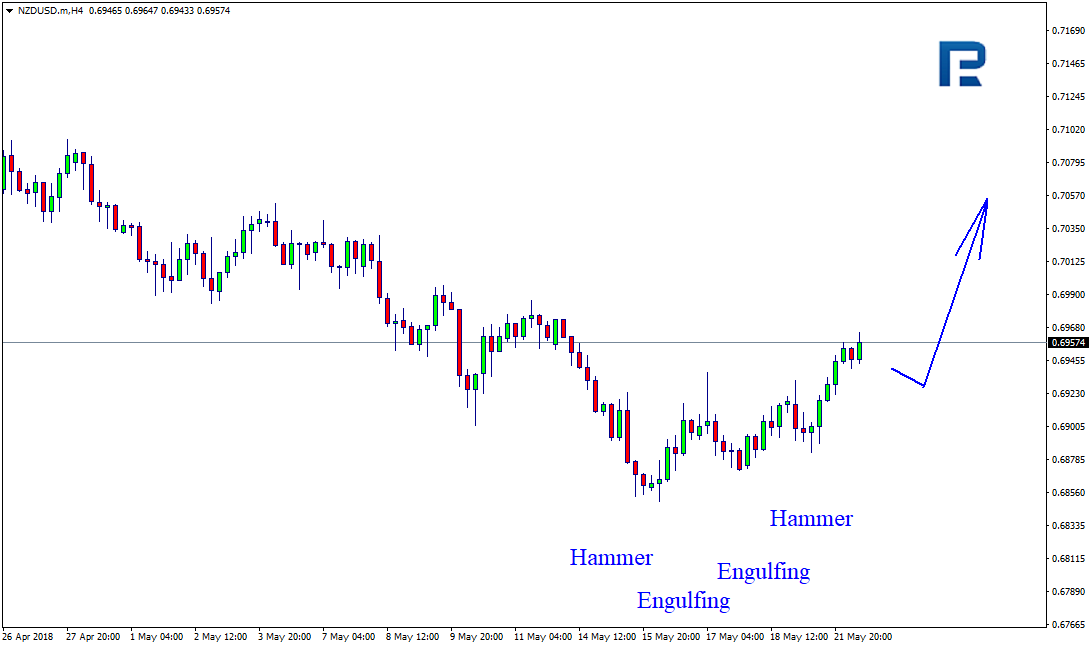
As we can see in the H4 chart, after reaching a new low, NZDUSD has formed several Hammer and Engulfing reversal patterns and completed another pullback. Judging by the previous movements, at the moment it may be assumed that instrument may start a new uptrend.

NZDUSD
Risk Warning: the result of previous trading operations do not guarantee the same results in the future


RoboForex Analytical Department

Article By RoboForex.com

Attention!
Forecasts presented in this section only reflect the author’s private opinion and should not be considered as guidance for trading. RoboForex LP bears no responsibility for trading results based on trading recommendations described in these analytical reviews.

Ichimoku Cloud Analysis 22.05.2018 (AUDUSD, NZDUSD, USDCAD)

Article By RoboForex.com

AUDUSD, “Australian Dollar vs US Dollar”

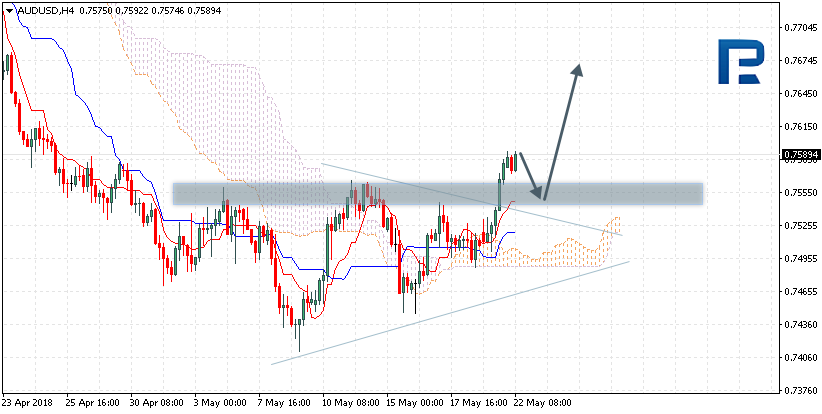
AUDUSD is trading at 0.7584; the instrument is moving above Ichimoku Cloud, which means that it may continue growing. The markets could indicate that the price may test Tenkan-Sen and Kijun-Sen at 0.7550 and then continue moving upwards to reach 0.7675. However, the scenario that Implies further growth may be cancelled if the price breaks the downside border of the cloud and fixes below 0.7465. In this case, the pair may continue falling towards 0.7370.

AUDUSD
Risk Warning: the result of previous trading operations do not guarantee the same results in the future


NZDUSD, “New Zealand Dollar vs US Dollar”

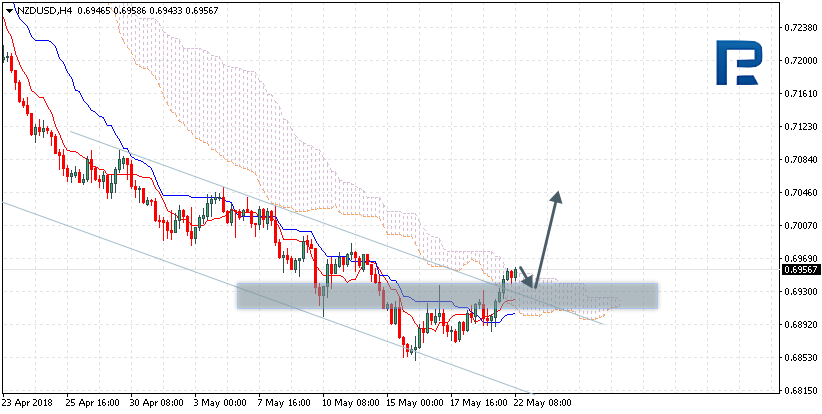
NZDUSD is trading at 0.6956; the instrument is moving above Ichimoku Cloud, which means that it may continue growing. The markets could indicate that the price may test Tenkan-Sen and Kijun-Sen at 0.6940 and then continue moving upwards to reach 0.7045. Another signal to confirm further ascending movement is the price’s rebounding from the support level. However, the scenario that implies further growth may be cancelled if the price breaks the downside border of the cloud and fixes below 0.6880. In this case, the pair may continue falling towards 0.6805.

NZDUSD
Risk Warning: the result of previous trading operations do not guarantee the same results in the future


USDCAD, “US Dollar vs Canadian Dollar”

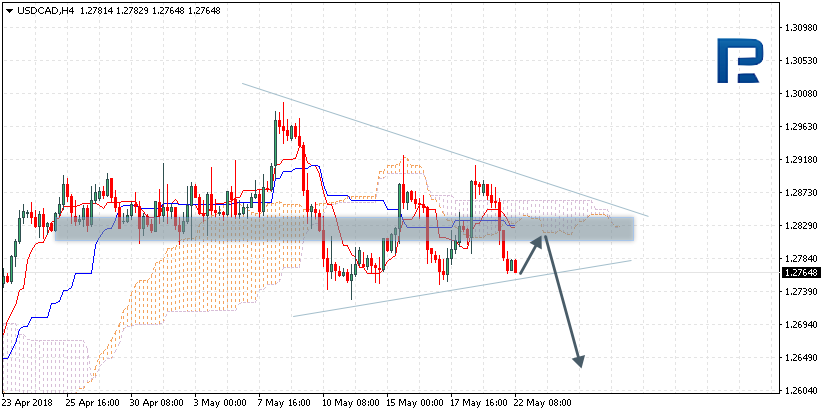
USDCAD is trading at 1.2764; the instrument is moving below Ichimoku Cloud, which means that it may continue falling. The markets could indicate that the price may test the downside border of the cloud at 1.2830 and then continue moving downwards to reach 1.2650. Another signal to confirm further descending movement is the price’s rebounding from the resistance level. However, the scenario that implies further decline may be cancelled if the price breaks the upside border of the cloud and fixes above 1.2880. In this case, the pair may continue growing towards 1.2960. After breaking the downside border of the Triangle pattern and fixing below 1.2720, the price may continue moving downwards.

USDCAD
Risk Warning: the result of previous trading operations do not guarantee the same results in the future


RoboForex Analytical Department

Article By RoboForex.com

Attention!
Forecasts presented in this section only reflect the author’s private opinion and should not be considered as guidance for trading. RoboForex LP bears no responsibility for trading results based on trading recommendations described in these analytical reviews.

EURUSD: bulls trying to develop the upwards correction

By Gabriel Ojimadu, Alpari

Previous:

On Monday the 21st of May, trading on the euro closed up. At the beginning of the European session, the single currency dropped to 1.1717 before rebounding. The euro initially rose against the dollar to 1.1779 and climbed further to 1.1796 during the US session.

The euro fluctuated on the back of political uncertainty in Italy. The League and Five Star Movement have put forward a candidate for the post of Prime Minister of Italy, who now awaits confirmation from the president.

In the US session, the euro’s rise was facilitated by an easing of tensions between the US and China as well as a decline in US10Y bond yields. I’d like to point out that there is again a negative correlation between the EURUSD pair and US10Y bond yields.

US Secretary of the Treasury Steven Mnuchin said yesterday that the trade war between the US and China has been put on hold for the time being.

Day’s news (GMT+3):

  • 11:30 UK: public sector net borrowing (Apr).
  • 12:00 UK: inflation report hearings.
  • 13:00 UK: CBI industrial trends survey – orders (May).
  • 15:30 Canada: wholesale sales (Mar).
  • 17:00 USA: Richmond Fed manufacturing index (May).

Fig 1. EURUSD hourly chart. Source: TradingView

Sellers moved with the trend to bring the price to 1.1717 on the back of a rising dollar and political uncertainty in Italy. My fears of a rebound upon reaching the 1.1740 support were not unfounded.

Once again, this rebound was brought about by developments in the news. Since our pair was ready for this, positive news from Italy gave rise to a sharp surge in quotes.

This growth petered out around the upper boundary of the A-A channel and the 67th degree. After a rebound on the daily timeframe, a pin bar or hammer was formed. Since the US and China have pressed the pause button on their trade dispute, it’s worth considering the continuation of the upwards correction past 1.18.

Also, considering that the greenback is showing mixed dynamics, and that all the euro crosses are trading down, today I’m forecasting a drop along with the trend to 1.1750 followed by an upwards reversal. However, I wouldn’t advise rushing to buy against the trend at 45 degrees. The trend hasn’t been broken and the bears could yet cancel the pin bar model. In keeping with the trend, the price could return to yesterday’s low from which another rebound is likely.

U.S. – China trade truce optimism fades in Asia

Article by ForexTime

U.S. investors got overexcited on Monday after Treasury Secretary, Steven Mnuchin, announced over the weekend that the trade war with China was “on hold.” The relief over trade concerns sent stocks sharply higher, particularly the heavyweight industrial stocks. Boeing, United Technologies, Caterpillar and General Electric were the best-performing stocks on the Dow Jones Industrial Average. The rally in the industrial sector pushed the Dow 298 points to trade above 25,000 for the first time since mid-March. Meanwhile, the S&P 500 and Nasdaq Composite gained 0.7% and 0.5%, respectively.

“China has agreed to buy massive amounts of ADDITIONAL Farm/Agricultural Products – would be one of the best things to happen to our farmers in many years!”Donald Trump

It seems the ceasefire is likely to remain on hold for some time. Trump’s political base will be severely damaged if Beijing imposes 25% tariffs on soybeans, especially as we get closer to November’s midterm elections, which the President won’t want to risk. This development will lead investors to shift their focus back to fundamentals.

Asian equities didn’t enjoy the same excitement in Wall Street as optimism over easing tensions faded, meaning that Asian investors are likely to become more worried about oil trading at $80. The first response to Nicolás Maduro’s victory in Sunday’s Venezuelan elections was a fresh round of U.S. sanctions. President Trump banned the purchase of debt issued by the country and state-run oil company PDVSA. Venezuela, literally running out of money, may see its oil production fall below 1 million barrels per day, and given the tight market conditions, energy prices likely to remain elevated.

In currency markets, the Dollar Index pulled back slightly from its 2018 highs. There were no key economic data releases nor big moves in fixed income instruments to take the cue from yesterday. Traders are waiting for Wednesday’s minutes from the latest FOMC meeting to see any fresh signals related to U.S. monetary policy.

The Euro continued to struggle over the political uncertainty unfolding in Italy and it remains unclear where the new populist party coalition will take the country. People voted for the Five Star and far-right League to reject the European consensus on policy, so keep an eye on how Italian bonds perform in the next couple of days, as they are the key barometer on what investors think about the third-largest Eurozone economy.

The Pound has fallen by approximately 1000 pips from April highs in less than five weeks. A combination of weak economic data, delay in rate hikes and the dollar strength contributed to the steep fall. Today’s testimony from BoE Governor, Mark Carney, on the latest inflation report may provide some guidance on when the BoE likely to raise rates. Any new signals on policy may lead to big swings in Sterling.

Disclaimer: The content in this article comprises personal opinions and should not be construed as containing personal and/or other investment advice and/or an offer of and/or solicitation for any transactions in financial instruments and/or a guarantee and/or prediction of future performance. ForexTime (FXTM), its affiliates, agents, directors, officers or employees do not guarantee the accuracy, validity, timeliness or completeness, of any information or data made available and assume no liability as to any loss arising from any investment based on the same.


Forex-Time-LogoArticle by ForexTime

ForexTime Ltd (FXTM) is an award winning international online forex broker regulated by CySEC 185/12 www.forextime.com

Admiral Markets Offers a Limited Risk Account to Clients in France

In line with the French regulatory requirements Admiral Markets offers a new account type – Admiral.RisqueLimité, which is designed with an emphasis on protection of retail clients from risks connected to trading in the financial markets.

The major benefits of the new limited risk offering are:

1. Mandatory Stop Loss

As prescribed by Autorité des Marchés Financiers (AMF), retail trading offering advertised to retail clients in France must include an option of a mandatory Stop Loss order. Additionally, any losses resulting from trading may not exceed the monetary value of the margin reserved for a particular position.

Admiral.RisqueLimité meets this regulatory requirement and provides the option to trade on an account with a Stop Loss order calculated and placed automatically whenever a client opens a position. Stop Losses on this account cannot be cancelled or moved away too far from the opening price, so in case the Stop Loss is triggered, the resulting loss never exceeds the maximum value determined by the value of margin collateral for the position.

2. Limited Maximum Leverage

As recommended in the notice made by the European Securities and Markets Authority (ESMA) on 27 March 2018, all retail clients in Europe and in the UK will be provided with the limited maximum leverage, in order to reduce the risks connected to margin trading.

Admiral.RisqueLimité was made with anticipation of the above measures to be applied on a permanent basis in the EU, so that the leverage rates provided on this account already reflect the maximum rates proposed by the ESMA:

  • 1:30 on major currency pairs and 1:20 on other FX instruments;
  • 1:20 on gold spot CFD and CFDs on major stock indices.

3. Negative Balance Protection

Admiral.RisqueLimité provides full and unconditional compensation of negative balances, which may result from time to time when a client has a position on a leveraged product and the market moves abruptly against it.

4. 100% Stop Out Level and Additional Protection Against Price Slippage

Admiral.RisqueLimité provides the level of liquidation of open positions (Stop Out) equal to 100% of the reserved margin collateral. And, similarly to Stop Loss orders, Stop Outs are always processed with zero slippage.

5. Volatility Protection Settings

Admiral.RisqueLimité also provides an additional layer of protection with Admiral Markets’ Volatility Protection settings, which represent a set of conditional orders aimed to address typical issues connected to market volatility.

Please find more details about Admiral.RisqueLimité offering in the Account Types section and in the Contract Specifications section.

For the official announcement, please visit Admiral Markets French website.

***

Risk disclosure: trading in financial markets on margin carries a high level of risk and losses may exceed your initial deposit. Admiral Markets UK Ltd. recommends you seek advice from an independent financial advisor to ensure that you understand the risks involved with Forex, CFDs and margin trading (https://admiralmarkets.com/risk-disclosure) .

About Admiral Markets

Admiral Markets is a leading online trading provider. In addition to a wide range of financial instruments, Admiral Markets offers free educational materials, including analytics, webinars and seminars.

Fibonacci Retracements Analysis 21.05.2018 (GOLD, USDCHF)

Article By RoboForex.com

XAUUSD, “Gold vs US Dollar”

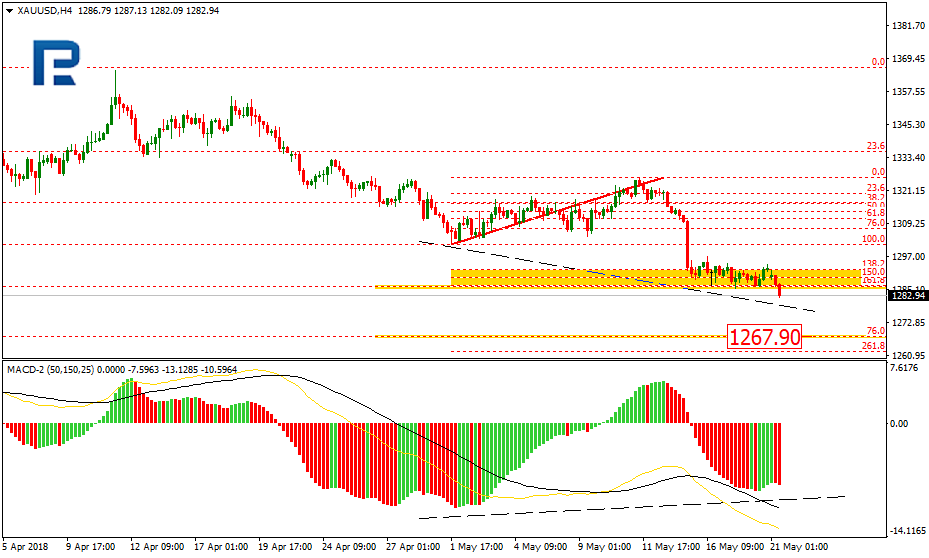
As we can see in the H4 chart, the downtrend continues; after completing a short-term correction to the upside, XAUUSD has broken the local low and reached the retracement of 61.8%. The next downside target may be the retracements of 76.0% at 1267.90. At the same time, one can see the convergence being formed, which may indicate a new pullback once the instrument reaches its downside targets.

GOLD1
Risk Warning: the result of previous trading operations do not guarantee the same results in the future

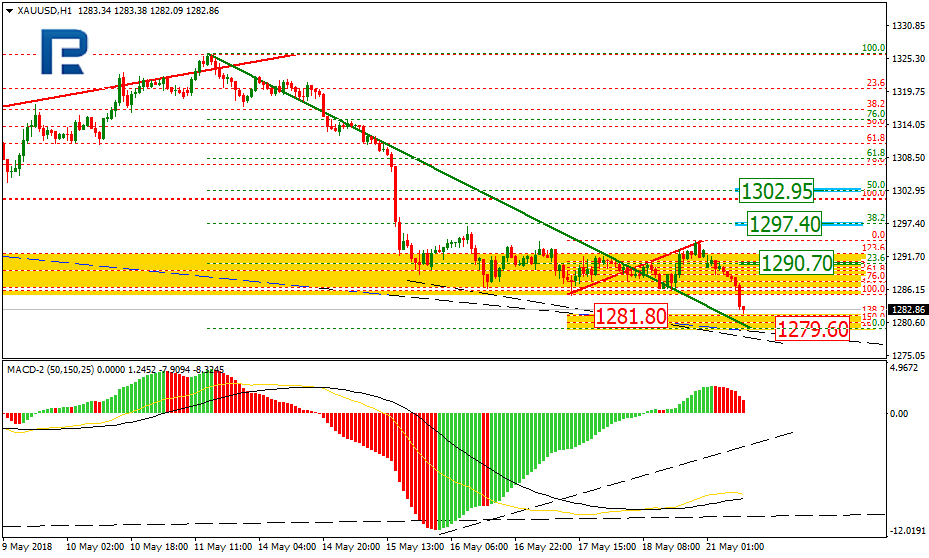
In the H1 chart, after finishing the short-term correction, XAUUSD has broken its previous low and right now is trading towards the post-correctional extension area between the retracements of 138.2% and 161.8% at 1281.80 and 1279.60 respectively. The convergence that is being formed right now may indicate a possible pullback towards the retracements of 23.6%, 38.2%, and 50.05 at 1290.70, 1297.40, and 1302.05 respectively.

GOLD2
Risk Warning: the result of previous trading operations do not guarantee the same results in the future


USDCHF, “US Dollar vs Swiss Franc”

As we can see in the H4 chart, USDCHF is trading sideways. The closest and the following targets of this sideways correction are the retracements of 23.6%, 38.2%, and 50.0% at 0.9940, 0.9871, and 0.9816 respectively. If the price breaks the high at 1.0056, the uptrend may continue.

USDCHF1
Risk Warning: the result of previous trading operations do not guarantee the same results in the future

In the H1 chart, the convergence is being formed, which may indicate a new impulse to the upside. After breaking 1.0056, the instrument may continue growing towards the post-correctional extension area between the retracements of 138.2% and 161.8% at 1.0096 and 1.0121 respectively.

USDCHF2
Risk Warning: the result of previous trading operations do not guarantee the same results in the future


RoboForex Analytical Department

Article By RoboForex.com

Attention!
Forecasts presented in this section only reflect the author’s private opinion and should not be considered as guidance for trading. RoboForex LP bears no responsibility for trading results based on trading recommendations described in these analytical reviews.