Author Archive for InvestMacro – Page 416

Italian politics drag equities; Euro continues to fall

Article by ForexTime

Italy’s political drama drove the risk-off mood felt across the globe early Tuesday as investors sold risk assets and bought the Japanese Yen and U.S. Treasuries. Most Asian markets were in the red, with the USDJPY trading at its lowest level in three weeks, hitting 108.90.

The Italian president’s intervention to block populist coalition plans led to a massive selloff in Italian equities and bonds.  The FTSE MIB, which gained more than 12% Year-to-Date earlier this month, fell 2% on Monday to erase all gains made in 2018. Meanwhile, yields on Italian two-year bonds rose from 0.28% to 0.88% in less than 24 hours in a clear sign of investor nervousness.

The Euro bounce on Monday was short-lived. EURUSD spiked to 1.1728 after Sergio Mattarella blocked the coalition’s nomination of Paolo Savona as finance minister. His veto and assignment of Carlo Cottarelli to form a new government means another round of elections possibly taking place in August. The risk here is that a re-election will lead to a stronger populist group forming, and thus, a possible referendum on the European Union. This will eventually lead to further rating downgrades from credit rating agencies, and with outstanding debt of more than 2.3 trillion Euros, Italy’s public finances will look to be in a very bad shape.

The Euro may remain out of favor this week, as traders also await the results of Spain’s Prime Minister, Mariano Rajoy’s vote of confidence in Parliament on Friday.

The Dollar Index hovered near 7-month highs early Tuesday while the Yen was the only major outperforming currency. With no tier-one economic data releases on the calendar today, expect politics to continue driving the currency moves.

The Turkish Lira continued to climb after its sharp recovery on Monday. The Turkish central bank’s decision to make the one-week repo rate the primary policy rate was strongly welcomed by investors. This comes just a couple of days after the 300-basis points rate hike. If the central bank sends a clear message indicating its independence from the political power, this may restore confidence.

Disclaimer: The content in this article comprises personal opinions and should not be construed as containing personal and/or other investment advice and/or an offer of and/or solicitation for any transactions in financial instruments and/or a guarantee and/or prediction of future performance. ForexTime (FXTM), its affiliates, agents, directors, officers or employees do not guarantee the accuracy, validity, timeliness or completeness, of any information or data made available and assume no liability as to any loss arising from any investment based on the same.


Forex-Time-LogoArticle by ForexTime

ForexTime Ltd (FXTM) is an award winning international online forex broker regulated by CySEC 185/12 www.forextime.com

Kyrgyzstan cuts rate 25 bps, to maintain current policy

By CentralBankNews.info
      Kyrgyzstan’s central bank lowered its policy rate, the discount rate, by 25 basis points to 4.75 percent to help stimulate economic activity and said it intended to adhere to the current direction of monetary policy for the forthcoming period, provided there are no external shocks.
      It is the first rate cut by the National Bank of the Kyrgyz Republic (NBKR) since December 2016 and takes place against a backdrop of growing aggregate demand and moderate inflation.
      Kyrgyzstan’s inflation rate eased to 2.0 percent in April from 2.7 percent in March for the lowest rate since February last year as food prices declined on a favorable situation in international food markets, the central bank said.
      Based on the current recovery of domestic demand and stable dynamics of food prices, including imports, NBKR said it expects inflation to remain moderate and within its 5-7 percent inflation target.
      The economy of the Kyrgyz Republic is continuing to benefit from growing aggregate demand based on a steady increase in remittances from abroad, rising real wages and growth among its trading partners.
      The economy expanded by an annual rate of 1.3 percent in the first quarter of this year, down from 4.5 percent in the fourth quarter of last year, and the central bank expects growth this year to remain close to its potential level.

      www.CentralBankNews.info
     

Italian uncertainty puts pressure on Euro

Article by ForexTime

Italy looks to be putting more pressure on the Euro as the current president of Italy Sergio Mattarella has rejected the nomination for the economic minster of the country based on his views of leaving the Euro all together. As a result of this all the two major parties who had formed a coalition are already in campaign mode and more driven than ever before to form a government and get there way. Many are now saying that this election in reality could be a referendum for Italy about the Euro and if it does indeed decide to stay in the Euro all together. Markets are obviously not excited about such a prospect and bond yields for Italy 10 year notes have jumped, and the equity markets have come under serious selling pressure.

Looking at the Euro it’s clear to see that it’s moving with the politics of the day and not paying too much attention to much else, as Italy is the third largest economy in the euro-zone. Markets were bullish until it looked like elections were to be called and resistance at 1.1719 stopped all hope of any further climbs higher. With the bears looking to swipe on this uncertainty there is real scope for further pressure at 1.1582 and 1.1482 on the charts, and it’s very likely that markets will be relentless with the Italy question being the big question that markets will be watching and trading on heavily.

Oil has been one of the big movers this time around, as it has slipped sharply down the charts on the back of a strong USD, but also concerns that oversupply could be a factor as Saudi Arabia and Russia have agreed on Friday to start ramping up production again as the market has improved. This has obviously sent oil tumbling, however they feel now is the time to act in the current market and as oil has previously lifted above that 70 dollar a barrel mark.

Looking at oil on the chart is quite interesting as you have two long term trend lines in play. The first one being in the red is the one that markets are playing off at present and likely to be strong in the coming weeks. The black line below this is the bullish run from where it started so if we see a slip through of the first red line then expect bears to shy away from taking it further at the black bullish trend line. So far the bounce of support around 65.75 has been respected from the bears and they’ve certainly eased of the pressure as a result with oil looking like it may reverse some losses. Resistance levels can be found accordingly at 67.45 and 69.21 with the potential to carry higher if markets perceive the upcoming increase in production to be negligible. Below support at 65.75 the market has solid support at 63.94 with the potential to go lower than this to the trend line if the bears are able to really take control of things.

Disclaimer: The content in this article comprises personal opinions and should not be construed as containing personal and/or other investment advice and/or an offer of and/or solicitation for any transactions in financial instruments and/or a guarantee and/or prediction of future performance. ForexTime (FXTM), its affiliates, agents, directors, officers or employees do not guarantee the accuracy, validity, timeliness or completeness, of any information or data made available and assume no liability as to any loss arising from any investment based on the same.


Forex-Time-LogoArticle by ForexTime

ForexTime Ltd (FXTM) is an award winning international online forex broker regulated by CySEC 185/12 www.forextime.com

Dollar strengthening continues on rising Treasury yields

By IFCMarkets

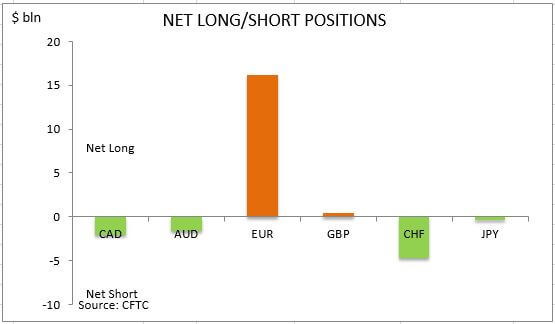
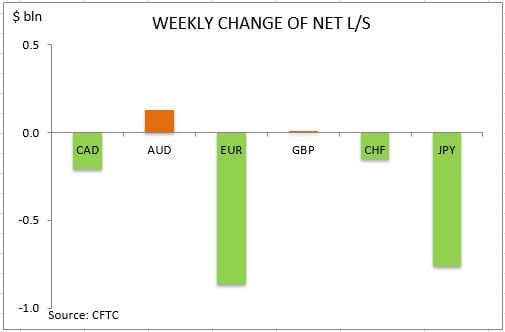
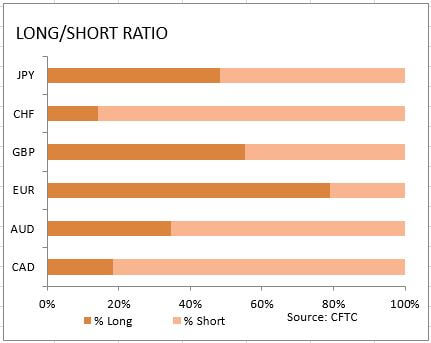
US dollar bearish bets fell to $7.95 billion from $9.80 billion against the major currencies during the previous week, according to the report of the Commodity Futures Trading Commission (CFTC) covering data up to May 22 released on Friday May 25. The dollar strengthening continued as industrial production rose at steady rate of 0.7% in April while Treasury yields continued rising .


CFTC Sentiment vs Exchange Rate

May 22 2018BiasEx RateTrendPosition $ mlnWeekly Change
CADbearishnegative-2045-206
AUDbearishnegative-1598127
EURbullishnegative16154-862
GBPbullishnegative4794
CHFbearishnegative-4700-154
JPYbearishpositive-343-760
Total7947


commitment of traders net long short
commitment of traders weekly change
market sentiment ratio long short positions

Market Analysis provided by IFCMarkets

Note:
This overview has an informative and tutorial character and is published for free. All the data, included in the overview, are received from public sources, recognized as more or less reliable. Moreover, there is no guarantee that the indicated information is full and precise. Overviews are not updated. The whole information in each overview, including opinion, indicators, charts and anything else, is provided only for familiarization purposes and is not financial advice or а recommendation. The whole text and its any part, as well as the charts cannot be considered as an offer to make a deal with any asset. IFC Markets and its employees under any circumstances are not liable for any action taken by someone else during or after reading the overview.

The End of US Internationalism

How Trump’s ditching of the Irean nuclear deal affirms American Unipolarity – with Obama’s help

By Dan Steinbock

The Trump White House plans to break the Iran deal by sanctioning companies from Europe and Asia doing business in and with Iran. Ironically, President Obama paved the way to unilateral sanctions.

For three years, the comprehensive nuclear accord (JCPOA) has offered Iran relief from US, UN and multilateral sanctions on energy, financial, shipping, automotive and other sectors. But recently that era came to a halt. “The United States will withdraw from the Iran nuclear deal,” President Trump said on May 8.

Two weeks later, Secretary of State Mike Pompeo, the ultra-conservative former head of the CIA, said Washington will impose “the strongest sanctions in history [on Iran] once they come into full force.”

In contrast, Chinese Foreign Minister Wang Yi has reiterated Beijing’s support for the deal. “China will continue to work to maintain the deal,” Wang said, stressing that the agreement was “hard-earned.” By the same token, the other key signatories of the nuclear deal – UK, France, and Germany, and Russia – say the deal will be sustained.

Breaking Iran by sanctioning EU and Asian companies

American internationalism began a century ago, when President Woodrow Wilson purported to make “the world safe for democracy.” That’s no longer the goal (if it ever was). Rather, the objective is now to ensure US unipolarity in a multipolar era, by any means necessary.

Regionally, Trump’s quest for primacy leans on Saudi Arabia for economic and geopolitical support, as evidenced by the $110 billion arms deal with Riyadh a year ago, and reinforced security ties with Israel, as reflected by US recognition of Jerusalem as capital of Israel – another fatal policy mistake that reversed decades of US foreign policy.

Now America also plans to “apply unprecedented financial pressure on the Iranian regime,” as Pompeo said. The administration’s objective is to restore primary sanctions that were lifted after the International Atomic Energy Agency’s (IAEA) certification in January 2016 that Iran had complied with the agreement. As secondary sanctions on firms have remained in place, along with sanctions applying to US companies, including banks, the White House will fortify them.

In a typical unipolar move, the Trump administration is extending sanctions over to EU firms that have done business in and with Iran since the 2015 nuclear deal, thus raising risks for their U.S. access. As Treasury Secretary Steven Mnuchin says, EU-Iran business agreements will be voided as “the existing licenses will be revoked.”

Along with Renault, PSA Peugeot Citroen and Sanofi, French companies have huge stakes in the deal, thanks to the $21 billion Airbus contract and the oil giant Total’s $2 billion deal to develop the South Pars oil field. Some 120 German companies, including Volkswagen and Siemens, operate in Iran and another 10,000 do business with Iran. Royal Dutch Shell would be adversely affected.

Economic pressure could harm significantly Iran’s oil industry which is the fourth largest reserve holder of crude oil in the world and whose largest buyers include China, South Korea, Turkey, Japan, Italy and India.

During the sanctions era, Iran shifted toward Asia and it has a vital role in the China-led One Road One Belt initiative. Indeed, through the worst days of the 2010-16 sanctions, Asian countries remained engaged in Iran’s economy. In the coming years, these countries hope to support Iran to become a major regional trading hub and to diversify its economy away from oil and gas. But if the White House sanctions EU companies for Iran business, it will sanctions firms from Asia as well.

In the 2003 Iraq War, President Trump’s new National Security Advisor John Bolton relied on false data from U.S.-based Iraqi exiles. Since last fall, Bolton has been urging the US to implement a similar regime change with Mojahedin-e Khalq (MEK), which was de-listed as a terrorist group by Secretary of State Hillary Clinton in the early 2010s. MEK is an Iranian opposition group which has lucratively financed and then been lobbied by former heads of the CIA, FBI and the Homeland.

Bolton wants a new regime in Tehran before February 2019 – the 50th anniversary of the revolution.

How Obama paved the way to Trump’s withdrawals

With his pledges to withdraw from the climate and nuclear accords and America’s key trade agreements (e.g., North American NAFTA, Asia-Pacific TPP, and US-EU TTIP), Trump has electrified the historical debate on the legality of US withdrawal from treaties and other international agreements.

While the US constitution sets forth a process whereby the executive has the power to make treaties with the advise and consent of the Senate, it does not specify how such treaties can be terminated. The nature of the agreement matters as well. When the president enters into executive agreements, these do not receive the Senate’s advice and consent. But such “political commitments” are not seen as binding. As a result, the US will withdraw if the Iran deal is not renegotiated.

Ironically, it was the President Obama who created the opportunity for such strategic maneuvering. When his administration concluded the JCPOA, it considered the plan of action a non-binding political commitment, which allows the Trump administration to argue it has ability to withdraw from the JCPOA. True, on 2015, the Security Council unanimously adopted resolution 2231 endorsing the Iran deal. So Trump’s critics could argue that the resolution converted at least some provisions in the JCPOA into obligations that are binding under international law which would mean a complex and long debate.

Yet, today such critics seem to be largely absent. When Obama concluded the Iran talks, most Democrats hailed the accord. Yet, most Democrats turned their coats in late 2016, the Senate and the House of Representatives unanimously extended the Iran Sanctions Act for a decade.

As a legal scholar, Obama knew well the loopholes his administration left to its successor. His (few remaining) supporters say he concluded the deal out of political expediency (not enough Republican support in the Congress). Others see it as a “Wilsonian” failure (adequate authority to sign the deal but not to implement it). But radicals believe that Obama, who was trained in the CIA front Business International Corp. in the ‘80s, was used to pave the way to withdrawal.

In a recent meeting with President Xi Jinping, German Chancellor Angela Merkel sought a common strategy to ward off a trade war, keep markets open and a unity in the nuclear deal. It is a stance that is aligned with the interests and values in Beijing.

Whatever the legal pretexts for Trump’s withdrawals, they herald the end of Wilsonian internationalism in America. In the past, Washington, Brussels and Tokyo shared similar interests and values, it was said. As the White House is substituting unilateral bullying for multilateral diplomacy, those days are busy fading into history.

About the Author:

Dr. Dan Steinbock is an internationally recognized strategist of the multipolar world and the founder of Difference Group. He has served as research director at the India, China and America Institute (USA) and visiting fellow at the Shanghai Institutes for International Studies (China) and the EU Center (Singapore). For more, see https://www.differencegroup.net/

The commentary was released by South China Morning Post (Hong Kong) on May 25, 2018
 

Turkey sets repo rate as policy rate, raises it 850 bps

By CentralBankNews.info
      Turkey’s central bank lived up to past promises and simplified its monetary policy framework, setting the one-week repurchase rate as its new policy rate and raising it by 8.50 percentage points to 16.50 percent, the current level of the late liquidity lending rate.
      In a brief statement the Central Bank of the Republic of Turkey (CBRT) said the new operational framework would take effect on June 1, and the overnight borrowing and lending rate would be set 150 basis points below and above the one-week repo rate.
      Several years ago Turkey’s central bank said it was planning to simplify the operational aspects of its monetary policy but this talk then quieted in 2016 following a failed coup attempt that July and then the election of Donal Trump as U.S. president, which dented Turkish asset prices.
      Since then CBRT has used five different rates to control interest market rates and the attractiveness of Turkish assets, including the lira. This included the one-week repo rate, an overnight  funding and borrowing rate, and a late liquidity borrowing and lending rate.
      While the repo rate was last raised in November 2016 to 8.0 percent, CBRT has been tightening its monetary policy by other means, such as the rate it pays on local lenders’ U.S. dollar reserves and require reserve ratios, and raising the volume of foreign exchange deposits.
       Since early 2017 the central bank has been using the late liquidity lending rate as its main tool to tighten its policy stance in response to high inflation from lira depreciation.
      This year alone, the late liquidity rate – used by banks to access funds shortly before local markets’ close – has been raised 375 basis points, including last week’s 300 basis point hike to 16.50 percent. Since 2017 the late liquidity lending rate has been raised by 650 points.
       Last week’s hike in the late liquidity rate came in response to a fresh bout of pressure on the lira from investors who are unnerved by President Tayyip Erdogan’s statements that he would exert greater control over the central bank if he win’s the presidential elections on June 24.
       Erdogan has long been a vocal opponent of the central bank’s tight monetary policy, claiming high inflation is a result of its high interest rates, an argument that runs counter to economic theory and practice.
       The lira reacted swiftly to the central bank’s simplification of its policy framework, jumping 3.0 percent to 4.56 to the U.S. dollar. But the lira still remains almost 17 percent below the level at the start of this year.
      Turkey’s headline inflation rate rose to 10.85 percent in April from 10.23 percent in March while core inflation rose to 12.2 percent.
       Last month the central bank raised its 2018 inflation forecast to 8.4 percent from 7.9 percent but retained its 2019 forecast of 6.5 percent and its medium-term outlook for inflation of 5 percent.

      www.CentralBankNews.info


Key events to watch this week

Article by ForexTime

European politics

After falling to a six-and-a-half month low against the dollar on Friday, the Euro bounced back early Monday following the Italian president’s blocking the formation of a new government supported by anti-establishment parties. Mr. Mattarella’s refusal on Sunday to approve a proposed Eurosceptic economic minister gave the Euro a much-needed push. However, it is far from certain that Mattarella’s current move will end Italy’s drama. In fact, the situation may worsen going forward, as 5 Star leader Luigi Di Maio is planning to request the parliament to have Mattarella impeached. On the other hand, the League leader Matteo Salvini suggested Italians return to the polls for a re-vote. Such developments will put the third-largest European economy on an uncertain path that will ultimately lead to further pressure on the single currency.

Another looming risk to the Euro this week is Spain, after Pedro Sanchez, the leader of the Socialist Workers’ Party, filed a no-confidence motion against the prime minister, Mariano Rajoy. If Sanchez gets the required votes in parliament to replace Rajoy, expect to see a further selloff in Spanish bonds and equities. So, instead of one headache, the European Union will probably need to deal with two now, and with continuing deterioration in economic data, the Euro bounce is likely to be short-lived.

Oil prices

Oil resumed its slide on Monday, following discussions that Russia and Saudi Arabia may restore some of the halted output when OPEC and non-OPEC ministers meet in Vienna on June 22 & 23. Brent fell 7.45% from its peak of $80.49 recorded on Tuesday, while WTI declined more than 9.6% from Tuesday’s high.

The sustained fall in Venezuelan output helped OPEC and non-OPEC members to significantly exceed the intended total production cuts over the past eight months. Whether only Venezuela lost production will be recovered or more remains unknown, but the impression of easing output cuts on its own is sufficient to put a cap on prices. From now and until the OPEC and non-OPEC meeting, the ongoing commentary will continue to drive prices.

Trump – Kim Jong-un summit back on

The summit between Donald Trump and Kim Jong-un could happen after all. After calling off the planned historic summit on Thursday, President Trump tweeted on Sunday “I truly believe North Korea has brilliant potential and will be a great economic and financial Nation one day. Kim Jong-Un agrees with me on this. It will happen!”

Hopes that the Singapore summit could still take place may support appetite for risk assets. However, it has become evident that these developments tend to have only a temporary impact on equities and investors should not be distracted from the fundamental drivers.

Non-Farm Payroll report

Whether the dots on the Fed’s plot chart will move upwards or downwards when the Fed meets on June 12 & 13 will depend largely on this week’s economic data. Friday’s Non-Farm Payroll report is expected to show an increase of 185,000 for the month of May, up from 164,000 in April. Average hourly earnings are also expected to improve slightly, rising 0.2% in May from 0.1% in the previous month. If these figures do not deviate widely from expectations, I don’t think the shape of the dot plot will change a lot. Another important indicator for the Fed will be the Personal Consumption Expenditure due on Thursday, which if begins to overshoot the 2% target, will imply faster tightening in the coming months.

Disclaimer: The content in this article comprises personal opinions and should not be construed as containing personal and/or other investment advice and/or an offer of and/or solicitation for any transactions in financial instruments and/or a guarantee and/or prediction of future performance. ForexTime (FXTM), its affiliates, agents, directors, officers or employees do not guarantee the accuracy, validity, timeliness or completeness, of any information or data made available and assume no liability as to any loss arising from any investment based on the same.


Forex-Time-LogoArticle by ForexTime

ForexTime Ltd (FXTM) is an award winning international online forex broker regulated by CySEC 185/12 www.forextime.com

This week in monetary policy: Israel, Kenya, Kyrgyzstan, Indonesia, Mauritius, Canada, Fiji, Bulgaria, Gambia & Dominican Rep.

By CentralBankNews.info

      This week – May 27 through June 2 – central banks from 10 countries or jurisdictions are scheduled to decide on monetary policy: Israel, Kenya, Kyrgyz Republic, Indonesia, Mauritius, Canada, Fiji, Bulgaria, Gambia and Dominican Republic.
      Indonesia’s central bank will hold an additional monthly meeting of its board of governors on Wednesday, May 30, triggering speculation that it will raise interest rates for the second time in less than two weeks to shore up the exchange rate of its rupiah and Indonesian assets. 
      On May 17 Bank Indonesia raised its benchmark BI 7-day reverse repo rate by 25 basis points to 4.50 percent – its first rate hike since November 2014 – but this did little to reverse the fortunes of the rupiah which has weakened in the last month.
      Wednesday’s meeting by BI’s board will be the first to be chaired by Perry Wariyo who took over from Agus Martowardojo on May 24.
      Wednesday also sees the first meeting of the Bank of Mauritius’ new monetary policy committee, which includes three new members.
      On May 15 Mauritius’ central bank reconstituted its monetary policy committee and postponed a meeting scheduled for May 18 to May 30 “due to administrative matters.”
      The new committee will again be chaired by Yandraduth Googoolye, who took over as governor in December 2017, and includes previous members: Renganaden Padayachy, Mahendra Vikramdass Punchoo, Mustag Mohammad Namdarkhan, Streevarsen Narrainen.
      The new committee members are Sanjeev Sobhee  and Lim Chang Kwong Lam Thuon Mine, both appointed by the prime minister,  along with Ms. Pricilla Pattoo, who is appointed by the finance and economic development minister.
      The Bank of Mauritius has for several years been preparing to implement a new monetary policy framework to improve the responsiveness of market interest rates to changes in the policy rate.
      Following table includes the name of the country, the date of the next policy decision, the current policy rate, the result of the last policy decision, the change in the policy rate year to date, the rate one year ago, and the country’s MSCI classification.
     The table is updated when the latest decisions are announced and can always accessed by clicking on This Week.
WEEK 22
MAY 27 – JUN 2, 2018:
COUNTRY                   DATE                     RATE                LATEST                    YTD              1 YR AGO      MSCI
ISRAEL28-May0.10%000.10%         DM
KENYA28-May9.50%-50-5010.00%         FM
KYRGYZSTAN28-May5.00%005.00%
INDONESIA *)30-May4.50%25254.75%         EM
MAURITIUS30-May3.50%004.00%         FM
CANADA30-May1.25%000.50%         DM
FIJI31-May0.50%000.50%
BULGARIA31-May0.00%000.00%         FM
GAMBIA31-May15.00%0020.00%
DOMINICAN REP.31-May5.25%005.75%
*) ADDITIONAL MONTHLY MEETING

US Dollar Index Speculators raised their bets to highest since December

By CountingPips.comReceive our weekly COT Reports by Email

US Dollar Index Non-Commercial Speculator Positions:

Large currency speculators advanced their net positions in the US Dollar Index futures markets again this week, according to the latest Commitment of Traders (COT) data released by the Commodity Futures Trading Commission (CFTC) on Friday.

The non-commercial futures contracts of US Dollar Index futures, traded by large speculators and hedge funds, totaled a net position of 2,586 contracts in the data reported through Tuesday May 22nd. This was a weekly gain of 2,568 contracts from the previous week which had a total of 18 net contracts.

Speculative positions for the dollar index have improved for five consecutive weeks and pushed the net position into bullish territory for a second week. The current net position is at the best level since December 19th when the net position totaled +3,868 contracts.

US Dollar Index Commercial Positions:

The commercial traders position, hedgers or traders engaged in buying and selling for business purposes, totaled a net position of -7,017 contracts on the week. This was a weekly decrease of -2,332 contracts from the total net of -4,685 contracts reported the previous week.

UUP:

Over the same weekly reporting time-frame, from Tuesday to Tuesday, the UUP ETF, which tracks the price of US Dollar Index, closed at approximately $24.61 which was a gain of $0.11 from the previous close of $24.5, according to unofficial market data.

*COT Report: The COT data, released weekly to the public each Friday, is updated through the most recent Tuesday (data is 3 days old) and shows a quick view of how large speculators or non-commercials (for-profit traders) as well as the commercial traders (hedgers & traders for business purposes) were positioned in the futures markets. The CFTC categorizes trader positions according to commercial hedgers (traders who use futures contracts for hedging as part of the business), non-commercials (large traders who speculate to realize trading profits) and nonreportable traders (usually small traders/speculators). Find CFTC criteria here: (http://www.cftc.gov/MarketReports/CommitmentsofTraders/ExplanatoryNotes/index.htm).

Article By CountingPips.comReceive our weekly COT Reports by Email

Currency Speculators continued to trim US Dollar bearish positions for 5th week

By CountingPips.comGet our weekly COT Reports by Email

US Dollar net speculator positions landed at $-7.98 billion this week

The latest data for the weekly Commitment of Traders (COT) report, released by the Commodity Futures Trading Commission (CFTC) on Friday, showed that large traders and currency speculators reduced their bearish bets for the US dollar this week.

Non-commercial large futures traders, including hedge funds and large speculators, had an overall US dollar net position totaling $-7.98 billion as of Tuesday May 22nd, according to the latest data from the CFTC and dollar amount calculations by Reuters. This was a weekly rise of $1.84 billion from the $-9.82 billion total position that was registered the previous week, according to the Reuters calculation (totals of the US dollar contracts against the combined contracts of the euro, British pound, Japanese yen, Australian dollar, Canadian dollar and the Swiss franc).

The aggregate speculative position is now at the least bearish level since January 2nd when the position totaled $-4.62 billion. Despite five weeks of declining bearish bets, the US dollar aggregate position has remained in bearish territory for forty-five straight weeks dating back to July 18th of 2017.


Weekly Speculator Contract Changes:

This week saw just one substantial change (+ or – 10,000 contracts) in the individual currency contracts for the speculators category.

Mexican peso speculative bets fell by over -20,000 contracts for a second straight week. Speculator peso bets have overall declined for six consecutive weeks as sentiment has been waning for the peso amid an election season, uncertainty over NAFTA as well as emerging market currency woes. The MXN spec position has now fallen to the lowest level since January 9th when net positions totaled 29,797 contracts.

The individual major currencies that improved against the US dollar this week were just the Australian dollar (1,994 weekly change in contracts) and the British pound sterling (80 contracts).

The currencies whose speculative bets declined this week versus the dollar were the euro (-5,370 weekly change in contracts), Japanese yen (-6,447 contracts), Swiss franc (-918 contracts), Canadian dollar (-2,556 contracts), , New Zealand dollar (-3,316 contracts) and the Mexican peso (-21,238 contracts).


Table of Weekly Commercial Traders and Speculators Levels & Changes:

CurrencyNet CommercialsComms Weekly ChgNet SpeculatorsSpecs Weekly Chg
EuroFx-123,7225,221109,744-5,370
GBP-8,628-3,5845,70180
JPY19,10115,626-2,767-6,447
CHF60,008-291-37,311-918
CAD23,386-4,037-26,212-2,556
AUD42,912-1,384-21,1121,994
NZD4,4173,753-1,363-3,316
MXN-31,38922,26931,540-21,238


This latest COT data is through Tuesday and shows a quick view of how large speculators or non-commercials (for-profit traders) as well as the commercial traders (hedgers & traders for business purposes) were positioned in the futures markets. All currency positions are in direct relation to the US dollar where, for example, a bet for the euro is a bet that the euro will rise versus the dollar while a bet against the euro will be a bet that the dollar will gain versus the euro.


Weekly Charts: Large Trader Weekly Positions vs Price

EuroFX:


British Pound Sterling:


Japanese Yen:


Swiss Franc:


Canadian Dollar:


Australian Dollar:


New Zealand Dollar:


Mexican Peso:


*COT Report: The weekly commitment of traders report summarizes the total trader positions for open contracts in the futures trading markets. The CFTC categorizes trader positions according to commercial hedgers (traders who use futures contracts for hedging as part of the business), non-commercials (large traders who speculate to realize trading profits) and nonreportable traders (usually small traders/speculators). Find CFTC criteria here: (http://www.cftc.gov/MarketReports/CommitmentsofTraders/ExplanatoryNotes/index.htm).

The Commitment of Traders report is published every Friday by the Commodity Futures Trading Commission (CFTC) and shows futures positions data that was reported as of the previous Tuesday (3 days behind).

Each currency contract is a quote for that currency directly against the U.S. dollar, a net short amount of contracts means that more speculators are betting that currency to fall against the dollar and a net long position expect that currency to rise versus the dollar.

(The charts overlay the forex closing price of each Tuesday when COT trader positions are reported for each corresponding spot currency pair.) See more information and explanation on the weekly COT report from the CFTC website.

Article by CountingPips.com