Author Archive for InvestMacro – Page 414

It Was the Best of Times, It Was the Worst of Times

By The Gold Report

Source: Bob Moriarty for Streetwise Reports   05/31/2018

Bob Moriarty of 321 Gold finds parallels between “A Tale of Two Cities” and resource investing.

I’m told that is the most famous opening line of any book in English literature. It comes from Charles Dickens’ “A Tale of Two Cities.”

The paragraph continues: “…it was the age of wisdom, it was the age of foolishness, it was the epoch of belief, it was the epoch of incredulity, it was the season of Light, it was the season of Darkness, it was the spring of hope, it was the winter of despair, we had everything before us, we had nothing before us, we were all going direct to Heaven, we were all going direct the other way – in short, the period was so far like the present period, that some of its noisiest authorities insisted on its being received, for good or for evil, in the superlative degree of comparison only.”

The quote came to mind because I got two emails a short time ago. One from Keith Barron talking about a press release he put out today about his Lost Cities Project in Ecuador; the other announcing the closing of a $4 billion dollar financing of a blockchain company without a product.

My reaction was, “You gotta be shitting me.”

I am quite happy to suggest along with two others, I managed to pretty much nail the top of “Bitcon” and the “cliptocurrencies” in December. I’ll skip the false modesty and humility. People are usually humble for very real reasons. I’m not; I don’t do with false modesty. I called the top of the $800-billion dollar fraud perfectly correctly. It will be another 2–3 years before it hits bottom with 95% of the money flown off to Bitcon heaven. People pissing $4 billion down a cliptocurrency rat hole deserve everything they have coming and they will get it good and hard.

We are near a tradable low in the metals the same as we pretty much get every summer. Billions of dollars are pouring into the biggest financial fraud in world history yet very real resource stories are going begging. It will change soon.

Keith Barron began tracking the two Lost Cities of Gold almost 20 years ago, well before his discovery of Fruta del Norte. In 2017 Aurania Resources Ltd. (ARU:TSX.V) picked up 42 mineral claims with 2080 square km in Ecuador that Keith believed would hold the homes of those two projects.

It’s a simple story. The Spanish had seven major gold mining districts in what is now Ecuador. They treated the natives poorly, the natives rose up and killed as many of the Spanish as possible and two cities or properties were deserted and eventually lost to time.

Ecuador went through some bad times when the government got stupid and literally held mining companies up for ransom. So they all left and there was an eight-year period where nothing happened in the country in mining.

While they are a lot smarter now and there are some wonderful results coming out of the country, their terms are stiff. Aurania just paid $2.5 million in concession fees and have a $1 million+ yearly exploration requirement that doubles in another year. But they own 100% of the 2,080 square km and Keith believes he has narrowed down the location of the two Lost Cities. From the data it appears he is on to something potentially giant.

I happen to be a big Keith Barron fan. He points out on a regular basis that I am not a PhD geologist and I point out, “so what?” I was buying shares when the company hadn’t even done the deal on the projects. I participated in the PP at $2 a year ago and paid $3 to exercise the warrants. I am a believer.

If you want to see the opposite of pissing billions of dollars down a cliptocurrency rat hole, go to Aurania’s web site and wander around. Keith Barron is one of the most knowledgeable and best writers in mining. In 2001 he wrote a series of educational articles about the basics of mining that every investor should read. Two years ago I formatted some of them into a book titled Straight Talk on Mining available on Amazon.

The Aurania team is busy doing the basic ground exploration work necessary prior to putting the Truth Detector (drill) to work in Q4 of 2018. I’ll cut to the chase here for my readers. He has found at least one major deposit. It will take drilling to prove it but if you look at the pictures and read the information you will begin to understand how I feel. This is the real deal and the shares are eventually going to go much higher.

The price for Aurania shares has been as high as $7.20 in January after someone put in a market order to buy and bounced the price from $3.20 after someone came out with a write up. The price settled to about $4.50, Keith accelerated the $3 warrants and got cashed up.

He will need to do a financing soon; it’s expensive keeping the government happy down there. It’s expensive enough that you aren’t going to see any of the Vancouver scams run by drillers or cab drivers operating in the country. Word has gotten out and people who want in the financing cheap are dumping shares to make the price go down. It’s part of the Vancouver/Toronto games.

I believe he has found exactly what he was looking for. It will take more work, more money and drilling but I think he is on to another big discovery. They have just put out an updated presentation. Take a look at it and you figure out if I am right.

Aurania is an advertiser. I bought shares in the open market, in the PP, exercised warrants and I’m back buying shares in the open market. I suspect $2 is pretty much going to be the floor for now. Do your own due diligence.

Aurania Resources
ARU-V $2.00 (May 31, 2018)
AUIAF-OTCQB 29.5 million shares
Aurania Resources website.

Bob and Barb Moriarty brought 321gold.com to the Internet almost 16 years ago. They later added 321energy.com to cover oil, natural gas, gasoline, coal, solar, wind and nuclear energy. Both sites feature articles, editorial opinions, pricing figures and updates on current events affecting both sectors. Previously, Moriarty was a Marine F-4B and O-1 pilot with more than 832 missions in Vietnam. He holds 14 international aviation records.

Want to read more Gold Report articles like this? Sign up for our free e-newsletter, and you’ll learn when new articles have been published. To see a list of recent articles and interviews with industry analysts and commentators, visit our Streetwise Interviews page.

Disclosure:
1) Bob Moriarty: I, or members of my immediate household or family, own shares of the following companies mentioned in this article: Aurania Resources. Aurania Resources is an advertiser on 321 Gold. I determined which companies would be included in this article based on my research and understanding of the sector.
2) The following companies mentioned are billboard sponsors of Streetwise Reports: None. Click here for important disclosures about sponsor fees.
3) Statements and opinions expressed are the opinions of the author and not of Streetwise Reports or its officers. The author is wholly responsible for the validity of the statements. The author was not paid by Streetwise Reports for this article. Streetwise Reports was not paid by the author to publish or syndicate this article. The information provided above is for informational purposes only and is not a recommendation to buy or sell any security. Streetwise Reports requires contributing authors to disclose any shareholdings in, or economic relationships with, companies that they write about. Streetwise Reports relies upon the authors to accurately provide this information and Streetwise Reports has no means of verifying its accuracy.
4) The article does not constitute investment advice. Each reader is encouraged to consult with his or her individual financial professional and any action a reader takes as a result of information presented here is his or her own responsibility. By opening this page, each reader accepts and agrees to Streetwise Reports’ terms of use and full legal disclaimer. This article is not a solicitation for investment. Streetwise Reports does not render general or specific investment advice and the information on Streetwise Reports should not be considered a recommendation to buy or sell any security. Streetwise Reports does not endorse or recommend the business, products, services or securities of any company mentioned on Streetwise Reports.
5) From time to time, Streetwise Reports LLC and its directors, officers, employees or members of their families, as well as persons interviewed for articles and interviews on the site, may have a long or short position in securities mentioned. Directors, officers, employees or members of their immediate families are prohibited from making purchases and/or sales of those securities in the open market or otherwise from the time of the interview or the decision to write an article, until one week after the publication of the interview or article.

( Companies Mentioned: ARU:TSX.V,
)

Global stocks shrug off trade war fears, NFP in focus

Article by ForexTime

This has certainly been a rollercoaster trading week for financial markets thanks to geopolitical uncertainty and renewed trade war fears.

Easing political tensions in Italy have rekindled risk appetite, ultimately resulting in global equity markets venturing higher. However, global sentiment is likely to remain cautious after the United States announced it would impose steel and aluminium tariffs on Canada, Mexico and the EU. With Canada and Mexico immediately retaliating against the US tariffs and the EU threatening a similar response, fears could intensify over a global trade war. While stock markets could nudge higher on relief over Italy narrowly avoiding snap elections, gains are likely to be capped by renewed trade war concerns.

Euro strengthens as Italy fears ease

The Euro was thrown a lifeline this week after a last-minute coalition agreement between Italy’s two anti-establishment parties eased fears of a snap election.

While the Euro has scope to extend gains as Italian political tensions ease, the question is –  for how long? With uncertainty likely to mount following the Spanish Parliament forcing Mariano Rajoy out of office in a vote of no confidence, the Euro remains exposed to downside risks. Taking a look at the technical picture, the EURUSD remains bearish on the daily charts despite the rebound witnessed this week. A technical bounce could be in play, with the next key levels of interest at 1.1750 and 1.1820.

Dollar weakens ahead of NFP report

Today’s main risk event for the Dollar will be the monthly US jobs report for May, which could offer fresh insight into the health of the US labour market.

Markets expect the US economy to have added 189k jobs in May, up from 164k in April, while the unemployment rate is predicted to remain steady at 3.9%. Much attention will be directed towards wage growth figures which could shape US rate hike expectations beyond June. Any signs of accelerating wage growth may boost speculation over the Federal Reserve adopting a more aggressive approach towards monetary policy normalization this year. With the Dollar highly sensitive to monetary policy speculation, expectations over the Fed raising rates faster than expected could provide the currency a boost.

Taking a look at the technical picture, the Dollar Index remains bullish on the daily charts. A solid US jobs report could inspire bulls with enough inspiration to challenge the 95.00 level. Alternatively, sustained weakness below 94.00 could invite a decline towards 93.40.

Commodity spotlight – Gold

Gold has been pushed and pulled by a variety of fundamental drivers this week with prices trading marginally below $1300 as of writing.

While geopolitical uncertainty and trade war fears continue to boost appetite for the precious metal, gains have been limited by expectations of higher US interest rates. Price action suggests that the yellow metal is searching for a fresh directional catalyst, and this could come in the form of the US jobs report that is scheduled for release today. Investors will continue to closely observe how prices react around the psychological $1300 level.

From a technical standpoint, repeated weakness below $1300 could encourage a decline towards $1280. Alternatively, a solid breakout above $1300 may invite an incline higher towards $1324.

Disclaimer: The content in this article comprises personal opinions and should not be construed as containing personal and/or other investment advice and/or an offer of and/or solicitation for any transactions in financial instruments and/or a guarantee and/or prediction of future performance. ForexTime (FXTM), its affiliates, agents, directors, officers or employees do not guarantee the accuracy, validity, timeliness or completeness, of any information or data made available and assume no liability as to any loss arising from any investment based on the same.


Forex-Time-LogoArticle by ForexTime

ForexTime Ltd (FXTM) is an award winning international online forex broker regulated by CySEC 185/12 www.forextime.com

EURUSD: euro consolidating ahead of the NPF report and Spanish parliament vote

By Gabriel Ojimadu, Alpari

Previous:

On Thursday the 31st of May, trading on the EURUSD pair closed slightly up. Despite the fact that the euro dropped to 1.1641, it managed to recover to 1.1700 by the end of the session. This recovery was the result of reduced pressure on the single currency. Giuseppe Conte is set to be sworn in as Italy’s Prime Minister today, along with his cabinet, having gained the approval of the president.

The new Finance Minister will be economics professor Giovanni Tria. Eurosceptic Paolo Savona, who was vetoed as Finance Minister, has been appointed Minister of European affairs.

In the US session, riskier assets declined on the back of new developments in the trade dispute between the US and the rest of the world. US Commerce Secretary Wilbur Ross announced that from the 1st of June, tariffs would come into effect on steel (25%) and aluminium (10%) imports from Canada, Mexico, and the EU. The US has imposed the condition that should anyone impose their own counter measures in response to the tariffs, continued negotiations will become impossible.

US data:

  • Initial jobless claims (25 May): 221,000 (forecast: 228,000, previous: 234,000).
  • Personal income (Apr): 0.3% (forecast: 0.3%, previous: 0.2%).
  • Personal spending (Apr): 0.6% (forecast: 0.4%, previous: 0.5%).
  • Chicago PMI (May): 62.7 (forecast: 58.0, previous: 57.6).
  • Canada – GDP (Q1): 1.3% YoY (forecast: 1.8% YoY, previous: 1.7% YoY).

Day’s news (GMT+3):

  • 10:30 Switzerland: SVME – PMI (May).
  • 10:50 France: Markit manufacturing PMI (May).
  • 10:55 Germany: Markit manufacturing PMI (May).
  • 11:00 Eurozone: Markit manufacturing PMI (May).
  • 11:30 UK: Markit manufacturing PMI (May).
  • 15:30 USA: unemployment rate (May), nonfarm payrolls (May), average hourly earnings (May), average weekly hours (May), labour force participation rate (May).
  • 16:45 USA: Markit manufacturing PMI (May).
  • 17:00 USA: ISM manufacturing PMI (May), construction spending (Apr).
  • 20:00 USA: Baker Hughes US oil rig count.

Fig 1. EURUSD hourly chart. Source: TradingView

During Thursday’s European session, the euro rose to 1.1724. The single currency broke through the trend line and continued its upwards trajectory to the U3 MA line, just as I expected. Since the euro subsequently dropped from the U3 MA line to 1.1641, this confirmed the breakout of the trend line as false. The line now runs through the high of 1.1724.

Today’s key developments will be the Spanish parliament’s vote of confidence in the government as well as the nonfarm payrolls report from the US. These are what traders and investors will be looking at today.

Considering that the US dollar is on the rise against all the majors in today’s Asian session, I’m expecting the euro to decline today. The rise of the EURGBP cross has been providing support to the euro for 14 hours and only started declining in the Asian session, now providing support to sellers.

I don’t make predictions on payrolls day. The only thing I can do is to set a target level for sellers; 1.1620. As the crosses are reluctant to decline, downwards movement should prove difficult today. Also, on the way down, sellers will be met with resistance at the 45th degree and the LB line at 1.1653.

If the NFP report is weak, and the vote of confidence in Spain goes in the government’s favour, the euro should surge to around 1.1840. Of course, if you have a profitable open position, I think it best to get out of the market ahead of the payrolls report. It’s not a nice feeling when you have a profitable position ahead of some event, only to lose it once the news has come out. There are too many factors adding to the uncertainty of the situation.

Investors eye payrolls. Wage growth expected to rise

By Orbex

Daily Forex Market Preview, 01/06/2018

The U.S. dollar was seen trading flat on Thursday as investors prepared for Friday’s payrolls report. On the political front, the U.S. steel and aluminum tariffs go into effect from Friday. Canada, Mexico and the EU are some of the economies that would be hit by the new tariffs.

EU officials vowed to retaliate against the tariffs which once again raise the specter of a full-blown trade war. On the economic front Canada’s GDP increased 0.3% on the month which was better than expected. In the U.S. the core PCE price index showed a 0.2% increase on the month while both personal spending and income grew better than expected.

Investors will be geared into the U.S. nonfarm payrolls report that will be released later today. Economists forecast that the U.S. unemployment rate was steady at 3.9% while estimating that the average number of job gains during May increased 189k. This marks a slightly higher print compared to 164k jobs added in April. Wage gains are expected to accelerate at a pace of 0.3% on a month over month basis.

Following the payrolls report, the monthly ISM manufacturing PMI data is expected to be released. Estimates show a rebound in manufacturing activity from 57.3 in April to 58.2 in May.

Data from the Eurozone will see the release of the manufacturing PMI including that from the UK.

Will you be trading the NFP this coming Friday? Register now for our Live NFP Webinar, coming to you before, during and after the release! 

EURUSD intra-day analysis

EURUSD (1.1681): The EURUSD currency pair managed to post gains for the second day but price action was mostly subdued. The early trading on Friday showed some bearish momentum in price action which indicates perhaps a moderate pullback to the gains from the previous two days. On the 4-hour chart, the recent gains coincide with the upper end of the falling price channel alongside the hidden bearish divergence. Unless the EURUSD clears the resistance level at 1.1730, we expect to see a pullback in price. Support is most likely to be established around 1.1610 – 1.1577. If price rebounds along this level, we could expect to see further gains in store.

USDJPY intra-day analysis

USDJPY (109.16): The USDJPY currency pair settled into a consolidation between 108.90 – 108.48 level before attempting to breakout from this tight range. The upside momentum currently is pushing the USDJPY to rally toward the next main resistance level at 109.57 – 109.43 level. If resistance is established here, we expect USDJPY to maintain the range below this resistance level. For the short term, USDJPY is likely to have formed a bottom in the near term.

XAUUSD intra-day analysis

XAUUSD (1298.58): Gold prices were seen easing back following the test of resistance near 1304 – 1301 level. The reversal off this resistance level is expected to push gold prices to the downside. With the consolidation taking place, as long as the previous lows of 1282 are not breached, we expect to see gold prices staying subdued. A breakout above 1304 is needed in order for further gains to be posted. In the near term however, gold prices could remain range bound at the current price levels.


WTI Horizontal Channel Congestion Prior to Breakout

By Admiral Markets

WTI - 1 hour - 1 June 2018

Source: Admiral Markets MT5 with MT5SE Add-on

The WTI started a bearish move at the break of bullish wedge top and now it is trading within the horizontal channel. However, the price is currently below the EMA89 and MACD is below zero line so we might see another drop. 67.20-40 is the POC zone. Rejections from the zone should target 66.52 and 66.06. Below the channel targets are 65.28 and 64.37. However a spike above 67.55 will change the tide and targets are 67.93 and 68.70. This might likely happen on profit taking – if shorts start to close their positions today. Pay attention to the POC zone.

W L3 – Weekly Camarilla Pivot (Weekly Interim Support)

W H3 – Weekly Camarilla Pivot (Weekly Interim Resistance)

W H4 – Weekly Camarilla Pivot (Strong Weekly Resistance)

D H4 – Daily Camarilla Pivot (Very Strong Daily Resistance)

D L3 – Daily Camarilla Pivot (Daily Support)

D L4 – Daily H4 Camarilla (Very Strong Daily Support)

POC – Point Of Confluence (The zone where we expect price to react aka entry zone)

Best wishes,

Nenad

Follow Admiral Markets on Facebook – @AdmiralMarkets on Twitter – for the latest market updates.

This material does not contain and should not be construed as containing investment advice, investment recommendations, an offer of or solicitation for any transactions in financial instruments. Please note that such trading analysis is not a reliable indicator for any current or future performance, as circumstances may change over time. Before making any investment decisions, you should seek advice from independent financial advisors to ensure you understand the risks.

Article by Admiral Markets

Source: WTI Horizontal Channel Congestion Prior to Breakout


Admiral Markets is a leading online provider, offering trading with Forex and CFDs on stocks, indices, precious metals and energy.


Stocks fall as US tariffs revive trade war fears

By IFCMarkets

SP 500 logs monthly gain

US markets reversed most of previous day gains on Thursday as trade war concerns came to fore again after US imposed tariffs on steel and aluminum imports from the European Union, Canada and Mexico starting Friday. Dow Jones industrial average lost 1% to 24415.84. The S&P 500 slid 0.7% to 2705.27, but closed 2.2% higher for the month. The Nasdaqcomposite fell 0.3% to 7442.12. The dollar weakening slowed: the live dollar index data show the ICE US Dollar index, a measure of the dollar’s strength against a basket of six rival currencies, fell 0.1% to 93.96 but is rebounding currently. Stock index futures point to higher openings today.

Global trade war scenarios got more real after Canadian Prime Minister Justin Trudeau said Ottawa would impose a 25% tariff on steel imports from the US, a 10% tariff on aluminum and other US goods, Mexico said it would target several US goods in response and the EU has announced it may target industries such as whiskey and motorcycles. Market reaction to positive economic news was muted: spending on consumer goods rose sharply for a second straight month in April, up 0.6%, the PCE index, the Fed’s preferred inflation gauge, was up 0.2% on month instead of expected 0.1%, and the Chicago purchasing managers index came in at 62.7, compared with the previous level of 57.6.

DAX slumps most as European indices slip

European stock indices ended lower on Thursday as US imposed earlier announced tariffs on EU steel and aluminum imports. Both the euro and British Pound continued rebound against the dollar with euro up currently while Pound is lower. The Stoxx Europe 600 index lost 0.6%. Germany’s DAX 30 dropped 1.4% to 12604.89. France’s CAC 40 fell 0.5% and UK’sFTSE 100 slid 0.2% to 7678.20. Markets opened 0.5% – 0.9% higher today.

Jean-Claude Juncker, president of the European Commission, tweeted that EU will defend Europe’s interests. The EU has threatened to impose $3.5 billion of tariff on US agriculture, steel and industrial products. In response Trump has threatened to impose import tax on European cars. In Italy the antiestablishment League and 5 Star Movement have agreed to revive a coalition government, withdrawing the candidacy of Paolo Savona for finance minister. In economic news inflation jumped to 1.9% in April in euro-zone, closer to ECB’s 2% target.

Asian markets down

Asian stock indices are mostly lower today. Nikkei slid 0.1% to 22171.35 in choppy trade despite resumed yen slide against the dollar. Chinese stocks are lower as Caixin China manufacturing PMI held steady in May : the Shanghai Composite Indexis 0.7% lower while Hong Kong’s Hang Seng Index is up 0.2%. Australia’s All Ordinaries Index is down 0.4% despite Australian dollar continued slide against the greenback.

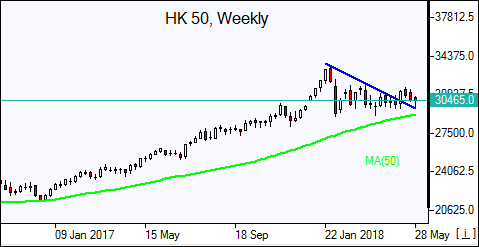
HK50

Market Analysis provided by IFCMarkets

Note:
This overview has an informative and tutorial character and is published for free. All the data, included in the overview, are received from public sources, recognized as more or less reliable. Moreover, there is no guarantee that the indicated information is full and precise. Overviews are not updated. The whole information in each overview, including opinion, indicators, charts and anything else, is provided only for familiarization purposes and is not financial advice or а recommendation. The whole text and its any part, as well as the charts cannot be considered as an offer to make a deal with any asset. IFC Markets and its employees under any circumstances are not liable for any action taken by someone else during or after reading the overview.

Take a Bite: FAANG Stocks are on the Rise

By Amram Margalit – Leverate

The stock market has seen an acronym craze of tech stocks, which began when CNBC’s “Mad Money” host Jim Cramer coined the term “FANG stocks” in an episode on February 5 ,2013. Back then, this abbreviation referred to Facebook, Amazon, Netflix and Google, which were all on their way to an all-time high. In the episode, Cramer exclaimed: “Put money to work in the companies that represent the future.”

Since then, the future has mostly proved him right, and newer, longer abbreviations emerged to represent other large tech companies who also experience a strong momentum in the stock markets.

We’ve had Cramer’s own FAAA – excluding Netflix and including Alibaba and Google’s parent company, Alphabet, we’ve had Merrill Lynch strategist Savita Subramanian’s FAAANG – adding Broadcom (AVGO) and Adobe in late 2017, and Goldman Sachs added Apple to their list of stocks with huge growth potential, giving birth to FAAMG (with Microsoft, without Netflix), and the now more popular term “FAANG”.

Despite the considerable variation within this group of companies – with Netflix being a relatively small company which focuses on content rather than technology, and each of the other four making their original fortune in entirely different fields of the high-tech world – these five companies are grouped together in Wall Street since they are the most popular tech stocks with the highest performance rates overall.

The purpose of categorizing them under one moniker, is to illustrate a certain impact they hold on the financial markets as a whole. All of these stocks are traded on the NASDAQ, which lists more than 3,000 companies which some consider to be a pretty accurate representation of the entire economy.

In the S&P 500 Index, which measures the market capitalization of the 500 leading stocks in both the NYSE and NASDAQ, FAANG stocks are all within the top 10, and in 2017 they contributed almost a quarter of the entire S&P 500 return.

Over the years, there has been speculation on whether FAANG stocks actually represent a bubble, similar to the Dotcom bubble that burst in early 2000. Some analysts asserted that a growth rate of such proportions is not sustainable in the long term, and their bullish momentum would eventually wane when they wouldn’t be able to keep up with their own pace of innovation. However, most analysts agree that these companies still have enough room to grow in upcoming years, especially with their insanely high R&D budgets which continuously explore new fields and ventures, from artificial intelligence to big data and cloud computing.

Pulling FAANGs Apart

Nevertheless, the main question that investors are interested in is whether to buy, sell or hold these stocks. Despite the tremendous gains these stocks made in the past five years, concerns are arising regarding their average price, which soared dramatically during those years. Each one of them will have to generate almost unimaginable returns in order to justify their excessive current price.

So that almost certainly rules out the “buy” option for most traders. But chances are that if you’ve been trading for some time in US stocks than you already own some FAANGs, if not directly than through mutual funds, so the main question on your mind should be whether to sell or hold. For these purposes it is best not to group them together, but to analyze each one of them separately.

So here is a short breakdown of the “FAANG five” in terms of future market performance, according to Kiplinger’s financial advisors:

Facebook – The social media giant is under heavy fire lately regarding its data privacy blunders. However, analysts are far from bearish on Facebook’s stock, considering its enormous user base, so it’s highly likely that Facebook will keep up its 27% profit growth in upcoming years, making it a definite hold.

Amazon – Jeff Bezos is apparently betting his company’s future on online grocery-shopping, with the acquisition of Whole Foods. Amazon’s growth strategy is known for its exceptionally high R&D spending, so analysts predict it will be able to generate profit whenever it wants. With its never-ending expansion, and a price-earnings ratio of 202, holding is the best strategy right now.

Apple – As the company with the highest market cap in the S&P 500, Apple is undoubtedly a mammoth. The iPhone remains its main source of income, and with a P/E ratio of 18 and a horde of devoted followers, it seems like Apple’s future is bright, with Kiplinger rating it “buy”, or in case you already own some, a sure-fire “hold”.

Netflix – The smallest company on the list with the most volatile stock action, Netflix has seen an unimaginable ascent of 82% in 2018, at one point surpassing its main competitors Comcast and Disney to reach a market cap of 153 Billion USD. Despite a fierce competition from newcomers Hulu and Amazon Prime, so far Netflix has been able to retain its edge, and although Kiplinger rated it “sell” in late 2017, investors today are more optimistic about its ability to grow.

Alphabet (Google) – Probably the biggest question mark on this list, analysts cannot be sure of Google’s potential to maintain high revenue. Following Google’s restructuring and the founding of Alphabet, the company has been launching many different trial balloons, from cloud to AI to self-driving cars. It’s hard to tell which one of these will land, but Google’s daily bread is still ads, so the company needs to keep counting on its ability to draw more searches. In that sense, analysts give it a cautious “hold”.


About the Author:

Amram Margalit is a professional writer who has worked in a wide range of settings, including technology companies, nonprofits, and the entertainment industry. Within these positions, Amram has provided quality content and advertising services and is currently the Content Manager at Leverate.

USD in focus ahead of Non-farm

Article by ForexTime

The USD will be in focus tomorrow as it’s a key test of strength with the upcoming non-farm payroll data on the US economy. So far the markets are expecting a solid figure to be produced at 190K (164K prev), which would be a solid result given the drop last month. One of the key figures will also be manufacturing data which has come under scrutiny as of late, given the tariffs that have tried to be applied by the US on major trade partners when it comes to commodities such as steel and aluminium. All in all though, the US economy is set for a wild ride and markets will be keenly watching it to see what happens next given that another rate rise is expected next month, and is so far locked in by the markets.

For me one of the key markets to watch will be the USDJPY which for a long time has suffered against the JPY but has clawed back some ground in recent weeks. This rise has been on the back of markets become more risk focused and looking to leave safe havens. However, it has come up against some resistance as the market is struggling to break through resistance now at 108.768 on the chart. If we see some positive data then expect it to punch through this level and rise potentially to resistance at 111.083 in the long run. If the bears take control and swipe strongly then support at 107.795 is likely to be key in this scenario.

One of the key movers this evening so far has been the Australian dollar as data was positive with manufacturing lifting to 57.5, even though it was below the expected 58.3 by the market. This still shows solid expansion in the Australian economy and is a positive in a sea of red recently, as Australian data has been hit and miss, and many are expecting any future rate rises to be some time off as a result. Given the recent data though the Reserve Bank of Australia will be bullish on the prospect of the AUD but will be hoping that it slips lower to help support the export and manufacturing sector.

Looking at the AUDUSD on the charts it’s clear to see that so far it has managed to claw back some very solid ground against the USD. However it has faltered at resistance at 0.7588 on the charts as markets still don’t believe there is large upside potential here. This can be further viewed from the weekly chart which shows a declining bearish market in the long run if looked at closely. If the AUDUSD does fall further I expect support at 0.7527 and 0.7472 on the charts, but it will be very tight unless we see some strong USD strength in the interim.

Disclaimer: The content in this article comprises personal opinions and should not be construed as containing personal and/or other investment advice and/or an offer of and/or solicitation for any transactions in financial instruments and/or a guarantee and/or prediction of future performance. ForexTime (FXTM), its affiliates, agents, directors, officers or employees do not guarantee the accuracy, validity, timeliness or completeness, of any information or data made available and assume no liability as to any loss arising from any investment based on the same.


Forex-Time-LogoArticle by ForexTime

ForexTime Ltd (FXTM) is an award winning international online forex broker regulated by CySEC 185/12 www.forextime.com

Gambia cuts rate 150 bps to boost credit growth

By CentralBankNews.info
      Gambia’s central. bank lowered its policy rate by 150 basis points to 13.50 percent to “reinforce private sector credit growth particularly to small and medium size enterprises.”
       It is the first rate cut by the Central Bank of The Gambia (CBG) since June 2017 and the policy rate has now been cut by a total of 950 basis points since it began an easing cycle in May 2017/
       The CBG also said it was introducing an overnight interest corridor as of Aug. 30 to help limit the volatility of short-term interest rates around its policy rate.
       “Lower volatility increases the effectiveness of the monetary policy rate and strengthens the interest channel of the monetary transmission mechanism,” the central bank said, adding it would introduce standing lending and deposit facilities as part of it corridor framework.
       Gambia’s inflation rate eased to 6.6 percent in April from 8.7 percent in April 2017 but was up from 6.7 percent in March 2018 due to a slight rise in non-food inflation, the central bank said.
       But the CBG expects this increase in inflation to be temporary and the outlook is for inflation to decelerate further toward its 5 percent target based on continued stability of the exchange rate and prudent monetary and fiscal policies.
       Risks to this outlook include higher global commodity prices, particularly energy and food, while  Gambia’s debt to Gross Domestic Product ratio of 130 percent “poses a major risk to the economy.”
       Gambia’s economic recovery is gathering strength, the central bank said, adding real GDP is projected to grow by 5.4 percent this year, up from 3.5 percent in 2017, predicated on a rebound in agriculture and continued improvement in trade, tourism and construction.
       The exchange rate of Gambia’s dalasi has remained stable and rose by 1.2 percent against the U.S. dollar from December last year to May 2018, the CBG said.


     The Central Bank of the Gambia issued the following statement:

  1. “The Monetary Policy Committee (MPC) of the Central Bank of The Gambia met on Wednesday May 30, 2018 to assess the performance, risks and outlook of the domestic and the global economy. The Committee decided on the key policy rate and the following are highlights of the deliberations on key economic indicators that informed the Committee’s decision.
Global Economic Outlook
  1. Since the last MPC, the global economy continues to strengthen supported by increased trade flows and higher investment, accommodative monetary policy, and recovery in commodity prices. Strong economic growth in emerging market and developing economies and robust recovery in advanced economies are expected to continue in 2018. In sub-Saharan Africa, economic growth is expected to improve further against the backdrop of more supportive external environment, including stronger global growth, higher commodity prices, and improved market access. However, there are risks to the global economic outlook including, prospect for increased trade protectionism, rising volatility in asset markets, and geo-political tensions.
  1. The International Monetary Fund (IMF) forecast the global economy to grow by 3.9 percent in2018 compared to 3.8 percent in 2017.Global inflation is projected to increase to 3.5 percent in 2018 from 3.2 percent in 2017 predicated on continued recovery in commodity prices and stronger global demand. 
Domestic Economic Outlook
Real Sector
  1. At the domestic front, economic recovery is gathering strength, supported by improved implementation of macroeconomic policies and business confidence. Real GDP is projected to grow by 5.4 percent in 2018 compared to 3.5 percent in 2017 predicated on rebound in agriculture, and continued improvement in trade, tourism, and construction. 
External Sector
  1. Preliminary Balance of payments estimates for the first quarter of 2018 indicates an improved position compared to the corresponding period a year ago, thanks largely to the increase in current transfers. 
  1. The current account deficit narrowed to US$7.01 million (0.7 percent of GDP) in the first quarter of 2018 from US$29.45 million (2.7 percent of GDP) a year ago, reflecting marked increase in current transfers  (mainly remittances) by 62.2 percent to US$60.71 million. However, the goods account balance worsened from a deficit of US$54.61 million (5.2 percent of GDP)in the first quarter of 2017 to a deficit of US$67.46 million (6.1 percent of GDP) in the first quarter of 2018, following sharp decline in exports and significant increase in imports. 
  1. The capital and financial account balance declined to a surplus of US$7.53 million in the first quarter of 2018 from a surplus of US$27.36 million in the same period a year ago.  Against the backdrop of strong international support and  improved  domestic foreign   exchange market conditions, gross international reserves is projected at 4 months of next year’s  imports of goods and services. 
Exchange rate developments
  1. In the year to end-March, 2018, volume of transactions in the domestic foreign exchange market totaled US$1.7 billion, higher than US$1.3 billion the same period last year, reflecting improved market conditions and confidence. Purchases of foreign currency, indicating supply, increased markedly by 31.1 percent to US$863.7 million during the period under review. Similarly, sales of foreign currency, indicating demand, increased significantly by 31.2 percent to 652.0 million. 
  1. The exchange rate of the dalasi remains stable.  From December 2017 to May 2018, the dalasi appreciated against all major international currencies traded in the domestic foreign exchange market.  The Dalasi appreciated against the US Dollar by 1.2 percent, Pound Sterling by 1.0 percent, Euro by 2.4 percent and CFA franc by 1.3 percent.  
Domestic Debt
  1. The Gambia’s domestic debt is stabilizing. Stock of domestic debt decreased from D29.3 billion or 62.2 percent of GDP in April 2017 to D28.8 billion or 55.8 percent of GDP in April 2018.  Stock of Treasury and Sukuk Al Salaam bills contracted significantly by 13.5 percent to D16.1 billion during the period under review.
  1. Yields on all Treasury bills and Sukuk Al Salaam bills declined, reflecting reduced borrowing by government.  The 91-day, 182-day and 364-day yields fell from 9.37 percent, 11.29 percent and 12.88 percent in April 2017 to 5.87 percent, 5.99 percent and 9.23 percent respectively in April 2018. 
Banking Sector
  1. According to financial soundness indicators, the banking sector remains well capitalized, highly liquid and profitable. The risk weighted capital adequacy ratio stood at 31 percent as at end-March 2018, significantly higher than the statutory requirement of 10 percent. Liquidity ratio of the banking industry stood at 94.7 percent, also significantly higher than the requirement of 30 percent. Non-performing loans ratio dropped from 9.7 percent at end-March 2017 to 7.2 percent as at end-March 2018.Total assets of the industry expanded from D33.5 billion as at end-March 2017 to D39.8 billion as at end-March 2018.
Monetary developments
  1. Money supply grew by 28.0 percent in March 2018, driven largely by the increase in net foreign assets (NFA) of the banking system from D1.5 billion in March 2017 to D8.0 billion in March 2018.Net domestic assets (NDA) of the banking system rose by 1.0 percent to D22.4 billion.  Reserve money, the Bank’s operating target, grew by 24.2 percent in March 2018 relative to 18.1 percent a year ago. 
  1. Private sector credit growth is recovering strongly following slowdown in government borrowing. Private sector credit grew by 6.2 percent in March 2018, the highest since 2014. On the other hand, the banking system’s net claims on government contracted by 5.8 percent. 
Inflation
  1. Consumer price inflation as measured by the National Consumer Price Index (NCPI) declined from 8.7 percent in April 2017 to 6.6 percent in April 2018. Compared to March 2018, inflation edged up slightly by 0.1 percentage point driven by marginal increase in non-food inflation due mainly to temporal factors. However, Food inflation remains unchanged at 6.4 percent. 
Inflation Outlook
  1. The Committee observed that economic and business environment continue to improve, and recovery is gaining momentum, thanks to sound macroeconomic policies, strong international support and improved confidence. 
  1. With reduced government borrowing and decline in interest rates, private sector credit has started to recover.
  1. The Committee observed that prices edged up slightly in the run-up to the month of Ramadan. The Committee judges this to be a temporary development and that the outlook remains a further deceleration in inflation towards the Bank’s medium term target of 5 percent, premised on continued stability of exchange rate on the back of prudent monetary and fiscal policies.
  1. According to the forward looking business sentiment survey, all respondents indicated higher economic activity in the first quarter of 2018.
  1. However, the Committee noted that there are risks to inflation outlook including rising global commodity prices, particularly energy and food.  Furthermore, debt to GDP ratio of 130 percent poses major risk to the economy.
Decision
  1. Taken the above factors into consideration, the Committee decided to reduce the Policy rate by 1.5 percentage points to 13.5 percent.  This decision is to reinforce private sector credit growth particularly to small and medium size enterprises.  The committee will continue to closely monitor domestic and international economic developments and stands ready to act accordingly should economic conditions change.
Information Note
Introduction of interest rate corridor
The Monetary Policy Committee (MPC) of CBG would like to announce the introduction of an overnight interest rate corridor effective August 30, 2018.The main purpose of the corridor is to limit the short term interest rate volatility around the key monetary policy interest rate. Excessive interest rate volatility is undesirable for the smooth implementation of monetary policy. Lower volatility increases the effectiveness of the monetary policy rate and strengthens the interest rate channel of the monetary transmission mechanism.  In the interest rate corridor framework, standing lending and deposit facilities will be introduced. 
Date for the next MPC
The next Monetary Policy Committee (MPC) meeting is scheduled for August 29, 2018. The meeting will be followed by the announcement of the policy decision on August 30, 2018.”

Eurozone inflation expected to accelerate

By Orbex

Daily Forex Market Preview, 31/05/2018

The U.S. dollar was seen easing back from its strong patch of gains on Wednesday. The softer USD was attributed to the revised GDP estimates for the first quarter. Data showed that the U.S. economy expanded at a slightly slower pace of 2.2% in the first three months of the year.

This was slightly weaker than the 2.3% increase that was estimated previously. The ADP’s private payrolls data released on the day showed that private sector hiring added 178k jobs during the month of May. Previous month’s data was also revised down to 163k.

The data was seen to be slightly negative for the U.S. dollar as a result.

Looking ahead, the economic calendar for the day will see the release of the first quarter GDP numbers from Switzerland. Economists forecast a softer pace of growth of 0.5% during the period. Following the rebound in German inflation figures released yesterday, the Eurozone flash inflation estimates point to a 1.6% increase in headline CPI marking a strong acceleration from 1.2% previously. Core CPI is expected to rise 1.0% after registering 0.7% increase the month before.

Later in the day, Canada will be releasing the monthly GDP numbers. The median estimates point to a 0.2% increase in GDP following a 0.4% increase the month before.

Will you be trading the NFP this coming Friday? Register now for our Live NFP Webinar, coming to you before, during and after the release! 

EURUSD intra-day analysis

EURUSD (1.1657): The EURUSD currency pair managed to close on a bullish note for the first time in three consecutive days. The rebound in prices came following slightly weaker fundamentals for the USD and an extremely oversold market in the euro. Price action was seen testing the lows of 1.1540 before reversing the gains. The strong bullish price action could potentially signal a short term turnaround. On the 4-hour chart, the Stochastics is currently printing a hidden bearish divergence. This suggests some near-term decline in price. As long as 1.1540 low is not breached, we expect the EURUSD to potentially form a bottom near the current levels. Resistance is seen at 1.1730.

USDJPY intra-day analysis

USDJPY (108.68): The USDJPY currency pair was seen consolidating near the recently breached support level of 108.90. The rebound in price back to this level indicates that resistance is being established. In the near term, we could expect to see a downside follow through in prices as long as the resistance level of 108.90 is not breached. A break down below the recent lows of 108.48 could signal further declines in store with the potential bearish flag pattern being validated.

XAUUSD intra-day analysis

XAUUSD (1301.94): Gold prices continue to remain consolidating near the resistance of 1304 – 1301 since late last week. This strong consolidation could trigger an upside breakout above the resistance level. A close above 1304 could potentially pave the way for gold prices to post a correction to the next main resistance level at 1325. To the downside, price action looks to be forming a bottom. However, we can expect declines back to the 1282 level where a firm retest of support is still pending.