Author Archive for InvestMacro – Page 404

Forex Speculators upped their US Dollar bearish bets for a 2nd week

By CountingPips.comGet our weekly COT Reports by Email

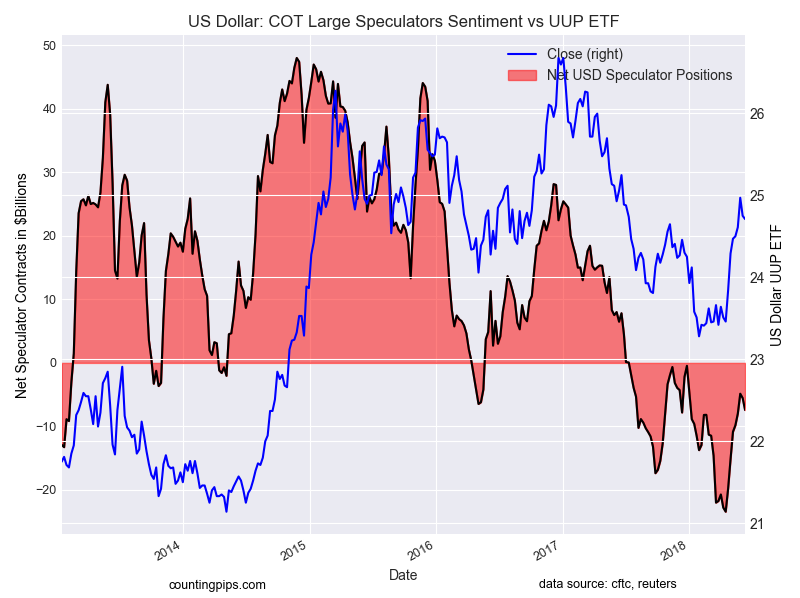
US Dollar net speculator positions leveled at $-7.42 billion this week

The latest data for the weekly Commitment of Traders (COT) report, released by the Commodity Futures Trading Commission (CFTC) on Friday, showed that large traders and currency speculators increased their aggregate bearish bets for the US dollar again this week.

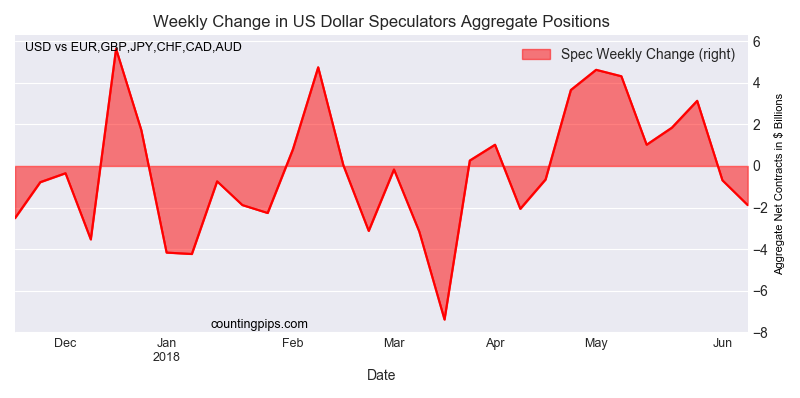
Non-commercial large futures traders, including hedge funds and large speculators, had an overall US dollar net position totaling $-7.42 billion as of Tuesday June 12th, according to the latest data from the CFTC and dollar amount calculations by Reuters. This was a weekly decline of $-1.88 billion from the $-5.54 billion total position that was registered the previous week, according to the Reuters calculation (totals of the US dollar contracts against the combined contracts of the euro, British pound, Japanese yen, Australian dollar, Canadian dollar and the Swiss franc).

The aggregate speculative bearish position increased for a second straight week after having six weeks of declining bearish levels that had brought the USD position to its second least bearish level all year. The overall bearish level remains under the $-10 billion threshold for a fifth straight week.
 

Weekly Speculator Contract Changes:

This week saw just one substantial changes (+ or – 10,000 contracts) in the individual currency contract level for the speculators category.

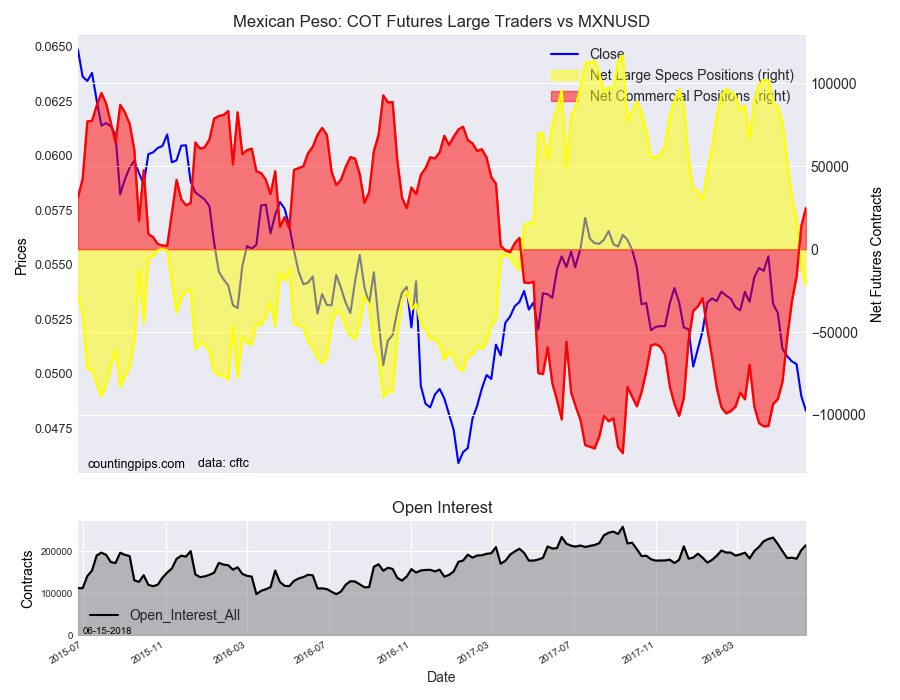
Mexican peso speculative bets continued to decline sharply and dropped by over -10,000 contracts for a fifth consecutive week. Overall, the speculator peso bets have now decreased for nine weeks in a row and the MXN spec position is in a bearish position for a second straight week.

Overall, the major currencies that improved against the US dollar this week were the British pound sterling (3,624 contracts), Japanese yen (8,489 contracts), Swiss franc (1,971 contracts), Canadian dollar (1,051 contracts), Australian dollar (4,973 contracts) and the New Zealand dollar (2,623 contracts).

The currencies whose speculative bets declined this week versus the dollar were the euro (-1,011 weekly change in contracts) and the Mexican peso (-10,590 contracts).


Table of Weekly Commercial Traders and Speculators Levels & Changes:

CurrencyNet CommercialsComms Weekly ChgNet SpeculatorsSpecs Weekly Chg
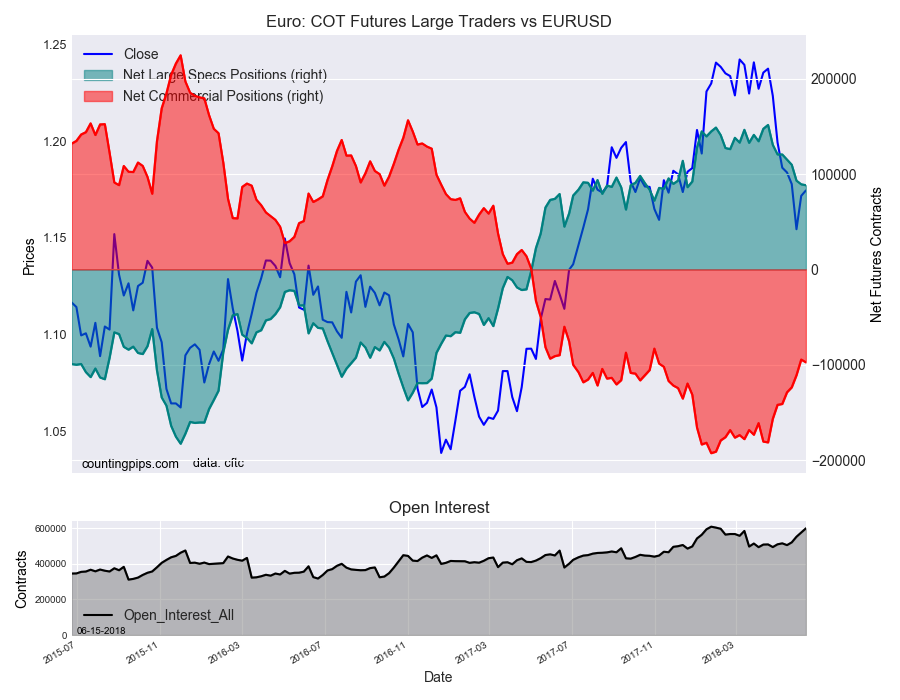
EuroFx-97,526-2,92488,225-1,011
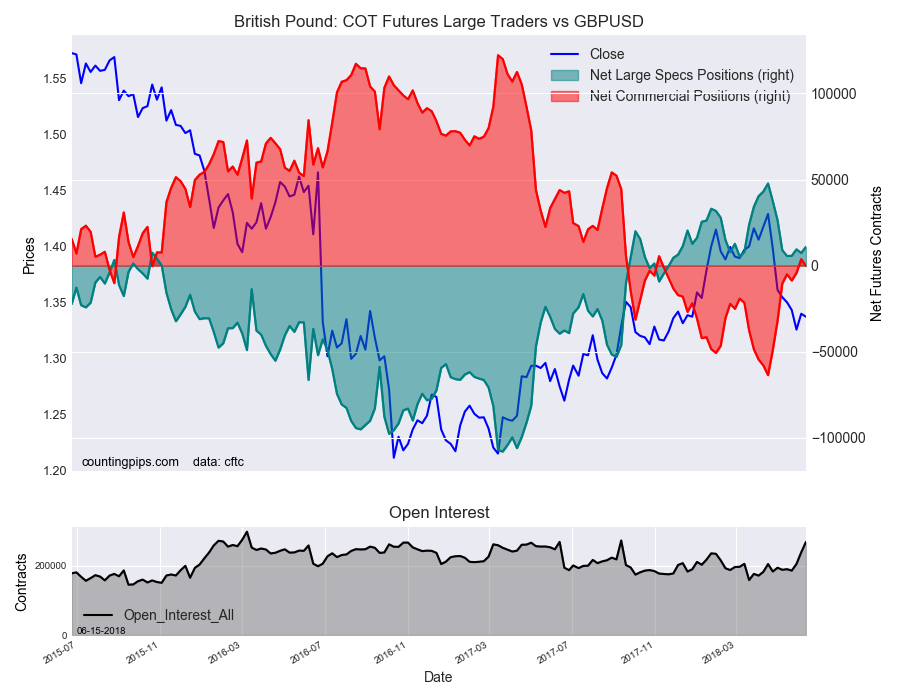
GBP-180-3,97910,9693,624
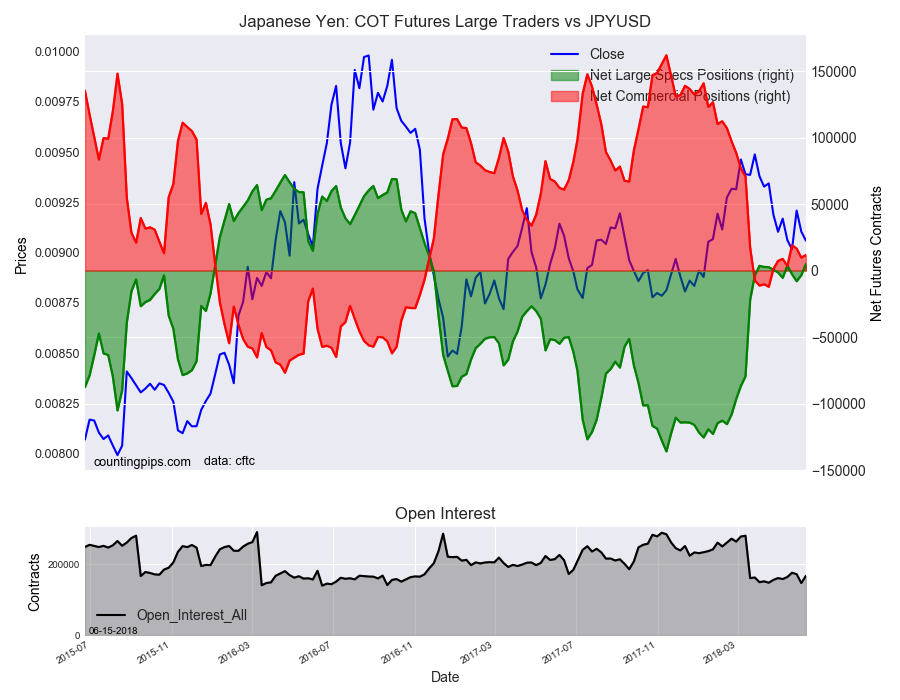
JPY11,7762,0295,0528,489
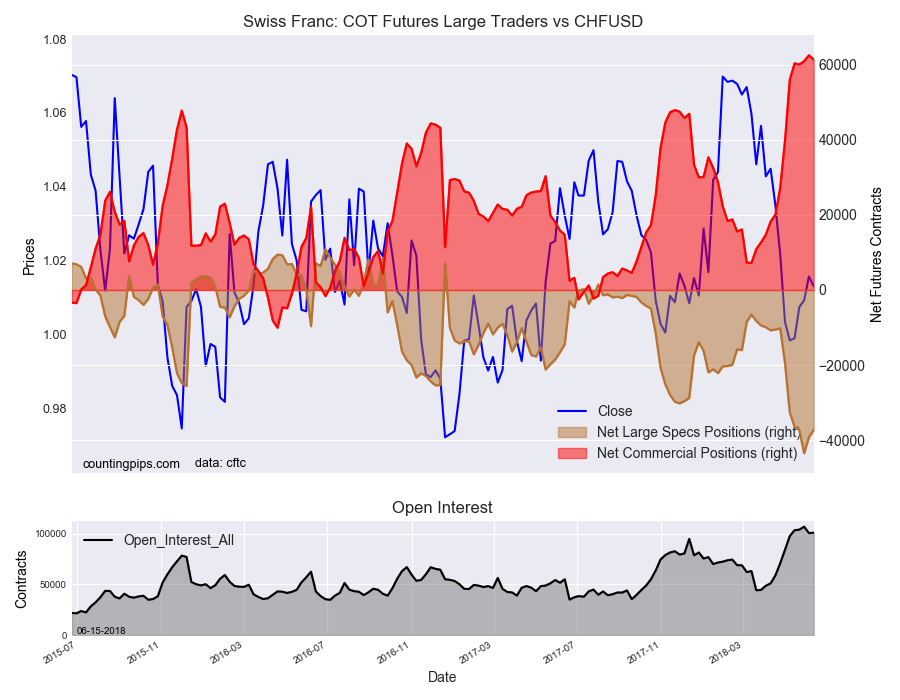
CHF61,344-1,107-37,2451,971
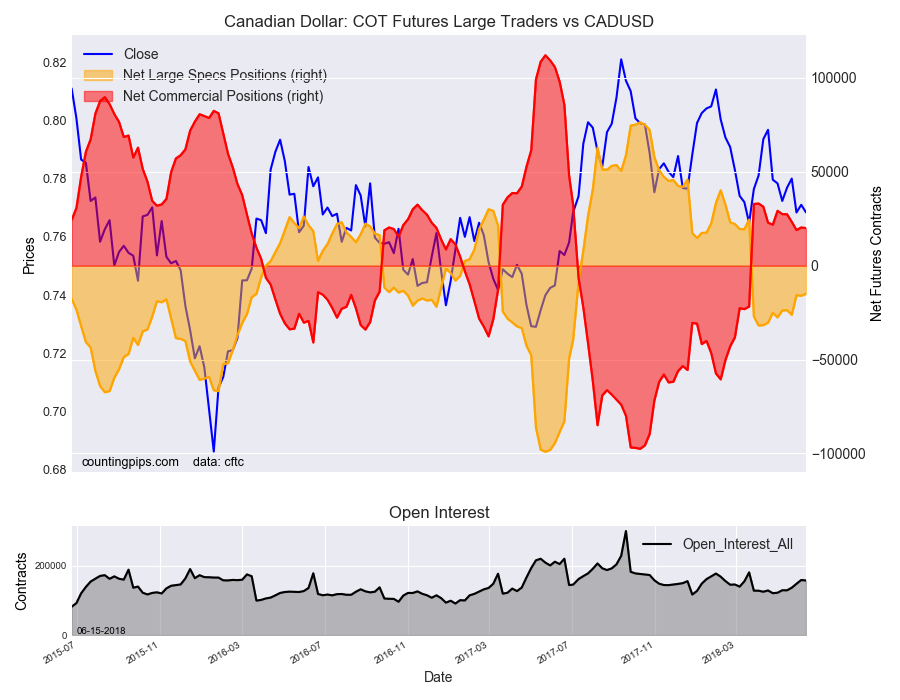
CAD20,041-320-14,9881,051
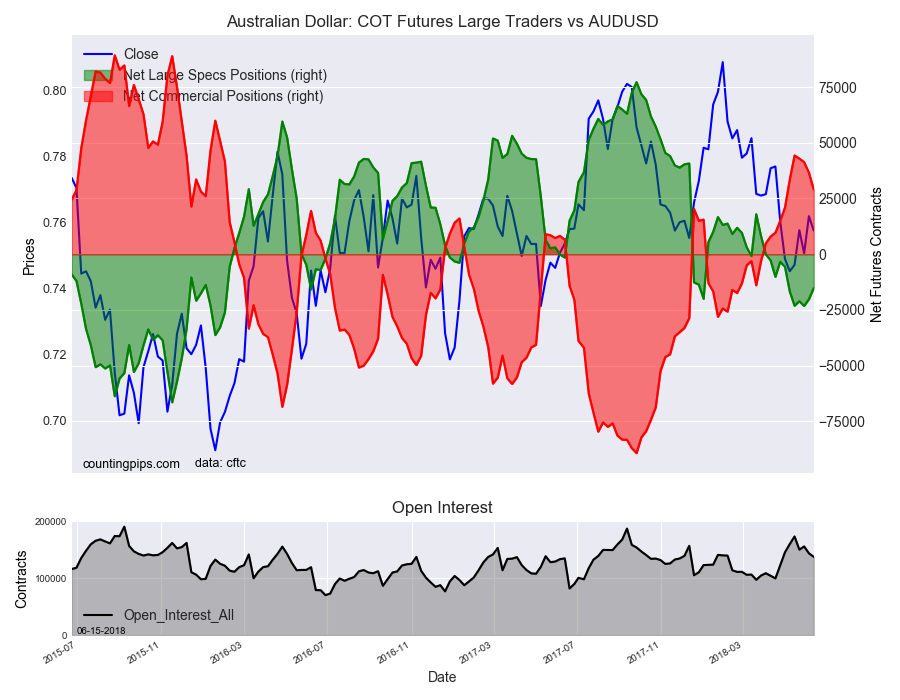
AUD29,066-7,536-15,2354,973
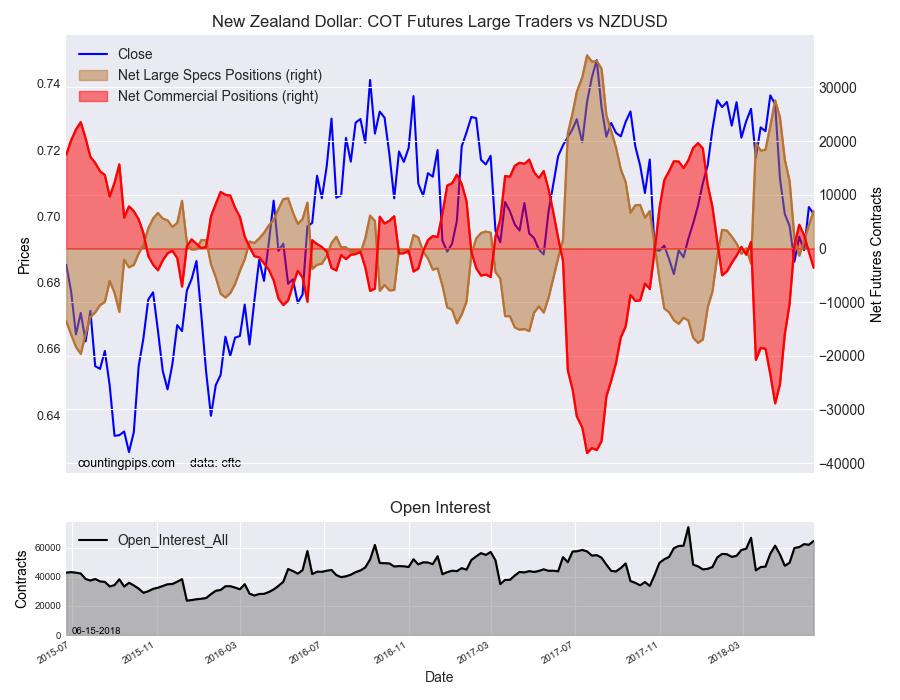
NZD-3,621-2,9467,0062,623
MXN25,00711,055-21,700-10,590


This latest COT data is through Tuesday and shows a quick view of how large speculators or non-commercials (for-profit traders) as well as the commercial traders (hedgers & traders for business purposes) were positioned in the futures markets. All currency positions are in direct relation to the US dollar where, for example, a bet for the euro is a bet that the euro will rise versus the dollar while a bet against the euro will be a bet that the dollar will gain versus the euro.


Weekly Charts: Large Trader Weekly Positions vs Price

EuroFX:

British Pound Sterling:

Japanese Yen:


Swiss Franc:

Canadian Dollar:

Australian Dollar:

New Zealand Dollar:

Mexican Peso:

*COT Report: The weekly commitment of traders report summarizes the total trader positions for open contracts in the futures trading markets. The CFTC categorizes trader positions according to commercial hedgers (traders who use futures contracts for hedging as part of the business), non-commercials (large traders who speculate to realize trading profits) and nonreportable traders (usually small traders/speculators). Find CFTC criteria here: (http://www.cftc.gov/MarketReports/CommitmentsofTraders/ExplanatoryNotes/index.htm).

The Commitment of Traders report is published every Friday by the Commodity Futures Trading Commission (CFTC) and shows futures positions data that was reported as of the previous Tuesday (3 days behind).

Each currency contract is a quote for that currency directly against the U.S. dollar, a net short amount of contracts means that more speculators are betting that currency to fall against the dollar and a net long position expect that currency to rise versus the dollar.

(The charts overlay the forex closing price of each Tuesday when COT trader positions are reported for each corresponding spot currency pair.) See more information and explanation on the weekly COT report from the CFTC website.

Article by CountingPips.com

Fibonacci Retracements Analysis 15.06.2018 (BITCOIN, ETHEREUM)

Article By RoboForex.com

BTCUSD, “Bitcoin vs US Dollar”

As we can see in the H4 chart, BTCUSD is still trading downwards; it has already passed through towards the post-correctional extension area between the retracements of 138.2% and 161.8%. The next downside target may be the retracement of 261.8% at 5875, but only after the instrument breaks the local low at 6120.30.

BTCUSD1
Risk Warning: the result of previous trading operations do not guarantee the same results in the future

As we can see in the H1 chart, the convergence made BTCUSD reverse and started a new ascending movement, which has already reached the retracement of 38.2%. The next upside target may be the retracements of 50.0% and 61.8% at 6930.00 and 7121.00 respectively.

BTCUSD2
Risk Warning: the result of previous trading operations do not guarantee the same results in the future


ETHUSD, “Ethereum vs. US Dollar”

As we can see in the H4 chart, ETHUSD is moving downwards and has already reached the post-correctional extension area between the retracements of 138.2% and 161.8% at 457.80 and 429.70 respectively. At the same time, the convergence is being formed, but the downtrend may yet continue.

ETHUSD1
Risk Warning: the result of previous trading operations do not guarantee the same results in the future

In the H1 chart, the convergence made ETHUSD reverse and start a new ascending correction, which has already reached the retracement of 38.2% and may continue towards the retracements of 50.0% and 61.8% at 537.60 and 558.70 respectively.

ETHUSD2
Risk Warning: the result of previous trading operations do not guarantee the same results in the future

Article By RoboForex.com

Attention!
Forecasts presented in this section only reflect the author’s private opinion and should not be considered as guidance for trading. RoboForex LP bears no responsibility for trading results based on trading recommendations described in these analytical reviews.

Forex Technical Analysis & Forecast 15.06.2018 (EURUSD, GBPUSD, USDCHF, USDJPY, AUDUSD, USDRUB, GOLD, BRENT)

Article By RoboForex.com

EURUSD, “Euro vs US Dollar”

Being influenced by the negative fundamental background related to the European Central Bank, EURUSD has plummeted and right now is still moving downwards. Possibly, today the price may reach 1 .1540 and then grow towards the short-term target at 1.1420. In fact, the instrument is expected to continue falling inside the downtrend.

EURUSD
Risk Warning: the result of previous trading operations do not guarantee the same results in the future


GBPUSD, “Great Britain Pound vs US Dollar”

GBPUSD has broken 1.3300 downwards and is still falling inside the downtrend. The first target is at 1.3170. After that, the instrument may return to 1.3300 and then start another decline with the short-term target at 1.3022.

GBPUSD
Risk Warning: the result of previous trading operations do not guarantee the same results in the future


USDCHF, “US Dollar vs Swiss Franc”

USDCHF has reached the predicted target of the third ascending structure. Today, the price reach 0.9988 and then resume falling towards 0.9900. Later, the market may continue growing with the first target at 1.0020.

USDCHF
Risk Warning: the result of previous trading operations do not guarantee the same results in the future


USDJPY, “US Dollar vs Japanese Yen”

USDJPY has rebounded from 109.97. Possibly, the price may grow to reach 111.11 and then continue this decline with the first target at 109.58.

USDJPY
Risk Warning: the result of previous trading operations do not guarantee the same results in the future


AUDUSD, “Australian Dollar vs US Dollar”

AUDUSD has broken 0.7540 downwards and may continue trading to the downside to reach the target at 0.7450. Possibly, today the price may form a new ascending structure towards 0.7483 and then resume falling to reach the above-mentioned target. After that, the instrument may start another correction towards 0.7515 and then continue falling inside the downtrend to reach 0.7400.

AUDUSD
Risk Warning: the result of previous trading operations do not guarantee the same results in the future


USDRUB, “US Dollar vs Russian Ruble”

USDRUB is moving downwards. Possibly, the price may reach 61.57 and then grow towards 62.35. After that, the instrument may continue trading to the downside with the short-term target at 60.00.

USDRUB
Risk Warning: the result of previous trading operations do not guarantee the same results in the future


XAUUSD, “Gold vs US Dollar”

Gold has reached all upside targets and broken the high of the Flag correctional pattern. Today, the price may fall to reach 1288, break it, and then continue trading to the downside to reach the short-term target at 1266.00.

GOLD
Risk Warning: the result of previous trading operations do not guarantee the same results in the future


BRENT

Brent is still consolidating. Possibly, today the price may reach 75.55. Later, the market may form a new ascending structure to reach 76.85, break it, and then grow with the first target at 78.30.

BRENT
Risk Warning: the result of previous trading operations do not guarantee the same results in the future

Article By RoboForex.com

Attention!
Forecasts presented in this section only reflect the author’s private opinion and should not be considered as guidance for trading. RoboForex LP bears no responsibility for trading results based on trading recommendations described in these analytical reviews.

EURUSD: Eurobulls disappointed by ECB meeting

By Gabriel Ojimadu, Alpari

Previous:

  • In evening trading the EURUSD pair fell 2.4% after the ECB meeting and Draghi’s statements during a press conference.
  • The regulator lowered its 2018 eurozone growth forecast from 2.4% to 2.1%, retained the QE program  until the end of the year, and will lower bond purchases from 30 to 15bln EUR. Draghi also said that the time frames for the rate increase were not discussed in the meeting.

Day’s news (GMT+3):

  • 12:00 Eurozone: consumer price index (May).
  • 15:30 Canada: foreign portfolio investment in Canadian securities (Apr), manufacturing shipments (Apr).
  • 15:30 US: NY empire state manufacturing index (Jun).
  • 16:15 US: industrial production (May).
  • 17:00 US: Michigan consumer sentiment index (Jun).
  • 20:00 US: Baker Hughes US oil rig count.
  • 23:00 US: net long-term TIC flows (Apr), total net TIC flows (Apr).

Fig 1. EURUSD hourly chart. Source: TradingView

Current situation:

I did not make a forecast for yesterday, and I would never have predicted an intraday 2.4% drop. Following the ECB meeting, the euro fell to 1.1738 against the dollar. During Draghi’s press conference, pressure on the euro increased.

At the American session, the price moved to the reversal zone (between lines D3-D4). The fall from the level of 1.1852 was 247 degrees. As the price did not immediately leave the reversal  zone, I’m expecting a fall on Friday to the level of 1.1547 against the backdrop of the general strengthening of the American currency. I’m awaiting the formation of three bases with a double bearish divergence. If my expectations are justified, then afterwards we can expect a correction to the level of 1.1640.

Can Saudi Arabia Prevent The Next Oil Shock?

By OilPrice.com

The ongoing speculation online about the future of cooperation between Russia and OPEC seems to be a little one-sided. The main point of discussion up until now has been the fact that, due to international pressure (such as Trump’s Twitter diplomacy, perceived Russian willingness to open up the taps and pressure from Asian consumers) Saudi Arabia will be willing to revoke its current production cut stance.

Current volatility in the global oil market is, according to most analysts, due to fears that markets are facing a severe threat. A doomsday scenario is being painted in the media which suggests that oil prices will collapse as Moscow and Riyadh allow for OPEC compliance to slip, and that a glut of Saudi crude will be hitting the market. This has been the leading theme in the last couple of days, after reporters stated that Moscow and Riyadh are ready to assist the market.

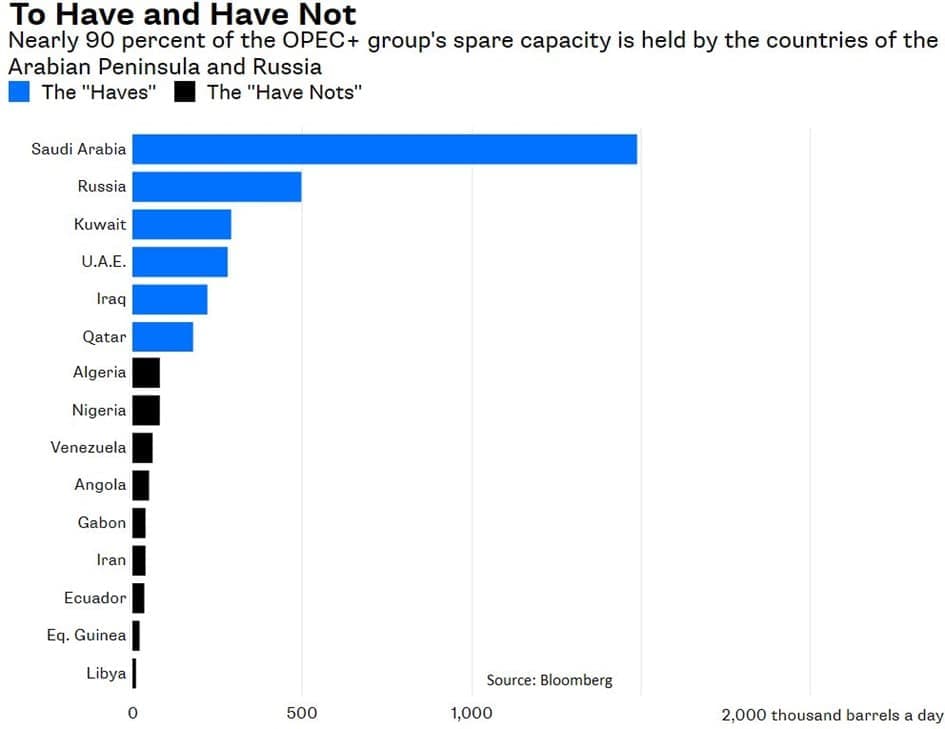
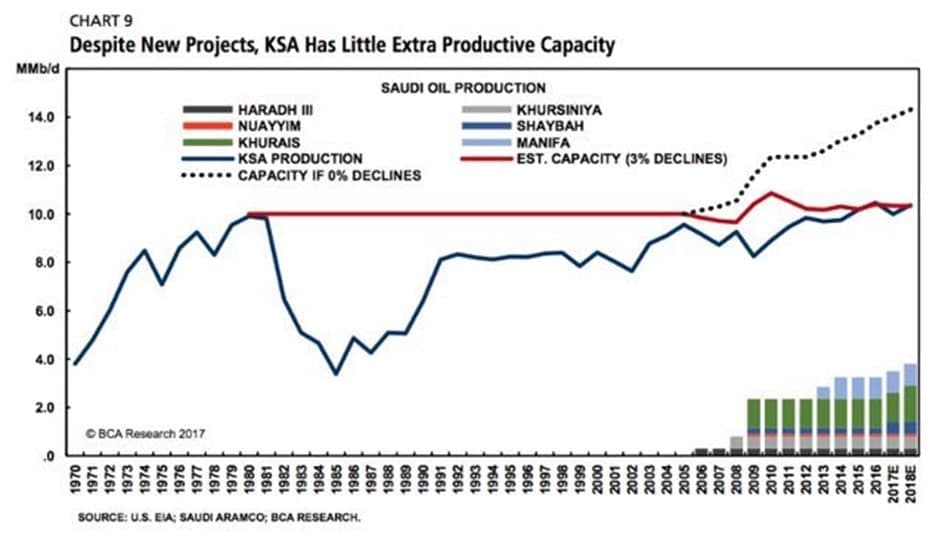
At the same time, analysts and pundits support the thesis that Saudi Arabia is able to produce at least 12.5 million bpd, which will be hitting the market on short notice. No one has really assessed the Saudi spare capacity capabilities though, with a majority of analysts taking the aggressive rhetoric for granted.

Saudi Arabia, the Kingdom of Oil, will be the savior of the oil universe as it holds not only 276 billion barrels of reserves, but also can hit the market with millions of barrels of Saudi sweet to confront or mitigate possible shortages caused by Venezuela’s collapse, the lack of U.S. oil infrastructure, and the impact of Iran sanctions. The main question to be answered, hopefully before reality hits us, is if the Kingdom of Oil really is capable of opening the taps and keep them open in the long term.


Several analysts have been warning about the possible technical issues Saudi Aramco is facing for years. The lack of inside information into the world’s largest NOC is one of the main reasons behind this.

Some insiders have, however, been opening up some doors, indicating that Aramco could have hit a possible production ceiling, as production on several large fields, including Ghawar, has been hit by a long list of issues.

In addition to the normal upstream problems, such as black powder, corrosion, biological fowling and misuse of seawater injection for decades, other issues could also affect overall capacity. Sources have seen major pipelines being blocked by corrosion and scaling, while other production has been hit by major sludging threats. These production issues are known, but the impact has never been able to be assessed fully. Financial analysts have always based their forecasts on open sources, such as reports from the IEA, EIA and OPEC, in which the statement is being repeated that Saudi Arabia has spare production capacity.

In recent years, especially since the Russia+OPEC production cut agreement, it became a fact of life. Existing production capacity of Aramco was seen as a law, and analysts even concluded that production cuts increased overall spare capacity by the same number. Few analysts dared to ask the main question: “If there is spare capacity available, can you prove the figures? At the same time, market watchers should have asked themselves the question: “When did Aramco ever produce even 11 million bpd in the last few years.

Additionally, there are other indicators that Saudi Aramco could be fighting an increasingly difficult battle to keep overall production up in its existing fields. While analysts differ about the exact rates, production declines can be expected to be above 6 percent per year on average. If this is taken as a fact for all production in the Kingdom, additional new production needed to come onstream is around 600,000-750,000 bpd per year.

Hence the ongoing impressive investment schemes, which were even in place during the last oil crisis, as continuous innovation is needed to keep existing production at the same level. This fact is also a major driver for the ongoing discussion within Aramco to speed up conventional field developments on- and offshore, such as in the Arab Gulf (shallow water) and the current focus on shallow-deep-water Red Sea area. The costs of drilling and developing these projects are much higher, than the very easy onshore oil that Saudi Arabia traditionally drilled. Still, the need is there to keep overall production figures at the same level, while even trying to get additional spare capacity. With the widely published spare capacity of 2-2.1 million bpd, the need for these projects would be much less than current investments show.

When these questions are not being addressed, but become reality, OPEC’s upcoming meeting will be put in another light. Without a real spare production capacity, or with a much lower capacity, the current discussion is null and void. Additional oil on the market will be constrained, leaving a ceterus paribus situation, with increased threats from Venezuela and Iran.

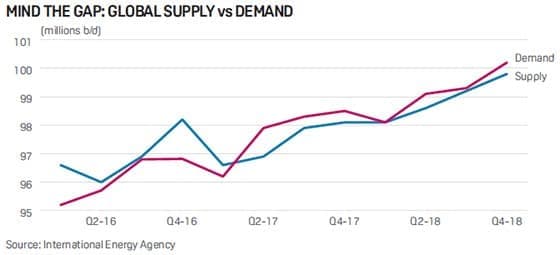
As U.S. bank Goldman Sachs already indicated, demand for crude oil and products is not showing any real slowdown. If production cuts stay in place, markets will tighten at an even faster pace.

Despite the still elevated inventories and a small supply overhang, the Russia/OPEC mission has been mostly accomplished. A healthy appetite for crude, combined with an unexpected high level of compliance (or forced compliance in Venezuela’s or Libya’s case), has stabilized markets. Demand, as reported by all institutions and market watchers, is expected to be robust. The threat of higher oil prices culling demand is still very low, but will be looming on the horizon. For 2018-2019, no real risks exist for an oil price showdown. Without a real global financial crisis, lights are on green for a tight crude oil market for an extended period of time. OPEC’s Vienna meeting will not trigger a new oil glut. Some goodwill gestures might be expected, such as the use of Saudi’s floating storage, but in reality no options exist to move anything. Without major new investments outside of Saudi Arabia or the GCC region, the world is heading for higher prices long-term. Counting on Saudi Arabia’s spare capacity could be foolish.

By Cyril Widdershoven for Oilprice.com

Link to original article: https://oilprice.com/Geopolitics/International/Can-Saudi-Arabia-Prevent-The-Next-Oil-Shock.html


Is This a Big Sign of a Big Stock Market Turn?

Financial legislation might mean something different than most investors believes it means

By Elliott Wave International

A stock market warning has just developed for those who are bullish.

Here’s what I’m talking about (CNBC, May 22):

The House voted May 22 to pass the biggest rollback of financial regulations since the global financial crisis.

In a nutshell, lawmakers want to get rid of onerous rules that have been placed on small and medium banks as part of Dodd-Frank, the law that was passed in 2010 to prevent another financial meltdown.

One might ask, “Why should bullish investors see this as a red flag? Isn’t the loosening of financial regulations a positive for the stock market?”

Well, EWI has, indeed, observed a correlation between financial legislation and the stock market, but it’s probably not what most investors expect.

Financial history shows that financial legislation tends to follow the stock market, not the other way around. Put another way, financial regulators implement reforms after busts and later turn optimistic and repeal or relax financial regulations after booms.

Besides Dodd-Frank, a historic example is Glass-Steagall, the first major federal legislation to separate commercial and investment banking. This law was enacted after the bottom of the 1929-1932 stock market crash.

The December 2013 issue of the monthly publication, The Socionomist, showed this chart and said:

SocialMoodFinancialReg

In 1933, Congress passed laws designed to prevent the crash that had already happened. In 1999, Congress passed laws designed to encourage the rally that had already happened.

Notably, the stock market rallied after Glass-Steagall passed, and then some 66-years later, plummeted shortly after the law was repealed.

Yes, the government is usually the last group to act on a trend. If technical indicators are also pointing to a reversal, investors would do well to position their portfolios accordingly.

So happens, EWI’s analysts are saying that many of the market’s technical indicators are suggesting a major acceleration in the DJIA’s current Elliott wave price pattern.

We just released this new, free report, 5 ‘Tells’ that the Markets Are About to Reverse, that reveals many false indicators – a.k.a. “head fakes” — investors see every day. The report helps readers separate themselves from the herd and survive (and thrive) in volatile markets. Read the free report now.

This article was syndicated by Elliott Wave International and was originally published under the headline Is This a Big Sign of a Big Stock Market Turn?. EWI is the world’s largest market forecasting firm. Its staff of full-time analysts led by Chartered Market Technician Robert Prechter provides 24-hour-a-day market analysis to institutional and private investors around the world.

The Trump-Kim Deal and the Long Path to Peace in the Korean Peninsula

By Dan Steinbock   

The new Trump-Kim joint agreement could prove a promising ‘memorandum of understanding.’ However, it is not just about denuclearization; it should also be about peace and U.S. withdrawal from the Korean peninsula.

Here are the facts: Following hours of closed-door talks in the Hotel Capella Singapore, President Trump and North Korean leader Kim Jong Un signed a joint four-point agreement: to establish new US-North Korean relations, a stable peace regime, a North Korean commitment to achieve the “complete denuclearization” of the Korean peninsula, and the repatriation of the remains of American prisoners of war.

Unsurprisingly, the agreement does not include a firm “verifiable” and “irreversible” pledge by North Korea to abandon its nuclear weapon program. Yet, the Trump-Kim agreement is not a final deal, but a framework to pave the way to ongoing discussions. Consequently, it should be seen as a promising ‘memorandum of understanding.’

U.S. and North Korean leaders have never met before. So technically, a state of war prevails between the two countries. For these two leaders to sit down, agree on their differences and outline a path to resolve them is a very big deal.

Nevertheless, a real peace and stability requires far more than a four-point agreement – a bilateral peace agreement and U.S. withdrawal from the Korean peninsula.

No stability without peace agreement

In the West, North Korea is customarily portrayed as a sort of a paranoid hermit kingdom with demons as leaders. In reality, Pyongyang has long – and justifiably – seen America as an existential threat.

In 1951 – after Washington had lost its nuclear monopoly to the Soviet Union – the early setbacks in the Korean War prompted General MacArthur to consider using nuclear weapons against the Chinese and North Koreans – to use radioactive fallout zones to disrupt Chinese supply chains – until, he was dismissed by President Truman.

Nevertheless, between 1950 and 1953, the U.S. subjected North Korea to a devastating bombing campaign, which destroyed 85 percent of the country’s buildings and caused one million civilians to die; more than the entire civilian deaths in World War II bombing of Germany and Japan, respectively. The scorched-earth policy set the standard of what was to come in Vietnam and the rest of Southeast Asia.

Ever since the 1953 Armistice Agreement, Washington has seen North Korea as a “rogue state.” Even with the Soviet Union, Washington supported “peaceful coexistence”, but with North Korea, only a “temporary ceasefire.” That’s the material basis for fears of imminent intrusion in Pyongyang.

In this status quo, Trump’s statement in the press conference that the U.S. had agreed to stop playing “war games” with Pyongyang, referring to the joint military exercises with South Korea, is important. But while Trump added he wants to “bring our soldiers back home” from South Korea, he admitted it was “not part of the equation right now.”

Typically, the decision to cease the joint military exercises with South Korea was not included in the agreement. That’s vintage Trump. Only days before, he had nearly agreed to the G7 Summit communiqué, which fell apart amid the controversial aftermath. In the Trump world, deals are seldom fixed entities, but always subject to changing circumstances.

Last August, former U.S. President Jimmy Carter who has negotiated with several North Korean leaders, noted that, for a long time, Pyongyang has sought a “peace treaty to replace the [1953] ceasefire.” In his experience, North Koreans wanted peaceful relations with the U.S. and regional neighbors.

In view of the long record of U.S.-led regime changes and the recently-undermined Iran nuclear deal, that’s not a futile concern.

No lasting peace without U.S. withdrawal from the Korean peninsula

In a televised 2013 New Year’s address, Kim Jong Un advocated “a radical turn in the building of an economic giant on the strength of science and technology by fanning the flames of the industrial revolution in the new century.” These economic efforts should “be manifested in the people’s standard of living.”

It was an appeal to the White House. But instead of seizing the transition in Pyongyang to work for the peace, President Obama opted for a Pentagon-led “pivot to Asia” that virtually ensured another half a decade of nuclear escalation. After Secretary of State Hillary Clinton’s outline for a Pentagon-led “pivot to Asia,” Obama did not want reconciliation with Pyongyang. Rather, the objective was to seize the opportunity to cooperate with the then-President of South Korea, Park Geun-hye, a conservative hawk and the daughter of the controversial former President Park Chung-hee.

So, instead of rapprochement, Washington pushed for a Terminal High Altitude Area Defense (THAAD) anti-ballistic missile system in South Korea. As far as Washington was concerned, THAAD would kill two birds with one stone: it would subdue Pyongyang and, if needed, it could be used to contain China. These plans, however, fell apart in early 2017, when President Park was impeached and sentenced to 24 years in prison. That paved the way to the presidency of the more moderate Moon Jae-in, who seeks reconciliation with South Korea.

Nevertheless, Park’s conservatives were able to postpone the repeal of the Operation Control agreement (OPCON), which allows the Pentagon – not Seoul – to control its military fate. The mission of the South Korea/US Combined Forces Command (CFC) is to “deter hostile acts of external aggression” South Korea by a “combined military effort.” The CFC is commanded by a U.S. General and it has operational control (OPCON) over more than 600,000 active duty military personnel both countries.

President Park managed to defer the transfer to 2022. In the event of war, U.S. interests will thus override the interests of South Koreans – in their own country.

The ultimate barriers

As a result, a true and lasting peace in the Korean peninsula requires not just on the Trump-Kim deal and the implied talks.

It is also predicated on a Trump administration that will continue to support the talks, the nullification of impeachment efforts against the White House, minimal losses for the incumbents in the U.S. mid-term elections, another Trump election triumph in 2020 – and continued support for the peace process in South Korea in the 2022 election.

It’s a very, very tall order. But in Singapore, Trump and Kim took the first, historical step to the right direction.

About the Author:

Dr. Dan Steinbock is an internationally recognized strategist of the multipolar world and the founder of Difference Group. He has served at the India, China and America Institute (US), the Shanghai Institutes for International Studies (China) and the EU Center (Singapore). For more, see https://www.differencegroup.net/ 

The original version was released by China Daily on June 14, 2018.


Ichimoku Cloud Analysis 14.06.2018 (AUDUSD, NZDUSD, USDCAD)

Article By RoboForex.com

AUDUSD, “Australian Dollar vs US Dollar”

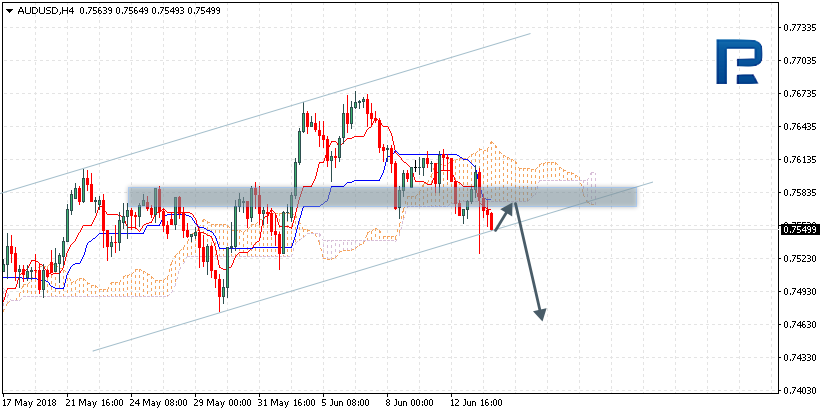
AUDUSD is trading at 0.7549; the instrument is moving below Ichimoku Cloud, which means that it may continue falling. The markets could indicate that the price may test the downside border of the cloud at 0.7575 and then continue moving downwards to reach 0.7465. However, the scenario that Implies further decline may be cancelled if the price breaks the upside border of the cloud and fixes above 0.7620. In this case, the pair may continue growing towards 0.7680. After breaking the channel’s downside border and fixing below 0.7530, the price may continue moving downwards.

AUDUSD
Risk Warning: the result of previous trading operations do not guarantee the same results in the future


NZDUSD, “New Zealand Dollar vs US Dollar”

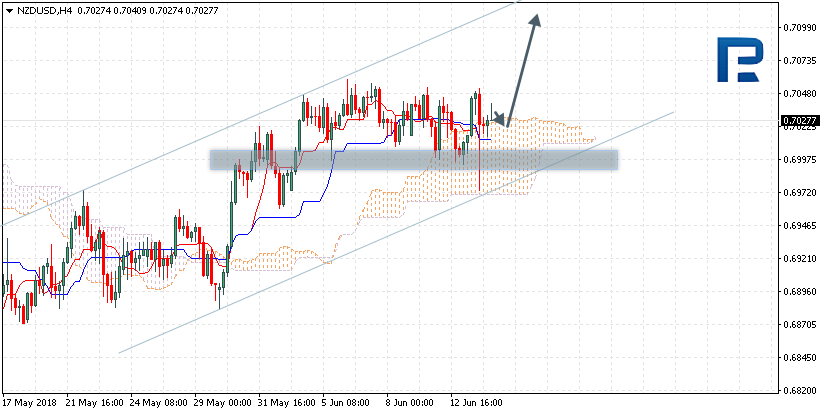
NZDUSD is trading at 0.7027; the instrument is moving above Ichimoku Cloud, which means that it may continue growing. The markets could indicate that the price may test the upside border of the cloud at 0.7020 and then continue moving upwards to reach 0.7095. However, the scenario that implies further growth may be cancelled if the price breaks the downside border of the cloud and fixes below 0.6960. After breaking the cloud’s upside border and fixing above 0.7050, the price may continue moving upwards.

NZDUSD
Risk Warning: the result of previous trading operations do not guarantee the same results in the future


USDCAD, “US Dollar vs Canadian Dollar”

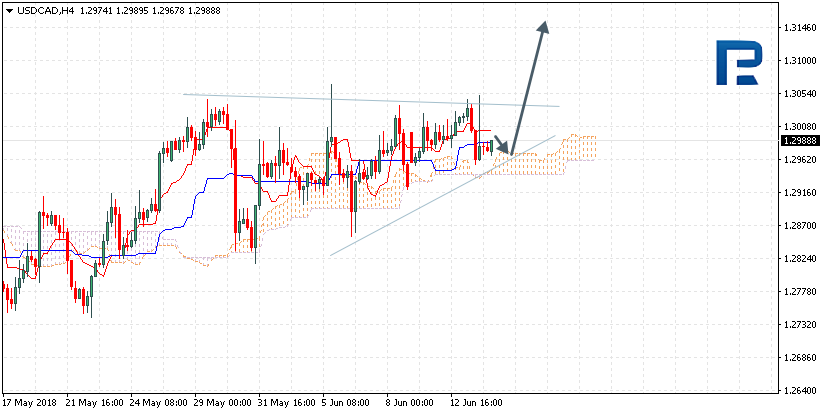
USDCAD is trading at 1.2988; the instrument is moving above Ichimoku Cloud, which means that it may continue growing. The markets could indicate that the price may test the upside border of the cloud at 1.2965 and then continue moving upwards to reach 1.3150. Another signal to confirm further ascending movement is the price’s rebounding from the downside border of the Triangle pattern. However, the scenario that implies further growth may be cancelled if the price breaks the downside border of the cloud and fixes below 1.2910. In this case, the pair may continue falling towards 1.2845. After breaking the upside border of the Triangle pattern and fixing above 1.3060, the price may continue moving upwards.

USDCAD
Risk Warning: the result of previous trading operations do not guarantee the same results in the future

Article By RoboForex.com

Attention!
Forecasts presented in this section only reflect the author’s private opinion and should not be considered as guidance for trading. RoboForex LP bears no responsibility for trading results based on trading recommendations described in these analytical reviews.

Murrey Math Lines 14.06.2018 (USDCHF, GOLD)

Article By RoboForex.com

USDCHF, “US Dollar vs Swiss Franc”

As we can see in the H4 chart, USDCHF has broken the 3/8 level and is no longer consolidating. In this case, the price may continue falling to reach the support at the 1/8 level.

USDCHF1
Risk Warning: the result of previous trading operations do not guarantee the same results in the future

In the H1 chart, the price may break the 6/8 level and trade upwards to reach the resistance at the 8/8 one.

USDCHF2
Risk Warning: the result of previous trading operations do not guarantee the same results in the future

As we can see in the M15 chart, the pair has broken the downside line of the VoltyChannel indicator and, as a result, may continue moving downwards.

USDCHF3
Risk Warning: the result of previous trading operations do not guarantee the same results in the future


XAUUSD, “Gold vs US Dollar”

In the H4 chart, XAUUSD is trading between the 1/8 and 3/8 levels. In this case, the price may break the 3/8 level and then continue growing towards the 4/8 one.

GOLD1
Risk Warning: the result of previous trading operations do not guarantee the same results in the future

As we can see in the H1 chart, the pair has broken the 5/8 level and is no longer consolidating. Later, the price continue trading upwards to reach the 8/8 level.

GOLD2
Risk Warning: the result of previous trading operations do not guarantee the same results in the future

As we can see in the M15 chart, the pair has broken the upside line of the VoltyChannel indicator and, as a result, may continue moving to the upside.

GOLD3
Risk Warning: the result of previous trading operations do not guarantee the same results in the future

Article By RoboForex.com

Attention!
Forecasts presented in this section only reflect the author’s private opinion and should not be considered as guidance for trading. RoboForex LP bears no responsibility for trading results based on trading recommendations described in these analytical reviews.

EURUSD: risks of a correction to 1.1780 ahead of Fed decision

By Gabriel Ojimadu, Alpari

Previous:

On Wednesday the 13th of June, trading on the euro closed up. The euro recovered to 1.1793 just before the announcement of the Fed’s interest rate decision. Volatility spiked when the Fed decided to raise the benchmark interest rate 25 bps; from 1.75% to 2.00%.

The euro dropped from 1.1793 to 1.1725 (-68 pips). The market had ample time to brace itself for the rate hike. Long positions on the dollar resulted from talk of the high probability of four major rate hikes this year, creating quite the volatile situation. Within the span of an hour the price rose from 1.1725 to 1.1801. I believe that the rebound was caused by a drop in US10Y bond yields. Euro bulls are fired up ahead of the ECB meeting.

Day’s news (GMT+3):

  • 11:30 UK: retail sales (May).
  • 14:45 Eurozone: ECB interest rate decision.
  • 15:30 Eurozone: ECB monetary policy statement and press conference.
  • 15:30 Canada: new housing price index (Apr).

Fig 1. EURUSD hourly chart. Source: TradingView

Current situation:

The price has been trading in a sideways trend over the last several days with a range of 1.1730 – 1.1820. The price fluctuations amount to about 67 degrees. Now, investors’ attention is focused on the results of the ECB meeting.

Above I wrote that the ECB is not planning on changing the interest rates. After the announcement of the results of the most recent meetings, the euro has risen by 20-40 pips. Given that we are awaiting the details of the curtailment of the QE program, volatility on the euro today is set to go through the roof. Traders and investors will have all eyes on Draghi’s press conference.

Mario is unpredictable, so today’s chart is without a forecast. I have not yet learned to predict candlesticks with long shadows. Due to false breakouts, I’ve adjusted the trend line several times. Now it’s passing through 1.1738. The resistance zone is between 1.1835 and 1.1840. There is a risk of a correction to 1.1780 just ahead of the interest rate announcement.