Author Archive for InvestMacro – Page 399

For Stocks, the Line in the Sand Has been Drawn

See illustrations of complete bull and bear market cycles

By Elliott Wave International

You may have heard pundits on financial television say something like, “I see support for the Dow at this price level,” or “This stock should experience some resistance at that price level.”

So, what do these analysts mean by support and resistance?

Well, according to Technical Analysis of Stock Trends, the classic book by Robert Edwards and John Magee, support means buying in sufficient volume to prevent any further downward movement in prices for an appreciable period. Resistance is just the opposite. It means selling in enough volume to satisfy all bids, thereby preventing prices from going any higher for a while.

On a chart, after a support line is meaningfully broken, prices tend to move more freely downward. The opposite applies when lines of resistance are broken.

When support and resistance have long held, or have been touched several times, the price moves after a breakthrough can be quite dramatic.

With that in mind, here’s a chart and commentary from our June 22 U.S. Short Term Update (wave labels available to subscribers):

WeightoftheWorld

The Global Dow comprises 150 global blue-chip stocks, including all 30 components of the DJIA. Unlike the DJIA, which is a price-weighted index, the Global Dow is equal-weighted so that price moves in large stocks hold no disproportionate sway over the index. The Global Dow peaked on January 29, the day after the DJIA, and traced out [an Elliott wave pattern downward] to February 9, along with the U.S. blue-chip stock indexes.

But notice how each successive rally thereafter has topped at a lower high despite the hefty representation of U.S. blue chips…

Heavy is an understatement, because:

“…the U.S. accounts for more than 42% of the total index’s valuation.”

Needless to say, if the Global Dow’s support shelf gives way, it could have profound implications for U.S. stocks, as well.

Jump on once-in-a-lifetime opportunities and avoid dangerous pitfalls that no one else sees coming. We can help you prepare for opportunities and side step risks that will surprise most investors. You can get deeper insights in Elliott Wave International’s new free report: 5 “Tells” that the Markets Are About to Reverse. The insights that you’ll gain are especially applicable to the price patterns of key financial markets, including the stock market, now.

Read the free report now.

This article was syndicated by Elliott Wave International and was originally published under the headline For Stocks, the Line in the Sand Has been Drawn. EWI is the world’s largest market forecasting firm. Its staff of full-time analysts led by Chartered Market Technician Robert Prechter provides 24-hour-a-day market analysis to institutional and private investors around the world.

EOS Mainnet – A ‘Diamond in the rough’ or a ‘Cautionary tale’?

By Amie Parnaby

EOS Mainnet launched on June 10th, but in its short life has had much turmoil. Regarding the axiom “that which doesn’t kill you, makes you stronger”, will the initials struggles mean death for the much-anticipated release of Block.one’s software or will it be tempered by the experience and thrive?

A treacherous path to launch…

Block.one’s much-touted EOS mainnet release has been plagued by bugs and hacks even before a release date was agreed. A hack to Block.one’s Zendesk account on May 31st brought about fraudulent, but legitimate-looking, emails being sent out announcing an ‘unsold tokens giveaway’, which resulted in investors losing millions of dollars. Before that, a Chinese cybersecurity company identified some severely critical flaws and loopholes in the EOS system, including the error that hackers could take control of the entire network through a single network node.

Block.one promptly launched a bug bounty programme which saw many more security professionals trying to find further bugs and weaknesses. It doesn’t say much for a $4 billion project if one man can discover 12 vulnerabilities in just a few weeks (earning $10,000 per bug, Guido Vranken made a name for himself).

In addition to the bugs, flaws and hacks the EOS ‘charter’ also came under fire from crypto community heavy-hitters with Nick Szabo calling it “naively drafted” and would lead to EOS being “labour-intensive.” and having “poor social scalability.” It was not a good omen for a project that held a year-long ICO (you would expect better).

… they made it to the launch pad

Yes, they made it to launch-day, June 10th, amid troubled democratic discussion of the date and some highly controversial content in the conference call between developers and potential “Block Producers” (BPs are the Proof-of-Stake equivalent to miners on the Bitcoin blockchain). When the ConCall transcript was published investors, and other community members were left perturbed by the disorganisation and general havoc as well as the discussion to allow BPs the ability to ‘print’ EOS tokens.

This launch isn’t going to the moon

It was not a successful launch. Four days lapsed between launch and ‘live’. For all the hype and anticipation surrounding the project, it took four days for 15% of the total EOS tokens to be staked against the potential BPs.  The Proof-of-Stake protocol that allows coin-holders to stake their coins on the BP group that best reflects their needs and values proved a hard nut to crack. Some of the main reasons for the slow launch I have listed below.

  • Voting for BPs meant exposing private wallet keys to prove the holding of tokens
  • There was only one third-party, security-tested, voting tool, which is a command-line tool that can be challenging for the non-technically minded. (CLEOS, created by Block.one)
  • There is a lot of mistrust in the financial industry, and the lack of security tested voting tools was a cause for concern within the community, and many didn’t want to trust the security of their holdings to untested voting software.
  • Selling strategy. To vote for a BP all but 10 of the tokens held would be staked against that vote and to sell tokens would require ‘unstaking’ those coins and waiting 72 hours after the blockchain went live for the tokens to be released. Not beneficial for holders betting on a steep increase in price after launch.
  • Whales and BPs. The vast majority of EOS tokens are held in quite a small number of wallets, leading people to believe that the BPs have “bought” their votes. It is more probable that the voting was held up by deals and discussions between block producer groups while deciding where the best bets were going.
  • The realisation that small investors have very little reason to vote (voting is weighted according to the number of tokens held) and that it isn’t worth their risk on untested software when their vote would mean so very little.

It’s a long list of reasons for a stalled start, and there were still more bumps in the road.

They’ll be lucky to reach orbit

More problems have arisen since the dreary beginning. Less than 48 hours after the Mainnet going live there was a bug that caused the network to freeze. While this only created a five-hour network blackout, it was not something that should have been anticipated at such a delicate time. Some from the BP groups have posited that the ‘bug’ could only have come from a hacking attempt, while others have kept quiet on the subject.

If that wasn’t enough, the controversy was sparked when BPs froze seven accounts under the belief that they were stolen. The controversial part of this is that they didn’t wait for an arbitration ruling, which is what should have happened according to the EOS charter. The BPs acted in consensus with each other, but they should not have had the right or ability to freeze accounts without arbiter approval. Unfortunately, it appears that Nick Szabo was correct in his derision about the charter. The EOS Core Arbitration Forum (ECAF) claim that they didn’t have the right to make a formal ruling on the situation because the charter hadn’t been fully ratified. ECAF still hadn’t made a decision less than 24 hours before the 72-hour unstacking period was over, which would have allowed the stolen EOS tokens to be sold and the owners losing out.

Some BP groups and also BP groups ‘in-waiting.’ have spoken out in defense of the move, saying that they would have done the same thing in protecting genuine owners from theft, while others have said they agreed to the freeze reluctantly, in the absence of an ECAF ruling.

Can EOS Mainnet recover this launch or will it crash and burn?

For a short life, EOS has seen a long line of troubles. It’s only to be expected that such highly publicised problems plague a well-hyped launch. Each of the issues that have faced the EOS community of holders, block producers, and arbiters has drawn into sharp relief severe issues in the areas of security, user-friendliness, decentralisation and self-regulation.

The hacks, protocol loopholes, and voting parameters show a distinct lack of due diligence on the part of Block.one to create a functional and secure blockchain. Block.one responded to the query about the voting tool by saying they were taking a “hands-off approach” and that it was up to the community to create the tools, yet they still produced the CLEOS tool. Would it have been too much to ask for them to create a universally functional tool?

The question of decentralisation keeps rearing its ugly head, and in this case, it has been highlighted. How can this genuinely be a decentralised system if BP groups could agree to freeze accounts? The block producers were voted in by the weighty votes of the EOS whales, which indicates that power is, once again, in the hands of the rich alone.

Let’s not start on the self-regulation part of the problem. In fairness, the system of splitting the EOS community into Block Producers, Holders, and Arbiters to correspond with the executive, constituency and judicial areas of any governed system is a good idea. However, lack of defined parameters and ratified rights and responsibilities have let the EOS charter down in a spectacular way.

So what is there to salvage?

EOS is not dead yet, but it will be up to the community (and maybe a little help from Block.one) to fix the bugs, vulnerabilities, development needs and governance of the EOS Mainnet. Only time and good (stable and timely) fixes will prove whether EOS Mainnet can survive this diabolical start to life.

A lot has happened in protracted time-span space of time. EOS wasn’t the only ICO proposing PoS as a means to compete with PoW to reduce associated costs and scalability issues. Any other project intending to use the PoS protocol has learned a lot about ‘How-NOT-to-do-it.’

For a Blockchain development that was supposed to rival and then supersede Ethereum, it isn’t doing too well. However, we can’t rule it out just yet; everyone is entitled to their second chance. In the meantime, we will have to watch as other projects learn from the mistakes made here and start making a raft of new ones.


About the Author:

Amie Parnaby is a professional writer with an experience in a broad range of industries, from I.T to training, from optics to banking. Within these settings, Amie has provided quality web content, training materials and technical documentation. She is currently an in-house Content Writer at Leverate.


Japanese Candlesticks Analysis 28.06.2018 (GOLD, NZDUSD)

Article By RoboForex.com

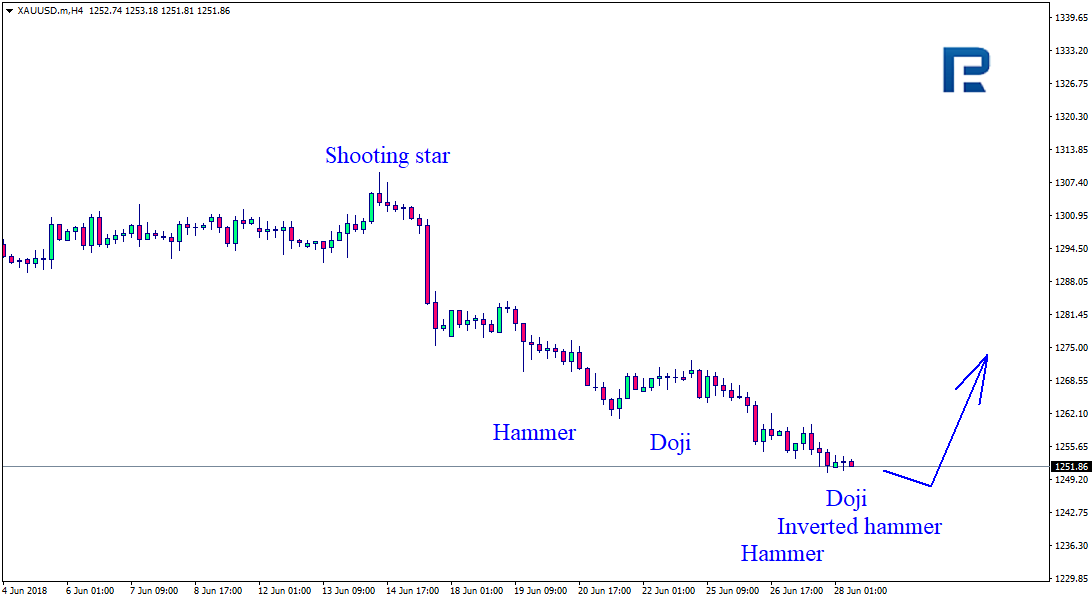
XAUUSD, “Gold vs US Dollar”

As we can see in the H4 chart, after breaking the support level, XAUUSD has formed several Doji, Hammer, and Inverted Hammer reversal patterns. Judging by the previous movements, it may be assumed that the price may try to rebound in the nearest future and start a new ascending tendency.

GOLD
Risk Warning: the result of previous trading operations do not guarantee the same results in the future


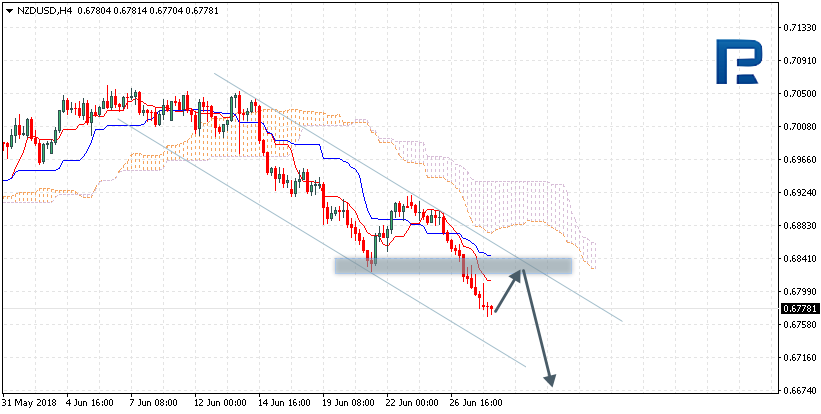
NZDUSD, “New Zealand vs. US Dollar”

As we can see in the H4 chart, after breaking the support level, NZDUSD has formed several Doji, Hammer, and Inverted Hammer reversal patterns. At the moment, it may be assumed that the instrument may updates the lows, reverse, and resume the uptrend.

NZDUSD
Risk Warning: the result of previous trading operations do not guarantee the same results in the future

Article By RoboForex.com

Attention!
Forecasts presented in this section only reflect the author’s private opinion and should not be considered as guidance for trading. RoboForex LP bears no responsibility for trading results based on trading recommendations described in these analytical reviews.

Ichimoku Cloud Analysis 28.06.2018 (AUDUSD, NZDUSD, USDCAD)

Article By RoboForex.com

AUDUSD, “Australian Dollar vs US Dollar”

AUDUSD is trading at 0.7351; the instrument is moving below Ichimoku Cloud, which means that it may continue falling. The markets could indicate that the price may test Tenkan-Sen and Kijun-Sen at 0.7375 and then continue moving downwards to reach 0.7255. Another signal to confirm further descending movement is the price’s rebounding prom the channel’s upside border. However, the scenario that Implies further decline may be cancelled if the price breaks the upside border of the cloud and fixes above 0.7465. In this case, the pair may continue growing towards 0.7585.

AUDUSD
Risk Warning: the result of previous trading operations do not guarantee the same results in the future


NZDUSD, “New Zealand Dollar vs US Dollar”

NZDUSD is trading at 0.6778; the instrument is moving below Ichimoku Cloud, which means that it may continue falling. The markets could indicate that the price may test Tenkan-Sen and Kijun-Sen at 0.6825 and then continue moving downwards to reach 0.6675. Another signal to confirm further descending movement is the price’s rebounding from the resistance level.  However, the scenario that implies further decline may be cancelled if the price breaks the upside border of the cloud and fixes above 0.6935. In this case, the pair may continue growing towards 0.7050.

NZDUSD
Risk Warning: the result of previous trading operations do not guarantee the same results in the future


USDCAD, “US Dollar vs Canadian Dollar”

USDCAD is trading at 1.3334; the instrument is moving above Ichimoku Cloud, which means that it may continue growing. The markets could indicate that the price may test Tenkan-Sen and Kijun-Sen at 1.3325 and then continue moving upwards to reach 1.3515. Another signal to confirm further ascending movement is the price’s rebounding from the channel’s downside border. However, the scenario that implies further growth may be cancelled if the price breaks the downside border of the cloud and fixes below 1.3120. In this case, the pair may continue falling towards 1.2990.

USDCAD
Risk Warning: the result of previous trading operations do not guarantee the same results in the future

Article By RoboForex.com

Attention!
Forecasts presented in this section only reflect the author’s private opinion and should not be considered as guidance for trading. RoboForex LP bears no responsibility for trading results based on trading recommendations described in these analytical reviews.

EURUSD: a rebound from the lower border of the MA channel is possible

By Gabriel Ojimadu, Alpari

Previous:

On Wednesday the 27th of June, the euro fell by 93 pips against the dollar to 1.1553. The fall of the euro/dollar pair was due to the overall strengthening of the US currency, despite the decline in 10-year US Treasury bond yields and weak statistics. The dollar was supported by reports that the White House could soften its stance regarding the limit on Chinese investments in the US. It didn’t occur to me that the euro would drop below 1.16, so I was not prepared at all, as I thought that it would last for several days.

Day’s news (GMT+3):

  • 11:00 Eurozone: economic bulletin.
  • 12:00 Eurozone: consumer confidence (Jul), industrial confidence (Jun), economic sentiment indicator (Jun), business climate (Jun).
  • 15:00 Germany: consumer price index (YoY) (Jun).
  • 15:30 US: gross domestic product annualised (Q1), initial jobless claims (Jun 22).
  • 16:30 UK: MPC member Haldane speech.
  • 17:45 US: Fed’s Bullard speech.
  • 19:00 US: FOMC member Bostic speech.

Fig 1. EURUSD hourly chart. Source: TradingView

Current situation:

The euro fell to the D3 MA line from the LB balance line. During trading in Asia, quotes fell to 1.1527. I believe that the pressure on the euro in the European session will continue, and sellers today will try to return to the low of 1.1518 (21 June).

According to the forecast, the euro is expected to weaken to 1.1504 (180 degrees). I don’t foresee it falling any lower, since a bullish divergence has appeared between the AO indicator and the price. The pair could undergo an upwards correction from its current level.

A surge in market volatility is expected at 11:00 and 15:00 (GMT+3). An economic bulletin from the ECB will be issued at 11:00. At 15:00, Germany will publish its consumer price index for June. From D3, it would be nice to go back to LB, which is now far away at 1.1632, however the pair will close at around 1.1585.

Facebook’s lifting of Bitcoin ban will boost cryptocurrency market

By George Prior

Facebook’s lifting of its controversial Bitcoin ban will prove to be another catalyst for the unstoppable cryptocurrency revolution, affirms the boss of one of the world’s largest independent financial services organizations.

Nigel Green, founder and CEO of deVere Group, is speaking out after the social media and tech giant on Wednesday reversed its ban on cryptocurrency adverts, triggering further speculation that it might be planning something big in the crypto space. The ban was introduced in January amid concerns that adverts were being used for illicit purposes.

Mr Green says: “The lifting of this controversial ban must be welcomed. Whilst we respect Facebook’s good intentions behind prohibiting the adverts, an outright ban on new concepts and innovation is seldom a positive or helpful stance.

“With the social media giant taking this proactive step, which is fuelling global speculation that it could now also have its own crypto ambitions, I believe history will show that this decision to lift the ban will prove to be another catalyst for the unstoppable cryptocurrency revolution.”

He continues: “The crypto market has been in bear territory over the last week or so. Facebook’s step can be expected to help take it back towards the bulls.

“Whilst there is likely to be bearish sentiment for a while, savvy investors are looking at the bigger picture. For instance, Bitcoin, the flagship cryptocurrency, is still 140 per cent higher than this time last year.”

Mr Green goes on to say: “The long-term trajectory for cryptocurrencies is upward. I believe this to be true for four main reasons.

“First, the world needs and demands digital currencies in a digital age.

“Second, cryptocurrencies are beginning to be adopted by established financial institutions.

“Third, household name retail and institutional investors are jumping on board the crypto train.

“And fourth, regulation of the cryptocurrency sector is now becoming inevitable.”

The deVere CEO concludes: “Facebook’s latest step, and indeed its next moves, are likely to have a positive impact on the crypto space.”


About:

deVere Group is one of the world’s largest independent advisors of specialist global financial solutions to international, local mass affluent, and high-net-worth clients.  It has a network of more than 70 offices across the world, over 80,000 clients and $12bn under advisement.

China’s central bank gears up for trade war, Trump deserves ‘one out of three cheers’

By George Prior

As China’s central bank frees up funds for a looming trade war, Trump deserves at least ‘one out of three cheers’, affirms a senior analyst at one of the world’s largest independent financial advisory organisations.

The comments from Tom Elliot, deVere Group’s International Investment Strategist, come as U.S. President Donald Trump appears to be on the cusp of escalating his trade war with China.

Mr Elliott observes: “This week, the Trump administration is likely to reveal plans to limit Chinese investment in American firms and block the ability of U.S. companies to some high-tech products to China.

“Meanwhile, China’s central bank reducing its reserve requirements for its banks is significant. Is it just to add pressure on the U.S., by looking like they won’t back down and are preparing the economy for the worst? Or do they actually think no agreement to avert trade wars will be reached and that this is necessary?”

He continues: “Relaxing bank reserve requirements allows banks to lend out more money than previously was the case. It’s traditionally something they do if the economy looks set to weaken. Of course, they aren’t publicly linking the two because the Communist Party would want to avoid a situation whereby the Chinese population sense their leaders have ‘lost’ a trade dispute.”

Mr Elliott goes on to say: “The escalating dispute with China is as much about legitimate U.S. security considerations as it is about Trump’s apparent lack of understanding of the benefits of free trade.

“The Trump administration objects to what they see as the stealing and forced licencing of U.S. technology, by China, from American companies that do business in China. And the lack of access to the Chinese market for U.S. businesses in general, despite China’s membership of the World Trade Organisation (WTO) and numerous trade agreements.

“On this the EU, Australia and Japan are in agreement, but show far less willingness to stand up to China. So, Trump deserves at least one out of three cheers for what he’s doing.”

Earlier this week, Nigel Green, the founder and CEO of deVere Group, commented: “There really hasn’t been any major asset class or any part of the world Trump hasn’t spoken out against in recent weeks.  As such, if investors are serious about growing and safeguarding their wealth, complacency should no longer be an option. Vigilance is crucial.

“Now is the time for investors to ensure that their portfolios are properly diversified.

“As history teaches us, diversification is the best way an investor can position themselves to mitigate risks – and also, importantly, to benefit from the buying opportunities that all bouts of market volatility present.”


About:

deVere Group is one of the world’s largest independent advisors of specialist global financial solutions to international, local mass affluent, and high-net-worth clients.  It has a network of more than 70 offices across the world, over 80,000 clients and $12bn under advisement.


Fibonacci Retracements Analysis 27.06.2018 (GBPUSD, EURJPY)

Article By RoboForex.com

GBPUSD, “Great Britain Pound vs US Dollar”

As we can see in the H4 chart, the convergence made GBPUSD start a new correction to the upside. The possible targets of this correction may be the retracements of 23.6% and 38.2% at 1.3402 and 1.3587 respectively. However, in case the downtrend continues, the instrument may trade to reach the post-correctional extension area between the retracements of 138.2% and 161.8% at 1.3100 and 1.3036 respectively.

GBPUSD1
Risk Warning: the result of previous trading operations do not guarantee the same results in the future

In the H1 chart, after finishing another ascending impulse, the pair has started a new correction to the downside, which has already reached the retracement of 50.0%. The next targets may be the retracements of 61.8%% and 76.0%. The resistance level is the high at 1.3315

GBPUSD2
Risk Warning: the result of previous trading operations do not guarantee the same results in the future


EURJPY, “Euro vs. Japanese Yen”

The H4 chart shows two corrections, the mid-term correction to the upside and the short-term one to the downside. The targets of the first correction may be the retracements of 50.0% and 61.85 at 131.05 and 132.576 respectively; the target of the short-term one – the retracement of 76.0% at 126.00.

EURUSD1
Risk Warning: the result of previous trading operations do not guarantee the same results in the future

In the H1 chart, the divergence made the pair reverse and start a new correction to the downside, which has already reached the retracement of 38.2%. In the future, this decline may continue towards the retracements of 50.0%, 61.8%, and 76.0% at 127.74, 127.48, and 127.17 respectively. The resistance level is at 128.84.

EURJPY2
Risk Warning: the result of previous trading operations do not guarantee the same results in the future

Article By RoboForex.com

Attention!
Forecasts presented in this section only reflect the author’s private opinion and should not be considered as guidance for trading. RoboForex LP bears no responsibility for trading results based on trading recommendations described in these analytical reviews.

Bubble Charts: War Between Tech Investors vs. Gold and Silver

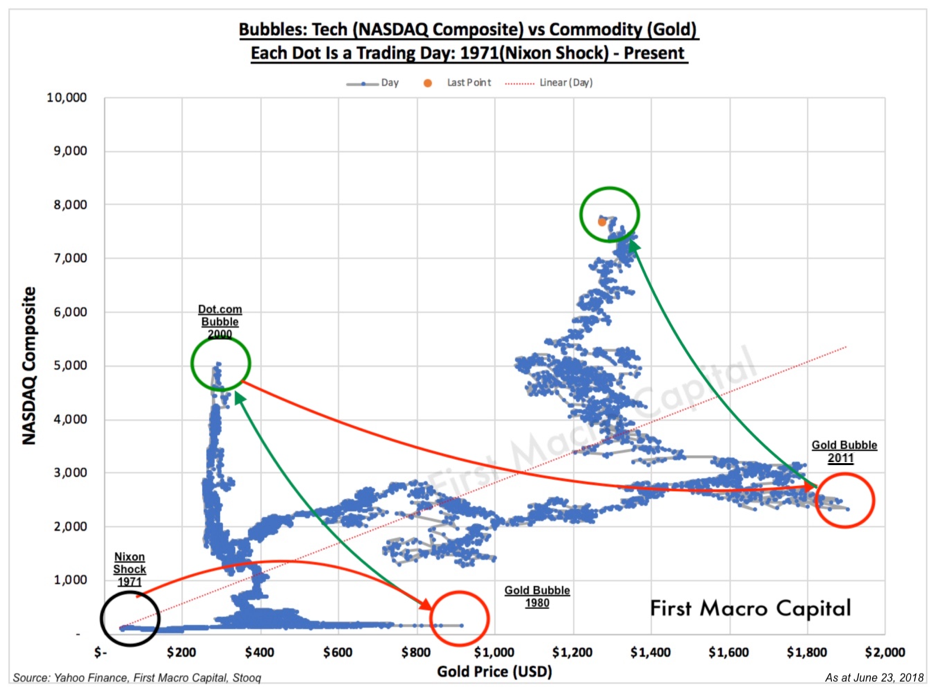
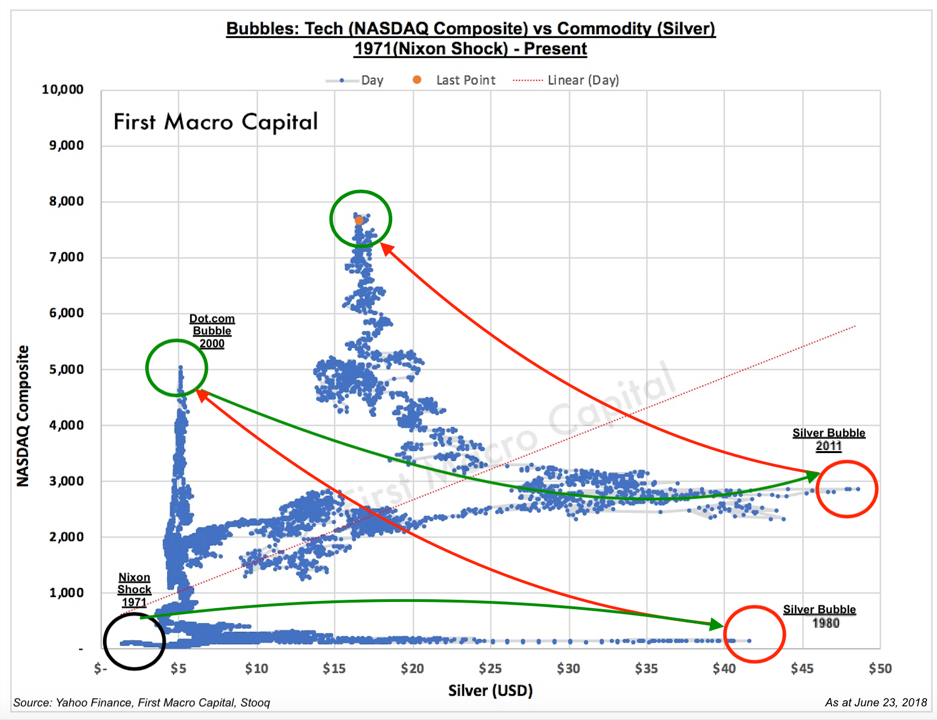
The cyclical nature of commodities and equities goes back at least until the 1970’s. When commodities are doing well, equities are performing poorly. Then the cycle flips and investors pile into equities, eventually making them expensive and commodities like gold and silver become cheap. But what do you get when you take the extremes of both equities and commodities? The extreme side of equities, technology stocks (NASDAQ Composite) being driven by lines of code you can’t touch. On the opposite end of commodities, you get tangible precious metals, silver and in particular gold. Tech investors versus gold and silver couldn’t be more different. Their history of being at a tug-of-war has rarely been discussed until now.

When we look at the NASDAQ Composite (NASDAQ) in relation to gold and silver in US dollars, going back to 1971, when the Nixon shock occurred. You get a striking relationship that confirms the cyclical nature between the commodities and equities. This was four years before Paul Allen and Bill Gates read the famous popular mechanics issue highlighting the world’s first microcomputer kit. That magazine propelled the creation of Microsoft. The 1970’s were a period of rising commodity prices, high inflation, a stagnant economy, and multiple recessions.


The Pendulum of Gold and Silver vs. NASDAQ Composite

1) 1971 – 1980: Commodities went on an epic bull run, increasing by more than twenty-five times, clearly outperforming the NASDAQ. By 1980, the NASDAQ was incredibly cheap relative to gold and silver.

2) 1980 – 2000: From 1980 onward capital flowed out of gold and silver and the overall commodities complex. as interest rates lowered, and confidence in the public sector was renewed. Equities were the cheap asset class in relation to commodities. This then set up the bull run in technology with the NASDAQ peaking in 2000. Gold and silver by this time were incredibly cheap to the NASDAQ.

3) 2000 – 2011: The cycle rotated back to gold and silver until they peaked in 2011.  This is in contrast to the S&P/GS Commodity Index (GSCI), that peaked in 2008. For gold and silver investors that followed the GSCI, they would have sold out early, as gold almost doubled almost three years later in 2011.

4) 2011- Today: Investors could have rotated into the NASDAQ in 2011, when gold and silver peaked in 2011, as NASDAQ has since almost tripled. Today, both gold and silver are incredibly cheap to the NASDAQ. Today, silver may bounce around, but it will be small moves in relation to the coming years ahead, that just like the past four cycles the beginning moves were small until the end of the cycle. This fifth cycle will swing back to silver and gold and we expect them to outperform the NASDAQ on a multi-year basis during for the fifth rotation.


This back and forth pendulum swinging between the two, confirms the cyclical nature between equities and commodities, but at their extremes.

Gold and Silver Warn Tech Melt-Up

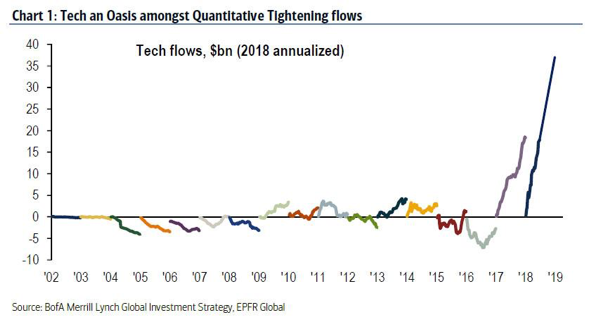
With the manufacturing starting to experience headwinds from the tariffs. Investors are rotating out of manufacturing stocks, and further into technology because for now, tech stocks are less impacted. This rotation may be the final push higher, which investors like Paul Tudor Jones are referring to a second half of 2018 peak in the markets. Remember, based on past cycles we have seen between gold and silver to the NASDAQ Composite, there was a big thrust UP at the peak. Will this time be any different?

As the NASDAQ pushes ahead while the S&P 500 languishes we are experiencing an accelerated melt-up. Is the blow-off-top going to be driven by technology because of the famous FOMO? It doesn’t have the same sensations of Bitcoin in 2017 or the Dotcom bubble yet. But as investors rotate out of Dow components because of trade concerns and into the asset light, businesses you end up at technology stocks. Gold and silver say, yes.

“Rates go up, and stocks go up in tandem at the end of the year. I can see things getting crazy, particularly at year end, after mid-term elections. I can see things crazy to the upside.” Paul Tudor Jones

Was Paul Tudor Jones referring to tech stocks?

US Economy Is Holding Up The World

The US economy continues to be strong, with the underlying ISM Manufacturing PMI at 58.7%, and the US ISM NON-Manufacturing PMI 58.6% for May. No, a recession isn’t in the cards yet. But we sure are getting close as the QE experiment is in tightening mode, and central banks are raising rates around the world.

The Melting Up of Tech Warns – Expect Lower Returns Next 5 Years

For the remainder of the year, it is still quite possible the NASDAQ could go higher, as the NASDAQ is still hasn’t experienced its phrase transition relative to gold and silver. Based on past cycles, there was always a melt-up and outlier for gold, silver, and the NASDAQ. Will the NASDAQ repeat history? With global central bank liquidity decreasing, increasing rates, and the ever-increasing tariffs, maybe it won’t break through the highs in 2002. Investors should reduce expectations to generate the same returns on a multi-year basis going forward as the past five years. For gold and silver investors, this is a massive long-term opportunity.

BULL MARKET SETTING UP FOR GOLD AND SILVER NEXT 5 YEARS

Once the NASDAQ peaks, capital will flow to commodities, setting in the new trend for the commodities boom. From an investors perspective, on a multi-year basis, the reward is clearly to gold and silver, the downside risk clearly to the NASDAQ. Tech investors will swear they will never own commodities. But do you want to continue the streak after the tech boom?

An investor does not need to be precisely right, but just approximately right over multiple years to take advantage of this gold and silver opportunity.

“You only need one bull market to build life-changing wealth. And a new bull market may be knocking at the door…” – Rick Rule

Taking a multi-year view and not shorter-term view, silver and gold are incredibly cheap right now and they stand to benefit from the capital outflows from technology based on the cyclical rotation that has historically occurred. We are only in the first inning or two for gold and silver, particularly when you look at the where the NASDAQ is today.

Takeaways from Tech vs Precious Metals Cycle

  • In all three booms that occurred between the NASDAQ Composite, gold, and silver, there was a melt-up higher for each of them. But the bottom may have already been set in 2016.
  • What is in favor today (Technology) will soon be out of favor in the future, and what is out of favor today (Silver & Gold) will become in favor tomorrow.
  • High-quality businesses with exposure to gold and/silver will give investors an edge to massively outperform the commodities complex and in particular the NASDAQ Composite on a multi-year basis.
  • Don’t marry the trade.
  • Following the Bloomberg Commodity Index is not bulletproof particularly for tech and precious metals investors.
  • Precious Metals will outperform the technology sector over the next 5 years because tech is peaking.

Buy Cheap and Sell to the Crowd

————————————– 

We will be hosting a Live Webcast on Tuesday, July 3, at 4:20 PM ET. Mr. Paul Farrugia (President & CEO) will be discussing an unconventional approach for gold and silver investors in the coming commodity cycle.

There will be no replay. We have limited seats.  

Reserve Your Seat Today


Paul Farrugia, BCom. Paul is the President & CEO of First Macro Capital. He helps his readers identify mining stocks that you can hold for the long-term. He provides a checklist to find winning gold and silver mining producer stocks, including battery metals.


Forex Technical Analysis & Forecast 27.06.2018 (EURUSD, GBPUSD, USDCHF, USDJPY, AUDUSD, USDRUB, GOLD, BRENT)

Article By RoboForex.com

EURUSD, “Euro vs US Dollar”

EURUSD is falling towards 1.1600. After that, the instrument may grow to reach 1.172 and then form another descending structure with the short-term target at 1.1425.

EURUSD
Risk Warning: the result of previous trading operations do not guarantee the same results in the future


GBPUSD, “Great Britain Pound vs US Dollar”

GBPUSD has reached 1.3200. Today, the price may grow towards 1.3330, thus forming a new consolidation range. If later the pair breaks this range to the upside, the market may continue the correction to reach 1.3434 (an alternative scenario); if to the downside – resume falling with the target at 1.3078.

GBPUSD
Risk Warning: the result of previous trading operations do not guarantee the same results in the future


USDCHF, “US Dollar vs Swiss Franc”

USDCHF has returned to 0.9922. Possibly, today the price may fall to reach 0.9844 and then grow towards 1.0020.

USDCHF
Risk Warning: the result of previous trading operations do not guarantee the same results in the future


USDJPY, “US Dollar vs Japanese Yen”

USDJPY is consolidating above 109.78. Possibly, the pair may grow towards 110.55 and then fall with the target at 109.23. Later, the market may continue trading upwards to reach 110.10.

USDJPY
Risk Warning: the result of previous trading operations do not guarantee the same results in the future


AUDUSD, “Australian Dollar vs US Dollar”

AUDUSD has broken 0.7389 and may continue falling to reach the short-term target at 0.7333. After that, the instrument may form another ascending structure towards 0.7470 and then resume falling with the target at 0.7286.

AUDUSD
Risk Warning: the result of previous trading operations do not guarantee the same results in the future


USDRUB, “US Dollar vs Russian Ruble”

USDRUB is trading upwards to reach 63.40. Later, the market may resume trading downwards with the target at 60.00.

USDRUB
Risk Warning: the result of previous trading operations do not guarantee the same results in the future


XAUUSD, “Gold vs US Dollar”

Gold is moving downwards; it has broken 1257.00 and may continue falling to reach 1240.00. After that, the instrument may start another consolidation range near the lows. The price is expected to form a reversal pattern and start another correction with the target at 1304.00.

GOLD
Risk Warning: the result of previous trading operations do not guarantee the same results in the future


BRENT

Brent is still consolidating around 75.00. Possibly, today the pair may grow towards 77.00 and then fall to return to 75.00. Later, the market may form another ascending structure to reach 77.40 and complete the correction. After that, the instrument may continue growing to reach 82.00.

BRENT
Risk Warning: the result of previous trading operations do not guarantee the same results in the future

Article By RoboForex.com

Attention!
Forecasts presented in this section only reflect the author’s private opinion and should not be considered as guidance for trading. RoboForex LP bears no responsibility for trading results based on trading recommendations described in these analytical reviews.