Author Archive for InvestMacro – Page 398

Mexico’s Historical Election and Obrador’s Triumph

By Dan Steinbock

For decades, the specter of Andrés Manuel López Obrador has haunted Mexico’s ruling elites. After July 1, his coalition triumph – after years of contested elections – could change the country’s domestic, regional, even international policies.

For a year or two, international media touted the neoliberal reforms of President Enrique Peña Nieto. However, as the “reform” narrative has proved hollow, Nieto’s approval rating has plunged from almost 50 percent to barely 10 percent. So the media narrative has been revised it by downplaying Nieto but focusing on the flawed portrayal of Obrador as Mexico’s Chávez who will undermine Mexico’s future.

Perhaps that’s why the Economist portrayed Obrador as “Mexico’s answer to Donald Trump” whose “nationalist populism” offers “many reasons to worry about Mexico’s most likely next president.” Similarly, U.S.-based economic hit men and political risk groups, including Ian Bremmer’s Eurasia Group, have framed Obrador’s popular front as a “significant market risk.”

With few variations, the same narrative has been replicated in leading US dailies (Washington Post, New York Times), weeklies (Time and Newsweek), and the UK-based Financial Times. Theirs is a story about the “firebrand leftist” whose biography is “replete with danger signals.”

What these ideological briefings will not report is that Obrador is neither an overnight phenomenon nor Trump-induced collateral damage. In reality, Obrador’s movement is a belated triumph for Mexico’s popular will, after decades of electoral fraud.

Change is coming

In the past six years, Nieto’s administration has sold Mexico’s public assets to foreign bidders and opened financial markets to speculation, while accommodating loyally Washington’s policies. At the same time, corruption, crime, narco-violence and rising murder rates have soared. While neoliberal elites portray the past decade as that of rising competitiveness, market realities prove otherwise. Mexico’s real GDP growth has fallen significantly behind its BRIC potential during the years of Calderon (2006-12) and Nieto (2012-18) (see Figure).

But change may be at the door, finally. Obrador’s coalition “Juntos Haremos Historia” (Together We’ll Make History) rests on popular will, not on the needs of the oligarchic economic and political elite, or what Obrador calls the “power mafia.”

Sectorally, he is pushing for the rejuvenation of the agricultural sector. In particular, he would like to develop the agricultural economy of Southern Mexico, which has been hurt by cheap (and tacitly subsidized) U.S. food imports. In contrast to Nieto’s “energy reform” – which ended Pemex’s monopoly in the oil industry and brought foreign investors to Mexican energy markets – Obrador wants a popular referendum over the energy sector, knowing well that many Mexicans oppose are highly skeptical about the sale of national assets to foreign speculators.

Figure Real GDP Growth vs BRIC Potential, 2005-E2020*

* Mexico’s GDP level as % of US GDP.


After Trump’s inauguration, Obrador published a best-selling book called Oye, Trump, in which he takes a critical look at the American “Caligura on Twitter.” While he is politically too shrewd to challenge Trump head on, he is not an appeaser like Nieto. And unlike Nieto, Obrador also had no hurry to conclude the Trump talks about the North American Free Trade Agreement (NAFTA). Through the election campaigns, he supported the delay of the renegotiations of NAFTA until the elections, to have a say in the final outcome.

Obrador seeks increased spending for welfare, which should be a central political objective in a large emerging economy. He is also a strong proponent of cutting the salaries of the political elite to avoid penalizing ordinary Mexicans. He is willing to walk the talk: he has cut his own public-service salary, several times.

Instead of pushing elite educational objectives, Obrador seeks educational reforms through universal access to public colleges and proposes increases in financial aid to students and the elderly.

Like President Duterte in the Philippines, Obrador, having served in both Tabasco and as mayor of Mexico City, knows only too well how the ruling elite operates in the imperial metropolis. As a result, he is strongly for the decentralization of the executive cabinet by moving secretaries from the capital to the states – closer to the people that they should serve, further from the lobbies they tend to collude with.

In contrast to ‘law and order’ candidates that in the past have colluded with the drug kingpins, he wants to restore law and order and thus peace and stability, in order to focus on economic development. He might even seek to negotiate an amnesty for the key narco criminals.

Obrador’s platform reflects popular will. That’s why it has been marginalized by the oligarchic elites for decades – even with electoral fraud.

Decades of electoral fraud

Born in 1953, Andrés Manuel López Obrador, often abbreviated as AMLO, is everything but a new force or overnight phenomenon in Mexican politics. Starting his career in 1976 in the then-dominant Institutional Revolutionary Party (PRI) in Tabasco, on the Gulf of Mexico, he soon became the party’s state leader. In this capacity, Obrador saw intimately how PRI’s longstanding political monopoly began to crumble as domestic elites and foreign interests paved the way to Carlos Salinas’s presidency (1988-94).

Following a highly controversial electoral process and reported electoral fraud, Salinas who had been groomed at elite US universities, subjected Mexico to neoliberal reforms, which led to years of economic rollercoaster climaxing with the NAFTA. As a series of other presidents ensued – from Zedillo and Fox to Felipe Calderón and Enrique Peña Nieto – they all promised economic reforms, war against drugs and a better future. Yet, each, despite different parties, shared a common denominator: neoliberal economic policies – which were predicated on the continued embrace of NAFTA, the expansion of cartels, and bandwagoning of US policies.

Those were never Obrador’s political objectives. He resigned from PRI years before NAFTA and joined the Party of the Democratic Revolution (PRD), a social-democratic coalition that was formed after the contested election of 1988. Although early results suggested a clear win to Cuauhtemoc Cárdenas, the corrupt Salinas was declared the new president.

In the 1990s, Obrador succeeded Cárdenas. In 1994, he run for Tabasco’s governor but lost to the PRI’s candidate. After the election, a supporter informed Obrador the PRI had spent $95 million dollars on an election in which half a million people voted. In 2000, Obrador became Mexico City’s mayor. After more national exposure, he entered the 2006 presidential election, representing a PRD-led coalition of center-left parties. Obrador’s ‘Coalition for the Good of All’ appeared to be winning until he was declared to have lost by 0.58 percent. That led to a massive, takeover of Paseo de la Reforma and the Zocalo in Mexico City, where protests endured for months.

In the 2012 election, Obrador again represented a coalition of PRD and various labor and citizen movements. However, Peña Nieto’s domestic and foreign supporters took a more proactive stance against Obrador’s popular movement. Despite mass popular opposition to Nieto’s perceived “corruption, tyranny and authoritarianism,” printed and televised media, particularly the pro-Nieto Televisa, downplayed or left unreported much of the criticism. A few years later, Bloomberg discovered that hired Colombian hackers had been paid hundreds of thousands of dollars by Nieto’s PRI to undermine his adversaries and manipulate social media. The election was contested, but despite post-electoral protests, claims of fraud, and Obrador’s formal request to invalidate the election, popular will was discounted – once again.

So Obrador left the PRD and founded the National Regeneration Movement (MORENA) creating his current coalition “Juntos Haremos Historia.” He concluded that to win in Mexico, an alternative candidate needs a broader popular front. So he tailored his platform accordingly. As a result, this time around, his pre-election ratings were almost twice as high as his closest rivals.

While Obrador’s success has been augmented by Trump’s protectionism and immigration phobias, his electoral success in 2018 is the direct result of personal integrity and political resilience.

Toward sovereign Mexico

As Mexicans elected new president until 2024, they also elected 128 members of the Senate for six years and 500 members of the Chamber of Deputies for three years.

If Mexico opts for a new direction, the consequences will be historical in domestically, regionally, even internationally. Not only the White House, but Mexicans may well review the role of NAFTA. Moreover, the drug trade that is maintained by mainly U.S. demand will be under new scrutiny as well. It is time; the cartel violence has taken the lives of more than 200,000 Mexicans.

With more than 122 million people, Mexico is the world’s 15th largest economy and its 11th most populous democracy; a large, emerging economy that could morph into one of the leading global economies by 2050. To win the future, one has to know where one comes from. Having written half a dozen books about Mexico’s history, Obrador is acutely aware of his country’s past, and the territories that were lost following U.S. interventions in the 19th century.

Unlike his modern-day elite peers, Obrador’s political idols reflect Mexico’s decades of industrialization and modernization. He has written particularly warmly about Benito Juárez who had poor, rural origins but rose to national power and presidency (1858-72). Juárez won the War of the Reform and beat the French invasion. He was not an ideologue, but smart, pragmatic and – when necessary – ruthless. Despite his charm with the masses, Obrador’s nickname is El Peje, which refers to abasco’s freshwater gar – an ancient fish with an alligator’s face.

Ultimately, Obrador seeks economic development. In his world, “Mexico First” would be a poor match with a global economy. Yet, unlike Nieto and the neoliberals, he does believe that a sovereign Mexico belongs to the Mexican people.

About the Author:

Dr. Dan Steinbock is an internationally recognized strategist of the multipolar world and the founder of Difference Group. He has served at the India, China and America Institute (US), the Shanghai Institutes for International Studies (China) and the EU Center (Singapore). For more, see https://www.differencegroup.net/ 


The original commentary was released by Difference Group on July 1, 2018.

Leverate China GM Andy Zhang moving on to pursue personal interests

After 3.5 years in the company, Andy Zhang, General Manager of Leverate’s China branch in Shanghai, is leaving his position to pursue a new path in his life. Mr. Zhang was the first Leverate employee in China recruited by Itai Damti, one of Leverate’s founders.

Andy had a key role in establishing Leverate’s foothold in China and APAC regions, and took an essential part in the expansion of Leverate into Asia.

Mr. Zhang sent this message to his staff: “It’s very hard for me to make this decision, but I know I need to take this step and go forward to my next challenge.”

He also expressed his undoubted trust in Leverate China’s team, saying: “You’re really excellent and work very hard. I believe Leverate will be more and more successful in the future.”

Leverate’s CEO Mr.Yasha Polyakov commented: “Andy was a great person to work with. I wish him all the best in his new ventures. The APAC region is now in the capable hands of the outstanding management team that was built during the past few years, and they will continue to provide excellent services to all of their clients, present and future.”


3 Breakthrough Technologies Changing The Energy Sector

By OilPrice.com

Energy has seen some big changes in the last few years.

Coal has stumbled. Renewables have surged. Oil fell hard, then spent years clawing its way back up.

But the biggest change in energy has been in tech.

The shale revolution unlocked millions of barrels that had been trapped away in shale deposits for decades. Today, increased automation at drill sites has allowed frackers and shale drillers to drastically cut costs.

Newer, more sophisticated computer systems have allowed exploration/production companies to earn more from less. Blockchain platforms are streamlining supply chains and cutting out middlemen.

The future of energy belongs to new tech, and investors hoping to score should look to these exciting new firms for some of those solutions.

#1 Oil Production…Without Any Greenhouse Gases

Oil demand has never been higher. Around the world, global hunger for fossil fuels grows and grows…but what about the environmental cost?

Petroteq Inc. (OTCMKTS: PQEFF) has a solution: a patented form of oil sands extraction that leaves no waste, requires no high temperature liquids and produces no greenhouse gases.

The company has set up a new extraction plant at its property at Asphalt Ridge in the oil sands of the Uintah Basin in Utah. Petroteq hopes to produce 1,000 bpd in 2018 and double that next year.

The company uses a proprietary closed-loop extraction system that is focused on oil sands exploitation—a field of oil and gas extraction that has been neglected lately, associated with high costs and tremendous environmental waste.

But the closed-loop Petroteq system leaves out all waste, ensuring that no harmful hydrocarbon vapors escape during extraction. The process is clean and, more importantly, inexpensive.

After two years of hard work, Petroteq is ready to take its first steps into full production. And their technology is already proven in test results!

Petroteq has extracted 10,000 barrels of oil at their original plant.

Its wholly-owned subsidiary PetroBLOQ is developing the first blockchain-based platform for managing the oil and gas supply chain.

#2 What if you could extract lithium in 24 hours…instead of 24 months?

International Battery Metals (CSE:IBATOTC: RHHNF) has invented a new way to extract lithium, the “white petroleum” that could hold the key to the global energy future.

Lithium is the critical ingredient in lithium battery technology, which is utilized in a wide range of different industries from cell phones to electric vehicles (EVs) to wind turbines.

The global battery market could hit $120 billion in less than two years, and lithium prices have been rising rapidly.

Demand is so high, lithium miners have been able to raise billions of dollars before they deliver a single ton of product.

But traditional lithium extraction is slow, expensive and wasteful. It usually involves waiting for lithium spodumene to collect from evaporating salt brine.

IBAT is taking a different approach.

According to inventor-CEO John Burba: “Our tech has such a high specificity for lithium that it can directly take the lithium out.”

The method isolates lithium ions in the brine salt solution, removing lithium chloride and leaving the salt behind.

No toxic ponds of brine are left over and no salt piles are left dotting the lithium fields.

The new method is the lithium equivalent of fracking: a fast new method that could free up huge amounts of supply for the hungry lithium market.

This is a company that hopes to revolutionize oil and gas, from exploration and production all the way to transportation—disrupting every sector along the way.

#3 Perovskite: Solar Panels That You Can Paint On Buildings

The future of solar power belongs to perovskite—innovative new ‘sandwich’ panels that are easy to manufacture and can capture solar energy from virtually any surface.

That’s because perovskite panels can be sprayed onto the side of buildings from an ink solution, or printed like a newspaper and used to cover walls and roofs with ease. No surface lies outside their reach.

Development of perovskite panels is still in its infancy, but a handful of small companies are at the forefront of this big change in solar tech.

One company that is bound to profit is Vivint Solar, Inc. (NYSE:VSLR), one of the best U.S. solar stocks and a leader in the field.

While the company hasn’t announced any perovskite plans yet, it’s certain to take an interest once development surpasses the trial period and the tech becomes more applicable.

Vivint is the top stock in the solar sector, and despite tariffs making solar panels more expensive the company is well positioned to make further inroads into the residential solar sector.

That’s where perovskite could really shine—the new solar tech can be mass produced and applied to new houses, cutting electricity costs and making the U.S. suburbs much greener.

It’s just another stock disrupting the traditional energy mix…one that investors should watch closely in the months to come.

Other companies to watch as a new energy revolution dawns:

Enbridge, Inc (NYSE:ENB, TSX:ENB), based in Canada’s oil sands capital Alberta, is an energy delivery company focusing on transportation, distribution, and generation of energy. Operating in the United States and Canada, Enbridge owns and operates the largest natural gas distribution network in Canada and the longest crude oil transportation system in the world. Founded in 1949, investors can feel confident in Enbridge’s experience and market know-how.

Though not strictly dealing in commodities, Enbridge’s diversified assets and connections to a variety of industries position the company as solidified player in many Canadian investors’ portfolio.

TransCanada (TSX:TRP, NYSE:TRP): is a major oil and energy company based in Calgary, Canada. The company owns and operates energy infrastructure throughout North America. TransCanada is one of the continent’s largest providers of gas storage, and owns and has interests in approximately 11,800 megawatts of power generations.

With TransCanada’s massive influence throughout North America, it is no wonder that the company is among one of Canada’s highest valued energy companies. Investors can feel comfortable with the company due to its huge and diverse portfolio, and continuing eye for success.

Franco-Nevada Corporation (TSX:FNV, NYSE:FNV) specializes in securing precious-metal streams, but the company also works in the oil and gas industry. With key assets in some of North America’s most desirable oil and gas plays, including Texas, Oklahoma and Alberta, it is clear that the company has amazing potential in the coming years.

FNV ended 2016 with a relative bang. And as oil and gas prices inch up, investors are watching this diverse company very closely.

Pengrowth Energy Corp. (TSX:PGF, NYSE:PGH): Another company that looks to have halted its falling stock price and is now preparing to ride the bullish sentiment in oil markets. Having shed a lot of excess weight this year in massive asset selloffs, investors can expect a much leaner and meaner Pengrowth in 2018.

For those investors who like to follow the smart money, billionaire investor Seymour Schulich bought millions of extra shares in Pengrowth in early October, boosting his position from 19 percent of the stock to 24 percent. He claims that he is confident that oil and gas is going up.

Pembina Pipeline Corp. (TSE:PPL, NYSE:PBA): The North American pipeline industry has had a tough year, but the recent approval of the Keystone XL pipeline route and the growing need for transportation capacity should act as a boon for the sector.

Pembina Pipeline Corp. has ridden the oil price crash in an impressive manner, maintaining a good stock price and increasing its dividend. This is a stock that pays you to wait, and as the sector continues to improve it is likely investors will see good gains here.

By Gregory Brew for Oilprice.com

NOT AN INVESTMENT ADVISOR. Oilprice.com is not registered or licensed by any governing body in any jurisdiction to give investing advice or provide investment recommendation. ALWAYS DO YOUR OWN RESEARCH and consult with a licensed investment professional before making an investment. This communication should not be used as a basis for making any investment.

RISK OF INVESTING. Investing is inherently risky. While a potential for rewards exists, by investing, you are putting yourself at risk. You must be aware of the risks and be willing to accept them in order to invest in any type of security. Don’t trade with money you can’t afford to lose. This is neither a solicitation nor an offer to Buy/Sell securities.

RISK OF BIAS. We often own shares in the companies we feature. For those reasons, please be aware that we are extremely bias in regards to the companies we write about and feature in our newsletter and on our website.

By Greg Brew for Oilprice.com

Link to original article: https://oilprice.com/Alternative-Energy/Renewable-Energy/3-Breakthrough-Technologies-Changing-The-Energy-Sector.html


Currency Speculators added to US Dollar bullish positions this week

By CountingPips.comGet our weekly COT Reports by Email

US Dollar net speculator positions rose to $11.03 billion this week

The latest data for the weekly Commitment of Traders (COT) report, released by the Commodity Futures Trading Commission (CFTC) on Friday, showed that large traders and currency speculators raised their aggregate bullish bets for the US dollar this week.

Non-commercial large futures traders, including hedge funds and large speculators, had an overall US dollar net position totaling $11.03 billion as of Tuesday June 26th, according to the latest data from the CFTC and dollar amount calculations by Reuters. This was a weekly rise of $2.39 billion from the $8.64 billion total position that was registered the previous week, according to the Reuters calculation (totals of the US dollar contracts against the combined contracts of the euro, British pound, Japanese yen, Australian dollar, Canadian dollar and the Swiss franc).

The aggregate speculator position has now improved in favor of the US dollar for eight out of the past ten weeks and has landed the dollar position in bullish territory for a second straight week. The current bullish standing is at the highest level since May 16th of 2017 when the aggregate position totaled $13.5 billion.


Weekly Speculator Contract Changes:

This week we only saw one substantial change (+ or – 10,000 contracts) in the individual currency contract levels for the speculators category. Last week, we witnessed six such changes with gigantic moves favoring the dollar.

Canadian dollar contracts dropped by over -18,000 contracts this week and pushed the current position to the 14th straight week in bearish territory. Overall, the loonie speculator sentiment is at the most bearish spot since July 3rd of 2017 when the net position totaled -39,372 contracts.

Overall, the major currencies that improved against the US dollar this week were the Japanese yen (1,341 weekly change in contracts) and the Australian dollar (2,121 contracts).

The currencies whose speculative bets declined this week versus the dollar were the euro (-2,214 weekly change in contracts), British pound sterling (-2,375 contracts),  Swiss franc (-6,074 contracts), Canadian dollar (-18,785 contracts),  New Zealand dollar (-1,622 contracts) and the Mexican peso (-1,245 contracts).


Table of Weekly Commercial Traders and Speculators Levels & Changes:

CurrencyNet CommercialsComms Weekly ChgNet SpeculatorsSpecs Weekly Chg
EuroFx-41,8401,06333,904-2,214
GBP36,5472,755-21,581-2,375
JPY47,0121,995-34,2211,341
CHF60,5295,401-38,031-6,074
CAD40,90947,193-32,799-18,785
AUD62,7582,210-40,9782,121
NZD22,0541,723-17,562-1,622
MXN16,184873-12,510-1,245


This latest COT data is through Tuesday and shows a quick view of how large speculators or non-commercials (for-profit traders) as well as the commercial traders (hedgers & traders for business purposes) were positioned in the futures markets. All currency positions are in direct relation to the US dollar where, for example, a bet for the euro is a bet that the euro will rise versus the dollar while a bet against the euro will be a bet that the dollar will gain versus the euro.


Weekly Charts: Large Trader Weekly Positions vs Price

EuroFX:


British Pound Sterling:


Japanese Yen:


Swiss Franc:


Canadian Dollar:


Australian Dollar:


New Zealand Dollar:


Mexican Peso:

*COT Report: The weekly commitment of traders report summarizes the total trader positions for open contracts in the futures trading markets. The CFTC categorizes trader positions according to commercial hedgers (traders who use futures contracts for hedging as part of the business), non-commercials (large traders who speculate to realize trading profits) and nonreportable traders (usually small traders/speculators). Find CFTC criteria here: (http://www.cftc.gov/MarketReports/CommitmentsofTraders/ExplanatoryNotes/index.htm).

The Commitment of Traders report is published every Friday by the Commodity Futures Trading Commission (CFTC) and shows futures positions data that was reported as of the previous Tuesday (3 days behind).

Each currency contract is a quote for that currency directly against the U.S. dollar, a net short amount of contracts means that more speculators are betting that currency to fall against the dollar and a net long position expect that currency to rise versus the dollar.

(The charts overlay the forex closing price of each Tuesday when COT trader positions are reported for each corresponding spot currency pair.) See more information and explanation on the weekly COT report from the CFTC website.

Article by CountingPips.com


COT Report: USD, SP500 Mini bets go higher. WTI bets rebound while Metals fall

By CountingPips.com – Receive our weekly COT Reports by Email

Here is a short summary and this week’s links (below) to the latest Commitment of Traders changes that was released on Friday.


Currency Speculators added to US Dollar bullish positions this week

US Dollar net speculator positions leveled at $11.03 billion as of Tuesday

The latest data for the weekly Commitment of Traders (COT) report, released by the Commodity Futures Trading Commission (CFTC) on Friday, showed that large traders and currency speculators raised their aggregate bullish bets for the US dollar this week. See full article


WTI Crude Oil Speculators sharply raised their bullish bets this week

The non-commercial contracts of WTI crude futures totaled a net position of 625,091 contracts, according to data from this week. This was a lift of 44,144 contracts from the previous weekly total. See full article


Gold Speculators sharply dropped their bullish bets for 2nd week

The large speculator contracts of gold futures totaled a net position of 76,672 contracts. This was a weekly decline of -19,840 contracts from the previous week. See full article


10-Year Note Speculators trimmed their bearish net positions this week

The large speculator contracts of 10-year treasury note futures totaled a net position of -355,324 contracts. This was a weekly increase of 4,139 contracts from the previous week. See full article


S&P500 Mini Speculators raised bullish bets for 4th week

The non-commercial futures contracts of S&P500 Mini futures, traded by large speculators and hedge funds, totaled a net position of 197,186 contracts. See full article


Silver Speculators cut back on their bullish net positions for 2nd week

The non-commercial contracts of silver futures totaled a net position of 34,221 contracts, according to data from this week. This was a weekly fall of -6,681 contracts from the previous totals. See full article


Copper Speculators sharply dropped their bullish net positions for 2nd week

The large speculator contracts of copper futures totaled a net position of 34,045 contracts. This was a weekly shortfall of -22,266 contracts from the data of the previous week. See full article


Article By CountingPips.com – Receive our weekly COT Reports by Email

The Commitment of Traders report data is published in raw form every Friday by the Commodity Futures Trading Commission (CFTC) and shows the futures positions of market participants as of the previous Tuesday (data is reported 3 days behind).

To learn more about this data please visit the CFTC website at http://www.cftc.gov/MarketReports/CommitmentsofTraders/index.htm

The Saudis Won’t Prevent The Next Oil Shock

By OilPrice.com

Saudi Arabia is starting to panic, and is growing concerned that the growing number of supply disruptions around the world could cause oil prices to spike. Saudi Arabia is moving quickly to head off a supply crunch, aiming to dramatically ramp up production to a record high 11 million barrels per day in July, according to Reuters.

The increase, if it can be pulled off, would be an incredibly rapid ramp up in output, up more than 1 million barrels per day (mb/d) from May levels.

How this plan fits into the latest OPEC+ deal remains to be seen. It was only a few days ago that Saudi Arabia and its coalition partners said that they would add 1 mb/d of supply back onto the market, with many of them acknowledging that, in reality, the figures would be closer to 600,000 bpd because of the inability of so many producers to ratchet up output.

As such, the addition of 1 mb/d from Saudi Arabia alone would lead to the OPEC+ group exceeding the production levels they just committed to, after factoring in additions from Russia and other Gulf States.

However, the surge in output does not need to exported, at least not right away. Saudi Arabia could divert extra barrels into storage. Moreover, higher output is needed during summer months anyway because the country burns oil for electricity, which spikes amid hot summer temperatures. So some of the extra production will be consumed domestically.

Still, an industry source told Reuters that the increase in output “will go to the market,” although the details are unclear. Bloomberg reports that shipments from Saudi Arabia to Aramco’s overseas storage facility in Egypt have already been on the rise this month.

“We already mobilized the Aramco machinery, before coming to Vienna,” Saudi oil minister Khalid al-Falih said over the weekend.

The dramatic ramp up in production suggests that Riyadh wants to prevent prices from rising too much. Producing at 11 mb/d will help offset the outages in Libya, Venezuela, Nigeria, Canada and Iran, but it might not be enough. The U.S. State Department said on Tuesday that Washington would take a hardline towards countries importing Iranian oil. The Trump administration expects countries to zero out Iranian oil imports by November 4, and the State Department said it would be unlikely that anyone would be granted a waiver.

That raises the odds of a much more serious outage from Iran than previously expected. Some analysts put the potential outage at 1 mb/d or more. If the U.S. is successful at convincing most countries to stop buying oil from Iran, the outages could rise to as high as 2 mb/d, although that remains speculation.

In another sign of how unpredictable the oil market has become, Kazakhstan lost 240,000 bpd this week, due to an unknown cause.

In this context, Saudi Arabia producing at 11 mb/d is probably needed, and it still might not be enough.

Worse, ramping up to 11 mb/d significantly cuts into available spare capacity. Estimates vary, but Saudi Arabia may have the ability to produce as much as 12.5 mb/d, although perhaps less. That means producing at 11 mb/d leaves only up to 1.5 mb/d of spare capacity. Add in smaller contributions from elsewhere and global spare capacity might only amount to 2 mb/d of supply as of July, or only about 2 percent of total global production. That would be down from about 3.0 to 3.5 mb/d up until recently.

“It basically leaves us with no spare capacity, at a time when Iran isn’t the only issue,” Amrita Sen, chief oil analyst at consultant Energy Aspects Ltd., said in a Bloomberg television interview. “Venezuelan production’s falling, Angola, Libya, Nigeria –there are lots and lots of issues everywhere in the world.”

Unless demand falls back, or some of these outages dissipate, oil prices could be heading much higher.

By Nick Cunningham of Oilprice.com

Link to original article: https://oilprice.com/Energy/Energy-General/The-Saudis-Wont-Prevent-The-Next-Oil-Shock.html


Fibonacci Retracements Analysis 29.06.2018 (BITCOIN, ETHEREUM)

Article By RoboForex.com

BTCUSD, “Bitcoin vs US Dollar”

As we can see in the H4 chart, BTCUSD has broken the long-term low at 5980.00 and reached a new one at 5750.00. In addition to that, the convergence made the pair start a new correction to the upside, which has reached the retracement of 23.6%, but a new short-term descending impulse is heading to break the low. In case it succeeds, the instrument may continue trading towards the post-correctional extension area between the retracements of 138.2% and 161.8% at 5535.00 and 5395.00 respectively.

BTCUSD1
Risk Warning: the result of previous trading operations do not guarantee the same results in the future

The H1 chart shows more detailed structure of the current movement. If the pair deciders to cotinine the ascending correction, the targets may be the retracements of 38.2% and 50.0% at 6530.00 and 6770.00 respectively.

BTCUSD2
Risk Warning: the result of previous trading operations do not guarantee the same results in the future


ETHUSD, “Ethereum vs. US Dollar”

As we can see in the H4 chart, the downtrend continues. After breaking the previous low, ETHUSD is trading towards the post-correctional extension area between the retracements of 138.2% and 161.8% at 409.00 and 386.00 respectively. The resistance level is at 471.50.

ETHUSD1
Risk Warning: the result of previous trading operations do not guarantee the same results in the future

In the H1 chart, ETHUSD is being corrected downwards. The local resistance level is at 447.62.

ETHUSD2
Risk Warning: the result of previous trading operations do not guarantee the same results in the future

Article By RoboForex.com

Attention!
Forecasts presented in this section only reflect the author’s private opinion and should not be considered as guidance for trading. RoboForex LP bears no responsibility for trading results based on trading recommendations described in these analytical reviews.

Buy When They Cry, Sell When They Yell!

By TheTechnicalTraders.com

We have been pouring over the charts to find out what to expect over the rest of 2018 and our advanced predictive modeling tools are showing us a few key elements that all traders need to be aware of.  So, let’s get right to it.

First, the NASDAQ has likely neared or reached its peak near 7400 for the next few months.  Don’t expect the NQ to move much beyond 7400 and don’t expect a lot of volatility in the NQ over the next few months.  Our research shows the NQ should stall near 7400 and volatility should decrease through September (possibly).

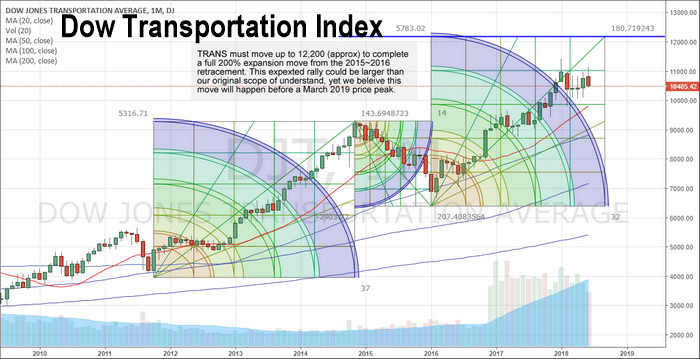
Second, the ES/YM/Transportation sectors are poised for a very healthy rally over the next 3+ months or longer.  We believe a massive capital shift is underway that will drive capital from foreign markets and tech stocks into Blue Chips, Small Caps and the Transportation sector.

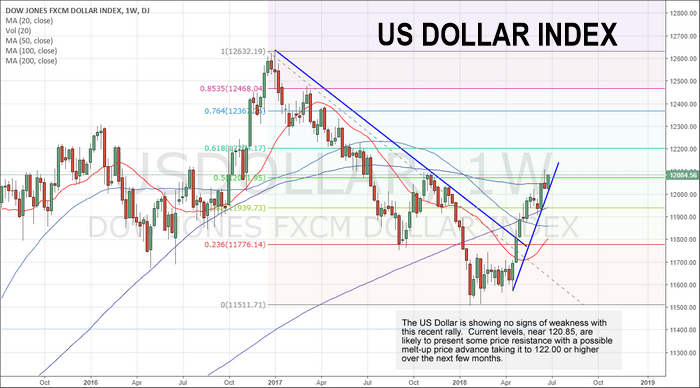
Third, the US dollar will likely continue to appreciate towards 122 after a brief price stall near 120.85.  120.85 is resistance that will probably cause the price advance to stall a bit before pushing higher.  The next resistance level is near 122 and is our next higher target.

Lastly, overall volatility will likely decrease in the general market as price trend continues to unfold.  The recent spike in the VIX has a lot of people wondering if we could see some type of deeper market rotation.  Our opinion is that these projected upside trends will begin after the July 4th trading week and surprise many traders.  Shorts will get squeezed very quickly as this upside trend unfolds.

Now, let’s take a look at some charts.  This, a Weekly US Dollar chart, shows the recent price channel breach as well as the clearly defined upside price trend.  120.85 is currently resistance near the 50% retracement level of the previous price downtrend.  This level will likely cause the price to stall a bit before advancing higher to the 122.00 level.  Overall, until something changes in the global markets or price pushes above the 123.65 level, we expect the US Dollar to continue to advance.

This, the Monthly Dow Jones Transportation Index, shows us the scope and amplitude of recent price swings as well as the price alignment of price rotation over the past 3+ years.  Notice that the last Fibonacci Arc Square aligns with price pullbacks and retracements much like the one originating near 2012 through 2014.  The point of this exercise is to understand how the price is supposed to react within this expansion and to attempt to predict the future upside targets based on these moves.  It is our opinion that the Transportation index will rally to near $12,200 before this move is over.  The reasoning for this is simple – given current and past price rotation, the alignment of the Fibonacci arc suggests that $12,200 will be the ultimate price peak.  Simply put, we just align the Fibonacci arc to price rotation and see where the final outcome for the price is located.


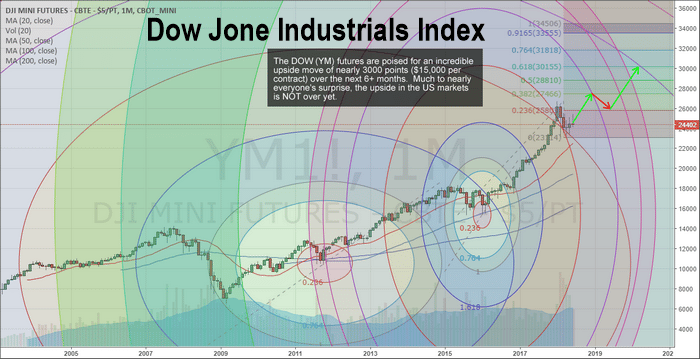
Lastly, this Monthly YM Chart shows us a very clear picture of what to expect over the long term if our predictive analysis and projected price/cycle analysis is correct.  The YM should rally to new highs before the end of this year while potentially stalling near the end of 2018 or within Q1 of 2019.  This stall/peak formation will result in a slight price correction (of likely 3~6%) before prices, again, begin another upside move.  These Fibonacci price circles help us determine projected price targets as well as assist us in understanding current and past price rotation.  The key to all of this is overlaying different analysis and predictive modeling systems that help us understand what to expect in the future.  From this analysis, we can then take at look at these types of “trigger point models” that helps us to understand where and when the price may attempt to reach peaks or troughs.


The current price rotation in the market, with the ES trading near 2720, would indicate that the ES, YM and other Blue Chips may be setting up for a massive upside move.  The YM alone could rally nearly +3000 points ($15k per contract) and the ES could rally +100 points (+$5k per contract) over a fairly short period of time (3~8+ weeks).  This is a tremendous opportunity for traders.  Get ready for an incredible opportunity for profits and let us help you stay ahead of these moves.

Please take a minute to visit www.TheTechnicalTraders.com to learn how we can help you find and execute better trading solutions, better research and provide a top-tier solution for active traders.  If you like our research and find it helps you, then consider joining our other valued members in supporting our work and taking advantage of our solutions for active traders.  Want to know where this market is headed and what to expect throughout the end of this year and beyond – our members already know what our predictive modeling systems are suggesting for the next 5+ months.

Do These Charts Make Sense or Confuse You? It doesn’t matter, just use our easy to follow trade alerts complete with entry, stop, and price targets! JOIN NOW AND TRADE LIKE A PRO!

Chris Vermeulen

By TheTechnicalTraders.com

Forex Technical Analysis & Forecast 29.06.2018 (EURUSD, GBPUSD, USDCHF, USDJPY, AUDUSD, USDRUB, GOLD, BRENT)

Article By RoboForex.com

EURUSD, “Euro vs US Dollar”

EURUSD has broken its consolidation range to the upside may continue growing towards 1.1675. After that, the instrument may resume falling to break 1.1575 and continue trading downwards with the target at 1.1425.

EURUSD
Risk Warning: the result of previous trading operations do not guarantee the same results in the future


GBPUSD, “Great Britain Pound vs US Dollar”

GBPUSD has broken 1.3100. Possibly, today the pair may be corrected towards 1.3162 and then fall to reach 1.3025, thus forming a new consolidation range. If later the pair breaks this range to the upside, the market may start another correction to reach 1.3500; if to the downside – resume falling inside the downtrend with the target at 1.2700.

GBPUSD
Risk Warning: the result of previous trading operations do not guarantee the same results in the future


USDCHF, “US Dollar vs Swiss Franc”

USDCHF has reached 0.9938. Today, the price may form another ascending structure towards 1.0020 and then resume trading downwards to reach 0.9900.

USDCHF
Risk Warning: the result of previous trading operations do not guarantee the same results in the future


USDJPY, “US Dollar vs Japanese Yen”

USDJPY has reached 110.78. Possibly, today the pair may resume falling towards 110.08 and then form another ascending structure with the target at 111.11.

USDJPY
Risk Warning: the result of previous trading operations do not guarantee the same results in the future


AUDUSD, “Australian Dollar vs US Dollar”

AUDUSD has reached the short-term target of the fifth descending wave and right now is being corrected towards 0.7400. Later, the market may fall towards 0.7285 and then form a new consolidation range with a reversal pattern. The price is expected to start another correction to reach 0.7700.

AUDUSD
Risk Warning: the result of previous trading operations do not guarantee the same results in the future


USDRUB, “US Dollar vs Russian Ruble”

USDRUB is falling. Today, the price may reach 62.54, break it, and then continue trading downwards with the target at 60.00.

USDRUB
Risk Warning: the result of previous trading operations do not guarantee the same results in the future


XAUUSD, “Gold vs US Dollar”

Gold has reached 1246.00 and may form another ascending structure towards 1257.00. After that, the instrument may resume falling with the target at 1240.00.

GOLD
Risk Warning: the result of previous trading operations do not guarantee the same results in the future


BRENT

Brent is consolidating around 77.66. According to the main scenario, the pair may grow to break the range to the upside and reach the short-term target at 79.79. Later, the market may start another correction towards 76.86 and then continue trading upwards to reach 80.30.

BRENT
Risk Warning: the result of previous trading operations do not guarantee the same results in the future

Article By RoboForex.com

Attention!
Forecasts presented in this section only reflect the author’s private opinion and should not be considered as guidance for trading. RoboForex LP bears no responsibility for trading results based on trading recommendations described in these analytical reviews.

EURUSD: euro strengthens on Tusk’s comments

By Gabriel Ojimadu, Alpari

Previous:

On Thursday the 28th of June, trading on the euro closed slightly up. A technical correction along with the general weakening of the dollar pushed the euro up. Softer rhetoric from the Trump administration towards China led to increased demand for risky assets. The euro later recovered from 1.1527 to 1.1600. The daily candlestick closed at 1.1568.

Day’s news (GMT+3):

  • 09:45 France: consumer spending (May), CPI (Jun).
  • 10:00 Switzerland: KOF leading indicator (Jun).
  • 10:55 Germany: unemployment change (Jun), unemployment rate (Jun).
  • 11:30 UK: current account (Q1), GDP (Q1), net lending to individuals (May), mortgage approvals (May).
  • 12:00 Eurozone: CPI (Jun).
  • 15:30 Canada: GDP (Apr), industrial product price (May).
  • 15:30 USA: personal consumption expenditure – price index (May), personal spending (May), personal income (May).
  • 16:45 USA: Chicago PMI (Jun).
  • 17:00 USA: Michigan consumer sentiment index (Jun).
  • 20:00 USA: Baker Hughes US oil rig count.

Fig 1. EURUSD hourly chart. Source: TradingView

In Asia, the single currency has sharply increased on the back of an announcement from European Council President Donald Tusk that EU leaders have reached a deal on migration. This caused the rate to jump by 0.85% to reach 1.1667. Growth stopped at the 112th degree.

At the time of writing, the euro is trading at 1.1636, having recovered by 112 degrees. Given that the euro’s surge was brought about by fundamental factors, the euro crosses are all trading up. Shorting the euro against the crosses and a dollar in decline across the board is risky. Because of the crosses, I’m expecting the rate to recover to 1.1689 followed by a drop to 1.1655. If this happens quickly enough, we can entertain a further drop to 1.1624.

Trader attention today is focused on the EU summit, where an update on Brexit negotiations is expected.