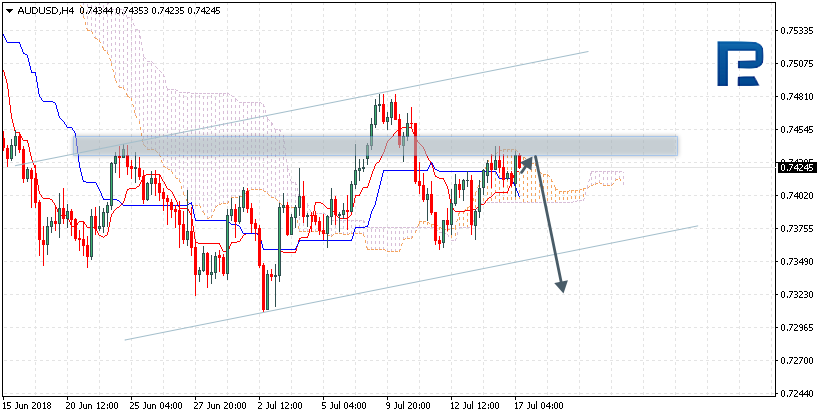
The AUD/USD is trading at 0.7424, inside the Ichimoku cloud, which means the pair is trading sideways. We expect a test of the upper cloud boundary at 0.7435, and then a downward pullback to 0.7325. This fall may be prevented in case the price breaks out the upper boundary and closes above 0.7455, which will be a signal for a further rise to 0.7525 and above. Conversely, the fall will be confirmed once the bottom boundary gets broken out and the price closes below 0.7380.
NZD/USD
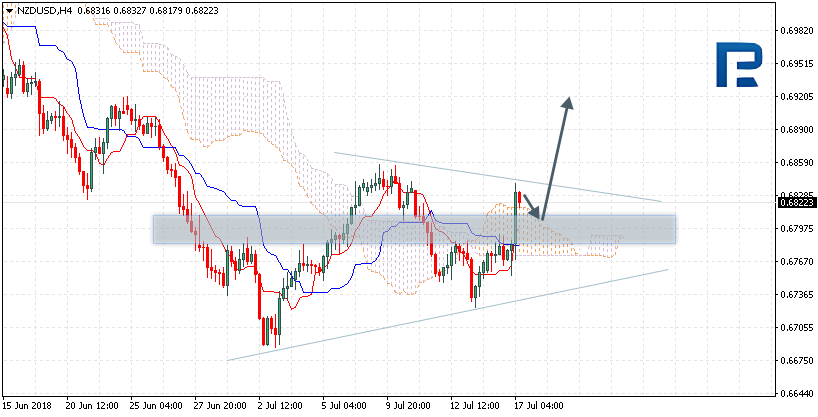
The NZD/USD is trading at 0.6822, above the Ichimoku cloud, which means there’s an uptrend forming. We expect a test of the upper cloud boundary at 0.6805, and then a rise to 0.6920 and above, which may be confirmed with the price bouncing off the resistance. This rise may be prevented in case price breaks out the lower boundary and closes below 0.6750, which will be a signal for a further fall to 0.6670 and below. The rise will get confirmed once the upper boundary of the triangle is broken out and the price closes above 0.6850.
USD/CAD
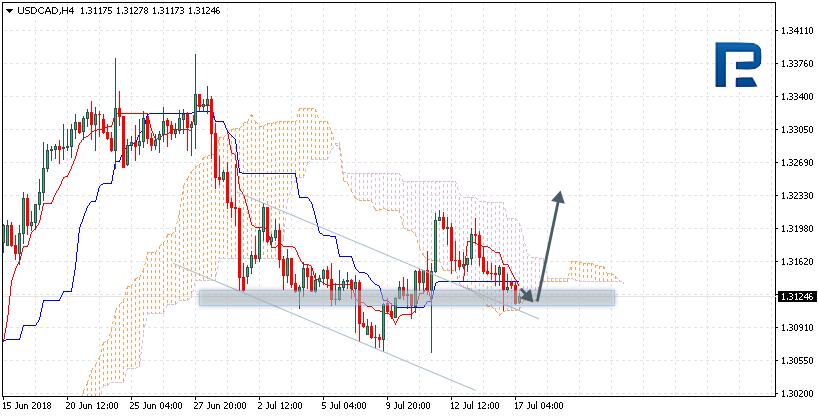
The USD/CAD is trading at 1.3124, inside the Ichimoku cloud, which means the pair is trading sideways. We expect a test of the lower cloud boundary at 1.3120, and then an upward pullback to 1.3235, which will be confirmed with the price bouncing off the lower boundary of the descending channel. This rise may be prevented in case price breaks out the lower boundary and closes below 1.3080, which will be a signal for a further fall to 1.3010 and below. The rise will get confirmed once the upper cloud boundary is broken out and the price closes above 1.3205.
Attention! Forecasts presented in this section only reflect the author’s private opinion and should not be considered as guidance for trading. RoboForex LP bears no responsibility for trading results based on trading recommendations described in these analytical reviews.
This morning, the 17th of July, the EURUSD pair is trading at 1.1714 as we await the opening of the European session, which puts the euro slightly up (about 20 pips) over the last 24 hours. I don’t think that this growth over the last 24 hours is part of any kind of purposeful movement, but is rather just a pullback.
Looking at the fundamentals, the following events have the potential to significantly affect the dynamics of major currency pairs today:
11:00 (GMT+3) UK: BoE Governor Carney’s speech – could have a significant effect on the dynamics of the pound.
11:30 (GMT+3) UK: ILO unemployment rate (May), average earnings excluding bonus (May) – Unemployment is expected to remain at 4.2%. Average earnings excluding bonuses are expected to rise by 2.5%.
17:00 (GMT+3) USA: Fed’s Powell speech.
EURUSD:
On the daily timeframe (D1), the EURUSD could potentially form a head and shoulders model:
The right shoulder has yet to fully form, however, so I wouldn’t yet open a trade on the basis of this model.
On the 4-hour timeframe (H4), the EURUSD pair is forming a descending triangle:
The 5th wave is currently being formed inside this wedge.
An analysis of the D1 and H4 charts tells me that while we currently lack any clear sell signals on the EURUSD pair, the sentiment is certainly bearish, and so pressure on this pair looks set to remain. I reckon we’ll see the pair hit some new lows pretty soon.
Crude Oil has been a major play for some traders over the past few months. With price, rotation ranges near $5~$7 and upside pressure driving a price assent from below $45 to nearly $75 peaks. This upside price move has been tremendous.
Over the past few weeks, many things have changed in the fundamentals of the Oil market. Supply continues to outpace demand, trade tariffs and slowing global economies are now starting to become real concerns, foreign suppliers have continued to increase production, US Dollar continues to strengthen and social/political unrest is starting to become more evident in many foreign nations.
In fact, we felt so strongly that big downside move in crude oil was about to happen we posted a warning to oil traders two days before the drop started.
When we consider what could happen with oil in the future with regards to over-supply and the potential for constricting global markets, we have to understand that support will likely be identified at levels that are much lower than current price – possibly below $60. Yet, at the same time, we must understand that disruptions in supply and/or regional chaos, such as war or political turmoil, in specific regions could cause the price of oil to skyrocket as these disruptions continue.
RIGHT NOW, THREE KEY ISSUES ARE DRIVING OIL LOWER:
– A stronger US Dollar is making it more expensive for foreign nations to purchase Oil on the open market as well as moving capital away from foreign local investments and migrating capital into the US Equities markets
– Supply issues (the increased capacity for greater supply) is resulting in a glut of oil available on the open market when we have dozens of supply ships still waiting to offload throughout the world. In other words, we have an over-supply of oil at the moment.
– A lack of any urgency or crisis event to support Oil above $65 at the moment. Given the slow, but consistent, transition towards cleaner more energy efficient vehicles and energy as well as the lack of any real conflict or crisis event to disrupt supply, it appears there is no real support for Oil above $65 – at least so far.
DAILY CRUDE LIGHT CHART
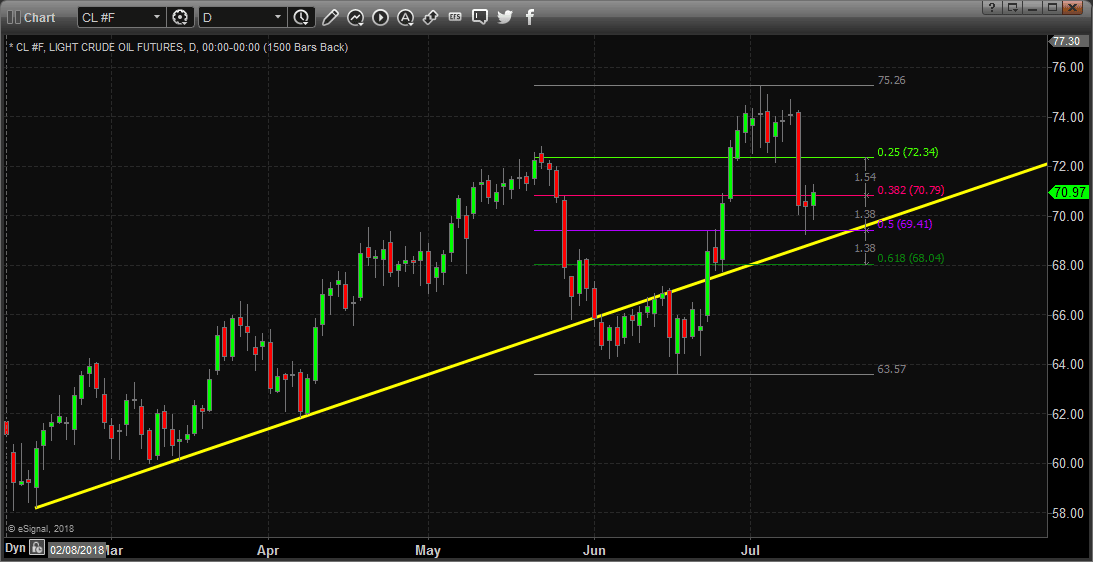
This Daily Crude Light chart shows a simple price channel that correlates recent price lows into a channel and shows a Fibonacci Retracement range for recent price rotations. We can see that the price of Crude is holding just above the 50% retracement level right now and any breach below $70 would be a very strong downside price breakout. Should price drop below $68, we could see a selloff to below $64 as price may attempt to establish a new “price low” to the downside.
MONTHLY CRUDE CHART
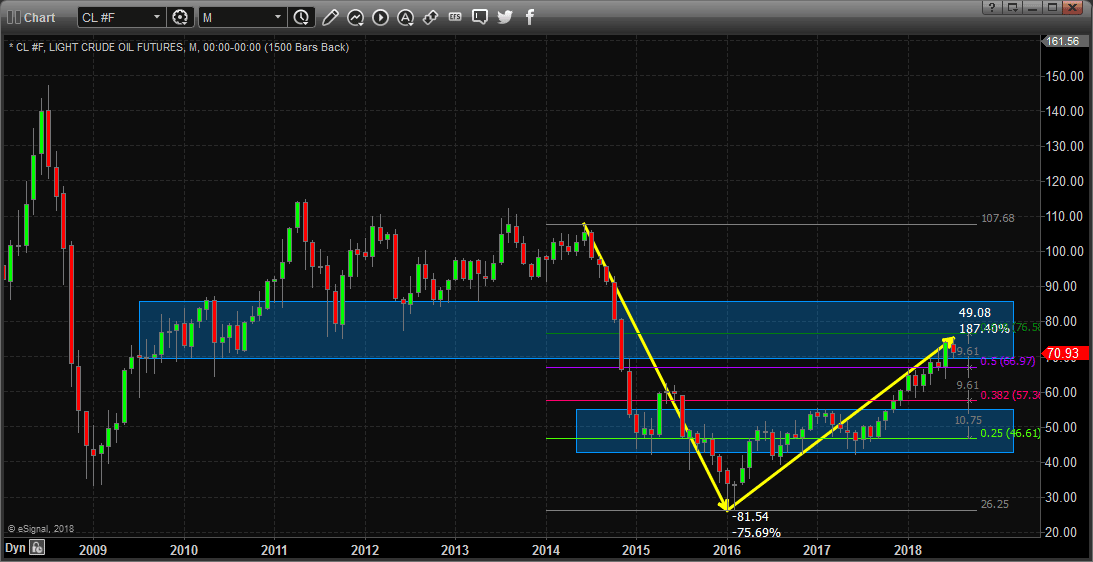
This Monthly Crude chart below shows us where we believe support and resistance price zones are located. You can see from the highlighted areas that resistance is located between $70~86 and support is located between $44~56 on this longer-term monthly chart. You can also see that the Fibonacci retracement levels for the current upside move are currently nearing 55~57% (above the 50% level and nearing the 61.8% level). The combination factor that Crude has recently rotated lower, near the upper price channel, within the resistance zone, above 50% and nearing 61.8% Fibonacci level, strongly suggests that we could see a stronger downside price swing in the near future. Until $60 is breached, consider this move simple rotation. Once $60 is breached to the downside, then consider this a deeper downside price move.
With so many factors in play throughout the world, one has to be aware that Crude Oil is a commodity that correlates to expected economic activities, global crisis events, and supply/demand factors. Right now, an almost perfect storm is setting up for Oil to continue to fall to new lows which will likely push Crude below $60 ppb (eventually) and may push it down to near $55 ppb (our upper support zone). We caution traders/investors through – any crisis news item, war or other disruption in supply could dramatically alter the factor that makes up this price prediction. Right now, without any of these issues, we see Oil continuing to fall towards the $60 price level.
Also, visit www.TheTechnicalTraders.com/FreeMarketResearch to read all of our most recent free research posts. We believe you’ll quickly see the value in what we provide our members and our visitors by reading and understanding how we have continued to stay ahead of these market moves for months.
53 years experience in researching and trading makes analyzing the complex and ever-changing financial markets a natural process. We have a simple and highly effective way to provide our customers with the most convenient, accurate, and timely market forecasts available today. Our stock and ETF trading alerts are readily available through our exclusive membership service via email and SMS text. Our newsletter, Technical Trading Mastery book, and 3 Hour Trading Video Course are designed for both traders and investors. Also, some of our strategies have been fully automated for the ultimate trading experience.
Get our advanced research and market reporting, Daily market videos, detailed trading signals and join the hundreds of other traders that follow our research every day and profit.
The American dollar is falling against a basket of the major currencies. Last week was marked by the maximum increase of the USD for the last month. The US dollar index (#DX) closed in the negative zone (-0,24%). US retail sales data for June was also released and it met the expectations of investors at the level of 0,5%.
The trading conflict between the USA and China is still in the spotlight. Weak economic reports from China has strengthen the concerns of the financial market participants that this trading war with the United States may slow the growth of Chinese economics. The US Administration, in turn, is not satisfied with the retaliatory duties on imports of American goods from China, the EU, Canada, Mexico and Turkey. Washington, D.C., considers these actions as illegal and illegitimate.
The Consumers Price Index of New Zealand was released during the Asian trading session. It fell to 0,4%, while experts expected 0,5%. Today we expect the statements of the head of the Bank of England, Mark Carney, and the chairman of the Federal Reserve, Jerome Powell.
The “black gold” prices drop sharply against the increasing oil supply on the world’s market. At the moment, futures for the WTI crude oil are testing a mark of $66,95 per barrel. At 23:30 (GMT+3:00), a report on the US crude oil inventories will be published.
Market Indicators
Yesterday, there was a variety of trends in the US stock market: #SPY (-0,09%), #DIA (+0,19%), #QQQ (-0,24%).
At the moment, the 10-year US government bonds yield is at the level of 2,85-2,86%.
The news feed on 2018.07.17:
– The Average UK salary at 11:30 (GMT+3:00).
We also recommend paying attention to the speech by the heads of the Fed and the Bank of England.
EURUSD doesn’t look active and is not moving in any clear direction. Still, although trade wars are no longer as a strong trigger as before, they have not become less relevant. Now it’s China’s turn, but its government has not taken any measures in response to the US policies yet.
Meanwhile, Donald Trump is still traveling around the political world. He already visited Britain where he spoke hawkish on May and Brexit, which affected pound sterling negatively. Now the US President, as well as the market, is focused on the meeting with the Russian leader Vladimir Putin.
Investors are watching both economic and political news closely, but very calmly. While the market is not that interesting for its participants now, it may save some effort for the future moves that may be caused by a lot of various drivers and triggers.
Thus, today’s evening we’ll be expecting the US retail sales in June. May was a great month for the retail sector, with the figures adding 0.8% MoM, while the automotives were even higher, +0.9%. The markets are now very engaged in watching what could June data reveal. This time the expectations are not that high, just 0.4% in both cases. If these expectations are met or beaten, this may well support the US dollar.
On Tuesday, the manufacturing production is being released, which should confirm current trends.
Technically, the EURUSD is downtrending in the short term, which was caused by the previous uptrend support breakout. This new downtrend already reached the projection channel support and may go further down till another support at 1.1605. However, the pair may start rising again soon, so one should also closely watch the resistance at $1.1715, which, if broken out, may lead the price to the important local highs at $1.1790 and $1.1875.
Disclaimer
Any predictions contained herein are based on the authors’ particular opinion. This analysis shall not be treated as trading advice. RoboForex shall not be held liable for the results of the trades arising from relying upon trading recommendations and reviews contained herein.
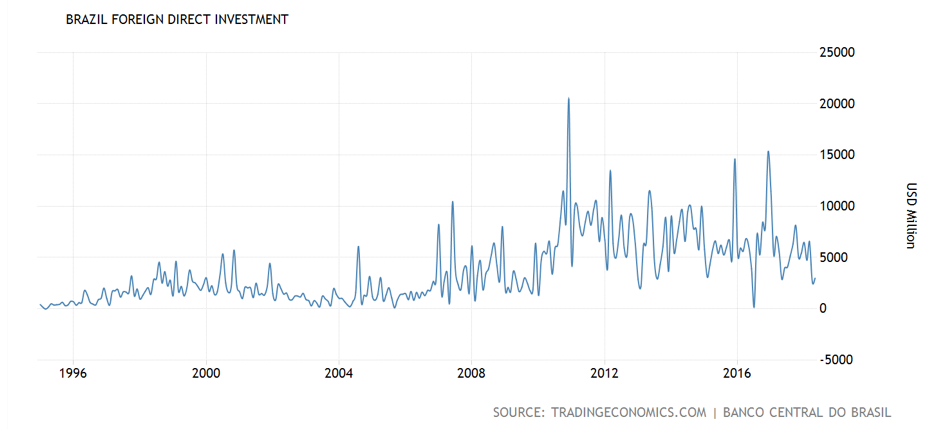
Brazil has been one of the hardest hit countries since the natural resources boom ended. This resulted in Brazil falling into a very deep recession and foreign direct investment dropping by more than 75% from its peak. But the rules of the game changed in June, setting the stage to dramatically change investor outlook in its mining sector for a number of years ahead. This is after little changes in Brazil’s mining sector going back to 1967.
But before putting money to work in Brazil, most investors and speculators can think about a number of issues the country has faced since the commodities boom ended. For instance:
Foreign Direct Investment is down by more than 50% since the peak in 2011
Mining Disaster in 2015
Mining Bankruptcy: Luna Gold
Currency Heavily Depreciated
Increased Political Challenges over the past few years
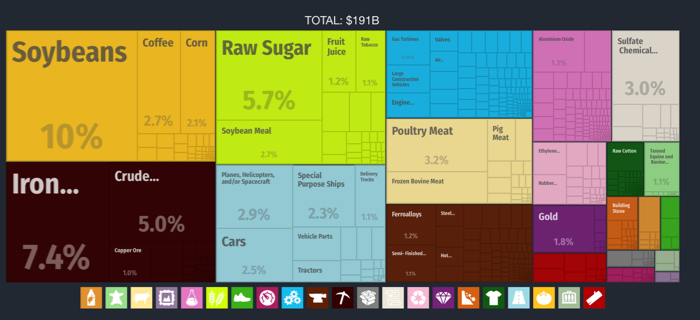
These are all the hallmarks of wanting to shy away as an investor. In the short-term, we see these as only temporary, and more issues may continue to unfold becauseBrazil is primarily a natural resources country. Just like Canada, and Australia that are heavily influenced by the prices of oil, iron ore, and other natural resources. Brazil is no different, with iron ore, crude, soybeans, raw sugar, and gold accounting for almost 30% of the country’s exports in 2016.
What Happened? The BIGGEST Change in Brazil’s Mining Sector in 50 Years
Brazil updated its mining code that has changed little since 1967, that will positively impact investors looking to invest in the sector.
“…allow for mining titles to be used as guarantees for financing, aimed at stimulating investment in the sector and to allow miners to continue exploring for minerals while production license applications are pending,” the Mines and Energy Ministry said.(Reuters)
Legal classifications for mining resources, which still use terms from a 1967 mining code, will come into line with global standards, and filings for permits will be more focused on economic feasibility, the two sources said. (Reuters)
President Temer signed the decrees on Tuesday, saying the economy needed a competitive, innovative and sustainable mining industry. “The mining code has been modernised and reflects the best international practices, as well as improving legal certainty,” he said in a translated tweet, “which helps to attract more investments and jobs for our country.”Mining Journal
What Does the New Rule Changes Open Up For Investors?
The decree would open up roughly 20,000 exploration areas where permit applications have stalled or been abandoned,one source said. Those blocks, which account for about a tenth of areas in Brazil with permits pending, would be subject to new auctions. (Reuters)
“Brazil is opening up its markets and there are many opportunities,”Andre Clark, head of Siemens in Brazil.
Why Do the Policy Change?
“The objective of the measure is to attract new investments, generating wealth for the country and employment and income for society, always based on the precepts of sustainability,” the Brazil ministry said in a statement.
“With this (decree), we will ensure our attractiveness to foreign capital,” the second source said. “There will be the legal security necessary for people to invest in Brazil.”(Reuters)
The Timing of The Policy Change
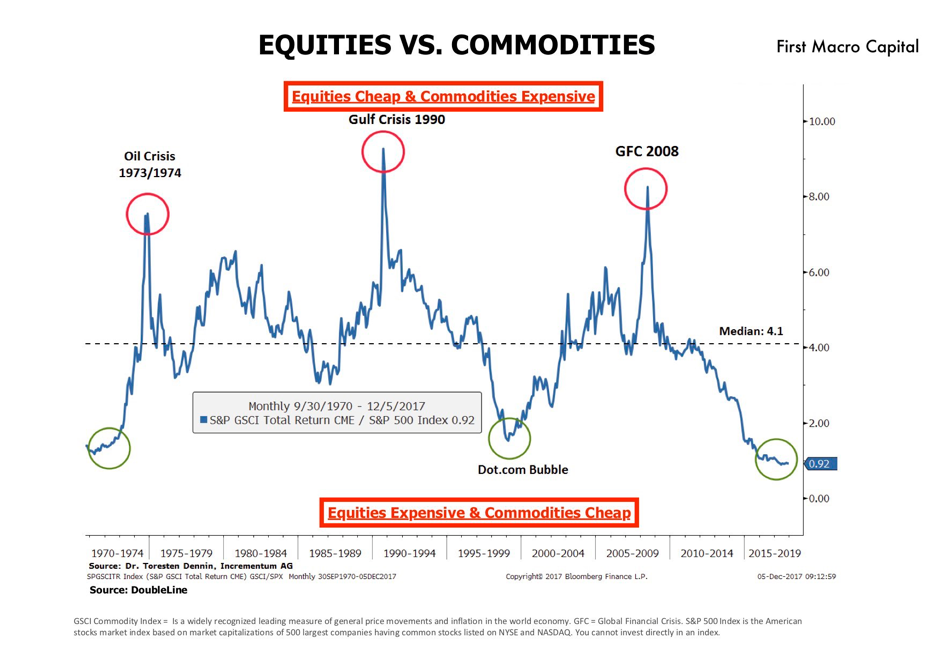
If we take into account a rotation from equities to commodities, then this is a huge positive policy change at the start of the commodities cycle. Brazil has the potential in the coming natural resource boom to be a big winner again for investors because it is setting policies in place to help the country grow again and attract investment. There are plenty of different commodities for investors to invest in Brazil. These new mining policies have a high probability of improving investor sentiment of Brazil. Government policies can pull or push away investment, and these new changes will pull in investment into Brazil, particularly as the commodity cycle unfolds. In turn, new job opportunities will open up in Brazil’s mining sector.
Bloomberg Interview with Mark Mobius – July 11, 2018
Host: “Do we know enough who the winners might be in your view?”
Mobius: “In our view, in terms of the emerging markets, some of the most interesting now because of their tremendous decline in the currencies and markets, would be Brazil.
Host: “Do you think we bottomed across emerging markets, just generally speaking from a sentiment play?”
Mobius: “I can’t say they bottomed. Emerging markets as you know are down about 20 something percent in general. Some markets are down more than that. I expect probably another 10%. As you know about a year ago, I said probably a 30% decline/correction. I think we will still achieve that. But now of course, now is the time to begin looking and locating those companies in emerging markets. The opportunities are going to get better. The currencies look very cheap as you know. The markets are down in many cases substantially. Places like Brazil, Argentina, these are really bombed out markets.”
Host:”Bombed out presents the opportunity of being greedy when others are fearful.”
Mobius:“That’s always been the case. The problem of course is putting money to work when markets are down substantially. One of the reasons of course, is that investors hold back. And therefore, we don’t have the cash to put money to in these markets. People are learning, there are a lot of investors that are willing to go into these bombed out markets.”
Wealthy Group and Strategic Investors that Added to Their Investments in Brazil in 2018:
In recent months there has been an increased activity of successful mining investors deploying capital into Brazil while gold price remains down. These are investors with a proven track record of creating wealth with a longer-term focus than just 3-6 months.
Ross Beatty via Equinox
Sprott and Lundin family in joint investment via Americano Mining
Mitsui investing in Vale
Asked whether Mitsui could buy all of the shareholders’ stake if it were offered as a parcel, Takebe said: “I wouldn’t rule out possibility, but it’s unlikely that we would buy all the shares on sale.” Source: Reuters
Anglo American
Anglo has confirmed to Reuters it had obtained permits covering almost 1.9 million hectares to explore in the Mato Grosso and Para states but said it was too soon to make claims about the project’s viability.
Brazil’s national mining agency director general Victor Bicca told the wire service it could be a “mega deposit” with similar mineral content to Chile. Source: Mining Journal
There are a number of companies already invested in Brazil, and this new rule could entice them to further invest in the country with these new rule changes. They’ll be able to utilize their first mover advantage versus everyone else. Already registered companies, established teams, relationships, etc.
Vale
BHP Billiton Limited
AngloGold Ashanti Ltd.
Kinross Gold Corporation
Alcoa Inversiones España
Hydro ASA
ArcelorMittal
Anglo American
Yamana Gold, Inc.
Novelis
ThyssenKrupp CSA
Sao Bento Mineracao
Technip
Goldmining
Equinox Gold
Americano Mining
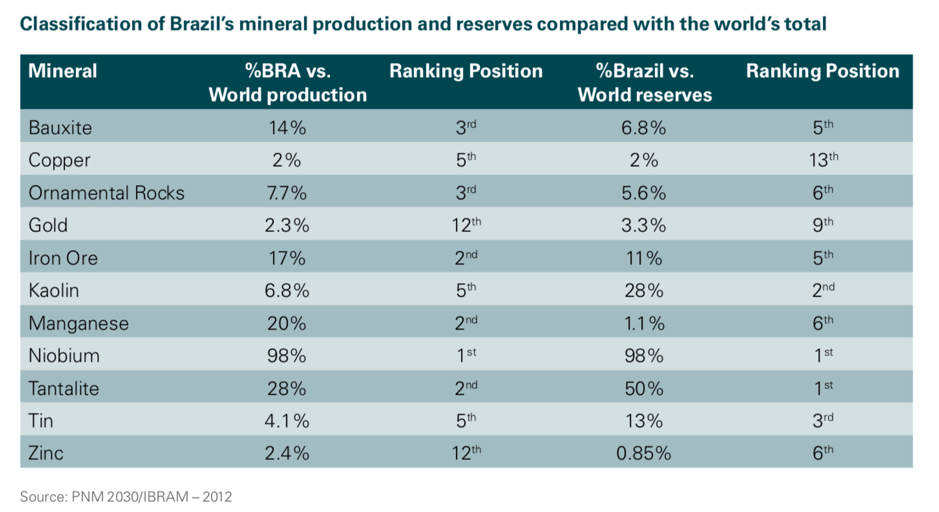
Brazil is the #1 producer in niobium, 2nd largest producer of iron ore and manganese, as part of the almost 80 mineral commodities that Brazil produces. The big winners will be on gold and copper investment because there is more certainty with customers, and investors are more familiar with these commodities. Electric vehicles will create a new source of demand for copper, that no one truly knows the demand side.
Policy changes can dramatically positively or negatively impact investor sentiment. We think in Brazil’s case, these new mining updates positively improve investor sentiment over the coming years ahead. Will the currency and other issues probably come up in the meantime as the natural resources boom has yet to take hold? We think there’s a high probability chance. Smart money is already deploying capital in the country, and those investors that are willing to take a multi-year view on Brazil; mining in Brazil has the potential to eclipse what it did in the last cycle because of these new policy changes. Copper and gold projects will be some of the big winners, particularly as electric vehicle demand grows. Being greedy when others are fearful, puts Brazil near the top to consider for natural resource investors and investors looking for deep value opportunities.
————————————–
We will be hosting a Live Webcast on Thursday, July 19, at 8:15 PM ET. Mr. Paul Farrugia (President & CEO) will be discussing an unconventional approach for gold and silver investors in the coming commodity cycle.
Paul Farrugia, BCom. Paul is the President & CEO of First Macro Capital. He helps his readers identify mining stocks that you can hold for the long-term. He provides a checklist to find winning gold and silver mining producer stocks, including battery metals.
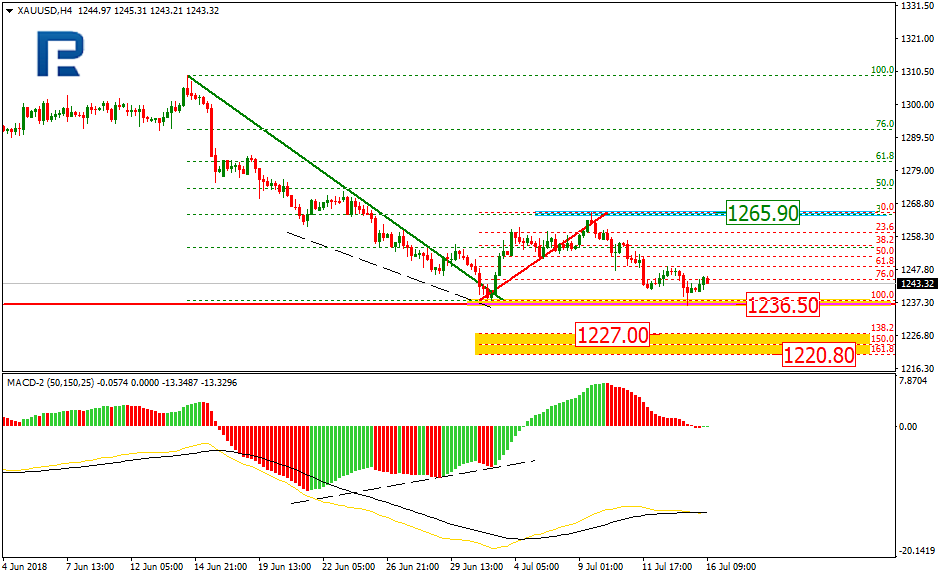
On H4, the gold has broken out both the local and the long term low at $1,236.50 with its new downward move. The further downward targets may lie in the post correctional range of 138.20 to 161.80% Fibo extensions, or between $1227.00 and $1220.80. The resistance is at $1265.90.
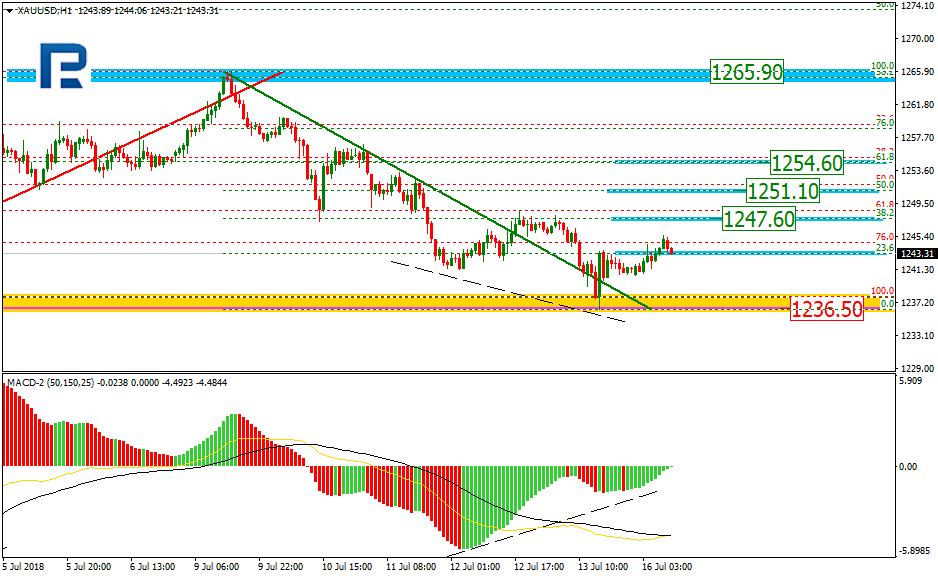
On H1, the price is start pulling back after a convergence. This pullback targets may be at the following Fibo retracement levels: 38.20% ($1,247.60), 50.00% ($1,251.10), and 61.80% ($1,254.60).
USD/CHF
The USD/CHF has broken out its latest key high on H4. The further rise targets may lie within the post correctional range between 138.20% and 161.80% Fibo, or between $1.0157 and 1.0220. The ascending trend is supported with 0.9851.
On H1, the USD/CHF is correcting towards 38.20% (0.9987), 50.00% (0.9963), and 61.80% (0.9938). The resistance is at 1.0068.
Attention! Forecasts presented in this section only reflect the author’s private opinion and should not be considered as guidance for trading. RoboForex LP bears no responsibility for trading results based on trading recommendations described in these analytical reviews.
Over the past 4+ months, many emerging markets have come under pressure as the global markets were roiled by the sudden and relatively deep market retracement in early February. For many, this downward price trend has been frightening and somewhat disastrous. Recently, though, something new appears to be on the horizon that may be the early signs of renewed life for many Latin American, South American and Indian markets – early signs of support and a potential bottom formation in the works.
Our researchers have been following the recent moves in these emerging market ETF for Brazil, Latin America, and India with great interest because we believe in finding opportunities when many others may not be looking for them. We believe these early warning stages of a market bottom could be an excellent time to “forward think” any possible price recovery that may occur in the near future and to prepare for any success opportunities that may arise. Heck, we are traders and if the opportunity exists for a decent profit with little risk, we’ll investigate it.
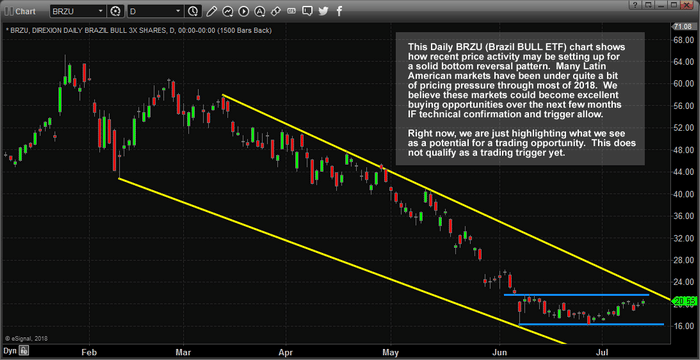
Let’s get started with this Daily chart of the BRZU (Brazil Bull 3x ETF). We can see from this chart the extended downtrend channel that has existed for nearly 4 months. Near the bottom right side, pay close attention to the horizontal price channel that is setting up – this could be an excellent bottom rotation channel resulting in an upside breakout eventually. With only 3 to 7 days to go before the upper price channel may be challenged and a clear double bottom formation near $16, any downside rotation below $17.50~18 would be an excellent buying opportunity range with $16 being our protective stop level. Assuming this channel continues as price reaches this apex, at some point price will either rotate higher or continue to channel lower (below the $16 level). So, buying near the lower range of this horizontal price channel may be a great opportunity for an upside move.
Additionally, the GAP between $26 and $28 is a clear upside target. We would hope this move would be quick and simple, buy below $18 with a target above $26. A quick $9 profit per share (50%+) and we could manage the remainder of our trade by moving our stop to $23 or $24 to protect against any unwanted losses.
Yet, in order for this trade to really have any teeth, we would need to see some correlation across multiple emerging market ETF. Then we could really say that we may be seeing some type of bottom rotation starting to form. Let’s look for more correlative signals.
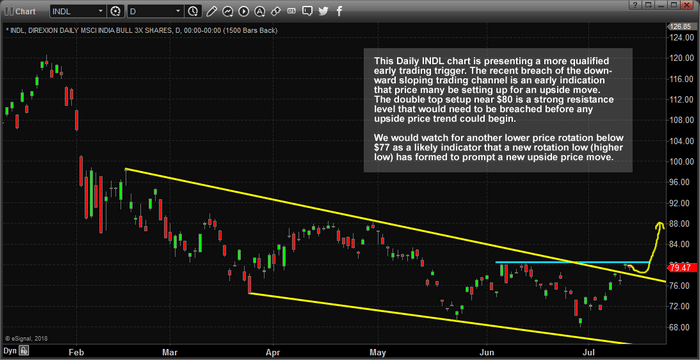
This next chart is a Daily INDL (India Bull 3x ETF) and it is showing a similar pattern that has recently broken above the downward sloping price channel. This is a good sign that price may be attempting a rotational upside move in the near future. Yet, upon closer inspection, we can see that a double top is setting up $80 that may unsettle this move. Additionally, the range of the price channel is rather deep – $68 to $80. That $12 range may include a bit more RISK than we want to consider at the moment. Certainly, this trade looks like it may have some potential, but there are still concerns that this trend may be a false flag type of move.
We would like to see more pronounced and defined “higher low” rotations in the process of creating this double top formation. Currently, we have a few moderate higher low setups, but the deeper low near the end of June is concerning. Ideally, we would wait for a low price move below $72~74 and watch for price rotation back to the upside as a better sign that price is “technically conforming to Fibonacci price rotation theory”.
Still, this pattern is setting up as resistance near $80 with a clear sign that a bottom could be forming in INDL at the moment. Our opinion is to watch it and wait for a better setup before taking a position. We believe we can identify a better entry point by waiting for price to show us it is ready to move higher instead of presuming this rotation WILL move higher.
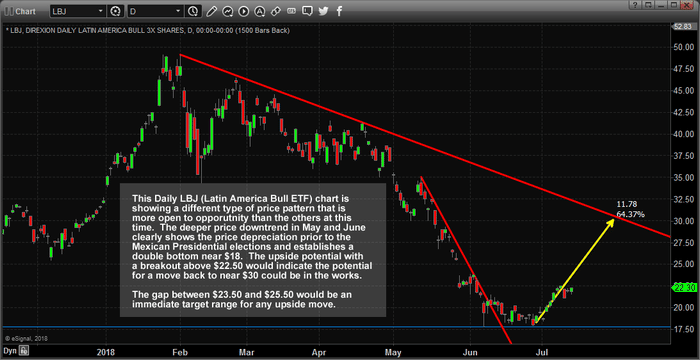
Lastly, let’s take a look at this LBJ (Latin America Bull 3x ETF) Daily chart. We find this chart very interesting for one simple reason – the big “U” shaped bottom formation near $17.50 and the clear upside price swing that is taking place right now. You can clearly see the RED price channel slopes that are key to understanding price resistance and the more aggressive downward slope that was breached in mid-June. Yes, should this ETF rally back to near $30 from this level, we would be looking at a 50%+ increase in value. Yet, again, we have to learn to be patient and wait for the price to show us that it is preparing for an upward swing higher.
As of right now, we have “higher highs”, which is a great sign that the trend has changed to the upside. Yet, we also have a clear GAP between $23.50 and $25.50 that could become immediate resistance. We also don’t have any “low price rotation points” that we can use as a technical confirmation of price trend and price rotation. In other words, we have what may be an impulse move higher with no real confirmation of longer-term upside potential.
We would caution investors from jumping into this trade at this time and urge them to wait for better confirmation – likely after the breach of the price GAP is filled and price rotates back below, or near to, $20. Short and simple, this is a very interesting bottom formation in the works that has not qualified as a solid uptrend yet. There are still too many unanswered concerns to allocate capital towards this trade.
While all of this is interesting and possibly a bit early in terms of bottom formation expectations, we believe the correlation across these multiple markets shows enough evidence of a potential emerging market bottom in select markets as it relates to these under performing Latin American and Indian markets. Obviously, we still have to be cautious of any downside rotation that could be dangerous – these percent ranges still show quite a bit of risk. But the upside potential for a perfectly timed entry may be just around the corner.
Want to learn more about what we do and how we help traders find success in the markets? Visit www.TheTechnicalTraders.com to learn how our research team, with more than 50 combined years of trading experience, can assist you in finding tremendous trading opportunities each month as well as provide you with detailed market research, Daily market videos and much more. Our job is to help you find and execute successful trades in the future and to help you stay aware of future market moves.
Visit www.TheTechnicalTraders.com/FreeMarketResearch to see how our research team has been ahead of these turns in the global markets for the past 8+ months. We have an incredibly deep research library of posts available to all members/visitors at the link above. We are certain you will find value in our work and our abilities to accurately predict the markets. We’ve been calling for upside price moves in the US Equities markets since the middle of February when everyone was warning about a collapse. We called the downtrend in China months before it happened and we recently called the downward rotation in Crude 4 days before it happened.
The euro has reached 1.1725 against the dollar, which may be considered as correction after the previous downmove. Once this correction is over, another downmove towards 1.1560 may occur, and then a rise to 1.1670 may follow.
GBPUSD
The pound has reached its downmove target. The pair is currently trading at 1.3333, ready to fall till 1.3220. A triangle pattern is forming at almost all lows. If the price goes up, the correction towards 1.3550 may follow; conversely, the trend may continue, with the price going to 1.3000.
USDCHF
The CHF has reached its target at 1.0067, while the pair is still sliding down, being under pressure. This may lead to a correction towards 0.9960.
USDJPY
The US dollar – Japanese yen pair is also under pressure and is going down, which may lead to correction to 111.11; then, a rise to 111.95 may follow. After that, a consolidation range with a reversal pattern may appear, and once it’s broken down, the trend may continue with the price reaching 109.75.This is the first target.
AUDUSD
The Aussie has reached 0.7430 and may continue falling towards 0.7340, after which the consolidation range may be expected. If the price goes up after that consolidation, the correction towards 0.7520 may follow; conversely, the price may head down towards 0.7285, aiming to reach a strategic target.
USDRUB
The Russian ruble is still consolidating around 62.00; today, 61.51 may be reached. With further breakout, the price may head lower to reach the local target at 60.60.
GOLD
The gold is trading around its lows within a consolidation range. The yellow metal may go ahead to reach $1,249, and then fall back to the lower range boundary. Once the range is broken out top down, $1,234 may be reached; conversely, the price may go up towards $1,270.
BRENT
Brent crude pulled back to $74.70, although today it may rise to its local target at $76.35. Afterwards, another downward move to the same $74.70 may occur, and then a rise to 76.70 may follow. This is the first target.
Attention! Forecasts presented in this section only reflect the author’s private opinion and should not be considered as guidance for trading. RoboForex LP bears no responsibility for trading results based on trading recommendations described in these analytical reviews.
The upside price moves recently in the US Equities markets have been dramatic. While many people believe the US Equity markets are overvalued and setting up for a top, we believe just the opposite – that the US Equity market and strong US Dollar are attracting capital and investment from numerous internal and external sources. We also believe the Q2 2018 earnings season, which is just about to begin, could be an additional driving force for further price advances – with big upside moves ahead.
There are really three things at work in the global markets right now:
Strong US Dollar and global trade/policy issues: these are driving concerns and economic sustainability issues in many foreign nations and attracting investments as the US Dollar continues to strengthen against many foreign currencies.
Foreign Debt/Economic Sustainability issues: the facts that economic cycles, as well as political and social concerns, have roiled many foreign markets, elections and policies in combination with somewhat out of control debt levels in some countries is starting to weigh on investors. Yes, strategic investors will still be looking for opportunities, but longer-term investors are seeking risks everywhere and are searching for protected investments – not risky deflationary investments.
Leadership Changes/Challenges: as we have all recently seen, there are a number of political leadership and regional economic and policy challenges that are underway at the moment. Italy, Greece, Malaysia, Mexico, Denmark, Belgium and a host of others are all in the process of restructuring policies, objectives and SOP (standard operating procedures) to address new demands from their people and the world. What was acceptable, nearly 24+ months ago, is now just not the case any longer. The result is that leadership must adapt to the new demands of the people and economic environment.
Simply put, there is so much going on throughout the rest of the world in terms of currency valuations, global trade and policy issues, debt levels and economic sustainability concerns as well as leadership concerns and dramatically changing political and economic environments that investors are actively seeking some level of “standard of protection” for their capital.. And the only places on the planet, right now, that offer that standard are the US, Canada, and Great Britain. Our opinion is that, soon enough, the only economies on the planet that will be capable of handling the ROI and capital requirements of the world will be the most mature and dynamic economies on the planet.
Keeping this in mind, as we near the Q2 US earnings season, expect the following to play out:
– Technology will likely continue to shine with earnings growth and increased subscriber bases. Netflix, Hulu, Microsoft, Amazon and a host of other will likely surprise with earnings over the next few weeks.
– Industrial standards like Disney, Comcast, Charter Communications, Sony, Marvel and many others will likely support strong earnings and forward guidance.
– Manufacturing and Chemicals will likely be positive to mixed overall. Some companies will likely issue strong forward guidance while others may issue weaker guidance as a result of foreign market slowdowns.
– Biotech and healthcare will likely produce strong results overall as the past quarter has likely been a “lean operational process” for many not knowing what to expect throughout the next 12+ months.
– Weakness may be seen in some isolated instances with companies that may be more exposed to global demand and raw material costs (oil, copper, hard materials). Yet we believe the outcome of this Q2 earnings season will be moderately strong overall.
What does this mean for the markets?
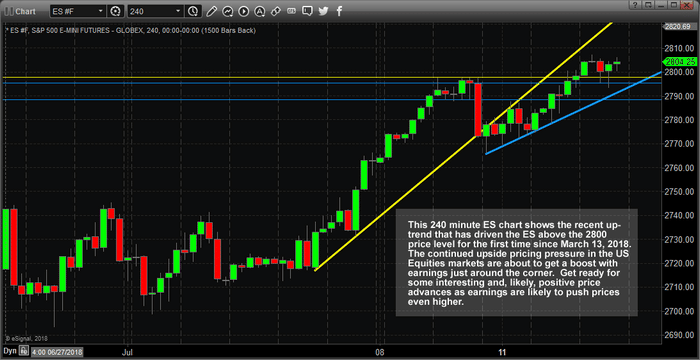
This 240 Minute ES chart shows the recent upside price action as well as the recent breakout to new highs (above 2800 for the first time since March 2018). These upside price channels are likely to hold going forward and we expect earnings to drive prices to near or above 2900 (new all-timehighs) relatively quickly in the ES. As we have been highlighting, we believe the ES and YM have the strongest potential for upside price moves compared to the NQ.
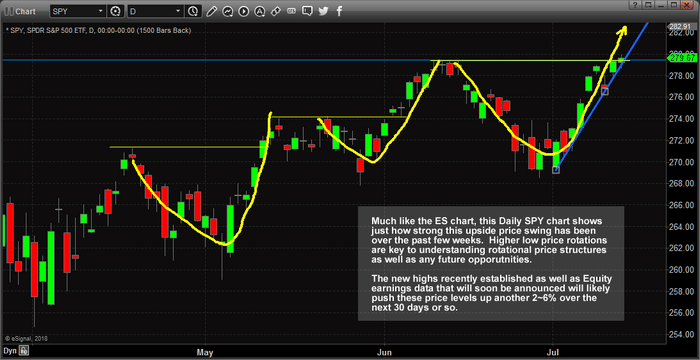
This Daily SPY chart clearly shows the rotational lows followed by upside price advances that are indicative of the recent price swings. These deep rotational lows continue to setup “higher low” price levels that allow technicians to understand price pivot formations. Each of these rotations sets up an opportunity for skilled traders to jump into the next upside move for profits. The recent breakout of new highs indicates we could be in for a dramatic move to well above $290 throughout the earnings season.
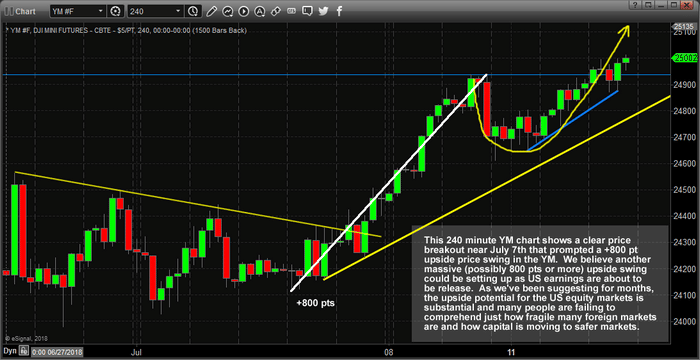
Lastly, this 240 Minute YM chart helps to illustrate the upside potential of the DOW & Transports Index. The last upside swing in price from July 7th till July 11th totaled about 800 points. If that move replicates with this new upside swing, we could see another +800 point move higher from recent lows near 24,500. This would indicate an upside potential to near 25,300 or higher.
Make sure you are positioned for these moves through this next earnings season. If our estimates are correct, we should see some fantastic trading opportunities over the next 30+ days. Visit www.TheTechnicalTraders.com to learn how we can assist you in capturing greater profits and greater success with our advanced research and market reporting, Daily market videos, detailed trading signals and more. Join the hundreds of other traders that follow our research every day to create greater successes.
Also, visit www.TheTechnicalTraders.com/FreeMarketResearch to read all of our most recent free research posts. We believe you’ll quickly see the value in what we provide our members and our visitors by reading and understanding how we have continued to stay ahead of these market moves for months.