Author Archive for InvestMacro – Page 393

Trader Case Study: What Happens When You Use Corporate Earnings to Pick Trades

See which data set helped traders stay in front of REGN’s late 2017-early 2018 crash

By Elliott Wave International

According to a June 26 Fortune Magazine article, New York-based bio tech company Regeneron Pharmaceuticals is one of the “100 Best Places for Millennials to Work” in the world. Shares one of Regeneron’s employees:

“The thing I love about working at Regeneron is that when they say data is king, they mean it. Our work and projects are always changing based on what the data shows us.”

We hear the same expression bandied about Wall Street; data is king to determining a market’s price trend, with the long-reigning monarch of that data being earnings reports.

All hail earnings reports? Not so fast!

Our very own senior analyst and long-reigning Trader’s Classroom instructor Jeffrey Kennedy admits to the “seductive nature” of earnings data, tempting investors into a false sense of confidence regarding future price action. But there’s a danger in such logic, as Jeffrey explains:

“My own experience trading earnings reports has been hit or miss. At the very least, it’s been frustrating because there have been times when the earnings report will be positive, and the stock price will decline — or vice a versa.”


Get immediate access to Jeffrey Kennedy’s free 20-minute video, “4 Keys to Crafting Rock-Solid Trades.” In this video, Jeffrey reveals his time-proven tricks to ID top trade set-ups in the markets you follow. Learn more now.


You’ve seen this happen too, I’m sure. So, why does it happen?

Because it’s not the hard data inside the earnings report that drives prices. It’s how the market participants interpret that data. And their interpretation depends on the current trend in market psychology. But hold on, let’s let Jeffrey explain more.

Over the course of his career as a technical market analyst and trading instructor, Jeffrey has relied on another form of data to determine the most “watch-worthy” issues: Elliott wave analysis. For Jeffrey, there are three main requirements for a high-confidence trade set-up:

  • A Clear Trend: Jeffrey explains: “The first thing I want to identify on a market’s price chart is the trend.” Higher highs and higher lows indicate an uptrend, whereas lower highs and lower lows suggest a downtrend at play.
  • A Recognizable Wave Pattern: Jeffrey is emphatic: “If you can’t count [the Elliott wave subdivisions inside a price move], don’t trade it.” He sticks to the five core Elliott wave patterns: impulse wave, ending diagonal, zigzag, flat, and triangle.
  • A Clue to Price Personality: Slow and choppy price action contained within parallel lines indicates countertrend action — i.e., a correction. Conversely, when prices move far and fast, and especially if you see a price gap on the chart, this indicates the so-called impulse waves — i.e., the direction of the larger trend.

Now let’s see how Jeffrey uses this Elliott wave data to interpret real-world price charts. One market that’s fresh on the brain is Regeneron Pharmaceuticals (NASDAQ: REGN).

Our first mention of REGN comes from Jeffrey’s October 19, 2017 Trader’s Classroom video lesson. See why Elliott waves called for REGN to step off a sharp bearish cliff to new lows. Simply press “play” and enjoy:

Here’s a close-up of Jeffrey’s chart of REGN along with a recap of his overall forecast:

“The weight of evidence… would argue for a move to the downside.”

7618REGN1

The next chart shows you how closely REGN’s prices followed Jeffrey’s October 19 Trader’s Classroom Elliott wave script: They collapsed 35% to a four-year low.

And yes – prices fell DESPITE one of the most glowing earnings reports in the biotech company’s history.

You read that right! On November 8, 2017, Regeneron published its Q3 2017 earnings, which showed “street-topping revenue” that “crushed” expectations with a 27.5% increase in adjusted income per share and a 23% increase in sales versus year ago period. (Investor’s Business Journal)

7818REGNafter

The failure of a positive earnings report to stem the market’s decline and fuel a rally is exactly the “hit or miss” nature of the earnings beast Jeffrey spoke about.

By contrast, Elliott wave analysis steered a clear, objective course that proved invaluable to traders and investors.

And while Elliott wave data enabled Jeffrey to anticipate the larger trend unfolding on Regeneron’s weekly price chart, it also facilitated a strong assessment of the market’s near-term prospects in his more recent, June 26, 2018 Trader’s Classroom video lesson.

There, Jeffrey “moved down to a smaller, 60-minute time frame to examine the smaller Elliott wave substructure.” The chart, pictured below showed that a large move up was on tap.

7618REGN2

And here’s what happened next:

7618REGN3

In the same June 26 Trader’s Classroom video lesson, Jeffrey also revisits REGN’s larger trend, to answer the question:

“Is there sufficient evidence in place that the selloff from the 2017 high is complete?”

In the video, Jeffrey examines the data at hand and comes up with a strong case for one kind of move in the weeks and months ahead.

While not every Elliott wave forecast works out, the value of Elliott wave analysis is clear from this real-world example — and from every Trader’s Classroom lesson Jeffrey records for his subscribers.


Get immediate access to Jeffrey Kennedy’s free 20-minute video, “4 Keys to Crafting Rock-Solid Trades.” In this video, Jeffrey reveals his time-proven tricks to ID top trade set-ups in the markets you follow. Learn more now.

This article was syndicated by Elliott Wave International and was originally published under the headline Trader Case Study: What Happens When You Use Corporate Earnings to Pick Trades. EWI is the world’s largest market forecasting firm. Its staff of full-time analysts led by Chartered Market Technician Robert Prechter provides 24-hour-a-day market analysis to institutional and private investors around the world.

COT Report: USD, Gold & SP500 Mini bets rise. 10-Yr & Bitcoin bearish bets decline

By CountingPips.com – Receive our weekly COT Reports by Email

Here is a short summary and this week’s links (below) to the latest Commitment of Traders changes that was released on Friday.


Currency Speculators sharply cut Euro & Pound bets, raised Peso, Franc & USD Index bets

US Dollar net speculator positions leveled at $16.41 billion as of Tuesday

The latest data for the weekly Commitment of Traders (COT) report, released by the Commodity Futures Trading Commission (CFTC) on Friday, showed that large traders and currency speculators increased their bets for the US dollar this week. See full article


WTI Crude Oil Speculators edged their bullish bets lower after 2 strong weeks

The non-commercial contracts of WTI crude futures totaled a net position of 654,465 contracts, according to data from this week. This was a slide of -2,255 contracts from the previous weekly total. See full article


Gold Speculators increased bullish net positions for 2nd week

The large speculator contracts of gold futures totaled a net position of 81,434 contracts. This was a weekly advance of 3,107 contracts from the previous week. See full article


10-Year Note Speculators pared their bearish bets from record position

The large speculator contracts of 10-year treasury note futures totaled a net position of -439,148 contracts. This was a weekly increase of 60,928 contracts from the previous week. See full article


Silver Speculators dropped their bullish bets for 4th week

The non-commercial contracts of silver futures totaled a net position of 23,699 contracts, according to data from this week. This was a weekly fall of -983 contracts from the previous totals. See full article


Copper Speculators continued to reduce their bullish bets again this week

The large speculator contracts of copper futures totaled a net position of 14,183 contracts. This was a weekly shortfall of -11,322 contracts from the data of the previous week. See full article


Article By CountingPips.com – Receive our weekly COT Reports by Email

The Commitment of Traders report data is published in raw form every Friday by the Commodity Futures Trading Commission (CFTC) and shows the futures positions of market participants as of the previous Tuesday (data is reported 3 days behind).

To learn more about this data please visit the CFTC website at http://www.cftc.gov/MarketReports/CommitmentsofTraders/index.htm

Currency Speculators sharply cut Euro & Pound bets, raised Peso, Franc & USD Index bets

By CountingPips.comGet our weekly COT Reports by Email

Speculators positions rose to $16.41 billion this week

The latest data for the weekly Commitment of Traders (COT) report, released by the Commodity Futures Trading Commission (CFTC) on Friday, showed that large traders and currency speculators boosted their bets again for the Mexican Peso this week while also adding to US dollar index and Swiss franc positions. Speculators also cut back sharply on the European common currency as well as the British pound sterling.

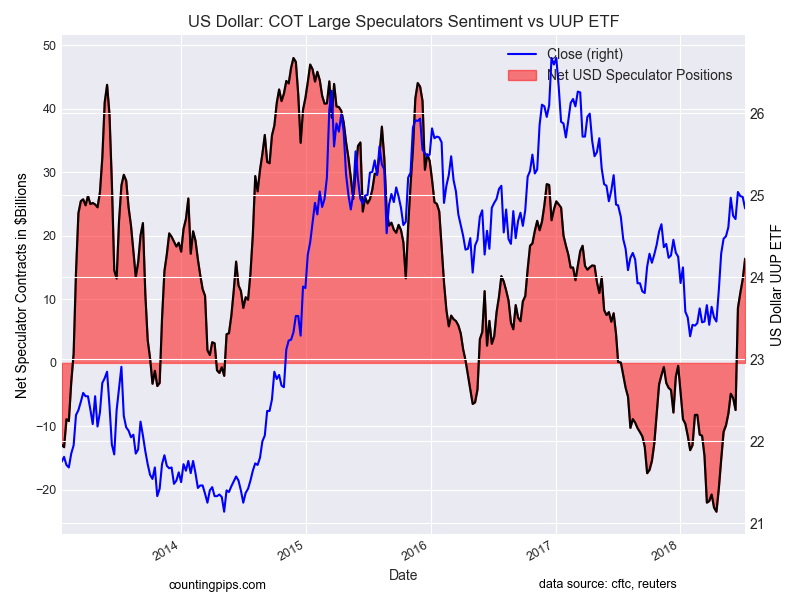
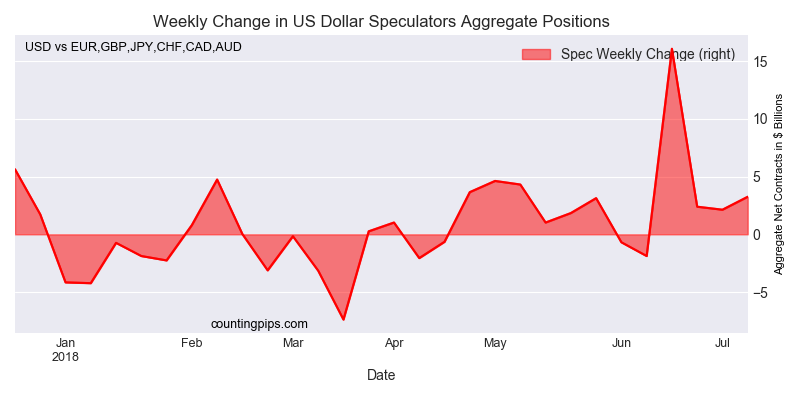
The broad aggregate dollar position, published by Reuters (chart above), showed that non-commercial large futures traders, including hedge funds and large speculators, had an overall US dollar net position totaling $16.41 billion as of Tuesday July 10th, according to the latest data from the CFTC and dollar amount calculations by Reuters. This was a weekly rise of $3.25 billion from the $13.16 billion total position that was registered the previous week, according to the Reuters calculation (totals of the US dollar contracts against the combined contracts of the euro, British pound, Japanese yen, Australian dollar, Canadian dollar and the Swiss franc).

This aggregate measure of the dollar position is at the highest level now since March 21st of 2017 when the bullish position totaled $18.44 billion.

Individual Currency Contract Data this week

For individual currency contracts this week, the non-commercial large futures traders, including hedge funds and large speculators, bet in favor of the the Mexican peso (22,217 weekly change in contracts), Swiss franc (373 contracts) and the US dollar index (13 contracts), according to the data reported through Tuesday July 10th.

On the flip side, the currencies whose speculative bets declined on the week were the euro (-12,390 weekly change in contracts), British pound sterling (-11,622 contracts), Japanese yen (-1,102 contracts), Canadian dollar (-3,439 contracts), Australian dollar (-1,743 contracts) and the New Zealand dollar (-170 contracts).

See more individual currency contract information and charts below.

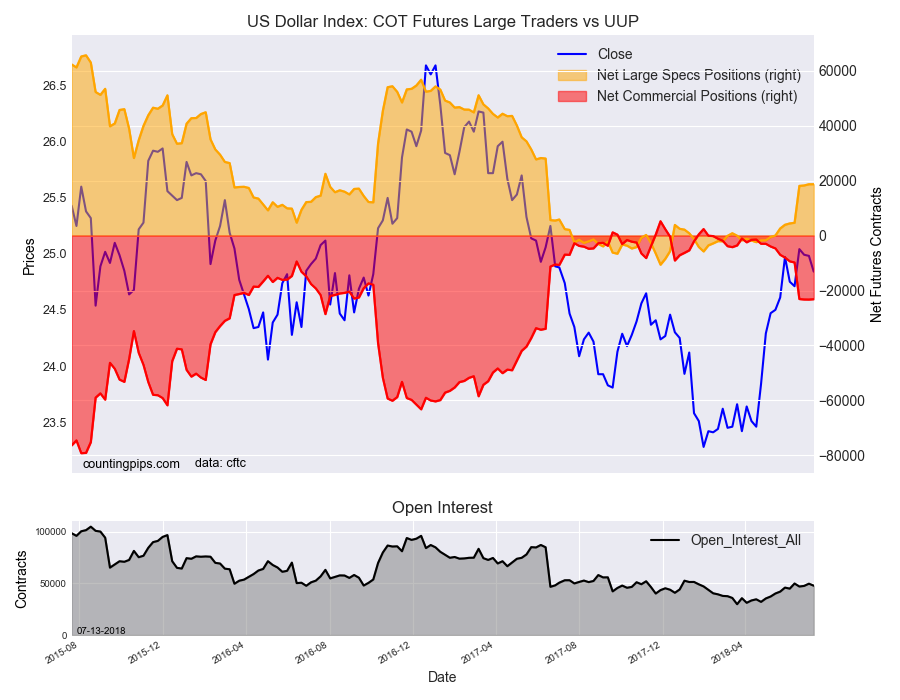
US Dollar Index positions keep improving

Speculators continued to raise bets for the US dollar index this week (although very slightly by just 13 contracts) to a total a net position of 18,685 contracts. The spec position has now improved for twelve consecutive weeks and to a new highest bullish level since June 13th 2017 when the net positions totaled 28,025 contracts.


Table of Weekly Commercial Traders and Speculators Levels & Changes:

CurrencyNet CommercialsComms Weekly ChgNet SpeculatorsSpecs Weekly Chg
EuroFx-29,78018,15924,357-12,390
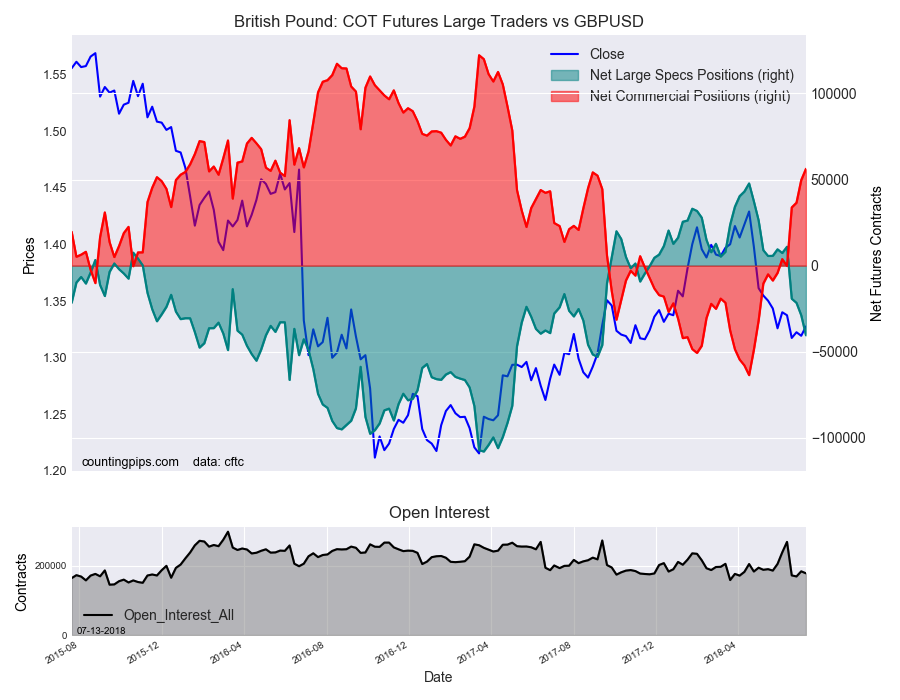
GBP56,1976,565-40,403-11,622
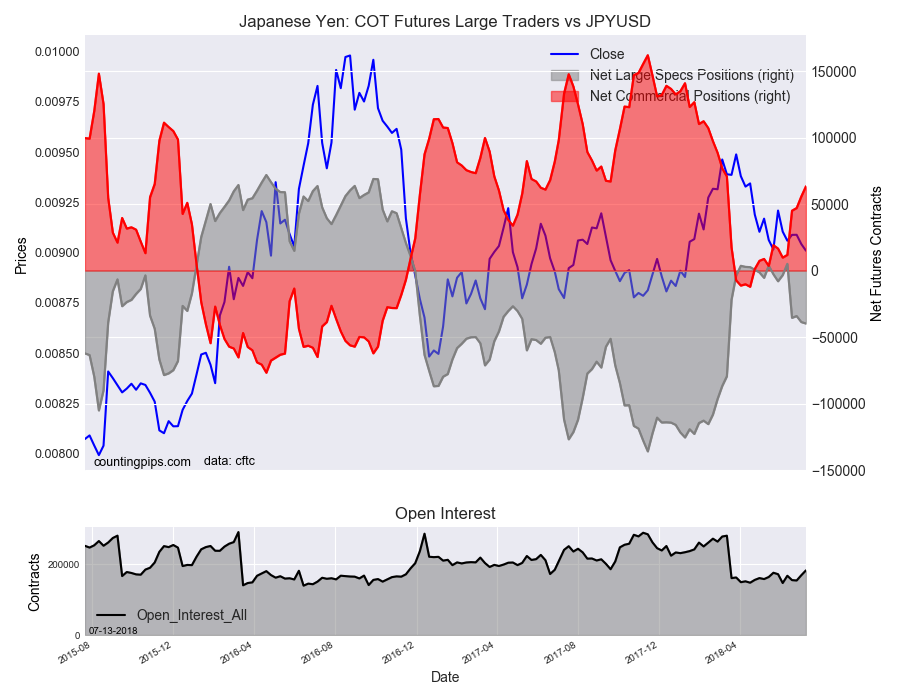
JPY63,3547,655-39,832-1,102
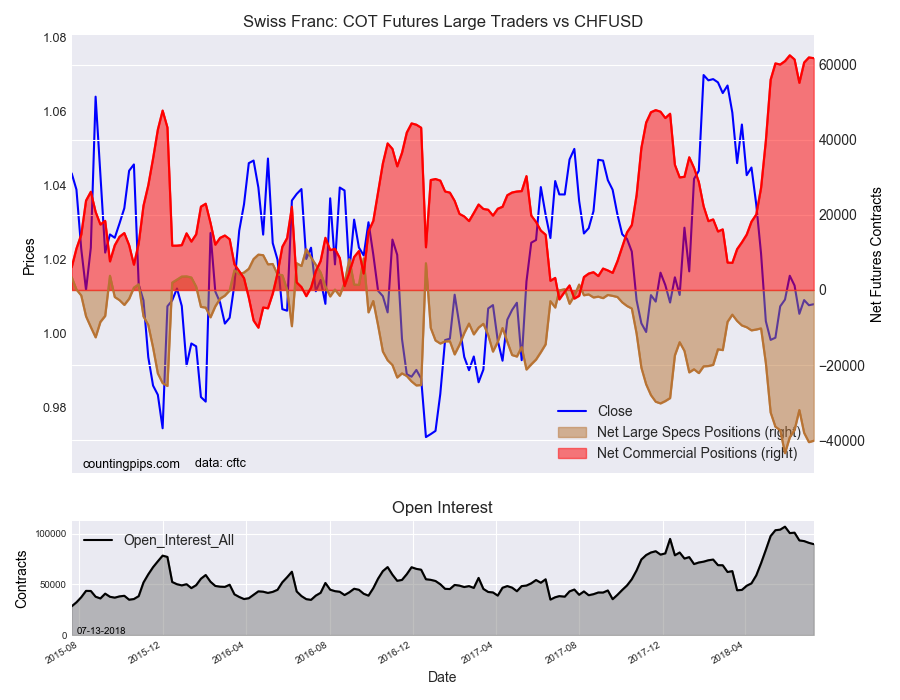
CHF61,688-203-40,121373
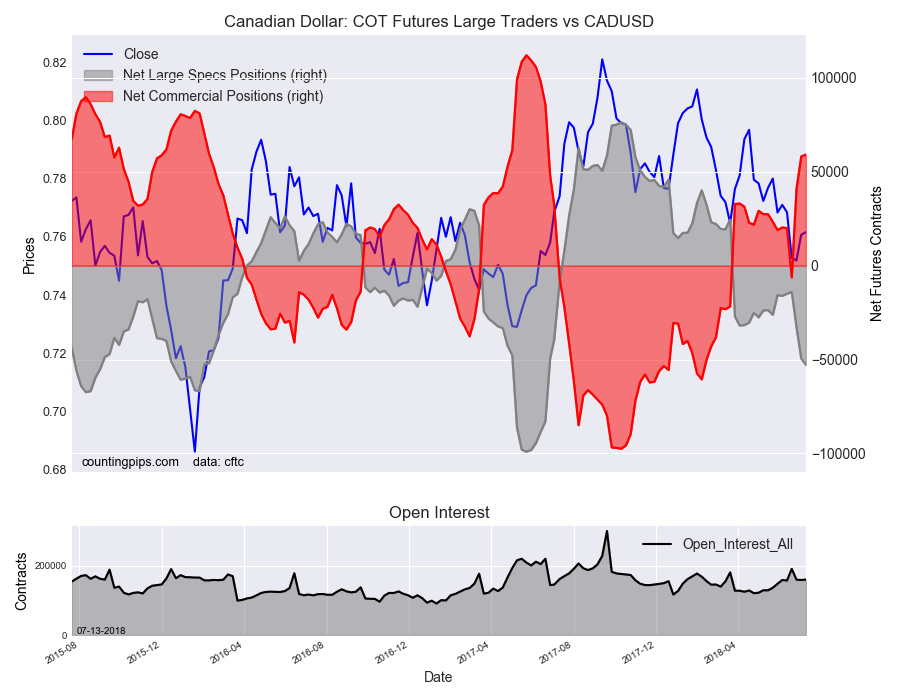
CAD59,1951,044-52,887-3,439
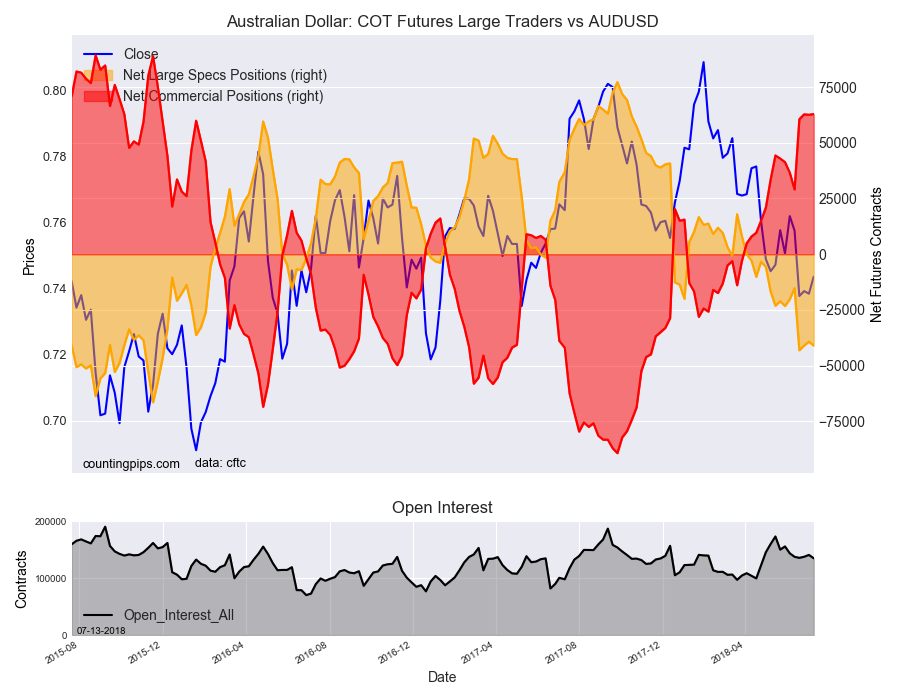
AUD62,880334-40,973-1,743
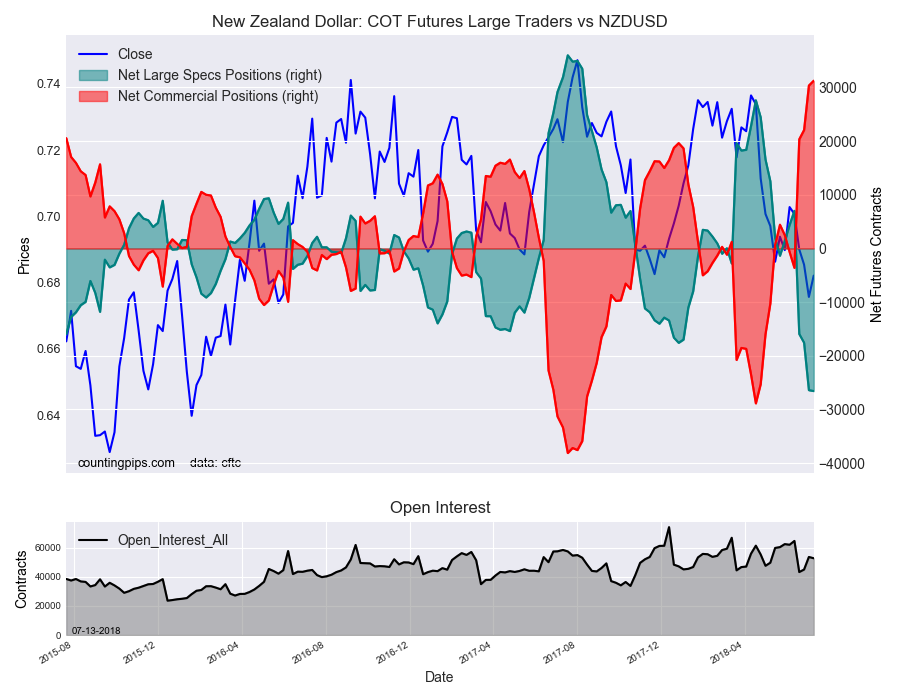
NZD31,242900-26,574-170
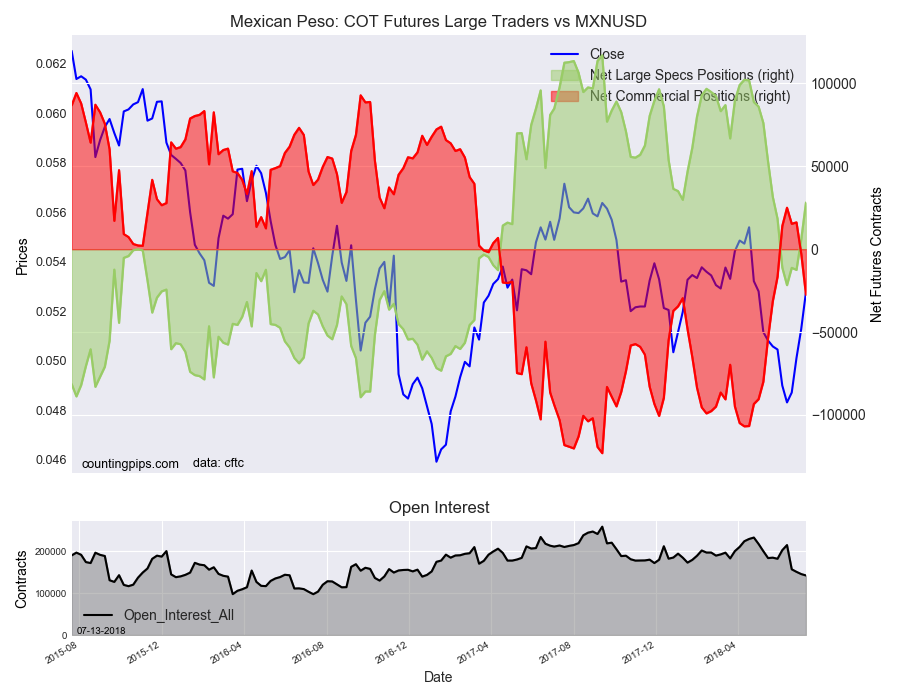
MXN-27,459-24,72928,13222,217


This latest COT data is through Tuesday and shows a quick view of how large speculators or non-commercials (for-profit traders) as well as the commercial traders (hedgers & traders for business purposes) were positioned in the futures markets. All currency positions are in direct relation to the US dollar where, for example, a bet for the euro is a bet that the euro will rise versus the dollar while a bet against the euro will be a bet that the dollar will gain versus the euro.


Weekly Charts: Large Trader Weekly Positions vs Price

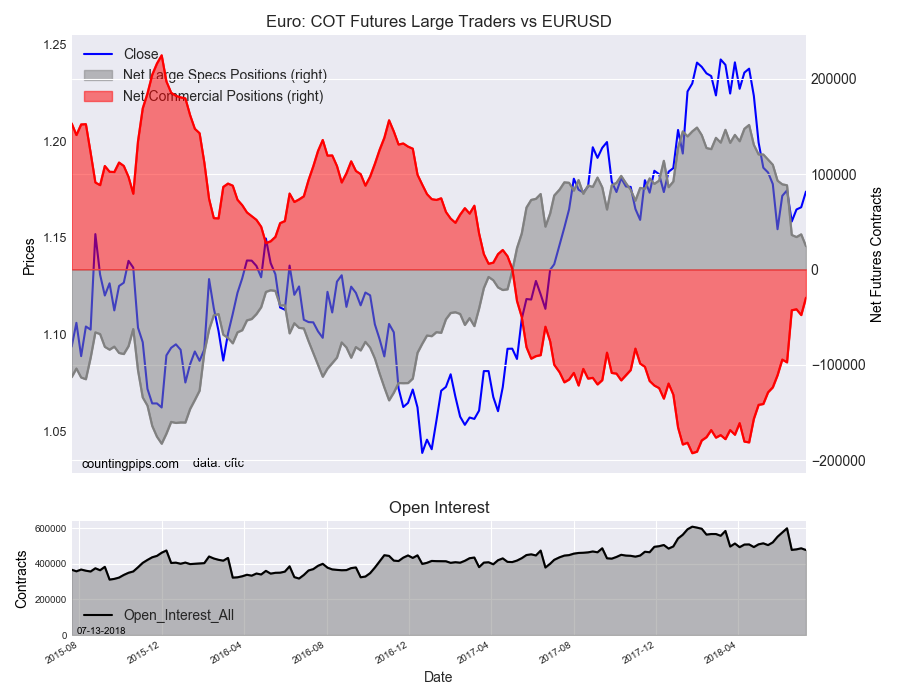
EuroFX:

Euro positions dropped sharply this week by over -12,000 contracts. The euro speculator sentiment has been basically in free fall and has fallen for nine out of the past ten weeks after making a record high above +150,000 contracts in April.


British Pound Sterling:

British pound sterling positions dropped sharply this week by over -10,000 contracts. The GBP has fallen for four weeks in a row to the most bearish level since September of 2017.


Japanese Yen:

Japanese yen positions dipped for a second week this week and for the third week out of the past four. The overall position level is now the most bearish since March 13th.


Swiss Franc:

Swiss franc positions rose this week after two down weeks. The overall net position remains bearish above -40,000 net contracts for a second straight week. The franc position has been bearish for 49 straight weeks now dating back to August 2017.


Canadian Dollar:

Canadian dollar positions dropped for a third straight week this week. The overall net position has now been bearish for sixteen straight weeks and is at the most bearish standing since June 20th 2017.


Australian Dollar:

Australian dollar bets fell this week after two up weeks. The overall net position now remains in a bearish position for a fifteenth straight week.


New Zealand Dollar:

New Zealand dollar bets declined this week for the fourth consecutive week and for the seventh time out of the past ten weeks. The overall net position has now been bearish for four weeks in a row and is in the largest bearish position dating back to 1999, according to our records.


Mexican Peso:

Mexican peso bets jumped again this week by over +22,000 contracts following last week’s +18,425 contract gain. The overall position is back into bullish territory for a second week.


*COT Report: The weekly commitment of traders report summarizes the total trader positions for open contracts in the futures trading markets. The CFTC categorizes trader positions according to commercial hedgers (traders who use futures contracts for hedging as part of the business), non-commercials (large traders who speculate to realize trading profits) and nonreportable traders (usually small traders/speculators). Find CFTC criteria here: (http://www.cftc.gov/MarketReports/CommitmentsofTraders/ExplanatoryNotes/index.htm).

The Commitment of Traders report is published every Friday by the Commodity Futures Trading Commission (CFTC) and shows futures positions data that was reported as of the previous Tuesday (3 days behind).

Each currency contract is a quote for that currency directly against the U.S. dollar, a net short amount of contracts means that more speculators are betting that currency to fall against the dollar and a net long position expect that currency to rise versus the dollar.

(The charts overlay the forex closing price of each Tuesday when COT trader positions are reported for each corresponding spot currency pair.) See more information and explanation on the weekly COT report from the CFTC website.

Article by CountingPips.com


Fibonacci Retracements Analysis 13.07.2018 (BITCOIN, ETHEREUM)

Article By RoboForex.com

BTCUSD, “Bitcoin vs US Dollar”

As we can see in the H4 chart, BTCUSD has already been corrected to the upside by 23.6%. The next possible targets of this ascending correction are the retracements of 38.2% and 50.0% at 7350.00 and 7850.00 respectively. The support level is the low at 5750.00.

BTCUSD1
Risk Warning: the result of previous trading operations do not guarantee the same results in the future

In the H1 chart, the divergence made the pair reverse and formed a new descending correction that completed at the retracement of 61.8%. Later, the instrument stared another correction to the upside, which has already reached the retracement of 23.6%. The next possible targets are the retracements of 38.2% and 50.0% at 6350.00 and 6437.00 respectively.

BTCUSD2
Risk Warning: the result of previous trading operations do not guarantee the same results in the future


ETHUSD, “Ethereum vs. US Dollar”

As we can see in the H4 chart, ETHUSD is being corrected upwards and has already reached the retracement of 38.2%. The next upside targets are the retracements of 50.0% and 61.8% at 516.00 and 543.00 respectively. However, if the instrument breaks the low at 404.21, it may continue falling towards the post-correctional extension area between the retracements of 138.2% and 161.8% at 372.00 and 353.00 respectively.

ETHUSD1
Risk Warning: the result of previous trading operations do not guarantee the same results in the future

In the H1 chart, the convergence made ETHUSD reverse and start a new correction upwards, which has already reached the retracement of 23.6% and may continue towards the retracements of 38.2%, 50.0%, and 61.8% at 446.50, 455.70, and 464.70 respectively.

ETHUSD2
Risk Warning: the result of previous trading operations do not guarantee the same results in the future

Article By RoboForex.com

Attention!
Forecasts presented in this section only reflect the author’s private opinion and should not be considered as guidance for trading. RoboForex LP bears no responsibility for trading results based on trading recommendations described in these analytical reviews.

How International Observers Undervalue the Chinese Bond Market

By Dan Steinbock

Criticism is typical of vibrant international media. Yet, prejudiced biases in financial matters have the potential to harm investors worldwide. The Chinese bond market is a case in point.

Not only is China’s bond market growing explosively, but it has become diversified and provides broad investment options to both Chinese and foreign investors.

However, should you believe the hype, China’s bond era is about to “go through a rough patch” (CNBC), will be “tested by rising defaults” (Bloomberg) and may have “more defaults” in the future (Wall Street Journal). While China bulls might accuse such coverage of being excessive “glass is half empty” reporting, a more substantial problem haunts these briefings.

Essentially, such reports tend to assess the financial future of large emerging economies, which have relatively high growth rates but low living standards, with the same benchmarks as major advanced economies, which are amid secular stagnation but have high living standards.

As a result, such reports systematically undervalue financial futures in emerging economies, while overvaluing those in advanced economies. That’s misleading to investors at a historical moment of transition when financial might is following economic power toward emerging economies.

Low foreign participation as an investment opportunity

Rather than a great one-time opportunity for foreign investors, the low share of these investors in China’s bond market is often portrayed as a major liability. This is then explained by a higher number of corporate bond defaults, a weaker yuan versus the U.S. dollar or technical issues with the bond program that hinder foreign participation.

Here are the realities: not only is China the world’s second largest economy today, but China also has the world’s third-largest bond market, which was valued at about $12 trillion in year-end 2017. Currently, foreign investors own only 1.6% of the total market. That is not a problem, but an investment opportunity, however.

Here’s why: Since the early 1990s, the Chinese bond market has achieved an annualized average growth rate of almost 40%. Just as Chinese industrialization took off in the late 20th century and accelerated in the early 21st century, China’s financial sector is following in these footprints, but with a time lag.

In the West, that may seem like a delay, but let’s put this in context. In the U.S., the Treasury bond market was created as part of the funding plans for World War I. In other words, it took almost 140 years of independence to create the first bond markets in America. In China, the bond market was created in the early ‘90s; barely 40 years after China’s independence – that is, more than three times faster than in the U.S.

It is the historical pace and structural importance of the Chinese bond market to ordinary Chinese and Beijing’s central government that should make it attractive to international investors as well. Here’s why: After four decades of the most rapid catch-up in world history, Chinese per capita incomes, adjusted to purchasing power, are today on average about $18,100; or 30% of those in the U.S. In America, multiple generations have contributed to the bond market; in China, barely one.

Due to the lower prosperity levels of individual Chinese and Beijing’s national growth plan, the Chinese bond market is a priority for the well-being of Chinese families and for Beijing’s economic welfare plans – a priority that now can benefit foreign investors as well.

China’s impending financial expansion

In the past four decades, China’s economy has grown almost six-fold to more than 12% of the global economy. In the future, that share will continue to expand, as evidenced by the Chinese contribution to global growth, which has been around 30% since the 2008 global crisis. This is about 2.5 times more than its current share of the global GDP.

Relative to its rising economic importance, China’s role in the global financial market was limited until the early 2000s. Financial reforms started with pilot programs a decade ago and have dramatically accelerated, along with the internationalization of the renminbi. At the same time, sovereign paper, which dominated the bond market until the late 2000s, has been augmented by corporate bond issuance, particularly after the global crisis.

Not only is China’s bond market growing explosively, but it has become diversified, which provides broad investment options to both Chinese and foreign investors. Today, it comprises an expansive mix of sovereign, quasi-sovereign (policy banks), sub-government (municipal and state-owned enterprises, SOEs) and corporate bonds.

The rapid growth of the Chinese bond market is not likely to be exhausted any time soon. By 2020, China is likely to catch up with Japan as the second-largest bond market in the world. But the Chinese bond market has much more space to grow: relative to the $12 trillion economy, the bond market is less than 100% of China’s GDP. This ratio is far smaller than those in major economies. In the U.S., that ratio is closer to 200%. Moreover, China’s population base is more than four times larger than that of the U.S.

Caveats less valid today

Media caveats about China’s bond market focus largely on short-term forces and thus tends to neglect the long-term opportunities, while reflecting dated realities.

After fast appreciation earlier in the decade, a mix of RMB depreciation and rising onshore interest rates did alienate international interest in China bonds, especially after the 2015 correction. However, the fundamentals have changed.

First of all, the RMB trends have largely reversed and stabilized. Second, onshore interest rates are likely to remain around 3.5 – 4% in 2018. Third, the medium-term outlook of the RMB relies in part on China’s impending financial reforms, which are seen as critical to government policies, the middle class and to combat aging demographics. Fourth, the international landscape is signaling constraints of financial developments in advanced economies, due to secular stagnation, aging demographics, lingering growth and productivity. Fifth, trade wars may penalize global growth prospects but are also likely to speed up Chinese financial reforms, which will ensure easier access to the Chinese market for foreign investors.

Finally, while cases of defaults and downgrades in the Chinese bond market have increased in recent years, these have remained under the control of the government, particularly regarding the state-owned enterprises (SOE) and local government subsidiaries (e.g. local government financing vehicles, LGFVs) – which only a decade ago were often portrayed as fatal to China’s economy by a slate of “China crash” theorists.

The Chinese government may even have used some defaults as “demonstration effects” to signal the need for greater budget and market discipline, while the campaign against corruption has enhanced regulators’ grip over potential credit events in the future.

As the gap between media perceptions and investor realities has broadened, many investors have opted to ignore media reports that downplay opportunities, as evidenced by June data suggesting that overseas investors are pouring funds into China’s domestic bonds at record pace, despite what media portray as the “yuan’s jitters.”

Chinese bond market’s international takeoff

The future of Chinese bond market expansion is likely to mimic that of China’s role in the IMF’s reserve currency basket (SDR), which is today 11%. That’s less than that of the U.S. dollar (42%) and the Euro (31%), but more than the Japanese yen (8%) and the UK pound (8%).

For all practical purposes, the Chinese bond market is likely to emulate the SDR allocations, which would imply that foreign participation has the potential to grow at least six-fold. Unsurprisingly, central banks and sovereign-wealth funds were the first to participate in RMB following its inclusion in the IMF’s SDR basket.

In contrast, private-sector investors – pension funds, insurance companies and asset managers – remain largely underrepresented. Yet, in the past few years, the likelihood of their entry has been boosted by a number of highly-regarded global index operators that have incorporated Chinese assets into their index space, including the IMF (SDR for global reserve currencies), MSCI (global equities) and Bloomberg-Barclays (BBGAI for global bonds).

It is the critical moments of historical transition— such as the coming explosion of the Chinese bond market as a part of the global bond market— that highlight the importance of unbiased financial observers, investment analysts and the international media.

Unfortunately, it is also such historical moments that are increasingly exploited by those Western geopolitical interests that try to sustain entrenched interests that may no longer be warranted. Such efforts seek to downplay and subdue dramatic changes in the international economic and financial landscape – but at the expense of retail investors, and even institutions, in the major advanced economies, particularly the United States.

About the Author:

Dan Steinbock is the founder of Difference Group and has served as research director of international business at the India, China and America Institute (US) and a visiting fellow at the Shanghai Institute for International Studies (China) and the EU Center (Singapore). For more, see http://www.differencegroup.net/ 

The original commentary was released by China-US Focus on July 12, 2018.


Forex Technical Analysis & Forecast 13.07.2018 (EURUSD, GBPUSD, USDCHF, USDJPY, AUDUSD, USDRUB, GOLD, BRENT)

Article By RoboForex.com

EURUSD, “Euro vs US Dollar”

EURUSD is consolidating near the lows. If later the instrument breaks this range to the downside, the price may continue trading downwards to reach 1.1550; if to the upside – form a new ascending structure with the target at 1.1725.

EURUSD
Risk Warning: the result of previous trading operations do not guarantee the same results in the future


GBPUSD, “Great Britain Pound vs US Dollar”

GBPUSD continues falling. Possibly, the pair may reach 1.3140 and then form another ascending structure towards 1.3375 to continue the correction (an alternative scenario). According to the main scenario, the instrument may continue trading downwards with the target at 1.3000.

GBPUSD
Risk Warning: the result of previous trading operations do not guarantee the same results in the future


USDCHF, “US Dollar vs Swiss Franc”

USDCHF has broken 0.9985. Possibly, today the pair may fall to return to this level and then continue growing to reach the short-term target at 1.0067.

USDCHF
Risk Warning: the result of previous trading operations do not guarantee the same results in the future


USDJPY, “US Dollar vs Japanese Yen”

USDJPY has almost competed one more ascending structure. Today, the price may consolidate near the highs, break the range downwards, and start another descending wave to reach the first target at 110.05.

USDJPY
Risk Warning: the result of previous trading operations do not guarantee the same results in the future


AUDUSD, “Australian Dollar vs US Dollar”

AUDUSD is moving upwards to reach 0.7430. After that, the instrument may form another descending structure towards 0.7348 and then start another growth to reach 0.7520. Later, the market may resume trading to the downside with the target at 0.7285.

AUDUSD
Risk Warning: the result of previous trading operations do not guarantee the same results in the future


USDRUB, “US Dollar vs Russian Ruble”

USDRUB is still consolidating around 62.00. Today, the price may form a new ascending structure towards 62.50 and then fall to return to 61.50. After that, the instrument may breaks this range downwards and continue trading to the downside with the short-term target at 60.60.

USDRUB
Risk Warning: the result of previous trading operations do not guarantee the same results in the future


XAUUSD, “Gold vs US Dollar”

Gold is consolidating near the lows. Possibly, today the pair may grow towards 1251.00 and then return to the downside border. If later the instrument breaks this range to the upside, the price may continue trading upwards to reach 1270.00; if to the downside – continue falling towards 1234.00.

GOLD
Risk Warning: the result of previous trading operations do not guarantee the same results in the future


BRENT

Brent has reached the main downside target. Possibly, today the pair may grow to break 75.15 and then continue trading to the upside to return to 76.30.

BRENT
Risk Warning: the result of previous trading operations do not guarantee the same results in the future

Article By RoboForex.com

Attention!
Forecasts presented in this section only reflect the author’s private opinion and should not be considered as guidance for trading. RoboForex LP bears no responsibility for trading results based on trading recommendations described in these analytical reviews.

Nice acquires FIBARO, one of the major player in the Smart Home, consolidating its global leadership position in the Home Automation and Home Security sector

The Italian company continues along its path of international expansion and, thanks to an even broader and innovative offer, is ready to seize  the opportunities of a segment with a high growth potential such as the “Smart Home”

Oderzo (Treviso – Italy), July 13th, 2018 – Nice S.p.A., the Italian international reference firm in Home Automation and Home Security, expands in the Smart Home sector and acquires FIBARO, a leading brand in the sector, which offers a true wireless, modular ecosystem for a connected, controlled and customized home suited to the user’s specific needs.

Founded in 2010 with headquarters in Poznan, Poland, in just a few years FIBARO has established itself on 6 continents and in over 100 countries as one of the most advanced wireless systems for the Smart Home, designing and producing devices with Z-Wave and HomeKit protocols in its facilities and research centers, with a view to utmost simplicity in installation, plug & play, the possibility of remote access and compatibility with third-party systems such as Apple HomeKit®, Z-Wave, Google Assistant®, Amazon Alexa® and Apple’s Siri®.

FIBARO’s competences will expand Nice offer in the area of home automation systems, to turn the vision of a completely connected home into reality, everywhere in the world. This will be possible thanks to the complementary offers of the two companies, which have in common the international strategy, the Design Thinking approach, the constant push towards technological innovation and, most importantly, the willingness of putting people at the center stage, developing solutions that are easy to implement and use.

FIBARO offers a complete range of integrated Smart Home products: from its “Home Center” gateways, which are the heart of the home and building management system, to the most advanced design awarded multifunction sensors, which monitor the indoor environment for factors such as flooding, fumes and presence of CO, including sensors that detect whether doors and windows are open, acoustic alarms and cameras. It also offers innovative heat controllers that optimize the temperature of the house and allow significant energy savings.

FIBARO apps simplify remote control of the systems, such as home alarms, automation and sensor control.

The applications for smartphones and tablets are extraordinarily easy and intuitive, and are available from the App Store, Google Play and the web. Moreover, it is possible to control FIBARO devices by voice control, choosing among several virtual assistants, such as Google Assistant®, Amazon Alexa® and Apple’sSiri® which respond to voice commands and the user’s questions, enabling the management of lights, automation, cameras, heat controllers, sensors and scenarios in the home.

FIBARO sensors are adaptable and can be connected to smart systems and products of the most famous international brands, such as Abode, Sonos, Philips, D-Link, iRobot, making the home more comfortable, safe and eco-friendly. Access to the home and data are always protected by the most advanced encryption systems.

We are pleased to announce this important new deal for the Group”, commented Lauro Buoro, founder and Chairman of Nice S.p.A.. “It allows us to accelerate our growth by offering a portfolio of the most complete products in the Home Automation and Home Security sector, thus strengthening our position of leadership in world markets, characterized by the growing demand for connected solutions to allow consumers to have their own most innovative Smart Home. Nice and Fibaro are united by a drive for innovation and digitalization, as well as by a shared mission: to simplify the daily lives of people by offering an extraordinary, simple, friendly and secure user experience, in a domestic space for maximum comfort. Twenty-five years from the founding of Nice, we want to be the reference point in offering cutting-edge solutions on a global scale in the Home Automation, Home Security and Smart Home sectors”.


Maciej Fiedler
, CEO and Founder of Fibar Group S.A., commented: “We are happy to join a solid and successful company like Nice, in strong expansion in the international market. This will allow to reinforce our position through technological and commercial synergies. We believe that simplicity is the way to go: eight years ago, I made the decision to build a truly intuitive and functional system, for a welcoming home that is always by your side, wherever you go, thanks to the applications for smartphones, tablets and PCs to have constant information about and control over what is happening at home”.

On the basis of the agreements reached, Nice S.p.A. acquires the entire share capital of Fibar Group S.A., indirectly acquiring its subsidiaries as well.

The operation resulted in the payment, today, of consideration of Euro 63 million, partly financed through equity and lines of credit already available to Nice S.p.A. Furthermore, the sellers may receive additional consideration through an earn-out mechanism linked to the performance of Fibar Group S.A. in the years 2019, 2020 and 2021.

In 2017, Fibar Group S.A. generated revenues of around 114 million Polish zloty.

The Nice Group, which has production and distribution facilities and research and development centers in more than 20 different countries, with a headcount in 2017 of more than 1,500, 2017 consolidated turnover of Euro 325 million and adjusted EBITDA1 of Euro 52.4 million, helps spread awareness of Italian excellence in more than 100 countries worldwide, which have chosen high quality home automation solutions that masterfully combine technology, design, innovation and ease of use. Nice has also recently acquired Abode Systems, Inc., an American company specialized in offering smart solutions for home security and integrated Home Automation.

Nice S.p.A. was assisted with closing by Banca IMI (Gruppo Intesa Sanpaolo) for the financial aspects and by an Italian and Polish team from the Clifford Chance law firm for all legal aspects. The acquisition is considered as “non-significant” under the terms of article 71 of the Issuers’ Regulation and the criteria pursuant to Annex 3B of said Issuers’ Regulation.


EURUSD: the market anxiously awaits new aggressive statements by Donald Trump

By Gabriel Ojimadu, Alpari

Previous

On Thursday the 12th of July, trading on the euro closed up by 2 pips. The candlestick was closed to form a doji due to price fluctuations. Sharp movements were observed during the US session following the release of US inflation data. Market players were cleaned out as the euro soared to 1.1696. Before the release of the US data, the ECB published the minutes of its latest meeting, which put pressure on the euro. As a result, we first observed a drop to 1.1650, and then a rise to 1.1690, followed by a return to 1.1666.

Day’s news (GMT+3):

  • 14:00 UK: BoE MPC member Cunliffe speaks.
  • 15:30 US: import price index (MoM) (Jun).
  • 17:00 US: Michigan consumer sentiment (Jun).
  • 19:30 US: FOMC member Bostic speaks.
  • 20:00 US: Baker Hughes oil rig count.

Fig 1. EURUSD hourly chart. Source: TradingView

Current situation:

We reached our forecasted target yesterday. It was very difficult in the morning to predict what would happen after the release of US inflation data. The fall from 1.1758 amounted to 90 degrees. The pair found support at 1.1650. If you look at the technical picture, I see a rebound to 1.1700 from the current level. At the moment, I am concerned about an escalation of the trade conflict between the US and China.

China has published data on its trade balance for June. The surplus amounted to 41.6bn USD against the forecasted 27.72bn USD (previous: 24.92bn USD). Meanwhile, the US deficit increased. Thus, in the near future we can expect new aggressive statements by Donald Trump and the further escalation of the trade conflict between the two countries.

The dollar is trading in positive territory against all currencies. If the pressure on the euro increases, then the earliest we could expect to see a rebound is 1.1625.

Fibonacci Retracements Analysis 12.07.2018 (AUDUSD, USDCAD)

Article By RoboForex.com

AUDUSD, “Australian Dollar vs US Dollar”

As we can see in the H4 chart, after being corrected by 38.2%, AUDUSD has started a new impulse to the downside. Later, the price may break the low at 0.7310 and then continue falling towards the post-correctional extension area between the retracements of 138.2% and 161.8% at 0.7243 and 0.7020 respectively. However, the correctional uptrend may yet continue. The possible upside targets may be the retracements of 50.0%, 61.8%, and 76.0% at 0.7494, 0.7537, and 0.7589 respectively.

AUDUSD1
Risk Warning: the result of previous trading operations do not guarantee the same results in the future

In the H1 chart, the pair is trading downwards and has already reached the retracement of 61.8%. The next downside target may be the retracement of 76.0% at 0.7353.

AUDUSD2
Risk Warning: the result of previous trading operations do not guarantee the same results in the future


USDCAD, “US Dollar vs Canadian Dollar”

As we can see in the H4 chart, after being corrected by 50.0%, USDCAD has started a new impulse to the upside with the target at 1.3386. After breaking this level, the instrument may continue trading towards the post-correctional extension area between the retracements of 138.2% and 161.8% at 1.3507 and 1.3583 respectively

USDCAD1
Risk Warning: the result of previous trading operations do not guarantee the same results in the future

In the H1 chart, the pair is being corrected to the upside and has already reached the retracement of 50.0%. The next target may be the retracements of 61.8% and 76.0% at 1.3260 and 1.3307 respectively.

USDCAD2
Risk Warning: the result of previous trading operations do not guarantee the same results in the future

Article By RoboForex.com

Attention!
Forecasts presented in this section only reflect the author’s private opinion and should not be considered as guidance for trading. RoboForex LP bears no responsibility for trading results based on trading recommendations described in these analytical reviews.

Japanese Candlesticks Analysis 12.07.2018 (USDCAD, AUDUSD)

Article By RoboForex.com

USDCAD, “US Dollar vs Canadian Dollar”

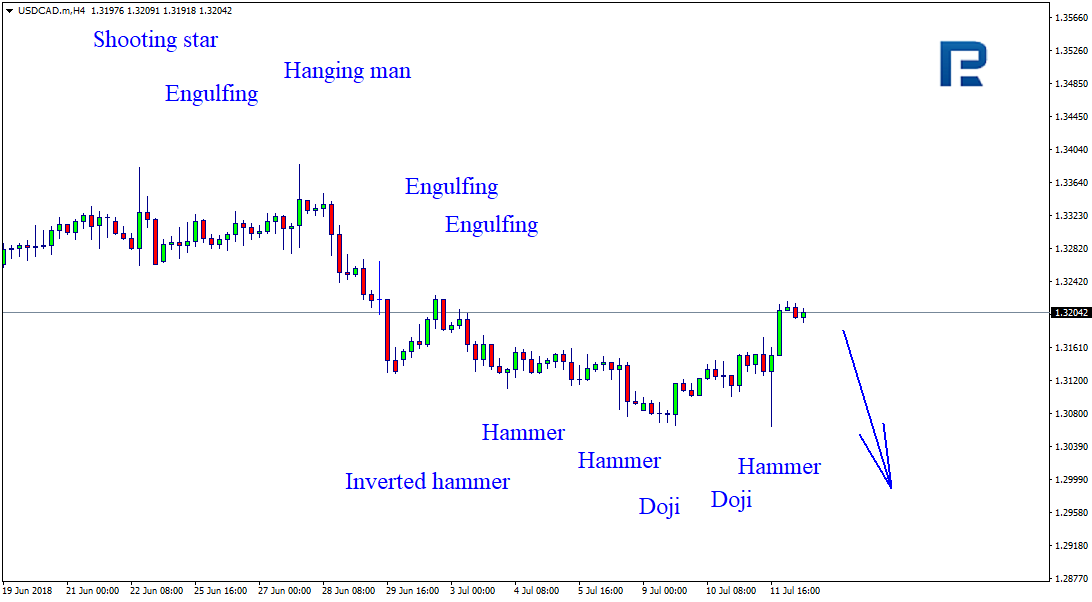
As we can see in the H4 chart, USDCAD continues falling; from time to time, it stops near support levels and forms Hammer, Doji, and Inverted Hammer reversal patterns. At the moment, the price is being corrected once again. Judging by the previous movements, it may be assumed that the instrument may finish the pullback, break the support level, and then continue falling.

USDCAD
Risk Warning: the result of previous trading operations do not guarantee the same results in the future


AUDUSD, “Australian Dollar vs US Dollar”

As we can see in the H4 chart, AUDUSD keeps growing and forming several Doji, Hammer, and Engulfing reversal patterns during pullbacks. Judging by the previous movements, it may be assumed that the instrument may complete the correction and then continue moving upwards.

AUDUSD
Risk Warning: the result of previous trading operations do not guarantee the same results in the future

Article By RoboForex.com

Attention!
Forecasts presented in this section only reflect the author’s private opinion and should not be considered as guidance for trading. RoboForex LP bears no responsibility for trading results based on trading recommendations described in these analytical reviews.