Author Archive for InvestMacro – Page 391

Japanese Candlestick Analysis for EURUSD and USDJPY: July 18, 2018

Article By RoboForex.com

EURUSD

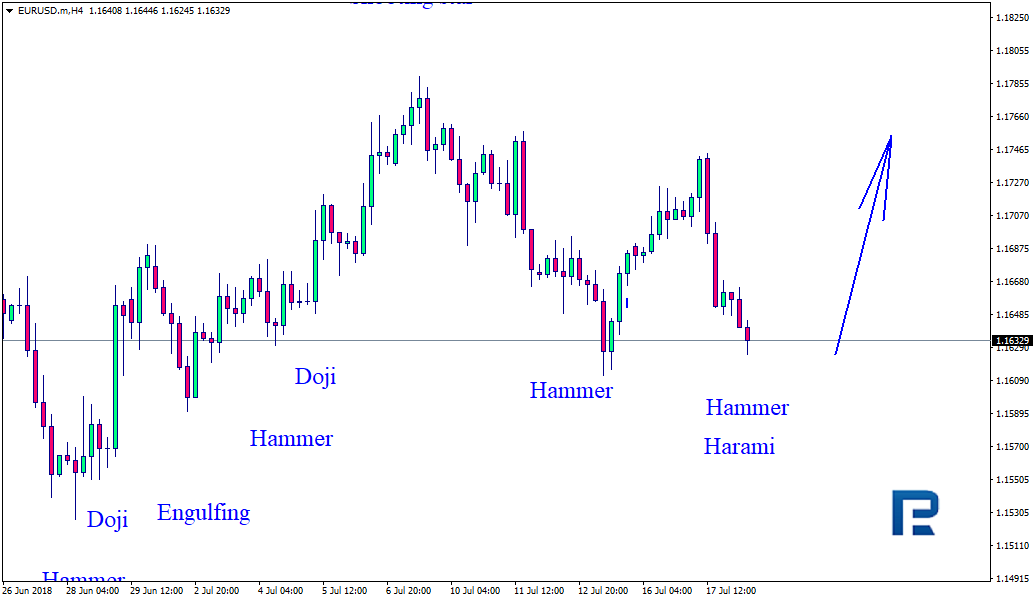
On H4, the pair is making pullbacks and forming reversal patterns, such as Hammer and Harami. Previously, this usually lead to the price rising after the correction phase, so this time we can expect the same.

EURUSD
Risk Warning: the result of previous trading operations do not guarantee the same results in the future

USDJPY

On H4, the pair has again broken out the resistance, while also forming a few Dojis and Falling Stars, which are reversal patterns. According to the previous similar cases, this is likely to be an attempt to stop the correction before forming a new uptrend.

USDJPY
Risk Warning: the result of previous trading operations do not guarantee the same results in the future

Article By RoboForex.com

Attention!
Forecasts presented in this section only reflect the author’s private opinion and should not be considered as guidance for trading. RoboForex LP bears no responsibility for trading results based on trading recommendations described in these analytical reviews.

The Next Best to Bitcoin: Other Cryptocurrencies to Watch For

By Amie Parnaby

“Bitcoin [cryptocurrency] is the beginning of something great: a currency without a government, something necessary and imperative.” – Nassim Taleb

The rapid growth in the Bitcoin price in 2017 has propelled Bitcoin, and cryptocurrencies in general, into the global public’s eye. However, it hasn’t all been good news, which begs the question of whether traders should risk investing in cryptocurrencies or not. Even though this statement might sound negative, we believe that, as the quotation by Nassim Taleb states, cryptocurrencies are a vital step forward in the digitisation of our global economy.

Cryptocurrencies: Benefits versus risk

On the one hand, naysayers have questioned the longevity and viability of the cryptocurrency industry. Furthermore, they predicted that the rampantly increasing Bitcoin price was merely a bubble which would burst and wipe out the profits made by investors, leaving them with massive losses.

The risks involved in cryptocurrency trading have prompted several governments like Bangladesh, Morocco, and Nepal to ban the buying and selling of any of the cryptocurrencies. While other countries such as China have not prohibited cryptocurrencies, they have cracked down on the digital currency industry, making it very difficult to trade in any one of the cryptocurrencies, including Bitcoin.

Furthermore, Initial Coin Offerings (ICO), or new coin forks, are coming under increasing scrutiny by global financial regulators because of the high risk to which investors are exposed.

On the other hand, the cryptocurrency industry seems to be shaking off the aftereffects of the negativity and the inevitable regulation by the global financial regulatory bodies. In fact, the Bitcoin price reached $10 000 at the end of November 2017. Moreover, there is growing adoption of cryptocurrency funds in the mainstream financial markets.

According to the research firm Autonomous Next, there are more than 120 funds that are focusing on cryptocurrencies, including hedge funds. Finally, the Chicago CBOE opened a Bitcoin futures exchange in December 2017.

The best cryptocurrencies to invest in

The closest we can reach to a conclusion is thus; while investing in cryptocurrency can be considered a risky venture, the investor’s exposure to that risk can and should be mitigated by intelligent investing.

After considering deciding to invest in cryptocurrency, the subsequent question should be; After Bitcoin, which are the next best digital currencies in which to invest?

In response to this question here is a list of the most popular, and viable, currencies in which you may consider investing:

Ethereum: Not only is Ethereum (or Ether) the second most popular digital currency that has captured the imagination of both investors and miners, it is also the second largest currency available by market cap. The reason it is gaining in popularity, especially amongst cryptocurrency miners, is that is becoming increasingly difficult to solve the Bitcoin hash-algorithms. This is because there is a finite number of Bitcoins that can be generated and miners are reaching that figure. Ether is also more reasonably-priced than Bitcoin, so there is a more significant potential for growth when trading in Ether.

Bitcoin cash: Bitcoin cash is a Bitcoin fork which has a greater block size (8mb limit) which allows miners to process more payments per second. The faster payment process leads to a better user experience it offers better protection from having your investment wiped out due to fraudulent activities.

Litecoin: Litecoin is also a Bitcoin fork, and it is currently the fourth largest digital currency. The main selling point is that the Litecoin infrastructure can solve some of the issues faced by the Bitcoin mining and trading infrastructure.

About the Author:

Amie Parnaby is a professional writer with experience in a broad range of industries, from I.T to training, from optics to banking. Within these settings, Amie has provided quality web content, training materials and technical documentation. She is currently an in-house Content Writer at Leverate.


The Analytical Overview of the Main Currency Pairs on 2018.07.18

Analytics by JustForex

The EUR/USD currency pair

Technical indicators of the currency pair:
  • Prev Open: 1.17101
  • Open: 1.16596
  • % chg. over the last day: -0.49
  • Day’s range: 1.16251 – 1.16649
  • 52 wk range: 1.0571 – 1.2557

The bearish sentiment prevails on the EUR/USD currency pair. During yesterday’s and today’s trading sessions, the drop in quotations has counted to 80 points. Demand for the American currency grew after the speech by the Fed’s head. The regulator noted the stability of the labor market and his plans for a gradual increase in the key interest rate. At the moment, the key trading range is 1.16250-1.16500. We recommend opening positions from these marks. We are waiting for important economic reports.

The news feed on 2018.07.18:
  • – The consumer price index in the Eurozone at 12:00 (GMT+3:00);
  • – Statistics on the real estate market in the US at 15:30 (GMT+3:00);
  • – The Fed’s “Beige book” at 21:00 (GMT+3:00).

We also recommend paying attention to the speech by the Fed’s head.

EUR/USD

The price has fixed below 50 MA and 200 MA, which indicates the power of sellers.

The MACD histogram is located in the negative zone and below the signal line, which gives a strong signal to sell EUR/USD.

Stochastic Oscillator is in oversold zone, the %K line is crossing the %D line. There are no accurate signals.

Trading recommendations
  • Support levels: 1.16250, 1.16000, 1.15500
  • Resistance levels: 1.16500, 1.16750, 1.17000

If the price fixes below the support level of 1.16250, further decline in EUR/USD is expected. The movement is tending to 1.16000-1.15500.

Alternative option. If the price fixes above 1.16500, we recommend you to look for entry points to open long positions. The target movement level is 1.16750-1.17000.

The GBP/USD currency pair

Technical indicators of the currency pair:
  • Prev Open: 1.32330
  • Open: 1.31103
  • % chg. over the last day: -0.99
  • Day’s range: 1.30793 – 1.31169
  • 52 wk range: 1.2361 – 1.4345

Yesterday aggressive sales were observed on the GBP/USD currency pair. The drop in quotations exceeded 130 points. Demand for the US dollar has grown significantly after the statements by the Fed’s head. Additional pressure on the pound was caused by a weak report on the labor market in the UK. At the moment, GBP/USD is testing the local support and resistance levels: 1.30750 and 1.31150, respectively. The positions must be opened from these marks.

At 11:30 (GMT+3:00), the UK consumer price index will be published.

GBP/USD

Indicators point to the power of sellers. The price has fixed below 50 MA and 200 MA.

The MACD histogram is in the negative zone, but above the signal line, which gives a weak signal to sell GBP/USD.

Stochastic Oscillator is located in the neutral zone, the %K line is below the %D line, which indicates the bearish sentiment.

Trading recommendations
  • Support levels: 1.30750, 1.30250, 1.30000
  • Resistance levels: 1.31150, 1.31700, 1.32000

If the price falls below the support level of 1.30750, further fall of the GBP/USD currency pair is expected. The movement is tending to 1.30300-1.30000.

Alternative option. If the price fixes above 1.31150, it is necessary to consider buying GBP/USD. The movement is tending to 1.31500-1.31700.

The USD/CAD currency pair

Technical indicators of the currency pair:
  • Prev Open: 1.31367
  • Open: 1.31928
  • % chg. over the last day: +0.52
  • Day’s range: 1.31907 – 1.32453
  • 52 wk range: 1.2059 – 1.3795

At the moment there are aggressive purchases of USD/CAD. During yesterday’s and today’s trading, the growth of quotations exceeded 100 points. The trading instrument has updated a monthly maximum. At the moment the USD/CAD quotes are testing the local resistance of 1.32400. The mark of 1.32150 is already a “mirror” support. The currency pair is tending to grow. We recommend opening positions from the key levels.

The news feed on Canada’s economy is calm.

USD/CAD

Indicators point to the power of buyers: the price has fixed above 50 MA and 200 MA.

The MACD histogram is in the positive zone and above the signal line, which gives a strong signal to buy USD/CAD.

Stochastic Oscillator is located in the overbought zone, the %K line is crossing the %D line. There are no signals at the moment.

Trading recommendations
  • Support levels: 1.32150, 1.31850, 1.31550
  • Resistance levels: 1.32400, 1.33000

If the price fixes above the local resistance of 1.32400, further growth of the USD/CAD currency pair is expected. The movement is tending to the round level of 1.33000.

Alternative option. If the price fixes below the “mirror” support of 1.32150, a correction movement is expected. The target level of movement is 1.31850-1.31700.

The USD/JPY currency pair

Technical indicators of the currency pair:
  • Prev Open: 112.269
  • Open: 112.858
  • % chg. over the last day: +0.65
  • Day’s range: 112.833 – 113.137
  • 52 wk range: 104.56 – 114.74

USD/JPY continues to show positive dynamics. Currently, quotes are testing monthly highs. The key trading range is 112.800-113.100. In the near future, a technical correction is not ruled out. We recommend paying attention to the news feed from the USA. Positions must be opened from the key levels.

The publication of important economic reports from Japan is not planned.

USD/JPY

The price has fixed above 50 MA and 200 MA, which indicates the power of buyers.

The MACD histogram is in the positive zone, but below the signal line, which gives a weak signal to buy USD/JPY.

Stochastic Oscillator is located in the neutral zone, the %K line is crossing the %D line. There are no signals at the moment.

Trading recommendations
  • Support levels: 112.800, 112.500, 112.200
  • Resistance levels: 113.100, 113.500

If the price fixes above the 113.100 level, you should consider buying USD/JPY. The movement is tending to 113.500-113.750.

Alternative option. If the price falls below the “mirror” support level of 112.800, the correction of the USD/JPY currency pair is expected. The target level of movement is 112.500-112.300.

Analytics by JustForex, 2018.07.18


Tech Analysis: EUR/USD, GBP/USD, USD/CHF, USD/JPY, AUD/USD, USD/RUB, GOLD, BRENT, July 18, 2018

Article By RoboForex.com

EURUSD

In EURUSD, the major trend is descending; today, 1.1575 may be reached, which is just a half of the whole falling potential. The local target is at 1.1420.

EURUSD
Risk Warning: the result of previous trading operations do not guarantee the same results in the future

GBPUSD

The GPB/USD continues falling; today, it may reach 1.3000, but then a pullback to 1.3150 might occur. After that, the pair is likely to head down again, reaching 1.2950.

GBPUSD
Risk Warning: the result of previous trading operations do not guarantee the same results in the future

USDCHF

The USD/CHF continues uptrending. Today, it may go ahead to reach $1.0120, and then fall till 1.0000. After that, it may rise back to $1.0200 again.

USDCHF
Risk Warning: the result of previous trading operations do not guarantee the same results in the future

USDJPY

The USD/JPY has broken out the consolidation range, bottom up. This may lead to a rise towards 113.40. All rising patterns are, however, temporary, as the price may head down to form another fall any time, first target being at 110.10.

USDJPY
Risk Warning: the result of previous trading operations do not guarantee the same results in the future

AUDUSD

The AUD is trading within Wave 5 against the greenback, and is going to fall at least to 0.7285. Today, the price may fall to 0.7314, and then rise to 0.7377, after which the pair will try to reach its major target.

AUDUSD
Risk Warning: the result of previous trading operations do not guarantee the same results in the future

USDRUB

The USD/RUB reached 62.55, but then pulled back. It may now take another attempt to rise till 62.62, but then is likely to fall till 61.61. Once this price is broken out, the local target at 60.60 may also be achieved.

USDRUB
Risk Warning: the result of previous trading operations do not guarantee the same results in the future

GOLD

The gold has broken out the consolidation range top down. This may lead to a fall towards $1,218, but then a rise to 1,242 is possible. Still, the downward movement may extend to $1,205.

GOLD
Risk Warning: the result of previous trading operations do not guarantee the same results in the future

BRENT

Brent crude is trading within a consolidation range near $71.80. Today, the black gold may fall to $68.22, bet then recover again till $71.80. After that, the crude is likely to head down again, reaching 68.00. This is basically a 5-wave correction flag, which, when fully formed, may push the price higher to $82.00.

BRENT
Risk Warning: the result of previous trading operations do not guarantee the same results in the future

Article By RoboForex.com

Attention!
Forecasts presented in this section only reflect the author’s private opinion and should not be considered as guidance for trading. RoboForex LP bears no responsibility for trading results based on trading recommendations described in these analytical reviews.

The US Currency Is Strengthening Against the Backdrop of Statements by Mr. Powell

Analytics by JustForex

The US dollar has been rising against the basket of major currencies after the speech by the Fed’s head, Jerome Powell. The official said that the US central bank would continue gradually increasing of the interest rate amid high economic growth and stable inflation. However, Powell also noted that trade disputes on the world market caused some concerns and it was still unknown how they would affect the US economy. The US dollar index (#DX) closed yesterday in the positive zone (+0.49%).

The British pound significantly weakened yesterday against the US currency. As yesterday’s economic reports showed, the average earning index in the UK, taking into account bonuses, counted to 2.5% in May, which met investors’ expectations. However, the number of jobless claims in June rose to 7.8K, while experts expected 2.3K. Today important economic statistics are expected from the UK, the Eurozone and the US.

The “black gold” prices are falling against the backdrop of growing crude oil stocks in the US from the American Petroleum Institute. At the moment, futures for WTI crude oil are testing the level of $66.75 per barrel. At 17:30 (GMT+3:00), a report on US crude oil inventories will be published.

Market Indicators

Yesterday the bullish sentiment prevailed in the US stock market: #SPY (+0.40%), #DIA (+0.24%), #QQQ (+0.61%).

At the moment, the yield of 10-year US government bonds is at the level of 2.85-2.86%.

The news feed on 2018.07.18:

– The consumer price index in the UK at 11:30 (GMT+3:00);
– The consumer price index in the Eurozone at 12:00 (GMT+3:00);
– Statistics on the real estate market in the US at 15:30 (GMT+3:00);
– The Fed’s “Beige Book” at 21:00 (GMT+3:00).

We also recommend paying attention to the speech by the Fed’s head, Mr. Powell.

Analytics by JustForex, 2018.07.18


Forex market review (18/07/18)

By Veselin Petkov, Alpari

Yesterday evening, the US dollar got a boost from Fed Chair Jerome Powell’s speech, causing it to rise. The Fed Chair, citing solid economic growth and improving employment situation, made the case for continuing with the process of tightening monetary policy.

The way I see it, the following economic events could have an impact on currency exchange rates today:

  • 11:30 (GMT+3) UK: CPI (Jun) – consumer prices are expected to a rise of 2.6% year-on-year.
  • 12:00 (GMT+3) Eurozone: CPI (Jun) – year-on-year consumer inflation is expected to rise by 2.0%.
  • 17:00 (GMT+3) USA: Fed’s Powell speech.
  • 21:00 (GMT+3) USA: Fed’s beige book.

EURUSD:

On the 4-hour timeframe (H4), the EURUSD pair is forming the fifth wave inside the wedge (descending triangle):

At the time of writing, the EURUSD pair is moving towards the lower line of the wedge, which is located at around 1.1530.

On the hourly timeframe (H1), I believe that there’s potential for the beginning of a downwards trend:

I reckon that barring any unforeseen circumstances, the EURUSD pair could drop as far as 1.1550.

The pair is currently trading at 1.16343; about 80 pips lower than yesterday morning.

Multi-asset portfolio favoured as global markets hang in the balance

By George Prior

Investors must move towards diversifying their portfolio in light of tenuous U.S.-China relations, a Brexit deal that stands on the edge of a knife, and a looming shift in global markets, says the world’s largest independent financial advisory organization.

The investment advice comes as the VIX index – also known as the ‘fear-gauge’ – indicates that stock market sentiment on the S&P500 has improved slightly, though investors remain torn and uncertain, according to Tom Elliott, deVere Group’s International Investment Strategist.

Mr Elliott outlines two possible scenarios moving forward, one bullish and one bearish, in relation to global stock markets.

Explaining the bearish case, Tom states: “A lot of disruption that be inflicted on the global economy and capital markets should a full trade war develop between the U.S. and the rest of the world.”

He continues: “As a result, complex supply chains will be broken, with input prices increasing while access to overseas markets is decreasing.Manufacturing plants will have to be relocated, which would require companies to allocate capital for the cost of closing old plants and opening new ones. U.S. tariff barriers on Chinese imports have already contributed to weakness in Chinese stocks in recent months, this could yet happen to other Asian and European suppliers to U.S. companies.

“The 23 per cent fall in the Chinese CSI300 index – which tracks the country’s 300 biggest companies – perhaps gives a glimpse of what Western stock markets can expect should this future come to pass.”

Still, the deVere investment strategist notes that it’s not necessarily doom and gloom, as there is a flip side to this story.

Mr Elliott adds: “On the plus side, the U.S. economy appears to be in an enviable position of relatively strong GDP growth, with estimates forecasting a 2.8 per cent growth margin this year. Increased revenues are driving corporate profit growth and not cost-cutting tactics – another strong indicator. In addition, the market data company FactSet is predicting an average S&P500 second quarter earnings growth to be in the region of 20 per cent year-on-year.”

“Much of the acceleration has been due to Trump’s tax cuts, and the return of U.S. companies to America’s jurisdiction, which has translated into higher wages in tight labour market conditions.”

Meanwhile, Brexit’s tenuous stance doesn’t dispel the atmosphere of uncertainty and volatility, says Mr Elliott.

“The soft Brexit stance by cabinet ministers contained numerous contradictions within it, in order to appease the demands of hard-line Brexitiers.

“For instance, the British government is proposing   unlimited access to the EU market for British goods with no hard borders, whilst at the same time asking to be able to do trade deals with countries like the U.S. How, for example, will the E.U be then able to stop American imports arriving, tariff-free, into France or the Republic of Ireland?

Mr Elliott goes on to say that a soft Brexit is the most likely outcome, but recent Cabinet resignations from May’s government might add more fuel to a kindling fire.

He states: “A soft Brexit that excludes the ability for a free trade deal with the U.S. is the most likely, with Sterling taking a boost as a consequence.

“However, the resignation of cabinet ministers Boris Johnson and David Davis could cause enough trouble to render any deal with the EU untenable. The clock to March’s no-deal Brexit is ticking.”

As such, mitigating risk through a protective, all-encompassing, multi-asset fund is a safer bet that offers some protection against any market upsets – not least because it will contain a mixture of negative or low-correlated assets.

Tom Elliott affirms that such funds should be at the heart of any investment portfolio.

About:

deVere Group is one of the world’s largest independent advisors of specialist global financial solutions to international, local mass affluent, and high-net-worth clients.  It has a network of more than 70 offices across the world, over 80,000 clients and $12bn under advisement.

5 Statistics For Analyzing Your Trading Performance

By Vic Patel, Forex Training Group

There are many different ways that a trader can measure success in the markets. But some methods are a bit better than others when it comes to evaluating trading performance. In this article, we will discuss 5 key statistics that will give you an objective means by which to assess your trading strategy or system.

Risk Adjusted Returns

If you ask most amateur traders what the most important metric is when it comes to trading performance, they will typically respond by saying that the total return or percentage gain is the most important factor. But if you pose the same question to a professional trader, they will usually respond by saying that the risk adjusted return or gain is the most important factor.

Did you catch the difference? The amateur trader is most concerned with absolute returns while the professional trader understands that absolute returns are meaningless and should be measured against risk. And so, they always prefer risk adjusted performance measures.

This is an important concept that novice traders should learn sooner than later. Understanding that your overall return as a gauge of trading performance measured in a vacuum without taking into account risk is quite naive and can sometime provide a false sense of security. In the following sections, we will take a look at 5 ways you can measure your trading performance like a professional – based on a risk adjusted basis.

Sharpe Ratio

The Sharpe Ratio is one of the more well-known measures of risk adjusted returns. It was introduced by William Sharpe of Stanford University in the mid 1960’s. Essentially, the Sharpe ratio describes how much excess return you receive over the risk-free rate by taking into account the additional volatility that you incur by holding a risky asset. Typically, the 90 day US T-Bill rate is taken as the risk-free rate of return.

The calculation of the Sharpe ratio involves calculating the expect return on your account and then deducting the risk-free rate of return from that. Afterwards you would divide the resulting amount by the standard deviation within the trading account.

Let’s take an example assuming a risk-free return of 4%:

Assuming that within your trading account you are able to achieve a return of 24%, and the standard deviation of your return is 10%, then your Sharpe Ratio would be calculated as follows:

24% (Return Achieved) – 4% (Risk Free Return = 20%

20% / 10% (Standard Deviation) = 2

Sharpe Ratio = 2

In this case, your Shape Ratio would be 2. Typically, a Sharpe ratio of 1.50 and higher is considered a good risk adjusted trading performance.

Sortino Ratio

One of the biggest drawbacks for the Sharpe Ratio is that it does not distinguish between upside volatility and downside volatility, meaning that it penalizes both negative volatility from losing trades, as well as positive volatility occurring from winning trades.

Some trading strategies, especially trend following strategies are prone to a having a lower win percentage, but the average winning trades can be many multiples of the average losing trades. When we are evaluating trading performance for this type of system or strategy, the Shape ratio does not provide the best reflection of trading performance.

The Sortino Ratio aims to address this inherent flaw with in the Sharpe Ratio. The Sortino Ratio uses the same calculation as the Shape Ratio but with one important difference. The Sortino ratio only takes into consideration the downside volatility of the negative returns and does not consider the upside volatility of the positive returns. This creates a better more accurate risk adjusted measure of trading performance. As with the Shape Ratio, the higher the number the better the risk adjusted trading performance. A Sortino ratio of 1.50 and higher is considered good.

Calmer Ratio

The Calmer Ratio is one of my favorite trading performance metrics. It is the one that I tend to put the most amount of weight into when evaluating my own trading performance as well as when I am evaluating the performance of CTAs and Hedge funds.

The Calmer Ratio is calculated by taking the average annual compound rate of return and then dividing that by the maximum drawdown incurred over the same time horizon, typically 3 years. If, however, 3 years of data is not available, then you would simply use the maximum amount of time that data is available for your trading strategy.

Let’s take an example:

If you have been trading for 3 years using a particular trading strategy, and the average annual compound rate of return  that your strategy has achieved over this period is 36%, and the maximum drawdown that you have experienced during the same periodic is 20%, then your Calmer ratio would simply be calculation as:

36% (3 Year Avg. Return)  / 20% ( 3 Year Max DD )

= 1.80 Calmer Ratio

The higher the Calmer ratio the better the risk adjusted return. Usually you want to have at least a 0.50 Calmer ratio in your trading program. Anything over 1 is considered a pretty healthy risk adjusted return.

Profit Factor

One of the simplest measures of trading performance is a metric called Profit Factor. Though it is simple enough for any trader to understand and utilize, it is one of the most effective ways to quickly gauge your trading performance. So how it is calculated?

Profit Factor is determined by taking your gross profits and dividing it by the gross losses. That’s all there is to it. So, let’s say that you want to evaluate your trading performance based on Profit Factor over the course of the last one year period. Here’s how you would do it.

You go back into your records and find that your total gross profits for your trading strategy was $ 82,000 and your total gross losses for the same period was $ 51.000. Based on this, you can figure out what your Profit Factor was. You simply divide your gross profit of $ 82,000 by your gross loss of $ 51,000 to arrive at a Profit factor of 1.60. Generally, a profit factor above 1.25 is acceptable, and anything above 1.75 is considered very good.

Profit Factor is one trading strategy metric that every trader should know. It is easy to understand and calculate, and it provides a quick and valuable snapshot into the efficiency of your trading performance.

Gain to Pain Ratio

The Gain to Pain Ratio was popularized by Jack Schwager and introduced in his book “Hedge Fund Market Wizards”.  It is a risk adjusted performance metric that is somewhat similar to Profit Factor but with a bit of a twist.

The Gain to Pain ratio is computed by taking the sum of all monthly returns and dividing that by the absolute value of the sum all monthly losses. Let’s take a look at an example.

Let’s assume that over a course of one year, the sum total of all your total monthly returns equals 40%. And let’s say that you have 4 losing months within that 12 month period where you lost 5%, 3%,7%, and 4%. The absolute value of the sum of these four monthly losses is 19%. Based on this we would divide 40% by 19% to arrive at 2.10, which would be the Gain to Pain Ratio for your trading strategy over the last one year period.

A Gain to Pain ratio above 1.25 is considered good, and a value over 2 is very good.

Summary

So now you should be more familiar with risk adjusted returns, and understand why using this type of trading performance metric is important when evaluating your own trading results. You don’t necessarily need to memorize or refer to each one that we have mentioned thus far, but you should pick at least one or two that you are comfortable and use that as your go performance metric.

This is a guest post by Vic Patel of Forex Training Group, a trading education blog that provides in-depth analysis related to the currency markets.

 

Fibo Analysis for EUR/USD and USD/JPY: July 17, 2018

Article By RoboForex.com

EUR/USD

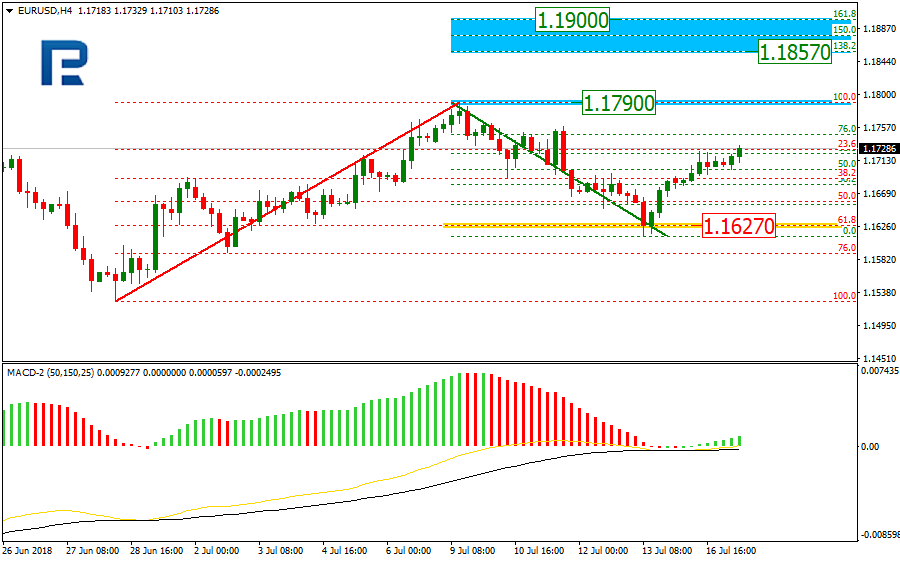
On H4, the EURUSD is rising again after the correction, with the local target at 1.1790. Once this high is reached, the price may move to the post correctional range within 138.2% and 161.8% Fibo, or 1.1857-1.1900. The current move is supported by 1.1627.

EURUSD1
Risk Warning: the result of previous trading operations do not guarantee the same results in the future

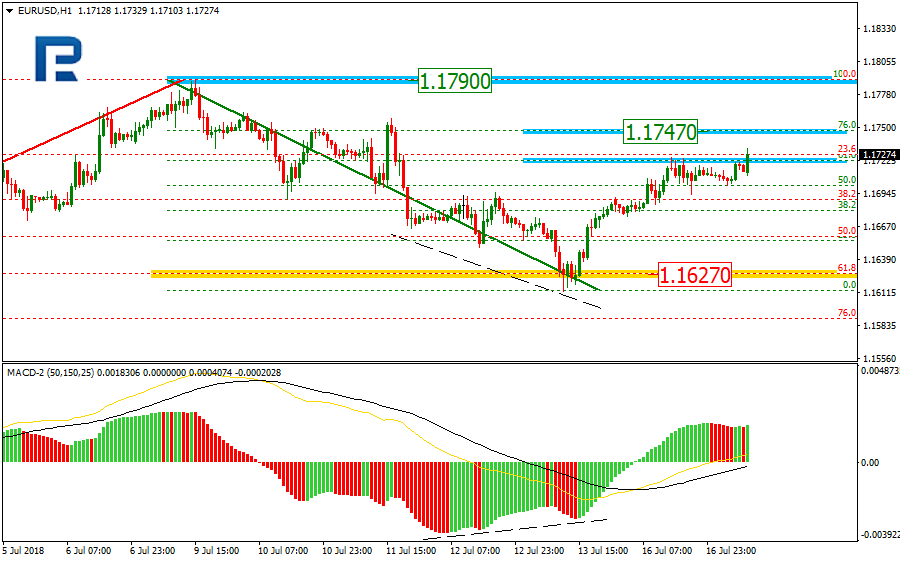
On H1, one can see the new EURUSD uptrend is currently just a piece of correction with respect to the previous downtrend that ended with convergence. This correctional uptrend has reach the 61.8% Fibo level, with the next target being at 76.0% (1.1747).

EURUSD2
Risk Warning: the result of previous trading operations do not guarantee the same results in the future

USD/JPY

On H4, USDJPY is continuing to ascend. The price has reached 111.39 and is very close to the post correctional range between 138.2% and 161.8% Fibo, or 112.67 and 113.46.

USDJPY1
Risk Warning: the result of previous trading operations do not guarantee the same results in the future

Meanwhile, H1 charts show a pullback has started after the divergence. This pullback has already reached the 23.6% Fibo level, the next levels may lie at 38.2%, or 111.85, and at 50.0%, or 111.56.

USDJPY2
Risk Warning: the result of previous trading operations do not guarantee the same results in the future

Article By RoboForex.com

Attention!
Forecasts presented in this section only reflect the author’s private opinion and should not be considered as guidance for trading. RoboForex LP bears no responsibility for trading results based on trading recommendations described in these analytical reviews.

The Analytical Overview of the Main Currency Pairs on 2018.07.17

Analytics by JustForex

The EUR/USD currency pair

Technical indicators of the currency pair:

  • Prev Open: 1.16905
  • Open: 1.17101
  • % chg. over the last day: +0.26
  • Day’s range: 1.17096 – 1.17151
  • 52 wk range: 1.0571 – 1.2557

During yesterday’s trading session the bullish sentiment was observed on the EUR/USD currency pair. Yesterday, a report on the volume of retail sales in the US for June was published, which met the expectations of investors and amounted to 0.5%. At the moment, EUR/USD is still rising. The key levels of support and resistance are 1.17100 and 1.17400 respectively. We recommend opening positions from these marks. The trading instrument is tending potentially to grow.

The news feed on 2018.07.17:

  • – The average wage level in the UK at 11:30 (GMT+3:00).

We also recommend paying attention to the speech by the Fed’s head.

Indicators point to the power of buyers: the price has fixed above 50 MA and 200 MA.

The MACD histogram is located in the positive zone and above the signal line, which gives a strong signal to buy EUR/USD.

Stochastic Oscillator is near the overbought zone, the %K line has crossed the %D line. There are no accurate signals.

Trading recommendations

  • Support levels: 1.17100, 1.16800, 1.16400
  • Resistance levels: 1.17400, 1.17800

If the price fixes below the already “mirror” support of 1.17100, a technical correction of the EUR/USD quotes is expected. The movement is tending to 1.16800-1.16600.

Alternative option. If the price fixes above 1.17400, we recommend you opening long positions. The target level of movement is 1.17800-1.18000.

The GBP/USD currency pair

Technical indicators of the currency pair:

  • Prev Open: 1.32166
  • Open: 1.32330
  • % chg. over the last day: +0.07
  • Day’s range: 1.32343 – 1.32567
  • 52 wk range: 1.2361 – 1.4345

Yesterday, a variety of trends was observed on the GBP/USD currency pair. At the moment, the technical pattern is ambiguous: the trading instrument is in a sideways trend. Investors expect additional drivers. The local support and resistance levels are 1.32300 and 1.32700, respectively. We recommend opening positions from these marks.

Today, the news feed on the UK economy is calm. We recommend you to pay attention to the speech by the Bank of England head Mark Carney.

The price is being traded above 50 MA and 200 MA, which indicates the power of buyers.

The MACD histogram is in the positive zone and above the signal line, which sends a signal to buy GBP/USD.

Stochastic Oscillator is located in the neutral zone, the %K line is crossing the %D line. There are no accurate signals.

Trading recommendations

  • Support levels: 1.32300, 1.31800, 1.31300
  • Resistance levels: 1.32700, 1.33100, 1.33500

If the price fixes above 1.32700, GBP/USD is expected to rise. The movement is tending to 1.33100-1.33500.

Alternative option. If the price fixes below the support level of 1.32300, it is necessary to consider sales of GBP/USD. The movement is tending to 1.31800-1.31600.

The USD/CAD currency pair

Technical indicators of the currency pair:

  • Prev Open: 1.31523
  • Open: 1.31367
  • % chg. over the last day: -0.15
  • Day’s range: 1.31135 – 1.31281
  • 52 wk range: 1.2059 – 1.3795

There is a downward trend on the USD/CAD currency pair. Currently, the local levels of support and resistance are 1.31100 and 1.31350, respectively. Positions should be opened from these marks. The trading instrument is tending potentially to reduce.

The news feed on the economy of Canada is calm.

Indicators point to the power of sellers: the price has fixed below 50 MA and 200 MA.

The MACD histogram is in the negative zone and below the signal line, which gives a strong signal to sell USD/CAD.

Stochastic Oscillator is moving out from the oversold zone, the %K line is above the %D line, which gives a weak signal to buy USD/CAD.

Trading recommendations

  • Support levels: 1.31100, 1.30800
  • Resistance levels: 1.31350, 1.31600, 1.31900

If the price fixes below the support level of 1.31100, further decrease of the USD/CAD currency pair is expected. The movement is tending to 1.30800-1.30500.

Alternative option. If the price fixes above the already “mirror” resistance level of 1.31350, the correction of the USD/CAD quotes is expected. The target level of movement is 1.31600-1.31900.

The USD/JPY currency pair

Technical indicators of the currency pair:

  • Prev Open: 112.203
  • Open: 112.269
  • % chg. over the last day: -0.02
  • Day’s range: 112.344 – 112.375
  • 52 wk range: 104.56 – 114.74

There is an ambiguous technical pattern on the USD/JPY currency pair. The quotes are in a sideways trend. Investors expect additional drivers. The price is testing the key support level of 112.250. The resistance level is still 112.600. Positions must be opened from these marks.

The news feed on the economy of Japan is calm.

Indicators do not send accurate signals: the price is being traded between 50 MA and 200 MA.

The MACD histogram is near the 0 MArk.

Stochastic Oscillator is located in the neutral zone, the %K line is above the %D line, which indicates the growth of USD/JPY.

Trading recommendations

  • Support levels: 112.250, 111.900, 111.500
  • Resistance levels: 112.600, 112.900

If the price fixes below the 112.250 level, the USD/JPY currency pair is expected to decline. The movement is tending to 111.900-111.700.

Alternative option. If the price fixes above the resistance of 112.600, we recommend opening long positions. The target level of movement is 112.900-113.100.

by JustForex, 2018.07.17