Author Archive for InvestMacro – Page 387

Is the BRIC Future on Track

10TH BRICS Summit at Critical Crossroads

By Dan Steinbock

Even amid trade wars and eroding global growth prospects, the large emerging BRIC economies remain positioned to surpass the largest advanced economies in about 15 years.

The 10th BRICS Summit will take place in Johannesburg, South Asia. Led by Brazil, Russia, India, China and South Africa, the international conference highlights the rising power of large emerging economies in the world economy.

When the first BRICS Summit took place in Yekaterinburg, Russia, after the global crisis, the combined economic power of the major BRIC countries amounted to some $10 trillion, or about a third of the largest economies of the West, as reflected by the US, the core European countries (Germany, UK, France, Italy), and Japan – the so-called G6 economies.

Today, the BRICs are coping with a fragile global recovery that is overshadowed by America’s new protectionism.

China and India on track, Russia and Brazil penalized by politics

In 2000, China’s economy was barely a tenth of the US GDP. Brazil was stabilizing after years of turmoil. Russian economy had been crushed by the US-led “shock therapy.” And reforms were intensifying in India.

A decade later, the world economy looked very different. The US economy was still more than twice as big as that of China but Japan’s growth had been penalized by stagnation. Chancellor Merkel’s Germany and President Sarkozy’s France led the ailing Europe. In Brazil, the Lula era brought about a dramatic catch-up, while reducing historical income polarization. In Manmohan Singh’s India, growth was accelerating. In Russia, President Putin had multiplied the size of the economy by almost six-fold.

Is the world economy’s structural transformation on track? The short answer is an emphatic yes, but there are significant differences among the BRIC economies.

Let’s use the largest economy, the United States, as a benchmark to compare the original BRIC assumptions (dashed line) in the early 2000s with the real economic development in the past two decades and the expected decade (Figure 1).


Figure 1 BRIC Economies, 2000-2030

Sources: Goldman Sachs; IMF; Difference Group.


According to this simple exercise, China’s economic expansion accelerated dramatically, even word-historically, in the course of the 2000s, when its share of the US economy more than tripled from 12% to 40%. The original BRIC estimate was that China would surpass the U.S. in the late 2020s; and that remains the case under Xi Jinping’s leadership. If current trends prevail, Chinese economy would be 13% larger than that of the U.S. by 2030 (only 1% less than the original BRIC projection).

While India’s growth trajectory slipped in the past few years, it has been largely restored by Prime Minister Narendra Modi. If things go right, India’s economy would double relative to the U.S. in the next decade. It could also soar to about a third of the U.S. by 2030 (4% higher than the original BRIC projection).

However, Brazil and Russia have slipped significantly from the original projections.

Under Lula’s visionary leadership, Brazil’s GDP grew even faster than expected by the original BRIC projection. And the first term of Dilma Rousseff was still not far behind the projection. Nevertheless, since the mid-2010s and Rousseff’s contested impeachment, political turmoil has harmed Brazil’s growth trajectory, which has penalized middle classes, working people and the poor. If Brazil had been steered by Lula’s administration, its economy would have been almost a fifth of the US GDP by 2030. Now, Brazil’s economy is positioned to be about 13% of that of the US by 2030 (more than 40% smaller than originally expected).

In Russia, President Putin was able to reverse the economy’s drastic fall in the 1990s and restore the growth trajectory in the 2000s. For all practical purposes, Russian economic prospects are very much in line with the original BRIC projection; it is the sanctions by the West that account for the negative difference. Without the controversial sanctions, the Russian economy would have been about a fifth of the U.S. economy by 2030. Thanks to the US-led new Cold War, Russian economy could be less than a tenth of the US GDP by 2030 (some 55% smaller than expected).

Two caveats

There are two major caveats to the BRIC future projections. The first involves international trade prospects amid rising US protectionism. The second has to do with the impact of these trade actions on the consequent global prospects.

After a year of threats, the Trump administration initiated a tariff war against China last March. The measures became effective in early July. What began with “national security reviews” on steel and aluminum soon spread to intellectual property rights and technology. Moreover, the bilateral friction with China soon broadened to US trade conflicts with the NAFTA, Europe, East Asia and the rest of the world.

If the Trump administration will keep moving away from the postwar trading regime, these bilateral frictions will broaden and multilateralize. And if a full-scale trade war cannot be avoided, then the nascent tariff wars have potential to spread across industry sectors and geographic regions.

After the first half of 2018, the IMF growth projections have already been revised down for Europe, Japan and the UK, and for Brazil and India. As economic uncertainty is rising, investors can no longer ignore it. Given the right adverse triggers, a “sudden reassessment of fundamentals and risks by investors” is now a viable possibility.

Yet, in the long-term, even negative turns – if they remain short-term– cannot alter – but can slow – the relative rise of the large emerging economies. If trade risks grow elevated, secular stagnation in major advanced economies will deepen as well. Second, amid the 2008 global crisis, China accounted for almost 50% of global growth and continues to account for some 30% of global prospects today.

The implication is that how China goes, so will the world go. In positive scenarios, such economic spillovers support global growth. In negative scenarios, such spillovers would penalize those growth prospects – and the collateral damage would likely be the worst in emerging and developing economies.

What will the catch-up by the BRIC economies under these conditions mean in terms of global economic power?

BRICs positioned to surpass G6 in early 2030s

The peak of the advanced economies’ global power was in the 1980s and ‘90s. Despite continued absolute expansion, their relative erosion has increased. In 2000, the economies of the major advanced nations of the “West,” as reflected by the G6, were still almost ten times bigger than the BRICs. However, the global crisis sped up their relative erosion (compare Figure 2).


Figure 2 G6 and BRIC economies, 1980-2030 ($ Billions)

Sources: Goldman Sachs; IMF; Difference Group.


By 2010, the G6 were almost three times bigger than the BRICs. Today, their edge has shrunk to about 30 percent.

Despite trade war against China, India’s struggle against poverty, Brazil’s internal turmoil and sanctions against Russia, the BRICs are still likely to surpass the major advanced economies around the early 2030s. By 2030, the G6 economies will be about 5 percent behind the original estimate; the BRICs a bit more, about 7 percent.

Indeed, if G6 were to be balanced with six large emerging economies – rather than just four BRIC nations – by including Indonesia, Mexico or Turkey, or Nigeria or South Africa, the trend line would prove even more prominent.

While advanced economies have been penalized by their sovereign debt crises, large emerging economies have been harmed by political turmoil in Brazil and sanctions against Russia. In other words, the challenges in these two countries are political by nature and both have had to cope with external efforts to shape their sovereign future.

In contrast, as advanced economies have not even begun to reduce their debt burden, their economic leverage may decline relatively faster sometime in the future. In other words, their challenges are largely economic by nature.

There is only one viable way to deliver the economic promise of the BRICs (and the G6), and that is economic development. Any political, quasi-political (e.g., sanctions, regime changes) or military efforts that undercut development will penalize the economic future of both set of countries.

About the Author:

Dr Dan Steinbock is the founder of Difference Group and has served as research director at the India, China and America Institute (USA) and visiting fellow at the Shanghai Institutes for International Studies (China) and the EU Center (Singapore). For more, see http://www.differencegroup.net/

The original commentary was released by China Daily on July 24, 2018.


RoboForex to Add EOS to Its Portfolio

25.07.2018

Limassol, Cyprus

RoboForex announced today adding EOS, a cryptocurrency which is now available for trading with the broker on both MT4 and MT5 platforms. Currently, RoboForex clients have 7 crypto instruments to choose from.

RoboForex keeps expanding its crypto portfolio. The latest addition is EOSUSD, which is already available to the clients through MT4 and MT5, alongside with six other crypto pairs: BTCUSD, ETHUSD, BCHUSD, DSHUSD, LTCUSD, and XRPUSD. The EOSUSD trading conditions are the following: minimum lot size: 100, minimum increment: 0.01, leverage 5:1.

EOS is a cryptocurrency that was introduced in 2017 and is based on blockchain and smart contracts. Its key features are scalability, decentralized apps, and huge throughput (a few million transaction per second).

‘This is another step towards developing our crypto portfolio’, says Denis Golomedov, Marketing Director at RoboForex. ‘Our clients do value the flexibility and state of the art technologies we offer them As for us, our mission is meeting their expectations and constantly improving the trading conditions by opening the door to new instruments and opportunities.’

About RoboForex

RoboForex is a brokerage company catering to clients from various countries. The broker’s focus is providing the traders with access to its own financial market platforms. RoboForex Ltd is a licensed company (License No. IFSC/60/271/TS/17). To learn more about RoboForex, please go to www.roboforex.com.


Fibonacci Analysis for GBP/USD and EUR/JPY: July 25, 2018

Article By RoboForex.com

GBP/USD

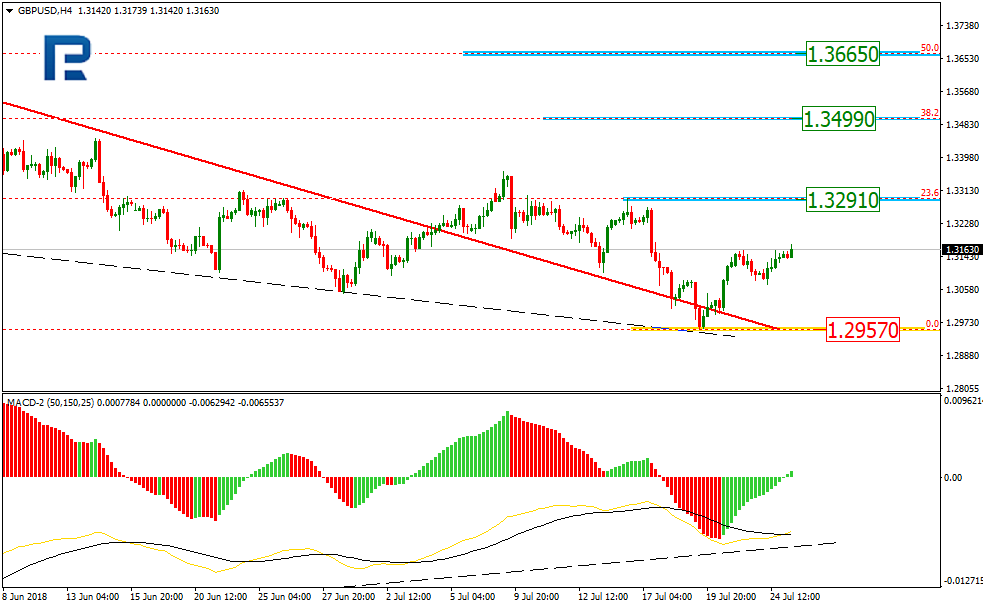
On H4, for GBP/USD we can see that after the convergence has been formed, the market is starting to form a correction uptrend. The targets of the correction uptrend may lie at Fibonacci levels of 23.6% (1.3291), 38.2% (1,3499) and 50.0% (1.3665). The low at 1.2957 is acting as a support.

GBPUSD1
Risk Warning: the result of previous trading operations do not guarantee the same results in the future

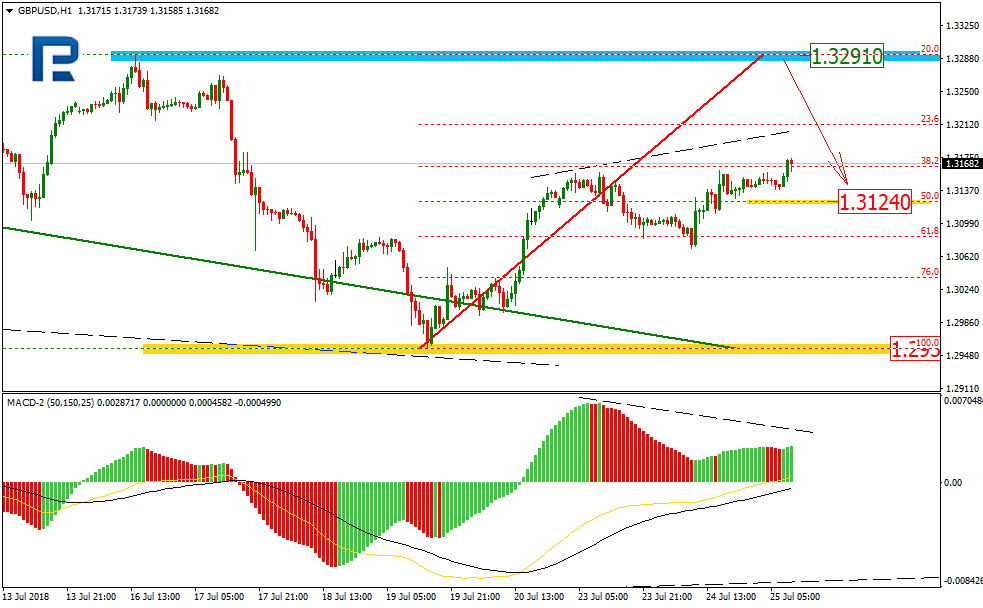
On H1, GBP/USD is forming a local uptrend towards 1.3291. With due consideration of the developing convergence we can assume that there will be a pullback after the level of 1.3291 has been reached. The Fibonacci level of 50.0% may become the main target of the pullback.

GBPUSD2
Risk Warning: the result of previous trading operations do not guarantee the same results in the future

EUR/JPY

On H4, for EUR/JPY we see that after the convergence the market has corrected the previous uptrend at Fibonacci level of 38.2%. Further the downtrend to 50.0% (129.32) and 61,8% (128.68) can be expected. The resistance is on the level of 131.98.

EURJPY1
Risk Warning: the result of previous trading operations do not guarantee the same results in the future

On H1, for EUR/JPY the convergence is forming which can be the signal for an upward correction. Its targets may be at the following Fibonacci levels: 23.6% (130.27), 38.2% (130.60), and 50.0% (130.86).

EURJPY2
Risk Warning: the result of previous trading operations do not guarantee the same results in the future

Article By RoboForex.com

Attention!
Forecasts presented in this section only reflect the author’s private opinion and should not be considered as guidance for trading. RoboForex LP bears no responsibility for trading results based on trading recommendations described in these analytical reviews.

Tech Analysis: EUR/USD, GBP/USD, USD/CHF, USD/JPY, AUD/USD, USD/RUB, GOLD, BRENT as of July 25, 2018

Article By RoboForex.com

EURUSD

EUR/USD has entered a consolidation range. Today, the price may fall to 1.1633. If the price goes up, the rise towards 1.1800 may follow. After that, the pair is likely to head down again, reaching 1.1570.

EURUSD
Risk Warning: the result of previous trading operations do not guarantee the same results in the future

GBPUSD

GBP/USD has entered a consolidation range. If the price goes down, the trend may continue, with the price going to 1.2888. If the price goes up, the rise towards 1.3195 may follow. After this the downtrend may be expected.

GBPUSD
Risk Warning: the result of previous trading operations do not guarantee the same results in the future

USDCHF

USDCHF continues to rise.Today, the rise to 0.9980 may be expected with the subsequent fall to 0.9950, which will form a consolidation range.In case of a rise, the main possible scenario is the continuous uptrend to 1.020. In case of a fall we cannot exclude the price to reach 0.9880.

USDCHF
Risk Warning: the result of previous trading operations do not guarantee the same results in the future

USDJPY

USDJPY has entered a consolidation range. If the price goes up, the correction towards 111.73 may follow If the price goes down, the downtrend may continue. The target is not at least at 110.30.

USDJPY
Risk Warning: the result of previous trading operations do not guarantee the same results in the future

AUDUSD

AUDUSD has entered a consolidation range. If the price goes down it may reach 0.7285. If the price goes up the continuous correction towards 0.7474 may follow.

AUDUSD
Risk Warning: the result of previous trading operations do not guarantee the same results in the future

USDRUB

USDRUB price is falling to 62.42. Today the rise to 63.10 is possible, but later the price is likely to fall to 62.42. In practice we can expect the consolidation range to develop. If the downtrend continues the price may go down to 61.00. In case of an uptrend, the rise to 63.77 is possible. After this the downtrend may be expected.

USDRUB
Risk Warning: the result of previous trading operations do not guarantee the same results in the future

GOLD

Gold has entered a consolidation range.In case of a fall the price may reach 1,205. In case of a rise the price may reach 1,239. After that, if gold continues to head down, it may reach 1205.

GOLD
Risk Warning: the result of previous trading operations do not guarantee the same results in the future

BRENT

Brent continues to trade within a consolidation range. At the moment the price is rising towards 74.22. Later, it may fall to 71.85. Аnd then, once a breakout occurs, the price is likely to go down to 69.33.

BRENT
Risk Warning: the result of previous trading operations do not guarantee the same results in the future

Article By RoboForex.com

Attention!
Forecasts presented in this section only reflect the author’s private opinion and should not be considered as guidance for trading. RoboForex LP bears no responsibility for trading results based on trading recommendations described in these analytical reviews.

World’s “Largest Robot” Makes First Delivery

In an industry known for its picks and shovels, in the hunt for gold treasures, the mining industry going through a technology renaissance, that many tech investors are missing, focusing on SAAS, PAAS, and IAAS companies in Silicon Valley. Yet mining production locations are ideal locations for autonomous implementation because the production occurs in a relatively more controlled environment than rolling out a self-driving car in downtown Sydney, London, or Vancouver. Rio Tinto has been the first mining company to deploy a fully autonomous ‘robot’  train to make deliveries of iron ore. This is

In July, the autonomous train made its first delivery traveling over 280 km. The project is called AutoHaul Project and will be the largest fully autonomous train network for heavy hauling in the world.

Note: Autonomous Driving Starts at 01:30

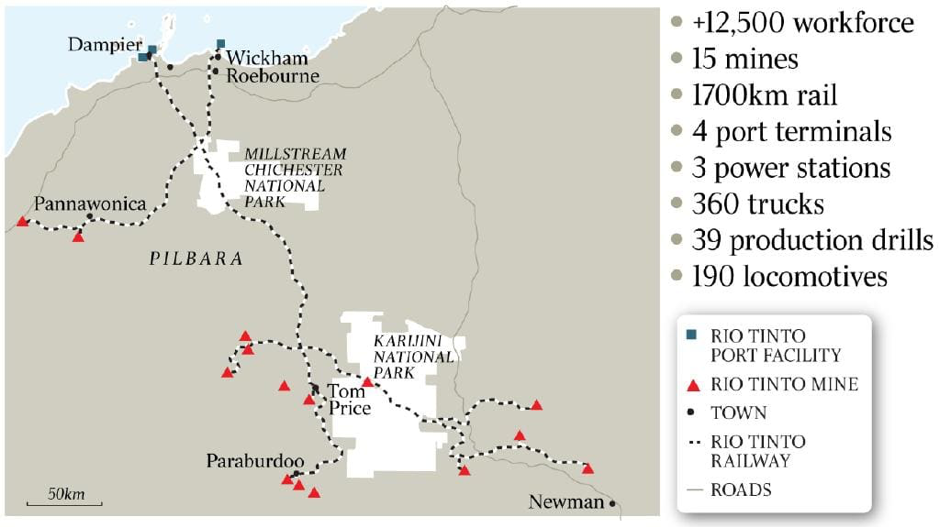
Rio Tinto’s fully automated train will haul iron ore from its operations in the Pilbara region to Western Australia port facilities. Rio Tinto has more than 200 locomotives, across more than 1,700 kilometers of tracks in the Pilbara region.  At the end of the first quarter, there were 1,100 km’s of track already automated, with the remainder of the tracks finished by the end of 2018. [1]

The Rio Tinto Railroad Track

Source: The Australian Miner

Bottomline Impact:

We estimate this automation would add about $0.05 USD to Rio Tinto’s earnings.

“In 2012-2013, an Australian mine worker earned US$137,100, while his Brazilian counterpart earned US$76,800. Similarly, BHP Billiton reports that Pilbaran train drivers earned an average of US$190,694 in 2013; they bring a high degree of technical skill to this remote location—necessary to safely transverse the diverse topography while carrying such heavy freights.” (Source:WEForum).

What are the other diversified miners doing for rail automation?

Fortesqcue: “Developing its own integrated train control system for its network based in Perth that will track its trains via GPS and digitally deliver operating instructions.”[2]

BHP: “(BHP) has indicated that it would prefer to allow others to develop automated train technology and then adopt the second-generation technology when it becomes available.”[2]

VALE: Vale relies on a multi-user railway and cannot turn to automation as easily. It therefore decided to cut costs in its Brazil operations instead, investing US$20bn in a project that will build a railway through the Amazon and replace mining trucks with a 23-mile-long conveyor belt in the hopes of reducing mine-to-port costs”.[2] These initial form of transportation improvements should facilitate further automation going forward.

What has already been deployed for automation in mines?

Caterpillar and Komatsu have already deployed self-driving dump trucks across mine operations. The controlled operations of the mines make it ideal for this type of automation. Glencore Technology’s Isa Mills are largely already in operation by Minera Peñasquito, Xstrata Copper, Xstrata Zinc, Teck, OceanaGold, Kalgoorlie Consolidated Gold Mines, MMG & Heron Resources. [2] This increased automation will reduce labor on the mines during the commodity price acceleration because of increased technology usage implemented. You also have Volvo build a self-driving truck for underground mines, over a 6 km track.

Labor Market Will Transform With Key Winners

Just like how farmers transitioned to manufacturing during the 1930’s-1940’s. This third industrial revolution, where automation now is focused on very specific industries outside of traditional tech, that will truly transform the labor force over the next 10 years. Mining is a low hanging fruit sector because of the controlled environments, remote locations, high labor costs, labor sourcing challenges, and cost pressures from a low-commodities price environment. Equipment providers turning to deliver more automation for companies should be able to increase equipment providers margin, as we think over time we will see more Tesla attempts to automate as much of the equipment manufacturing. Higher value technology offerings by equipment manufactures should boost their margins as they are able to offer new SAAS and PAAS as part of their product offering to miners. The OEM’s that are able to transform with more technology in their offerings, should be able to gain more competitive advantages, and thus monopoly or duopoly positioning. There are also the GPU manufacturers like NVIDIA inside the vehicles, and TE connectivity which provides the heavy-duty equipment sensors that can be benefactors of increased transportation automation.

WHERE WILL FUTURE SAVINGS COME FROM?

Mines operations are becoming one of the most automated operations in the world. The remaining factor comes down to, how much more cost efficiencies can be made if miners have already automated major items like hauling and milling?One remaining area would be in implementing solar on operations to reduce diesel and costs in these remote locations. We think there are value chain opportunities outside of the traditional miners that both technology and mining investors are missing, to a rebound in the natural resource sector over the next 3-5 years.

In case you are wondering, no one was inside the cab when it was delivering the ore.

Source:

[1] RIO RINTO [2] WEForum [3] VISTA GOLD————————————–

We will be hosting a Live Webcast on Thursday, August 2nd
at 2:15 PM ET / 11:15 AM PT.

Mr. Paul Farrugia (President & CEO) will be discussing an unconventional approach for gold and silver investors in the coming commodity cycle.

There will be no replay. We have limited seats.

Reserve Your Seat Today


About the Author:

Paul Farrugia, BCom. Paul is the President & CEO of First Macro Capital. He helps his readers identify mining stocks that you can hold for the long-term. He provides a checklist to find winning gold and silver mining producer stocks, including battery metals.


The Analytical Overview of the Main Currency Pairs on 2018.07.25

Analytics by JustForex

The EUR/USD currency pair

Technical indicators of the currency pair:
  • Prev Open: 1.16920
  • Open: 1.16805
  • % chg. over the last day: -0.06
  • Day’s range: 1.16777 – 1.16836
  • 52 wk range: 1.0571 – 1.2557

Yesterday a variety of trends was observed on the EUR/USD currency pair. The index of economic activity in the manufacturing sector of Germany was published, which counted to 57.3, while experts expected the value of 55.5. At the moment, the technical pattern is ambiguous. Investors expect additional drivers. The key support and resistance levels are 1.16750 and 1.17100, respectively. We recommend opening positions from these marks.

The news feed on 2018.07.25:
  • – German IFO business climate index at 11:00 (GMT+3:00);
  • – New home sales in the US at 17:00 (GMT+3:00).
EUR/USD

Indicators do not send accurate signals: the price is testing 50 MA.

The MACD histogram is located in the negative zone, but above the signal line, which gives a weak signal to sell EUR/USD.

Stochastic Oscillator is in the neutral zone, the %K line is above the %D line, which indicates the power of the buyers.

Trading recommendations
  • Support levels: 1.16750, 1.16400, 1.16000
  • Resistance levels: 1.17100, 1.17400

If the price fixes below 1.16750, we recommend considering sales of EUR/USD. The movement is tending to 1.16400-1.16200.

Alternative option. If the price fixes above the resistance level of 1.17100, the EUR/USD quotes are expected to grow. The movement is tending to 1.17400-1.17600.

The GBP/USD currency pair

Technical indicators of the currency pair:
  • Prev Open: 1.30944
  • Open: 1.31421
  • % chg. over the last day: +0.37
  • Day’s range: 1.31610 – 1.31738
  • 52 wk range: 1.2361 – 1.4345

During yesterday’s trading session, the GBP/USD currency pair strengthened. Quotes rose by more than 70 points. At the moment, the key levels of support and resistance are: 1.31400 and 1.31900, respectively. The positions must be opened from these marks. The trading instrument is tending to grow.

The news feed on the UK economy is calm.

GBP/USD

Indicators point to thw power of buyers: the price has fixed above 50 MA and 200 MA.

The MACD histogram is in the positive zone and above the signal line, which sends a signal to buy GBP/USD.

Stochastic Oscillator is located in the neutral zone, the %K line is above the %D line, which also sends a signal to buy GBP/USD.

Trading recommendations
  • Support levels: 1.31400, 1.31000, 1.30500
  • Resistance levels: 1.31900, 1.32400, 1.32800

If the price fixes above 1.31900, further growth of GBP/USD is expected. The movement is tending to 1.32400-1.32600.

Alternative option. If the price fixes below the support of 1.31400, it is necessary to consider sales of GBP/USD. The movement is tending to 1.31000-1.30800.

The USD/CAD currency pair

Technical indicators of the currency pair:
  • Prev Open: 1.31667
  • Open: 1.31542
  • % chg. over the last day: -0.16
  • Day’s range: 1.31491 – 1.31575
  • 52 wk range: 1.2059 – 1.3795

There is an ambiguous technical pattern on the USD/CAD currency pair. At the moment, the trading instrument is in a sideways trend. Local support and resistance levels are: 1.31350 and 1.31650, respectively. The positions must be opened from these marks. We recommend paying attention to the dynamics of oil quotations.

Publication of important news from Canada is not expected.

USD/CAD

Indicators point to the power of sellers: the price has fixed below 50 MA and 200 MA.

The MACD histogram is near the mark 0. There are no accurate signals.

Stochastic Oscillator is in the neutral zone, the %K line is below the %D line, which gives a signal to sell USD/CAD.

Trading recommendations
  • Support levels: 1.31350, 1.31100
  • Resistance levels: 1.31650, 1.32000, 1.32400

If the price fixes below the support level of 1.31350, a decline of the currency pair is expected. The movement is tending to 1.31100-1.30900.

If the price fixes above the level of 1.31650, one should look for entry points to the market to open long positions. The target movement level is 1.32250-1.32600.

The USD/JPY currency pair

Technical indicators of the currency pair:
  • Prev Open: 111/325
  • Open: 111.141
  • % chg. over the last day: -0.05
  • Day’s range: 111.240 – 111.310
  • 52 wk range: 104.56 – 114.74

There is an ambiguous technical pattern on the USD/JPY currency pair. The trading instrument is in a sideways trend. Investors expect additional drivers. The key support and resistance levels are: 111.100 and 111.400, respectively. We recommend opening positions from these marks.

The news feed on Japan’s economy is calm.

USD/JPY

Indicators do not send accurate signals: the price is testing 50 MA.

The MACD histogram is near the 0 mark.

Stochastic Oscillator is located in the neutral zone, the %K line has crossed the %D line. There are no accurate signals.

Trading recommendations
  • Support levels: 111.100, 110.750
  • Resistance levels: 111.400, 111.750, 112.100

If the price fixes below the 111.100 level, the USD/JPY currency pair is expected to decline. The movement is tending to 110.750-110.500.

Alternative option. If the price fixes above the level of 111.400, it is necessary to consider buying USD/JPY. The movement is tending to 111.750-112.100.

Analytics by JustForex, 2018.07.25


The Us Dollar Is Stable Against the Basket of Major Currencies

By JustForex

The US dollar stays stable against the basket of major currencies. It was learned that the Fed intends to continue the increase of the interest rate despite criticism of the President of the United States. It should be reminded that last Friday Donald Trump expressed the belief that the policy of the Central Bank undermined his efforts to strengthen the US economy. The US dollar index (#DX) decreased slightly and closed in the negative zone (-0,05%).

The British pound grew against the American currency, as soon as it became known that the premier-minister of Great Britain, Teresa May intends to take control of the negotiations on Brexit. According to provisional data, the process of British exit from the EU will officially finish on March 29, 2019.

The Business Climate Index of Germany was published yesterday. It was 57,3, while the experts’ expectation was 55,5. Today during the Asian trading session the consumer price index in Australia has been released. It is 0,4% which is worse than the predicted value of 0,5%. The experts expect  important statistics of the USA and the Eurozone.

The “black gold” prices are growing. At the moment, futures for the WTI crude oil are testing a mark of $68,80 per barrel.  At 17:30 (GMT+3:00), a report on the US crude oil inventories will be published.

Market Indicators

Yesterday, the bullish sentiment prevailed in the US stock market: #SPY (+0,50%), #DIA (+0,78%), #QQQ (+0,41%).

At the moment, the 10-year US government bonds yield is at the level of 2,93-2,94%.

The news feed on 2018.07.25:

– The IFO Business Climate Index of Germany – 11:00 (GMT+3:00);

– The US New Home Sales – 17:00 (GMT+3:00).

By JustForex, 2018.07.25


Overview of the Forex market (25/07/18)

By Veselin Petkov, Alpari

This morning, in the run-up to the opening of the European session, EURUSD is trading at around 1.16875, in other words, almost at the same level as yesterday morning. As I wrote earlier, I do not expect any big changes in the major currency pairs before the ECB monetary policy meeting, the results of which will be published tomorrow at 16:30 (GMT+3).

However, looking at the fundamentals, the potential for pressure on the euro by the dollar is increasing. According to IHS Markit reports for the European and American economy for July, which were published yesterday at 11:00 (GMT + 3) and 16:45 (GMT + 3) respectively, the Eurozone GDP growth rates will continue to lag behind the US GDP growth rate in the near future. IHS Markit forecasts that in the third quarter of 2018, the Eurozone’s GDP growth will be approximately only 0.4% in quarterly terms, and the US GDP – 0.7% QoQ.

Therefore, I suppose that if tomorrow the ECB does not present any surprises, then very soon the  pressure on the euro by the dollar will be felt, and the EURUSD pair will slowly go south.

Today it would be a good idea to pay attention to the following macroeconomic data:

  • 13:00 UK: CBI distributive trades survey – realized (MoM) (Jul).
  • 17:00 US: new home sales (MoM) (Jun).

EURUSD:

On the hourly timeframe (H1), EURUSD has been trying to recover from the potential downwards trend since yesterday:

The chart shows that the EURUSD pair has lately been fluctuating near the trend line (green circle on the chart).

At the moment, it’s very difficult to predict how the EURUSD pair will behave before the ECB meeting set to take place in the next 30 hours. Theoretically, looking at the fundamentals, if we consider that the growth rate of the US’ GDP is likely to outpace the European growth rates in the coming months, the dollar should put pressure on the euro. Also, by looking at the charts, it appears as though the bearish setup (H1) on the EURUSD pair remains. For the last 24 hours so far nothing has changed, hence, most likely, the EURUSD pair will decline. However, the ECB meeting on monetary policy is ahead, and the EURUSD pair could behave very chaotically in the lead-up to the meeting. As mentioned previously, the EURUSD pair is facing strong resistance at 1.1824.

I would wait for the ECB meeting to wrap up and after that, if the ECB does not change its rhetoric on monetary policy, I would consider, in all likeliness, shorting the EURUSD pair.

Source: Overview of the Forex market (25/07/18)


Foreign Currencies show Massive Volatility/Rotation Setup

By TheTechnicalTraders.com

Our research team has been watching the foreign currency markets with great interest.  Recently, the strength of the US Dollar has put extended pressures on many foreign currencies.  The recent crash of the Chinese Yuan has alerted many traders to the concerns that China could be edging over the precipice in terms of debt and credit market collapse.

As traders/investors, we need to understand how these currencies move, and future moves may drive the global equity markets to new highs or lows.  Let’s take a brief look at how some of our proprietary indicators are set up on these Weekly charts.

WEEKLY BRITISH POUND CHART

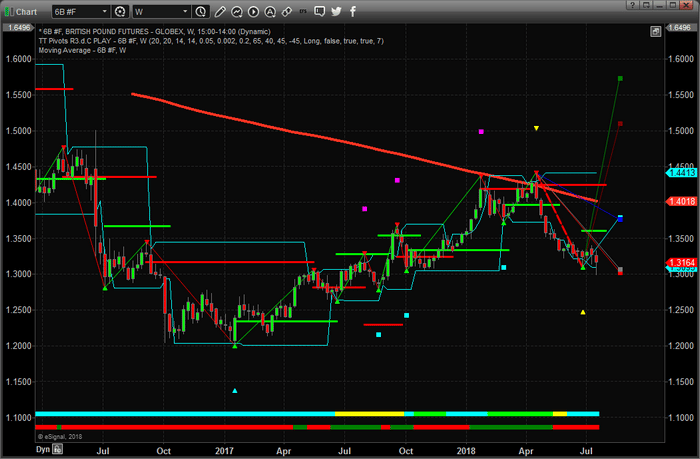
This Weekly British Pound chart showing our proprietary Fibonacci Price Modeling system presents a very clear picture that the current trend is Bearish and that price is contracting.  The Weekly Fibonacci price modeling system functions as an adaptive price modeling system – allowing the price rotations (peaks and valleys – highlighted by the yellow, cyan, magenta and white markers on the chart) to develop into a concise and efficient current model of price expectations and projections.  The multiple price projection levels (the six projected lines to the right of the current price bar) show us where price may attempt to target should a breakout move happen.

Notice that the current British Pound price has reached and stalled near the 1.3100 level – which is exactly where two of our Fibonacci price modeling system has predicted with the Red and Grey projection levels?  Also, notice how the Blue and Cyan projected levels are aligning near 1.3775?  This would be a proper expected price level should price find some support near the 1.3000 level and attempt a short recovery.

As get further into these charts, please understand the key elements of these charts and what they are attempting to illustrate to all of us.  With each pivot high or low, this price modeling system identifies a “trigger price level” that is used to confirm a trend reversal (if it happens) as well as to identify key future support/resistance.  These are drawn as Green and Red horizontal lines.  You’ll notice a Green trigger price level near the current price bar – this is the “upside price trigger level” that would have to be breached if we were to see any further upside price advance.  As long as price stays below this level, we should continue to expect a downside price move with a strong potential for new lows.

Summarizing this charts analysis, the current trend is Bearish.  The current bullish trigger level is near 1.3600.  Price is trending lower from a previous Bearish price trigger level near 1.4240.  Price has reached the two (Red & Grey) projected price levels which means we should expect some price consolidation near these levels before establishing a new price trend (extending lower or rotating higher).  Recent, new price bar lows show a very strong potential for further downside price activity.  At this point, we see that support from a previous bottom, near 1.3060, will likely cause the price to stall near this level.  We believe the price will continue to fall below the 1.3000 eventually as the strength of the US Dollar continues to push higher and the Brexit issues continue.  The British Pound could fall well below 1.2500 before finding real support.  Wait for this consolidation period to end and watch for lower prices to continue.


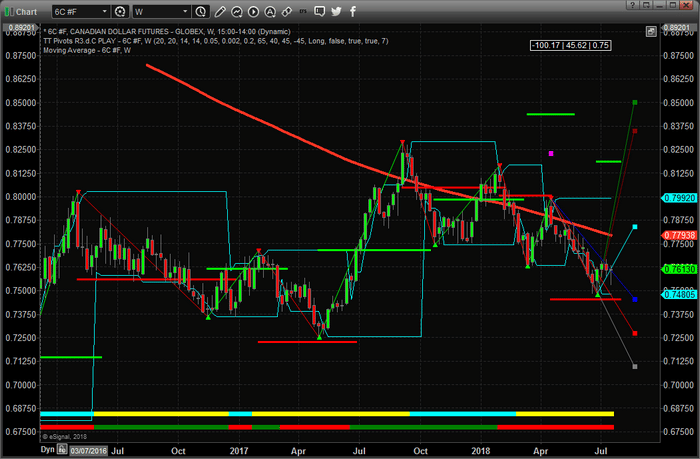
WEEKLY CANADIAN DOLLAR CHART

This Weekly Canadian Dollar chart below shows a very interesting setup with our proprietary price modeling system.  Notice the wide range between the trigger price levels (Green and Red) near the right edge of this chart?  This extended range of the trigger price levels happens when the adaptive price modeling system finds price trend rotation.  Previously, on this chart, we can see the trigger price levels were closer to price and within rotational ranges – the most recent breached trigger level being a Red (Bearish) trigger – indicating the start of a new bearish trend near February 5, 2018.

At this point, should price fall below 0.7450, we should expect price to continue to drop towards 0.7250.  Upside resistance should be near the Cyan projected price level – near 0.7850.  Unless the Canadian Dollar finds support near 0.7500 and rotates higher to breach 0.81875 – this is nothing but extended price rotation.  Typically, as price sets up an extended Top or Bottom, the trigger price levels will eventually tighten to establish a breakout trend setup.  Right now, the extended ranges of these trigger levels is showing us that volatility and price rotation should be expected and the downward sloping Moving Average level will likely operate as a key resistance zone.  The YELLOW markers at the bottom of the chart show us that price range is expanding and volatility is increasing.  We could see some bigger swings in the Canadian Dollar over the next few weeks and months – but the trend is still bearish.


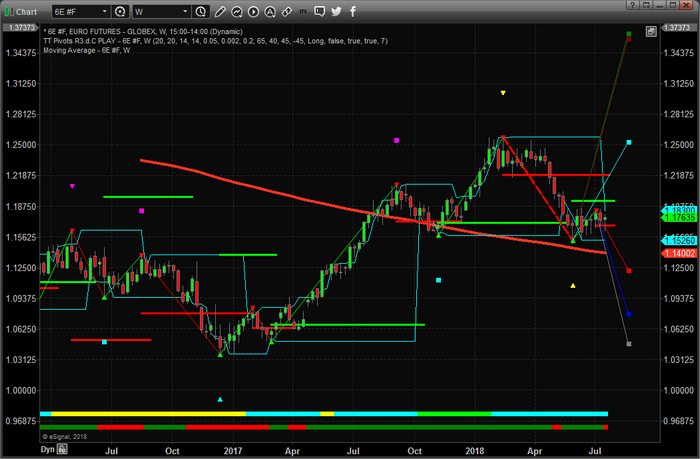
WEEKLY EURO CHART

This Weekly Euro chart shows a more traditional price rotation setup with our Fibonacci price modeling system.  Notice how the trigger price levels are very narrow and close to the current price.  You’ll also notice the Cyan price trend indicator, near the bottom of the chart, that is indicating that price range is contracting.  The two price trigger levels (Red and Green) provide very clear breakout trigger levels (bullish near 1.1913 & bearish near 1.1687).  The most recent trigger level to be breached was the Bearish level near 1.2200.  A recent low price rotation has established a new low price pivot that is projecting much higher price projection points.  Additionally, a more recent high price rotation has established new lower price projection points.

This sideways price rotation will be broken and a new trend will be established in time.  At this point, we know the 1.1913 level is the bullish trend trigger point and the 1.1687 level is the bearish trend trigger point. Price trend is still bearish and any lower price breakdown below 1.1576 would be a strong indication that price is breaking below current support and should attempt to move to near 1.1000.  To summarize, the Euro appears to be under extended pressure and any price breakdown could be a great short for traders.


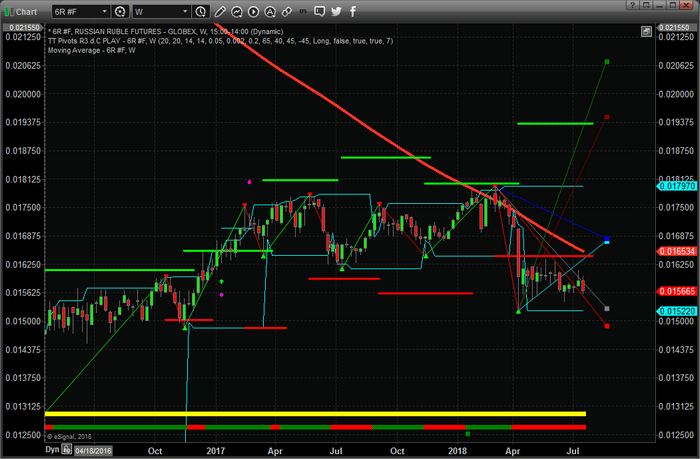
RUSSIAN RUBLE WEEKLY CHART

Lastly, this Russian Ruble Weekly chart shows, again, price rotation and volatility.  Notice how the bullish trigger price levels have been expanding throughout this sideways price rotation for the past year or longer?

As we stated early, the adapting modeling component of our proprietary Fibonacci price modeling system identified this rotation as “extended price congestion” and attempts to identify broader market breakout levels as a means to confirm a true change in price trend.  The most recent bearish trigger price level was breached on April 9, 2018.  Price is trending lower/bearish and the price trend indicator near the bottom is showing yellow – price volatility is expanding.  We should expect further downside price moves with expanded volatility.  Any price move below 0.01520 will indicate a very strong downside price move with the potential for price to reach 0.01250.


CONCLUDING THOUGHTS:

Overall, we need to remember the recent political, economic and geopolitical conundrums are reflecting in expectations within global economies and currencies to be put under greater concerns.  What was once a given, that the world would continue to operate without much disruption in the global balance of thing, is now open for debate.  We are watching global concerns and liabilities as a result of China’s recent downturn and currency devaluation reflect in additional concerns throughout the global currency markets.  We have to be aware that these issues typically don’t end quickly or without some form of government intervention.  This means we may have quite a bit of time to play these moves and find good trades.

Right now, the Russian Ruble, British Pound and the Canadian Dollar appear to be poised for a breakdown in prices in the immediate future – breaking through support and possibly dropping to recent historical lows.  The Euro is setting up for a breakout/breakdown move with a very narrow trigger price level range.  The Euro may follow rally, briefly, if the US Dollar retraces a bit from current levels.  Remember, these are weekly chart and help to understand the broader price trend.  A breakdown in the Russian Ruble, British Pound and Canadian Dollar would likely coincide with a rally in the US Dollar and possibly the Euro.  Therefore, watch for weakness in these markets and strength in the US Dollar as these moves happen.

If you’ve been follow our research recently, you already know why our members and followers stay dedicated to our team and our services.  We have called nearly every move in the markets over the past 8 months perfectly.  We urge you to visit www.TheTechnicalTraders.com to read some of our most recent research and to stay ahead of the markets by joining our membership services where we provide access to our most advanced predictive analysis tools and research.  You owe it to yourself to have a dedicated team of professionals that can help you find success and stay ahead of the markets if you want to build greater success in your future.

53 years experience in researching and trading makes analyzing the complex and ever-changing financial markets a natural process. We have a simple and highly effective way to provide our customers with the most convenient, accurate, and timely market forecasts available today. Our stock and ETF trading alerts are readily available through our exclusive membership service via email and SMS text. Our newsletter, Technical Trading Mastery book, and 3 Hour Trading Video Course are designed for both traders and investors. Also, some of our strategies have been fully automated for the ultimate trading experience.

Get our advanced research and market reporting, Daily market videos, detailed trading signals and join the hundreds of other traders that follow our research every day and profit.

Chris Vermeulen
TheTechnicalTraders.com
Technical Traders Ltd.

Yuan Getting Cheap Rapidly

By Dmitriy Gurkovskiy, Chief Analyst at RoboForex

China is depreciating its currency, paying no attention to what the US think about it. Today, the renminbi hit its 13-month lows against the greenback, and, most likely, it won’t stop here. The USD/CNY is now trading at 6.8123.

The yuan started its downtrend this April, while the depreciation got massive when the Fed signaled for keeping its aggressive monetary policy and continuing rate hikes. Meanwhile, the Chinese government does not have enough effective tools and methods to counter such policy and the greenback’s growth.

This is how People’s Bank of China decided to depreciate renminbi in order to keep good conditions for the exporters. Capital requirements for banks, as well as some other parameters, are changing, too. Thus, the Chinese central bank adjusts its policy to the ever changing conditions, in a very flexible way, without any attempts to counter the current situation.

Last Friday, Donald Trump said some central banks were manipulating the currency exchange rates, which led to the US dollar strengthening and created problems for the US business to be competitive. The greenback’s reaction was clear: it went down against the major currencies, but this did not affect the USD/CNY.

The PBC is likely to prioritize its depreciation policy for now, so we may well assume the USD/CNY will continue going down, at least before another Fed rate hike occurs.

Technically, the USDCNY is now heading towards the previous high at 6.9869, which has become the most likely target for the pair as of now. The uptrend is stable, but the closer the price gets to the high, the higher is the likelihood of a short term pullback. The short term ascending channel is meanwhile starting to go down towards the support at 6.7870. If this level gets tested and the price bounces, it may reach the resistance at 6.9020. There is another possible scenario, though: the price may break out the local support and reach the long term one at 6.7528. When the latter gets tested, we will see how much strong the current uptrend is. If it is really that strong, the price may then head upwards, aiming for the major high.

Disclaimer

Any predictions contained herein are based on the authors’ particular opinion. This analysis shall not be treated as trading advice. RoboForex shall not be held liable for the results of the trades arising from relying upon trading recommendations and reviews contained herein.