Author Archive for InvestMacro – Page 377

The Analytical Overview of the Main Currency Pairs on 2018.08.15

Analytics by JustForex

The EUR/USD currency pair

Technical indicators of the currency pair:
  • Prev Open: 1.14099
  • Open: 1.13460
  • % chg. over the last day: -0.54
  • Day’s range: 1.13334 – 1.13442
  • 52 wk range: 1.0571 – 1.2557

During yesterday’s trading session, the bearish sentiment was observed on the EUR/USD currency pair. Demand for the US currency is at a high level, while the euro is declining. The drop in quotes exceeded 70 points. At the moment, the local support and resistance levels are 1.13100 and 1.13600, respectively. We recommend opening positions from these marks. In the near future, we do not exclude the technical correction of the EUR/USD currency pair.

The news feed on 15.08.2018:
  • – Data on retail sales in the US at 15:30 (GMT+3:00).
EUR/USD

Indicators point to the power of sellers: the price has fixed below 50 MA and 200 MA.

The MACD histogram is located in the negative zone, but above the signal line, which gives a weak signal to sell EUR/USD.

Stochastic Oscillator is in the neutral zone, the %K line is above the %D line, which indicates a corrective movement.

Trading recommendations
  • Support levels: 1.13100, 1.12600
  • Resistance levels: 1.13600, 1.14000, 1.14400

If the price fixes above the resistance level of 1.13600, correction of the EUR/USD currency pair is expected. The movement is tending to 1.14000-1.14200.

Alternative option. If the price fixes below 1.13100, it is necessary to look for entry points to open short positions. The movement is tending to 1.12800-1.12600.

The GBP/USD currency pair

Technical indicators of the currency pair:
  • Prev Open: 1.27577
  • Open: 1.27201
  • % chg. over the last day: -0.39
  • Day’s range: 1.27039 – 1.27238
  • 52 wk range: 1.2361 – 1.4345

Yesterday, the bearish sentiment was observed on the GBP/USD currency pair. The British pound weakened after the publication of a weak report on the UK labor market. At the moment, the key support and resistance levels are 1.26900 and 1.27500, respectively. In the near future, a technical correction is not ruled out. Positions should be opened from the key levels.

At 11:30 (GMT+3:00), the consumer price index will be published in the UK.

GBP/USD

Indicators point to the power of sellers: the price has fixed below 50 MA and 200 MA.

The MACD histogram is in the negative zone, but above the signal line, which gives a weak signal to sell GBP/USD.

Stochastic Oscillator is located in the neutral zone, the %K line is above the %D line, which indicates the GBP/USD quotes growth.

Trading recommendations
  • Support levels: 1.26900, 1.26500
  • Resistance levels: 1.27500, 1.28000, 1.28500

If the price fixes above 1.27500, corrective movement is expected. The target level for profit-taking is 1.28000-1.28200.

An alternative may be a decline in the GBP/USD quotes to 1.26500-1.26300.

The USD/CAD currency pair

Technical indicators of the currency pair:
  • Prev Open: 1.31259
  • Open: 1.30567
  • % chg. over the last day: -0.58
  • Day’s range: 1.30534 – 1.30565
  • 52 wk range: 1.2059 – 1.3795

Yesterday, sales prevailed on the USD/CAD. The decline in quotes was caused mostly by the technical factors. At the moment, the technical pattern is ambiguous. Financial market participants expect additional drivers. The key support and resistance levels are 1.30600 and 1.30900, respectively. We recommend opening positions from these marks.

Today, the news feed on the economy of Canada is calm.

USD/CAD

The price has fixed between 50 MA and 200 MA, which are strong dynamic support and resistance levels.

The MACD histogram is in the negative zone, but above the signal line, which gives a weak signal to sell USD/CAD.

Stochastic Oscillator is located in the overbought zone, the %K line is below the %D line, which indicates a decrease in the USD/CAD quotes.

Trading recommendations
  • Support levels: 1.30600, 1.30300, 1.30000
  • Resistance levels: 1.30900, 1.31200, 1.31600

If the price fixes below 1.30600, the USD/CAD quotes are expected to fall further. The movement is tending to 1.30300-1.30000.

Alternative option. If the price fixes above the already “mirror” resistance of 1.30900, it is necessary to consider purchases of USD/CAD. The movement is tending to 1.31200-1.31600.

The USD/JPY currency pair

Technical indicators of the currency pair:
  • Prev Open: 110.640
  • Open: 111.112
  • % chg. over the last day: +0.47
  • Day`s range: 111.111 – 111.239
  • 52 wk range: 104.56 – 114.74

The bullish sentiment is prevailing on the USD/JPY currency pair. At the moment, the key support and resistance levels are 111.150 and 111.450, respectively. The trading instrument has the potential for further growth. Positions should be opened from the key levels. We recommend paying attention to economic reports from the US.

The news feed on the economy of Japan is calm.

USD/JPY

Indicators point to the power of buyers: the price has fixed above 50 MA and 200 MA.

The MACD histogram is in the positive zone, but below the signal line, which gives a weak signal to buy USD/JPY.

Stochastic Oscillator is located in the neutral zone, the %K line is crossing the %D line. There are no accurate signals.

Trading recommendations
  • Support levels: 111.150, 110.800, 110.500
  • Resistance levels: 111.450, 111.800

If the price fixes above the resistance level of 111.450, the USD/JPY currency pair is expected to grow. The movement is tending to 111.800-112.000.

Alternative option. If the price fixes below the level of 111.150, it is necessary to consider sales of USD/JPY. The movement is tending to 110.800-110.600.

Analytics by JustForex

Demand for the US Dollar Is Still High

by JustForex

Yesterday, the US currency continued to strengthen against the basket of major currencies. The US dollar index (#DX) closed in the positive zone (+0.31%). Demand for the US currency is still high. The Turkish lira has begun to cover losses after the conflict with the US. The Central Bank of Turkey provided a list of measures to prevent a financial crisis in the country.

The British pound weakened after the publication of weak reports on the UK labor market. The average wage level, taking into account bonuses, slowed down to 2.4% in June, while experts expected 2.5%. The number of jobless claims rose to 6.2K instead of the forecasted value of 3.8K in July. Also, the value for June was revised from 7.8K to 9.0K. At the same time, the unemployment rate fell from 4.2% to 4.0%. German ZEW economic sentiment index counted to -13.7 and was better than the forecasted value of -20.1.

The “black gold” prices are declining. At the moment, futures for the WTI crude oil are testing a mark of $66.85 per barrel. At 17:30 (GMT+3:00) data on the US crude oil inventories will be published.

Market Indicators

Yesterday, the bullish sentiment was observed in the US stock market: #SPY (+0.64%), #DIA (+0.46%), #QQQ (+0.63%).

At the moment, the 10-year US government bonds yield is at the level of 2.88%-2.89%.

The news feed on 2018.08.15:

– Consumer price index in the UK at 11:30 (GMT+3:00);
– Data on retail sales in the US at 15:30 (GMT+3:00).

by JustForex

How US Indo-Pacific Vision Forgot Asian Development

By Dan Steinbock

The Trump administration’s Indo-Pacific Vision is not an alternative to Chinese and other development initiatives in the Asia Pacific. It is a geopolitical play that is likely to benefit mainly advanced economies. What the Asia Pacific needs is a sustainable, long-term plan for accelerated economic development – not new geopolitical divisions.

On July 30, U.S. Secretary of State Mike Pompeo gave a highly-anticipated speech on “America’s Indo-Pacific Economic Vision”:

The Indo-Pacific, which stretches from the United States west coast to the west coast of India, is a subject of great importance to American foreign policy. This region is one of the greatest engines … of the future global economy, and it already is today. And the American people and the whole world have a stake in the Indo-Pacific’s peace and prosperity. It’s why the Indo-Pacific must be free and open.

In his speech, Pompeo announced $113 million in new U.S. initiatives to “support foundational areas of the future: digital economy, energy, and infrastructure.” As he put it, the funds represent a “down payment on a new era in U.S. economic commitment to peace and prosperity in the Indo-Pacific region.”

While bypassing the specifics of where the money would come from, these remarks were designed to inspire comparisons with the postwar Marshall Plan and China’s One Belt One Road (OBOR) initiative. However, the scale of the U.S.’ Indo-Pacific Economic Vision pales in comparison with the OBOR, which involves far greater cumulative investments. There are also valid concerns about U.S. financing capacity in the foreseeable future – not just in Asia, but at home.

Financing Challenges

All Trump initiatives are overshadowed by America’s massive twin deficit. The federal budget deficit for fiscal 2019 is almost $1 trillion. Despite Trump’s trade wars, the trade deficit increased by more than 12% in 2017 to $570 billion, the largest deficit since 2008.

Earlier this year, President Trump announced his highly-anticipated domestic infrastructure plan, the $1.5 trillion infrastructure initiative. The goal is to provide $200 billion over the next 10 years for infrastructure replacement and modernization projects across the U.S., which would be paid for by unspecified cuts in the federal budget.

In his 2016 campaign, Trump pledged to set America on a more financially sound and responsible course. Yet, instead of contributing to a credible, bipartisan and medium- to long-term debt-cutting program, the administration is taking on historical levels of new debt. Today, U.S. debt exceeds $21.3 trillion, which amounts to 105% of the U.S. gross domestic product (GDP.)

The Three Plans Compared

Both the Indo-Pacific Strategy and the OBOR have been compared with the postwar Marshall Plan. There are parallels, but the differences matter more.

While there is no consensus on exact historical amounts, the Marshall Plan’s cumulative aid may have totaled over $12 billion (more than $100 billion in today’s dollar value.) Consequently, Trump’s much-touted Indo-Pacific Strategy represents less than 10% of the value of the Marshall Plan. Most importantly, both of these efforts pale in comparison with the OBOR, which involves far greater cumulative investments, which are currently anticipated to be in the range of $4 trillion to $8 trillion, depending on timelines and scenario estimates (Figure).


Figure Indo-Pacific Vision, Marshall Plan, and China’s OBOR:

Economic Investment Estimates*

* Estimates expressed in trillions of contemporary U.S. dollars. China’s One Belt One Road (OBOR) initiative features both maximum (OBOR, max) and minimum (OBOR, min) estimates, based on relevant literature.


The three initiatives can be differentiated according to the value of their estimated investment, but also strategic objectives, underlying military frameworks and anticipated duration (Table).

Beginning in 1948, the Marshall Plan was created to help rebuild the war-torn economies of postwar Western Europe. It was not philanthropy. After 1945, the United States was the world’s largest exporter and dominated much of the global economy – but it could not trade without customers. While Europe’s largest economies had a desperate need for American goods and services, these countries did not have the dollars to purchase them. The Marshall Plan served as a seed fund that allowed Europe to get back on its feet, while sustaining U.S. economic strength in the immediate postwar era.


Table Indo-Pacific Vision, Marshall Plan, and China’s OBOR:

Key Characteristics


 Marshall PlanIndo-Pacific VisionOne Belt One Road
Economic investment$100 billion (in today’s dollars)Stated to be $113 millionEstimated $4 to $8 trillion, depending on scenarios
Strategic objectivesEconomic support in Europe, Cold War containmentU.S. presence in Asia, peace and prosperity in AsiaEconomic development across the world, a modern-day Silk Road
Military frameworkNorth American Treaty Organization (NATO)NATO, U.S. alliance system in Asia PacificNo explicit military frameworks
TimelineAbout three yearsUnspecifiedMulti-decade


Accordingly, the Marshall Plan’s timeline was limited, lasting roughly three years. In contrast, the timeline of the OBOR is likely to be one to three decades. The former sought to fuel European reconstruction using U.S. dollars. The latter seeks to promote industrialization and economic development, predicated on a far longer time-frame. Indirectly, it will contribute to renminbi internationalization, while reducing Chinese excess capacity in multiple sectors, such as steel, cement, coal and shipbuilding.

Ultimately, the Marshall Plan was designed not just to support European recovery, but to contain the Soviet Union in the Cold War, which was vital to the Pentagon. In light of the Obama pivot to Asia (predicated on the shift of 60% of U.S. warship capacity to the Asia Pacific by 2020) and the Trump administration’s 2017 National Security Strategy, the strategic objective of the Indo-Pacific Vision is somewhat similar. From Washington’s perspective, it is not just a competitive alternative to China’s OBOR initiative, but a geopolitical tool that, if needed, can be used to contain China economically and strategically.

In contrast, the OBOR is mainly economic by nature. It offers massive seed funding and infrastructure assistance to accelerate industrialization in economies that were once colonized by the major European powers, the United States and Japan – mainly emerging and developing economies which thus far have been unable to fully modernize.

Third, the Marshall Plan did speed up European postwar recovery but it was predicated on participation in the U.S.-led North American Treaty Organization (NATO). Some 75 percent of the total aid went to just five countries: the UK, France, West Germany, Italy, and the Netherlands, which also became the NATO’s core members. Unlike the Marshall Plan, the OBOR does not predicate participation in or tacit support of military alliances; it is not necessary for countries to join, say, the Shanghai Cooperation Organization (SCO). The OBOR is focused on 21st century economic development, not on the 20th century Cold War.

It is this aspect – the hope for a better future – of the OBOR that remains most underestimated by the White House.

The Need for Inclusive Economic Development

For all practical purposes, the Trump administration’s Indo-Pacific Strategy is a rehash of several ideas that former Secretary of State John Kerry introduced in 2013 when the idea of the Indo-Pacific Economic Corridor was conceptualized.

As for the potential future impact of the Indo-Pacific Vision, in the most benign scenario, the initiative will shed its geopolitical pretensions and focus instead on economic development, led by three key partners: the United States, Australia and Japan. In a less benign scenario, the interests, values and strategic objectives of the initiative’s leading major advanced economies will, once again, overshadow the values and interests of the emerging Asia Pacific economies. Moreover, geopolitics rather than best-practice development principles will determine the allocation of investment and project timelines.

According to the Asian Development Bank (ADB), infrastructure needs in the developing Asia Pacific will exceed $22.6 trillion through 2030, or $1.5 trillion per year. With costs related to climate change mitigation and adaptation factored in, this is more likely to come to over $26 trillion, or $1.7 trillion per year.

What the Asia Pacific needs is a sustainable, long-term plan for accelerated economic development – not new geopolitical divisions.

About the Author:

Dan Steinbock is the founder of Difference Group and has served as research director of international business at the India, China and America Institute (US) and a visiting fellow at the Shanghai Institute for International Studies (China) and the EU Center (Singapore). For more, see http://www.differencegroup.net/    

The original release was published by China-US Focus on August 14, 2018.


EURUSD: pair technically ready for a correction

By Gabriel Ojimadu, Alpari

Previous:

On Tuesday the 14th of August, trading on the euro closed down. After a correction to 1.1429 during US trading, the EURUSD pair dropped to 1.1320. The euro lost ground against the dollar despite the fact that the Turkish lira has stabilised. The lira gained 11% against the dollar.

Traders shorted the euro on the back of the uncertainty over Turkey’s situation and how it will affect the financial solvency of a few European banks as well as the US dollar rising across the board.

Day’s news (GMT+3):

  • 11:30 UK: CPI (Jul), PPI – input (Jul), PPI – output (Jul).
  • 12:30 UK: retail price index (Jul).
  • 15:30 US: retail sales (Jul), nonfarm productivity (Q2), unit labour costs (Q2), NY Empire State manufacturing index (Aug).
  • 16:15 US: industrial production (Jul).
  • 17:00 US: NAHB housing market index (Aug).
  • 17:30 US: EIA crude oil stocks change (10 Aug).
  • 19:00 Germany: German Buba president Weidmann speech.
  • 23:00 US: net long-term TIC flows.

Fig 1. EURUSD hourly chart. Source: TradingView.

Current situation:

My predictions for yesterday came off in full. The rate dropped from the balance line past the 67th degree to reach 1.1330.

The formation is complete on the hourly timeframe. I haven’t been able to choose a scenario today because the pair has reached a support on the daily timeframe and the 112th degree, which is sitting below it at 1.1301, is a potential reversal level. Moreover, in today’s Asian session, all the majors are trading down. The picture on the euro crosses is mixed. Some pairs are trading up and others down.

I can only tell you my thoughts on what’s happening today:

  1. The pair will consolidate between 1.1320 and 1.1360 before a drop occurs.
  2. On the hourly timeframe, there’s a divergence between the AO indicator and the lows of 1.1365 and 1.1320. The conditions for an upwards correction have been fulfilled.
  3. As trading gets underway in Europe, the downtrend could take us as far as 1.1301. There’s no guarantee that the drop will end there.


Source: “EURUSD: pair technically ready for a correction


Saudi Arabia And Iran Reignite The Oil Price War

By OilPrice.com

The rivalry between Saudi Arabia and Iran is becoming increasingly evident in the oil pricing policies of the two large Middle Eastern producers. The two countries are currently reigniting the market share and pricing war ahead of the returning U.S. sanctions on Iranian oil.

Saudi Arabia, OPEC’s largest producer, has been boosting oil production to offset supply disruptions elsewhere, including the anticipated loss of Iranian oil supply after U.S. sanctions on Tehran return in early November. The Saudis are also cutting their prices to the prized Asian market to lure more customers as they increase supply.

Iran, OPEC’s third-largest producer, is trying to convince its oil customers to continue buying Iranian oil despite stringent U.S. efforts to curb Iranian production.

Iran has slashed its official selling prices (OSPs) for all grades to all markets for September, looking to monetize what could be its last oil sales to some markets in Asia before the U.S. sanctions kick in. Tehran cut the prices for its flagship oil grades to more than a decade low compared to similar varieties of the Saudi crude grades, according to data compiled by Bloomberg.

Last week, the National Iranian Oil Company (NIOC) slashed the OSP for the Iranian Light crude grade to Asia by US$0.80 to US$1.20 a barrel above the Dubai/Oman average, used for pricing oil to Asia. The September prices for Iranian Light to Asia are at a 14-year-low compared to the similar Saudi grade sold to the world’s fastest-growing oil market, Bloomberg has estimated.

Earlier this month, the Saudis also slashed the September prices to Asia for their flagship grade, Arab Light, by US$0.70 to US$1.20 a barrel premium over the Dubai/Oman average. The reduction was slightly deeper than expected and the second consecutive monthly cut in pricing. The Saudis cut the prices for all their grades to all markets except for the United States.

Now Iran is also slashing prices for all grades to all markets, with the prices for Iranian LightIranian HeavyForozan, and Soroush grades to Asia, Northwest Europe, and the Mediterranean all cut by between US$0.50 and US$1.45, depending on the market and grades.

The OSPs for Iranian Heavy and Forozan to Asia were slashed against the similar Saudi grades to their lowest levels since at least 2000, the year in which Bloomberg started compiling the data.

Iranian Light and the Saudi Arab Light for Asia for September are now priced at the same level—US$1.20 a barrel above the Dubai/Oman average.

For the Saudis, the cut is aimed at enticing more buyers in order to take advantage of the refiners in Asia that are looking to cut Iranian oil intake for fear of running afoul of the U.S. sanctions. For Tehran, the cut in prices is an attempt to keep refiners buying by offering yet another incentive for them on top of the extended credit periods and nearly free shipping.

It has also been reported that Iran has started to offer India—its second-biggest oil customer after China—cargo insurance and tankers operated by Iranian companies as some Indian insurers have backed out of covering oil cargoes from Iran in the face of the returning U.S. sanctions on Tehran.

India’s imports from Iran could start to slow from August as some big Indian refiners worry that their access to the U.S. financial system could be cut off if they continue to import Iranian oil, prompting them to reduce oil purchases from Tehran.

The U.S. hasn’t been able to persuade Iran’s biggest oil customer China to reduce oil purchases, but Beijing has reportedly agreed not to increase its oil imports from Iran.

Other relatively large Asian buyers of Iranian oil—South Korea and Japan—are looking for U.S. guidance and (possibly) waivers before deciding how to proceed, but they are currently very cautious and on the lookout for alternative supplies.

Analysts, and reportedly the U.S. Administration itself, currently expect the sanctions to remove around 1 million bpd from the oil market.

Considering the intensity of efforts by the U.S. to cut off as much Iranian oil exports as possible, it is unlikely that even Iran’s significant discounts to Asian customers will save the country’s oil exports.

By Tsvetana Paraskova for Oilprice.com

Link to original article: https://oilprice.com/Energy/Oil-Prices/Saudi-Arabia-And-Iran-Reignite-The-Oil-Price-War.html


XBTUSD (Bitmex) – sellers are ready to hit fresh June low at 5,743 USD

By Gabriel Ojimadu, Alpari

On Monday, the 13th of August, bitcoin trading on the Bitmex exchange closed slightly down. After the unsuccessful attempt by bears to break through 6,500 USD, the price returned to 6,134 USD. The long shadow which remained at the top of the daily candlestick was a trigger today for bulls. During the Asian session, XBTUSD fell to 5,860 USD.

A fresh monthly low has been reached. At the time of writing the review, bitcoin sits at 5,984 USD. Considering how market participants are dumping altcoins, it is worth waiting for bitcoin to hit a new low. I’m waiting for it to test at 5,500 around the 17th of August. The key support is 5,400-5,500. If it does not hold, then you can expect some panic selling. In this case, purchase orders should be placed as low as possible.

On Tuesday, sellers can set two supports: at 5,875 and 5,760. The first level is the lower border of the A-A channel, the second is the line projected from these lows: 6,100 and 5,971.


Source: “XBTUSD (Bitmex) – sellers are ready to hit fresh June low at 5,743 USD

Is Solar Rising From The Ashes Again?

By TheTechnicalTraders.com

Recently, the Solar Energy sector has popped up on our watch-list of potential sectors to pay attention to.  Over the past few weeks, the Solar Energy sector has been under some pricing pressure and has retraced nearly 50% of the previous trend across the sector.  We, the research team at Technical Traders Ltd. understand the Trade War and uncertainty resulting from geopolitical tensions can sometimes create opportunities in the markets for all traders/investors.  We just have to be smart enough to find them end execute them efficiently.

Is Solar Energy the next big trend to hit in the Energy sector?  What is the potential for these stocks to move 10%, 20% or even 30%+ higher?  Let’s take a look.

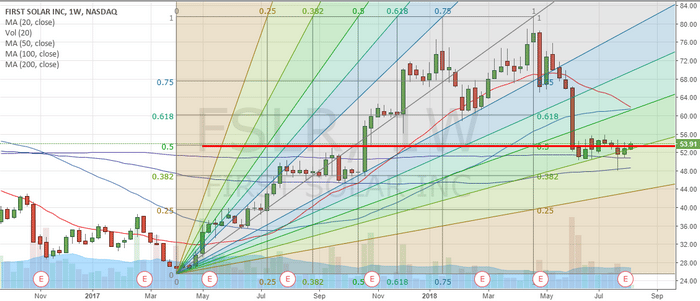
This first chart, a Weekly chart of First Solar (FSLR) presents us with an interesting price setup.  After a dramatic price decline in May and June of 2018, the price decline abruptly halted near $52.00.  In fact, this downside move ended almost as if prices “legged down” to the last known true support level.  Historically, looking all the way back to the lows of 2012, this downside move represents just a little over a 38.2% retracement from the highs and coincides almost perfectly with a 50% retracement from the lows in 2017.  These two numbers interest us because they show us that $53.50~55.00 is very likely a strong support level that is currently being tested.

Simple Fibonacci expansion analysis tells us any upside potential could target $61.35 (+12.65%), 69.95 (+28.44%) & 76.20 (+39.99%).  These levels don’t take into consideration the potential for new breakout highs above $82.50.  If this were to happen, we could see a +50% or more price upside happen.


Before we get too far ahead of ourselves, what would cause the Solar sector to begin a price advance at this stage in the economy?  Renewed interest in the new technology of new infrastructure/government contracts?  Replacing older technology with newer, higher performance, technology?  Renewed interest from personal and corporate clients?  What could cause this move?

You may remember that we’ve been suggesting that capital, cash, is always attempting to find solid sources of growth and opportunity while avoiding risk and depreciation.  We’ve been suggesting that the spare cash on the planet has been rushing into the US stock markets by the boatload to take advantage of the strong dollar and the strong US stock market values.  Could it be time for that capital to shift away from the FANGs and other leaders and move back into opportunistic equities that are somewhat off the radar?

Earnings for these companies for Q3 are set to be announced near October 28, 2018.  With FSLR, the Q3 earnings have typically been fairly strong.  One could attempt to assume Q3 2018 sales value may surprise the markets again and this could be a good time to consider the Solar Sector as an opportunity.

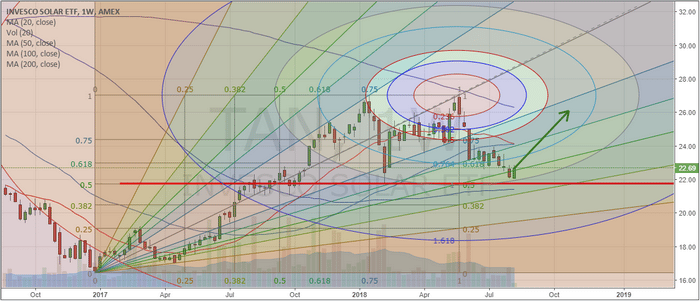
Our next chart is a Weekly ETF chart of INVESCO SOLAR (TAN).  This chart presents a similar picture as the previous chart – a relatively strong pullback from April~June of 2018.  The price pullback ends near a 50% Fibonacci retracement level and coincides quite nicely with our Tesla Vibrational Price Arc.  We’ve drawn an arrow on the chart that suggests where we believe prices could be headed as long at this $21.75 support level holds.

Again, it does not take a genius to understand that any price advance from the $22.70 level to above $26.00 (or higher) would represent an almost +15% move.  Any move above $28.00 from current levels would represent a +23.34% move.  There is room for profits if our analysis is correct.


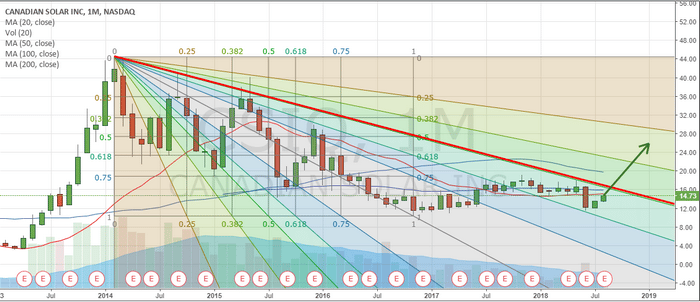
Lastly, we want to highlight what might be the most interesting setup in the Solar sector so far – Canadian Solar Inc (CSIQ).  This Monthly chart attempt to show our readers exactly what has been transpiring in the Solar Sector for the past 5+ years.  After peaking in early 2014, Solar technology lost its sparkle with investors.  Slowly, over time, prices waned and dropped while attempting to find support.  Technically, we view that support as the lows established in 2016 (prior to and near the US Presidential elections).

After that point it time, it is pretty clear to see that some renewed interest in the Solar Sector began to take place.  Slowly, price advanced from the low as volume stayed somewhat muted.  New rotational highs were established while the most recent low is still testing the 2016 lows.  This tells us that the price trend, at least until we see a new breakdown low, is attempting to move higher.

CSIQ is currently trading near $14.75 and has upside potential above $21.00 on a breakout move.  We are not saying this is definitely going to happen, but we do believe the Solar sector is setting up for an upside move and we do believe the potential for a new rotational high price to be established is quite strong.  This means, finding the proper entry point and understanding the downside risk of these trades is critical.

Once CSIQ breaks our Red downward price sloping line, we would assume the price channel has been broken and we would expect the price to begin to rise dramatically.

As a member of our subscription services, you will be alerted to these, and other triggers, as our research team identifies them for the best chances at future success.  Please take a minute to visit www.TheTechnicalTraders.com to learn how we can help you find new opportunities in the markets and stay ahead of these trends.  Our most recent trade in UDOW returned 12.6% for our members last week.  Please take a few minutes to understand how a small, dedicated, team of researchers with 53+ years of experience can make a difference in your future.

By TheTechnicalTraders.com

Japanese Candlesticks Analysis 14.08.2018 (GOLD, NZDUSD)

Article By RoboForex.com

XAUUSD, “Gold vs US Dollar”

As we can see in the H4 chart, XAUUSD is testing another support level and forming Doji reversal patterns. Judging by the previous movements, it may be assumed that the price may complete the correction and then start a new descending movement.

GOLD
Risk Warning: the result of previous trading operations do not guarantee the same results in the future


NZDUSD, “New Zealand vs. US Dollar”

As we can see in the H4 chart, NZDUSD is still trading downwards; right now, it is being corrected and forming Hammer, Inverted Hammer, and Doji reversal patterns. Judging by the previous movements, it may be assumed that the instrument is forming another correction before starting a new decline.

NZDUSD
Risk Warning: the result of previous trading operations do not guarantee the same results in the future

Article By RoboForex.com

Attention!
Forecasts presented in this section only reflect the author’s private opinion and should not be considered as guidance for trading. RoboForex LP bears no responsibility for trading results based on trading recommendations described in these analytical reviews.

The Analytical Overview of the Main Currency Pairs on 2018.08.14

Analytics by JustForex

The EUR/USD currency pair

Technical indicators of the currency pair:
  • Prev Open: 1.13721
  • Open: 1.14099
  • % chg. over the last day: +0.05
  • Day’s range: 1.13949 – 1.14248
  • 52 wk range: 1.0571 – 1.2557

The single currency recovered slightly after a sharp decline last week. Political tension between the US and Turkey is still in the spotlight. At the moment the EUR/USD quotations are consolidating. Local support and resistance levels are 1.14000 and 1.14300, respectively. We recommend opening positions from these marks. In the near future, we do not exclude the technical correction of the EUR/USD currency pair.

The news feed 14.08.2018:
  • – Preliminary data on the GDP of the Eurozone at 12:00 (GMT+3:00);
  • – ZEW economic sentiment index in Germany at 12:00 (GMT+3:00);
  • – Export and import price indices in the USA at 15:30 (GMT+3:00).
EUR/USD

Indicators do not send accurate signals. The price has crossed 50 MA.

The MACD histogram is located near the 0 mark.

Stochastic Oscillator is in the neutral zone, the %K line is crossing the %D line. There are no signals at the moment.

Trading recommendations
  • Support levels: 1.14000, 1.13650
  • Resistance levels: 1.14300, 1.14700, 1.15350

If the price fixes above the resistance level of 1.14300, the correction of the EUR/USD currency pair is expected. The movement is tending to 1.14700-1.15000

Alternative option. If the price fixes below the round level of 1.14000, you need to look for entry points to the market to open short positions. The movement is tending to 1.13700-1.13500.

The GBP/USD currency pair

Technical indicators of the currency pair:
  • Prev Open: 1.27406
  • Open: 1.27577
  • % chg. over the last day: +0.03
  • Day’s range: 1.27469 – 1.27988
  • 52 wk range: 1.2361 – 1.4345

The GBP/USD currency pair is still consolidating. At the moment, the key support and resistance levels are: 1.27350 and 1.27900, respectively. In the near future, a technical correction is not ruled out. Participants in financial markets expect important statistics from the UK. Positions must be opened from the key levels.

At 11:30 (GMT+3:00) a report on the UK labor market will be published.

GBP/USD

Indicators do not send accurate signals. The price has fixed between 50 MA and 200 MA.

The MACD histogram has begun to rise, indicating the power of the buyers.

Stochastic Oscillator is located in the neutral zone, the %K line is crossing the %D line. There are no signals at the moment.

Trading recommendations
  • Support levels: 1.27350, 1.27000
  • Resistance levels: 1.27900, 1.28500, 1.29000

If the price fixes above the 1.27900 mark, corrective movement is expected. The target level for profit taking is 1.28400-1.28500.

An alternative may be a decrease of GBP/USD to the level of 1.27400-1.27250.

The USD/CAD currency pair

Technical indicators of the currency pair:
  • Prev Open: 1.31601
  • Open: 1.31259
  • % chg. over the last day: -0.14
  • Day’s range: 1.30905 – 1.31364
  • 52 wk range: 1.2059 – 1.3795

At the moment, sales are prevailing on the USD/CAD currency pair. Quotations are testing the local demand zone of 1.30750-1.30900. The mark 1.31200 is already a “mirror” resistance. Participants in financial markets expect additional drivers. The trading instrument is tending to reduce. We recommend opening positions from key levels.

Today, the news feed on Canada’s economy is calm.

USD/CAD

The price has fixed between 50 MA and 200 MA, which are strong dynamic levels of support and resistance.

The MACD histogram has moved to the negative zone and continues to decline, which signals the bearish sentiment.

Stochastic Oscillator is located in the oversold zone, the %K line is crossing the %D line. There are no signals at the moment.

Trading recommendations
  • Support levels: 1.30900, 1.30300, 1.30000
  • Resistance levels: 1.31200, 1.31650, 1.32000

If the price fixes below 1.30900, the USD/CAD quotes are expected to fall. The movement is tending to 1.30500-1.30300.

Alternative option. If the price fixes above 1.31350, it is necessary to consider buying USD/CAD. The movement is tending to 1.31600-1.31900.

The USD/JPY currency pair

Technical indicators of the currency pair:
  • Prev Open: 110.429
  • Open: 110.640
  • % chg. over the last day: +0.06
  • Day`s range: 110.586 – 111.152
  • 52 wk range: 104.56 – 114.74

Since the beginning of this week, the bullish sentiment have been prevailing on the USD/JPY currency pair. At the moment, quotes are testing the key resistance of 111.150. The 110.800 mark is already a “mirror” support. The trading instrument is tending to grow. Positions must be opened from the key levels. We recommend you to pay attention to the dynamics of the US government bond yield.

In the Asian trading session weak data on the volume of industrial production in Japan has been published.

USD/JPY

Indicators do not send accurate signals. The price has fixed between 50 MA and 200 MA.

The MACD histogram is in the positive zone and above the signal line, which gives a strong signal to buy USD/JPY.

Stochastic Oscillator is located in the overbought zone, the %K line is above the %D line, which gives a weak signal to buy USD/JPY.

Trading recommendations
  • Support levels: 110.800, 110.600, 110.200
  • Resistance levels: 111.150, 111.450, 111.700

If the price fixes above the resistance level of 111.150, further growth of the USD/JPY currency pair is expected. The movement is tending to 111.450-111.700.

Alternative option. If the price fixes below 110.800, sales of USD/JPY should be considered. The movement is tending to 110.400-110.200.

Analytics by JustForex

Conflict Between the US and Turkey Is Still in the Spotlight

by JustForex

The US currency slightly weakened against the basket of major currencies. The US dollar index (#DX) closed in the negative zone (-0.06%) yesterday. However, demand for the US dollar is at a high level. Political tension between Turkey and the US continues to put pressure on the Turkish lira. These events caused a decline in the currencies of developing countries.

Today, during the Asian trading session, data on the volume of industrial production in China have been published. In July, the indicator increased by 6.0% and was worse than the forecasted value of 6.3%. Germany published preliminary data on GDP. In the second quarter, the country’s economy grew by 0.5%, which was higher than market expectations of 0.4%. Today, we recommend paying attention to the news feed of the UK and the Eurozone.

The “black gold” prices show positive dynamics. At the moment, futures for the WTI crude oil are testing a mark of $67.65 per barrel. At 23:30 (GMT+3:00) data on the API weekly crude oil stock will be published.

Market Indicators

Yesterday, the bearish sentiment was observed in the US stock market: #SPY (-0.37%), #DIA (-0.50%), #QQQ (-0.11%).

At the moment, the 10-year US government bonds yield is at the level of 2.88%-2.89%.

The news feed on 2018.08.14:

– Reports on the UK labor market at 11:30 (GMT+3:00);
– German ZEW economic sentiment at 12:00 (GMT+3:00).

by JustForex