Author Archive for InvestMacro – Page 356

How US Dollar penalizes emerging Asia

By Dan Steinbock            

Foreign exchange rates in emerging markets have suffered significant damage against US dollar, including Asia’s high-growth economies (India, Indonesia, Philippines). Is the severity of the damage justified?

Internationally, US dollar has been fueled by the Federal Reserve’s rate hikes, oil price increases, and the Trump administration’s trade wars.

Domestically, the worst foreign-exchange performers have been emerging economies – including Argentina, Turkey, Brazil, and Russia – that are vulnerable to rate normalization, exposed to Trump tariffs, major energy importers, or whose sovereign interests have conflicted with US geopolitics.

While some of these external and internal conditions also apply to emerging Asian economies – India, Indonesia, and Philippines – their strong fundamentals would not seem to warrant so severe penalties (Figure).

So why are they falling?

Figure Emerging Foreign Exchange Performance Year-To-Date*

Note: The bars reflect year-to-date percent change in each currency against the US dollar; emerging Asian currencies are in red color.

Why is the Philippine peso falling?

The Philippine economy is projected to grow at an annual rate of about 6.8% in 2018 and 2019, when it could become an upper-middle income economy. Yet, recently, the Philippine peso sank to a 2005-low of 54.28 per US dollar. The Duterte government is pushing an extensive infrastructure program, which requires foreign imports that in the long-term will raise living standards. In this regard, the peso’s depreciation was to be expected; it is a temporary sacrifice for investment into the future.

In January, when the peso was still 50.80 against the US dollar, I projected the peso to soften to 54 or more toward the end of the year, which I considered largely the net effect of normalization in advanced economies (especially the US Fed), elevated trade friction worldwide, and the infrastructure drive in the Philippines.

As imports of capital goods continue to flood in to support Duterte’s infrastructure drive, the trade deficit may widen further. Some Western analysts take this to mean gloom and doom for the peso.  Yet, their predictions ignore seasonal variation and thus the impending remittance effect.

Since 2009, the highest monthly remittances value has occurred in every December and last year’s $2.7 billion inflow in the month was the largest in record. These funds have historically alleviated pressure on the peso.

Nevertheless, along with other currencies in emerging Asia, Philippine peso is not immune to pressures in the coming years.

Why is Indonesian rupee falling?

At the end of the summer, Indonesia’s short-term projections could still rely on consumption to offset soft trade. In the second quarter, expansion amounted to 5.3% year-to-year; the fastest since the last quarter of 2014.

Indeed, in Indonesia, the first half of the current year indicated an upside momentum. In part, that reflected the rise of government spending ahead of the 2019 elections, which supports improved private consumption.

And yet, Indonesian financial markets continue to feel the pressure from the emerging markets’ end-of-summer sell-off, despite relatively benign domestic conditions and strong future potential. In late July, Indonesian rupiah was still below 14,400 against US dollar; today, it is over 14,800.

Understandably, policymakers have used interventions to cushion the rupiah’s decline and avoid volatility, while seeking to reduce the current account deficit. Moreover, fuel price liberalization is on hold.

However, as seen from Jakarta, the extent of the sell-off has not been justified by Indonesia’s fundamentals or external balances. Nevertheless, policymakers will have to cope with pressure, which is not likely to diminish in the immediate future.

Why is Indian rupee falling?

Today, India is among the largest economies in the world. In the recent quarter, it posted impressive growth of 8.2%. And yet, contagion worries from the US-Turkey friction were a mounting concern in India through the summer.

Recently, rupee reached an all time high of 72.70 against the US dollar. It has lost more than 13% against the greenback year to date and is likely to face more downside pressure in the months ahead.

External balances continue to suffer from pressure, as trade deficits have surged and current account gap may widen to -2.7% of GDP (more than 50% increase from FY2018). As the central bank seeks to defend the currency, foreign reserves have declined.

While the fall of the rupee leaves analysts apprehensive, Finance Minister Arun Jaitley is pushing India to reduce “non-essential imports” to enable foreign investors to buy rupee bonds issued by Indian companies. Still, the sharp fall in the rupee is stoking inflation as imported goods become less affordable.

In the short term, inflationary threats have eased but oil remains a risk in inflationary projections since India is a major energy importer.

How dollar distorts effective currency markets

In all three economies, there are some internal factors (e.g., rising inflation, current account deficit, delayed infrastructure projects, etc), which explain part of the story; but in no case do they account for the full story.

The conventional explanation is that the emerging markets adjustment reflects the strength of US economy and US dollar as safe haven. It was not a bad explanation in the postwar era when the US still fueled the global economy. But today, the US accounts for only a fifth of the world economy. It has suffered from trade deficits since the ‘70s. The debt burden exceeds 106% of US GDP. While the US was long an energy importer, commodities are still denominated in US dollars. The euro is strong internationally; the Chinese yuan is ascendant.

So the conventional explanation is defunct. The presumed strength of the US dollar no longer relies on its fundamentals, but on a perception that such fundamentals prevail, despite dramatic changes. Whether it is a question of the debt burden, budget deficit or current account deficit, in most cases, US economy is actually relatively weaker than the three Asian economies.

Intriguingly, the recent emerging-market currency selloff was focused against the US dollar. The same outcomes were smaller or tiny in terms of trade-weighted real effective exchange rate (REER): Indian rupee less than -4%, Indonesian rupiah less than -2% and Philippine peso less than -1%. In brief, these currencies may succumb to US dollar, but not against each other. Most of the adjustment is cancelled out in real effective terms.

No informed investor would stake all portfolio funds on a single stock. Yet, that’s what foreign-exchange markets currently do. The net effect is a house of mirrors. In the 21st century, the world economy desperately needs a multipolar basket of major currencies. Business as usual today is likely to result in a dollar crisis tomorrow.

About the Author:

Dr Steinbock is the founder of Difference Group and has served as research director at the India, China and America Institute (USA) and visiting fellow at the Shanghai Institutes for International Studies (China) and the EU Center (Singapore). For more, see http://www.differencegroup.net/ 


EURUSD: a reversal pattern has formed on the euro

By Tomasz Wisniewski, Alpari

Previous:

On Monday the 24th of September, the euro closed at the level of Friday, leaving a long shadow on the daily candlestick. The British pound coupled with the statements by ECB head Mario Draghi acted as catalysts, thus strengthening the euro against the dollar.

The euro rose to 1.1851. Buyers retreated to 1.1744 against the backdrop of an increase in US 10-year yields. The currency dropped to 1.1731 during the Asian session.

Mario Draghi said that he expects an increase in inflation and the continued growth of salaries in the Eurozone.

Day’s news (GMT+3):

  • 16:00 US: HPI (MoM) (Jul).
  • 17:00 US: Richmond Fed manufacturing index (Sep), CB consumer confidence (Sep).
  • 23:30 US: API weekly crude oil stock (Sep 21).

Current situation:

Sellers completely blocked yesterday’s growth. A reversal pattern was formed, but so far without confirmation. To make it work, sellers need to consolidate below 1.1715. According to forecast, I expect a fall to the trend line (1.1715) with a subsequent rebound at 1.1750 as a breather, and an acceleration for the trend line pattern. Given the formations on 4H and the daily chart, I expect the euro to fall to 1.1685.

Traders’ attention has shifted to the Fed meeting, the results of which will be announced on Wednesday. The rate is expected to increase by 0.25%. The reaction will be on the comments on the December rate hike. The euro will rise if there are any hints that the Fed will take a pause or the dollar will collapse. I believe that we could go to 1.1680 by the time of the announcement.

Warning: while the price is above the trend line (1.1715), buyers can return it to 1.1783. Keep this in mind before opening short positions. Although now selling the euro is risky. There’s a poor profit-to-risk ratio.

SP500: testing the broken resistance as a support

By Tomasz Wisniewski, Alpari

On the SP500, last week was replete with new all-time highs. If this came as a surprise to you, then you are probably relatively new to the market. We have many reasons to think that the upswing should be continued.

Anyway, the scenario here was rather typical. The price made a V-shaped reversal, from the major upwards trend line and went higher. In the same time, the price formed an ascending triangle pattern, promoting a further upswing. The price broke the horizontal resistance (yellow) and went up, setting the new ATH. What we’re seeing now is normal. Following the breakout of the resistance, the price is currently testing that as a support (yellow). According to the rules, this is where we should see a bounce. The chances for that are quite high.

Positive sentiment in the market will shift should the price break the blue upwards trend line, however, the odds for that are very limited. Any decline would be a great opportunity for another V-shaped reversal – which would put a smile on the face of American investors.

Gold and Miners are about to explode upward

By TheTechnicalTraders.com

After many weeks of pricing pressure as the US Dollar extended a rally delivering nearly unending devaluation pricing in most commodities, Gold is setting up for a big upside rally and is likely to extend beyond $1240 in this initial run higher. We believe the immediate bottom has formed in Gold and we believe the upside move will consist of two unique legs higher. The first leg is likely to run to near $1240~1250 and end near the middle of November 2018. The second leg of this move will likely run to near $1310 and end near May 2019.

This move is the precious metals and miners will likely coincide with some moderate US Dollar weakness as well as extended global market concerns related to the trade war with China, economic factors originating from China and the EU as well as concerns stemming from the existing emerging market issues. The bottom line is that all of these global concerns are setting up a nearly perfect storm for Gold, Silver and the mining sector to see some extended rallies over the next 6+ month – possibly longer.

This Weekly Gold chart shows our proprietary Fibonacci price modeling system and we’ve highlighted key price points that are currently being predicted as targets. The CYAN colored line on this chart (near $1245) shows a number of key Fibonacci projected price levels align near this level. These coordinated price targets usually result in key price levels that price will target. So, $1240~1250 is setting up as our first upside target.

The second key level is the MAGENTA level near $1300. This lone target well above the other aligns with historical support going back to October/November 2017.


Ultimately, our Fibonacci price modeling system is showing projected price targets as high as $1435 and $1570 – see the YELLOW ARROWS on the chart below. These levels are valid targets given the current price rotation and the potential for these levels to be reached, eventually, should not be discounted. Our Fibonacci price modeling systems are adaptive and learns from price activity as it operates. It identifies these levels based on price activity, relational modeling and active learning of Fibonacci price structure and price theory. We believe these levels will become strong upside targets over the next 12+ months which indicates we have a potential for a massive 18% to 30% upside potential in Gold.

Please take a moment to read some of our other research posts, at www.TheTechnicalTraders.com, to learn how we keep our members keenly aware of these market moves before they happen and help our members find profits with strategic trading signals. Our most recent trade has already gained over 8% in less than 2 days. Our team of researchers are dedicated to helping you find and execute greater success and our advanced proprietary price modeling solutions are some of the best in the industry. Isn’t it time you decided to invest in your future by finding a solid team of professionals to help you create greater success?

By TheTechnicalTraders.com


Fibo Analysis for GOLD and USD/CHF: 24.09.2018

Article By RoboForex.com

GOLD

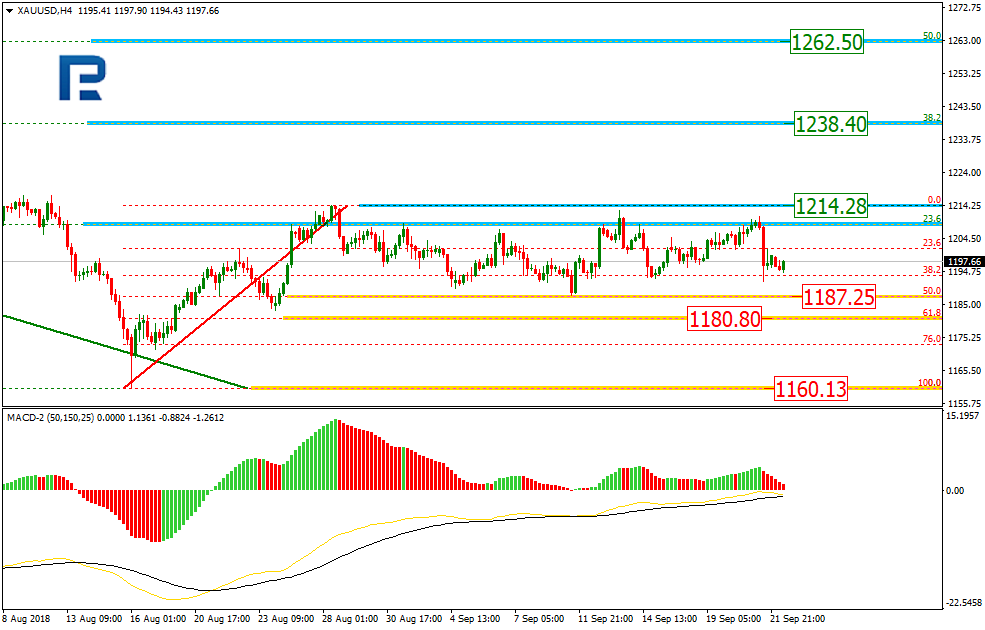
On H4, gold is moving inside a correctional range after hitting 23.60% Fibo. The primary 50% impulse has been corrected, and the price may now head to 61.80 at $1,180.80. After hitting the current high at $1,214.28, the price may correct upwards to 38.20%, or $1,238.40, and 50.00%, or $1262.50.

GOLD1
Risk Warning: the result of previous trading operations do not guarantee the same results in the future

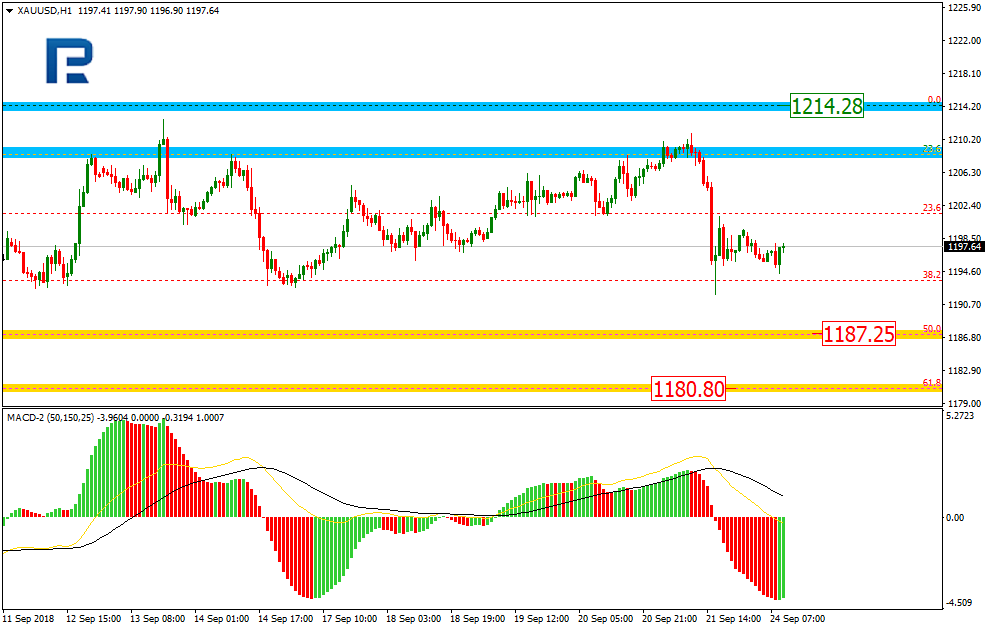
On H1, gold is moving down, heading towards 50.00%% ($1187.25) and 61.80% ($1,180.80).

GOLD2
Risk Warning: the result of previous trading operations do not guarantee the same results in the future

USD/CHF

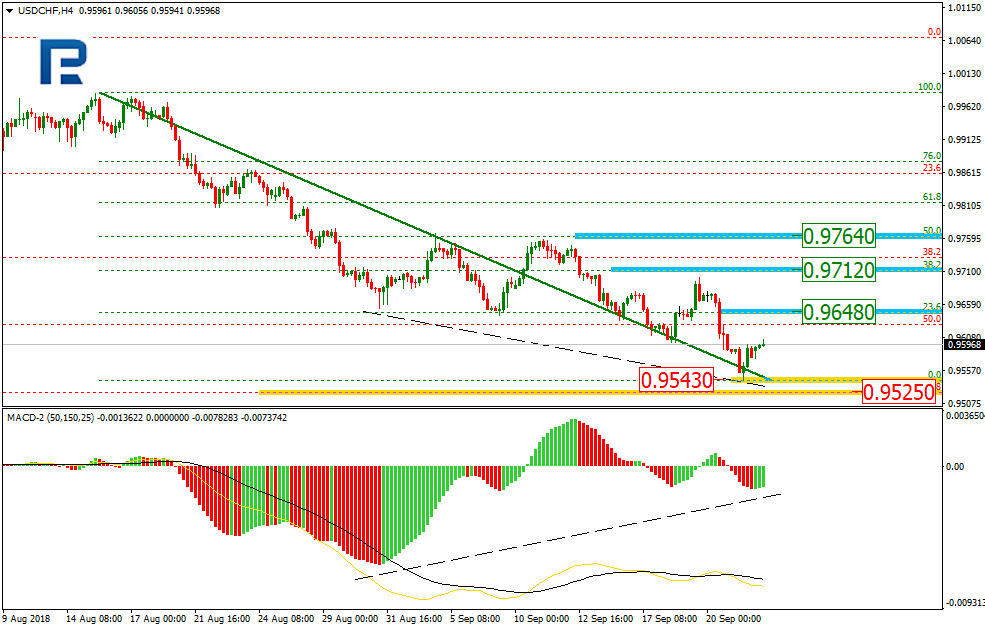
On H4, the USD/CHF is downtrending and approaching 61.80% Fibo (0.9525). Meanwhile, the convergence is forming, which mean the price may pull back to 23.60% (0.9648), 38.20% (0.9712), and 50.00% (0.9764), the support being at 0.9543.

USDCHF1
Risk Warning: the result of previous trading operations do not guarantee the same results in the future

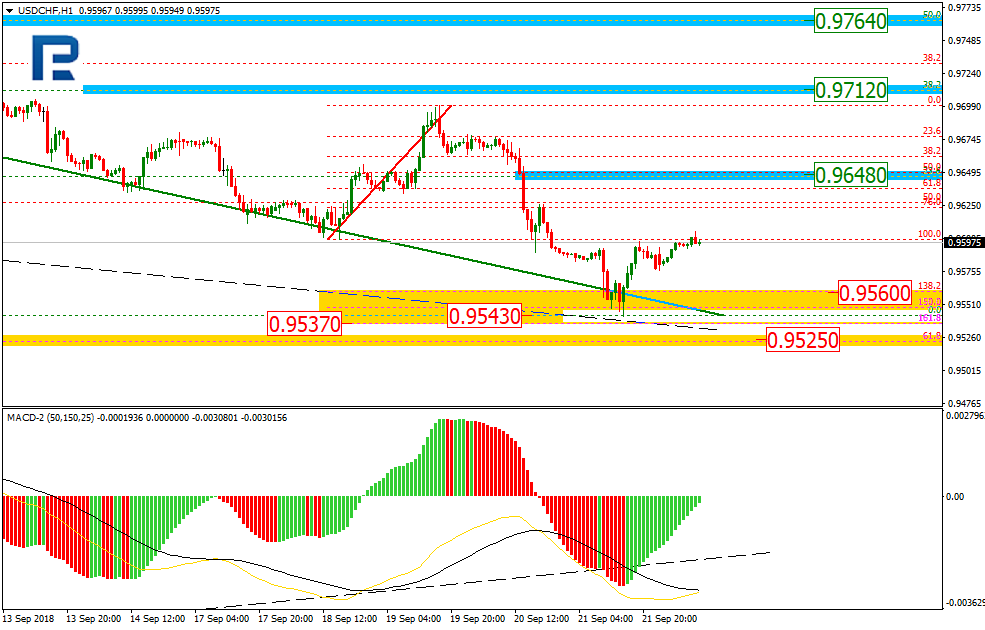
On H1, the price has tested the post correctional extension at 138.20%-161.80% (0.9560-0.9537) with a new downtrend impulse, and may now get back to test it once more.

USDCHF2
Risk Warning: the result of previous trading operations do not guarantee the same results in the future

Article By RoboForex.com

Attention!
Forecasts presented in this section only reflect the author’s private opinion and should not be considered as guidance for trading. RoboForex LP bears no responsibility for trading results based on trading recommendations described in these analytical reviews.

Tech Analysis: EUR/USD, GBP/USD, USD/CHF, USD/JPY, AUD/USD, USD/RUB, GOLD, BRENT; 24.09.2018

Article By RoboForex.com

EURUSD

The EUR/USD is trading within the first downward wave and may reach 1.1722 today. Then, it may go down to 1.1765, and fall back to $1.1660,i.e. a local target.

EURUSD
Risk Warning: the result of previous trading operations do not guarantee the same results in the future

GBPUSD

The GBP/USD is being under pressure; today, it may reach 1.3027, but then a pullback to 1.3165 might occur. Then, a downtrend may start, with the target at 1.2895.

GBPUSD
Risk Warning: the result of previous trading operations do not guarantee the same results in the future

USDCHF

The USD is rising against the franc within the first upward wave and may reach 0.9600 today. Then, a pullback to 0.9570 is possible, and then another rise (wave 3) to 0.9630.

USDCHF
Risk Warning: the result of previous trading operations do not guarantee the same results in the future

USDJPY

The USD/JPY is trading within the first downward wave with the target at 112.25. Then, a rise to 112.60 is possible, and after that, it may go back to 111.66, i.e. a local target.

USDJPY
Risk Warning: the result of previous trading operations do not guarantee the same results in the future

AUDUSD

The AUDUSD got inside the first downward impulse, and today it may go down again, to reach 0.7222. Then, a rise to 0.7250 is possible, and after that, it may go back to 0.7160.

AUDUSD
Risk Warning: the result of previous trading operations do not guarantee the same results in the future

USDRUB

The USDRUB is still consolidating around the downward wave lows. Today, it may reach 66.00, and then pull back to 68.00. After that, it may go back to 65.65 again, which is going to be the first target.

USDRUB
Risk Warning: the result of previous trading operations do not guarantee the same results in the future

GOLD

Gold is downtrending, with the target at 1188.75. Then, a rise to 1199.80 is possible, and after that, it may go back to 1186.22 again.

GOLD
Risk Warning: the result of previous trading operations do not guarantee the same results in the future

BRENT

Brent crude is consolidating around $79.15. Today, it may break out the range and go up to reach $80.00, but then is likely to correct to 79.60. After that, it may rise back to $82.20 again.

BRENT
Risk Warning: the result of previous trading operations do not guarantee the same results in the future

Article By RoboForex.com

Attention!
Forecasts presented in this section only reflect the author’s private opinion and should not be considered as guidance for trading. RoboForex LP bears no responsibility for trading results based on trading recommendations described in these analytical reviews.

The Analytical Overview of the Main Currency Pairs on 2018.09.24

Analytics by JustForex

The EUR/USD currency pair

Technical indicators of the currency pair:
  • Prev Open: 1.17764
  • Open: 1.17401
  • % chg. over the last day: -0.23
  • Day’s range: 1.17368 – 1.17523
  • 52 wk range: 1.0571 – 1.2557

On Friday, the EUR/USD currency pair moved away from local highs. At the moment, the technical pattern is ambiguous. The EUR/USD quotes are testing local support and resistance levels: 1.17300 and 1.17700, respectively. The positions should be opened from these marks. The further growth of the EUR/USD currency pair is not excluded.

The news feed on 2018.09.24:
  • – German Ifo business climate index at 11:00 (GMT+3:00).

We also recommend paying attention to the speech by the ECB president Draghi.

EUR/USD

Indicators do not send accurate signals: the price has crossed 50 MA.

The MACD histogram is near 0 mark. There are no accurate signals.

Stochastic Oscillator is located in the neutral zone, the %K line is above the %D line, which indicates the growth of quotes.

Trading recommendations
  • Support levels: 1.17300, 1.16850, 1.16400
  • Resistance levels: 1.17700, 1.18000

If the price fixes above the resistance level of 1.17700, further growth of the EUR/USD quotes is expected. The movement is tending to 1.18000-1.18200.

An alternative may be the decrease of the EUR/USD currency pair to 1.16850-1.16400.

The GBP/USD currency pair

Technical indicators of the currency pair:
  • Prev Open: 1.32500
  • Open: 1.30749
  • % chg. over the last day: -1.43
  • Day’s range: 1.30963 – 1.31151
  • 52 wk range: 1.2361 – 1.4345

On Friday, aggressive sales were observed on the GBP/USD currency pair. The decrease in quotes exceeded 175 points. The British pound weakened significantly against the US dollar after Theresa May stated that Brexit negotiations were at an impasse. At the moment, the key trading range is 1.30700-1.31300. The positions should be opened from these marks.

Today, the news feed on the UK economy is calm.

GBP/USD

The price has fixed below 50 MA and 200 MA, which signals the power of sellers.

The MACD histogram is located in the negative zone, but above the signal line, which gives a weak signal to sell GBP/USD.

Stochastic Oscillator is in the neutral zone, the %K line is above the %D line, which indicates the bullish sentiment.

Trading recommendations
  • Support levels: 1.30700, 1.30200, 1.29700
  • Resistance levels: 1.31300, 1.31800, 1.32400

If the price fixes below the local support of 1.30700, further decline in the GBP/USD currency pair is expected. The movement is tending to 1.30200-1.30000.

An alternative may be the GBP/USD quotes growth to the local offer zone of 1.31800-1.32000.

The USD/CAD currency pair

Technical indicators of the currency pair:
  • Prev Open: 1.29042
  • Open: 1.29243
  • % chg. over the last day: +0.09
  • Day’s range: 1.29157 – 1.29276
  • 52 wk range: 1.2059 – 1.3795

The USD/CAD quotes are still in a sideways trend. A unidirectional trend is not observed. According to report published on Friday, the core retail sales index in Canada rose to 0.9% in August instead of 0.6%. Local support and resistance levels are: 1.29150 and 1.29500, respectively. We recommend looking for entry points to the market from these marks.

The news feed on the economy of Canada is calm.

USD/CAD

The price has fixed between 50 MA and 200 MA, which are dynamic support and resistance levels.

The MACD histogram is in the positive zone, above the signal line, which signals to buy USD/CAD.

Stochastic Oscillator is in the neutral zone, the %K line is below the %D line, which indicates the bearish sentiment.

Trading recommendations
  • Support levels: 1.29150, 1.28800
  • Resistance levels: 1.29500, 1.29900, 1.30300

If the price fixes below the local support of 1.29150, the USD/CAD quotes are expected to decline. The movement is tending to 1.28800-1.28500.

Alternative option. If the price fixes above 1.29500, it is necessary to consider purchases of USD/CAD. The target movement level is 1.29900-1.30300.

The USD/JPY currency pair

Technical indicators of the currency pair:
  • Prev Open: 112.440
  • Open: 112.422
  • % chg. over the last day: +0.07
  • Day’s range: 112.429 – 112.874
  • 52 wk range: 104.56 – 114.74

The technical pattern on the USD/JPY currency pair is ambiguous. At the moment, quotes are consolidating. Local support and resistance levels are: 112.450 and 112.700. We recommend paying attention to the US government bonds yield. Positions should be opened from the key levels.

The news feed on the economy of Japan is calm today.

USD/JPY

The price has fixed above 50 MA and 200 MA, which signals the power of buyers.

The MACD histogram is located near the 0 mark. There are no signals.

Stochastic Oscillator is in the neutral zone, the %K line has crossed the %D line. There are no accurate signals.

Trading recommendations
  • Support levels: 112.450, 112.150, 111.900
  • Resistance levels: 112.700, 112.900

If the price fixes above the resistance level of 112.700, the USD/JPY quotes are expected to rise. The movement is tending to 112.900-113.200.

Alternative option. If the price fixes below 112.450, we recommend looking for entry points to open short positions. The target movement level is 112.150-111.900.

Analytics by JustForex

The Dollar Index Has Recovered Some of the Losses

by JustForex

On Friday, the US dollar strengthened against the basket of major currencies. The US dollar index (#DX) closed in the positive zone (+0.33%). Demand for the American currency is still high. This week investors expect the Fed meeting, which will be held on September 25-26. Financial market participants believe that the regulator will raise the key interest rate by 25 basis points to 2.00%-2.25% per annum.

The British pound weakened significantly against the US dollar on Friday after Theresa May stated that Brexit negotiations were at an impasse. According to the Prime Minister, the EU rejected any proposals of the UK without suggesting alternatives.

On Friday, economic data were also published. Thus, the index of economic activity in the German manufacturing sector fell to 53.7 in September, while experts expected 55.7. The core retail sales index in Canada rose to 0.9% in August instead of 0.6%.

The “black gold” prices show positive dynamics. At the moment, futures for the WTI crude oil are testing a mark of $72.00 per barrel.

Market Indicators

On Friday, there was a variety of trends in the US stock market: #SPY (-0.54%), #DIA (+0.03%), #QQQ (-0.55%).

At the moment, the 10-year US government bonds yield is at the level of 3.07-3.08%.

The news feed on 24.09.2018:

– German Ifo business climate index at 11:00 (GMT+3:00).

We also recommend paying attention to the speech by the ECB president Draghi.

by JustForex

USDJPY: clean, technical setup

By Tomasz Wisniewski, Alpari

The new week starts with few very clean technical setups! This could be a great week for the technical traders. So, all speculators using price action should check this out!

The cleanest, and in my opinion, the best setup overall, is the USDJPY, where we have a nice buy signal. USDJPY has made the same correction 4 times in a row (grey)! It all started in the middle of September and since then, every bearish correction has come to around 45 pips. That’s the first thing. The second point is that the price defended the horizontal support at 112.4 (yellow). Slightly below that line was a mid-term upwards trend line (blue), which after today’s upswing looks pretty safe.

To sum up, all supports were defended and we are ready for a new bullish wave. The potential target for this movement is at 113.15, which is 50 pips higher than the current rate. This is just the first one though. In my opinion, using this momentum, we should go even higher. The buy signal is on as long as we stay above the yellow line. A breakout here is obviously possible but the probability is really low.

EURUSD: Movement is expected on the euro against Friday’s gains

By Gabriel Ojimadu, Alpari

Despite the strengthening of the US dollar on Friday, by the end of the week all major currencies, except the yen, showed gains. The highest gains were shown by the New Zealand dollar (+ 2.05%). The Australian dollar gained 1.87%, the euro – 1.08%, the Canadian dollar – 0.99%, the Swiss franc 0.96, and the British pound – 0.09%. The Japanese yen fell by 0.45%.

Fig 1. Last week’s USD dynamics.

Previous:

On Friday, trading on the EURUSD pair closed down. The single currency began to lose ground to the dollar in the European session after hitting new all-time highs, and accelerated the fall in the US session following the British pound.

The British pound dropped by 220 pips (to 1.3054). On Friday, British PM Teresa May announced that negotiations with the EU on the issue of Brexit had reached a dead end, which caused the euro to fall to 1.1733.

Day’s news (GMT+3):

  • 11:00 Germany: IFO business climate (Sep), current assessment (Sep), expectations (Sep).
  • 13:00 UK: CBI industrial trends survey – orders (MoM) (Sep).
  • 15:30 Canada: wholesale sales (MoM) (Jul).
  • 15:30 US: Chicago Fed National Activity Index (Aug).
  • 16:00 Eurozone: Draghi ECB speech.

Fig 2. EURUSD hourly chart.

Current situation:

Expectations on Friday were fully justified. The price was adjusted to the lb balance line.

In Asia, the dollar is trading in positive territory, so the euro is now declining along with other major currencies. It currently sits at 1.1734. Euro crosses are almost all in the green zone. With such allies, the support at 1.1725 should stand. I’m seeing a correction in place with regards to Friday’s drop.

Now traders have their attention focused on the Federal Reserve System (FRS) meeting, which will be held on the 25th and 26th of September, and Brexit news. As for the meeting, everyone is expecting an a rate increase of 0.25 – up to 2-2.25% per annum. The rate increase is included in the price, so the Fed’s trading and commerce will be of interest when it comes to other increases this year.

Source: EURUSD: Movement is expected on the euro against Friday’s gains