Author Archive for InvestMacro – Page 339

EURUSD: correction offers euro bulls new chance to recover losses

By Matthew Anthony, Alpari

Previous:

ECB President Mario Draghi’s press conference was the key event on Thursday. Following the meeting, the governing council of the ECB decided to leave interest rates in the Eurozone unchanged. The refinancing rate remained at 0.00%. The decision coincided with the market forecast, so there was no noticeable reaction to it.

At the beginning of ECB President Draghi’s press conference, the euro rose to 1.1433. From there, it fell 77 pips to 1.1356. Draghi thus collapsed the euro with his statement. He said that the ECB will not act as a mediator in resolving the problems plaguing Italy.

Why did the market respond to this statement by selling the euro? The fact is that if the ECB does not intervene in a timely manner, then because of the growth in Italian government bond yields, large banks will find themselves in a difficult situation.

Day’s news (GMT+3):

  • 15:30 US: GDP annualized (Q3).
  • 17:00 US: Michigan CSI (Oct).
  • 20:00 US: Baker Hughes US oil rig count.

Fig 1. EURUSD hourly chart.

Current situation:

The price rebounded from the LB balance line on Wednesday and Thursday, during the press conference. The 67th degree acted as a support for buyers, and a resistance for sellers. Now the price is in the corrective phase. Considering that a bullish divergence formed between the price and the AO, according to the forecast, I expect the price to return to the LB balance line. The forecast was made before the US session. And it is not yet known how stock indices will behave before the weekend.

Today is Friday, so without negative news from Italy, buyers will be able to raise the rate to 1.1409 as part of the correction. If the week closes before 1.14, the weekly breakout of the trend line will be fixed. Growth to 1.1440 will fix the reversal of the downward movement.

What US rate rises say about its growth?

By Amram Margalit – Leverate

What US rate rises say about its growth?

Last month, the US Federal reserve raised interest rates for the eighth time since late 2015. The Fed has “penciled-in” a further rate rise in December, when the Fed next meets. Current projections are that the Federal benchmark will hit 3.4% by 2020, with three rises expected over 2019.

The September minutes from the Fed meeting showed that the majority of Fed reserve officials believe that rate increases are needed to “slow down the economy”, with some conjecture as to how long a restrictive policy should be instituted. It seems that the Fed believe that some delicacy is needed to balancing the economy; tightening too quickly, will cause the economy to weaken, yet too slowly, will prompt inflationary pressures.

The decision by the Fed was in relation to current firming in inflationary pressures, which Federal officials believe will “modestly” exceed the 2% annual target. In addition, the sentence describing the current conditions and monetary policy as “accommodative” was removed. Fed officials were quick to clarify the meaning behind this decision, with Jay Powell, Fed Chairman, indicating that the change in language “does not mean that the policy is not accommodative”, with other officials noting that the language was simply outdated and should be removed prior to rates approaching a neutral stance.

Despite the decision on the language of the Federal reserve, it is clear that the position taken by the Fed is one that is intended to create a slowdown due to increased inflationary pressures. The early increases in interest rates in 2015 were needed to normalize the levels after the years of zero interest rates in the wake of the Great Depression of 2008, where the rate increases were in fact designed to be “accommodative”.

The recent inflationary pressures that the Fed cited are largely due to recent political factors. Over the last year, the Trump administration has provided support for taxation cuts, which has stimulated economic growth in the US. At this stage of the economic recovery post QE, the further need for interest rate rises shows the prospects of dangerous overheating.

As it stands, the US economy is in the process of an unusually long bull run since the conclusion of the Great Depression. This is despite the instability caused by the Trump administration’s war on tariffs that appear to be throwing world markets into turmoil. Or perhaps, as the intended beneficiaries of these tariff wars, the US economy is looking towards a brighter future. Certainly, the impact of steel and aluminum tariffs on Chinese imports has yet to be felt in the US economy.

Indeed, the Fed is bullish over the long term, despite the “uncertainty regarding trade policy”. Markets appear to be less certain and having priced in interest rate increases, appear to be continuing the bull market while keeping a close eye on wages, inflation, imports and commodities. But volatility is high and the bond market, while increasing, does not yet seem to show that it believes in the US’s strength for economic recovery.

The Fed is watching closely to see what impact its rises will have on a strong economy. The markets are also waiting and watching to see how this will impact the continued recovery of the US economy. For now, all appears to be well, and the US economy continues to grow in strength.

About the Author:

Amram Margalit is a professional writer who has worked in a wide range of settings, including technology companies, nonprofits, and the entertainment industry. Within these positions, Amram has provided quality content and advertising services and is currently the Content Manager at Leverate.


Batten Down The Hatches, Mates!

By TheTechnicalTraders.com

Get ready for some crazy price trends in the US markets as investors react to earnings, housing data and overall re-evaluations of future objectives.  As we warned on September 17 with this post and on October 1 with this post, we believed the future Q3 earnings weeks and the 2~4 weeks leading into the US Mid-term elections could be very volatile.  We even suggested a 5~8% price correction was expected to start after September 21~24.

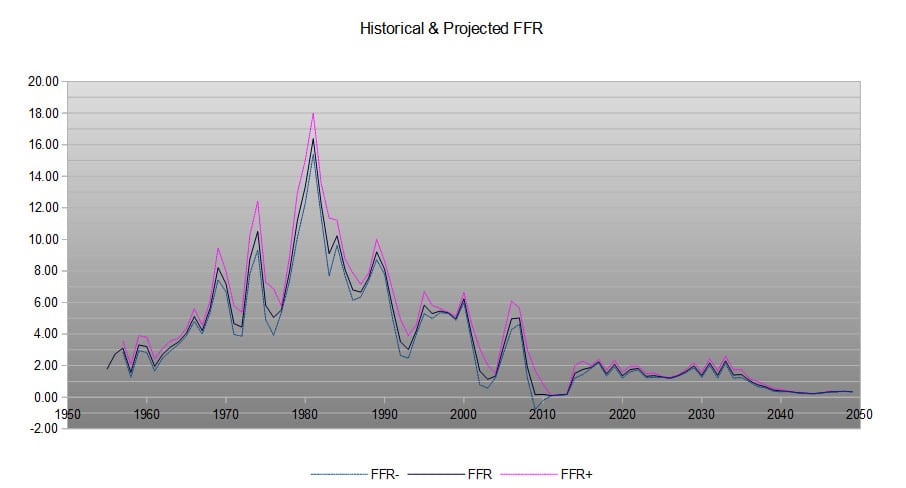
What we did not expect is the Federal Reserve to raise rates, again, on September 26 – just days before the Q3 Earnings season actually started.  Our price models for the Fed Funds Rates have suggested that any move above 2% FFR would put pricing pressures on homes and other assets.  This research we completed was first published in 2015 here.  This was the first time we illustrated our Fed Funds Rate Adaptive Learning modeling systems results.  The chart within this article that shows that our model expected the US Fed to begin increasing interest rates in 2014~2015 to levels near 0.75~1.25.  From that point, a gradual increase towards 2.0 was expected prior to 2018~19.  Our price modeling system then expected a decrease in the FFR from 2.0% to between 1.5~1.75%.

The reason our model expected this decrease in the FFR near current time is because the balance between growth of asset values, credit expansion and consumer’s ability to navigate efficiently within these constructs becomes very constrained above 2%.  In other words, as soon as the US Fed raising rates above 2%, they risk blowing holes in the economic recovery simply because it will outpace consumers ability to borrow and repay in an efficient manner.

We continue to believe this is the root of what is transpiring in the US Equity markets currently as a crush or reality has hit traders and investors as the housing, trade, Fed and other data is hitting the news wires.  So far, the earnings release have not been anything but a success when you look at the real data.  Nearly 75%+ of the total earnings announced as I write this post have been positive.  Yet, the markets collapsed on news related data and home sales data.  With more of this data streamed into the news cycle, we can only expect one thing to happen – a continued washout or price near recent lows or slightly lower as investors continue to digest this data and react to perceived weakness.

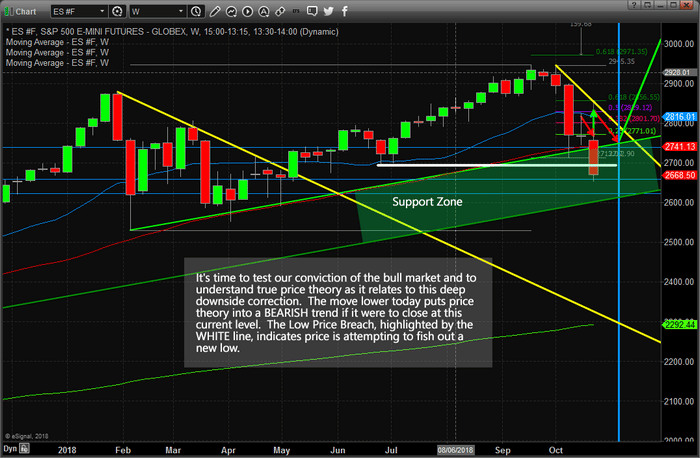
We urge you to understand the longer-term perspective of the markets and to understand true price theory as it relates to actual price highs and lows.  Right now, all indications are that we have entered a deeper price correction that has initiated an intermediate term bearish trend.  As of the close of Wednesday, Oct 24, price has breached recent critical price lows that has initiated this new intermediate bearish price trend.  If price can’t recover above these levels before the end of this week, then we will have a confirmed intermediate bearish price trend.  Yet, the ultimate low from February 2018 is still active as key support and a key price level that would need to be breached before we could call this a “new bear market trend”.  Right now this is just a price correction – yes, a DEEP price correction.  Those February 2018 lows are the ultimate test for a new bearish trend to setup.

This Weekly ES chart, below, helps to put everything into perspective in terms of what we are actually seeing transpire in the markets.  If you have been following our analysis, we’ve called for the markets to move lower heading into a November 8~12 ultimate price bottom before turning around and heading much higher throughout the end of this year and early into 2019.  The GREEN support zone is part of our key analysis that support our belief that this is nothing more than a very deep “washout low” price rotation happening right now.  The WHITE line on this chart shows the key price lows that are currently at risk in traditional price theory rotation.  A breach of that White line by the end of this week would indicate that we could see much further downside price movement – possibly to test the lower Support Zone level.  Beyond this analysis, the ultimate price low that is holding us back from calling this a “new bearish trend” is that February 2018 price low near 2529.75.  As long as price stays above that level, the overall bullish price trend is still in place.

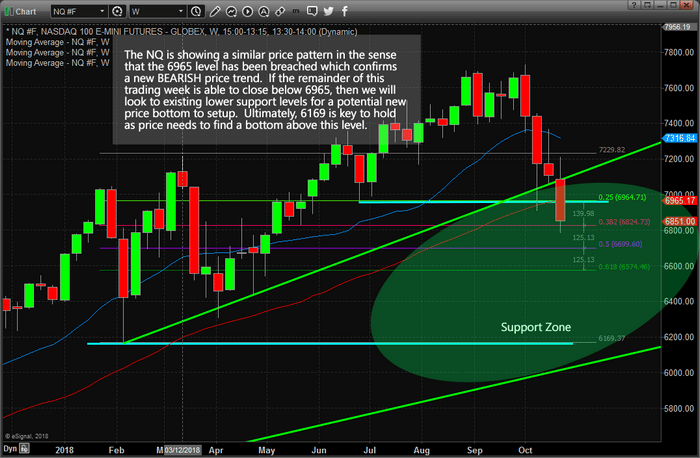
This Weekly NQ chart helps to understand how the deeper NASDAQ price rotation has played out and where the true support and critical price levels are located.  The Support Zone in the NQ is much larger than in the ES.  This is because the price expansion in the NQ has been much greater than in the ES – thus, the range between current and long-term support is greater.  Additionally, we have critical price lows from February 2018 near $6164.  Although the recent price moves lower have seemed massive and a crisis like event, we are talking about 10.5% downside correction.  To give that some perspective, the correction in March 2018 in the NQ was a total of about -11.5%.  The price correction near the end of 2015~2016 in the NQ was about -18%.  The price correction near the end of 2012 in the NQ was a total of about -13%.  Want to know what happened after all of these various deeper price corrections – the market moved MUCH HIGHER.

Please pay attention to our research and our predictive modeling systems.  Skilled traders attempt to find opportunities in any market condition and execute for success no matter what the markets are doing.  Keeping a calm and rational head through all of this is critical to being able to achieve success.

Visit www.TheTechnicalTraders.com to understand how we help our members navigate these markets move and find success each day.  Remember, these huge moves create incredible opportunities for skilled traders.  Visit www.TheTechnicalTraders.com/FreeResearch/ to read all of our research posts and learn why we are still bullish going forward.

Chris Vermeulen


The USMCA Quest for ‘America First’ World Trade

By Dan Steinbock

The era of post-1945 multilateralism is fading. After the revised NAFTA, Trump’s dream is U.S.-dominated world trade and the ‘America FirstAsian Century, says Dan Steinbock.

President Trump seeks to redefine all major free trade agreements on the basis of U.S. economic and geopolitical leverage.

In these efforts, the United States Mexico Canada Agreement (USMCA) is likely to serve as a blueprint.

From NAFTA to U.S. First North America

Despite all Trump’s hyperbole, the USMCA reads like a mix of Clinton’s NAFTA and Obama’s Trans-Pacific Partnership (TPP). Within North America, the treaty will tighten current restrictions on North American vehicle content and introduce new rules for manufacturing in high-wage factories, mainly in the U.S. and Canada, though it may leave major supply networks largely intact. Moreover, NAFTA’s dispute settlement mechanism, which the U.S. would have liked to eliminate, will carry over into the USMCA.

To investors, businesses and consumers, the net effect means rising costs.

Internationally, the effects will be more ambiguous but potentially consequential. The contract is mined with fine-print clauses designed against possible Canadian or Mexican deals with a “non-market economy” (read: China) – which, through the USMCA, Trump would like to extend into all other major U.S. free trade agreements.

What’s worse is that some provisions could make it easier for companies to challenge climate and environment regulations in the three countries, even before they are adopted. In this way, the USMCA has the potential to extend the Trump administration’s pollution agenda and thus prolong its climate damage legacy for years after he leaves the office, despite the just-released UN (IPCC) warning about impending global climate risks.

From the failed FTAA to U.S.-South America trade?

In the 1990s, President Clinton hoped to extend the NAFTA into a Free Trade Agreement of the Americas (FTAA). Venezuela’s Hugo Chavez condemned it as a “tool of imperialism.” Latin America’s leaders, including then-presidents of Brazil, Luiz Inácio Lula da Silva, and Argentina, Néstor Kirchner, demanded the pact eliminate U.S. agriculture subsidies and offer access to South American producers to U.S. markets. Yet, instead of opening South America to free trade, the FTAA split the region into two blocs, as President Lula had predicted.

Like the Reagan administration in the 1980s, the Trump White House is willing to resort to hard power and is now in a better position to superimpose U.S. trade terms on South America.

After the ‘soft coup’ in Brazil and the controversial imprisonment of former President Lula to prevent his likely victory in the 2018 presidential election, the first-round triumph of the extreme-right ex-paratrooper Jair Bolsonaro bodes well for U.S. efforts. Bolsonaro is an admirer of its military dictatorship (1964-85), which heralded the rise of Chile’s Pinochet, Latin American juntas and Operation Condor; the U.S.–backed campaign of political repression and terror by right-wing dictatorships. In Argentina, the pro-U.S. President Mauricio Macri has undermined the economy with a $50 billion deal with the International Monetary Fund (IMF) that led interest rates to a world record 60 percent.

In brief, the bargaining position of the key South American economies is currently significantly lower than it was only a decade ago. Nevertheless, an ‘America First’ South America deal will not materialize without resistance, thanks to Trump’s controversial immigration policies, and U.S. withdrawal from international trade and climate change agreements.

Stalemate in U.S.-EU trade talks

When President Obama began talks on the Transatlantic Trade and Investment Partnership (TTIP) in early 2013, EU leaders were divided over goals and the Democratic White House was constrained by a Republican-controlled Congress. As the talks dragged out, transatlantic goals faced new head winds across Europe, where free trade is increasingly opposed and mainstream parties felt uneasy with the secret and opaque TTIP negotiating process.

Trump has alienated and weakened German Chancellor Angela Merkel. French President Macron has stated that he is not in favor”of a “TTIP-style” U.S. deal. European public opinion is vehemently against the Trump White House. The series of disagreements between Washington and Brussels extend from trade and protectionism to the Iran nuclear deal, and the U.S. withdrawal from the Paris Accord. Moreover, the impending UK Brexit clouds projections.

Despite a short-term trade truce last July, the EU has warned that Trump’s pressure tactics will not work with Brussels. The outgoing European Commission president Jean-Claude Juncker has gone further highlighting the dependence of the US dollar on the euro, saying, “It is absurd that Europe pays for 80 percent of its energy import bill, worth €300bn a year, in U.S. dollars when only roughly 2 percent of our energy imports come from the United States.”

In brief, Brussels is posturing, positioning and transacting with Trump; just as Trump is with Brussels. The historical stress on “common values and interests” hasn’t crumbled but is eroding.

Toward ‘America First Asian Century

In Asia Pacific, the most dynamic world region, Trump killed the TPP during his first day in office. More recently, he has considered rejoining a revised TPP, but only if the U.S. is granted a “better deal.” In turn, some TPP-11 participants hope Trump will prove a one-term president and U.S. withdrawal will be reversed after 2020. Others have joined China-led talks at a Regional Comprehensive Economic Partnership (RCEP).

An Asia Pacific USMCA will not be an easy sell in the region. Even America’s allies – Japan and South Korea – feel unsettled about new protectionism. But as before, Trump is likely to use geopolitics as leverage to get an economic deal he wants.

Irrespective of the outcome of the mid-term elections, Trump is likely to push a new Asia Pacific alignment, which strategically will seek to cement America’s Indo-Pacific Vision to contain China’s rise. Economically, it aspires to neutralize China’s One Road One Belt initiative. Militarily, it is exploiting the “freedom of navigation” doctrine to dominate the South China Sea as 60 percent of U.S. naval fleet will be transferred into the region by 2020.

If U.S. protectionism will undermine free trade in Asia Pacific, the regional extension of the USMCA could prove more ‘moderate’ than initially projected, but it would split the region, seek to undermine China’s rise and thus derail the highly-anticipated Asian Century.

What Trump wants is an ‘America First’ Asian Century.

About the Author:

Dan Steinbock is the founder of Difference Group and has served at the India, China and America Institute (US), Shanghai Institute for International Studies (China) and the EU Center (Singapore). For more, see http://www.differencegroup.net/     

A shorter version of this commentary was released by South China Morning Post (Hong Kong) on October 25, 2018



Ichimoku Cloud Analysis 25.10.2018 (AUDUSD, NZDUSD, USDCAD)

Article By RoboForex.com

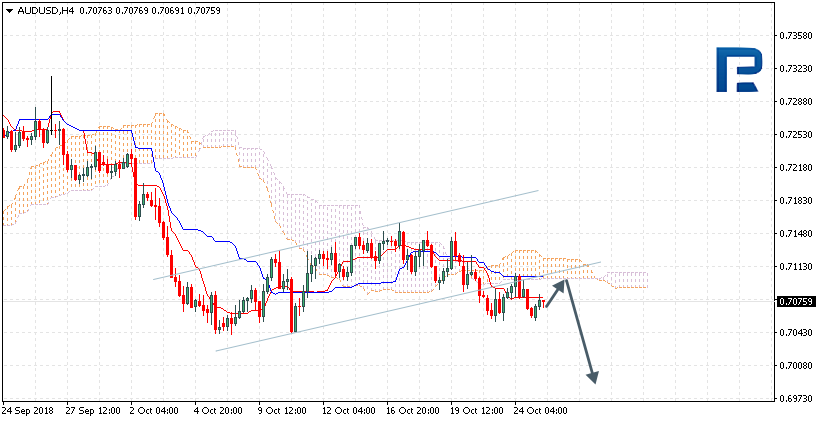
AUDUSD, “Australian Dollar vs US Dollar”

AUDUSD is trading at 0.7075; the instrument is moving below Ichimoku Cloud, thus indicating a descending tendency. The markets could indicate that the price may test the downside border of the cloud at 0.7090 and then resume moving downwards to reach 0.6990. Another signal to confirm further descending movement is the price’s rebounding from the channel’s downside border. However, the scenario that Implies further decline may be cancelled if the price breaks the upside border of the cloud and fixes above 0.7135. In this case, the pair may continue growing towards 0.7250.

AUDUSD
Risk Warning: the result of previous trading operations do not guarantee the same results in the future


NZDUSD, “New Zealand Dollar vs US Dollar”

NZDUSD is trading at 0.6523; the instrument is moving inside Ichimoku Cloud, thus indicating a sideways tendency. The markets could indicate that the price may test Tenkan-Sen and Kijun-Sen at 0.6535 and then resume moving downwards to reach 0.6455. Another signal to confirm further descending movement is the price’s rebounding from the resistance level. However, the scenario that Implies further decline may be cancelled if the price breaks the upside border of the cloud and fixes above 0.6590. In this case, the pair may continue growing towards 0.6690.

NZDUSD
Risk Warning: the result of previous trading operations do not guarantee the same results in the future


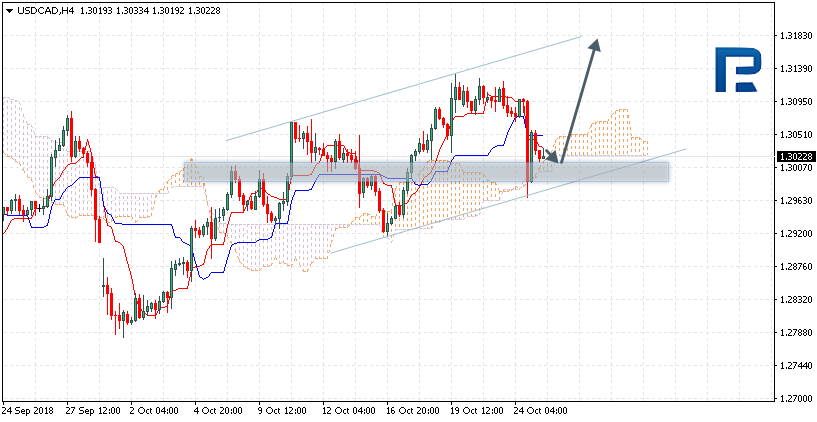
USDCAD, “US Dollar vs Canadian Dollar”

USDCAD is trading at 1.3022; the instrument is moving above Ichimoku Cloud, thus indicating an ascending tendency. The markets could indicate that the price may test the upside border of the cloud at 1.3020 and then continue moving upwards to reach 1.3185. Another signal to confirm further ascending movement is the price’s rebounding from the support level. However, the scenario that implies further growth may be cancelled if the price breaks the downside border of the cloud and fixes below 1.2965. In this case, the pair may continue falling towards 1.2875.

USDCAD
Risk Warning: the result of previous trading operations do not guarantee the same results in the future

Article By RoboForex.com

Attention!
Forecasts presented in this section only reflect the author’s private opinion and should not be considered as guidance for trading. RoboForex LP bears no responsibility for trading results based on trading recommendations described in these analytical reviews.

The Yen is in demand. Overview for 25.10.2018

Article By RoboForex.com

On Thursday, USDJPY continues falling; investors need “safe haven” assets.

The Japanese Yen continues rising against the USD on Thursday. The current quote for the instrument is 112.25.

Over the last 24 hours, global capital markets were dominated by aggressive sellers and many of first world countries and developed economies suffered pretty much. Due to such numerous sales, investors’ demand for “safe haven” assets increased significantly, including the Yen. Probably, it may continue for a while in the nearest future.

According to the Deputy Governor of the Bank of Japan Masazumi Vakatabe, any attempts to influence the Japanese balance “bloated” with assets by tightening the regulator’s monetary policy may turn very nasty. Being a supporter of the BoJ’s current strategy, Vakatabe usually stands up for the regulator’s monetary approach and believes that the country should continue its soft policy. In his speeches, he fights any attempts to decrease the QE program efficiency.

Of course, no one is trying to hide the real “cost” of the monetary policy held (both in the past and the future) by the Bank of Japan. It’s quite obvious that such policy increases the Japanese national debt, but the regulator believes that it should try reach its fiscal targets first and deal with the extra debt issue later.

Article By RoboForex.com

Attention!
Forecasts presented in this section only reflect the author’s private opinion and should not be considered as guidance for trading. RoboForex LP bears no responsibility for trading results based on trading recommendations described in these analytical reviews.

The Analytical Overview of the Main Currency Pairs on 2018.10.25

Analytics by JustForex

The EUR/USD currency pair

Technical indicators of the currency pair:
  • Prev Open: 1.14698
  • Open: 1.13914
  • % chg. over the last day: -0.63
  • Day’s range: 1.13913 – 1.14199
  • 52 wk range: 1.1299 – 1.2557

During yesterday’s trading, the euro continued to lose ground against the US dollar. EUR/USD fell by more than 80 points and updated local minima. Weak statistics on economic activity in Germany and the Eurozone put pressure on the single currency. At the moment, the trading instrument is consolidating in the range of 1.13850-1.14200. Investors took a wait-and-see attitude before the ECB meeting. It is expected that the regulator will keep the main parameters of monetary policy at the same level. We recommend paying attention to the comments and rhetoric by the Central Bank representatives.

The news feed on 25.10.2018:
  • – The ECB decision on interest rate at 14:45 (GMT+3:00);
  • – Statistics on orders for durable goods in the United States at 15:30 (GMT+3:00);
  • – The index of pending sales in the US real estate market at 17:00 (GMT+3:00).
EUR/USD

The price has fixed below 50 MA and 200 MA, which indicates the power of the sellers.

The MACD histogram is in the negative zone, but above the signal line, which gives a weak signal to sell EUR/USD.

The Stochastic Oscillator is in the neutral zone, the% K line is below the% D line, indicating a drop in EUR/USD quotes.

Trading recommendations
  • Support levels: 1.13850, 1.13500, 1.13000
  • Resistance levels: 1.14200, 1.14500, 1.14850

If the price fixes below the local support level of 1.13850, a further fall in the EUR/USD quotes is expected. The movement is tending to 1.13300-1.13000.

Alternative option. If the price fixes above 1.14200, it is necessary to look for entry points to the market in order to open long positions. The movement is tending to 1.14500-1.14850.

The GBP/USD currency pair

Technical indicators of the currency pair:
  • Prev Open: 1.29821
  • Open: 1.28794
  • % chg. over the last day: -0.76
  • Day’s range: 1.28732 – 1.29195
  • 52 wk range: 1.2662 – 1.4378

Yesterday aggressive sales were observed on the GBP/USD currency pair. Drop in quotes exceeded 100 pips. The trading instrument has set new monthly lows. At the moment, the pound is in a sideways trend. Local levels of support and resistance are: 1.28750 and 1.29250, respectively. Positions must be opened from these marks. The GBP/USD quotes are tending to decline.

Publication of important economic reports from the UK is not planned.

GBP/USD

The price has fixed below 50 MA and 200 MA, which indicates the power of sellers.

The MACD histogram is in the negative zone, but above the signal line, which gives a weak signal to sell GBP/USD.

Stochastic Oscillator is in the neutral zone, the %K line has crossed the %D line. There are no signals at the moment.

Trading recommendations
  • Support levels: 1.28750, 1.28400, 1.28000
  • Resistance levels: 1.29250, 1.29850, 1.30200

If the price fixes below the support level of 1.28750, a further fall in the GBP/USD currency pair is expected. The movement is tending to 1.28400-1.28000.

Alternative option. If the price fixes above 1.29250, it is necessary to consider buying GBP/USD. The movement is tending to 1.29600-1.29850.

The USD/CAD currency pair

Technical indicators of the currency pair:
  • Prev Open: 1.30839
  • Open: 1.30556
  • % chg. over the last day: -0.28
  • Day’s range: 1.30154 – 1.30567
  • 52 wk range: 1.2248 – 1.3387

Yesterday, the bearish sentiment prevailed on the USD/CAD currency pair. Trading instrument updated local lows. The Bank of Canada raised its key interest rate by 25 basis points to 1.75%. The demand for the Canadian dollar has increased significantly. At the moment, the USD/CAD quotes are consolidating in the range of 1.30200-1.30500. The USD/CAD currency pair is tending to decline. Positions must be opened from the key levels.

Today, the news feed on the Canadian economy is calm.

USD/CAD

Indicators do not send accurate signals: the price is testing 200 MA.

The MACD histogram is in the negative zone, but above the signal line, which gives a weak signal to sell USD/CAD.

Stochastic Oscillator is in the neutral zone, the %K line is above the %D line, which indicates the bullish sentiment.

Trading recommendations
  • Support levels: 1.30200, 1.29850, 1.29600
  • Resistance levels: 1.30500, 1.30800, 1.31200

If the price fixes below the local support of 1.30200, a further fall in the USD/CAD quotes is expected. The movement is tending to 1.29700-1.29500.

Alternative option. If the price fixes above 1.30500, the growth of the USD/CAD currency pair is expected. The target level for profit taking is 1.30800-1.31000.

The USD/JPY currency pair

Technical indicators of the currency pair:
  • Prev Open: 112.406
  • Open: 112.214
  • % chg. over the last day: -0.39
  • Day’s range: 111.819 – 112.363
  • 52 wk range: 104.56 – 114.74

The technical pattern on the USD/JPY currency pair is still ambiguous. At the moment, the trading instrument is testing local support and resistance levels: 112.000 and 112.350, respectively. Financial market participants expect additional drivers. Positions must be opened from the key levels. We recommend paying attention to the dynamics of US government bonds.

The news feed on the Japanese economy is calm.

USD/JPY

Indicators do not send accurate signals: 50 MA has crossed 200 MA.

The MACD histogram is in the negative zone, but above the signal line, which gives a weak signal to sell USD/JPY.

Stochastic Oscillator is located near the overbought zone, the %K line is above the %D line, which gives a weak signal to buy USD/JPY.

Trading recommendations
  • Support levels: 112.000, 111.650
  • Resistance levels: 112.350, 112.650, 112.900

If the price fixes above 112.350, the growth of the USD/JPY quotes is expected. The movement is tending to 112.650-112.900.

An alternative could be a decline in the USD/JPY currency pair to 111.650-111.500.

Analytics by JustForex

The US Dollar Index Has Updated Monthly Highs

by JustForex

The US dollar strengthened significantly against a basket of major currencies. The US dollar index (#DX) updated monthly highs and closed in the positive zone (+0.47%). The US currency strengthened even despite the weak report on new home sales. According to the report, in August, the value of sales was revised from 629K to 585K, and in September, the value counted to 553K and turned out to be worse than the forecasted level of 627K.

The growth of the dollar contributed to the decline of the euro and the British pound. The euro continued to fall due to uncertainty about the Italian budget project. Let us recall that the EU rejected the draft proposed by Italy and gave three weeks to correct it. Also, the euro was under pressure due to the German manufacturing activity index (PMI), which counted to 52.3 in September instead of 53.5.

The British pound is under pressure, as negotiations on Brexit have not resumed. Also, British Prime Minister, Theresa May, was criticized for her Brexit strategy.

The “black gold” prices have been declining. At the moment, futures for the WTI crude oil are testing a mark of $66.30 per barrel.

Market Indicators

Yesterday, aggressive sales were observed in the US stock market: #SPY (-3.03%), #DIA (-2.40%), #QQQ (-4.58%).

The 10-year US government bonds yield continues to decline. At the moment, the indicator is at the level of 3.11-3.12%.

The news feed 25.10.2018:

– German IFO business climate index at 11:00 (GMT+3:00);
– ECB interest rate decision at 14:45 (GMT+3:00);
– Core durable goods orders in the US at 15:30 (GMT+3:00);
– Pending home sales index in the US at 17:00 (GMT+3:00).

by JustForex

EURUSD: euro licking its wounds after yesterday’s drop

By Matthew Anthony, Alpari

Previous:

On Wednesday the 24th of October, the single currency lost significant ground against the greenback to reach the 1.1379 mark. The drop gained momentum in Europe after breaking through the 1.1440 support. I reckon the bears ditched their protective stop levels after this breakout on the back of uncertainty surrounding Italy, after which market participants adjusted their positions ahead of the ECB meeting. They’ll now be waiting to hear an answer as to whether or not the regulator will move their planned date for ending their bond-buying program, and when they plan to raise interest rates. Will Mario Draghi change his tone or not?

Day’s news (GMT+3):

  • 11:00 Germany: IFO – business climate (Oct), IFO – current assessment (Oct), IFO – expectations (Oct).
  • 14:45 Eurozone: interest rate decision.
  • 15:30 Eurozone: ECB monetary policy statement and press conference.
  • 15:30 US: initial jobless claims (19 Oct), durable goods orders (Sep), goods trade balance (Sep).
  • 17:00 US: pending home sales (Sep).

Fig 1. EURUSD hourly chart.

Current situation:

The upwards correction has come to nothing. In the European session, the pair jumped to 1.1477 before a sharp downwards reversal. Stop levels were activated below 1.1440. The drop came to an end at around the 90th degree. The weekly trend line runs through this level. If the weekly candlestick closes below 1.1400, sellers will aim for 1.1200.

I don’t make predictions for this pair on days where Mario Draghi has a press conference, just like on payrolls day. If we look at past behaviour of price movements ahead of ECB meetings, they tend to move against previous movements and trade within a narrow corridor for the 2-3 hours leading up to the press conference. It’s anyone’s guess where Draghi will send prices afterwards.

There’s a resistance at 1.1432. I think there are some stop levels here on short positions. There’s another set of stops at 1.1450. If the day closes above these, we can safely say that the pair has rebounded from the weekly trend line.

Bitcoin’s 10th anniversary: its dominance will decline, but crypto market will rise by 5000%

By George Prior

Bitcoin’s influence and dominance of the cryptocurrency sector will “drastically reduce” in its second decade, with the crypto market likely to expand by “at least” 5000% in the next 10 years.

These are the bold forecasts from Nigel Green, founder and CEO of deVere Group, one of the world’s largest independent financial advisory organizations, which launched deVere Crypto, the pioneering cryptocurrency app earlier this year.

His comments come a week ahead of 31st October celebrations to mark the 10th anniversary of Satoshi Nakamoto’s release of the Bitcoin whitepaper.

Mr Green states: “Next week Bitcoin, the original and still largest cryptocurrency by market capitalization, celebrates its 10th anniversary.

“Bitcoin is what kickstarted the crypto revolution and it has changed the way the world handles money, makes transactions, does business, and manages assets, amongst other things, forever.  It all began with Bitcoin.”

He continues: “However, whilst I don’t wish to rain on anyone’s parade, I believe that Bitcoin’s influence and dominance of the cryptocurrency sector will drastically reduce in its second decade.

“This is because as mass adoption of cryptocurrency grows, more and more digital assets will be launched – by organizations in both the private and the public sectors. This will increase competition for Bitcoin and dent its market share.

“In addition, it is likely that Bitcoin will be hit by the superior technology, features, and problem-solutions, offered by existing and yet-to-be-released cryptocurrencies.”

Mr Green goes on to say: “There’s an ongoing shift away from fiat money, and the momentum of this is only set to increase over the next 10 years.

“The pace of mass adoption will speed-up and the cryptocurrency market cap can reasonably be assumed to reach at least 5000 per cent above its current valuation over the next decade.”

Today the cryptocurrency market is worth more than $400 billion, meaning it could reach the $20 trillion mark by the deVere CEO’s prediction.

He concludes: “A growing number of major institutional and retail investors, as well as financial institutions and regulators, amongst others, understand that cryptocurrencies are the future of money.

“As such, the market will have grown beyond recognition when Bitcoin celebrates its 20th anniversary.”

deVere Group is one of the world’s largest independent advisors of specialist global financial solutions to international, local mass affluent, and high-net-worth clients.  It has a network of more than 70 offices across the world, over 80,000 clients and $12bn under advisement.