Author Archive for InvestMacro – Page 338

The USD Index Is Testing the Monthly Maximums

by JustForex

This Friday the USD slightly weakened against the basket of the other currencies. The USD index closed in the negative zone (-0,33%). Particularly, the demand for the American currency holds. According to preliminary data, the US economic growth in the third quarter reached 3.5% instead of the predicted 3.3%.

The EUR is still under pressure since Mario Draghi expressed the possibility of extending the asset purchase program against the backdrop of political instability and a slowdown in the growth of the European economy. The ECB President noted that further stimulation of the economy is necessary. This week the investors are waiting for a Eurozone inflation report, which will be published this Wednesday.

Prices on oil are showing a downward trend. At the moment the WTI futures are testing 67.20 USD/barrel price.

Market Indicators

On Friday the major US stock indices significantly lowered: #SPY (-1,76%), #DIA (-1,30%), #QQQ (-2,57%).

The 10-year US government bonds yield keeps lowering. At the moment, it is on the 3,06-3,07%.

The Economic News Feed for 29.10.2018:

– Chancellor’s autumn forecast statement (UK) – 14:30 (GMT+2:00);

– Consumer Spending Trends (USA) – 14:30 (GMT+2:00).

by JustForex

EURUSD: a reversal pattern is forming as Italy’s debt outlook turns negative

By Matthew Anthony, Alpari

Previous:

At the end of last week, almost all major currencies showed a decline. The Briton showed the biggest decline against the US dollar (1.81%). The New Zealand dollar fell by 1.08%, the euro by 0.95%, the Australian dollar by 0.45%, the Swiss franc by 0.06%, and the Canadian dollar by 0.03%. The Japanese yen gained 0.57%.

The euro fell to 1.1336, and by the time trading closed for the day, buyers won back all their losses, updating the European high. US data and a decline in US bond yields exerted pressure on the US dollar. The fall in stock indices has resumed demand for the yen and US government bonds, and the increase in bond prices lowered their yield. Euro bulls met a resistance at 1.1421.

At the close of trading, the SP500 fell by 1.19%, the DJIA by 1.73%, and the NASDAQ by 2.06%. Sales of shares increased after the publication of quarterly reports by large corporations such as Amazon and Alphabet.

Day’s news (GMT+3):

  • 12:30 UK: net lending to individuals (MoM), mortgage approvals (Sep), consumer credit (Sep).
  • 14:00 UK: CBI Distributive Trades Survey – realized (MoM) (Oct).
  • 15:30 US: core personal consumption expenditure – price index (YoY) (Sep), personal income (Sep), personal spending (Sep).

Fig 1. EURUSD hourly chart.

Current situation:

The price recovered to the estimated level through a drop to 1.1336. Uncertainty around Italy and Brexit will prevent the pair from seeing any strong growth. Therefore, the euro is unlikely to rise any higher until the situation with Italy’s 2019 draft budget is resolved. The strengthening of the euro is possible against the background of the general weakening of the US currency.

At the moment I see two negative factors for the euro:

1. Standard & Poors (S&P) downgraded its outlook for Italy’s sovereign debt to negative (BBB-).

2. Italy’s Deputy Prime Minister Matteo Salvini said that the government will not change its course.

He also assured that no Italian bank will go bankrupt. Say what you will, but it is unlikely that investors will listen. The Italians do not want to repeat the fate of the Greeks and withdraw capital from the country, fearing that the fall in the euro will result in a banking crisis. The franc and the yen are acting as protective assets for them.

If information leaks to the media that Italian banks holding Italian bonds are having problems due to increasing yields on them, the euro will weaken on all fronts. How hard the fall will be will depend on how the media decides to report on it.

Today I wanted to consider a fall to the 67th degree, but our historic trend indicates a possible upwards reversal during the US session. In this regard, I’m anticipating a rebound from the 45th degree.

Source: EURUSD: a reversal pattern is forming as Italy’s debt outlook turns negative


The trade week ahead – Inflation

By FPMarkets.com

https://www.youtube.com/watch?v=jhWg-dSVHAI

Never forget that inflation is the one thing that keeps a central banker up a night. They may talk about employment and GDP and the like, but inflation (either hyper or hypo inflation) is the stuff of nightmares.

Therefore the 2 main economic events on the inflation front this week are:

  • US: Personal Consumption Expenditure (PCE) (look to the core read) – No nightmares yet, but US inflation has the potential to rapidly extend upwards. There has been some in the market that have suggested that the Fed has been too slow to increase rates as inflation is likely to ran pass the target rate. A snap upside movement would put pressure on its ‘gradual rate path’. The previous read from August was a surprise PCE slowed to its lowest level in 18 months. However the year-on-year figures still show that US PCE is at or near the Federal Reserve’s target of 2%. The consensus Monday nights read is YoY to remain at 2%, which will justify with the Fed’s current policy path of raising rates – if it pops pass this, the market will jump on the USD.


  • Australia’ Consumer Price Index (CPI). I suspect Philip Lowe and co are starting to understand the meaning of insomnia – the core mandate of the RBA is to maintain trimmed mean inflation between 2% and 3%. Since the third quarter of 2015 the core measures of CPI haven’t touch this level and until last quarter trimmed mean CPI had flatlined at 1.8% for six consecutive reads. Q2 did have some green shoot movements and seeing CPI increasing to 1.9% year-on-year. The reasoning; the employment boom has finally begun to eat into the employment slack and wage were beginning to shift. However the issue facing the RBA is housing; this has been a key driver of CPI. The change in housing in the third quarter is likely to be negative suggesting core inflation will spend another quarter below the target band and could even suggest its moving away once more, AUD I believe will suffer on Wednesday’s release.


One has to ask, is the RBA’s glass third quarters full view of the economy justified? There are three macro thematic issues facing the RBA’s neutral-Hawkish view.

  1. Housing and bank funding, housing market is already on the slide and global funding feed-throughs will market credit expensive over the coming 24 months – it could turn the RBA dovish
  2. China, the RBA is starting to acknowledge that the growth profile into China is slowing and again that could see the ¾ view shifting.
  3. AUD, the currency is in its favour currently however it has made no secret it would like it lower still. I have been very bullish on the USD for the last 18 months. However most strategist believe the USD appreciation will slow and could even reverse in the coming few quarters making Australian exports less competitive again – Another possible rethink

In short the RBA’s current stance although understandable could shift to dovish pretty quickly – the trade therefore is short AUD.


By FPMarkets.com


COT Report: Specs edge USD Index bets up. Gold, Copper bets rise. WTI Crude bets fall

By CountingPips.com – Receive our weekly COT Reports by Email

Here are this week’s links to the latest Commitment of Traders data changes that were released on Friday.

  • Forex Speculators edged US Dollar Index bets higher, Euro bets lower. MXN bets drop
  • WTI Crude Oil Speculators reduced their bearish bets for 4th straight week
  • 10-Year Note Speculators continued to sharply decrease their bearish bets
  • Bitcoin Speculators cut back on their bearish bets for 2nd week
  • Gold Speculators pushed their bullish net positions higher
  • S&P500 Mini Speculators raised their bullish bets after last week’s down week
  • VIX Speculators sharply decreased their bearish bets for 3rd week, to lowest since May
  • Silver Speculators sharply reduced their bearish bets for 2nd week
  • Copper Speculators lifted their bullish net positions for 2nd week

Forex Speculators edged US Dollar Index bets higher, Euro bets lower. MXN bets drop

US Dollar net speculator positions leveled at billion as of Tuesday

The latest data for the weekly Commitment of Traders (COT) report, released by the Commodity Futures Trading Commission (CFTC) on Friday, showed that large traders and speculators continued to slightly add to their bullish bets for the US Dollar Index while sharply betting against the Mexican peso this week. See full article


WTI Crude Oil Speculators reduced their bearish bets for 4th straight week

The non-commercial contracts of WTI crude futures totaled a net position of 455,278 contracts, according to data from this week. This was a slide of -37,951 contracts from the previous weekly total. See full article


Gold Speculators pushed their bullish net positions higher this week

The large speculator contracts of gold futures totaled a net position of 29,388 contracts. This was a weekly advance of 11,721 contracts from the previous week. See full article


10-Year Note Speculators continued to sharply decrease their bearish bets

The large speculator contracts of 10-year treasury note futures totaled a net position of -544,033 contracts. This was a weekly increase of 71,937 contracts from the previous week. See full article


S&P500 Mini Speculators raised their bullish bets after last week’s down week

The large speculator contracts of S&P500 Mini futures totaled a net position of 239,372 contracts. This was a rise of 12,580 contracts from the reported data of the previous week. See full article


Silver Speculators sharply reduced their bearish bets for 2nd week

The non-commercial contracts of silver futures totaled a net position of -5,179 contracts, according to data from this week. This was a weekly gain of 9,648 contracts from the previous totals. See full article


Copper Speculators lifted their bullish net positions for 2nd week

The large speculator contracts of copper futures totaled a net position of 9,347 contracts. This was a weekly boost of 429 contracts from the data of the previous week. See full article


Article by CountingPips.com – Receive our weekly COT Reports by Email

The Commitment of Traders report data is published in raw form every Friday by the Commodity Futures Trading Commission (CFTC) and shows the futures positions of market participants as of the previous Tuesday (data is reported 3 days behind).

To learn more about this data please visit the CFTC website at http://www.cftc.gov/MarketReports/CommitmentsofTraders/index.htm


Forex Speculators edged US Dollar Index bets higher, Euro bets lower. MXN bets drop

October 27th 2018 – By CountingPips.comGet our weekly COT Reports by Email

US Dollar Index speculator positions edged higher for 4th week

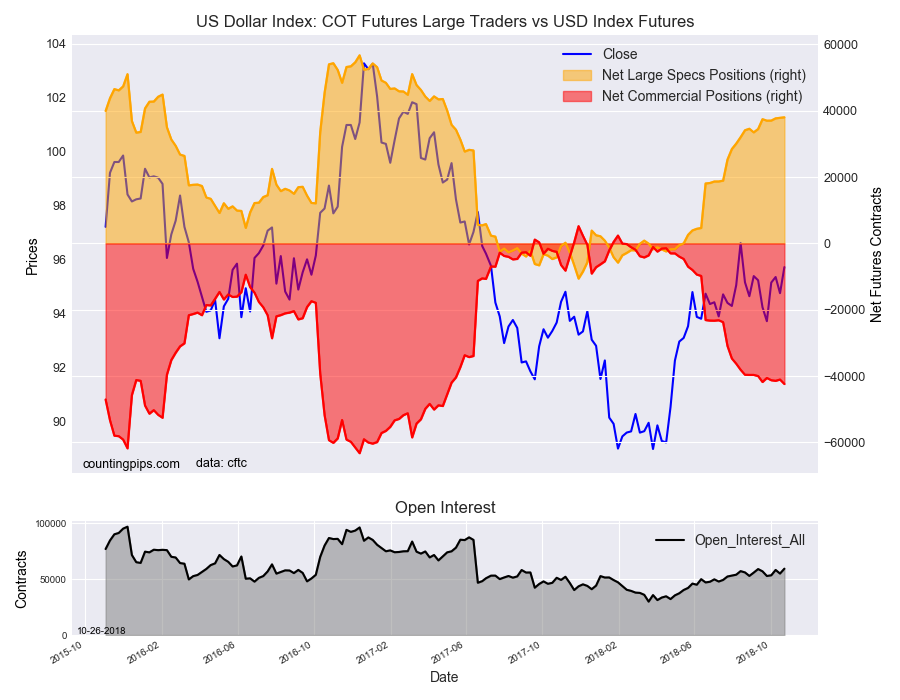
The latest data for the weekly Commitment of Traders (COT) report, released by the Commodity Futures Trading Commission (CFTC) on Friday, showed that large traders and speculators continued to slightly add to their bullish bets for the US Dollar Index while sharply betting against the Mexican peso this week.

The non-commercial futures contracts of US Dollar Index futures, traded by large speculators and hedge funds, totaled a net position of 38,028 contracts in the data reported through Tuesday October 23rd. This was a weekly increase of 152 contracts from the previous week which had a total of 37,876 net contracts.

The speculator position has edged higher for four straight weeks and continues to notch higher levels. Overall, the spec bullish position has now advanced for twenty-five out of the past twenty-seven weeks and remains at the highest standing since May 2nd of 2017.


Individual Currencies Data this week:

In the individual currency contracts data, we saw only one substantial change (+ or – 10,000 contracts) in the speculators category this week.

Mexican peso bets dropped sharply this week by over -10,000 contracts and fell for a second straight week after the peso sentiment had improved for the previous five weeks. Overall, the current standing remains bullish is above the +50,000 contract level. The peso is the only major currency with a bullish standing among the major currencies.

The major currencies that improved this week were the US Dollar Index (152 weekly change in contracts), British pound sterling (3,356 contracts), Japanese yen (7,817 contracts), Canadian dollar (3,791 contracts), Australian dollar (1,123 contracts) and the New Zealand dollar (2,364 contracts).

The currencies whose speculative bets declined this week were the euro (-960 weekly change in contracts), Swiss franc (-581 contracts) and the Mexican peso (-10,548 contracts).

Other Notables:

Euro positions dropped lower for a fourth straight week and is in bearish territory also for the fourth straight week. The current standing at over -30,000 contracts is at the most bearish level since March 14th of 2017.

New Zealand dollar positions rebounded a little bit this week (+2,364 contracts) and came off the record high bearish level of last week. The NZD still remains very bearish and above the -30,000 contract level for a sixth week in a row.

See the table and individual currency charts below.


Table of Weekly Commercial Traders and Speculators Levels & Changes:

CurrencyNet CommercialsComms Weekly ChgNet SpeculatorsSpecs Weekly Chg
EuroFx11,845-68-30,304-960
GBP66,529128-46,9973,356
JPY113,150-6,471-92,8047,817
CHF35,6084,657-17,105-581
CAD8,1581,284-7,2283,791
AUD89,932-2,973-70,3681,123
NZD37,272-2,929-33,0482,364
MXN-61,76911,15958,027-10,548


This latest COT data is through Tuesday and shows a quick view of how large speculators or non-commercials (for-profit traders) as well as the commercial traders (hedgers & traders for business purposes) were positioned in the futures markets. All currency positions are in direct relation to the US dollar where, for example, a bet for the euro is a bet that the euro will rise versus the dollar while a bet against the euro will be a bet that the dollar will gain versus the euro.


Weekly Charts: Large Trader Weekly Positions vs Price

EuroFX:


British Pound Sterling:


Japanese Yen:


Swiss Franc:


Canadian Dollar:


Australian Dollar:


New Zealand Dollar:


Mexican Peso:


*COT Report: The weekly commitment of traders report summarizes the total trader positions for open contracts in the futures trading markets. The CFTC categorizes trader positions according to commercial hedgers (traders who use futures contracts for hedging as part of the business), non-commercials (large traders who speculate to realize trading profits) and nonreportable traders (usually small traders/speculators). Find CFTC criteria here: (http://www.cftc.gov/MarketReports/CommitmentsofTraders/ExplanatoryNotes/index.htm).

The Commitment of Traders report is published every Friday by the Commodity Futures Trading Commission (CFTC) and shows futures positions data that was reported as of the previous Tuesday (3 days behind).

Each currency contract is a quote for that currency directly against the U.S. dollar, a net short amount of contracts means that more speculators are betting that currency to fall against the dollar and a net long position expect that currency to rise versus the dollar.

(The charts overlay the forex closing price of each Tuesday when COT trader positions are reported for each corresponding spot currency pair.) See more information and explanation on the weekly COT report from the CFTC website.

Article by CountingPips.com


Fibonacci Retracements Analysis 26.10.2018 (BITCOIN, ETHEREUM)

Article By RoboForex.com

BTCUSD, “Bitcoin vs US Dollar”

As we can see in the H4 chart, BTCUSD is still moving sideways around the retracement of 61.8%. The resistance level is the retracement of 50.0% at 6475.00, while the support level is the retracement of 76.0% at 6307.00. If the instrument breaks the support level, the price may trade downwards to reach the low at 6151.00.

BTCUSD1
Risk Warning: the result of previous trading operations do not guarantee the same results in the future

The H1 chart shows more detailed structure of the current sideways movement.

BTCUSD2
Risk Warning: the result of previous trading operations do not guarantee the same results in the future


ETHUSD, “Ethereum vs. US Dollar”

As we can see in the H4 chart, ETHUSD is still being corrected. The support level is the retracement of 76.0% at 196.50. If the instrument breaks this level, the price may continue falling towards the low at 189.24. The resistance level is the retracement of 38.2% at 207.80 respectively. if the pair breaks it, the price may grow towards the high at 219.56.

ETHUSD1
Risk Warning: the result of previous trading operations do not guarantee the same results in the future

In the H1 chart, the pair is trading sideways.

ETHUSD2
Risk Warning: the result of previous trading operations do not guarantee the same results in the future

Article By RoboForex.com

Attention!
Forecasts presented in this section only reflect the author’s private opinion and should not be considered as guidance for trading. RoboForex LP bears no responsibility for trading results based on trading recommendations described in these analytical reviews.

Forex Technical Analysis & Forecast 26.10.2018 (EURUSD, GBPUSD, USDCHF, USDJPY, AUDUSD, USDRUB, GOLD, BRENT)

Article By RoboForex.com

EURUSD, “Euro vs US Dollar”

EURUSD has reached 1.1362. Possibly, today the price may start a new correction towards 1.1425 and then resume trading inside the downtrend with the target at 1.1307. considering that the price is forming the third descending wave, possible correction may be rather short. As a rule, these waves continue the downtrend. The short-term target of this wave is at 1.1234.

EURUSD
Risk Warning: the result of previous trading operations do not guarantee the same results in the future


GBPUSD, “Great Britain Pound vs US Dollar”

GBPUSD has completed another descending wave. Possibly, today the price may be corrected towards 1.2920. After that, the instrument may resume trading inside the downtrend with the short-term target at 1.2615.

GBPUSD
Risk Warning: the result of previous trading operations do not guarantee the same results in the future


USDCHF, “US Dollar vs Swiss Franc”

USDCHF is moving upwards; it has reached 1.0000 and then tested 0.9990 from above. Today, the pair may continue trading inside the uptrend towards the target at 1.0053. However, the instrument may choose an alternative scenario and start a new correction to reach 0.9965 and then resume trading inside the uptrend towards 1.0155.

USDCHF
Risk Warning: the result of previous trading operations do not guarantee the same results in the future


USDJPY, “US Dollar vs Japanese Yen”

USDJPY is still trading inside the Triangle pattern. If the instrument breaks this pattern to the downside, the price may resume trading inside the downtrend towards 111.57; if to the upside – continue the correction with the target at 113.10 and then resume falling to reach 110.72.

USDJPY
Risk Warning: the result of previous trading operations do not guarantee the same results in the future


AUDUSD, “Australian Dollar vs US Dollar”

AUDUSD has broken the consolidation range downwards and extended the descending wave up to 0.7027. Today, the pair may test 0.7070 from below and then resume trading inside the downtrend with the target at 0.7000.

AUDUSD
Risk Warning: the result of previous trading operations do not guarantee the same results in the future


USDRUB, “US Dollar vs Russian Ruble”

USDRUB is still consolidating around 65.55 and forming the Divergent Triangle pattern. Possibly, today the price may grow to reach 66.13 and then fall towards 64.55. According to the main scenario, the instrument is expected to continue forming the third wave with the target at 64.20.

USDRUB
Risk Warning: the result of previous trading operations do not guarantee the same results in the future


XAUUSD, “Gold vs US Dollar”

Gold is still consolidating around 1231.70. Possibly, the pair may fall to reach 1224.30 and then continue trading inside the uptrend with the target at 1241.25.

GOLD
Risk Warning: the result of previous trading operations do not guarantee the same results in the future


BRENT

Brent is forming another consolidation range around 76.50. Possibly, the price may form a new descending structure towards 74.98 and then start another growth to reach 80.30. Later, the market may resume falling with the first target at 76.30.

BRENT
Risk Warning: the result of previous trading operations do not guarantee the same results in the future

Article By RoboForex.com

Attention!
Forecasts presented in this section only reflect the author’s private opinion and should not be considered as guidance for trading. RoboForex LP bears no responsibility for trading results based on trading recommendations described in these analytical reviews.

The Analytical Overview of the Main Currency Pairs on 2018.10.26

Analytics by JustForex

The EUR/USD currency pair

Technical indicators of the currency pair:
  • Prev Open: 1.13914
  • Open: 1.13722
  • % chg. over the last day: -0.14
  • Day’s range: 1.13580 – 1.13836
  • 52 wk range: 1.1299 – 1.2557

The single currency continues to show negative dynamics. The pressure is provided by weak economic reports from the eurozone. Yesterday, the EUR/USD quotes again updated local minima. The ECB, as expected, kept the main parameters of monetary policy at the same level. At the moment, the EUR/USD currency pair is consolidating in the range of 1.13550-1.13850. Positions must be opened from these marks.

The news feed on 26.10.2018:
  • At 15:30 (GMT+3:00) a report on US GDP will be published.

We also recommend paying attention to the speech of the ECB President Mario Draghi.

EUR/USD

The price has fixed below 50 MA and 200 MA, which indicates the power of the sellers.

The MACD histogram is in the negative zone, but above the signal line, which gives a weak signal to sell EUR/USD.

The Stochastic Oscillator is in the neutral zone, the %K line is above the %D line, which indicates a possible correction of the EUR/USD quotes.

Trading recommendations
  • Support levels: 1.13550, 1.13000
  • Resistance levels: 1.13850, 1.14200, 1.14500

If the price fixes below the local support level of 1.13550, a further fall in the EUR/USD quotes is expected. The movement is tending to the round level of 1.13000.

Alternative option. If the price fixes above the “mirror” resistance of 1.13850, one should look for entry points to the market to open long positions. The movement is tending to 1.14200-1.14500.

The GBP/USD currency pair

Technical indicators of the currency pair:
  • Prev Open: 1.28794
  • Open: 1.28154
  • % chg. over the last day: -0.47
  • Day’s range: 1.28026 – 1.28243
  • 52 wk range: 1.2662 – 1.4378

The GBP/USD currency pair continues to update local minima. During yesterday’s trading, the drop in quotes exceeded 65 points. At the moment, the trading instrument is consolidating near the round level of 1.28000. The local resistance is the mark of 1.28300. Shortly technical correction is not excluded. We recommend opening positions from key levels.

Publication of important economic reports from the UK is not planned.

GBP/USD

The price has fixed below 50 MA and 200 MA, which indicates the power of sellers.

The MACD histogram is in the negative zone, but above the signal line, which gives a weak signal to sell GBP/USD.

Stochastic Oscillator is in the neutral zone, the %K line is below the %D line, which also indicates the bearish sentiment.

Trading recommendations
  • Support levels: 1.28000, 1.27500
  • Resistance levels: 1.28300, 1.28750, 1.29100

If the price fixes below the round level of 1.28000, a further fall in the GBP/USD currency pair is expected. The movement is tending to 1.27600-1.27400.

Alternative option. If the price fixes above 1.28300, it is necessary to consider buying GBP/USD. The movement is tending to the “mirror” resistance level of 1.28750.

The USD/CAD currency pair

Technical indicators of the currency pair:
  • Prev Open: 1.30556
  • Open: 1.30677
  • % chg. over the last day: +0.14
  • Day’s range: 1.30672 – 1.31439
  • 52 wk range: 1.2248 – 1.3387

The USD/CAD currency pair has been growing. During yesterday’s and today’s trading, the growth of quotes was more than 80 points. The trading instrument approached the key resistance of 1.31500. The 1.31200 mark is already a “mirror” support. The USD/CAD currency pair has the potential for further growth. We recommend paying attention to the US GDP report. Positions should be opened from the key levels.

Today, the news feed on the Canadian economy is calm.

USD/CAD

The price has fixed above 50 MA and 200 MA, which indicates the power of buyers.

The MACD histogram is in the positive zone and above the signal line, which gives a strong signal to buy USD/CAD.

Stochastic Oscillator is in the overbought zone, the %K line has crossed the %D line. There are no signals at the moment.

Trading recommendations
  • Support levels: 1.31200, 1.30800, 1.30500
  • Resistance levels: 1.31500, 1.32000

If the price fixes above the level of 1.31500, further growth of the USD/CAD quotes is expected. The movement is tending to the round level of 1.32000.

An alternative may be the decrease of the USD/CAD currency pair to 1.30800-1.30600.

The USD/JPY currency pair

Technical indicators of the currency pair:
  • Prev Open: 112.214
  • Open: 112.397
  • % chg. over the last day: +0.07
  • Day’s range: 111.990 – 112.440
  • 52 wk range: 104.56 – 114.74

The USD/JPY currency pair is still being traded in a prolonged flat. Unidirectional trend is not observed. At the moment, the USD/JPY quotes are testing the round level of 112.000. The nearest resistance is at 112.350. Investors expect a report on US GDP. Positions must be opened from key levels. We also recommend paying attention to the yield of US government bonds.

The news feed on the Japanese economy is calm.

USD/JPY

Indicators do not send accurate signals: 50 MA has crossed 200 MA.

The MACD histogram has moved to the negative zone, indicating the bearish sentiment.

The Stochastic Oscillator is located near the oversold zone, the %K line has crossed the %D line. There are no signals at the moment.

Trading recommendations
  • Support levels: 112.000, 111.650
  • Resistance levels: 112.350, 112.650, 112.900

If the price fixes below the support level of 112.000, the USD/JPY quotes are expected to fall. The movement is tending to 111.600-111.400.

An alternative could be the growth of the USD/JPY currency pair to 112.600-112.900.

Analytics by JustForex

Centralised Cryptocurrency Exchange – Or is an alternative better?

By Amie Parnaby

While the cryptocurrency markets grow, the need for exchanges increases. However, newer exchanges on the market are taking notes from their centralised custodial competitors on how to provide a different type of service. Making non-custodial and decentralised transfers the new wave in cryptocurrency exchange.

The difference between Custodial, Non-custodial and Decentralised Exchanges

There are some significant differences between the three different types of exchange which can be the make or break reasons for choosing one over the other.

Custodial exchanges are the ones you know about, the big names that come up in all of your searches for a crypto exchange; Coinbase, Kraken, Binance, HitBTC, and numerous others. These exchanges require you to deposit your crypto (or fiat in some cases) funds to a non-segregated exchange wallet. When you exchange your crypto coins and tokens most of these trades are made “off-chain” which means the transactions occur only on the exchanges internal ledger, without the confirmation of the blockchain. When your funds are deposited onto the custodial exchange; you lose the complete control of your funds until you remove them from the exchange.

Non-Custodial exchanges do not require you to deposit your funds. You keep sole control of your coins in a hot or cold wallet until you initiate a transaction on the (ex)change platform. Some examples of non-custodial exchanges are Shapeshift, Changelly and Evercoin, with newer ones coming along like Switchain, which compares prices across exchanges to get the best rate, and  Terrexa, which facilitates the entry and exit from the crypto space with fiat – crypto and crypto –fiat exchanges available (no crypto –crypto exchange available). Non-custodial exchanges operate much in the same way as an exchange bureau between fiat currencies, you provide one currency (coin) and stipulate the currency (coin) to receive in return, which is then sent directly to a wallet (or bank account) under your control. This almost real-time exchange removes the risk of losing control of your investment through exchange mismanagement or, hacking attempts.

Decentralised exchanges are still in their infancy, but attempting to adhere to the decentralised ethos of the cryptocurrency initiative. The demand for this kind of decentralised exchange is growing. However, so far the volumes available on these exchanges are still low. Some exchanges that you may have heard of are Etherdelta and IDEX. Essentially, these are peer-to-peer transactions with the exchange providing an anonymous ”introductory” service. Trades take place using smart contracts on the Ethereum network, and while trusting a third party with access to your private keys isn’t necessary, you still need to trust the integrity of the smart contract. Ethereum isn’t the only network that supports decentralised exchange,  but it is the most prevalent. Some people believe that decentralised exchanges are unhackable, but there have been occasions when money has been stolen from them.

There is a concept of cross-chain atomic swapping, between networks, but so far there hasn’t been a working product that has managed to use this tool for a decentralised exchange platform.

The dangers inherent in custodial exchanges

The reasons for the increased interest in alternative trading solutions are several. The security requirements for centralised exchanges are phenomenal.

As a storage tank for thousands of users cryptocurrencies, they are prime targets on which hackers can justifiably concentrate their efforts for the significant reward at the end. Some of the largest exchanges have been wiped out of the game entirely by dedicated hacking attacks that resulted in the loss of millions in Bitcoin and altcoin fortunes.  Mt.Gox is one with which you are probably familiar, once the biggest exchange in the industry, it was all but destroyed by the loss of approximately 850,000 Bitcoin (at the time worth around $450million).

The off-chain nature of the centralised exchange model is cause for concern when it comes down to the transparency of transactions for things such a tax and income reporting.

The large, centralised exchanges are primarily the only places where you can cash out your cryptocurrency for your local fiat equivalent (or at least USD). As such, they have been made subject to the stringent and highly intrusive measures required by traditional financial institutions; there goes any chance of anonymity in trading cryptocurrency.

The vast amount of control that can be exerted over deposited funds can be worrying to some investors and traders. There is also the potential concern that some of these large, centralised exchanges aren’t fully collateralised in case of systems failure, to compensate their clients. In a primarily unregulated sphere, the customer protections that exist in fiat and securities markets aren’t there.

Finally, as another potential problem to come from the unregulated status of the digital currency market, there are no measures in place to inhibit large exchanges from manipulating the markets when they are in possession of inside information. In traditional financial spheres, there are controls and laws in place to make this kind of market manipulation illegal.

Why would non-custodial and decentralised exchanges be better?

It is not always the case that they are. It may be that you want access to large pools of a particular coin or trade your bitcoin for fiat. Depending on your location, a centralised exchange may be your only option. However, there are restrictions in the centralised exchange space just as anywhere else.

Access to small and unlisted coins may cause problems on an extensive exchange that hasn’t decided to list an obscure token. You are more likely to find access to small pools of unknown and new coins on a decentralised exchange.

Non-custodial exchanges that don’t have a fiat trading option have less bureaucratic red-tape to wade through when it comes to listing new coins. Although

You may not like the idea of handing over control of your holdings to a third party.

Which one should you use?

At present, there is no catch-all exchange solution to cryptocurrency trading. Whichever exchange type you use, it is worth doing your own research (DYOR is such a ubiquitous acronym in crypto circles) dependant on your trading or investing strategy or style.

If you want to quickly and easily trade coin again coin in quick succession, you may not have a choice but to use a centralised exchange for your needs. You will need to be aware of the risks and make a regular withdrawal off the exchange.

If you want to slowly build a portfolio of cryptocurrencies, with no desire to trade, then a non-custodial exchange could be great for you.

If your interest lies in small, low volume, and obscure coins in which you make small trades against Satoshi, then your best bet will probably be the decentralised exchanges.

There is no definitive “correct” choice.

However, it is worth noting that the desire for alternative exchange solutions is increasing. The need and desire for such alternates will drive them to greater adoption. Greater control over your holdings, more transparent trading, greater reach over the range of coins available; there are abundant reasons why traders and investors want to change the way they are doing business.

The future may be a little less profitable for the centralised exchanges if as David Lee, author of the Handbook of Digital Currency, asserts that decentralised exchanges will become the main avenue for crypto trading in the next five to ten years. Although, the centralised exchange may yet be saved by a change in role, perhaps becoming the cryptocurrency central banks of a crypto-adopted financial future.

About the Author:

Amie Parnaby is a professional writer and her experience spans a broad range of industries, from I.T. to training and optics to banking. Currently, Amie is the content writer for Terrexa – your entry point for crypto.


The USD Index Updated the Local Highs Again

by JustForex

The US dollar keeps strengthening against the basket of major currencies despite the ambiguous economic reports. For example, the core durable goods orders show a 0.1% growth in September, which is below the expected value of 0.5%. Pending home sales index in September actually overshot the expected value of -0.1% and reached +0.5%. The demand for the American currency remains. Yesterday, the USD index (#DX) updated the local highs again and closed in the positive zone (+0.18%). Today the investors are lying in wait for the US GDP report.

The EUR keeps falling against the USD. The weak economic stats are pressuring the EU currency down. The IFO business climate index in Germany fell to 102.8, while the experts were expecting 103.1. The ECB keeps the basic parameters of the monetary policy at the same level.

The oil prices are showing negative dynamics. At the moment, the WTI futures are testing the rate of 66.5 USD/barrel.

Market Indicators

Yesterday, the US major stock indices started to recover: #SPY (+1.79%), #DIA (+1.68%), #QQQ (+3.46%).

The 10-year US government bonds yield continues to decline. At the moment, the indicator is at the level of 3.10-3.11%.

The news feed on 26.10.2018:

– The US GDP report – 15:30 (GMT +3:00).

We also recommend you keep an eye on the statements made by Mario Draghi — the President of the European Central Bank.

by JustForex