Author Archive for InvestMacro – Page 326

Forex Technical Analysis & Forecast 19.11.2018 (EURUSD, GBPUSD, USDCHF, USDJPY, AUDUSD, USDRUB, GOLD, BRENT)

Article By RoboForex.com

EURUSD, “Euro vs US Dollar”

EURUSD has finished another ascending correctional wave, which may be considered as the fourth Elliot wave. Possibly, the price may form the fifth one to reach 1.1150. Today, the pair may start forming the first descending structure of this wave with the first target at 1.1321.


EURUSD
Risk Warning: the result of previous trading operations do not guarantee the same results in the future

GBPUSD, “Great Britain Pound vs US Dollar”

GBPUSD has completed the descending impulse along with the correction. Possibly, today the price may form a new descending structure to reach 1.2741 and then start another growth towards 1.2791. Later, the market may resume falling with the short-term target at 1.2710.

GBPUSD
Risk Warning: the result of previous trading operations do not guarantee the same results in the future

USDCHF, “US Dollar vs Swiss Franc”

USDCHF has expected the fourth descending wave, which may be considered as the fourth Elliot wave. Today, the pair may grow towards 1.0054 and then fall to reach 1.0025, thus forming a new consolidation range. If later the instrument breaks this range to the upside, the price may start the fifth ascending wave with the first target at 1.0192; if to the downside – choose an alternative scenario to form a new descending wave towards 0.9975 and then resume trading inside the uptrend.

USDCHF
Risk Warning: the result of previous trading operations do not guarantee the same results in the future

USDJPY, “US Dollar vs Japanese Yen”

USDJPY has almost reached its downside target at 112.60. Possibly, today the price may grow to reach 113.43 and then resume trading inside the downtrend with the short-term target at 111.75.

USDJPY
Risk Warning: the result of previous trading operations do not guarantee the same results in the future

AUDUSD, “Australian Dollar vs US Dollar”

AUDUSD has completed another ascending structure, which may be considered as the fifth correctional wave. Today, the pair may fall with the first target at 0.7242 and then start another growth to reach 0.7290. After that, the instrument may resume trading inside the downtrend towards 0.7155.

AUDUSD
Risk Warning: the result of previous trading operations do not guarantee the same results in the future

USDRUB, “US Dollar vs Russian Ruble”

USDRUB has reached the first target of another descending structure. Possibly, the pair may start a new consolidation range around 65.60. After that, the instrument may form one more ascending structure towards 66.90 and then resume trading inside the downtrend with the short-term target at 64.38.

USDRUB
Risk Warning: the result of previous trading operations do not guarantee the same results in the future

XAUUSD, “Gold vs US Dollar”

Gold is trading downwards. Possibly, today the price may start the fifth descending wave to reach 1190.00. After breaking 1216.75, the market may reach the first target at 1207.45 and then resume growing to test 1216.75 from below.

GOLD
Risk Warning: the result of previous trading operations do not guarantee the same results in the future

BRENT

Brent is forming the second ascending impulse with the target at 68.88. Today, the pair may reach this target and then resume falling towards 67.20. After that, the instrument may form one more ascending impulse, the third one, to reach the first target at 69.69.

BRENT
Risk Warning: the result of previous trading operations do not guarantee the same results in the future

Article By RoboForex.com

Attention!
Forecasts presented in this section only reflect the author’s private opinion and should not be considered as guidance for trading. RoboForex LP bears no responsibility for trading results based on trading recommendations described in these analytical reviews.

The price charts are not that tough to read

When you are in the workplace, your mind will be focused on the working process all the time. Because the results of your projects or jobs will remind you all the time. When it is not bothering, the bosses over your position in the office will play that role. They will consistently pressurize your mind with working procedures and precautions. This is good for efficiency and saving your work. If it is a business this kind of strategy is really needed. When you will be running a business, there will be one common thing before each and every project. In the case of the production-based business, people will have to deal with planning and thinking about all the necessary ingredients and the total batch to be produced. In the case of the trading business, people also have a common thing to do for each and every trades. It is called the price charts analysis. This work may not be perfect for all trades, especially for novice traders. In the following article, we are going to talk about it and give you some simple ideas about where to concentrate while analyzing the price charts.

Think about the tools for analyzing

Before analyzing the markets the traders will have to know about why they are doing it. It is for finding positions sizes for the trades from your account. Because if you cannot open and close the trades with the right combination of buying and selling trades, there will be no profits for you. And with some consistent trades like that, your business will end pretty soon. So, traders should concentrate on their market analysis for good positions sizes. If this helps, positions sizes also help with the maintenance of the trades both before opening and while running time of the trades. So, get concentration on the trading approach with market analysis and learn to use the tools like the Fibonacci one for your position sizing.

Choose a reputed broker

The new investors never rely on a simple trading strategy. On the contrary, the experienced UK traders know simplicity is the key success in Forex trading profession. In order to establish yourself as a successful trader, you must find a reputed broker with proper regulations. The majority of the elite class trader choose Saxo as their prime broker as the offer a precise feed. The pro traders even spend extra money to have access to the premium platform. At Saxo, you will have free access to SaxoTraderGO which is one of the best platforms for retail traders.

Spend time before opening a trade

For analyzing the markets the traders need time. You will have to be the most accurate about assuming as possible. As the markets are not predictable to the trades, you will not be able to do with just guessing. Then the trades will go into the dump. For a good position sizing the traders will have to get enough time to think about the terms like the price trends and key swings, support or resistance points etc. then the traders will also have to use tools like the Fibonacci one for the better understanding of the possible future condition. All of this takes time. So, give every trade time before opening it.

Follow a decent trading schedule

With a solid trading schedule, you will never have to worry about spending time before trades. It will be planned for your trading method. With a decent time gap, any trader can make his or her trading schedule for the business. No matter which method you follow (day trading, swing trading or any other) this routine or schedule will be made according to the required time gap. Some traders even follow the end of the day trading technique for their business. If you can adapt this one, your business will also run smoothly and be easily managed.

By Taylor Wilman


Oil Rises Due To USD Correction

Author: Dmitriy Gurkovskiy, Chief Analyst at RoboForex

After being sold for about a month and a half, the oil is being slightly corrected. It’s still too early to say that it has completely recovered, but little by little investors are starting to buy the asset that has lowered in price quite a lot recently.

On one hand, these long positions, apart from quite attractive prices, are based on the USD weakness. As long as the American currency is under pressure, investors have reasons to buy. On the other hand, fundamental background remains “bearish” and the positive momentum in the oil may quickly disappear at the first signs of strong USD.

The US numbers on the Gas Storage and Crude Oil Inventories have been growing for 8 consecutive weeks. The Oil Refinery Plant Utilization is also improving (90.1%, according to the latest data) as well as the Oil Extraction Volume (11.7M barrels per day – all-time high). At the same time, there is information about the oil extraction increase in Russia, although Saudi Arabia is trying to balance the offered market by itself and take steps to decrease the daily extraction volume.

In the meantime, the global demand for the oil is not growing as fast as it was expected, further still, it is expected to slow down even more in the weeks to come. This factor may also have some negative influence on the oil prices.

It might be really interesting to watch the OPEC+ creating a new document regulating the oil extraction for the countries that joined the agreement earlier. Previous regulations outlived themselves, new ones haven’t been created yet, while the oil market does require some restrictions. There is an opinion that the OPEC+ may start working on a new agreement in the nearest future and present it to the world by the end of the first quarter 2019.

Brent is still trading inside the long-term downtrend. Of course, many investors may already be bored of such monotonous decline, but there are hardly any signals for a significant correction so far. As we can see in the H1 chart, after breaking the support line of the previous channel, Brent hasn’t been able to reach the target support line of the projected channel and right now is forming a short-term correctional trend. The instrument is back into the previous channel and currently testing its support line again. In case the line is broken, the price may fall towards the target at 61.10. However, one should realize that the test may result in a rebound. In this case, Brent may continue the correction towards the resistance line at 70.00.

Disclaimer

Any predictions contained herein are based on the authors’ particular opinion. This analysis shall not be treated as trading advice. RoboForex shall not be held liable for the results of the trades arising from relying upon trading recommendations and reviews contained herein.


The Analytical Overview of the Main Currency Pairs on 2018.11.19

Analytics by JustForex

The EUR/USD currency pair

Technical indicators of the currency pair:
  • Prev Open: 1.13230
  • Open: 1.14129
  • % chg. over the last day: +0.81
  • Day’s range: 1.13939 – 1.14249
  • 52 wk range: 1.1299 – 1.2557

EUR/USD quotes keep recovering. Friday was marked by an aggressive sell-off. EUR strengthened against the USD by 100 points while the quotes updated the local minimums. At the moment the local support and resistance levels are 1.13900 and 1.14300. EUR has potential for further growth.

The Economic News Feed for 2018.11.19 is calm.
EUR/USD

The indicators point toward the power of the sellers, the price fixed between 50 MA and 200 MA.

The MACD histogram is in the positive zone but below the signal line, which give a weak signal towards the purchase of EUR/USD.

The Stochastic Oscillator is in the neutral zone, the %K line is above the %D line, which indicates a bullish sentiment.

Trading recommendations
  • Support levels: 1.13900, 1.13500, 1.13100
  • Resistance levels: 1.14300, 1.14550, 1.14900

If the price fixes above 1.14300, expect further growth. Potentially towards 1.14550-1.14900.

Alternatively, the price will fix below 1.13900 and you should consider selling EUR/USD. The movement will tend toward 1.13600-1.13400.

The GBP/USD currency pair

Technical indicators of the currency pair:
  • Prev Open: 1.27629
  • Open: 1.28440
  • % chg. over the last day: +0.49
  • Day’s range: 1.28184 – 1.28841
  • 52 wk range: 1.2662 – 1.4378

GBP/USD shows an ambigous picture. The quotes are consolidating. The local support and resistance levels are 1.28250 and 1.28850. Financial market participants are waiting for the relevant data regarding Brexit. As a reminder: last week, Dominic Raab, the Secretary of UK regarding the Brexit, resigned. Positions should be opened from the key levels.

No important publications are planned for today.

GBP/USD

The price is between both 50 MA and 200 MA, there are no precise signals.

The MACD histogram started to rise, which indicates a bullish sentiment.

The Stochastic Oscillator is in near the neutral zone, the %K line is above the %D line, which provides a signal towards a sale of GBP/USD.

Trading recommendations
  • Support levels: 1.28250, 1.27750, 1.27250
  • Resistance levels: 1.28850, 1.29500, 1.30300

If the price fixes above the mirror support 1.28850, expect further correction of the quotes toward 1.29400-1.29600.

Alternatively, the quotes can fall towards the 1.29400-1.29600.

The USD/CAD currency pair

Technical indicators of the currency pair:
  • Prev Open: 1.31762
  • Open: 1.31489
  • % chg. over the last day: -0.24
  • Day’s range: 1.31414 – 1.31717
  • 52 wk range: 1.2248 – 1.3387

The USD/CAD quotes are in a flat. The picture is ambigous. The local support and resistance levels are 1.31500 and 1.31800. Positions should be opened from these levels. Keep in mind the oil quotes dynamics. USD/CAD has prospects for further descend.

The News Feed for Canada is calm.

USD/CAD

The indicators provide no signals: 50 MA has crossed 200 MA.

The MACD histogram is in the negative zone, but above the signal line, which give a weak signal towards a sale of USD/CAD.

The Stochastic Oscillator is in the neutral zone, the %K line is below the %D line, which indicates a bearish mood.

Trading recommendations
  • Support levels: 1.31500, 1.31200, 1.30900
  • Resistance levels: 1.31800, 1.32150, 1.32500

If the price fixes below 1.31150, consider selling USD/CAD. The movement will tend toward the round 1.31200-1.31000.

Alternatively, the currency pair can grow to 1.32000-1.32200.

The USD/JPY currency pair

Technical indicators of the currency pair:
  • Prev Open: 113.637
  • Open: 112.754
  • % chg. over the last day: -0.71
  • Day’s range: 112.607 – 112.857
  • 52 wk range: 104.56 – 114.74

USD/JPY quotes have a bearish mood. On Friday they fell by 85 points. The Vice President of Federal Reserve Richard Clarida considers that the interest rates are at the neutral level. He is worried about the growth rate of the world economy and thinks that the Central Bank should consider the future statistics. At the moment JPY/USD is being traded between 112.650-112.900. Positions should be opened from these levels.

Some ambiguous economic stats regarding Japanese trading balance were published today.

USD/JPY

The price is below 50 MA and 200 MA, which indicates the power of the sellers.

The MACD histogram is around in the negative zone but above the signal line. It provides a weak signal towards the sale of JPY/USD.

The Stochastic Oscillator is in the negative zone, the %K line crosses the %D line. There are no signals at the moment.

Trading recommendations
  • Support levels: 112.650, 112.300, 112.000
  • Resistance levels: 112.900, 113.200, 113.450

If the price fixes below the support 113.650, expect a further descend of the quotes. The movement will tend toward 112.300-112.000.

Alternatively, quotes can grow towards 113.200-113.400.

Analytics by JustForex

Technical Analysis Points to DOW 30k Next Target

By TheTechnicalTraders.com

An incredible really/breakout pattern is setting up in the US Stock Market and US Indexes currently that many traders/investors may not be paying attention to.  This is such an incredible opportunity for traders, we are alerting you to this setup and what we expect to be the outcome based on our proprietary predictive price modeling and analysis tools.

Almost without fail, the end of each year experiences a “Christmas Rally” that results in a moderate bullish price bias for most of the 4th quarter.  Over the past 17 years, 76.47% of each Q4 period resulted in an average +1049.85 pts in the YM (Dow Futures Contract).  Only 23.59% of the time did the YM decline on an average of about -1039.75 pts.  This data helps us to understand that downside price rotation in the Q4 (Christmas Rally months) is possible, but unlikely by a 4:1 ratio.  It also helps us to understand that our expectations of a massive price rally, much greater than the average +1049 pts, may be a very big play for traders.

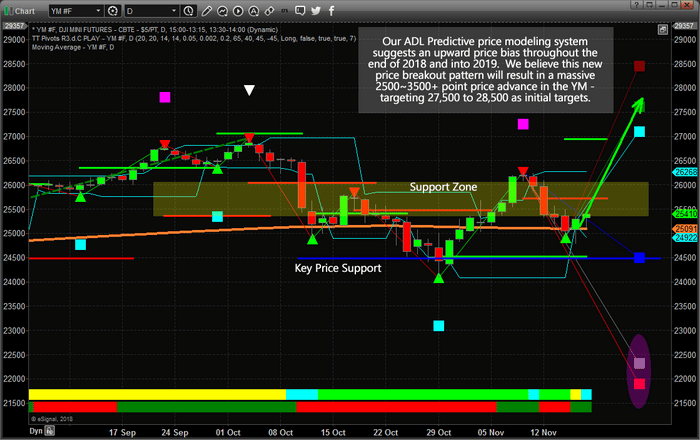
We wrote about our predictive modeling system’s expectations on September 17, 2018, https://www.thetechnicaltraders.com/predictive-trading-model-suggests-falling-stock-prices-us-elections/, where we predicted a market top occurring near September 21, followed by a -5~8% price correction, followed by an Ultimate Bottom setup near or after November 8~12.  This Ultimate Bottom setup was predicted by our ADL predictive price modeling tool and suggested a bottom in price would prompt a massive upside rally where new market highs will be reached in early 2019 or before.  Our Fibonacci price modeling tool is now telling us the breakout move is imminent and we are alerting all our followers to be prepared for some incredible trading opportunities between now and Jan 1, 2019.

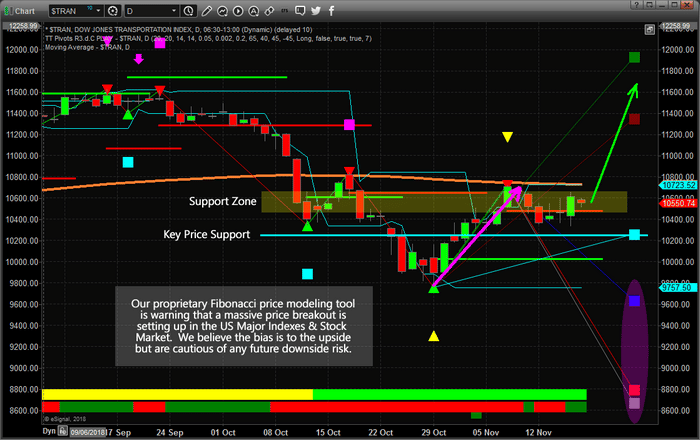
Let’s take a look at some Daily charts that support our conclusions and warn of downside risk levels.  Within each of the two following charts, you will notice similarities.  The markets are setting up in a similar pattern that clearly illustrates how price wants to react to a positive price impulse and where support is located.  We believe any downside risk, at this time, would be from a dramatic external news event.  In other words, we believe current support will hold and we believe the upside price bias predicted by our ADL price modeling system will become the ultimate outcome.

This first chart is a Daily YM chart showing our proprietary Fibonacci price modeling system.  Notice the upside and downside projected price targets on the right side of the chart.  When these price targets are at wide disparities, as they are now, it usually indicates that the markets are setting up for a bigger breakout move.  Additionally, it is easy to see the YELLOW Support Zone and the Key Price Support level on this chart.  Based on Fibonacci Price Theory, the YM price trend is already Bullish and within a minor price pullback.  As long as the Key Price Support level is not breached, the trend will stay Bullish.

Please pay special attention to the upside price targets near 27,500 to 28,500 (nearly 3000 pts higher).  We believe the upside price trend predicted by our ADL price modeling system will support a price move up to near these levels before or shortly after Jan 1, 2019.  We also believe any downside price risk will be contained with the BLUE Key Price Support level.

This next Daily chart is of the Transportation Index (TRAN).  We are certain you will notice the similarities between the two charts and our Fibonacci Price Modeling System.  The primary difference in this chart vs. the YM chart is where the Key Price Support level is located on the price axis of the chart.  Overall, the prediction and technical components of these two charts are similar.  As long as the Key Price Support level is holding, the upside price bias should drive an upward price breakout over the next few weeks and months.

As traders, we want to understand and identify where opportunities exist, when they become advantageous and when we need to act upon them.  Our research team believes the next 5~14 days will present incredible opportunities for skilled traders to identify and setup new trades in certain sectors of the market based on this analysis and our predictions of new price highs within 2+ months.

We’ve seen a similar pattern play out back in March and April of 2018, just before the YM rallied 3400+ pts.  If a similar price breakout occurs as we are suggesting, the 30,000 price level in the YM suddenly becomes a very valid price target.

If you like our analysis and research and want to know how we can help you find and execute better trades, please take a minute to visit www.TheTechnicalTraders.com. Our proprietary price modeling tools and our skilled team of traders and researchers attempt to bring you the very best and timely market research you can find.  Take a minute to read our September 17th research post to understand just how incredible our research really is.   Ask yourself this question, do you know of anyone else that can accurately predict stock market moves 4~6 months in advance?  Take a few minutes to learn how we can help you navigate these incredible market opportunities and find new success.

Chris Vermeulen – TheTechnicalTraders.com

USD Updated the Local Minimums

By JustForex

The USD keeps descending regarding the basket of major currencies. On Friday, the USD index (#DX) updated the local minimums and closed in the negative zone (-0.48%). Some Federal Reserve representatives took a guarded position regarding the aggressive monetary policy going further. Richard Clarida, the Vice Chairman of Federal Reserve, thinks that the interest rates are around the “neutral” level. He is concerned about the slow growth rate of the world ecnomy and reports that the Central Bank needs to consider the future statistics. According to the CME FedWatch Tool, the probability of Federal Reserve increasing the interest rates in December has decreased to 68.9%.

The investors keep evaluating the Brexit conundrum. As a reminder: last week, Dominic Raab, the Secretary of UK regarding the Brexit, resigned. Previously, Jeremy Hunt, the head of the Foreign Office, said that London and Brussels will be able to reach an agreement by the end of November. Aside from that, keep an eye on the trading conflict between the US and China.

The oil quotes keep recovering. The WTI futures are testing the 57.50 USD/barrel mark.

Market Indicators

On Friday the major stock indices were rather ambigous: #SPY (+0,26%), #DIA (+0,33%), #QQQ (-0,35%).

The 10-year US government bonds yield keeps falling. Current value is 3,07-3,08%.

The Economic News Feed for 19.11.2018 is calm.

By JustForex


EURUSD: the euro is expected to drop to the Lb balance line

By Matthew Anthony, Alpari

Previous:

On Friday the 16th of November, trading on the euro closed up against the US dollar. From the Lb line, the price rose to 1.1420. Fed Vice Chairman Richard Clarida acted as a support for the euro and put pressure on the US dollar. He believes that there are signs of a slowdown in the global economy and that the Fed should include the slowdown in its economic forecast. The yield on 10-year bonds in the US fell by 1.9%, to 3.06%.

President and CEO of the Federal Reserve Bank of Dallas Robert Kaplan said that the US economy is in better shape. At the same time, he noted that an economic slowdown in Europe and China may affect the US economy.

Day’s news (GMT+3):

  • 12:00 Eurozone: current account s.a (Sep).
  • 13:00 Eurozone: construction output s.a (Sep).
  • 14:00 Germany: German Buba Monthly Report.
  • 18:00 US: NAHB housing market index (Nov).

Fig 1. EURUSD hourly chart.

Current situation:

On Friday, the euro/dollar closed up. Our expectations for Friday were fully justified. Growth stalled in the area around 112-135 degrees. At the time of writing, the euro is trading at 1.1402. Most major currencies are trading in the red. Since the Stochastic Oscillator is in the buy zone, it is likely that trading will remain flat or rise to 1.1420. I believe it will remain flat because of crosses with the euro. They are showing mixed dynamics.

The economic calendar for Monday is empty, so I would venture to consider the movement on Monday against Friday. I’m waiting for the euro to weaken to the 45th degree (1.1368). If buyers allow sellers to reach the Lb and 45th degree, then the risks will increase, to drop to 1.1335. For buyers, it would be better if the price increased from the current level.

On the 21st of November, the European Commission must respond to Italy’s 2019 draft budget. Any negative news will send the euro into an downtrend.

The Trade Week Ahead – Staying the Course

By Evan Lucas, FPMarkets.com

Remain solid in my view short bias of EURAUD, I see the June low as the next level of support and thus want to remain short all the way down to 1.53.

Technicals tell me so but so does the macro backdrop for the remainder of 2018 and into 2019

EUR Side:

• The so called EU ‘renaissance’ in growth has faded as geo-politics and general malaise filtered through in late 2018 and will likely carry through into 2019. The leading activity metrics that were firing in early 2018 are now behind the EU area.

• The slack in traditional measures such as employment and manufacturing has been almost fully absorbed, meaning less room for further growth.

• Trade issues remain a headwind.

• 2019 will see geo-politics come to a head with the European Parliamentary elections. The rise of nationalism will likely be a head wind here: France, Italy and Germany have seen a large rise in nationalism.

AUD side:

• Overall strength in traditional measures, growth in 2018 has and will remain ahead of consensus, employment is boom and absorbing slack, wages are growth at their strongest levels in 16 quarters and consumer confidence is peaking.

• Despite “doomsday” calls of a housing crash in Australia the supportive macro fundamentals are consistent with above-trend growth for 2019 and confidence in employment is likely to put a floor in the housing market reducing its possible headwind issues.

All confirms my short bias on EUR/AUD

AUD is still a proxy for EM

However, AUDUSD is a different story despite the domestic economic strength. AUD has had three failures of the 73.00 handle as EM remains uncertain. The pair looks range bound now between 70.50 and 73.00 it will need a circuit breaker in my opinion to breakout either an EM positive break out story or, some US strength that smashes through the lower support.

I’m leaning to the latter as China is the key and here is why:

• EM and AUD remain tightly correlated – the MSCI EM index is dominated by China and further deceleration in China and thus EM will like mean the AUD will test 70.5 pretty quickly.

• China has been flexible in easing policy to buffer the slowdown – see the changes to the reserve requirement ratios, the debt to equity swap program and moderating but still solid infrastructure programs – but it is only buffering, not accelerating.

• The uncertainty for the market is what does the economic roadmap for China farther out look like?

• Is there a possibility of the debt-driven growth model making a ‘return tour’?

• Will there be a diminished economic role of private enterprises?

These 2019 outlook points add to concerns for EM and thus AUD. Therefore; currently neutral on AUDUSD however I see EM downside risks thus have a slight negative bias on AUDUSD.

Article provided by FPMarkets.com


How APEC Can Boost Free Trade in Asia Pacific

By Dan Steinbock

Amid trade wars, the outcome of the APEC meeting matters. As globalization is at crossroads, trade in Asia today will shape world trade tomorrow.

As the 21 member countries of the Asia Pacific Economic Cooperation (APEC) meet during the weekend in Papua New Guinea, there is an elevated international concern about the future of global trade amid the tide of nationalism and protectionism.

APEC member economies represent some 40% of global population, the region’s combined GDP is more than 60% of global GDP and it accounts for almost 50% of global trade in goods and services. What APEC leaders decide matters.

The paths to global trade

There are three possible (but two probable) paths to free trade in Asia Pacific.

The ‘mini-TPP’. Founded in the early 2000s by a few smaller regional countries, the initial Trans-Pacific Partnership (TPP) was more economic, open and inclusive by nature. Former President Obama’s ‘pivot to Asia’ opted for a more exclusive, geopolitical and secretive TPP, which aspired to a “gold standard” that would remove tariffs between its members that represented 40% of global economy. But TPP also deemed provisions on labor rights, environmental protection and state-owned enterprises. These “high standards” made it impossible for China and India to join the TPP, while boosting the role of US multinationals in Asia Pacific trade.

On his first day in office, President Trump killed the TPP. He is considering rejoining a revised TPP, but only if the US is granted a “better deal.” Without US participation, other TPP members have agreed on a mini-deal (that is, the Comprehensive and Progressive Agreement for Trans-Pacific Partnership, CPTPP), which may be progressive, but it cannot be comprehensive without China, India – and the US.

ASEAN-led RCEP. The Regional Comprehensive Economic Partnership (RCEP) is fueled by the 10 ASEAN members. Since 2012, the goal has been to harmonize free trade agreements among ASEAN countries, advanced economies (Australia, Japan, South Korea, and New Zealand), and China and India. The US has stayed on the sidelines. Seeking to exploit its economic clout, it prioritizes bilateral talks and seeks to defuse ASEAN’s bargaining power. As a trade pact, the RCEP is not as exclusive, broad and deep as the Obama TPP. But it is more multilateral, realistic, and inclusive – and could materialize in 2019.

‘America First’ Asia Pacific. Trump and his trade hawks are pushing a new Asia Pacific alignment, which strategically seeks to cement America’s Indo-Pacific Vision to contain China’s rise. Economically, it aspires to neutralize China’s One Road One Belt initiative. Militarily, it is exploiting the “freedom of navigation” doctrine to dominate the South China Sea as 60% of U.S. naval fleet will be transferred into the region by 2020. However, any geopolitical sphere-of-interest plan would split the region and thus derail the much anticipated Asian Century.

Unsurprisingly, even America’s allies – Japan and South Korea – feel unsettled about new US protectionism. And that leaves only one solution.

Toward the FTAAP

Within the APEC economies, the idea of regional free trade has been around since 1966 when Japanese economist Kiyoshi Kojima advocated a Pacific Free Trade agreement. Three decades later, APEC leaders opted for free and open trade and investment in the Asia Pacific.

In 2006, C. Fred Bergsten, then chief of an influential US think-tank, advocated the Free Trade Area of the Asia Pacific (FTAAP). If the FTAAP could be achieved, he argued, it would represent the largest single liberalization in history.

The TPP-11 is dominated by advanced high-income economies but excludes upper- and lower-middle income regional engines. In contrast, RCEP includes these regional engines and a few high-income economies as well. Yet, the final pact must be able to include the interests of both advanced and emerging economies. Ultimately, only the FTAAP has potential to cover the interests of the RCEP, the TPP-11, the U.S. (when Trump or the next White House accepts a more inclusive deal), Russia, and other potential members (Figure).

That’s the FTAAP goal that APEC put forward in 2006 and Asian economies support, including China. Ultimately, the TPP-11 and RCEP must agree on harmonization that will facilitate trade and cooperation among regional members and can form a joint path to the FTAAP.

It is very much in the long-term interest also of the US to accept the idea that all nations, including those in Asia Pacific, have interests of their own. Neither the US nor any other country can have a unipolar primacy in world trade; but all countries do have a critical stake in multilateral world trade.

A tentative draft suggests that APEC leaders “acknowledge the importance of APEC’s regional economic integration agenda, including how to advance, in a comprehensive and systematic manner, the process toward the eventual realization of a Free Trade Area of the Asia Pacific.”

A timely roadmap for the effective implementation of this agreement would be the right start for the region and the world.

About the Author:

The author is the director of Difference Group Ltd and has served at the India, China and America Institute (US), Shanghai Institute for International Studies (China) and the EU Center (Singapore). For more, see http://www.differencegroup.net/     

The original version was published by China Daily on November 15, 2018


Fibonacci Retracements Analysis 16.11.2018 (BITCOIN, ETHEREUM)

Article By RoboForex.com

BTCUSD, “Bitcoin vs US Dollar”

As we can see in the H4 chart, the quick descending impulse continued the long-term downtrend; the impulse has broken the previous low and the post-correctional extension area between the retracements of 138.2% and 161.8%. The next target may be the retracement of 261.8% at 4944.00. The local pullback may reach 5818.00.

BTCUSD1
Risk Warning: the result of previous trading operations do not guarantee the same results in the future

As we can see in the H1 chart, the convergence made the pair reverse and start a new correctional uptrend, which has already reached the retracement of 38.2%. The next upside target may be the retracements of 50.0% and 61.8% at 5771.00 and 5875.00 respectively.

BTCUSD2
Risk Warning: the result of previous trading operations do not guarantee the same results in the future

ETHUSD, “Ethereum vs. US Dollar”

As we can see in the H4 chart, after breaking the key low, ETHUSD continued trading downwards to reach the post-correctional extension area between the retracements of 138.2% and 161.8% at 169.60 and 160.50 respectively. The resistance level is at 184.38.

ETHUSD1
Risk Warning: the result of previous trading operations do not guarantee the same results in the future

In the H1 chart, the pair is trading inside the correctional uptrend. The upside targets may be the retracements of 38.2%, 50.0%, and 61.8% at 181.25, 186.25, and 191.08 respectively.

ETHUSD2
Risk Warning: the result of previous trading operations do not guarantee the same results in the future

Article By RoboForex.com

Attention!
Forecasts presented in this section only reflect the author’s private opinion and should not be considered as guidance for trading. RoboForex LP bears no responsibility for trading results based on trading recommendations described in these analytical reviews.