Author Archive for InvestMacro – Page 325

Ichimoku Cloud Analysis 20.11.2018 (AUDUSD, NZDUSD, USDCAD)

Article By RoboForex.com

AUDUSD, “Australian Dollar vs US Dollar”

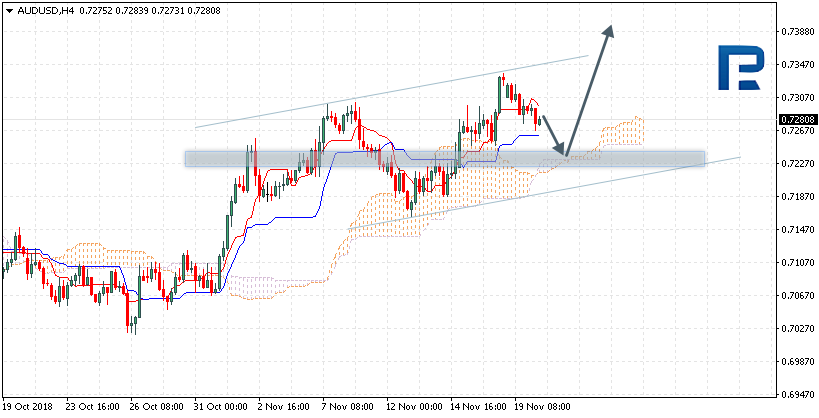
AUDUSD is trading at 0.7280; the instrument is moving above Ichimoku Cloud, thus indicating an ascending tendency. The markets could indicate that the price may test the upside border of the cloud at 0.7230 and then resume moving upwards to reach 0.7385. Another signal to confirm further ascending movement is the price’s rebounding from the support level. However, the scenario that Implies further growth may be cancelled if the price breaks the downside border of the cloud and fixes below 0.7215. In this case, the pair may continue falling towards 0.7150.

AUDUSD
Risk Warning: the result of previous trading operations do not guarantee the same results in the future

NZDUSD, “New Zealand Dollar vs US Dollar”

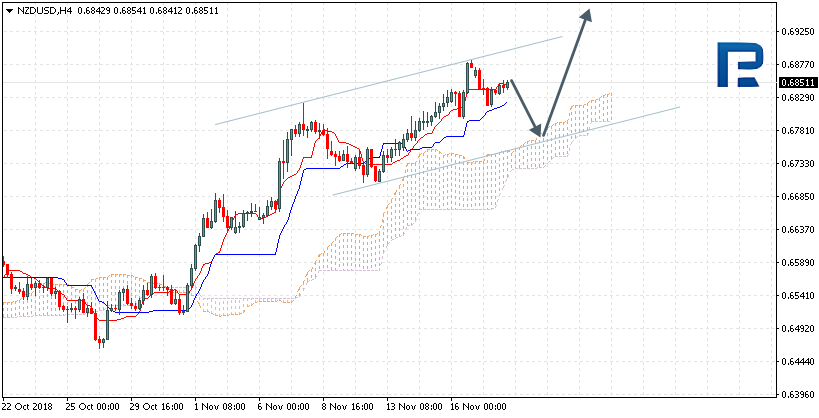
NZDUSD is trading at 0.6851; the instrument is moving above Ichimoku Cloud, thus indicating an ascending tendency. The markets could indicate that the price may test the upside border of the cloud at 0.6780 and then resume moving upwards to reach 0.6935. Another signal to confirm further ascending movement is the price’s rebounding from the channel’s downside border. However, the scenario that Implies further growth may be cancelled if the price breaks the downside border of the cloud and fixes below 0.6725. In this case, the pair may continue falling towards 0.6655.

NZDUSD
Risk Warning: the result of previous trading operations do not guarantee the same results in the future

USDCAD, “US Dollar vs Canadian Dollar”

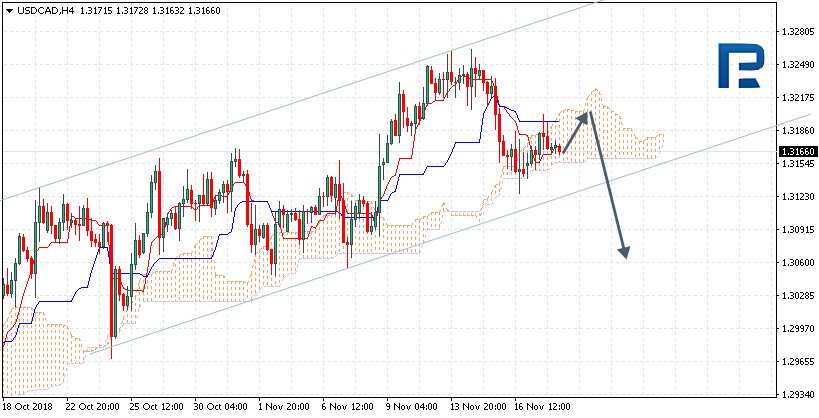
USDCAD is trading at 1.3166; the instrument is moving inside Ichimoku Cloud, thus indicating a sideways tendency. The markets could indicate that the price may test the upside border of the cloud at 1.3195 and then resume moving downwards to reach 1.3060. Another signal to confirm further descending movement is the price’s forming Head & Shoulders reversal pattern. However, the scenario that implies further decline may be cancelled if the price breaks the upside border of the cloud and fixes above 1.3225. In this case, the pair may continue growing towards 1.3295. After breaking the cloud’s downside border and fixing below 1.3120, the price may continue moving downwards.

USDCAD
Risk Warning: the result of previous trading operations do not guarantee the same results in the future

Article By RoboForex.com

Attention!
Forecasts presented in this section only reflect the author’s private opinion and should not be considered as guidance for trading. RoboForex LP bears no responsibility for trading results based on trading recommendations described in these analytical reviews.

Fibonacci Retracements Analysis 20.11.2018 (EURUSD, USDJPY)

Article By RoboForex.com

EURUSD, “Euro vs US Dollar”

As we can see in the H4 chart, the convergence made EURUSD reverse and start a new correctional uptrend, which has already reached the retracement of 38.2%. The next possible upside targets may be the retracements of 50.0% and 61.8% at 1.1516 and 1.1586 respectively. The local support level is at 1.1357.

EURUSD1
Risk Warning: the result of previous trading operations do not guarantee the same results in the future

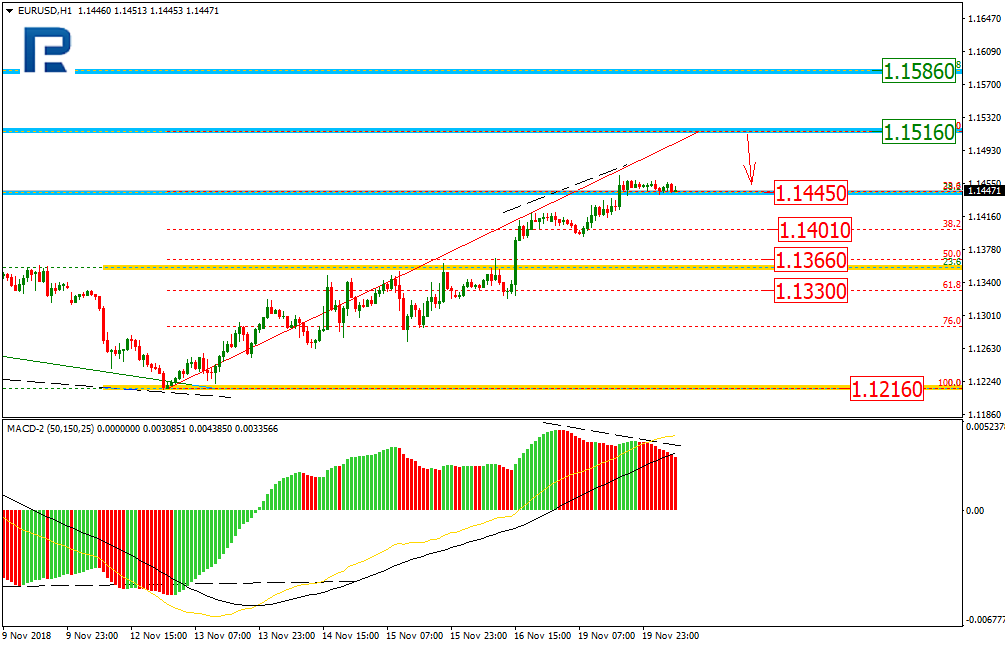
In the H1 chart, there is a divergence while EURUSD is still trading upwards. In this case, the price is expected to reach the retracement of 50.0% at 1.1516 and then start a new pullback. The possible targets are the retracements of 23.6%, 38.2%, 50.0%, and 61.8% at 1.1445, 1.1401, 1.1366, and 1.1330 respectively.

EURUSD2
Risk Warning: the result of previous trading operations do not guarantee the same results in the future

USDJPY, “US Dollar vs. Japanese Yen”

As we can see in the H4 chart, USDJPY has failed to form a steady ascending impulse; the current movement may be considered as a new descending wave inside the mid-term correction. After breaking the local support at 111.37, the pair may continue falling to reach the retracements of 38.2% and 50.0% at 110.76 and 109.58 respectively. The resistance level is at 114.20.

USDJPY1
Risk Warning: the result of previous trading operations do not guarantee the same results in the future

In the H1 chart, there is a convergence while the pair is still trading downwards. Possibly, after reaching the local support at 112.20, the instrument may start a new pullback. The correctional targets may be the retracements of 23.6%, 38.2%, and 50.0% at 112.68, 112.97, and 113.21 respectively.

USDJPY2
Risk Warning: the result of previous trading operations do not guarantee the same results in the future

Article By RoboForex.com

Attention!
Forecasts presented in this section only reflect the author’s private opinion and should not be considered as guidance for trading. RoboForex LP bears no responsibility for trading results based on trading recommendations described in these analytical reviews.

AUDUSD: testing the broken neckline

By Tomasz Wisniewski, Alpari

One of the best looking setups among major pairs can be seen on AUDUSD, where we have a beautiful reversal pattern, and according to price action rules, we should soon see a further rise. We are talking here about the setup on the daily chart, which only adds credibility (setups on daily and weekly charts are always the most powerful).

Since the beginning of September, AUDUSD has been creating an inverse head and shoulders, so a strong bullish reversal formation. In our case, everything has gone according to plan, and on Friday buyers managed to break the neckline (grey) of this structure. At the same time, that resistance was at the 23.6% Fibonacci of the main yearly downtrend. The new week is starting out with a small pull-back, which is rather typical for this kind of price action. Simply put, the broken resistance is being tested as a support.

We will have a strong buy signal if the price closes the day above the grey area. On the other hand, if the price comes back deep below the neckline, we could have a false breakout, which could spell trouble for the bullish dreams for a long time. There is one rule when it comes to trading on false breakouts – you do not mess with them.

Source: “AUDUSD: testing the broken neckline


The Analytical Overview of the Main Currency Pairs on 2018.11.20

by JustForex

The EUR/USD currency pair

Technical indicators of the currency pair:
  • Prev Open: 1.14129
  • Open: 1.14520
  • % chg. over the last day: +0.35
  • Day’s range: 1.14423 – 1.14723
  • 52 wk range: 1.1299 – 1.2557

EUR keeps showing a positive trend. During yesterday`s and today`s trading, the quotes grew by 50 points. The trading instrument is close to the monthly maximums. The local support and resistance levels are 1.14350 and 1.14750. The currency pair can grow further. You should open positions from the key levels.

At 15:30 the US will publish some important stats from the real estate market.
EUR/USD

The indicators point toward the power of the buyers, the price fixed above 50 MA and 200 MA.

The MACD histogram is in the positive zone but below the signal line, which give a weak signal towards the purchase of EUR/USD.

The Stochastic Oscillator is in the neutral zone, the %K line is above the %D line, which indicates a bullish sentiment.

Trading recommendations
  • Support levels: 1.14350, 1.14000, 1.13650
  • Resistance levels: 1.14750, 1.15000

If the price fixes above 1.14750, expect further growth. Potentially towards 1.15000-1.15200.

Alternatively, the movement will correct toward 1.14200-1.14000.

The GBP/USD currency pair

Technical indicators of the currency pair:
  • Prev Open: 1.28440
  • Open: 1.28470
  • % chg. over the last day: +0.16
  • Day’s range: 1.28330 – 1.28808
  • 52 wk range: 1.2662 – 1.4378

GBP/USD keeps trading in flat. There is no single trend here. The support and resistance levels are 1.28250 and 1.28850. Financial market participants wait for new data regarding Brexit. Positions should be opened from the key levels.

You should keep an eye on the statements by the Head of the Bank of England.

GBP/USD

The price is between both 50 MA and 200 MA, there are no precise signals.

The MACD histogram is around 0. There are no precise signals.

The Stochastic Oscillator is in near the neutral zone, the %K line is above the %D line, which provides a signal towards a purchase of GBP/USD.

Trading recommendations
  • Support levels: 1.28250, 1.27750, 1.27250
  • Resistance levels: 1.28850, 1.29500, 1.30300

If the price fixes above the support 1.28850, expect further correction of the quotes toward 1.29400-1.29600.

Alternatively, the quotes can fall towards the round 1.28000.

The USD/CAD currency pair

Technical indicators of the currency pair:
  • Prev Open: 1.31489
  • Open: 1.31693
  • % chg. over the last day: +0.19
  • Day’s range: 1.31554 – 1.31772
  • 52 wk range: 1.2248 – 1.3387

The technical picture on USD/CAD remains ambiguos. It keeps testing the support and resistance levels of 1.31500 and 1.31800. The quotes have a tendency to descend. Investors are waiting for the important reports from the US. Positions should be opened from the key levels.

The News Feed for Canada is calm.

USD/CAD

The indicators provide no signals: 50 MA has crossed 200 MA.

The MACD histogram is around 0.

The Stochastic Oscillator is in the neutral zone, the %K line is below the %D line, which indicates a bearish mood.

Trading recommendations
  • Support levels: 1.31500, 1.31200, 1.30900
  • Resistance levels: 1.31800, 1.32150, 1.32500

If the price fixes below 1.31150, consider selling USD/CAD. The movement will tend toward the round 1.31200-1.31000.

Alternatively, the currency pair can grow to 1.32000-1.32200.

The USD/JPY currency pair

Technical indicators of the currency pair:
  • Prev Open: 112.754
  • Open: 112.517
  • % chg. over the last day: -0.24
  • Day’s range: 112.374 – 112.661
  • 52 wk range: 104.56 – 114.74

USD/JPY is still dominated by the bearish sentiment. The trading instrument has updated the local minimums. At the moment the USD/JPY quotes are consolidating. Positions should be opened from the key levels 112.350 and 112.650. The currency pair has a tendency to descend further.

The news feed is calm for today.

USD/JPY

The price is below 50 MA and 200 MA, which indicates the power of the sellers.

The MACD histogram is around in the negative zone and keeps descending, which indicates a bearish mood.

The Stochastic Oscillator is in the negative zone, the %K line is below the %D line. It is also a signal to sell USD/JPY.

Trading recommendations
  • Support levels: 112.250, 112.000
  • Resistance levels: 112.650, 112.900, 113.200

If the price fixes below the support 112.350, expect a further descend of the quotes. The movement will tend toward 112.000-111.750.

Alternatively, quotes can grow towards 112.650-112.900.

by JustForex

The USD Index Is Testing the 2-weeks Minimums

Analytics by JustForex

Yesterday USD kept losing positions against the major currencies. The USD index (#DX) is in the red (-0.27%). The financial market participants keep evaluating the “careful” comments by the Federal Reserve representatives regarding the increase of the key interest rate. An additional pressure on the USD is caused by the drop in the yield of the US Treasury bonds. We recommend you keep an eye on the US/China trade conflict as well as Brexit.

The Reserve Bank of Australia foresees a stable growth of the economy in 2018-2019. They indend to keep the current direction of the monetary policy and keep the interest rates at the all-time-low level. The investors are waiting for a series of reports from the US real estate market.

The quotes on oil are consolidating. The WTI futures are testing the 56.80 USD/barrel mark. Keep an eye on the weekly report on the crude oil reserves in the US by API – 23:30 (GMT+2:00).

Market indicators

Yesterday the US stock market was marked by an aggressive sell-off: #SPY (-1,69%), #DIA (-1,65%), #QQQ (-3,25%).

The 10-year US government bonds yield keeps falling. Right now it is 3,05-3,06%.

The News Feed for 2018.11.20

At 15:30 (GMT+2:00) the US will publish some important real estate market reports.

You should also keep an eye on the statement by the Head of the Bank of England.

JustForex, 2018.11.20

Analytics by JustForex

CADCHF: inception!

By Tomasz Wisniewski, Alpari

This piece will be about an instrument which is definitely not the most popular on the market. Despite the fact that it’s a minor pair, we have an interesting technical situation here, which I can easily call ‘Inception’.

CADCHF is in a symmetrical triangle pattern, which is directly in the middle of a bigger symmetrical triangle pattern. This is really interesting especially considering the price is breaking the lower line of the smaller triangle as we speak, which may be a proper signal to go short. Where is the potential target for this drop? Yes, you are right, it is on the lower line of the bigger triangle. In terms of the risk-to-reward ratio, this setup is really sweet, and you should at least have a look at it (the potential profit is around four times bigger than the potential loss).

For the time being, buyers are attempting some kind of reversal, so let them. If the price finishes the day below the blue horizontal resistance this will be a clear signal for us to open shorts.

Source: “CADCHF: inception!


Bitcoin: don’t say we didn’t warn you!

By Tomasz Wisniewski, Alpari

Bitcoin was last mentioned here on the 29th of October. Back then, we were locked in a sideways trend and said that a breakout of a certain support should bring us a sell signal. You probably know that we are currently sitting at yearly lows. So guess what? That analysis was spot on!

The new yearly lows are the result of the giant descending triangle pattern. Every single bounce from the horizontal support got smaller and smaller, which was a clear sign of bullish weakness. Buyers eventually surrendered and the price dropped like a rock. That happened on Wednesday. On Thursday, bulls attempted a small pullback, but today we can see how it ended. The sell signal is on and the potential target for this movement is much lower than you can imagine. We are talking here about levels below 3,000 USD.

Negative sentiment will be temporarily cancelled if the price comes back above the yellow area. The chances of that are currently miniscule. As for now, we are testing the pain threshold of all HODLers.

Metals Moving In Unison For A Massive Price Advance : Part I

By TheTechnicalTraders.com

Are the metals markets ending a price correction in unison and preparing for a massive price advance?  This is the question we asked our research team to investigate and their findings may help skilled traders identify great opportunities in the future.  This multi-part research article will share our most recent opinion about the metals markets as well as share some critical new data that can shed some light into what we believe will become a massive upside price rally in the metals markets. Let’s get into the data.

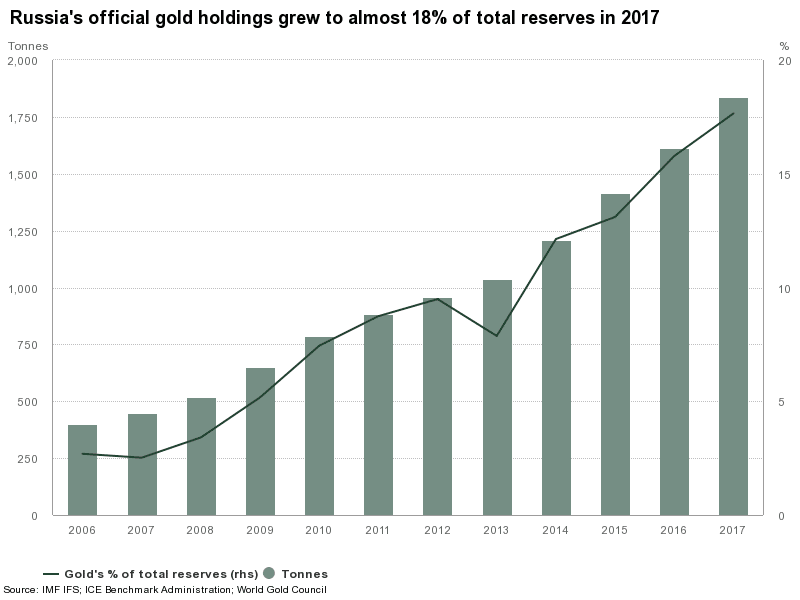
When one considers the global demand for Gold as a hedge against economic crisis events and the continued advancement in gold reserves for China and Russia, one has to consider the supply side issues that are a result of central banks global demand.  Even though global production of Gold is near an all-time high, the demand from foreign nations and central banks are also near all-time highs.  This correlation creates a demand-side consumption that offsets supply and, in some ways limits, consumer, retail and technology suppliers.

Our researchers focused on this aspect of the supply/demand equation when trying to analyze recent metals price action in correlation to disruptions that could occur in the markets.  For example, increased central bank buying/hoarding of gold could dramatically result in prices spiking.  Foreign market disruptions in supply could also send prices spiking.  Global conflicts and or continued trade issues could send metals prices skyrocketing.  Anything to do with the supply side for Gold could send prices higher.  At least this is the conclusion of our research team at this time.

Russia has continued to build its gold reserves throughout the past 10+ years.  Should Russia and other nations continue to absorb supply at these levels, one could easily argue that price declines in the metals markets are unusual.

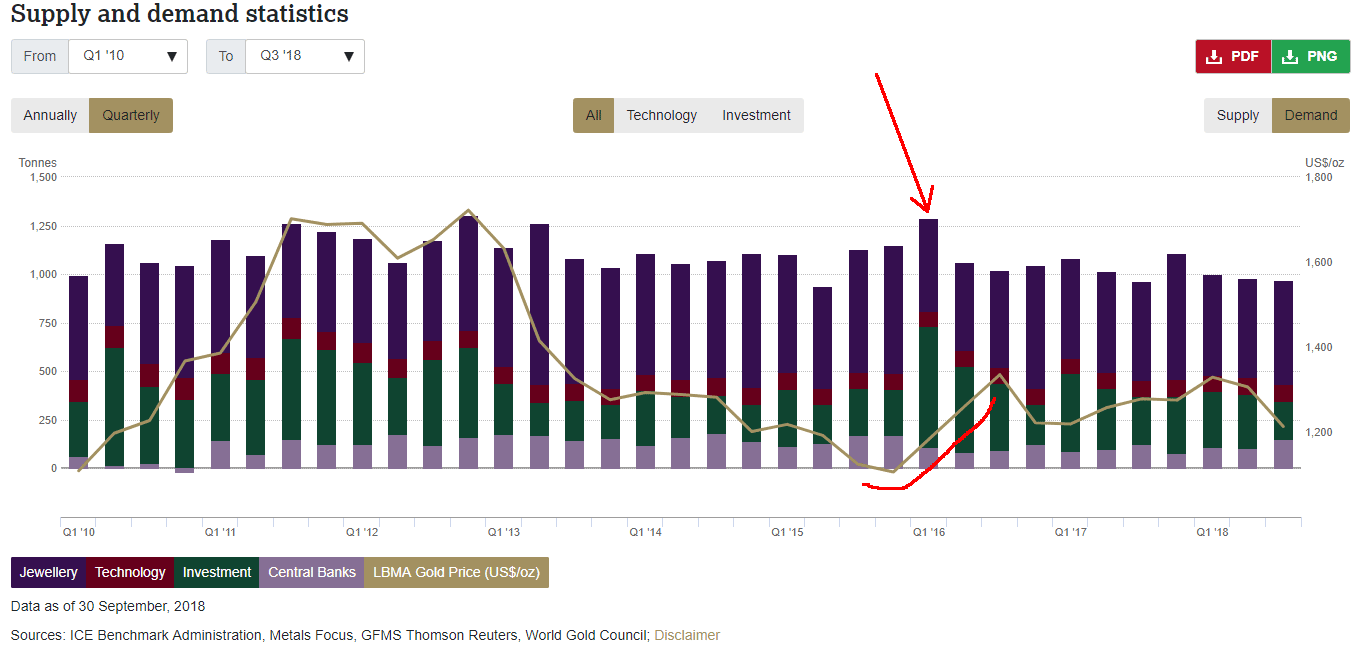
Demand for gold is varied and includes Jewelry, Technology, Investment, and Central Banks.  We can see from this data that Jewelry and Investment make up nearly 65~70% of total demand every quarter.  Jewelry, in many nations, is a secondary form of investment for many people.  Unlike in the US, gold is typically sold at 22K levels in much of Asia and at 24K levels throughout much of the Arab world.  Individuals can purchase these high-quality jewelry items not only to wear but also as a capital investment.  People in these countries are able to resell this high-quality gold to jewelers and others at near spot price whenever they need extra cash.

We can see from the chart, below, that demand is moderately weaker over the past 2 years, but still near all-time highs.  Consider, for a moment, what a moderate supply-side disruption or pricing advance would do to the demand side of these levels?

Take a look at the increase in Investment demand in 2010 through 2012 in relation to today.  Also, pay attention to the huge Investment increase in demand in Q1 of 2016 and the correlative price advance that occurred as demand shot higher.  One key factor for price advance is that Investment demand increases dramatically as a driving force for price increases.  Because of this, we would watch for investment demand to increase dramatically over the next 4~6+ months which would indicate that a continued price advancement is expected.

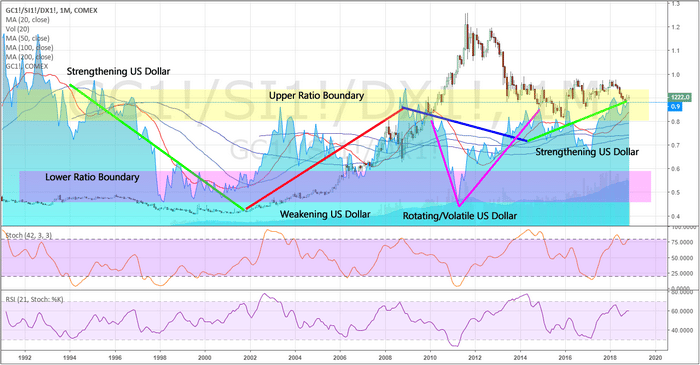
Our researchers dug further into price history with a dynamic new tool that allows us to measure and gauge price rotation in comparison to a number of key factors.  The purpose of this exercise was to identify the price and relationship boundaries of Gold, Silver and the US Dollar as these price variances correlate to the price advance and decline of Gold.  Our hope was that we would identify some very important new aspect to the relationships of these markets as related to the future movement of the metals markets.  Our researchers focused on these key relationship and found the following.

This first chart highlighting our custom Gold/Silver/US Dollar ratio (the blue area chart) in comparison to the historical price of Gold is actually very interesting.  First, we highlighted the general trend direction of the US Dollar – showing Strengthening, Weakening and Rotating trends.  Next, we highlighted the Upper and Lower boundaries of our custom price ratio to highlight key areas where the ratio changed direction or where prices initiated new or reversed price trends.  It is fairly easy to see the price of Gold either initiated new trends or changed price trend at or near these Upper and Lower boundary levels.  It is also fairly easy to see the huge price advancement between 2004 and 2011 occurred within a Weak and Rotating US Dollar environment.  Additionally, within this same time span, we were able to witness multiple boundary rotations and different Gold price activity types as the US Dollar shifted from a downward price trend to a very volatile/rotating price trend (2009~2015).

In all reality, the biggest Gold price rally and decline happened between 2009~2015 at a time when the US Dollar was rotating and at a time when the global markets were experiencing a massive credit/market event; including much of the subsequent market recovery event.  The massive ratio trough occurred in April 2011; at a time when the US Dollar reached a fresh new low and when the US stock markets were recovering quite well.

Taking a look at the most recent 4~5 years on this chart, two critical items came to our attention; first, the lows reached in 2015 and the recent lows in 2018 both occurred while the custom ratio levels were within the Upper Boundary area.  We have not seen the ratio move into the Lower Boundary since 2011.  What causes the ratio to move toward this level and what are the correlations that we can ascertain from further research using this new tool?  Could this new tool provide any real insight into the future price of Gold, Silver, and other metals?

We’ll continue our research in the second part of this article to show you why we believe the metals markets are set for a massive price rally and why we believe this one will be completely different than anything we’ve seen in the past 20 years.

We believe you won’t find a better team of researchers, traders and analysts than with www.TheTechnicalTraders.com. Our proprietary research, price modeling systems, and predictive analysis tools help to keep our members well ahead of the market with each turn.

Chris Vermeulen


EURUSD is being slightly corrected. Overview for 19.11.2018

Article By RoboForex.com

Early in the week, the major currency pair is consolidating and waiting for more statistics.

On Monday morning, EURUSD is trading downwards, but still looking quite stable. The current quote for the instrument is 1.1396.

Investors are watching the dialog between the White House and the US Federal Reserve. According to the media, the growth of the interest rates and the disposable income increase, the housing demand went down.

Earlier, policymakers already said that at the beginning of 2019 the rising impulse in the US economy would get weaker, but the Federal Reserve was holding its ground to continue tightening its monetary policy. The news media, in its turn, provides its own contribution to make the situation even more uncertain by constantly reminding about the regulator’s worry relating to influence of the labor market of the inflation.

It is known that earlier the USD President Donald Trump asked for the statistics that indicated the housing demand decline due to the rate increase. On YoY, the indicator had little to show indeed: in 2017, it decreased by 3.7% and in 2018 (over the first three quarters) lost additional 0.6%. The connection is quite simple to see: when consumers stop buying houses, sales of household goods, such as construction and building materials, domestic appliances, furniture, and everyday objects, move down. The durable goods are up to 40% of the consumer group, that’s why the decline has a critical influence on the manufacturing sector.

It’s a pretty interesting story, given that the Federal Reserve has already announced three more rate hikes next year. it seems investors can expect more scandals between the White House and the regulator.

Article By RoboForex.com

Attention!
Forecasts presented in this section only reflect the author’s private opinion and should not be considered as guidance for trading. RoboForex LP bears no responsibility for trading results based on trading recommendations described in these analytical reviews.

World Trade Organization At Risk

By Dan Steinbock

In the past two years, the Trump administration has started trade wars against China, its major trade partners, and security allies. In the absence of united opposition by advanced and emerging economies, the next target will be the World Trade Organization.

As the White House began to escalate the U.S.-Sino trade war last April, President Trump’s trade adviser Peter Navarro was asked on CNN whether the United States is planning to leave the World Trade Organization (WTO).

A controversial advocate of American neo-protectionism known for his China-bashing books and documentaries, Navarro said that “a lot of problem has been the World Trade Organization, which is over 160 countries, and a lot of them simply don’t like us and so we don’t get good results there.”

When Navarro was asked whether the U.S. will ultimately leave the WTO, he dodged the question saying that it was “a provocative question.” But it was a fair question.

Historical shift    

After all, the U.S. was the key architect of the WTO; the 164-member international organization established in 1995 that replaced the General Agreement on Tariffs and Trade (GATT), which was created in 1948. Today, the WTO oversees global trade rules and resolves trade disputes on the basis of international trade law and practices. It covers some 98% of global trade.

Since the postwar era, successive rounds of trade liberalization have promoted a dramatic expansion of trade. So the average most-favored nation (MFN) applied tariff of TWO members fell from 25% in 1994 to less than 10% today – before the Trump era.

Unlike previous postwar and post-Cold War administrations, the Trump trade hawks seem to believe that the WTO does not add “value” to the U.S. economy. As a candidate, Trump called WTO trade deals a “disaster” proposing that the U.S. “renegotiate” or “pull out” from such agreements. As president, Trump has made it very clear that his administration prefers bilateral agreements to exploit US economic muscle; not multilateral deals that rely on international rules.

While the White House has targeted all major economies that currently have a trade surplus with America – including Canada, Mexico, Germany, the European Union, Japan, and South Korea – its primary effort has been to break China’s opposition to Washington’s new managed trade.

Through the Cold War, Washington promoted global economic integration – world trade, investment, and migration – which served to contain the Soviet Union. After the end of the Cold War, voices stressing America’s unipolar clout in security (the Bush neoconservatives) and trade (Trump’s trade hawks) have advanced – at the expense of those emphasizing the importance of realist diplomacy and international alliances.

The WTO is just the latest, though very symbolic, target of those who see America as a “victim” of “unfair” trade – in contrast to the historical record.

How the China ‘MES’ debacle heralded the attack against the WTO    

Trump’s trade hawks began to criticize the WTO during the 2016 campaign, when they first targeted China and Trump declared in Iowa, “China is not a market economy.”  But that was preceded by the refusal of former President Obama, the EU and Japan to grant China its market economy status (MES), even as the key clause in China’s 2001 agreement to join the WTO expired on December 11, 2016. Indeed, Trump has benefited immensely from the decisions of those who now criticize his decisions.

The key issue in the MES debacle was the WTO’s Western member states’ desire to inflate tariffs against Chinese goods. When China joined the WTO on December 11, 2001, it was written into the agreement that member states could treat China as a “non-market economy.”

Due to the size of the Chinese economy, government intervention, and state-owned enterprises, advanced economies argued that Chinese domestic price comparisons must be ignored and “constructed values” should be used to gain a “true picture” of the Chinese economy – which allowed them to impose heavy anti-dumping duties on the basis that China’s low prices did not reflect market reality.

Since the early 2000s, the surrogate figures have permitted wide discretion and manipulation of price data, which was then used as the basis for anti-dumping charges; i.e., tariffs up to 40% higher than normal anti-dumping duties. On the campaign trail, Trump exploited precisely such figures when he pledged he would introduce 45% tariffs against Chinese products. It was this revision of history – which emerged amid the U.S. “pivot to Asia” developed by former President Obama and former Secretary of State Hillary Clinton – that paved the way for the White House’s effort to undermine the postwar international trading regime.

In the Trump White House, not only China but all emerging and developing economies are potential targets, as evidenced by the Trump administration’s criticisms of emerging economies claims of special treatment under WTO rules for developing countries.

A world without the WTO?

The bottom line: Since the unipolar ‘America First’ doctrine cannot accommodate the multipolar WTO, one has to go. But the first steps came before the Trump era.

The White House has suggested that the U.S. may simply ignore WTO rulings that are not in its favor, amid alleged concerns that dispute settlement infringes on U.S. sovereignty. Moreover, from the time of the Obama administration, the U.S. has been blocking new appointments to the WTO’s Appellate Body (AB); i.e., the seven-member body responsible for appeals. As more judicial terms are set to expire, the AB may no longer meet its quorum after December 2019. It’s a tactic that serves the White House’s strategic goals.

Officially, none of these measures are acknowledged. Still, the Trump administration’s overall approach has sparked questions regarding the future of U.S. leadership and participation in the WTO, as well as the role of Congress in U.S. trade policy.

Although unease about the ‘America First’ doctrine has now surfaced, many are still signing bilateral deals with the U.S. As long as this happens, the Trump administration will continue to divide and rule its allies. There is a way to respond to the Trump challenge, but that requires unity and cooperation among and between the major advanced and emerging economies.

In the absence of effective Democratic opposition, a sustained effort by President Trump to withdraw the U.S. unilaterally from the WTO – if legal under U.S. law – would devastate America’s foreign trade, debilitate the WTO and has potential to pave the way to the kind of horrors that led to the creation of the postwar WTO in the first place.

About the Author:

Dr Steinbock is the founder of the Difference Group, a global consultancy, and has served as the research director at the India, China, and America Institute (USA) and a visiting fellow at the Shanghai Institutes for International Studies (China) and the EU Center (Singapore). For more information, see http://www.differencegroup.net/ 

The original commentary was published by China-US Focus on November 16, 2018