Author Archive for InvestMacro – Page 319

EURUSD: a drop is expected by close on Friday

By Matthew Anthony, Alpari

Previous:

On Friday the 30th of November, trading on the euro closed down. The strengthening of USD was due in part to the anticipated meeting between the US President and the PRC Chairman during the G20 summit in Argentina. US President Trump tweeted that if negotiations reached a dead end, he would raise tariffs against China. This caused the rate to dip to 1.1306.

Day’s news (GMT+3):

  • 12:00 Eurozone: Markit manufacturing PMI (Nov).
  • 12:30 UK: manufacturing PMI (Nov).
  • 13:00 Eurozone: Eurogroup meetings.
  • 14:30 US: FOMC Member Clarida speaks.
  • 16:00 US: FOMC Member Quarles speaks.
  • 16:30 Canada: RBC manufacturing PMI (Nov).
  • 17:15 US: FOMC Member Williams speaks.
  • 17:45 US: manufacturing PMI (Nov).
  • 18:00 US: ISM manufacturing (Nov).

Fig 1. EURUSD hourly chart.

Current situation:

On Monday, trading on the dollar index opened lower. The euro rose against the dollar to 1.1373. Growth is sharp due to the fact that the US and China have agreed to suspend the trade war until the end of Q1 2019. The market reacted positively to this news.

China has agreed to increase the volume of agricultural, energy, industrial, and other products from the US to reduce trade imbalances between the countries. In addition to negotiations, on Monday, oil went up by 5.5%, which had a positive effect on commodity currencies.

The price held at 1.1363, in actuality – 1.1374. According to the forecast, I’m waiting for the price to return to the bottom line of the channel at the 45th degree (1.1317). On Friday, there was a strong sell signal at this level, so when I did the review, I took into account that it would possibly defend the level of 1.1370.

If you look at today’s trade volumes, they are very low. As such, I do not see the possibility for any stop losses, and they are low for  buy orders as well. It seems that sellers are setting a trap for buyers.

Source: EURUSD: a drop is expected by close on Friday


Admiral Markets reduces trading spreads on popular financial instruments

Admiral Markets has reduced its typical spreads on its most popular financial instruments, including top currency pairs like the EUR/USD.

Admiral Markets clients can now trade its most popular Forex currency pairs at the following typical spreads:

– EUR/USD: 0.6 pips
– GBP/USD: 1.0 pips
– USD/JPY: 0.9 pips
– AUD/USD: 1.0 pips
– EUR/GBP: 1.0 pips

In addition, clients can trade the world’s most popular indices at Admiral Markets’ already tight spreads:

– DAX30: 0.8 pips
– DJI30: 1.2 pips
– FTSE100: 0.8 pips
– SP500: 0.4 pips

These changes apply to all Admiral Markets clients with an Admiral.Markets or an Admiral.MT5 account, with no difference between spreads offered to Retail and Professional clients.

This spread reduction makes Admiral Markets’ typical spreads some of the most competitive on the market, and supports Admiral Markets’ commitment to providing clients with the best possible trading experience.

About Admiral Markets

Admiral Markets is a leading online Forex and CFD trading provider. In addition to a wide range of financial instruments, Admiral Markets offers free educational materials, including analytics, webinars and seminars.

***

Risk disclosure: CFDs are complex instruments and come with a high risk of losing money rapidly due to leverage. 83% of retail investor accounts lose money when trading CFDs with this provider. You should consider whether you understand how CFDs work and whether you can afford to take the high risk of losing your money. Read more at admiralmarkets.com


AUDNZD: and the best currency in the region is…

By Tomasz Wisniewski, Alpari

In this piece, we will look for the strongest currency in the Antipodes. So, let the battle between AUD and NZD begin. I will tell you from the very beginning that in my opinion, Australia should win this, at least in the middle term, and to back this up, I have the following arguments:

First of all, and this is actually the most important reason, we are bouncing from the blue line. That doesn’t sound so serious, right? Oh but it is, the blue line is the lower line of the triangle, which has been connecting higher lows since March 2015! We’re bouncing from this line, which is creating a smaller triangle, or an inverse head and shoulders pattern if you will. Both formations will be active when the rate breaks the upper pink line. That will be the ultimate trigger here. As long as we stay inside, you can hope, but there won’t be a signal.

Well, long story short, the pair closing the day above the pink line will tell you to buy. On the other hand, a closing price below the blue line will signal the opposite.

The World-Class Lessons of China’s Shanghai Free-Trade Zone

By Dan Steinbock

Amid the fifth anniversary of the Shanghai Free-Trade Zone, new economic zones are proliferating in China’s critical productivity centers. Despite trade wars, China is opening but in its own terms.

The Shanghai Free-Trade Zone (FTZ) was launched in September 2013, some five years ago. It was the first FTZ in mainland China and has progressively been expanding its territorial coverage. Yet, territorial coverage is only a part of its strategic significance.

What the FTZ experiments herald is a new stage in China’s economic reforms and opening-up policies.

FTZ impact on market liberalization

When the Shanghai FTZ was created half a decade ago, the idea was to develop Shanghai into an international financial center and trading hub by 2020, by loosening the government’s grip on foreign investment, the currency market and the banking.

Initially, Shanghai FTZ covered only 30 square kilometers, including a logistics park, port and airport. In 2015, the FTZs were expanded to include Lujiazui Financial and Trade Zone, Shanghai Jinqiao Economic and Technological Development Zone and Zhangjiang Hi-Tech Park. The objective is to gradually expand the FTZ to 1,200 kilometers of Pudong.

According to research, the FTZ has already had an impact on the internationalization of the Chinese yuan. In the past, Chinese offshore yuan was traded on foreign currency markets, whereas onshore yuan trading was controlled by the China’s central bank. Shanghai FTZ reduced the gap of the price spread between offshore yuan (CNH) and onshore yuan (CNY). Meanwhile, the yield gap between offshore and onshore yuan of 3-month maturity had decreased as well.

And while the internationalization of the Chinese yuan is far from complete, the Chinese currency was included as a major reserve currency in the IMF’ international basket (SDR) in October 2016.

In the advanced West, free trade agreements were used in the postwar era to accelerate market liberalization. In China and emerging economies, FTZs have been deployed to foster a favorable environment to attract foreign investment and promote economic growth.

From new FTZs to the Great Bay Area

In 2014, China announced three new FTZs in Guangdong, Tianjin and Fujian. As Shanghai FTZ expanded in Pudong, new FTZs were “cloned” in other major Chinese cities. A dozen Chinese municipalities and provinces, including Shaanxi, Henan, Zhejiang, Tianjin, Guangdong and Sichuan, are building free trade ports and seek to shorten negative lists to attract foreign capital.

In early 2016, I forecasted that Guangdong was moving from industrialization to a post-industrial society, while emerging as a global hub of innovation. In China, innovation – as measured by R&D per GDP – had then climbed to 2.1% (which, despite the huge population, was higher than that of France, the UK or Australia). In Guangdong, the comparable figure was 2.5% but in Shenzhen around 4% – not far from the world leaders, South Korea (4.4%) and Israel (4.2%).

Today, the Greater Bay Area combines the nine cities of the Pearl River Delta with the special administrative regions of Hong Kong and Macao. While it comprises just 1% of China’s land mass, it has a population of 70 million and produces 37% of Chinese exports and 12% of its GDP.

It is the Guangdong FTZ that is fueling new gains in productivity and innovation.

How FTZs differ from imposed bilateral tariffs

In effect, pure “free-market” doctrines would have failed Guangdong’s growth and innovation. If all nine cities had only focused on their own narrow interests, while Hong Kong and Macao had remained insular, positive spillover effects would have been impossible.

Rather, it is economic cooperation and integration within and across these cities and regions that has made the difference.

In the U.S. tariff wars, the White House’s trade hawks seek to impose bilateral trade agreements top-down on other countries. The idea is to rule and divide over major sovereign nations that trade with America. It is a 21st century version of a colonial ‘open door’ policy.

The idea of the Shanghai FTZ is almost diametrically the opposite. Here the effort is to open the Chinese economy progressively to multilateral world trade. The ultimate objective is to open Chinese economy bottom-up to trade with other nations.

It is China’s response to rising nationalism and protectionism in the advanced West. It is also a development blueprint to other emerging and developing economies.

About the Author:

Dr Dan Steinbock is the founder of global consultancy Difference Group and has served at the India, China, and America Institute (US), Shanghai Institutes for International Studies (China) and the EU Center (Singapore). For more information, see http://www.differencegroup.net/ 

The original commentary was published by China.org, China’s official government portal, on November 30, 2018.


Fibonacci Retracements Analysis 30.11.2018 (BITCOIN, ETHEREUM)

Article By RoboForex.com

BTCUSD, “Bitcoin vs US Dollar”

As we can see in the H4 chart, the convergence made BTCUSD reverse and start a new correction to the upside, which has already reached the retracement of 23.6%. The next possible targets may be the retracements of 38.2% and 50.0% at 4636.00 and 5006.00 respectively. The support level is the low at 3460.10.

BTCUSD1
Risk Warning: the result of previous trading operations do not guarantee the same results in the future

In the H1 chart, the divergence made the pair start a new correction, which has already reached the retracement of 23.6%. In case it continues, the targets will be the retracements of 38.2% and 50.0% at 4065.40 and 3960.00 respectively. If the price breaks the local high at 4406.50, the instrument will continue growing.

BTCUSD2
Risk Warning: the result of previous trading operations do not guarantee the same results in the future

ETHUSD, “Ethereum vs. US Dollar”

As we can see in the H4 chart, the convergence made ETHUSD start a new correctional uptrend, which has failed to reach the retracement of 23.6%, but may reach in the nearest future. The next possible targets may be the retracements of 38.2% and 50.0% at 145.62 and 160.50 respectively. The support is the low at 98.04.

ETHUSD1
Risk Warning: the result of previous trading operations do not guarantee the same results in the future

As we can see in the H1 chart, the pair has been corrected to the downside by 38.2%. The next possible targets may be the retracements of 50.0% and 61.8% at 112.28 and 109.20 respectively. If the price breaks the local high at 125.51, the instrument will continue moving upwards.

ETHUSD2
Risk Warning: the result of previous trading operations do not guarantee the same results in the future

Article By RoboForex.com

Attention!
Forecasts presented in this section only reflect the author’s private opinion and should not be considered as guidance for trading. RoboForex LP bears no responsibility for trading results based on trading recommendations described in these analytical reviews.

Forex Technical Analysis & Forecast 30.11.2018 (EURUSD, GBPUSD, USDCHF, USDJPY, AUDUSD, USDRUB, GOLD, BRENT)

Article By RoboForex.com

EURUSD, “Euro vs US Dollar”

EURUSD is still consolidating around 1.1377 and trying to expand it upwards. Possibly, the pair may reach 1.1414 or even 1.1500 (an alternative scenario). According to the main scenario, the price is expected to resume trading inside the downtrend with the target at 1.1295.

EURUSD
Risk Warning: the result of previous trading operations do not guarantee the same results in the future

GBPUSD, “Great Britain Pound vs US Dollar”

GBPUSD has finished the descending structure; right now, it is trading near the lows. Possibly, the pair may grow towards 1.2860. After that, the instrument may resume falling inside the downtrend with the short-term target of the fifth descending wave at 1.2655.

GBPUSD
Risk Warning: the result of previous trading operations do not guarantee the same results in the future

USDCHF, “US Dollar vs Swiss Franc”

USDCHF is trading upwards. Possibly, today the pair may reach 1.0007. Later, the market may form a new descending structure towards 0.9970 and then start another growth with the target at 1.0063.

USDCHF
Risk Warning: the result of previous trading operations do not guarantee the same results in the future

USDJPY, “US Dollar vs Japanese Yen”

USDJPY is trading downwards with the target at 112.25. After that, the instrument may form one more ascending structure towards 114.15 and then resume falling to reach 113.25.

USDJPY
Risk Warning: the result of previous trading operations do not guarantee the same results in the future

AUDUSD, “Australian Dollar vs US Dollar”

AUDUSD is consolidating at the top. Possibly, the pair may expand the range towards 0.7273. Later, the market may form one more ascending structure to reach 0.7349 and then resume falling inside the downtrend with the target at 0.7190.

AUDUSD
Risk Warning: the result of previous trading operations do not guarantee the same results in the future

USDRUB, “US Dollar vs Russian Ruble”

USDRUB has broken 66.43 downwards. Today, the pair may fall to break 65.60 and then continue trading inside the downtrend with the short-term target at 64.00.

USDRUB
Risk Warning: the result of previous trading operations do not guarantee the same results in the future

XAUUSD, “Gold vs US Dollar”

Gold is consolidating in the center of the range at 1224.05. If later the instrument breaks 1229.20 to the upside, the price may start another growth to reach 1250.30; if 1220.10 to the downside – resume trading inside the downtrend with the target at 1190.30.

GOLD
Risk Warning: the result of previous trading operations do not guarantee the same results in the future

BRENT

Brent has completed the ascending structure at 59.90; right now, it is consolidating around it. If later the instrument breaks this range to the upside, the price may form one more ascending structure with the first target at 62.22; if to the downside – resume falling towards 57.33 and then start another growth to reach the above-mentioned target.

BRENT
Risk Warning: the result of previous trading operations do not guarantee the same results in the future

Article By RoboForex.com

Attention!
Forecasts presented in this section only reflect the author’s private opinion and should not be considered as guidance for trading. RoboForex LP bears no responsibility for trading results based on trading recommendations described in these analytical reviews.

The Analytical Overview of the Main Currency Pairs on 2018.11.30

Analytics by JustForex

The EUR/USD currency pair

Technical indicators of the currency pair:
  • Prev Open: 1.13678
  • Open: 1.13827
  • % chg. over the last day: +0.24
  • Day’s range: 1.13748 – 1.13838
  • 52 wk range: 1.1299 – 1.2557

The technical pattern on the EUR/USD currency pair is ambiguous. Quotes are in a sideways trend. Investors expect the G20 summit. Currently, the local support and resistance levels are 1.13700 and 1.14000, respectively. Positions should be opened from these marks. Quotes have the potential for further growth.

The news feed on 30.11.2018:
  • – Consumer price index in the Eurozone at 12:00 (GMT+2:00).
EUR/USD

Indicators point to the power of buyers: the price has fixed above 50 MA and 200 MA.

The MACD histogram is in the positive zone, but below the signal line, which gives a strong signal to buy EUR/USD.

Stochastic Oscillator is located near the oversold zone, the %K line is below the %D line, which gives a weak signal to sell EUR/USD.

Trading recommendations
  • Support levels: 1.13700, 1.13400, 1.13100
  • Resistance levels: 1.14000, 1.14300, 1.14550

If the price fixes above the round level of 1.14000, the EUR/USD quotes are expected to grow. The movement is tending to 1.14300-1.14550.

An alternative may be a decrease in the EUR/USD currency pair to the level of 1.13400-1.13100.

The GBP/USD currency pair

Technical indicators of the currency pair:
  • Prev Open: 1.28235
  • Open: 1.27821
  • % chg. over the last day: -0.30
  • Day’s range: 1.27790 – 1.28345
  • 52 wk range: 1.2662 – 1.4378

The technical pattern on the GBP/USD currency pair is ambiguous. The trading instrument is moving in a flat. Financial market participants expect additional drivers. At the moment, the key support and resistance levels are 1.27750 and 1.28100. Positions should be opened from these marks. We recommend following the current information regarding the Brexit process.

Today the publication of important economic reports from the UK is not planned.

GBP/USD

Indicators do not send accurate signals: the price has crossed 50 MA and 200 MA.

The MACD histogram is near the 0 mark.

Stochastic Oscillator is in the neutral zone, the %K line has crossed the %D line. There are no signals.

Trading recommendations
  • Support levels: 1.27750, 1.27400
  • Resistance levels: 1.28100, 1.28400, 1.28800

If the price fixes below the support level of 1.27750, the GBP/USD quotes are expected to decline. The movement is tending to 1.27400-1.27000.

An alternative may be the GBP/USD currency pair growth to 1.28400-1.28800.

The USD/CAD currency pair

Technical indicators of the currency pair:
  • Prev Open: 1.32725
  • Open: 1.32793
  • % chg. over the last day: -0.00
  • Day’s range: 1.32959 – 1.33069
  • 52 wk range: 1.2248 – 1.3387

Yesterday, there was a variety of trends on the USD/CAD currency pair. At the moment, the technical pattern is ambiguous. Investors expect additional drivers. Local support and resistance levels are 1.32850 and 1.33150, respectively. Positions should be opened from these marks. We recommend paying attention to important economic data from Canada.

At 15:30 (GMT+2:00), the GDP data will be published in Canada.

USD/CAD

The price is being traded above 50 MA and 200 MA, which indicates the power of buyers.

The MACD histogram is near the 0 mark. There are no signals.

The Stochastic Oscillator is located near the overbought zone, the %K line has crossed the %D line. There are no signals at the moment.

Trading recommendations
  • Support levels: 1.32850, 1.32500, 1.32150
  • Resistance levels: 1.33150, 1.33500

If the price fixes below the support level of 1.32850, it is necessary to consider sales of USD/CAD. The movement is tending to 1.32500-1.32150.

Alternative option. If the price fixes above the 1.33150 mark, we recommend looking for entry points to the market to open long positions. The movement is tending to 1.33500-1.33700.

The USD/JPY currency pair

Technical indicators of the currency pair:
  • Prev Open: 113.672
  • Open: 113.479
  • % chg. over the last day: -0.25
  • Day’s range: 113.417 – 113.425
  • 52 wk range: 104.56 – 114.74

The USD/JPY currency pair is consolidating. The unidirectional trend is not observed. At the moment, the local support and resistance levels are 113.250 and 113.500, respectively. Positions should be opened from these marks. The USD/JPY quotes have the potential for further correction. We recommend paying attention to the 10-year US government bonds yield.

The news feed on the economy of Japan is calm.

USD/JPY

Indicators do not send accurate signals: the price has fixed between 50 MA and 200 MA.

The MACD histogram is near the 0 mark.

Stochastic Oscillator is in the neutral zone, the %K line has crossed the %D line. There are no accurate signals.

Trading recommendations
  • Support levels: 113.250, 113.000, 112.750
  • Resistance levels: 113.500, 113.750, 114.000

If the price fixes below the local support of 113.250, the USD/JPY currency pair correction is expected. The movement is tending to 113.000-112.750.

An alternative may be the USD/JPY quotes growth to 113.750-114.000.

Analytics by JustForex

Global Economic Perceptions Are Shifting – PART I

By TheTechnicalTraders.com

Our researchers spent a good portion of the holiday weekend researching a continued capital shift that is taking place in the US equities markets and throughout the global market.  Over the past 20+ months, a massive capital shift has taken place where investment capital fled weaker global economies and rushed into the US stock market because of a tremendous value opportunity that existed at that time.  Technology, Biotech and many others equity sectors were skyrocketing – in some cases 2~3% a month.  This ROI, along with the benefit of a stronger US Dollar, created a very unique environment where foreign capital could rush into the US markets, land pretty much anywhere and become relatively safe from foreign risks/devaluation.

Yet, over the past 45+ days, the US equity markets have declined dramatically and our researchers wanted to investigate if this capital shift dynamic had abated or ended recently.  This could be a very important question for investors to understand because the most to safety for capital is one of the most critical functions of capital preservation.

Capital operates under the premise that certain risks will be allowed as long as ROI is sufficient to offset those risks.  Capital tends to move away from hostile environments and towards environments that are stable and capable of generating returns with limited risks.  The only time capital rushes towards high-risk returns is when managers become greedy with their client’s money.  Yes, these types of returns can be tremendous when there is little risk, but these high-risk returns often result in “unknowns” that can be catastrophic for investors (think Greece or Puerto Rico).  Overall, far greater capital is deployed in more traditional investment sources that are lower risk and produce lower ROI as a means of supporting long term objectives.

The question before our research team is “has the capital shift that we believe has taken place over the past 18+ months changed direction or changed focus and how can we profit from this dynamic?”  It is our believe that capital is still searching for the safest and most capable ROI on the planet in comparison to global economic and currency risks.  Has the economic environment changed so much that capital is now searching for new sources of safety and return?

Our researchers focused on four key aspects of the global economy in an attempt to answer these questions :

_  China/Asia Future Economic Expectations/Realities

_  Europe/EU Future Economic Expectations/Realities

_  Arab/Russia Future Economic Expectations/Realities

_  US/North America Future Economic Expectations/Realities


By focusing on these different regions of economic power and capital, we believe we can attempt to develop a better understanding of where capital will find suitable investment environments and stability over the next 12 to 18+ months and better understand how capital will be deployed in the future.

The new cycle is full of concerning headlines from all over the planet.  Russia and Ukraine appear to be headed into a conflict.  Turkey and Saudi Arabia have already entered a war (of sorts) over the Jamal Khashoggi murder with could conflate into broader issues for Iran, Syria, Russia, the US, and many other nations.  China is experiencing an economic slowdown that could result in a populous uprising if conditions don’t improve soon – as we are starting to see in Hong Kong.  Regions of Europe are already cracking under a severe banking/credit risk scenario with little to no hope of support from the EU.  And thousands of migrants are rushing the US border attempting to flood into the US illegally as they feel it is their right to invade a nation that is offering entitlements to all invaders.  If we step back and really consider all of this, the world certainly appears to be unraveling before our very eyes.  The fabric of society that was in place 20+ years ago seems to be tearing apart more and more each second.

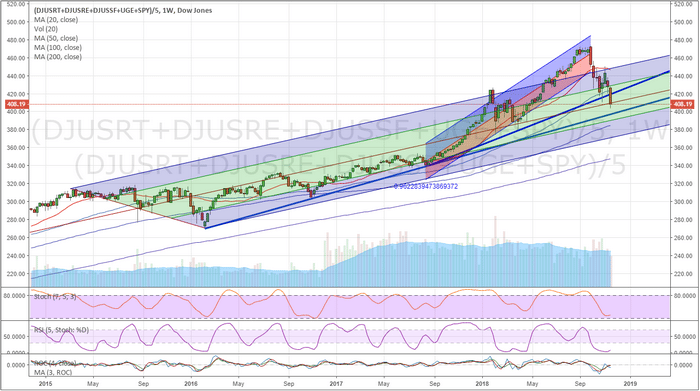
As long as the US Dollar continues to strengthen above $92 and Gold/Silver continue to form a deep price base (as we recently suggested here: https://www.thetechnicaltraders.com/metals-moving-in-unison-for-a-massive-price-advance-part-ii/) we believe the US equity markets will quickly find support near current lows and attempt a new price rally that should push prices back towards new price highs before the end of January 2019.  Take a look at this Weekly chart of our Custom US Equity Market Composite Index.

Although the recent price decline has been dramatic and concerning, the reality of this price correction is that it has dropped to the middle level of longer-term support originating from the 2012 to 2016 price range.  When we take a very long-term view of the markets, the middle (green area) of price rotation has continued to act as resistance and support for price over the past 2~3 years.  In 2015~2017, this area acted as resistance.  In late 2017 and early 2018, the US equity markets began a dramatic acceleration that resulted in this same area becoming support for the price (seen in Feb 2018).  Overall, this recent price decline is likely a result of the US Fed prompting longer-term concerns and the US elections prompting some levels of uncertainty in the markets.

How will investors digest the remaining 30+ trading days for 2018 and early 2019 in light of this retracement and new price valuation?  Will these price levels be viewed as advantageous buy levels of will further pricing concerns prevent investors from pulling the trigger?  We’ll continue our research and attempt to more clearly illustrate our findings in the next part of this multi-part research article.  Right now, think about how the global markets are set for the next 30~90 days of trading action and think about what you believe will be the likely outcome of the new year (the end of the Christmas season, the start of a new year and the continued shifting global economic headlines).

We believe 2019 and 2020 will be incredible years for skilled traders with big price swings and fantastic opportunities for traders.  Please take a minute to visit TheTechnicalTraders.com to learn about our research team and how we can assist you in finding great trades.  We have been calling these market moves with incredible accuracy over the past 18+ months because of our proprietary research tools and skilled researchers.  Try our services and see for yourself how we can help you become a better trader. Stay Tuned for Part II

Chris Vermeulen

See Part 2 of this series here: https://www.countingpips.com/2018/12/part-ii-global-economic-perceptions-are-shifting/


Investors Expect G20 Summit

by JustForex

The US dollar has not changed a lot against a basket of major currencies. Financial market participants took a wait-and-see position before the G20 summit. First of all, the attention of investors will be focused on the meeting between the US President Donald Trump and China’s leader Xi Jinping. The US dollar index (#DX) closed the trading session with a slight increase (+0.02%).

Yesterday, weak economic statistics from the United States were published. Thus, pending home sales index fell by -2.6% in October, while experts expected an increase of 0.8%. Also, investors assess the published FOMC minutes, according to which the Fed leaders consider the need to raise the base interest rate in December. At the same time, the regulator may open a question of slowing down the monetary policy tightening in the future.

Today, weak economic data from China have been also published during the Asian trading session. The index of economic activity in the manufacturing sector (PMI) counted to 50.0 in November, although investors forecasted 50.2.

The “black gold” prices are recovering. At the moment, futures for the WTI crude oil are testing the mark of $51.25 per barrel.

Market Indicators

Yesterday, sales prevailed in the US stock market: #SPY (-0.23%), #DIA (-0.10%), #QQQ (-0.33%).

The 10-year US government bonds yield has stabilized. Currently, the indicator is at the level of 3.01-3.02%.

The news feed on 2018.11.30:

– Consumer price index in the Eurozone at 12:00 (GMT+2:00);
– GDP data in Canada at 15:30 (GMT+2:00).

by JustForex

EURUSD: pair trading around the consolidation support

By Matthew Anthony, Alpari

Previous:

On Thursday the 29th of November, trading on the EURUSD pair closed slightly up. The pair traded within a narrow range of 1.1350 – 1.1400. Market participants were responding to news from the UK, Italy, and US. Activity was low as markets awaited the publication of the minutes of the FOMC’s November meeting, which was expected to provide hints as to the central bank’s intentions with regard to tightening monetary policy.

According to the FOMC minutes, committee members discussed the timeframe for suspending interest rate hikes. The dollar lost ground against the euro, but not much. US10Y bond yields dropped to around 3.00%.

According to CME Group’s FedWatch, the likelihood of a rate hike in December is 82.7%. CME also expects just one interest rate hike for the whole of next year. So, remarks from FOMC members as well as macroeconomic data from the US are of critical importance to global currency markets.

Day’s news (GMT+3):

  • 10:00 Germany: retail sales (Oct);
  • 10:45 France: CPI (Nov);
  • 11:00 Switzerland: KOF leading indicator (Nov);
  • 13:00 Eurozone: CPI (Nov), unemployment rate (Oct);
  • 16:30 Canada: GDP (Q3), industrial product price (Oct);
  • 18:45 US: Chicago PMI (Nov);
  • 21:00 US: Baker Hughes US oil rig count.

Fig 1. EURUSD hourly chart.

Current situation:

I was right not to make any predictions about the euro yesterday. The thought didn’t even enter my head. The news kept the pair trading within a narrow range, from which it should break out today.

I’m expecting a breakout of 1.1387 at the beginning of the European session and a subsequent drop to 1.1368. If the drop is sharp enough, we can target 1.1349. The jury is still out on whether it can go any lower. We need to see what kind of volume the bears will encounter, and how they will behave around the 45th degree.

If we don’t get a drop in the next 2-3 hours, and the bulls start pushing towards the 1.1400 resistance, we can expect further growth to 1.1425. If the bulls break through this level, we can expect trading to close around 1.1465 at the U3 MA line.