Author Archive for InvestMacro – Page 318

Bitcoin Scams and How to Avoid Them

Image Source

Bitcoin has taken the world by storm, and since its introduction in 2008, it has inevitably faced several controversies. Scammers found a gold mine in the digital currency for many reasons. One of them is the fact that only a few people understand it, which makes it easier to make them believe false promises. Another reason is anonymity – cryptocurrency gives scammers relative ease to cover their tracks. Lastly, a major reason is that it is largely unregulated.  Bitcoin chiefly operates outside of the conventions of a financial system; and this worries regulators as it has the potential to be linked to money laundering, tax evasion, fraud, and terrorist funding.

What are the most common bitcoin scams and how do you spot them?

Fake Bitcoin Exchanges. One popular example for these would be South Korea’s BitKRX, which posed to be a branch of the country’s Korean Exchange (KRX) and claimed to be a platform to exchange and trade bitcoin. Ultimately, it turned out to be fraudulent. There are also those that pretend to be connected with well-known exchanges using apps or fake websites; users are scammed when they log in and their account details are given away. When you are directed to a website, make sure that the URL has “HTTPS” rather than just “HTTP.” Without the letter S, it means that the web traffic has no security and encryption.

Ponzi Scams. Someone promises an incredible return of investment using bitcoin and a lot of people buy in it. Before you know it, someone runs off with all of your money. That’s basically how Ponzi schemes work. At first, victims will be made to believe that it actually works – say, the digits in their bank account are increasing. This will also make them talk about its “success” and convince others to join in. Eventually, calls to the customer service are unanswered, there are technical problems with the website, or the money will be remitted late – among several excuses while your money disappears for good. If you see ads that sound like, “double your bitcoin overnight,” they’re probably scams. How it usually works is you have to send them your money first before they can double it.

Pyramid Schemes. Scammers use bitcoin as a product in pyramid scams. In these schemes, your low initial investment will be multiplied if you invite more people to sign up. After a lot of people have invested their money, the original scammer walks away with all the money.

Malware. Hackers have long been using malware in order to get a hold of other people’s login credentials and account details. Now, it’s being used to drain Bitcoin wallets that are connected to the Internet.

How do you avoid falling into these scams?

  • If the offer is too good to be true, stay away from it.
  • Be vigilant on social media – legitimate bitcoin traders and brokers can be victims of poser accounts or impersonators.
  • Never conduct financial transactions via direct messages on social media platforms.
  • Do your homework and research on services you encounter and the best trading platforms; verify their claims and check their legitimacy or whether they are a registered corporation or not.

Contact us at Hogan Injury for expert legal advice.

None of the content on Hoganinjury.com is legal advice nor is it a replacement for advice from a certified lawyer. Please consult a legal professional for further information.

 

The USD Index Is in the Red

by JustForex

Financial market participants keep evaluating the results of the G20 summit. The warnings of the trade war are now unfounded due to Donald Trump’s and Xi Jinping’s agreement not to introduce additional fees during the next 90 days of the truce. The demand for risky assets is up. The USD index (#DX) started to descend.

An array of important economic reports was published in EU, UK, and the US. The Industrial PMI in Germany reached 51.8 instead of the expected 51.6. The Industrial PMI for the UK grew to 53.1 instead of 51.6. The Industrial PMI for the US, published by ISM, reached 59.3 instead of 57.6. The Reserve Bank of Australia today released a resolution regarding the key interest rate, which remained 1.50%.

The prices on oil keep recovering. The WTI futures are trading at 53.70 USD/barrel.

Market Indicators

The US stock market is showing some aggressive purchases: #SPY (+1,32%), #DIA (+1,26%), #QQQ (+1,75%).

The 10-year US government bonds yield lowered significantly and now is at 2.95-2.96%.

The Economic News Feed for 04.12.2018:
  • – Construction PMI (UK) – 11:30 (GMT+2:00).

Also, keep an eye on the statements made by the Head of the Bank of England Mark Carney.

by JustForex

EURUSD: pair on course to strengthen amid positive backdrop

By Matthew Anthony, Alpari

Previous:

On Monday the 3rd of December, trading on EURUSD closed up. The bullish momentum, which formed during the Asian session against the background of a 90-day truce between the US and China, did not last long. The euro fell against the US dollar in trading in Europe after the British session, and in the American session recovered losses as USD weakened. Many major currencies traded in positive territory before the close of trading.

US data:

The ISM business activity index amounted to 59.3 (forecast 57.7, previous 57.7).

Day’s news (GMT+3):

  • 12:15 UK: BOE’s Governor Carney speech.
  • 12:30 UK: PMI construction (Nov).
  • 13:00 Eurozone: PPI (MoM) (Oct).
  • 16:30 Canada: labor productivity (QoQ) (Q3).

Fig 1. EURUSD hourly chart.

Current situation:

Our expectations for yesterday were proved true. Despite the positive results of the G20 summit, EURUSD dropped to 45 degrees. Since the level hike was small, I did not build new levels from 1.1319.

The price has recovered to the 67th degree. Since the stochastic oscillator is in the sell zone, the risks of a decline to the lb 1.1356 increased. During the Asian session the dollar traded in the red, while the main cross EURGBP traded in the black. The price rebounded from the bottom line of the rising channel. I do not see anything that would prevent a return to the level of 1.1413.

Source: EURUSD: pair on course to strengthen amid positive backdrop


The Saudi Dilemma: To Cut Or Not To Cut

By OilPrice.com

To cut and push up prices or not to cut and preserve market share, this is the question that Saudi Arabia is facing ahead of this year’s December OPEC meeting. It seems like just yesterday when OPEC met in 2016 and decided to cut production by 1.8 million barrels daily, including from Russia, to reverse the free fall of oil prices. At the time, it worked because everyone was desperate. Now, many OPEC members are both desperate while not yet recovered from the 2014 blow. Saudi Arabia is not an exception.

A recent report from Capital Economics said Saudi Arabia has its problems but it could withstand lower oil prices without feeling too much of a pinch. “Even if [Brent] prices fall further to $40-$50 a barrel, immediate balance of payments strains are unlikely to emerge,” the report said, with its authors adding the Kingdom would be able to finance its trade deficit from its foreign exchange reserves “for at least a decade.”

This suggestion is not universally accepted. Reuters’ John Kemp this week offered a different perspective in his regular column on oil, noting Saudi Arabia’s foreign exchange reserves currently stand at US$500 billion, down from nearly US$750 billion in 2014 when the oil prices slumped under the weight of U.S. shale oil. At the same time, Saudi Arabia is in a major push to diversify its revenue streams and has committed a lot of money to it.

Also, Kemp wrote, “The kingdom probably needs to keep several hundred billion dollars’ worth of reserve assets on hand to maintain confidence in its fixed exchange-rate peg to the U.S. dollar and prevent a run on the currency.”

It’s a classic rock and a hard place situation for the Saudis. On the one hand, they could continue pumping at the current record rate or close to it, pressuring prices further, which is what they did in 2014. That strategy hurt U.S. shale substantially, but the attempted assault did not go quite as planned. Now, it will once again hurt U.S. shale, but again, it won’t beat the resilience of the US shale patch. That much should have become clear in the past three years.

On the other hand, Saudi Arabia could start cutting, but it will need to convince all other OPEC members to join the cuts and, more importantly, Russia. Reuters earlier today reported, quoting unnamed sources, that Russia had “accepted the need to cut production” and prices immediately jumped, once again highlighting how important the Russia-Saudi Arabia cooperation has become for oil markets, if it even needs highlighting.

For now, it seems like a cut is the more likely outcome. In spite of reservations expressed by Nigeria and Libya, if Saudi Arabia managed to convince everyone to cut amid the major tensions with Iran ahead of the U.S. sanctions, then it could probably convince them again, if only on the grounds that if they don’t start cutting all will suffer.

Kemp agrees. “Saudi Arabia cannot afford another slump in oil prices,” he warns. “It needs to keep revenues high to help its economy climb out of recession and finance ambitious social and economic transformation programs.”

Yet the Kingdom is preparing. Kpler reported this week loadings of Saudi crude since the start of November had reached new highs of 8.14 million bpd, which was 770,000 bpd more than the average daily loadings rate for October and much higher than the last 2018 high of 7.766 million bpd booked for June. The bulk of the increase comes from China, with shipments in that direction up by more than half a million barrels daily in November from October. Production is also at record highs, like Russia’s was ahead of the first cuts in 2016. Perhaps we are seeing a lesson learned there or perhaps the Kingdom is out of options besides cutting.

Link to article: https://oilprice.com/Energy/Crude-Oil/The-Saudi-Dilemma-To-Cut-Or-Not-To-Cut.html

By Irina Slav for Oilprice.com

PART II – Global Economic Perceptions Are Shifting

By TheTechnicalTraders.com

This is Part 2 – Read Part 1 here: Global Economic Perceptions Are Shifting – PART I

The continued efforts of our research team to identify and quantify the possibility that the capital shift which has taken place over the past 18+ months may be shifting to other assets is in the interest of all global investors.  Is there a new, more opportunistic investment that will take away from the capital that has been rushing into the US equity markets over the past 2+ years or is the capital shift towards the US equity markets still intact?  These are the questions before us and these are the questions that will determine if the US equity markets continue to rally or continue to top out.

In part one of this research article, we began to explore the aspects of our research that we believe are key to understanding the future of the global capital shift phenomenon. In short, the capital shift is the movement of investment capital from one asset to another asset (from country to country, from one form to another or from one asset class to another) in an attempt to seek out and secure the best, safest and most secure ROI on the planet.  We believe this process has been a driving force behind much of the global markets success or malaise over the past 4+ years (actually starting near 2013 when wealth in China and capital controls forced investors to seek outside investment sources).

Additionally, in part one of this research article, we highlighted the traditional range channels of the US equity market and how these ranges have played an important role in identifying price support.  Currently, the US market is sitting at the middle support level of historical ranges after retracing from recent highs.  This is far from the “crash moment” that many are predicting.  The reality is that this is more of a reversion to support in a strongly upward sloping price channel.

Let’s start out by asking the question “what will happen to Asia/China over the next 2+ years and what will happen with the capital from Asian investors?”  Should we believe that China/Asia capital markets are healthy and robust for sufficient ROI in current form or are these investors seeking outside sources for healthier and safer ROI solutions for their capital?  And what should we expect over the next 18~24+ months beginning in early 2019?

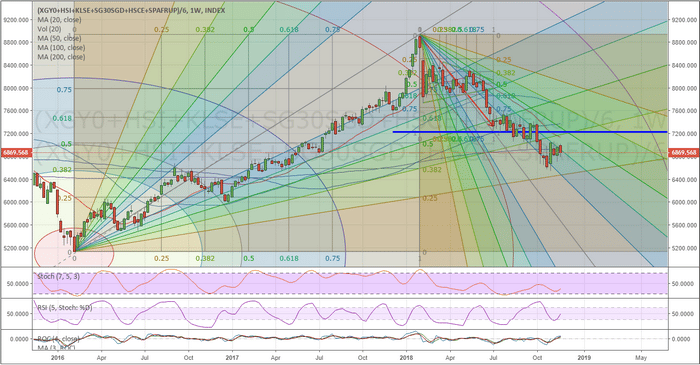
Our Custom China/Asia Index has clearly shown that prices have reflected a downward trend since the top in early 2018.  This price decline has already breached the 50% Fibonacci retracement level and appear to be attempting a deeper price move lower.  We believe the banking/credit/expansion issues in Asia/China are related to this capital contraction and won’t abate until the majority of these issues are resolved.  In other words, there is far too much uncertainty in this area of the investment world to support a change in investor sentiment.  Yes, everyone wants to see Asia/China settle these economic issues and become poised for a stronger growth model going forward, but everyone is also waiting for the next shoe to drop to detail these expectations.  Housing, Trade, Credit Markets, Banking, Global Objectives, Regional Issues, Manufacturing??  Pick one and wait a few months for some news.  At this point, there is so much news originating from China/Asia that is pointing to a broad market correction that we are simply waiting for the next news item to hit.

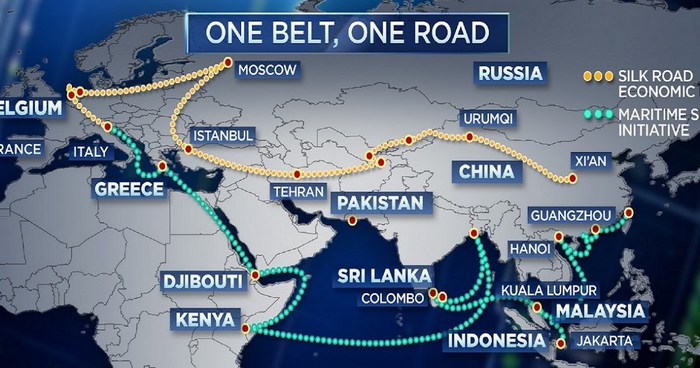
The One Belt, One Road project is another concerning aspect to what China/Asia is capable of achieving.  This project is incredibly diverse – spanning dozens of nations/countries.  The reality of this project is that uncertainty abounds from all angles when one considers the routs this project is taking and the global uncertainties that originate from many of the areas on these routes.  Tehran, Kenya, Pakistan, Sri Lanka, Kuala Lumpur, Jakarta??  Sure, the land and sea transport solutions offer a very interesting and dynamic shift for economic growth, but this is all based on the assumption that wars, graft, politics and local/regional tensions don’t flame up to halt or block any of these routes and the future success of this project.

Already, Malaysia has terminated multiple projects related to the One Belt, One Road objective because of corruption and fraud against the Malaysian people.  We are reading news stories of Pakistan and other nations questioning the deals made with China in support of this project.  In our opinion, the land routes are much more fragile than the sea routes.  Ships can change course and head to another port if needed.  Train tracks are not easily relocated and shifted around to address regional issues.


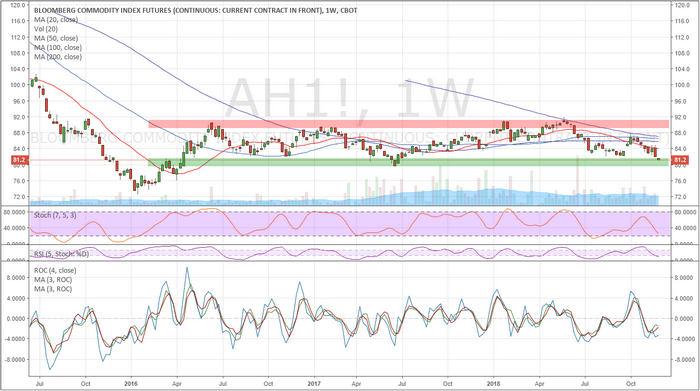
Additionally, the global commodities pricing index (from Bloomberg) is suggesting that global commodities have reached a peak and are declining.  This puts pricing pressures on larger global projects like the One Belt, One Road project because profits from mining or manufacturing raw commodities and secondary commodity products are dramatically decreased.  This would also suggest that suppliers and manufacturers may be experiencing an economic stall in terms of growth expectations over the next few years.  If the commodities futures prices are declining, then global investors are not seeing any aspect of the global markets that would relate to higher demand, manufacturing or increased general consumption/use of global commodities.


Watch Crude Oil for signs of life in the economy.  The price of Oil is often a very good gauge of economic activity and expectations in terms of freight, shipping, consumer activities and more.  Oil has seen a very dramatic selloff over the past 2 months and is nearing levels that should be concerning for producers.  Oil price levels below $40 ppb could be a game changer for much of the Arab world.

Our conclusion is that until global investors see the true opportunity for Asia/China and see real strength in the global commodities markets, risks continue to outweigh opportunities in much of Asia/China.  Therefore, we believe the capital shift phenomenon originating from this region will continue to source more suitable returns in other global investments.  Should the commodity index break down or the Chinese/Asian markets collapse further, we believe the push for outside safety will increase.  This may be likely near the start of 2019.

Want to know what our predictive modeling systems are suggesting will happen in 2019 and beyond?  Are you searching for a dedicated team of researchers that can help you understand where opportunities are and how to find great trades?  Take a minute to visit TheTechnicalTraders.com to learn how we can assist you and help you find greater success.  Want to see how we’ve been calling the markets, visit www.TheTechnicalTraders.com/FreeResearch/ to review all of our public research posts.  2019 and 2020 are setting up to be incredible opportunities for investors – get ready for some incredible success with these bigger price swings playing out.

Chris Vermeulen


Trade Wars Armistice Counted Against USD

By Dmitriy Gurkovskiy, Chief Analyst at RoboForex

The currency market started December against the USD. On Monday morning, the major currency pair is trading upwards as investors have no interest in the American currency as a “safe haven” asset. It happened after G20 summit, where the USA and China decided to take a break in their “trade wars”.

The parties agreed on the following: they will stop increasing import duties starting January 1st 2019 for three months in order to resume negotiations on a new trade agreement. Over this period of time, Washington shall postpone introducing additional 25% import duties on Chinese goods and “freeze“ this idea. China, in its turn, is obliged to buy a large volume of US-manufactured goods, including agricultural and commodity products.

Frankly speaking, it the same old soup just reheated, this time not in trading, but in politics. Most likely, the USA will start to put pressure on China to make the future trade agreement more profitable for Americans. There are reasons to believe that China might not like this and the Chinese government will use these three months to stimulate the country’s economy along with domestic demand and improve the banking sector in order to be ready for further “trade wars”.

However, at the moment investors aren’t interested in such distant prospects. The point is that there is a “spur-of-the-moment” thing: euphoria and rebound.

Under such conditions, investors’ interest in “safe haven” assets is reducing, thus making the USD fall.

Looking at EURUSD movements over the last month, one can see a convergent trading range, which means that the correction to the upside continues. The previous local downtrend corrected the quick rising impulse, thus “counterweighing” the market. It seems that the current ascending impulse is heading towards the resistance level and 1.1445. In other words, this correctional movement to the upside is not over yet. At the same time, the pair may start a short-term decline towards the local support at 1.1322 and break it. In this case, the instrument may continue falling towards the key support at 1.1288. However, according to the main scenario, EURUSD is expected to move upwards to reach the Triangle’s upside border.

Disclaimer

Any predictions contained herein are based on the authors’ particular opinion. This analysis shall not be treated as trading advice. RoboForex shall not be held liable for the results of the trades arising from relying upon trading recommendations and reviews contained herein.


Forex Technical Analysis & Forecast 03.12.2018 (EURUSD, GBPUSD, USDCHF, USDJPY, AUDUSD, USDRUB, GOLD, BRENT)

Article By RoboForex.com

EURUSD, “Euro vs US Dollar”

EURUSD has formed another consolidation range around 1.1347 and expanded it towards 1.1365; right now, it is trading upwards and trying to return to an alternative scenario and grow towards 1.1500. Possibly, the pair may return to 1.1347, thus forming a new consolidation range between this level and 1.1365. If later the instrument breaks this range to the upside, the price may form one more ascending structure to reach 1.1388 and then resume falling towards 1.1347; if to the downside – continue trading inside the downtrend with the target at 1.1295.

EURUSD
Risk Warning: the result of previous trading operations do not guarantee the same results in the future

GBPUSD, “Great Britain Pound vs US Dollar”

GBPUSD is still consolidating around 1.2777. Possibly, today the pair may continue trading inside the downtrend towards 1.2698. After that, the instrument may start another growth to reach 1.2760 and then resume falling with the target at 1.2650.

GBPUSD
Risk Warning: the result of previous trading operations do not guarantee the same results in the future

USDCHF, “US Dollar vs Swiss Franc”

USDCHF has formed another consolidation range around 0.9977. According to the main scenario, the price is expected to trade upwards and reach 1.0007. Later, the market may fall to return o 0.9977. If later the instrument breaks this range to the upside, the price may continue trading inside the uptrend with the target at 1.0400; if to the downside – continue the correction towards 0.9888 (an alternative scenario).

USDCHF
Risk Warning: the result of previous trading operations do not guarantee the same results in the future

USDJPY, “US Dollar vs Japanese Yen”

USDJPY has formed another consolidation range around 113.48. Possibly, the pair may trade upwards to reach 113.83 and then fall to return to 113.48. After that, the instrument may form one more ascending structure towards 114.15 and then resume falling with the first target at 112.95.

USDJPY
Risk Warning: the result of previous trading operations do not guarantee the same results in the future

AUDUSD, “Australian Dollar vs US Dollar”

AUDUSD is trading upwards. Possibly, the pair may reach 0.7393 and then fall towards 0.7282, thus expanding the consolidation range both upwards and downwards. Later, the market may break the range to the downside and continue falling inside the downtrend with the first target at 0.7180.

AUDUSD
Risk Warning: the result of previous trading operations do not guarantee the same results in the future

USDRUB, “US Dollar vs Russian Ruble”

USDRUB has broken 66.20 downwards. Today, the pair may fall to break 65.60 and then continue trading inside the downtrend with the short-term target at 64.00.

USDRUB
Risk Warning: the result of previous trading operations do not guarantee the same results in the future

XAUUSD, “Gold vs US Dollar”

Gold is trading upwards; it has broken 1224.10 and may choose an alternative scenario to continue growing towards 1231.62. After that, the instrument may fall to return to 1224.10 and then form one more ascending structure with the target at 1237.05.

GOLD
Risk Warning: the result of previous trading operations do not guarantee the same results in the future

BRENT

Brent is forming a new descending structure. Today, the pair may reach 62.76 and then resume falling towards 60.80. Later, the market may form one more ascending structure with the first target at 64.10.

BRENT
Risk Warning: the result of previous trading operations do not guarantee the same results in the future

Article By RoboForex.com

Attention!
Forecasts presented in this section only reflect the author’s private opinion and should not be considered as guidance for trading. RoboForex LP bears no responsibility for trading results based on trading recommendations described in these analytical reviews.

Fibonacci Retracements Analysis 03.12.2018 (GOLD, USDCHF)

Article By RoboForex.com

XAUUSD, “Gold vs US Dollar”

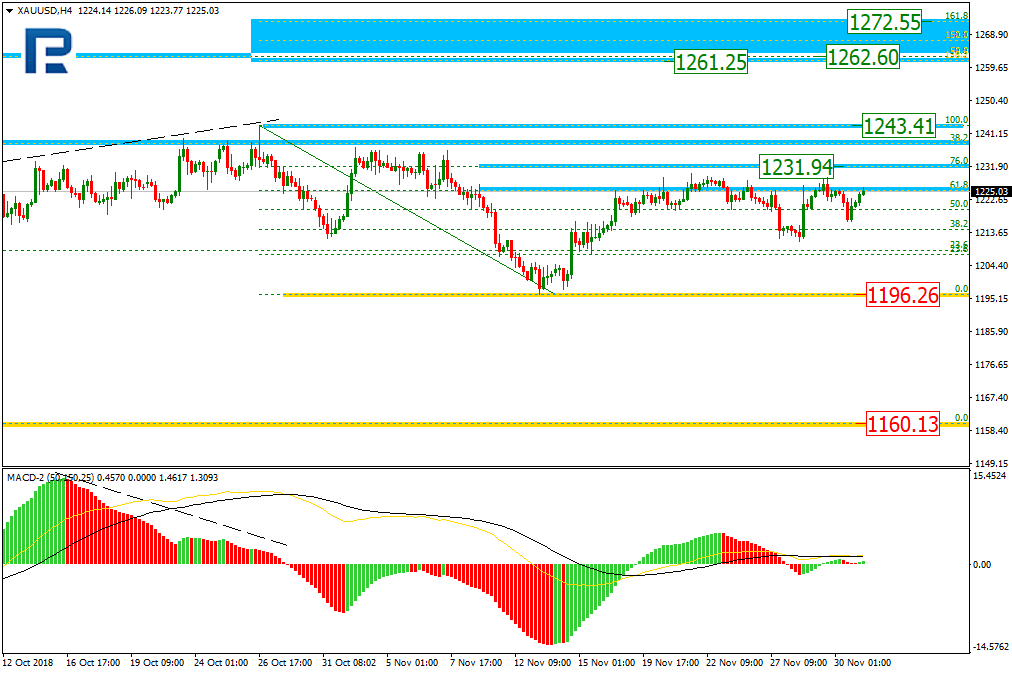
As we can see in the H4 chart, the uptrend has already reached the retracement of 61.8%. The closest upside targets are the retracement of 76.0% at 1232.00 and the current high at 1243.41. In case XAUUSD breaks the high, the instrument may continue growing towards the long-term retracement of 50.0% at 1262.60, which is inside the post-correctional extension area between the retracements of 138.2% and 161.8% at 1261.25 and 1272.55 respectively. The key support level is at 1196.26.

GOLD1
Risk Warning: the result of previous trading operations do not guarantee the same results in the future

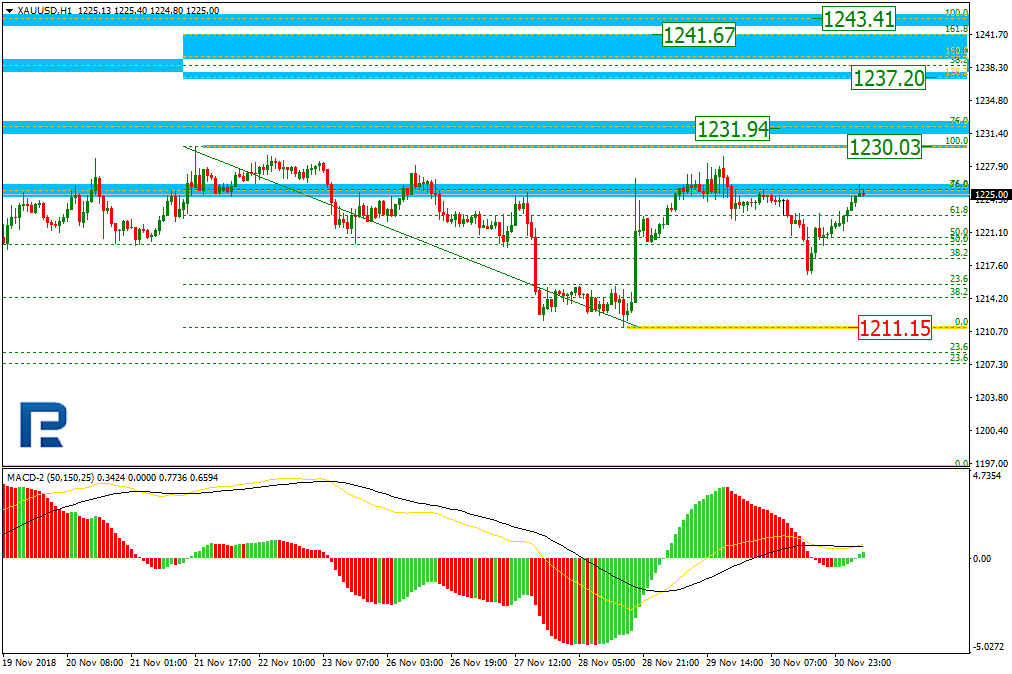
In the H1 chart, the pair couldn’t break the local high at 1230.03. In case the price does break it, the instrument may grow towards the post-correctional extension area between the retracements of 138.2% and 161.8% at 1237.20 and 1241.67 respectively. The support is at 1211.15.

GOLD2
Risk Warning: the result of previous trading operations do not guarantee the same results in the future

USDCHF, “US Dollar vs Swiss Franc”

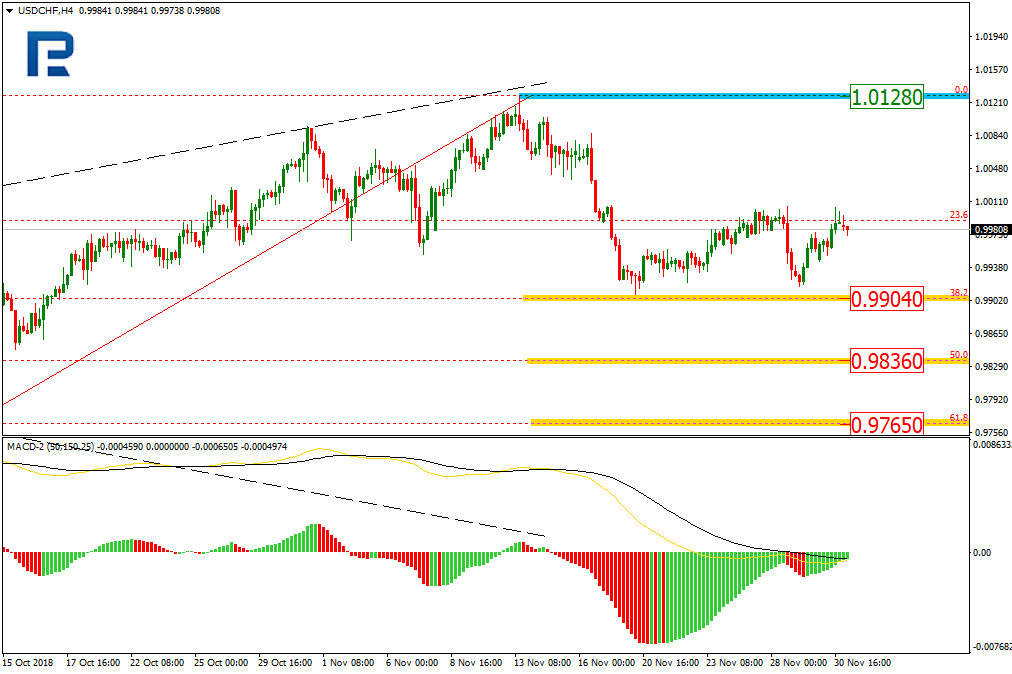
In the H4 chart, USDCHF is trading sideways. In case the downtrend continues, the price may reach the retracements of 38.2%, 50.0%, and 61.8% at 0.9904, 0.9836, and 0.9765 respectively. The resistance level is the high at 1.0128.

USDCHF1
Risk Warning: the result of previous trading operations do not guarantee the same results in the future

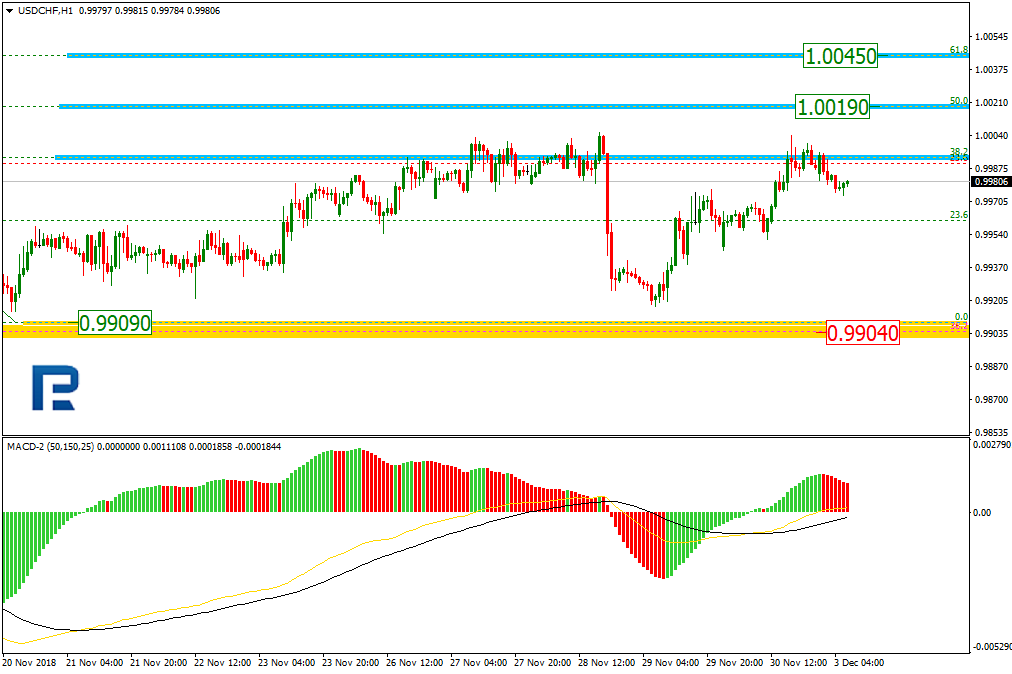
As we can see in the H1 chart, the pair has been corrected to the upside by 38.2%. The next targets of this pullback may be the retracements of 50.0% and 61.8% at 1.0019 and 1.0045 respectively.

USDCHF2
Risk Warning: the result of previous trading operations do not guarantee the same results in the future

Article By RoboForex.com

Attention!
Forecasts presented in this section only reflect the author’s private opinion and should not be considered as guidance for trading. RoboForex LP bears no responsibility for trading results based on trading recommendations described in these analytical reviews.

The Analytical Overview of the Main Currency Pairs on 2018.12.03

Analytics by JustForex

The EUR/USD currency pair

Technical indicators of the currency pair:
  • Prev Open: 1.13827
  • Open: 1.13499
  • % chg. over the last day: -0.67
  • Day’s range: 1.13748 – 1.13838
  • 52 wk range: 1.1299 – 1.2557

On Friday EUR/USD had a bearish mood. The quotes lowered by more than 70 points. Currently the currency pair is recovering. The local support and resistance are 1.13500 and 1.13800. Positions should be opened from these levels. The financial market participants are waiting for reports from the EU and the US.

The news feed on 03.12.2018:
  • – Industrial Purchasing Managers’ Index (GER) – 10:55 (GMT+2:00);
  • – Industrial Purchasing Managers’ Index (US) – 17:00 (GMT+2:00);
EUR/USD

Indicators do not provide precise signals, the price has crossed 50 MA and 200 MA.

The MACD histogram is close to 0.

Stochastic Oscillator is located in the neutral zone, the %K line is crossing the %D line. There are no precise signals.

Trading recommendations
  • Support levels: 1.13500, 1.13250, 1.13000
  • Resistance levels: 1.13800, 1.14100, 1.14400

If the price fixes above 1.13800, the EUR/USD quotes are expected to grow. The movement is tending to 1.14100-1.14400.

An alternative may be a decrease in the EUR/USD currency pair to the level of 1.13250-1.13000.

The GBP/USD currency pair

Technical indicators of the currency pair:
  • Prev Open: 1.27821
  • Open: 1.27291
  • % chg. over the last day: -0.33
  • Day’s range: 1.27916 – 1.28248
  • 52 wk range: 1.2662 – 1.4378

The technical picture of the GBP/USD is still ambiguous. The pound is trading in flat. The financial market participants are waiting for the additional drivers. At the moment, the local support and resistance levles are 1.27700 and 1.28100 respectively. Positions should be opened from these levels.

At 11:30 (GMT+2:00) the Industrial PMI index will be published in UK.

GBP/USD

Indicators do not send accurate signals: the price has crossed 50 MA and 200 MA.

The MACD histogram is in the positive zone, which indicates a bullish mood.

Stochastic Oscillator is leaving the overbought zone, the %K line is below the %D line, which sends a signal to sell GBP/USD.

Trading recommendations
  • Support levels: 1.27700, 1.27400
  • Resistance levels: 1.28100, 1.28500, 1.28800

If the price fixes below the support level of 1.27700, the GBP/USD quotes are expected to decline. The movement is tending to 1.27400-1.27000.

An alternative may be the GBP/USD currency pair growth to 1.28500-1.28800.

The USD/CAD currency pair

Technical indicators of the currency pair:
  • Prev Open: 1.32793
  • Open: 1.32359
  • % chg. over the last day: +0.10
  • Day’s range: 1.31672 – 1.31731
  • 52 wk range: 1.2248 – 1.3387

USD/CAD is seeing some aggressive sales. CAD has strengthened against the USD by more than 100 points and the currency pair has updated the local minimums. It is supported by the growth of the oil quotes. The local support and resistance levels are 1.31600 and 1.31850. Positions should be opened from these levels. The trading instrument has a tendency to decrease.

The newsfeed for Canada is calm.

USD/CAD

The price is being traded bellow 50 MA and 200 MA, which indicates the power of sellers.

The MACD histogram is in the negative zone and below the signal line, which gives a strong signal towards the sale of USD/CAD.

The Stochastic Oscillator is located in the oversold zone, the %K line has crossed the %D line. There are no signals at the moment.

Trading recommendations
  • Support levels: 1.31600, 1.31300, 1.31000
  • Resistance levels: 1.31850, 1.32150, 1.32500

If the price fixes below the support level of 1.31600, it is necessary to consider sales of USD/CAD. The movement is tending to 1.31300-1.31000.

Alternative option. If the price fixes above the 1.31850 mark, we recommend looking for entry points to the market to open long positions. The movement is tending to 1.32150-1.32400.

The USD/JPY currency pair

Technical indicators of the currency pair:
  • Prev Open: 113.479
  • Open: 113.654
  • % chg. over the last day: -0.01
  • Day’s range: 113.395 – 113.437
  • 52 wk range: 104.56 – 114.74

The USD/JPY is showing a variety of trends. The quotes are consolidating. The local support and resistance levels are 113.300 and 113.500. Positions should be opened from these levels. The trading instrument has a tendency to fall. You should keep an eye on the 10-year US government bonds yield.

The news feed on the economy of Japan is calm.

USD/JPY

Indicators do not send accurate signals: the price has fixed between 50 MA and 200 MA.

The MACD histogram is near the 0 mark.

Stochastic Oscillator is near the oversold zone, the %K line has crossed the %D line. There are no accurate signals.

Trading recommendations
  • Support levels: 113.300, 113.000, 112.800
  • Resistance levels: 113.500, 113.750, 114.000

If the price fixes below the local support of 113.300,, the USD/JPY currency pair correction is expected. The movement is tending to 113.000-112.800.

An alternative may be the USD/JPY quotes growth to 113.750-114.000.

Analytics by JustForex

Investors Are Evaluating the Results of the G20 Summit

by JustForex

The USD strengthened against the major currencies. A G20 summit happened on Friday. The President of the United States Donald Trump and the leader of the People’s Republic of China Xi Jinping met during the summit and agreed to keep the 10% fees on the Chinese wares worth more than 200 billion USD. The officials agreed that China will expand the import of the US wares, including the agricultural products. The USD index (#DX) closed in the green (+0,51%).

Some economic reports were published on Friday by the EU and Canada. According to the preliminary data, the inflation in the EU reached 2%, while the experts were expecting 2.1%. The Canadian GDP growth slowed down by 0.1% instead of growing by the same amount, as had been expected. Today, during the Asian trading session, Caixin published a PMI rating of China which rose to 50.2 in November instead of 50.1.

The oil market is characterized by aggressive purchases. At the moment the WTI futures are testing the 53.55 USD/barrel mark.

Market Indicators

On Friday the US stock market had seen a lot of purchases: #SPY (+0,62%), #DIA (+0,70%), #QQQ (+0,73%).

The 10-year US government bonds yield is at 3,03-3,04%.

The Economic News Feed for 03.12.2018:
  • – Industrial Purchasing Managers’ Index (GER) – 10:55 (GMT+2:00);
  • – Industrial Purchasing Managers’ Index (UK) – 11:30 (GMT+2:00);
  • – Industrial Purchasing Managers’ Index by ISM (US) – 17:00 (GMT+2:00);

by JustForex