Author Archive for InvestMacro – Page 274

The Analytical Overview of the Main Currency Pairs on 2019.03.06

Analytics by JustForex

The EUR/USD currency pair

Technical indicators of the currency pair:
  • Prev Open: 1.13391
  • Open: 1.13073
  • % chg. over the last day: -0.30
  • Day’s range: 1.12898 – 1.13075
  • 52 wk range: 1.1214 – 1.2557

EUR keeps losing positions against the USD before the Central Bank meeting. Yesterday EUR/USD quotes updated the local minimums. The trading instrument is consolidating around 1.12900-1.13100. EUR is under pressure due to the worries that ECB might renew the stimulating measures for the economy and announce it on Thursday. An additional support for USD is given by the optimistic report on the business activity in the non-industrial and real-estate markets. You should open positions from the key levels.

The Economic News Feed for 06.03.2019:

  • – Preliminary Report on the Labour Market by ADP (US) – 15:15 (GMT+2:00);
  • – Trading Balance (US) – 15:30 (GMT+2:00);
  • – Beige Book (US) – 21:00 (GMT+2:00);

Keep an eye on the comments by FOMC representatives.

EUR/USD

The price fixed below 50 MA and 200 MA which points to the power of the sellers.

The MACD histogram is in the negative zone but above the signal line which gives a weak signal to sell EUR/USD.

The Stochastic Oscillator is near the oversold zone, the %K line is above the %D line which points to the bullish mood.

Trading recommendations
  • Support levels: 1.12900, 1.12500
  • Resistance levels: 1.13200, 1.13450, 1.13650

If the price fixes below the support level of 1.12900, expect the quotes to fall further toward 1.12500-1.12300.

Alternatively, the quotes can grow toward 1.13400-1.13600.

The GBP/USD currency pair

Technical indicators of the currency pair:
  • Prev Open: 1.31734
  • Open: 1.31729
  • % chg. over the last day: -0.01
  • Day’s range: 1.31240 – 1.31788
  • 52 wk range: 1.2438 – 1.4378

GBP/USD keeps showing a negative trend. The market participants started to fix their positions after the long rally in the last two weeks. GBP is under pressure due to Brexit ambiguousness. On Tuesday the represtative of the Labour party claimed that not many parliamentaries support the EU deal proposed by May, and that there hasn’t been any breakthroughs on that front. Right now the quotes are consolidating. The key range is 1.31100-1.31800. You should open positions from these levels.

The Economic News Feed for 06.03.2019 is calm.

GBP/USD

The indicators do not provide precise signals, 50 MA has crossed 200 MA.

The MACD histogram is in the negative zone but above the signal line which gives a weak signal to sell GBP/USD.

The Stochastic Oscillator is in the neutral zone, the %K line is above the %D line which points to the bullish mood.

Trading recommendations
  • Support levels: 1.31100, 1.30500, 1.29800
  • Resistance levels: 1.31800, 1.32400, 1.32800

If the price fixes below 1.31000, expect the quotes to fall toward 1.30700-1.30400.

Alternatively, the quotes can recover toward 1.32300-1.32600.

The USD/CAD currency pair

Technical indicators of the currency pair:
  • Prev Open: 1.33018
  • Open: 1.33502
  • % chg. over the last day: +0.39
  • Day’s range: 1.33489 – 1.33736
  • 52 wk range: 1.2248 – 1.3664

CAD is weakened again against the USD. The quotes are consolidating around the local resistance 1.33750 with 1.33350 acting as a mirror resistance. The financial market participants are waiting for the Bank of Canada meeting. The regulator is planned to keep the 1.75% key interest rate. Keep an eye on the comments and rhetorics by the Central Bank representatives. You should open positions from the key levels.

The Economic News Feed for 06.03.2019:

  • – Trading Balance (CAD) – 15:30 (GMT+2:00);
  • – Decision of Bank of Canada on the key interest rate (CAD) – 17:00 (GMT+2:00);
  • – Ivey’s Business Activity Index (CAD) – 17:00 (GMT+2:00);
USD/CAD

The price fixed above 50 MA and 200 MA which points to the power of byers.

The MACD histogram is in the positive zone but below the signal line, which gives a weak signal to buy USD/CAD.

The Stochastic Oscillator is in the neutral zone, the %K line is below the %D line which points toward the correction of USD/CAD.

Trading recommendations
  • Support levels: 1.33350, 1.33000, 1.32700
  • Resistance levels: 1.33750, 1.34000

If the price fixes above 1.33750, expect the quotes to grow toward 1.34250-1.34500.

Alternatively, the quotes can correct toward the round 1.33000.

The USD/JPY currency pair

Technical indicators of the currency pair:
  • Prev Open: 111.729
  • Open: 111.849
  • % chg. over the last day: +0.10
  • Day’s range: 111.725 – 111.924
  • 52 wk range: 104.56 – 114.56

USD/JPY remains in a flat. The technical picture is ambiguous. The investors are waiting for additional drivers, with levels being 111.750 and 112.000 respectively. Keep an eye on the economic reports, as well the US Treasury bond yield dynamics. You should open positions from the key levels.

The Economic News Feed for 06.03.2019 is calm.

USD/JPY

The indicators do not provide precise signals, the price has crossed 50 MA.

The MACD histogram is close to 0.

The Stochastic Oscillator is in the neutral zone, the %K line is above the %D line which gives a signal to buy USD/JPY.

Trading recommendations
  • Support levels: 111.750, 111.500, 111.200
  • Resistance levels: 112.000, 112.500

If the price fixes above the round 112.000, expect the quotes to grow toward 112.400-112.600.

Alternatively, the quotes can fall toward 111.500-111.300.

Analytics by JustForex

The US Dollar Is Again in the Green. The Potential for Growth Remains. We Expect the Bank of Canada Decision

by JustForex

Yesterday, the US dollar strengthened against a basket of major currencies. The dollar index (#DX) updated two-week highs and closed in the positive zone (+0.19%). Positive economic data, as well as the growth of the US government bonds yield supported the US currency. Thus, ISM non-manufacturing PMI counted to 59.7 in February and turned out to be better than the forecasted value of 57.3. New home sales increased to 621K in December instead of 600K.

The Australian dollar weakened against the US dollar. Today, during the Asian trading session, weak Australia GDP has been published. Thus, GDP (q/q) grew by only 0.2% in the 4th quarter of 2018, while experts expected growth by 0.5%. GDP (y/y) increased by 2.3% instead of 2.5%.

The British pound also fell against the US currency. Financial market participants began to fix positions due to the uncertainty concerning Brexit. Talks between representatives of the UK and the EU were held yesterday in Brussels, which did not bring positive results and did not go well. Today, discussions will resume.

Investors expect the Bank of Canada interest rate decision. It is expected that the regulator will keep the key marks of monetary policy at the same level. We recommend paying attention to the comments by the Central Bank representatives.

The “black gold” prices are falling. At the moment, futures for the WTI crude oil have approached the mark of $56.00 per barrel. At 17:30 (GMT+2:00), a report on crude oil inventories will be published in the US.

Market Indicators

Yesterday, there was a variety of trends in the US stock market: #SPY (-0.14%), #DIA (-0.03%), #QQQ (+0.07%).

At the moment, the 10-year US government bonds yield is at 2.70-2.71%.

The news feed on 06.03.2019:

– ADP nonfarm employment change in the US at 15:15 (GMT+2:00);
– Trade balance in the US at 15:30 (GMT+2:00);
– Bank of Canada interest rate decision at 17:00 (GMT+2:00);
– Ivey PMI at 17:00 (GMT+2:00);
– Fed’s “Beige Book” at 21:00 (GMT+2:00).

We also recommend paying attention to the speeches by the FOMC members.

by JustForex

EURUSD: euro under pressure ahead of the ECB meeting

By Matthew Anthony, Alpari

Previous:

On Tuesday the 5th of March, trading on the euro closed down. The rebound from 1.1316 didn’t come to pass. The bulls defended 1.1320 for 6 hours before giving way. The pair then dropped to 1.1290. The euro slid against the dollar on the back of positive US data (ISM non-manufacturing index and new home sales).

At the beginning of the European session, the euro was bought up on the crosses by day traders, but this wasn’t enough to prop up the support at 1.1320 on the EURUSD pair. The downside pressure from a broadly stronger US dollar proved too much. Later, rumours started circulating about another round of TLTROs from the ECB in an attempt to address slowed economic growth. This heaped added pressure on the euro towards the end of the day.

Day’s news (GMT+3):

  • 15:15 UK: BoE’s Cunliffe speech.
  • 16:15 US: ADP employment change (Feb).
  • 16:30 US: trade balance (Dec).
  • 16:30 Canada: international merchandise trade (Dec), labour productivity (Q4).
  • 18:00 Canada: BoC interest rate decision and statement.
  • 18:30 US: EIA crude oil sticks change (25 Feb).
  • 20:00 US: Fed’s Williams speech.
  • 22:00 US: Fed’s Beige Book.

EURUSD H1

Current situation:

On Tuesday, the bulls tried to induce a rebound from 1.1309 to no avail. In Wednesday’s Asian session, the euro was trading around Tuesday’s low of 1.1290. All the majors are trading down against the US dollar.

There’s currently no sign of a reversal, so judging by the MA line, I’m going to predict a drop to its lower boundary at the 112th degree and the lower boundary of the wedge formation. At 17:00 EET, we’re likely to see a sharp rebound. If this doesn’t happen, there’s a chance the pair could drop to 1.1245. In order to get a correction to 1.1345, the bulls first need to break 1.1315.

Remember that the key events for the euro this week are the ECB meeting, Mario Draghi’s press conference, and the US employment report coming out on Friday.

What Commodities and Transportation Telling Us – PART I

By TheTechnicalTraders.com

Our ongoing efforts to dissect these markets and to help educated and inform traders has led us on an exploration path into the general market activities of two leading market indicators; Commodity prices and Transportation Prices.  These two core elements of any regional or global economy are usually about 3~6 months ahead of the general markets.  When viewing the Transportation Index, remember that transportation is key to any growing economy and a healthy economy.  When an economy is doing well, the transportation sector will be busy shipping and delivering consumer product and staples as well as manufacturing equipment and supplies.  When viewing the Commodity Index, remember the Supply and Demand equation where greater demand for commodities needed to manufacture, create, deliver or sell a product will drive prices higher as supply remains relatively constant, prices will increase.

Therefore, the theory of today’s research post is “are Transportation and Commodity prices telling us anything important about the future stock market valuations?”.  Let’s get into the research.

First, the NASDAQ Transportation Index is painting a very clear picture that the upside price move starting near the end of 2016 drove prices well above historical normal ranges.  Even today, we are well above historical ranges originating from the lows in 1998 and including the range expansion from the highs of 2007 to the lows of 2009.  Given the premise that the Transportation Index would be highlighting increased economic activities across the planet and particularly those of more mature economies, one should expect that global trade/economic activity should be near all-time highs.

We would like to point out a defined upward price slope, highlighted by the RED LINE on this chart.  We believe any potential downside price swing will find clear support near the $5025 level (the first upper range level from historic deviation ranges) or near $4690 (the RED LINE support channel).


In order to further our research, we’ll take a look at our “Custom Smart Cash Index” which highlights a broad range of global market indexes and weights them in a US Dollar basis.  Obviously, the results of this Smart Cash Index is designed to highlight the total global valuation levels of a variety of mature economies/markets.  We can easily see the volatility range established by the concerns prior to the 2016 US Presidential Elections created a very deep volatility range.  We believe this is important because it establishes a “relative high point” and a “relative low point” that reflects human psychology and expectations.  In other words, we believe the high point in early 2015 reflects an optimistic investor sentiment and the low point in early 2016 reflects a pessimistic investor sentiment.

This range can help us determine if current Smart Cash valuations are reflecting optimistic or pessimistic expectations by determining if the current price is near the lower areas of this range or the upper areas of this range.

Currently, the Smart Cash Index is moving higher after reaching an ultimate low point near December 24, 2018. This would indicate that optimism is increasing in the global markets.  Additionally, The Smart Cash Index has breached a downward sloping price channel, drawn in BLACK.  We believe continued optimism will drive global market valuations higher over time.  Yet, we believe numerous 4~7%+ price rotations will occur in the US Stock Market as the total valuations continue to rise over the next 12~24 months.

What we would expect to find to help confirm our analysis is the price levels of general commodities would be increased to match the renewed optimism we believe is growing in the global markets.  Obviously, if the global economies are doing well and trade/sales are increasing, then we would expect core commodity levels to increase as demand stays strong which we have seen this happen time and time again during economic cycles.

This concludes PART I and how we identify market opportunities for us to trade. Analysis like this has allowed us to generate substantial profits in the past 30 days with UGAZ 30%, NIO 21.6%, ROKU 18%, GDXJ 10.5%. IF you want to know our conclusion on what commodities and transports are telling us then visit our website to read PART II in the next 24 hours.

If you want to learn how we can help you find success throughout this shifting market and throughout 2019 and beyond, then visit TheTechnicalTraders.com to learn how we help our members create success.

Chris Vermeulen
Technical Traders Ltd.


The Looming UK Brexit Mess

By Dan Steinbock

After the misguided referendum three years ago, the Brexit end-game is about to begin. In the UK, it means political division and fiscal erosion. Moreover, global growth prospects will not remain immune to turmoil in the world’s fifth largest economy.

Initially, London’s goal was to wheel and deal the best possible deal with Brussels. That became more difficult after mid-January when the House of Commons rejected PM May’s EU withdrawal agreement. The rejection compounded the odds for a risky and disorderly no-deal Brexit scenario.

The risks for volatility are also fueled by the impending European Parliament election in May 25-26, which is likely to strengthen Euroskeptics, anti-immigration forces, and radical right and left, at the expense of mainstream parties.

Behind official posturing, Brussels would likely prefer London to revoke the Article 50 of the EU Treaty, avoid Brexit and stay in the EU until UK lawmakers can agree about a future course. Yet, a no-deal Brexit scenario can no longer be excluded.

As the Brexit looms, political fallout is spreading. Recently, eight Labor members of the parliament left the party in protest at Jeremy Corbyn’s leadership to form a breakaway party. Days later, three Conservative MPs quit Conservative Party denouncing May’s “disastrous” handling of Brexit and its shift to the right.

The ex-Conservative MPs joined the former Labor lawmakers on the opposition benches in Parliament. Labor and Conservatives could face more resignations, with members of the new Independent group saying they expect more MPs to join them.

Some scenarios

London must cope with three Brexit scenarios by the March 29 deadline to exit the European Union (EU). In the first scenario – Brexit Deal – the EU divorce will materialize after Prime Minister Theresa May’s deal. That’s the markets’ base case.

In the second scenario – Brexit Deferral – the goal would be to shun a no-deal. This is an option that markets consider unlikely.

In the third scenario – No Brexit Deal – the objective would be to revoke the Article 50 of the EU Treaty to retain the current status quo. This scenario is perceived as improbable by the markets.

But what if May fails to secure a Brexit deal?

Then the Brexit Deal will be undermined, even though Brexit will still loom ahead. In turn, the Brexit Deferral scenario would result in an election or a second referendum, or both. The No Brexit deal would remain the same – Article 50 would be revoked to sustain the status quo.

These scenarios are the direct result of Conservatives’ double miscalculation.

How to undermine the future, twice

If the UK’s neoliberal economic policies peaked in the Thatcher years, they were sustained by labor governments led by Tony Blair (1997-2007) and Gordon Brown (2007-2010). After the global crisis, Conservatives’ David Cameron won a mandate to govern in a coalition with Liberal Democrats.

Cameron championed fashionable social causes, including same-sex marriage and the UN target for aid spending, but cut down government’s large deficits through harsh austerity measures. In 2011, he became the first UK PM to “veto” the EU treaty, to bargain better membership terms with Brussels. Two years later, he pledged that, should his Conservatives win the parliamentary majority in the 2015 election, the government would negotiate more favorable terms for British membership of the EU, before a referendum.

As the gamble failed, Cameron was succeeded by Theresa May, a veteran “law and order” Tory. Ed Miliband resigned as Labor’s leader and was followed by “hard left’s” Jeremy Corbyn. Both parties sought to defuse Euroscepticism that the right-wing UK Independence Party (UKIP) and Nigel Farage had popularized.

In April 2017, May announced a snap general election, “to guarantee certainty and security for years ahead.” Like Cameron in 2016, she thought she could capitalize on her popularity to ensure political consolidation before talks with Brussels. And like Cameron, she miscalculated.

Conservatives remained the largest single party, but lost their majority, resulting in a minority government.

The economic fallout

As the risk of a no-deal seems to be increasing, markets are re-pricing the Brexit’s economic consequences. The likely effects include a moderate recession after the first quarter of 2019. Given the current indications, the British economy could suffer a loss of some 5.5% GDP over three years; while the UK’s direct loss of trade globally could amount to almost 2% of its GDP over 2020-2021.

Ironically, Cameron introduced his referendum hoping to sustain the success of City’s financial institutions. Now U.K. banks seem most vulnerable, thanks to no-deal scenarios. The long-term economic erosion could result in rising corporate insolvencies and weaker collateral values, which will weaken bank asset quality.

The Bank of England (BoE) has already indicated that a no-deal Brexit could result in a reversal of the BoEs current gradual normalization of interest rates. As volatility broadens, an easing or an extended pause is more likely than continued tightening. In turn, markets no longer expect an upcoming rates hike by the European Central Bank (ECB) and are speculating about a new ECB round of stimulus spending via cheap bank loans. While these policies will be deemed pragmatic, the simple reality is that they will be predicated on more debt, disinflation and depreciation over time.

During the 2008 global crisis, UK’s annual growth rate took a severe hit, but bounced back by the early 2010s. The annual growth rate has been around 1.9% to 2.1% since then. Yet, the story of the British pound shows a very different picture (Figure).

Figure      British Pound and UK GDP Annual Growth Rate, 2008-2019

At the eve of the global crisis, one pound was still almost 2 U.S. dollars. Despite a plunge to 1.40 around 2009, the pound rose to almost 1.70 in the early 2010s; a level it maintained until 2015. When the U.S. Federal Reserve began its normalization and Cameron declared the Brexit referendum, the pound began to plunge, hitting the low of 1.20 in 2017 and remaining around 1.30 U.S. dollar.

Since 2008, the UK growth rate suggests business as usual, yet the British pound has fallen more than by a third in the same period.

And the Brexit erosion is only about to start.

About the Author:

Dr. Dan Steinbock is the founder of Difference Group and has served at the India, China and America Institute (US), Shanghai Institute for International Studies (China) and the EU Center (Singapore). For more, see http://www.differencegroup.net/ 


Fibonacci Retracements Analysis 05.03.2019 (EURUSD, USDJPY)

Article By RoboForex.com

EURUSD, “Euro vs US Dollar”

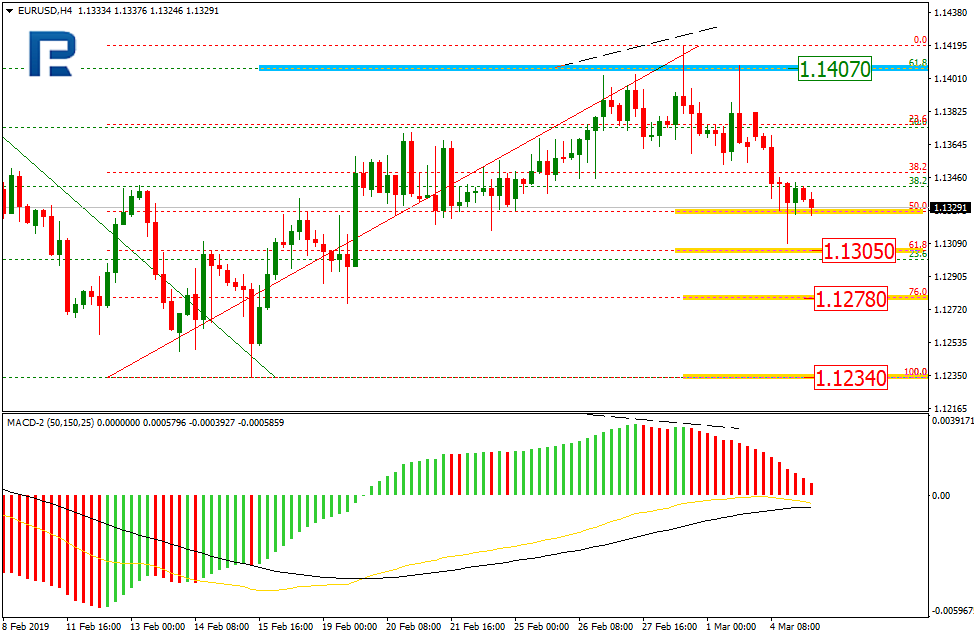
As we can see in the H4 chart, the convergence on MACD made EURUSD start a new descending correction, which has already reached the retracement of 50.0%. The next targets may be the retracements of 61.8% and 76.0% at 1.1305 and 1.1278 respectively. The key support level is the low at 1.1234.

EURUSD1
Risk Warning: the result of previous trading operations do not guarantee the same results in the future

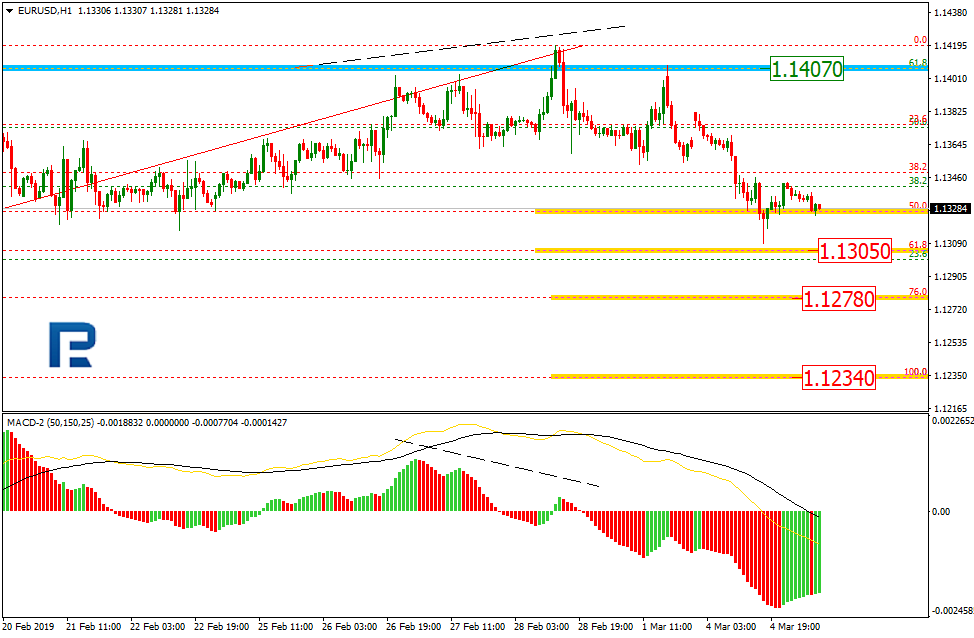
In the H1 chart, after reaching the retracement of 61.8% at 1.1305, EURUSD started a new short-term pullback.

EURUSD2
Risk Warning: the result of previous trading operations do not guarantee the same results in the future

USDJPY, “US Dollar vs. Japanese Yen”

In the H4 chart, USDJPY is trading upwards and getting closer to the retracement of 76.0% at 112.14. After breaking it, the price may continue growing towards the post-correctional retracement of 261.8% at 112.65. The support level is at 110.72. At the same time, there is a divergence on MACD.

USDJPY1
Risk Warning: the result of previous trading operations do not guarantee the same results in the future

As we can see in the H1 chart, the pair has been corrected to the downside by 23.6%. The next targets may be the retracements of 38.2% and 50.0% at 111.53 and 111.376 respectively. The resistance level is the high at 112.07.

USDJPY2
Risk Warning: the result of previous trading operations do not guarantee the same results in the future

Article By RoboForex.com

Attention!
Forecasts presented in this section only reflect the author’s private opinion and should not be considered as guidance for trading. RoboForex LP bears no responsibility for trading results based on trading recommendations described in these analytical reviews.

Ichimoku Cloud Analysis 05.03.2019 (AUDUSD, NZDUSD, USDCAD)

Article By RoboForex.com

AUDUSD, “Australian Dollar vs US Dollar”

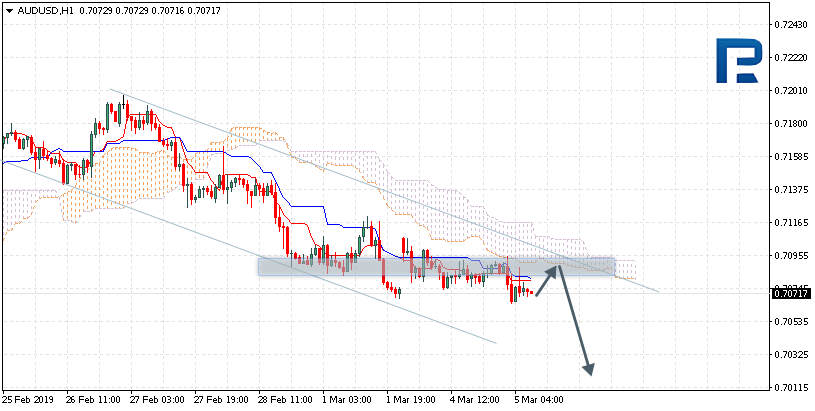
AUDUSD is trading at 0.7071; the instrument is moving below Ichimoku Cloud, thus indicating a descending tendency. The markets could indicate that the price may test the downside border of the cloud at 0.7085 and then resume moving downwards to reach 0.7005. Another signal to confirm further descending movement is the price’s rebounding from the channel’s upside border. However, the scenario that implies further decline may be cancelled if the price breaks the upside border of the cloud and fixes above 0.7120. In this case, the pair may continue growing towards 0.7195.

AUDUSD
Risk Warning: the result of previous trading operations do not guarantee the same results in the future

NZDUSD, “New Zealand Dollar vs US Dollar”

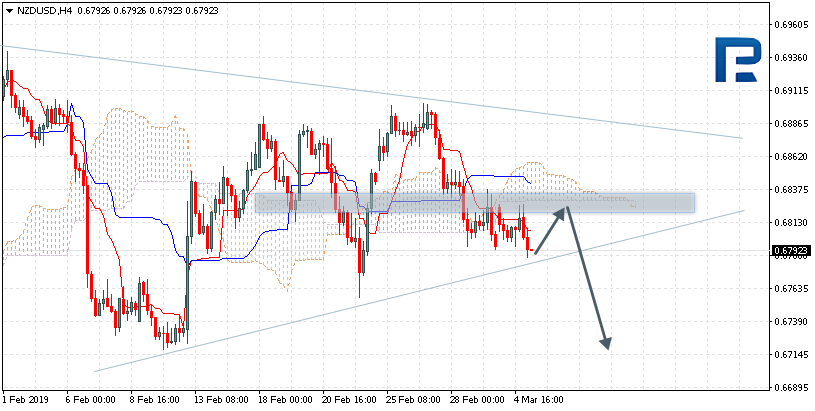
NZDUSD is trading at 0.6792; the instrument is moving below Ichimoku Cloud, thus indicating a descending tendency. The markets could indicate that the price may test the downside border of the cloud at 0.6815 and then resume moving downwards to reach 0.6715. Another signal to confirm further descending movement is the price’s rebounding from the resistance level. However, the scenario that implies further decline may be cancelled if the price breaks the upside border of the cloud and fixes above 0.6855. In this case, the pair may continue growing towards 0.6945. After breaking the downside border of the Triangle pattern and fixing below 0.6760, the price may continue moving downwards.

NZDUSD
Risk Warning: the result of previous trading operations do not guarantee the same results in the future

USDCAD, “US Dollar vs Canadian Dollar”

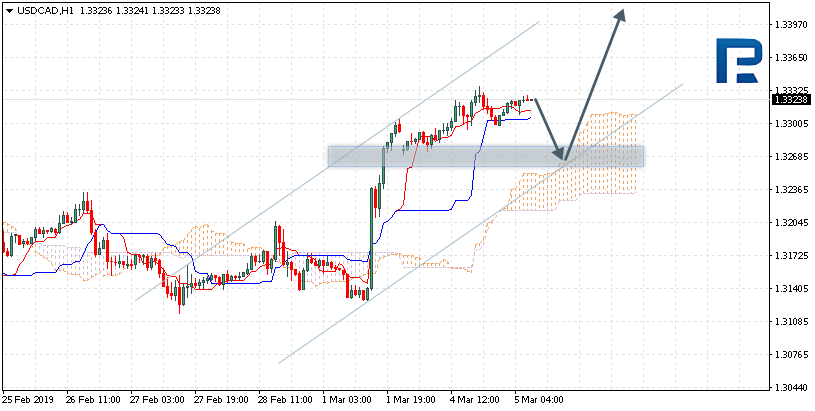
USDCAD is trading at 1.3323; the instrument is moving above Ichimoku Cloud, thus indicating an ascending tendency. The markets could indicate that the price may test the upside border of the cloud at 1.3275 and then resume moving upwards to reach 1.3405. Another signal to confirm further ascending movement is the price’s rebounding from the support level. However, the scenario that implies further growth may be cancelled if the price breaks the downside border of the cloud and fixes below 1.3205. In this case, the pair may continue falling towards 1.3095.

USDCAD
Risk Warning: the result of previous trading operations do not guarantee the same results in the future

Article By RoboForex.com

Attention!
Forecasts presented in this section only reflect the author’s private opinion and should not be considered as guidance for trading. RoboForex LP bears no responsibility for trading results based on trading recommendations described in these analytical reviews.

The Analytical Overview of the Main Currency Pairs on 2019.03.05

Analytics by JustForex

The EUR/USD currency pair

Technical indicators of the currency pair:
  • Prev Open: 1.13802
  • Open: 1.13391
  • % chg. over the last day: -0.34
  • Day’s range: 1.13182 – 1.13409
  • 52 wk range: 1.1214 – 1.2557

EUR started to descend before the Central Bank of Europe meeting set for Thursday. During the last two days, the quotes fell by 50 points and updated the local minimums. The EUR can descend further. The demand for USD is propped up by the good dynamics of the US/China negotiations. The financial market participants are expecting the publiscation of the US economic reports. You should also keep an eye on the FOMC representatives’ rhetorics. The key range is 1.13200-1.13450. You should open positions from these levels.

The Economic News Feed for 05.03.2019:

  • – Business Activity Report (EU) – 11:00 (GMT+2:00);
  • – Non-Industrial PMI (US) – 17:00 (GMT+2:00);
  • – New Real Estate Sales (EU) – 17:00 (GMT+2:00);
EUR/USD

The price fixed below 50 MA and 200 MA which points to the power of the buyers.

The MACD histogram is in the negative zone but above the signal line, which gives a weak signal to sell EUR/USD.

The Stochastic Oscillator is near the oversold zone, the %K line is crossing the %D line. There are no signals at the moment.

Trading recommendations
  • Support levels: 1.13200, 1.13000, 1.12800
  • Resistance levels: 1.13450, 1.13650, 1.13800

If the price fixes below 1.13200, expect the quotes to fall toward 1.12800-1.12600.

Alternatively, the quotes can recover toward 1.13600-1.13800.

The GBP/USD currency pair

Technical indicators of the currency pair:
  • Prev Open: 1.32476
  • Open: 1.31734
  • % chg. over the last day: -0.45
  • Day’s range: 1.31499 – 1.31857
  • 52 wk range: 1.2438 – 1.4378

GBP/USD is in the bearish mood. The GBP started to descend after the release of weak business reports in the UK construction sector. The investors are waiting for more intel on the Brexit project. Right now the quotes are consolidating at 1.31500-1.32000. The trading instrument can correct further. You should also keep an eye on the US newsfeed.

At 11:30 (GMT+2:00) the UK will publish the Service Industry PMI.

GBP/USD

The indicators do not provide precise signals, the price has crossed 200 MA.

The MACD histogram is in the negative zone but above the signal line, which gives a weak signal to sell GBP/USD.

The Stochastic Oscillator is in the neutral zone, the %K line is above the %D line which points to the bullish mood.

Trading recommendations
  • Support levels: 1.31500, 1.31000, 1.30500
  • Resistance levels: 1.32000, 1.32450, 1.32800

If the price fixes below 1.31500, expect the quotes to correct toward the round 1.31000.

Alternatively, the quotes can grow toward 1.32400-1.32600.

The USD/CAD currency pair

Technical indicators of the currency pair:
  • Prev Open: 1.32756
  • Open: 1.33018
  • % chg. over the last day: +0.18
  • Day’s range: 1.33012 – 1.33440
  • 52 wk range: 1.2248 – 1.3664

USD/CAD keeps showing a positive trend. Right now the CAD is testing the local resistance at 1.33400. The round 1.33000 acts as a mirror support. The trading instrument has further growth prospects. The financial market participants are waiting for important economic reports from Canada and the US. You should open positions from the key levels.

At 17:00 (GMT+2:00) Ivey will publish the PMI for Canada.

USD/CAD

The price fixed above 50 MA and 200 MA which points to the power of the buyers.

The MACD histogram is in the positive zone but below the %K line which gives a weak signal to sell USD/CAD.

The Stochastic Oscillator is in the overbought zone, the %K line is crossing the %D line. There are no signals at the moment.

Trading recommendations
  • Support levels: 1.33000, 1.32700, 1.32400
  • Resistance levels: 1.33400, 1.34000

If the price fixes above 1.33400, expect the USD/CAD to grow toward the round 1.34000.

Alternatively, the quotes can descend toward 1.32700-1.32500.

The USD/JPY currency pair

Technical indicators of the currency pair:
  • Prev Open: 111.841
  • Open: 111.729
  • % chg. over the last day: -0.14
  • Day’s range: 111.712 – 111.959
  • 52 wk range: 104.56 – 114.56

The safe haven currency keeps consolidating. There is no single defined trend. The local support and resistance levels are 111.750 and 112.000. The investors are waiting for the statistic reports from the US. You should keep an eye on the US Treasury bonds yield and open positions from the key levels.

The Economic News Feed for 05.03.2019 is calm.

USD/JPY

There are no precise signals, the price has crossed 50 MA.

The MACD histogram started to rise again, which points to the bullish mood.

The Stochastic Oscillator is in the neutral zone, the %K line is below the %D line, which gives a signal to sell USD/JPY.

Trading recommendations
  • Support levels: 111.750, 111.500, 111.200
  • Resistance levels: 112.000, 112.500

If the price fixes above the round 112.000, expect the quotes to grow toward 112.400-112.600.

Alternatively, the quotes can descend toward 11.500-111.300.

Analytics by JustForex

The US Dollar Index Updated Two-Week Highs

by JustForex

Yesterday, the US dollar strengthened against a basket of major currencies. The dollar index (#DX) updated two-week highs and closed in the positive zone (+0.17%). The US currency was supported by the growth of the US government bonds yield, which increased amid news about positive negotiations between the US and China. Donald Trump also noted yesterday that the dollar had become too strong and criticized the Fed, but the markets did not particularly react to his statements. Today, investors expect important statistics from the US, as well as speeches by the FOMC representatives.

The Reserve Bank of Australia left the interest rate unchanged at 1.50%, as experts expected. The head of the Central Bank, Philip Lowe, expects the acceleration of economic growth in the country this year. Additional support for the Australian and New Zealand dollars was provided by the prospects for the abolition of tariffs on Chinese goods if a trade agreement would be signed.

The “black gold” prices are falling after growth the day before. At the moment, futures for the WTI crude oil are testing the mark of $56.45 per barrel. At 23:30 (GMT+2:00), the API weekly crude oil stock will be published.

Market Indicators

Yesterday, there was a variety of trends in the US stock market: #SPY (-0.36%), #DIA (-0.82%), #QQQ (+0.02%).

At the moment, the 10-year US government bonds yield is at the level of 2.72-2.73%.

The news feed on 05.03.2019:

– Statistics on economic activity in the Eurozone at 11:00 (GMT+2:00);
– The index of economic activity in the UK services sector at 11:30 (GMT+2:00);
– ISM non-manufacturing PMI in the US at 17:00 (GMT+2:00);
– New home sales in the US at 17:00 (GMT+2:00);
– Ivey PMI in Canada at 17:00 (GMT+2:00).

We also recommend paying attention to the speeches by the FOMC members and the Bank of England governor.

by JustForex

EURUSD: upwards correction on its way

By Matthew Anthony, Alpari

Previous:

On Monday the 4th of March, trading on the euro closed down. After the breakout of the trend line at 1.1360, the single currency shed 0.45% against the dollar to reach 1.1309. Interestingly, the euro dropped during a decline in US10Y bond yields. In theory, after seeing progress in the talks between the US and China, we should have seen an increased appetite for risk. Yesterday, however, the only risky asset to appreciate was oil.

Day’s news (GMT+3):

  • 10:30 Switzerland: CPI (Feb).
  • 11:15 Spain: Markit services PMI (Feb).
  • 11:45 Italy: Markit services PMI (Feb).
  • 11:50 France: Markit services PMI (Feb).
  • 11:55 Germany: Markit services PMI (Feb).
  • 12:00 Eurozone: Markit services PMI (Feb).
  • 12:30 UK: Markit services PMI (Feb), FPC statement.
  • 13:00 Eurozone: retail sales (Jan).
  • 17:45 US: Markit services PMI (Feb).
  • 18:00 US: ISM non-manufacturing PMI (Feb), new home sales (Dec).
  • 18:35 UK: BoE Governor Carney’s speech.
  • 22:00 US: monthly budget statement (Jan).

EURUSD H1Current situation:

My expectations of a trend line breakout were met in full. I think that the euro’s drop was a bit excessive given yesterday’s newsfeed.

Today I expect to see an upwards correction on the euro. We may even see a new high in the near future. US President Donald Trump has renewed his criticism of Fed Chair Jerome Powell, saying that the US dollar is too strong, thereby hampering the US economy. I think that when the US and China sign a new trade deal, he will start making moves to weaken the dollar in order to make American businesses more profitable.

Today I expect the euro to recover to 1.1371. That’s what my pricing models predict. We’ll see today whether or not the bulls want to break through the LB line. The 1.1356 – 1.1362 range is providing resistance.

The ECB meeting and NFP report will take centre stage this week.