Author Archive for InvestMacro – Page 273

Should We Rethink Nuclear Power?

By OilPrice.com

While it seems to fly in the face of everything we believe and have been taught about nuclear power, it may actually be the safest form of power production that we have. Ironically, the immense potency of the power of splitting an atom is simultaneously what makes nuclear weapons so dangerous as well as what makes nuclear power so safe.

Despite high-profile nuclear disasters like Chernobyl in Ukraine (then the Soviet Union), Fukushima in Japan, and Three Mile Island in the United States, the deaths related to nuclear meltdowns are actually very few. In fact, climate scientists Pushker Kharecha and James Hanson discovered that overall, nuclear energy actually saves lives–their study found that up until now, nuclear power has already saved nearly two million lives that would have been lost to air pollution-related deaths from the contamination that would have been produced by other, more traditional, sources of energy.

Nuclear power is an incredibly clean form of energy thanks to its staggering efficiency. The uranium used to produce nuclear power has the ability to create a whopping one million times more heat than equal masses of fossil fuels or even gunpowder. Nuclear power has the valuable ability to create massive amounts of heat without creating fire, and therefore it produces no smoke. This means that it’s a much, much cleaner alternative as compared to fossil fuels, which cause seven million premature deaths per year (according to data provided by the World Health Organization) thanks to the massive amount of smoke produced by the industry.

While renewable resources like wind and solar are also much, much cleaner alternatives to the fossil fuel industry, with negligible levels of emissions, nuclear has a lot of benefits that renewables can’t compete with. One of these is that although nuclear plants create massive amounts of energy, they take up very little space thanks to their energy density. Even in places where the sun shines the majority of the time, like in California, a solar farm takes up 450 times more space than a nuclear plant to produce the same amount of energy.

On top of taking up far less space than renewable energy production, nuclear also requires a much, much smaller quantity of materials and therefore produces considerably less waste. Put simply, nuclear is far more efficient and energy-dense than either solar or wind. In fact, according to a fact sheet published by the Nuclear Energy Institute, the entire nuclear industry in the United States, one of the biggest energy-consuming cultures per capita in the world, produces just 2,000 metric tons of used nuclear fuel rods each year, or just a single soda can’s worth of waste per person served by nuclear energy per year.

Michael Shellenberger, president of independent research and policy organization Environmental Progress and a Time Magazine “Hero of the Environment,” sums the matter up simply: “the energy density of the fuel determines its environmental and health impacts.” In his think piece titled “Why Renewables Can’t Save the Planet” Shellenberger goes on to say, “It’s true that you can stand next to a solar panel without much harm while if you stand next to a nuclear reactor at full power you’ll die. But when it comes to generating power for billions of people, it turns out that producing solar and wind collectors, and spreading them over large areas, has vastly worse impacts on humans and wildlife alike.”

Despite the strong case for nuclear, however, it remains a hard sell in the United States thanks to a poor public image and overblown safety concerns as well as an adverse political climate. Even those politicians who are pushing for green energy reform are simultaneously pulling away from nuclear. With all of the solid evidence in its favor and an ever-increasing need to clean up our energy act, what more will it take for nuclear to become part of the United States’ energy future?

Link to article: https://oilprice.com/Alternative-Energy/Nuclear-Power/Should-We-Rethink-Nuclear-Power.html

By Haley Zaremba for Oilprice.com
Japanese Candlesticks Analysis 07.03.2019 (USDCAD, AUDUSD)

Article By RoboForex.com

USDCAD, “US Dollar vs Canadian Dollar”

As we can see in the H4 chart, USDCAD has once again reached the resistance level and formed Hanging Man and Shooting Star reversal patterns. Judging by the previous movements, it may be assumed that the instrument may finish another correction and then resume its ascending movement.

USDCAD
Risk Warning: the result of previous trading operations do not guarantee the same results in the future

AUDUSD, “Australian Dollar vs US Dollar”

As we can see in the H4 chart, AUDUSD is still trading close to the support level and forming Hammer reversal patterns. Judging by the previous movements, it may be assumed that after testing the level the instrument may start a new growth.

AUDUSD
Risk Warning: the result of previous trading operations do not guarantee the same results in the future

Article By RoboForex.com

Attention!
Forecasts presented in this section only reflect the author’s private opinion and should not be considered as guidance for trading. RoboForex LP bears no responsibility for trading results based on trading recommendations described in these analytical reviews.

Ichimoku Cloud Analysis 07.03.2019 (AUDUSD, NZDUSD, USDCAD)

Article By RoboForex.com

AUDUSD, “Australian Dollar vs US Dollar”

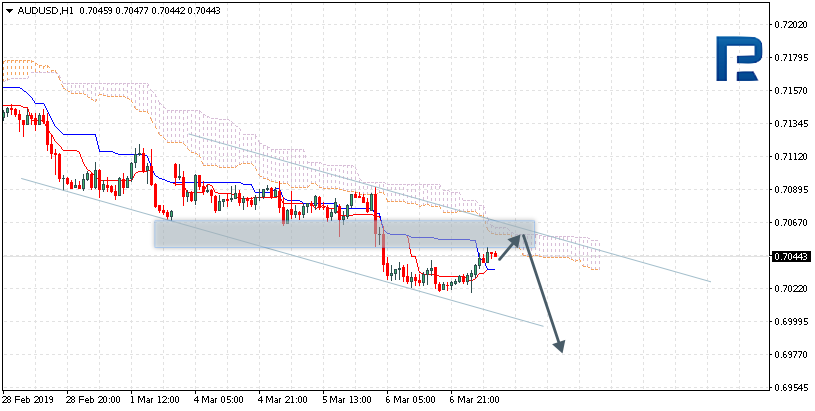
AUDUSD is trading at 0.7044; the instrument is moving below Ichimoku Cloud, thus indicating a descending tendency. The markets could indicate that the price may test the downside border of the cloud at 0.7055 and then resume moving downwards to reach 0.6975. Another signal to confirm further descending movement is the price’s rebounding from the channel’s upside border. However, the scenario that implies further decline may be cancelled if the price breaks the upside border of the cloud and fixes above 0.7075. In this case, the pair may continue growing towards 0.7145.

AUDUSD
Risk Warning: the result of previous trading operations do not guarantee the same results in the future

NZDUSD, “New Zealand Dollar vs US Dollar”

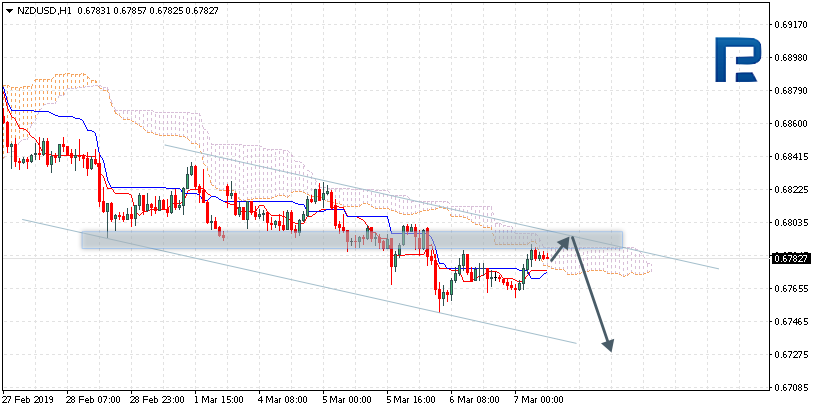
NZDUSD is trading at 0.6782; the instrument is moving inside Ichimoku Cloud, thus indicating a sideways tendency. The markets could indicate that the price may test the upside border of the cloud at 0.6785 and then resume moving downwards to reach 0.6725. Another signal to confirm further descending movement is the price’s rebounding from the resistance level. However, the scenario that implies further decline may be cancelled if the price breaks the upside border of the cloud and fixes above 0.6815. In this case, the pair may continue growing towards 0.6925. After breaking the downside border of the cloud and fixing below 0.6765, the price may continue moving downwards.

NZDUSD
Risk Warning: the result of previous trading operations do not guarantee the same results in the future

USDCAD, “US Dollar vs Canadian Dollar”

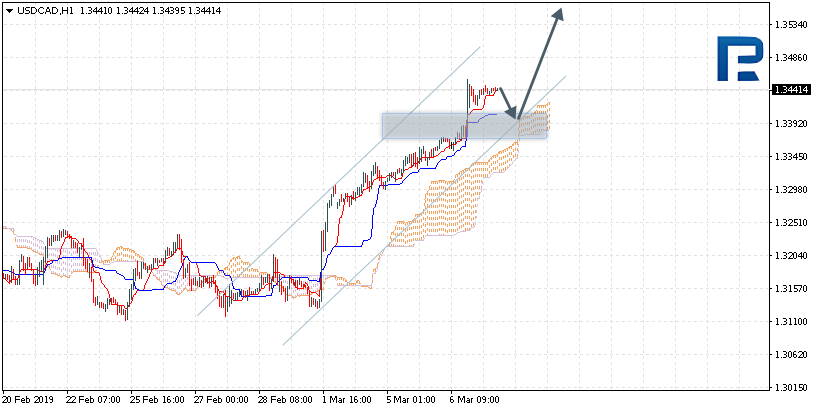
USDCAD is trading at 1.3441; the instrument is moving above Ichimoku Cloud, thus indicating an ascending tendency. The markets could indicate that the price may test the upside border of the cloud at 1.3395 and then resume moving upwards to reach 1.3545. Another signal to confirm further ascending movement is the price’s rebounding from the support level. However, the scenario that implies further growth may be cancelled if the price breaks the downside border of the cloud and fixes below 1.3345. In this case, the pair may continue falling towards 1.3265.

USDCAD
Risk Warning: the result of previous trading operations do not guarantee the same results in the future

Article By RoboForex.com

Attention!
Forecasts presented in this section only reflect the author’s private opinion and should not be considered as guidance for trading. RoboForex LP bears no responsibility for trading results based on trading recommendations described in these analytical reviews.

The Analytical Overview of the Main Currency Pairs on 2019.03.07

Analytics by JustForex

The EUR/USD currency pair

Technical indicators of the currency pair:
  • Prev Open: 1.13073
  • Open: 1.13068
  • % chg. over the last day: -0.03
  • Day’s range: 1.13011 – 1.13157
  • 52 wk range: 1.1214 – 1.2557

EUR has stabilized. The financial market participants are waiting for the Central Bank meeting. The regulator is supposed to leave the interest rate without changes. Keep an eye on the comments and rhetorics by the CBE representatives. The bank is also discussing the possibility of renewal of the long-term credit operations TLTRO to stimulate the European economy. The EUR/USD currency pair is consolidating around 1.12900-1.13200. You should open positions from these levels.

At 14:45 (GMT+2:00) CBE will declare the new key interest rate.

  • – GDP Report (EU) – 12:00 (GMT+2:00);
  • – Report on primary unemployment benefits requests (US) – 15:30 (GMT+2:00);
EUR/USD

The indicators do not provide precise signals, the price has crossed 50 MA.

The MACD histogram is close to 0.

The Stochastic Oscillator is in the neutral zone, the %K line is above the %D line, which points to the bullish mood.

Trading recommendations
  • Support levels: 1.12900, 1.12500
  • Resistance levels: 1.13200, 1.13450, 1.13650

If the price fixes below the support level of 1.12900, expect the quotes to fall toward 1.12500-1.12300.

Alternatively, the quotes can grow toward 1.13500-1.13700.

The GBP/USD currency pair

Technical indicators of the currency pair:
  • Prev Open: 1.31729
  • Open: 1.31690
  • % chg. over the last day: +0.18
  • Day’s range: 1.31586 – 1.31846
  • 52 wk range: 1.2438 – 1.4378

GBP/USD has stabilized. The financial market participants are waiting for the new info regarding Brexit. The quotes have stabilized around 1.31350 and 1.31850. The trading instrument started to descend. The demand for the USD remains high. You should open positions from these levels.

The Economic News Feed for 07.03.2019 is calm.

GBP/USD

The indicators do not provide precise signals, the price fixed between 50 MA and 200 MA.

The MACD histogram is in the positive zone but below the signal line, which gives a weak signal to buy GBP/USD.

The Stochastic Oscillator is in the neutral zone, the %K line is above the %D line which points to a bullish mood.

Trading recommendations
  • Support levels: 1.31350, 1.30800, 1.30500
  • Resistance levels: 1.31850, 1.32400, 1.32800

If the price fixes below 1.31350, expect the quotes to fall toward 1.30800-1.30500.

Alternatively, the quotes can grow toward 1.32300-1.32600.

The USD/CAD currency pair

Technical indicators of the currency pair:
  • Prev Open: 1.33502
  • Open: 1.34366
  • % chg. over the last day: +0.66
  • Day’s range: 1.34299 – 1.34471
  • 52 wk range: 1.2248 – 1.3664

CAD started losing positions yesterday, since Bank of Canada kept the monetary positions at the same level. The regulator is worried about the economic situation in the country and is not going to raise the rates any time soon. An additional pressure on CAD is caused by weak economic reports from canada. Right now the quotes are consolidating around 1.34150-1.34500. You should open positions from these levels.

The Economic News Feed for 07.03.2019 is calm. At 15:30 (GMT+2:00) Canada will publish a report on the building permissions.

USD/CAD

The price fixed above 50 MA and 200 MA, which points to the power of the buyers.

The MACD histogram is in the positive zone but below the signal line, which points toward the correction of the USD/CAD quotes.

The Stochastic Oscillator is in the neutral zone, the %K line is below the %D line, which points toward the correction of USD/CAD.

Trading recommendations
  • Support levels: 1.34150, 1.33700, 1.33350
  • Resistance levels: 1.34500, 1.35000

If the price fixes above 1.34500, expect tje qiptes to grow toward 1.35000.

Alternatively, the quotes can correct toward 1.33800-1.33600.

The USD/JPY currency pair

Technical indicators of the currency pair:
  • Prev Open: 111.849
  • Open: 111.765
  • % chg. over the last day: -0.21
  • Day’s range: 111.575 – 111.800
  • 52 wk range: 104.56 – 114.56

USD/JPY keeps moving sideways. There is no single defined trend. The investors are waiting for additional drivers. The demand for the safe haven currencies remains before the ECB meeting today and the US Labour Market report for December set to release on March 8. The local support and resistance levels are 111.550 and 111.800. You should open positions from these levels.

The Economic News Feed for 07.03.2019 is calm.

USD/JPY

The indicators do not provide precise signals, the price fixed between 50 MA and 200 MA.

The MACD histogram is in the negative zone but above the signal line, which points toward selling USD/JPY.

The Stochastic Oscillator is near the overbought zone, the %K line is crossing the %D line. There are no signals at the moment.

Trading recommendations
  • Support levels: 111.550, 111.200, 111.050
  • Resistance levels: 111.800, 112.000, 112.500

If the price fixed below 111.500, expect the quotes to fall toward 111.250-111.000.

Alternatively, the quotes can correct toward 112.000-112.300.

Analytics by JustForex

The US Dollar Is Consolidating. Investors Expect the ECB Meeting

by JustForex

Yesterday, the US dollar did not change a lot against a basket of major currencies. The dollar index (#DX) closed the trading session with a slight increase (+0.02%). Yesterday, ambiguous economic reports were published in the US. Thus, ADP nonfarm employment change fell to 183K in February, while experts expected 189K. The trade balance counted to -59.80B instead of -57.90B. The Fed’s Beige Book was also published, according to which growth in economic activity in ten of the twelve regions of the US slowed down to slight and modest. At the same time, there was no growth at all in the districts of Philadelphia and St. Louis. The shutdown of the government’s work in early 2019 was the reason for the slowdown.

The Canadian dollar reached 2-month lows against the US dollar. The Bank of Canada kept the key marks of the monetary policy at the same level. The regulator is concerned about the growing risks for the country’s economy. In the near future, the Central Bank plans to adhere to the current rate of monetary policy and will not consider the interest rate rise. Loonie was under pressure due to weak statistics. Thus, Ivey PMI dropped to 50.6 in February instead of the forecasted value of 55.1. The trade balance counted to -59.80B in December, while experts expected -57.90B.

During the Asian trading session, a report on the volume of retail sales has been published in Australia, which rose by 0.1% in January and was worse than the expected value of +0.3%. Today, investors are focused on the ECB monetary policy statement. The regulator considers the resumption of the targeted longer-term refinancing operations (TLTRO) in order to stimulate the Eurozone economy. We recommend paying attention to the comments by the Central Bank representatives.

The “black gold” prices are rising. At the moment, futures for the WTI crude oil have approached the mark of $56.30 per barrel.

Market Indicators

Yesterday, there was the bearish sentiment in the US stock market: #SPY (-0.61%), #DIA (-0.51%), #QQQ (-0.57%).

At the moment, the 10-year US government bonds yield is at the level of 2.68-2.69%.

The news feed on 07.03.2019:

– Eurozone GDP data at 12:00 (GMT+2:00);
– ECB interest rate decision at 14:45 (GMT+2:00);
– Initial jobless claims in the US at 15:30 (GMT+2:00).

by JustForex

EURUSD: markets awaiting Mario Draghi’s press conference

By Matthew Anthony, Alpari

Previous:

On Thursday the 7th of March, trading on the euro closed 1 pip down. The day’s candlestick had a range of 39 pips. The drop to 1.1285 was brought about by rumours that the ECB is set to downgrade the Eurozone’s economic growth and inflation forecasts at today’s meeting and to start issuing new loans.

The US dollar showed mixed dynamics against the major currencies following the release of US economic data. The ADP employment report fell short of expectations. This allowed the euro bulls to recover their losses and reach a new intraday high.

Day’s news (GMT+3):

  • 11:30 UK: Halifax house prices (Feb).
  • 13:00 Eurozone: GDP (Q4).
  • 15:45 Eurozone: ECB interest rate decision.
  • 16:30 Eurozone: ECB monetary policy statement and press conference.
  • 16:30 Canada: building permits (Jan).
  • 16:30 US: initial jobless claims (25 Feb).

EURUSD H1

Current situation:

The bears didn’t manage to reach the reversal zone of 112 – 135 degrees by 17:00 (GMT+3). The bulls bought up euros as the 1.1290 low was revisited. After a rebound, a triple base was formed with a double bullish divergence on the AO indicator. The signal was strong, but Mario Draghi, whose words can overturn any price model, was much stronger.

Growth came to a halt at the LB balance line. Market activity was low in the Asian session, so the LB line is now providing solid resistance. The trend line has been broken and we’ve now got a 50% rebound. The market is ready for some wild fluctuations.

Going by technical analysis and the formations we’ve seen over the last 3 days, our target zone ranges from 1.1355 (U1) to 1.1366 (67th degree). You can ignore the indicators during Mario Draghi’s speech. After the ECB meeting, markets will start preparing for the US payrolls report. Considering that the ADP report came out lower than expected, the dollar will remain under pressure until Friday. I think that we’re going to see some intense swings on the euro.

The euro crosses are trading down, except for EURCAD. This means that the EURUSD pair may test 1.13 before rising any further. The ideal scenario for this pair is to trade flat along the LB line up until 16:30 (GMT+3).

PART II – What Commodities and Transportation Telling Us

By TheTechnicalTraders.com

In Part I of this report we talked about and showed you what commodities and transports where doing in relation to each other. Here in Part II, we show you in detail what we expect to take place.

This final chart highlights our Custom Smart Cash Index (in BLUE) as well as the CBOE Commodity Index pricing levels (in RED).  This data goes all the way back to 2012 and highlights a number of key pricing rotations.  First, we can see that Commodities have been decreasing in total value from 2012 till mid-2017.  We can also identify a key support level that was established in the Commodities Index near the beginning of 2016 – coinciding just a month or so before the bottom in the Smart Cash Index.

We believe this Key Bottom in both the Commodities Index and the Smart Cash Index reflect a dramatic pricing shift that took place at that point in time.  Although Commodities have yet to rally beyond upper high ranges, we can see the Smart Cash Index rallied to incredible new all-time highs.  The rally that started near the end of 2016 in the Smart Cash Index was likely the result of a “Capital Shift” that we have discussed extensively in the past.  With commodity prices staying historically low and an increase in economic optimism, capital shifted away from “commodity-based sectors” and into “technology and biotech sectors”.  Now, it appears this rally has run its course and a new capital shift is taking place.

Until Commodities begin to break out of the downward price channels we’ve highlighted on this last chart, global capital will be searching for two primary objectives; safety and hedged returns.  By this, we mean to say that global capital and investment will be seeking out strong Blue Chip and Mid-Cap performers that can produce safety in growth, dividends and hedge against currency swings or further eroding commodity price levels.  Think of this as a move to “key elements supporting the global economies”.

Heavy equipment, support services, and retailers, tool suppliers, and mid-level equipment suppliers, transportation services for these items and the repair parts and services to keep these tools running efficiently.  Human services, labor, labor services, medical services, and entertainment services are likely to do well over the next 12~24 months.  In an economy where commodity prices are relatively low and Transportation and Capital is flowing quite well, one could easily identify that Capital will seek out and identify the strongest opportunity for safety and growth as sectors continue to shift.  After a massive rally in Technology and Bio-Tech, we believe a continued shift towards Blue Chips and Mid-Caps is taking place right now.  Technology and Bio-Tech will likely find some support in the near future and become “opportunistic investments” eventually.  But right now, we believe global investors are focusing on different targets to hedge the risks that are associated with certain technology stocks.

In closing, our research highlights that Commodities are not increasing as one would expect in an expanding global market/economy.  We believe this is one core factor that will continue to drive a “capital shift” toward opportunity and performance in the Blue Chips and Mid-Caps.  Global investors will re-enter the Technology and Biotech sectors when pricing levels become more opportunistic – at some point in the future.  This means we have a very strong likelihood of the US and global Blue Chips, Banks, Industrial Supply, Basic Materials and Human Services (Entertainment, basic human essentials, regional human services, and utilities) will continue to perform well.

The US and the global economy is growing, just not as one would expect in a “total growth” environment.  We believe the global economy has shifted to support “fundamental growth elements” that are related more closely to the types of industry and market sectors that support the fundamental growth components.  We’ve discussed our theory that the global economies operate in a “growth or protection mode” many times before.  We believe the current global economic stance is more in tune with  “moderate growth while still being overly protective”.  Watch Commodities and the Transportation Index for signs of when the global economy enters a larger growth phase and when more opportunity for a broader capital shift will take place.

This concludes this two-part series and how we identify market opportunities for us to trade. Analysis like this has allowed us to generate substantial profits in the past 30 days with UGAZ 30%, NIO 21.6%, ROKU 18%, GDXJ 10.5%.

If you want to learn how we can help you find success throughout this shifting market and throughout 2019 and beyond, then visit TheTechnicalTraders.com.

Chris Vermeulen
Technical Traders Ltd.


Forex Technical Analysis & Forecast 06.03.2019 (EURUSD, GBPUSD, USDCHF, USDJPY, AUDUSD, USDRUB, GOLD, BRENT)

Article By RoboForex.com

EURUSD, “Euro vs US Dollar”

EURUSD has reached the predicted target of the third descending wave; it may yet continue this structure towards 1.1286. Today, the pair may reach this level and then form one more ascending structure with the target at 1.1345. After that, the instrument may resume trading inside the downtrend to reach the first target at 1.1272.

EURUSD
Risk Warning: the result of previous trading operations do not guarantee the same results in the future

GBPUSD, “Great Britain Pound vs US Dollar”

GBPUSD is trading downwards and forming the third descending wave. The target is at 1.3062. Later, the market may resume growing to reach 1.3173 and the start a new decline to reach 1.2993.

GBPUSD
Risk Warning: the result of previous trading operations do not guarantee the same results in the future

USDCHF, “US Dollar vs Swiss Franc”

USDCHF is still forming the third ascending wave. Possibly, today the pair may reach 1.0060 and then start a new correction towards 1.0020. After that, the instrument may continue growing with the target at 1.0103.

USDCHF
Risk Warning: the result of previous trading operations do not guarantee the same results in the future

USDJPY, “US Dollar vs Japanese Yen”

USDJPY has reached the short-term target at 112.12. Today, the pair may be corrected towards 111.37 and then form another ascending structure to reach 112.40.

USDJPY
Risk Warning: the result of previous trading operations do not guarantee the same results in the future

AUDUSD, “Australian Dollar vs US Dollar”

AUDUSD has broken 0.7060 downwards. Possibly, today the pair may reach 0.7009 and then start a new growth to return to 0.7060. Later, the market may resume trading inside the downtrend with the target at 0.6922.

AUDUSD
Risk Warning: the result of previous trading operations do not guarantee the same results in the future

USDRUB, “US Dollar vs Russian Ruble”

USDRUB is consolidating around 65.65 without any particular direction. If later the price breaks range to the upside, the instrument may continue growing to reach 66.20; if to the downside – resume trading inside the downtrend with the short-term target at 62.90.

USDRUB
Risk Warning: the result of previous trading operations do not guarantee the same results in the future

XAUUSD, “Gold vs US Dollar”

Gold is consolidating around 1286.45. If later the price breaks range to the upside, the instrument may be corrected to reach 1312.00; if to the downside – resume trading downwards with the target at 1276.80.

GOLD
Risk Warning: the result of previous trading operations do not guarantee the same results in the future

BRENT

Brent has rebounded from 65.80; right now, it is falling towards 63.95. Later, the market may form one more ascending structure towards 68.40.

BRENT

Article By RoboForex.com

Attention!
Forecasts presented in this section only reflect the author’s private opinion and should not be considered as guidance for trading. RoboForex LP bears no responsibility for trading results based on trading recommendations described in these analytical reviews.

China – A Critical Global Growth Engine, Despite Deceleration

By Dan Steinbock

Despite U.S. trade wars, China will stick to its growth target and fiscal easing in the short-term, deleveraging in the medium-term and rebalancing in the long-term. That’s the message of Premier Li’s report.

Released on Monday at the annual session of the National People’s Congress (NPC), Premier Li Keqian’s annual work report sets the general tone for the 2019 economic policies.

In 2019, China has set a lower, flexible economic growth target at the range of 6.0% to 6.5%, while raising its tolerance of fiscal deficit at 2.8% of GDP.

The point about the GDP growth target is not how much it will exceed 6%, but that it should not fall below that level. That’s vital to sustain the quest to double living standard by 2020.

Tax cuts, 11 million new urban jobs

China is focused on raising per capita incomes, eradicating remaining poverty and battling climate change. Beijing is planning to cut $300 billion in taxes and corporate pension payments, especially to ease the burden on small-and- medium size (SME) enterprises.

The idea is also to cut the value-added tax rate that covers the manufacturing sector by 3 percentage points.

In this policy mix, the focus is on cutting banks’ reserve requirement ratios, instead of lowering interest rates, and guiding liquidity into SMEs. That supports the aim to create over 11 million new urban jobs.

Still, skeptical observers note that the purchasing managers index (PMI) came in at 49.2 in February representing the worst performance in three years. But the PMI data should be seen in historical context. A decade ago, when Chinese growth still relied mainly on manufacturing exports, PMI data reflected economic realities directly. As China is rebalancing away from manufacturing exports, PMI offers a less accurate picture of the full economy.

Indeed, the new Caixin PMI – which focuses on light industry, as opposed to the official survey’s focus on heavy industry – posted a sharp rebound in February, rising to 49.9 from 48.3 in January.

Foreign investment legislation and IPRs

In addition to Chinese growth, international observers are focusing on foreign direct investment (FDI) legislation and intellectual property rights (IPRs), largely due to U.S. trade wars.

In January, China’s exports rose 9.1% on year-to-year basis, up from -4.4% in December. China’s trade surplus with the U.S. remained high at $27.3 billion, due to sharp fall of imports and modest decline of exports. Unsurprisingly, the White House’s punitive tariffs on Chinese exports have not resolved the issue of U.S. trade deficit. Bilateral tariffs against China simply cannot surpass these deficits that are multilateral and began already in the early 1970s.

When the U.S. and China began talks amid hopes for an agreement that would head off President Trump’s planned March 2 tariff increase on $200 billion in Chinese goods, China was already pushing plans to introduce a new foreign investment law. By mid-March, it is widely expected to replace three existing regulations and to increase IPR protection, while limiting technology transfer.

Yet, even a partial deal is unlikely to mitigate all broader tensions between the two nations on technology and industrial policy, as evidenced by the highly controversial extradition process of Huawei CFO Meng Wanzhou.

Instead of fair commercial competition – whether in 5G deployment or other areas – Washington is increasingly relying on contentious “national security concerns” to impair rival companies in China, Europe and elsewhere.

Turning financial tides

Recently, Chinese economic cooling has eased, thanks to early issuances of local governments’ special-purpose bonds and targeted adjustments to monetary policy, and increased infrastructure investment. In 2019, China plans to issue $320 billion of special local government bonds.

Since 2015, President Xi Jinping has promoted the idea of the supply-side reform to achieve greater policy focus on reducing industrial overcapacity and deleveraging the corporate sector. As the scope of supply-side reforms has now been broadened to include the financial sector, bank regulators are offering more diversified financial services, strengthening the monetary transmission channels and improving the efficiency of financial resources.

In 2019, China’s sovereign commercial debt could climb to $2.4 trillion, while local and regional government borrowing is expected to amount to $770 billion, according to Standard & Poor’s. But let’s put it in the context. In 2019 sovereign commercial debt will rise to $16.5 trillion in the U.S. and to $10 trillion in Japan.

Moreover, financial tides may be turning. Surging fund inflows indicate a rebound in sentiment for Chinese equities. While the market registered sharp inflows in 2018, nearly reversing prior years’ outflows, the Fed’s tightening seems to be peaking out.

Additionally, MSCI Inc. will quadruple the weight of Chinese stocks in its global benchmarks to 20%, which could translate to $80 billion of foreign inflows to China. Recently, China’s blue-chip CSI300 Index surged its best week since fall 2015. And the Shanghai Stock Exchange is in the final stages of launching a highly-anticipated Nasdaq-style high-tech board, which will serve as a financial incubator for innovative technology firms.

The valuation of Chinese market, as measured by CAPE (cyclically-adjusted price-to-earnings ratio) is still relatively low at 15, whereas the U.S. figure, despite recent losses, remains almost 31; twice its historical average. In financial markets, China has huge structural potential to expand, whereas the U.S. is hovering too close to a secular edge.

Gaining global approval

Despite deceleration, the size of Chinese economy has tripled in just a decade. Last year alone, China’s added GDP is equal to the value of Australia’s total output. As China’s contribution to the world GDP growth will continue to exceed 30%, it supports global economic prospects.

Chinese leadership’s commitment to more inclusive globalization remains strong, as President Xi Jinping affirmed in last December’s anniversary of reforms and opening-up policies.

China’s innovation is prominently displayed by world-class productivity in the Greater Bay Area of South China, and international cooperation by the One Road One Belt initiative that’s fueling 21st century globalization.

According to Gallup’s new Rating World Leaders, U.S. leadership approval ratings have plunged, while China’s leadership is gaining more clout.

Irrespective of Washington’s trade wars, Chinese reforms will prevail.

About the Author:

Dr. Dan Steinbock is the founder of Difference Group and has served at the India, China and America Institute (US), Shanghai Institute for International Studies (China) and the EU Center (Singapore). For more, see http://www.differencegroup.net/ 

The original version was released by China Daily amid the opening of China’s ‘Two Sessions’ on March 5, 2019


Fibonacci Retracements Analysis 06.03.2019 (GBPUSD, EURJPY)

Article By RoboForex.com

GBPUSD, “Great Britain Pound vs US Dollar”

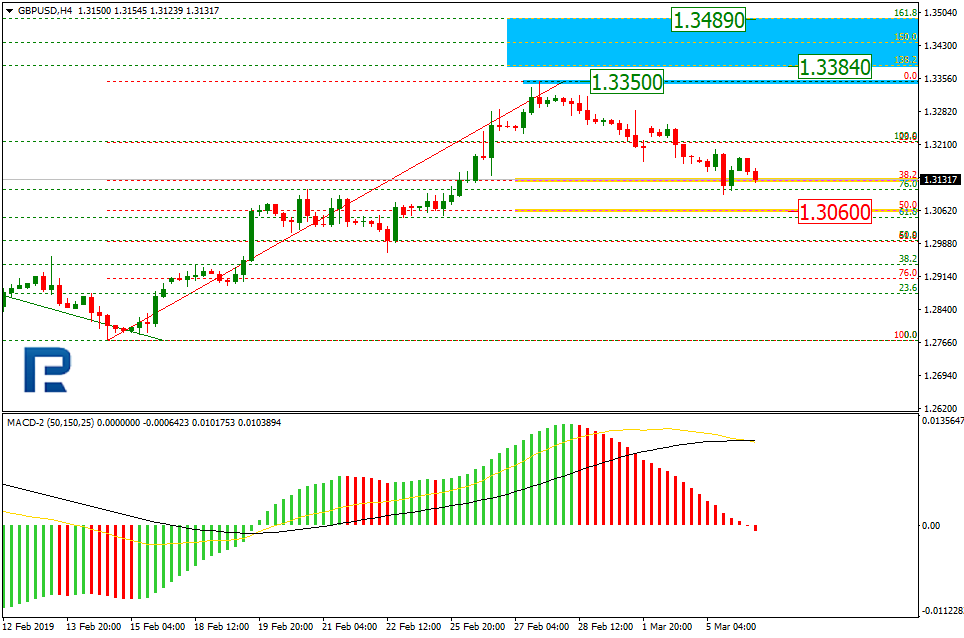
As we can see in the H4 chart, GBPUSD is being corrected downwards to reach retracement of 50.0% at 1.3060. After completing the correction, the price may start a new rising impulse towards the high at 1.3350. If the pair breaks t, the instrument may continue growing to reach the post-correctional extension area between the retracements of 138.2% and 161.8% at 1.3384 and 1.3489 respectively.

GBPUSD1
Risk Warning: the result of previous trading operations do not guarantee the same results in the future

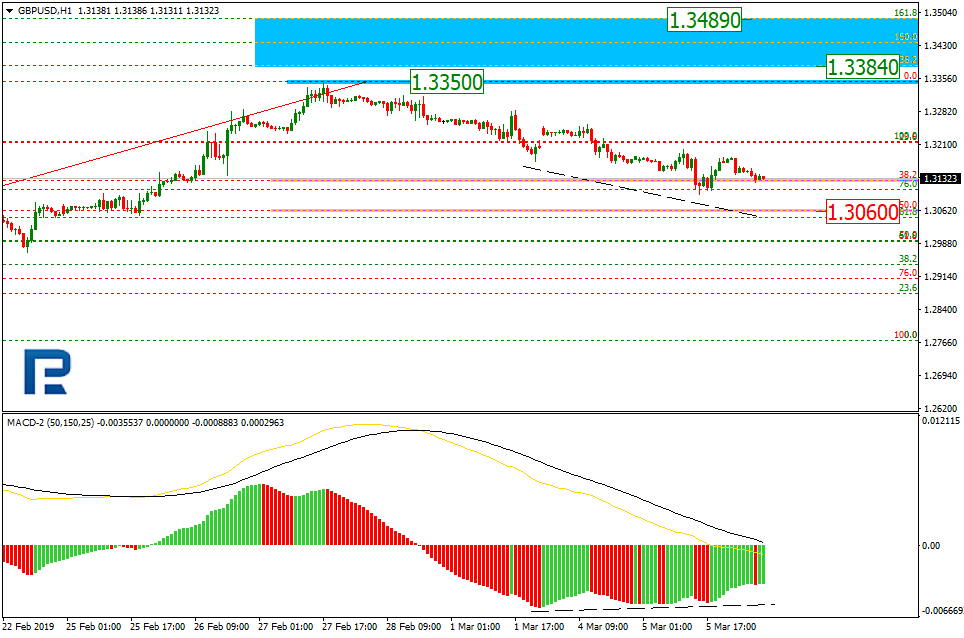
The H1 chart shows more detailed structure of the current decline towards the retracement of 50.0% at 1.3060. At the same time, there is a convergence on MACD, which may indicate a new correctional uptrend.

GBPUSD2
Risk Warning: the result of previous trading operations do not guarantee the same results in the future

EURJPY, “Euro vs. Japanese Yen”

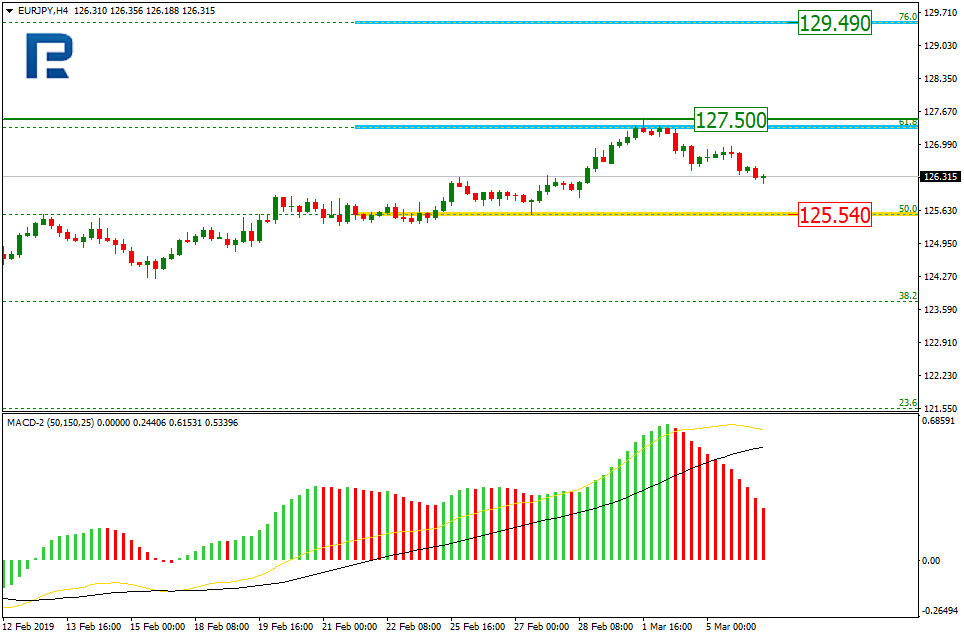
As we can see in the H4 chart, after reaching the retracement of 61.8%, EURJPY is trading downwards. The downside target may be the retracement of 50.0% at 125.54. After finishing the correction, the price may resume growing to reach the retracement of 76.0% at 129.49. The resistance level is the high at 127.50.

EURJPY1
Risk Warning: the result of previous trading operations do not guarantee the same results in the future

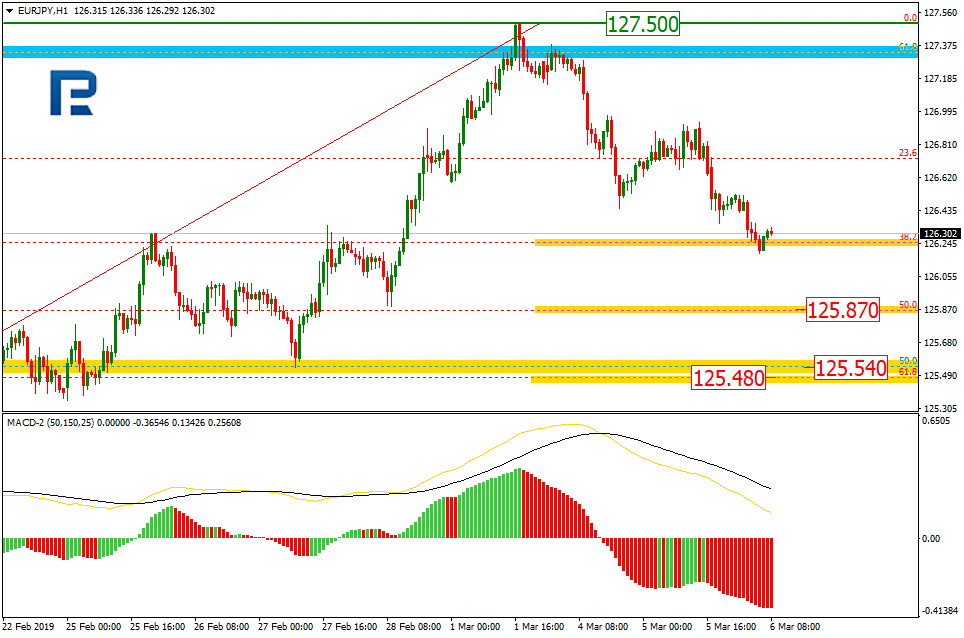
In the H1 chart, the downtrend has reached the retracement of 38.2%. The next possible targets are the retracements of 50.0% and 61.8% at 125.87 and 125.48 respectively.

EURJPY2

Article By RoboForex.com

Attention!
Forecasts presented in this section only reflect the author’s private opinion and should not be considered as guidance for trading. RoboForex LP bears no responsibility for trading results based on trading recommendations described in these analytical reviews.