Author Archive for InvestMacro – Page 267

Currency Majors Are Consolidating. The Fed Meeting Is in the Focus of Attention

by JustForex

At the moment, the main currency pairs have become stable before the announcement of the results of the Fed meeting. Recent economic releases from the US were rather weak. Most financial market participants believe that the regulator will keep the range of key interest rates at the same level of 2.25%-2.50%. The Fed will adhere to a “patient” approach concerning monetary policy tightening. We recommend paying attention to the comments by representatives of the Central Bank, as well as to updated economic forecasts.

Yesterday, the Office for National Statistics published ambiguous data on the labor market. In January, the average wage level rose by 3.4%, which was higher than market expectations at 3.2%. The unemployment rate fell from 4.0% to 3.9%. At the same time, the Claimant count change increased to 27.0K in February compared to the expectations of experts 13.1K. The trade negotiations between Washington and Beijing have escalated again. According to Bloomberg, some US officials expressed concern that China might refuse to accept US demands.

The “black gold” prices are consolidating. At the moment, futures for the WTI crude oil are testing the mark of $59.40 per barrel. We recommend paying attention to the data on the EIA crude oil inventories at 16:30 (GMT+2:00).

Market Indicators

Yesterday, the main US stock indices showed variety of trends: #SPY (+0.02%), #DIA (-0.04%), #QQQ (+0.34%).

The 10-year US government bonds yield is at the level of 2.59-2.60%.

The news feed on 20.03.2019:

– Consumer price index in the UK at 11:30 (GMT+2:00);
– Fed interest rate decision at 20:00 (GMT+2:00);
– New Zealand GDP at 23:45 (GMT+2:00).

by JustForex

EURUSD: pair caught on the balance line

By Matthew Anthony, Alpari

Previous:

On Tuesday the 19th of March, trading on the euro closed up. If you ask me, it looks like the pair spent the day in a sideways trend. While the euro strengthened throughout the European session without any serious pullbacks, volatility was higher during the US session. Market participants are a bit shaky ahead of the upcoming Fed decision.

Day’s news (GMT+3):

  • 10:00 Germany: PPI (Feb).
  • 12:30 UK: CPI (Feb), retail price index (Feb), PPI – input (Feb), PPI – output (Feb).
  • 14:00 UK: CBI industrial trends survey (Mar).
  • 17:30 US: EIA crude oil stocks change (15 Mar).
  • 21:00 US: Fed interest rate decision, Fed monetary policy statement, FOMC economic projections.
  • 21:30 US: FOMC press conference.

EURUSD H1

Current situation:

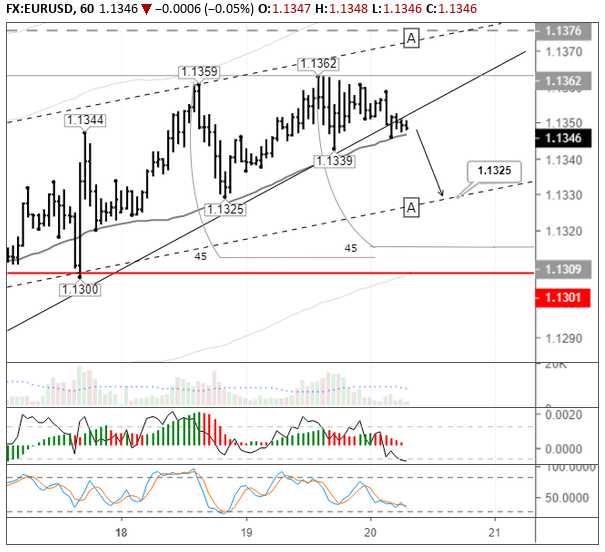
The rise to 1.1360 came to pass just as expected, but the subsequent drop is dragging on due to the Fed meeting. Last week saw the release of weak economic data. Now there are fears that the Fed will soften its rhetoric with regards to monetary policy. No one is expecting interest rates to be changed, however. Everyone is waiting for the FOMC’s economic projections and the press conference with Jerome Powell.

In today’s Asian session, the technical picture remains the same as far as I’m concerned. I’m keeping my target of 1.1325 at the lower boundary of the A-A channel. The trend line has been broken, but I’m not paying attention to this given the current truncated formation.

Most relevant for me at the moment is the A-A channel. The pair has been hovering around the balance line for the last few hours. I expected the euro to continue heading south as part of a correctional movement. By June, I expect to see the euro at 1.23. Although growth is subdued for the time being, the bigger picture on the monthly timeframe suggests a rising euro.

Dow Jones Head and Shoulders Pattern To Be Aware Of

By TheTechnicalTraders.com

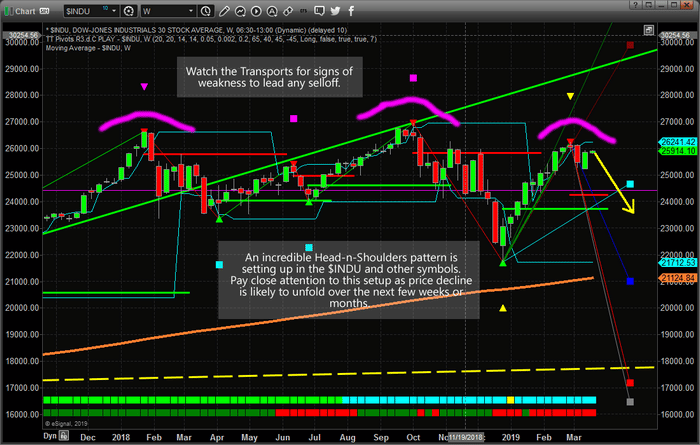
Our research team believes a moderately mild price rotation will unfold over the next 30 to 60 days where the US Stock Market will rotate downward.  Particularly, the $INDU (Dow Jones Industrials) should move lower towards the $23,000 to 24,000 before finding support based on the longer term weekly chart. Keep in mind we are not saying the price is going to fall. We are stating price could correct in a big way if recent support levels are broken. If so, then 23,000-24,000 levels should be reviewed.

We have been warning about a specific price pattern that we believe is currently in the process of setting up in the US Stock Market.  This pattern is a “Falling Wedge” pattern.  We’ve seen a few of these over the past 5+ years in downward retracing price swings.  They typically act as a means for the price to explore a “momentum base” setup before breaking out to the upside.  You can read our previous research here.

Price weakness could begin to drive market prices lower over the next few weeks as this right Shoulder acts as critical resistance.  If you have not already prepared for this move, please try to understand the importance of this long term price pattern.  Head-n-Shoulders patterns are typically viewed as major resistance and a classic topping formation.  Our belief that the downside price swing from the right Shoulder is based on our predictive modeling systems results.  We believe this move will drive prices lower before support is found and our downward sloping wedge pattern sets up.  This wedge pattern will likely break to the upside during the Summer months.

This Head-n-Shoulders pattern is something all traders need to pay attention to.  This is a critical resistance/top formation that should drive prices lower over the next few weeks/months.

Just take a look at the daily chart and reversal type price action forming this week.

If you have not protected your long trades well enough or you have recently deployed a bunch of capital into the markets, we strongly suggest you develop a “Plan B” as we are likely to see a 5~10% correction before this downside swing is over.

Our team has 53 years of experience in researching and trading makes analyzing the complex and ever-changing financial markets a natural process. We have a simple and highly effective way to provide our customers with the most convenient, accurate, and timely market forecasts available today. Our stock and ETF trading alerts are readily available through our exclusive membership service via email and SMS text. Our newsletter, Technical Trading Mastery book, and 3 Hour Trading Video Course are designed for both traders and investors. Also, some of our strategies have been fully automated for the ultimate trading experience.

RECENT CLOSED TRADES

Chris Vermeulen
Technical Traders Ltd.

TheTechnicalTraders.com


Japanese Candlestick Analysis for GOLD and NZDUSD: 19/3/2019

Article By RoboForex.com

GOLD

On H4, the gold is rising, making pullbacks every now and again. A correction is happening, with the price forming such reversal patterns as the hammer, doji, and engulfment. By analyzing the previous moves, one can assume the gold may continue uptrending once the pullback is over.

GOLD
Risk Warning: the result of previous trading operations do not guarantee the same results in the future

NZDUSD

On H4, the pair bounced off the support again and is forming pullbacks and reversal patterns, such as the harami, doji, and falling star. By analyzing the previous moves, one can assume the NZDUSD may start forming a new uptrend after a correction.

NZDUSD
Risk Warning: the result of previous trading operations do not guarantee the same results in the future

Article By RoboForex.com

Attention!
Forecasts presented in this section only reflect the author’s private opinion and should not be considered as guidance for trading. RoboForex LP bears no responsibility for trading results based on trading recommendations described in these analytical reviews.

Development Should Guide US-Philippine Mutual Defense Treaty Review

By Dan Steinbock

In times of great uncertainty, strategic ambiguity offers little clarity. The review of the U.S.-Philippines Mutual Defense Treaty should be guided by the quest for sovereignty and economic development.

During his recent visit in the Philippines, Malaysian Prime Minister Mahathir Mohamad met Murad Ebrahim, the Filipino Muslim rebel leader who became a regional governor under the Malaysian-brokered peace deal. In the course of the meeting, Mahathir told to Murad that “it’s easy to shoot and kill, but it’s difficult to develop. If there is peace, then everything will come.”

Mahathir’s words offer guidance in intra-country divides, but also in inter-country friction, including the review of the decades-old Mutual Defense Treaty (MDT) with the United States.

In early March, Philippine defense secretary Delfin Lorenzana said the government should review the MDT to avoid provoking a potential armed conflict with China in the South China Sea. Lorenzana pointed out that the security environment in the region is today “much more complex” than in the early Cold War era, when it was drawn up. “The Philippines is not in a conflict with anyone and will not be at war with anyone in the future.”

Obviously, there are different views about the preferred future of the MDT in Manila, Washington and elsewhere. Typically, most are predicated on geopolitical arguments, treaty texts and interpretations of various statements.

Yet, Mahathir’s wisdom matters. Development is not viable without peace. In the long-run, it is the quest for economic development that should drive the MDT debate.

Sovereignty and “zero problems” foreign policy

Since the early 2000s, the rapid growth of the so-called BRIC economies has greatly inspired debates on economic development. As a large emerging economy with solid structural potential for the future, Philippines could draw from the lessons of these countries.

As I have stressed since my 2014 Mabini lecture at the Foreign Service Institute, there is nothing automatic about strong growth potential. Vital economic, political and security shifts can support or penalize growth.

In light of Mahathir’s views, the most important lesson may well be the “zero problems policy,” which was developed a decade ago by former Turkish foreign minister Ahmet Davutoglu who lectured in Malaysia in the Mahathir era.

Historically, this approach has been typical to successful industrializers in the emerging world. From the 1980s to 2000s, China was largely focused on inward development, though gradually building international relations. The same goes for India’s industrialization in the past two decades. In Brazil, the most intensive phase of modernization occurred earlier but could only be completed in the Lula era.

In Southeast Asia, the rise of Singapore only took off after Lee Kuan Yew’s leadership overcame race riots and began a decisive focus on development. In Vietnam, reunification and reforms could only move ahead after colonialism and triumphs against the French and U.S. neocolonial wars. In Indonesia, both Sukarno and Suharto sought rapid industrialization, but it was only completed with peace and stability in the era of Susilo Bambang Yudhoyono (SBY).

Of course, none of the large emerging economies have been able to avoid all conflicts, many of which stem from colonial legacies following artificial partitions (India), invasions and wars (China), and structural dependency (Brazil). Yet, the effort to reduce friction in foreign relations, in order to focus on economic development has been typical to successful modernization.

What these large emerging economies also share is their insistence on sovereignty. After decades, even centuries of colonial “divide and rule,” they want to control their own future. While all of them seek to cooperate and partner with other nations in different ways, they do not easily tolerate the military presence of other countries within their territories.

As evidenced by the Middle East, such presence is not just a reminder of colonial legacies but can violate their sovereignty and result in destructive proxy conflicts in the region.

Economic development first

Following the recalibration of the Philippine foreign policy, there is nothing so challenging in the country’s bilateral relations with China that could not be negotiated in a mutually satisfactory way over time.

But just as Manila would not easily tolerate an anti-Philippine stance by foreign troops in China, it is hardly surprising that Beijing has concerns about any military presence by third-party countries in the Philippines – especially in light of historical track-record.

The Philippines became U.S. colony after the Spanish-American war and the subsequent Philippine-American War. The promised independence materialized only after Japanese invasion and the end of World War II in 1946. Yet, a strong U.S. military presence remained in the country until 1991.

Following President Obama’s “pivot to Asia” in 2011, President Aquino and his foreign minister Albert del Rosario achieved the 2014 Enhanced Defense Cooperation Agreement (EDCA), as a sort of a prelude to more intimate collaboration with the anticipated presidency of Senator Mar Roxas in 2016.

The scenario was foiled by Duterte’s electoral triumph, which, reportedly, led to a regime change plan by former U.S. Ambassador Philip Goldberg in fall 2017.

In all these scenarios – from the late 1890s up to present – Philippines has been seen as a geopolitical platform to project U.S. hard power in the region, particularly vis-à-vis China, as most historians acknowledge.

Toward peace, development and prosperity

When defense secretary Lorenzana said last December that the objective of the MDT Treaty review would be to “maintain it, strengthen it, or scrap it,” he presented three clear future scenarios to the country.

Any scenario that would maintain or strengthen the MDT runs the risk of undermining Philippine sovereignty, exposing the country to costly entanglements and potentially fatal conflicts in the region, which, in turn, would undermine the quest for economic development. Instead, what Manila needs is strengthened sovereignty, strong ASEAN cooperation and development.

Successful economic modernization is not viable without sovereignty and focus on development, as evidenced by the history of the BRIC economies (and that of the United States).

When the MDT was signed in 1951, the U.S. and advanced countries still dominated world growth, whereas emerging Asia was struggling amid poverty. Today, China and emerging countries fuel global growth prospects, while emerging Asia is catching up with higher living standards – but only as long as peaceful conditions prevail in the region.

So if economic development is to remain the national priority, these are the facts that should guide the review of the MDT in the new and far more complex security environment.

About the Author:

Dr. Dan Steinbock is the founder of Difference Group and has served at the India, China and America Institute (US), Shanghai Institute for International Studies (China) and the EU Center (Singapore). For more, see http://www.differencegroup.net/ 

The original commentary was released by The Manila Times on March 18, 2019
 

Ichimoku Analysis: AUDUSD, NZDUSD, USDCAD, 19/03/2019

Article By RoboForex.com

AUDUSD

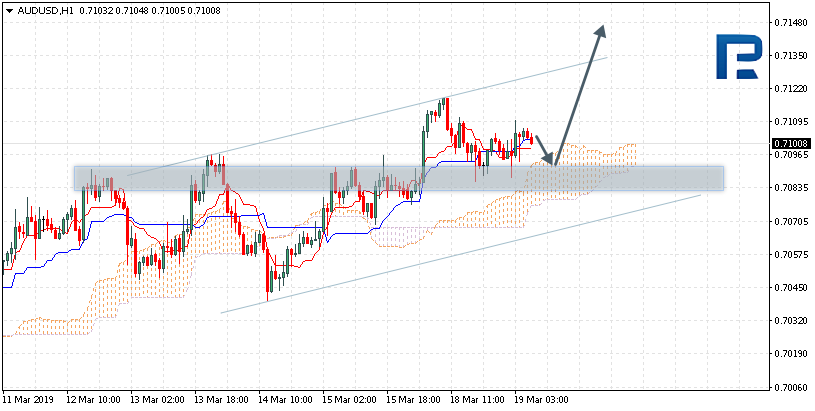
The AUDUSD is trading at 0.7100, above the Ichimoku cloud, which means there’s an uptrend forming. We are expecting a test of the upper cloud boundary at 0.7085, and then a downward pullback to 0.7145, which may be confirmed with the price bouncing off the support area. This rise may be prevented in case price breaks out the lower boundary of the Ichimoku cloud and closes below 0.7075, which will be a signal for a further fall to 0.6985 and below.

AUDUSD
Risk Warning: the result of previous trading operations do not guarantee the same results in the future

NZDUSD

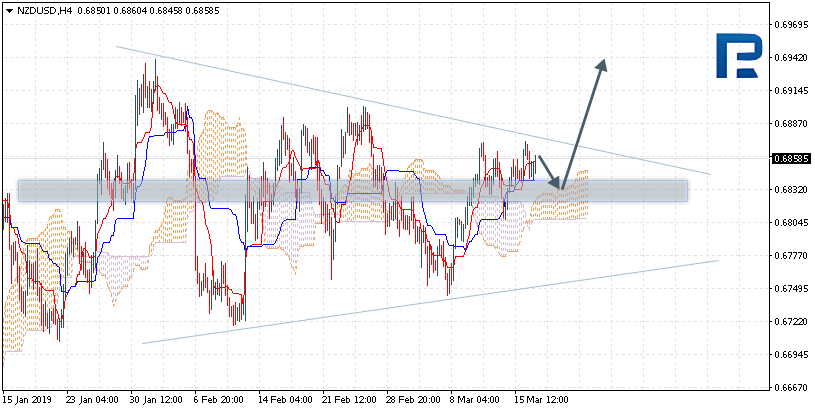
The NZDUSD is trading at 0.6858, above the Ichimoku cloud, which means there’s an uptrend forming. We are expecting a test of the upper cloud boundary at 0.6835, and then a downward pullback to 0.6940, which may be confirmed with the price bouncing off the support area. The rise may be prevented in case price breaks out the lower boundary and closes below 0.6800, which will be a signal for a further fall to 0.6720.

NZDUSD
Risk Warning: the result of previous trading operations do not guarantee the same results in the future

USDCAD

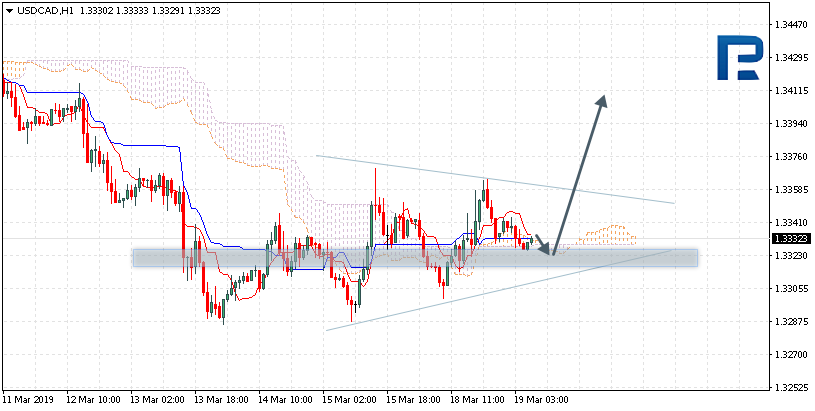
The USDCAD is trading at 1.3332, above the Ichimoku cloud, which means there’s an uptrend forming. We expect a test of the lower cloud boundary at 1.3325, and then an upward pullback to 1.3415, which may be confirmed with the price bouncing off the support area. This rise may be prevented in case price breaks out the lower boundary and closes below 1.3305, which will be a signal for a further fall to 1.3205. The rise confirmed once the the upper boundary of the triangle is broken out and the price closes above 1.3365.

USDCAD
Risk Warning: the result of previous trading operations do not guarantee the same results in the future

Article By RoboForex.com

Attention!
Forecasts presented in this section only reflect the author’s private opinion and should not be considered as guidance for trading. RoboForex LP bears no responsibility for trading results based on trading recommendations described in these analytical reviews.

The Analytical Overview of the Main Currency Pairs on 2019.03.19

Analytics by JustForex

The EUR/USD currency pair

Technical indicators of the currency pair:
  • Prev Open: 1.13255
  • Open: 1.13362
  • % chg. over the last day: +0.14
  • Day’s range: 1.13336 – 1.13544
  • 52 wk range: 1.1214 – 1.2557

The USD index holds the two-week minimums before the Federal Reserve meeting. The financial market participants are waiting for the regulator to approve a “careful” approach towards hardening the monetary policy. Right now the currency pair is moving in a flat. The key support and resistance levels are 1.13250 and 1.13600. EUR has further growth prospects. You should open positions from the key levels.

At 12:00 (GMT+2:00) ZEW will publish the economic mood index in Germany.

EUR/USD

The price fixed above 50 MA and 200 MA which points to the power of the buyers.

The MACD histogram is in the positive zone and keeps rising, which gives a signal to buy EUR/USD.

The Stochastic Oscillator is in the overbought zone, the %K line is crossing the %D line. There are no signals at the moment.

Trading recommendations
  • Support levels: 1.13250, 1.13000, 1.12800
  • Resistance levels: 1.13600, 1.14000

If the price fixes above the local resistance of 1.13600, expect the quotes to grow toward 1.14000.

Alternatively, the quotes can descend toward 1.13000-1.12800.

The GBP/USD currency pair

Technical indicators of the currency pair:
  • Prev Open: 1.32955
  • Open: 1.32466
  • % chg. over the last day: -0.24
  • Day’s range: 1.32431 – 1.32806
  • 52 wk range: 1.2438 – 1.4378

GBP/USD keeps trading in a flat. The key levels are 1.12400 and 1.33000. The investors are waiting for new data regarding Brexit. The GBP is under pressure after John Bercow refused to approve a new Brexit vote. The official stated that the deal should be presented in a different format. You should open positions from the key levels.

At 11:30 (GMT+2:00) the UK will publish a labour market report.

GBP/USD

The indicators do not provide precise signals, the price has crossed 50 MA.

The MACD histogram is close to 0.

The Stochastic Oscillator is in the neutral zone, the %K line is crossing the %D line. There are no signals at the moment.

Trading recommendations
  • Support levels: 1.32400, 1.32000,1.31500
  • Resistance levels: 1.33000, 1.33600

If the price fixes above 1.33000, expect the quotes to rise toward 1.33500-1.33700.

Alternatively, the quotes can fall toward 1.32000-1.31500.

This article reflects a personal opinion and should not be interpreted as an investment advice, and/or offer, and/or a persistent request for carrying out financial transactions, and/or a guarantee, and/or a forecast of future events.

Registration The USD/CAD currency pair

Technical indicators of the currency pair:
  • Prev Open: 1.33316
  • Open: 1.33375
  • % chg. over the last day: -0.09
  • Day’s range: 1.33224 – 1.33441
  • 52 wk range: 1.2248 – 1.3664

USD/CAD keeps trading in a flat. The technical picture is ambiguous. Right now the local support and resistance levels are 1.33100 and 1.33400. The demand for USD is weakened before the Federal Reserve meeting. Additional support for CAD is caused by the bullish oil market. The quotes have a tendency to descend. You should open positions from the key levels.

The Economic News Feed for 19.03.2019 is calm.

USD/CAD

The indicators do not provide precise signals, the price has crossed 50 MA.

The MACD histogram is close to 0.

The Stochastic Oscillator is in the neutral zone, the %K line is crossing the %D line. There are no signals at the moment.

Trading recommendations
  • Support levels: 1.33100, 1.32900, 1.32500
  • Resistance levels: 1.33400, 1.33650, 1.33900

If the price fixes below 1.33100, expect the quotes to fall toward 1.32800-1.32600.

Alternatively, the quotes can grow toward 1.33650-1.33900.

The USD/JPY currency pair

Technical indicators of the currency pair:
  • Prev Open: 111.466
  • Open: 111.443
  • % chg. over the last day: -0.15
  • Day’s range: 111.158 – 111.443
  • 52 wk range: 104.56 – 114.56

USD/JPY started to descend. The trading instrument updated the local miniums. Right now the quotes are consolidating. The local support and resistance levels are 111.150 and 111.400. The demand for USD is weakening. You should keep an eye on the US Treasury bonds` yield dynamics and open positions from the key levels.

The Economic News Feed for 19.03.2019 is calm.

USD/JPY

The indicators do not provide precise signals, 50 MA started to cross 200 MA.

The MACD histogram is in the negative zone but above the signal line, which gives a weak signal to sell USD/JPY.

The Stochastic Oscillator is in the neutral zone, the %K line is above the %D line which points towards the bullish mood.

Trading recommendations
  • Support levels: 111.150, 111.900, 110.600
  • Resistance levels: 111.400, 111.650, 111.850

If the price fixes below the local support 111.150, expect the quotes to fall toward 110.900-110.700.

Alternatively, the quotes can grow toward 111.600-111.800.

Analytics by JustForex

Investors Are Focused on the British Pound

by JustForex

Yesterday, the US dollar weakened slightly against a basket of major currencies. Investors took a wait-and-see attitude before the Fed’s monetary policy decision. Financial market participants expect the Fed to keep interest rates unchanged following a two-day meeting, which will start today. The dollar index (#DX) closed the trading session in the negative zone (-0.08%).

At the moment, the British pound is in the spotlight. The pound fell in price after it became known that British Prime Minister Theresa May wanted to carry out the third voting for her Brexit deal in Parliament. However, the pound was under pressure after the Parliament canceled the vote. According to the representative of the House of Commons, John Bercow, fundamental changes had to take place with the offered agreement in order to vote. Theresa May should officially ask EU for the Article 50 extension, since the Brexit date expires on March 29. All 27 EU countries should approve the extension of the Article at the summit on Thursday. But the problem is that Theresa May still hasn’t made the request. If May does not make a request for an extension until Thursday, the pound will have serious problems, because it will force the EU to hold an emergency summit on March 28.

The “black gold” prices are showing positive dynamics amid a decrease in OPEC+ production. At the moment, futures for the WTI crude oil have approached $59.60 per barrel.

Market Indicators

Yesterday, the bullish sentiment prevailed in the US stock market: #SPY (+0.36%), #DIA (+0.25%), #QQQ (+0.06%).

The 10-year US government bonds yield is at the level of 2.59-2.60%.

The news feed on 19.03.2019:

– Reports on the UK labor market at 11:30 (GMT+2:00);
– German ZEW economic sentiment index at 12:00 (GMT+2:00).

by JustForex

EURUSD: triangle formation keeping the bears at bay

By Matthew Anthony, Alpari

Previous:

On Monday the 18th of March, trading on the euro closed slightly up. During the European session, the bulls pushed the pair up to 1.1359 on the back of the weak US data released last week. The dollar partially recovered its losses in the US session and the EURUSD pair returned to the balance line.

Day’s news (GMT+3):

  • 10:00 Switzerland: trade balance (Feb).
  • 12:30 UK: claimant count change (Feb), average earnings (Jan), ILO unemployment rate (Jan).
  • 13:00 Germany: ZEW survey – economic sentiment (Mar), ZEW survey – current situation (Mar).
  • 17:00 US: factory orders (Jan).
  • 22:30 US: API weekly crude oil stock (15 Mar).

EURUSD H1Current situation:

The bulls have shifted the upper boundary of the channel, but the pair’s dynamics followed my forecast for the most part. The price bounced from the balance line and the trend line (from 1.1176) to 1.1349. By close, the bulls had retreated back to the balance line.

A triangle formation has appeared on the H4 timeframe. Judging by the wave structure, this isn’t an ending diagonal. Most traders judge these price models by eye without looking at the internal wave structure. As such, the more defined the formation is, the bigger the influence it will have on the market.

Trader attention is shifting towards the Fed meeting. The US central bank’s meeting will begin today, and end with a press conference tomorrow. The regulator is expected to leave interest rates at their current levels and to downgrade their outlook. We’ll have to wait and see what kind of statements we get and what the reactions to them will be like.

From a technical standpoint, the pair is poised to decline from its current level. Considering the rebounds that occurred on the 14th and 18th of March, the bulls may try to use the rising euro crosses to trigger stop levels ahead of the meeting. I expect to see the pair rebound downwards from around 1.1360 – 1.1367 as traders cash in on their long positions. A breakout of the trend line at 1.1345 would increase pressure on the bulls. After such a breakout, we would have a target zone of 1.1318 – 1.1320. It remains to be seen whether we’ll reach the 45th degree.

US Equities Price Anomaly Setup Continues

By TheTechnicalTraders.com

This research post highlights what we believe to be a unique price anomaly setup in many of the US major markets this week.  Our research suggests that April 21, or near this date, will be an important price inflection point base level for the US stock markets.  We believe a unique price base will begin to form near this date and a bigger price move in May/June 2019 will unfold.

Our Advanced Dynamic Learning (ADL) price modeling system is suggesting the rotation in the US stock market may stay somewhat muted before this move on April 21 begins.  The ADL predictive modeling system is one of our proprietary price modeling utilities that our research uses to identify key levels of future support and resistance as well as to watch for “price anomalies” that setup.  Price anomalies are where the current price level of any symbol is greatly diverted from the ADL predictive price level.  When this happens, the price will usually “revert” back to near the ADL levels at some point in the immediate future – sometimes setting up a great trading opportunity.

This Daily YM chart shows a current price anomaly in the YM of about 1000 points.  This is a pretty big range for skilled traders that are capable of identifying the right trade.  The ADL system is suggesting that YM will rotate lower between now and the end of April by at least 800~1000 pts.


The next, Weekly, YM chart showing the ADL price modeling system is confirming the Daily ADL chart.  Both are showing a lower price rotation over the next few weeks.  Additionally, the Weekly ADL chart is showing a deep price low near May 1, 2019.  This aligns perfectly with our earlier analysis that May/June would start a bigger price rotation in the US stock market, global equities markets and precious metals. More on precious metals forecast in this video clip on TradingView.com


As we continue to move closer to these important dates, we’ll keep our followers informed of our research and our proprietary trading tools, yet the real opportunity exists by knowing how to trade these moves and how to take advantage of the total scope of these market.  Be prepared for a fairly large downside price swing in the YM over the next 5~7 weeks as the 24,800~25,000 attempts to set up support and a momentum base.

Please take a minute to visit TheTechnicalTraders.com to learn more about what we do and how we can help you stay ahead of these market moves.  Visit www.TheTechnicalTraders.com/FreeResearch/ to read all of our recent research posts.  We take great pride in our ability to provide our members and followers with the highest level of research, trading signals, daily video content and more.  Find our why our hundreds of members continue to believe in the opportunity we provide them each and every day.  Isn’t it time you invested in your future success – today?

Chris Vermeulen