Author Archive for InvestMacro – Page 263

EURUSD: shorting the euro crosses has weighed down on the main pair

By Matthew Anthony, Alpari

Previous:

On Tuesday the 26th of March, the euro hit a new weekly low after an unsuccessful attempt at breaking the trend line. During the European session, the pair’s drop was brought about by a decline on the EURGBP cross as a result of news concerning Brexit. Pressure increased during the US session on the back of increased demand for the dollar. The greenback also got a boost from a rise in US 10-year bond yields.

I’ve long been under the impression that the statements of various officials are carefully planned to bring about price fluctuations on the markets at a certain time. While they may seem random from the sidelines, randomness is just a pattern you haven’t yet recognised.

Any official can give their personal opinion on a hot topic and have a marked influence on the market. They don’t face any consequences for this verbal manipulation of the market as they are simply expressing an opinion. Nevertheless, these expressions destabilise markets.

The EURUSD pair is trading down on the 21st of March, while the GBPUSD pair is trading up. The trajectories of these pairs have diverged, but we can expect them to converge again in the near future.

Day’s news (GMT+3):

  • 10:45 France: consumer confidence (Mar).
  • 11:00 Eurozone: ECB President Draghi’s speech.
  • 12:00 Switzerland: ZEW survey – expectations (Mar).
  • 14:00 UK: CBI distributed trades survey (Mar).
  • 15:30 Canada: imports (Jan), exports (Jan), international merchandise trade (Jan).
  • 15:30 US: trade balance (Jan).
  • 16:30 Eurozone: ECB’s Mersch speech.
  • 17:00 Switzerland: SNB quarterly bulletin.
  • 17:30 US: EIA crude oil stocks change (22 Mar).

EURUSD H1

Current situation:

The pair fulfilled one third of my forecast yesterday. The breakout of the trend line turned out to be false. My predicted scenario became unworkable after the rate dropped below 1.1300. The euro bears improved their positions on the back of a strengthened dollar as they pushed the bulls back to 1.1251 (70% of the upwards movement from 1.1176 to 1.1448). Judging by trading volumes, this is a key support level. If the bears take it during the European session, I don’t think that the 67th degree will be able to withstand them and the pair will slump to 1.1222.

I wrote above that the highly correlated EURUSD and GBPUSD pairs have diverged. Now it’s time to find a balance point between them so that they can start moving in the same direction again. Either the pound will drop, and the euro will stay at 1.1257 and wait for the pound to catch up, or the euro will shoot upwards and the pound will keep trading at 1.3180.

I’ve decided not to make a prediction today pending further developments on Brexit and given the upcoming trade talks between the US and China (a new round of talks is set to take place on the 28th and 29th of March in China). I’ll simply state my target levels: 1.1220 (target for bears), and 1.1293 (target for bulls; the LB and trend lines).

Japanese Candlestick Analysis for EURUSD and USDJPY: 26/03/2019

Article By RoboForex.com

EURUSD

On H4, the pair is testing the support and forming reversal patterns, such as hammer and doji, after correction. By analyzing the previous moves, one can assume the EURUSD may start forming a new uptrend after a pullback.

EURUSD
Risk Warning: the result of previous trading operations do not guarantee the same results in the future

USDJPY

On H4, the pair is still testing the support and forming such reversal patterns as long doji, hammer, and inverted hammer. By analyzing the previous moves, one can assume the USDJPY may continue uptrending once the pullback is over.

USDJPY

Article By RoboForex.com

Attention!
Forecasts presented in this section only reflect the author’s private opinion and should not be considered as guidance for trading. RoboForex LP bears no responsibility for trading results based on trading recommendations described in these analytical reviews.

The Uhuru blueprint: What if PH had stayed in ICC?

By Dan Steinbock  

Recently, the Philippines withdrew from the ICC opting for the path of US and Russia, China and India. To focus on a new economic future and the battle against drugs and corruption, the government shunned the Uhuru blueprint.

On March 17, the Philippines withdrew from the International Criminal Court (ICC), which has sought to investigate allegations that President Duterte had committed “crimes against humanity.”

The charges were pushed by controversial critics associated with former President Aquino’s Liberal Party and its allies, which – after the 2016 election meltdown – have sought domestic political change increasingly through international pressure.

Fast-forward to an imagined future: If the Philippines had not withdrawn from the ICC, Duterte’s government could have faced the Uhuru blueprint.

The Uhuru blueprint

In 2010, then-ICC Prosecutor Luis Moreno Ocampo charged then-Deputy Prime Minister Uhuru Kenyatta, along with five other government leaders, as an indirect co-perpetrator in the violence that followed Kenya’s 2007-08 post-election violence. Ocampo accused them of “crimes against humanity.”

Despite the ICC process, Uhuru was elected Kenya’s president in 2013. He is a popular politician and the son of the legendary anti-colonial leader Jomo Kenyatta. However, opposition led by Raila Odinga hoped to benefit from his demise.

Reportedly, Odinga’s Orange Democratic Movement was named after the Ukrainian “Orange Revolution,” which billionaire George Soros had supported. Soros’s Open Society also funded the pro-Odinga key NGO and Kenyan think-tanks to stop President Uhuru from the 2013 general election. And yet, after a three-year juridical chaos, the ICC charges were dropped in March 2015 for lack of evidence.

Another show began ahead of the 2017 elections. In August, the bank account of Odinga’s daughter was frozen, and a pro-Odinga NGO received more than $5 million from Soros Foundation. In September, Uhuru was re-elected for a second term. Odinga challenged the outcome in the Supreme Court, which ordered a new election. Oddly enough, Odinga withdrew from October election, which resulted in Uhuru’s crushing electoral victory.

Instead of democratic competition, Odinga traveled to London where he met former UN Deputy Secretary General, Lord Mark Malloch Brown, the PR muscle behind Cory Aquino election win in 1986 and the Aquino family since then; and the chair of Smartmatic, whose election technology has unleashed controversies in many countries, including the Philippines. In 2007, Malloch Brown was named vice-chairman of Soros Fund Management and his Open Society Institute.

The Uhuru case undermined the ICC’s credibility, wasting resources and causing gratuitous political turmoil. It also cost to Kenya as ICC’s lingering process began to penalize the perceived legitimacy of Kenya’s political leadership.

When Uhuru served as deputy PM, Kenya’s growth surged to more than 10% in the early 2010s. During the ICC debacle, it more than halved to 4% in 2012 stabilizing thereafter at a lower level. Concurrently, Kenyan shilling weakened from 80 to more than 100 the U.S. dollar; plunging more than 25%.

Several ICC cases suggest a similar sequence: First, the target country enjoys promising development. Political destabilization ensues in the name of “people power.” Financial speculation penalizes economic growth and currency stability, causing capital outflows. If new leaders take over, privatization of public assets tends to follow. Development potential weakens.

While only a probable future, even an imagined Uhuru blueprint leaves one apprehensive. Without withdrawal from the ICC, it could have recurred in the Philippines, especially as some of the key actors are identical (Soros, Malloch Brown) or comparable (transnationally-supported NGOs and think-tanks, Smartmatic interests).

The ICC liabilities

In Kenya, the ICC effort to prosecute President Uhuru led to the parliament’s call for withdrawal from the ICC and the 2013 African Union summit in which Uhuru accused the ICC of being “a toy of declining imperial powers.” There is good reason for frustration. For a decade or two, the ICC has gone after the poorest countries mainly in Africa, which has suffered the most from colonial plunder.

The ties of Ocampo to Soros-supported organizations stem from early 1990s, when the billionaire infused funds into a prominent real estate backer of the lawyer’s NGO in Argentina. Then, Ocampo worked for Transparency International, a corruption watchdog that has been criticized for bias against developing countries. A decade later, he joined a roundtable by Soros’s Open Society called “Restoring American Leadership –  the ICC.”

When the UN Security Council assigned Ocampo to investigate war crimes in Libya, he reportedly shared confidential information with the French government, which was bombing Libya. After he indicted Gaddafi in 2011, he signed a lucrative $3-million contract to advise the Libyan oil billionaire Hassan Tatanaki, presumably to protect him from potential ICC prosecution. Reportedly, he also profited by routing monies to offshore companies in tax havens, as evidenced by the Panama Papers.

Importantly, the ICC’s ability to investigate and prosecute is severely restricted by its mandate. It can only prosecute crimes after its creation in 2002 – which conveniently suspends the worst genocides, crimes against humanity, war crimes and crimes of aggression; the four key international crime categories.

Today, there are more than 120 state parties to the Rome Statute. Over 30 countries have signed but not ratified the statute, and there are more than 50 non-signatory countries.

The ICC is financed “primarily” by its member states. About two-thirds of its budget comes from only 10 countries, especially Europe’s former colonial powers. Additional funding is provided –  but not detailed – by “voluntary government contributions, international organizations, individuals, corporations, and other entities.” The net effect is a moral hazard. The ICC is not immune to external influence.

U.S., Russia, China and India are not ICC signatories. In Southeast Asia, neither wealthier countries (Singapore, Brunei, Malaysia) nor emerging economies (Indonesia, Thailand, Vietnam, Myanmar, Lao) have signed the Statute.

Philippines and ICC

Unlike his peers, President Aquino signed the Statute in February 2011, right before he aligned Manila’s foreign policy with President Obama’s security pivot to Asia –  in contrast with almost all BRIC and ASEAN economies.

Since 2016, the effort to have the ICC intervene in Philippine matters has been further fueled by the domestic meltdown of the Liberal Party and the exploitation of human rights abroad, to advance political agendas at home.

Since its creation, the ICC’s credibility and judicial independence has been deflated.

The world needs a truly international criminal court – not one that targets the most vulnerable members of the international community.

About the Author:

Dr. Dan Steinbock is the founder of Difference Group and has served at India, China and America Institute (USA) Shanghai Institutes for International Studies (China) and EU Center (Singapore). For more, see https://www.differencegroup.net/

The original commentary was released by The Manila Times on March 25, 2019


Ichimoku Analysis: AUDUSD, NZDUSD, USDCAD, 26/03/2019

Article By RoboForex.com

AUDUSD

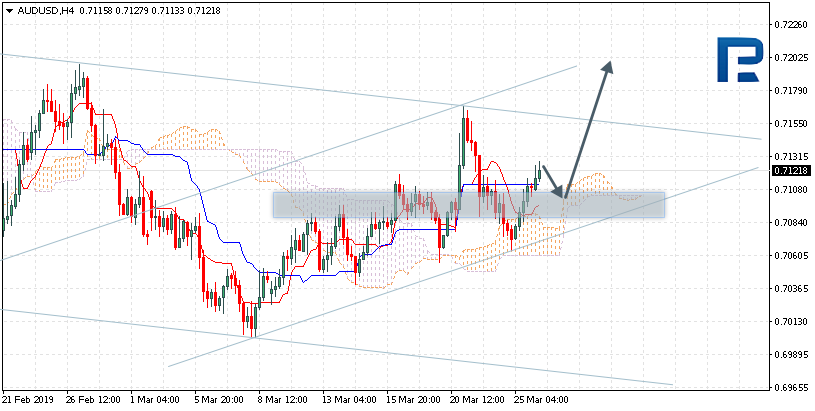
The AUDUSD is trading at 0.7121, above the Ichimoku cloud, which means there’s an uptrend forming. We are expecting a test of the upper cloud boundary at 0.7105, and then a downward pullback to 0.7205, which may be confirmed with the price bouncing off the support area. This rise may be prevented in case price breaks out the lower boundary of the Ichimoku cloud and closes below 0.7065, which will be a signal for a further fall to 0.6975 and below. The rise will get confirmed once the upper boundary of the descending channel is broken out and the price closes above 0.7155.

AUDUSD
Risk Warning: the result of previous trading operations do not guarantee the same results in the future

NZDUSD

The NZDUSD is trading at 0.6907, above the Ichimoku cloud, which means there’s an uptrend forming. We are expecting a test of the upper cloud boundary at 0.6885, and then a downward pullback to 0.6965, which will be confirmed with the price bouncing off the lower boundary of the ascending channel. The rise may be prevented in case price breaks out the lower boundary and closes below 0.6845, which will be a signal for a further fall to 0.6765.

NZDUSD
Risk Warning: the result of previous trading operations do not guarantee the same results in the future

USDCAD

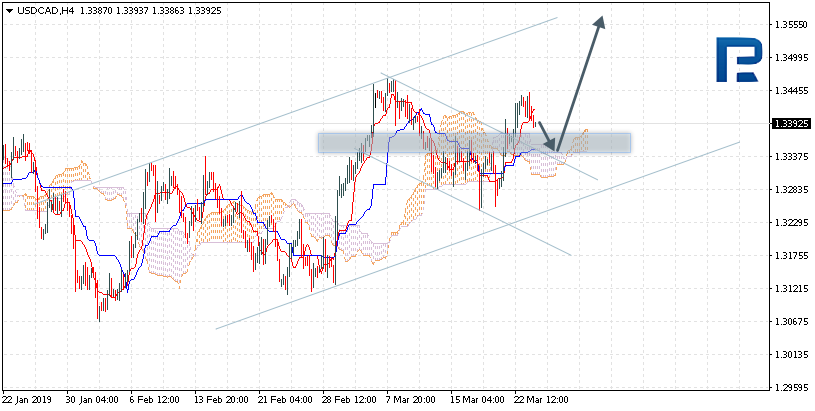
The USDCAD is trading at 1.3392, above the Ichimoku cloud, which means there’s an uptrend forming. We are expecting a test of the upper cloud boundary at 1.3365, and then a downward pullback to 1.3555, which will be confirmed with the price bouncing off the upper boundary of the descending channel. This rise may be prevented in case price breaks out the lower boundary and closes below 1.3285, which will be a signal for a further fall to 1.3175.

USDCAD
Risk Warning: the result of previous trading operations do not guarantee the same results in the future

Article By RoboForex.com

Attention!
Forecasts presented in this section only reflect the author’s private opinion and should not be considered as guidance for trading. RoboForex LP bears no responsibility for trading results based on trading recommendations described in these analytical reviews.

The Analytical Overview of the Main Currency Pairs on 2019.03.26

Analytics by JustForex

The EUR/USD currency pair

Technical indicators of the currency pair:
  • Prev Open: 1.12966
  • Open: 1.13158
  • % chg. over the last day: +0.17
  • Day’s range: 1.13052 – 1.13220
  • 52 wk range: 1.1214 – 1.2557

EUR/USD stabilized after a long fall last week. EUR is supported by the strong economic reports from Germany. The financial market participants are worried about the possible recession in the world economy. Right now the quotes are consolidating. The key levels are 1.13000 and 1.13250. You should open positions from these levels and watch the US economic releases.

The Economic News Feed for 26.03.2019:

  • – Real Estate Market Report (US) – 14:30 (GMT+2:00);
  • – Consumer Trust Index (US) – 16:00 (GMT+2:00);
EUR/USD

The indicators do not provide precise data, the price has crossed 50 MA.

The MACD histogram is close to 0.

The Stochastic Oscillator started to leave the oversold zone, the %K line is above the %D line which points towards a recover of EUR/USD.

Trading recommendations
  • Support levels: 1.13000, 1.12750
  • Resistance levels: 1.13250, 1.13500, 1.13900

If the price fixes below 1.13000, expect the quotes to fall toward 1.12750-1.12500.

Alternatively, the quotes can recover toward 1.13500-1.13700.

The GBP/USD currency pair

Technical indicators of the currency pair:
  • Prev Open: 1.32141
  • Open: 1.31946
  • % chg. over the last day: -0.05
  • Day’s range: 1.31774 – 1.32226
  • 52 wk range: 1.2438 – 1.4378

GBP keeps consolidating. The GBP/USD quotes are testing the key levels at 1.31600 and 1.32250. On Monday Theresa May said that she doesn’t have enough support for a second vote. Keep an eye on this issue and open positions from the key levels.

The Economic News Feed for 26.03.2019 is calm.

GBP/USD

Indicators do not provide precise signals, the price crossed 50 MA and 200 MA.

The MACD histogram is close to 0.

The Stochastic Oscillator is in the neutral zone, the %K is above the %D line which points to the bullish mood.

Trading recommendations
  • Support levels: 1.31600, 1.31000, 1.30300
  • Resistance levels: 1.32250, 1.33000, 1.33600

If the price fixes above 1.32250, expect the movement toward 1.32750-1.33000.

Alternatively, the quotes can fall toward 1.31000.

This article reflects a personal opinion and should not be interpreted as an investment advice, and/or offer, and/or a persistent request for carrying out financial transactions, and/or a guarantee, and/or a forecast of future events.

Registration The USD/CAD currency pair

Technical indicators of the currency pair:
  • Prev Open: 1.34257
  • Open: 1.34064
  • % chg. over the last day: -0.23
  • Day’s range: 1.33863 – 1.34073
  • 52 wk range: 1.2248 – 1.3664

USD/CAD retreated from the local maximums. The technical picture is ambiguous. CAD is consolidating in the 1.33850-1.34100 range. The financial market participants are waiting for additional drivers. Today you should keep an eye on the US economic releases and open positions from the key levels.

The Economic News Feed for 26.03.2019 is calm.

USD/CAD

The indicators do not provide precise signals, the price fixed between 50 MA and 200 MA.

The MACD histogram is in the negative zone but above the signal line which gives a weak signal to sell USD/CAD.

The Stochastic Oscillator is in the neutral zone, the %K line is crossing the %D line. There are no signals at the moment.

Trading recommendations
  • Support levels: 1.33850, 1.33500, 1.33100
  • Resistance levels: 1.34100, 1.34400, 1.35000

If the price fixes above 1.34100, expect the quotes to grow toward 1.34400-1.34700.

Alternatively, the quotes can fall toward 1.33600-1.33400.

The USD/JPY currency pair

Technical indicators of the currency pair:
  • Prev Open: 109.996
  • Open: 109.977
  • % chg. over the last day: -0.03
  • Day’s range: 109.977 – 110.243
  • 52 wk range: 104.56 – 114.56

USD/JPY stabilized after an agressive sell-off last week. The key support and resistance levels are 109.800 and 110.300. The demand for safe assets is high. The investors are worried about growing recession risks. Keep an eye on the economic reports and the US Treasury bonds` yield dynamic. Open positions from the key levels.

The Economic News Feed for 26.03.2019 is calm.

USD/JPY

Indicators do not provide precise signals, the price has crossed 50 MA.

The MACD histogram is in the positive zone which points to the power of the buyers.

The Stochastic Oscillator is near the overbought zone, the %K line is above the %D line which gives a weak signal to buy USD/JPY.

Trading recommendations
  • Support levels: 109.800, 109.500
  • Resistance levels: 110.300, 110.600, 110.900

If the price fixes above 109.800, expect the quotes to fall toward 109.500-109.300.

Alternatively, the quotes can recover toward 110.600-110.900.

Analytics by JustForex

Treasury Inversion and Political Fed Cycles

By TheTechnicalTraders.com

With so much news hitting the wires regarding the Treasury Inversion level and the “potential pending recession”, we wanted to shed a little insight into this phenomenon and what we believe the most likely outcome to be going forward.  Our researchers, at Technical Traders Ltd., believe the Treasure inversion is a reactionary process to overly tight US Fed monetary policies, consumer demand factors and outside cycle forces.  There is very little correlation to inverted Treasury levels and causation factors other than the US Fed and global central banks.  We believe consumers and consumer sentiment also play a role in setting up the conditions that prompt yield inversion.  The one aspect we believe everyone fails to consider is the uncertainty that is associated with major US election cycles.

The US Fed is obviously a driving force with regards to yields and consumer expectations.  In the past, the US Fed has rotated FFR levels up and down by enormous amounts (in some cases 200 to 500%+ over very short spans of time.  Consumers, you know those people, the ones that are the actual driving force of the local and state level economies, have been the the ones having to deal with wildly rotating FFR levels and the consequences of their debt rotating from 4~7% average interest rates to 8~25%+ average interest rates over the span of just a few years.

Take a look at this chart that highlights the current and previous US Federal Reserve FFR rate changes.  It is quite easy to see that consumers and business, on the receiving end of these changes, often swing from one extreme to another as the US fed makes these dramatic moves.  And, yes, that last 2400% number is correct.  The FFR went from 0.06% to 2.4% over the past 3+ years – do the math yourself if you don’t believe us.

Let’s talk about how the US economy operates as a host to the global economy for a second.  When the US economy is booming, it exports growth, opportunity, and activity to the rest of the world.  When the US economy is contracting, it exports contraction, diminishing opportunity and slower economic activity to the rest of the world.  This may be a bold statement to make, but it is true.  For the past 80+ years, the US economy has been the “mothership” of the global markets in terms of creating and exporting growth and opportunity for foreign nations.

The US Fed, therefore, has an incredible responsibility to safely navigate the current and future global expectations with regards to FFR levels and yield levels as the global economy expands and contracts with political, trade and social issues.  It is a very difficult process to navigate for anyone.

US Presidential Election cycles also play an important role in how these expansion and contraction cycles take place.  Anyone with any understanding of Music understands each note includes an “Attack” and “Decay” process.  The same thing takes place in economic cycles.  Within the Attack phase, the economy builds strength, capability, and output, just as the musical note does.  Within the Decay process, the economy begins to wain in strength, capability, and output, just as the musical note does.  The process within the global economy is very similar to an orchestra of musical instruments playing difference components of the music output.  Some play loudly and dramatically, others play softly and more demure.  The outcome is a finely balanced and enjoyable musical presentation.  The global economy is very similar to this and right now we are starting to see a slower, softer period of economic activity throughout the global economy.

Currently, the US is starting a new Presidential Election cycle where dozens of Democrats are lining up against President Trump.  This is sure to be a battle that will rival “Rocky II” in terms of scale and scope.  It is also starting far earlier than most normal mid-term Presidential election cycles.  This is one of the biggest reasons we believe the Treasury yields may stay rather muted for the next 12+ months while the end of the “attack phase” plays out for the global economy.  Eventually, the “decay phase” will begin within the global economy and we’ll start the process of waiting for the US Fed and central banks to rally opportunity with lower rates and possibly QE ventures.

We’ve highlighted the US Presidential Election “run-up” cycles (the hyperbole 16-month process that takes place before the actual elections) in BLUE on these charts.  It is fairly simple to see that the combination of the US Fed rate levels, US political controlling party policies and consumer sentiment related to these policies and economic factors have driven yields higher or lower throughout the past 50+ years.  In fact, the US and the Globe have recently transitioned from more of a regionally localized global economy to more of a centrally functioning global economy.  One thing has not changed, though, the US is still the largest of the global economic drivers and will continue to be for the foreseeable future.


When we take into consideration how these yield contractions have resulted in asset price changes in the US stock market, we need to compare these moves in yield with the expectations of traders, investors, and capitalists throughout the world.  Remember, the US stock market is currently, and has been, a pool asset valuation protection for global investors throughout the planet.  Over the past 40+ years, the US economy has exported opportunity and capacity throughout the globe while global investors have continued pour capital into US stocks, Bonds and Debt because of the strength of the US Dollar.

Our expectations are that the yield inversion, much like the inversion near 1980/1990 is the precipice of a renewed economic expansion as the planet develops new 21st-century trade, economic and political ties while shedding the 19th-century shackles that are currently binding it to obligation and debt originating from the 1960s through 1980s.  This transition period may be fraught with some dramatic price swings in assets, stocks and economic output levels.  Yet, we believe the outcome of this process will be a fantastic opportunity for skilled traders to find and execute tremendous upside pricing opportunities once it completes.

We have been completing a series of market cycle research that focuses on the alignment and timing of core global cycles.  By our research, 2027 and 2048 are key years for the global markets.  We believe 2027 will likely be a breakout year where the global markets align for an incredible upside price increase and we believe 2048 could be the year that the global economies exhibit some type of “metamorphosis” in terms of capacity and function.

In short, we believe these current inverted yields are nothing more than a “symptom” of the current political and US Fed FFR interest rate climate in combination with the current global economic output capacity and consumer sentiment.  To put it simply, after the US Fed raised rates by 2400%+ and the current trade and political issues are still unresolved – where do you expect yields to be moving?  Right, into further contraction while the US Fed tightens monetary policy and consumers react by tightening their spending.

Once the trade issues are resolved and the US Fed adopts a bit of easing in terms of current rates, we may continue to see have another year of wild and choppy market condition much like 2015, and 2018, but that all depends on what type of resolution there is with the current trade issues.

We’ll keep you informed of our research and longer-term date cycles as we continue to extract more concrete data from our research.  If you like our research and can clearly understand the value of having a team of dedicated market technicians and researchers working for you to help you find and execute better trades, then please visit www.TheTechnicalTraders.com to learn how we can help you.  This US presidential election cycle is going to have top billing for the next few months – get used to it and get used to the fact that the markets and yields will likely do what they always do within these cycles – muted price rotation where underlying fundamentals and consumer sentiment will likely drive future pricing.  Stay tuned and watch precious metals.

Chris Vermeulen

TheTechnicalTraders.com


Brexit Is in the Focus of Attention

by JustForex

The uncertainty regarding Brexit is in the foreground again. The European Commission has completed all preparations in case of non-deal Brexit. This week the UK Parliament should vote for the Brexit agreement. If parliamentarians vote for the deal, the UK will leave the union on May 22. If they do not support the agreement, Theresa May will have to choose one of several options before April 12: ask the EU to extend the Brexit deadline, exit from the EU without a deal, or terminate Article 50 of the Lisbon Treaty, which initiated Brexit.

However, yesterday British parliamentarians voted to give them the right to control the country’s exit from the EU. The British Parliament wants to be able to vote for different Brexit options. Most officials consider Theresa May to be not competent enough and unable to control the exit process.

The US currency weakened against a basket of major currencies. Investors are concerned about the inversion of the US government bonds yield curve. The dollar index (#DX) closed the trading session in the negative zone (-0.14%). The euro strengthened slightly after the release of optimistic data from Germany. The German IFO business climate index rose to 99.6, while experts expected 98.7. Previous data has also been revised upwards from 98.5 to 98.7.

The “black gold” prices show positive dynamics. At the moment, futures for the WTI crude oil are testing the mark of $59.45 per barrel. At 22:30 (GMT+2:00), a report on the API weekly crude oil stock will be published.

Market Indicators

Yesterday, there was a variety of trends in the US stock market: #SPY (-0.21%), #DIA (+0.04%), #QQQ (-0.19%).

The 10-year US government bonds yield has slightly moved away from local lows. At the moment, the indicator is at the level of 2.42-2.43%.

The news feed on 26.03.2019:

– Statistics on the real estate market in the US at 14:30 (GMT+2:00);
– CB consumer confidence index in the US at 16:00 (GMT+2:00).

by JustForex

EURUSD: hovering around the balance line

By Matthew Anthony, Alpari

Previous:

On Monday the 25th of March, trading on the euro closed up. In the US session, the EURUSD pair hit an intraday high of 1.1332. The pair was propped up by a broadly weaker dollar.

Day’s news (GMT+3):

  • 10:00 Germany: Gfk consumer confidence (Apr).
  • 12:30 UK: BBA mortgage approvals (Feb).
  • 14:00 UK: MPC member Broadbent speech.
  • 15:30 US: building permits (Feb), housing starts (Feb).
  • 16:00 US: housing price index (Jan).
  • 17:00 US: consumer confidence, Richmond Fed manufacturing index (Mar).
  • 23:30 US: API weekly crude oil stock (22 Mar).

EURUSD H1

Current situation:

The pair recovered to the LB balance line, as well as the 45th degree and 50% of the drop from 1.1391 to 1.1273. The euro has rebounded from the 45th degree and at the time of writing is trading at 1.1307.

I’ve shown my predictions for the pair on the chart resulting from my analysis. It’s unclear whether the euro will continue rising, or whether downside pressure will come back in force given that traders are still cautious since the US bond yield curve inverted.

Experts having been keeping an eye on the difference between long-term and short-term (around 3 months) bond yields. The difference between 10-year and 3-month yields has now entered negative territory, while this has yet to happen between 10-year and 2-year yields.

Chicago Fed President Charles Evans yesterday said that despite justified nerves over the yield curve inversion, he is still confident about the strength of the US economy.

Trader attention today will turn towards the UK parliament, where another round of votes is set to take place. Keep an eye on the yen and US10Y bond yields. In my forecast, I’m expecting a breakout of the trend line followed by a recovery to the 67th degree at 1.1353.

USDCAD: ready for new yearly highs

By Tomasz Wisniewski, Alpari

As you probably know, Wednesday was pretty bad for USD, but by the end of the week, the greenback had managed to recover most of its losses. There is a pair where the drop from Wednesday wasn’t even visible – USDCAD. Wednesday’s candlestick is bearish, which while true, is not relevant from a technical point of view. Those from Thursday and Friday are, though, as they show us the reversal and the strength of the bulls.

USDCAD D1

We’ve got a very strong bullish technical formation on the USDCAD pair; an inverse Head & Shoulders pattern (orange). It’s been forming since the beginning of the year and at the beginning of March, we got a breakout of the neckline, which gave us a proper buy signal. In the last week, the pair has tested the broken neckline (red) as the closest support and the result of that test was positive. Along with the price being above the upwards trend line (blue), that gives us a legitimate bullish trading opportunity.

The positive view on this pair is additionally strengthened by the correction on oil, which may be just starting and could drag the value of the Canadian dollar lower. A buy signal will be triggered with a breakout of the blue upwards trend line, but the chances of that happening are currently very limited. As for a target, the highs from December look reasonable, but if we assume that we are still in an upwards channel formation, we should get much higher than those tops.

Seeking to feed the world as alternative investments to soar to $14 Trillion by 2023

By George Prior

Investors are increasingly seeking out rewarding opportunities that help feed the world, according to Peter Rockefeller.

This view from the legendary family of investors supports the now almost universally recognized investment trend: Impact Investing is growing.  And fast.

The considerable – and growing – opportunities for both impact investors and social entrepreneurs is one of the key themes to be discussed, and moderated by the World Economic Forum, at the inaugural AIM Europe Summit in Geneva on 12 June at the Hotel President Wilson.

After many successful editions of the Alternative Investment Management (AIM) Summit in the Middle East over the past five years, which have brought together high-profile global investors from leading institutions and family offices, this is the AIM organisation’s first-ever European Summit.

At this inaugural European Summit, impact investing is high on the agenda as more and more global investors seek out the diverse opportunities to advance social and environmental solutions through investments that also produce robust financial returns.

“The Summit will address one of the most critical issues of our time as it will introduce global investors to the vast array of opportunities that are key to advancing the innovations in technology that are essential for meeting the food supply of a world population that is projected to be a staggering 9 billion by 2050,” says Lee Tashjian of the World Economic Forum’s Global Council.

Opening the event is keynote speaker Peter Rockefeller, Board Member & Vice Chairman of Rockefeller Philanthropy Advisors and Managing Director of Brock Capital Group.  Mr Rockefeller observes: “As the world’s population continues to surge it becomes ever more pressing to increase the production of healthy foods using Earth-friendly farming methods that can be sustained into the future.

“This need is matched by opportunities for forward-thinking investors to deploy investment capital in ways that will simultaneously advance sustainability in agriculture and meet the need to feed additional millions, while generating real returns.”

The World Economic Forum’s Katherine Brown, Head of Sustainable and Impact Investing, will be moderating this part of the Summit.  She emphasises: “The future of sustainable and impact investing is based on building industry coherence and collaboration to accelerate the evolution from the short-term investment mindset to one that focuses on long-term investments and sustainable impact.”

It is not only the global rise of impact investing that is attracting investors from all over the world to Geneva for the gathering on alternative investments:  This asset class forecast by industry experts to grow to $14 trillion by 2023 according to Dalma Capital.

“Investors are increasingly seeking uncorrelated investment opportunities in the late stages of global asset price cycles,” said Zachary Cefaratti, CEO of Dalma Capital and Strategic Partner of AIM Summit.

“Leading institutions and family offices are also increasingly conscious of the impact their investments make on society and the environment, as well as the governance of the firms they invest into – thus a focus on ESG and Impact Investing at the AIM Summit is welcome at its first European Summit.”

The Managing Partner of AIM Summit, Raha Moradi, comments: “No serious investor can ignore any longer the vital importance of alternative investments – including hedge funds, private equity, venture capital, and private debt – in their portfolio.

“The world has changed in recent years – and continues to evolve rapidly – and investors’ portfolios must evolve accordingly.  This is why we are seeing unprecedented demand by institutional investors, family offices, sovereign wealth funds, private investors and fund managers to attend this inaugural AIM Europe Summit.”

AIM Summit Geneva Edition

Venue: President Wilson Hotel, Geneva, Switzerland

Date: June 12, 2019. 

Program: 9:00 am until 5:00 pm

Networking soiree: 5:00 pm

About Dalma Capital:

Dalma (DIFC) is an alternative investment accelerator and investment advisory firm focused on alternative investments and innovative financial products. The company primarily serves institutions, family offices and corporations – managing their alternative investments and advising on innovative financial products, including Islamic Investment Solutions, with a focus on Alpha generating strategies.

For enquiries, contact [email protected]