Author Archive for InvestMacro – Page 237

Ichimoku Cloud Analysis 14.05.2019 (AUDUSD, NZDUSD, USDCAD)

Article By RoboForex.com

AUDUSD, “Australian Dollar vs US Dollar”

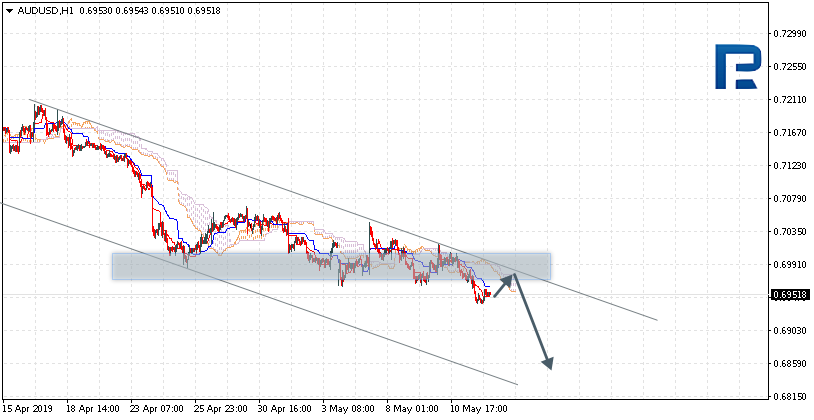
AUDUSD is trading at 0.6951; the instrument is moving below Ichimoku Cloud, thus indicating a descending tendency. The markets could indicate that the price may test the upside border of the cloud at 0.6955 and then resume moving downwards to reach 0.6855. Another signal to confirm further descending movement is the price’s rebounding from the channel’s upside border. However, the scenario that implies further decline may be cancelled if the price breaks the upside border of the cloud and fixes above 0.7000. In this case, the pair may continue growing towards 0.7085.

AUDUSD
Risk Warning: the result of previous trading operations do not guarantee the same results in the future

NZDUSD, “New Zealand Dollar vs US Dollar”

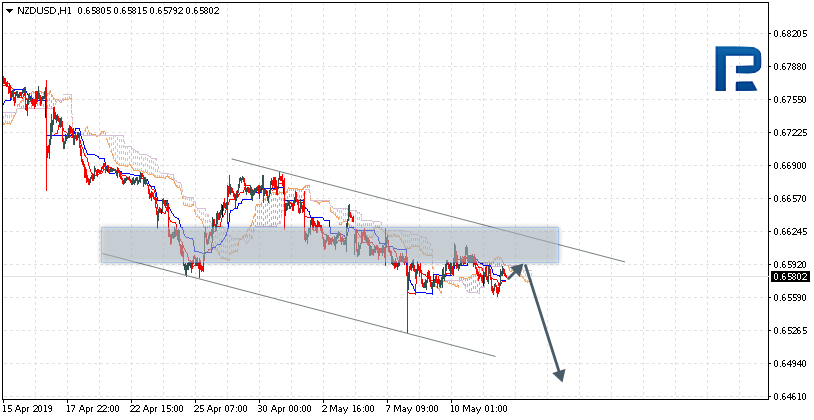
NZDUSD is trading at 0.6580; the instrument is moving below Ichimoku Cloud, thus indicating a descending tendency. The markets could indicate that the price may test the upside border of the cloud at 0.6590 and then resume moving downwards to reach 0.6465. Another signal to confirm further descending movement is the price’s rebounding from the channel’s upside border. However, the scenario that implies further decline may be cancelled if the price breaks the upside border of the cloud and fixes above 0.6620. In this case, the pair may continue growing towards 0.6715.

NZDUSD
Risk Warning: the result of previous trading operations do not guarantee the same results in the future

USDCAD, “US Dollar vs Canadian Dollar”

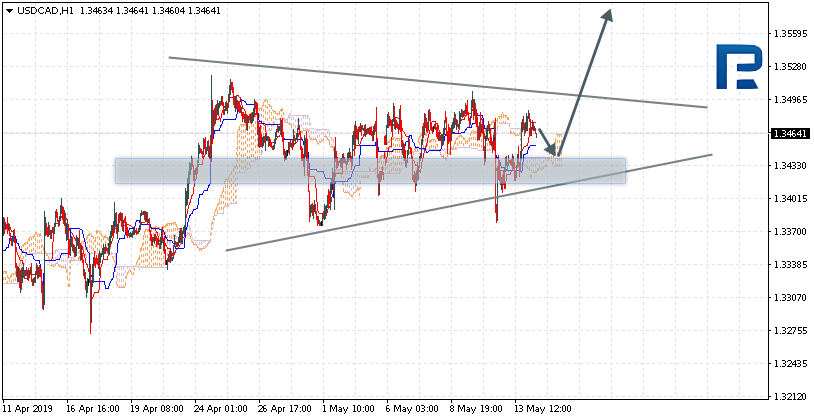
USDCAD is trading at 1.3464; the instrument is moving above Ichimoku Cloud, thus indicating an ascending tendency. The markets could indicate that the price may test the upside border of the cloud at 1.3345 and then resume moving upwards to reach 1.3565. Another signal to confirm further ascending movement is the price’s rebounding from the support level. However, the scenario that implies further growth may be cancelled if the price breaks the downside border of the cloud and fixes below 1.3405. In this case, the pair may continue falling towards 1.3315. After breaking the upside border of the Triangle pattern and fixing above 1.3505, the price may continue moving upwards

USDCAD

Article By RoboForex.com

Attention!
Forecasts presented in this section only reflect the author’s private opinion and should not be considered as guidance for trading. RoboForex LP bears no responsibility for trading results based on trading recommendations described in these analytical reviews.

Why Rising Living Standard in China Offers Global Hope

China’s 70-Year Anniversary

By Dan Steinbock

As living standard rises in China, its global contribution continues to increase. And that means potential for growth, poverty reduction and prosperity in emerging and developing world – new hope.

When Chairman Mao Zedong proclaimed the founding of the People’s Republic of China (PRC) on October 1, 1949, the Chinese people could finally begin to leave behind a century of colonial humiliation and start building a new life.

What remains so poorly understood is how dire were the conditions on that extraordinary day, seven decades ago. While China had sustained its triumph, Chinese living standard was barely 5 percent relative to the United States.

It was a dire starting point.

China’s transitions

After Mao’s establishment of sovereignty, foreign minister Zhou Enlai’s “Four Modernizations,” and Deng Xiaoping’s the “reform and opening” policies and Special Economic Zones (SEZs), China became the member of the World Trade Organization (2001). That paved the way to a decade of export-led double-digit growth and the ongoing the shift to post-industrialization, which has been accelerated under Xi Jinping’s leadership.

Following the reforms, Chinese industrialization peaked between the late 1990s and the 2008 Western financial crisis. Now the rate of growth is decelerating, which has been the norm to all industrializers from Great Britain in the 19th century to America in the 20th century.

In China, deceleration is a sign that rebalancing toward consumption and innovation by 2030 is on track.

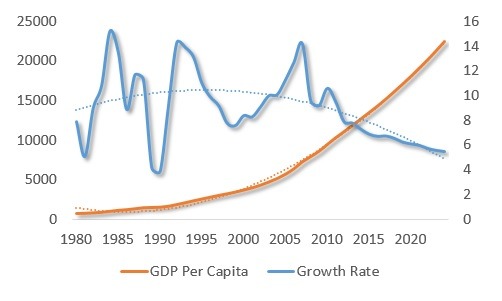
Nevertheless, Chinese living standard continues to climb steadily. It is today about a third relative to the US. In other words, it has multiplied six times relative to American living standard, thus supporting the rise of the world’s largest emerging middle-class (Figure 1).

Figure 1   Chinese Economy and Living Standards

gdp per capitaGDP per capita: Gross domestic product per capita, constant prices, purchasing power parity; 2011 international dollars. Growth Rate: Gross domestic product, constant prices, percent change  

Trends: Dashed lines

Source: IMF/WEO Database, April 2019.

Emerging economies, the new growth engines

Only since the late 20th century, global economic integration – trade, investment and finance – has begun to benefit large emerging and developing economies. To be sustained, globalization cannot serve just a few wealthy advanced economies, which no longer fuel the global economy. It must also serve poorer and faster-growing economies, which today account for most global growth.

While advanced economies are flirting with protectionism and tariffs, the latter are precisely the wrong policies in the wrong time. As advanced countries have fallen into secular stagnation, they desperately need growth. The rise of poorer economies is not a win-lose game. It also benefits advanced economies.

In the aftermath of the 2008 crisis, all major advanced economies would have fallen into the second great depression without the support of large emerging economies, particularly China. By 2050, the contribution of these countries to global GDP growth is expected to climb to 80 percent.

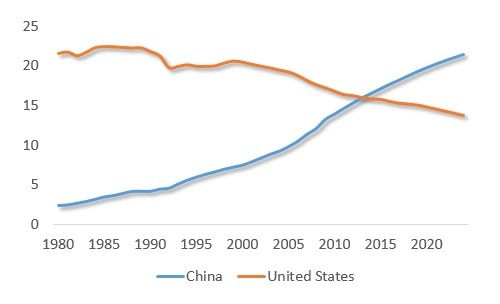
In the 1980s, the share of U.S. in the world economy was more than 20 percent; in the past four decades, it has steadily declined to 15 percent. At the same time, China’s share has soared from 5 percent to 20 percent. While these (purchasing-power-parity) indicators inflate the pace of progress, the trend lines do herald a coming structural shift in the world economy (Figure).

Figure 2   US and Chinese GDP Share in the World Economy

gdp share

GDP Share: Gross domestic product based on purchasing-power-parity share of world total

Source: IMF/WEO Database

Global economic development

In the future, the well-being of advanced economies will depend on rising living standards in less-wealthy economies. Just as US leadership supported the role of advanced countries in the 20th century world, China has potential to foster the share of emerging and developing countries in the 21st century.

In particular, China’s Belt and Road Initiative (BRI) can redirect domestic overcapacity and capital for regional infrastructure development to improve trade and relations with Southeast and South Asia, Central Asia, the Middle East and Europe – even across Americas and Sub-Saharan Africa.

The BRI seeks to accelerate modernization in emerging and developing economies, with the participation of advanced nations. Yet, in recent months, Washington has charged the BRI for “debt traps” It is a flawed effort at distraction.

If anything, BRI projects seek to promote more inclusive global economic development. Certainly, China will make its share of mistakes, but it has a track-record in learning quickly from those mistakes.

In the postwar era, Washington and its allies had an opportunity to lift the Third World from abject poverty. Yet, success stories involve mainly those Asian economies that ignored the West’s growth lessons, which were too often coupled with conditionality, debt and dependency, in the name of “structural adjustment.”

Unlike Marshall Plan, the BRI does not require participation in military alliances. It is not predicated on still another Cold War. It does not seek self-interested economic sanctions against the rest of the world.

Nor does the BRI practice regime change to force its will on the international community. It is focused on 21st century global economic development.

About the Author:

Dr. Dan Steinbock is the founder of Difference Group and has served at the India, China and America Institute (US), Shanghai Institute for International Studies (China) and the EU Center (Singapore). For more, see http://www.differencegroup.net/ 

A shorter version of the commentary was published by China Daily on May 6, 2019.


The Marijuana Industry’s Dirty Little Secret

By OilPrice.com

The cannabis industry is hiding a dirty little secret.

According to Evan Mills, a California-based energy and climate change scientist, the marijuana industry has a major problem…and it’s likely to get worse before it gets better.

“Legislators and energy agencies have largely turned a blind eye to the carbon footprint of indoor cultivation, which already belches out greenhouse-gas emissions equal to that from 3 million cars in America,” says Mills.

In fact, just one marijuana cigarette creates over 10 pounds of carbon dioxide pollution.

An entire kilogram of finished product?

That produces a staggering 4600 kg of CO2 emissions to the atmosphere.

As far back as 2011, the then-illicit industry was racking up an energy bill of $6 billion per year in the U.S. That’s double the energy spent by all pharmaceutical companies combined!

And this was before commercial sized indoor growing facilities started popping up across the United States.

The runaway-growth in the cannabis industry, fueled by rolling de-regulation and a high demand forecast, is bringing with it a growing carbon footprint.

But luckily, a handful of companies are trying to repair the damage. Firms like Cannabis One are bringing smart clean energy policies to the pot industry.

“You’ve got to be smart,” says Cannabis One CEO Jeffery Mascio,”or sooner or later, you’ll have to turn out the lights.”

Growing Demand

The single most important factor in the cannabis sector has been growth—driven by rolling de-regulation and de-criminalization (and, in Canada, complete legalization).

In the United States, dozens of state governments have passed legislation, legalizing marijuana for medical use, or de-criminalizing it for recreational use—and the market has been growing by leaps and bounds as a result.

“You’ve never seen anything quite like this,” says Jeffery Mascio, CEO of Cannabis One Holdings, a company that develops and markets cannabis products in Colorado, Washington and Nevada. “It’s a new industry that’s sprung up practically over-night.”

Since 2011, legal marijuana sales have increased dramatically—fueling the growth of an industry which in the United States is worth $10 billion and employs 250,000 people.

In 2017, marijuana stocks exploded on to the market, led by some heavy-hitters like Canopy Growth Corp. In 2019, and sales are estimated to grow by 38% to $16.9 billion.

In Colorado, legal pot sales reached $6 billion in 2018. The industry has really taken off in the Rocky Mountain state, serving as a contrast to California, where the roll-out of legalized weed has been a bit bumpier. Colorado now earns more than $200 million in taxes from legal dispensaries.

By 2025, analysts predict the legal marijuana market could be worth $146.4 billion.

Impact on Energy Demand

Most people imagine pot growers like modern farmers—tilling the earth, planting their crops, gathering the harvest.

But in fact, most cannabis cultivation is done indoors, in specially-designed growing facilities that utilize heat lamps and temperature control to maximize yields over a year-long growing season.

When you factor in additional energy costs, like fertilizer and water, cannabis is one of the most energy-intensive crops out there.

Cannabis cultivation generates $6 billion in energy costs each year, and uses about 10x more power per square foot than a standard office building.

In Denver, 4% of all electricity goes to cannabis cultivation. Total power consumption in the cannabis sector has nearly tripled since 2013.

In 2017, about 1 mWh went towards cannabis cultivation—but projections have that figure rising to 2.79 mWh by 2022, an increase of 162%.

Compared to business or residential use, energy demand in cannabis grow houses is staggering. The average household in Boulder Country, Colorado uses about 630 kilowatt hours (Kwh). A grow house of 5,000 square feet, by comparison, uses 41,808 kWh—roughly enough electricity to power sixty-six homes.

And cannabis cultivation is a 24-hour business—the lights stay on, no matter what. So while most businesses and residences power down at night, growing facilities remain active, putting pressure on energy grids.

Most of the demand comes from appliances used in the growing process. Indoor lighting units are 500x times more powerful than normal reading lights, and four-plant lighting units use as much power as twenty-nine refrigerators.

In monetary terms, production from a grow house comes in at $2500 per kilogram—the energy used to produce one marijuana cigarette could produce 18 pints of beer.

For cannabis cultivators, this comes with a hefty price tag. One Colorado company spends $13,000 per month on electricity for a single grow facility.

For a vertically-integrated company like Cannabis One Holdings, electricity costs eat up a significant portion of revenues. “We’re making money,” says CEO Mascio, “but it costs a ton just to keep the lights on.”

Right now, such costs may be manageable—cannabis is in high demand and prices per kilo are high. But as the market is saturated, that price is sure to drop, squeezing producers’ margins.

In fact, falling prices and shrinking margins (as well as general concerns with reducing carbon emissions) are driving cannabis cultivators and state regulators to take aim at electricity use in the cannabis sector.

The amount of carbon emissions being pumped out by cannabis cultivators will double by 2020-so if the industry wants to stay green, it’s going to have to make some changes.

Solutions

Given the federal laws that continue to restrict cannabis cultivation, regulating energy use in the industry is primarily a state concern—and some states have started cracking down.

In Massachusetts, lawmakers have stipulated that grow houses of more than 5000 square feet must limit lighting power density to 36 watts per square foot. Reducing energy use in cannabis cultivation is part of the state’s plan to cut emissions by 80 percent below the 1990 level by 2050.

Colorado, where marijuana is de-criminalized, has created a Retail Marijuana Code while lays down guidelines for energy use. The law mandates that “material changes” in how companies grow their crops must be approved by the Marijuana Enforcement Division.

In Boulder County, authorities require growers to utilize renewable energy or pay a $2.16 kwh fine. The fines pay for other renewable energy projects in the county area, through the Boulder County Impact Offset Fund. The fund offers cannabis growers access to renewable energy resources, offers education on efficient cultivation practices and encourages better energy use habits in the cannabis sector.

The key to improved energy efficiency will likely come from new technologies—including new lighting units being tested in British Columbia that are twice as effective as standard lights.

LED lights shine brighter for longer and use less power than standard lighting units—and some companies are already making the switch to cut down on electricity expenses.

Improved greenhouse practices through dehumidification, improved lighting and use of HVAC to retain moisture could save up to 70% per flower, according to one cannabis cultivator.

Utilizing green energy and harnessing renewable power for cannabis cultivation might allow cultivators to cut down on energy costs in a huge way. In Oregon, an energy trust has provided $400,000 in incentives to growers, who installed LED lights and a 56.4 Kw solar system, at a cost of $1.1 million—saving them millions in future energy costs.

Investments in new tech, new methods and new approaches will allow cannabis cultivators to stay profitable despite narrowing margins and falling prices. And that means the green boom will keep going.

Cutting down on costs has allowed up-and-coming firms like Cannabis One Holdings continue to expand into new markets. In April, CEO Jeffrey Mascio announced the acquisition of a Nevada-based cultivator, Evergreen Organix.

“With the addition of these popular Nevada marques to our growing portfolio,” said Mascio, “CBIS continue to demonstrate its ability to execute on its stated strategy.”

Such news is proof that the lights are staying on for America’s newest growth sector—and that the cannabis boom has only just begun.

Companies to watch as the cannabis industry scrambles to clean up its image:

Molson Coors (NYSE: TAP) (TSX: TPX-A)

Molson Coors is an iconic multi-national beer company, with brands that are recognizable across the United States and Canada. Besides just its Molson and Coors lines, the company has also ventured into more niche beverages to take advantage of the growing craft beer market, buying up brands like Leinenkugel’s and Blue Moon.

Not to be left behind in the marijuana boom, Molson Coors is also developing a line of non-alcoholic cannabis-based beverages with its partner, the Hydropothecary Corporation.

Molson Coors Canada president and CEO Frederic Landtmeters noted, “While we remain a beer business at our core, we are excited to create a separate new venture with a trusted partner that will be a market leader in offering Canadian consumers new experiences with quality, reliable and consistent non-alcoholic, cannabis-infused beverages.”

Aurora Cannabis (NYSE:ACB) (TSX:ACB)

Aurora Cannabis is one of the biggest names in the burgeoning marijuana sector. With a market cap over $14 billion, Aurora has carved out its position as a leader in the industry. And the company is still making moves.

Recently, Aurora sealed a supply deal with Mexico’s Farmacias Magistrales SA, the country’s first and, for now, at least, only federally licensed importer of raw materials containing THC.

In an announcement from Aurora, the company stated that the deal “firmly establishes Aurora’s first-mover advantage in one of the world’s most populous countries, where more than 130 million people will have federally legal access to a range of Aurora’s non-flower medical cannabis products containing THC.”

Canopy Growth Corporation (NYSE:CGC) (TSX:WEED)

After securing a major $4 billion investment from beverage giant Constellation Brands, it seemed like Canopy Growth was on the top of the world. The same day, shares in the company surged by 30 percent.

Though things have cooled down a bit since then after a downgrade from analysts of the Constellation Brands stock, Canopy has not stopped making moves in the market, most recently swallowing up renowned vaporizer producer Stor & Bickel Gmbh & Co., the creator of the iconic Volcano® Medic and the Mighty® Medic devices

The €145 million all-cash deal makes it one of the largest in the marijuana sector this year, and Canopy Growth is not likely to stop there.

Cronos Group (NASDAQ: CRON) (TSX: CRON)

Following its October slump, Cronos Group has seen a surge in trading volume, with a renewed investor interest in the company thanks to rumors surrounding the company’s discussions with tobacco giant Altria.

The Canadian firm, though primarily an equity investor, has made some major moves in recent years, wheeling and dealing with some of the hottest names in the sector. Because of its forward-thinking attitude, it has drawn the attention of many major mainstream players, including the company behind Marlboro, Altria Group.

On December 7th, rumors were finally confirmed when Cronos made the official announcement of a C$2.4 billion strategic investment from Altria. “Altria is the ideal partner for Cronos Group, providing the resources and expertise we need to meaningfully accelerate our strategic growth,” said Cronos Group’s Mike Gorenstein, Chairman, President and Chief Executive Officer.

Auxly Cannabis Group (NASDAQOTH:CBWTF) (TSX.V:XLY)

Auxly is an up-and-comer in the marijuana industry, with a growing presence in Eastern Canada. The company, formerly known as Cannabis Wheaton, the streaming company operates with a unique spin, focusing on its investments and partnerships within the space.

Some investors are bullish on Auxly due to its rapid rate of growth. And its recent strategic partnership with Atlantic Cultivation solidifies that stance.

The $2.5 million deal gives Auxly a 50 percent equity stake in Atlantic, in addition to a right-to-purchase up to 30 percent of dried cannabis and cannabis trim at Atlantic’s Newfoundland and Labrador facilities.

Hugo Alves, President and Director of Auxly commented: “This partnership with Atlantic, coupled with our premium craft producer Robinson’s Cannabis in Nova Scotia and our world class innovation and extraction hub at Dosecann in PEI demonstrates Auxly’s commitment to Atlantic Canada where we are building meaningful cannabis businesses that have a positive impact on the region.”

Link to article: https://oilprice.com/Energy/Energy-General/The-Marijuana-Industrys-Dirty-Little-Secret.html

By. Ian Jenkins
Japanese Candlesticks Analysis 14.05.2019 (USDCAD, AUDUSD)

Article By RoboForex.com

USDCAD, “US Dollar vs Canadian Dollar”

As we can see in the H4 chart, USDCAD is still trading sideways, testing the resistance level, and forming Shooting Star and Hanging Man reversal patterns. Judging by the previous movements, it may be assumed that after finishing the correction, the instrument may resume trading upwards.

USDCAD
Risk Warning: the result of previous trading operations do not guarantee the same results in the future

AUDUSD, “Australian Dollar vs US Dollar”

As we can see in the H4 chart, AUDUSD is still trading close to the support level and forming Harami and Doji reversal patterns. Judging by the previous movements, right now it may be assumed that after testing the level, the instrument may continue its growth.

AUDUSD

Article By RoboForex.com

Attention!
Forecasts presented in this section only reflect the author’s private opinion and should not be considered as guidance for trading. RoboForex LP bears no responsibility for trading results based on trading recommendations described in these analytical reviews.

SP500: seems that the correction did not end on Friday

By Tomasz Wiśniewski, Chief analyst at Alpari Research & Analysis

Sell in May and go away. Is it that easy? Well, it wasn’t last year but it seems that it is now, at least in the first half of the month. The S&P 500 index is close to monthly lows and has already beaten the lowest price in April. What is more, we are not that far from the lowest price of March.

What are the reasons of that? From a fundamental point of view, you can always find an explanation, always! At the moment, we can put this all down to trade talks and new tariffs. Tensions between US and Iran are also playing a role here. Some experts are also pointing to future conflicts like the one between US and EU as soon we will find out if Trump’s administration will impose tariffs on car imports from the EU, which could significantly hurt the block’s economy. It is hard to predict the outcome here and all we can do right now is either guess or simply wait.

SPX500 D1If you cannot predict the fundamentals, you can switch to technical analysis and trade what the dots and lines are telling you. In this regard, the situation looked quite alright on Friday, but does not look good anymore after the weekend. On Friday, the price created a second daily hammer in a row, which did not happen in a random place but on the long-term upwards trend line (red) and on the lower line of the wedge (black). After this, we would normally witness an upswing, but apparently, these are not normal times.

We started the week on the back foot, with the price ignoring those hammers and opening below the upwards trend line. That is a very negative sign. If you still believe there will be an upswing, this is not the best place to buy. Technical analysis is pretty clear here and says that one can buy after a bullish breakout from the wedge (black) so after the daily candlestick closes above the upper black line. So long as this doesn’t happen, sellers have the higher chance of success.

Source: Alpari

The Analytical Overview of the Main Currency Pairs on 2019.05.14

by JustForex

The EUR/USD currency pair

Technical indicators of the currency pair:
  • Prev Open: 1.12299
  • Open: 1.12213
  • % chg. over the last day: -0.03
  • Day’s range: 1.12185 – 1.12416
  • 52 wk range: 1.1111 – 1.2009

EUR/USD keeps consolidating around 1.12150-1.12400. The technical picture is ambiguous, the market participants wait for additional drivers. The US/China trading conflict remains in the spotlight. Beijing had fired back with additional fees, totaling around 60 billion USD annually. Keep an eye on this issue. The quotes have good prospects for growth, open the positions from these issues.

The Economic News Feed for 14.05.2019:

  • – ZEW Economic Mood Index (EU) – 12:00 (GMT+3:00);
  • – Industrial Production Volume (EU) – 12:00 (GMT+3:00);
  • – Import/Export Price Index (US) – 15:30 (GMT+3:00);
EUR/USD

The indicators do not provide precise signals, the price has crossed 50 MA.

The MACD histogram is close to 0.

The Stochastic Oscillator is in the neutral zone, the %K line is below the %D line which points to the bearish mood.

Trading recommendations
  • Support levels: 1.12150, 1.11850, 1.11650
  • Resistance levels: 1.12400, 1.12600

If the price fixes above 1.12400, the quotes will grow toward 1.12600-1.12800.

Alternatively, the quotes can descend toward 1.11900-1.11700.

The GBP/USD currency pair

Technical indicators of the currency pair:
  • Prev Open: 1.29926
  • Open: 1.29926
  • % chg. over the last day: -0.33
  • Day’s range: 1.29346 – 1.29699
  • 52 wk range: 1.2438 – 1.3631

GBP/USD started to descend and updated the local minimums. GBP remains under pressure due to Brexit. The market participants are worried tha the ruling and the opposing parties won’t be able to reach an agreement. The quotes are testing 1.29400 with 1.29800 acting as a mirror resistance. There are prospects for further descend. You should open positions from the key levels.’

At 11:30 (GMT+3:00) the UK will publish a labour market report.

GBP/USD

The price fixed below 50 MA and 200 MA which points to the power of the sellers.

The MACD histogram is in the negative zone and keeps falling which recommends selling GBP/USD.

The Stochastic Oscillator is in the oversold zone, the %K line is crossing the %D line. There are no signals at the moment.

Trading recommendations
  • Support levels: 1.29400, 1.29000
  • Resistance levels: 1.29800, 1.30200, 1.30450

If the price fixes below 1.29400, expect further descend toward 1.29000.

Alternatively, the quotes can recover toward 1.30200-1.30450.

Registration The USD/CAD currency pair

Technical indicators of the currency pair:
  • Prev Open: 1.34208
  • Open: 1.34716
  • % chg. over the last day: +0.28
  • Day’s range: 1.34593 – 1.34874
  • 52 wk range: 1.2727 – 1.3664

USD/CAD started to grow. The instrument updated the local maximums. The qutoes are consolidating around 1.34550-1.34850. The market participants are waiting for additional drivers. You should keep an eye on the oil quotes and open positions from the key levels.

The Economic News Feed for 14.05.2019 is calm.

USD/CAD

The indicators do not provide precise signals, the price is consolidating around 200 MA.

The MACD histogram is in the positive zone but below the signal line which gives a weak signal to buy USD/CAD.

The Stochastic Oscillator is in the neutral zone, the %K line is above the %D line which points to the bullish mood.

Trading recommendations
  • Support levels: 1.34550, 1.34350, 1.34100
  • Resistance levels: 1.34850, 1.35000

If the price fixes above 1.34850 expect further growth toward 1.35250-1.35400.

Alternatively, the quotes are descending toward 1.34300-1.34100.

The USD/JPY currency pair

Technical indicators of the currency pair:
  • Prev Open: 109.760
  • Open: 109.287
  • % chg. over the last day: -0.44
  • Day’s range: 109.145 – 109.772
  • 52 wk range: 104.97 – 114.56

USD/JPY started recovering after a long fall. Right now the quotes are consolidating. The local support and resistance levels are 109.350-109.750. The demand for the safe assets remains high due to the trading conflict escalation between the US and China. Keep an eye on the US Treasury bonds and open positions from the key levels.

The Economic News Feed for 14.05.2019 is calm.

USD/JPY

The indicators do not provide precise signals, the price has crossed 50 MA/

The MACD histogram moved into a positive zone which points towards a correction.

The Stochastic Oscillator is in the neutral zone, the %K line is below the %D line which recommends selling USD/JPY.

Trading recommendations
  • Support levels: 109.350, 109.000
  • Resistance levels: 109.750, 110.100, 110.300

If the price fixes above 109.750, expect a correction toward 110.100-110.300.

Alternatively, the quotes can fall toward 109.000.

by JustForex

GBPJPY: from a strong buy to a proper sell in 3 days

By Tomasz Wiśniewski, Chief analyst at Alpari Research & Analysis

Last week was pretty terrible for GBPJPY. It all started with the denial of a proper buy signal and ended with the creation of a long-term signal to go short. Luckily for technical traders, the situation here is really nice and clean in terms of price action, so that huge drop was largely anticipated.

The earthquake started last Monday when we opened with a huge bearish gap. This was not just any gap, but the one that cancelled the buy signal from the previous Friday. The breakout of the downwards trend line (black) got cancelled and a false breakout pattern was created (orange). All price action traders know that this is a pure invitation to go short. The price fell like a rock, breaking the crucial long-term horizontal support (yellow) on Wednesday. That breakout gave us a legitimate sell signal.

GBPJPY H4The pair is currently forming a pennant (blue). In theory, that is a trend continuation pattern, so it should result in a further drop. This is purely theoretical, though, as the recent downtrend has been so strong that I can’t imagine it continuing without a bigger correction. We haven’t even tested the yellow area as a resistance yet and I would imagine that this is a must. Anyway, we are not here to imagine, we are here to trade. Pennants are usually traded in the following way: the breakout to the upside gives us a buy signal and a breakout to the downside gives us a signal to sell.

Source: Alpari

China Strikes Back

by JustForex

The US dollar slightly strengthened against a basket of major currencies. The dollar index (#DX) closed in the positive zone (+0.04%). Investors are focused on the trade war between the US and China. It became known that China intended to impose duties on the US goods $60 billion worth starting on June 1 after Washington tariff raising on Chinese imports $200 billion worth. However, US President Donald Trump warned China not to strike back, otherwise, China will only get worse. “There is no reason for the U.S. Consumer to pay the Tariffs, which take effect on China today… Therefore, China should not retaliate-will only get worse!” – Trump tweeted. At the same time, the President hopes that countries will nevertheless be able to reach an agreement.

The news feed was fairly calm yesterday. Today we expect important economic data from the UK and the Eurozone. The euro demonstrates positive dynamics, as the German economy shows growth and investors hope that economic releases will support the improvements. We also recommend paying attention to the escalation of the trade conflict between the US and China.

The “black gold” prices are consolidating after the collapse the day before. At the moment, futures for the WTI crude oil are testing the mark of $61.00 per barrel. At 23:30 (GMT+3:00) the API weekly crude oil stock will be published.

Market Indicators

Yesterday, the aggressive sales were observed in the US stock market due to trade disputes between the US and China: #SPY (-2.51%), #DIA (-2.48%), #QQQ (-3.47%).

The 10-year US government bonds yield is also declining. Currently, the indicator is at the level of 2.41-2.42%.

The news feed on 2019.05.14:

– Data on the UK labor market at 11:30 (GMT+3:00);
– ZEW economic sentiment indices in Germany and the Eurozone at 12:00 (GMT+3:00);
– Export and import price indices in the US at 15:30 (GMT+3:00).

by JustForex

EURUSD: pair trading at the balance point

By Matthew Anthony, Alpari analyst

Previous:

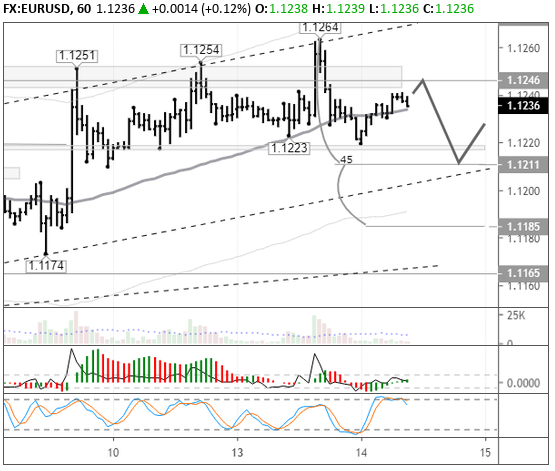
On Monday the 13th of May, trading on the EURUSD pair closed down. In the US session, however, the pair rose to 1.1264. The bulls managed to break above the 1.1250 resistance by 14 pips. I reckon the sharp decline was brought about by increased tensions in the US-China trade conflict. This provided a boost to the yen, Swiss franc, and gold. Chinese authorities have announced import tariffs on 60bn USD of US goods set to take effect on the 1st of June. The tariffs will be increased from 5% to 25%.

Head of the Boston Fed Eric Rosengren said yesterday that the biggest potential risk to the global economy is the ongoing trade conflict between the US and China.

Day’s news (GMT+3):

  • 11:30 UK: average earnings (Mar), ILO unemployment rate (Mar), claimant count rate (Apr).
  • 12:00 Germany: ZEW survey – economic sentiment (May).
  • 12:00 Eurozone: ZEW survey – economic sentiment (May), industrial production (Mar).
  • 13:00 US: NFIB business optimism index (Apr).
  • 15:30 US: import price index (Apr).
  • 19:45 US: Fed’s George speech.
  • 23:30 US: API weekly crude oil stock (10 May).

EURUSD H1Current situation:

Expectations of a test of 1.1250 were met. The pair is now trading around the balance line at 1.1239. Yesterday’s daily bar with a long tail is a bearish signal. We could see a 50 – 61% movement against this bar. As such, I expect a drop from 1.1250 to 1.1211 (45 degrees).

Despite my expectations that the euro would decline against the dollar, the bullish trend on the hourly timeframe remains intact. The trend line runs below the 45th degree. If we don’t see a retreat from risky assets, this should keep the bears at bay.

There are no significant data releases planned for today. All eyes are on Donald Trump’s Twitter account, which is where the market will get its direction from.

Source: Alpari


Oil Deadlocked Again

By Dmitriy Gurkovskiy, Chief Analyst at RoboForex

Oil has come to the deadlock. On Monday May 13th, Brent is trading at 71.12 USD as it recovered from plunging early in the month. However, oil has no reasons for either rising or being actively sold.

On one hand, escalation of tensions in the US-Iran relations is a “bullish” catalyst. In addition to that, the latest numbers on the Gas and Crude Oil Stocks Change published last week provided investors with an opportunity to buy. On the other hand, another round of trade wars between the USA and China may really hurt oil producing countries if China decides to reduce the oil volume it buys from them.

Also, there are questions to OPEC+. It’s still not clear whether the agreement between oil producing countries will be extended, and if yes, then on what terms. Earlier, Russia was completely against this idea, while Saudi Arabia was totally for it.

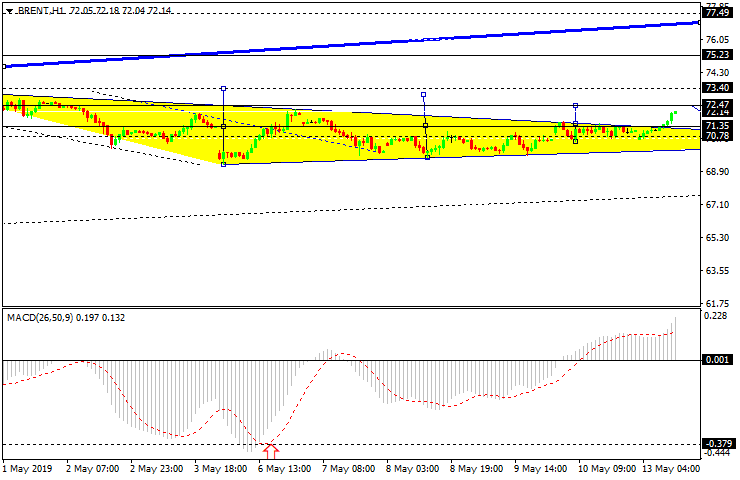
As we can see in the H4 chart, Brent continues forming the rising wave. It has broken 71.30 and may continue this wave up to 73.40. In general, the price is expected to continue trading inside the uptrend with the target at 76.50. From the technical point of view, this scenario is confirmed by Stochastic, as its signal line is trading upwards.

brent crude oil

In the H1 chart, the situation is quite similar. After breaking 71.30, Brent is still moving upwards with the target at 72.50. After that, the instrument may be corrected to return to 71.30 and then form one more ascending structure to reach 73.40. According to this scenario, the price may continue the uptrend up to 76.50. From the technical point of view, this scenario is confirmed by MACD, as its line is moving upwards. However, this scenario will no longer be valid if the instrument breaks 70.00 downwards. In this case, the pair may choose an alternative scenario and continue the correction to reach 68.00.

BRENT Crude Oil Hour Chart

Disclaimer

Any predictions contained herein are based on the authors’ particular opinion. This analysis shall not be treated as trading advice. RoboForex shall not be held liable for the results of the trades arising from relying upon trading recommendations and reviews contained herein.