Author Archive for InvestMacro – Page 233

Global Economic Tensions Translate Into Oil Volatility

By TheTechnicalTraders.com

Our continued efforts to alert and assist fellow traders to the incredible setups that are currently happening throughout the globe with regards to increased global economic tensions are starting to take root.  We are hearing from our readers and follower and we love the comments we are receiving.  Near April/May 2018, we started predicting that the end of 2018 and almost all of 2019/2020 were going to include incredible opportunities for skilled traders.  We made these predictions at about the same time that we issued a series of incredible calls regarding the future market moves in 2018 & 2019.

Our most recent multiple-part research post regarding the current global economic environment and how EU elections, US/China trade issues and a very contentious US Presidential Election cycle are poised to continue driving increased price volatility just hit the digital medium last weekend (https://www.thetechnicaltraders.com/us-vs-global-sector-rotation-what-next-part-ii/ ).  We urge all of our followers to read this detailed article about how a series of global events are stacking up to create incredible opportunities for skilled traders.

Today, we are focusing on Crude Oil because our proprietary adaptive learning Fibonacci modeling system is suggesting a surge of massive volatility is very likely to happen over the next few months in Crude Oil and we believe the DOWNSIDE price risk is the most likely outcome at this point.  Fibonacci price theory dictates that price must ALWAYS attempt to seek out new price highs or new price lows – ALWAYS.  We interpret this price requirement as the following:

“Tracking major price peaks and valleys, one can determine if the price is currently achieving new higher high price levels or lower low price levels (thus continuing the price trend) or failing to reach these new higher high or lower low levels.  Any failure to reach new higher highs or lower lows is a warning that price may be attempting to continue a previous price trend or reversing.”

This Weekly chart of Crude Oil clearly illustrates our thinking in terms of this Fibonacci price theory component and other technical aspects.  The CYAN price trend line (downward sloping) suggests a failure to establish any new price highs over the longer term trend.  Additionally, the recent downward price rotation suggests price weakness may be returning to Crude Oil.  Pay very special attention to the Fibonacci price projection levels on the right side of this chart.  Notice that the upside price projections start near $74 and the downside price projections start near $33.  This is an incredible $41 price range in Crude Oil and this very wide Fibonacci projection range suggests massive volatility is about to hit.


This Daily Crude Oil chart showing our proprietary Fibonacci price modeling system’s results also suggests incredible upside and downside price projections.  The upside levels target the current price level (near $63.50) as well as additional levels above $70.  The downside levels target a range of lower price objectives between $53 and $57.  The current Fibonacci price target level (CYAN) is quite interesting as it suggests Oil prices will find resistance near $63.50 and potentially move lower if this upside price trend fails.


Therefore, we take the entire analysis into consideration and come to the following conclusion:

If price falls below the $64 level and begins to move below $61.85 (the Daily Fibonacci Bearish Trigger Level), then we would consider the current upside price trend to have “failed” in attempting to reach a “new higher high” level (which would require price to move to levels above $66.60).  This conclusion would suggest that the failure of the upside price move should prompt a downside price move attempting to take out the $60.07 lows (attempting to establish a “new lower low” price level).

The longer-term downward sloping price channel suggests the failure to achieve recent higher price highs is indicative of a failed rally attempt which will prompt a new downside price move in the near future.  The only condition that could reverse this analysis is if Oil prices rallied above $66.60 and attempted to break the longer term price channel.

It is our opinion that Crude Oil will attempt a move lower, attempting to breach the $60.07 low price level and attempt a move back to levels near $55 to $56 before finding support.  This current rotation in price is a process of setting up a downward sloping Pennant/Flag formation (we believe).  Global economic factors, being what they are right now, are likely to see increased supply and decreased demand for Oil across the planet – at least until more clarity and resolution is established with the US/China trade issues and the US Presidential elections.

Get ready for a big move in Crude Oil.  Our analysis suggests the move will be to the downside with a downside target between $53 and $55 right now.  Any further price expectations will be updated as we get further information from our proprietary price modeling systems.  Remember, any new conflicts/wars with Iran or in the Middle East will push Oil prices much higher and negate the technical analysis/supply/demand price analysis we’ve presented.  We would not like to see any conflicts happen, but we have to be aware that this reality exists and that Oil could rally well past $70 if a new conflict occurred.

If you want to follow the exact trades I take while learning to read the charts and make money be sure to join my Wealth Trading Newsletter today!

Chris Vermeulen TheTechnicalTraders.com

Ichimoku Cloud Analysis 21.05.2019 (AUDUSD, NZDUSD, USDCAD)

Article By RoboForex.com

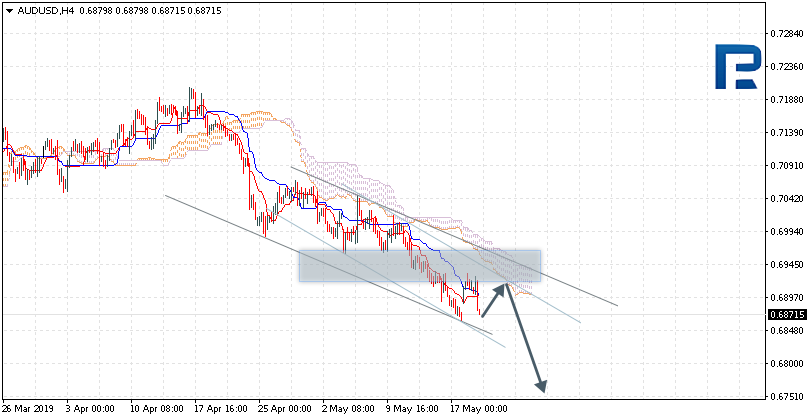
AUDUSD, “Australian Dollar vs US Dollar”

AUDUSD is trading at 0.6871; the instrument is moving below Ichimoku Cloud, thus indicating a descending tendency. The markets could indicate that the price may test the downside border of the cloud at 0.6895 and then resume moving downwards to reach 0.6755. Another signal to confirm further descending movement is the price’s rebounding from the channel’s upside border. However, the scenario that implies further decline may be cancelled if the price breaks the upside border of the cloud and fixes above 0.6945. In this case, the pair may continue growing towards 0.7005.

AUDUSD
Risk Warning: the result of previous trading operations do not guarantee the same results in the future

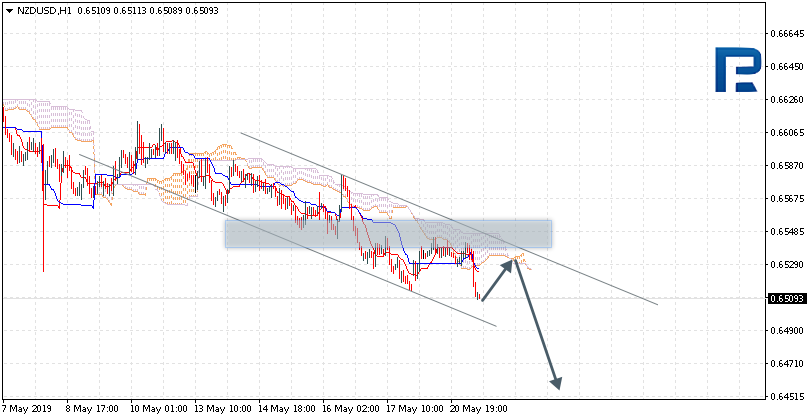
NZDUSD, “New Zealand Dollar vs US Dollar”

NZDUSD is trading at 0.6509; the instrument is moving below Ichimoku Cloud, thus indicating a descending tendency. The markets could indicate that the price may test the downside border of the cloud at 0.6530 and then resume moving downwards to reach 0.6455. Another signal to confirm further descending movement is the price’s rebounding from the channel’s upside border. However, the scenario that implies further decline may be cancelled if the price breaks the upside border of the cloud and fixes above 0.6545. In this case, the pair may continue growing towards 0.6625.

NZDUSD
Risk Warning: the result of previous trading operations do not guarantee the same results in the future

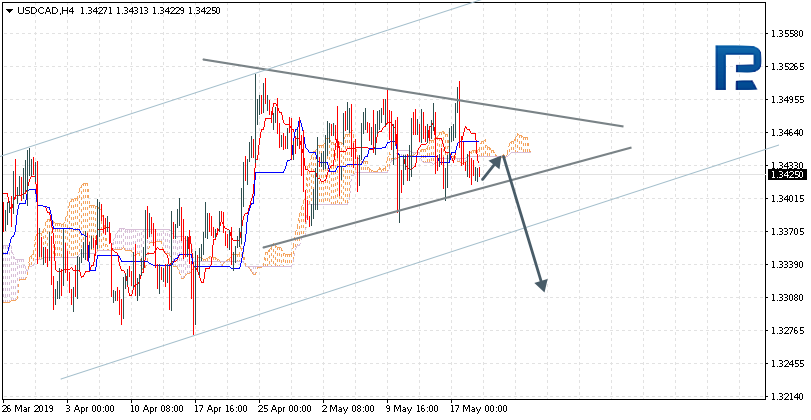
USDCAD, “US Dollar vs Canadian Dollar”

USDCAD is trading inside the Triangle pattern at 1.3425; the instrument is moving below Ichimoku Cloud, thus indicating a descending tendency. The markets could indicate that the price may test the downside border of the cloud at 1.3435 and then resume moving downwards to reach 1.3305. Another signal to confirm further descending movement is the price’s rebounding from the resistance level. However, the scenario that implies further decline may be cancelled if the price breaks the upside border of the cloud and fixes above 1.3485. In this case, the pair may continue growing towards 1.3565. After breaking the downside border of the Triangle pattern and fixing below 1.3385, the price may continue moving downwards.

USDCAD
Risk Warning: the result of previous trading operations do not guarantee the same results in the future

Article By RoboForex.com

Attention!
Forecasts presented in this section only reflect the author’s private opinion and should not be considered as guidance for trading. RoboForex LP bears no responsibility for trading results based on trading recommendations described in these analytical reviews.

European elections? It’s what comes NEXT that matters for the pound

By George Prior

The results of the European elections have been largely priced-in for the Pound.  It is what happens next with the Conservative leadership contest that will determine if Sterling will prolong its run of losses.

This is the bold observation from Nigel Green, CEO and founder of deVere Group, one of the world’s largest independent financial advisory organizations, with more than $12bn under advisement.

It comes as millions of citizens across the UK and the rest of the European Union head to vote this week in the pan-European elections.

Mr Green affirms: “Voters are likely to deliver a bloody nose to the UK and EU hierarchy in these European elections.

“In the UK, due to the ongoing Brexit chaos, it can be expected that voters will move away from the two big parties, Conservative and Labour, and towards the Brexit Party, the Liberal Democrats, Change UK and The Green Party.  This will dramatically change the political landscape.

“In normal times, this would cause the Pound to lose value against the Euro.  But these are not normal times.

“The groundswell has been building for sometime and the markets have largely priced-in this result, meaning there should not be a significant further drop in Sterling against the Euro.”

He continues: “The impact could be offset by a similar drop in the Euro if, as expected, populist parties across the eurozone do well at the polls.

“Marine Le Pen’s far-right National Rally party in France, Matteo Salvini’s The League in Italy and Gert Wilders’ Freedom Party in The Netherlands, amongst others, have all openly expressed scepticism regarding the Euro.”

However, it is what happens in the UK after the European elections that will determine the Pound’s trajectory.

Mr Green explains: “Whether the Pound will prolong its longest run of losses against the Euro since the single currency’s introduction will depend on who imminently takes over from Prime Minister Theresa May.

“Should, as expected, The Brexit Party, led by Nigel Farage, do well at the European Elections, the chances are higher that whoever takes over from Mrs May following a leadership contest would push for a no-deal Brexit.

“This would cause more downward pressure for the Pound.

“Boris Johnson, a frontrunner in the Conservative leadership contest to be the next Prime Minister, has in the past pushed for a no-deal exit from the bloc.”

The deVere CEO concludes: “The European elections might cause a minor knee-jerk reaction in the currency markets.

“But all eyes should be on the battle for the Conservative leadership.”

About:

deVere Group is one of the world’s largest independent advisors of specialist global financial solutions to international, local mass affluent, and high-net-worth clients.  It has a network of more than 70 offices across the world, over 80,000 clients and $12bn under advisement.


Japanese Candlesticks Analysis 21.05.2019 (GOLD, NZDUSD)

Article By RoboForex.com

XAUUSD, “Gold vs US Dollar”

As we can see in the H4 chart, the ascending tendency continues. The pair has tested the channel’s downside border and formed Inverted Hamer reversal pattern; right now, it is being slightly corrected. After completing the pullback, the instrument may resume moving downwards to reach the support level at 1266.00.

GOLD
Risk Warning: the result of previous trading operations do not guarantee the same results in the future

NZDUSD, “New Zealand vs. US Dollar”

As we can see in the H4 chart, NZDUSD has been trading downwards for quite a long time. It has formed Long-Legged Doji pattern close to the channel’s upside border, which resulted in a rebound and a new descending impulse. Right now, it may be assumed that the instrument may trade to reach its key target at 0.6480. Possibly, later the price may rebound towards 0.6540.

NZDUSD

Article By RoboForex.com

Attention!
Forecasts presented in this section only reflect the author’s private opinion and should not be considered as guidance for trading. RoboForex LP bears no responsibility for trading results based on trading recommendations described in these analytical reviews.

The Analytical Overview of the Main Currency Pairs on 2019.05.21

by JustForex

The EUR/USD currency pair

Technical indicators of the currency pair:
  • Prev Open: 1.11602
  • Open: 1.11650
  • % chg. over the last day: +0.05
  • Day’s range: 1.11443 – 1.11722
  • 52 wk range: 1.1111 – 1.2009

EUR/USD remains in a bullish mood. Right now EUR is consolidating around 1.11450-1.11650. The market participants keep watching the Washington/Beijing trading conflict. Threats of further actions escalated after the US sanctioned Chinese tech giant Huawei. Further descend of the quotes remain possible. You should open positions from the key levels.

At 17:00 (GMT+3:00) the US will publish the secondary real estate sales report.

EUR/USD

The price fixed below 50 MA and 200 MA which points towards the power of the sellers.

The MACD histogram is in the negative zone and below the signal line which gives a strong signal towards selling EUR/USD.

The Stochastic Oscillator is in the neutral zone, the %K line is above the %D line which points towards a bullish mood.

Trading recommendations
  • Support levels: 1.11450, 1.11200, 1.11000
  • Resistance levels: 1.11650, 1.11850, 1.12000

If the price fixes below 1.11450, expect further descend toward 1.11200-1.11000.

Alternatively, the quotes can recover toward 1.11800-1.12000.

The GBP/USD currency pair

Technical indicators of the currency pair:
  • Prev Open: 1.27303
  • Open: 1.27210
  • % chg. over the last day: -0.02
  • Day’s range: 1.26853 – 1.27322
  • 52 wk range: 1.2438 – 1.3631

GBP/USD keeps showing a negative trend. The ambiguousness regarding Brexit pushed the GBP down. Theresa May earlier stated that she wants to present a brave new offer to the lawmakers in order to reach the Brexit agreement. The local support and resistance levels are 1.26800 and 1.27150. The trading instrument can descend further. You should open positions from the key levels.

At 11:30 (GMT+3:00) the Bank of England will publish the inflation report.

GBP/USD

The price fixed below 50 MA and 200 MA which points to the power of the sellers.

The MACD histogram is in the negative zone and below the signal line which indicates a signal to sell GBP/USD.

The Stochastic Oscillator is in the oversold zone, the %K line is below the %D line which gives a weak signal to sell GBP/USD.

Trading recommendations
  • Support levels: 1.26800, 1.26500
  • Resistance levels: 1.27150, 1.27550, 1.28250

If the price fixes below the 1.26800, expect further descend toward 1.26500-1.26300.

Alternatively, the quotes can recover toward the round 1.28000.

Registration

The USD/CAD currency pair

Technical indicators of the currency pair:
  • Prev Open: 1.34399
  • Open: 1.34246
  • % chg. over the last day: -0.14
  • Day’s range: 1.34194 – 1.34355
  • 52 wk range: 1.2727 – 1.3664

USD/CAD keeps showing an ambiguous technical picture. The trading instrument is consolidating. The local support and resistance levels are 1.34200 and 1.34450. The financial market participants are waiting for additional drivers. Keep an eye on the oil quotes and open positions from the key levels.

The Economic News Feed for 21.05.2019 is calm.

USD/CAD

The price fixed below 200 MA which points towards the power of the sellers.

The MACD histogram is in the negative zone but above the signal line which gives a weak signal to sell USD/CAD.

The Stochastic Oscillator is in the neutral zone, the %K line started to cross the %D line. There are no signals at the moment.

Trading recommendations
  • Support levels: 1.34200, 1.34000, 1.33800
  • Resistance levels: 1.34450, 1.34650, 1.34850

If the price fixes below 1.34200, expect further descend towards 1.34000-1.33800.

Alternatively, the quotes can grow towards 1.34700-1.34850.

The USD/JPY currency pair

Technical indicators of the currency pair:
  • Prev Open: 110.103
  • Open: 110.068
  • % chg. over the last day: -0.07
  • Day’s range: 110.010 – 110.263
  • 52 wk range: 104.97 – 114.56

USD/JPY stabilized. The technical picture is ambiguous. The local support and resistance are 110.000 and 110.300. The demand for the safe assets remains due to the US/China trading conflict. The trading instrument can descend further.

The Economic News Feed for 21.05.2019 is calm.

USD/JPY

The price fixed above 50 MA and 200 MA which points towads the power of the buyers.

The MACD histogram is in the positive zone but below the signal line which gives a weak signal towards buying USD/JPY.

The Stochastic Oscillator is in the neutral zone, the %K line is crossing the %D line. There are no signals at the moment.

Trading recommendations
  • Support levels: 110.000, 109.750, 109.500
  • Resistance levels: 110.300, 110.700

If the price fixes below the round 110.000, expect further descend towards 109.750-109.500.

Alternatively, the quotes can grow towards 110.600-110.800.

by JustForex

The Dollar Index Is Holding Key Highs

by JustForex

Demand for the greenback is still high enough. At the moment, the dollar index is consolidating near annual highs. The trade conflict between the US and China is in the focus of attention. Concerns about further escalation of the trade war have increased significantly after Washington imposed sanctions on the Chinese telecom giant Huawei. The recovery of the 10-year US government bonds yield supports the US currency.

Uncertainty concerning Brexit continues to put pressure on the British pound. British Prime Minister Theresa May said that she would present a “new bold offer” to lawmakers in a final attempt to conclude a Brexit deal. The Australian dollar fell after the publication of the RBA monetary policy meeting minutes. The head of the Central Bank said that the regulator would consider the issue of lowering interest rates at the meeting in June. Today, investors will assess important economic releases from the UK and the US.

Oil quotes show positive dynamics. At the moment, futures for the WTI crude oil are testing the mark of $63.45 per barrel.

Market Indicators

Yesterday, the bearish sentiment prevailed in the US stock market: #SPY (-0.66%), #DIA (-0.30%), #QQQ (-1.69%).

The 10-year US government bonds yield is recovering. Currently, the indicator is at the level of 2.41-2.42%.

The news feed on 2019.05.21:

– Bank of England inflation report hearings at 11:30 (GMT+3:00);
– Existing home sales in the US at 17:00 (GMT+3:00).

by JustForex

Oil, Hot Stocks, and Currencies – Part III

By TheTechnicalTraders.com

In our continued effort to help skilled traders/investors understand the future risks associated with geopolitical market turmoil, the EU Elections next week and the continued US/China trade war, this Part III of our Sector Rotation article will highlight certain sectors that we believe may continue to perform over the next 12 to 24+ months and help traders/investors survive any extended price volatility/rotation over that same time. Read Part I, and Part II.

Currently, the US stock market has weathered a bit of a jolt in terms of price rotation.  After many stock indexes reached new all-time highs, the news of Iran Oil Sanctions, US/China trade talks failing and the political turmoil in DC as an incredible 2020 US Presidential election cycle heats up, investors are watching the markets for any signs of strength or weakness.  Meanwhile, the US Dollar continues to strengthen against other global currencies in an incredible show of “King Dollar” strength and dominance.  All of this plays into one of our favorite narratives that we started discussing over 30 months ago – the Global Capital Shift.

For those of you who remember our many articles about this global market phenomenon and the root causes of it, we’ll try to keep the following example/explanation of it fairly short.  For those of you that are new to our research, please allow us to try to explain the Capital Shift event and why it is important to understand.

The Capital Shift started after the 2008-09 global credit market collapse.  The US and many other nations created an easy money policy that was designed to spark investment and recovery across the globe.  This easy money, at first, supported failing companies and governments in order to maintain social order and structure.  After that process was completed, this capital went to work investing in under-valued global markets and assets.  As prices continued to rise and the easy money policies became rooted into the social structure, the hunt for greater returns rotated throughout the planet – diving into undervalued markets and opportunities, often with no regard for risk.

After 2014, things began to change in the US and throughout the planet.  The US entered a period of extended sideways trading that caused many investors to reconsider the “buy the dip” mentality.  In 2014-15, China initiated “capital controls” in an effort to prevent outflows of capital from a newly rich population and corporate structure.  Just before 2014, the Emerging Markets went through a period of pricing collapse which was associated with over-inflated expectations and $100+ oil.  All of that started changing in 2014~2016 as Oil prices collapsed – taking with it the expectations and promises of many Emerging Market investors and speculators.

This shifting of capital in search of “returns with a moderate degree of risk” is what we are calling the “Capital Shift Event”.  It is still taking place and it is our opinion that the US stock market will become the central focus of global capital investment over the next 4+ years.  We believe the strength of the US Dollar and the strength of the US Stock Market/US Economy will drive future capital investment into US and other US Associated major markets in an attempt to avoid risks associated with the foreign market and currency market valuations.  In other words, when the crap starts flying across the globe, cash will rush into the US and other safe-haven investments to protect real value.


Currently, the potential for another price decline in Crude Oil is rather strong with our research expecting a move back below $55 ppb over the next 4+ months.  We believe a further economic contraction across the globe with a very strong potential for increased price volatility will drive Oil prices back below $55 with a very strong potential for prices to settle near $46~48 before the downward trend is completed.

The potential for some type of price contraction over the next 12+ months will be related to how the global and localized economic concerns play out over the next 24+ months.  Yet, investors can prepare for these extended price rotations now by becoming aware of weakening price trends and the potential that certain sectors will likely be hit harder than others.  For example, the most recent price weakness in the US stock market appears to be focused in certain sectors:

Technology, Semiconductors, Scientific Instruments, Financials, Asset Management, Property Management, Banking (Generally all over the US), Consumer Goods – Electronics, Airlines, Mail Order Services, Industrial Goods, Aerospace/Defense, Farming and Farming Supply, Medical Laboratories, Medical Appliances, Oil & Gas and others.  This type of market contraction is fairly common in an early stage Commodity and Industrial economic slowdown.


The sectors that are improving over the past week are : Healthcare, Electric Utilities, Diversified Utilities, Gas Utilities, Consumer Personal Products, Consumer Confectioners, Cigarettes, Entertainment, Beverages and Soft Drinks, Meat Products, Specialty Eateries, REITS (almost all types), Credit Services, Telecom and Telecom/Communication Services.

All of these are protectionist rallies based on the US/China trade war and the market rotation away from Technology/manufacturing growth and into more consumer protectionist spending mode – where the consumer and larger firms focus on core items while expecting a mild recession within the economy.  All of this is very common at this time within the US Presidential Election cycle.  In fact, our researchers have shown that nearly 80% of the time when a major US presidential election is taking place, the US stock markets will decline within the 24 months prior to the election date.

The Monthly S&P heat map is not much different.  It is still showing weakness where we expect and strength in sectors that have been somewhat dormant over the past 4+ years.  The key to success for skilled traders is to be able to play this future price rotation very effectively as the different sectors continue to rotate headed into the 2020 US Presidential Elections and with all of the external foreign market factors taking place.


It is quite likely that the US Dollar will continue to push high, possibly well above $102, before finding any real resistance.  It is very likely that most of the US stock market will fair quite well over the next 24+ months – yet we do expect some extended price rotation over this time and we believe Technology, Financials, Real estate, and Industrial/Consumer related stock sectors could take a hit over the next 16 to 24 months.  These rotations are, again, common for this type of US Presidential Election cycle.  Skilled traders are already aware of this cycle and have begun to prepare for this event to unfold.  The unknowns of the current global market is China and the EU at present.


And with that last US Dollar chart, there you have it.  Our three-part article about how the Global Capital Shift is about to intensify and continue to drive a US Sector rotation that many traders have failed to consider.  The EU elections, the US/China trade wars, and the US Presidential Election event are all big factors in what we believe will drive in an increased level of uncertainty over the next 16~24 months.  Additionally, we are very concerned that China is very close to experiencing what we are calling a “broken backbone” over the next 12+ months.  We believe the pricing pressures in combination with a slowing economy and a consumer move into a protectionist stance could create a waterfall event in China/Asia.

Our advice for traders is to protect open long positions and to prepare for 16 to 36 months of “repositioning” of the global markets.  The US elections are certain to drive an incredible range of future expectations throughout the world.  Combine that with the EU elections, the BREXIT effort and the continued repositioning of US/China/Foreign market relations and we are setting up for a big shock-wave event in the near future.

Follow our research.  We’ve already mapped out the next 24 to 36 months of market price activity with our proprietary price modeling tools.  We believe we know what will happen over the next 24 to 36 months, we are just waiting for the price to confirm our analysis. Visit TheTechnicalTraders.com to learn more.

Chris Vermeulen
Technical Traders Ltd.


China’s looming current account deficit will have consequences for us all

By George Prior

Investors need to mitigate the risks of China’s looming current account deficit, coming at a time of ballooning U.S. budget deficits.

This is the warning from a Senior International Investment Strategist at one of the world’s largest independent financial advisory organizations.

The stark observation from deVere Group’s Tom Elliott comes as the escalating trade war between the U.S. and China – the world’s two largest economies  -threatens to curb Chinese exports, accelerating the Asian powerhouse’s lurch towards a current account deficit.

He explains: “China has spent the last two decades turning its trade surplus into purchases of overseas assets, from U.S. Treasuries to London property.

“But China is changing. Its current account is about to turn negative, meaning its economy will be increasingly dependent on foreign capital to continue growing. This has potentially far-reaching implications, not just for China, but for the U.S. and the rest of the world. The 25% tariff imposed by the U.S. on $500 bn worth of Chinese imports will accelerate this trend.

He continues: “As China stops being a large buyer of U.S. Treasuries, America’s budget deficit is ballooning and will be just short of $1 trillion this fiscal year. The combination is negative for U.S. Treasuries, and may help drive up U.S. and global bond yields.

“Investors around the world may see higher global borrowing rates, from car loans to mortgages, because of the end of the Chinese savings glut.

“This could trigger a global economic downturn.”

“The two main drivers of this change both reflect the fact that China has become wealthier, and that a growing middle class has cash to spend.

“First, the growth in the export of goods has not kept pace with the growth of consumer imports. China’s deficit in traded goods with Japan and South Korea has grown.

“Second, a huge increase in Chinese tourism abroad has occurred over the last decade which has increased the persistent deficit in services. In 2018, Chinese visitors spent $240 billion more abroad than foreign visitors spent in China, thanks in part to their lavish spending habits. In 2017 Harrods, the London department store, reported that mainland Chinese overtook British customers as the largest customer group.

“Domestically, the Chinese authorities have responded to the change in the current account by opening China’s capital markets to foreign investors, to help boost inflows of foreign capital.”

deVere’s International Investment Strategist concludes: “China’s – and therefore the world’s – economy is changing.

“But remember, wherever there is disruption there will be winners.

“As such, investors should remain diversified, geographically and by asset class  – that’s to say, maintaining exposure to equities and bonds, from as many different issuers as possible – in order to protect their savings from this uncertainty and capitalise on the opportunities that will inevitably present themselves.”

About:

deVere Group is one of the world’s largest independent advisors of specialist global financial solutions to international, local mass affluent, and high-net-worth clients.  It has a network of more than 70 offices across the world, over 80,000 clients and $12bn under advisement.

Can Blockchain Change How We Compute Credit Scores?

This article was originally published by Uncapped Mortgage

Blockchain has been making people in the know reconsider the way they handle finances. Blockchain is basically a triple-entry accounting ledger that is part of a network. Each blockchain contains a copy of that ledger and every new record will be added to that ledger and each new record will be linked to the previous one. Each group of entries forms a block and since new records are linked to the record before that, it forms a chain. Hence, the name blockchain.

Credit score, on the other hand, is something that banks and other financial institutions judge your creditworthiness against. Meaning, if you have bad credit, either banks or any other financial institution will not approve your loan, or you will incur higher interests on your loan compared to someone with a good credit rating. Credit scoring bureaus often use your social security as your identity. If your identity is stolen and your credit ruined, it will be a nightmare to fix.

So how are these two connected, and more importantly, can blockchain actually affect how we compute credit scores?

In the world of credit scores, there are three big players: Equifax, Experian, and TransUnion. These are the three main credit scoring bureaus used by many banks. In 2017, one of the “big three,” Equifax, was breached and personal data of millions of people including their social security numbers and tax identification numbers were compromised. Since credit scoring bureaus hold all their information centrally, any breaches like this will put millions of people’s information at risk. This is one of the major downfalls of the current credit scoring system.

Aside from that, credit scores are based on reputation and how you handled your previous debt. And since having a bad credit score can affect your access to formal financial institutions, even your employment and the chances of renting a place to live in, people across the globe who are underbanked or unbanked are currently on the losing end.

People also have very little insight into what’s happening with their credit data. And there is also very little that anyone can do to protect themselves from fraud or mistakes. The data collected by these bureaus are accessed by people usually only when they are applying for loans such as mortgages. And the credit reports they provide consumers are different from the credit reports they provide banks. The banks get more detailed reports thereby creating a power imbalance.

What blockchain can offer is a decentralized system. This means that there is better security over your sensitive data. This also means that it would be harder for people to provide false information and hide any financial indiscretions. This decentralized system will remove many of the barriers consumers have to accessing and controlling their credit reports. Consumers can give their entire credit history and not just the bits and pieces the credit bureaus provide. Blockchain can also empower the people who have no access to formal financial institutions and improve their lives and finances.

So can blockchain affect how we compute our credit scores? The answer is a resounding yes. Blockchain has the potential to provide fairer, more transparent, and more complete credit reports, therefore, affecting how credit scores are computed and viewed.


US vs. Global Sector Rotation – What Next? Part II

By TheTechnicalTraders.com

In Part One of this research post, we highlighted and discussed the many geopolitical and economic factors that are driving the market price volatility over the past 30+ days in addition to highlighting some of the key elements/factors of the next 15+ days that may continue to drive market volatility higher.  The three key elements we discussed were the US Presidential Elections, the European Elections (European Union Elections) and the US/China Trade Discussions.  Each of these components is big enough to reflect many trillions of dollars in economic output and, individually, each of these components could drive increased price volatility over the next 30+ days.  Combined, should these events somehow combine into a massive disruption event, they could break the backbone of the global markets in such a way that many investors are simply not prepared to discuss or trade.

In our opinion, there are a number of elements to the unfolding global market economics that play into our future expectations.  China becomes one of the biggest unknowns simply because we believe the best information we have at the moment is shaded and hidden in terms of true values.  Let’s take a minute to discuss a few of them…

First, the currency markets are the first area that moves to protect against fears and risks (https://www.scmp.com/economy/china-economy/article/3010364/will-falling-yuan-torpedo-chinas-trade-talks-us).  The FOREX ratios operate as an immediate hedge against debt, credit and future expectations.  The recent decline of the Chinese Yuan represents a massive danger for the Chinese government.  Not only does this create an issue for the population of China, seeing their purchasing power diminish, but it also creates a debt servicing issue for business, corporations, and government on a massive scale.  Servicing their foreign debts just became much more expensive as the Yuan value decreases compared for other foreign currency levels.


Second, falsified corporate accounts/book and statements of cash balances are not something new for the Chinese (https://www.scmp.com/business/banking-finance/article/3010713/chinese-msci-constituent-firm-kangmei-pharmaceutical-faces).  We have first-hand experience from back in the early 1990s that these false books are fairly common “standard operating procedures” for many Chinese.  It would not surprise our research team is many of the economic numbers and corporate balance sheets are completely made up.  We believe this practice of creating a false economic support system will implode and more and more pressure is exerted onto China’s economy.

Third, the pressures put on the Chinese economy not only by the US trade tariffs but also by the Chinese people and government may open up massive cracks in the Chinese population in terms of trust and support for Xi and the bigger plans for China.  Our sources are suggesting that much of the animosity currently in China is directed at the US and President Trump for the current trade issues.  Our belief is that as more and more evidence becomes available and more and more Chinese people see what their government has created in terms of real opportunity and leadership, we believe an “awakening process” will take place to expose corruption, criminal activities and much more.  Simply put, the Chinese people are mostly unaware of the levels of corruption and falsified numbers.  They have been running on the premise that Xi and the Chinese leadership were executing a flawless success plan.  When the real numbers come out, pushed into reality because of a contraction in economic “slush money”, the likelihood of a populous revolt is fairly strong (https://www.scmp.com/business/companies/article/3010621/brutal-interventions-sanpowers-debt-workout-show-why-chinas)

Lastly, it appears many of the bigger Chinese firms have enough reserve capital to weather the Trade issues and survive (https://www.scmp.com/business/companies/article/3010280/chinas-biggest-companies-can-weather-us-china-trade-war), yet our resources are telling us the people in the bigger cities of China are already feeling the pain of the trade tariffs.  Many are reporting being suddenly laid-off as the very real threat of consumer inactivity sets in throughout most of China.  One of the first things to happen when an economy is under threat or contracts is that consumers move into a protectionist stance.  Consumers cut back spending, investment, and many external activities while attempt to protect their capital from unknown risks.  As the contraction continues, consumers cut back even further attempting to protect assets that are valuable or essential.  Their natural reaction is to spend only on essential items and to protect value in assets.

Should some unsettling economic event push the Chinese markets into a collapse mode, we are certain the US market would react as well.  The strength of the US Dollar may come under some pricing pressure as investors revalue the true strength of the US Dollar as well as the continued global economic outcome.  It is very likely that the US stock market would retrace lower as this even unfolds and that the US Dollar would rotate a bit lower as global investors search to identify true valuation levels for the global markets.

We don’t expect the Chinese markets to collapse over the next 10 to 20+ days,  as we are suggesting, but we do expect continued political positioning and news to become a driving a force of extended market volatility.

The VIX has settled into a Pennant/Flag formation that suggests a July/Aug 2019 breakout may be very likely.  This aligns with much of our other research to suggest that a July/Aug rally in Precious Metals is very likely as well.  The combination of a VIX rally along with a Precious Metals rally suggests a moderately strong downward price rotation in the US and global stock markets that may begin near the end of July or early August 2019.


The likelihood of a continued increase in price volatility seems like a sure thing over the next few months.  EU Elections, US/China trade issues, the US Presidential elections, and many additional geopolitical events seem to coalesce into a new perfect storm for price volatility.

In Part III, we’ll highlight sectors of the US stock market that may be partially immune from this price volatility and try to help traders identify and understand how to prepare for a VIX Spike and the volatility that will follow.

This is proving to be an incredible trading year for traders who follow our trade alerts newsletter.

For active swing traders, you are going to love our daily trading analysis. On May 1st we talked about the old saying goes, “Sell in May and Go Away!” and that is exactly what is happening now right on queue. In fact, we closed out our SDS position on Thursday for a quick 3.9% profit and our other new trade started Thursday is up 18% already.


Second, my birthday is only three days away and I think its time I open the doors for a once a year opportunity for everyone to get a gift that could have some considerable value in the future.

Right now I am going to give away and shipping out silver rounds to anyone who buys a 1-year, or 2-year subscription to my Wealth Trading Newsletter. I only have a few more left as they are going fast so be sure to upgrade your membership to a longer-term subscription or if you are new, join one of these two plans, and you will receive:

1-Year Subscription Gets One 1oz Silver Round FREE
(Could be worth hundreds of dollars)

2-Year Subscription Gets TWO 1oz Silver Rounds FREE
(Could be worth a lot in the future)

SUBSCRIBE TO MY TRADE ALERTS AND GET YOUR FREE SILVER ROUNDS!

Chris Vermeulen – TheTechnicalTraders.com