Author Archive for InvestMacro – Page 191

The Analytical Overview of the Main Currency Pairs on 2019.08.06

by JustForex

The EUR/USD currency pair

Technical indicators of the currency pair:
  • Prev Open: 1.11039
  • Open: 1.12034
  • % chg. over the last day: +1.22
  • Day’s range: 1.11901– 1.12496
  • 52 wk range: 1.1034 – 1.1817

The EUR/USD currency pair stabilized after significant growth during yesterday’s trading. The growth of the quotes exceeded 100 points. Investors began to partially fix the positions on the USD. Additional pressure on the US currency was provided by weak data on business activity in the US non-manufacturing sector from ISM. The focus remains on the trade conflict between Washington and Beijing. Currently, the EUR/USD currency pair is consolidating. The local support and resistance levels are: 1.11850 and 1.12150, respectively. We recommend opening positions from these marks.

At 17:00 (GMT+3) the US will publish the JOLTS report.

EUR/USD

Indicators point to the strength of the buyers: the price has fixed above 50 MA and 100 MA.

The MACD histogram is in the positive zone, but below the signal line, which gives a weak signal to buy EUR/USD.

Stochastic Oscillator is located near the oversold zone, the %K line crossed the %D line. There are no signals at the moment.

Trading recommendations
  • Support levels: 1.11850, 1.11600, 1.11150
  • Resistance levels: 1.12150, 1.12450, 1.12800

If the price consolidates above 1.12150, further growth of EUR/USD quotes is expected. The potential movement is to 1.12450-1.12600.

Alternatively the currency pair could decrease to 1.11600-1.11400.

The GBP/USD currency pair

Technical indicators of the currency pair:
  • Prev Open: 1.21297
  • Open: 1.21368
  • % chg. over the last day: +0.06
  • Day’s range: 1.21355 – 1.21678
  • 52 wk range: 1.2080 – 1.3385

The GBP/USD currency pair continues to trade in a long flat. There is no defined trend. The financial market participants expect additional drivers. At the moment, the local support and resistance levels are 1.21300 and 1.21800. We recommend keeping track of current information on the Brexit issue. In the near future, technical correction of the trading instrument after a prolonged fall is quite possible. You should open positions from key levels.

The Economic News Feed for 06.08.2019 is calm.

GBP/USD

Indicators do not provide accurate signals: the price crossed 50 MA and 100 MA.

The MACD histogram is close to 0.

The Stochastic Oscillator is in the neutral zone, the %K line is below the %D line, which gives a signal to sell GBP/USD.

Trading recommendations
  • Support levels: 1.21300, 1.20850, 1.20500
  • Resistance levels: 1.21800, 1.22500, 1.23000

If the price consolidates above 1.21800, expect a correction toward 1.22300-1.22500.

Alternatively, the price could descend toward 1.20850-1.20600.

The USD/CAD currency pair

Technical indicators of the currency pair:
  • Prev Open: 1.32110
  • Open: 1.32012
  • % chg. over the last day: -0.08
  • Day’s range: 1.31869 – 1.32224
  • 52 wk range: 1.2727 – 1.3664

The USD/CAD currency pair is still in sideways movement. There are no defined trends. At the moment, the following local support and resistance levels can be distinguished: 1.31800 and 1.32150, respectively. USD/CAD quotes has the potential for further growth. We recommend paying attention to the dynamics of oil quotes. Positions must be opened from key levels.

The Economic News Feed for 06.08.2019 is calm.

USD/CAD

Indicators do not provide accurate signals, the price has crossed 100 MA.

The MACD histogram is in the negative zone and below the signal line which indicates a bearish sentiment.

The Stochastic Oscillator has started to leave the oversold zone, the %K line is above the %D line, which gives a signal to buy USD/CAD.

Trading recommendations
  • Support levels: 1.31800, 1.31500, 1.31200
  • Resistance levels: 1.32150, 1.32450, 1.32650

If the price consolidates above 1.32150, the USD/CAD currency pair is expected to grow to 1.32500-1.32700.

Alternatively, the price could drop toward 1.31500-1.31350.

The USD/JPY currency pair

Technical indicators of the currency pair:
  • Prev Open: 106.528
  • Open: 105.944
  • % chg. over the last day: -0.75
  • Day’s range: 105.521 – 107.088
  • 52 wk range: 104.97 – 114.56

USD/JPY quotes began to recover after a long fall. The trading tool has updated local highs. At present, the currency of the “safe haven” is consolidating in the range of 106.250-106.800. Investors continue to monitor the trade conflict between Washington and Beijing. The US Treasury has accused China of currency manipulation. We also recommend paying attention to the dynamics of yield on US government bonds. Positions must be opened from key levels.

The Economic News Feed for 06.08.2019 is calm.

USD/JPY

Indicators do not give accurate signals, the price has fixed between 50 MA and 100 MA.

The MACD histogram has moved into the positive zone, which indicates a further correction of the USD/JPY currency pair.

Stochastic Oscillator is in the neutral zone, the %K line is below the %D line, which gives a signal to sell USD/JPY.

Trading recommendations
  • Support levels: 106.250, 105.800, 105.550
  • Resistance levels: 106.800, 107.200, 107.500

If the price consolidates above 106.800, the price will correct toward 107.200-107.500.

Alternatively, the price could decrease toward 105.800-105.600.

by JustForex

The US Dollar Is Falling due to Tensions with China

by JustForex

The US dollar continued to decline against a basket of currency majors due to tense trade relations between the US and China. Yesterday, the US dollar index (#DX) closed trading in the negative zone (-0.56%). The US dollar was under pressure due to weak data on ISM non-manufacturing PMI.

US-China relations continue to escalate. The People’s Bank of China set the yuan reference rate at its lowest level for the year. The Chinese yuan collapsed due to these events, which sparked rumors that Beijing was ready to depreciate in order to offset the negative effects of US tariffs. Trump, in turn, accused China of currency manipulation. We recommend following current information on this issue.

The British pound is still under pressure. The EU believes that the new British Prime Minister, Boris Johnson, does not plan to make a deal on Brexit. As it became known, the official does not intend to resume negotiations with the European Union and look for solutions to exit Britain. It means that it is more likely that the country will leave the bloc without a deal before October 31 of the current year.

Today, during the Asian trading session, economic data from New Zealand and Australia have been published. Thus, the employment rate in New Zealand increased by 0.8% in the second quarter, while experts forecasted growth by only 0.3%. New Zealand’s unemployment rate counted to only 3.9% in the second quarter instead of 4.3%. The Reserve Bank of Australia decided on the interest rate and left the indicator unchanged at 1.00%.

The “black gold” prices are rising after the collapse the day before. At the moment, futures for the WTI crude oil are testing a mark of $55.00 per barrel. At 23:30 (GMT+3:00) API weekly crude oil stock will be published.

Market Indicators

Yesterday, aggressive sales were observed in the US stock markets: #SPY (-3.01%), #DIA (-2.91%), #QQQ (-3.53%).

The 10-year US government bonds yield has been recovering after a significant fall. At the moment, the indicator is at the level of 1.75-1.76%.

The news feed for 2019.08.06:

– JOLTS job openings at 17:00 (GMT+3:00).

by JustForex

EURUSD: pair taking a breather at 1.12

By Alpari.com

Previous:

On Monday the 5th of August, trading on the EURUSD pair closed up. The day’s dominant theme was the ongoing trade dispute between the US and China.

On Friday the 2nd of August, Donald Trump announced that tariffs on Chinese goods would go up by 10% on the 1st of September. On Monday, the yuan shed 1.77% against the dollar. The stock market took a dive while gold, the yen, the Swiss franc, and bitcoin all rose.

During the US session, the US government officially labelled China a currency manipulator. China responded by halting the import of US agricultural produce. This has led to fears among investors that the trade conflict is set to continue for a while.

Day’s news (GMT+3):

  • 17:00 US: JOLTS job openings (Jun).
  • 19:00 US: Fed’s Bullard speech.
  • 23:30 US: API weekly crude oil stock (2 Aug).

EURUSD H1Current situation:

With a correction taking place on the safe haven assets, the EURUSD pair has corrected from the U3 line to 1.1190. There are currently no technical factors favouring a stronger euro; its rise is on account of geopolitical developments. China is showing no sign of backing down, while Trump is looking for new ways to pile on the pressure. It looks like the standoff between the two countries is set to continue, so keep an eye on the stock market, safe havens, the yuan, and Trump’s Twitter account. Trump has been the catalyst for the market’s most recent movements.

The EURUSD pair corrected by 45 degrees. The 67th degree and the trend line are sitting slightly lower at around 1.1175. At the time of writing, the pair is trading at 1.1205. I expect the pair to slide to 1.1180 followed by a recovery amounting to 76% of the drop from 1.1235. The economic calendar is virtually empty.

By Alpari.com

Where’s the Market bottom? Is This It?

By TheTechnicalTraders.com

Last Friday, August 2, 2019, we posted an article suggesting this current downside move in the US stock market may be setting up a “washout low” price rotation and we suggested all traders be very cautious over the weekend.  Obviously, with the US major indexes down -2 to -3% right now on extended selling after the Asian/Chinese stock market and currencies collapsed overnight, one has to ask the question “is this IT?  The big collapse everyone has been waiting for?”

Our researchers believe this is the precursor to the move that everyone has been waiting for.  This move in the markets sets up a potential for a bigger collapse and we strongly believe this is a washout rotational low that is setting up – very similar to what happened in October 2018 when the US Fed initiated a downside price rotation in the markets.  Time will tell if we are correct or not, but we believe the August 19, 2019 peak/breakdown date that we’ve been predicting is still a valid target date and this current news sets up a price pattern that may result in an incredible future price rotation for skilled technical traders.

At this time, if you have not been paying attention to our research and have not already scaled back your long trades in preparation for this type of volatility, you may get one more chance to reposition your portfolio before the move really breaks.  We believe the US markets are over-reacting to this US/China trade issue and the new tariffs with regards to this current downside price move.  We believe that once the news settles and reality returns, investors will suddenly realize the US economic outlook, as well as 4th quarter expectations, are much more opportunistic than current global trade issues.

There are three critical aspects that we, as skilled technical traders, have to consider at this time.

_  First, the 6 to 18-month pre-election price weakness cycle that should prompt a price decline sometime between now and May or June 2020.  Every major Presidential election cycle in the US has prompted this type of price weakness cycle as concerns regarding the future leadership in the US as well as a moderate economic stagnation in the US related to the election cycle create a pause/rotation in the US equity markets.  Is it starting early because of the US/China trade issues?  Take a minute to read this.

_  Second, the global trade issues and Asia/China banking issues present a very interesting dynamic related to global expectations.  As we’re reported, Asia/China have attempted to take advantage of cheap US Dollar QE functions and extended this debt into all sorts of projects and banking instruments.  As the US Fed pushes interest rates higher while the Asian/Chinese economic outlook weakens, at some point the Asian/Chinese markets may enter a “death spiral” mode with a domino-effect type of collapse.  Once the Asian/Chinese economy turns from expansion/growth to contraction/fear, it is just a matter of time before panic sets in as consumers watch assets, markets, capital and opportunity contract into the abyss.  How much longer can China continue to keep their citizens immune from reality? Take a minute to read this.

_  Third, the EU is starting to crumble under the weight of the lack of foreign investment and growth expectations.  Recent news suggests that Germany has entered a negative rate process with GDP and manufacturing shrinking considerably over the past 16+ months.  We believe this contraction in the EU is starting to take root and could be a much broader problem in the EU than anyone really wants to admit. Take a minute to read this.

ES Mini – SP500 Index Daily Chart

Using our proprietary Fibonacci price modeling system, we’re going to attempt to highlight why we believe this move may be very close to being over (bottoming) and why traders need to pay attention to the rotation/reversion that may begin to unfold very shortly.  First, we’ll take a look at this ES Daily chart and we want all of our readers to pay attention to the deeper price low setup in June 2019.  Until the current price breaks below that low price level, near 2720, Fibonacci price theory teaches us that this downside rotation is nothing more than a bearish price rotation in a BULLISH trend.  Fibonacci price theory suggests that price will attempt to identify new price support (likely near the GREY and RED projected Fib price levels on the right side of the chart) and then attempt to rotate higher after support has been found.

If our analysis is correct, then the price has already found support, near 2900, and is already exploring a “washout low” price level below this critical support level on the ES.  This would suggest that price may attempt a rebound upside price move (reversion) back to levels near 3000 fairly quickly once this downside pricing pressure (news) abates.

Just like we saw back in May, we profited from the rally before the May sell-off, then we profited from the falling market using SDS just like we did again for the recent rally now this market crash/correction. Our Current SDS ETF is up over 8.5% in a couple of days during a time when everyone else is losing a lot of money.

Dow Jones Industrial Index Daily Chart

This INDU chart paints a similar picture where price has already broken lower, below the 26,000 GREY Fibonacci projected target level and is currently resting just 400 points above the ORANGE Moving Average support level.  If our analysis is correct and this is a washout low price rotation that will prompt a price reversion move, the upside potential in the INDU is +1000 to +1750 points higher.

NASDAQ Daily Chart

Lastly, this NASDAQ chart represents the most volatile of the three markets we are highlighting.  The NQ Fibonacci price modeling system suggests the downside price move has yet to reach the GREY or RED Fibonacci projected targets and that suggests the NQ could still see some price weakness over the next few days.  Overall, though, the ES and INDU are suggesting the bottom is likely already starting to form and we would not be surprised to see the NQ trading above 7800 before August 19, 2019 (+300 points).

The one thing we want to keep in mind is that the total global stock market matrix is not a single entity – it is a combination of various entities that make up a basket of trading instruments.  As the old saying goes, it is not a “stock market”, it is a “market of stocks”.

Pay attention to how capital shifts play out as we get nearer to the US election date and what is happening throughout the world.  The German elections, BREXIT, Asian/Chinese market turmoil and commodity price deflation are all playing out to generate these huge swings in the global markets.  Our members have already seen incredible success from our calls and trades.  Isn’t it time for you to learn how TheTechnicalTraders.com can help you stay ahead of these incredible market moves?

In early June I posted a detailed video explaining in showing the bottoming formation and gold and where to spot the breakout level, I also talked about crude oil reaching it upside target after a double bottom, and I called short term top in the SP 500 index. This was one of my premarket videos for members it gives you a good taste of what you can expect each and every morning before the Opening Bell. Watch Video Here.

I then posted a detailed report talking about where the next bull and bear markets are and how to identify them. This report focused mainly on the SP 500 index and the gold miners index. My charts compared the 2008 market top and bear market along with the 2019 market prices today. See Comparison Charts Here.

On June 26th I posted that silver was likely to pause for a week or two before it took another run up on June 26. This played out perfectly as well and silver is now head up to our first key price target of $17. See Silver Price Cycle and Analysis.

More recently on July 16th, I warned that the next financial crisis (bear market) was scary close, possibly just a couple weeks away. The charts I posted will make you really start to worry. See Scary Bear Market Setup Charts.

CONCLUDING THOUGHTS:

We believe this current downside price move is setting up to become an over-reaction price swing that will likely result in a very short-term buying opportunity for skilled technical traders.

In short, you should be starting to get a feel of where stocks are headed for the next. The next step is knowing when and what to buy and sell as these turning points take place, and this is the hard part. If you want someone to guide you through the next 12-24 months complete with detailed market analysis and trade alerts (entry, targets and exit price levels) join my ETF Trading Newsletter.

Be prepared for these incredible price swings before they happen and learn how you can identify and trade these fantastic trading opportunities in 2019, 2020, and beyond with our  Wealth Building & Global Financial Reset Newsletter.  You won’t want to miss this big move, folks.  As you can see from our research, everything has been set up for this move for many months.

Join me with a 1 or 2-year subscription to lock in the lowest rate possible and ride my coattails as I navigate these financial market and build wealth while others lose nearly everything they own during the next financial crisis.

As a technical analysis and trader since 1997, I have been through a few bull/bear market cycles. I believe I have a good pulse on the market and timing key turning points for both short-term swing trading and long-term investment capital. The opportunities starting to present themselves will be life-changing if handled properly.

FREE GOLD OR SILVER WITH MEMBERSHIP!

Kill two birds with one stone and subscribe for two years to get your FREE PRECIOUS METAL and get enough trades to profit through the next metals bull market and financial crisis!

Chris Vermeulen – TheTechnicalTraders.com


Oil Continues Falling

By Dmitriy Gurkovskiy, Chief Analyst at RoboForex

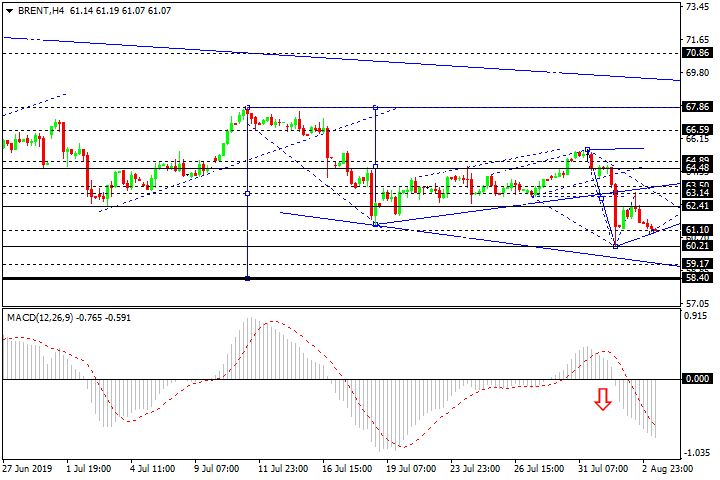
Brent is falling again but is still trading below the significant support area at 60.00. The long-term sideways channel between 60.00 and 67.00 remains in place. The instrument is seriously influenced by another round of trade wars between the USA and China as the US President Donald Trump announced additional 10% tariffs on some of the Chinese goods imported to the USA. As a result, largest oil consumers may reduce their demand for the “black gold”.

Moreover, last Friday the U.S. Energy Information Administration published Baker Hughes United States Oil Rig Count report, which has been falling for the fifth week in a row. Between July 27th and August 2nd, the number of active oil rigs went from 776 to 770 units. As a result, the actual number of rigs is the lowest since January 2018.

The pressure on oil remains. However, to continue pushing the instrument downwards, bears must fix the price below 60.00. In this case, the next downside target will be the area at 57.40.

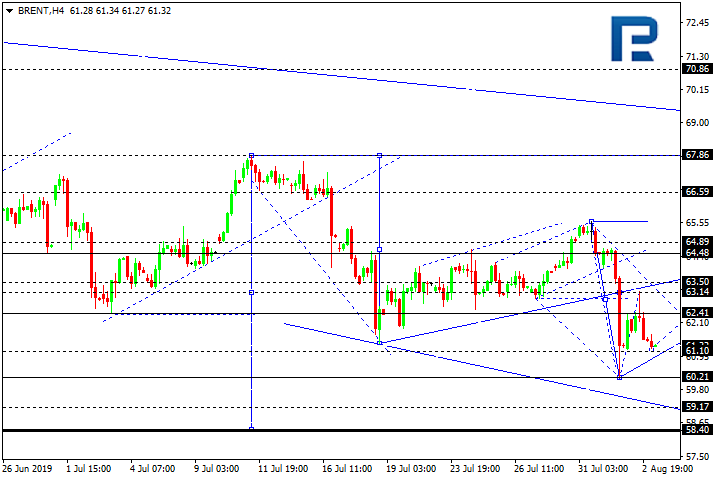
In the H4 chart, Brent is forming the fifth descending wave. Possibly, today the pair may be corrected towards 63.50 and then form a new descending structure to reach 62.40. Later, the market may start another growth with the target at 64.89. However, all these ascending movements may be considered as an alternative scenario, which may be possible only after the price breaks 62.41. Until that, the instrument is expected to continue trading downwards with the target at 58.40. From the technical point of view, this scenario is confirmed by MACD Oscillator, as its signal line is moving below 0, thus indicating further decline towards 60.82. After breaking this level, the pair may continue falling to reach 58.40. Still, this scenario may no longer be valid if the signal line breaks 0 to the upside. In this case, the instrument may turn to the above-mentioned alternative scenario.

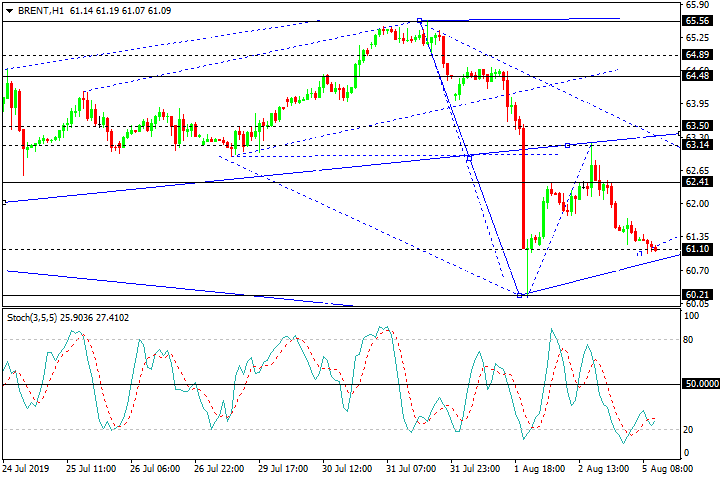
As we can see in the H1 chart, after reaching the closest correctional target at 63.14, Brent has moved downwards and formed a structure towards 61.05; right now, it is consolidating near the lows. Possibly, the pair may form one more ascending structure to break 63.10 and then continue the correction to reach the short-term target at 63.50. Later, the market may fall towards 61.50 and then complete the correction by reaching 64.89. After that, the instrument may continue trading inside the downtrend with the key target at 58.40. From the technical point of view, this scenario is confirmed by Stochastic Oscillator, as its signal is moving upwards to leave the “oversold area”, thus indicating a breakout of 50 to the upside. After this level is broken, the ascending wave may continue up to 63.50. Still, this scenario may be canceled if the line rebounds from 50 to continue the actual trend.

Disclaimer

Any predictions contained herein are based on the authors’ particular opinion. This analysis shall not be treated as trading advice. RoboForex shall not be held liable for the results of the trades arising from relying upon trading recommendations and reviews contained herein.

China’s currency fall rocks global markets – what should investors do?

By George Prior

Global financial markets have been rocked by China’s currency falling below an important threshold – and investors must consider action to protect their wealth and capitalize on the opportunities.

This is the message from Tom Elliott, International Investment Strategist at deVere Group, one of the world’s largest independent financial advisory organizations.

It comes after the Chinese renminbi fell to under 7 to the U.S. dollar on Monday – the lowest in more than a decade – igniting drops in stocks and emerging market currencies and driving a rally in government bonds.

Mr Elliott notes: “The nervousness in financial markets over the falling renminbi in recent weeks has reached panic levels, as the Chinese currency passes the psychologically important barrier of RMB 7 to the dollar.

“Just as in July and August 2015, when China engineered a small devaluation to support growth, global stock markets have panicked.”

He continues: “This has happened for three reasons.

“First, because a weaker renminbi will export deflationary pressure around the world’s manufacturing industries. Chinese goods, always competitive on price, will be even more competitive. This is therefore bad news for manufacturers outside of China, at a time when global manufacturing is struggling with weakening demand growth and the negative impact of the U.S-China trade dispute on their supply lines and profits.

“Second, with Chinese imports becoming cheaper, the major central banks’ efforts to energize inflation have taken a setback. And with it their attempts to ‘normalize’ interest rates, unwind quantitative easing and escape the black hole of negative real interest rates. Indeed, the size of the Chinese export sector means the direction of the renminbi is a key calculation when economists attempt to forecast global prices.

“Third, unlike the summer of 2015, the devaluation occurs against the background of a trade war with the U.S.”

For investors, the major question now is ‘How will the U.S. respond?’

“Policymakers in Washington will be wondering if Beijing’s refusal to intervene more heavily in the currency markets to support the renminbi is a strategic decision to put pressure on the U.S. in regard to the trade talks. Is it an ‘aggressive’ devaluation? If they conclude it is, we can expect furious reaction from Trump,” says Mr Elliott.

“Or is it that Beijing sees a weaker currency as inevitable, given China’s slowing growth? After all, currencies do go up and down, why should China be different just because we have become used to it being managed in the past through currency intervention.

“It would be ironic for the U.S. to be demanding a more liberal attitude towards trade from China, but to object to China’s currency being allowed to find a new rate in line with market conditions.

“If Washington takes this line, investors can sleep a little easier.”

The International Investment Strategist concludes: “It is worth perhaps remembering the investor’s mantra: where there is chaos, there is opportunity.

“Investors are urged to check their portfolios to ensure that they are best-positioned to capitalize on current opportunities and sidestep the risks.”

About:

deVere Group is one of the world’s largest independent advisors of specialist global financial solutions to international, local mass affluent, and high-net-worth clients.  It has a network of more than 70 offices across the world, over 80,000 clients and $12bn under advisement.


Forex Technical Analysis & Forecast 05.08.2019 (EURUSD, GBPUSD, USDCHF, USDJPY, AUDUSD, USDRUB, GOLD, BRENT)

Article By RoboForex.com

EURUSD, “Euro vs US Dollar”

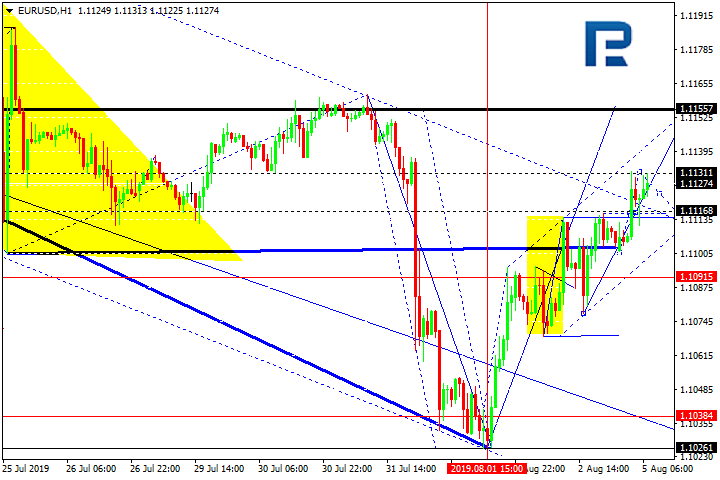
After forming another consolidation range around 1.1090, EURUSD has broken it to the upside. Possibly, the pair may start a new correction with the target at 1.1155. Later, the market may continue trading inside the downtrend to reach 1.1000.

EURUSD
Risk Warning: the result of previous trading operations do not guarantee the same results in the future

GBPUSD, “Great Britain Pound vs US Dollar”

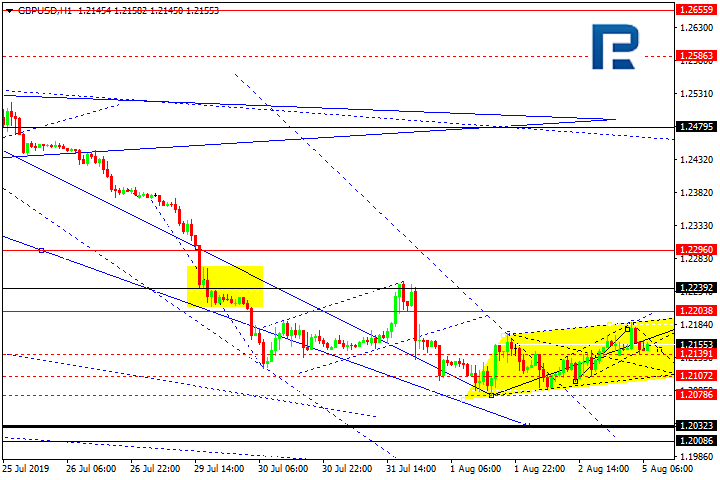
GBPUSD is consolidating around 1.2139. Today, the pair may form a new descending structure towards 1.2107 and then start another growth to reach 1.2200. After that, the instrument may continue trading downwards with the short-term target at 1.2034.

GBPUSD
Risk Warning: the result of previous trading operations do not guarantee the same results in the future

USDCHF, “US Dollar vs Swiss Franc”

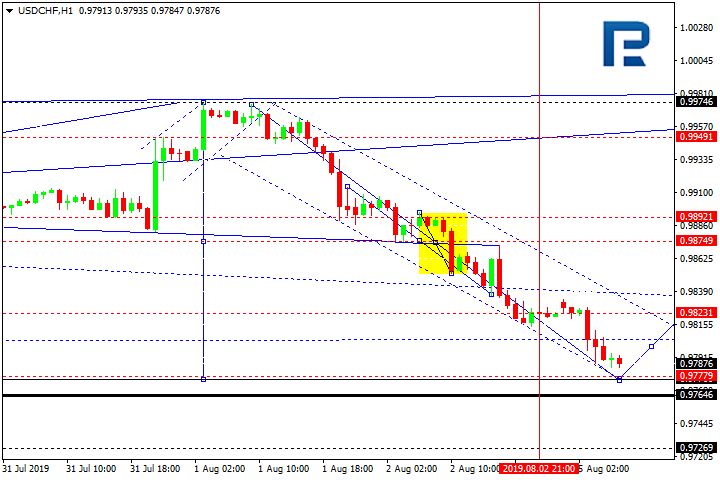
USDCHF has broken 0.9975 downwards. Possibly, the pair may be corrected to the downside with the target at 0.9777. After that, the instrument may form one more ascending structure to continue the uptrend and reach 1.0000.

USDCHF
Risk Warning: the result of previous trading operations do not guarantee the same results in the future

USDJPY, “US Dollar vs Japanese Yen”

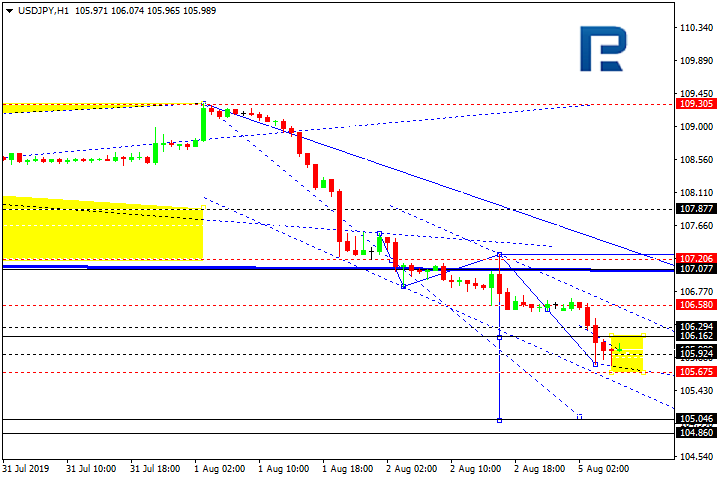
USDJPY has broken 107.20 downwards. Possibly, today the pair may continue trading inside the downtrend with the short-term target at 105.05. Later, the market may start a new growth to return to 107.20 and test it from below.

USDJPY
Risk Warning: the result of previous trading operations do not guarantee the same results in the future

AUDUSD, “Australian Dollar vs US Dollar”

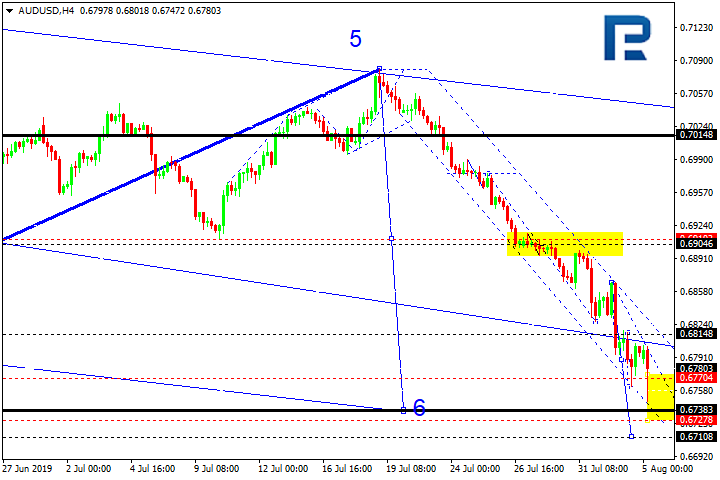
AUDUSD continues moving downwards. Possibly, the pair may reach the key downside target at 0.6738. After that, the instrument may start consolidating near the lows.

AUDUSD
Risk Warning: the result of previous trading operations do not guarantee the same results in the future

USDRUB, “US Dollar vs Russian Ruble”

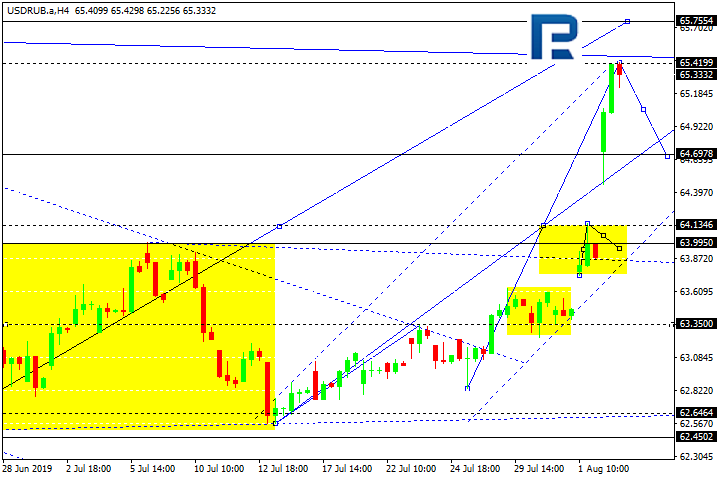
USDRUB has expanded the range up to 65.40 and almost reached the short-term correctional target. Today, the pair may form a new descending structure towards 64.15 and then start another growth with the target at 65.75.

USDRUB
Risk Warning: the result of previous trading operations do not guarantee the same results in the future

XAUUSD, “Gold vs US Dollar”

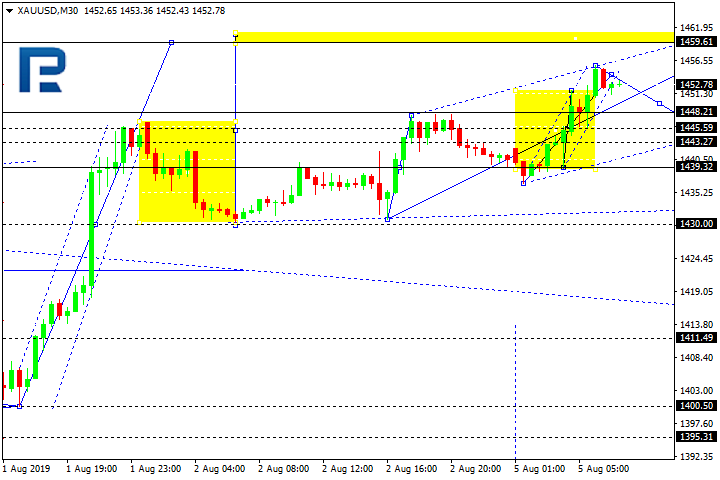
Gold has broken the consolidation range to the downside and may grow 1459.60. Possibly, today the pair may fall to test 1445.60 from above and then grow to break 1455.00. After that, the instrument may continue trading inside the uptrend to reach the above-mentioned target.

GOLD
Risk Warning: the result of previous trading operations do not guarantee the same results in the future

BRENT

Brent is moving downwards and may reach 58.40. Today, the pair may consolidate around 62.40. Possibly, the pair may continue the correction towards 63.50. Later, the market may return to 62.40 and then form one more ascending structure to reach 64.90 and then continue trading downwards with the target at 58.40.

BRENT
Risk Warning: the result of previous trading operations do not guarantee the same results in the future

Article By RoboForex.com

Attention!
Forecasts presented in this section only reflect the author’s private opinion and should not be considered as guidance for trading. RoboForex LP bears no responsibility for trading results based on trading recommendations described in these analytical reviews.

Fibonacci Retracements Analysis 05.08.2019 (GOLD, USDCHF)

Article By RoboForex.com

XAUUSD, “Gold vs US Dollar”

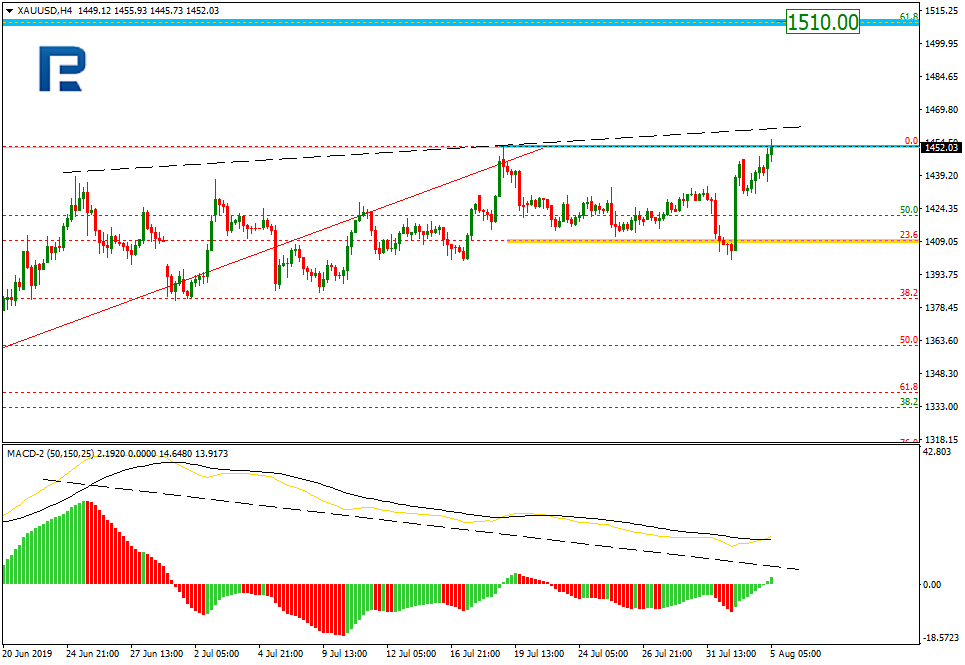
In the H4 chart, after finishing the short-term correction towards 23.6% fibo, XAUUSD is trying to break the high. The upside target is long-term 61.8% fibo at 1510.00. At the same time, there is a divergence, which means that the current rising tendency may be weak.

GOLD_H4
Risk Warning: the result of previous trading operations do not guarantee the same results in the future

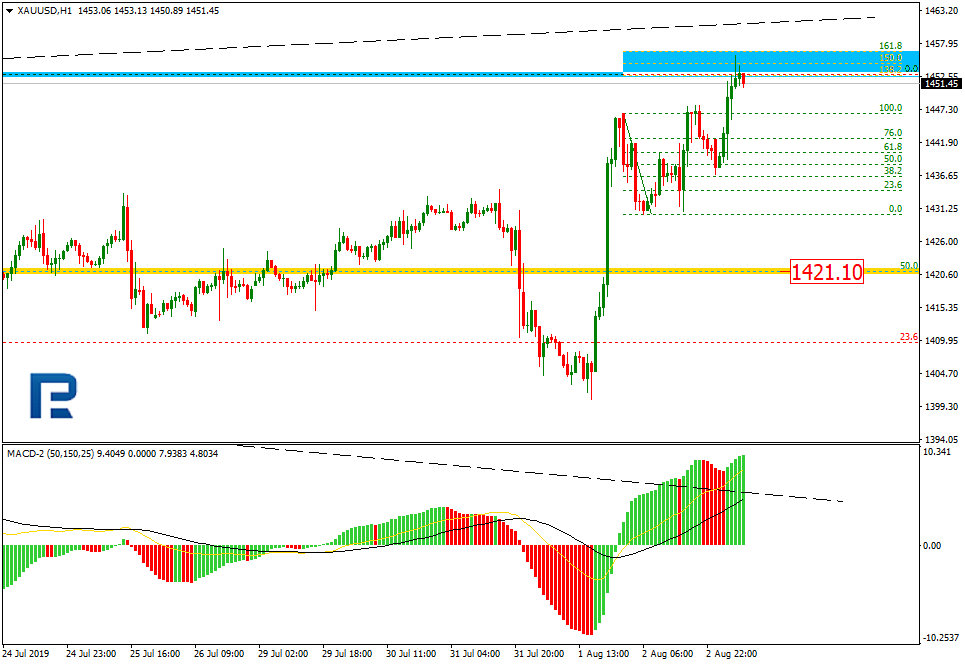
As we can see in the H1 chart, the pair is forming a new rising impulse. After finishing another correction, the impulse has reached the post-correctional extension area between 138.2% and 161.8% fibo. The key support is long-term 50.0% fibo at 1421.10.

GOLD_H1
Risk Warning: the result of previous trading operations do not guarantee the same results in the future

USDCHF, “US Dollar vs Swiss Franc”

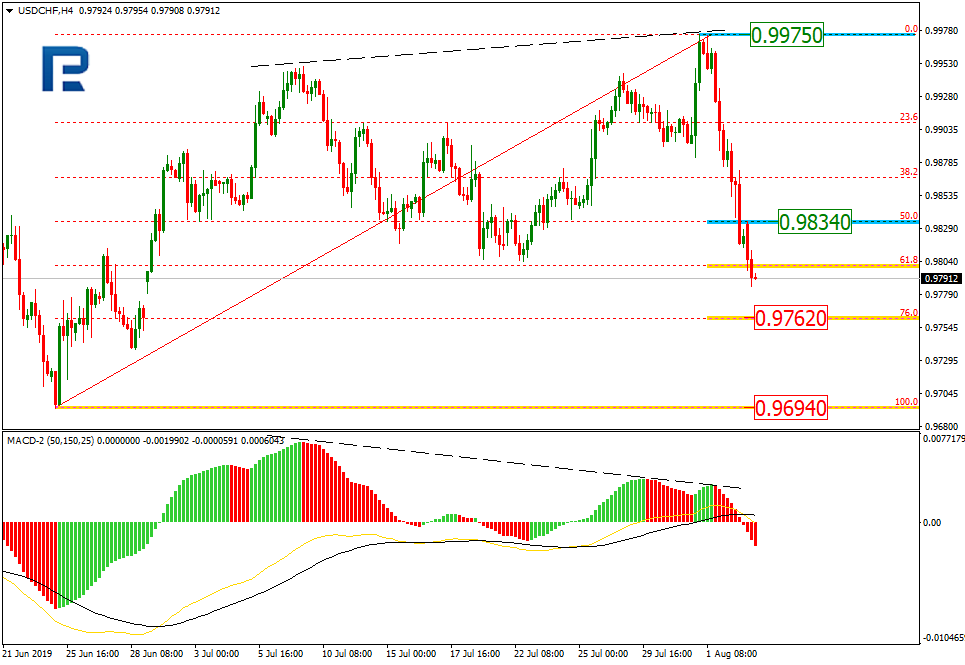
As we can see in the H4 chart, the divergence made USDCHF plunge, by now, it has already broken 61.8% fibo and may continue falling towards 76.0% fibo at 0.9762. The key downside target is the mid-term low at 0.9694. The resistance is 50.0% fibo at 0.9834.

USDCHF_H4
Risk Warning: the result of previous trading operations do not guarantee the same results in the future

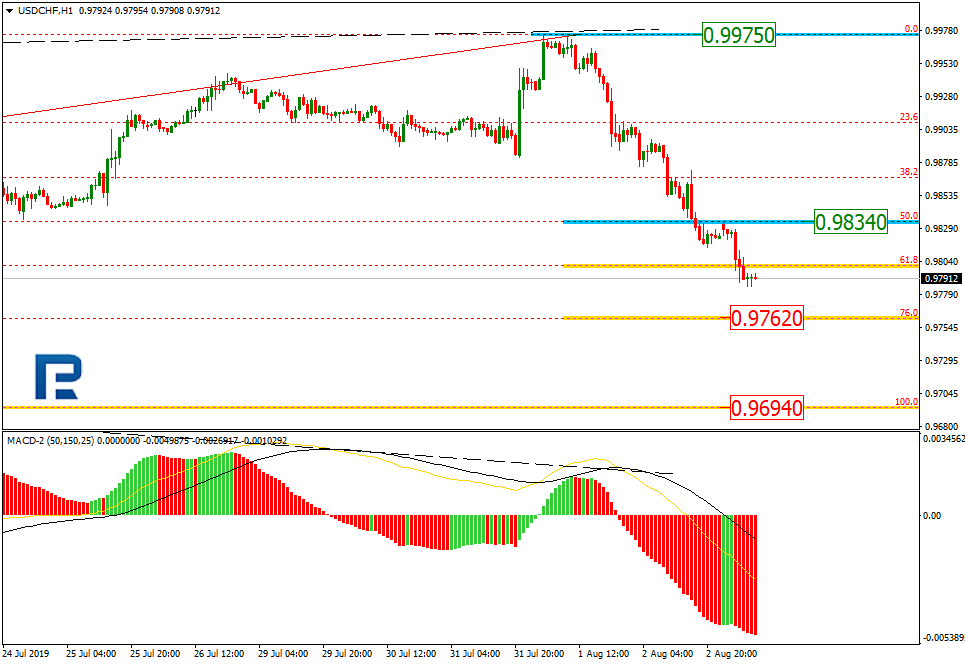
In the H1 chart, the pair is steadily trading downwards to reach 76.0% fibo at 0.9762.

USDCHF_H1

Article By RoboForex.com

Attention!
Forecasts presented in this section only reflect the author’s private opinion and should not be considered as guidance for trading. RoboForex LP bears no responsibility for trading results based on trading recommendations described in these analytical reviews.

Tariff Damage Spreading in US, China within Target in H2 2019

By Dan Steinbock

In the second half of 2019, US economic prospects will soften, despite the Fed rate cut, whereas Chinese growth target is likely to prevail. It’s time to prepare for diminished global economic prospects in 2019-20.

After an important meeting of the Central Committee of the Communist Party of China (CPC), participants said that China seeks to make its fiscal policy more effective and to maintain “reasonably ample” liquidity.

Instead of resorting to a stimulus in the real estate market, the emphasis will be on “proactive fiscal policy and prudent monetary policy.” It is a challenging balancing act, but the right stance in the right time.

Meanwhile, President Trump pledged to impose an additional 10% tariff on Chinese imports to the US, which caused US stocks to tank 280 points. The White House needs a scapegoat as the Fed cuts cannot offset Trump’s tweet policies, US growth is slowing and a slowdown is looming in 2020.

China’s 2019 growth within range

Clearly, the CPC Central Committee seeks to avoid targeted but costly stimulus policies, which could exacerbate new risks of asset bubbles over time, but it will ensure adequate fiscal support.

Since infrastructure investment remains relatively soft by historical standards, fiscal easing on investment may prove likely in the second half of the year. It could be biased toward small enterprises and startups.

Moreover, fiscal easing is likely to be coupled with monetary support, including cuts of the banks reserve requirement ratio. Although the easing bias could cause downward pressure on Chinese bond yields and corporate spreads in the near future, the big picture suggests stabilization and resilience.

In the second quarter, Chinese economy grew 6.2%, a drop relative to 6.4% in the first quarter, yet hardly a surprise in view of global challenges. China’s economic growth is within the target range of 6% to 6.5% set by the government. Indeed, the full-year 2019 growth rate of 6.2% remains achievable, even if growth stabilizes around 6% to 6.2% in the second half.

In view of the CPC Central Committee meeting, policy authorities are likely to stick to the effort to cap debt growth. While that will support Chinese economy in the long term, the potential risk in this approach is premature tightening in the short-term. To avoid adverse outcomes, fiscal easing is likely in the second half of the year, while monetary easing will be likely to offset riskier scenarios.

Such stances could benefit Chinese stocks, which will also be supported by the anticipated foreign inflows, thanks to the inclusion of Chinese assets in international benchmarks. Despite the relatively benign macroeconomic prospects, more optimistic scenarios are constrained by the lingering trade-war uncertainty and caution in economic sentiment.

The US economy is a different story.

Fed cuts cannot contain White House’s policy mistakes

In the second quarter, US GDP grew at a 2.1% pace, which heralds “slowing economy.” Last spring, I predicted in China Daily that collateral damage in the US economy would begin to be felt more broadly by the summer. And a month ago, I argued that this damage is spreading, particularly as the White House is initiating new tariff wars against other countries around the world.

That is one reason why the US Federal Reserve – in a widely expected move, but one that critics see as a sign of diminished independence – cut interest rates by 25 basis points to a range of 2% to 2.25%, for the first time in more than a decade. The Fed also declared a premature end to its balance sheet reduction.

Ironically, the Fed’s statement – unchanged economic conditions, solid job gains, moderately-rising economic activity, though soft business investment – did not necessarily warrant a rate cut (the decision was not unanimous). What motivated Fed chair Jerome Powell’s decision may well have been the muted inflation pressures and particularly global growth concerns, which the Trump White House has undermined since the onset of its tariff wars in spring 2018.

Interestingly, the Fed cut did not cause a rally; it stumped the market. S&P 500 dropped almost 2%; 10-year Treasury yields to about 2%. The Fed cut does not imply a start of a new rate-cut cycle, but it does mean that the post-2008 recovery is now over with darker clouds looming in the horizon.

Trump tariff wars cloud US and global forecasts

When President Trump arrived in the White House, he pledged GDP growth at 4%. More recently, he projected US growth at 3%. Yet, analysts estimate US growth this year at 2.5% or less. Qualitative assessments suggest deterioration, as growth in domestic demand is slumping.

Worse, US GDP growth forecasts for 2020 indicate softening to 1.8%, possibly a (near-recession) slowdown – especially if trade and tech wars still escalate.

In the absence of negative surprises, Chinese GDP growth is likely to stay within the target of 6.2% in 2019 and possibly in 2020 as well, with supportive fiscal and monetary conditions. US tariff wars are likely to penalize Chinese economy by less than 0.5% of GDP, which could be offset by just a modest depreciation of the renminbi.

If recent policy mistakes in the White House will prevail, slower growth in investment spending, rising concern for continued trade wars and destabilizing geopolitics are likely to foster downside risks in global economic prospects, as risks for further downgrades morph into actual realities.

About the Author:

[This commentary was released by China Daily on August 3, 2019; it is based on Dr Steinbock’s briefing about US and Chinese growth in H2 2019.]

Dr. Dan Steinbock is an internationally recognized strategist of the multipolar world and the founder of Difference Group. He has served at India, China and America Institute (US), Shanghai Institutes for International Studies (China) and the EU Center (Singapore). See https://www.differencegroup.net/ 


The Analytical Overview of the Main Currency Pairs on 2019.08.05

by JustForex

The EUR/USD currency pair

Technical indicators of the currency pair:
  • Prev Open: 1.10804
  • Open: 1.11039
  • % chg. over the last day: +0.22
  • Day’s range: 1.10996– 1.11326
  • 52 wk range: 1.1034 – 1.1817

The EUR/USD currency pair began to recover after a long fall. The trading tool has updated the local highs. Currently, EUR/USD quotes are consolidating iaround 1.10950-1.11300. On Friday, the United States published mixed reports on the US labor market in July. Investors expect up-to-date information regarding the trade negotiations between Washington and Beijing. In the near future, we do not exclude the further restoration of the EUR. We recommend opening positions from key support and resistance levels.

The Economic News Feed for 05.08.2019:

  • – Some business activity indicators (GER, EU) – 10:55, 11:00 (GMT+3:00);
  • – Non-manufacturing PMI by ISM (US) – 17:00 (GMT+3:00);
EUR/USD

Indicators point to the strength of buyers: the price has fixed above 100 MA.

The MACD histogram is in the positive zone and above the signal line, which gives a strong signal to buy EUR/USD.

The Stochastic Oscillator is in the neutral zone, the %K line crossed the %D line. There are no signals at the moment.

Trading recommendations
  • Support levels: 1.10950, 1.10600, 1.10250
  • Resistance levels: 1.11300, 1.11600, 1.11850

If the price consolidates above 1.11300, expect further correction toward 1.11600-1.11850.

Alternatively, the price could descend toward 1.10700-1.10500.

The GBP/USD currency pair

Technical indicators of the currency pair:
  • Prev Open: 1.21512
  • Open: 1.21199
  • % chg. over the last day: -0.29
  • Day’s range: 1.20903 – 1.21447
  • 52 wk range: 1.2080 – 1.3385

Yesterday, the Bank of England, as expected, kept its key interest rate unchanged at 0.75%. The regulator is concerned about the hard Brexit scenario. The Central Bank also worsened the forecast for UK GDP growth for 2019-2020. At the moment, the GBP/USD currency pair is in lateral movement. The trading tool tests the key support and resistance levels 1.20800 and 1.21600. Investors are expecting a report on the US labor market. We recommend opening positions from key levels.

At 11:30 (GMT+3:00), the UK will publish the business activity index for the construction sector.

GBP/USD

The price fixed below 50 MA and 100 MA, which signals the strength of sellers.

The MACD histogram is in the negative zone and below the signal line, which gives a strong signal to sell GBP/USD.

The Stochastic Oscillator is in the neutral zone, the %K line crossed the %D line. There are no signals at the moment.

Trading recommendations
  • Support levels: 1.20800, 1.20200
  • Resistance levels: 1.21600, 1.22500, 1.23000

If the price consolidates below 1.20800, expect a further drop toward 1.20500-1.20200.

Alternatively, the price could recover toward 1.22000-1.22300.

The USD/CAD currency pair

Technical indicators of the currency pair:
  • Prev Open: 1.32122
  • Open: 1.32110
  • % chg. over the last day: -0.05
  • Day’s range: 1.31916 – 1.32425
  • 52 wk range: 1.2727 – 1.3664

The technical picture on the USD/CAD currency pair is still ambiguous. The trading instrument is in lateral movement. CAD is currently testing local support and resistance levels at 1.32000 and 1.32350. USD/CAD quotes have the potential for further growth. We recommend paying attention to the dynamics of oil quotes. Positions must be opened from key levels.

Today, Canada’s financial markets are closed due to the holiday.

USD/CAD

Indicators signal the strength of buyers: the price has fixed above 50 MA and 100 MA.

The MACD histogram is in the positive zone and continues to rise, indicating bullish sentiment.

The Stochastic Oscillator is in the neutral zone, the %K line crossed the %D line. There are no signals at the moment.

Trading recommendations
  • Support levels: 1.32000, 1.31800, 1.31500
  • Resistance levels: 1.32350, 1.32650, 1.32800

If the price consolidates above 1.32350 expect further growth toward 1.32650-1.32800.

Alternatively, the price could drop toward 1.31800-1.31500.

The USD/JPY currency pair

Technical indicators of the currency pair:
  • Prev Open: 107.334
  • Open: 106.528
  • % chg. over the last day: -0.70
  • Day’s range: 105.786 – 106.682
  • 52 wk range: 104.97 – 114.56

The USD/JPY currency pair continues to show a pronounced downtrend. The trading instrument approached annual lows. Demand for “safe” assets remains high due to the escalation of the trade conflict between the US and China. At the moment, USD/JPY quotes are consolidating in the range of 105.800-106.300. In the near future, technical correction is not ruled out. Today we recommend paying attention to economic releases from the USA. Positions must be opened from key levels.

The Economic News Feed for 05.08.2019 is calm.

USD/JPY

Indicators signal the strength of sellers: the price has fixed below 50 MA and 100 MA.

The MACD histogram is in the negative zone and below the signal line, which gives a strong signal to sell USD/JPY.

The Stochastic Oscillator is in the neutral zone, the %K line crossed the %D line. There are no signals at the moment.

Trading recommendations
  • Support levels: 105.800, 105.500
  • Resistance levels: 106.300, 106.800, 107.200

If the price consolidates below 105.800, expect further descend toward 105.500-105.300.

Alternatively, the price could rise toward 106.700-107.000.

by JustForex