Author Archive for InvestMacro – Page 178

Japanese Candlesticks Analysis 29.08.2019 (GOLD, NZDUSD)

Article By RoboForex.com

XAUUSD, “Gold vs US Dollar”

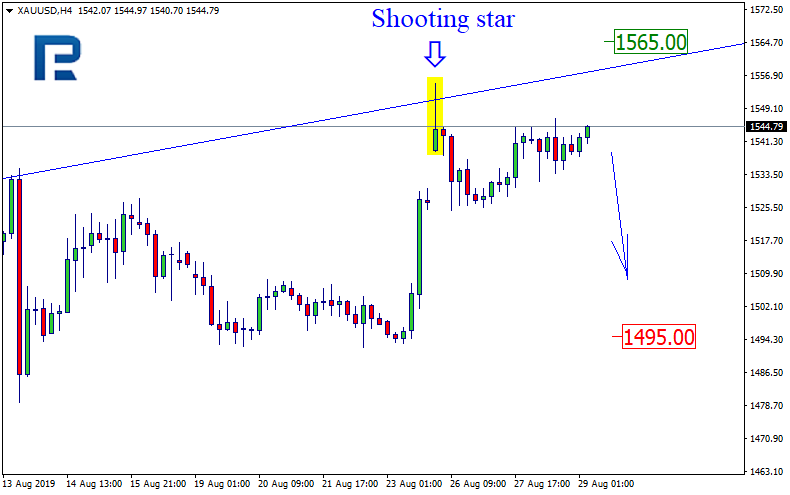
As we can see in the H4 chart, the ascending tendency continues. There was a gap at the beginning of the week; after completing another reversal pattern, Shooting Star, XAUUSD is still testing the channel’s upside border. Right now, the pair is trading sideways. The downside target may be at 1495.00. At the same time, we shouldn’t exclude a possibility that the instrument may break the closest high, reach 1565.00 and continue forming the ascending channel.

GOLD
Risk Warning: the result of previous trading operations do not guarantee the same results in the future

NZDUSD, “New Zealand vs. US Dollar”

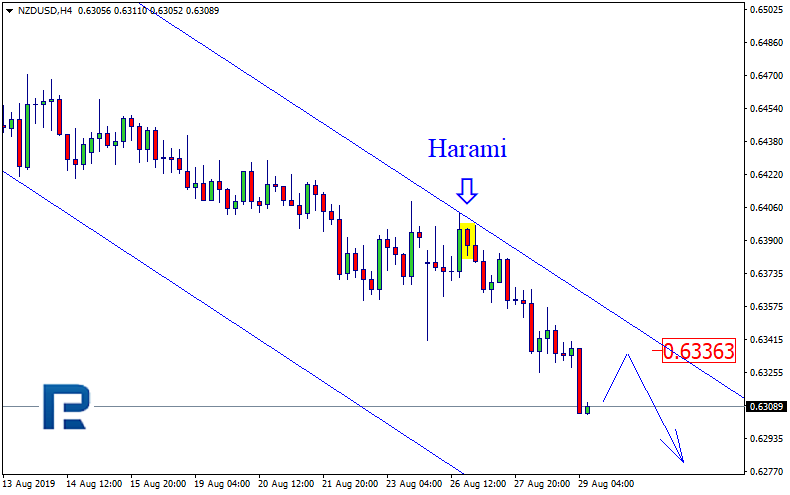
As we can see in the H4 chart, the descending channel continues. NZDUSD has formed Harami reversal pattern close to the channel’s upside border. Right now, the pair is reversing. At the moment, it may be assumed that after completing another correction, the price may fall to update its closest lows. At the same time, one shouldn’t exclude an opposite scenario, according to which the instrument may rebound from the support level and grow towards 0.6370.

NZDUSD

Article By RoboForex.com

Attention!
Forecasts presented in this section only reflect the author’s private opinion and should not be considered as guidance for trading. RoboForex LP bears no responsibility for trading results based on trading recommendations described in these analytical reviews.

EURUSD: pair consolidating within the range from the 16th of August

By Alpari.com

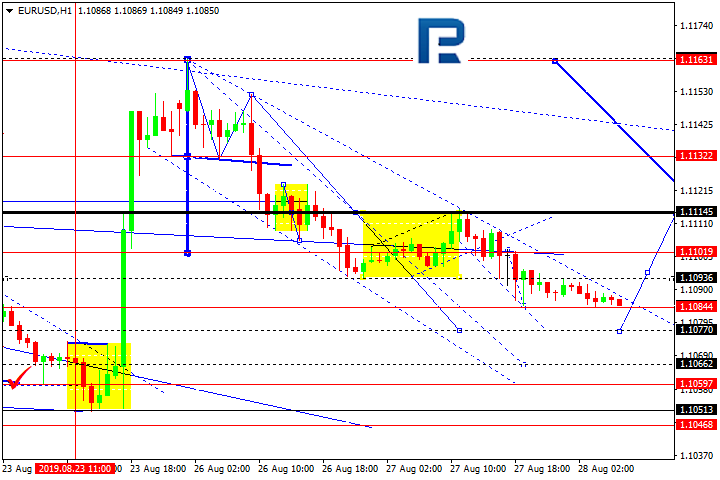
On Wednesday the 28th of August, trading on the EURUSD pair closed slightly down. Movements on the pair were almost identical to Tuesday’s. The bar pattern from Tuesday has been copied and superimposed over Wednesday’s on the chart. We can see the euro dropping from 1.1098 to 1.1073.

Yesterday’s biggest loser was the pound, which slumped following UK Prime Minister Boris Johnson’s decision to prorogue parliament. The order has received royal assent from the Queen. According to the official order, parliament must be suspended no earlier than Monday, the 9th of September, and reconvene on the 14th of October. This move did not go unnoticed by Donald Trump, who commended Johnson from his Twitter account.

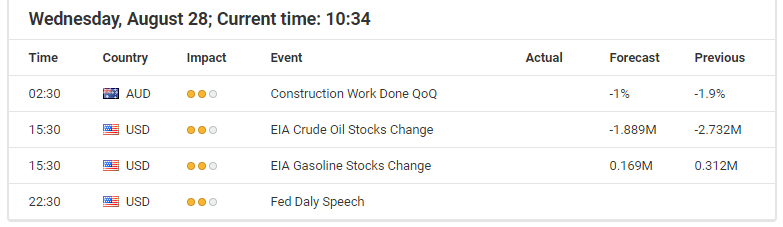
Day’s news (GMT+3):

  • 10:55 Germany: unemployment rate (Aug).
  • 12:00 Eurozone: consumer confidence (Aug), business climate (Aug), industrial confidence (Aug), economic sentiment indicator (Aug).
  • 15:00 Germany: harmonised index of consumer prices (Aug).
  • 15:30 Canada: current account (Q2).
  • 15:30 US: GDP (Q2), initial jobless claims (23 Aug).
  • 17:00 US: pending home sales (Jul).

EURUSD H1Current situation:

The main topics on today’s agenda are as follows:

  • The US-China trade conflict.
  • The political crisis in Italy.
  • Increased risks of a hard Brexit.
  • Expectations that the ECB will ease its monetary policy at its September meeting.

All the factors mentioned above are adding to investors’ fears of a global economic slowdown. Moreover, the yield curve inversion is adding to this uncertainty, with the difference between 2- and 10-year US Treasury bonds at its highest since 2007. For the time being, the euro isn’t expected to suffer too big a decline. The 1.1066 mark is expected to provide some support, as it did on the 16th of August.

By Alpari.com

Pound nosedives, UK recession looming – now is the time to protect UK-based assets

By George Prior

As the pound nosedives and the UK faces a looming recession, those with UK financial assets – including UK pensions, bonds and sizeable holdings of sterling – should consider international options to protect their wealth.

This is the message from the chief executive and founder of deVere Group, Nigel Green, after the Queen accepted UK Prime Minister Boris Johnson’s government request to suspend parliament from mid-September.  The move now reduces the time available to MPs to block a no-deal Brexit.

Mr Green affirms: “The already Brexit-battered pound has taken yet another hammering thanks to Boris Johnson’s highly controversial suspension of parliament.

“Sterling is down more than 0.5% against both the euro and U.S. dollar as a result of the political manoeuvring.

“The pressure will remain on for the pound for the foreseeable future as the possibility of a no-deal Brexit increases.  Should the UK leave with no-deal, the pound is likely to remain weak for several years until the country and the bloc readjusts.

“In addition, the likelihood of a general election is weighing on the currency.

“And should a Corbyn-led Labour party win such an election, there will be even more longer-term bad news for the pound. His anti-business rhetoric, and high tax and low-profit policies would lead to a considerable and sustained selling of the pound.

“There’s also now the serious possibility of a general strike, mass protests and civil disobedience as political uncertainty intensifies.”

He adds: “This critical period for Brexit negotiations is also happening as the UK economy is potentially on the brink of a harmful recession which will deliver another bloody nose to investment, trade and confidence in the UK.”

Mr Green continues: “Looking at the nose-diving pound and a looming UK recession, the outlook is somewhat bleak in Britain. Those with UK financial assets – including UK pensions, bonds and sizeable holdings of sterling – should now perhaps consider the available international options to protect their wealth.”

Earlier on Wednesday, the deVere CEO noted: “Boris Johnson’s decision to suspend parliament will have far-reaching economic effects, many of which will not be known for years to come.”

He concludes: “Those who are serious about building and safeguarding their assets should explore legitimate overseas options as the UK moves into an unprecedented crisis.”

About:

deVere Group is one of the world’s largest independent advisors of specialist global financial solutions to international, local mass affluent, and high-net-worth clients.  It has a network of more than 70 offices across the world, over 80,000 clients and $12bn under advisement.


Fibonacci Retracements Analysis 28.08.2019 (GBPUSD, EURJPY)

Article By RoboForex.com

GBPUSD, “Great Britain Pound vs US Dollar”

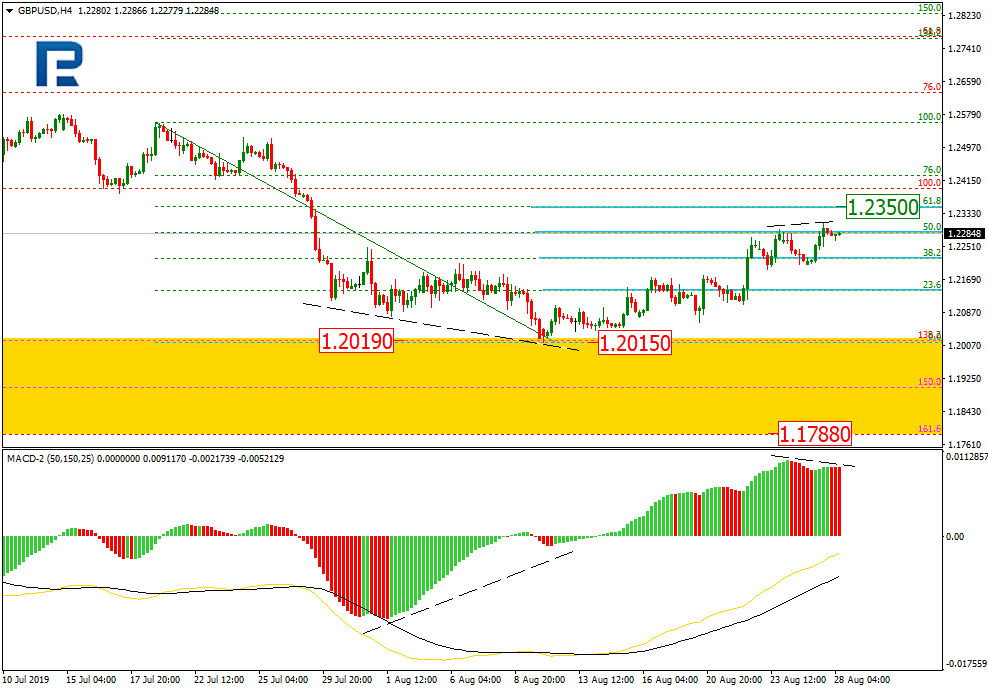
As we can see in the H4 chart, the correctional uptrend is heading towards 61.8% fibo at 1.2350. After completing the correction, GBPUSD may form a new descending structure to reach the support at 1.2015. The mid-term downside targets are inside the post-correctional extension area between 138.2% and 161.8% fibo at 1.2019 and 1.1788 respectively.

GBPUSD_H4
Risk Warning: the result of previous trading operations do not guarantee the same results in the future

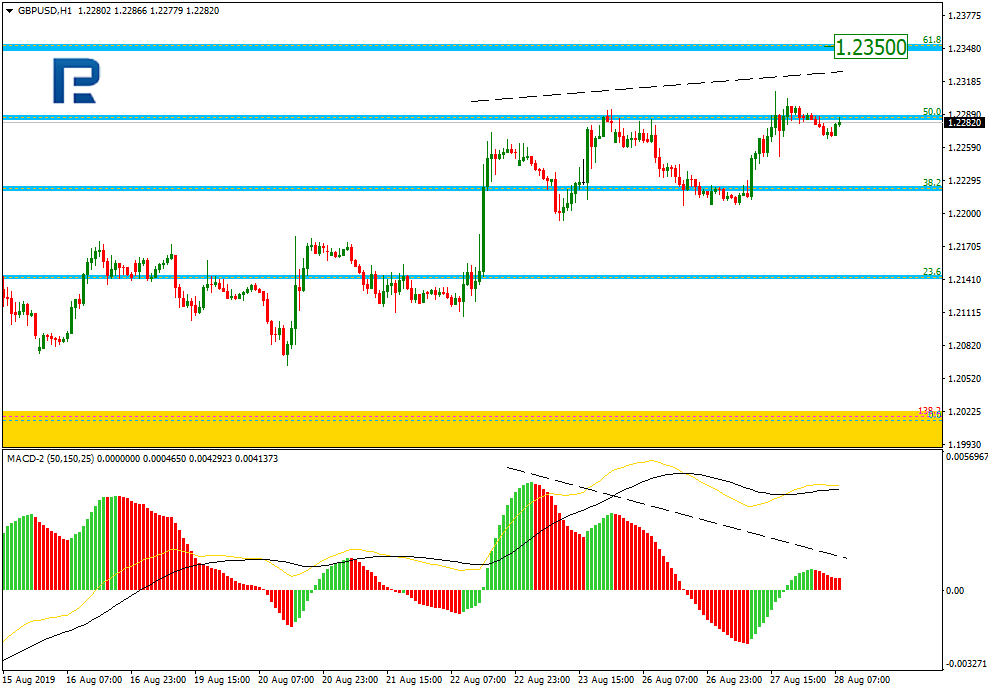
More detailed structure of the current correction is shown on the H1 chart. Right now, the pair is re-testing 50.0% fibo. Later, the market may continue moving towards 61.8% fibo at 1.2350. At the same time, there is a divergence within the uptrend on MACD, which may indicate a forthcoming reverse.

GBPUSD_H1
Risk Warning: the result of previous trading operations do not guarantee the same results in the future

EURJPY, “Euro vs. Japanese Yen”

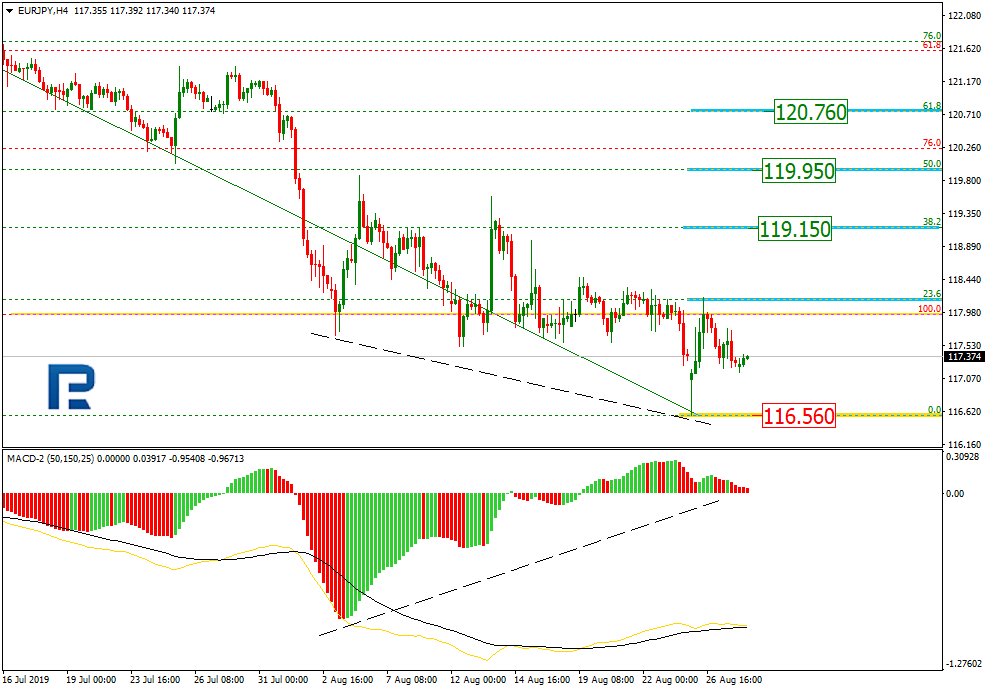
As we can see in the H4 chart, after EURJPY broke the significant low, there was a convergence on MACD, which was later followed by the first correctional impulse towards 23.6% fibo. The next correctional targets may be 38.2%, 50.0%, and 61.8% fibo at 119.15, 119.95, and 120.76 respectively. The support is at 116.56.

EURJPY_H4
Risk Warning: the result of previous trading operations do not guarantee the same results in the future

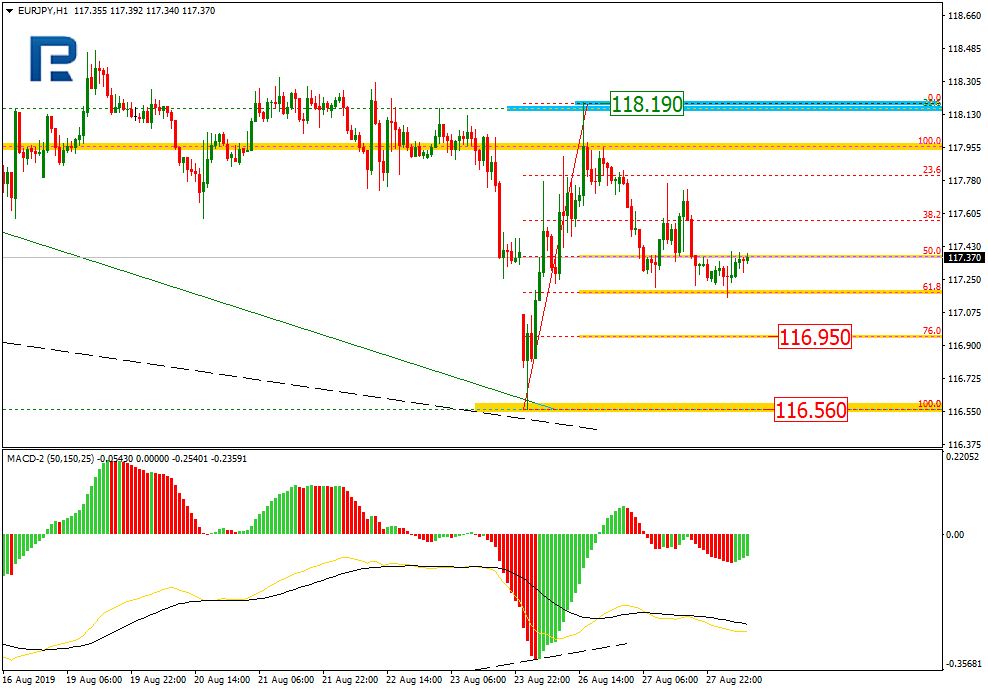
In the H1 chart, after completing the rising impulse, the pair is correcting to the downside and has already reached 61.8% fibo. Later, the market may continue the correction towards 76.0% fibo at 116.95.

EURJPY_H1
Risk Warning: the result of previous trading operations do not guarantee the same results in the future

Article By RoboForex.com

Attention!
Forecasts presented in this section only reflect the author’s private opinion and should not be considered as guidance for trading. RoboForex LP bears no responsibility for trading results based on trading recommendations described in these analytical reviews.

Forex Technical Analysis & Forecast 28.08.2019 (EURUSD, GBPUSD, USDCHF, USDJPY, AUDUSD, USDRUB, USDCAD, GOLD, BRENT, BTCUSD)

Article By RoboForex.com

EURUSD, “Euro vs US Dollar”

EURUSD has completed the correction at 1.1114; right now, it is moving downwards to reach 1.1077. Later, the market may start a new correction to return to 1.1114 and then continue trading inside the downtrend with the target at 1.1066.

EURUSD
Risk Warning: the result of previous trading operations do not guarantee the same results in the future

GBPUSD, “Great Britain Pound vs US Dollar”

GBPUSD has broken 1.2267 upwards; right now, it is consolidating above this level. Possibly, the pair may form one more ascending structure towards 1.2323 and then start another decline with the target at 1.2194.

GBPUSD
Risk Warning: the result of previous trading operations do not guarantee the same results in the future

USDCHF, “US Dollar vs Swiss Franc”

After finishing the ascending wave at 0.9834, USDCHF has formed a new descending impulse; right now, it is correcting towards 0.9826. After that, the instrument may resume trading downwards with the target at 0.9750.

USDCHF
Risk Warning: the result of previous trading operations do not guarantee the same results in the future

USDJPY, “US Dollar vs Japanese Yen”

USDJPY is consolidating above 105.67. Possibly, the pair may form a new descending structure to reach 105.52. Later, the market may resume trading upwards to reach 107.07.

USDJPY
Risk Warning: the result of previous trading operations do not guarantee the same results in the future

AUDUSD, “Australian Dollar vs US Dollar”

AUDUSD has completed the correction in the form of Flag at 0.6737. Possibly, today the pair may form a new descending structure to reach 0.6767, thus forming a new consolidation range. If the price breaks this range to the downside, the instrument may continue the correction with the target at 0.6720; if to the upside – start a new growth towards 0.6815.

AUDUSD
Risk Warning: the result of previous trading operations do not guarantee the same results in the future

USDRUB, “US Dollar vs Russian Ruble”

USDRUB has almost completed the ascending wave. Today, the pair may form a new consolidation range above 66.28. If the price breaks this range to the downside, the instrument may start a new decline with the first target at 65.98.

USDRUB
Risk Warning: the result of previous trading operations do not guarantee the same results in the future

USDCAD, “US Dollar vs Canadian Dollar”

USDCAD is moving upwards. Today, the pair may form a new consolidation range above 1.3292. After that, the instrument may break this range to the upside and grow towards 1.3361. Later, the market may form a new descending structure with the target at 1.3300 and then resume trading upwards to reach 1.3434 at least.

USDCAD
Risk Warning: the result of previous trading operations do not guarantee the same results in the future

XAUUSD, “Gold vs US Dollar”

After finishing the correction at 1545.00, Gold has completed the descending impulse towards 1533.40. Possibly, today the pair may form a new consolidation range above the latter level. If the price breaks this range to the upside, the instrument may start a new growth to return to 1545.00; if to the downside – resume trading inside the downtrend to break 1523.00 and then continue moving downwards with the target at 1502.00.

GOLD
Risk Warning: the result of previous trading operations do not guarantee the same results in the future

BRENT

Brent has reached 59.90; right now, it is consolidating below this level. Possibly, the pair may start a new correction towards 59.40 and then form one more ascending structure with the first target at 60.40.

BRENT
Risk Warning: the result of previous trading operations do not guarantee the same results in the future

BTCUSD, “Bitcoin vs US Dollar”

BTCUSD is moving downwards with the target at 9900.00. After that, the instrument may be corrected towards 10270.00 and then resume trading downwards with the predicted target at 9500.00.

BTCUSD

Article By RoboForex.com

Attention!
Forecasts presented in this section only reflect the author’s private opinion and should not be considered as guidance for trading. RoboForex LP bears no responsibility for trading results based on trading recommendations described in these analytical reviews.

The US Currency Is Consolidating

by JustForex

The US dollar is consolidating against a basket of major currencies. The US dollar index (#DX) closed the trading session in the negative zone (-0.47%). The US currency is under pressure due to yet another decrease in the 10-year US government bonds yield. The inversion of the US government bond yield curve has strengthened concern over the recession again.

Positive economic data released yesterday supported the US dollar. Thus, the CB consumer confidence index counted to 135.1 in August, although experts expected 129.5.

Investors are still concerned about tense trade relations between the US and China. It should be recalled that Donald Trump said that representatives of China called Washington several times intending to continue trade negotiations. However, the editor of the Global Times, Hu Xijin, said that the calls were just a technical formality and did not carry the significance attached to them by the US President.

The “black gold” prices are rising. Currently, futures for the WTI crude oil are testing the $55.75 mark per barrel. At 17:30 (GMT+3:00), the US crude oil inventories will be published.

Market Indicators

Yesterday, the bullish sentiment was observed in the US stock markets: #SPY (-0.39%), #DIA (-0.50%), #QQQ (-0.21%).

The 10-year US government bonds yield has updated local lows again. At the moment, the indicator is at the level of 1.47-1.48%.

The News Feed on 2019.08.28:

Today, the publication of important economic news is not expected. Investors expect signals regarding the escalation of the trade war between the US and China.

by JustForex


Trade war escalation, and recession fears – Gold stays bullish

By Admiral Markets

Source: Economic Events 28 August 2019 – Admiral Markets’ Forex Calendar

While the economic calendar is thin today, the latest political developments have us instead looking at Gold, especially in regards to the trade war between the US and China.

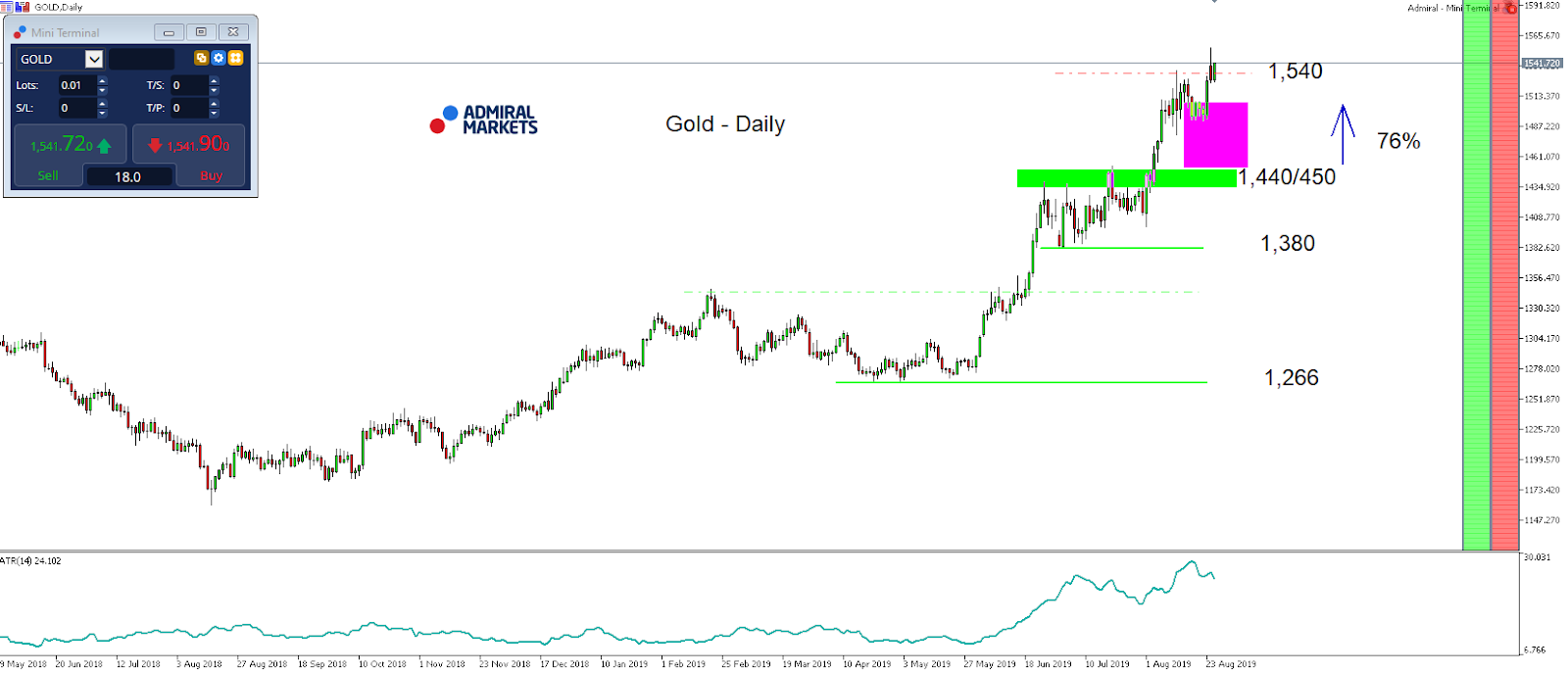
In general, the picture in Gold stays clearly bullish after the continued escalation of the trade dispute last Friday. After the retaliation of China which was answered by Trump after markets closed on Friday, announcing new tariffs on Chinese goods and the growing expectation of an outright currency market intervention announced to devalue the US dollar are clearly risk-off-drivers and thus bullish for Gold.

And while Trump tried to take the heat out of the trade dispute at the G7 meeting, saying that China called over the weekend, beginning an attempt to get at a table with the US again which was not confirmed by the Chinese, one thing became nevertheless certain: uncertainty in financial markets remains high.

That said, the long-side in Gold should be favoured and the dip in the precious metal, closing the gap over the weekend around 1,525/530 USD can be considered an interesting region for long engagements in Gold.

In general, the mode stays short-term bullish (Hourly chart) above 1,492 USD, a little longer-term (Daily chart) above 1,380 USD with an overall potential target around 1,650/700 USD in the weeks to come:

Source: Admiral Markets MT5 with MT5-SE Add-on Gold Daily chart (between May 29, 2018, to August 27, 2019). Accessed: August 27, 2019, at 10:00pm GMT – Please note: Past performance is not a reliable indicator of future results, or future performance.

In 2014, the value of Gold fell by 1.7%, in 2015, it fell by 10.4%, in 2016, it increased by 8.1%, in 2017, it increased by 13.1%, in 2018, it fell by 1.6%, meaning that after five years, it was up by 6.4%.

Discover the world’s #1 multi-asset platform

Admiral Markets offers professional traders the ability to trade with a custom, upgraded version of MetaTrader 5, allowing you to experience trading at a significantly higher, more rewarding level. Experience benefits such as the addition of the Market Heat Map, so you can compare various currency pairs to see which ones might be lucrative investments, access real-time trading data, and so much more. Click the banner below to start your FREE download of MT5 Supreme Edition!

Download MetaTrader 5 and begin trading today!

Disclaimer: The given data provides additional information regarding all analysis, estimates, prognosis, forecasts or other similar assessments or information (hereinafter “Analysis”) published on the website of Admiral Markets. Before making any investment decisions please pay close attention to the following:

  1. This is a marketing communication. The analysis is published for informative purposes only and are in no way to be construed as investment advice or recommendation. It has not been prepared in accordance with legal requirements designed to promote the independence of investment research, and that it is not subject to any prohibition on dealing ahead of the dissemination of investment research.
  2. Any investment decision is made by each client alone whereas Admiral Markets shall not be responsible for any loss or damage arising from any such decision, whether or not based on the Analysis.
  3. Each of the Analysis is prepared by an independent analyst (Jens Klatt, Professional Trader and Analyst, hereinafter “Author”) based on the Author’s personal estimations.
  4. To ensure that the interests of the clients would be protected and objectivity of the Analysis would not be damaged Admiral Markets has established relevant internal procedures for prevention and management of conflicts of interest.
  5. Whilst every reasonable effort is taken to ensure that all sources of the Analysis are reliable and that all information is presented, as much as possible, in an understandable, timely, precise and complete manner, Admiral Markets does not guarantee the accuracy or completeness of any information contained within the Analysis. The presented figures refer that refer to any past performance is not a reliable indicator of future results.
  6. The contents of the Analysis should not be construed as an express or implied promise, guarantee or implication by Admiral Markets that the client shall profit from the strategies therein or that losses in connection therewith may or shall be limited.
  7. Any kind of previous or modeled performance of financial instruments indicated within the Publication should not be construed as an express or implied promise, guarantee or implication by Admiral Markets for any future performance. The value of the financial instrument may both increase and decrease and the preservation of the asset value is not guaranteed.
  8. The projections included in the Analysis may be subject to additional fees, taxes or other charges, depending on the subject of the Publication. The price list applicable to the services provided by Admiral Markets is publicly available from the website of Admiral Markets.
  9. Leveraged products (including contracts for difference) are speculative in nature and may result in losses or profit. Before you start trading, you should make sure that you understand all the risks.

By Admiral Markets

Johnson’s move to suspend parliament will hit UK economy and pound

By George Prior

Prime Minister Boris Johnson is inflicting unnecessary economic damage on an already vulnerable UK economy, warns the CEO of the world’s largest independent financial advisory organization.

The warning from Nigel Green, chief executive and founder of deVere Group, comes as it is revealed that the government is to ask the Queen to suspend Parliament when lawmakers return to work next week.  This means that they are unlikely to have time to stop the Prime Minister taking the UK out of the EU without a deal on October 31.

Mr Green comments: “It could be argued that Boris Johnson’s decision to ask the Queen to suspend parliament, and therefore to prevent democratically elected representatives of the people doing their job, is deeply unconstitutional and has the hallmarks of a tin-pot dictator.

“However, it could also be argued that it is Mr Johnson fulfilling, one way or another, the will of the British people who voted to leave the EU in the 2016 referendum.

“It is likely to be a tactic to spook negotiators into making concessions to the Withdrawal Agreement.  Whether it will work remains to be seen.  It will almost certainly be challenged in the courts.”

He continues: “What we do know for sure though is that this step will inflict further unnecessary economic damage on an already extremely vulnerable UK economy.

“Depressingly, a recession is looming for Britain and Johnson’s highly controversial tactics seriously increase the uncertainty which will further drag on investment and trade.

“In addition, it will further batter the beleaguered pound, which reduces people’s purchasing power. Weaker sterling means imports are more expensive, with rising prices typically being passed on to consumers.”

Mr Green goes on to add: “The situation in the UK is deteriorating.  As such individuals and businesses will, inevitably and quite sensibly, be looking to grow and safeguard their wealth by moving assets out of the UK through various established international financial solutions.

“Brexit has plunged Britain into an existential crisis that will last for generations.

“It has also already cost billions upon billions of pounds. Indeed, it has cost the UK economy a staggering £66bn in just under three years, according to S&P Global Ratings.

“But perhaps even worse is the haemorrhaging of opportunity and confidence in the UK that will continue far beyond the Halloween deadline.”

The deVere CEO concludes: “Boris Johnson’s decision to suspend parliament will have far-reaching economic effects, many of which will not be known for years to come.

“Domestic and international investors in UK assets need to watch the situation carefully and ensure that their portfolios are best-positioned to deal with the growing uncertainties.”

About:

deVere Group is one of the world’s largest independent advisors of specialist global financial solutions to international, local mass affluent, and high-net-worth clients.  It has a network of more than 70 offices across the world, over 80,000 clients and $12bn under advisement.

EURUSD: euro gains a foothold at the 67th degree

By Alpari.com

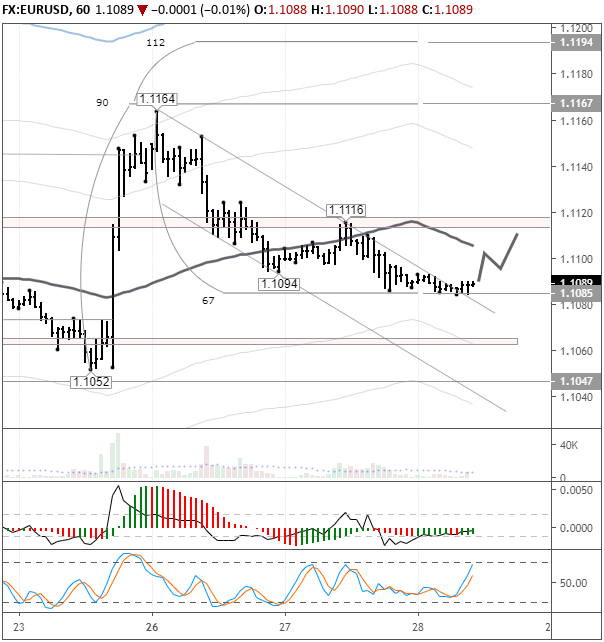
On Tuesday the 27th of August, trading on the euro closed slightly down. Initial growth was snuffed out by the trend line at 1.1116. In the US session, the EURUSD pair slid to the 67th degree at 1.1085.

The single currency came under pressure via the EURGBP pair, which dropped from 0.9095 to 0.9016 on the back of a rising pound. Leader of the UK’s opposition Labour Party Jeremy Corbyn has said the he will do everything he can to prevent the UK leaving the EU without a deal. The opposition parties have made a pact to use any legal means necessary to prevent a no-deal Brexit on the 31st of October.

The pound was the only major to make gains against the dollar. Most currencies have lost ground against the dollar amid a retreat towards the safe havens by investors, who are skeptical of Donald Trump’s optimistic suggestion that a trade deal could be reached by September. Trump said on Monday that he received a call from China asking him to return to the negotiating table. China’s foreign ministry has denied making any such calls.

Day’s news (GMT+3):

  • 11:00 Switzerland: ZEW survey – expectations (Aug).
  • 11:00 Eurozone: M3 money supply (Jul), private loans (Jul).
  • 17:30 US: EIA crude oil stocks change (23 Aug).

EURUSD H1Current situation:

At the time of writing, the euro is trading at 1.1089. As predicted yesterday, the pair reached the 67th degree, but the ensuing rebound was weak due to the EURGBP pair putting pressure on the bulls. All the majors are trading down against the greenback in today’s Asian session. The euro has lost the least ground at -0.01%. Despite the drop on the majors, it seems likely that the euro will rise against the dollar today.

By Alpari.com


The Mystery of the African swine fever in China and Asia

By Dan Steinbock    

The costly and deadly African swine fever is penalizing food security in China and more than half a dozen Asian countries. Despite the official ASF story, the virus has been used as a bio-weapon in the past. The suppression of such bio-threats requires multipolar cooperation.

On August 20, Agriculture Secretary William Dar confirmed the BAI report on the growing death rate of pigs raised by farmers in their backyards. The Philippines is tightening bio-security awaiting lab results.

Along with Myanmar, Philippines may prove the most recent target of the Asian swine fever (ASF). The virus is already present in six Asian countries: Cambodia, China, DPR Korea, Lao PDR, Mongolia and Vietnam. Current losses represent more than 10% of the total pig population in China, Vietnam and Mongolia, respectively.

But how did the African swine fever (ASF) outbreak start?

The official ASF narrative

The ASF is a devastating hemorrhagic fever of pigs with mortality rates close to 100 percent. It causes major economic losses, threatens food security and limits pig production in affected countries. There is no vaccine against the virus. It persistently infects its natural hosts, warthogs, bush pigs, and soft ticks, which likely act as a vector with no disease signs.

Historically, the first African swine fever outbreak took place in Kenya in 1907. The first spread of ASF outside Africa was to Portugal in 1957, presumably as a result of waste from airline flights being fed to pigs near Lisbon airport. Outbreaks of ASF were reported subsequently in other European countries.

Cuba was the first country in the Caribbean region to report infection with ASF in 1971. It was believed to have been introduced from Spain. ASF was further reported in the late 1970s in several Caribbean island countries and in Brazil 1978. Presumably, it was introduced from Spain or Portugal through food waste carried by transcontinental flights.

After a decade or more relative quiet, the ASF in 2007 spread to Georgia in the Caucasus and thereafter widely to neighboring countries, including Armenia, Azerbaijan and several territories in Russia. After another decade of quiet, the number of ASF outbreaks suddenly soared after September 2018, especially in China, although it had not been detected in China or Asia before. Since then, over 2.8 million hogs have been culled globally due to ASF, although according to the World Organization for Animal Health (OIE). Industry observers believe the actual number is much higher.

That’s the conventional wisdom, which implies that ASF remained restricted to Africa until the late ‘50s. In reality, ASF had arrived in North America already in the early 1950s, when Fort Terry, a US biowarfare facility in Plum Island New York, housed seven deadly virus strains.

ASF in biological warfare

After World War II experimentation, U.S. biological warfare was launched for offensive purposes. During the Cold War, ASF attracted great interest among anti-animal viruses, such as foot and mouth disease and cattle plague. By 1954, according to biowarfare historians, three viruses were available as agents for the destruction of food-bearing animals, including ASF.

Between the mid-1960s and late ‘90s, Cuba accused the United States of 10 biological warfare attacks following serious infectious disease outbreaks. None were proven conclusively, but several probably occurred. In 1971, pigs in Havana hog farm were diagnosed with ASF virus, which spread and caused half a million pigs to be slaughtered. Cuba suffered food shortage. The UN labeled the outbreak the “most alarming event” of 1971.

In 1977, the investigative journalists of Newsday, a Long Island daily, reported the virus was delivered from a US army base in the Panama Canal Zone; the site of joint Army-CIA covert operations in Latin America and the Caribbean.

Reportedly, anti-Castro saboteurs, backed by the CIA, had introduced ASF into Cuba six weeks before the outbreak to destabilize the economy. US Army denied involvement. Nevertheless, Norman Covert, historian of Fort Detrick, Maryland – the center of US biowarfare from the mid-50s to late ‘60s – has said that CIA had access to these laboratories. Later, a CIA document confirmed that biological warfare was used in efforts to destabilize Cuba.

Such efforts did not end with the Cold War. In 2000, neoconservatives behind the Bush administration flirted with the idea of “politically useful” ethnic bioweapons. That led Russia in 2007 to ban all exports of human bio samples.

In October 2018, Russian Defense Ministry claimed that the spread of viral diseases from Georgia, including African swine fever since 2007, could be connected to a US lab network. In the area, more than 70 Georgians had died in mysterious conditions, which Moscow attributed to US toxins or bioweapons. Russia believed bio agents violated the prohibition of biological weapons.

The lab network is part of the Cooperative Biological Engagement Program (CBEP), which is funded by Pentagon’s Cooperative Threat Reduction Agency (DTRA). The CBEP labs are located in 25 countries, particularly in Eastern Europe, and the Middle East, Africa and Southeast Asia, including Philippines.

As Pentagon denied that US was developing biological weapons in the labs, Vladimir Shamanov, head of Russia’s State Duma Defense Committee, called for a “comprehensive evaluation” suggesting “joint inspections.” Yet, these multilateral demands have been ignored.

In its 2020 multimillion-dollar budget, the DTRA characterizes the program in Asia by its biosecurity functions, but also as “the partner of choice in a region competing against Chinese influence.” So while virus outbreaks operate across borders, multilateral cooperation is shunned for geopolitics.

How did ASF spread in China and Asia

Some speculate that secrecy and misguided incentives might have fueled the crisis in China. But possible reasons for the accelerated ASF spread do not explain its source, timing or strain.

In August 2018, the first ASF outbreak was reported in Shenyang, northeast China. The ASF viral sequence in China seems to be highly homologous to that of the Georgia 2007 strain. So it is speculated that ASF came to China via Russia or Eastern Europe – from the areas that remain the crux of the US-Russian biowarfare debate.

What is certain is that the ASF is a major threat to Chinese and Asian biosafety. China has the largest swine population in the world, with 690 million pigs in 2017. That’s almost half of the world’s pork production. Already nearly 5 million pigs in Asia have died or been culled because of the spread of ASF.

In addition to the geographic source of the virus, the timing is intriguing. In China, the ASF spread began in parallel with the US trade war after mid-2018. As a result, US pork sales to China were over three times pricier last spring than during the same period a year before, despite the US retaliatory tariffs.

There is still another odd anomaly. In a new study, Chinese medical researchers identified the ASFV strain but conclude that it differs from reported ASF virus strains in China in 2018.

The way to resolve the ASF oddities, including the spread of information and disinformation, is to build on international multipolar biological arms control; that is, the 1925 Geneva Protocol, the 1972 Biological and Toxin Weapons Convention (BWC) and the 1993 Chemical Weapons Convention (CWC). But that would require multilateralism, which the Trump administration abhors.

The economic costs and existential risks associated with biological threats should outweigh the current mistrust among major powers.

About the Author:

This commentary is based on Dr Steinbock’s fully-referenced research note on the African swine fever outbreaks worldwide.

Dr. Dan Steinbock is the founder of Difference Group and has served at the India, China and America Institute (US), Shanghai Institute for International Studies (China) and the EU Center (Singapore). For more, see http://www.differencegroup.net/