Author Archive for InvestMacro – Page 169

PH, China and US: Joint Exploration Vs Rearmament

By Dan Steinbock    

President Duterte’s joint exploration framework with China is a historical breakthrough. But since it has potential to de-escalate tensions over time, it is opposed by those interests that prefer rearmament, even if that would lead to a split of Southeast Asia and new nuclearization.

In early 2018, the Philippines and China agreed to set up a special panel to work out how the two could jointly explore oil and gas in parts of the South China Sea that both sides claim without having to address the issue of sovereignty. That was something of a breakthrough.

Last fall, President Xi Jinping’s state visit to the Philippines resulted in the bilateral memorandum of understanding on oil and gas development in the contested South China Sea (SCS). It was one of the some 30 documents signed during Xi’s visit in Manila.

Following a recent meeting with President Xi, Duterte said the Philippines could set aside the ruling of the international arbitral tribunal on China’s SCS claims, in exchange for a joint oil and gas exploration deal with Beijing.

The Xi-Duterte framework relative to Malampaya

To undermine the breakthrough and cooperation, critics argue that Duterte is “abandoning” the international ruling on South China Sea. In reality, setting aside the ruling does not mean abandoning it.

As I have argued since the early 2010s, the friction between the Philippines and China can be overcome by focusing on the economic cooperative potential, suspending the stated bilateral differences, creating mechanisms to settle those disagreements over time and fostering joint confidence-building measures. That’s what most ASEAN countries aspire to, including those that have SCS disagreements with China.

It may be useful to compare the stated joint exploration framework with another historical precedent. In 1989, during the rule of President Corazon Aquino, a gas field was discovered offshore Palawan. Following successful appraisal in the ‘90s – the reign of Fidel Ramos and Joseph Estrada, respectively – the Malampaya field became operational in 2001.

According to its operators’ estimate, as of 2018, the Malampaya, whose supply is forecast to start declining by 2022, has surpassed $10 billion in Philippine government revenues. That’s a nice way to say that that 90% of the Malampaya revenues go to multinationals in Europe and the US. In reality, the Philippine interest in the gas field is a just 10%, as opposed to the British-Dutch Shell (45%) and the US Chevron (45%).

According to President Duterte’s statement, China has promised to give the Philippines 60% of the profit from any gas or oil deal as opposed to China’s 40%. That’s a breakthrough; something that none of Duterte’s precursors achieved in the past decades.

Of course, there is another possible approach to the SCS issues, as well. After Duterte’s statement, Vice President Leni Robredo, the last major holdout of the Liberal Party meltdown following the 2016 election, blamed Duterte for a “shameful’ sellout to China over the joint-exploration deal. In turn, Duterte has argued that the Philippines needs to stop the “foolishness” of such scenarios.

Where would such scenarios lead?

The other scenario

In the April phone conversation between President Trump and President Duterte, Trump boasted about two US nuclear submarines near North Korea. “We have a lot of firepower over there,” Trump said. “We have two nuclear submarines — not that we want to use them at all.” The willingness to use nuclear weapons in the region is the latest phase in the ongoing rearmament.

During the Cold War, Washington created the security architecture in the region, including the Southeast Asia Treaty Organization (SEATO) signed in Manila, in the mid-50s. The SEATO’s stated task was to contain Soviet Communism. Hence, the U.S.-led wars from the Korean Peninsula in the early 1950s and the massacre of almost a million Communists and Chinese in Indonesia in the mid-‘60s to the war in Vietnam and subsequent conflicts in the former Indo-China in the ‘70s until the SEATO’s dissolution.

Today, the region looks very different. In relative terms, America’s economic role has been descending. Meanwhile, China has matured into a major economic contributor, as reflected by the economic spillovers associated with One Road One Belt initiatives.

Ever since President Obama’s pivot to Asia in the early 2010s, Pentagon has been pushing rearmament in the region, through arms sales. In 2017, the U.S. sold $42 billion in weapons to foreign countries, but $8 billion (20% of the total) in the “Indo-Pacific” region. Yet, in global arms transfers, Asia Pacific is the most lucrative region (over 40% of world total). Consequently, US defense contractors would like to double their revenues in the region.

Pentagon’s highest executives have a personal stake in rearmament. Former US Defense Secretary James Mattis served on the board of General Dynamics, a leading US defense contractor. His successor Patrick Shanahan served over 30 years in executive roles at Boeing, the largest US military exporter.

Current Defense Secretary Mark Esper has been recognized as America’s top military lobbyist. He spent seven years as the head of government relations at the leading defense contractor Raytheon.

In the early 2010s, the strategic goals of the former Aquino government and those of current Vice President Robredo have largely converged with the US “pivot to Asia.” As President Obama’s Defense Secretary Leon Panetta affirmed in 2012, this plan was predicated on the deployment of 60% of US warships to Asia Pacific by 2020 – that is, next year.

Last month, Pentagon’s new chief Esper illuminated the next phase of US rearmament in the region.

Pentagon’s missile aspirations in Asia

A day after Washington withdrew from the landmark Intermediate-Range Nuclear Forces (INF) treaty with Russia – that President Reagan and Gorbachev in 1987 hoped would ensure peace in the 21st century – Esper stated the US will be looking to deploy new ground-launched, intermediate- range missiles in Asia.

According to Pentagon estimates, a low-flying cruise missile with a potential range of about 1,000km could be ready for deployment in 18 months. The US continues to have almost 4,000 nuclear warheads.

Estimated Global Nuclear Warhead Inventories, May 2019

Esper has acknowledged the US is considering placing new medium-range conventional weapons in Asia: “We would like to deploy a capability sooner rather than later.” While he has not specified where the US intends to deploy these weapons, US allies in the region are historically prioritized.

In brief, geopolitical pressure toward missile deployments is about to begin in Southeast Asia.

ASEAN versus nightmare scenarios

In the Philippines, the history of nuclear deployments has been largely covert. Article II Section 8 of the Philippine Constitution forbids the presence of nuclear weapons in the country. But such clauses do not constrain its allies.

During the Cold War Marcos era, US nuclear warheads were secretly stockpiled in the Philippines. When the US Navy withdrew from Subic Bay naval base in 1992, it was due to the failure to iron out differences, including Manila’s ban on nuclear weapons.

By 1995, the ASEAN nations agreed on the Southeast Asian Nuclear-Weapon-Free Zone Treaty (SEANWFZ). The Bangkok Treaty entered into force on March 28, 1997 and obliges its members not to develop, manufacture or otherwise acquire, possess or have control over nuclear weapons. However, allies are not constrained by such limitations.

When President Aquino and Foreign Minister Rosario agreed with the US on a rotating US military presence at Philippine bases in March 2016 – right before Duterte’s landslide win – the effort seems to have been to lock in a path to closer military alignment (which eventually would require such deployments).

That scenario could bury the economic promise of the Philippines in the 21st century. President Duterte’s rebalancing, including a joint exploration deal, is an effort to foster new economic cooperation with China, in addition to the old ties with the US.

That rebalancing is very much in line with ASEAN’s efforts at peaceful, regional economic integration. Rearmament and nuclearization aren’t.

About the Author:

Dr. Dan Steinbock is the founder of Difference Group and has served at the India, China and America Institute (US), Shanghai Institute for International Studies (China) and the EU Center (Singapore). For more, see http://www.differencegroup.net/  

The original commentary was released by The Manila Times on September 15, 2019


The Analytical Overview of the Main Currency Pairs on 2019.09.17

by JustForex

The EUR/USD currency pair

Technical indicators of the currency pair:
  • Prev Open: 1.10731
  • Open: 1.09997
  • % chg. over the last day: -0.72
  • Day’s range: 1.09903 – 1.10175
  • 52 wk range: 1.0931 – 1.1817

Aggressive sales were observed on the EUR/USD currency pair yesterday. The fall in quotes exceeded 70 points. The trading instrument is currently consolidating. The local support and resistance levels are: 1.09850 and 1.10150, respectively. Participants in financial markets continue to monitor the development of the situation in the oil market. Today we expect the publication of important economic releases. We recommend opening positions from key support and resistance levels.

The Economic News Feed for 17.09.2019:

  • – ZEW economic sentiment index in Germany and EU – 12:00 (GMT+3:00);
  • – Industrial production in the USA (EU) – 12:00 (GMT+3:00);
EUR/USD

Indicators do not give accurate signals: 50 MA began to cross 100 MA.

The MACD histogram is in the negative zone but above the signal line, which gives a weak signal to sell EUR/USD.

The Stochastic Oscillator is in the neutral zone, the %K line began to cross the %D line. There are no signals at the moment.

Trading recommendations
  • Support levels: 1.09850, 1.09450
  • Resistance levels: 1.10150, 1.10550, 1.10850

If the price consolidates above 1.10150, expect further growth toward 1.10500-1.10700.

Alternatively the quotes could decrease to 1.09600-1.09400.

The GBP/USD currency pair

Technical indicators of the currency pair:
  • Prev Open: 1.24649
  • Open: 1.24248
  • % chg. over the last day: -0.56
  • Day’s range: 1.23960 – 1.24316
  • 52 wk range: 1.1995 – 1.3385

The GBP/USD currency pair stabilized after a protracted rally. A trading instrument is consolidating. In the near future, technical correction is not ruled out. At the moment, GBP/USD quotes are testing a round level of 1.24000. Mark 1.24600 acts as local resistance. Investors are waiting for new information regarding the Brexit process. Positions must be opened from key levels.

The Economic News Feed for 17.09.2019 is calm.

GBP/USD

Indicators do not give accurate signals, the price has fixed between 50 MA and 100 MA.

The MACD histogram is in the negative zone, which signals a possible correction of the GBP/USD currency pair.

The Stochastic Oscillator is in the neutral zone, the %K line crossed the %D line. There are no signals at the moment.

Trading recommendations
  • Support levels: 1.24000, 1.23550, 1.22850
  • Resistance levels: 1.24600, 1.25000

If the price consolidates below the round level of 1.24000, expect a correction toward 1.23600-1.23300.

Alternatively, the quotes can grow toward 1.24900-1.25200.

The USD/CAD currency pair

Technical indicators of the currency pair:
  • Prev Open: 1.32203
  • Open: 1.32392
  • % chg. over the last day: +0.21
  • Day’s range: 1.32343 – 1.32595
  • 52 wk range: 1.2727 – 1.3664

An ambiguous technical picture has developed on the USD/CAD currency pair. Looney is in lateral movement. There is no defined trend. USD/CAD quotes test local support and resistance levels: 1.32350 and 1.32650, respectively. The Canadian dollar is supported by the positive dynamics of oil quotes. We recommend that you closely monitor the development of the situation in the oil market. Positions must be opened from key levels.

At 15:30 (GMT+3:00), data on sales in the manufacturing sector of Canada will be published.

USD/CAD

Indicators do not give accurate signals: the price crossed 50 MA.

The MACD histogram is near 0.

The Stochastic Oscillator is in the neutral zone, the %K line is below the %D line, which gives a signal to sell USD/CAD.

Trading recommendations
  • Support levels: 1.32350, 1.32100, 1.31800
  • Resistance levels: 1.32650, 1.32850, 1.33150

If the price consolidates below 1.32350, USD/CAD quotes are expected to fall. The potential movement is to 1.32000-1.31800.

An alternative could be the growth of the USD/CAD currency pair to a round level of 1.33000.

The USD/JPY currency pair

Technical indicators of the currency pair:
  • Prev Open: 107.531
  • Open: 108.148
  • % chg. over the last day: +0.37
  • Day’s range: 108.022 – 108.369
  • 52 wk range: 104.97 – 114.56

The USD/JPY currency pair continues to trade flat. There is no defined trend. At the moment, the local support and resistance levels are: 107.850 and 108.250, respectively. Demand for safe haven currencies has grown due to the tense situation in the Middle East. In the near future, technical correction of the trading instrument is not ruled out. We also recommend that you pay attention to the dynamics of the yield of US government securities. Positions must be opened from key levels.

The Economic News Feed for 17.09.2019 is calm

USD/JPY

Indicators do not give accurate signals: the price is consolidating near 50 MA.

The MACD histogram is in the positive zone, but below the signal line, which gives a weak signal to buy USD/JPY.

The Stochastic Oscillator is in the neutral zone, the %K line crossed the %D line. There are no signals at the moment.

Trading recommendations
  • Support levels: 107.850, 107.500, 107.200
  • Resistance levels: 108.250, 108.500

If the price consolidates below 107.850, expect a correction toward 107.500-107.200.

Alternatively, the quotes could grow toward 108.500-108.700.

by JustForex

Financial Market Participants Continue to Monitor the Situation in the Oil Market

by JustForex

Yesterday, trading was very active on currency majors. The dollar index (#DX) closed the trading session in the green zone (+0.38%). Investors continue to monitor the situation in the “black gold” market. On Saturday, September 14, there were attacks on oil facilities in Saudi Arabia, which led to the loss of more than 5% of the world production of raw materials. The US blames Iran for the attack, Iran denies all charges. We recommend following the current information on this issue.

The Australian dollar has been declining after the publication of the RBA meeting minutes on monetary policy. The regulator is concerned about the state of the global economy and is ready to reduce interest rates further, if necessary. Investors are still focused on trade negotiations between Washington and Beijing, as well as the situation concerning Brexit.

At the moment, oil quotes have become stable after the sharp rally the day before. Futures for the WTI crude oil exceeded the $62 mark per barrel.

Market Indicators

Yesterday, the main US stock indices closed in the negative zone: #SPY (-0.31%), #DIA (-0.52%), #QQQ (-0.45%).

Currently, the 10-year US government bonds yield is at 1.82-1.83%.

The Economic News Feed for 17.09.2019:
  • – German ZEW economic sentiment at 12:00 (GMT+3:00);
  • – ZEW economic sentiment in the Eurozone at 12:00 (GMT+3:00);
  • – Industrial production in the US at 16:15 (GMT+3:00).

by JustForex

Turbocharging Python with Command Line Tools

By Noah Gift for Kite.com

Table of Contents

  • Introduction
  • Using The Numba JIT (Just in time Compiler)
  • Using the GPU with CUDA Python
  • Running True Multi-Core Multithreaded Python using Numba
  • KMeans Clustering
  • Summary

Introduction

It’s as good a time to be writing code as ever – these days, a little bit of code goes a long way. Just a single function is capable of performing incredible things. Thanks to GPUs, Machine Learning, the Cloud, and Python, it’s is easy to create “turbocharged” command-line tools. Think of it as upgrading your code from using a basic internal combustion engine to a nuclear reactor. The basic recipe for the upgrade? One function, a sprinkle of powerful logic, and, finally, a decorator to route it to the command-line.

Writing and maintaining traditional GUI applications – web or desktop – is a Sisyphean task at best. It all starts with the best of intentions, but can quickly turn into a soul crushing, time-consuming ordeal where you end up asking yourself why you thought becoming a programmer was a good idea in the first place. Why did you run that web framework setup utility that essentially automated a 1970’s technology – the relational database – into series of python files? The old Ford Pinto with the exploding rear gas tank has newer technology than your web framework. There has got to be a better way to make a living.

The answer is simple: stop writing web applications and start writing nuclear powered command-line tools instead. The turbocharged command-line tools that I share below are focused on fast results vis a vis minimal lines of code. They can do things like learn from data (machine learning), make your code run 2,000 times faster, and best of all, generate colored terminal output.

Here are the raw ingredients that will be used to make several solutions:

You can follow along with source code, examples, and resources in Kite’s github repository.

Using The Numba JIT (Just in time Compiler)

Python has a reputation for slow performance because it’s fundamentally a scripting language. One way to get around this problem is to use the Numba JIT. Here’s what that code looks like:

First, use a timing decorator to get a grasp on the runtime of your functions:

def timing(f):
    @wraps(f)
    def wrap(*args, **kwargs):
        ts = time()
        result = f(*args, **kwargs)
        te = time()
        print(f'fun: {f.__name__}, args: [{args}, {kwargs}] took: {te-ts} sec')
        return result
    return wrap

Next, add a numba.jit decorator with the “nopython” keyword argument, and set to true. This will ensure that the code will be run by the JIT instead of regular python.

@timing
@numba.jit(nopython=True)
def expmean_jit(rea):
    """Perform multiple mean calculations"""

    val = rea.mean() ** 2
    return val

When you run it, you can see both a “jit” as well as a regular version being run via the command-line tool:

$ python nuclearcli.py jit-test

Running NO JIT
func:'expmean' args:[(array([[1.0000e+00, 4.2080e+05, 4.2350e+05, ..., 1.0543e+06, 1.0485e+06,
        1.0444e+06],
       [2.0000e+00, 5.4240e+05, 5.4670e+05, ..., 1.5158e+06, 1.5199e+06,
        1.5253e+06],
       [3.0000e+00, 7.0900e+04, 7.1200e+04, ..., 1.1380e+05, 1.1350e+05,
        1.1330e+05],
       ...,
       [1.5277e+04, 9.8900e+04, 9.8100e+04, ..., 2.1980e+05, 2.2000e+05,
        2.2040e+05],
       [1.5280e+04, 8.6700e+04, 8.7500e+04, ..., 1.9070e+05, 1.9230e+05,
        1.9360e+05],
       [1.5281e+04, 2.5350e+05, 2.5400e+05, ..., 7.8360e+05, 7.7950e+05,
        7.7420e+05]], dtype=float32),), {}] took: 0.0007 sec

$ python nuclearcli.py jit-test –jit

Running with JIT
func:'expmean_jit' args:[(array([[1.0000e+00, 4.2080e+05, 4.2350e+05, ..., 1.0543e+06, 1.0485e+06,
        1.0444e+06],
       [2.0000e+00, 5.4240e+05, 5.4670e+05, ..., 1.5158e+06, 1.5199e+06,
        1.5253e+06],
       [3.0000e+00, 7.0900e+04, 7.1200e+04, ..., 1.1380e+05, 1.1350e+05,
        1.1330e+05],
       ...,
       [1.5277e+04, 9.8900e+04, 9.8100e+04, ..., 2.1980e+05, 2.2000e+05,
        2.2040e+05],
       [1.5280e+04, 8.6700e+04, 8.7500e+04, ..., 1.9070e+05, 1.9230e+05,
        1.9360e+05],
       [1.5281e+04, 2.5350e+05, 2.5400e+05, ..., 7.8360e+05, 7.7950e+05,
@click.option('--jit/--no-jit', default=False)
        7.7420e+05]], dtype=float32),), {}] took: 0.2180 sec

How does that work? Just a few lines of code allow for this simple toggle:

@cli.command()
def jit_test(jit):
    rea = real_estate_array()
    if jit:
        click.echo(click.style('Running with JIT', fg='green'))
        expmean_jit(rea)
    else:
        click.echo(click.style('Running NO JIT', fg='red'))
        expmean(rea)

In some cases a JIT version could make code run thousands of times faster, but benchmarking is key. Another item to point out is the line:

click.echo(click.style('Running with JIT', fg='green'))

This script allows for colored terminal output, which can be very helpful it creating sophisticated tools.

Using the GPU with CUDA Python

Another way to nuclear power your code is to run it straight on a GPU. This example requires you run it on a machine with a CUDA enabled. Here’s what that code looks like:

@cli.command()
def cuda_operation():
    """Performs Vectorized Operations on GPU"""

    x = real_estate_array()
    y = real_estate_array()

    print('Moving calculations to GPU memory')
    x_device = cuda.to_device(x)
    y_device = cuda.to_device(y)
    out_device = cuda.device_array(
        shape=(x_device.shape[0],x_device.shape[1]), dtype=np.float32)
    print(x_device)
    print(x_device.shape)
    print(x_device.dtype)

    print('Calculating on GPU')
    add_ufunc(x_device,y_device, out=out_device)

    out_host = out_device.copy_to_host()
    print(f'Calculations from GPU {out_host}')

It’s useful to point out is that if the numpy array is first moved to the GPU, then a vectorized function does the work on the GPU. After that work is completed, then the data is moved from the GPU. By using a GPU there could be a monumental improvement to the code, depending on what it’s running. The output from the command-line tool is shown below:

$ python nuclearcli.py cuda-operation
Moving calculations to GPU memory

(10015, 259)
float32
Calculating on GPU
Calculcations from GPU [[2.0000e+00 8.4160e+05 8.4700e+05 ... 2.1086e+06 2.0970e+06 2.0888e+06]
 [4.0000e+00 1.0848e+06 1.0934e+06 ... 3.0316e+06 3.0398e+06 3.0506e+06]
 [6.0000e+00 1.4180e+05 1.4240e+05 ... 2.2760e+05 2.2700e+05 2.2660e+05]
 ...
 [3.0554e+04 1.9780e+05 1.9620e+05 ... 4.3960e+05 4.4000e+05 4.4080e+05]
 [3.0560e+04 1.7340e+05 1.7500e+05 ... 3.8140e+05 3.8460e+05 3.8720e+05]
 [3.0562e+04 5.0700e+05 5.0800e+05 ... 1.5672e+06 1.5590e+06 1.5484e+06]]

Running True Multi-Core Multithreaded Python using Numba

One common performance problem with Python is the lack of true, multi-threaded performance. This also can be fixed with Numba. Here’s an example of some basic operations:

@timing
@numba.jit(parallel=True)
def add_sum_threaded(rea):
    """Use all the cores"""

    x,_ = rea.shape
    total = 0
    for _ in numba.prange(x):
        total += rea.sum()
        print(total)

@timing
def add_sum(rea):
    """traditional for loop"""

    x,_ = rea.shape
    total = 0
    for _ in numba.prange(x):
        total += rea.sum()
        print(total)

@cli.command()
@click.option('--threads/--no-jit', default=False)
def thread_test(threads):
    rea = real_estate_array()
    if threads:
        click.echo(click.style('Running with multicore threads', fg='green'))
        add_sum_threaded(rea)
    else:
        click.echo(click.style('Running NO THREADS', fg='red'))
        add_sum(rea)

Note that the key difference between the parallel version is that it uses @numba.jit(parallel=True) and numba.prange to spawn threads for iteration. Looking at the picture below, all of the CPUs are maxed out on the machine, but when almost the exact same code is run without the parallelization, it only uses a core.

$ python nuclearcli.py thread-test

$ python nuclearcli.py thread-test --threads

KMeans Clustering

One more powerful thing that can be accomplished in a command-line tool is machine learning. In the example below, a KMeans clustering function is created with just a few lines of code. This clusters a pandas DataFrame into a default of 3 clusters.

def kmeans_cluster_housing(clusters=3):
    """Kmeans cluster a dataframe"""
    url = 'https://raw.githubusercontent.com/noahgift/socialpowernba/master/data/nba_2017_att_val_elo_win_housing.csv'
    val_housing_win_df =pd.read_csv(url)
    numerical_df =(
        val_housing_win_df.loc[:,['TOTAL_ATTENDANCE_MILLIONS', 'ELO',
        'VALUE_MILLIONS', 'MEDIAN_HOME_PRICE_COUNTY_MILLIONS']]
    )
    #scale data
    scaler = MinMaxScaler()
    scaler.fit(numerical_df)
    scaler.transform(numerical_df)
    #cluster data
    k_means = KMeans(n_clusters=clusters)
    kmeans = k_means.fit(scaler.transform(numerical_df))
    val_housing_win_df['cluster'] = kmeans.labels_
    return val_housing_win_df

The cluster number can be changed by passing in another number (as shown below) using click:

@cli.command()
@click.option('--num', default=3, help='number of clusters')
def cluster(num):
    df = kmeans_cluster_housing(clusters=num)
    click.echo('Clustered DataFrame')
    click.echo(df.head())

Finally, the output of the Pandas DataFrame with the cluster assignment is show below. Note, it has cluster assignment as a column now.

$ python -W nuclearcli.py cluster

Clustered DataFrame01234
TEAMChicago BullsDallas MavericksSacramento KingsMiami HeatToronto Raptors
GMS4141414141
PCT_ATTENDANCE104103101100100
WINNING_SEASON10011
COUNTYCookDallasSacrementoMiami-DadeYork-County
MEDIAN_HOME_PRICE_COUNTY_MILLIONS269900.0314990.0343950.0389000.0390000.0
COUNTY_POPULATION_MILLIONS5.202.571.512.711.10
cluster00100

$ python -W nuclearcli.py cluster --num 2

Clustered DataFrame01234
TEAMChicago BullsDallas MavericksSacramento KingsMiami HeatToronto Raptors
GMS4141414141
PCT_ATTENDANCE104103101100100
WINNING_SEASON10011
COUNTYCookDallasSacrementoMiami-DadeYork-County
MEDIAN_HOME_PRICE_COUNTY_MILLIONS269900.0314990.0343950.0389000.0390000.0
COUNTY_POPULATION_MILLIONS5.202.571.512.711.10
cluster11011

Summary

The goal of this article is to show how simple command-line tools can be a great alternative to heavy web frameworks. In under 200 lines of code, you’re now able to create a command-line tool that involves GPU parallelization, JIT, core saturation, as well as Machine Learning. The examples I shared above are just the beginning of upgrading your developer productivity to nuclear power, and I hope you’ll use these programming tools to help build the future.

Many of the most powerful things happening in the software industry are based on functions: distributed computing, machine learning, cloud computing (functions as a service), and GPU based programming are all great examples. The natural way of controlling these functions is a decorator-based command-line tool – not clunky 20th Century clunky web frameworks. The Ford Pinto is now parked in a garage, and you’re driving a shiny new “turbocharged” command-line interface that maps powerful yet simple functions to logic using the Click framework.

Noah Gift is lecturer and consultant at both UC Davis Graduate School of Management MSBA program and the Graduate Data Science program, MSDS, at Northwestern. He is teaching and designing graduate machine learning, AI, Data Science courses and consulting on Machine Learning and Cloud Architecture for students and faculty.

Noah’s new book, Pragmatic AI, will help you solve real-world problems with contemporary machine learning, artificial intelligence, and cloud computing tools. Noah Gift demystifies all the concepts and tools you need to get results—even if you don’t have a strong background in math or data science. Save 30% with the code, “KITE”.

About the Author:

This article originally appeared on Kite.com.

(Reprinted with permission)


Bitcoin will get a healthy price boost from the Fed this week: deVere CEO

By George Prior

Bitcoin is likely to get given a price boost by the U.S. Federal Reserve this week, forecasts the boss of a global financial advisory giant.

The prediction from Nigel Green, founder and CEO of deVere Group, which launched deVere Crypto in early 2018, comes ahead of the U.S. central bank’s meeting on September 17 and 18.

Mr Green notes: “The Fed looks likely to follow the European Central Bank and cut rates this week by perhaps a quarter of a percentage point. This comes after it slashed interest rates for the first time in a decade in July on U.S.-China trade war tensions.

“Bitcoin, the world’s largest cryptocurrency by market cap, is likely to breakout of its recent sideways trading pattern and be given a healthy boost by the Fed’s rate cut.

“This is because an interest rate cut reduces the incentive to keep the fiat currency. In addition, rate cuts typically lead to higher inflation, which reduces the purchasing power of traditional currencies.

“As such, Bitcoin, and other decentralized cryptocurrencies, become more attractive and the price will adjust upwards accordingly.”

Last month, the deVere CEO said that Bitcoin can be expected to imminently reach $15,000 for four main reasons.

“First, geopolitical issues, such as the U.S.-China trade war and Brexit, are intensifying and investors will increase exposure to decentralized, non-sovereign, secure digital currencies, such as Bitcoin, to shield them from the turmoil taking place in traditional markets.

“Second, technical network improvements are further improving performance. Bitcoin’s hash rate has smashed through another new all-time high recently and this fuels investor confidence.

“Third, the 2020 Bitcoin halving will help drive the price skywards.  The code for mining Bitcoin halves around every four years and the next one is set for May 2020. When the code halves, miners receive 50 per cent fewer coins every few minutes.  History shows that there is typically a considerable Bitcoin surge resulting from halving events.

“And fourth – and perhaps the most important one – is that public awareness is consistently growing. Cryptocurrencies, and in particular Bitcoin, are increasingly part of mainstream finance. This is evidenced not only in the financial sector, in which all major banks are increasingly looking at blockchain and crypto, but with big names within the tech and retail sectors too.”

Today, he observes: “Added to these key reasons should also be inflation and governments’ current monetary policies which are driving investors towards Bitcoin and the wider crypto market.”

He concludes: “We can expect cryptocurrencies, now widely regarded as the future of money, to do well as the global economy slows and central banks ease monetary policies in response to this.”

About:

deVere Group is one of the world’s largest independent advisors of specialist global financial solutions to international, local mass affluent, and high-net-worth clients.  It has a network of more than 70 offices across the world, over 80,000 clients and $12bn under advisement.

Forex Technical Analysis & Forecast 16.09.2019 (EURUSD, GBPUSD, USDCHF, USDJPY, AUDUSD, USDRUB, USDCAD, GOLD, BRENT, BTCUSD)

Article By RoboForex.com

EURUSD, “Euro vs US Dollar”

EURUSD is consolidating around 1.1062. Today, the pair may fall towards 1.1057 and then grow to break 1.1111. Later, the market may continue trading upwards with the target at 1.1200.

EURUSD
Risk Warning: the result of previous trading operations do not guarantee the same results in the future

GBPUSD, “Great Britain Pound vs US Dollar”

After completing the ascending wave at 1.2500, GBPUSD is consolidating around 1.2463. Possibly, the pair may start a new correction towards 1.2407 and then form one more ascending structure with the target at 1.2530.

GBPUSD
Risk Warning: the result of previous trading operations do not guarantee the same results in the future

USDCHF, “US Dollar vs Swiss Franc”

USDCHF is still moving downwards to reach 0.9850. According to the main scenario, the price may reach this level and then and start another growth with the target at 0.9925.

USDCHF
Risk Warning: the result of previous trading operations do not guarantee the same results in the future

USDJPY, “US Dollar vs Japanese Yen”

USDJPY is consolidating around 107.87. Today, the pair may form a new descending structure to reach 107.45 and then resume trading inside the uptrend with the target at 107.87.

USDJPY
Risk Warning: the result of previous trading operations do not guarantee the same results in the future

AUDUSD, “Australian Dollar vs US Dollar”

AUDUSD is consolidating around 0.6872. Possibly, today the pair may start another growth towards 0.6915 and then resume trading downwards to reach 0.6888. After that, the instrument may form one more ascending structure with the target at 0.6928.

AUDUSD
Risk Warning: the result of previous trading operations do not guarantee the same results in the future

USDRUB, “US Dollar vs Russian Ruble”

USDRUB is moving downwards. Today, the pair may reach 64.40 and then resume trading upwards to reach 64.70. Later, the market may continue moving downwards with the first target at 63.50.

USDRUB
Risk Warning: the result of previous trading operations do not guarantee the same results in the future

USDCAD, “US Dollar vs Canadian Dollar”

USDCAD has completed the correction at 1.3222. Today, the pair may form one more ascending structure towards 1.3307 and then resume falling to return to 1.3222.

USDCAD
Risk Warning: the result of previous trading operations do not guarantee the same results in the future

XAUUSD, “Gold vs US Dollar”

Gold is consolidating around 1505.50. If later the price breaks this range to the downside, the instrument may resume trading downwards with the target at 1471.90; if to the upside – then start another growth to reach 1526.60.

GOLD
Risk Warning: the result of previous trading operations do not guarantee the same results in the future

BRENT

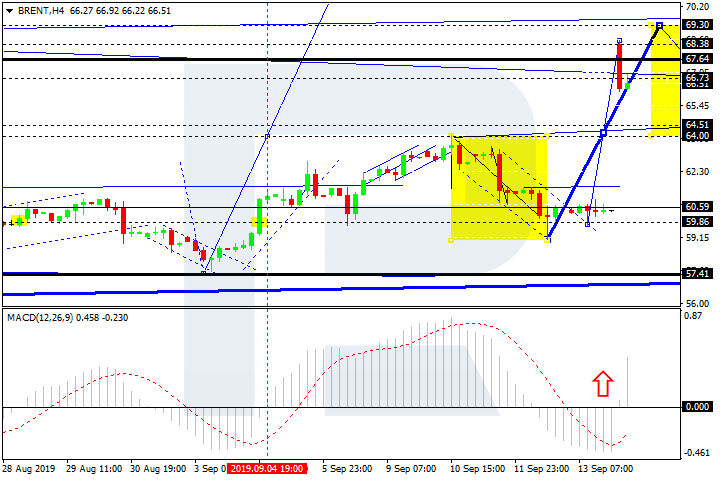
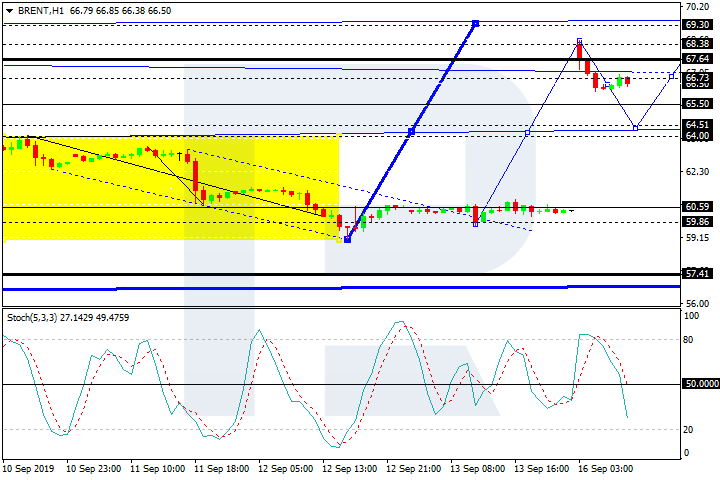
Brent has reached 68.38; right now, it is correction towards 64.73. Later, the market may resume trading inside the uptrend with the target at 69.30.

BRENT
Risk Warning: the result of previous trading operations do not guarantee the same results in the future

BTCUSD, “Bitcoin vs US Dollar”

BTCUSD is consolidating above 10180.00. Possibly, today the pair may move downwards to reach 9850.00 and then resume growing to return to 10180.00. After that, the instrument may form a new descending structure with the target at 9800.00.

BITCOIN

Article By RoboForex.com

Attention!
Forecasts presented in this section only reflect the author’s private opinion and should not be considered as guidance for trading. RoboForex LP bears no responsibility for trading results based on trading recommendations described in these analytical reviews.

Fibonacci Retracements Analysis 16.09.2019 (GOLD, USDCHF)

Article By RoboForex.com

XAUUSD, “Gold vs US Dollar”

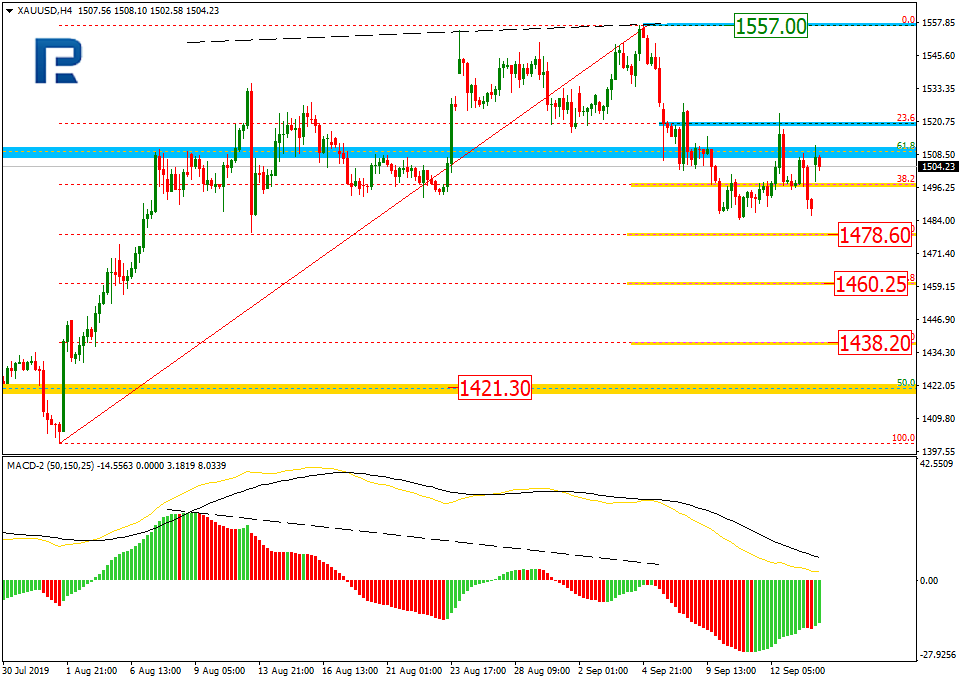
As we can see in the H4 chart, after reaching 38.2% fibo, XAUUSD has returned to 23.6% fibo. The current movement may be considered as a short-term correction before a new descending wave. The next downside targets may be 50.0%, 61.8%, and 76.0% fibo at 1478.60, 1460.25, and 1438.20 respectively. The key resistance is the high at 1557.00.

GOLD_H4
Risk Warning: the result of previous trading operations do not guarantee the same results in the future

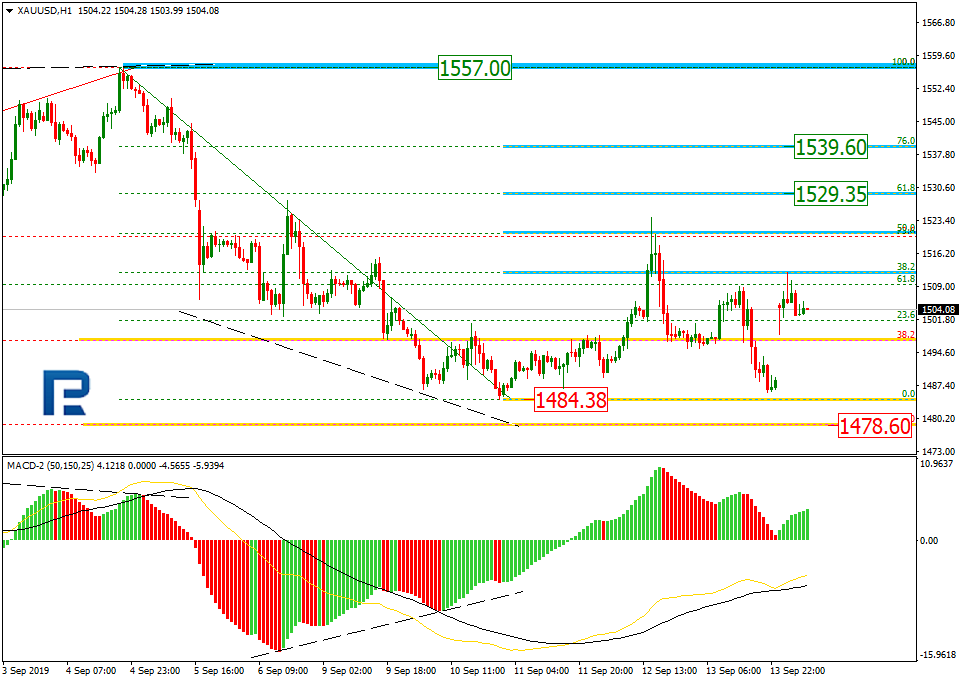
In the H1 chart, the convergence made the pair start a new pullback to the upside, which has already reached 50.0% fibo. The next upside targets may be 61.8% and 76.0% fibo at 1529.35 and 1539.60 respectively. The key support is the low at 1484.38.

GOLD_H1
Risk Warning: the result of previous trading operations do not guarantee the same results in the future

USDCHF, “US Dollar vs Swiss Franc”

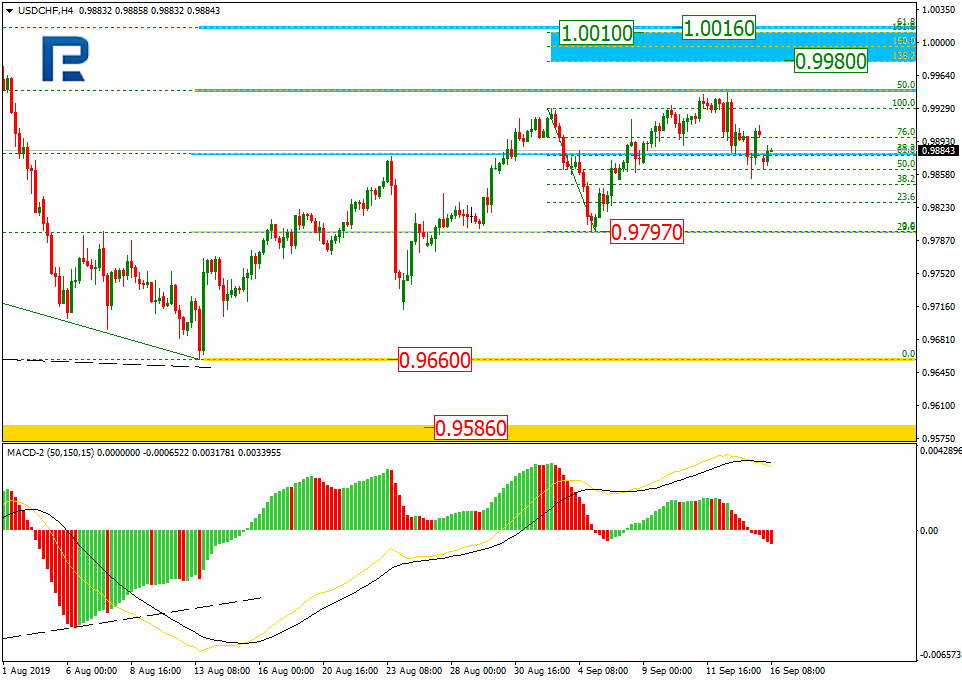
As we can see in the H4 chart, the correctional uptrend has already reached 50.0% fibo. At the same time, there is a divergence on MACD, which may indicates a new descending wave. However, as long as the price doesn’t break the support at 0.9797, USDCHF is expected to continue growing towards the post-correctional extension area between 138.2% and 161.8% fibo at 0.9980 and 1.0010 respectively, as well as 61.8% fibo at 1.0016.

USDCHF_H4
Risk Warning: the result of previous trading operations do not guarantee the same results in the future

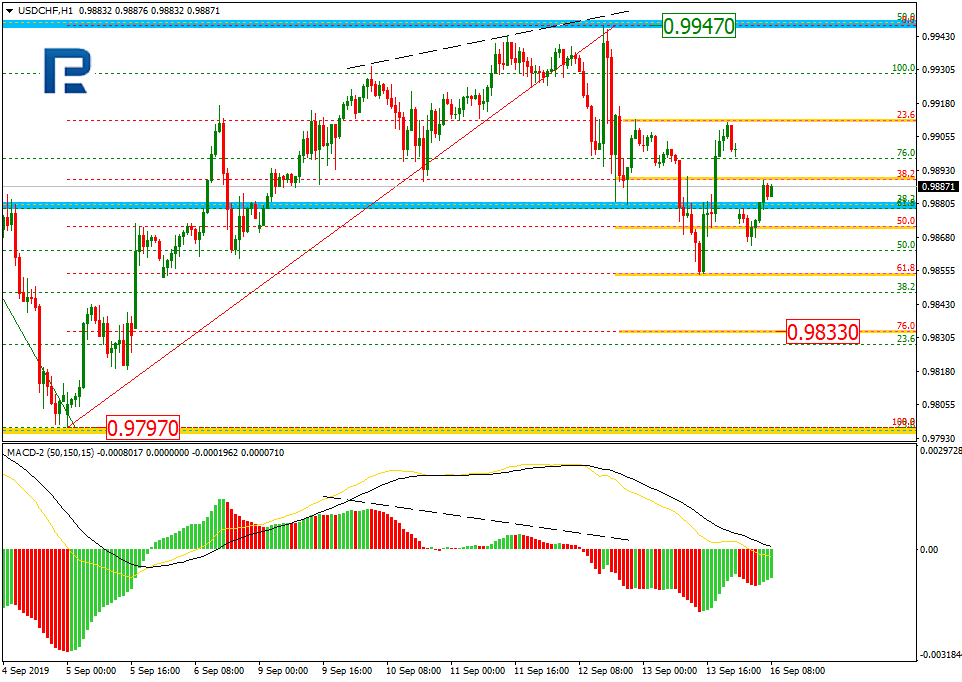
In the H1 chart, after reaching 61.8% fibo, USDCHF is correcting upwards. As long as the indicator lines are directed to the downside, one shouldn’t exclude a possibility that the price may fall to reach 76.0% fibo at 09833, while the rising impulse will be heading towards 0.9947.

USDCHF_H1

Article By RoboForex.com

Attention!
Forecasts presented in this section only reflect the author’s private opinion and should not be considered as guidance for trading. RoboForex LP bears no responsibility for trading results based on trading recommendations described in these analytical reviews.

Oil Intends To Skyrocket

By Dmitriy Gurkovskiy, Chief Analyst at RoboForex

The Oil market is extremely volatile and fluctuates significantly early in another September week. Brent is currently trading at 66.30 USD and may continue soaring.

It’s all about attacks of drones on Saudi Arabia facilities, which took place last weekend. There were two attacks on the Saudi Aramco oil facilities in Khurais and Abqaiq, one of which is the largest refinery in the world. This refining capacity covers about half of all oil production in Saudi Arabia, which is about 6 billion barrels per day. If damages are serious, and such is indeed the case, as they say, refineries won’t be restored very quickly. This, in its turn, means that Saudi Arabia’s supplies to the global oil market will significantly reduce and this quantity deficiency is what pushes the oil prices upwards.

The USA has already announced that the country is ready to fill the void with its own supplies, but the aspects of this are quite subtle.

Houthi rebels have already taken credit for the incident, but there are other versions as well, for example, Iran.

In the H4 chart, Brent is moving inside the third rising wave with the target at 69.30; right now, it is correcting towards 64.50. Later, the market may grow to reach 69.30 and then return to 64.50. After that, the instrument may resume trading upwards with the target at 70.60. From the technical point of view, this scenario is confirmed by MACD Oscillator: its signal is moving directly upwards.

As we can see in the H1 chart, Brent has completed another ascending structure and reached the target at 68.30; right now, it is correcting downwards to reach 64.50. After that, the instrument may start another growth towards 69.30. From the technical point of view, this scenario is confirmed by Stochastic Oscillator: its signal line has broken 50 to the downside, thus confirming a further correction.

Disclaimer

Any predictions contained herein are based on the authors’ particular opinion. This analysis shall not be treated as trading advice. RoboForex shall not be held liable for the results of the trades arising from relying upon trading recommendations and reviews contained herein.


The Analytical Overview of the Main Currency Pairs on 2019.09.16

by JustForex

The EUR/USD currency pair

Technical indicators of the currency pair:
  • Prev Open: 1.10638
  • Open: 1.10731
  • % chg. over the last day: +0.11
  • Day’s range: 1.10678 – 1.10864
  • 52 wk range: 1.0931 – 1.1817

An ambiguous technical picture has developed on the EUR/USD currency pair. A trading instrument is consolidating. Unidirectional trends are not observed. Recall that last week the ECB introduced additional measures to stimulate the eurozone economy. At the moment, participants in financial markets have taken a wait and see attitude before the Fed meeting. The local support and resistance levels are: 1.10550 and 1.10850, respectively. We recommend opening positions from these marks.

The Economic News Feed for 16.09.2019 is calm. At 15:30 (GMT+3:00), the NY Empire State manufacturing activity index will be published.

EUR/USD

The price fixed above 50 MA and 100 MA, which signals the strength of buyers.

The MACD histogram is in the positive zone, but below the signal line, which gives a weak signal to buy EUR/USD.

The Stochastic Oscillator is near the oversold zone, the %K line crossed the %D line. There are no signals at the moment.

Trading recommendations
  • Support levels: 1.10550, 1.10200, 1.09900
  • Resistance levels: 1.10850, 1.11100, 1.11300

If the price consolidates above the level of 1.10850, consider buying EUR/USD. The potential movement is to 1.11200-1.11400.

Alternatively, the qutoes could decrease toward 1.10300-1.10100.

The GBP/USD currency pair

Technical indicators of the currency pair:
  • Prev Open: 1.23325
  • Open: 1.24649
  • % chg. over the last day: +1.36
  • Day’s range: 1.24563 – 1.25028
  • 52 wk range: 1.1995 – 1.3385

The GBP/USD currency pair continues to show a pronounced upward trend. On Friday, September 13, the quotes grew by more than 170 points. Northern Ireland’s largest political party agreed to accept some of the rules of the European Union after Brexit. Currently, GBP/USD quotes are consolidating. Local levels of support and resistance are: 1.24300 and 1.25000, respectively. In the near future, technical correction is not ruled out. Positions must be opened from key levels.

The Economic News Feed for 16.09.2019 is calm.

GBP/USD

The price fixed above 50 MA and 100 MA, which signals the strength of buyers.

The MACD histogram is in the positive zone, but below the signal line, which gives a weak signal to buy GBP/USD.

The Stochastic Oscillator is in the oversold zone, the %K line crossed the %D line. There are no signals at the moment.

Trading recommendations
  • Support levels: 1.24300, 1.23800, 1.22900
  • Resistance levels: 1.25000, 1.25500

If the price consolidates above the resistance level of 1.25000, expect growth toward 1.25400-1.25600.

Alternatively, the quotes can correct toward 1.23800-1.23400.

The USD/CAD currency pair

Technical indicators of the currency pair:
  • Prev Open: 1.32041
  • Open: 1.32203
  • % chg. over the last day: +0.56
  • Day’s range: 1.32109 – 1.32479
  • 52 wk range: 1.2727 – 1.3664

Today, the USD/CAD currency pair opened with a gap down of more than 60 points. Demand for commodity currencies grew significantly amid a sharp rally of oil quotes. Prices for oil rose by almost 10% after attacks on oil facilities in Saudi Arabia, which led to a loss of about 5-6% of world production of raw materials. At the moment, USD/CAD quotes are consolidating in the range of 1.32100-1.32500. Positions must be opened from these marks.

The Economic News Feed for 16.09.2019 is calm.

USD/CAD

Indicators point to the strength of buyers: the price has fixed above 50 MA and 100 MA.

The MACD histogram is in the positive zone, but below the signal line, which gives a weak signal to buy USD/CAD.

The Stochastic Oscillator is located near the overbought zone, the %K line is above the %D line, which also indicates bullish sentiment.

Trading recommendations
  • Support levels: 1.32100, 1.31800, 1.31600
  • Resistance levels: 1.32500, 1.32850, 1.33150

If the price consolidates above 1.32500, expect further growth 1.32800-1.33000.

Alternatively, the quotes could drop 1.31800-1.31600.

The USD/JPY currency pair

Technical indicators of the currency pair:
  • Prev Open: 108.080
  • Open: 107.531
  • % chg. over the last day: -0.30
  • Day’s range: 107.498 – 107.914
  • 52 wk range: 104.97 – 114.56

The USD/JPY currency pair is in lateral movement. Unidirectional trends are not observed. In the near future, technical correction of the trading instrument is not ruled out after a significant increase since the beginning of this month. At the moment, the local support and resistance levels are 107.500 and 107.900, respectively. We recommend that you pay attention to the dynamics of the yield of US government securities. Positions must be opened from key levels.

Japan’s financial markets are closed due to the holiday.

USD/JPY

Indicators do not give accurate signals: the price crossed 50 MA and 100 MA.

The MACD histogram is in the negative zone, which indicates a bearish mood.

The Stochastic Oscillator is in the overbought zone, the %K line crossed the %D line. There are no signals at the moment.

Trading recommendations
  • Support levels: 107.500, 107.150, 106.700
  • Resistance levels: 107.900, 108.250, 108.500

If the price consolidates below 107.500, expect further correction toward 107.000.

Alternatively, the quotes can grow toward 108.250-108.500.

by JustForex

Demand for Commodity Currencies Has Risen After Attacks in Saudi Arabia

by JustForex

Last week, the ECB meeting was a key event in the financial markets. The regulator, as expected, introduced additional measures to stimulate the Eurozone economy. The Central Bank also lowered its forecast for GDP growth and inflation in the Eurozone for the current and next years. Donald Trump criticized the Fed for a “strong” dollar. Financial market participants expect the Fed and the Bank of England meetings.

Demand for commodity currencies has increased significantly after attacks on oil facilities in Saudi Arabia, which led to a loss of about 5-6% of world production of raw materials. The growth of oil quotes exceeded 9%. The United States blamed Iran for this incident. Donald Trump said that the United States was on alert. The US President also allowed the use of strategic oil reserves to stabilize the situation in the oil market. We recommend following the current information on this issue.

The British pound reached the $1.25 mark amid optimistic Brexit news. Northern Ireland’s largest political party agreed to accept some of the rules of the European Union after Brexit. Investors also continue to monitor trade negotiations between Washington and Beijing.

Market Indicators

On Friday, the main US stock indices showed mixed results: #SPY (-0.07%), #DIA (+0.10%), #QQQ (-0.36%).

The 10-year US government bonds yield has moved away from local highs. At the moment, the indicator is at the level of 1.82-1.83%.

The Economic News Feed for 16.09.2019:
  • Today, the news feed will be calm enough. At 15:30 (GMT+3:00), the NY Empire State manufacturing index will be published.

by JustForex