Author Archive for InvestMacro – Page 156

EURUSD: bulls tested the resistance at 1.1035

By Alpari.com

On Tuesday the 15th of October, trading on the euro closed slightly up. The bulls managed to recover the losses incurred in the first half of the European session. The pair’s recovery was sparked by news on Brexit.

Irish Taoiseach Leo Varadkar said that progress has been made in the Brexit talks while lauding the EU’s flexible approach. Markets have started factoring in that a deal will be reached this week based on comments from chief EU negotiator Michel Barnier. The pound rose across the board following these developments.

Barnier later clarified that talk of a Brexit deal being reached was premature. The pound underwent a small correction while trading on the EURUSD pair went flat at around 1.1033.

Day’s news (GMT+3):

  • 11:30 UK: CPI (Sep), retail price index (Sep), PPI output (Sep), PPI input (Sep).
  • 12:00 Eurozone: CPI (Sep), trade balance (Aug).
  • 15:30 Canada: CPI (Sep).
  • 15:30 US: retail sales (Sep).
  • 17:00 US: business inventories (Aug), NAHB housing market index (Oct).
  • 21:00 US: Fed’s Beige Book.
  • 23:00 US: net long-term TIC flows (Aug).
  • 23:30 US: API weekly crude oil stock (11 Oct).

EURUSD H1Current situation:

Yesterday’s expectations were met. The pair dropped to the trend line. In Asia, the bulls broke the 1.1038 resistance before running out of steam at 1.1060. The bulls on our main pair have been boosted by the pound, which is currently dictating movements on all the majors. There is one cause for concern. The optimism over a deal being reached between the US and China has subsided. On the 15th of October, the yuan dropped 0.2% against the US dollar, falling a further 0.30% on the 16th to reach 7.10. Pressure is building. In response to the yuan’s drop, gold and yen have risen.

Today we expect to see a rise to 1.1070. With some strong economic data today, the pair could rise even further, but with the euro crosses under pressure, we could get some bearish impetus. If the pair drops below 1.1023 (if the hourly candlestick closes below this level), this will overturn our forecast.

By Alpari.com

TensorFlow or PyTorch? A Guide to Python Machine Learning Libraries (with examples!)

By The Kite Team

Introduction

Python is the fastest-growing programming language out there. That isn’t surprising given that it’s simple, easy to use, free, and applicable for many computing tasks. Data scientists in particular have embraced Python’s efficient syntax, learnability, and easy integrations with other languages such as C and C++.

All these positive qualities, along with the recent spike of interest in machine learning and artificial intelligence, can help explain the plethora of powerful open-source libraries and frameworks for machine learning and data science applications. There are libraries that can be put to use in a multitude of applications, including:

  • natural language processing / NLP (Tensorflow)
  • visualization and analysis of complex data (Theano)
  • image recognition (Caffe)
  • prediction and recommendation

Open-source frameworks have popped up to address all of the above applications, and now it can be confusing to decide on which library to use for which project. Tensorflow or Sci-kit? Should I use Keras on top of Microsoft’s CNTK? What’s the best application to use MXNet?

Once you’ve determined the goals and overall priorities for your project, this article can help you select the language that is the best fit for your project. Some of the questions that you’ll need to consider include:

  • Your confidence level with machine learning fundamentals
  • If you will be using the framework for classic machine learning algorithms or for Deep Learning
  • What application you will be using the framework for: be it heavy numerical computations, complex data analysis, image analysis, or education and research
  • Whether or not you’ll be using any additional hardware (like GPUs and TPUs), software, or cloud services for scaling on to bigger data sets.

Each open-source framework available today has its own strengths and weaknesses when measured across these factors. And choosing the best framework for your needs will really depend on just what you want to accomplish.

For example, if you are new to machine learning or want to use classic machine learning algorithms, Sci-kit could be the best choice. On the other hand, if you need to do heavy numerical computations, Theano would work much better. In any case, no matter your specific situation – this guide will aim to help you figure out which framework is the perfect fit.

LibraryBest ApplicationCan Run on External HardwareMachine Learning or Deep Learning?ML Knowledge required (beginner, intermediate, advanced)Learning Curve
Sci-Kit LearnLearning MLNoML onlyBeginnerVery Low
PyTorchAcademic use and productionYesBothBeginnersLow
CaffeImage processingYesBothMid-levelLow
TensorFlowProcessing large data sets quicklyYesBothintermediateHigh
TheanoHigh-speed computationYesBothAdvancedVery High

Among all the myriad of options available for open-source Python frameworks, here is the compilation of our top 5 choices in descending order. You can follow along with examples for each library, stored in Kite’s github repository.

5. Sci-Kit Learn

Ideal for: ML beginners

Sci-kit Learn is a library that features a host of the classical machine learning algorithms like Support Vector Machines (SVMs), KNN Maps, K-Nearest Neighbors (KNN) classifiers, Random Forests, and regression algorithms. It includes options for both supervised and unsupervised learning. Thus, it’s ultimately an effective tool for statistical modeling.

It has been built on many other Python libraries like SciPy, Numpy, and Matplotlib, and some of its core algorithms are also written using Cython. I created an example of a Sci-Kit operation here.

Strengths:

  • Great for beginners and for those looking to explore machine learning algorithms
  • Good for data-mining and simple projects like predictions on small or labeled data sets

Weaknesses:

  • Does not support ANNs
  • Does not support GPU computing

What sets this framework apart from others is an easy-to-use interface for developers and a high level of abstraction that allows especially beginners in machine learning to get easily acquainted with the platform, without having to deal with the nitty-gritty of actual algorithms.

It’s easy to run and debug, and there are some nice and easy tutorials available to help understand the algorithms when you do have to work with them. However, Sci-kit Learn does have a couple of limitations.

First, it does not support Artificial Neural Networks.

Second, it’s only suitable for small projects with small datasets, and for tasks that are not particularly computationally intensive. This is mainly due to the fact that the framework does not support GPU computing.

For more seasoned or hard-core developers, it can feel limiting to some extent, as the abstraction doesn’t allow for fine tuning the underlying algorithms.

4. Theano

Ideal for: Hardcore developers requiring high-speed computation over a single GPU

If you’re looking for a framework that can crunch numbers like a pro, then Theano will be your best bet.

Theano is a workhorse well-equipped for numerical computing and sits under a large number of other deep learning frameworks like Tensorflow and Keras. The framework lets you efficiently work with mathematical expressions that include multi-dimensional arrays.

Strengths:

  • Efficiency in crunching large and multi-dimensional data sets
  • Provides the developer ample flexibility to fine-tune underlying algorithms and create novel models.

Weakness:

  • A very steep learning curve
  • Does not support scaling over multiple GPUs

While Sci-kit Learn is for beginners, Theano is only for advanced deep learning experts.

The API is low-level, so you really need feel comfortable in your coding abilities if you’re looking to explore this framework. The syntax for Theano is quite tightly integrated with NumPy and its code can run efficiently – both on a CPU and a GPU. You can see an example of a script using Theano here.

In contrast to Sci-kit learn, Theano empowers any developer with a complete flexibility to fine-tune and control their models. It even allows the developer to implement and test completely unconventional models.

Although Theano works better than Tensorflow over a single GPU, it still doesn’t match up to Tensorflow when working with multiple GPUs.

However, since Theano has been around longer, it does have a lot more documentation. The biggest drawback is that MILA, the makers of Theano, have decided to stop maintaining the framework following its 1.0 release. Nonetheless, it continues to be a great choice for avid deep learning enthusiasts.

3. Caffe

Ideal for: Mid-level programmers and image processing

Caffe (Convolutional Architecture for Fast Feature Embedding) was mainly built to support Convolutional Neural Networks (CNNs) and is the framework of choice for those working on computer vision, image processing, and feedforward networks.

The framework is a Python-based API, which was mainly written in C++. Models in Caffe are represented by Protobuf configuration files and the framework, is, in fact, the fastest CNN implementation among all Deep Learning frameworks.

It works well on image segmentation and classification tasks. With a single GPU, Caffe can process more than 60 million images in a day! Here is a simple example of using a pre-trained Caffe model to correctly identify an image as the digit, “5”.

Strengths:

  • Has great ready-to-use models for image recognition
  • It is the fastest CNN implementation framework
  • Models and optimizations are configured rather than coded

Weaknesses:

  • Not suitable for RNNs
  • Poor documentation
  • Creating new layers requires defining full forward, backward and gradient updates

The best thing about Caffe is that models and optimizations are not ‘coded’, but rather ‘configured’ – this reduces a lot of headaches for developers.

So, if you have a large set of images that you need to classify or run some regression algorithms on, you can quickly apply a DL Network without having to write even a line of code.

You can also train over multiple GPUs, but this has some limitations: for example, you can’t do model/data parallelism.

Another upside of Caffe is that it has a pretty good developer community – there’s a whole ‘Model Zoo’ available where you can find a number of CNN implementations and models, like AlexNet, GoogleNet, NIN, etc. This is something that other frameworks lack.

Although the framework is great for CNNs and image processing, it’s not suitable for Recurrent Neural Networks (RNNs) and applications involving text, sound, and time series data. Moreover, even though there are a lot of layers ready to be implemented, the creation of new layers can be tedious, as one would need to define full forward, backward and gradient updates for each new layer.

Finally, the framework offers a medium-level abstraction – it’s high-level enough to allow you to do quick experiments and flexible enough to allow you to fine-tune some of the aspects. This detail may be a positive for mid-level developers, but it feels somewhat limiting for hardcore developers.

2. Pytorch

Ideal for: Both academic use and production

Pytorch was developed using Python, C++ and CUDA backend. Created by the Facebook Artificial Intelligence Research team (FAIR), Pytorch is fairly new but is already competing neck-to-neck with Tensorflow, and many predict it will soon become a go-to alternative to many other frameworks.

Strengths:

  • Coding is easy, so it has a flatter learning curve
  • Supports dynamic graphs so you can adjust on-the-go.
  • Supports GPU acceleration

Weaknesses:

  • Quite new, so it has a smaller community and fewer resources available online

Pytorch is being lauded particularly by beginners, mostly due to its easy-to-write code – but the framework is basically a blend of both high and low-level APIs. In actuality, it’s suitable for both academic uses as well as hard-core deep learning.

It features a number of pre-trained models. When coding in Pytorch, you don’t need to categorize numbers into ‘int’, ‘short’, or ‘double’ data types, like other coding languages. This makes the performance of operations and functions on this framework more intuitive compared to other options. You can see example code for PyTorch here.

The highlight of this framework, though, is that it offers developers the ability to use dynamic graphs. Tensorflow, Theano, and their derivatives allow you to create only static graphs, so you have to define the whole graph for the model before you can run it. However, in Pytorch, you can define or adjust your graph during runtime, so it’s more flexible and allows you to use variable length inputs, especially in your RNNs.

The framework also provides strong support for GPU acceleration, so you get both efficiency and speed.

The main drawback to Pytorch, though, is that the framework is still growing and you may encounter some bugs. Moreover, owing to its younger age, the resources to supplement its official documentation are still quite scant. But looking at overall trends, this will not be a problem for too long, as more and more developers are converting to Pytorch and the community is growing slowly but steadily.

1. Tensorflow

Ideal for: Intermediate-level developers and for developing production models that need to quickly process vast data sets

Tensorflow is currently hailed as the best ML framework out there. Within a very short time, it has become a favorite for many developers and is witnessing an ever-growing community and extraordinary development momentum.

The framework was developed by the Google Brain team and supports all platforms, from Linux to Android. It is a high-level framework that allows you to run low-level code with supporting libraries. Ultimately, it allows you to monitor the progress of the training process, while tracking a lot of metrics and not having to bother about most of the other details.

Strengths:

  • Flexibility
  • Contains several ready-to-use ML models and ready-to-run application packages
  • Scalability with hardware and software
  • Large online community

Weaknesses:

  • Supports only NVIDIA GPUs
  • A slightly steep learning curve

Tensorflow’s architecture and UX are different from other frameworks in that the nodes in a Tensorflow graph represent mathematical operations, while the edges of the graph represent multidimensional arrays (tensors). These tensors flow between the nodes, giving you a lot of flexibility when it comes to creating new nodes, unlike the Caffe architecture, for example.

The system also has a host of models to choose from: the framework is pre-loaded with packages that let you perform voice recognition and machine translation, and models that let you run regressions, classifications, neural networks and an assortment of other algorithms.

Tensorflow can be used for quite a few applications within machine learning. Check out a basic “Hello, World” program here and a more traditional matrix example here.

But the feature that really takes the cake is Tensorflow’s computing capabilities. To date, Tensorflow is the strongest contender in the distributed processing arena. It provides remarkable scalability and lets you deploy your computations to multiple CPUs, GPUs, other servers, mobile devices, and the Google Cloud Machine Learning Engine. You can do this without having to rewrite any code – that’s truly powerful.

The main downside, though, is that at the moment, it only supports NVIDIA GPUs. Also, when it comes to RNN support, it is ultimately weaker than some other frameworks and the learning curve can be a little steeper than Sci-kit and Pytorch.

Overall, with a strong Google backing and a huge online community, Tensorflow is here for the long haul.

Conclusions

To sum up, while Tensorflow has gained enormous popularity owing to its flexibility and distributed processing capabilities, Pytorch is also slowly gaining momentum owing to its flatter learning curve and ability to process dynamic graphs. Both of these frameworks are multi-purpose and can be applied to many types of projects. Other frameworks like Caffe, Theano, and Sci-Kit Learn are more specialized and aimed toward specific tasks.

Nonetheless, machine learning and artificial intelligence are the future, and these open source frameworks have brought ML within the grasp of any developer with a really keen interest. These libraries provide the tools for any Pythonista to practice machine learning principles. Pick a framework that meets your level of expertise and application domain and try out your first project!


US Major Indexes Retest Critical Price Channel Resistance

By TheTechnicalTraders.com

News, again, drives the US stock market and major indexes higher as optimism of a US/China trade agreement floods the news wires.  As we’ve been suggesting, the global markets continue to be news-driven and are seeking any positive news related to easing trade tensions and capital markets.  We believe any US/China trade deal would be received as very positive news by the global capital markets – yet we understand the process of achieving the components of the “deal” would likely still be 6 to 24 months away.

Still, with the strength of the US economy and the potential that some deal could be reached before the end of 2019 setting positive expectations, the US stock market and major indexes rallied last Thursday and Friday (October 10 and 11).  As the long holiday weekend sets up with no trading on Monday, it will be interesting to see what is potentially resolved between President Trump and the Chinese before the markets start to react on Sunday and Monday nights. Make sure up opt-in to our free market trend signals newsletter.

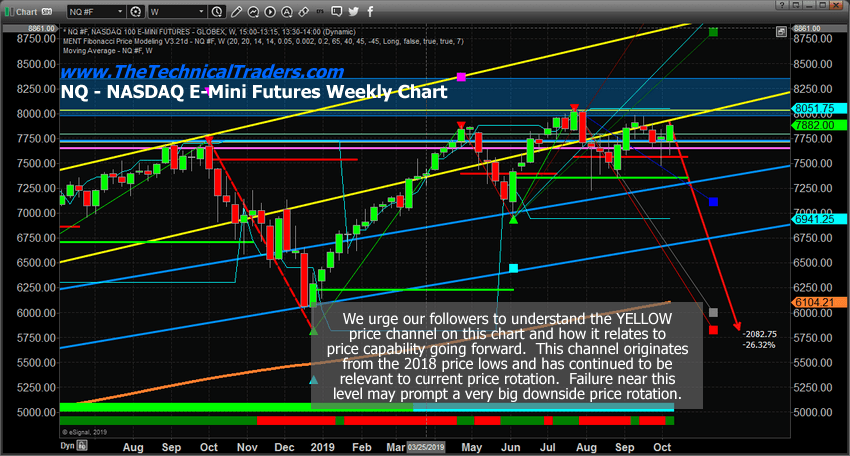
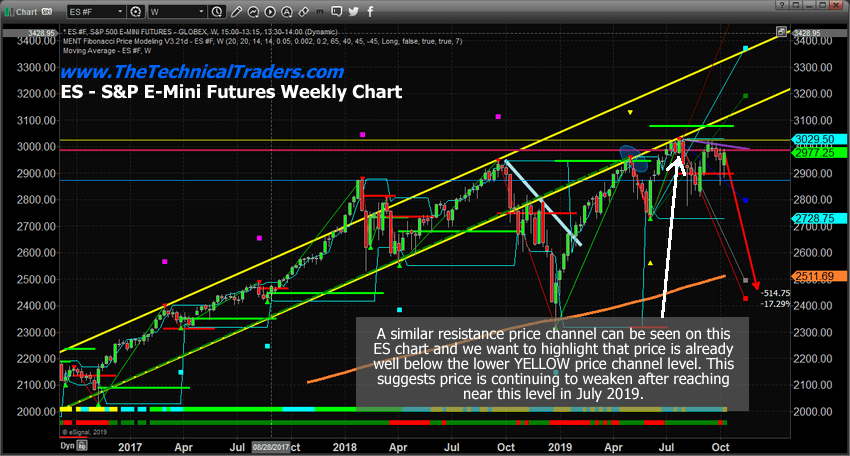
Our research team wanted to highlight some very key elements related to technical price theory and technical analysis.  These weekly charts highlight what we believe is “key resistance” in the US major indexes and share our research team’s concern that the markets may be reacting to news more than relying on fundamental economic and earnings valuations.  In past articles, we’ve highlighted how a “capital shift” is continuing to take place where foreign capital is actively seeking safety and security for future returns.  This leads to a shift in how capital is being deployed throughout the globe.

The current price channels in these Weekly charts highlight two key facets of the current market setup.  Either the US stock market will attempt to rally above this lower yellow price channel and attempt to regain strength between the two yellow price channels, or it will fail near the current price level and attempt to identify new support somewhere below the current price rotation ranges.

Just a few days ago, we posted this research article to alert traders of the Pennant/Flag formation that is setting up in the US markets …

October 7, 2019: US STOCK MARKETS TRADE SIDEWAYS – WAITING ON NEWS/GUIDANCE

Nasdaq Weekly Chart

With the holiday weekend upon us, we believe the news and economic data will continue to drive the market’s future moves and that volatility will continue to increase.

This Weekly ES chart highlights a similar setup, yet one key fact must be understood.  Price has already fallen away from the lower YELLOW price channel level and established a “lower high” price rotation recently.  Any price rally failure near this level may prompt a very big downside move.  The price must continue to rally above 3100 is price makes any attempt at further gains.

CONCLUDING THOUGHTS:

We believe skilled technical traders have already digested and are well aware of the risks that are present in the current market environment.  We’ve been urging our followers to stay mostly in cash and to consider very strategic, expertly timed, investments when price trends are relatively secure.

This is not a speculative market any longer – this is a very volatile and uncertain market that is currently resting as major resistance levels.  Don’t get overly aggressive at this point.  It is better for the markets to tell us what it wants to do.  Lower risk, lower chance of disaster and live to trade another day – these should be hammered into the heads of traders at this stage of the markets.

Our morning coffee video analysis recap is the one thing… that single investment that’s going to turn into the greatest investment you’ve ever made for your trading.

As a technical analysis and trader since 1997, I have been through a few bull/bear market cycles. I believe I have a good pulse on the market and timing key turning points for both short-term swing trading and long-term investment capital. The opportunities are massive/life-changing if handled properly.

Be sure to ride my coattails as I navigate these financial markets and build wealth while others lose nearly everything they own during the next financial crisis.

I can tell you that huge moves are about to start unfolding not only in metals, or stocks but globally and some of these supercycles are going to last years. My simple technical trading strategy using ETFs will allow you to follow the markets closely and trade with it so you never get caught on the wrong side of the market with big losses.

Chris Vermeulen
Subscribe Today – TheTechnicalTraders.com

NOTICE: Our free research does not constitute a trade recommendation or solicitation for our readers to take any action regarding this research.  It is provided for educational purposes only.  Our research team produces these research articles to share information with our followers/readers in an effort to try to keep you well informed.  Visit our web site to learn how to take advantage of our members-only research and trading signals.


Fibonacci Retracements Analysis 15.10.2019 (EURUSD, USDJPY)

Article By RoboForex.com

EURUSD, “Euro vs US Dollar”

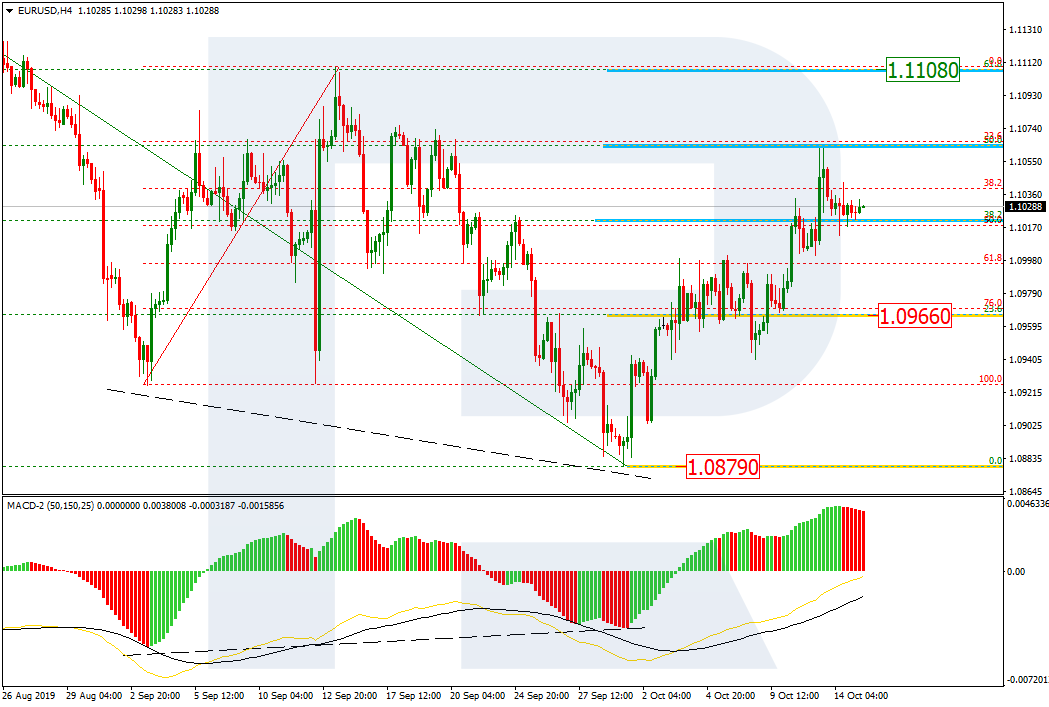
As we can see in the H4 chart, the correctional uptrend has reached 50.0% fibo. Right now, the price is forming a short-term descending correction. The local support is 23.6% fibo at 1.0966. After finishing the correction, EURUSD may start a new rising impulse to reach 61.8% fibo at 1.1108.

EURUSD_H4
Risk Warning: the result of previous trading operations do not guarantee the same results in the future

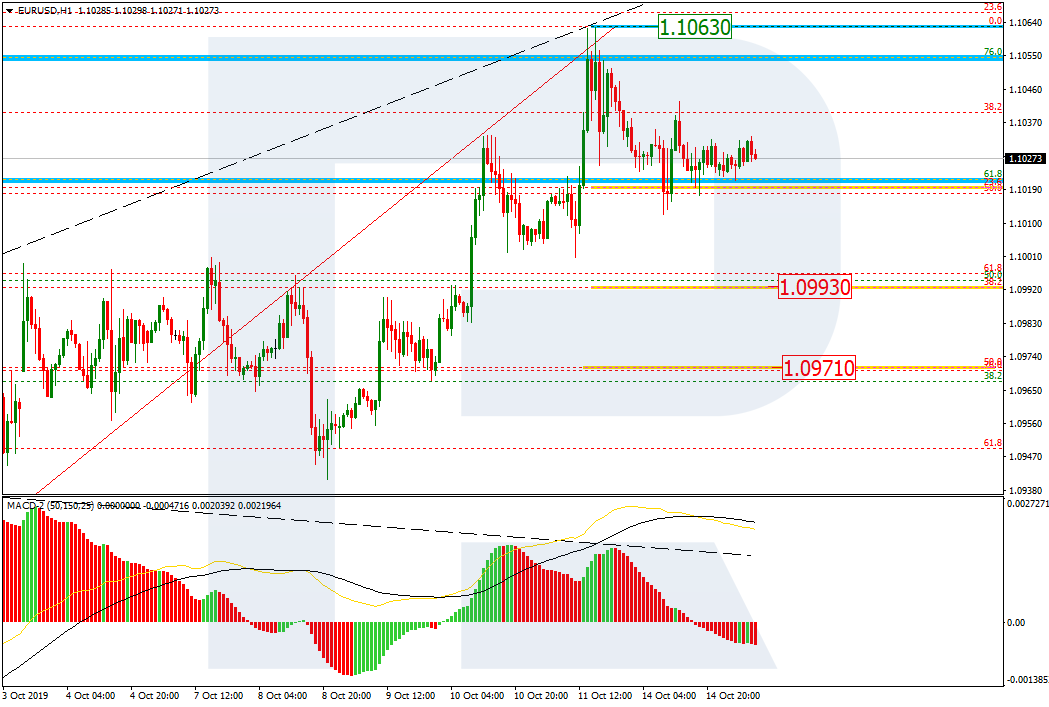
Looking at the H1 chart, we can see that the divergence made EURUSD start a new correctional decline, which has already reached 23.6% fibo. Later, the instrument may continue falling towards 38.2% and 50.0% fibo at 1.0993 and 1.0971 respectively. The resistance is the high at 1.1063.

EURUSD_H1
Risk Warning: the result of previous trading operations do not guarantee the same results in the future

USDJPY, “US Dollar vs. Japanese Yen”

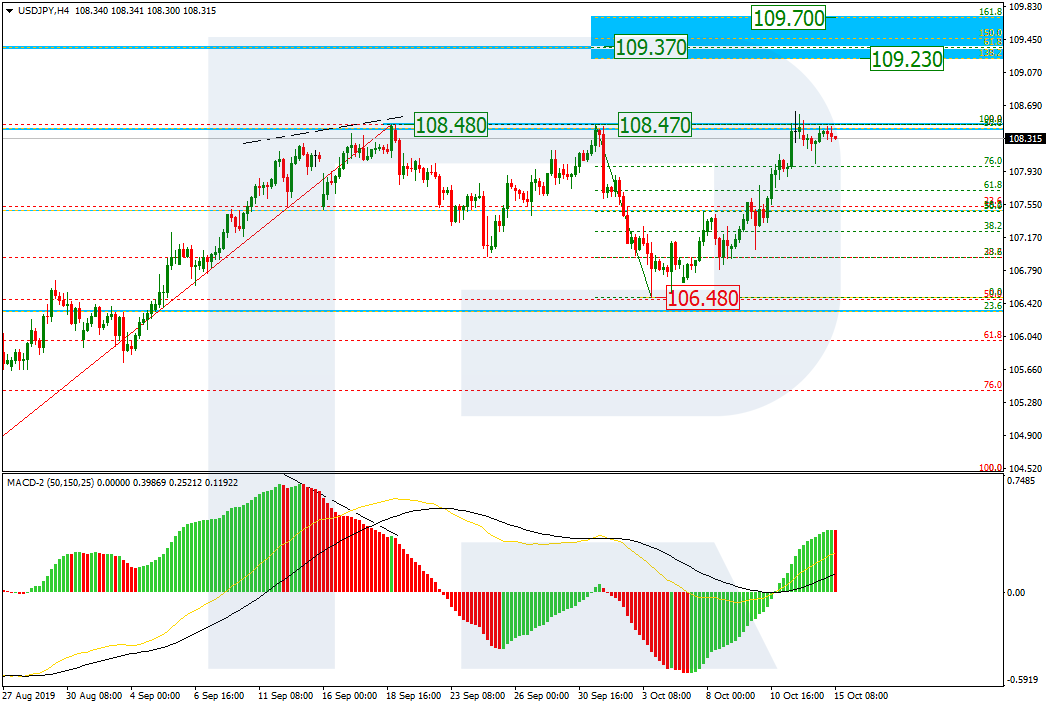
As we can see in the H4 chart, USDJPY has tested both the high and 50.0% fibo. In the short-term, the pair may form a slight pullback. After completing it, the price may continue growing towards 61.8% fibo at 109.37, which is inside the post-correctional extension area between 138.2% and 161.8% fibo at 109.23 and 109.70 respectively. The support is at 106.48.

USDJPY_H4
Risk Warning: the result of previous trading operations do not guarantee the same results in the future

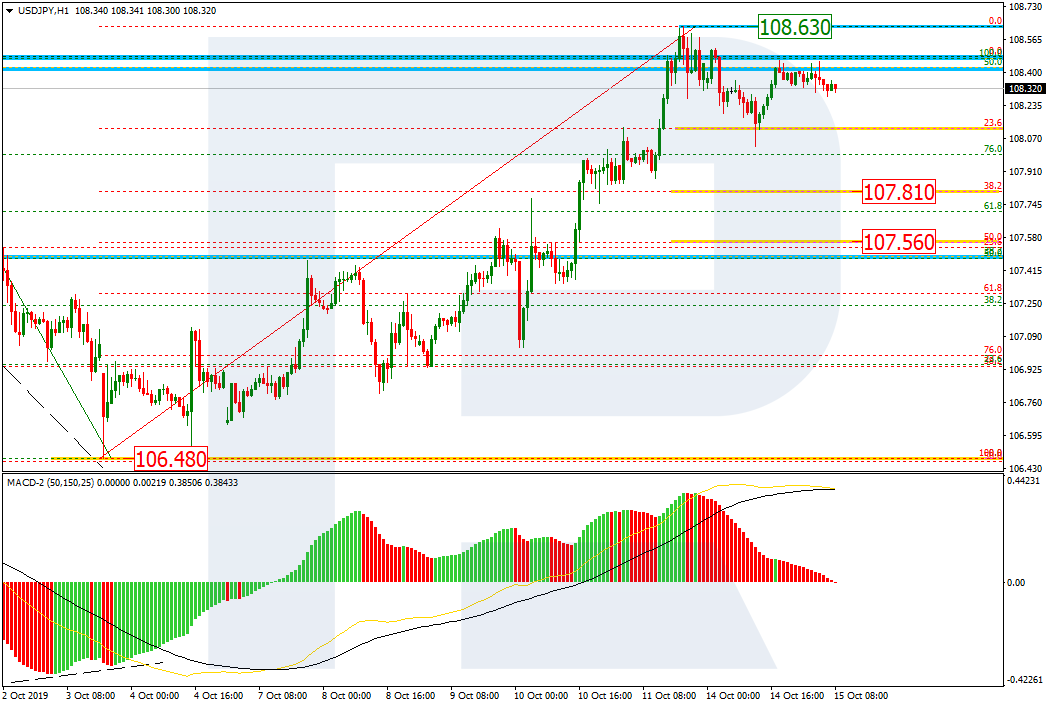
In the H1 chart, the price is forming a new descending pullback and has already reached 23.6% fibo. The next downside targets may be 38.2% and 50.0% fibo at 107.81 and 107.56 respectively. The resistance is the high at 108.63.

USDJPY_H1

Article By RoboForex.com

Attention!
Forecasts presented in this section only reflect the author’s private opinion and should not be considered as guidance for trading. RoboForex LP bears no responsibility for trading results based on trading recommendations described in these analytical reviews.

Japanese Candlesticks Analysis 15.10.2019 (GOLD, NZDUSD)

Article By RoboForex.com

XAUUSD, “Gold vs US Dollar”

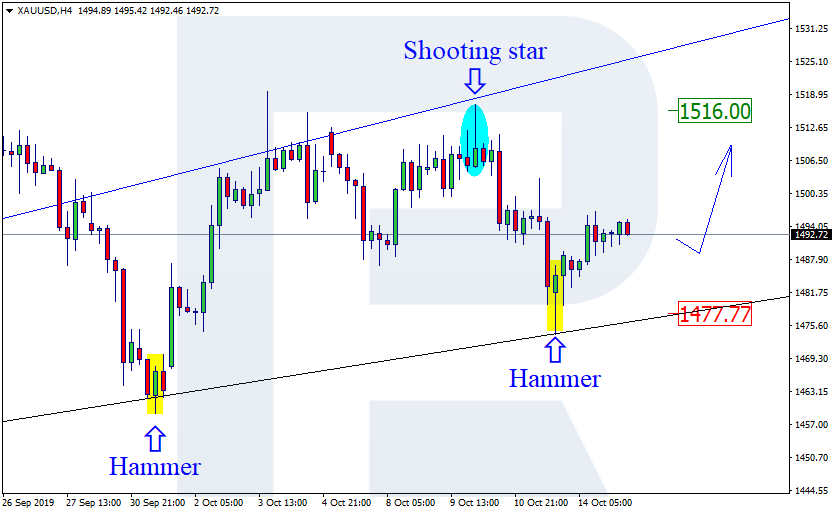
As we can see in the H4 chart, the ascending tendency continues. XAUUSD has formed Hammer reversal pattern close to the support level. At the moment, the pair is starting to reverse. If the price continues growing, it may return to 1516.00 to continue forming the ascending tendency. At the same time, we shouldn’t exclude an opposite scenario, which implies that the instrument may resume falling to reach 1477.77.

GOLD
Risk Warning: the result of previous trading operations do not guarantee the same results in the future

NZDUSD, “New Zealand vs. US Dollar”

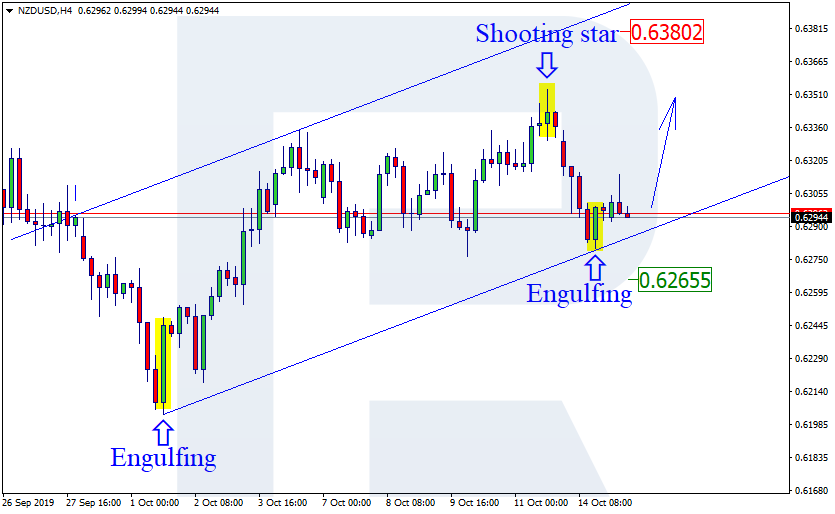
As we can see in the H4 chart, the ascending tendency continues. NZDUSD has formed several reversal patterns, including Engulfing, close to the support level. Right now, the pair is reversing and may start a slight correction, which may later be followed by further growth towards 0.6380. At the same time, one shouldn’t exclude an opposite scenario, according to which the instrument may continue falling towards 0.6265.

NZDUSD

Article By RoboForex.com

Attention!
Forecasts presented in this section only reflect the author’s private opinion and should not be considered as guidance for trading. RoboForex LP bears no responsibility for trading results based on trading recommendations described in these analytical reviews.

The Analytical Overview of the Main Currency Pairs on 2019.10.15

by JustForex

The EUR/USD currency pair

Technical indicators of the currency pair:
  • Prev Open: 1.10316
  • Open: 1.10271
  • % chg. over the last day: -0.02
  • Day’s range: 1.10215 – 1.10334
  • 52 wk range: 1.0884 – 1.1623

An ambiguous technical picture has developed on the EUR/USD currency pair. A trading instrument is consolidating. At the moment, the local support and resistance levels are 1.10150 and 1.10400, respectively. Financial market participants are waiting for new information regarding trade negotiations between the US and China. Today, investors will evaluate important economic releases from Germany. Positions must be opened from key levels.

The Economic News Feed for 15.10.2019:

  • – ZEW economic sentiment index (GER) – 12:00 (GMT+3:00);
  • – ZEW economic sentiment index (EU) – 12:00 (GMT+3:00);
  • – NY Empire State manufacturing activity index (US) – 15:30 (GMT+3:00);
EUR/USD

Indicators do not give accurate signals: the price crossed 50 MA.

The MACD histogram is located near the 0 mark.

The Stochastic Oscillator is in the neutral zone, the %K line crossed the %D line. There are no signals at the moment.

Trading recommendations
  • Support levels: 1.10150, 1.09900, 1.09650
  • Resistance levels: 1.10400, 1.10600

If the price consolidates above the resistance level of 1.10400, expect further growth toward 1.10700-1.10900.

Alternatively, the quotes can decrease toward 1.09900-1.09700.

The GBP/USD currency pair

Technical indicators of the currency pair:
  • Prev Open: 1.26237
  • Open: 1.26016
  • % chg. over the last day: -0.06
  • Day’s range: 1.26008 – 1.26371
  • 52 wk range: 1.1959 – 1.3385

The British pound stabilized after a significant rally last week. Optimism over the settlement of the Brexit process began to weaken. EU diplomats said they want additional concessions from Prime Minister Boris Johnson. Currently, the GBP/USD currency pair is consolidating. The local support and resistance levels are: 1.25700 and 1.26450, respectively. We are expecting important economic reports from the UK. We recommend opening positions from key levels.

At 11:30 (GMT+3:00), UK will publish the labor statistics. Keep an eye on the speech by the head of the Bank of England.

GBP/USD

The price fixed above 50 MA and 100 MA, which signals the strength of buyers.

The MACD histogram is located in the positive zone and above the signal line, which gives a strong signal to buy GBP/USD.

The Stochastic Oscillator is in the neutral zone, the %K line is above the %D line, which also indicates bullish sentiment.

Trading recommendations
  • Support levels: 1.25700, 1.25150, 1.24250
  • Resistance levels: 1.26450, 1.27000

If the price consolidates above 1.26450, expect further growth toward 1.27000-1.27400.

Alternatively, the quotes will reduce toward 1.25200-1.24800.

The USD/CAD currency pair

Technical indicators of the currency pair:
  • Prev Open: 1.32012
  • Open: 1.32345
  • % chg. over the last day: +0.18
  • Day’s range: 1.32181 – 1.32345
  • 52 wk range: 1.2727 – 1.3664

The USD/CAD currency pair retreated from monthly lows after a sharp fall at the end of last week. CAD is currently consolidating. The local support and resistance levels are 1.32100 and 1.32400, respectively. A trading instrument has the potential to further decline. We recommend that you pay attention to the dynamics of prices for oil. Positions must be opened from key levels.

The publication of important economic reports from Canada is not planned.

USD/CAD

Indicators do not give accurate signals: the price crossed 50 MA.

The MACD histogram is near 0.

The Stochastic Oscillator is in the neutral zone, the %K line crossed the %D line. There are no signals at the moment.

Trading recommendations
  • Support levels: 1.32100, 1.31800
  • Resistance levels: 1.32400, 1.32700, 1.33000

If the price consolidates below 1.32100, expect further drop toward 1.31800-1.31500.

Alternatively, the quotes will grow toward 1.32700-1.32900.

The USD/JPY currency pair

Technical indicators of the currency pair:
  • Prev Open: 108.343
  • Open: 108.397
  • % chg. over the last day: +0.02
  • Day’s range: 108.281 – 108.447
  • 52 wk range: 104.97 – 114.56

The USD/JPY currency pair stabilized near two-month highs. The trading instrument is currently consolidating. The local support and resistance levels are 108.100 and 108.450, respectively. Investors continue to monitor the progress of trade negotiations between Washington and Beijing. We also recommend paying attention to the dynamics of yield on US government bonds. Positions must be opened from key levels.

n the Asian trading session, some weak data was published on the volume of industrial production and business activity in the Japanese services sector.

USD/JPY

Indicators do not give accurate signals: the price crossed 50 MA.

The MACD histogram is near 0.

The Stochastic Oscillator is in the neutral zone, the %K line crossed the %D line. There are no signals at the moment.

Trading recommendations
  • Support levels: 108.100, 107.750, 107.45
  • Resistance levels: 108.450, 108.700, 109.000

If the price consolidates above 108.450, expect further growth toward 108.700-109.000.

Alternatively, the quotes could decrease toward 107.800-107.600.

by JustForex

Investors Assess the Interim Agreement Between the US and China

by JustForex

The US dollar began to recover against a basket of major currencies. The dollar index (#DX) closed yesterday’s trading session in the positive zone (+0.17%). On Friday, it became known that the US and China signed the interim trade agreement. US Secretary of the Treasury, Steven Mnuchin, said that Washington would not raise tariffs from 25% to 30% on Chinese exports $250 billion worth. Beijing, in turn, promised to increase the purchases of US agricultural products.

The interim agreement prepares the ground for more serious negotiations between the US President Donald Trump and Chinese President Xi Jinping, which will be held at the APEC summit in Chile (November 16-17). After the summit, the interim agreement will be signed down to the ground. However, yesterday, it became known that China intended to hold additional negotiations at the end of October to discuss the details of the “first” deal before final approval.

EU leaders told British Prime Minister, Boris Johnson, that a deal on Brexit could not be concluded before the EU summit since there was not enough time. Meanwhile, last week, European Council President Donald Tusk said that an agreement on Brexit was still possible. Also recently, the EU Brexit coordinator, Michel Barnier, met with Brexit Secretary, Stephen Barclay, to discuss the prospects for a possible Brexit agreement. Both officials noted that the meeting was “constructive.”

The “black gold” prices are declining. Currently, futures for the WTI crude oil are testing the $52.50 mark per barrel.

Market Indicators

Yesterday, there was the bearish sentiment in the US stock markets: #SPY (-0.11%), #DIA (-0.11%), #QQQ (-0.01%).

The 10-year US government bonds yield increased significantly. At the moment, the indicator is at the level of 1.68-1.69%.

The Economic News Feed for 15.10.2019:
  • – Data on the labor market in the UK at 11:30 (GMT+3:00);
  • – German ZEW economic sentiment index at 12:00 (GMT+3:00).


We also recommend paying attention to the speech by the FOMC representatives.

by JustForex

EURUSD: bulls trying to get a bounce from the balance line

By Alpari.com

The US and Canada had a national holiday on Monday. Market activity was low. The major currencies fluctuated within limited ranges. The EURUSD traded within a range of 1.1013 to 1.1043 (30 pips). By the end of the day, the trading range has narrowed to 13 pips.

Day’s news (GMT+3):

  • 09:30 Switzerland: producer and import prices (Sep).
  • 09:45 France: CPI (Sep).
  • 11:30 UK: claimant count rate (Sep), ILO unemployment rate (Aug), average earnings (Aug).
  • 12:00 Germany: ZEW survey – economic sentiment (Oct).

EURUSD H1Current situation:

We forecasted a wide trading range yesterday amid the US and Canadian national holidays, but it turned out narrower than expected with the pair hovering around the balance line. The volume profile filled the void from the 11th of October. This suggests that the market is ready to push the rate to new levels.

There’s a support zone between 1.1005 and 1.1013. If this falls, the trend line will be tested. It currently runs through 1.0990.

The stochastic is in the sell zone, so we expect the rate to drop to the 45th degree at 1.1009 after an initial rise to 1.1042. Today’s major economic event is the employment report from the UK. It’s important for the pound, so expect a surge in volatility at 11:30 (GMT+3) on GBP pairs. The EURGBP pair will have a ripple effect on the EURUSD. After a test of the 45th degree, we can expect a renewed rally.

By Alpari.com

Forex Technical Analysis & Forecast 14.10.2019 (EURUSD, GBPUSD, USDCHF, USDJPY, AUDUSD, USDRUB, USDCAD, GOLD, BRENT, BTCUSD)

Article By RoboForex.com

EURUSD, “Euro vs US Dollar”

After rebounding from 1.1000 and completing another ascending structure at 1.1062, EURUSD has finished one more descending impulse along with the correction; right now, it is forming the second descending impulse with the target at 1.0986. Later, the market may start a new growth to return to 1.1062.

EURUSD
Risk Warning: the result of previous trading operations do not guarantee the same results in the future

GBPUSD, “Great Britain Pound vs US Dollar”

GBPUSD has finished another ascending structure; right now, it is forming the descending impulse with the target at 1.2477, which may be considered as a correction. After that, the instrument may continue trading upwards with the target at 1.2704.

GBPUSD
Risk Warning: the result of previous trading operations do not guarantee the same results in the future

USDCHF, “US Dollar vs Swiss Franc”

USDCHF has another correctional structure to the downside to reach 0.9960. Possibly, today the pair may form another ascending wave to break 0.9982. After that, the instrument may continue trading upwards with the target at 1.0015.

USDCHF
Risk Warning: the result of previous trading operations do not guarantee the same results in the future

USDJPY, “US Dollar vs Japanese Yen”

USDJPY is forming the fifth ascending structure towards 108.87. Today, the pair may start a new correction to reach 107.82 and then resume trading towards 108.87 to complete this ascending wave. Later, the market may form a new descending structure with the first target at 106.50.

USDJPY
Risk Warning: the result of previous trading operations do not guarantee the same results in the future

AUDUSD, “Australian Dollar vs US Dollar”

AUDUSD has completed another ascending wave. Today, the pair may start a new correction to reach 0.6755 at least. Later, the market may form one more ascending structure with the target at 0.6840.

AUDUSD
Risk Warning: the result of previous trading operations do not guarantee the same results in the future

USDRUB, “US Dollar vs Russian Ruble”

USDRUB continues falling; it has formed a narrow consolidation range around 64.12. According to the main scenario, the price is expected to continue trading inside the downtrend with the predicted target at 63.00.

USDRUB
Risk Warning: the result of previous trading operations do not guarantee the same results in the future

USDCAD, “US Dollar vs Canadian Dollar”

USDCAD is still correcting. Possibly, today the pair may grow to reach 1.3257 and then form a new descending structure towards 1.3148. After that, the instrument may start another growth with the target at 1.3350.

USDCAD
Risk Warning: the result of previous trading operations do not guarantee the same results in the future

XAUUSD, “Gold vs US Dollar”

Gold has completed another descending wave at 1480.80; right now, it is consolidating around this level and this range may be considered as a downside continuation pattern. The predicted target is at 1459.33. An alternative scenario implies that the price may start a new correction towards 1495.36 and then resume trading inside the downtrend. The key target of this wave is at 1445.15.

GOLD
Risk Warning: the result of previous trading operations do not guarantee the same results in the future

BRENT

Brent is consolidating around 60.36. According to the main scenario, the price is expected to continue trading upwards with the predicted target at 62.70. After that, the instrument may start a new correction to reach 60.60 and then form one more ascending structure with the short-term target at 63.63.

BRENT
Risk Warning: the result of previous trading operations do not guarantee the same results in the future

BTCUSD, “Bitcoin vs US Dollar”

BTCUSD is correcting. Possibly, the pair may form a new descending structure towards 8060.00. Later, the market may start another growth to reach 8850.00 and then continue trading inside the downtrend with the target at 8000.00.

BITCOIN

Article By RoboForex.com

Attention!
Forecasts presented in this section only reflect the author’s private opinion and should not be considered as guidance for trading. RoboForex LP bears no responsibility for trading results based on trading recommendations described in these analytical reviews.

Fibonacci Retracements Analysis 14.10.2019 (GOLD, USDCHF)

Article By RoboForex.com

XAUUSD, “Gold vs US Dollar”

As we can see in the H4 chart, the convergence made the pair complete the ascending impulse at 61.8% fibo. The current situation may be considered as an attempt to form a new wave to the downside and continue the descending tendency. To confirm this scenario, the price must break the low at 1459.06. in this case, the downside target will be 76.0% fibo at 1438.05. at the same time, one shouldn’t exclude the opposite scenario, according to which the pair may start a new rising impulse towards the local high. After breaking it, the instrument may continue growing to reach 76.0% fibo at 1533.40 and the key high at 1557.00.

GOLD_H4
Risk Warning: the result of previous trading operations do not guarantee the same results in the future

In the H1 chart, the correctional downtrend has reached 76.0% fibo. MACD indicator implies further decline towards 1459.06. The resistance is the high at 1519.57.

GOLD_H1
Risk Warning: the result of previous trading operations do not guarantee the same results in the future

USDCHF, “US Dollar vs Swiss Franc”

As we can see in the H4 chart, the divergence made the pair stop at 61.8% fibo and start a new correction. However, if the price breaks the high at 1.0028, the tendency may yet continue to reach 76.0% fibo at 1.0098. Still, the divergence indicates a new decline in the first place towards 38.2%, 50.0%, 61.8%, and 76.0% fibo at 0.9887, 0.9844, 0.9801, and 0.9748 respectively.

USDCHF_H4
Risk Warning: the result of previous trading operations do not guarantee the same results in the future

In the H1 chart, after completing the descending impulse, the pair corrected to the upside by 61.8%. However, if the price reaches 76.0% fibo at 0.9998, the instrument may continue growing to break the high at 1.0028. The support is at 0.9905.

USDCHF_H1

Article By RoboForex.com

Attention!
Forecasts presented in this section only reflect the author’s private opinion and should not be considered as guidance for trading. RoboForex LP bears no responsibility for trading results based on trading recommendations described in these analytical reviews.