Author Archive for InvestMacro – Page 110

Japanese Candlesticks Analysis 16.01.2020 (GOLD, NZDUSD)

Article By RoboForex.com

XAUUSD, “Gold vs US Dollar”

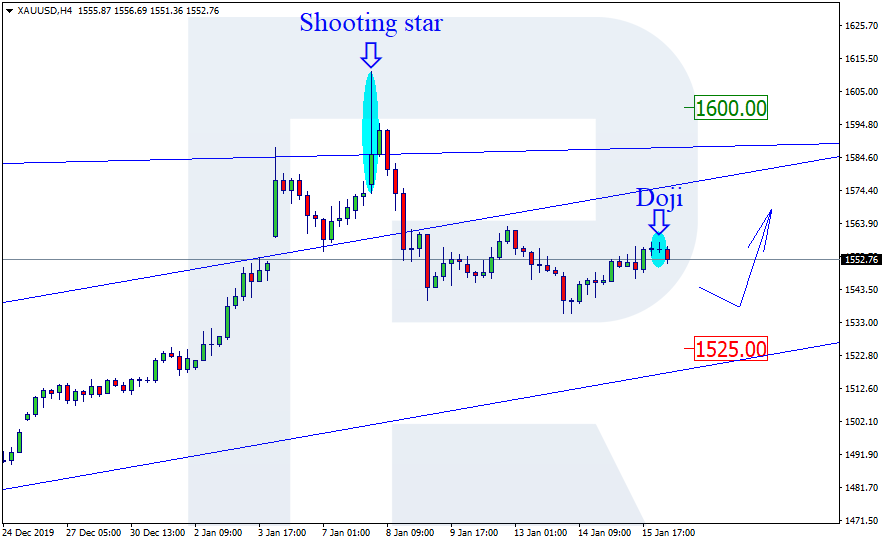
As we can see in the H4 chart, the correction within the ascending tendency continues. By now, XAUUSD has completed several Doji patterns. At the moment, the pair is reversing and may later reach 1525.00. After that, the price may continue growing towards 1600.00. However, one shouldn’t ignore another scenario, according to which the instrument may continue the ascending tendency towards 1525.00 without any corrections.

GOLD
Risk Warning: the result of previous trading operations do not guarantee the same results in the future

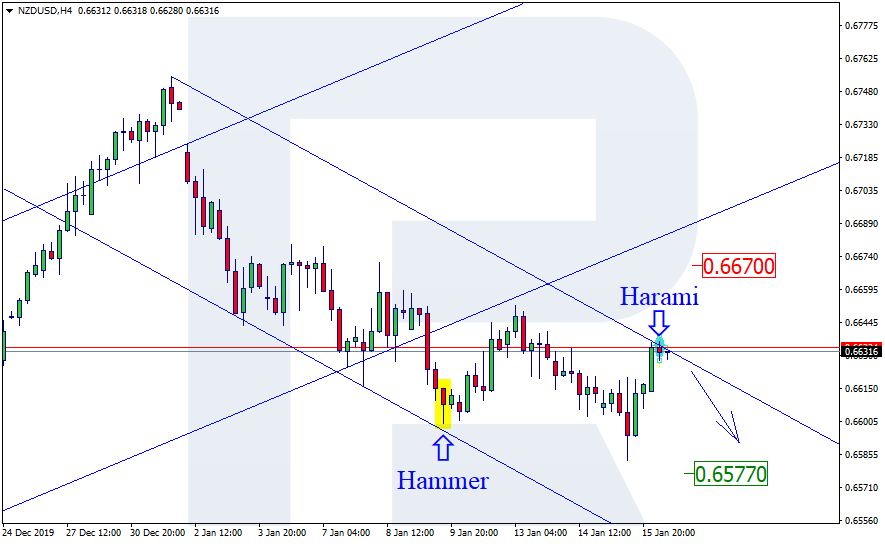
NZDUSD, “New Zealand vs. US Dollar”

As we can see in the H4 chart, the descending tendency continues. After forming Harami pattern near the resistance level, NZDUSD is reversing. The closest downside target may be at 0.6577. At the same time, one shouldn’t exclude an opposite scenario, according to which the instrument may grow to return to 0.6670.

NZDUSD

Article By RoboForex.com

Attention!
Forecasts presented in this section only reflect the author’s private opinion and should not be considered as guidance for trading. RoboForex LP bears no responsibility for trading results based on trading recommendations described in these analytical reviews.

The Analytical Overview of the Main Currency Pairs on 2020.01.16

by JustForex

The EUR/USD currency pair

Technical indicators of the currency pair:
  • Prev Open: 1.11282
  • Open: 1.11496
  • % chg. over the last day: +0.22
  • Day’s range: 1.11446 – 1.11581
  • 52 wk range: 1.0879 – 1.1572

The EUR/USD currency pair continues to recover. The trading tool has updated local highs. At the moment, EUR/USD quotes are consolidating in the range of 1.11450-1.11650. In December, the US producer price index was 0.1%, which is below market expectations at 0.2%. Washington and Beijing signed the first phase of the trade agreement. The parties began preparations for the second phase of the transaction. We do not exclude further growth of EUR/USD quotes. Today, participants in financial markets will evaluate a number of important economic releases. Open positions from key levels.

The Economic News Feed for 16.01.2020 is calm.

  • – Publication of the minutes of the ECB meeting on monetary policy – 14:30 (GMT+2:00);
  • – Report on the US retail sales – 15:30 (GMT+2:00);
  • – Philadelphia Federal Reserve Employment Index – 15:30 (GMT+2:00).
EUR/USD

The price has fixed above 50 MA and 100 MA, which signal the strength of buyers.

The MACD histogram is in the positive zone, but below the signal line, which gives a weak signal to buy EUR/USD.

The Stochastic Oscillator is in the neutral zone, the %K line is above the %D line, which indicates a bullish sentiment.

Trading recommendations
  • Support levels: 1.11450, 1.11200, 1.10900
  • Resistance levels: 1.11650, 1.12000

If the price consolidates above 1.11650, expect further growth toward 1.12000.

An alternative could be a decrease in the EUR/USD currency pair to 1.11200-1.11000.

The GBP/USD currency pair

Technical indicators of the currency pair:
  • Prev Open: 1.29872
  • Open: 1.30373
  • % chg. over the last day: +0.17
  • Day’s range: 1.30369 – 1.30566
  • 52 wk range: 1.1959 – 1.3516

GBP/USD quotes moved to growth. Sterling updated local highs. The trading tool found resistance at 1.30550. 1.30000 is a key support. The GBP/USD currency pair has the potential for further correction. Investors expect up-to-date information on Brexit. Today, the focus is on economic reports from the United States. Positions should be opened from key levels.

The Economic News Feed for 16.01.2020 is calm.

GBP/USD

The price has fixed above 100 MA, which signals the strength of buyers.

The MACD histogram is in the positive zone, indicating a bullish sentiment.

The Stochastic Oscillator is in the neutral zone, the %K line has crossed the %D line. There are no signals at the moment.

Trading recommendations
  • Support levels: 1.30000, 1.29600, 1.29200
  • Resistance levels: 1.30550, 1.31000, 1.31400

If the price consolidates above 1.30550, expect further growth toward 1.30900-1.31200.

Alternatively, the quotes could descend toward 1.29700-1.29500.

The USD/CAD currency pair

Technical indicators of the currency pair:
  • Prev Open: 1.30602
  • Open: 1.30424
  • % chg. over the last day: -0.17
  • Day’s range: 1.30350 – 1.30483
  • 52 wk range: 1.2949 – 1.3566

The USD/CAD currency pair continues to trade in a protracted flat. There is no defined trend. At the moment, USD/CAD is testing the support level of 1.30350. Mark 1.30550 is the nearest resistance. A trading instrument has a downside potential. Today we recommend paying attention to statistics on the US economy, as well as the dynamics of prices for oil. Open positions be opened from key levels.

The Economic News Feed for 16.01.2020 is calm.

USD/CAD

Indicators do not give accurate signals: 50 MA crossed 100 MA.

The MACD histogram is in the negative zone but above the signal line, which gives a weak signal to sell USD/CAD.

The Stochastic Oscillator has started to leave the overbought zone, the %K line is below the %D line, which indicates a bearish sentiment.

Trading recommendations
  • Support levels: 1.30350, 1.30200, 1.30000
  • Resistance levels: 1.30550, 1.30750, 1.31000

If the price consolidates below 1.30350, expect the quotes to drop toward 1.30000-1.29800.

Alternatively, the quotes could grow toward 1.30750-1.31000.

The USD/JPY currency pair

Technical indicators of the currency pair:
  • Prev Open: 109.981
  • Open: 109.899
  • % chg. over the last day: -0.09
  • Day’s range: 109.855 – 109.990
  • 52 wk range: 104.45 – 113.53

The USD/JPY currency pair stabilized after a protracted rally. The trading instrument is currently consolidating. Unidirectional trends are not observed. Participants in financial markets expect additional drivers. The key range is 109.700-110.200. In the near future, technical correction is not ruled out. Today we recommend paying attention to the news background on the US economy. Positions must be opened from key levels.

The Economic News Feed for 16.01.2020 is calm.

USD/JPY

Indicators do not give accurate signals: the price crossed 50 MA and 100 MA.

The MACD histogram is near the 0 mark.

The Stochastic Oscillator is in the neutral zone, the %K line is above the %D line, which indicates bullish sentiment.

Trading recommendations
  • Support levels: 109.700, 109.350, 109.000
  • Resistance levels: 110.200, 110.500

If the price consolidates above 110.200, expect further growth toward 110.500-110.700.

Alternatively, the quotes could correct toward 109.400-109.200.

by JustForex

The Dollar Index Is Consolidating. Investors Assess US-China Trade Deal

by JustForex

During yesterday’s trading session, the US dollar fell slightly against a basket of major currencies. The dollar index (#DX) closed yesterday in the red zone (-0.14%). The day before China and the US signed the phase-one trade deal in the White House, taking a step towards resolving the trade dispute. US Vice President Mike Pence said the second phase of negotiations has already begun, and the parties are working to resolve the differences. As part of the first phase, Washington reduced duties on Chinese goods $120 billion worth, from 15% to 7.5%. Beijing, in turn, agreed to increase purchases of US manufactured goods, agriculture, energy and services by $200 billion over the next two years.

Yesterday, the US House of Representatives delegation referred charges against President Donald Trump to the Senate. It will be the third impeachment process in US history. The trial should begin next week.

The “black gold” prices are rising. Currently, futures for the WTI crude oil are testing the $58.10 mark per barrel. At 17:30 (GMT+2:00), US crude oil inventories will be published.

Market Indicators

Yesterday, there was a variety of trends in the US stock market: #SPY (-0.15%), #DIA (+0.07%), #QQQ (-0.39%).

The 10-year US government bonds yield has declined. At the moment, the indicator is at the level of 1.79-1.80%.

The Economic News Feed for 16.01.2020:
  • – ECB monetary policy meeting account at 14:30 (GMT+2:00);
  • – Philadelphia Fed manufacturing index at 15:30 (GMT+2:00);
  • – Report on retail sales in the US at 15:30 (GMT+2:00).

by JustForex

EURUSD: decline to bottom line of channel expected

By Alpari.com

On Wednesday, January 15, the euro was up by 0.2% at the close of trading. Reaction to the signing of the first phase of the US-China trade agreement saw the EURUSD pair rise to 1.1164 (at the 67th degree). New all-time highs were set on US stock indices. Today, US President Trump confirmed that negotiations concerning the second phase of the agreement will begin soon.

Even though the first phase of the agreement has been signed, China remains in a “losing”  position. This is due to the fact that the US will maintain its current level of tariffs levied on Chinese imports until the second phase of the trade agreement has been concluded, as announced on Tuesday, by US Treasury Secretary Stephen Mnuchin.

Today’s events (GMT+3):

  • 12:30 UK: BoE Credit Conditions Survey (Q4).
  • 15:30 Eurozone: ECB Monetary Policy Meeting Accounts.
  • 16:30 USA: Retail Sales (MoM) (Dec), Philadelphia Fed Manufacturing Survey (Jan), Initial Jobless Claims 4-week average (Jan 10).
  • 18:00 USA: NAHB Housing Market Index (Jan).
  • 21:00 Eurozone: ECB’s President Christine Lagarde speech.

Pic. 1Current situation:

Yesterday’s expectations for growth were fully justified. During the American session, the euro hit 1.1164 (at the 67th degree).

We have two peaks here: 1.1147 and 1.1164, two bases: 1.1085 and 1.1105. Three values ​​were used for the channel: 1.1085, 1.1105 and 1.1147. As you can see, the price is having difficulty passing the 50% level during growth. Now the 50% level is acting as support.

At the time of writing, the euro is valued at 1.1149. The formation from 1.1085 is complex. The situation is mixed amongst cross pairs. We really wanted to consider growth up to 1.1190, but if we centre on the position of the indicators at 1H and 4H, we can see further weakening of the euro for the lower channel trend line. The minimum projection is shown in the arcs drawn up to the 20:00-mark.

We can expect to see a fall to 1.1127 – the balance line will act as support. A rebound is possible, but given that the wave structure from 1.1085 to 1.1164 is corrective, a rebound is probably not going to happen. At 21:00, ECB President Christine Lagarde is due to make a speech, maybe she will act as the trigger for sharp price fluctuations.

By Alpari.com

German CPI & Potential For ECB Action

By Orbex

There are two major economic events tomorrow which could drive the euro.

First, we have the release of German inflation data. We generally expect this to affirm the flash number provided at the beginning of the month.

Then we have the release of the minutes from the last ECB meeting. Let’s focus on the former, to address the change in expectations around what the ECB might do this year.

Last week saw one of the highest (preliminary) inflation prints in the eurozone for the month of December in quite some time. And we expect the final data to confirm this.

There is divided reasoning as to why that happened, and whether or not it was a one-off event. Or, perhaps, it marks a new trend of rising prices across Europe.

We might get some more insights with the release of the data for Germany tomorrow. That could help shape expectations a bit.

Harmonized or Not?

There are two portions of this data that could move the market: CPI and HICP, depending on the results.

Both measure inflation, but from a market perspective, they have different implications.

  • CPI, or Consumer Price Index, is what we all know as inflation. It’s important for fiscal policy and is a leading indicator of what’s going on economically in the eurozone, since Germany is the largest component.
  • HICP, or Harmonized Index of Consumer Prices, is the inflation rate in Germany “harmonized” with the rest of Europe. It is, therefore, the measure that the ECB follows. Hence, analysts use it trying to gauge what monetary policy might be in the future.

What We Are Looking For

The consensus among surveyed economists is that December CPI will come in at 0.5%, just like the preliminary number. This was a significant increase over the prior month and could be interpreted as a sign of consumer confidence, and at the top of the normal range.

Annualized, this would imply a rate of 1.5%, again the same as the preliminary number.

As for the Harmonized ICP, expectations are that it will confirm the 0.6% preliminary figure. This would imply an annualized growth of 1.5% as well, repeating the flash figure.

An increase in inflation would imply the ECB would be more likely to raise rates (reversing the move they made last September), but a disappointing result could dash hopes of that.

What About the Next Move by the ECB?

Speaking of the central bank, money markets are starting to price in the next move by the ECB to be a hike, sometime in early 2021.

Up until the holidays, the outlook was pretty much that the low rates in Europe would continue, following the softer data that we got through most of last year.

Lately, there appears to be more optimism. And if inflation rates start moving higher, it would be seen affirming that view. It might even be that analysts start pulling forward their expectations of a hike, and contributing to the strengthening of the euro.

So, tomorrow’s data could be quite important.

By Orbex

The Cannabis Industry’s Dirty Energy Secret

By OilPrice.com

Your average marijuana plant is a rather unimposing, forest green weed that blends well with nature. The dirty truth, however, is that the business of growing cannabis is anything but green. In fact, the growing of pot is so power-intensive that its ecological footprint is quickly becoming an environmental nightmare.

The $344 billion cannabis industry is one of the country’s most energy-intensive in the world, frequently demanding an array of heating, ventilation and air-conditioning (HVAC) systems, fans and 24-hour indoor lighting rigs at multiple growing sites.

Just how much electricity does the entire US marijuana industry consume?

The numbers are mind-boggling.

They’re also the bane of the cannabis industry, according to Joseph Maskell, founder and president of AAXLL, one cannabis company aiming to be a major disrupter of the short-lived status quo.

“The key in this emerging industry is to be asset-light,” says Maskell.

“With billions spent just on electricity in the US cannabis-growing industry, the companies that will survive the next culling, which is already in process, will be those with low capital outlays, no warehouses, no buildings, no machinery.”

Back in 2016, after the state of Oregon legalized recreational marijuana, Pacific Power in Portland recorded seven blackouts that the company traced to marijuana production.

Meanwhile, a good 45% of Denver’s increase in energy demand or “load growth” was directly linked to electricity that went to power marijuana growth.

In other words, investors are going to have to unplug unless they want to see their profits go up in smoke.

Appetite for Energy

The electricity consumption of marijuana grow houses is staggering when you compare it to consumption by the average business or residential unit.

In 2014, the NPCC worked out that it takes 4,000 to 6,000 kilowatt-hours (kWh) of energy to produce a single kilogram of marijuana product. Electricity costs can represent 20% of the total cost of cannabis production.

Back in 2015, it was estimated that a 5,000-square-foot indoor facility in Boulder County consumed ~41,808 kilowatt-hours per month–or nearly 66x the average consumption by a household in the county. More than two percent of the city’s electricity usage went to marijuana production.

More recent estimates are not very encouraging either, even as more energy professionals enter the marketplace.

Evan Mills, a scientist at the Lawrence Berkeley National Laboratory, says that production of legal marijuana in the US consumes 1% of total electricity, or 41.71 billion kilowatt-hours (kWh) of electricity, at a cost of $6 billion per year.

That’s enough energy to power 3.8 million homes or the entire State of Georgia. Generating that much electricity spews out 15m tons of greenhouse gas emissions (CO2), or about what three million average cars would produce in a year.

The actual figures could be much higher, says AAXLL’s Maskell.

A 2017 study by New Frontier Data revealed that only 25% of marijuana is produced legally, which is hardly surprising considering that recreational weed is legal in only 11 states and Washington DC. In effect, this means that growing marijuana could be consuming as much as 3-4% of the country’s electricity.

Obviously, such insane levels of electricity consumption is putting a major strain on public utilities as evidenced by the Pacific Power blackouts. As Steven Corson, a Portland General Electric (PGE) spokesman, has lamented: “We don’t track the numbers specifically related to cannabis producers, but some have created dangerous situations by overloading existing equipment.”

Lack of Standards

The huge energy appetite by the cannabis industry can be pinned on how grow houses operate.

Ron Flax, the chief building official in Boulder County, says the basic issue is the lighting intensity inside the grow facilities which is much higher than for any other plant. For instance, Solstice, a Washington based marijuana producer, uses 1,000W high intensity discharge lamps (HID), for the vegetative phase of growth.

Colorado, one of the leading cannabis states where most of the electricity is coal-powered, has devised schemes to discourage excessive power use by growers. The state requires commercial growers to either pay a 2c charge per kW or offset their electricity use with renewable energy (average electricity rate in Denver is 11.05 cents per kWh).

The accrued funds go to the Energy Impact Offset Fund where they are used to finance sustainable cannabis cultivation and also educate growers. Meanwhile, Seattle City Light is incentivizing growers to shift to more efficient lighting technologies. The public utility has promised six-figure rebates to growers who switch to LED lights instead of power-guzzling HIDs.

The big problem here is that the marijuana industry is still infantile and lacks clear standards. Even in states where weed is legal, production still tends to be done in underground operations with everyone doing what works for them.

It’s tough to be profitable right now in an industry that’s so energy-intensive. Cannabis 2.0, says Maskell, will be an entirely different beast. That’s why AAXLL isn’t focused on capital burying marijuana growing; rather, it’s focused on a revenue-generating end product that spends on marketing brilliance, like their Balance CBD line, not machinery.

Eventually, the market might dictate that growers use cheaper greenhouses and take production outdoors where costs are bound to be much lower. In the meantime, it’s going to be a steep learning curve for the burgeoning industry.

Companies to watch as the cannabis industry and the energy industry collide:

Canopy Growth Corporation (NYSE:CGC) (TSX:WEED)

After securing a major $4 billion investment from beverage giant Constellation Brands, it seemed like Canopy Growth was on the top of the world. The same day, shares in the company surged by 30 percent.

Though things have cooled down a bit since then after a downgrade from analysts of the Constellation Brands stock, Canopy has not stopped making moves in the market, most recently swallowing up renowned vaporizer producer Stor & Bickel Gmbh & Co., the creator of the iconic Volcano® Medic and the Mighty® Medic devices

The €145 million all-cash deal makes it one of the largest in the marijuana sector this year, and Canopy Growth is not likely to stop there.

Aurora Cannabis (NYSE:ACB) (TSX:ACB)

Aurora Cannabis is one of the biggest names in the burgeoning marijuana sector. With a market cap over $1.9 billion, Aurora has carved out its position as a leader in the industry. And the company is still making moves.

Recently, Aurora sealed a supply deal with Mexico’s Farmacias Magistrales SA, the country’s first and, for now, at least, only federally licensed importer of raw materials containing THC.

In an announcement from Aurora, the company stated that the deal “firmly establishes Aurora’s first-mover advantage in one of the world’s most populous countries, where more than 130 million people will have federally legal access to a range of Aurora’s non-flower medical cannabis products containing THC.”

Molson Coors (NYSE: TAP) (TSX: TPX-A)

Molson Coors is an iconic multi-national beer company, with brands that are recognizable across the United States and Canada. Besides just its Molson and Coors lines, the company has also ventured into more niche beverages to take advantage of the growing craft beer market, buying up brands like Leinenkugel’s and Blue Moon.

Not to be left behind in the marijuana boom, Molson Coors is also developing a line of non-alcoholic cannabis-based beverages with its partner, the Hydropothecary Corporation.

Molson Coors Canada president and CEO Frederic Landtmeters noted, “While we remain a beer business at our core, we are excited to create a separate new venture with a trusted partner that will be a market leader in offering Canadian consumers new experiences with quality, reliable and consistent non-alcoholic, cannabis-infused beverages.”

Exxon (NYSE:XOM) Despite Exxon’s late entry to the shale game, the company is still light years ahead of its competition in terms of profits.

Not only is Exxon held a key role in bringing the oil and gas industry into the modern era, the company is also a world leader in the development of biofuels and fuel cells.

Spending approximately $1-billion per year on the research and development in new energy technologies, Exxon is sure to continue on its path of innovation for years to come. Investors can rest assured; this research will pay off for them.

Halliburton (NYSE:HAL) is one of the largest oilfield services companies in the world. The company has secured its place in the oil and gas industry. But it didn’t happen overnight.

The oilfield services sector is highly competitive and ripe with innovation. In order to stay ahead, companies must be on the absolute cutting edge of technology. And that’s exactly what Halliburton has done.

And recently, Halliburton increased the heat for its competition. Partnering with Microsoft, Halliburton is securing its position as a leader in the industry.

This partnership is significant. Microsoft, a leader in the tech world, is looking to bring machine learning, augmented reality, and the Industrial Internet of Things to the oil and gas industry.

By. James Burgess
Is The US/Iran Crisis Over?

By Orbex

US Kills Top Iranian General

The hostilities between the US and Iran have subsided for now. However, it would be foolish to deem the crisis as having “ended”.

The year began with President Trump ordering the assassination of a top Iranian general, Qassem Soleimani. This was the first time, since the start of World War II, that the US has ordered such an attack.

The killing sparked outrage in Iran. The country immediately threatened to take heavy revenge on the US for killing Soleimani, who was a war hero in Iran.

The world watched in horror over those days, fearing that retaliation by Iran would inevitably lead to war. Trump publicly threatened that should Iran retaliate, the US would respond with up to 52 airstrikes on key Iranian targets including Iranian cultural sites.

Iran Retaliates

Iran saw large state gatherings for Soleimani’s burial. And after days of heavily aggressive rhetoric from Iran, they did respond. The country launched a series of 22 ballistic missiles at US army bases in Iraq.

The attack was met with horror as the world waited on the US response.

Trump Dials Back Tensions

Unexpectedly, Trump scaled back tensions by refraining from launching any physical retaliation. During an address to the nation, Trump announced further economic sanctions on Iran.

However, he said that, in light of intelligence reports suggesting that Iran was backing down from any further conflict, the US would not be responding at this stage.

Iran Admits Shooting Down Ukranian Airliner

Following a great deal of relief at having avoided further hostilities, things took a dark turn, however.

A Ukranian passenger jet flying into Iran was shot down, with all 176 passengers losing their lives.

The US immediately accused Iran of being behind the attack, which Iran initially denied. However, in the end, the Iranian military made the unprecedented move of admitting to the attack, live on TV.

The Iranians stated that the plane had been mistaken for a US missile, which it was trying to defend against.

Protests Begin in Iran

Over the weekend, protests erupted across Iran as the public reacted in outrage to the killing of Iranians by their own government. However, the protests themselves turned violent. Iranian security fired on the protesters.

The situation has seen a strong reversal in sentiment compared with the public gathering held around Soleimani’s death. Many protestors were seen ripping down posters and banners erected in Soleimani’s honor.

Trump Weighs in On Twitter

Commenting on Twitter, Trump wrote:

Risks Remain

The unexpected nature of recent developments in Iran shows just how fluid and fragile this situation is. And, as such, further aggression between the US and Iran cannot be ruled out.

The US and Iran pulled back from the brink of war last summer over Iranian attacks on oil ships in the Gulf region, followed by Iran shooting down a US drone.

The latest aggression came after months of calm and suggests that even if the US and Iran are not engaged in a full conflict currently, that is not to say this will remain so.

Technical Perspective

Gold prices continue to pull back from the 1608.54 level, with price having now broken back below the 1554.69 2019 highs. The correction is finding support into the lows, however, and, while above the 1522.75 level, a further push higher cannot be ruled out.

If price moves below the 1522.75 level, though, focus will shift to a test of the 1481.93 level next ahead of the broken bull flag pattern.

By Orbex

USD Maintains Modest Gains

By Orbex

The US dollar held onto gains as the index struggles to break out from the current highs near 97.50.

Economic data from the United States saw inflation data disappointing.

Headline inflation rose 0.2%, while core inflation rose just 0.1%. Still, the data was well within the estimates.

Euro Continues to Trade Subdued

A lack of any economic data from the eurozone saw the euro trading to the USD flows. The common currency continues to trade soft, as it has done for the past few days.

The consolidation is likely to continue ahead of next week’s ECB monetary policy meeting.

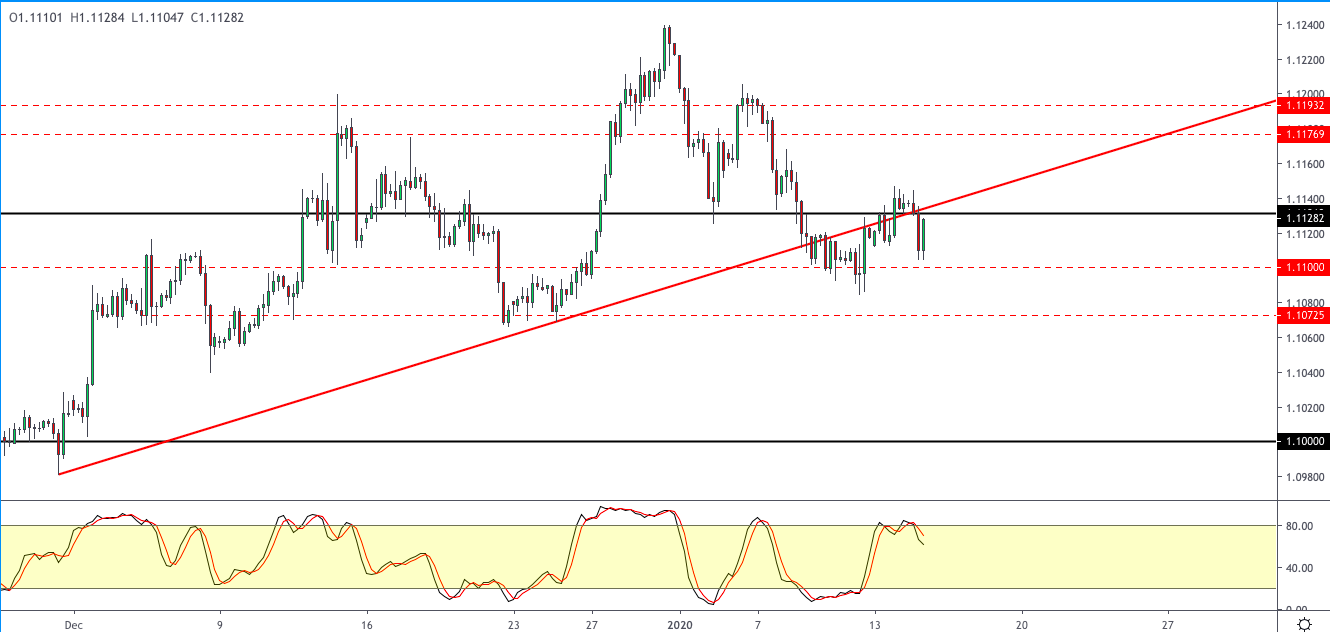
EURUSD Consolidating into a Bearish Flag

Price action in the common currency is consolidating into a bearish flag pattern. This indicates a downside risk. The support area of 1.1100 remains in place for now. But if the bearish pattern is validated, we expect the declines to push through to 1.1072 level eventually.

To the upside, the EURUSD will need to break out convincingly above the 1.1150 resistance level.

Sterling Pares Losses but Downside Risks Remain

The British pound is rebounding following the sell-off from Monday. The declines were set off by dovish remarks from BoE Governor Carney. Although the currency pair is paring losses from Monday, the downside risks remain. EU negotiator Barnier contradicted claims from PM Johnson about the border checks. This remains one of the key points of conflict in the Brexit talks.

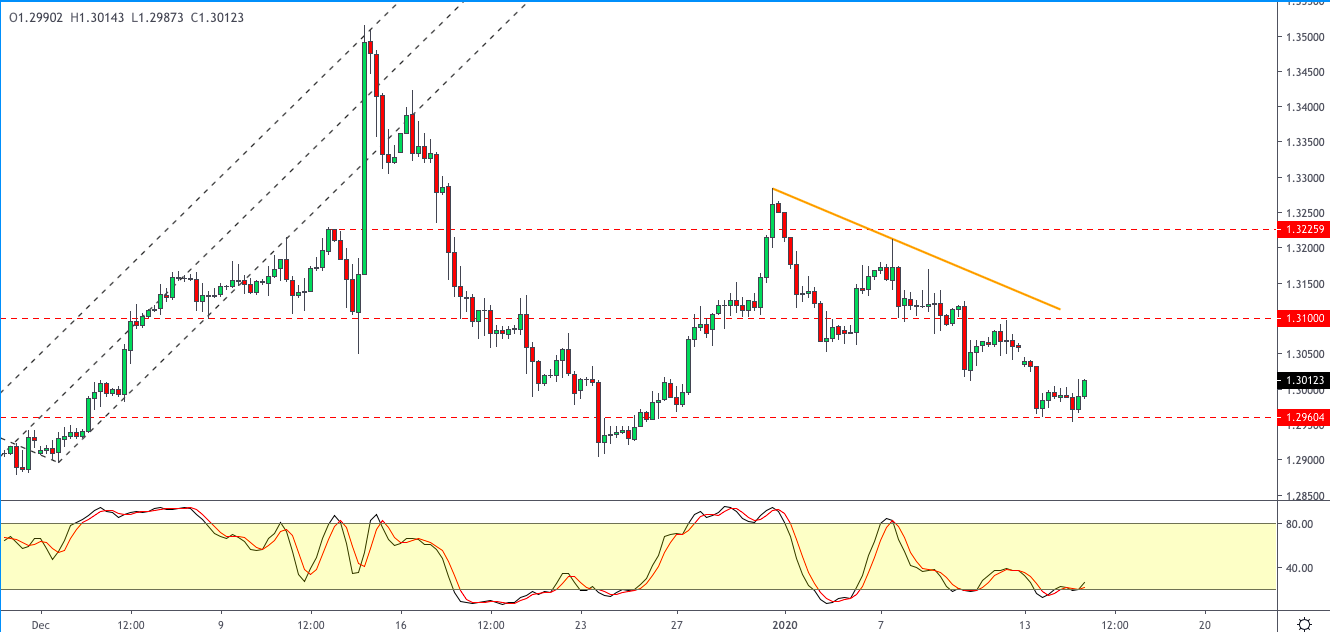
GBPUSD Could Rise to Fill the Gap

Price action in the currency pair is somewhat consistent with the bullish divergence on the 4-hour chart time frame. This indicates a minimum upside correction to 1.3068.

Considering that price left an unfilled gap from earlier this week, we expect the gains to be modest in nature. Price action is likely to remain within the 1.3100 and 1.2960 levels in the near term.

Gold Continues to Drift Lower

The precious metal is gradually retracing the gains made from the previous weeks. A lack of economic data and the impending trade deal signing remain one of the biggest cues for the gold prices at the moment.

President Trump is expected to sign the phase one deal sometime after today.

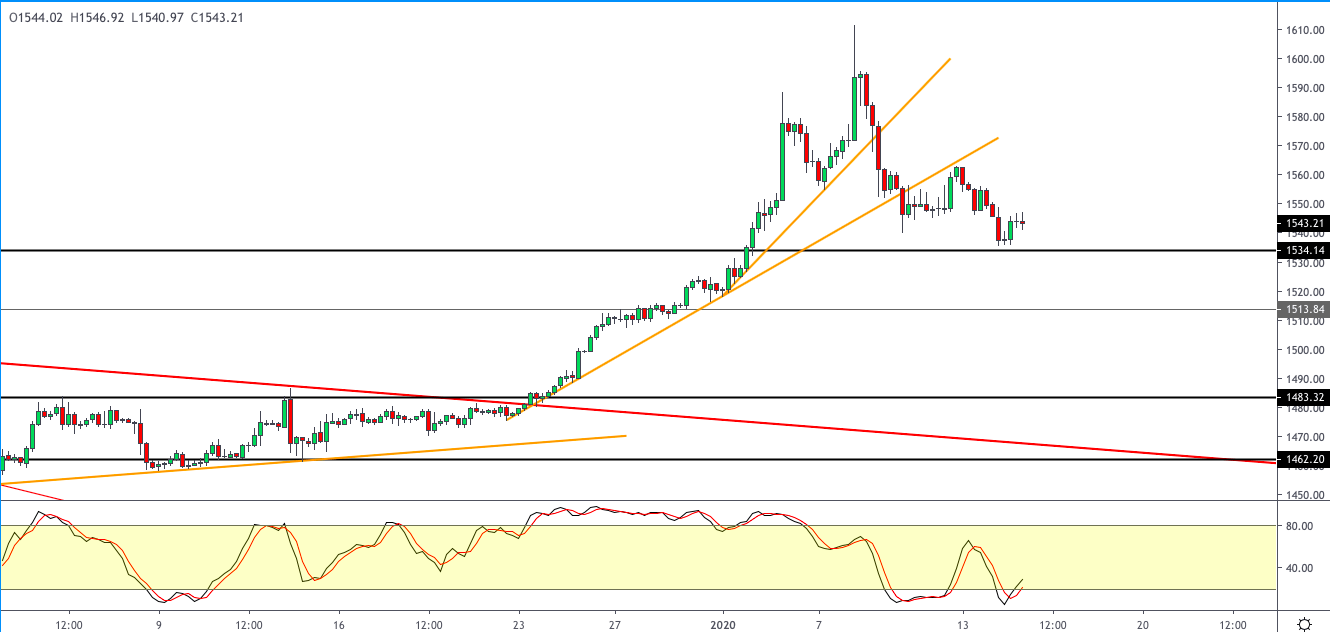
XAUUSD to Hold Near the Support

The precious metal initially bounced off the support level at 1534. Price action could retrace higher, but for the moment, further gains are unlikely.

The support level is likely to hold in the near term. In the event of a breakdown below this level, gold prices could accelerate the decline down to the 1513 region.

By Orbex

US/China Trade Deal Signing Today

By Orbex

USD Mixed Following CPI Miss

The US dollar has started the day with a mixed tone. The USD index has now spent the week consolidating just below the recent 97.26 highs. US inflation data released yesterday was a little lackluster with headline inflation rising in line with expectations at 0.2% on the month while core inflation missed at just 0.1% on the month. Looking ahead later we have PPI data as the main US data focus.

EUR Down Again

EURUSD has been weaker today also, though at 1.1124, is up off the weekly lows. ECB meeting minutes are the only key Eurozone print this week, due tomorrow. Traders will be keen to see how much division remains in the ECB following Lagarde taking over as ECB head, as well as how much support there is for further easing.

GBP Lower on CPI Miss

GBPUSD has been lower today. The latest inflation data confirmed a weaker than expected reading in December at 1.3% YOY vs 1.5% expected. The data adds to expectations that the BOE will look to ease in the coming months, guided by comments made recently by the BOE’s Carney. Retail sales on Friday will be the next key domestic release this week.

Risk Recovering

Risk assets have started the day on a positive footing as risk sentiment remains supported by today’s scheduled signing of the US/China trade deal which has been in the works since October last year. A Chinese delegation is in Washington to sign the deal today which should then pave the way for talks to move onto the next stage. SPX500 trades 3284.48 last.

Safe Havens Lower

Safe havens have had a subdued session over the European morning on Wednesday. Both JPY and gold have been roughly flat against USD as traders await the next directional catalyst. XAUUSD trades 1552.40 last, capped by the 1554.69 level for now. USDJPY trades 109.88, with JPY a little weaker against USD.

Crude Capped By API Report

Oil prices have been rather flat today also, with crude trading 58.18 last. Yesterday, the API reported a build in US crude stores of 1.1 million barrels. Traders will now be looking to today’s headline EIA release, which could see further downside in crude if the inventory surplus is confirmed.

Loonie Higher Again

USDCAD has been higher again today with price breaking out above the 1.3068 level again following a failed attempt earlier in the week. Should today’s EIA report come in bearish, CAD is likely to be weaker allowing for further upside in the pair.

Aussie Still Down

AUDUSD has been lower again today with price extending down to lows of .6882 before recovering to .6888 as of writing. Strength in USD, as well as dovish RBA expectations, are keeping AUD bias skewed to the downside here with the US/China trade deal now offering only limited support.

By Orbex

Forex Technical Analysis & Forecast 15.01.2020 (EURUSD, GBPUSD, USDCHF, USDJPY, AUDUSD, USDRUB, USDCAD, GOLD, BRENT, BTCUSD)

Article By RoboForex.com

EURUSD, “Euro vs US Dollar”

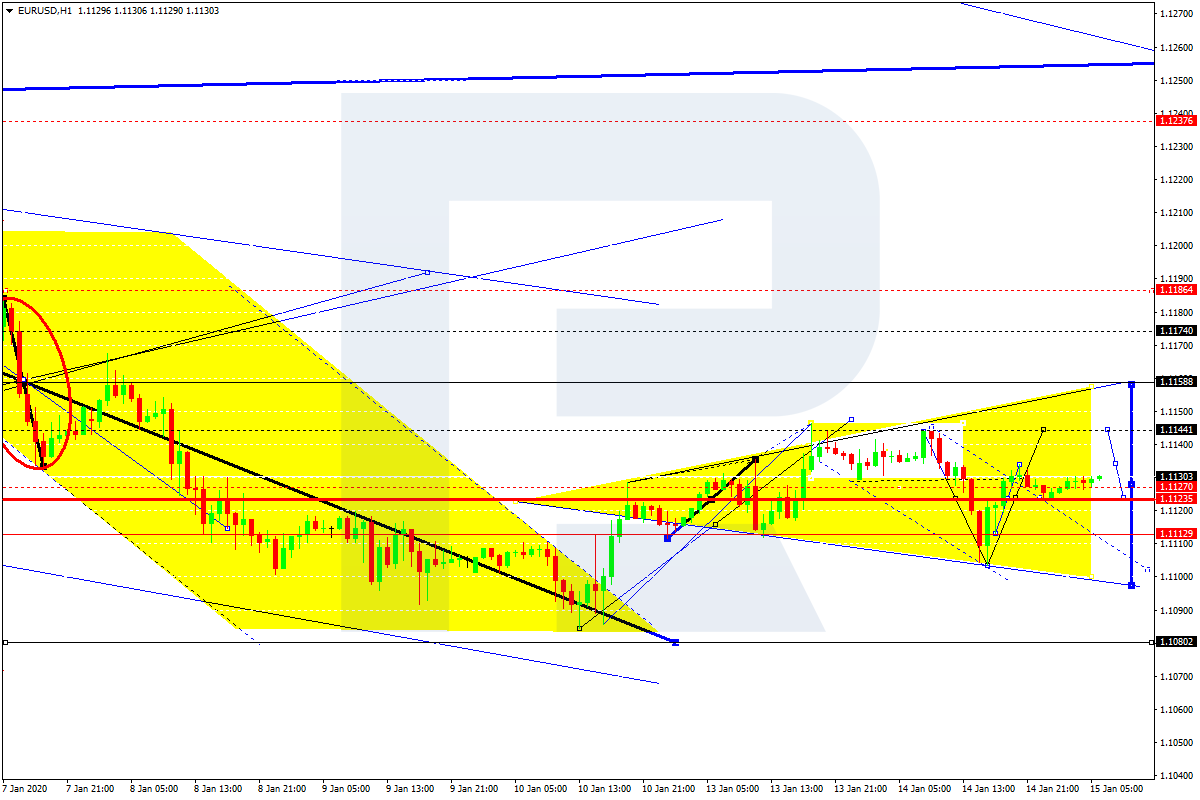
After breaking the consolidation range to the downside, EURUSD has completed the correction at 1.1104; right now, it is forming one more ascending wave towards 1.1114. Later, the market may start a new correction to reach 1.1123 and then resume moving upwards with the target at 1.1155.

EURUSD
Risk Warning: the result of previous trading operations do not guarantee the same results in the future

GBPUSD, “Great Britain Pound vs US Dollar”

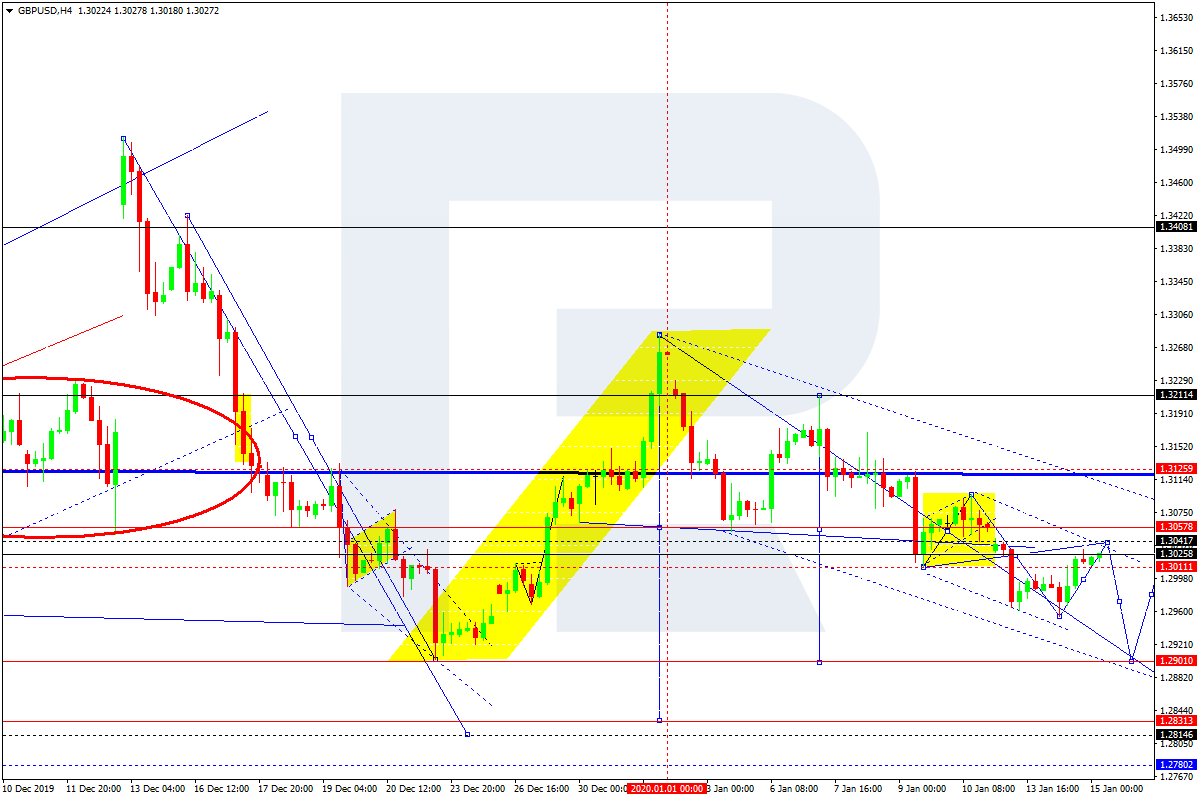
GBPUSD is moving upwards with the target at 1.3041. After that, the instrument may form a new descending structure to reach the short-term target at 1.2901.

GBPUSD
Risk Warning: the result of previous trading operations do not guarantee the same results in the future

USDCHF, “US Dollar vs Swiss Franc”

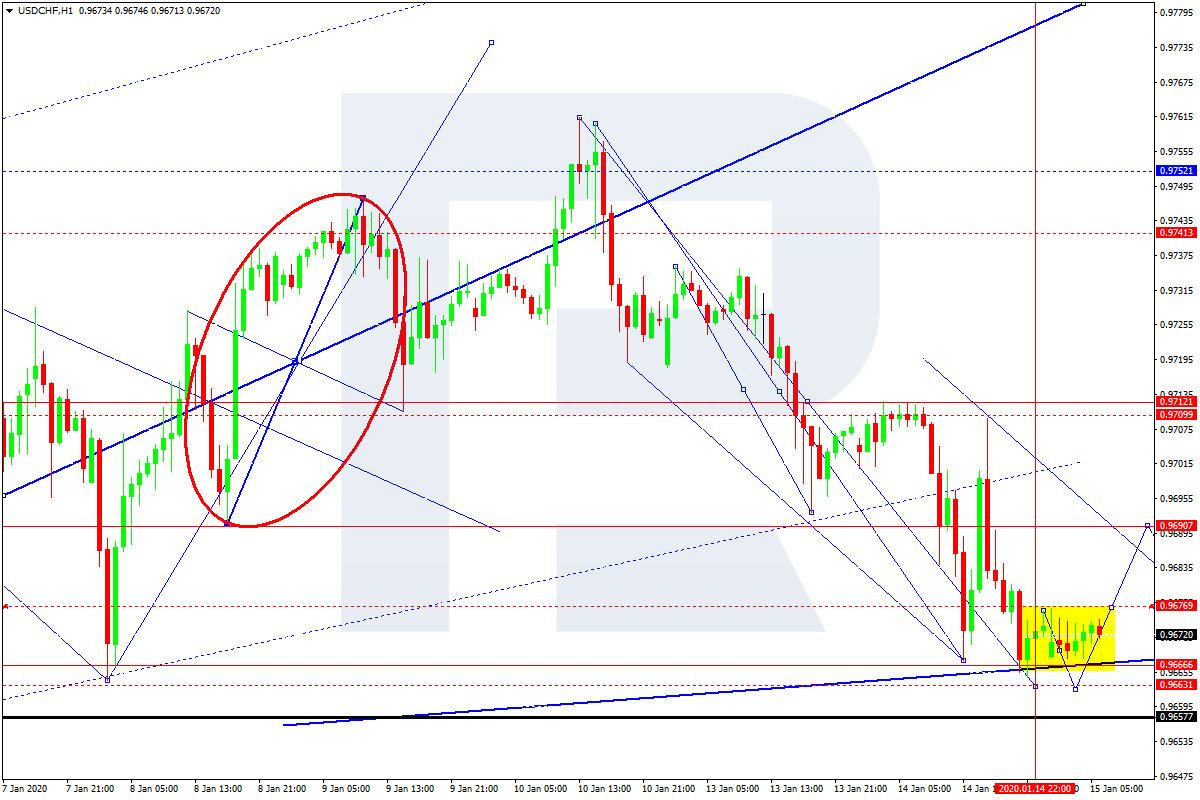
USDCHF is consolidating above 0.9666. Possibly, today the pair may reach 0.9660 and then form one more ascending structure with the target at 0.9690.

USDCHF
Risk Warning: the result of previous trading operations do not guarantee the same results in the future

USDJPY, “US Dollar vs Japanese Yen”

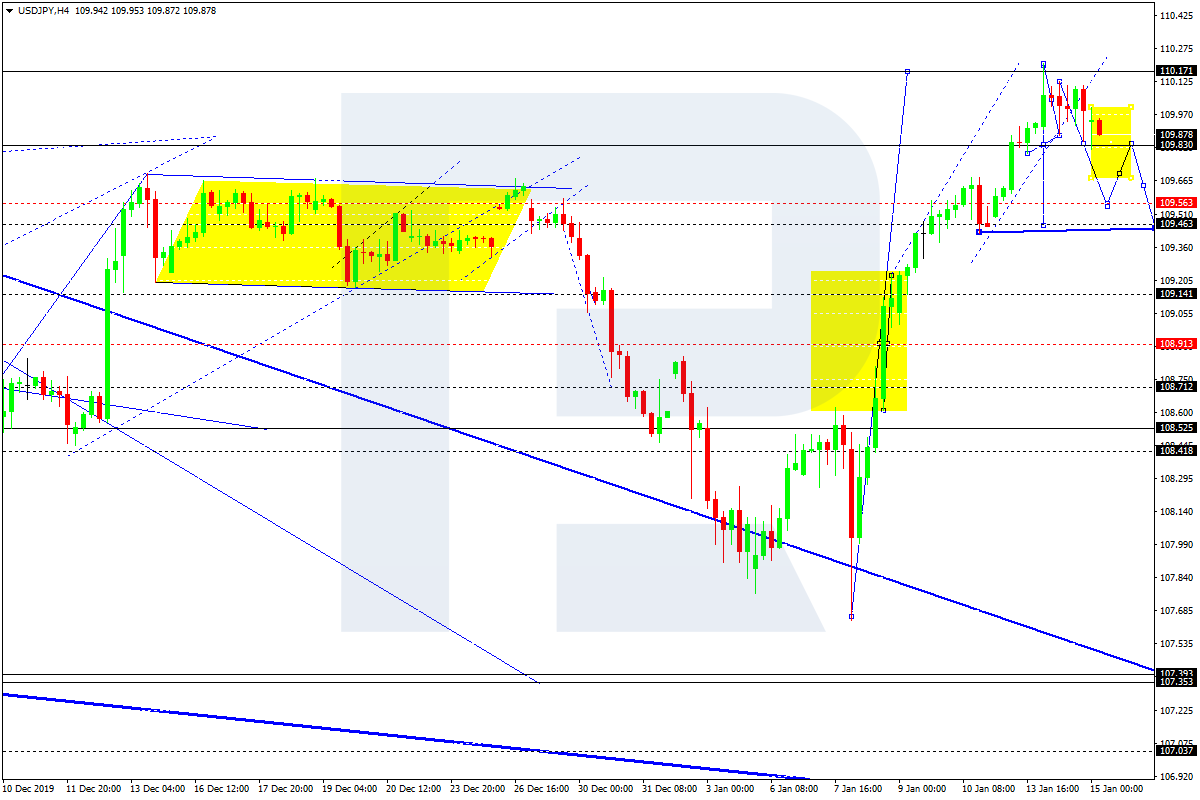
USDJPY is forming the second descending impulse. Possibly, the pair may reach 109.56 and then start another growth towards 109.83. Later, the market may form a new descending structure with the target at 109.46.

USDJPY
Risk Warning: the result of previous trading operations do not guarantee the same results in the future

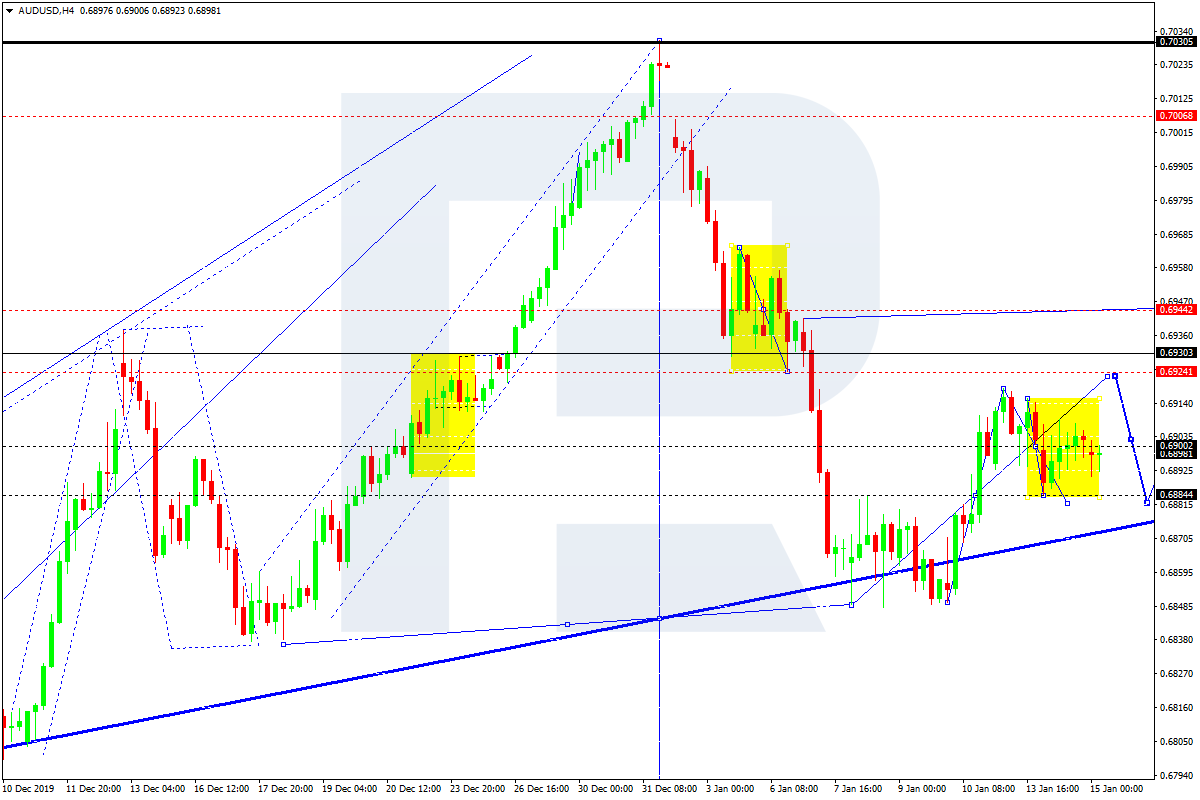
AUDUSD, “Australian Dollar vs US Dollar”

AUDUSD is still consolidating around 0.6900 without any particular direction. Today, the pair may expand the range down to 0.6884 and then resume trading upwards with the target at 0.6929.

AUDUSD
Risk Warning: the result of previous trading operations do not guarantee the same results in the future

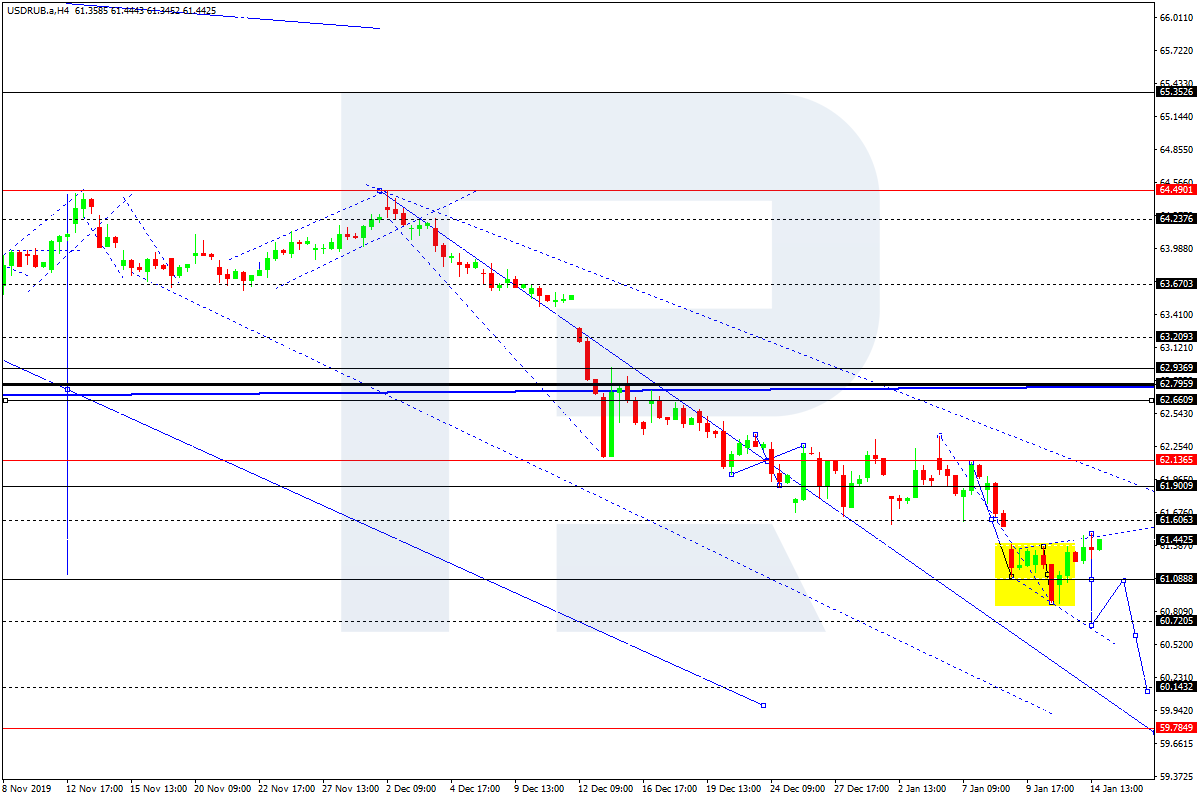
USDRUB, “US Dollar vs Russian Ruble”

USDRUB is still consolidating around 61.12. Today, the pair may expand the range down to 60.70 and then start another correction to reach 61.06. Later, the market may continue trading inside the downtrend towards 60.06.

USDRUB
Risk Warning: the result of previous trading operations do not guarantee the same results in the future

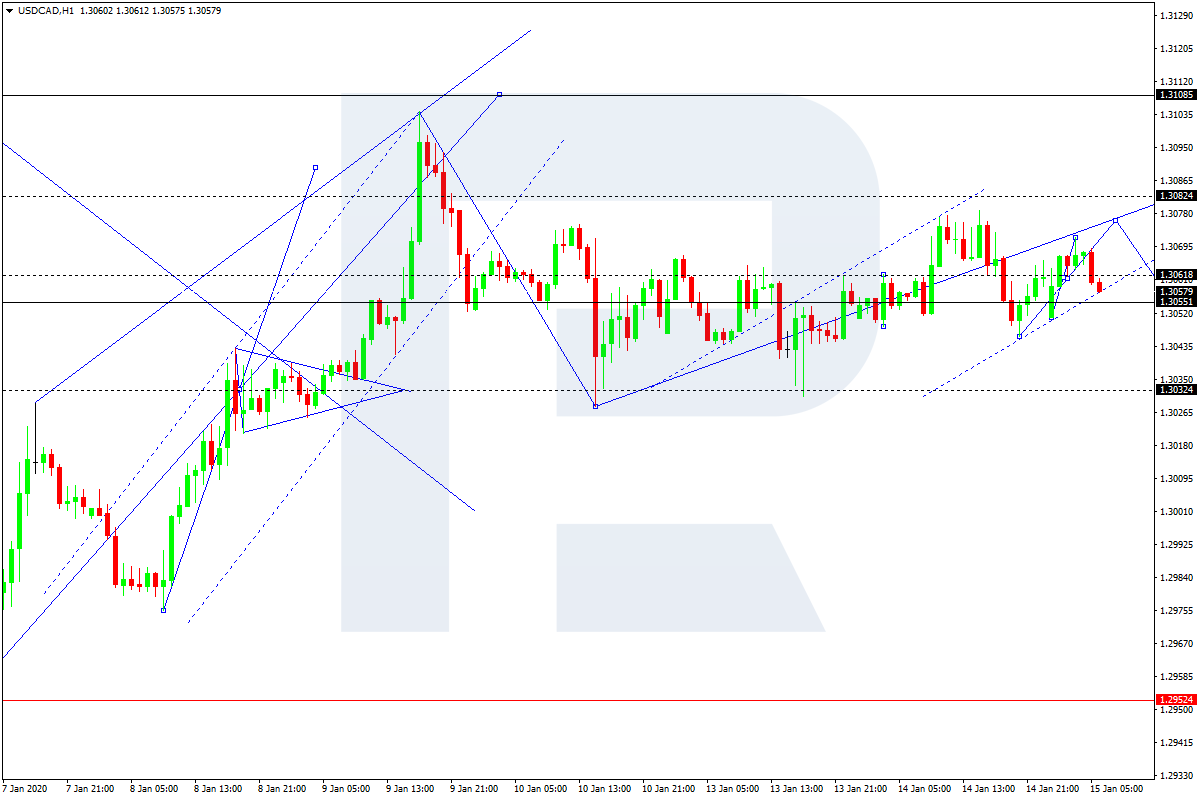
USDCAD, “US Dollar vs Canadian Dollar”

USDCAD continues consolidating around 1.3055 without any particular direction. Possibly, today the pair may form one more ascending structure towards 1.3080 and then resume falling to test 1.3055 from above. After that, the instrument may start a new growth with the target at 1.3100.

USDCAD
Risk Warning: the result of previous trading operations do not guarantee the same results in the future

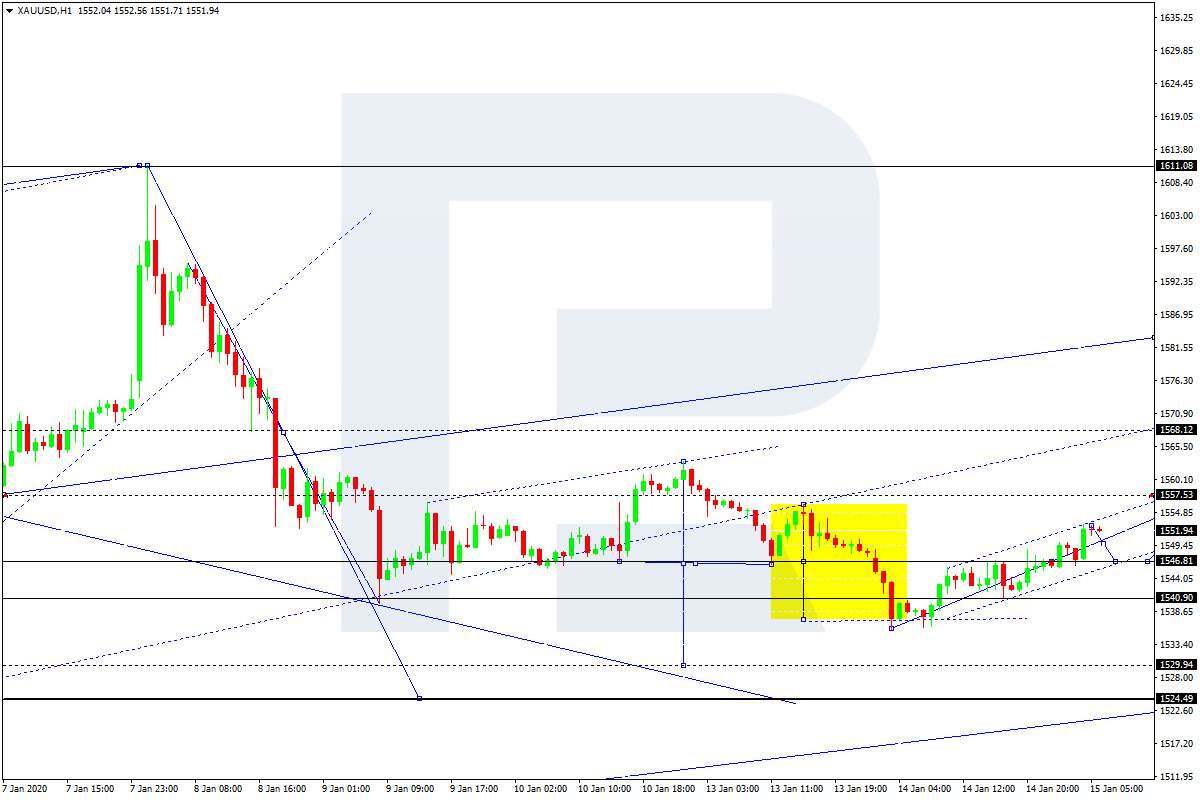
XAUUSD, “Gold vs US Dollar”

After breaking 1546.80 to the upside, Gold may choose an alternative scenario and extend the correction towards 1557.50. After that, the instrument may fall to break 1540.90 and then continue trading inside the downtrend with the target at 1524.50.

GOLD
Risk Warning: the result of previous trading operations do not guarantee the same results in the future

BRENT

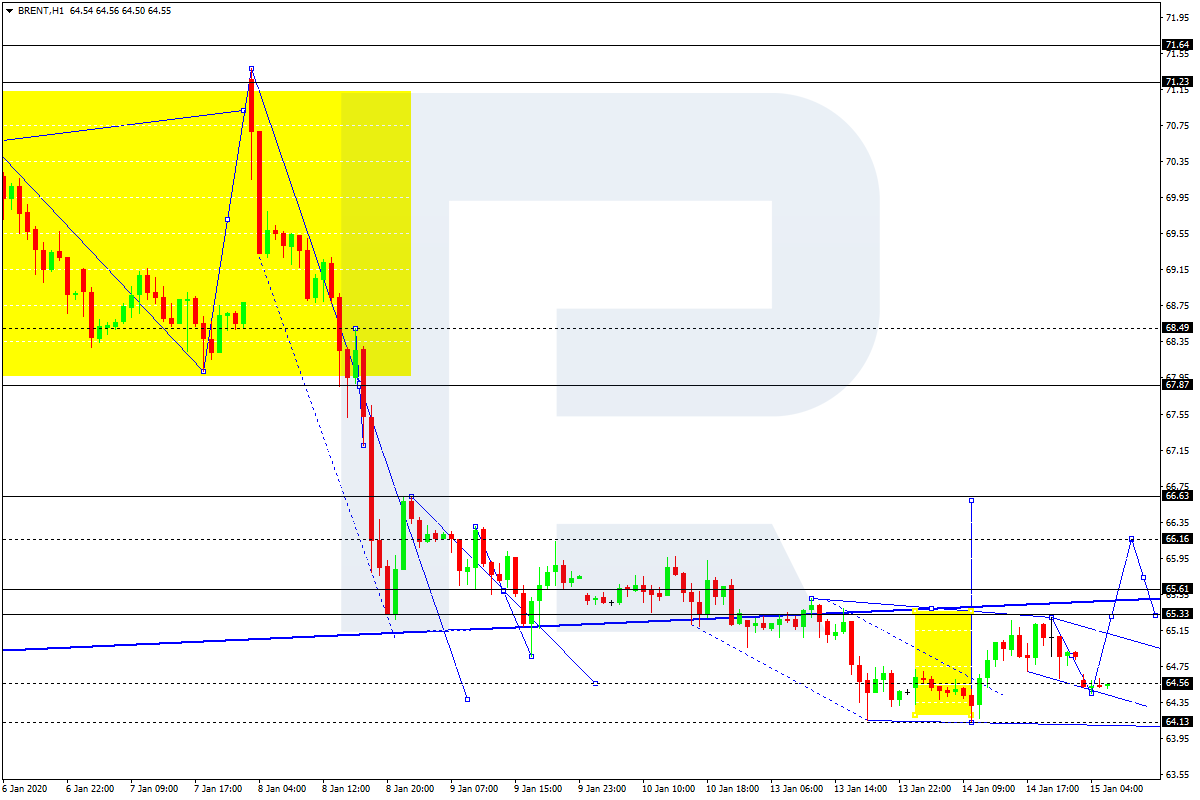
Brent has completed the ascending impulse at 65.33 along with the correction towards 64.55. Possibly, today the pair may form one more ascending structure to reach 66.16 and then start a new correction to return to 65.33. After that, the instrument may resume trading inside the uptrend with the first target at 66.66.

BRENT
Risk Warning: the result of previous trading operations do not guarantee the same results in the future

BTCUSD, “Bitcoin vs US Dollar”

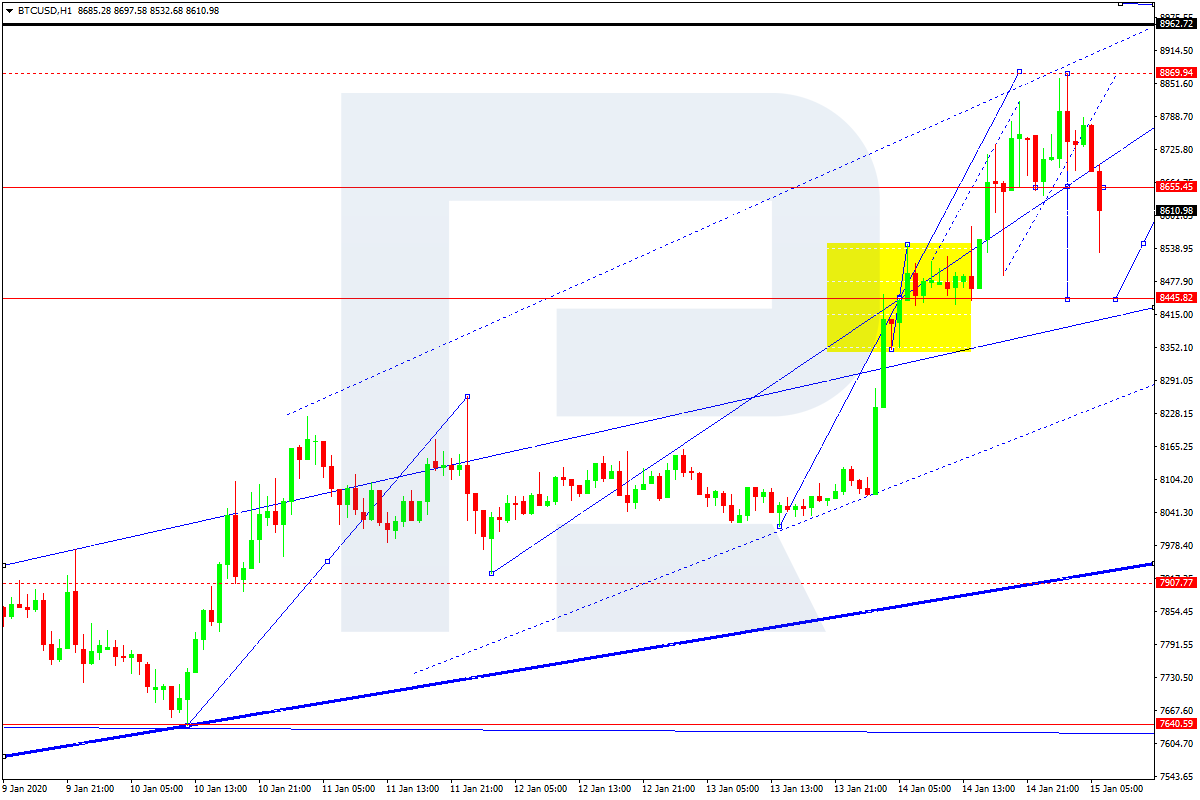
BTCUSD is moving downwards to reach 8444.00. Possibly, the pair may reach this level and then form one more ascending structure towards 8660.00, thus forming a new consolidation range. If later the price breaks this range to the upside, the market may start another growth to reach 8960.00; it to the downside – continue the correction with the target at 7900.00.

BITCOIN

Article By RoboForex.com

Attention!
Forecasts presented in this section only reflect the author’s private opinion and should not be considered as guidance for trading. RoboForex LP bears no responsibility for trading results based on trading recommendations described in these analytical reviews.