Bargain Hunting in Spain

By The Sizemore Letter

The first time I set foot on Spanish soil was the spring of 2000, and what a fantastic time it was to visit.  The dollar was near its all-time high versus the Euro, and an American could live like a king on a pauper’s budget.

My, how times have changed.  I most recently visited Spain in the summer of 2009, and a cup of my beloved café con leche in Madrid’s Plaza Mayor had more than doubled in price when translated into dollars.

Of course, I gladly paid it.  Even at an inflated price, there are few pleasures in life like enjoying a hot café con leche in a Madrid café.

Two years and a sovereign debt crisis later, prices in Madrid’s cafes are a little more reasonable.  But prices in Madrid’s stock market are downright extraordinary.

Consider the broad Ibex 35 Index, which tracks Spain’s blue chip companies.  At time of writing, it trades below the crisis levels of 2008; in fact, the index now sits at levels last seen in 2003.

The index sells for just 9.8 times earnings and yields and eye-popping 8.3 percent in dividends.  Remarkably, this is even cheaper than Greece—despite the now almost certain ejection of Greece from the Eurozone and the havoc that that will wreak.

Value investors have a nasty habit of jumping into investments too early, and I am certainly no exception.  I turned bullish on Spain in the first quarter, buying shares of the iShares MSCI Spain ETF (NYSE: $EWP) in my Tactical ETF Model—and taking substantial losses for it in the months that followed.

Value investors also tend to concentrate too heavily on the fundamentals and valuation of a company while ignoring the larger macro picture.  More often than not, macro concerns prove to be noise.  But during times of extreme stress, they have a way of overpowering company fundamentals.  For example, Spanish telecom giant Telefonica’s (NYSE: $TEF) decision to reduce its 2012 dividend had more to do with conserving capital in a tight credit market than it did the company’s financial health.

Still, today most investors would appear to making the opposite mistake: focusing entirely on macro concerns while completely ignoring the incredible value in front of them.

I’ve recommended Telefonica in recent articles, and I’ll spare readers a lengthy rehash of my reasoning.   I’ll reduce it to five  words: big dividend, emerging market exposure.

The same reasoning applies to banking giant Banco Santander (NYSE:$STD), the largest bank in the Eurozone by market cap.   Santander gets roughly half its profits from the emerging markets of Latin America and another quarter split between the United States and United Kingdom.  Only 13 percent comes from the bank’s home market of Spain.

Santander trades for just 60 percent of book value and its dividend is over 13 percent at current prices.  Could that dividend come under pressure in another wave of capital market volatility?  Of course.  But at current prices, it is worth the risk.

Moving on, investors should consider electric utility Iberdrola SA (Pink:$IBDRY).  Like the other Spanish stocks mentioned, Iberdrola gets only about half of its revenues from Spain.  Roughly a quarter comes from Latin America, and the remainder comes from the United States, United Kingdom, and the rest of Europe.  For a globally-diversified utility, Iberdrola is a steal.  It trades for just 0.62 times book value and 0.64 times sales and yields  6.0 percent.

Disclosures: EWP and TEF are holdings of the Sizemore Capital Tactical ETF Portfolio and Sizemore Investment Letter Portfolio.    
EUR Avoids New 4-Month Low

Source: ForexYard

While the euro remained bearish against its main currency rivals throughout yesterday’s trading session, it avoided falling to a new four-month low against the US dollar. The marketplace was unusually calm, as a bank holiday in Europe resulted in limited movements among the most traded currency pairs. As we close out the week, traders will want to note that another slow news day may result in low liquidity in the marketplace. Typically, low liquidity situations can result in exaggerated movements among currency pairs and commodities for seemingly no reason. Any mention of additional euro-zone worries may result in a significant drop for the euro.

Economic News

USD – Manufacturing Data Causes USD to Tumble

The US dollar tumbled vs. the Japanese yen during the afternoon session yesterday, following a significantly worse than expected Philly Fed Manufacturing Index. The manufacturing index came in at -5.8, well below the forecasted level of 10.3. Following the news, the USD/JPY fell close to 50 pips before finding support around the 79.75 level. Against the Swiss franc, the dollar saw gains during early morning trading before reversing later in the day. After reaching as high as 0.9480, the USD/CHF began falling, eventually dropping to the 0.9445 level.

As we begin to close out the week, dollar traders will want to note that a slow news day may result in exaggerated movements in the marketplace for seemingly no reason. Additionally, attention should be given to any announcements out of the euro-zone, especially with regards to the possible effects the current Greek political crisis may have on other indebted countries in the region, including Italy and Spain. Negative announcements could weigh heavily on riskier currencies, which may result in dollar gains throughout the European session.

EUR – Euro Limits Losses in Slow Trading Day

After dropping as low as 1.2666 during the morning session, the euro was able to recoup some of its losses against the US dollar, reaching as high as 1.2736. The currency was able to benefit from poor US manufacturing data which turned the USD bearish. Analysts were quick to warn that fears that Greece will be forced to exit the euro-zone is weighing down on the euro and that any gains could turn out to be temporary. Risk aversion in the marketplace following the disappointing US news caused the euro to fall against the Japanese yen. The EUR/JPY dropped over 60 pips during mid-day trading, eventually hitting the 101.32 level.

Turning to today, the euro may be able to hold onto its gains vs. the greenback if investors determine that the poor US news will lead the Fed to initiate a new round of quantitative easing to help boost the US economic recovery. At the same time, traders will want to remember that euro-zone fundamentals remain extremely poor. Any additional negative announcements today, especially with regards to the economic and political situation in Greece, could lead to further losses for the euro against the JPY.

AUD – Aussie Benefits From Positive Asian Data

The Australian dollar was able to move up vs. the USD following positive Japanese news during morning trading yesterday. Additionally, disappointing manufacturing data out of the US caused the AUD/USD to move up further. Overall, the pair was up almost 60 pips during European trading, reaching as high as 0.9951 during the afternoon session. The aussie was not as fortunate against the safe-haven Japanese yen. The AUD/JPY fell close to 100 pips over the course of the day, reaching as low as 79.04.

Turning to today, the recent disappointing news out of the US may help the aussie extend yesterday’s gains before markets close for the week. That being said, euro-zone political fears are keeping investors from shifting their funds to riskier assets. With market sentiment currently bearish toward higher yielding currencies, the AUD could drop further against the yen.

Crude Oil – Crude Oil Sees Mild Bullish Movement

The price of crude oil saw steady gains throughout the morning session yesterday, climbing as high as $93.84 a barrel before dropping during mid-day trading. Analysts attributed the bullish movement to better than forecasted economic growth in several Asian countries. That being said, poor news out of the euro-zone and US eventually brought the commodity as low as $92.79.

Turning to today, market sentiment toward the euro-zone is likely to dictate the direction oil takes. Fears that Greece will be forced to exit the euro-zone have led to significant risk aversion in the marketplace. Any announcements today that would indicate this trend will continue may weigh down on the price of oil.

Technical News

EUR/USD

Most long-term technical indicators place this pair in oversold territory, indicating that upward movement could occur in the near future. The Williams Percent Range on the weekly chart is currently at -90, while the daily chart’s Slow Stochastic has formed a bullish cross. Traders may want to go long in their positions.

GBP/USD

While the daily chart’s Slow Stochastic has formed a bullish cross, most other technical indicators place this pair in neutral territory. This includes the weekly chart’s Relative Strength Index and MACD/OsMA. Taking a wait and see approach may be the wise choice for this pair.

USD/JPY

The Williams Percent Range on the daily chart has drifted into overbought territory, indicating that this pair could see downward movement in the near future. Additionally, a bearish cross on the weekly chart’s MACD/OsMA has formed. Traders may want to go short in their positions.

USD/CHF

A bearish cross on the daily chart’s Slow Stochastic indicates that this pair could see downward movement in the near future. Additionally, the Relative Strength Index on the same chart is currently in the overbought zone. Opening short positions may be the wise choice for this pair.

The Wild Card

GBP/NZD

The daily chart’s Relative Strength Index is currently in overbought territory, indicating that downward movement could occur in the near future. Additionally, a bearish cross has formed on the same chart’s Slow Stochastic. Forex traders may want to go short in their positions before markets close for the week.

Forex Market Analysis provided by ForexYard.

© 2006 by FxYard Ltd

Disclaimer: Trading Foreign Exchange carries a high level of risk and may not be suitable for all investors. There is a possibility that you could sustain a loss of all of your investment and therefore you should not invest money that you cannot afford to lose. You should be aware of all the risks associated with Foreign Exchange trading.


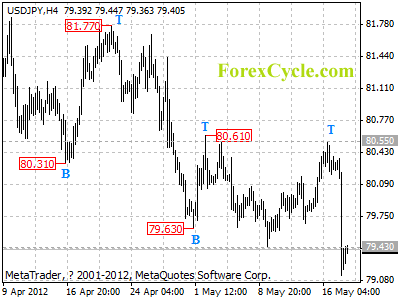
USDJPY breaks below 79.43 previous low

After consolidation, USDJPY breaks below 79.43 previous low support, and continues its downward movement from 84.17 (Mar 15 high). Further decline could be expected over the next several days, and next target would be at 78.00 area. Resistance is at 79.70, only break above this level could indicate that lengthier consolidation of the downtrend is underway, then another rise to test 80.61 resistance could be seen.

usdjpy

Daily Forex Forecast

How the Ukraine Could Be Europe’s Biggest Shale Gas Play

By MoneyMorning.com.au

We know it’s an odd thing to say, but right now, we like Europe.

Sure, Greece is on the verge of leaving the euro.

The European Union has only narrowly avoided falling into recession.

And Moody’s Investors Service is set to downgrade several Spanish banks.

Only a fool would exchange ‘safe’ Aussie dollars for ‘risky’ euros. But that’s exactly what we’re asking you to consider today.

Because, as we’ll explain in a moment, this could be the most profitable trade you make in 2012…

Europe is in a bind.

On one hand it’s battling a big debt problem and slow economic growth.

On the other hand, it needs to invest to ensure Europe doesn’t fall back into the dark ages.

As you may know, most of Europe’s natural gas comes from Russia. A supply that has more than once been disrupted due to political arguments.

Also remember that last year Germany vowed to close down the last of its nuclear reactors by 2022.

Nuclear power accounts for nearly one quarter of Germany’s electricity generation. That’s a big hole to plug.

Of course, the spin at the time was that Germany would be a ‘trailblazer’ for renewable energy sources (RES). That’s not likely.

Renewable sources (wind and solar) generate just 4.83% of electricity across Europe.

And in Germany renewable energy sources produce just 6.5% of the nation’s energy.

So, what’s the answer?

A clue is in a couple of headlines we’ve seen during the past two days:

‘Macquarie in $4b deal for European gas grid’ – The Age

‘Ukraine sees 2017 for commercial shale gas output’ – Reuters

In our view, these two stories support our position that Euro-Energy is the next big opportunity for investors.

Eastern Europe Leading the Way for Natural Gas Energy

To stress the point, big energy players Royal Dutch Shell and Chevron are backing what could be Europe’s biggest shale gas play – the Ukraine.

Nothing is certain. But Shell and Chevron clearly see the chance to make a buck or two.

According to the Reuters report:

‘The former Soviet republic has Europe’s third-largest shale gas reserves at 42 trillion cubic feet (1.2 trillion cubic metres), according to the U.S. Energy Information Administration, behind France and Norway.’

Bearing in mind the EIA says Europe could have as much as 639 trillion cubic feet of shale gas in the ground. So, if Europe is smart enough to exploit this resource, it could put them in the same position as the US. And that is energy independence.

Europe would no longer need to rely on Russia or the volatile Middle East.

Remember, the main reason the Brent Crude oil price is USD$16 higher than US crude oil is due to the fear of supply problems from the Middle East.

In short, Europe is paying a higher risk premium for energy than the US. All the more reason to develop a domestic natural gas supply.

Or you’d think so.

The Halt On Shale Gas That Europe Can’t Afford

In what we can only describe as a ‘typically French’ reaction, France has put a halt on shale gas exploration.

Despite having the largest shale gas resource in Europe, no one can produce it because, as usual, politicians have fallen under the spell of the green lobby.

In time this will change. But it goes to show that European unconventional natural gas development is still at a very early stage.

But in the end, even the green fanatics will have to face the facts. Europe can’t survive as an economic powerhouse without having a domestic energy supply.

Our bet is that Europe will have to develop shale gas. Not because it wants to, but because it’s the only option.

And that’s why we’re taking a punt on European natural gas stocks. It’s early and high risk, but if we’re right, the payoff will be immense.

Cheers,
Kris.

P.S. We first wrote about Euro-Energy stocks in the April issue of Australian Small-Cap Investigator. We’ve picked three Aussie stocks we believe are best placed to gain if Europe embraces shale gas. To find out what they are, take out an obligation-free trial of Australian Small-Cap Investigator and check out the latest issue. Click here for details…

Related Articles

The Conference of the Year “After America” DVD

APPEA – Day One at the Oil & Gas Show: Sand Dunes, Scuba Diving and Camels

Get in Early to Shale Gas


How the Ukraine Could Be Europe’s Biggest Shale Gas Play

Why Reverse Compounding is the Road to Rags… Not Riches

By MoneyMorning.com.au

While keeping expenses below revenues seems simple enough, many people today live beyond their means. Due to misguided monetary policy, society has favoured debt accumulation over saving.

And as a strategy, it has worked well for decades. That’s because the return on assets (shares, property, bonds etc) were well in excess of the cost of debt. So leverage worked.


Borrowing at 7 per cent to purchase an asset growing at 10 per cent – or more – is an easy way to make money. And as more people borrowed, the weight of money kept pushing asset prices up. This was particularly the case in residential property – the most leveraged of asset classes.

Reverse Compounding and Property Investments

Home loan borrowing costs are around 7 per cent. Assuming you put down a 10 per cent deposit and borrow the rest, you’ll need an annual return of at least 6.3 per cent to keep your head above water. If house prices fall (which is a likely scenario after years of increases) reverse compounding kicks in.

For example, if you put a 10 per cent deposit down when buying a house, it would only take a 10 per cent decline to wipe out all your equity. Meanwhile you continue to pay 7 per cent interest on the debt. Reverse compounding.

Reverse Compounding and Share Investing

I believe borrowing to buy shares is only slightly less risky. This relates to the differences in the cycles between property and shares. Share prices peaked in October 2007. House prices peaked around midway through 2010. In other words, shares offer better relative value than housing.

However, margin loans (borrowing to buy shares) are expensive. The interest rate charged can be as high as 10 per cent. If you buy opportunistically, I think shares have the potential to beat that 10 per cent hurdle over the long term.

But not by much. And with the market expected to remain volatile, there is a very good chance of getting margin calls (being forced to sell) at precisely the wrong time.

Compounding – Weighing Up Risk and Reward

In other words, it’s a bad risk/ reward trade-off. Borrowing to buy assets in the hope of making easy money is yesterday’s strategy. It won’t work in the years ahead.

You can see the very nasty effects of reverse compounding in Europe. Take Spain’s economy for example. While Spanish government debt is still relatively low, the market knows the banking sector in Spain is insolvent and will require government money at some point. So Spain’s debt situation is much worse than it looks.

These countries got to this point from years of over spending. They financed this ‘dis-saving’ by borrowing more and more. Their debt compounded until the market finally decided to turn the easy money tap off.

Now they are at the point of bankruptcy and social upheaval. Reverse compounding is as nasty as compounding is beneficial.

A Look at Reverse Compounding in the US

Consider the US, which is on the path to taking the concept of reverse compounding to epic levels:

It has total outstanding federal public debt of US$15.6 trillion.

In 2011, despite low interest rates, the interest expense on the debt hit a record US$454.4 billion. Given the size of the US economy is around US$15 trillion, interest expense is still manageable, representing about 3 per cent of national output.

But as a percentage of total Federal tax revenue the situation doesn’t look so benign. It’s estimated the government will extract US$2.5 trillion in taxes in 2012. If we assume interest expense of around US$450 billion, nearly 20 per cent of the tax take goes towards debt servicing. It can only get worse from here.

I think the US is still a few years away from a genuine debt crisis. But if it keeps compounding its debt it is a certainty to get there. And it will come quickly when it does.

A huge debt pile is manageable when interest rates are very low. But if interest rates all of a sudden went to 6 per cent because of a loss of confidence, US debt-servicing costs would be well over US$1 trillion per year. At that point, the option would be to raise taxes sharply or print money to pay for the interest expense. Neither of these is good.

Are You Safe From Reverse Compounding?

Unfortunately, you cannot entirely avoid the deleterious effects of reverse compounding at a national or international level. When financial ignoramuses run governments around the world there’s not a lot you can do to avoid the fallout.

I bring up reverse compounding because it’s an obstacle you need to consider in your own path the wealth creation. You can avoid reverse compounding at an individual level by simply staying away from debt. Or only get into debt when you have a high level of confidence it will work for you. (I would include debt to finance your own business in this definition.)

But this strategy will not work in the coming decade. Borrowing to purchase assets will result in reverse compounding in the years ahead.

The Compounding Strategy For the Future

What will work in this coming decade is a simple compounding strategy.

Which brings me to the most important – and simplest – point when it comes to compounding. It’s called saving. If you don’t save you can’t compound your wealth.

Successfully compounding your wealth in this sort of economic environment is difficult. But it can be achieved if you keep three things in mind:

  • Invest internationally – I think the Australian index will meander in a wide range and ultimately go nowhere. I also think the Aussie dollar is overvalued against a range of currencies. Given this view, I think you need to look further afield for opportunities. Adding some international companies to your portfolio will add currency diversity too.
  • Be patient. Wait for opportunities. Focus on quality business rather than a cheap stock price.
  • Buy gold. It’s one investment that many people dismiss as being over. But this metal is quietly going about its business of getting rid of as many investor as it possibly can before resuming its next leg up.

Compounding requires patience. Whereas most people want to get rich quick. That’s fine. But understand getting rich quick is a low probability outcome.

Growing your wealth through compounding has a very high probability outcome. If you’re prepared to save and keep my three guidelines in mind, I have no doubt you will become – and more importantly stay – wealthy.

Greg Canavan
Editor, Sound Money. Sound Investments.

From the Archives…

What Newton Knew About House Prices …That the IMF Should
2012-05-11 – Kris Sayce

Why a Greek Exit From the Eurozone Could Be Great News For Markets
2012-05-10 – John Stepek

Why Europe Will Ditch Green Energy
2012-05-09 – Kris Sayce

Why It’s Time to Buy Gold
2012-05-08 – Dr. Alex Cowie

Why You Should Be Watching Japan’s Economy
2012-04-07 – Dan Denning


Why Reverse Compounding is the Road to Rags… Not Riches

How to Profit From the Facebook IPO Without Buying Facebook

Article by Investment U

How to Profit From the Facebook IPO Without Buying Facebook

Facebook is a cloud computing company. Profit from the Facebook IPO by buying the companies that provide Facebook's cloud computing infrastructure.

Over the last couple of weeks, investors have been hearing a lot about the Facebook IPO and the accompanying high-profile road show.

For those who are confused, the road show is a planned set of meetings where the management team of the company going public, accompanied by its investment bankers, shares the investment merits of its about-to-be traded stock and why you, the investor, should buy in on the IPO.

It is not about whether the CEO of said company is wearing a suit, or a “hoodie,” or will even show up at all.

What’s challenging about the Facebook IPO isn’t whether this is a leading company in the new field of social media – oh, it certainly is. And it isn’t, in our opinion, about whether Facebook will continue to get “eyeballs” to its site – oh, it will.

What’s more meaningful to us is simply: Can an entire industry or company that has been in existence for less than 10 years continue to grow at its current torrid pace? Will social media continue to stay “hot hot hot” or will it merge into the mainstream? If it takes a company seven years to “rule the world,” how long could it take a competitor to come in and simply be cooler or just plain better?

And the more important question to us is: Should I even be asking those questions?

“Arms Suppliers”

This brings me back to a recent essay I wrote about cloud computing…

Facebook’s stock may go up or it may go down. But how do I profit from that when the largest institutional investors in the country get to see whether Mark Zuckerberg is wearing a “hoodie” or a suit? What advantage can I gain over them?

The honest answer for me is, “I don’t have any advantage,” and, sorry to say, neither do you.

So, let’s take a step back and look at Facebook another way. In its barest form, what is it? It’s a company offering a service by utilizing the internet. In the cloud computing essay, we defined cloud computing as “simply any technology service, such as an application, infrastructure, or platform that’s offered to customers over the internet.”

Sounds like Facebook to me!

And in that same note, I suggested investors look to the stocks of the “arms suppliers” to the big guys already at war. Make no mistake about it – Facebook’s war is no longer with the Winklevoss twins – it’s now with Google (Nasdaq: GOOG), LinkedIn (NYSE: LNKD), Apple (Nasdaq: AAPL) and even Microsoft (Nasdaq: MSFT), despite any appearances of cooperation. All these companies seek world domination in their sectors.

In the movie Social Network, the Zuckerberg character, irate because someone had threatened the website’s availability, states, “Facebook does not go down, Facebook never goes down,” or words to that effect.

So who are the arms suppliers to a company whose website “can’t go down?” There are a number of different areas in addition to those mentioned in our earlier note.

Infrastructure Management

Admittedly, this term sounds about as sexy as a burlap sack covering a Sumo wrestler. But it is important, and these are the companies that help a company like Facebook stay “up” and performing to expectations.

What are some of the weapons required?

  • Suite-based infrastructure management – Companies like CA Technologies (Nasdaq: CA), BMC Software (Nasdaq: BMC), Hewlett-Packard (NYSE: HPQ) and even IBM (NYSE: IBM) sell entire suites of products aimed at keeping data centers up and running.
  • Website performance management – If Facebook users in Boston are having problems with the site, but users in San Francisco are fine, what early detection mechanisms are available? Companies like Keynote Systems (Nasdaq: KEYN) and Compuware (Nasdaq: CPWR) have utilities that can monitor this constantly and give the site operator early notification if there is a particular problem in a particular location.
  • Application performance – There’s a group of companies that focus on monitoring and managing the performance of applications. Facebook likely has hundreds, if not thousands, of individual applications, and they need to be monitored. Companies like OPNET Technologies (Nasdaq: OPNT), as well as Compuware and Keynote, help with this.
  • Network performance – What if there’s something wrong in the network? Companies like NetScout Systems (Nasdaq: NTCT), OPNET, Hewlett-Packard, Cisco (Nasdaq: CSCO) and the other suite vendors can give visibility into what’s going on in the network.

Don’t try to keep up with what the big guys know about Facebook. Figure out what’s going on behind the scenes that makes Facebook work.

You’ll find the grounds far less crowded, and you may make a pretty penny along the way. And you won’t have to figure out if the “hoodie” is going to be the next big fashion trend, either.

Good Investing,

Gary Spivak

Article by Investment U

CNG: The Missing Link for Natural Gas Transportation

Article by Investment U

CNG: The Missing Link for Natural Gas Transportation

Gas drillers and other companies are looking with intense interest at CNG-based transport and storage technology.

Pity the poor North Slope of Alaska…

The region produces 600,000 barrels of oil a day, accruing millions of dollars for the state’s treasury as the crude is pumped through the Trans-Alaska Pipeline System. But its 35 trillion cubic feet in natural gas reserves are essentially a wasted resource.

For years, Alaskan authorities hoped a 1,700-mile natural gas pipeline, costing up to $40 billion by some estimates, might be the answer for tapping U.S. energy demand. Alas, gas in the Lower 48 is too cheap, and the pipeline too expensive. The overland-to-Alberta project was scrapped earlier this month. For now, the North Slope’s gas reserves remain in the ground, without a viable way to get to market.

It’s not just Alaska’s problem…

Stranded Gas

A 2007 EIA study concluded that, out of an estimated 6.1 trillion cubic feet of global natural gas reserves, roughly one-half is considered “stranded.” Remote and lightly populated regions like eastern Canada, northern Australia, Vietnam, Indonesia and parts of Russia’s Siberia are all mentioned as having massive reserves of stranded gas.

And then there’s the problem of “associated gas.” That’s the name drillers give for the stuff that comes up the pipe in oil drilling operations. In 2010, one French oil company estimated that 30% of its greenhouse gas emissions – about 15 million metric tons of “carbon equivalent” – were the result of flaring off associated gas at its drill sites. There just isn’t an economical and safe way to do anything else but burn it as a waste by-product.

But new transport and storage technologies for CNG might just offer new answers to these old problems…

Enter the Coselle

Coselle ™ stands loosely for “coiled pipe in a carousel.” It’s being commercialized by Alberta-based Sea NG. What exactly is the system? Imagine a giant hexagonal-shaped garden hose reel, around 50 feet wide and 10 feet tall. Let’s fill that “reel” with 13 miles of tightly wrapped six-inch diameter steel pipe, capable of holding four million cubic feet of compressed natural gas. That’s “a Coselle.”

Still with me? If you stack a bunch of these “Coselles” inside the hull of a specially-built “Coselle Ship,” you have a vessel capable of carrying up to 500 MMcf of CNG.

That’s smaller than what an LNG ship carries. But here’s the trade-off: LNG requires a large technical infrastructure, mainly because of the liquefaction facilities necessary to convert the gas to liquid form. Liquefaction plants are the biggest cost component of any LNG project, with a price tag of up to $4 billion. For those reasons, LNG ships are used mainly for high volume, high-demand shipping routes. CNG ships of the kind envisioned for these new transport technologies are positioned for shorter, lower volume transits of up to 1,200 miles.

So are Coselle-equipped ships the “missing link” to the problem of stranded natural gas? Perhaps. Sea NG is a private firm, but it has two publicly-held heavyweights in pipeline and ocean transport: Enbridge (NYSE: ENB) and Teekay Corp. (NYSE: TK) as investors.

It’s also why gas drillers and other companies are looking with intense interest at this CNG-based transport and storage technology:

  • PLN (Indonesia’s state-run power company) signed a deal in January to transport natural gas, via CNG ships, to a peaking plant on the island of Lombok. The first shipments are scheduled tentatively for 2013.
  • Centrica Energy (UK) is weighing the use of CNG ships for transport from its gas fields in offshore Tobago. Neighboring Trinidad has an LNG facility, but concerns about its capacity, and the shipping distance for processing, has Centrica looking at CNG instead.
  • Husky Energy (Canada) sees CNG as “the leading technology at present” to get natural gas from its fields off Newfoundland, where the company believes it has reserves of 2.3 trillion cubic feet.

Nor is Sea NG the only company out there pushing a CNG solution to the problem of stranded gas. A rival firm, Houston-based EnerSea Transport LLC, has a patented system called VOTRANS ™ which claims to transport larger volumes and lower operating pressures by optimizing the pressure and temperature conditions of the stored gas. EnerSea is backed by a Mitsui & Company Ltd., K Line Shipping (a Japanese shipping giant), Citigroup and Singapore-based Tanker Pacific.

Keep in mind, CNG ships as a concept have been around for years, but always with what’s called a “bottle” design. If you think of a series of immensely tall steel tanks – giant versions of the propane tank in your barbeque grill – that can fit in the hull of a ship, you get the idea. The drawback of a “bottle ship” is the cost and complexity of all the valves and piping, so each tank can be filled and drained, independent of all the others.

These new-generation gas technologies, on the other hand, are designed to make a CNG vessel much cheaper to build and operate. The American Bureau of Shipping, which sets the design, construction and operational standards for marine vessels and offshore platforms, has already approved designs for ships fitted for Coselle and VOTRANS technology. The main question now is when the first of these new ships is commissioned and built to tap into the world’s reserves of stranded gas.

Good Investing,

Jeff Yastine

Article by Investment U

CFD Trading Now Available at ForexYard!

Source: ForexYard

printprofile

In keeping up with the growing demand for online trading, ForexYard is now providing clients with the ability to trade in the CFD market. Have you ever wanted to profit from the rise or fall of the S&P 500 or NASDAQ? Trading in CFDs, or Contracts for Difference, gives you this ability in a click of a button with no hassle, and without the complexity of trading with a futures or stock broker.

CFD trading allows traders to enjoy all the benefits of owning a commodity or index without having to physically own the actual instrument itself. To put it simply, you can buy an index if you believe it will rise in value or sell if you think it will drop. Just like buying and selling forex!

Much like trading in the foreign exchange (Forex) market, CFDs are instantaneous exchanges of contracts between buyers and sellers with an agreement to exchange the difference in value upon closing the contract. So you can buy (go Long) or sell (go Short) any index or commodity with no worries of strange or difficult-to-understand rules prevalent in other markets.

ForexYard allows the trading of a wide array of market indices which represent some of the most significant markets worldwide. Now you can buy and sell indices like the NASDAQ 100, Dow Jones Industrial, S&P 500, and the Nikkei 225, just to name a few. (See full list of available indices here). All at a click of a button.

Simply open one of our Standard Trading Accounts, download our trading software, and enjoy the comfort and excitement of trading in the CFD market!

Forex Market Analysis provided by ForexYard.

© 2006 by FxYard Ltd

Disclaimer: Trading Foreign Exchange carries a high level of risk and may not be suitable for all investors. There is a possibility that you could sustain a loss of all of your investment and therefore you should not invest money that you cannot afford to lose. You should be aware of all the risks associated with Foreign Exchange trading.