Jump in Gold as France Refutes EU Pact, Portuguese Contingency Rumored, Chinese Demand Overtakes India

London Gold Market Report
from Adrian Ash
BullionVault
Thurs 17 May, 08:30 EST

THE WHOLESALE MARKET gold price jumped at the start of New York trade on Thursday, cutting the week’s previous 3.3% dive to 5-month lows in half as the Euro fell and Eurozone stock markets slumped once again.

The gold price touched $1558 per ounce before easing $3 lower. Silver did not follow, failing to break this morning’s earlier Dollar high at $27.86 per ounce.

German Bund yields fell to fresh record lows, but Spain had to offer investors in new 3-year debt an annual yield of 4.37%, up from the 2.89% charged at the last comparable sale in April.

The European Central Bank confirmed it has ceased working with some Greek banks because it believes them to be insolvent, while Portugal’s Diario Economico newspaper claimed a joint visit by the ECB, IMF and European Union to assess Lisbon’s €78 billion bail-out will also discuss contigency plans should Greece quit the single currency.

Greece’s interim cabinet of academics, lawyers and diplomats was today sworn in, pending fresh elections in four weeks’ time.

The gold price in Euros jumped 1.9% from Wednesday’s low, trading above last week’s closing level.

France’s new finance minister, Pierre Moscovici, today said the socialist government of Françoise Hollande will not ratify the European Union’s fiscal pact agreed by 25 out of 27 member states last December.

Gold’s Relative Strength Index – a technical measure of the speed and size of price change – “is approaching extreme oversold territory,” says the latest technical note from bullion bank Scotia Mocatta, “but there are no warning signs yet of a change in trend.”

“Gold is definitely in oversold territory, and there should be some good buying interest around the low in December,” Bloomberg quotes Dong Zhuying at Haitong Futures Co.

“Paring its losses near key support at $1525,” says Ed Meir at Intl FC Stone, the gold price likely saw “a decent amount of short-covering” by bearish traders on Wednesday, if not “fresh buying” after it held that level.

European stock markets fell again Thursday, losing value for the 8th session out of 11 in May so far and taking Madrid’s Ibex 35 index down to a fresh 9-year low, some 3.4% down on the day.

Crude oil slipped to new 6-month lows after data on Wednesday showed US energy stockpiles more glutted than any time since 1990.

Commeting on gold’s 20% drop from last summr’s all-time highs, “I believe gold will become a haven again, especially if you see fragmentation in the Eurozone,” said the World Gold Council’s Marcus Grubb to Bloomberg TV this morning, launching market-development group’s latest Gold Demand Trends report.

“Because then you’re going to get currency depreciation, you may get inflation in some countries, deflation in others…and you’ll see gold’s attributes as a hedge come to the fore.”

In the first quarter of 2012, global gold investment demand rose 13% by weight and 38% by Dollar value from the Jan-March period last year, says the report. In the jewelry sector, “Gold is underpined now by two large markets and China is playing catch up to India,” says Grubb, also speaking to Reuters this morning.

“Per capita gramme consumption rates are rising in China.”

Acknowledged as the leading authority on global demand and supply analysis, the World Gold Council says that China’s gold demand again beat India in the first quarter of 2012.

“You’re going to see China become the largest gold market overall by the end of this year for the first time,” Grubb believes. “It’s worth remembering that growth rates are still in the 7-8% range. So people are getting wealthier, and they will continue to buy gold strongly we believe.”

Beijing last month halved the rate of import rates on gold jewelry. So far in 2012, India has quadrupled its gold bullion import tax.

After last weekend’s cut by China’s central bank to the reserve ratio requirement – easing credit by enabling commercial banks to lend out more of the cash deposits they take – the State Council of China said Wednesday it will spend CNY36.3 billion ($5.7bn) over the next 12 months subsidizing household purchases of large electrical items, fuel-efficient cars and energy-saving lightbulbs.

Despite the cut in the reserve ratio requirement, however, lending by China’s four largest banks has “been flat so far this month” says the Shanghai Securities Journal.

Both the central and commercial banks were net sellers of foreign currency in April, the People’s Bank of China said this week, indicating an outflow of capital.

China’s 12-month trade surplus has halved from its peak above $300 billion of early 2009, according to data cited by the Financial Times.

Adrian Ash
BullionVault

Gold price chart, no delay   |   Buy gold online at live prices

Adrian Ash is head of research at BullionVault, the secure, low-cost gold and silver market for private investors online, where you can buy gold today vaulted in Zurich on $3 spreads and 0.8% dealing fees.

(c) BullionVault 2012

Please Note: This article is to inform your thinking, not lead it. Only you can decide the best place for your money, and any decision you make will put your money at risk. Information or data included here may have already been overtaken by events – and must be verified elsewhere – should you choose to act on it.
 

The Greek Debt Crisis In Historical Perspective

By The Sizemore Letter

With Greece again roiling world financial markets, it can be useful to step back and get an historical perspective.  Greece has been here before, and if history is any guide this will not be the last time.

If Greece has developed something of a bailout culture, it is because there has always been a Western power with a geopolitical interest in bailing the country out.  Whether it was Britain attempting to keep Tsarist Russia in check or the United States looking to best the Soviets in the Cold War, Greece has always had a patron.  By virtue of its strategic location in the Eastern Mediterranean, Greece mattered.

I’ve written favorably about geopolitical forecasting firm Stratfor and its prolific founder, George Friedman.  I wrote reviews of Friedman’s two most recent books (Book Review: The Next 100 Years and Book Review: The Next Decade) and continue to recommend both.

Today, I recommend you read Stratfor’s analysis of Greece’s debt woes, which first appeared on Stratfor.com as “Greece’s Continuing Cycle of Debt and Default“:

The ongoing financial crisis in Greece is a familiar situation for Athens. Greece has been in debt since its war for independence from the Ottoman Empire in the 1820s, which means international creditors and foreign sponsors have played a role in Greek finances, politics and economic development since then. Even though Greece has failed to achieve the expected gains from the reforms its Western creditors have demanded it make in order to pay back its loans, foreign powers have always had a strategic need for Greece and have thus refinanced or forgiven its debts despite numerous defaults.

Indebted from the Start

The modern state of Greece was born after 11 years of fighting against the Ottoman Empire (from 1821-1832). However, it was not until Western intervention in 1827 that the conflict turned decidedly in Greece’s favor. The war had disrupted commerce in the Eastern Mediterranean, and France and the United Kingdom were concerned that a power vacuum in the region would give the Russian Empire an opportunity to expand and gain direct access to the Mediterranean. They thus sought to balance any expansion of Russian power by positioning themselves strongly in a newly independent Greek states. When Greece finally achieved its independence, it was these three Great Powers — France, the United Kingdom and Russia — that negotiated the terms of that independence.

Despite the nationalist origins of the Greek conflict, the Treaty of Constantinople — negotiated by the Great Powers in 1832 — declared the Kingdom of Greece an absolute monarchy and appointed a Bavarian prince, Otto, as monarch. Since the 17-year-old Prince Otto was a minor when he was named monarch, a council of regents consisting of three Bavarian advisers who came to be known as the “Troika” — incidentally, the same term used for the International Monetary Fund (IMF), European Central Bank and European Union officials today — were appointed to rule in Otto’s name. One member of the Troika was particularly instrumental in establishing the framework for the new country: former Bavarian Finance Minister Josef Ludwig von Armansperg, who ultimately was appointed prime minister of Greece when Otto assumed the throne.

During the fight against the Ottomans, Greece accumulated a large external debt — a debt on which it defaulted in 1826, greatly restricting the new country’s ability to access international credit. The United Kingdom, France and Russia agreed to loan the new country 600 million francs. As a condition of the loan, the three countries maintained diplomatic representatives in Athens who were heavily involved in the creation and oversight of the Greek government. The Great Powers wanted to see immediate returns on their loans after the new country began taking shape. However, the only immediate source of internal revenue for Greece was agriculture. Loans were given to farmers to expand cultivation on land that was nationalized after the war. The financing terms of the state loans, which required a 3 percent down payment in cash, combined with an immediate and heavy tithe on the lands’ production, forced most agriculture laborers to borrow from the few private individuals who had access to large amounts of capital — mostly the wealthy members of the Greek diaspora and the merchant class. This created a cycle of debt wherein the state’s attempts to pay off its international debt resulted in an increasingly indebted population…

Greece in Modern Times

By the end of World War II, Greece, along with its European sponsors, was in economic ruins. In March 1947, the United Kingdom had to end the financial assistance it had provided Greece in varying degrees since the 1820s. However, the Communist insurgency that engulfed Greece immediately after World War II once again presented the threat of Russia (now the Soviet Union) controlling strategic points in the Eastern Mediterranean. This made Greece strategically critical to the single remaining Western superpower: the United States, whose military and economic aid to Greece during the Cold War prevented Communist forces from gaining influence in the country. In 1981, Greece became the 10th member of the European Economic Community (the predecessor of the European Union). After this, Greece received large loans and subsidies from the European bloc in addition to aid from the United States. Nonetheless, by the early 1990s, Greece’s lack of economic growth and massive budget deficit led the IMF and European Commission to supervise the country’s finances.

A Familiar Position for Athens

Greece’s current problems — a large external debt, high defense expenditures, a political system entrenched by its ability to provide its supporters with continual patronage, a capital-poor and import-dependent economy, an ineffective tax collection system, exclusion from international credit markets and the forfeiture of its fiscal sovereignty to external creditors — are problems Greece has faced throughout its modern existence. It has been in major powers’ strategic interest to ensure Greece’s stability since its independence from the Ottoman Empire, but it seems that nearly 200 years of international interest in developing the Greek economy has not done much to change Greece’s circumstances.

Article by Stratfor.  Full article can be viewed at “Greece’s Continuing Cycle of Debt and Default.”

Some things never change, though Greece’s strategic importance to the West perhaps has.  Greece has far less value as a military, diplomatic, or trading partner than, say, neighboring Turkey.  It will be interesting to see if, for the first time in two centuries of welfare payments, the West finally cuts Greece loose.


Major Forex Outlook For the Coming Week

By TraderVox.com

Tradervox (Dublin) – This week has seen major changes in currency trend as the EUR/USD pair remained under the uptrend support of 1.30 on Greece exit concerns. The GBP/USD pair has broken the 1.60 level to trade at mid 1.59 during the most of the week. The yen and the dollar have enjoyed bullish rally but is this going to continue to next week? Here is some technical analysis of major pairs.

EUR/USD: The pair has been bearish for most of the week due to concerns in the euro area. The pair has fallen to as low as 1.2681 close to 1.2660 level it touched twice in January. With few major event expected from the euro area during next week. The pair’s outlook remains bearish; we expect to see the currency reach 1.2623 which is this year’s lowest level.

GBP/USD: we expected the pair to remain neutral at mid 1.60 but recent data from Britain has caused the pair to go below this level. The pair is currently trading at 1.5832, but it is expected to remain at mid 1.59 during the next week. We have a bearish outlook for this cross during the next week.

USD/JPY: the pair is currently trading above the 80 level due to concerns that the BOJ might add stimulus next week. We are bullish on this cross and we might see the pair rise to 82.87 level which would expose the minor line of resistance of 83.50.

USD/CHF: the cross showed some movement during the week but it has remained unchanged over the week as demand for safe haven currencies increases. The pair opened the week at 0.9266 and later dropping to 0.9194. However, the resistance level of 0.9317 has remained firm and it is expected to continue during the next week as safe haven demand increases. Turmoil in Greece is expected to push the Swiss franc but the haven demand will be shared between the two currencies. We remain neutral on this pair.

Disclaimer
Tradervox.com is not giving advice nor is qualified or licensed to provide financial advice. You must seek guidance from your personal advisors before acting on this information. While we try to ensure that all of the information provided on this website is kept up-to-date and accurate we accept no responsibility for any use made of the information provided. Opinions expressed at Tradervox.com are those of the individual authors and do not necessarily represent the opinion of Tradervox.com or its management. 

Article provided by TraderVox.com
Tradervox.com is a Forex News Portal that provides real-time news and analysis relating to the Currency Markets.
News and analysis are produced throughout the day by our in-house staff.
Follow us on twitter: www.twitter.com/tradervox

Higher Yielding Currencies Maintain Bearish Trend

Source: ForexYard

Higher yielding currencies, namely the EUR and AUD, remained bearish during European trading yesterday, as fears that Greece will have to leave the euro-zone led to risk aversion in the marketplace. Investors are now worried about what the possible effects of a Greek exit from the euro-zone would be for other indebted countries, including Spain and Italy. Today, traders will want to note that there is a bank holiday in France, Germany and Switzerland. That being said, news out of the US may lead to market volatility. The Unemployment Claims figure and Philly Fed Manufacturing Index are both forecasted to show US economic growth. If true, the USD could see gains during the afternoon session.

Economic News

USD – Manufacturing Data Could Result in Dollar Gains Today

The dollar was able to benefit yet again from risk aversion in the marketplace yesterday, as worries about the Greek political situation caused investors to abandon higher yielding assets. The EUR/USD dropped to a fresh four-month low during the morning session, reaching 1.2679 before staging an upward correction. The pair eventually peaked at 1.2758. The greenback also saw gains against the Australian dollar. The AUD/USD fell as low as 0.9868 before moving upward during mid-day trading.

Turning to today, dollar traders will want to pay attention to the US Unemployment Claims figure at 12:30 GMT, followed by the Philly Fed Manufacturing Index at 14:00. Despite a lack of overall growth in the US labor market in recent months, the number of people claiming unemployment insurance in the US has remained relatively steady. Should today’s news come in below the forecasted 368K, the greenback could see gains vs. its main rivals. With regards to the manufacturing index, analysts are predicting the news to come in at 10.3, well above last month’s figure. If true, the USD/JPY could turn bullish as a result.

EUR – EUR/JPY Drops to 3-Month Low

The possible effects of a Greek exit from the euro-zone sent the common currency to fresh lows against several of its main rivals during trading yesterday. In addition to the EUR/USD, which hit a four-month low, the EUR/JPY dropped to its lowest level in three-months. The pair dropped to 101.89 at the beginning of the European session before staging a mild correction and stabilizing at 102.40. The euro had better luck against the British pound, following a warning from the Bank of England Governor that the euro-zone crisis could impact growth in the UK. The EUR/GBP advanced close to 60 pips, reaching as high as 0.8006 during the afternoon session.

Turning to today, euro traders will want to continue monitoring any announcements out of the euro-zone. Analysts are warning that the currency still has the potential to sink further as long as the prospect for a Greek exit from the euro-zone exists. Furthermore, the possible negative effects the current political crisis can have on other euro-zone countries, notably Spain and Italy, may result in additional risk aversion in the marketplace, which could cause the euro to fall further.

JPY – JPY Sees Mild Losses vs. USD

The USD/JPY advanced close to 30 pips during European trading yesterday, reaching as high as 80.54. The dollar was able to benefit from better than expected news out of the US, which placed the currency well above the psychologically significant 80.00 level. The yen also took losses against the Australian dollar. The AUD/JPY was up over 80 pips during mid-day trading, reaching as high as 80.15 before staging a slight downward correction.

Turning to today, JPY traders will want to pay attention to news out of the US, specifically the Philly Fed Manufacturing Index. The index is forecasted to show significant growth in the US manufacturing sector. If the indicator comes in at or above the forecasted 10.3, the yen may fall further against its US counterpart.

Crude Oil – Crude Oil Falls Following US Inventories Report

After moving up for most of the European trading session, crude oil once again turned bearish following a higher than forecasted US Crude Oil Inventories figure. The indicator was taken as a sign that demand for oil in the US continues to fall. While the commodity reached as high as $94.10 a barrel during mid-day trading, it eventually began falling later in the day, reaching as low as $92.73 by the end of European trading.

Turning to today, oil traders will want to continue monitoring developments out of the euro-zone. The political uncertainty in Greece has resulted in significant aversion to risk over the last several weeks, which has caused the price of oil to tumble. Any additional negative news today could result in the commodity taking further losses.

Technical News

EUR/USD

Most long-term technical indicators place this pair in oversold territory, indicating that upward movement could occur in the near future. The Williams Percent Range on the weekly chart is currently at -90, while the daily chart’s Slow Stochastic has formed a bullish cross. Traders may want to go long in their positions.

GBP/USD

While the daily chart’s Slow Stochastic has formed a bullish cross, most other technical indicators place this pair in neutral territory. This includes the weekly chart’s Relative Strength Index and MACD/OsMA. Taking a wait and see approach may be the wise choice for this pair.

USD/JPY

The Williams Percent Range on the daily chart has drifted into overbought territory, indicating that this pair could see downward movement in the near future. Additionally, a bearish cross on the weekly chart’s MACD/OsMA has formed. Traders may want to go short in their positions.

USD/CHF

A bearish cross on the daily chart’s Slow Stochastic indicates that this pair could see downward movement in the near future. Additionally, the Relative Strength Index on the same chart is currently in the overbought zone. Opening short positions may be the wise choice for this pair.

The Wild Card

AUD/CAD

The Williams Percent Range on the daily chart is currently in oversold territory, indicating that upward movement could occur in the near future. Additionally, a bullish cross on the same chart’s Slow Stochastic has formed. This may be a good time for forex traders to open long positions ahead of a possible upward correction.

Forex Market Analysis provided by ForexYard.

© 2006 by FxYard Ltd

Disclaimer: Trading Foreign Exchange carries a high level of risk and may not be suitable for all investors. There is a possibility that you could sustain a loss of all of your investment and therefore you should not invest money that you cannot afford to lose. You should be aware of all the risks associated with Foreign Exchange trading.


Get in Early on Shale Gas

By MoneyMorning.com.au

One of the buzzwords at this week’s Australian Petroleum Producer and Explorer Association (APPEA) conference is ‘Shale’.

And specifically, shale gas.

If you’re not familiar with it, shale gas is gas that’s trapped within deep shale rock formations. Until recently, it was almost impossible to recover this gas.

But technological advances mean natural gas companies can now access this gas. To the extent that it’s now revolutionizing the energy world right before your eyes.

The US Shale Gas Story

Nowhere has it had a bigger impact than in the United States. Less than 10 years ago, the US faced an energy crisis. Today they have more natural gas than they know what to do with.

Based on what I’ve heard this week at the ‘oil and gas show’, Australia has a chance to follow the same path. And that could be great news for you, if you get in early…

Shale gas already makes up 30% of the US gas supply. By the end of the decade, it could reach 50%.

The rapid success of shale gas exploration and production means cheap natural gas for the US. Really cheap!

Just four years ago, gas was USD$14 per million British thermal units (mmBtu). Last month, it fell below USD$2 mmBtu. This cheap energy can make life tough for the producers, but is a gift for the US economy.

The benefits go beyond affordable heating, transport, and more competitive manufacturing. It also creates jobs.

According to J. Michael Jaeger, the CEO of BHP Billiton Petroleum, ‘the unconventional energy sector has been responsible for 600,000 new jobs in recent years, and this is set to increase to 850,000.’

And by his estimates, the sector adds USD$100 billion to the US economy each year.

But this American energy revolution didn’t come easy.

In North America between 2008 and 2011, explorers drilled 15,000 shale gas wells. That takes a lot of investment, a lot of time and a lot of risk.

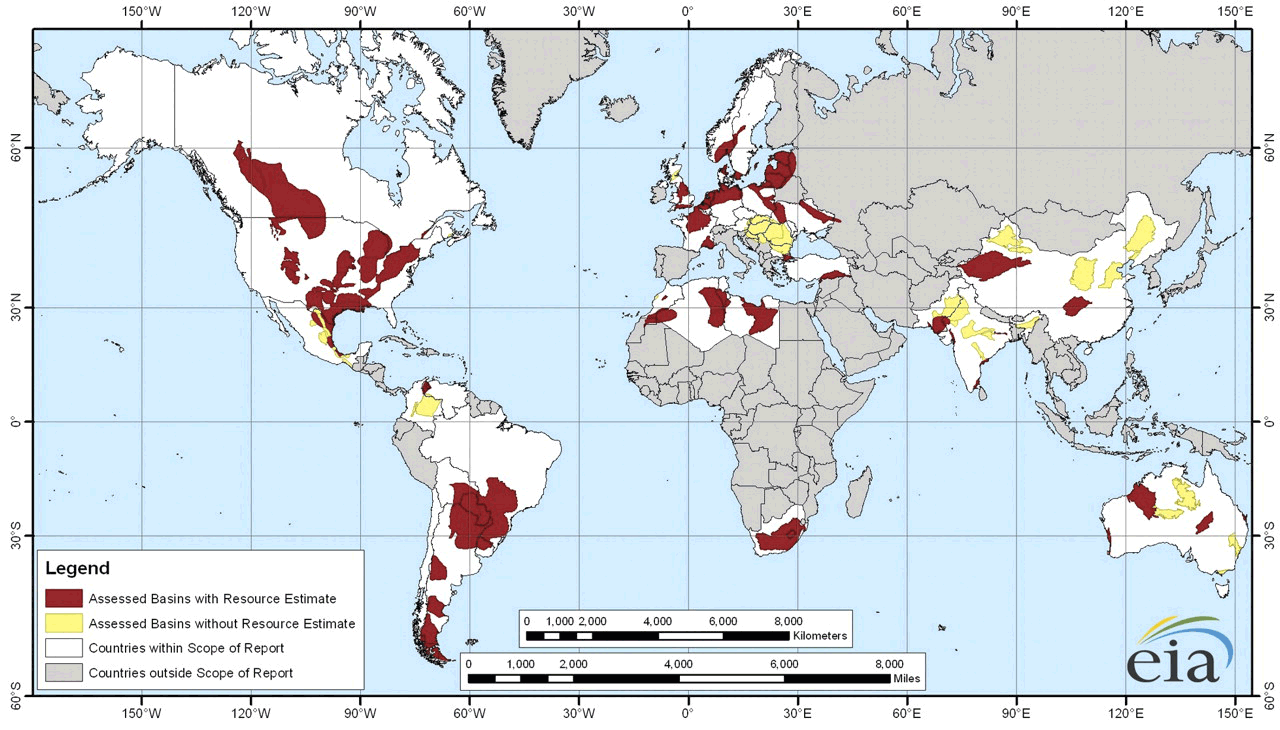
Abundant Shale Gas Basins

But, as you can see on the map below, you’ll find shale basins all over the world. Canada, Brazil, Argentina, South Africa, Europe, China, and of course…Australia.

Shale gas regions are not hard to find

Shale gas regions
Source: EIA

But in the time the North Americans drilled 15,000 wells and ensured cheap gas for decades to come, how much progress has the rest of the world made?

Less than 100 wells drilled.

So Australia has a lot of catching up to do. But it’s making tracks.

The Australian Shale Gas Story – Still in Early Stages

The market has embraced the shale story. Aussie shale stocks like Buru Energy (ASX: BRU) have gone up eight–fold in the last two years.

It’s an exciting start, but there’s still a long way to go for the Aussie shale industry.

And the best time to get in is before the industry becomes mainstream…before local explorers have drilled 15,000 wells.

My old pal, Australian Wealth Gameplan editor, Dan Denning knows this. Dan first wrote about shale gas in 2005.

This is what he wrote at the time:

‘If the U.S. government is eventually going to pump billions of dollars into the development of the shale industry, with the goal of national energy independence, I want to figure out who’s going to benefit the most…

‘…I’d rather be ahead than behind on the shale curve.’

He was ahead of the curve. Back then, the US produced less than two billion cubic feet (bcf) of shale gas per day.

This year the US is set to produce nearly 25 bcf of shale gas per day.

And last year he tipped a handful of Aussie stocks that he thought would benefit from the Aussie shale gas story.

But the real billion–dollar–question is, can we recreate North America’s success with shale gas, here in Australia?

We have the potential, but there are some big differences between Australia and the US.

Shale Gas With an Oil Kicker?

Research and Consulting Service, Wood Mackenzie, asked this question at the conference this week. The good news is they reckon it can be done.

The bad news is a number of stars need to align first.

First, explorers need to do much more drilling to see if the geology is right, and whether it’s possible to produce natural gas commercially.

Then there’s the issue of support services. It’s still a new game here, and, unlike in other resources sectors, we don’t have all the players, expertise and equipment to get the job done.

Remote locations, and the wet season, add an extra challenge.

We also need to ask the question — does Australia even need shale gas?

We have plenty of conventional natural gas already. Then we have the Coal Seam Gas industry, which is still growing, and now meets 40% of East Coast Australia’s natural gas needs. And, as I mentioned yesterday, the LNG industry is already set to triple production in the next six years.

So where does shale gas fit in to the Australian energy mix?

As with everything, it depends on the production cost. If it’s cheap enough, Australia can enjoy even more affordable natural gas, and could turn it into another export revenue stream.

But shale gas isn’t the only opportunity. The real money–spinner could be in ‘shale oil‘.

Shale Oil – ‘Liquid Rich’

They call shale ‘liquids rich’ when it contains oil. Oil is more profitable, and easier to export. Finding it in Aussie shale plays could help kick–start the development of a profitable Aussie shale industry.

The biggest opportunities for shale oil are in the Canning, Cooper and Georgina basins. They each have ‘liquids’ potential, but so far no–one has struck shale oil yet, only shale gas.

There’s a lot of Australian shale exploration planned this year. Joint ventures between small Aussie companies and giant overseas firms are drilling the better–known ‘Canning basin’ in WA and ‘Cooper Basin’ in South East QLD.

Drilling and hydraulic fracturing (fracking) is also taking place in the Georgina Basin in the Northern Territory, Gippsland in Victoria, and Galilee Basin in Queensland.

Back when the US shale boom was at this early stage, land was cheap.

Today, US shale acreage valuations are through the roof. Early investors in the right projects scored big.

This is probably why you see big players like Mitsubishi (TYO: 8058), BG Group (LON: BG), ConocoPhillips (NYSE: COP) and Hess Corp. (NYSE: HES) moving in early on the Aussie shale gas story.

And ConocoPhillips for one says it wants more.

With big companies getting in at the ground floor — and with so much focus on the sector at Australia’s largest oil and gas conference — it already looks like the shale sector is set to be Australia’s next resources boom.

Dr. Alex Cowie
Editor, Diggers and Drillers

Related Articles

The Conference of the Year "After America" DVD

APPEA – Day One at the Oil & Gas Show: Sand Dunes, Scuba Diving and Camels

Why Europe Will Ditch Green Energy


Get in Early on Shale Gas

Gold Mining Stocks: A Screaming Buy?

Article by Investment U

View the Investment U Video Archive
Gold Mining Stocks: A Screaming Buy?

Keiner said the big buy now is in the gold mining stocks. There are small miners trading at PEs of 2. That’s cheap!

In focus this week: gold at $6,000 by 2015 and $2,100 by the end of this year, natural gas and oil producers, home builders are for real and the SITFA.

Jurg Keiner of Swiss Asia Capital Singapore said this week in a CNBC interview that gold could hit $2,100 this year and $6,000 by 2015, all due to money printing and more crises in banking and debt issues.

Keiner sighted the weakening of the western democracies and the inevitable money printing to try to spur growth that has to occur as the major reasons we will see a further run in gold.

The money printing will lead to weaker currencies, especially the dollar, which will further erode buying power, which is just another way of saying inflation.

Keiner described the dollar as being very weak and can only weaken further, which he says will add significantly to the gold trade. He sees no upside for the dollar and sighted the fact that the dollar has been unable to rally against the euro despite the horrible news that has been coming out of the EU for over a year.

The weak dollar combined with accelerated money printing is what Keiner believes will drive gold this year and for the next three.

Keiner said the big buy now is in the gold mining stocks. There are small miners trading at PEs of 2. That’s cheap!

Gold has and will continue to trade against the dollar and with inflation. Both look to be very good bets for the next few years. The recent sell-off is an opportunity.

Natural Gas and Energy

If you’re a regular viewer of this segment, the recent run-up in natural gas prices shouldn’t be a surprise. I’ve been talking about it here for the last few months.

Analysts I’ve been reading see $3 nat gas by the end of the summer and $6 by the end of the year.

Pushing prices now is the hope for a normal cooling season after a very warm winter, increased demand by LNG exporters, decreasing amounts of gas being injected into storage and increasing demand from electric utilities.

PIMCO, one of the best names in the industry, sees all gas and oil as the biggest plays in the market with huge upside.

They like pipelines, specifically Plains Pipeline, and other names we have heard before: Anadarko, EOG, Pioneer and Continental.

PIMCO is focusing on low cost-producing companies in the shale gas areas and describes what’s happening now in energy as revolutionary and is reshaping the whole U.S. economy.

According to Mark Keisel, manager of PIMCO’s five star-rated corporate bond fund, the United States could be energy independent in as little as 10 years.

The United States is currently the lowest-cost energy producer in the world. EOG, for example, can produce a barrel of oil for as little as $32 and sell it in the 90s and low 100s.

That’s how big the opportunities are in the current energy market. You have to be a part of this.

Natural gas and oil producers!

Home Builders

Here’s another industry I’ve been banging the table about for two years and it’s finally showing movement.

Recent numbers are pointing to a firm turn around in new home sales.

The S&P’s home builders’ index is up 43% this year and up a whopping 125% since the low last October. Home builders’ shares are 23% higher than last year and in the first quarter there were 337,000 homes sold compared to 299,000 last year. But the 337,000 number is below the same period for 2010, so there may still be reason for hesitation.

The Journal reported that the three large home builders, Beazer (NYSE: BZH), MDC Holdings (NYSE: MDC) and Standard Pacific (NYSE: SPF), reported selling 2,115 homes in the first quarter up from 1,556 last year and up form 1,912 in 2010. Net new orders were up, as well.

Share prices are up a lot, so look for some weakness before you jump in with both feet, but barring any serious dumping in the economic numbers, this industry should finally see a slow but solid climb out of the abyss.

And the SITFA

France gets the cheek smacker this week, again. They did in fact elect a socialist who says he will dump the plan to save the EU that Sarkozy struck with the Germans.

I’ve just returned from two weeks in France and had a front row seat for their presidential elections last Sunday. It was something to watch.

Based on the people I spoke to and what I saw at the Bastille, which was the gathering place for Hollande’s supporters, that’s the socialist who won, I wouldn’t bet on any real improvement in the EU situation, at least not from France’s end.

But the Journal’s Joseph Joffe thinks otherwise.

He said watch the new French president in the coming weeks. He’s betting he will take a page out of “Casablanca” and sputter: “I am shocked, shocked to find out about the mess Mr. Sarkozy has left.” Then he will blame Mrs. Merkel’s brutishness for forcing him to deliver a “blood, toil, tears and sweat” speech in which he breaks all his campaign promises.

Sounds like the “Blame Bush” strategy our own president has been using, hmm?

And Joffe’s position is consistent with a conversation I had the night before the election with two bankers from Society Generale.

First off, they were bankers who described themselves as socialists. How do you work in investment banking and claim to be a socialist? I’m stumped!

But here’s the killer. Both of these bankers agreed that Hollande’s ideas are too far left for France’s current situation, but they believed his ministers would force the reality of France’s situation into his decision making.

My question for them and Joffe from the Journal, what if they don’t? What happens if this life long, committed socialist runs amok and forces more spending and government hiring?

Stay tuned. It looks like the next few years are going to be a real hoot.

Article by Investment U

The “Dangers” of Oil Speculation & More Nonsense from the Obama Administration

Article by Investment U

Obama on Oil Speculation

Is oil speculation truly a financial force for destruction, or has the Obama Administration just found a new scapegoat?

Every great leader I’ve known had one quality in common: a strong propensity to give credit to others when things go right and take personal responsibility when things go wrong.

Yet by that standard, Obama is no leader at all.

Nearly four years into his term, he still blames high unemployment and the state of the economy on his predecessor. He blames his trillion-dollar-plus deficit on the intransigence of his political opponents, even though his own party can’t even propose a budget. He insists that middle class Americans are suffering because “the one percent” – the folks who take risks, create jobs and experience economic success – are somehow denying opportunity to the rest of us. (I’m still waiting to hear how.) But this time he’s really outdone himself, blaming high oil prices on “greedy” traders and investors like us.

In a recent White House speech on April 17, Obama said, “We can’t afford a situation where speculators artificially manipulate the market by buying up oil, creating the perception of a shortage and driving prices higher, only to flip the oil for a quick profit.”

“Quick profit.” Man, that sounds ugly.

Of course, if you believe the federal government is hiding an alien space ship in Area 51, you may have stood and cheered his words. The rest of us were less impressed, including Terry Duffy, the Executive Chairman of CME Group, the world’s leading derivatives marketplace.

“People need to study their facts before criticizing speculators,” said Mr. Duffy. He points out that futures traders aren’t just exercising their freedom to take financial risk (and shoulder any resulting losses). They also increase liquidity, reduce spreads and, ironically, help the Treasury Department and American taxpayers save money on the cost of sovereign debt by allowing traders to hedge risk on Treasuries.

Of course, whenever oil prices surge, conspiracy theorists raise their heads again. Even though the facts regularly beat them down like so many whack-a-moles.

Four years ago, the Commodities Futures Trading Commission (CTFC) created a special task force to study whether speculation was responsible for the run-up in oil prices. It included experts from the Agriculture, Energy and Treasury Departments, the Federal Reserve, the Federal Trade Commission and the SEC.

Its conclusion? (Try to stifle that yawn.) That oil price increases were due to fundamental supply and demand factors.

I know it sounds humdrum to conspiracy theorists, but oil demand is what economists call “price inelastic.” People need to drive cars, heat homes, fly in airplanes and run factories. These things take oil. (Although an increasing shift to natural gas by utilities is already starting to undercut oil prices.)

The CTFC report found that growth in world oil demand – especially by China and other developing economies – was outstripping new production capacity. As a result, the market tightened and prices rose.

Moreover, the futures market is far less susceptible to bubbles than the stock or bond markets. That’s because, by contrast, the futures market is a “zero-sum game.” One investor’s gain is exactly equal to another investor’s loss.

Under the standard futures contract, one investor agrees to buy a commodity (say, 1,000 barrels of oil) at a future date for a given price, and another investor agrees to sell for the same price. If the price is up on the settlement date, the buyer wins. If it goes down, the seller reaps the profit. The loser pays the winner; actual commodities are rarely transferred.

Obama – forever in search of a new scapegoat – must surely know this. Then again, as someone who has never started a business, managed a company, taken a significant financial risk, or even held a job in the private sector, maybe he doesn’t.

Either way, demonizing speculators solves nothing. If Obama really wanted to help middle-class families by reducing oil prices, he could encourage production, conservation, or alternative fuels like natural gas.

Of course, that would mean telling the truth and taking responsibility. And those aren’t his strong suits.

Good Investing,

Alexander Green

Editor’s Note: Gas is one sector where Alex sees a contrarian opportunity right now. He recently recommended two gas companies in his premium trading service Insider Alert.

He was kind enough to share one of these recommendations with Investment U Plus subscribers in today’s edition. It’s a company with solid fundamentals, recent heavy insider buying and an 8% yield, to boot.

For more information on receiving this pick along with our experts’ recommendations in each daily issue of Investment U, click here.

Disclaimer: The views presented in today’s Investment U are solely those of the writer and do not necessarily represent the publication or publisher. As stringent supporters of an open marketplace of ideas, we encourage you to contribute your thoughts to the discussion in the comments section below.

Article by Investment U

EU Elections Causing More Market Uncertainty

Article by Investment U

EU Elections Causing More Market Uncertainty

The sudden resignation of the Dutch prime minister two weeks ago, coupled with the presidential elections in France and parliamentary elections in Greece, has everyone on edge that the European debt crisis will return with a vengeance.

Even though the European Union had its problems over the past few years, there were still some things about it that we could depend on…

The countries in the North are the good kids who follow all the EU rules. The PIGS down in the South act like pigs and are punished for living way beyond their means. And Germany and France have a Mommy/Daddy dynamic that keeps everyone in line.

Well, the times are changing. The changes aren’t the decrees of EU administrators, but for the most part, have a grass roots origin. People are voting in elections across the region, voicing their support or anger in response to austerity measures proposed or implemented. There will also be the need to create new coalitions to govern countries were the factions are nowhere near seeing eye to eye.

Over the past few weeks, there were three specific political events that will probably weigh on financial markets for the rest of the year and beyond.

The sudden resignation of the Dutch prime minister two weeks ago, coupled with the presidential elections in France and parliamentary elections in Greece, has everyone on edge that the European debt crisis will return with a vengeance.

Politicians and parties opposed to the austerity measures favored by Germany appear to be gaining momentum, advisers say. If new leaders reversed course and opposed the belt-tightening policies that were a condition for bailout funds, equity markets will suffer.

We need to take a look at three situations going on now that could be big headaches later…

The Netherlands: Another One Bites he Dust

Here’s the problem. Almost two weeks ago, Dutch Prime Minister Mark Rutte’s party was unable to reach an agreement on €14 billion in necessary budget cuts. They have to bring the country’s deficit to GDP ratio down to 3% in 2013 from the currently forecasted level of 4.6%.

Rutte submitted his letter of resignation to Queen Beatrix after entering into a governmental coalition with the extreme right-wing Freedom Party, led by Geert Wilders, which had refused to support the budget reduction.

And when you hear the rhetoric, don’t expect anyone from the Freedom Party to be won over anytime soon. According to Wilders, “The demands from Brussels are ridiculous. If we were to follow them then unemployment would only grow, and it is against the interests of my voters. We don’t want to see our pensioners sweating blood for the sake of a dictator in Brussels. We will not let our elderly people pay for the Greek swindlers,”

That doesn’t sound like “we’re close.”

Up to this point, one of the few remaining success stories in Europe has been the Netherlands.

This may come back to bite some of us because the uncertainty jeopardizes the Netherlands AAA rating. If the Dutch lose their rating, only German, Finish and Luxembourg debt would be top-rated.

So realistically, Germany would be left as the only true credible backer of the EU.

And due to its rating, many private money managers own Dutch debt as a hedge against the PIGS. A AAA rating allowed it to leverage a lot more. If Dutch sovereign debt tanks, you’ll see a lot more deleveraging of borrowed assets by hedge funds, banks and others.

France: Finance, Be Afraid, Be Very Afraid

Say “adios” to the Sarkozy administration in France. It’s the latest EU government to fall by the wayside – like Spain, Ireland, Italy, the UK, Portugal, Greece and the aforementioned the Netherlands – in the past two years.

French President Nicolas Sarkozy conceded defeat to socialist challenger François Hollande last weekend after polls closed in the final round of France’s presidential election.

Why is everyone on edge? Well, let’s briefly go over the platform Hollande ran on:

  • He refuses to play Robin to Merkel’s Batman. All those agreements that Sarkozy helped broker to tame the sovereign debt crisis are now possibly back on the table for renegotiation.
  • Imagine this, the socialist doesn’t like banks. He has openly attacked the City of London and Wall Street for causing the financial crisis. Mr. Hollande said in January, “My enemy is not another candidate, it is not a person, it has no face, it is the world of finance.”
  • He says he will raise the minimum wage, cancel scheduled spending cuts, hire back thousands of government workers and roll back the retirement age from 62 to 60.
  • He also wants to increase government spending to sponsor large infrastructure projects – all in a bid to spur economic growth.
  • And where is this money coming from? Hollande wants to tax France by means of shock and awe. Anyone making more than a million euros a year will see their tax rate go from 45 to 75 percent. That absolutely blows one’s mind.
  • If you declare war on banks, you might as well raise their taxes too by around 15%. In addition, he wants to implement a financial transaction tax, which could hurt high frequency trading, wiping out a major profit center for some hedge funds and banks that operate in France.

And last but not least, during the last Presidential debate, Hollande noted his discontent with the one thing that’s holding the euro together– cheap funding from the European Central Bank. He scornfully said, “Banks get a loan from ECB at 1% and lend at 6%. I refuse.” He just declared war on the only thing keeping the EU together right now. The money the ECB is essentially printing is being lent to banks at this rate so they can buy sovereign debt that no one else wants.

Greece: Plenty of Parties, Not Much Fun

They can’t help themselves. Greeks finally got to voice their opinion about austerity last weekend through popular vote when the people voted for an array of anti-bailout parties on the far left and right.

PASOK and New Democracy, the two parties that have dominated Greek politics for the last 40 years, received a combined one-third of the vote. That’s half of what they got three years ago. The two parties won a combined 150 seats and that’s not enough to form a coalition government on their own.

What should have EU officials very nervous was the strong showing by Syriza, a coalition of radical left and green groups. These groups don’t take too kindly to bailout and austerity measures. Syriza attracted many disaffected PASOK voters and finished in second at 16.6% – its best showing ever.

Since New Democracy got the most votes, it has three days to find partners to form a government. If they can’t, then Syriza and PASOK will have opportunities to power grab. If none of the parties can bring about a workable coalition, Greece will have to hold elections again. That would mean even more instability in a country already tearing at the seams as the economic crisis continues to deepen.

A possible credit rating downgrade, a finance-wary President-elect, and more Greece instability have already begin to make the markets uncomfortable. And there are things which will probably come to pass because of it.

What Will Money Managers Do?

At the moment, some investors are taking some cautious steps to prepare for prolonged uncertainty.

Because the United States is expected to grow at a more stable pace than Europe, investors should buy more U.S. stocks than international stocks, says Ethan Anderson, Chief Investment Strategist with Rehmann Financial.

Paul Christopher, Chief International Advisor of Wells Fargo, is cutting back exposure to commodities like base metals and agriculture, which could see prices drop due to the weakness in the European economy.

In equities, he’s balancing aggressive sectors like industrial and material with defensive sectors like utilities. These are things to keep in mind going into very uncertain times in the global economy.

Good Investing,

Jason Jenkins

Article by Investment U

Dollar and Yen Decline against the Euro

By TraderVox.com

Tradervox (Dublin) – The FOMC minutes were released yesterday showing that some members still think quantitative easing might be required is the economy loses momentum due to turmoil in Europe or due to the inability of lawmakers in US to reach consensus on the budget. As a result the dollar retreated from its four-month high against the euro as yen declined against 16 of the most traded currencies as speculation of Bank of Japan added stimulus next week rose. According to BOJ governor Masaaki Shirakawa, the central bank is keen on supporting growth in the country.

The turmoil in Greece and Europe as a whole has worsened as Greek political leaders failed to form a unity government. This is set to force Greece into another election with international bailout and it position in the 17-nation currency bloc at stake. The south pacific currencies have been able to shake off the recent decline as a result of the political turmoil in euro area. Some analysts have said that the recent decline of the dollar against the euro has been as a result of sentiments by some FOMC members that easing might be necessary if there is enough downside risk to the economy. Sentiments from the FOMC might force traders to pause there demand for the dollar causing it to stabilize.

There is also a growing concern about the BOJ’s intention to add stimulus next week which has caused traders to shy off from the yen. According to Bill Diviney and Masafumi Yamamuto, the escalating speculation of BOJ easing is one of the reasons the yen has weakened.

The greenback dropped against the euro by 0.2 percent to trade at $1.2739, ti had earlier climbed to $1.2681, which is the strongest it has been since January 17. The yen dropped by 0.1 percent to exchange at 102.25 yen per euro from yesterday’s close when it touched 101.91 yen which is the strongest since Feb 14.

Disclaimer
Tradervox.com is not giving advice nor is qualified or licensed to provide financial advice. You must seek guidance from your personal advisors before acting on this information. While we try to ensure that all of the information provided on this website is kept up-to-date and accurate we accept no responsibility for any use made of the information provided. Opinions expressed at Tradervox.com are those of the individual authors and do not necessarily represent the opinion of Tradervox.com or its management. 

Article provided by TraderVox.com
Tradervox.com is a Forex News Portal that provides real-time news and analysis relating to the Currency Markets.
News and analysis are produced throughout the day by our in-house staff.
Follow us on twitter: www.twitter.com/tradervox